EEE 330
Introduction to
Communication Systems
Lecture # 3
Modulation and Detection
Amplitude Modulation
Overview
The Objectives of Today’s Lecture
Amplitude Modulation
Read Carlson et al. pp. 152–159, 176–
177
To Study Communication Systems
you must understand…
Signals and Systems
Fourier Analysis
Modulation Theory
We will study this in detail
Detection Theory
Given that this signal is corrupt at the receiver, how
do we determine the original signal?
Probability Theory
Since the transmit signal and noise are both unknown
to the receiver, we can use probability theory to
study communications systems
Baseband Communication
In communication, baseband is used the
band of frequencies where the transmitter
and the receiver communicates
telephony – audio band (0 - 3.5 kHz)
television – video band (0 - 4.3 MHz)
In baseband communication, the baseband
signals are transmitted without modulation
short distance communication
coaxial cable, optical fibers
Local telephone, short-haul PCM, long-distance
PCM over optical fibers
Carrier Communication
In carrier communication, the baseband
signal is shifted to higher frequencies by
modulation and transmitted to long
distances
In continuous-wave (CW) modulation,
the carrier is a sinusoid of frequency ωc.
This is the traditional mode for all-
analogue communications.
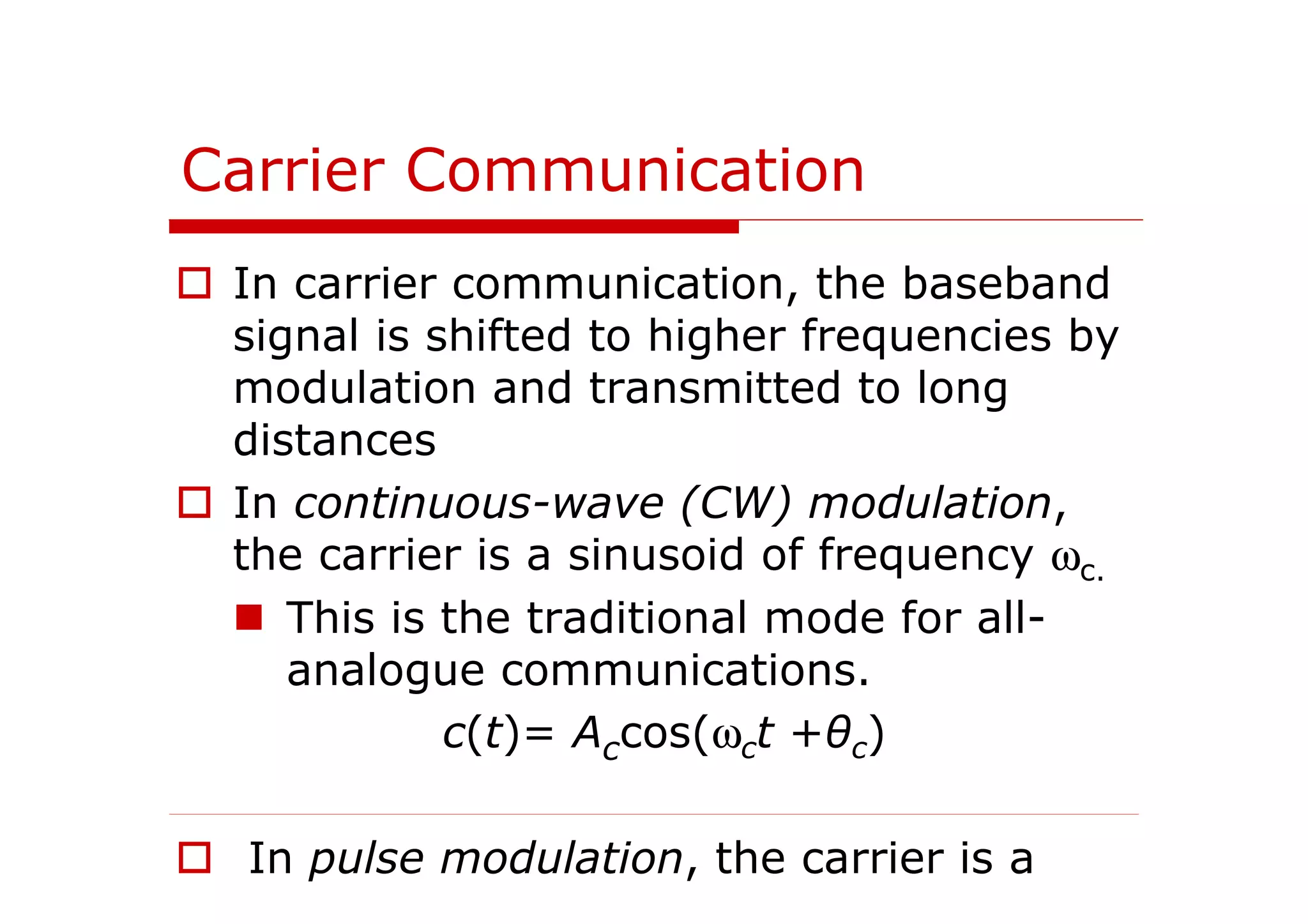
c(t)= Accos(ωct +θc)
In pulse modulation, the carrier is a
CW Modulation
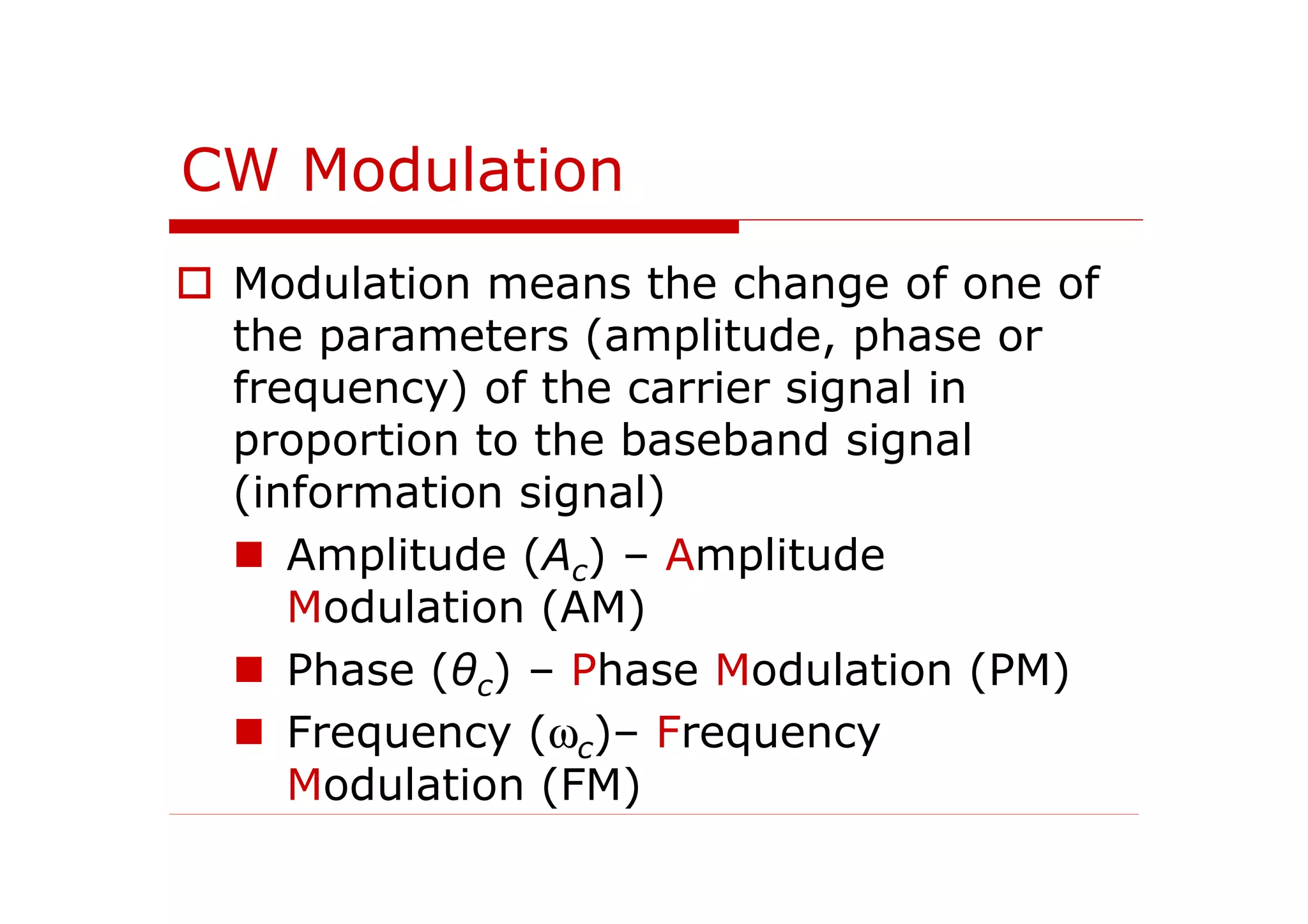
Modulation means the change of one of
the parameters (amplitude, phase or
frequency) of the carrier signal in
proportion to the baseband signal
(information signal)
Amplitude (Ac) – Amplitude
Modulation (AM)
Phase (θc) – Phase Modulation (PM)
Frequency (ωc)– Frequency
Modulation (FM)
CW Modulation
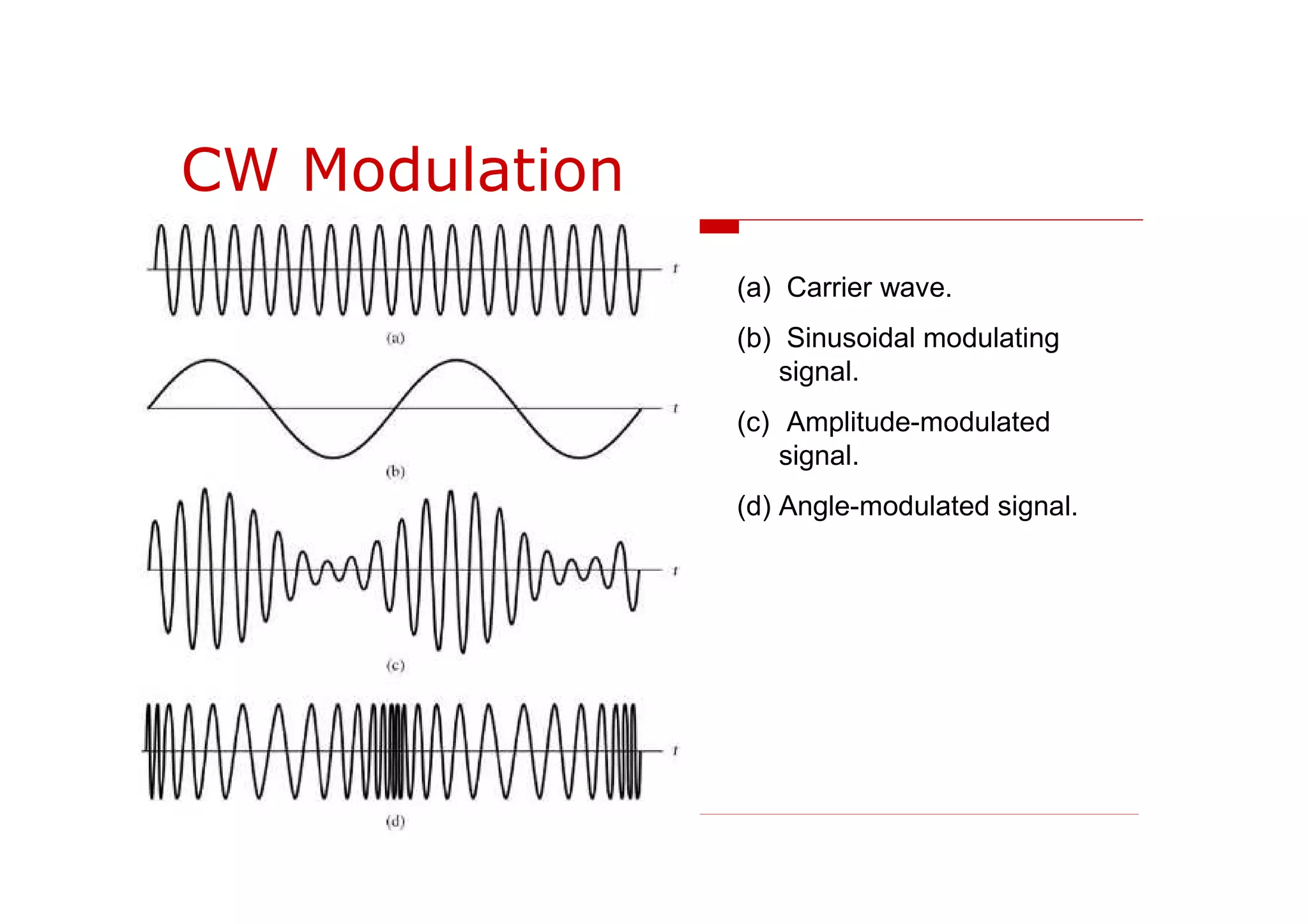
(a) Carrier wave.
(b) Sinusoidal modulating
signal.
(c) Amplitude-modulated
signal.
(d) Angle-modulated signal.
Benefits of Modulation
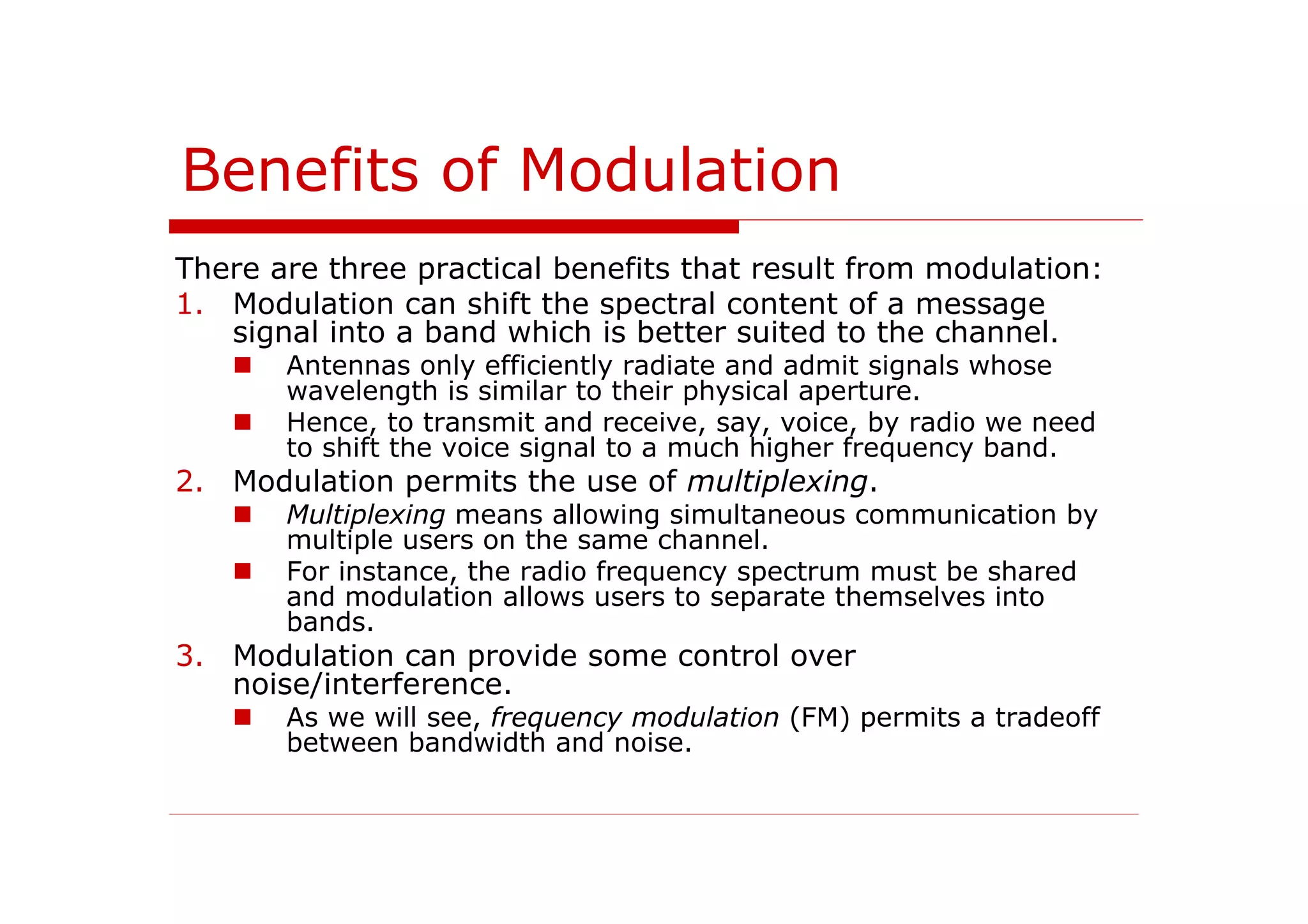
There are three practical benefits that result from modulation:
1. Modulation can shift the spectral content of a message
signal into a band which is better suited to the channel.
Antennas only efficiently radiate and admit signals whose
wavelength is similar to their physical aperture.
Hence, to transmit and receive, say, voice, by radio we need
to shift the voice signal to a much higher frequency band.
2. Modulation permits the use of multiplexing.
Multiplexing means allowing simultaneous communication by
multiple users on the same channel.
For instance, the radio frequency spectrum must be shared
and modulation allows users to separate themselves into
bands.
3. Modulation can provide some control over
noise/interference.
As we will see, frequency modulation (FM) permits a tradeoff
between bandwidth and noise.
Amplitude Modulation (AM)
Amplitude modulation (AM) is a
technique from the very beginning of
CW radio transmission.
Also called “Large carrier (LC)” AM or
“Double Sideband Large Carrier
(DSB-LC) AM
It is still in use today because of its
simplicity.
Definitions
Message signal – information-bearing
signal that is to be recovered at the
receiver [x(t) ]
Carrier – the sinusoid with frequency
ωc that is used to “carry” the
information signal
Envelope – the time-varying
magnitude of the sinusoidal signal
(modulated signal)
Amplitude Modulation (AM)
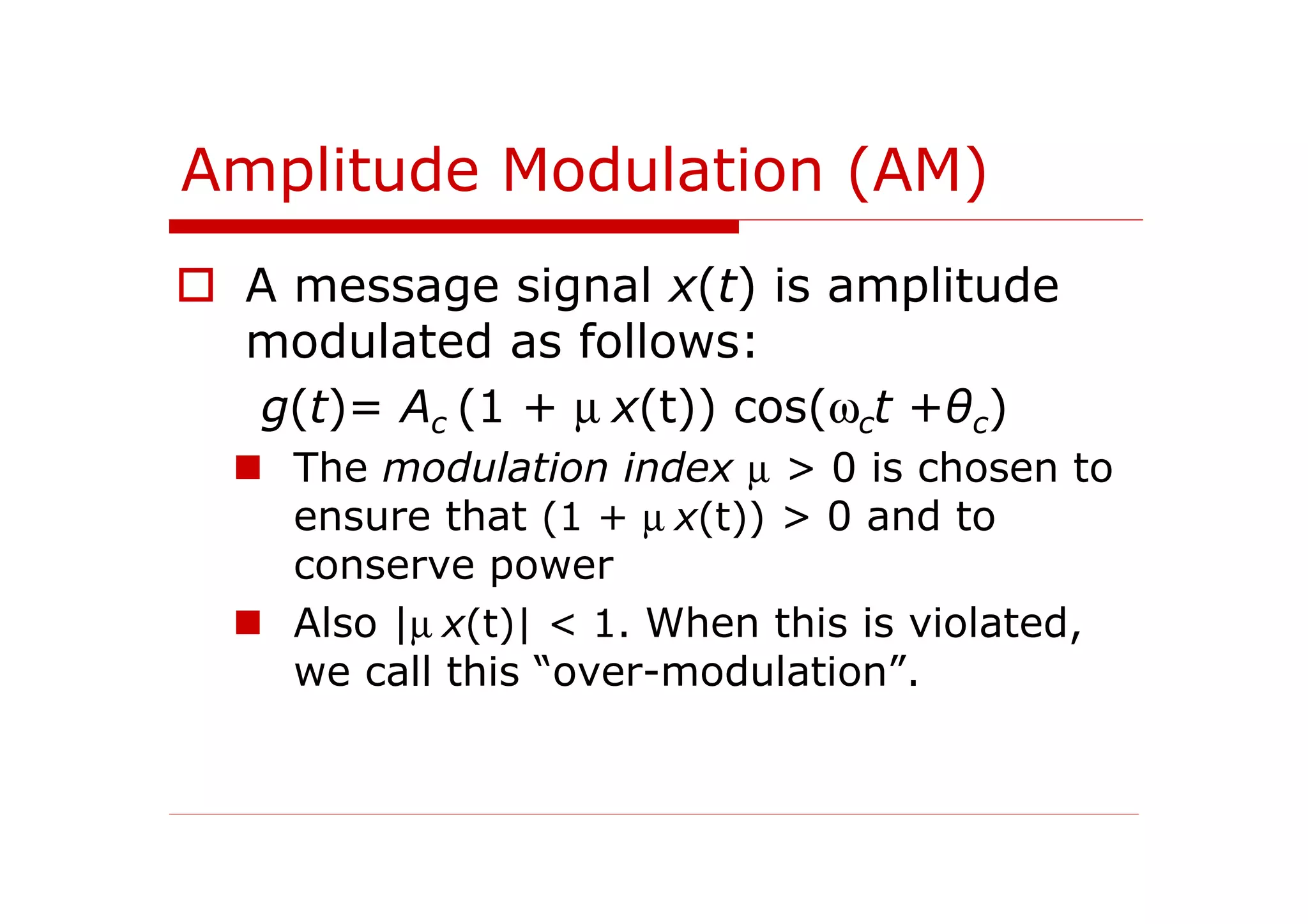
A message signal x(t) is amplitude
modulated as follows:
g(t)= Ac (1 + µ x(t)) cos(ωct +θc)
The modulation index µ > 0 is chosen to
ensure that (1 + µ x(t)) > 0 and to
conserve power
Also |µ x(t)| < 1. When this is violated,
we call this “over-modulation”.
Envelope Variation
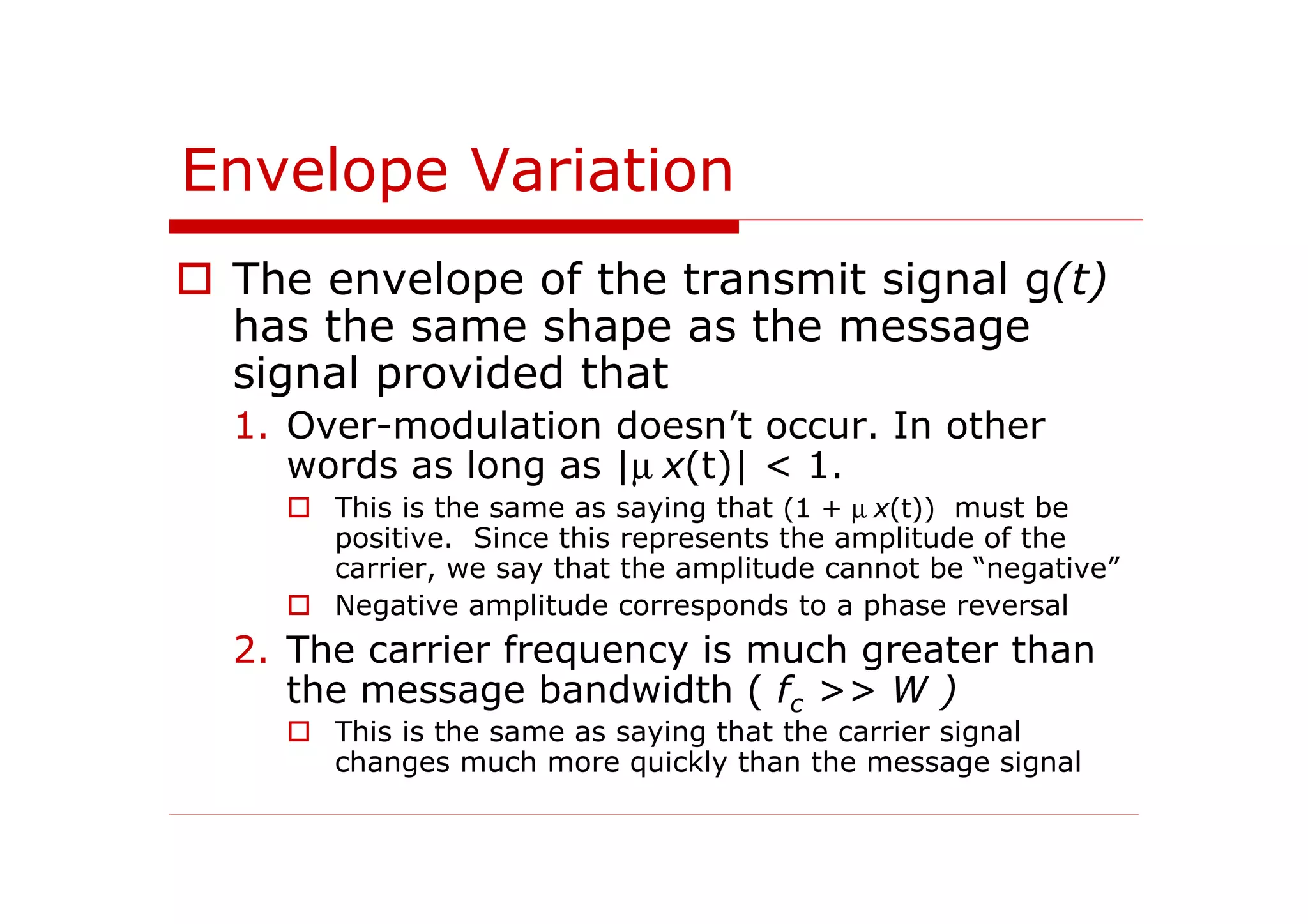
The envelope of the transmit signal g(t)
has the same shape as the message
signal provided that
1. Over-modulation doesn’t occur. In other
words as long as |µ x(t)| < 1.
This is the same as saying that (1 + µ x(t)) must be
positive. Since this represents the amplitude of the
carrier, we say that the amplitude cannot be “negative”
Negative amplitude corresponds to a phase reversal
2. The carrier frequency is much greater than
the message bandwidth ( fc >> W )
This is the same as saying that the carrier signal
changes much more quickly than the message signal
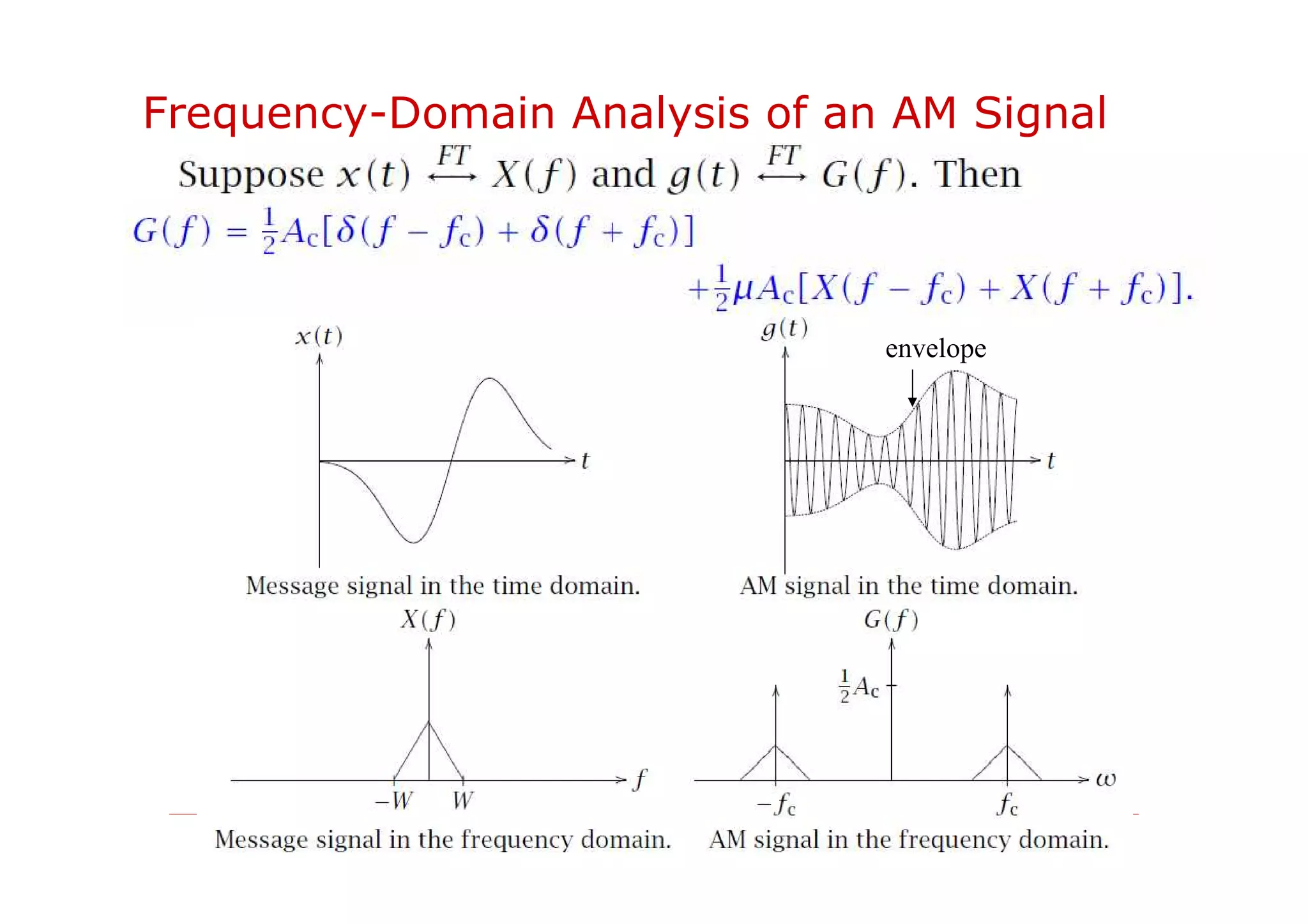
Frequency-Domain Analysis of an AM Signal
envelope
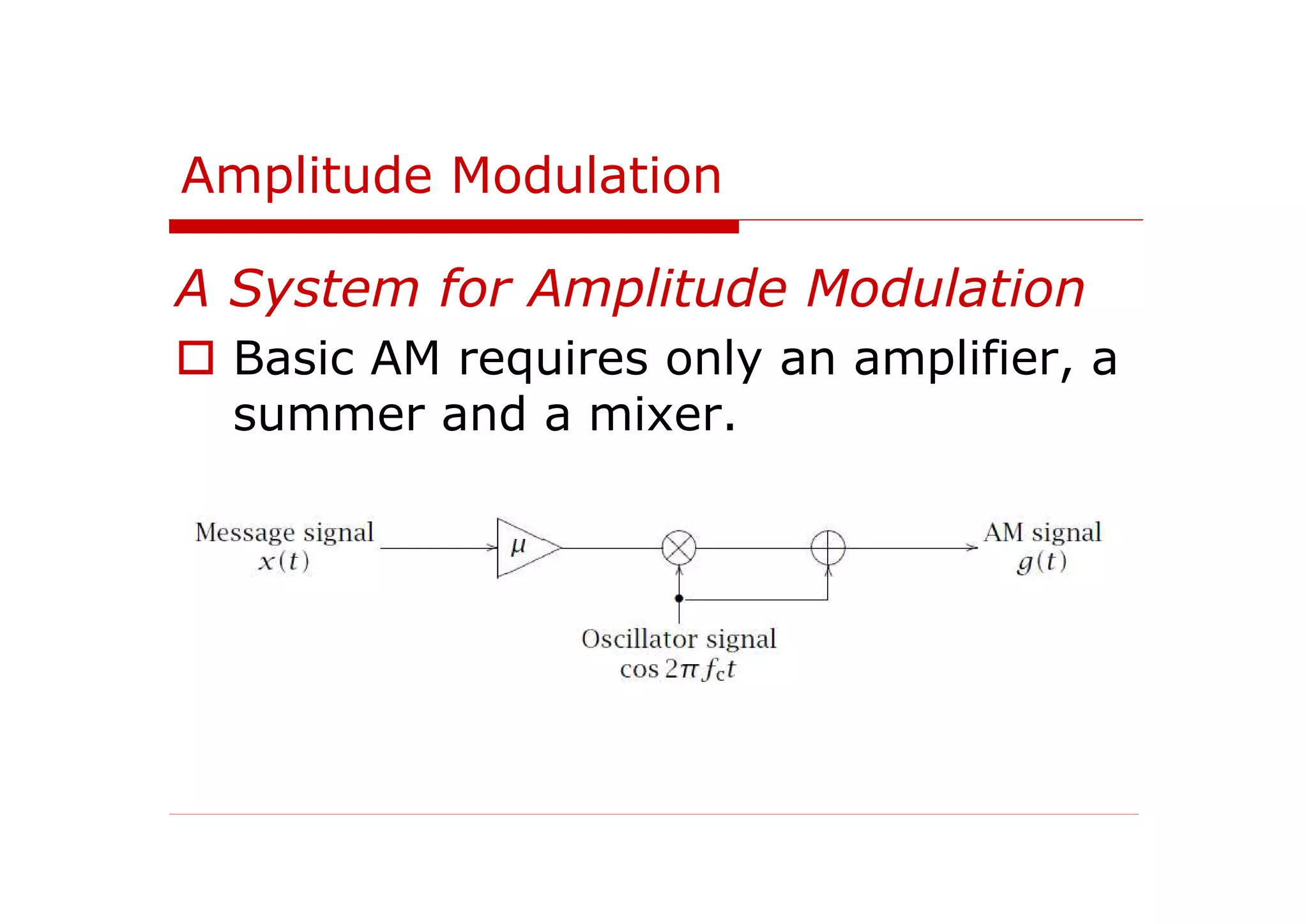
A System for Amplitude Modulation
Basic AM requires only an amplifier, a
summer and a mixer.
Amplitude Modulation
Demodulation
Definition: The recovery of the
message signal from the modulated
signal is called the demodulation or
detection.
Demodulation occurs at the receiver.
Amplitude Demodulation
A System for Amplitude Demodulation
To demodulate the received signal,
i.e., to recover the original message
signal, we can use an envelope
detector circuit.
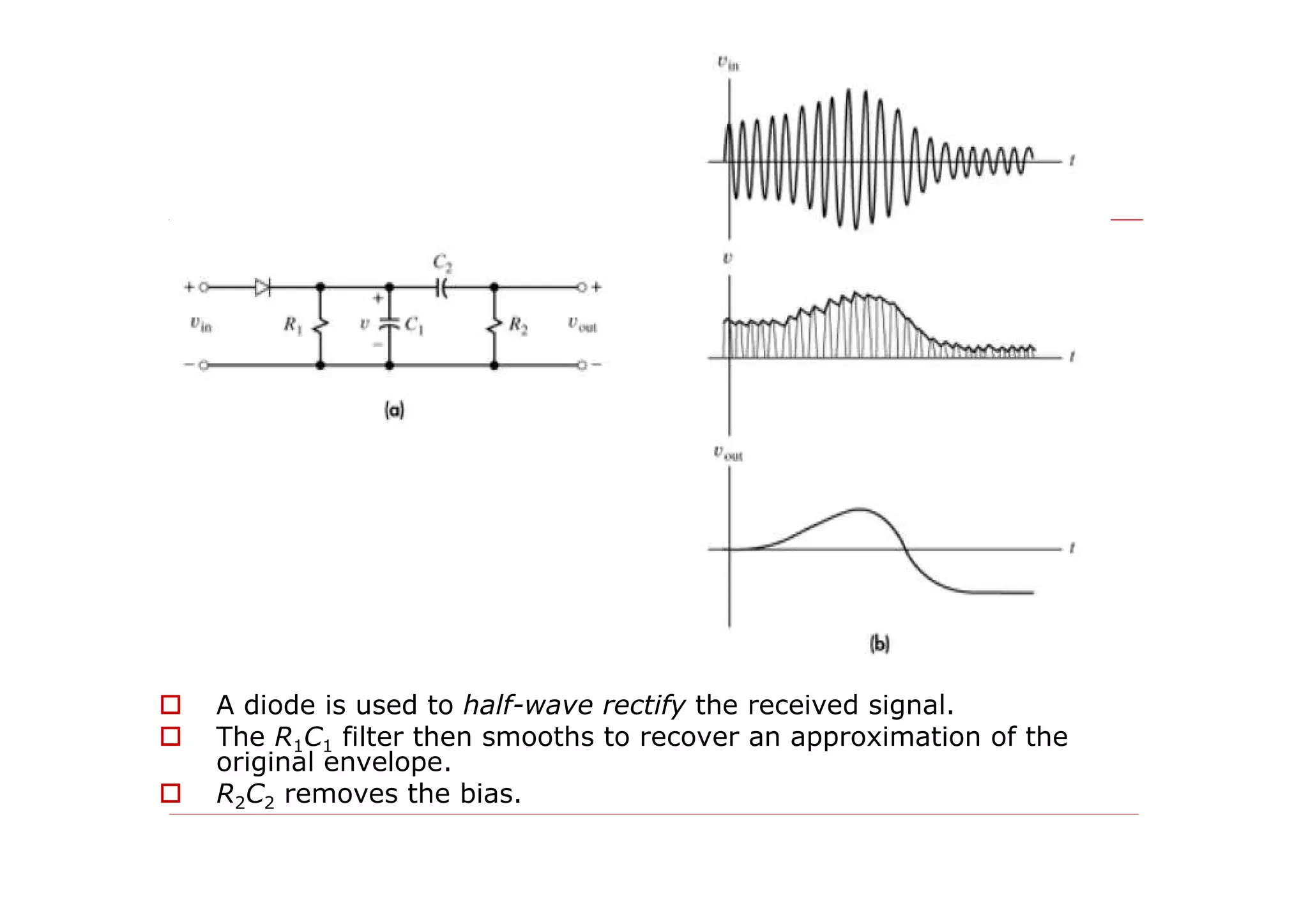
A diode is used to half-wave rectify the received signal.
The R1C1 filter then smooths to recover an approximation of the
original envelope.
R2C2 removes the bias.
Double Sideband Suppressed-
Carrier (DSB-SC) AM
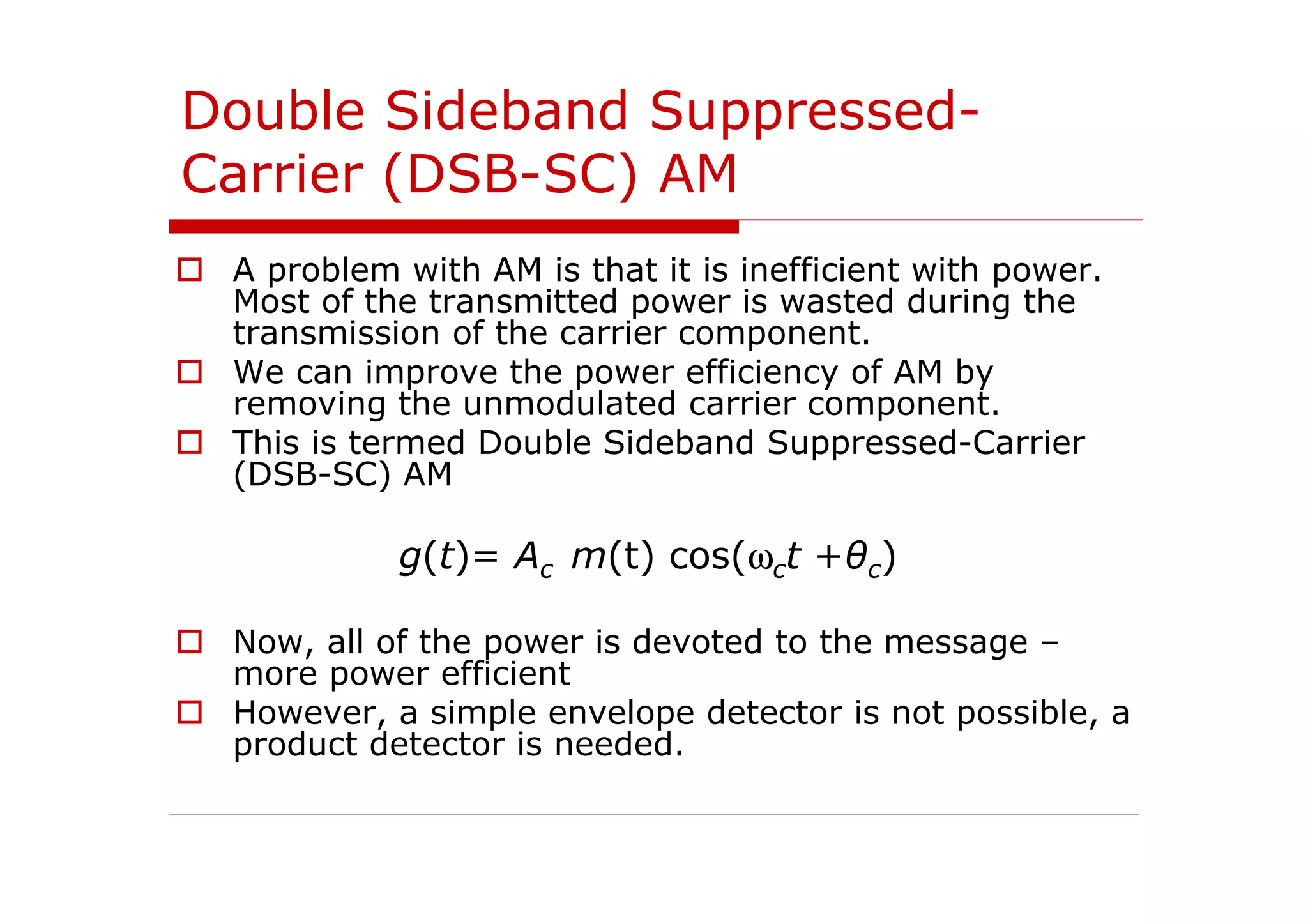
A problem with AM is that it is inefficient with power.
Most of the transmitted power is wasted during the
transmission of the carrier component.
We can improve the power efficiency of AM by
removing the unmodulated carrier component.
This is termed Double Sideband Suppressed-Carrier
(DSB-SC) AM
g(t)= Ac m(t) cos(ωct +θc)
Now, all of the power is devoted to the message –
more power efficient
However, a simple envelope detector is not possible, a
product detector is needed.
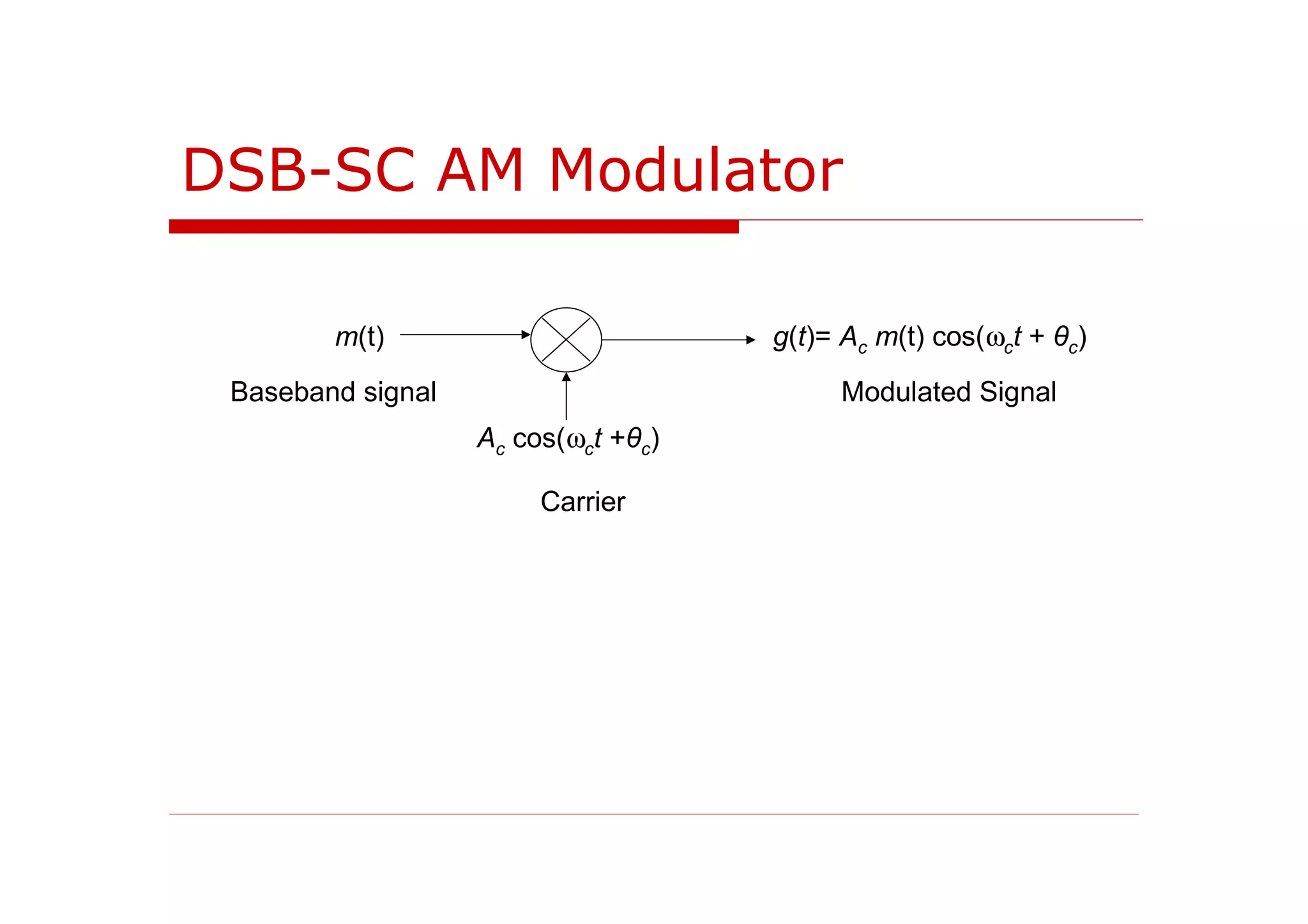
DSB-SC AM Modulator
Ac cos(ωct +θc)
m(t) g(t)= Ac m(t) cos(ωct + θc)
Baseband signal Modulated Signal
Carrier
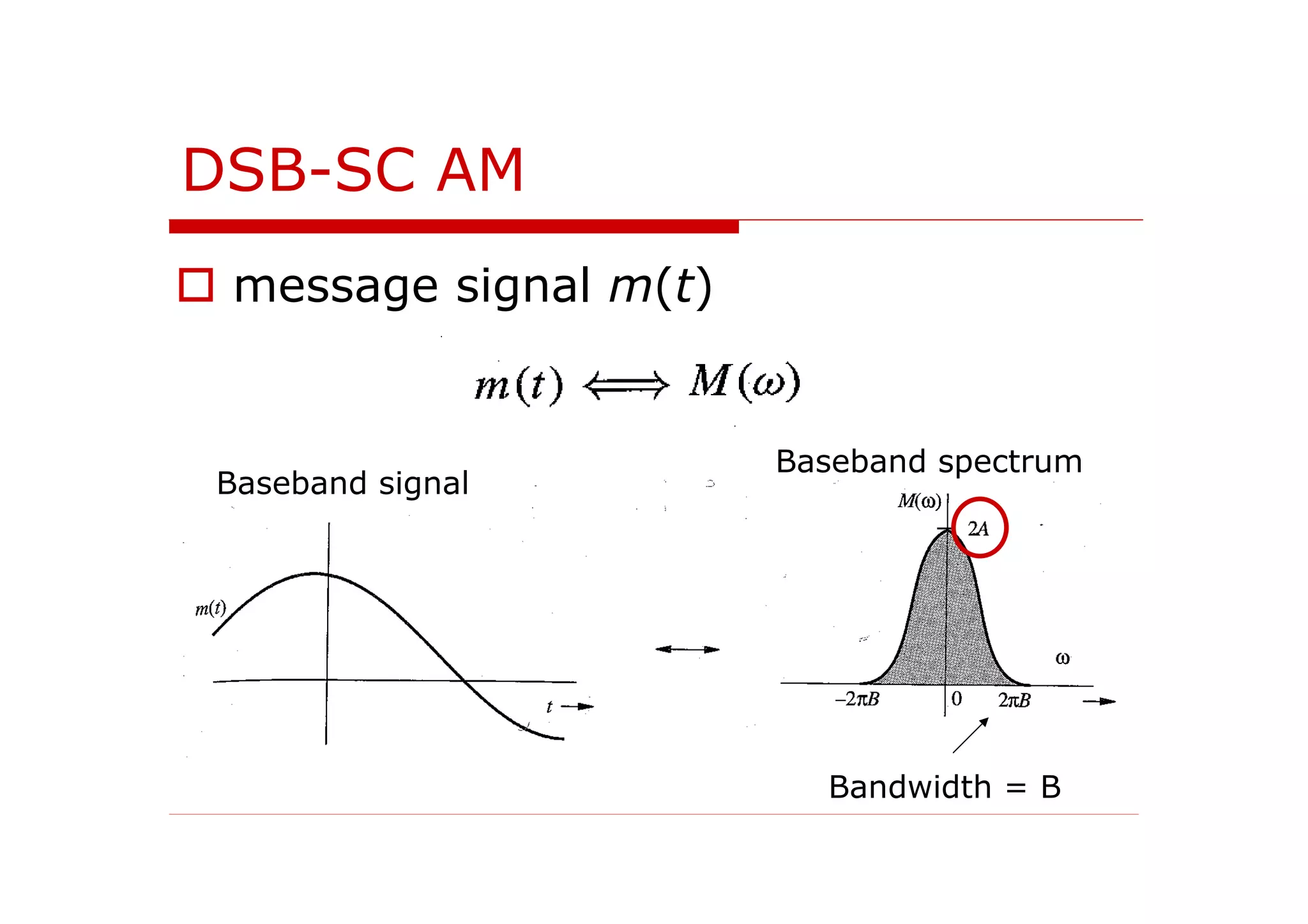
DSB-SC AM
message signal m(t)
Bandwidth = B
Baseband signal
Baseband spectrum
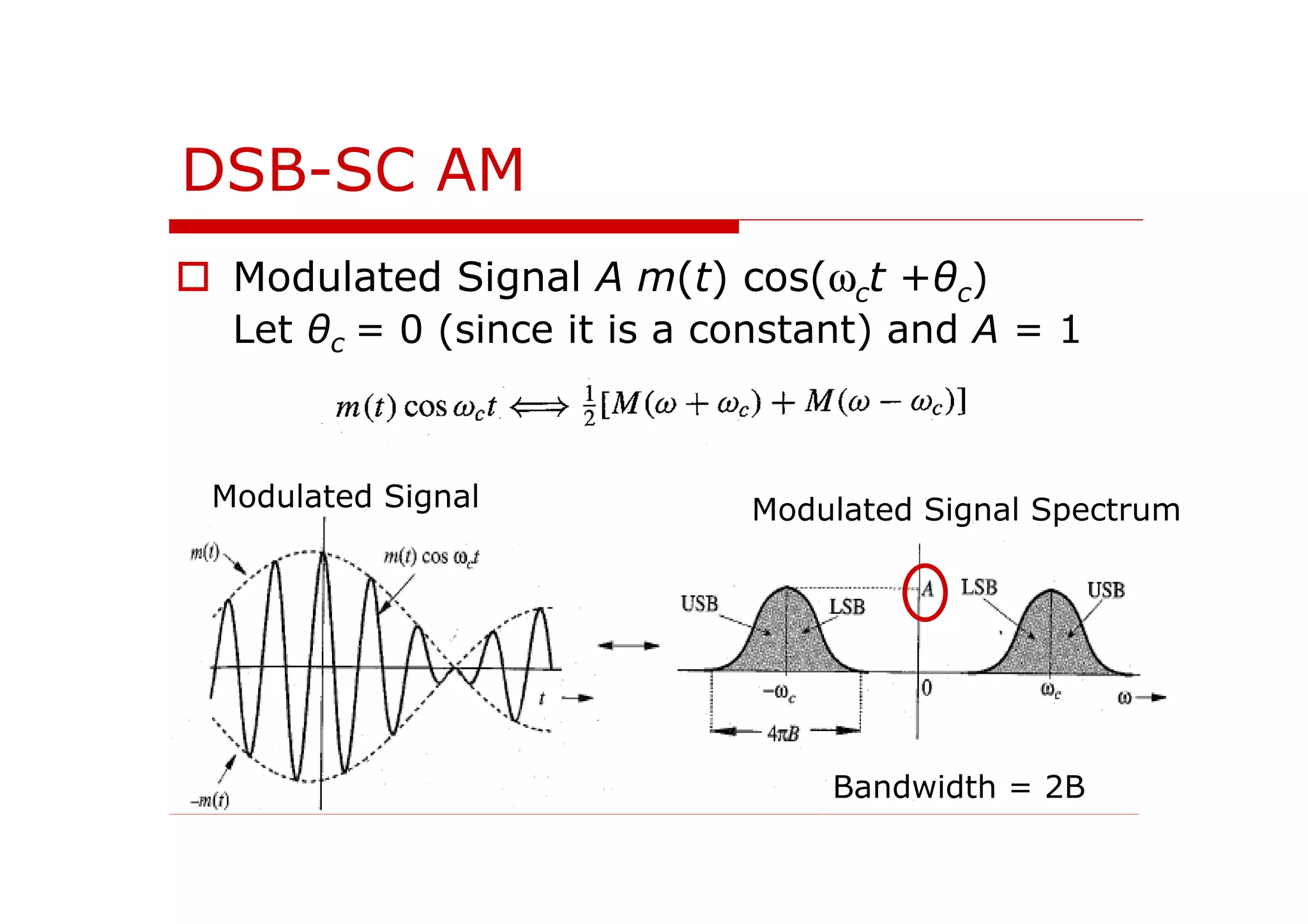
DSB-SC AM
Modulated Signal A m(t) cos(ωct +θc)
Let θc = 0 (since it is a constant) and A = 1
Bandwidth = 2B
Modulated Signal SpectrumModulated Signal
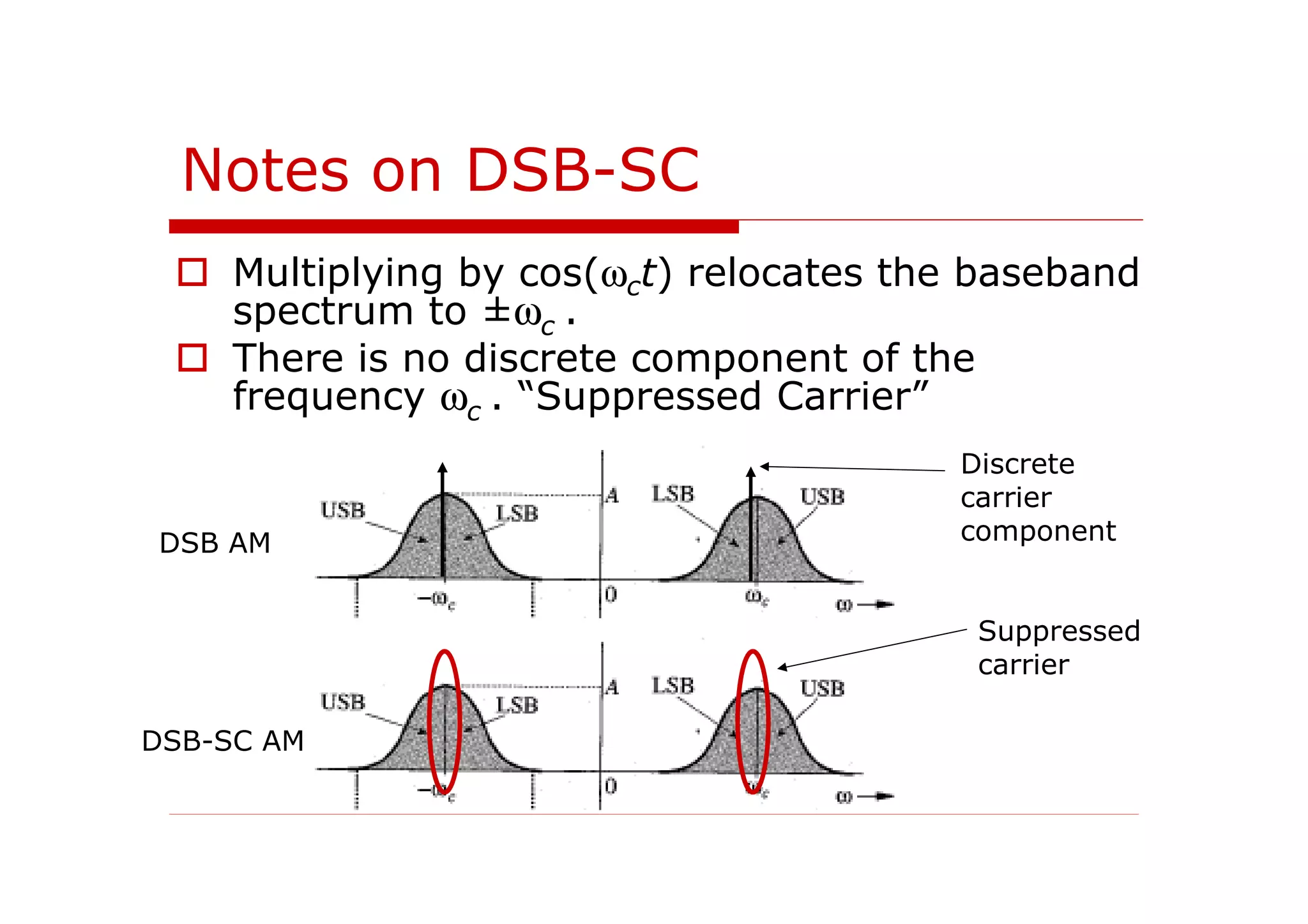
Notes on DSB-SC
Multiplying by cos(ωct) relocates the baseband
spectrum to ±ωc .
There is no discrete component of the
frequency ωc . “Suppressed Carrier”
DSB-SC AM
DSB AM
Suppressed
carrier
Discrete
carrier
component
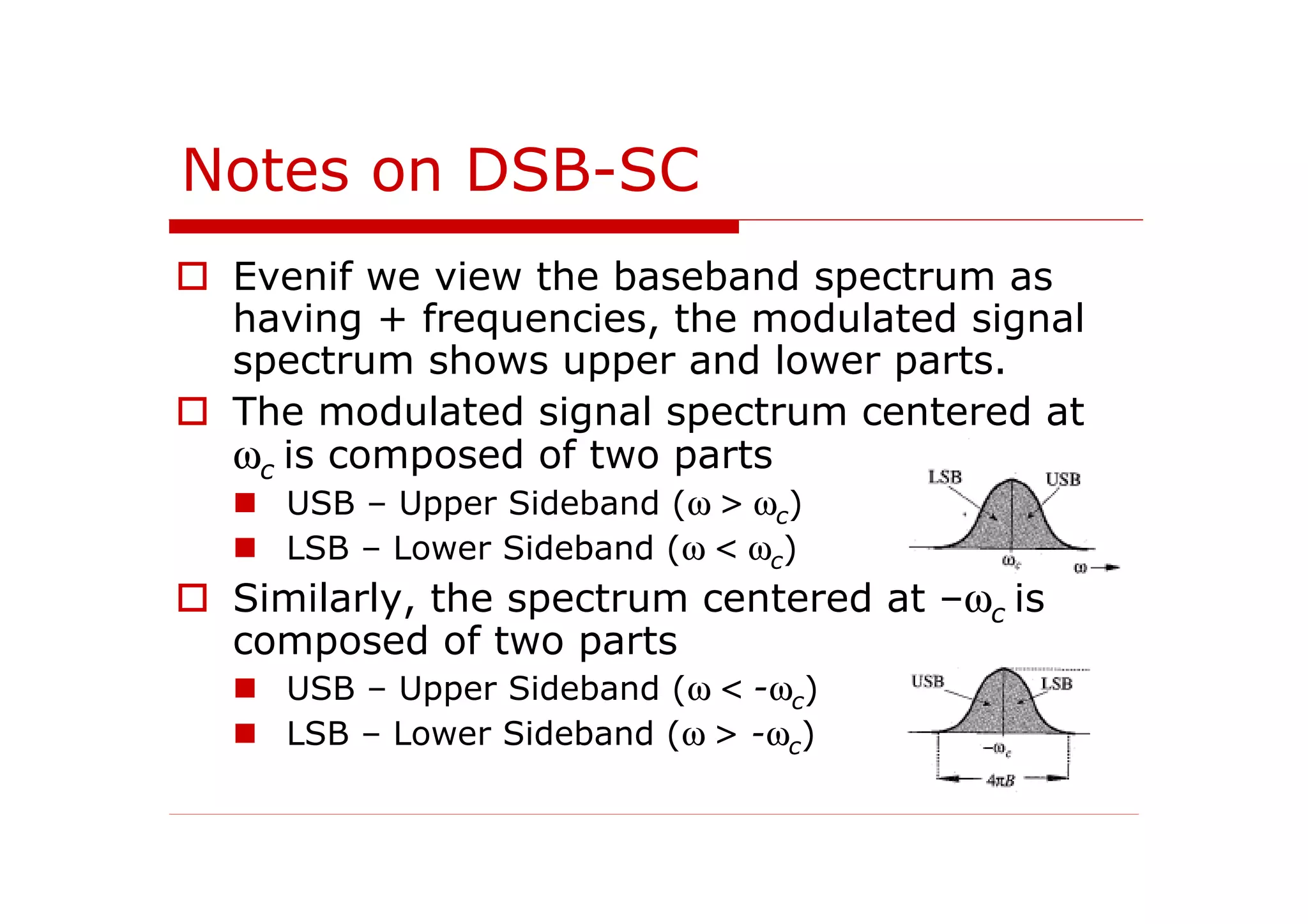
Notes on DSB-SC
Evenif we view the baseband spectrum as
having + frequencies, the modulated signal
spectrum shows upper and lower parts.
The modulated signal spectrum centered at
ωc is composed of two parts
USB – Upper Sideband (ω > ωc)
LSB – Lower Sideband (ω < ωc)
Similarly, the spectrum centered at –ωc is
composed of two parts
USB – Upper Sideband (ω < -ωc)
LSB – Lower Sideband (ω > -ωc)
Notes on DSB-SC
Each ± copy of the baseband spectrum
loses ½ amplitude relative to the
baseband.
To have non-overlapping spectra
centered at +ωc and –ωc , 2πB ≤ ωc.
Nyquist criterion
If two spectra overlaps, the message
signal cannot be recovered (Aliasing)
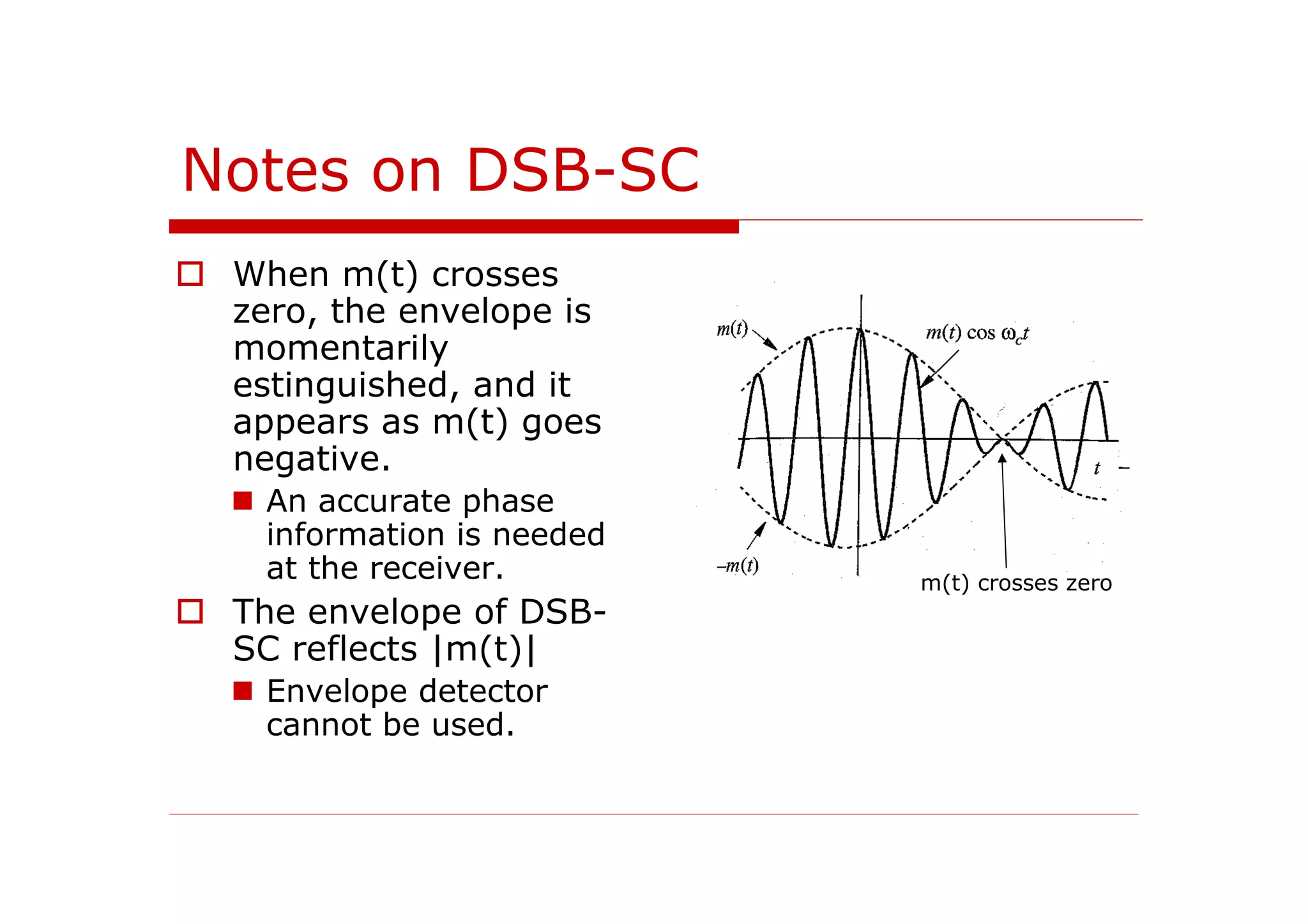
Notes on DSB-SC
When m(t) crosses
zero, the envelope is
momentarily
estinguished, and it
appears as m(t) goes
negative.
An accurate phase
information is needed
at the receiver.
The envelope of DSB-
SC reflects |m(t)|
Envelope detector
cannot be used.
m(t) crosses zero
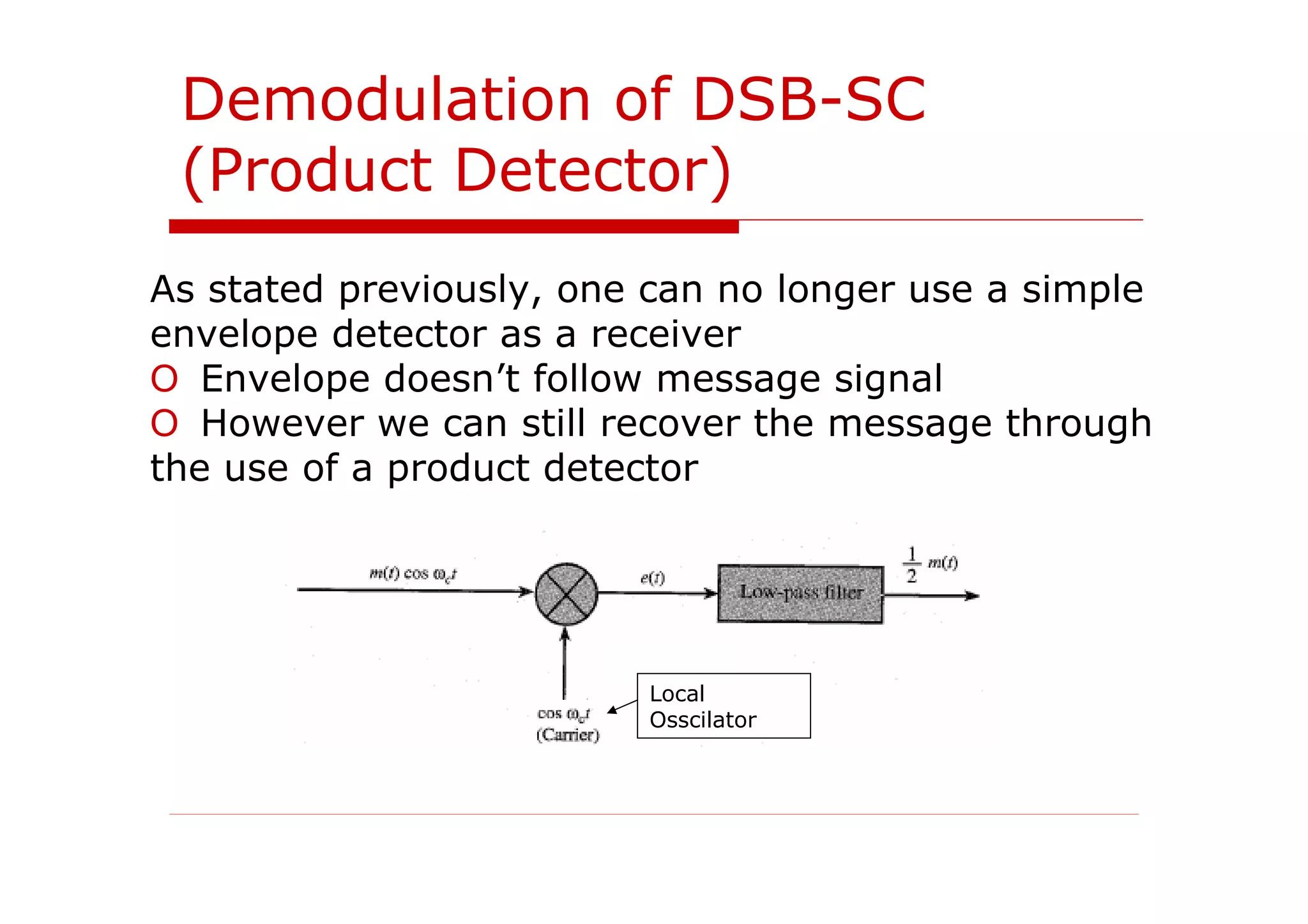
Demodulation of DSB-SC
(Product Detector)
Local
Osscilator
As stated previously, one can no longer use a simple
envelope detector as a receiver
Envelope doesn’t follow message signal
However we can still recover the message through
the use of a product detector
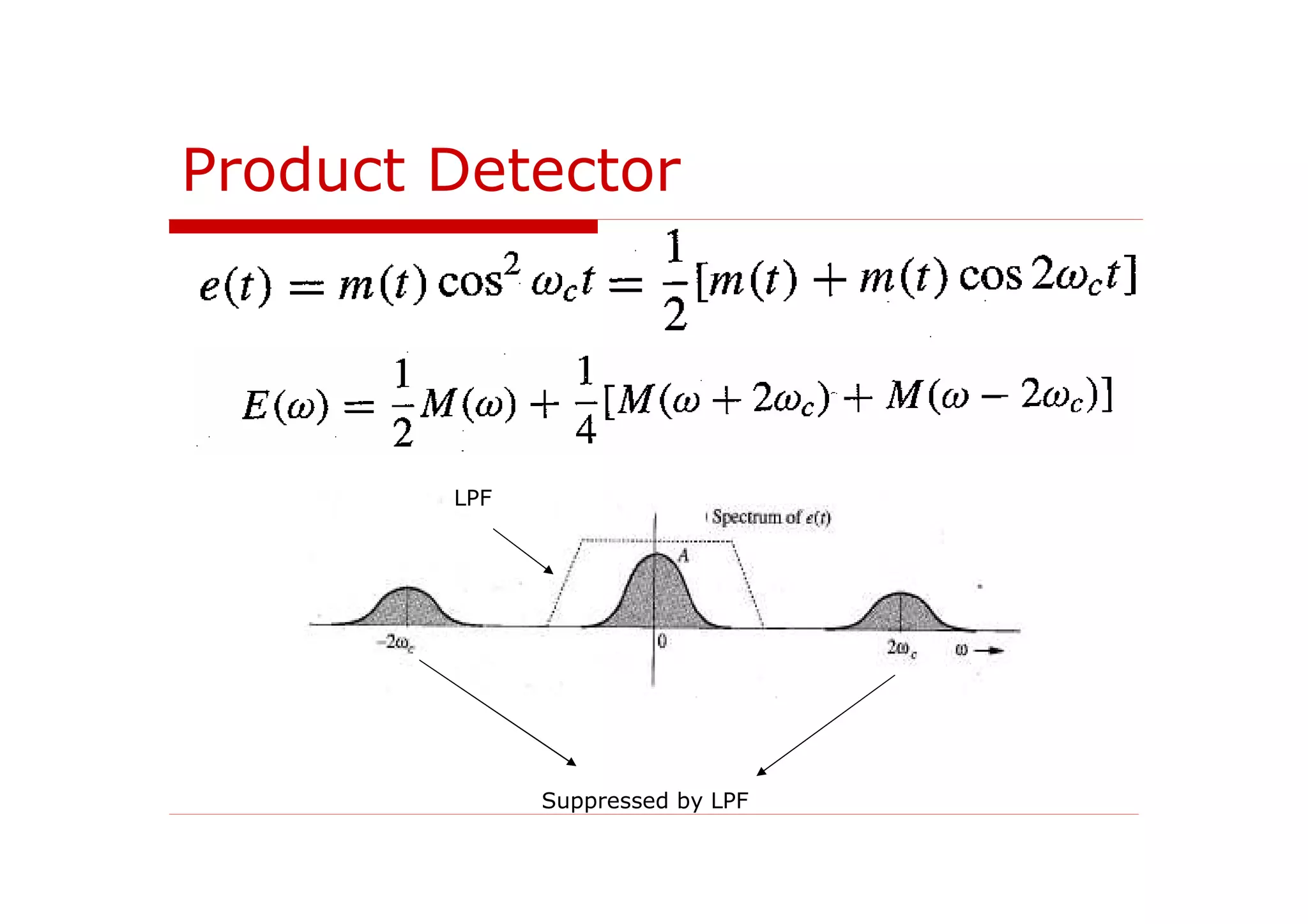
Product Detector
LPF
Suppressed by LPF
Notes on DSB-SC Demodulation
Multiply the modulated signal by the “same”
carrier signal of the transmitter used.
“same” : same frequency
: same phase
This type of demodulation is called the
synchronous or coherent detection
We need very precise local oscillator tuning
or automatic carrier recovery circuits

Introduction to Communication Systems 3

  • 1.
    EEE 330 Introduction to CommunicationSystems Lecture # 3 Modulation and Detection Amplitude Modulation
  • 2.
    Overview The Objectives ofToday’s Lecture Amplitude Modulation Read Carlson et al. pp. 152–159, 176– 177
  • 3.
    To Study CommunicationSystems you must understand… Signals and Systems Fourier Analysis Modulation Theory We will study this in detail Detection Theory Given that this signal is corrupt at the receiver, how do we determine the original signal? Probability Theory Since the transmit signal and noise are both unknown to the receiver, we can use probability theory to study communications systems
  • 4.
    Baseband Communication In communication,baseband is used the band of frequencies where the transmitter and the receiver communicates telephony – audio band (0 - 3.5 kHz) television – video band (0 - 4.3 MHz) In baseband communication, the baseband signals are transmitted without modulation short distance communication coaxial cable, optical fibers Local telephone, short-haul PCM, long-distance PCM over optical fibers
  • 5.
    Carrier Communication In carriercommunication, the baseband signal is shifted to higher frequencies by modulation and transmitted to long distances In continuous-wave (CW) modulation, the carrier is a sinusoid of frequency ωc. This is the traditional mode for all- analogue communications. c(t)= Accos(ωct +θc) In pulse modulation, the carrier is a
  • 6.
    CW Modulation Modulation meansthe change of one of the parameters (amplitude, phase or frequency) of the carrier signal in proportion to the baseband signal (information signal) Amplitude (Ac) – Amplitude Modulation (AM) Phase (θc) – Phase Modulation (PM) Frequency (ωc)– Frequency Modulation (FM)
  • 7.
    CW Modulation (a) Carrierwave. (b) Sinusoidal modulating signal. (c) Amplitude-modulated signal. (d) Angle-modulated signal.
  • 8.
    Benefits of Modulation Thereare three practical benefits that result from modulation: 1. Modulation can shift the spectral content of a message signal into a band which is better suited to the channel. Antennas only efficiently radiate and admit signals whose wavelength is similar to their physical aperture. Hence, to transmit and receive, say, voice, by radio we need to shift the voice signal to a much higher frequency band. 2. Modulation permits the use of multiplexing. Multiplexing means allowing simultaneous communication by multiple users on the same channel. For instance, the radio frequency spectrum must be shared and modulation allows users to separate themselves into bands. 3. Modulation can provide some control over noise/interference. As we will see, frequency modulation (FM) permits a tradeoff between bandwidth and noise.
  • 9.
    Amplitude Modulation (AM) Amplitudemodulation (AM) is a technique from the very beginning of CW radio transmission. Also called “Large carrier (LC)” AM or “Double Sideband Large Carrier (DSB-LC) AM It is still in use today because of its simplicity.
  • 10.
    Definitions Message signal –information-bearing signal that is to be recovered at the receiver [x(t) ] Carrier – the sinusoid with frequency ωc that is used to “carry” the information signal Envelope – the time-varying magnitude of the sinusoidal signal (modulated signal)
  • 11.
    Amplitude Modulation (AM) Amessage signal x(t) is amplitude modulated as follows: g(t)= Ac (1 + µ x(t)) cos(ωct +θc) The modulation index µ > 0 is chosen to ensure that (1 + µ x(t)) > 0 and to conserve power Also |µ x(t)| < 1. When this is violated, we call this “over-modulation”.
  • 12.
    Envelope Variation The envelopeof the transmit signal g(t) has the same shape as the message signal provided that 1. Over-modulation doesn’t occur. In other words as long as |µ x(t)| < 1. This is the same as saying that (1 + µ x(t)) must be positive. Since this represents the amplitude of the carrier, we say that the amplitude cannot be “negative” Negative amplitude corresponds to a phase reversal 2. The carrier frequency is much greater than the message bandwidth ( fc >> W ) This is the same as saying that the carrier signal changes much more quickly than the message signal
  • 13.
    Frequency-Domain Analysis ofan AM Signal envelope
  • 14.
    A System forAmplitude Modulation Basic AM requires only an amplifier, a summer and a mixer. Amplitude Modulation
  • 15.
    Demodulation Definition: The recoveryof the message signal from the modulated signal is called the demodulation or detection. Demodulation occurs at the receiver.
  • 16.
    Amplitude Demodulation A Systemfor Amplitude Demodulation To demodulate the received signal, i.e., to recover the original message signal, we can use an envelope detector circuit.
  • 17.
    A diode isused to half-wave rectify the received signal. The R1C1 filter then smooths to recover an approximation of the original envelope. R2C2 removes the bias.
  • 18.
    Double Sideband Suppressed- Carrier(DSB-SC) AM A problem with AM is that it is inefficient with power. Most of the transmitted power is wasted during the transmission of the carrier component. We can improve the power efficiency of AM by removing the unmodulated carrier component. This is termed Double Sideband Suppressed-Carrier (DSB-SC) AM g(t)= Ac m(t) cos(ωct +θc) Now, all of the power is devoted to the message – more power efficient However, a simple envelope detector is not possible, a product detector is needed.
  • 19.
    DSB-SC AM Modulator Accos(ωct +θc) m(t) g(t)= Ac m(t) cos(ωct + θc) Baseband signal Modulated Signal Carrier
  • 20.
    DSB-SC AM message signalm(t) Bandwidth = B Baseband signal Baseband spectrum
  • 21.
    DSB-SC AM Modulated SignalA m(t) cos(ωct +θc) Let θc = 0 (since it is a constant) and A = 1 Bandwidth = 2B Modulated Signal SpectrumModulated Signal
  • 22.
    Notes on DSB-SC Multiplyingby cos(ωct) relocates the baseband spectrum to ±ωc . There is no discrete component of the frequency ωc . “Suppressed Carrier” DSB-SC AM DSB AM Suppressed carrier Discrete carrier component
  • 23.
    Notes on DSB-SC Evenifwe view the baseband spectrum as having + frequencies, the modulated signal spectrum shows upper and lower parts. The modulated signal spectrum centered at ωc is composed of two parts USB – Upper Sideband (ω > ωc) LSB – Lower Sideband (ω < ωc) Similarly, the spectrum centered at –ωc is composed of two parts USB – Upper Sideband (ω < -ωc) LSB – Lower Sideband (ω > -ωc)
  • 24.
    Notes on DSB-SC Each± copy of the baseband spectrum loses ½ amplitude relative to the baseband. To have non-overlapping spectra centered at +ωc and –ωc , 2πB ≤ ωc. Nyquist criterion If two spectra overlaps, the message signal cannot be recovered (Aliasing)
  • 25.
    Notes on DSB-SC Whenm(t) crosses zero, the envelope is momentarily estinguished, and it appears as m(t) goes negative. An accurate phase information is needed at the receiver. The envelope of DSB- SC reflects |m(t)| Envelope detector cannot be used. m(t) crosses zero
  • 26.
    Demodulation of DSB-SC (ProductDetector) Local Osscilator As stated previously, one can no longer use a simple envelope detector as a receiver Envelope doesn’t follow message signal However we can still recover the message through the use of a product detector
  • 27.
  • 28.
    Notes on DSB-SCDemodulation Multiply the modulated signal by the “same” carrier signal of the transmitter used. “same” : same frequency : same phase This type of demodulation is called the synchronous or coherent detection We need very precise local oscillator tuning or automatic carrier recovery circuits