CATV
Presented by
Hrudya
CATV
 Cable TV
 Originally community antenna TV
 is a system for distributing television programs to subscribers
via radio frequency (RF) signals transmitted through coaxial
cables or digital light pulses through hybrid fibre coaxial (HFC)
networks.
 To receive cable television at a given location, cable
distribution lines must be available on the local utility poles
 Coaxial cable brings the signal to the customer's building
through a service drop, an overhead or underground cable.
 The cable company's portion of the wiring usually ends at a
distribution box on the building exterior, and built-in cable
usually distributes the signal through the walls to jacks in
different rooms to which televisions are connected.
STANDARD CABLE TV SYSTEM
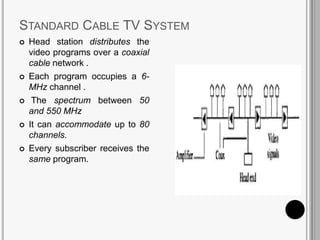
 Head station distributes the
video programs over a coaxial
cable network .
 Each program occupies a 6-
MHz channel .
 The spectrum between 50
and 550 MHz
 It can accommodate up to 80
channels.
 Every subscriber receives the
same program.
LAYOUT
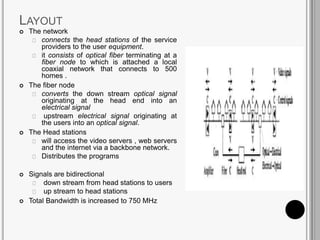
 The network
connects the head stations of the service
providers to the user equipment.
it consists of optical fiber terminating at a
fiber node to which is attached a local
coaxial network that connects to 500
homes .
 The fiber node
converts the down stream optical signal
originating at the head end into an
electrical signal
upstream electrical signal originating at
the users into an optical signal.
 The Head stations
will access the video servers , web servers
and the internet via a backbone network.
Distributes the programs
 Signals are bidirectional
down stream from head stations to users
up stream to head stations
 Total Bandwidth is increased to 750 MHz
WIRELESS CABLE SYSTEM
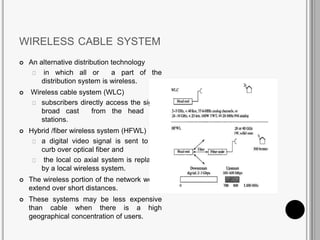
 An alternative distribution technology
in which all or a part of the
distribution system is wireless.
 Wireless cable system (WLC)
subscribers directly access the signal
broad cast from the head end
stations.
 Hybrid /fiber wireless system (HFWL)
a digital video signal is sent to the
curb over optical fiber and
the local co axial system is replaced
by a local wireless system.
 The wireless portion of the network would
extend over short distances.
 These systems may be less expensive
than cable when there is a high
geographical concentration of users.
CATV LAYERED NETWORK
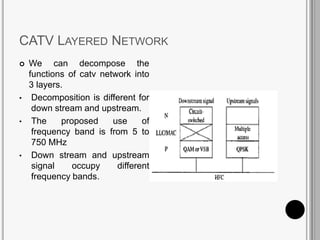
 We can decompose the
functions of catv network into
3 layers.
• Decomposition is different for
down stream and upstream.
• The proposed use of
frequency band is from 5 to
750 MHz
• Down stream and upstream
signal occupy different
frequency bands.
CONTINUE..............
Down stream
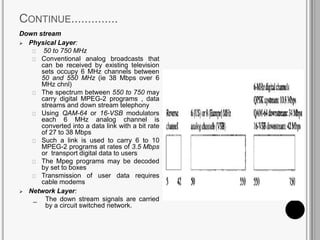
 Physical Layer:
50 to 750 MHz
Conventional analog broadcasts that
can be received by existing television
sets occupy 6 MHz channels between
50 and 550 MHz (ie 38 Mbps over 6
MHz chnl)
The spectrum between 550 to 750 may
carry digital MPEG-2 programs , data
streams and down stream telephony
Using QAM-64 or 16-VSB modulators
each 6 MHz analog channel is
converted into a data link with a bit rate
of 27 to 38 Mbps
Such a link is used to carry 6 to 10
MPEG-2 programs at rates of 3.5 Mbps
or transport digital data to users
The Mpeg programs may be decoded
by set to boxes
Transmission of user data requires
cable modems
 Network Layer:
_ The down stream signals are carried
by a circuit switched network.
CONTINUE..............
Up stream :
 Physical Layer :
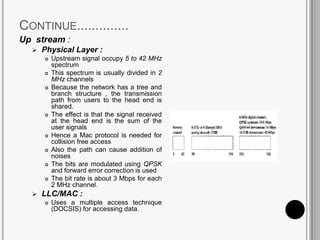
 Upstream signal occupy 5 to 42 MHz
spectrum
 This spectrum is usually divided in 2
MHz channels
 Because the network has a tree and
branch structure , the transmission
path from users to the head end is
shared.
 The effect is that the signal received
at the head end is the sum of the
user signals
 Hence a Mac protocol is needed for
collision free access
 Also the path can cause addition of
noises
 The bits are modulated using QPSK
and forward error correction is used
 The bit rate is about 3 Mbps for each
2 MHz channel.
 LLC/MAC :
 Uses a multiple access technique
(DOCSIS) for accessing data.
DATE OVER CABLE SERVICE INTERFACE
SPECIFICATIONS (DOCSIS)
 Date Over Cable Service
Interface Specifications
 An emerging standard
developed by MCNS
consortium (multimedia
Cable Network Systems )
 The goal is to transparently
transmit IP traffic between the
user cable modem and the
cable modem termination
system (CMTS) at the head
end
 The frames are divided into mini slots
 When a user makes a request , the CMTS
may grant the user a certain number of
mini slots in the next frame .
 The requests include modem id and
amount of bandwidth requested.
 The grants are carried out in a down
stream frame
 However more than one cable modem may
request at the same time resulting in
collision
 The colliding modems learn abt this , bcoz
they do not receive any grants
 They must back off for a random amount of
time before making another request.
 The standard also specifies how user
ethernet packets or ATM cells are to be
framed .
What is DOCSIS ? Working
SERVICES OVER CATV
 Also known as video dial tone
 The subscribers can demand for
a video
 Subscribers browse through a
large collection of video
programs and request a program
, using their set top boxes .
 The head end transports the
requests (MPEG digital stream)
over an available channel
 The set top box demodulates
and decompress the received bit
stream.
 And generated the NTSC or
HDTV signal for display on the
TV set
 Internet service providers
together with cable operators
offer , subscribers ,internet
access ,over a shared link (3
Mbps upstream and 38 Mbps
downsteram )
 Typically 10 subscribers
share a resource at any time
.
 Subscribers must purchase a
cable modem and usually
pay a monthly flat rate .
Video On Demand Internet Access

Catv

  • 1.
  • 2.
    CATV  Cable TV Originally community antenna TV  is a system for distributing television programs to subscribers via radio frequency (RF) signals transmitted through coaxial cables or digital light pulses through hybrid fibre coaxial (HFC) networks.  To receive cable television at a given location, cable distribution lines must be available on the local utility poles  Coaxial cable brings the signal to the customer's building through a service drop, an overhead or underground cable.  The cable company's portion of the wiring usually ends at a distribution box on the building exterior, and built-in cable usually distributes the signal through the walls to jacks in different rooms to which televisions are connected.
  • 3.
    STANDARD CABLE TVSYSTEM  Head station distributes the video programs over a coaxial cable network .  Each program occupies a 6- MHz channel .  The spectrum between 50 and 550 MHz  It can accommodate up to 80 channels.  Every subscriber receives the same program.
  • 4.
    LAYOUT  The network connectsthe head stations of the service providers to the user equipment. it consists of optical fiber terminating at a fiber node to which is attached a local coaxial network that connects to 500 homes .  The fiber node converts the down stream optical signal originating at the head end into an electrical signal upstream electrical signal originating at the users into an optical signal.  The Head stations will access the video servers , web servers and the internet via a backbone network. Distributes the programs  Signals are bidirectional down stream from head stations to users up stream to head stations  Total Bandwidth is increased to 750 MHz
  • 5.
    WIRELESS CABLE SYSTEM An alternative distribution technology in which all or a part of the distribution system is wireless.  Wireless cable system (WLC) subscribers directly access the signal broad cast from the head end stations.  Hybrid /fiber wireless system (HFWL) a digital video signal is sent to the curb over optical fiber and the local co axial system is replaced by a local wireless system.  The wireless portion of the network would extend over short distances.  These systems may be less expensive than cable when there is a high geographical concentration of users.
  • 6.
    CATV LAYERED NETWORK We can decompose the functions of catv network into 3 layers. • Decomposition is different for down stream and upstream. • The proposed use of frequency band is from 5 to 750 MHz • Down stream and upstream signal occupy different frequency bands.
  • 7.
    CONTINUE.............. Down stream  PhysicalLayer: 50 to 750 MHz Conventional analog broadcasts that can be received by existing television sets occupy 6 MHz channels between 50 and 550 MHz (ie 38 Mbps over 6 MHz chnl) The spectrum between 550 to 750 may carry digital MPEG-2 programs , data streams and down stream telephony Using QAM-64 or 16-VSB modulators each 6 MHz analog channel is converted into a data link with a bit rate of 27 to 38 Mbps Such a link is used to carry 6 to 10 MPEG-2 programs at rates of 3.5 Mbps or transport digital data to users The Mpeg programs may be decoded by set to boxes Transmission of user data requires cable modems  Network Layer: _ The down stream signals are carried by a circuit switched network.
  • 8.
    CONTINUE.............. Up stream : Physical Layer :  Upstream signal occupy 5 to 42 MHz spectrum  This spectrum is usually divided in 2 MHz channels  Because the network has a tree and branch structure , the transmission path from users to the head end is shared.  The effect is that the signal received at the head end is the sum of the user signals  Hence a Mac protocol is needed for collision free access  Also the path can cause addition of noises  The bits are modulated using QPSK and forward error correction is used  The bit rate is about 3 Mbps for each 2 MHz channel.  LLC/MAC :  Uses a multiple access technique (DOCSIS) for accessing data.
  • 9.
    DATE OVER CABLESERVICE INTERFACE SPECIFICATIONS (DOCSIS)  Date Over Cable Service Interface Specifications  An emerging standard developed by MCNS consortium (multimedia Cable Network Systems )  The goal is to transparently transmit IP traffic between the user cable modem and the cable modem termination system (CMTS) at the head end  The frames are divided into mini slots  When a user makes a request , the CMTS may grant the user a certain number of mini slots in the next frame .  The requests include modem id and amount of bandwidth requested.  The grants are carried out in a down stream frame  However more than one cable modem may request at the same time resulting in collision  The colliding modems learn abt this , bcoz they do not receive any grants  They must back off for a random amount of time before making another request.  The standard also specifies how user ethernet packets or ATM cells are to be framed . What is DOCSIS ? Working
  • 10.
    SERVICES OVER CATV Also known as video dial tone  The subscribers can demand for a video  Subscribers browse through a large collection of video programs and request a program , using their set top boxes .  The head end transports the requests (MPEG digital stream) over an available channel  The set top box demodulates and decompress the received bit stream.  And generated the NTSC or HDTV signal for display on the TV set  Internet service providers together with cable operators offer , subscribers ,internet access ,over a shared link (3 Mbps upstream and 38 Mbps downsteram )  Typically 10 subscribers share a resource at any time .  Subscribers must purchase a cable modem and usually pay a monthly flat rate . Video On Demand Internet Access