Super heterodyne receiver
Unit -1
Presented By
Mrs. M.P.Sasirekha
Super heterodyne receiver
• The FM receiver is the whole unit which takes the modulated
signal as input and outputs the original audio signal.
• They had got drawbacks such as poor sensitivity and selectivity.
• Selectivity is the selection of a particular signal while rejecting
the others.
• Sensitivity is the capacity of detecting RF signal and
demodulating it, while at the lowest power level.
• Both Selectivity and Sensitivity should be high for an FM
receiver.
Super heterodyne receiver
• To overcome these drawbacks of the ordinary receiver, the
super heterodyne receiver was invented.
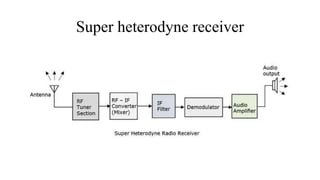
• This FM receiver consists of 5 main stages.
• RF Tuner Section
• RF Mixer
• IF Filter
• Demodulator
• Audio Amplifier
RF Tuner Section
• The modulated signal received by the antenna is first given to
the tuner circuit through a transformer.
• The tuner circuit is nothing but an LC circuit which is also called
as resonant or tank circuit.
• It selects the frequency, desired by the radio receiver.
• It also tunes the local oscillator and the RF filter at the same
time.
RF Mixer
• The signal from the tuner output is given to the RF-IF converter,
which acts as a mixer. It has a local oscillator, which produces a
constant frequency.
• The mixing process is done here, having the received signal as
one input and the local oscillator frequency as the other input.
• The resultant output is a mixture of two frequencies produced
by the mixer, which is called the Intermediate Frequency (IF)
• The production of IF helps in the demodulation of any station
signal having any carrier frequency.
• Hence, all signals are translated to a fixed carrier frequency for
adequate selectivity.
IF Filter and Demodulator
• IF Filter
• Intermediate frequency filter is a bandpass filter, which passes
the desired frequency. It eliminates any unwanted higher
frequency components present in it and noise. IF filter helps in
improving Signal to Noise Ratio (SNR)
• Demodulator
• The received modulated signal is now demodulated with the
same process used at the transmitter side. The frequency
discrimination is generally used for FM detection.
Audio Amplifier
• This is the power amplifier stage which is used to amplify the
detected audio signal.
• The processed signal is given strength to be effective.
• This signal is given to the loudspeaker to get the original sound
signal.
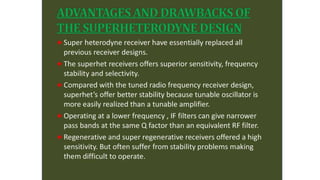
• This super heterodyne receiver is well used because of its
advantages like better SNR, sensitivity, and selectivity.
Thank you

Super heterodyne receiver

  • 1.
    Super heterodyne receiver Unit-1 Presented By Mrs. M.P.Sasirekha
  • 2.
  • 3.
    Super heterodyne receiver •The FM receiver is the whole unit which takes the modulated signal as input and outputs the original audio signal. • They had got drawbacks such as poor sensitivity and selectivity. • Selectivity is the selection of a particular signal while rejecting the others. • Sensitivity is the capacity of detecting RF signal and demodulating it, while at the lowest power level. • Both Selectivity and Sensitivity should be high for an FM receiver.
  • 4.
    Super heterodyne receiver •To overcome these drawbacks of the ordinary receiver, the super heterodyne receiver was invented. • This FM receiver consists of 5 main stages. • RF Tuner Section • RF Mixer • IF Filter • Demodulator • Audio Amplifier
  • 5.
    RF Tuner Section •The modulated signal received by the antenna is first given to the tuner circuit through a transformer. • The tuner circuit is nothing but an LC circuit which is also called as resonant or tank circuit. • It selects the frequency, desired by the radio receiver. • It also tunes the local oscillator and the RF filter at the same time.
  • 6.
    RF Mixer • Thesignal from the tuner output is given to the RF-IF converter, which acts as a mixer. It has a local oscillator, which produces a constant frequency. • The mixing process is done here, having the received signal as one input and the local oscillator frequency as the other input. • The resultant output is a mixture of two frequencies produced by the mixer, which is called the Intermediate Frequency (IF) • The production of IF helps in the demodulation of any station signal having any carrier frequency. • Hence, all signals are translated to a fixed carrier frequency for adequate selectivity.
  • 7.
    IF Filter andDemodulator • IF Filter • Intermediate frequency filter is a bandpass filter, which passes the desired frequency. It eliminates any unwanted higher frequency components present in it and noise. IF filter helps in improving Signal to Noise Ratio (SNR) • Demodulator • The received modulated signal is now demodulated with the same process used at the transmitter side. The frequency discrimination is generally used for FM detection.
  • 8.
    Audio Amplifier • Thisis the power amplifier stage which is used to amplify the detected audio signal. • The processed signal is given strength to be effective. • This signal is given to the loudspeaker to get the original sound signal. • This super heterodyne receiver is well used because of its advantages like better SNR, sensitivity, and selectivity.
  • 10.