IntroducingIntroducing
Data Communication &Data Communication &
TelecommunicationTelecommunication
Data Communication versusData Communication versus
TelecommunicationTelecommunication
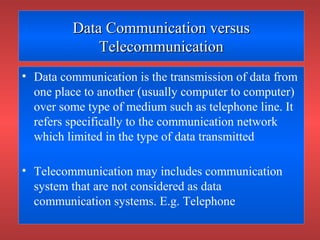
• Data communication is the transmission of data from
one place to another (usually computer to computer)
over some type of medium such as telephone line. It
refers specifically to the communication network
which limited in the type of data transmitted
• Telecommunication may includes communication
system that are not considered as data
communication systems. E.g. Telephone
Data Communication versusData Communication versus
TelecommunicationTelecommunication
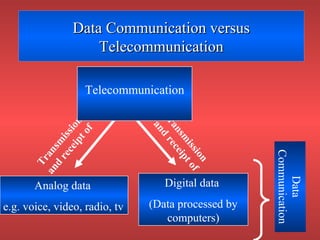
Transm
ission
and
receiptof
Transm
ission
and
receiptofAnalog data
e.g. voice, video, radio, tv
Digital data
(Data processed by
computers)
Telecommunication
Data
Communication
Standard OrganizationStandard Organization
 IEEE – Institute of Electrical and Electronics Engineers.
Professional organization whose activities include the
development of communications and network standards.
 ANSI – American National Standards Institute. Voluntary
organization composed of corporate, government, and other
members that coordinates standards-related activities, approves
U.S. national standards, and develops positions for the United
States in international standards organizations.
Standard OrganizationStandard Organization
 ISO – International Organization for Standardization.
International organization that is responsible for a wide range
of standards, including those relevant to networking. ISO
developed the OSI reference model, a popular networking
reference model.
 EIA– Electronic Industries Association. Group that specifies
electrical transmission standards. The EIA and TIA have
developed numerous well-known communications standards,
including EIA/TIA-232 and EIA/TIA-449.
Standard OrganizationStandard Organization
TIA – Telecommunications Industry Association.
Organization that develops standards relating to
telecommunications technologies. Together, the TIA
and the EIA have formalized standards, such as
EIA/TIA-232, for the electrical characteristics of data
transmission.
Basic Components of aBasic Components of a
Communication NetworkCommunication Network
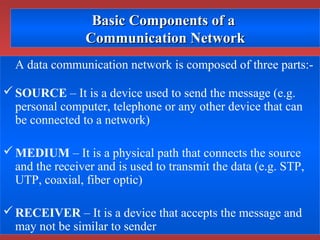
A data communication network is composed of three parts:-
SOURCE – It is a device used to send the message (e.g.
personal computer, telephone or any other device that can
be connected to a network)
MEDIUM – It is a physical path that connects the source
and the receiver and is used to transmit the data (e.g. STP,
UTP, coaxial, fiber optic)
RECEIVER – It is a device that accepts the message and
may not be similar to sender
Basic Components of a Communication NetworkBasic Components of a Communication Network
Modes of Channel / Data Flow:Modes of Channel / Data Flow:
Simplex, Half- andSimplex, Half- and
Full-Duplex CommunicationsFull-Duplex Communications
• Simplex
- Connection that allows communication in one
direction
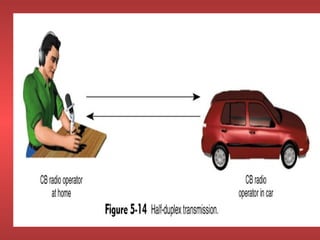
• Half-duplex
– Connection that allows communication in two
directions, but not simultaneously
• Full-duplex
– Connection that allows communication in two
directions at once
Half- and Full-Duplex CommunicationsHalf- and Full-Duplex Communications
• Benefits of using full duplex:
– Time is not wasted retransmitting frames
because there are no collisions
– Full bandwidth is available in both directions
because the send and receive functions are
separate
– Stations do not have to wait to until other
stations complete their transmission because
there is only one transmitter for each twisted
pair
Transmission Modes:Transmission Modes:
Serial and ParallelSerial and Parallel
Data may be transmitted between two points
in two different ways. It can be transmitted as
entire characters or as individual bits.
In computers, these bits may be sent all at
once (in parallel), or one after the other
(serial).
Transmission Modes:Transmission Modes:
Serial and ParallelSerial and Parallel
In parallel transmission the entire character is
transmitted all at once
Each bit uses a separate wire. Thus, 8 bits
character require 8 wires.
For serial transmission, each bit is sent over a
single wire, one after the after.
Data communication & telecommunication

Data communication & telecommunication

  • 1.
    IntroducingIntroducing Data Communication &DataCommunication & TelecommunicationTelecommunication
  • 2.
    Data Communication versusDataCommunication versus TelecommunicationTelecommunication • Data communication is the transmission of data from one place to another (usually computer to computer) over some type of medium such as telephone line. It refers specifically to the communication network which limited in the type of data transmitted • Telecommunication may includes communication system that are not considered as data communication systems. E.g. Telephone
  • 3.
    Data Communication versusDataCommunication versus TelecommunicationTelecommunication Transm ission and receiptof Transm ission and receiptofAnalog data e.g. voice, video, radio, tv Digital data (Data processed by computers) Telecommunication Data Communication
  • 8.
    Standard OrganizationStandard Organization IEEE – Institute of Electrical and Electronics Engineers. Professional organization whose activities include the development of communications and network standards.  ANSI – American National Standards Institute. Voluntary organization composed of corporate, government, and other members that coordinates standards-related activities, approves U.S. national standards, and develops positions for the United States in international standards organizations.
  • 9.
    Standard OrganizationStandard Organization ISO – International Organization for Standardization. International organization that is responsible for a wide range of standards, including those relevant to networking. ISO developed the OSI reference model, a popular networking reference model.  EIA– Electronic Industries Association. Group that specifies electrical transmission standards. The EIA and TIA have developed numerous well-known communications standards, including EIA/TIA-232 and EIA/TIA-449.
  • 10.
    Standard OrganizationStandard Organization TIA– Telecommunications Industry Association. Organization that develops standards relating to telecommunications technologies. Together, the TIA and the EIA have formalized standards, such as EIA/TIA-232, for the electrical characteristics of data transmission.
  • 11.
    Basic Components ofaBasic Components of a Communication NetworkCommunication Network A data communication network is composed of three parts:- SOURCE – It is a device used to send the message (e.g. personal computer, telephone or any other device that can be connected to a network) MEDIUM – It is a physical path that connects the source and the receiver and is used to transmit the data (e.g. STP, UTP, coaxial, fiber optic) RECEIVER – It is a device that accepts the message and may not be similar to sender
  • 12.
    Basic Components ofa Communication NetworkBasic Components of a Communication Network
  • 13.
    Modes of Channel/ Data Flow:Modes of Channel / Data Flow: Simplex, Half- andSimplex, Half- and Full-Duplex CommunicationsFull-Duplex Communications • Simplex - Connection that allows communication in one direction • Half-duplex – Connection that allows communication in two directions, but not simultaneously • Full-duplex – Connection that allows communication in two directions at once
  • 14.
    Half- and Full-DuplexCommunicationsHalf- and Full-Duplex Communications • Benefits of using full duplex: – Time is not wasted retransmitting frames because there are no collisions – Full bandwidth is available in both directions because the send and receive functions are separate – Stations do not have to wait to until other stations complete their transmission because there is only one transmitter for each twisted pair
  • 20.
    Transmission Modes:Transmission Modes: Serialand ParallelSerial and Parallel Data may be transmitted between two points in two different ways. It can be transmitted as entire characters or as individual bits. In computers, these bits may be sent all at once (in parallel), or one after the other (serial).
  • 21.
    Transmission Modes:Transmission Modes: Serialand ParallelSerial and Parallel In parallel transmission the entire character is transmitted all at once Each bit uses a separate wire. Thus, 8 bits character require 8 wires. For serial transmission, each bit is sent over a single wire, one after the after.