Amplitude

1

Modulation

By: Durgesh Suthar
En. No: 11115027
What is Modulation

2



Modulation
 In the modulation process, some characteristic of
a high-frequency carrier signal (bandpass), is
changed according to the instantaneous
amplitude of the information (baseband) signal.



Why Modulation is used
 Suitable for signal transmission (distance…etc)
 Multiple signals transmitted on the same channel
 Capacitive or inductive devices require high
frequency AC input (carrier) to operate.
 Stability and noise rejection
About Modulation


3

Application Examples
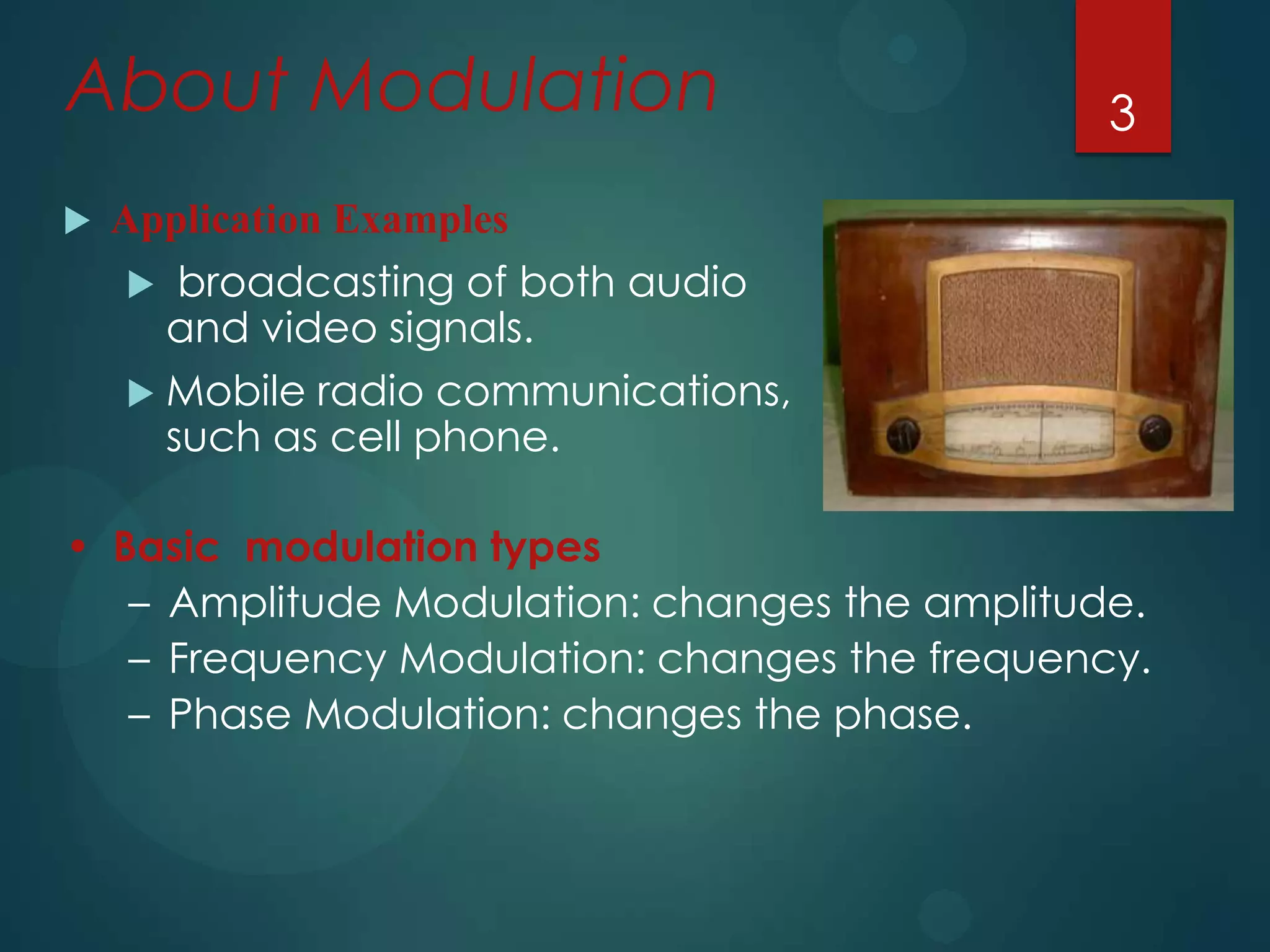
broadcasting of both audio
and video signals.
 Mobile radio communications,
such as cell phone.


• Basic modulation types
– Amplitude Modulation: changes the amplitude.
– Frequency Modulation: changes the frequency.
– Phase Modulation: changes the phase.
Modulation Theory


4

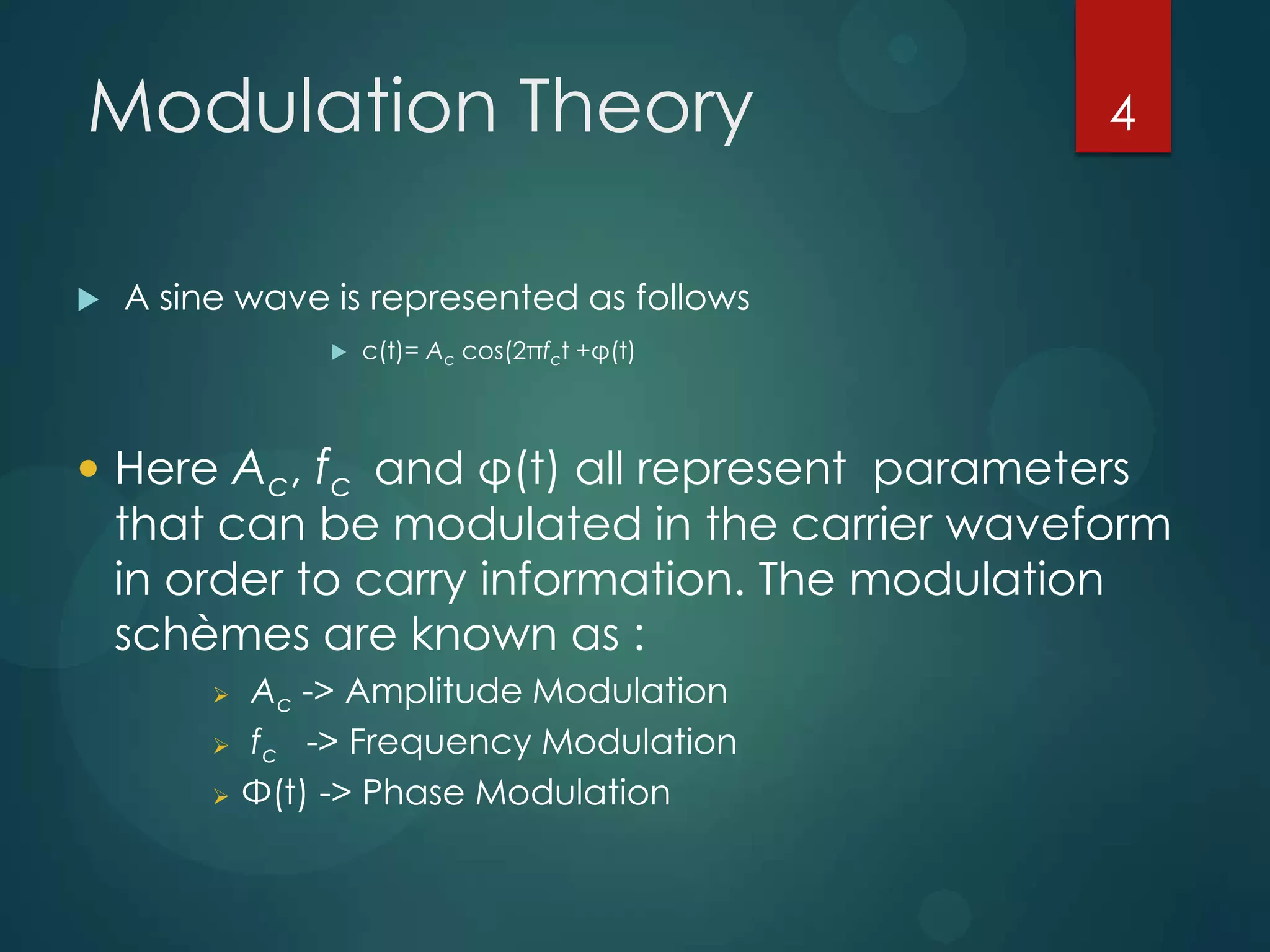
A sine wave is represented as follows


c(t)= Ac cos(2πfct +φ(t)

 Here Ac, fc and φ(t) all represent parameters

that can be modulated in the carrier waveform
in order to carry information. The modulation
schèmes are known as :




Ac -> Amplitude Modulation
fc -> Frequency Modulation
Φ(t) -> Phase Modulation
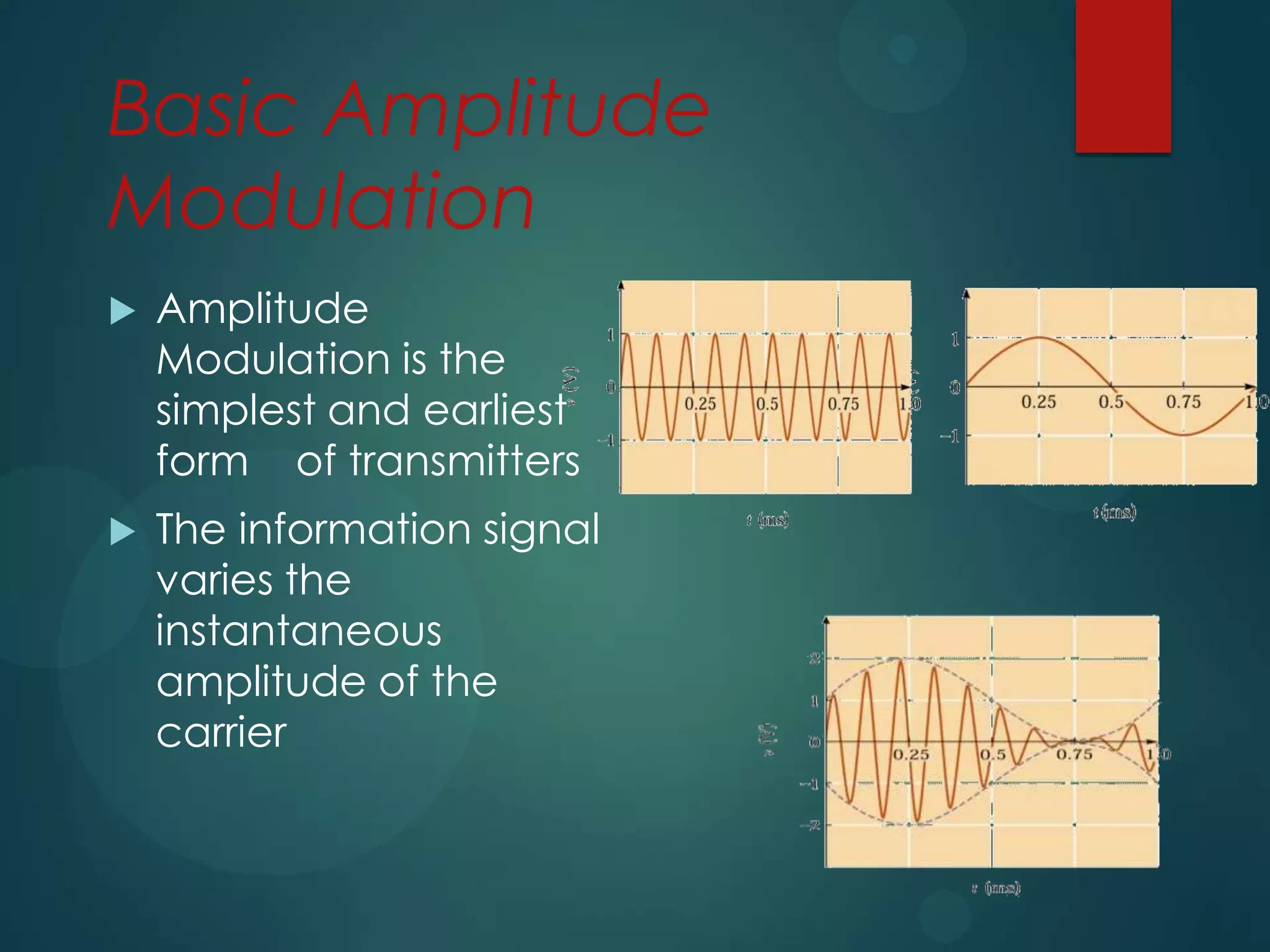
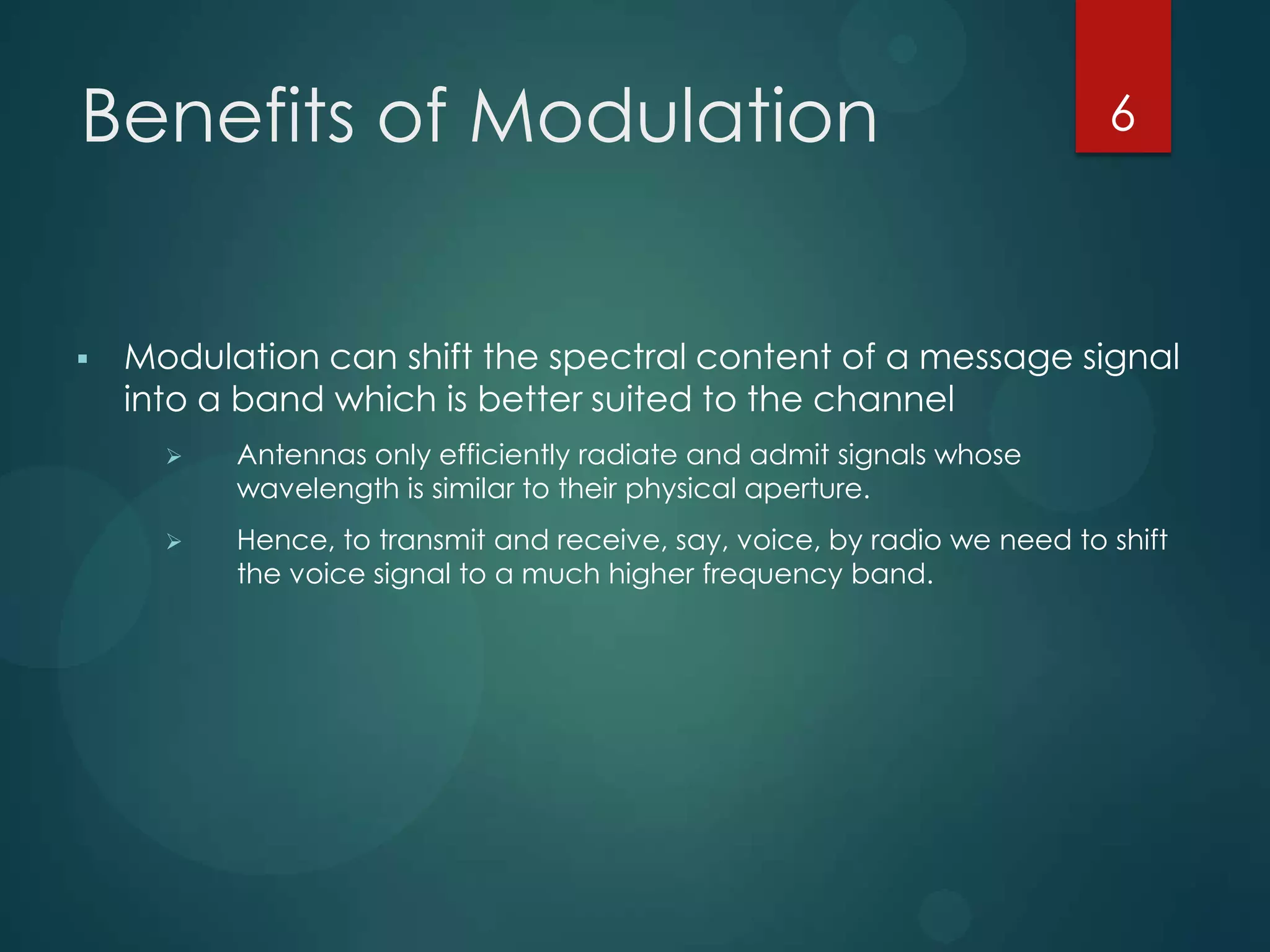
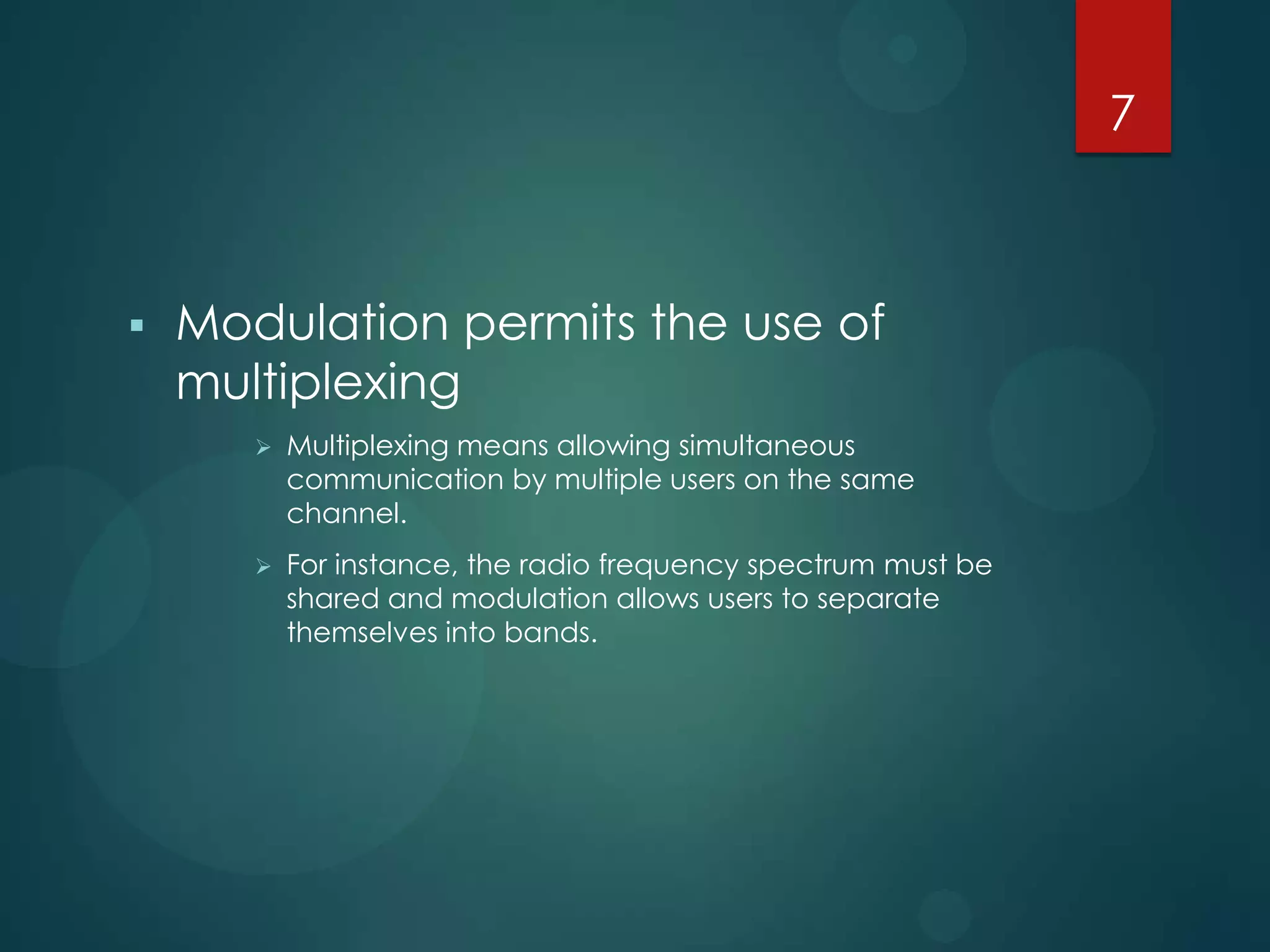
Basic Amplitude
Modulation


Amplitude
Modulation is the
simplest and earliest
form of transmitters



The information signal
varies the
instantaneous
amplitude of the
carrier
Benefits of Modulation



6

Modulation can shift the spectral content of a message signal
into a band which is better suited to the channel


Antennas only efficiently radiate and admit signals whose
wavelength is similar to their physical aperture.



Hence, to transmit and receive, say, voice, by radio we need to shift
the voice signal to a much higher frequency band.
7



Modulation permits the use of
multiplexing


Multiplexing means allowing simultaneous
communication by multiple users on the same
channel.



For instance, the radio frequency spectrum must be
shared and modulation allows users to separate
themselves into bands.
AMPLITUDE MODULATION (AM)8


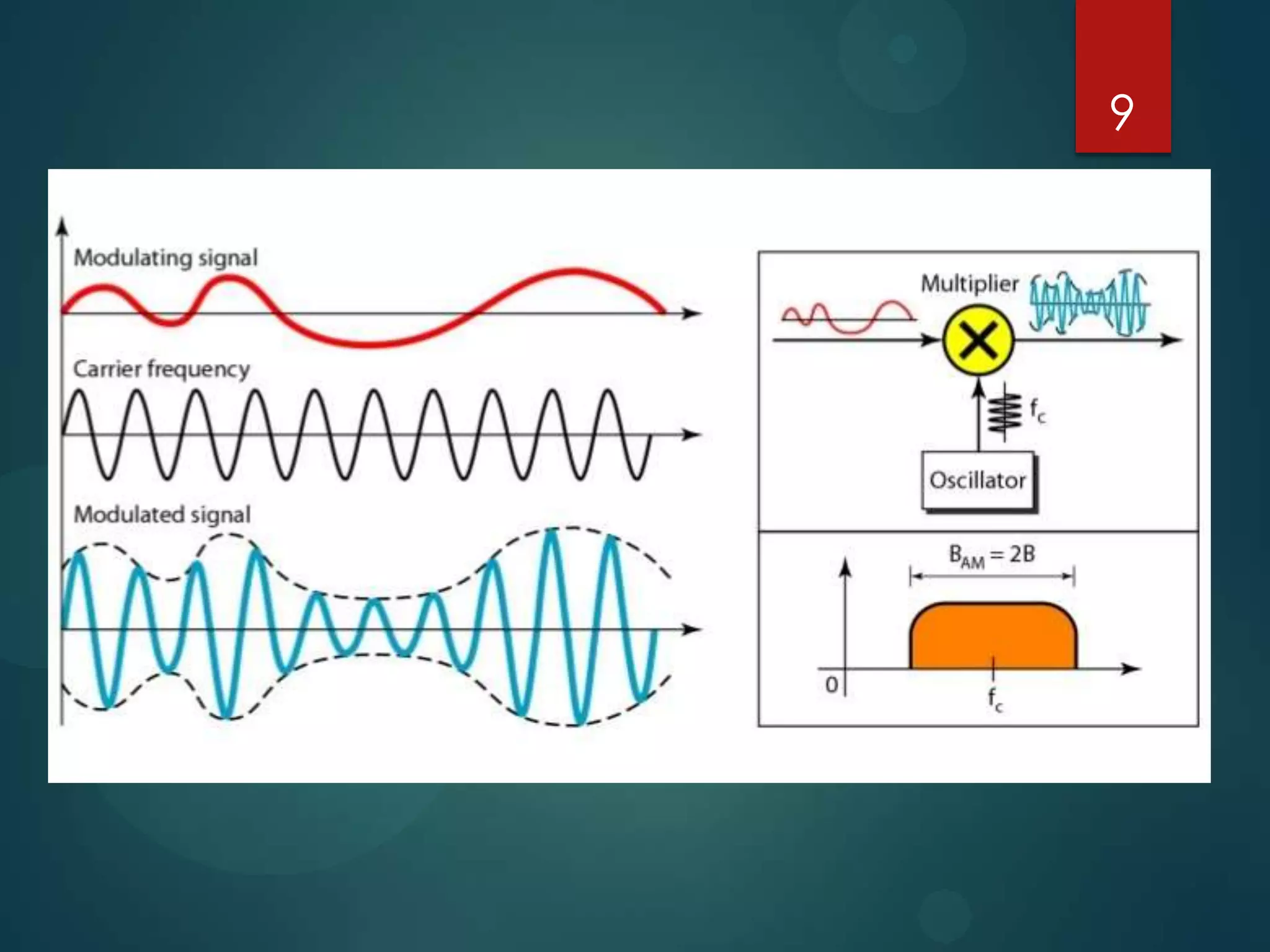
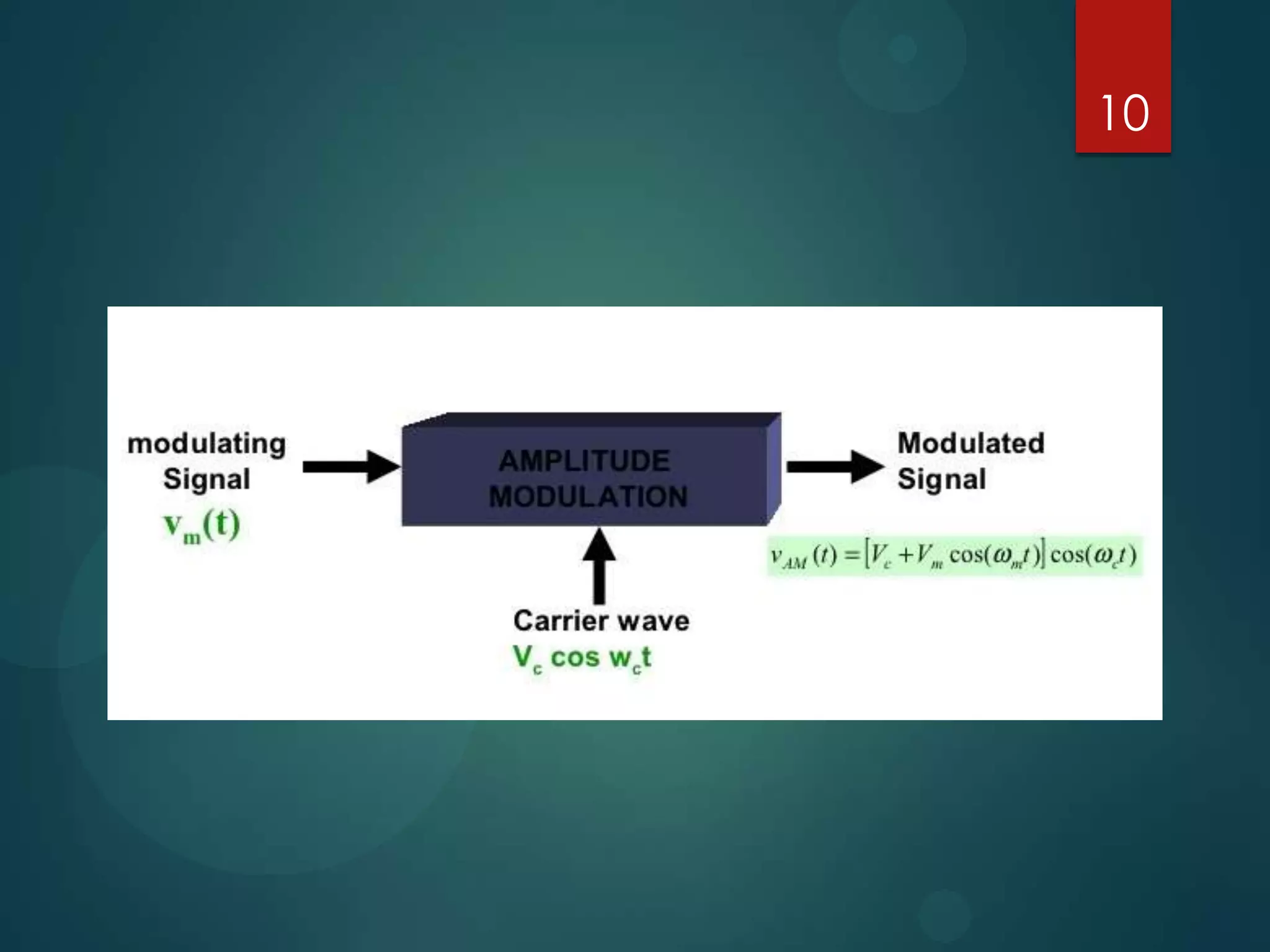
In amplitude modulation, the message signal m(t) is impressed
on the amplitude of the carrier signal c(t) = Accos(2fct)


This results in a sinusoidal signal whose amplitude is a function
of the message signal m(t)



There are several different ways of amplitude modulating
the carrier signal by m(t)



Each results in different spectral characteristics for the
transmitted signal



Mainly these methods are used for AM:
(a)

Double Sideband with Large carrier AM (DSB-LC AM)

(b)

Double sideband, suppressed-carrier AM (DSB-SC AM)

(c)

Single-sideband AM (SSB AM)

(d)

Vestigial Sideband (VSB) modulation
9
10
Full AM modulation ( DSB-LC) 11
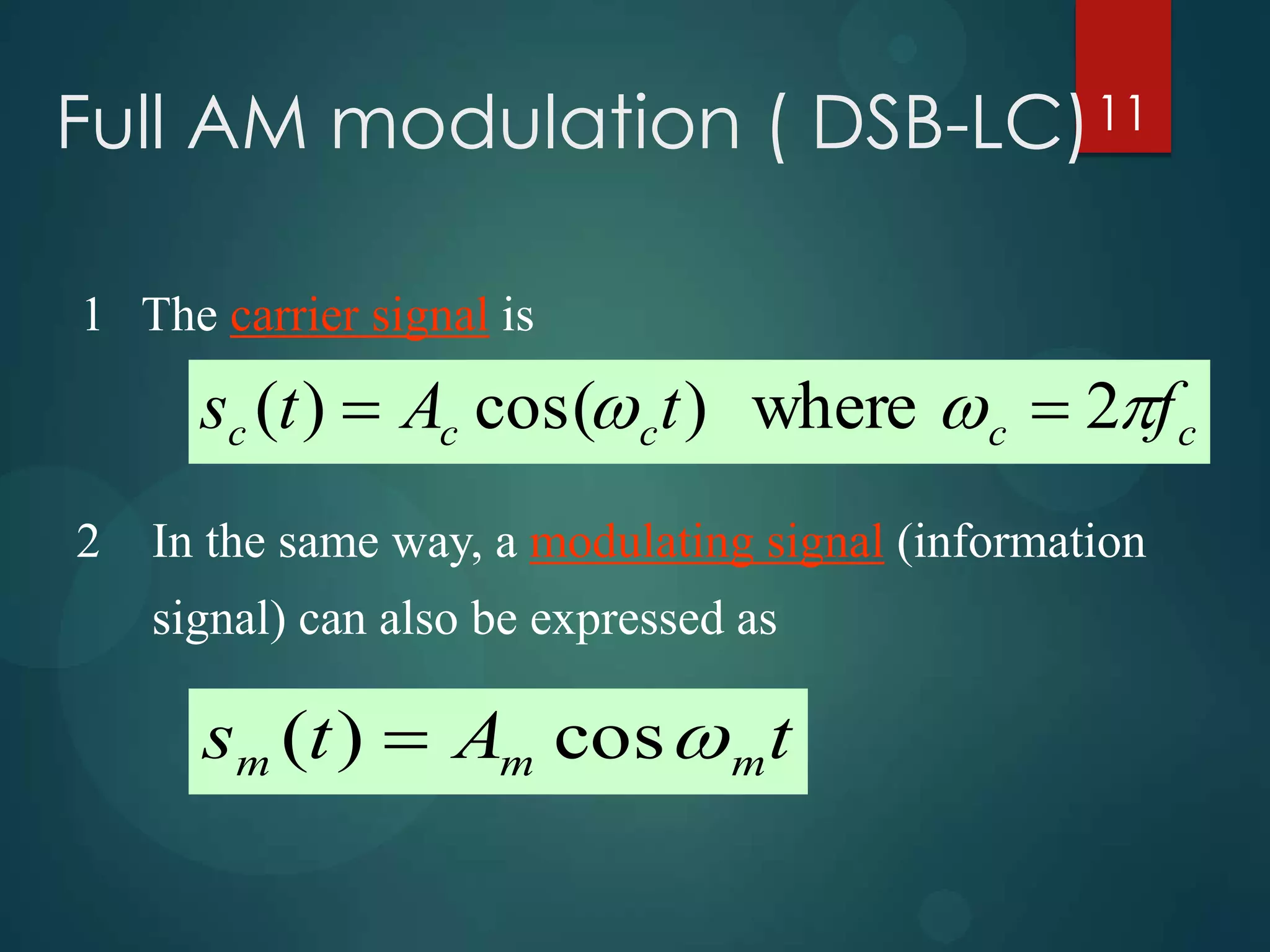
1 The carrier signal is

sc (t )  Ac cos( c t ) where  c  2f c
2

In the same way, a modulating signal (information
signal) can also be expressed as

sm (t )  Am cos  m t
13
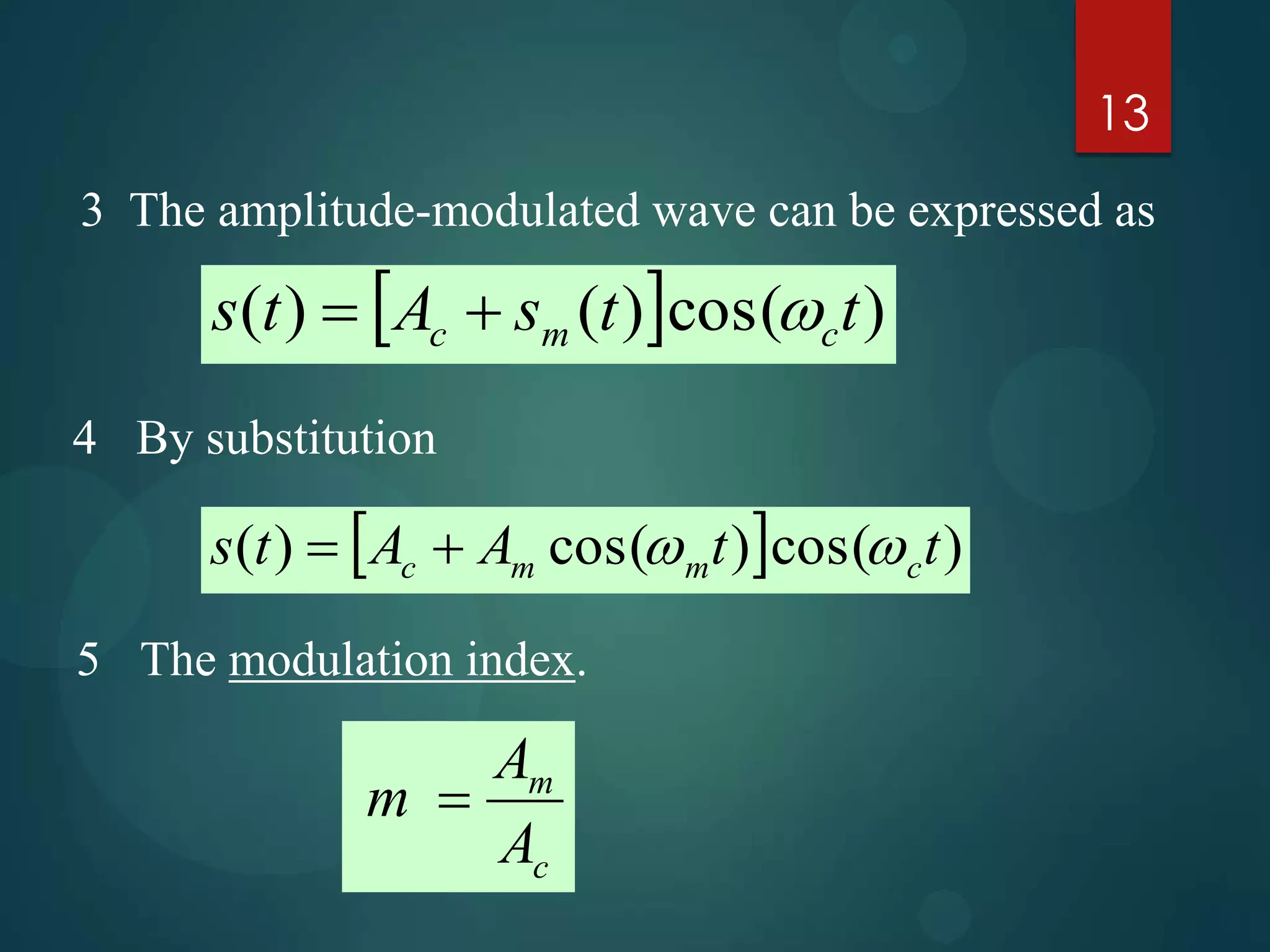
3 The amplitude-modulated wave can be expressed as

s(t )  Ac  sm (t )cos(c t )
4 By substitution

s (t )  Ac  Am cos( mt )cos( c t )
5 The modulation index.

Am
m 
Ac
13
6

Therefore The full AM signal may be
written as

s(t )  Ac (1  m cos( mt )) cos( c t )
cos A cos B  1 / 2[cos(A  B)  cos(A  B)]
mAc
mAc
s(t )  Ac (cos ct ) 
cos( c   m )t 
cos( c   m )t
2
2
Double-Sideband Suppressed-Carrier AM


14

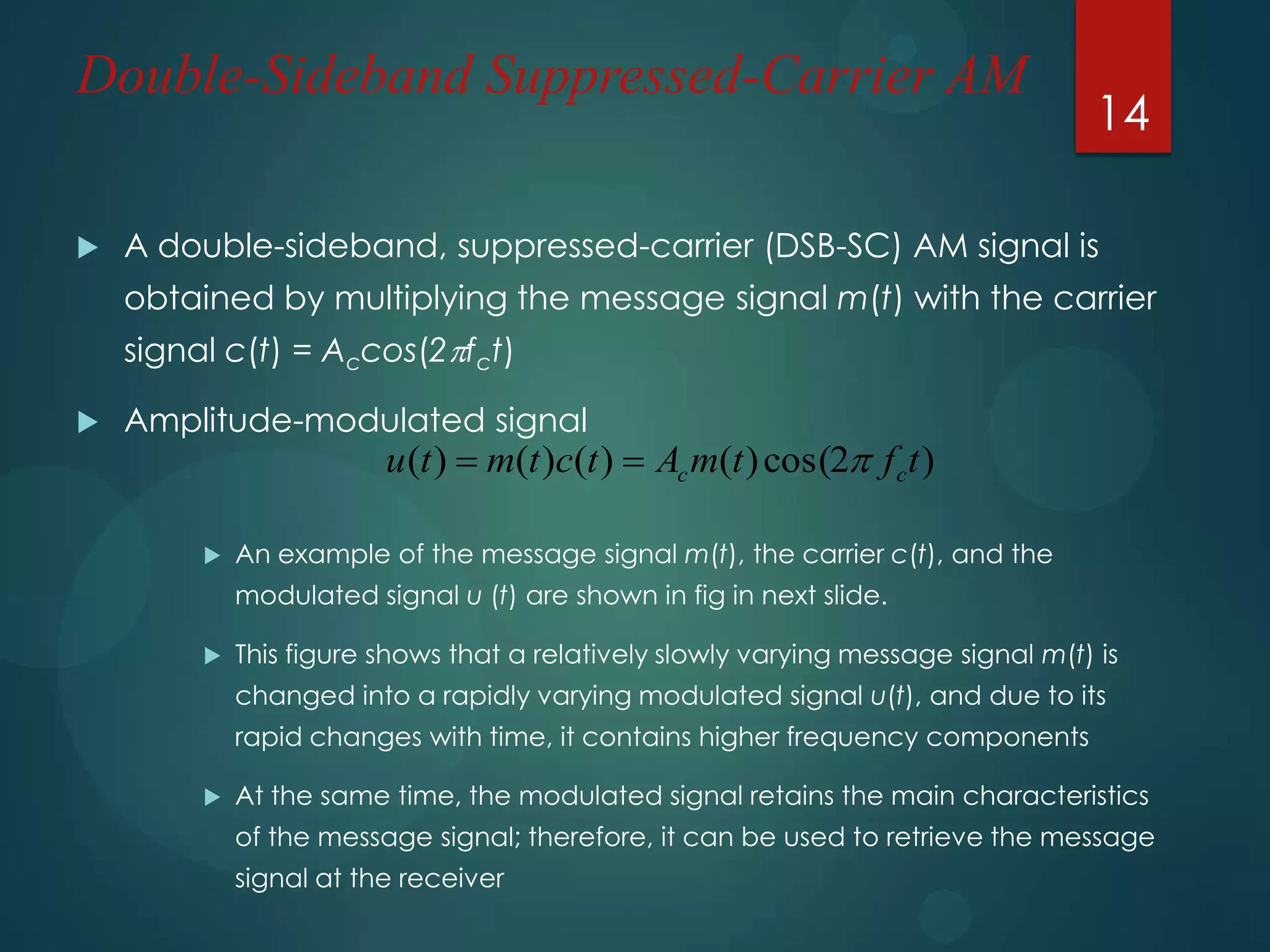
A double-sideband, suppressed-carrier (DSB-SC) AM signal is
obtained by multiplying the message signal m(t) with the carrier
signal c(t) = Accos(2fct)



Amplitude-modulated signal

u (t )  m(t )c(t )  Ac m(t ) cos(2 f c t )



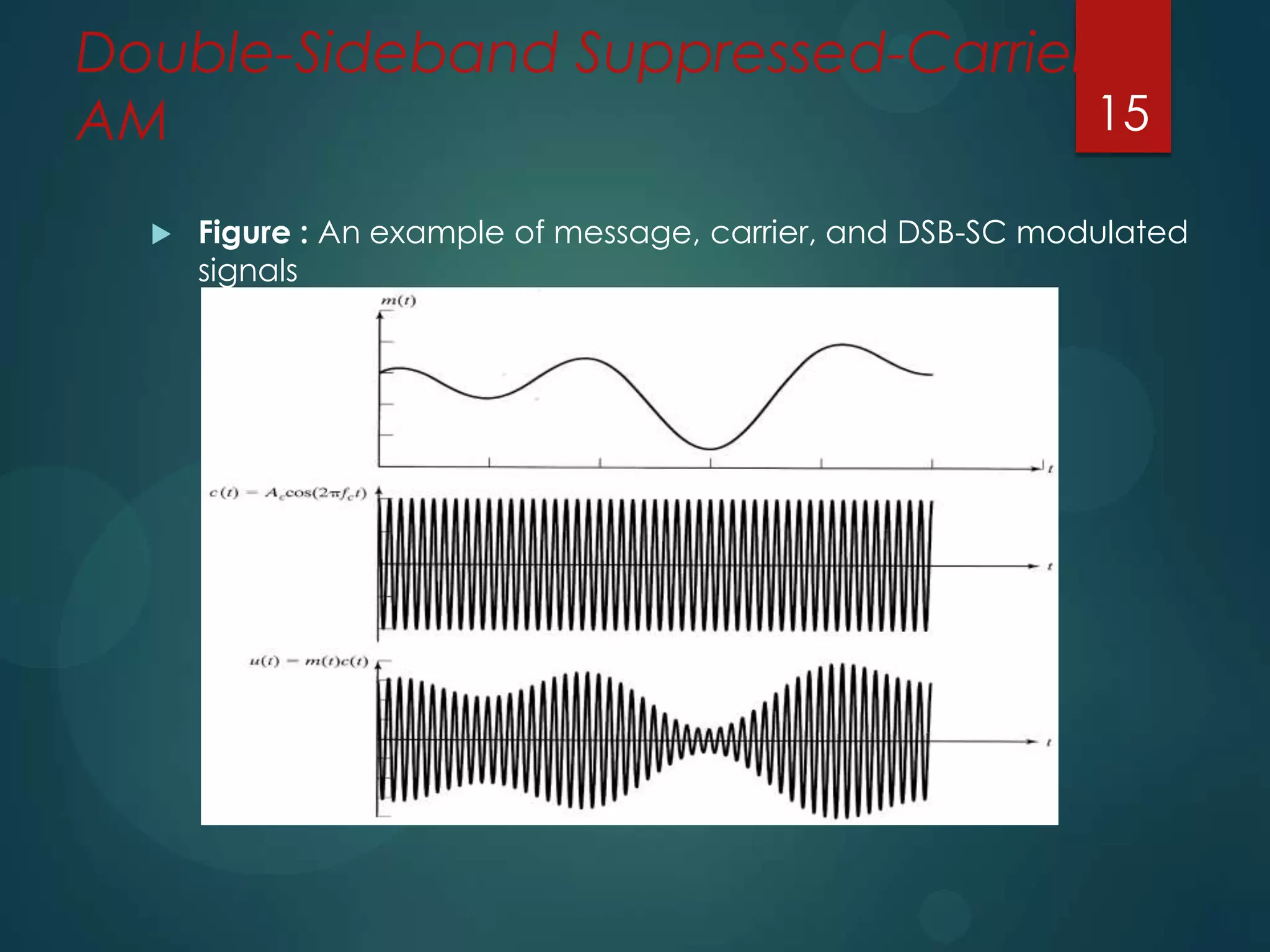
An example of the message signal m(t), the carrier c(t), and the
modulated signal u (t) are shown in fig in next slide.



This figure shows that a relatively slowly varying message signal m(t) is
changed into a rapidly varying modulated signal u(t), and due to its
rapid changes with time, it contains higher frequency components



At the same time, the modulated signal retains the main characteristics
of the message signal; therefore, it can be used to retrieve the message
signal at the receiver
Double-Sideband Suppressed-Carrier
15
AM


Figure : An example of message, carrier, and DSB-SC modulated
signals
16

Single-Sideband AM
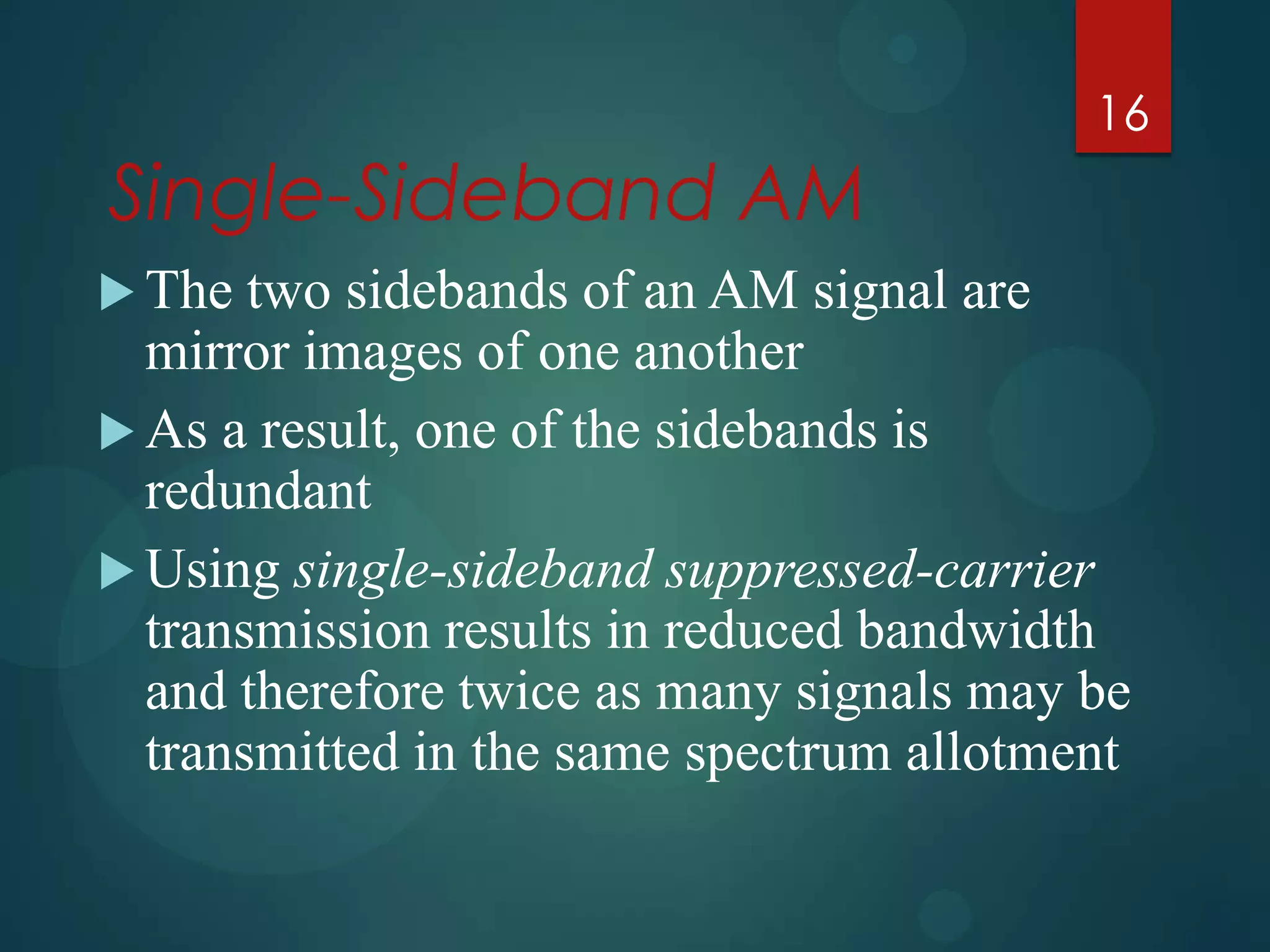
 The

two sidebands of an AM signal are
mirror images of one another
 As a result, one of the sidebands is
redundant
 Using single-sideband suppressed-carrier
transmission results in reduced bandwidth
and therefore twice as many signals may be
transmitted in the same spectrum allotment
Single-Sideband AM


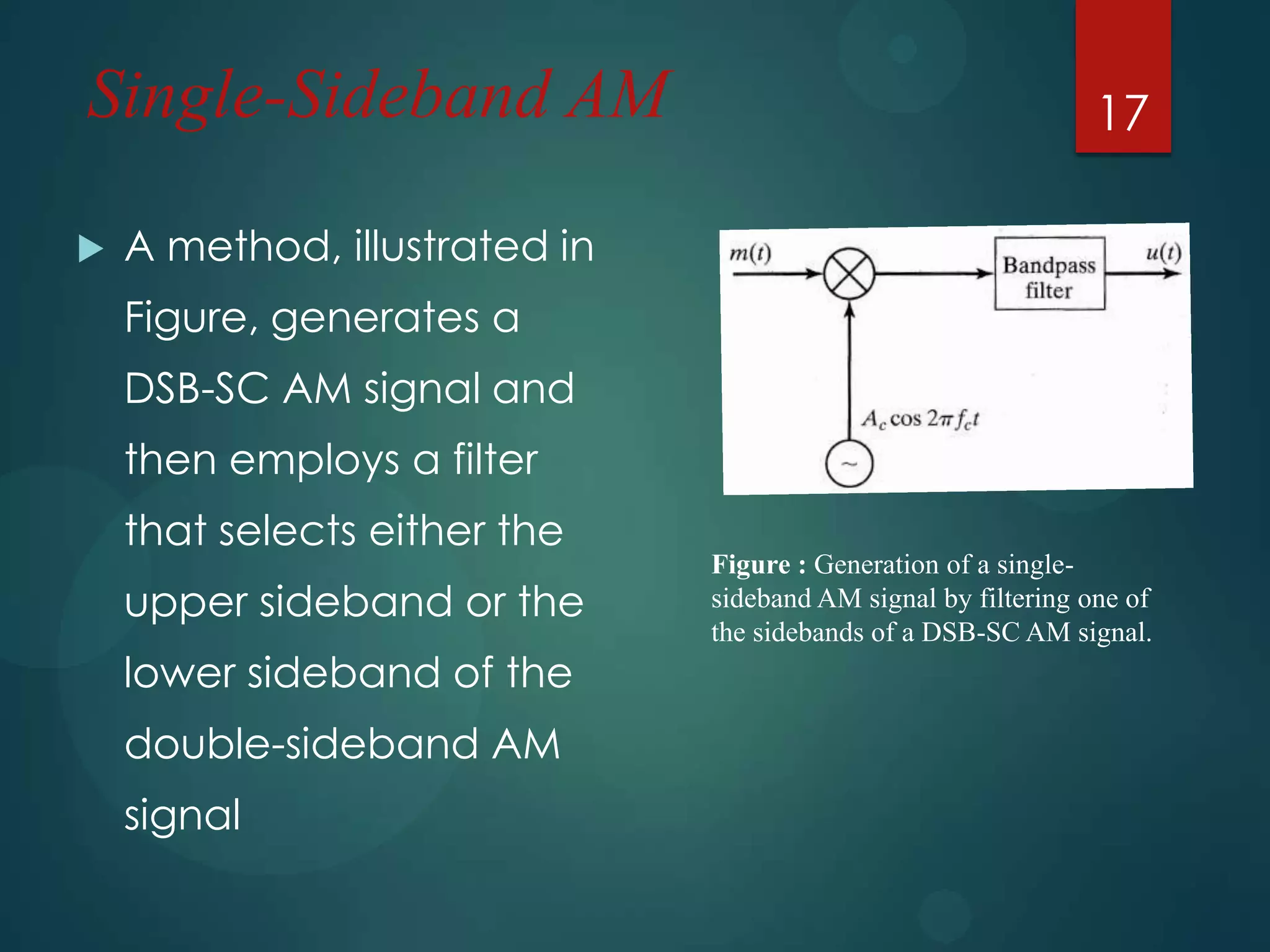
A method, illustrated in

17
.

Figure, generates a
DSB-SC AM signal and
then employs a filter
that selects either the
upper sideband or the
lower sideband of the
double-sideband AM
signal

Figure : Generation of a singlesideband AM signal by filtering one of
the sidebands of a DSB-SC AM signal.
Sideband and carrier power


18

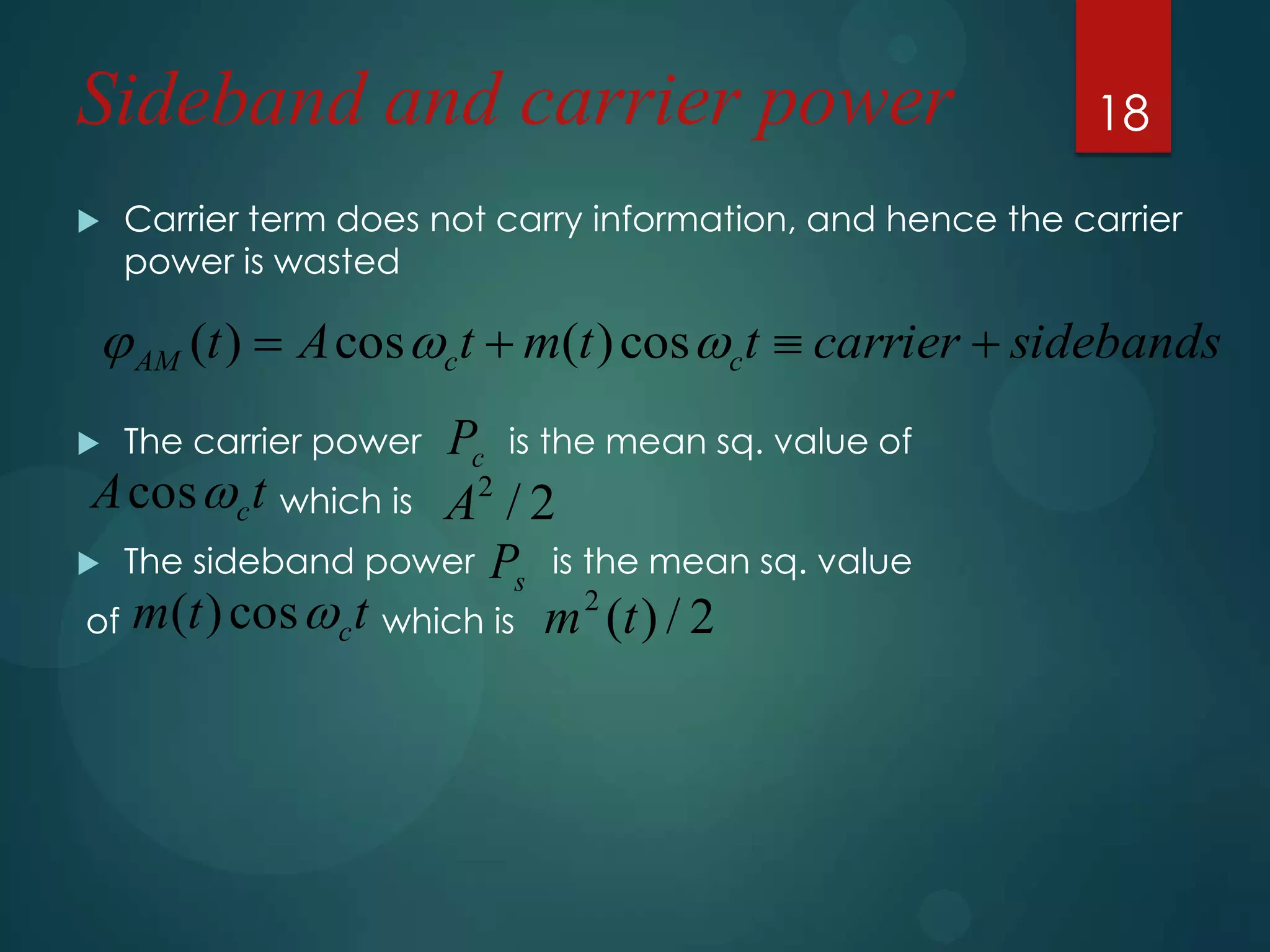
Carrier term does not carry information, and hence the carrier
power is wasted

 AM (t )  A cos ct  m(t ) cos ct  carrier  sidebands
Pc is the mean sq. value of
A cos c t which is A2 / 2
 The sideband power P is the mean sq. value
s
2
of m(t ) cos  c t which is m (t ) / 2


The carrier power
Advantages/disadvantages
20
Advantages of Amplitude Modulation, AM
There are several advantages of amplitude modulation, and some of these
reasons have meant that it is still in widespread use today:


It is simple to implement



it can be demodulated using a circuit consisting of very few components



AM receivers are very cheap as no specialized components are needed.

Disadvantages of amplitude modulation
Amplitude modulation is a very basic form of modulation, and although its
simplicity is one of its major advantages, other more sophisticated systems
provide a number of advantages. Accordingly it is worth looking at some of
the disadvantages of amplitude modulation.


It is not efficient in terms of its power usage



It is not efficient in terms of its use of bandwidth, requiring a bandwidth equal
to twice that of the highest audio frequency



It is prone to high levels of noise because most noise is amplitude based and
obviously AM detectors are sensitive to it.

Amplitude modulation

  • 1.
  • 2.
    What is Modulation 2  Modulation In the modulation process, some characteristic of a high-frequency carrier signal (bandpass), is changed according to the instantaneous amplitude of the information (baseband) signal.  Why Modulation is used  Suitable for signal transmission (distance…etc)  Multiple signals transmitted on the same channel  Capacitive or inductive devices require high frequency AC input (carrier) to operate.  Stability and noise rejection
  • 3.
    About Modulation  3 Application Examples broadcastingof both audio and video signals.  Mobile radio communications, such as cell phone.  • Basic modulation types – Amplitude Modulation: changes the amplitude. – Frequency Modulation: changes the frequency. – Phase Modulation: changes the phase.
  • 4.
    Modulation Theory  4 A sinewave is represented as follows  c(t)= Ac cos(2πfct +φ(t)  Here Ac, fc and φ(t) all represent parameters that can be modulated in the carrier waveform in order to carry information. The modulation schèmes are known as :    Ac -> Amplitude Modulation fc -> Frequency Modulation Φ(t) -> Phase Modulation
  • 5.
    Basic Amplitude Modulation  Amplitude Modulation isthe simplest and earliest form of transmitters  The information signal varies the instantaneous amplitude of the carrier
  • 6.
    Benefits of Modulation  6 Modulationcan shift the spectral content of a message signal into a band which is better suited to the channel  Antennas only efficiently radiate and admit signals whose wavelength is similar to their physical aperture.  Hence, to transmit and receive, say, voice, by radio we need to shift the voice signal to a much higher frequency band.
  • 7.
    7  Modulation permits theuse of multiplexing  Multiplexing means allowing simultaneous communication by multiple users on the same channel.  For instance, the radio frequency spectrum must be shared and modulation allows users to separate themselves into bands.
  • 8.
    AMPLITUDE MODULATION (AM)8  Inamplitude modulation, the message signal m(t) is impressed on the amplitude of the carrier signal c(t) = Accos(2fct)  This results in a sinusoidal signal whose amplitude is a function of the message signal m(t)  There are several different ways of amplitude modulating the carrier signal by m(t)  Each results in different spectral characteristics for the transmitted signal  Mainly these methods are used for AM: (a) Double Sideband with Large carrier AM (DSB-LC AM) (b) Double sideband, suppressed-carrier AM (DSB-SC AM) (c) Single-sideband AM (SSB AM) (d) Vestigial Sideband (VSB) modulation
  • 9.
  • 10.
  • 11.
    Full AM modulation( DSB-LC) 11 1 The carrier signal is sc (t )  Ac cos( c t ) where  c  2f c 2 In the same way, a modulating signal (information signal) can also be expressed as sm (t )  Am cos  m t
  • 12.
    13 3 The amplitude-modulatedwave can be expressed as s(t )  Ac  sm (t )cos(c t ) 4 By substitution s (t )  Ac  Am cos( mt )cos( c t ) 5 The modulation index. Am m  Ac
  • 13.
    13 6 Therefore The fullAM signal may be written as s(t )  Ac (1  m cos( mt )) cos( c t ) cos A cos B  1 / 2[cos(A  B)  cos(A  B)] mAc mAc s(t )  Ac (cos ct )  cos( c   m )t  cos( c   m )t 2 2
  • 14.
    Double-Sideband Suppressed-Carrier AM  14 Adouble-sideband, suppressed-carrier (DSB-SC) AM signal is obtained by multiplying the message signal m(t) with the carrier signal c(t) = Accos(2fct)  Amplitude-modulated signal u (t )  m(t )c(t )  Ac m(t ) cos(2 f c t )  An example of the message signal m(t), the carrier c(t), and the modulated signal u (t) are shown in fig in next slide.  This figure shows that a relatively slowly varying message signal m(t) is changed into a rapidly varying modulated signal u(t), and due to its rapid changes with time, it contains higher frequency components  At the same time, the modulated signal retains the main characteristics of the message signal; therefore, it can be used to retrieve the message signal at the receiver
  • 15.
    Double-Sideband Suppressed-Carrier 15 AM  Figure :An example of message, carrier, and DSB-SC modulated signals
  • 16.
    16 Single-Sideband AM  The twosidebands of an AM signal are mirror images of one another  As a result, one of the sidebands is redundant  Using single-sideband suppressed-carrier transmission results in reduced bandwidth and therefore twice as many signals may be transmitted in the same spectrum allotment
  • 17.
    Single-Sideband AM  A method,illustrated in 17 . Figure, generates a DSB-SC AM signal and then employs a filter that selects either the upper sideband or the lower sideband of the double-sideband AM signal Figure : Generation of a singlesideband AM signal by filtering one of the sidebands of a DSB-SC AM signal.
  • 18.
    Sideband and carrierpower  18 Carrier term does not carry information, and hence the carrier power is wasted  AM (t )  A cos ct  m(t ) cos ct  carrier  sidebands Pc is the mean sq. value of A cos c t which is A2 / 2  The sideband power P is the mean sq. value s 2 of m(t ) cos  c t which is m (t ) / 2  The carrier power
  • 19.
    Advantages/disadvantages 20 Advantages of AmplitudeModulation, AM There are several advantages of amplitude modulation, and some of these reasons have meant that it is still in widespread use today:  It is simple to implement  it can be demodulated using a circuit consisting of very few components  AM receivers are very cheap as no specialized components are needed. Disadvantages of amplitude modulation Amplitude modulation is a very basic form of modulation, and although its simplicity is one of its major advantages, other more sophisticated systems provide a number of advantages. Accordingly it is worth looking at some of the disadvantages of amplitude modulation.  It is not efficient in terms of its power usage  It is not efficient in terms of its use of bandwidth, requiring a bandwidth equal to twice that of the highest audio frequency  It is prone to high levels of noise because most noise is amplitude based and obviously AM detectors are sensitive to it.