1

Principles of Electronic
Communication Systems
Third Edition
Louis E. Frenzel, Jr.

© 2008 The McGraw-Hill Companies
2

Chapter 3

Amplitude Modulation Fundamentals
3

Topics Covered in Chapter 3
 3-1: AM Concepts
 3-2: Modulation Index and Percentage of

Modulation
 3-3: Sidebands and the Frequency
Domain
 3-4: AM Power
 3-5: Single-Sideband Modulation
 3-6: Classification of Radio Emissions

© 2008 The McGraw-Hill Companies
4

3-1: AM Concepts
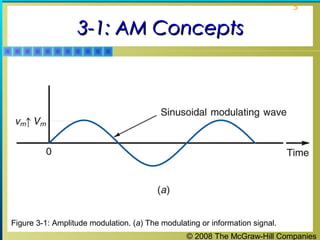
 In the modulation process, the voice, video,

or digital signal modifies another signal called
the carrier.
 In
amplitude modulation (AM) the
information signal varies the amplitude of the
carrier sine wave.
 The instantaneous value of the carrier
amplitude changes in accordance with the
amplitude and frequency variations of the
modulating signal.
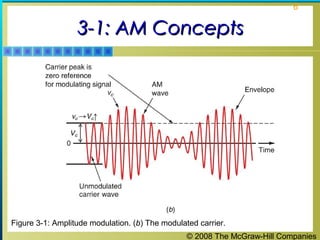
 An imaginary line called the envelope
connects the positive and negative peaks of
the carrier waveform.

© 2008 The McGraw-Hill Companies
5

3-1: AM Concepts

Figure 3-1: Amplitude modulation. (a) The modulating or information signal.
© 2008 The McGraw-Hill Companies
6

3-1: AM Concepts

Figure 3-1: Amplitude modulation. (b) The modulated carrier.
© 2008 The McGraw-Hill Companies
7

3-1: AM Concepts
 In AM, it is particularly important that the peak

value of the modulating signal be less than
the peak value of the carrier.
Vm < Vc
 Distortion occurs when the amplitude of the
modulating signal is greater than the
amplitude of the carrier.
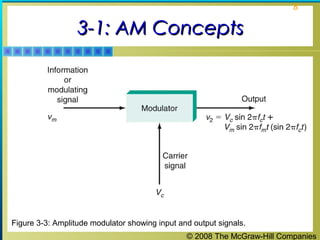
 A modulator is a circuit used to produce AM.
Amplitude modulators compute the product of
the carrier and modulating signals.
© 2008 The McGraw-Hill Companies
8

3-1: AM Concepts

Figure 3-3: Amplitude modulator showing input and output signals.
© 2008 The McGraw-Hill Companies
3-2: Modulation Index and
Percentage of Modulation

9

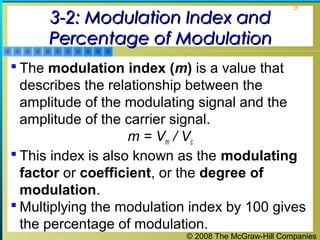
 The modulation index (m) is a value that

describes the relationship between the
amplitude of the modulating signal and the
amplitude of the carrier signal.
m = Vm / Vc
 This index is also known as the modulating
factor or coefficient, or the degree of
modulation.
 Multiplying the modulation index by 100 gives
the percentage of modulation.
© 2008 The McGraw-Hill Companies
3-2: Modulation Index and
Percentage of Modulation

10

Overmodulation and Distortion
 The modulation index should be a
number between 0 and 1.
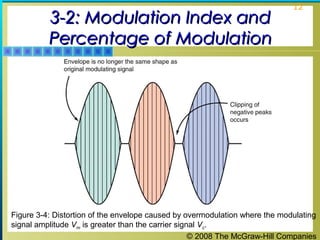
 If the amplitude of the modulating
voltage is higher than the carrier
voltage, m will be greater than 1,
causing distortion.
 If the distortion is great enough, the
intelligence
signal
becomes
unintelligible.
© 2008 The McGraw-Hill Companies
3-2: Modulation Index and
Percentage of Modulation

11

Overmodulation and Distortion
 Distortion of voice transmissions
produces garbled, harsh, or
unnatural sounds in the speaker.
 Distortion
of
video
signals
produces
a
scrambled
and
inaccurate picture on a TV screen.
© 2008 The McGraw-Hill Companies
3-2: Modulation Index and
Percentage of Modulation

12

Figure 3-4: Distortion of the envelope caused by overmodulation where the modulating
signal amplitude Vm is greater than the carrier signal Vc.
© 2008 The McGraw-Hill Companies
3-2: Modulation Index and
Percentage of Modulation

13

Percentage of Modulation
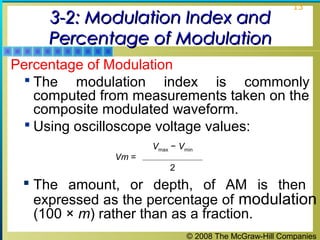
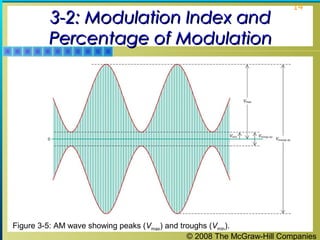
 The modulation index is commonly
computed from measurements taken on the
composite modulated waveform.
 Using oscilloscope voltage values:
Vm =

Vmax − Vmin
2

 The amount, or depth, of AM is then
expressed as the percentage of modulation
(100 × m) rather than as a fraction.
© 2008 The McGraw-Hill Companies
3-2: Modulation Index and
Percentage of Modulation

14

Figure 3-5: AM wave showing peaks (Vmax) and troughs (Vmin).
© 2008 The McGraw-Hill Companies
3-3: Sidebands and
the Frequency Domain

15

Side frequencies, or sidebands

are generated as part of the
modulation process and occur in
the frequency spectrum directly
above and below the carrier
frequency.
© 2008 The McGraw-Hill Companies
3-3: Sidebands and
the Frequency Domain

16

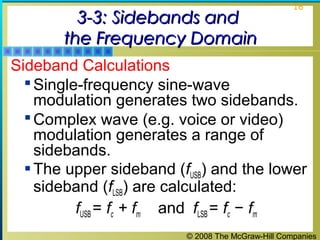
Sideband Calculations
 Single-frequency sine-wave
modulation generates two sidebands.
 Complex wave (e.g. voice or video)
modulation generates a range of
sidebands.
 The upper sideband (fUSB) and the lower
sideband (fLSB) are calculated:
fUSB = fc + fm and fLSB = fc − fm
© 2008 The McGraw-Hill Companies
3-3: Sidebands and
the Frequency Domain

17

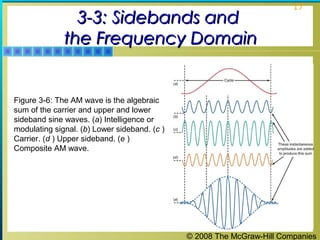
Figure 3-6: The AM wave is the algebraic
sum of the carrier and upper and lower
sideband sine waves. (a) Intelligence or
modulating signal. (b) Lower sideband. (c )
Carrier. (d ) Upper sideband. (e )
Composite AM wave.
© 2008 The McGraw-Hill Companies
3-3: Sidebands and
the Frequency Domain

18

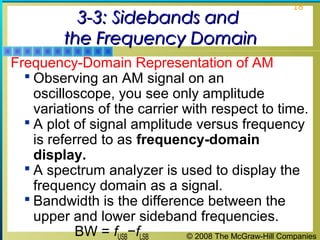
Frequency-Domain Representation of AM
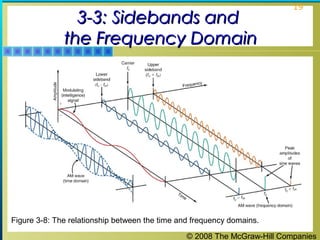
 Observing an AM signal on an
oscilloscope, you see only amplitude
variations of the carrier with respect to time.
 A plot of signal amplitude versus frequency
is referred to as frequency-domain
display.
 A spectrum analyzer is used to display the
frequency domain as a signal.
 Bandwidth is the difference between the
upper and lower sideband frequencies.
BW = fUSB−fLSB
© 2008 The McGraw-Hill Companies
3-3: Sidebands and
the Frequency Domain

19

Figure 3-8: The relationship between the time and frequency domains.
© 2008 The McGraw-Hill Companies
3-3: Sidebands and
the Frequency Domain

20

Frequency-Domain Representation of AM
 Example:
A standard AM broadcast station is allowed to
transmit modulating frequencies up to 5 kHz. If the
AM station is transmitting on a frequency of 980
kHz, what are sideband frequencies and total
bandwidth?
fUSB = 980 + 5 = 985 kHz
fLSB = 980 – 5 = 975 kHz
BW = fUSB – fLSB = 985 – 975 = 10 kHz
BW = 2 (5 kHz) = 10 kHz
© 2008 The McGraw-Hill Companies
3-3: Sidebands and
the Frequency Domain

21

Pulse Modulation:
 When complex signals such as pulses or
rectangular waves modulate a carrier, a broad
spectrum of sidebands is produced.
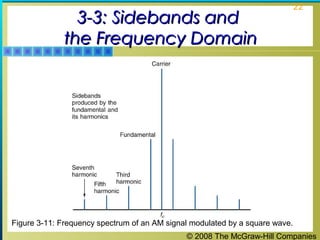
 A modulating square wave will produce sidebands
based on the fundamental sine wave as well as
the third, fifth, seventh, etc. harmonics.
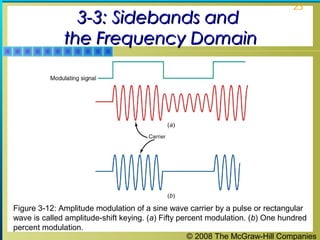
 Amplitude modulation by square waves or
rectangular pulses is referred to as amplitude
shift keying (ASK).
 ASK is used in some types of data
communications.
© 2008 The McGraw-Hill Companies
3-3: Sidebands and
the Frequency Domain

22

Figure 3-11: Frequency spectrum of an AM signal modulated by a square wave.
© 2008 The McGraw-Hill Companies
3-3: Sidebands and
the Frequency Domain

23

Figure 3-12: Amplitude modulation of a sine wave carrier by a pulse or rectangular
wave is called amplitude-shift keying. (a) Fifty percent modulation. (b) One hundred
percent modulation.
© 2008 The McGraw-Hill Companies
3-3: Sidebands and
the Frequency Domain

24

Pulse Modulation:
 Continuous-wave (CW)
transmission can be achieved by
turning the carrier off and on, as in
Morse code transmission.
 Continuous wave (CW)
transmission is sometimes referred
to as On-Off keying (OOK).
 Splatter is a term used to describe
harmonic sideband interference.
© 2008 The McGraw-Hill Companies
25

3-4: AM Power
 In radio transmission, the AM signal is

amplified by a power amplifier.
 A radio antenna has a characteristic
impedance that is ideally almost pure
resistance.
 The AM signal is a composite of the
carrier and sideband signal voltages.
 Each signal produces power in the
antenna.
 Total transmitted power (PT) is the sum
of carrier power (Pc ) and power of the

© 2008 The McGraw-Hill Companies
26

3-4: AM Power
 When the percentage of modulation is

less than the optimum 100, there is
much less power in the sidebands.
 Output power can be calculated by using
the formula
PT = (IT)2R
where IT is measured RF current and R
is antenna impedance
© 2008 The McGraw-Hill Companies
27

3-4: AM Power
 The greater the percentage of

modulation, the higher the sideband
power and the higher the total power
transmitted.
 Power in each sideband is calculated
PSB = PLSB = PUSB = Pcm2 / 4
 Maximum power appears in the
sidebands when the carrier is 100
© 2008 The McGraw-Hill Companies
28

3-5: Single-Sideband Modulation
 In amplitude modulation, two-thirds of

the transmitted power is in the carrier,
which conveys no information.
 Signal information is contained within the
sidebands.
 Single-sideband (SSB) is a form of AM
where the carrier is suppressed and one
sideband is eliminated.
© 2008 The McGraw-Hill Companies
29

3-5: Single-Sideband Modulation
DSB Signals:
 The first step in generating an SSB signal is
to suppress the carrier, leaving the upper
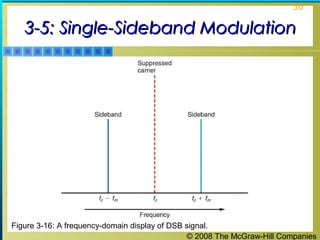
and lower sidebands.
 This type of signal is called a doublesideband suppressed carrier (DSSC)
signal. No power is wasted on the carrier.
 A balanced modulator is a circuit used to
produce the sum and difference frequencies
of a DSSC signal but to cancel or balance
out the carrier.
 DSB is not widely used because the signal is

difficult to demodulate (recover) at the receiver .

© 2008 The McGraw-Hill Companies
30

3-5: Single-Sideband Modulation

Figure 3-16: A frequency-domain display of DSB signal.
© 2008 The McGraw-Hill Companies
31

3-5: Single-Sideband Modulation

SSB Signals
 One sideband is all that is
necessary to convey information in
a signal.
 A single-sideband suppressed
carrier (SSSC) signal is generated
by suppressing the carrier and one
sideband.
© 2008 The McGraw-Hill Companies
32

3-5: Single-Sideband Modulation

SSB Signals

SSB signals offer four major benefits:
1. Spectrum space is conserved and
allows more signals to be transmitted
in the same frequency range.
2. All power is channeled into a single
sideband. This produces a stronger
signal that will carry farther and will
be more reliably received at greater
distances.
© 2008 The McGraw-Hill Companies
33

3-5: Single-Sideband Modulation

SSB Signals
3. Occupied bandwidth space is
narrower and noise in the
signal is reduced.
4. There is less selective fading
over long distances.
© 2008 The McGraw-Hill Companies
34

3-5: Single-Sideband Modulation

Disadvantages of DSB and SSB

 Single and double-sideband are

not widely used because the
signals are difficult to recover (i.e.
demodulate) at the receiver.
 A low power, pilot carrier is
sometimes transmitted along with
sidebands in order to more easily
recover the signal at the receiver.
© 2008 The McGraw-Hill Companies
35

3-5: Single-Sideband Modulation
Signal Power Considerations
 In SSB, the transmitter output is
expressed in terms of peak envelope
power (PEP), the maximum power
produced on voice amplitude peaks.
Applications of DSB and SSB
 A vestigial sideband signal (VSB) is
produced by partially suppressing the
lower sideband. This kind of signal is
used in TV transmission.
© 2008 The McGraw-Hill Companies
3-6: Classification of
Radio Emissions

36

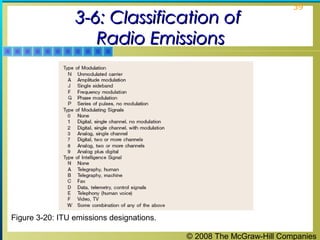
 A code is used to designate the types of signals that

can be transmitted by radio and wire.
 The code is made up of a capital letter and a number.
 Lowercase subscript letters are used for more specific
definition.
 Examples of codes:
 DSB two sidebands, full carrier = A3
 DSB two sidebands, suppressed carrier = A3b
 OOK and ASK = A1

© 2008 The McGraw-Hill Companies
3-6: Classification of
Radio Emissions

37

 The International

Telecommunications Union (ITU),
a standards organization, uses a code to describe
signals.
 Examples are:
 A3F
 J3E
 F2D
 G7E

amplitude-modulated analog TV
SSB voice
FSK data
phase-modulated voice, multiple signals
© 2008 The McGraw-Hill Companies
3-6: Classification of
Radio Emissions

38

Figure 3-19: Radio emission code designations.
© 2008 The McGraw-Hill Companies
3-6: Classification of
Radio Emissions

39

Figure 3-20: ITU emissions designations.
© 2008 The McGraw-Hill Companies

Chapter03 am

  • 1.
    1 Principles of Electronic CommunicationSystems Third Edition Louis E. Frenzel, Jr. © 2008 The McGraw-Hill Companies
  • 2.
  • 3.
    3 Topics Covered inChapter 3  3-1: AM Concepts  3-2: Modulation Index and Percentage of Modulation  3-3: Sidebands and the Frequency Domain  3-4: AM Power  3-5: Single-Sideband Modulation  3-6: Classification of Radio Emissions © 2008 The McGraw-Hill Companies
  • 4.
    4 3-1: AM Concepts In the modulation process, the voice, video, or digital signal modifies another signal called the carrier.  In amplitude modulation (AM) the information signal varies the amplitude of the carrier sine wave.  The instantaneous value of the carrier amplitude changes in accordance with the amplitude and frequency variations of the modulating signal.  An imaginary line called the envelope connects the positive and negative peaks of the carrier waveform. © 2008 The McGraw-Hill Companies
  • 5.
    5 3-1: AM Concepts Figure3-1: Amplitude modulation. (a) The modulating or information signal. © 2008 The McGraw-Hill Companies
  • 6.
    6 3-1: AM Concepts Figure3-1: Amplitude modulation. (b) The modulated carrier. © 2008 The McGraw-Hill Companies
  • 7.
    7 3-1: AM Concepts In AM, it is particularly important that the peak value of the modulating signal be less than the peak value of the carrier. Vm < Vc  Distortion occurs when the amplitude of the modulating signal is greater than the amplitude of the carrier.  A modulator is a circuit used to produce AM. Amplitude modulators compute the product of the carrier and modulating signals. © 2008 The McGraw-Hill Companies
  • 8.
    8 3-1: AM Concepts Figure3-3: Amplitude modulator showing input and output signals. © 2008 The McGraw-Hill Companies
  • 9.
    3-2: Modulation Indexand Percentage of Modulation 9  The modulation index (m) is a value that describes the relationship between the amplitude of the modulating signal and the amplitude of the carrier signal. m = Vm / Vc  This index is also known as the modulating factor or coefficient, or the degree of modulation.  Multiplying the modulation index by 100 gives the percentage of modulation. © 2008 The McGraw-Hill Companies
  • 10.
    3-2: Modulation Indexand Percentage of Modulation 10 Overmodulation and Distortion  The modulation index should be a number between 0 and 1.  If the amplitude of the modulating voltage is higher than the carrier voltage, m will be greater than 1, causing distortion.  If the distortion is great enough, the intelligence signal becomes unintelligible. © 2008 The McGraw-Hill Companies
  • 11.
    3-2: Modulation Indexand Percentage of Modulation 11 Overmodulation and Distortion  Distortion of voice transmissions produces garbled, harsh, or unnatural sounds in the speaker.  Distortion of video signals produces a scrambled and inaccurate picture on a TV screen. © 2008 The McGraw-Hill Companies
  • 12.
    3-2: Modulation Indexand Percentage of Modulation 12 Figure 3-4: Distortion of the envelope caused by overmodulation where the modulating signal amplitude Vm is greater than the carrier signal Vc. © 2008 The McGraw-Hill Companies
  • 13.
    3-2: Modulation Indexand Percentage of Modulation 13 Percentage of Modulation  The modulation index is commonly computed from measurements taken on the composite modulated waveform.  Using oscilloscope voltage values: Vm = Vmax − Vmin 2  The amount, or depth, of AM is then expressed as the percentage of modulation (100 × m) rather than as a fraction. © 2008 The McGraw-Hill Companies
  • 14.
    3-2: Modulation Indexand Percentage of Modulation 14 Figure 3-5: AM wave showing peaks (Vmax) and troughs (Vmin). © 2008 The McGraw-Hill Companies
  • 15.
    3-3: Sidebands and theFrequency Domain 15 Side frequencies, or sidebands are generated as part of the modulation process and occur in the frequency spectrum directly above and below the carrier frequency. © 2008 The McGraw-Hill Companies
  • 16.
    3-3: Sidebands and theFrequency Domain 16 Sideband Calculations  Single-frequency sine-wave modulation generates two sidebands.  Complex wave (e.g. voice or video) modulation generates a range of sidebands.  The upper sideband (fUSB) and the lower sideband (fLSB) are calculated: fUSB = fc + fm and fLSB = fc − fm © 2008 The McGraw-Hill Companies
  • 17.
    3-3: Sidebands and theFrequency Domain 17 Figure 3-6: The AM wave is the algebraic sum of the carrier and upper and lower sideband sine waves. (a) Intelligence or modulating signal. (b) Lower sideband. (c ) Carrier. (d ) Upper sideband. (e ) Composite AM wave. © 2008 The McGraw-Hill Companies
  • 18.
    3-3: Sidebands and theFrequency Domain 18 Frequency-Domain Representation of AM  Observing an AM signal on an oscilloscope, you see only amplitude variations of the carrier with respect to time.  A plot of signal amplitude versus frequency is referred to as frequency-domain display.  A spectrum analyzer is used to display the frequency domain as a signal.  Bandwidth is the difference between the upper and lower sideband frequencies. BW = fUSB−fLSB © 2008 The McGraw-Hill Companies
  • 19.
    3-3: Sidebands and theFrequency Domain 19 Figure 3-8: The relationship between the time and frequency domains. © 2008 The McGraw-Hill Companies
  • 20.
    3-3: Sidebands and theFrequency Domain 20 Frequency-Domain Representation of AM  Example: A standard AM broadcast station is allowed to transmit modulating frequencies up to 5 kHz. If the AM station is transmitting on a frequency of 980 kHz, what are sideband frequencies and total bandwidth? fUSB = 980 + 5 = 985 kHz fLSB = 980 – 5 = 975 kHz BW = fUSB – fLSB = 985 – 975 = 10 kHz BW = 2 (5 kHz) = 10 kHz © 2008 The McGraw-Hill Companies
  • 21.
    3-3: Sidebands and theFrequency Domain 21 Pulse Modulation:  When complex signals such as pulses or rectangular waves modulate a carrier, a broad spectrum of sidebands is produced.  A modulating square wave will produce sidebands based on the fundamental sine wave as well as the third, fifth, seventh, etc. harmonics.  Amplitude modulation by square waves or rectangular pulses is referred to as amplitude shift keying (ASK).  ASK is used in some types of data communications. © 2008 The McGraw-Hill Companies
  • 22.
    3-3: Sidebands and theFrequency Domain 22 Figure 3-11: Frequency spectrum of an AM signal modulated by a square wave. © 2008 The McGraw-Hill Companies
  • 23.
    3-3: Sidebands and theFrequency Domain 23 Figure 3-12: Amplitude modulation of a sine wave carrier by a pulse or rectangular wave is called amplitude-shift keying. (a) Fifty percent modulation. (b) One hundred percent modulation. © 2008 The McGraw-Hill Companies
  • 24.
    3-3: Sidebands and theFrequency Domain 24 Pulse Modulation:  Continuous-wave (CW) transmission can be achieved by turning the carrier off and on, as in Morse code transmission.  Continuous wave (CW) transmission is sometimes referred to as On-Off keying (OOK).  Splatter is a term used to describe harmonic sideband interference. © 2008 The McGraw-Hill Companies
  • 25.
    25 3-4: AM Power In radio transmission, the AM signal is amplified by a power amplifier.  A radio antenna has a characteristic impedance that is ideally almost pure resistance.  The AM signal is a composite of the carrier and sideband signal voltages.  Each signal produces power in the antenna.  Total transmitted power (PT) is the sum of carrier power (Pc ) and power of the © 2008 The McGraw-Hill Companies
  • 26.
    26 3-4: AM Power When the percentage of modulation is less than the optimum 100, there is much less power in the sidebands.  Output power can be calculated by using the formula PT = (IT)2R where IT is measured RF current and R is antenna impedance © 2008 The McGraw-Hill Companies
  • 27.
    27 3-4: AM Power The greater the percentage of modulation, the higher the sideband power and the higher the total power transmitted.  Power in each sideband is calculated PSB = PLSB = PUSB = Pcm2 / 4  Maximum power appears in the sidebands when the carrier is 100 © 2008 The McGraw-Hill Companies
  • 28.
    28 3-5: Single-Sideband Modulation In amplitude modulation, two-thirds of the transmitted power is in the carrier, which conveys no information.  Signal information is contained within the sidebands.  Single-sideband (SSB) is a form of AM where the carrier is suppressed and one sideband is eliminated. © 2008 The McGraw-Hill Companies
  • 29.
    29 3-5: Single-Sideband Modulation DSBSignals:  The first step in generating an SSB signal is to suppress the carrier, leaving the upper and lower sidebands.  This type of signal is called a doublesideband suppressed carrier (DSSC) signal. No power is wasted on the carrier.  A balanced modulator is a circuit used to produce the sum and difference frequencies of a DSSC signal but to cancel or balance out the carrier.  DSB is not widely used because the signal is difficult to demodulate (recover) at the receiver . © 2008 The McGraw-Hill Companies
  • 30.
    30 3-5: Single-Sideband Modulation Figure3-16: A frequency-domain display of DSB signal. © 2008 The McGraw-Hill Companies
  • 31.
    31 3-5: Single-Sideband Modulation SSBSignals  One sideband is all that is necessary to convey information in a signal.  A single-sideband suppressed carrier (SSSC) signal is generated by suppressing the carrier and one sideband. © 2008 The McGraw-Hill Companies
  • 32.
    32 3-5: Single-Sideband Modulation SSBSignals SSB signals offer four major benefits: 1. Spectrum space is conserved and allows more signals to be transmitted in the same frequency range. 2. All power is channeled into a single sideband. This produces a stronger signal that will carry farther and will be more reliably received at greater distances. © 2008 The McGraw-Hill Companies
  • 33.
    33 3-5: Single-Sideband Modulation SSBSignals 3. Occupied bandwidth space is narrower and noise in the signal is reduced. 4. There is less selective fading over long distances. © 2008 The McGraw-Hill Companies
  • 34.
    34 3-5: Single-Sideband Modulation Disadvantagesof DSB and SSB  Single and double-sideband are not widely used because the signals are difficult to recover (i.e. demodulate) at the receiver.  A low power, pilot carrier is sometimes transmitted along with sidebands in order to more easily recover the signal at the receiver. © 2008 The McGraw-Hill Companies
  • 35.
    35 3-5: Single-Sideband Modulation SignalPower Considerations  In SSB, the transmitter output is expressed in terms of peak envelope power (PEP), the maximum power produced on voice amplitude peaks. Applications of DSB and SSB  A vestigial sideband signal (VSB) is produced by partially suppressing the lower sideband. This kind of signal is used in TV transmission. © 2008 The McGraw-Hill Companies
  • 36.
    3-6: Classification of RadioEmissions 36  A code is used to designate the types of signals that can be transmitted by radio and wire.  The code is made up of a capital letter and a number.  Lowercase subscript letters are used for more specific definition.  Examples of codes:  DSB two sidebands, full carrier = A3  DSB two sidebands, suppressed carrier = A3b  OOK and ASK = A1 © 2008 The McGraw-Hill Companies
  • 37.
    3-6: Classification of RadioEmissions 37  The International Telecommunications Union (ITU), a standards organization, uses a code to describe signals.  Examples are:  A3F  J3E  F2D  G7E amplitude-modulated analog TV SSB voice FSK data phase-modulated voice, multiple signals © 2008 The McGraw-Hill Companies
  • 38.
    3-6: Classification of RadioEmissions 38 Figure 3-19: Radio emission code designations. © 2008 The McGraw-Hill Companies
  • 39.
    3-6: Classification of RadioEmissions 39 Figure 3-20: ITU emissions designations. © 2008 The McGraw-Hill Companies