*
We use the term modulation to refer to
changes made in a carrier
-according to the information being sent
Modulation takes two inputs
-a carrier
-and a signal
* MSK FSK ASK
* Shift Keying
To distinguish between analog and digital
modulation
-We use the term shift keying rather
than modulation
*
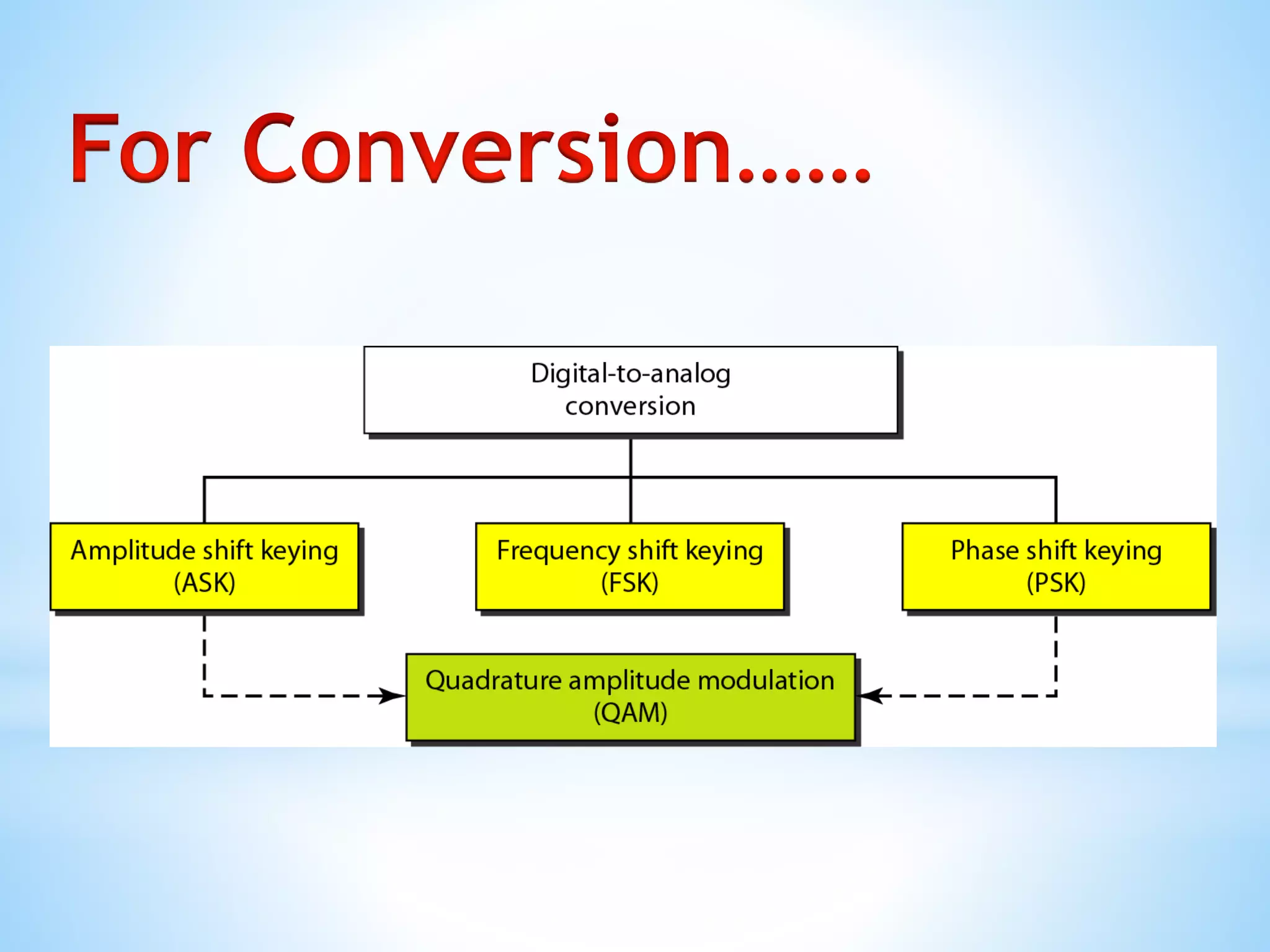
 ASK is the abbreviation of Amplitude
Shift Keying
 Ask is called On-Off Keying.
 The simplest and most common form
of operate as a switch.
*
 It is Abbreviated as Frequency shift keying
 Values represented by different frequencies (near
carrier)
 Less susceptible to error than ASK
 Typically used up to 1200bps on voice grade lines
 High frequency radio
 Even higher frequency on LANs using co-ax
*
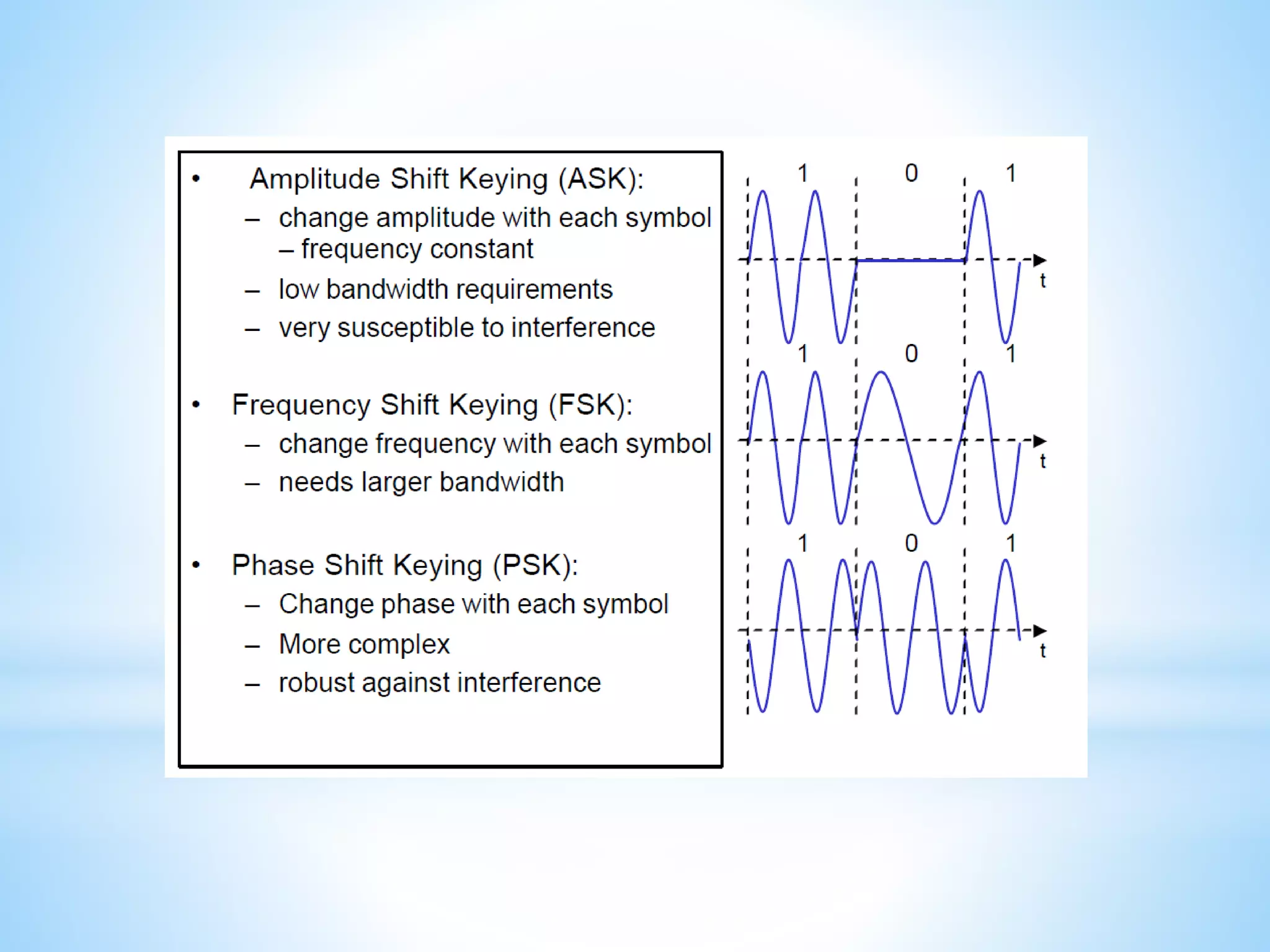
Amplitude and frequency modulations require at least one cycle
of a carrier wave to send a single bit
unless a special encoding scheme is used
The number of bits sent per unit time can be increased
if the encoding scheme permits multiple bits to be encoded in a
single cycle of the carrier
Data communications systems often use techniques that can
send more bits
PSK changes the phase of the carrier wave abruptly
each such change is called a phase shift
* Phase of carrier signal is shifted to represent data
Quadrature amplitude modulation is a
combination of ASK and PSK.
Note
*
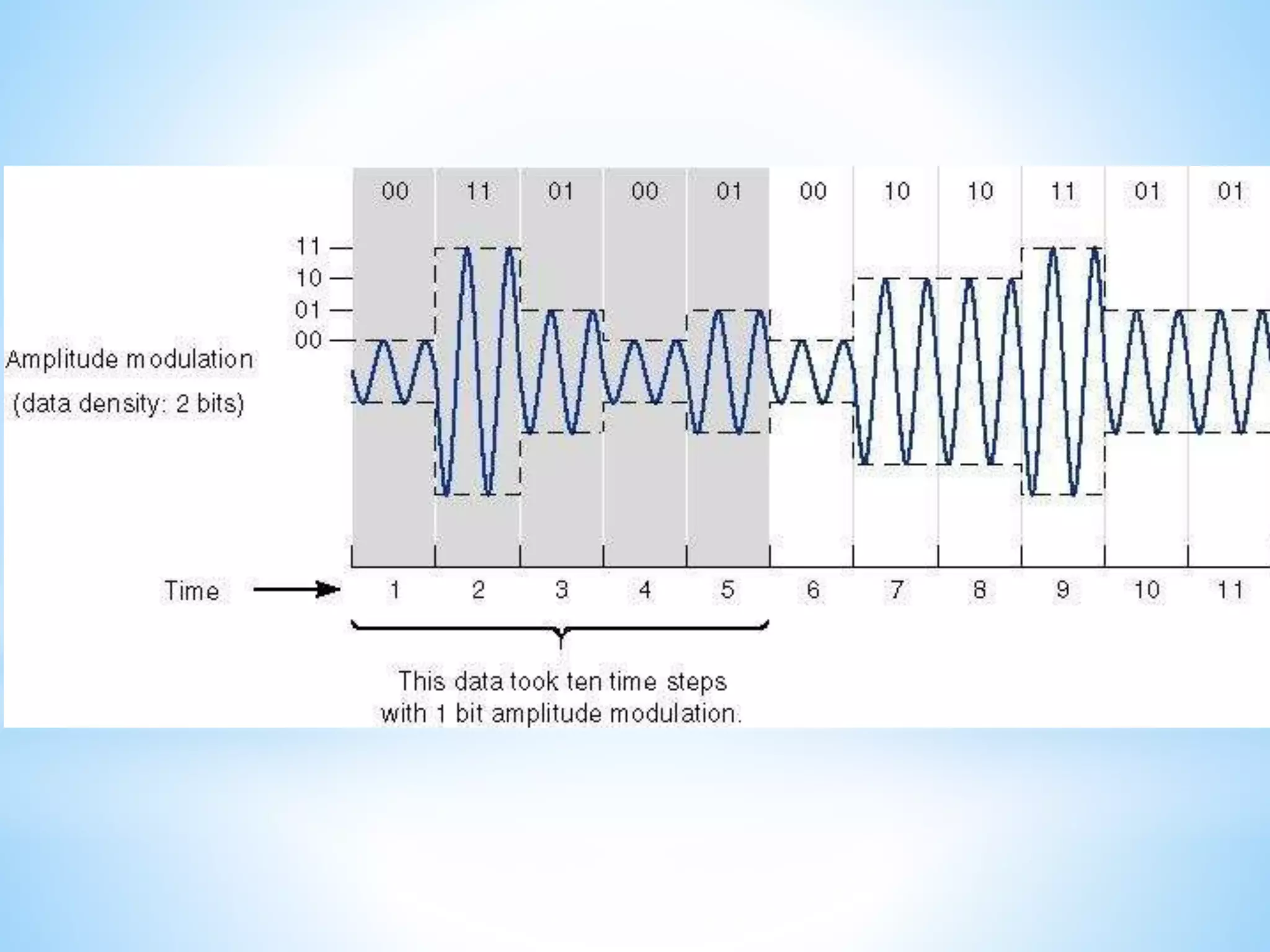
To send more than one bit at a time
It is possible to send two bits on
one wave by defining four different
amplitudes.
The same approach can be used for
frequency and phase modulation.
In practice, the maximum number of bits that can
be sent with any one of these techniques is about
five bits. The solution is to combine modulation
techniques.
One popular technique is quadrature amplitude
modulation (QAM) involves splitting the signal
into eight different phases, and two different
amplitude for a total of 16 different possible
values, giving us lg(16) or 4 bits per value.
*
*
*Minimum Shift Keying
MSK is a variant of OQPSK
The rectangular symbol pulse is replaced by a half cycle
sinusoidal symbol pulse.
MSK provides a constant envelope signal which has it’s phase
continuous at all times including the interbit switching
times.
 In MSK, also the phase shifts can be detected with an I or Q
modulator.
 At even numbered symbols, the polarity of I channel conveys
the transmitted data and at odd numbered symbols the polarity
of Q channel conveys the data.
 A phase shift of + 90 degrees represents a data bit equal to 1 and a
phase shift of –90 degrees represents a data bit equal to zero
It possesses properties
such as:
constant envelope
spectral efficiency
good BER
performance
self-synchronizing
capability.
MSK PROPERTIES
*
*
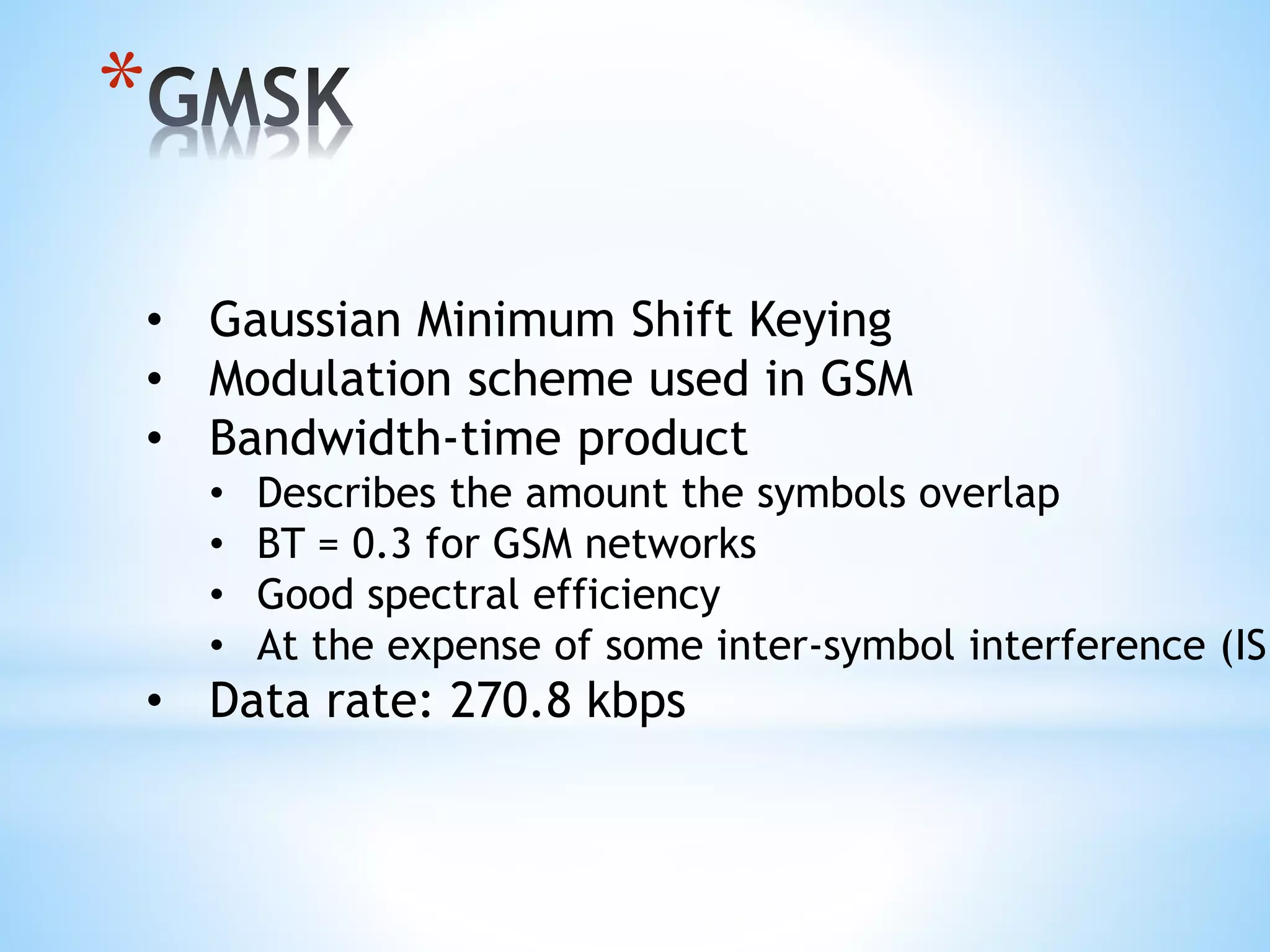
• Gaussian Minimum Shift Keying
• Modulation scheme used in GSM
• Bandwidth-time product
• Describes the amount the symbols overlap
• BT = 0.3 for GSM networks
• Good spectral efficiency
• At the expense of some inter-symbol interference (ISI
• Data rate: 270.8 kbps
*
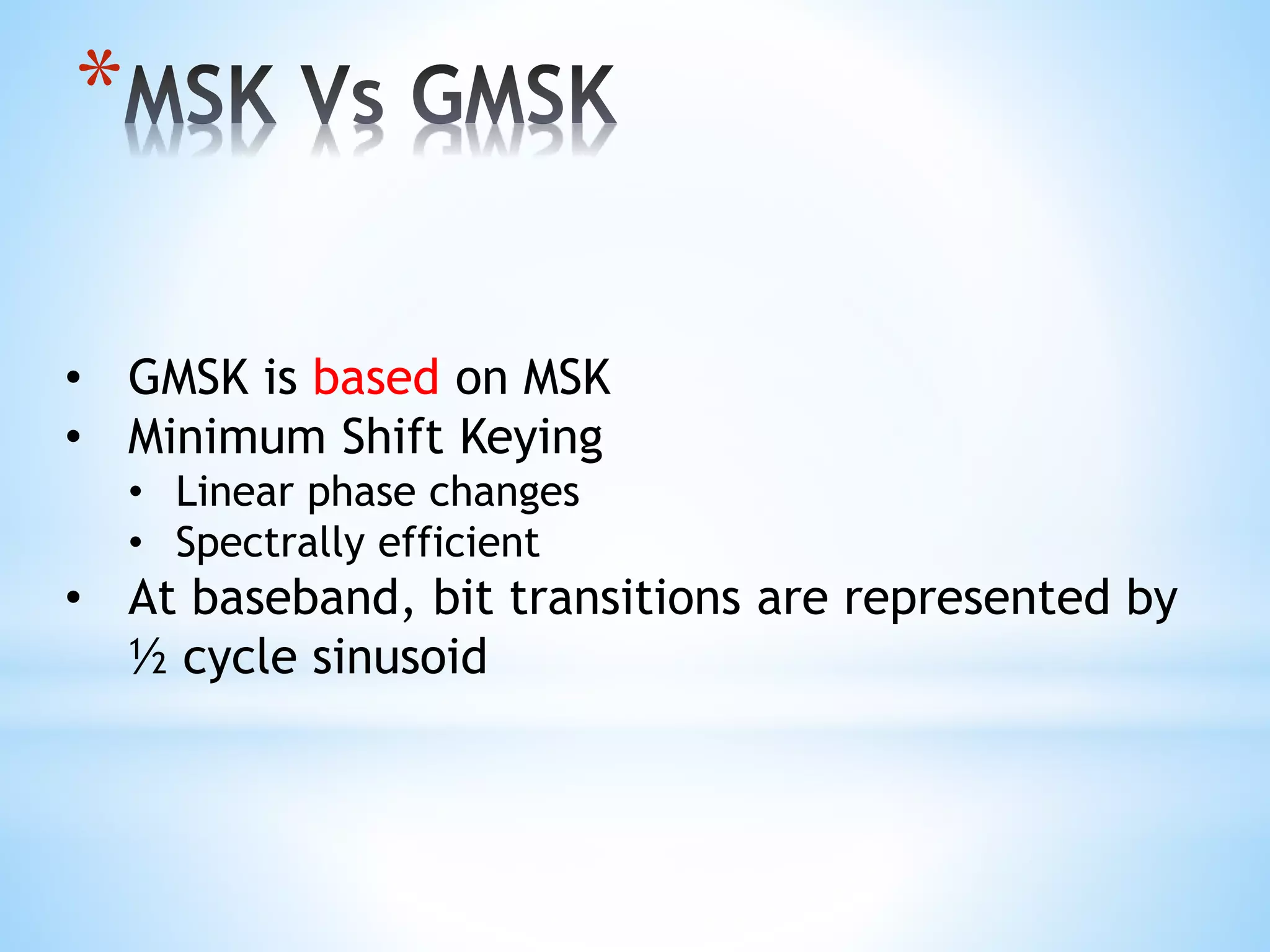
• GMSK is based on MSK
• Minimum Shift Keying
• Linear phase changes
• Spectrally efficient
• At baseband, bit transitions are represented by
½ cycle sinusoid
*
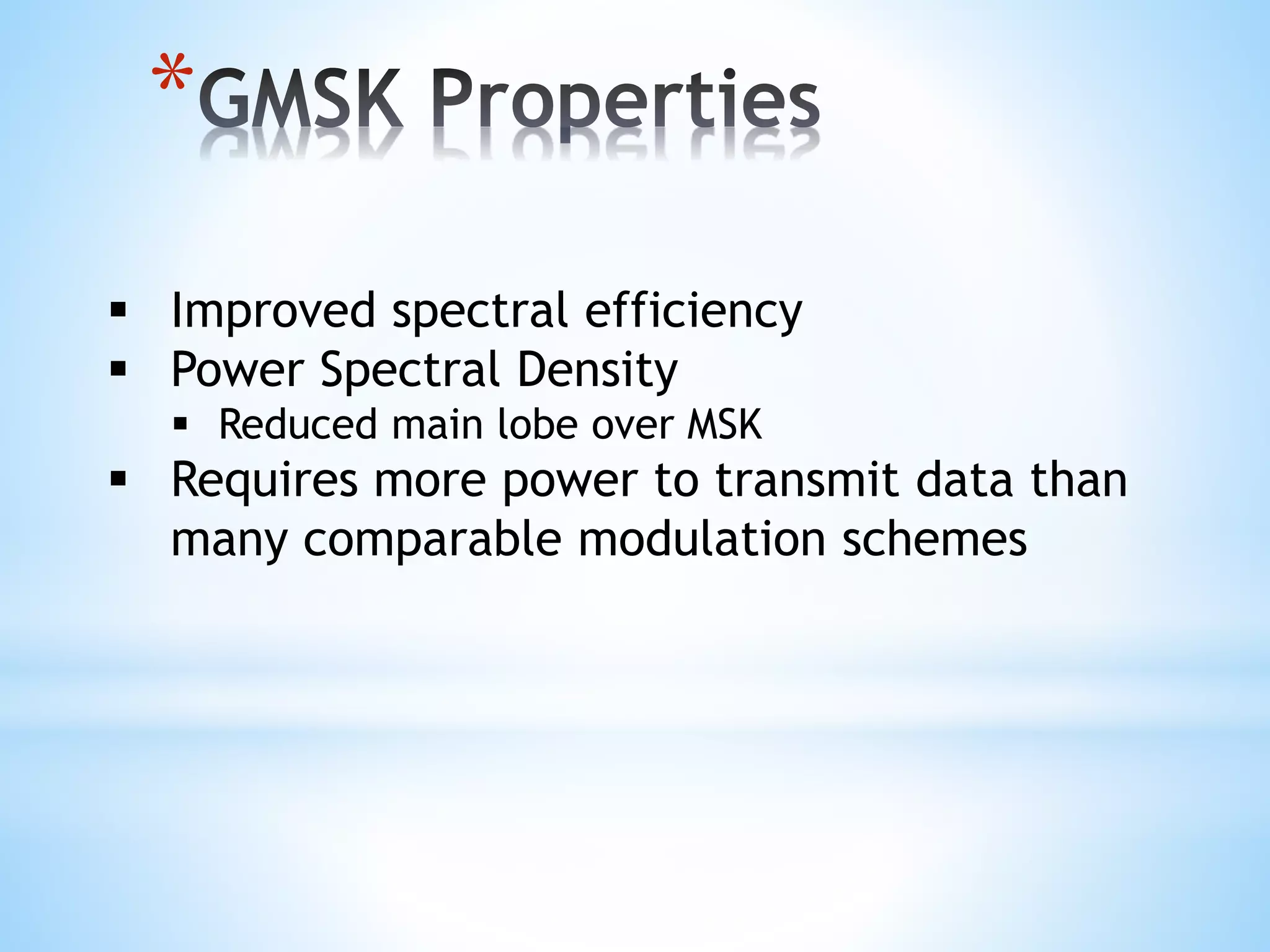
 Improved spectral efficiency
 Power Spectral Density
 Reduced main lobe over MSK
 Requires more power to transmit data than
many comparable modulation schemes
*
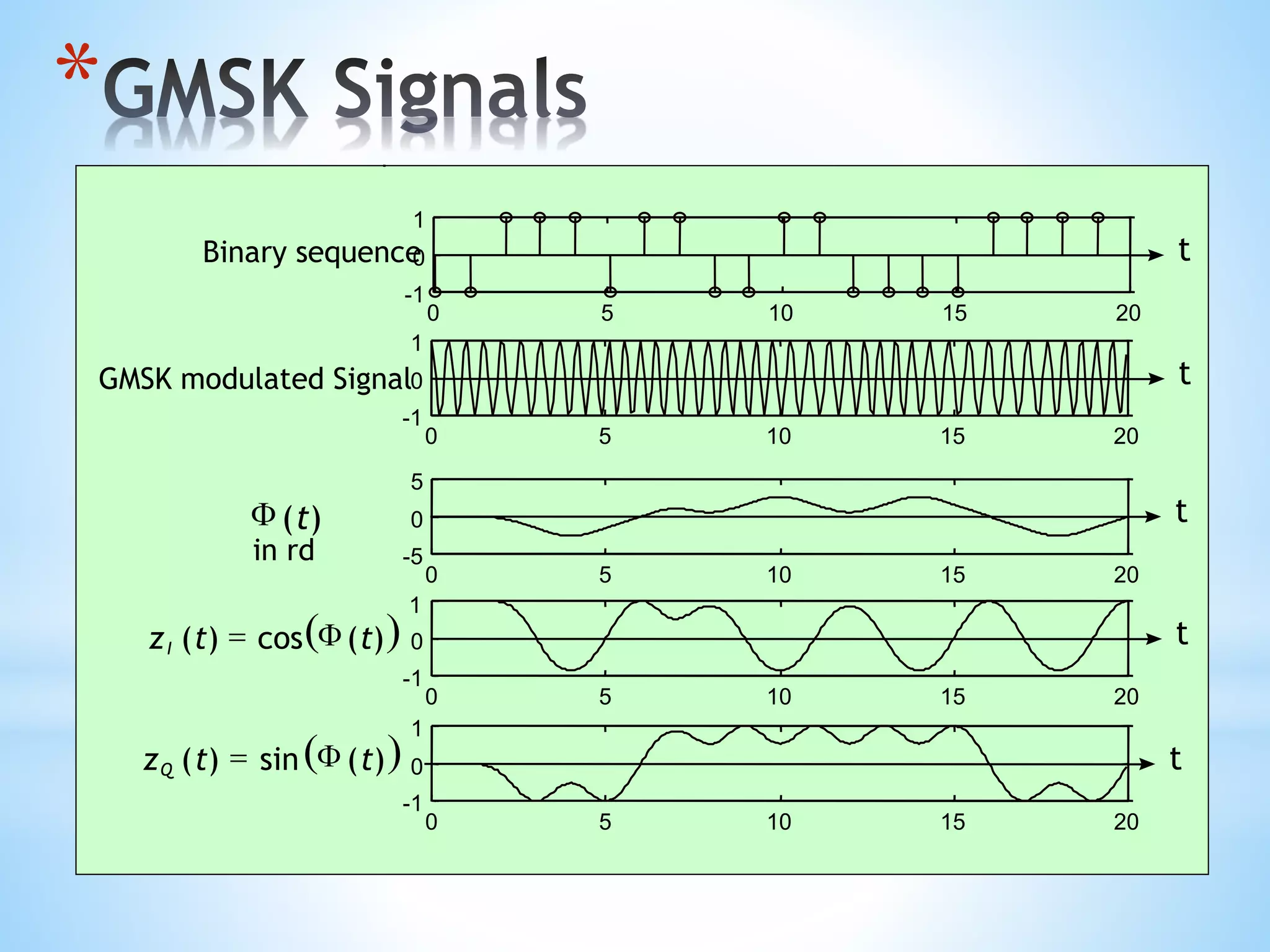
Binary sequence
GMSK modulated Signal
F ( )t
( )z t tI ( ) cos ( )= F
( )z t tQ ( ) sin ( )= F
5
1
0 5 10 15 20
-1
0
1
0 5 10 15 20
-1
0
1
t
0 5 10 15 20
1
-1
0 t
0 5 10 15 20
-5
0 t
0 5 10 15 20
-1
0 t
t
in rd
Modulation techniques

Modulation techniques

  • 1.
  • 2.
    We use theterm modulation to refer to changes made in a carrier -according to the information being sent Modulation takes two inputs -a carrier -and a signal
  • 3.
  • 5.
    * Shift Keying Todistinguish between analog and digital modulation -We use the term shift keying rather than modulation
  • 7.
    *  ASK isthe abbreviation of Amplitude Shift Keying  Ask is called On-Off Keying.  The simplest and most common form of operate as a switch.
  • 8.
    *  It isAbbreviated as Frequency shift keying  Values represented by different frequencies (near carrier)  Less susceptible to error than ASK  Typically used up to 1200bps on voice grade lines  High frequency radio  Even higher frequency on LANs using co-ax
  • 9.
    * Amplitude and frequencymodulations require at least one cycle of a carrier wave to send a single bit unless a special encoding scheme is used The number of bits sent per unit time can be increased if the encoding scheme permits multiple bits to be encoded in a single cycle of the carrier Data communications systems often use techniques that can send more bits PSK changes the phase of the carrier wave abruptly each such change is called a phase shift * Phase of carrier signal is shifted to represent data
  • 10.
    Quadrature amplitude modulationis a combination of ASK and PSK. Note
  • 11.
    * To send morethan one bit at a time It is possible to send two bits on one wave by defining four different amplitudes. The same approach can be used for frequency and phase modulation.
  • 13.
    In practice, themaximum number of bits that can be sent with any one of these techniques is about five bits. The solution is to combine modulation techniques. One popular technique is quadrature amplitude modulation (QAM) involves splitting the signal into eight different phases, and two different amplitude for a total of 16 different possible values, giving us lg(16) or 4 bits per value.
  • 14.
  • 15.
  • 16.
    *Minimum Shift Keying MSKis a variant of OQPSK The rectangular symbol pulse is replaced by a half cycle sinusoidal symbol pulse. MSK provides a constant envelope signal which has it’s phase continuous at all times including the interbit switching times.  In MSK, also the phase shifts can be detected with an I or Q modulator.  At even numbered symbols, the polarity of I channel conveys the transmitted data and at odd numbered symbols the polarity of Q channel conveys the data.  A phase shift of + 90 degrees represents a data bit equal to 1 and a phase shift of –90 degrees represents a data bit equal to zero
  • 17.
    It possesses properties suchas: constant envelope spectral efficiency good BER performance self-synchronizing capability. MSK PROPERTIES
  • 18.
  • 19.
    * • Gaussian MinimumShift Keying • Modulation scheme used in GSM • Bandwidth-time product • Describes the amount the symbols overlap • BT = 0.3 for GSM networks • Good spectral efficiency • At the expense of some inter-symbol interference (ISI • Data rate: 270.8 kbps
  • 20.
    * • GMSK isbased on MSK • Minimum Shift Keying • Linear phase changes • Spectrally efficient • At baseband, bit transitions are represented by ½ cycle sinusoid
  • 21.
    *  Improved spectralefficiency  Power Spectral Density  Reduced main lobe over MSK  Requires more power to transmit data than many comparable modulation schemes
  • 22.
    * Binary sequence GMSK modulatedSignal F ( )t ( )z t tI ( ) cos ( )= F ( )z t tQ ( ) sin ( )= F 5 1 0 5 10 15 20 -1 0 1 0 5 10 15 20 -1 0 1 t 0 5 10 15 20 1 -1 0 t 0 5 10 15 20 -5 0 t 0 5 10 15 20 -1 0 t t in rd