SEMINAR PRESENTATION
ON
AMPLITUDE MODULATION AND DEMODULATION TECHNIQUE
Presentation By
IMTIAZ ALI AHMED
ROLL NO:-11900315020
DEPARTMENT OF ELECTRONICS & COMMUNICATION
ENGINEERING
SILIGURI INSTITUTE OF TECHNOLOGY
Content
 What Is Modulation?
 Why Do We Need Modulation?
 Type of Modulation
 AMPLITUDE MODULATION
 Mathematical Equations of AM
 Modulation Index
 Type of Amplitude Modulation
 Balance Modulator
 Amplitude Demodulation
 Type of Amplitude Demodulation
 Envelope Detector
 Synchronous Detector
 Application of AM
 References
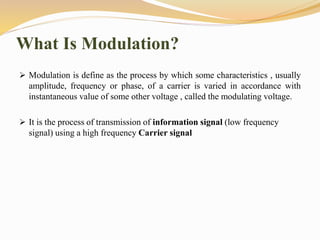
What Is Modulation?
 Modulation is define as the process by which some characteristics , usually
amplitude, frequency or phase, of a carrier is varied in accordance with
instantaneous value of some other voltage , called the modulating voltage.
 It is the process of transmission of information signal (low frequency
signal) using a high frequency Carrier signal
Why Do We Need Modulation?
 If we transmit the information signal directly. Signals from different
transmitters will get mixed up.
 Baseband signals or low frequency signals could not transmitted without
modulation.
 Antenna height :=l/4
c=nl
l=c/n
 signal transmission with minimum noise.
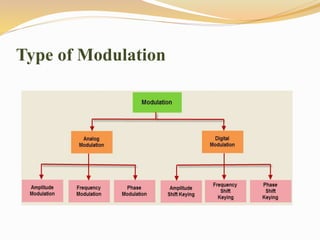
Type of Modulation
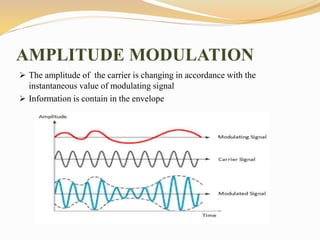
AMPLITUDE MODULATION
 The amplitude of the carrier is changing in accordance with the
instantaneous value of modulating signal
 Information is contain in the envelope
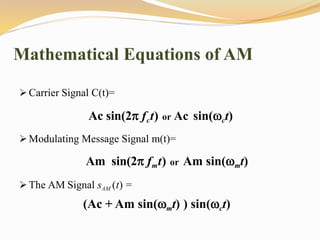
Mathematical Equations of AM
 Carrier Signal C(t)=
 Modulating Message Signal m(t)=
 The AM Signal sAM (t) =
Ac sin(2 fct) or Ac sin(ct)
Am sin(2 fmt) or Am sin(mt)
(Ac + Am sin(mt) ) sin(ct)
Modulation Index
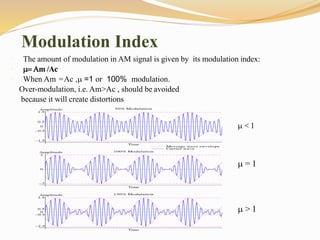
 The amount of modulation in AM signal is given by its modulation index:
 = Am /Ac
 When Am =Ac , =1 or 100% modulation.
Over-modulation, i.e. Am>Ac , should be avoided
because it will create distortions
 = 1
 > 1
 < 1
Type of Amplitude Modulation
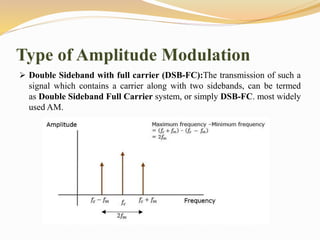
 Double Sideband with full carrier (DSB-FC):The transmission of such a
signal which contains a carrier along with two sidebands, can be termed
as Double Sideband Full Carrier system, or simply DSB-FC. most widely
used AM.
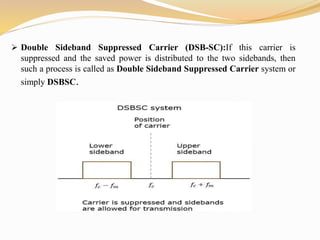
 Double Sideband Suppressed Carrier (DSB-SC):If this carrier is
suppressed and the saved power is distributed to the two sidebands, then
such a process is called as Double Sideband Suppressed Carrier system or
simply DSBSC.
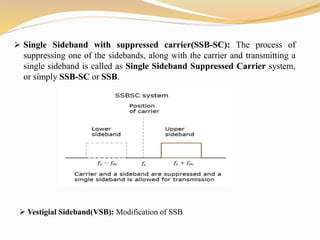
 Single Sideband with suppressed carrier(SSB-SC): The process of
suppressing one of the sidebands, along with the carrier and transmitting a
single sideband is called as Single Sideband Suppressed Carrier system,
or simply SSB-SC or SSB.
 Vestigial Sideband(VSB): Modification of SSB
Balance Modulator
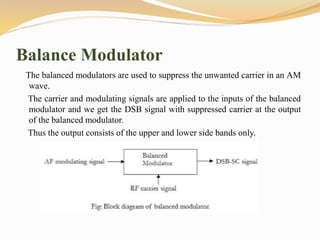
The balanced modulators are used to suppress the unwanted carrier in an AM
wave.
The carrier and modulating signals are applied to the inputs of the balanced
modulator and we get the DSB signal with suppressed carrier at the output
of the balanced modulator.
Thus the output consists of the upper and lower side bands only.
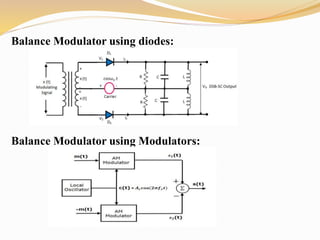
Balance Modulator using diodes:
Balance Modulator using Modulators:
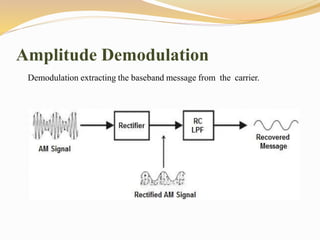
Amplitude Demodulation
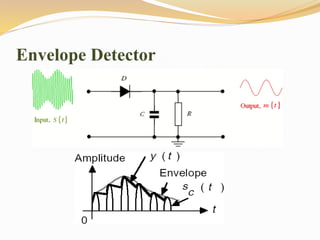
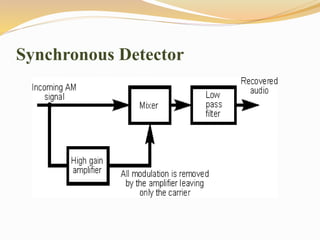
Demodulation extracting the baseband message from the carrier.
Type of Amplitude Demodulation
 Envelop Detector
 Square Law Detector
 Synchronous Detector or Coherent Detection
Envelope Detector
Synchronous Detector
Application of AM
 Entertainment - AM Radio (music, talk radio)
 Business - CB Radio to relay shipment progress, conference calls
with other branches via telephone or speakerphone
 Government - Police officers keeping contact with the station, or
relaying the information and location of a suspect
 Personal - Cell phones or walkie-talkies for chatting with friends
 Military - Using undetectable radio signals to communicate with
other soldiers, or voice commands to control weapons
References
 Communication system by-Sanjay Sharma
 https://en.wikipedia.org/wiki/Amplitude_modulation
 en.wikipedia.org/wiki/Demodulation
 Communication system Fourth Edition by Simon Haykin, from
chapter 2
 Google//AM pdf
 byjus.com/physics/modulation-need-modulation/
Thank You

AMPLITUDE MODULATION & DEMODULATION TECHNIQUE

  • 1.
    SEMINAR PRESENTATION ON AMPLITUDE MODULATIONAND DEMODULATION TECHNIQUE Presentation By IMTIAZ ALI AHMED ROLL NO:-11900315020 DEPARTMENT OF ELECTRONICS & COMMUNICATION ENGINEERING SILIGURI INSTITUTE OF TECHNOLOGY
  • 2.
    Content  What IsModulation?  Why Do We Need Modulation?  Type of Modulation  AMPLITUDE MODULATION  Mathematical Equations of AM  Modulation Index  Type of Amplitude Modulation  Balance Modulator  Amplitude Demodulation  Type of Amplitude Demodulation  Envelope Detector  Synchronous Detector  Application of AM  References
  • 3.
    What Is Modulation? Modulation is define as the process by which some characteristics , usually amplitude, frequency or phase, of a carrier is varied in accordance with instantaneous value of some other voltage , called the modulating voltage.  It is the process of transmission of information signal (low frequency signal) using a high frequency Carrier signal
  • 4.
    Why Do WeNeed Modulation?  If we transmit the information signal directly. Signals from different transmitters will get mixed up.  Baseband signals or low frequency signals could not transmitted without modulation.  Antenna height :=l/4 c=nl l=c/n  signal transmission with minimum noise.
  • 5.
  • 6.
    AMPLITUDE MODULATION  Theamplitude of the carrier is changing in accordance with the instantaneous value of modulating signal  Information is contain in the envelope
  • 7.
    Mathematical Equations ofAM  Carrier Signal C(t)=  Modulating Message Signal m(t)=  The AM Signal sAM (t) = Ac sin(2 fct) or Ac sin(ct) Am sin(2 fmt) or Am sin(mt) (Ac + Am sin(mt) ) sin(ct)
  • 8.
    Modulation Index  Theamount of modulation in AM signal is given by its modulation index:  = Am /Ac  When Am =Ac , =1 or 100% modulation. Over-modulation, i.e. Am>Ac , should be avoided because it will create distortions  = 1  > 1  < 1
  • 9.
    Type of AmplitudeModulation  Double Sideband with full carrier (DSB-FC):The transmission of such a signal which contains a carrier along with two sidebands, can be termed as Double Sideband Full Carrier system, or simply DSB-FC. most widely used AM.
  • 10.
     Double SidebandSuppressed Carrier (DSB-SC):If this carrier is suppressed and the saved power is distributed to the two sidebands, then such a process is called as Double Sideband Suppressed Carrier system or simply DSBSC.
  • 11.
     Single Sidebandwith suppressed carrier(SSB-SC): The process of suppressing one of the sidebands, along with the carrier and transmitting a single sideband is called as Single Sideband Suppressed Carrier system, or simply SSB-SC or SSB.  Vestigial Sideband(VSB): Modification of SSB
  • 12.
    Balance Modulator The balancedmodulators are used to suppress the unwanted carrier in an AM wave. The carrier and modulating signals are applied to the inputs of the balanced modulator and we get the DSB signal with suppressed carrier at the output of the balanced modulator. Thus the output consists of the upper and lower side bands only.
  • 13.
    Balance Modulator usingdiodes: Balance Modulator using Modulators:
  • 14.
    Amplitude Demodulation Demodulation extractingthe baseband message from the carrier.
  • 15.
    Type of AmplitudeDemodulation  Envelop Detector  Square Law Detector  Synchronous Detector or Coherent Detection
  • 16.
  • 17.
  • 18.
    Application of AM Entertainment - AM Radio (music, talk radio)  Business - CB Radio to relay shipment progress, conference calls with other branches via telephone or speakerphone  Government - Police officers keeping contact with the station, or relaying the information and location of a suspect  Personal - Cell phones or walkie-talkies for chatting with friends  Military - Using undetectable radio signals to communicate with other soldiers, or voice commands to control weapons
  • 19.
    References  Communication systemby-Sanjay Sharma  https://en.wikipedia.org/wiki/Amplitude_modulation  en.wikipedia.org/wiki/Demodulation  Communication system Fourth Edition by Simon Haykin, from chapter 2  Google//AM pdf  byjus.com/physics/modulation-need-modulation/
  • 20.