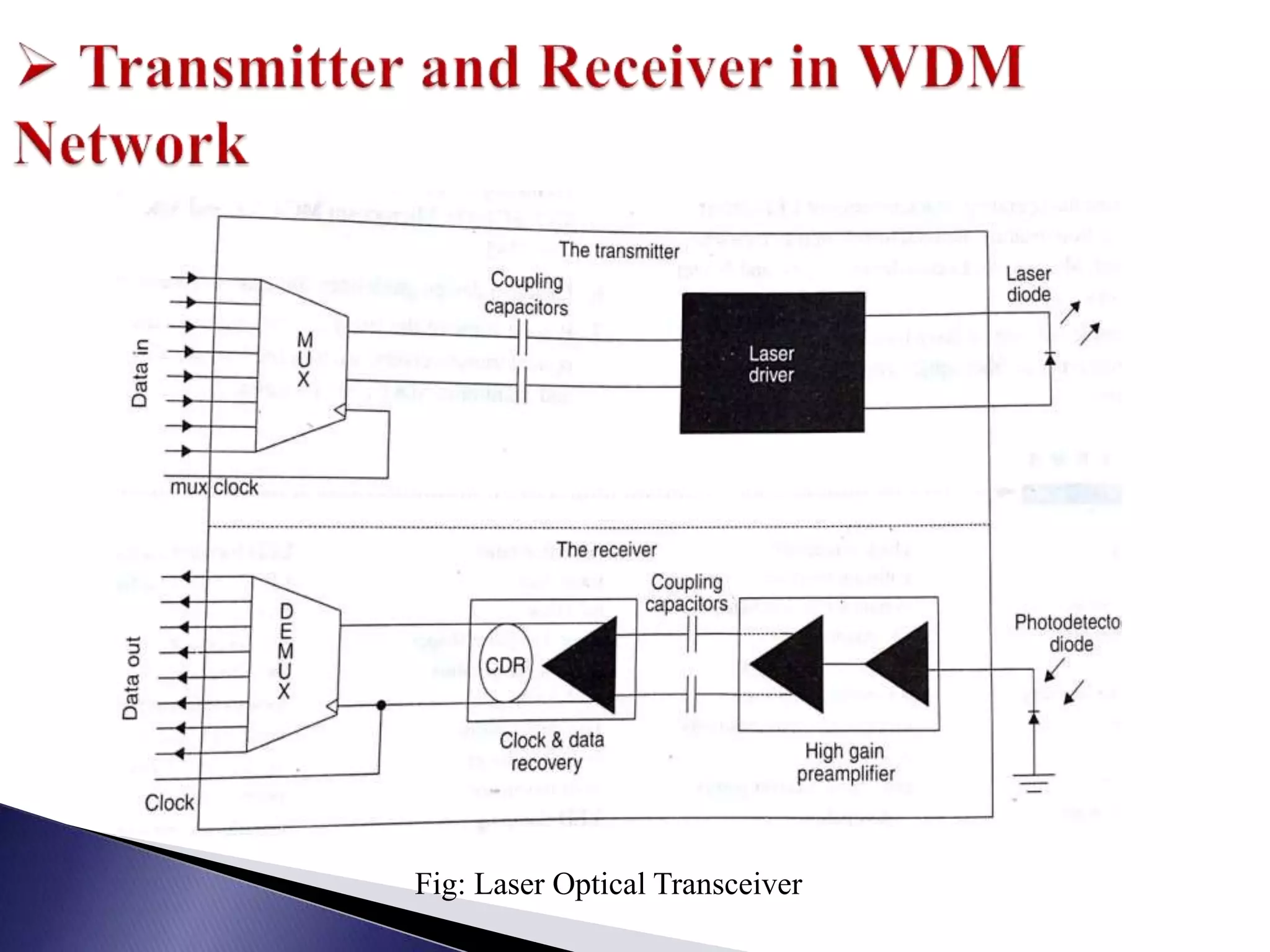
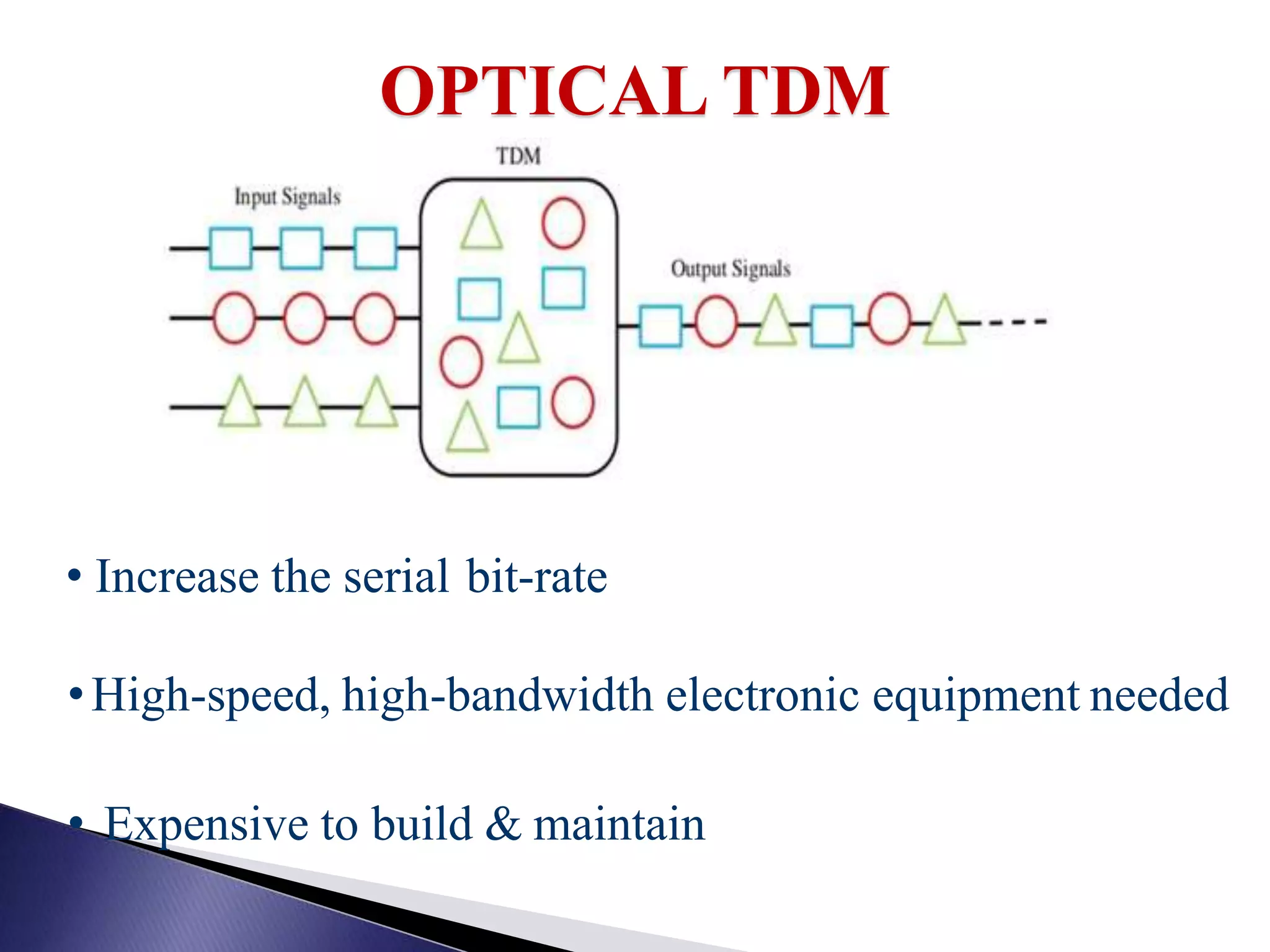

This document summarizes key concepts in optical communication systems, including optical networks, transceivers, and time-division multiplexing. It discusses the architecture of fiber optic networks and common network topologies like bus, ring, and star. It also describes elements like optical multiplexers and amplifiers that are used to increase bandwidth in fiber networks using time-division multiplexing. Specifically, it explains how optical time-division multiplexing works by taking samples from different transmitters and assigning each sample a specific time slot at the receiver to recover the original signals and increase data rates beyond what a single fiber could support.
Optical Network &Architecture
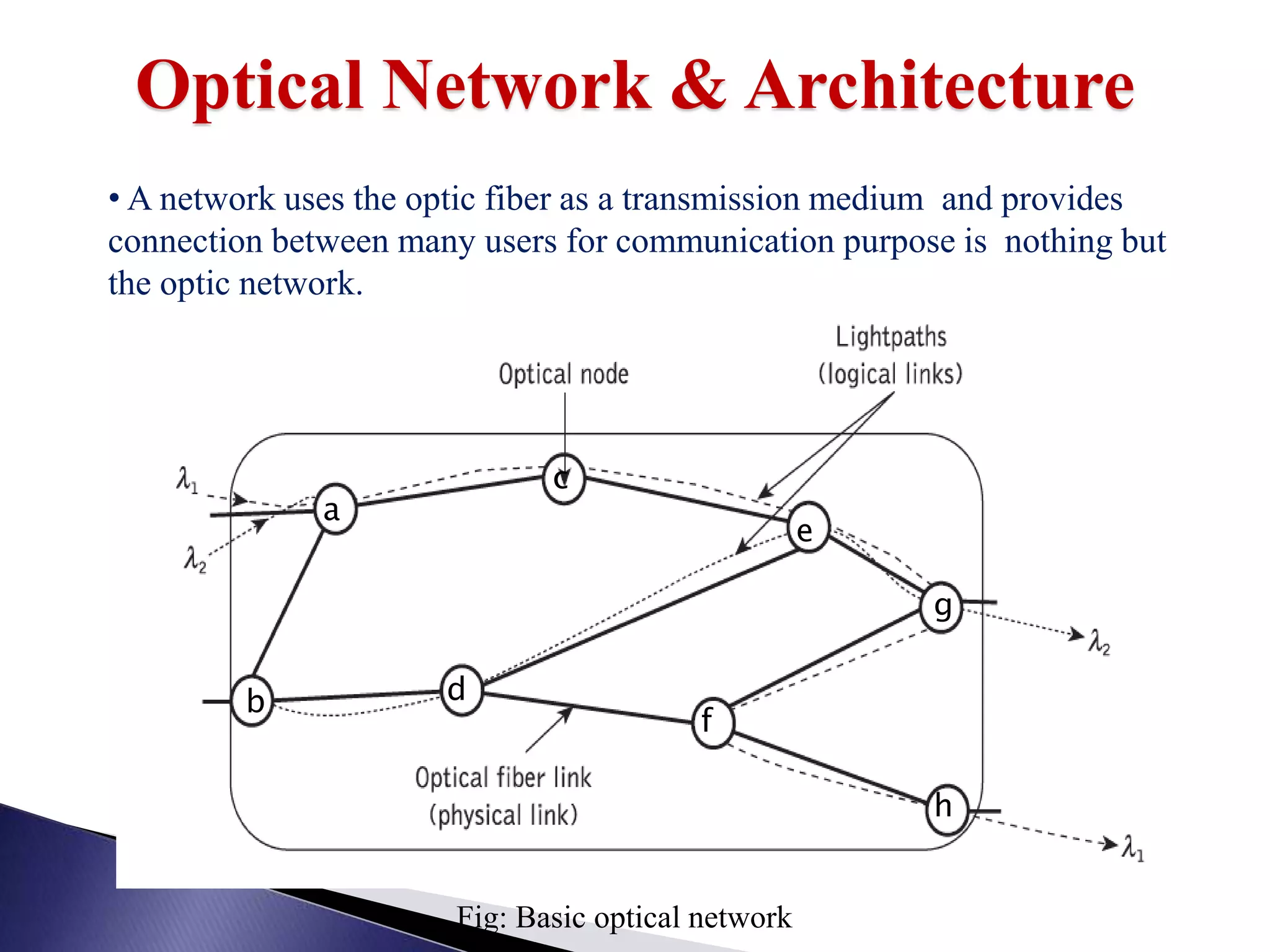
• A network uses the optic fiber as a transmission medium and provides
connection between many users for communication purpose is nothing but
the optic network.
Fig: Basic optical network
a
b
c
d
e
f
g
h
4.
Basic optical network
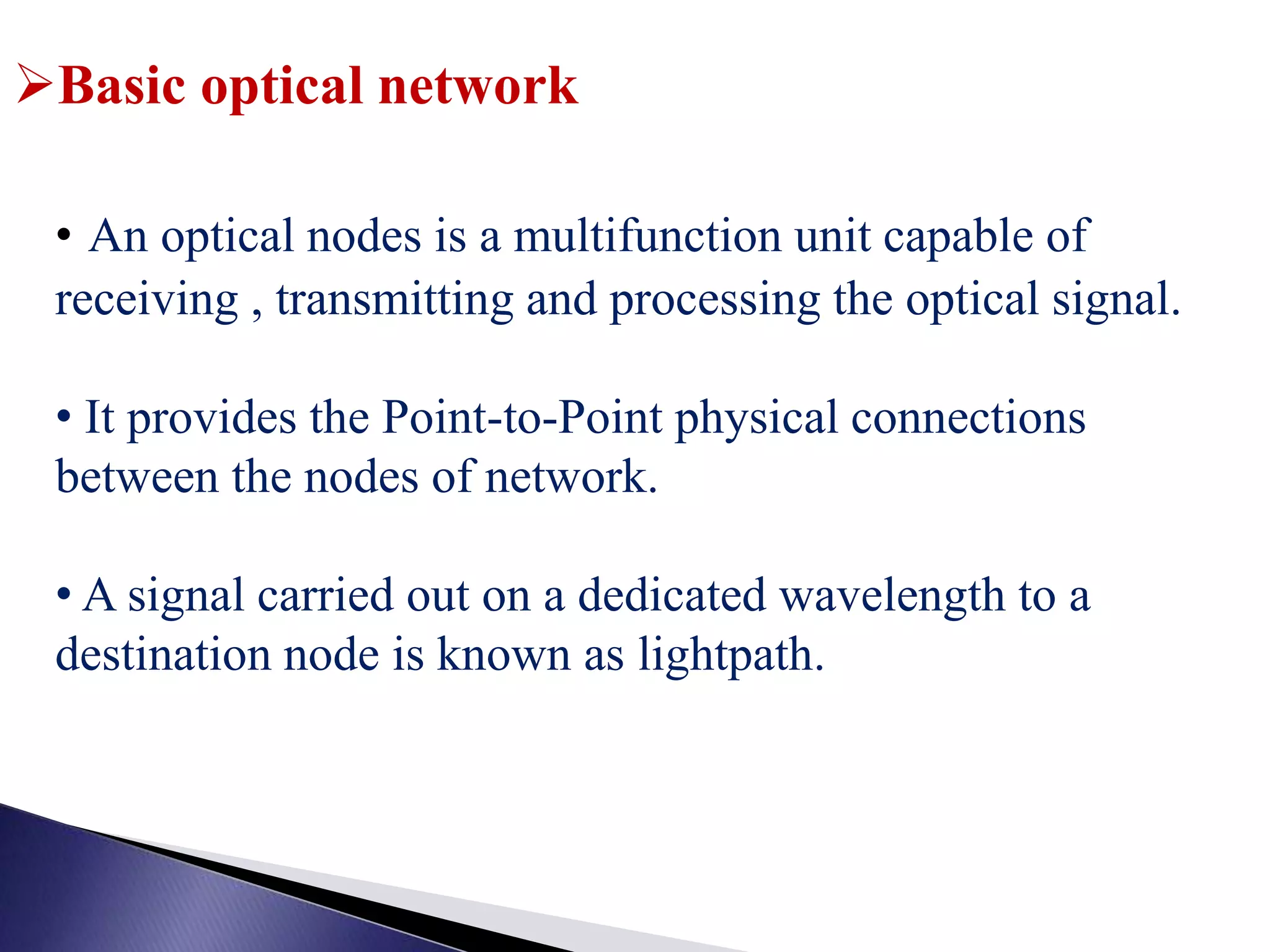
•An optical nodes is a multifunction unit capable of
receiving , transmitting and processing the optical signal.
• It provides the Point-to-Point physical connections
between the nodes of network.
• A signal carried out on a dedicated wavelength to a
destination node is known as lightpath.
5.
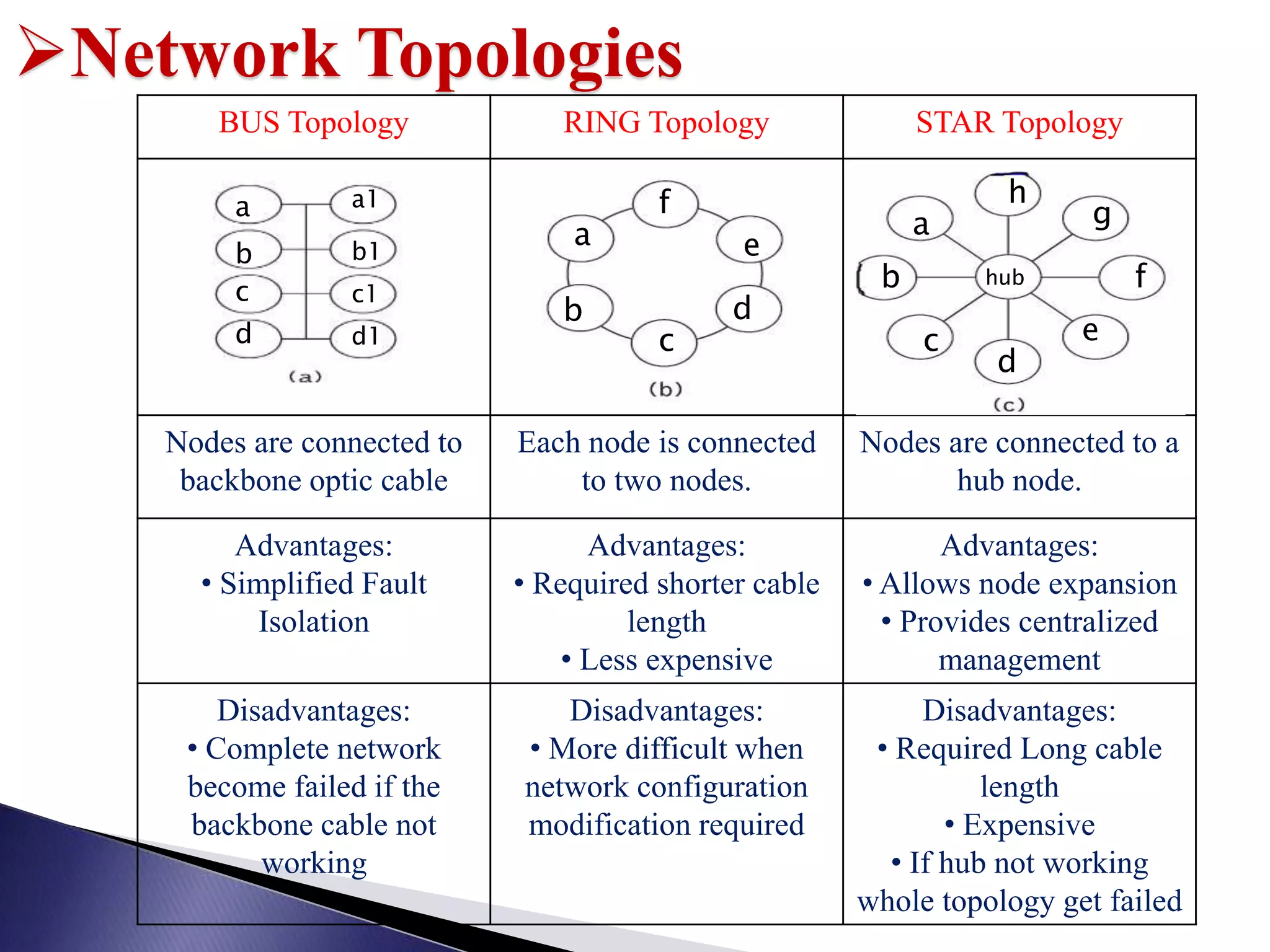
Network Topologies
BUS TopologyRING Topology STAR Topology
Nodes are connected to
backbone optic cable
Each node is connected
to two nodes.
Nodes are connected to a
hub node.
Advantages:
• Simplified Fault
Isolation
Advantages:
• Required shorter cable
length
• Less expensive
Advantages:
• Allows node expansion
• Provides centralized
management
Disadvantages:
• Complete network
become failed if the
backbone cable not
working
Disadvantages:
• More difficult when
network configuration
modification required
Disadvantages:
• Required Long cable
length
• Expensive
• If hub not working
whole topology get failed
hub
a
b
c
d
a1
b1
c1
d1
b
c
d
a e
f
a
b
c
d
e
f
g
h
6.
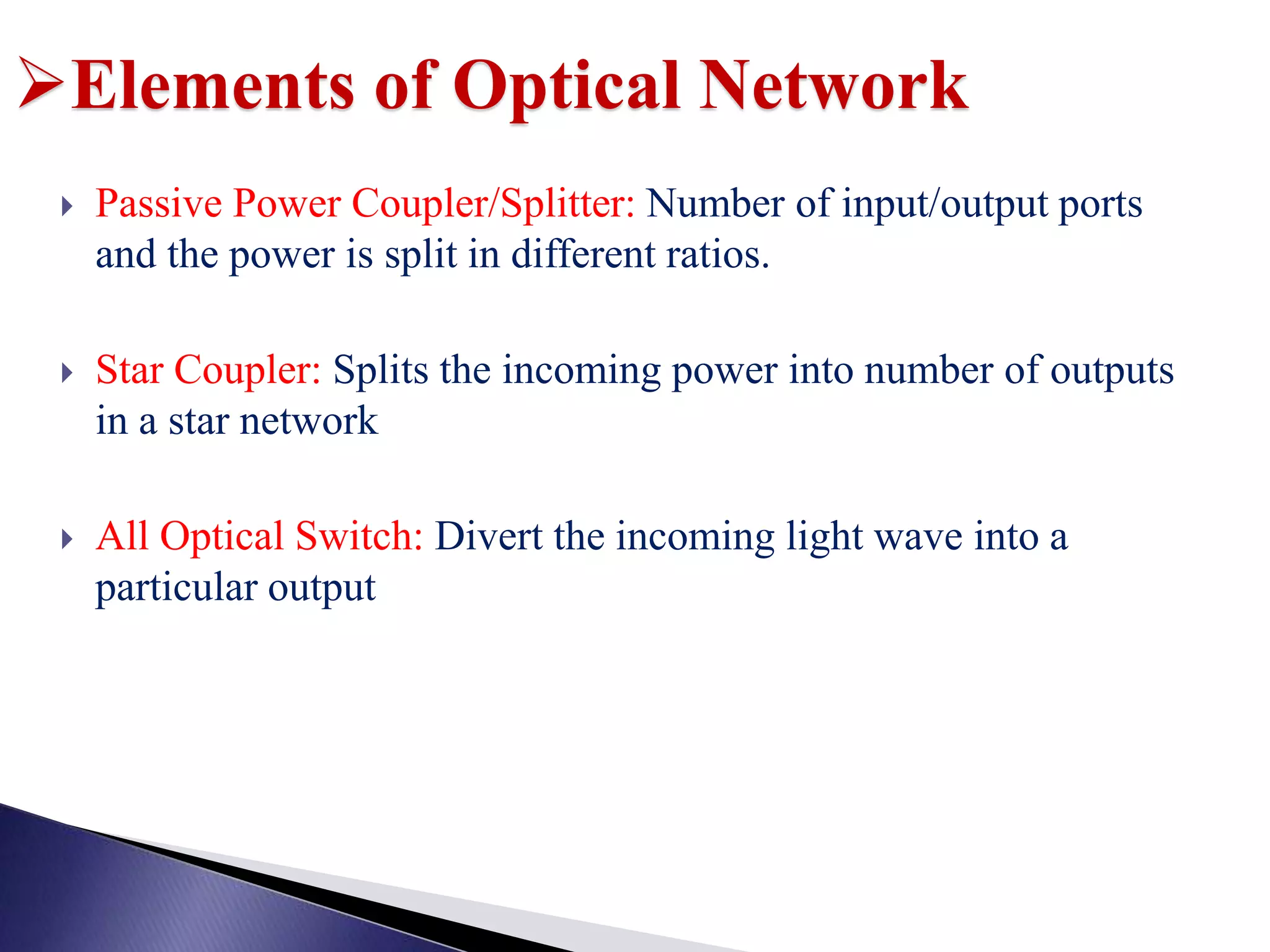
Passive PowerCoupler/Splitter: Number of input/output ports
and the power is split in different ratios.
Star Coupler: Splits the incoming power into number of outputs
in a star network
All Optical Switch: Divert the incoming light wave into a
particular output
Elements of Optical Network
7.
Performance of PassiveLinear Buses
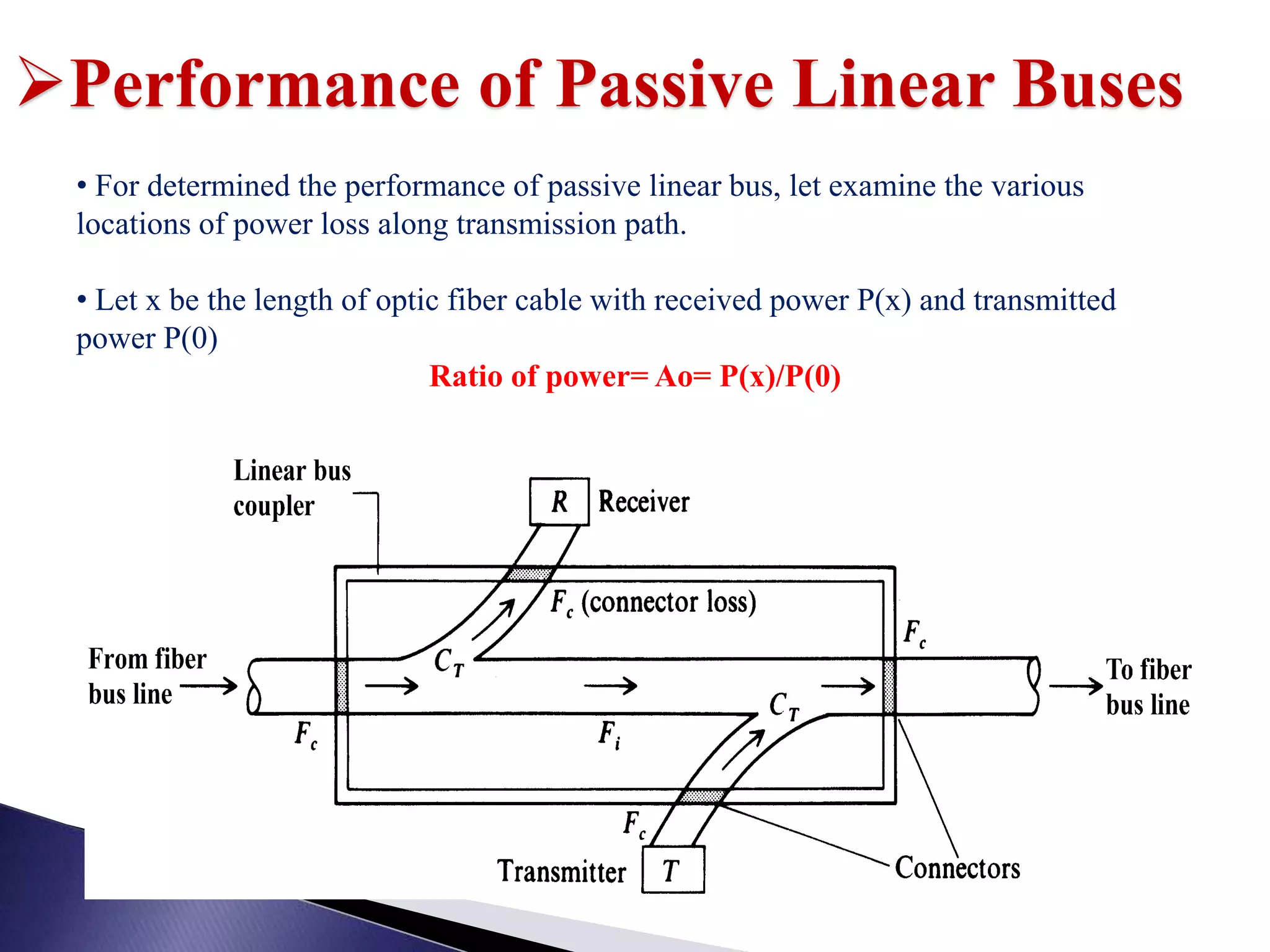
• For determined the performance of passive linear bus, let examine the various
locations of power loss along transmission path.
• Let x be the length of optic fiber cable with received power P(x) and transmitted
power P(0)
Ratio of power= Ao= P(x)/P(0)
8.
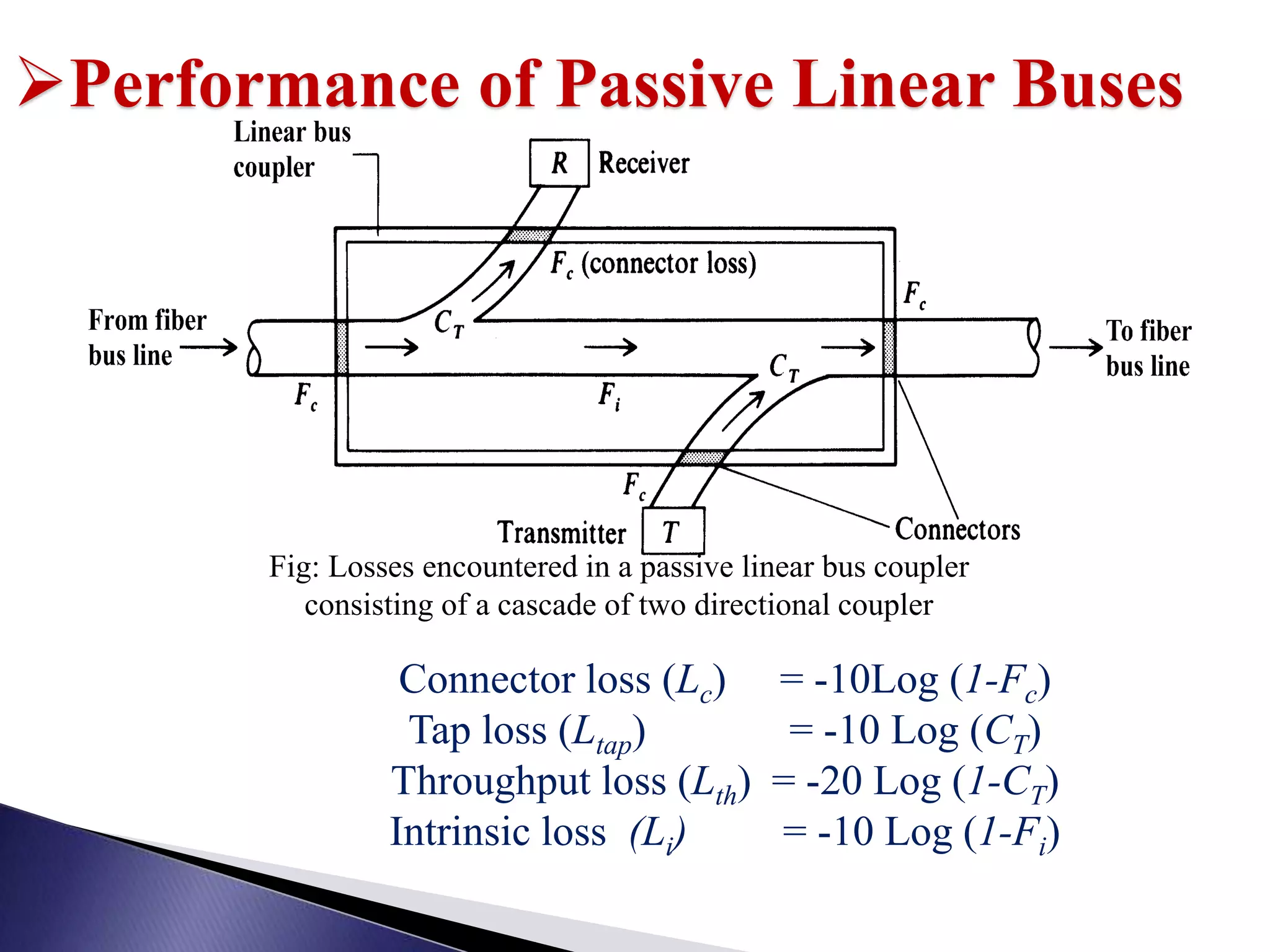
Fig: Losses encounteredin a passive linear bus coupler
consisting of a cascade of two directional coupler
Performance of Passive Linear Buses
Connector loss (Lc) = -10Log (1-Fc)
Tap loss (Ltap) = -10 Log (CT)
Throughput loss (Lth) = -20 Log (1-CT)
Intrinsic loss (Li) = -10 Log (1-Fi)
9.
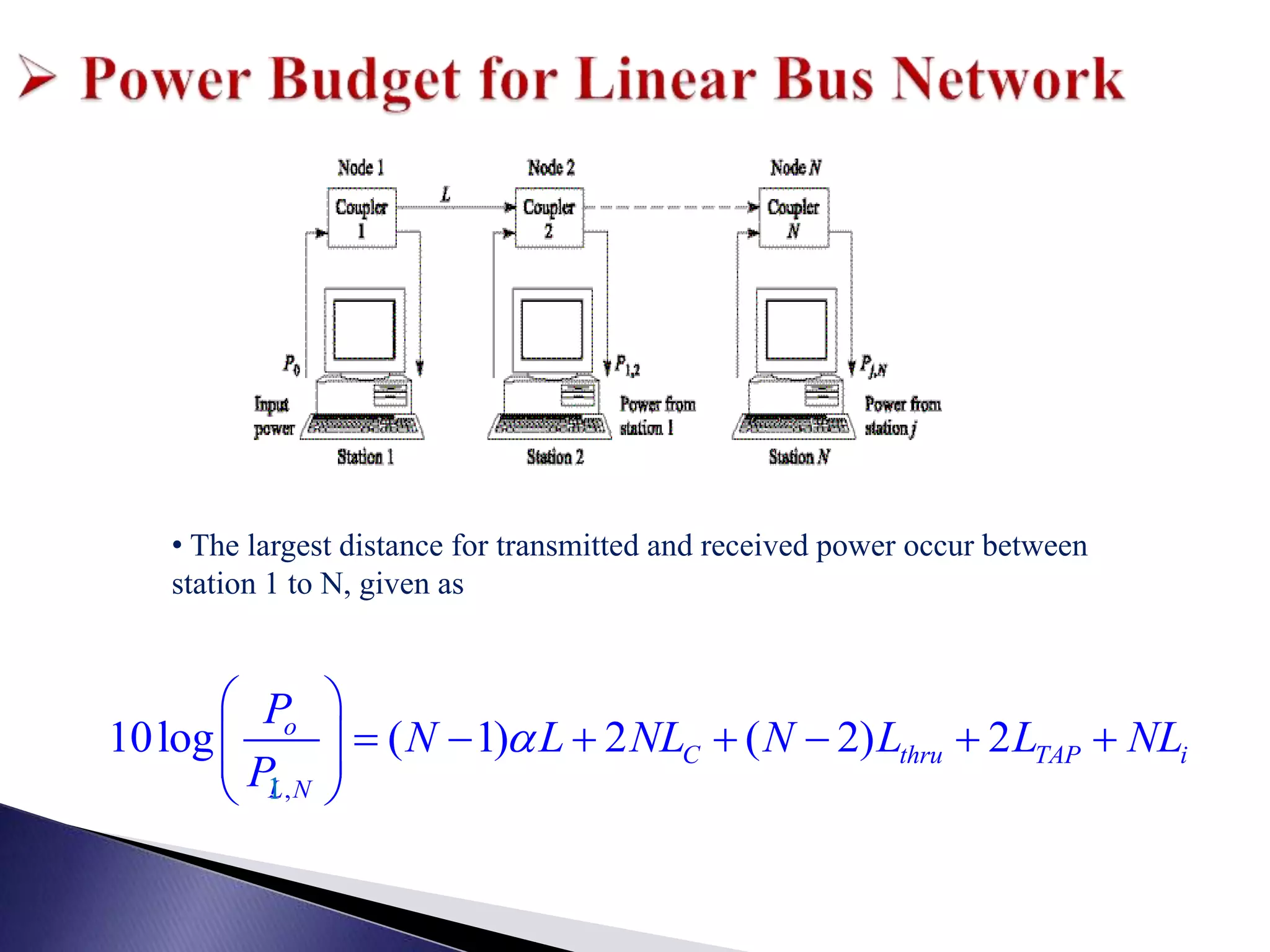
,
10log ( 1)2 ( 2) 2o
C thru TAP i
L N
P
N L NL N L L NL
P
• The largest distance for transmitted and received power occur between
station 1 to N, given as
L1
10.
Performance of StarArchitecture
• Star Coupler can be applied in star network
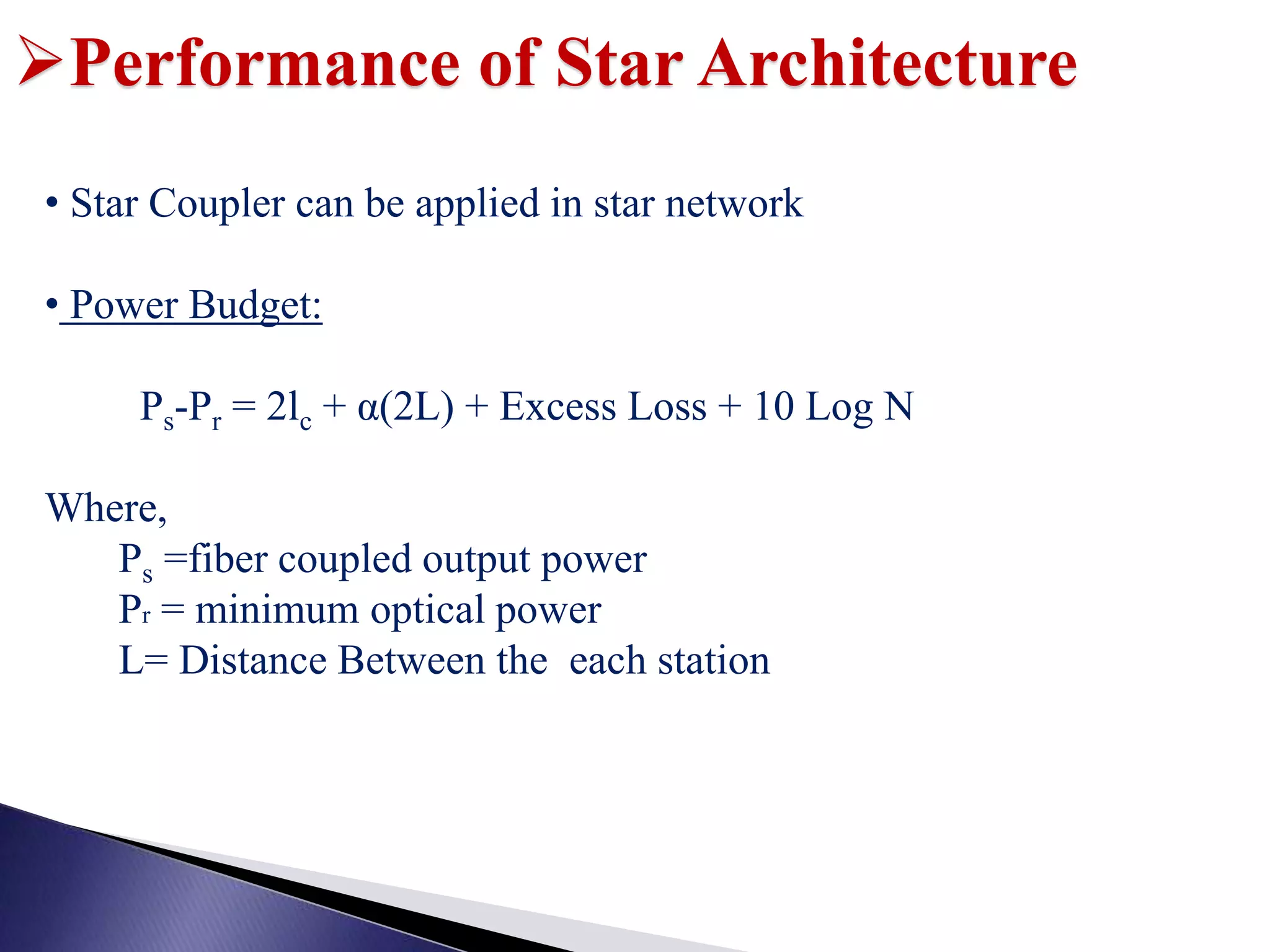
• Power Budget:
Ps-Pr = 2lc + α(2L) + Excess Loss + 10 Log N
Where,
Ps =fiber coupled output power
Pr = minimum optical power
L= Distance Between the each station
OPTICAL TDM
• Amultimode fiber has several bandwidth restriction because of modal
dispersion and single mode fiber cannot carry the traffic generated by needs of
modern society.
• Consider an example, the theoretical bandwidth of Single mode optic fiber is
50THz,while modern transmitter and receiver can operated at the 10GHz,
therefore bit rate of such point to point communication was restricted by system
electronic equipment .
• Solution to this problem is use the fiber optic technology multiplexing, there
are two types
1.Time Division Multiplexing
2. Wavelength Division Multiplexing
15.
OPTICAL TDM
Rx1
Rx2
Rx3
Rx4
Tx1
Tx2
Tx3
Tx4
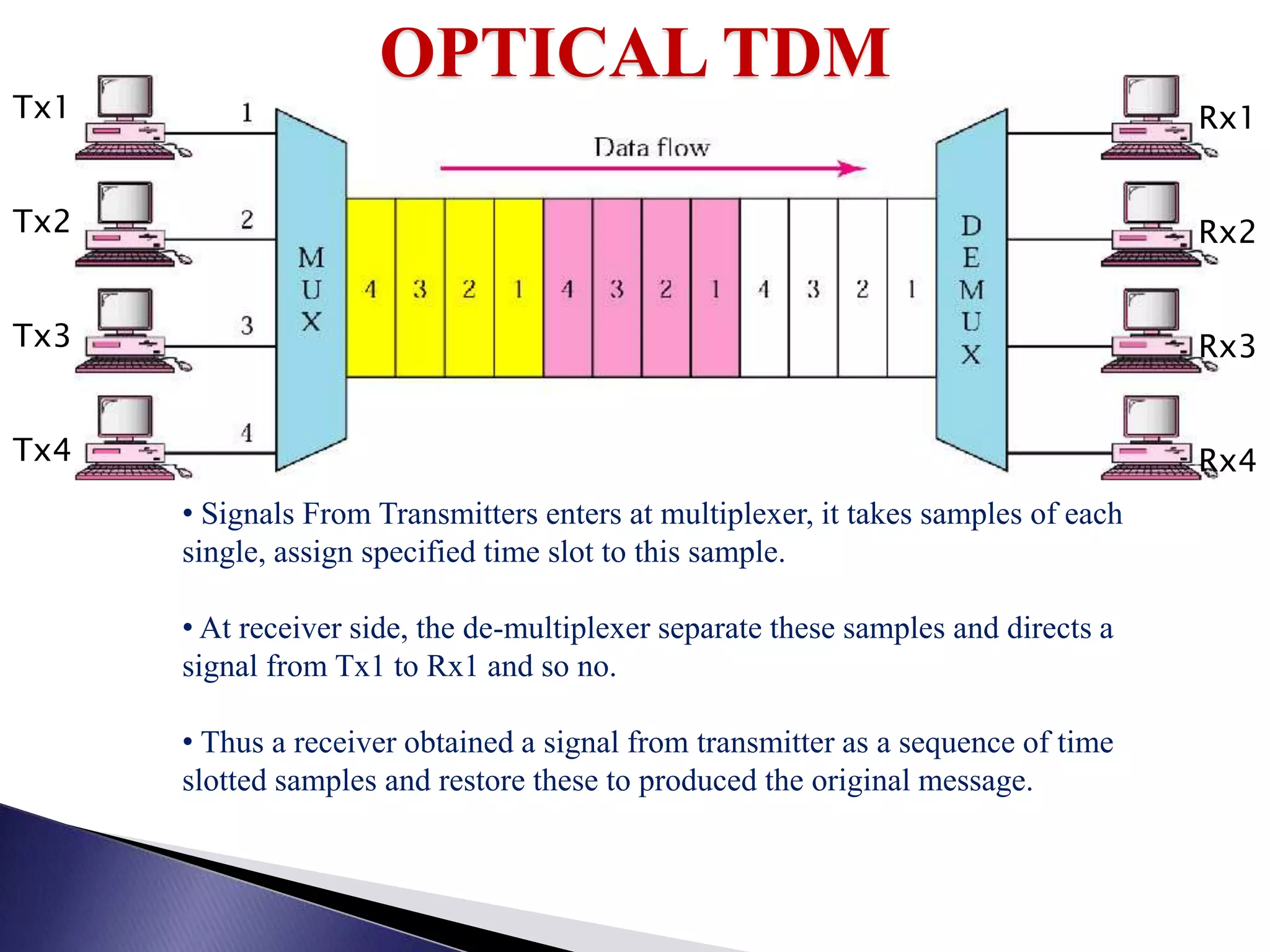
• SignalsFrom Transmitters enters at multiplexer, it takes samples of each
single, assign specified time slot to this sample.
• At receiver side, the de-multiplexer separate these samples and directs a
signal from Tx1 to Rx1 and so no.
• Thus a receiver obtained a signal from transmitter as a sequence of time
slotted samples and restore these to produced the original message.
References
• BOOKS
1. OpticalFiber Communication by John M. Senior (3rdEdition)
2. Optical Fiber Communication by Gerd Keiser (3rdEdition)
3. Fiber Optics Communications by Harold Kolimbiris
• WEBSITE
1. http://efxkits.com/blog/what-is-multiplexer-and-types/ on dated 01/12/2016