1
Detection Techniques in
Coherent Optical
Communications
MEC
2
Contents
• Introduction
• Modulation.
• Direct Detection OOK.
• OOK Homodyne System.
• PSK Homodyne System.
• Heterodyne Detection.
• Performance Comparison.
• Receiver Sensitivity.
3
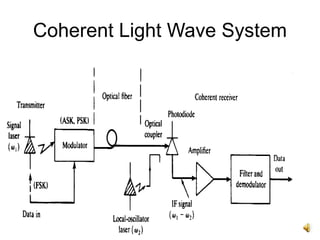
Coherent Light Wave System
4
Modulation Techniques
Modulation:
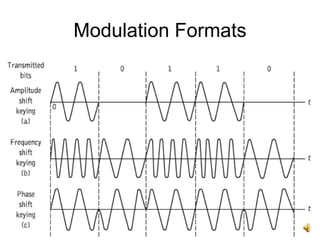
• Amplitude Shift Keying – On/Off Keying.
• Frequency Shift Keying
• Phase Shift Keying.
Detection:
• Homodyne/Heterodyne Detection
• Synchronous/Asynchronous Detection.
• Choice of Modulation/Demodulation
determines receiver sensitivity.
5
Modulation Formats
6
Direct Detection OOK
• Equal Probability 1/0 - OOK data stream is
ON only half of the time on an average.
• Required number of photons per bit of
information is half the number required per
pulse.
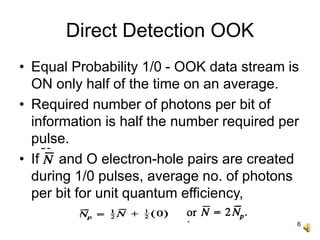
• If and O electron-hole pairs are created
during 1/0 pulses, average no. of photons
per bit for unit quantum efficiency,
7
Direct Detection OOK
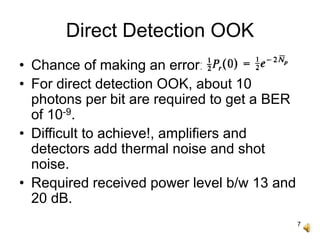
• Chance of making an error:
• For direct detection OOK, about 10
photons per bit are required to get a BER
of 10-9.
• Difficult to achieve!, amplifiers and
detectors add thermal noise and shot
noise.
• Required received power level b/w 13 and
20 dB.
8
Probability of Error
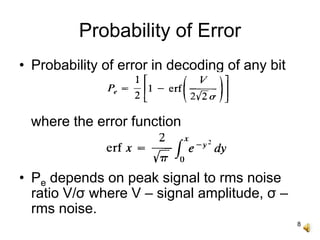
• Probability of error in decoding of any bit
where the error function
• Pe depends on peak signal to rms noise
ratio V/σ where V – signal amplitude, σ –
rms noise.
9
OOK Homodyne Systems
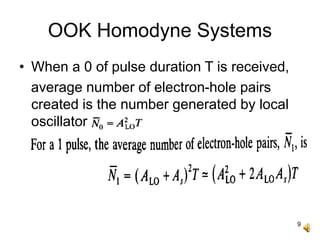
• When a 0 of pulse duration T is received,
average number of electron-hole pairs
created is the number generated by local
oscillator
10
OOK Homodyne Systems
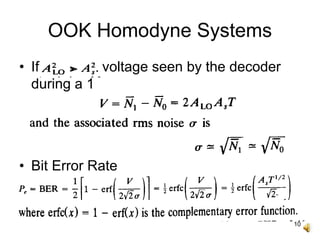
• If voltage seen by the decoder
during a 1
• Bit Error Rate
11
OOK Homodyne Systems
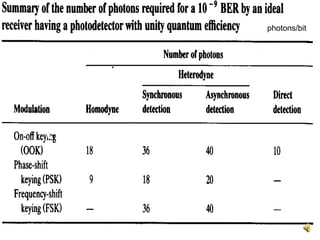
• To achieve BER = 10-9, V/σ = 12.
• Expected number of signal photons
created per pulse, As
2T = 36.
• Average energy of each pulse must
produce 36 electron-hole pairs.
• For equal probability of 1’s and 0’s,
average number of received photons per
bit of information = 18.
12
OOK Homodyne Systems
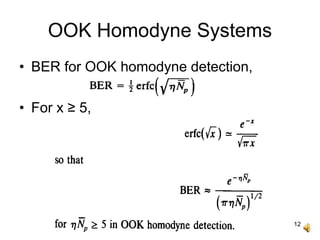
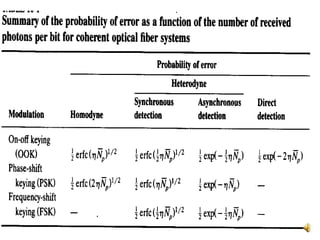
• BER for OOK homodyne detection,
• For x ≥ 5,
13
Homodyne Receiver
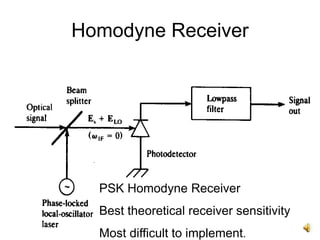
PSK Homodyne Receiver
Best theoretical receiver sensitivity
Most difficult to implement.
14
PSK Homodyne Receiver
• Incoming optical signal (AS) combined with
local oscillator signal (ALO) using a fiber
directional coupler / beam splitter.
• Incoming signal weaker than LO signal.
• Beam splitter made almost completely
transparent.
• Phase change to denote bit change : AS
and ALO out of phase for 0, in phase for 1.
15
PSK Homodyne Receiver
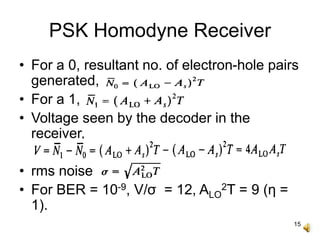
• For a 0, resultant no. of electron-hole pairs
generated,
• For a 1,
• Voltage seen by the decoder in the
receiver,
• rms noise
• For BER = 10-9, V/σ = 12, ALO
2T = 9 (η =
1).
16
PSK Homodyne Receiver
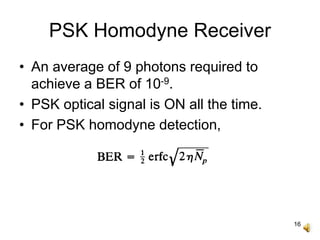
• An average of 9 photons required to
achieve a BER of 10-9.
• PSK optical signal is ON all the time.
• For PSK homodyne detection,
17
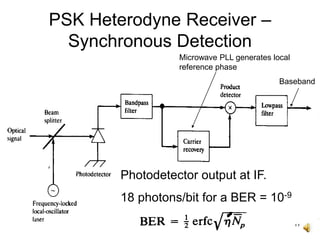
PSK Heterodyne Receiver –
Synchronous Detection
Photodetector output at IF.
18 photons/bit for a BER = 10-9
Microwave PLL generates local
reference phase
Baseband
18
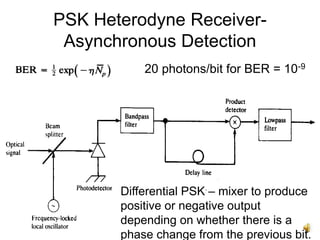
PSK Heterodyne Receiver-
Asynchronous Detection
20 photons/bit for BER = 10-9
Differential PSK – mixer to produce
positive or negative output
depending on whether there is a
phase change from the previous bit.
19
20
photons/bit
21
Comparison
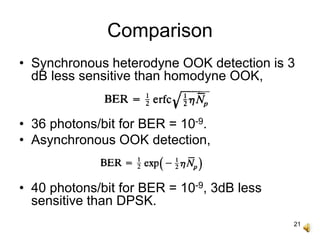
• Synchronous heterodyne OOK detection is 3
dB less sensitive than homodyne OOK,
• 36 photons/bit for BER = 10-9.
• Asynchronous OOK detection,
• 40 photons/bit for BER = 10-9, 3dB less
sensitive than DPSK.
22
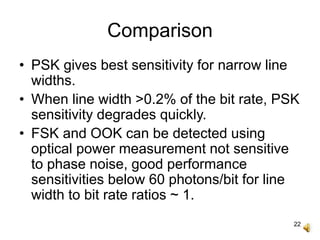
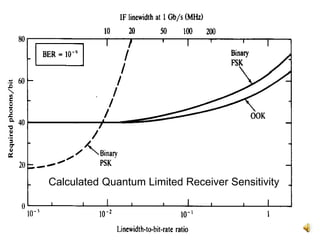
Comparison
• PSK gives best sensitivity for narrow line
widths.
• When line width >0.2% of the bit rate, PSK
sensitivity degrades quickly.
• FSK and OOK can be detected using
optical power measurement not sensitive
to phase noise, good performance
sensitivities below 60 photons/bit for line
width to bit rate ratios ~ 1.
23
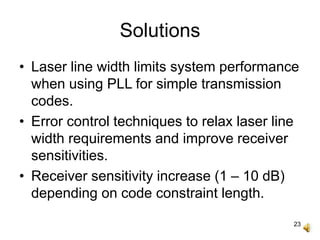
Solutions
• Laser line width limits system performance
when using PLL for simple transmission
codes.
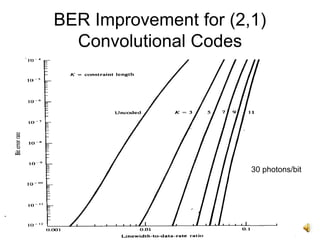
• Error control techniques to relax laser line
width requirements and improve receiver
sensitivities.
• Receiver sensitivity increase (1 – 10 dB)
depending on code constraint length.
24
Calculated Quantum Limited Receiver Sensitivity
25
BER Improvement for (2,1)
Convolutional Codes
30 photons/bit
26
Thank You

Detection techniques in coherent optical communications

  • 1.
    1 Detection Techniques in CoherentOptical Communications MEC
  • 2.
    2 Contents • Introduction • Modulation. •Direct Detection OOK. • OOK Homodyne System. • PSK Homodyne System. • Heterodyne Detection. • Performance Comparison. • Receiver Sensitivity.
  • 3.
  • 4.
    4 Modulation Techniques Modulation: • AmplitudeShift Keying – On/Off Keying. • Frequency Shift Keying • Phase Shift Keying. Detection: • Homodyne/Heterodyne Detection • Synchronous/Asynchronous Detection. • Choice of Modulation/Demodulation determines receiver sensitivity.
  • 5.
  • 6.
    6 Direct Detection OOK •Equal Probability 1/0 - OOK data stream is ON only half of the time on an average. • Required number of photons per bit of information is half the number required per pulse. • If and O electron-hole pairs are created during 1/0 pulses, average no. of photons per bit for unit quantum efficiency,
  • 7.
    7 Direct Detection OOK •Chance of making an error: • For direct detection OOK, about 10 photons per bit are required to get a BER of 10-9. • Difficult to achieve!, amplifiers and detectors add thermal noise and shot noise. • Required received power level b/w 13 and 20 dB.
  • 8.
    8 Probability of Error •Probability of error in decoding of any bit where the error function • Pe depends on peak signal to rms noise ratio V/σ where V – signal amplitude, σ – rms noise.
  • 9.
    9 OOK Homodyne Systems •When a 0 of pulse duration T is received, average number of electron-hole pairs created is the number generated by local oscillator
  • 10.
    10 OOK Homodyne Systems •If voltage seen by the decoder during a 1 • Bit Error Rate
  • 11.
    11 OOK Homodyne Systems •To achieve BER = 10-9, V/σ = 12. • Expected number of signal photons created per pulse, As 2T = 36. • Average energy of each pulse must produce 36 electron-hole pairs. • For equal probability of 1’s and 0’s, average number of received photons per bit of information = 18.
  • 12.
    12 OOK Homodyne Systems •BER for OOK homodyne detection, • For x ≥ 5,
  • 13.
    13 Homodyne Receiver PSK HomodyneReceiver Best theoretical receiver sensitivity Most difficult to implement.
  • 14.
    14 PSK Homodyne Receiver •Incoming optical signal (AS) combined with local oscillator signal (ALO) using a fiber directional coupler / beam splitter. • Incoming signal weaker than LO signal. • Beam splitter made almost completely transparent. • Phase change to denote bit change : AS and ALO out of phase for 0, in phase for 1.
  • 15.
    15 PSK Homodyne Receiver •For a 0, resultant no. of electron-hole pairs generated, • For a 1, • Voltage seen by the decoder in the receiver, • rms noise • For BER = 10-9, V/σ = 12, ALO 2T = 9 (η = 1).
  • 16.
    16 PSK Homodyne Receiver •An average of 9 photons required to achieve a BER of 10-9. • PSK optical signal is ON all the time. • For PSK homodyne detection,
  • 17.
    17 PSK Heterodyne Receiver– Synchronous Detection Photodetector output at IF. 18 photons/bit for a BER = 10-9 Microwave PLL generates local reference phase Baseband
  • 18.
    18 PSK Heterodyne Receiver- AsynchronousDetection 20 photons/bit for BER = 10-9 Differential PSK – mixer to produce positive or negative output depending on whether there is a phase change from the previous bit.
  • 19.
  • 20.
  • 21.
    21 Comparison • Synchronous heterodyneOOK detection is 3 dB less sensitive than homodyne OOK, • 36 photons/bit for BER = 10-9. • Asynchronous OOK detection, • 40 photons/bit for BER = 10-9, 3dB less sensitive than DPSK.
  • 22.
    22 Comparison • PSK givesbest sensitivity for narrow line widths. • When line width >0.2% of the bit rate, PSK sensitivity degrades quickly. • FSK and OOK can be detected using optical power measurement not sensitive to phase noise, good performance sensitivities below 60 photons/bit for line width to bit rate ratios ~ 1.
  • 23.
    23 Solutions • Laser linewidth limits system performance when using PLL for simple transmission codes. • Error control techniques to relax laser line width requirements and improve receiver sensitivities. • Receiver sensitivity increase (1 – 10 dB) depending on code constraint length.
  • 24.
    24 Calculated Quantum LimitedReceiver Sensitivity
  • 25.
    25 BER Improvement for(2,1) Convolutional Codes 30 photons/bit
  • 26.