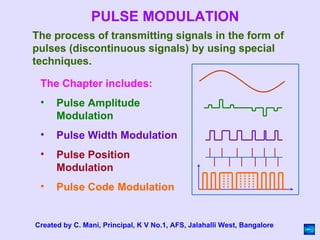
The Chapter includes:
• Pulse Amplitude
Modulation
• Pulse Width Modulation
• Pulse Position
Modulation
• Pulse Code Modulation
PULSE MODULATION
The process of transmitting signals in the form of
pulses (discontinuous signals) by using special
techniques.
Created by C. Mani, Principal, K V No.1, AFS, Jalahalli West, Bangalore
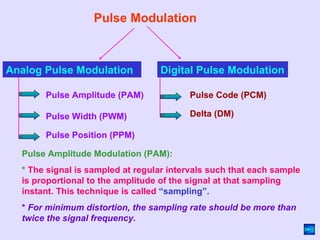
Analog Pulse Modulation Digital Pulse Modulation
Pulse Amplitude (PAM)
Pulse Width (PWM)
Pulse Position (PPM)
Pulse Code (PCM)
Delta (DM)
Pulse Modulation
Pulse Amplitude Modulation (PAM):
* The signal is sampled at regular intervals such that each sample
is proportional to the amplitude of the signal at that sampling
instant. This technique is called “sampling”.
* For minimum distortion, the sampling rate should be more than
twice the signal frequency.
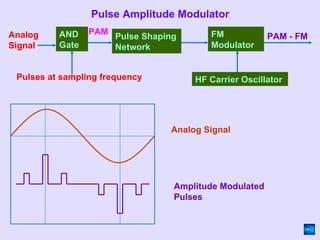
AND
Gate
Pulse Shaping
Network
FM
Modulator
Analog
Signal
PAM - FM
Pulses at sampling frequency HF Carrier Oscillator
PAM
Pulse Amplitude Modulator
Analog Signal
Amplitude Modulated
Pulses
* In this type, the amplitude is maintained constant but the duration
or length or width of each pulse is varied in accordance with
instantaneous value of the analog signal.
* The negative side of the signal is brought to the positive side by
adding a fixed d.c. voltage.
Analog Signal
Width Modulated Pulses
Pulse Width Modulation (PWM or PLM or PDM):
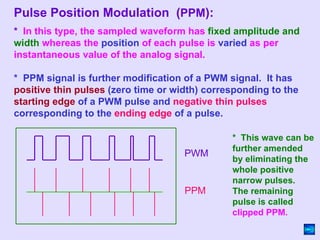
* In this type, the sampled waveform has fixed amplitude and
width whereas the position of each pulse is varied as per
instantaneous value of the analog signal.
* PPM signal is further modification of a PWM signal. It has
positive thin pulses (zero time or width) corresponding to the
starting edge of a PWM pulse and negative thin pulses
corresponding to the ending edge of a pulse.
* This wave can be
further amended
by eliminating the
whole positive
narrow pulses.
The remaining
pulse is called
clipped PPM.
PWM
PPM
Pulse Position Modulation (PPM):
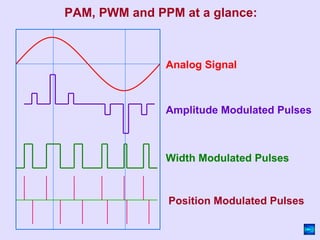
PAM, PWM and PPM at a glance:
Analog Signal
Amplitude Modulated Pulses
Width Modulated Pulses
Position Modulated Pulses
* Analog signal is converted into digital signal by using a digital
code.
* Analog to digital converter employs two techniques:
1. Sampling: The process of generating pulses of zero width
and of amplitude equal to the instantaneous amplitude of the
analog signal. The no. of pulses per second is called
“sampling rate”.
2. Quantization: The process of dividing the maximum value
of the analog signal into a fixed no. of levels in order to
convert the PAM into a Binary Code.
The levels obtained are called “quanization levels”.
* A digital signal is described by its ‘bit rate’ whereas analog
signal is described by its ‘frequency range’.
* Bit rate = sampling rate x no. of bits / sample
Pulse Code Modulation (PCM):
Time
V
o
l
t
a
g
e
7
6
5
4
3
2
1
0
111
110
101
100
011
010
001
000
L
e
v
e
l
s
B
i
n
a
r
y
C
o
d
e
s
Time
Time
V
o
l
t
a
g
e
0 1 0 1 0 1 1 1 0 1 1 1 1 1 0 1 0 1 0 1 0
Sampling,
Quantization
and Coding
Merits of Digital Communication:
• Digital signals are very easy to receive. The receiver has to just detect
whether the pulse is low or high.
• AM & FM signals become corrupted over much short distances as
compared to digital signals. In digital signals, the original signal can be
reproduced accurately.
• The signals lose power as they travel, which is called attenuation. When
AM and FM signals are amplified, the noise also get amplified. But the
digital signals can be cleaned up to restore the quality and amplified by
the regenerators.
• The noise may change the shape of the pulses but not the pattern of the
pulses.
• AM and FM signals can be received by any one by suitable receiver. But
digital signals can be coded so that only the person, who is intended for,
can receive them.
• AM and FM transmitters are ‘real time systems’. i.e. they can be received
only at the time of transmission. But digital signals can be stored at the
receiving end.
• The digital signals can be stored, or used to produce a display on a
computer monitor or converted back into analog signal to drive a loud
speaker. END

Pulse modulation

  • 1.
    The Chapter includes: •Pulse Amplitude Modulation • Pulse Width Modulation • Pulse Position Modulation • Pulse Code Modulation PULSE MODULATION The process of transmitting signals in the form of pulses (discontinuous signals) by using special techniques. Created by C. Mani, Principal, K V No.1, AFS, Jalahalli West, Bangalore
  • 2.
    Analog Pulse ModulationDigital Pulse Modulation Pulse Amplitude (PAM) Pulse Width (PWM) Pulse Position (PPM) Pulse Code (PCM) Delta (DM) Pulse Modulation Pulse Amplitude Modulation (PAM): * The signal is sampled at regular intervals such that each sample is proportional to the amplitude of the signal at that sampling instant. This technique is called “sampling”. * For minimum distortion, the sampling rate should be more than twice the signal frequency.
  • 3.
    AND Gate Pulse Shaping Network FM Modulator Analog Signal PAM -FM Pulses at sampling frequency HF Carrier Oscillator PAM Pulse Amplitude Modulator Analog Signal Amplitude Modulated Pulses
  • 4.
    * In thistype, the amplitude is maintained constant but the duration or length or width of each pulse is varied in accordance with instantaneous value of the analog signal. * The negative side of the signal is brought to the positive side by adding a fixed d.c. voltage. Analog Signal Width Modulated Pulses Pulse Width Modulation (PWM or PLM or PDM):
  • 5.
    * In thistype, the sampled waveform has fixed amplitude and width whereas the position of each pulse is varied as per instantaneous value of the analog signal. * PPM signal is further modification of a PWM signal. It has positive thin pulses (zero time or width) corresponding to the starting edge of a PWM pulse and negative thin pulses corresponding to the ending edge of a pulse. * This wave can be further amended by eliminating the whole positive narrow pulses. The remaining pulse is called clipped PPM. PWM PPM Pulse Position Modulation (PPM):
  • 6.
    PAM, PWM andPPM at a glance: Analog Signal Amplitude Modulated Pulses Width Modulated Pulses Position Modulated Pulses
  • 7.
    * Analog signalis converted into digital signal by using a digital code. * Analog to digital converter employs two techniques: 1. Sampling: The process of generating pulses of zero width and of amplitude equal to the instantaneous amplitude of the analog signal. The no. of pulses per second is called “sampling rate”. 2. Quantization: The process of dividing the maximum value of the analog signal into a fixed no. of levels in order to convert the PAM into a Binary Code. The levels obtained are called “quanization levels”. * A digital signal is described by its ‘bit rate’ whereas analog signal is described by its ‘frequency range’. * Bit rate = sampling rate x no. of bits / sample Pulse Code Modulation (PCM):
  • 8.
  • 9.
    Merits of DigitalCommunication: • Digital signals are very easy to receive. The receiver has to just detect whether the pulse is low or high. • AM & FM signals become corrupted over much short distances as compared to digital signals. In digital signals, the original signal can be reproduced accurately. • The signals lose power as they travel, which is called attenuation. When AM and FM signals are amplified, the noise also get amplified. But the digital signals can be cleaned up to restore the quality and amplified by the regenerators. • The noise may change the shape of the pulses but not the pattern of the pulses. • AM and FM signals can be received by any one by suitable receiver. But digital signals can be coded so that only the person, who is intended for, can receive them. • AM and FM transmitters are ‘real time systems’. i.e. they can be received only at the time of transmission. But digital signals can be stored at the receiving end. • The digital signals can be stored, or used to produce a display on a computer monitor or converted back into analog signal to drive a loud speaker. END