
DIT
Dar es Salaam institute of Technology (DIT)
ETU 07123
Introduction to Communication Systems
Ally, J
jumannea@gmail.com
Course Outline
 Principles of Communication Systems
 Analogue Modulation
 Angle Modulation
 Pulse Modulation
 Digital Modulation
Reference:
Introduction to Analogue and Digital
Communication, by Simon Haykin
DIT
DIT
Principle of Communication System
DIT
Information Representation
 Communication systems convert information into a format
appropriate for the transmission medium.
 Channels convey electromagnetic waves (signals).
 Analog communication systems convert (modulate) analog
signals into modulated (analog) signals
 Digital communication systems convert information in the form of
bits into binary/digital signals
 Types of Information:
 Analog Signals: Voice, Music, Temperature readings
 Analog signals or bits: Video, Images
 Bits: Text, Computer Data
 Analog signals can be converted into bits by quantizing/digitizing
DIT
Basic Mode of Communication
There are two basic modes of communication:
 Broadcasting: which involves the use of a single powerful
transmitter and numerous receivers that are relatively inexpensive
to build. Here information-bearing signals flow only in one
direction.
 Point-to-point communication: in which the communication
process takes place over a link between a single transmitter and a
receiver. In this case, there is usually a bidirectional flow of
information-bearing signals, which requires the use of a transmitter
and receiver at each end of the link.
DIT
Primary Communication Resources
In a communication system, two primary resources are employed:
Transmitted Power and Channel Bandwidth.
 The Transmitted Power: is the average power of the transmitted signal
 The channel bandwidth is defined as the band of frequencies allocated for
the transmission of the message signal
NB:
 A general system design objective is to use these two resources as
efficiently as possible.
 In most communication channels, one resource may be considered
more important than the other.
 Therefore we may classify communication channels as Power limited or
Band-limited.
 Example, the telephone circuit is a typical Band-limited channel, whereas
a space communication link or satellite channel is typically Power limited.
DIT
Source of Information
The telecommunications environment is dominated by four important
sources of information: speech, music, pictures, and computer data
 Speech is the primary method of human communication
 Music is the one originates from instruments such as the piano,
violin, and flute
 Pictures is the one relies on the human visual system for its
perception. The picture can be dynamic, as in television, or static,
as in fascimile (fax) machine
 Computer data is the information transmitted or exchanged through
computer or other electronic devices
DIT
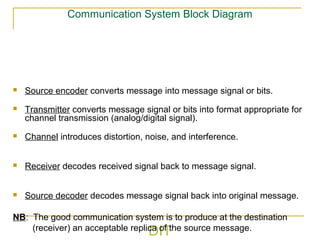
Communication System Block Diagram
 Source encoder converts message into message signal or bits.
 Transmitter converts message signal or bits into format appropriate for
channel transmission (analog/digital signal).
 Channel introduces distortion, noise, and interference.
 Receiver decodes received signal back to message signal.
 Source decoder decodes message signal back into original message.
NB: The good communication system is to produce at the destination
(receiver) an acceptable replica of the source message.
DIT
Modulation and Demodulation
 Modulation
 Is the process of changing ore or more properties such
as amplitude, frequency, and phase of the analog carrier
in proportion with the information signal
 Performed in a transmitter by a circuit called a modulator
 Demodulation
 Is the reverse process of modulation and converts the
modulated carrier back to the original information
 Performed in a receiver by a circuit called a demodulator
DIT
Electromagnetic Frequency Spectrum
 The purpose of an electronic communications system
is to communicate information between two or more
locations commonly called stations.
 Accomplished by converting the original information
into electromagnetic energy and then transmitting it
to one or more receive stations where it converted
back to its original form.
 Electromagnetic energy can propagate as a voltage
or current along a metallic wire, as emitted radio
waves through free space, or as a light waves down
an optical fiber.
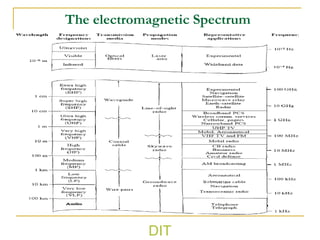
 Electromagnetic energy is distributed throughout an
almost infinite range of frequencies.
DIT
The electromagnetic Spectrum
DIT
Bandwidth
 Bandwidth of an information of signal: is the difference
between the highest and lowest frequencies contained in
the information.
 Bandwidth of a communication channel: is the difference
between the highest and lowest frequencies that the
channel will allow to pass through it.
 The bandwidth of the communications channel must be
equal to or greater than the bandwidth of the information.
 For example, voice frequencies contain signals between
300 Hz and 3000 Hz. Therefore, a voice frequency
channel must have a bandwidth equal to or greater than
2700 Hz (300 Hz-3000 Hz).
 If a cable television transmission system has a passband
from 500kHz to 5000kHz, it has a bandwidth of 4500 kHz.
DIT
Information Capacity
 Information theory: is a theoretical study of the efficient
use of bandwidth to propagate information through
electronic communications systems.
 Information theory can be used to determine the
information capacity of a data communications system.
 Information capacity: represents the number of
independent symbols that can be carried through a system
in a given unit of time.
 The most basic digital symbol used to represent
information is the binary digit or bit.
 It is convenient to express the information capacity of a
system as a bit rate.
 Bit rate: is the number of bits transmitted during one
second and is expressed in bits per second (bps).
DIT
Information Capacity (2)
 In 1928, R. Hartley (Bell Telephone Laboratories)
developed a useful relationship among bandwidth
(B), transmission time (t), and information capacity
(I). Simply stated, Hartley’s law is
I α B x t
 In 1948, mathematician Claude E. shannon (Bell
Telephone Laboratories) published a paper relating
the information capacity of a communication
channel to bandwidth and signal-to-noise power
ratio (S/N).
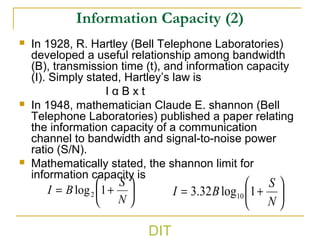
 Mathematically stated, the shannon limit for
information capacity is






+=
N
S
BI 1log2 





+=
N
S
BI 1log32.3 10
DIT
Two Basic of Electronic Communication
System
 An analog communication system
 Is a system in which energy is transmitted and received in analog
form (a continuously varying signal such as sine wave)
 Both the information and the carriers are analog signal
 The digital communication system
Covers a broad range of communication techniques, including
digital transmission and digital radio
DIT
Two Basic of Electronic Communication System(2)
 Digital transmission
- Is a true digital system where digital pulses are transferred between
two or more point a communication system
- There is no analog carrier, and the original source may be in digital or
analog form
- Require physical transmission medium such as metallic cable or optical
fiber
 Digital Radio
- Is the transmitted of digitally modulated carrier between two or
more points in a communication system
- The modulating signal and the demodulated signal are digital
pulses
- Digital pulse modulate an analog carrier
- Transmission medium may be a physical facility or free space
(i.e. The Earth’s atmosphere)
DIT
Advantage of using Digital transmission compared
to Analog transmission
 Increased immunity to channel noise and external
interference
 Flexible operation of the system
 A common format for the transmission of different kinds
of message signals (e.g. voice signals, video signals,
computer data)
 Improved security of communication through the use of
encryption
DIT
Summary of various modulation technique
 Analog Modulation Types
 Amplitude Modulation (AM): is the one if the information signal is analog and the
amplitude (V) of the carrier is varied proportional to the information signal
 Frequency Modulation (FM): is the one if the frequency (f) of the carrier is varied
proportional to the information signal
 Phase modulation (PM): is the one if the phase (θ) of the carrier is varied proportional
to the information signal
 Digital Modulation Types
 Amplitude Shift Keying (ASK): is the one if the information signal is digital and the
amplitude (V) of the carrier is varied proportional to the information signal
 Frequency Shift Keying (FSK): is the one if the frequency (f) of the carrier is varied
proportional to the information signal
 Phase Shift Keying (PSK): is the one if the phase (θ) of the carrier is varied
proportional to the information signal
 Quadrature Amplitude Modulation (QAM): is the one if both the amplitude (V) and the
phase (θ) of the carrier are varied proportional to the information signal
DIT
Why Modulation is necessary
 It is extremely difficult to radiate low frequency
signals from an antenna in the form of
electromagnetic energy
 It is possible to combine a number of baseband
(information) signal and send them through the
medium, provided different carrier frequencies
are used for different baseband signals
 Transmitting signals over large distance,
because low frequency signals have poor
radiation characteristics
DIT
Analog vs. Digital Systems
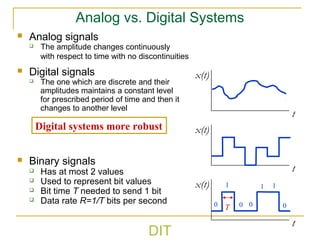
 Analog signals
 The amplitude changes continuously
with respect to time with no discontinuities
 Digital signals
 The one which are discrete and their
amplitudes maintains a constant level
for prescribed period of time and then it
changes to another level
 Binary signals
 Has at most 2 values
 Used to represent bit values
 Bit time T needed to send 1 bit
 Data rate R=1/T bits per second
t
x(t)
t
x(t)
t
x(t) 1
0 0 0
1 1
0T
Digital systems more robust
DIT
Fourier Transforms
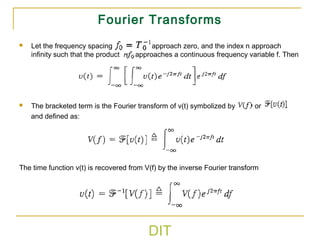
 Let the frequency spacing approach zero, and the index n approach
infinity such that the product approaches a continuous frequency variable f. Then
 The bracketed term is the Fourier transform of v(t) symbolized by or
and defined as:
The time function v(t) is recovered from V(f) by the inverse Fourier transform
DIT
Frequency Translation and Modulation
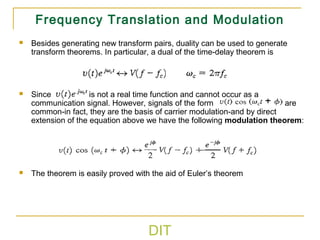
 Besides generating new transform pairs, duality can be used to generate
transform theorems. In particular, a dual of the time-delay theorem is
 Since is not a real time function and cannot occur as a
communication signal. However, signals of the form are
common-in fact, they are the basis of carrier modulation-and by direct
extension of the equation above we have the following modulation theorem:
 The theorem is easily proved with the aid of Euler’s theorem
DIT
Special Functions
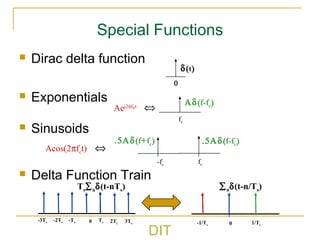
 Dirac delta function
 Exponentials
 Sinusoids
 Delta Function Train
δ(t)
0
fc
Αδ(f-fc)
Aej2πfct
⇔
Acos(2πfct) ⇔
fc
.5Αδ(f-fc)
-fc
.5Αδ(f+fc)
Ts∑nδ(t-nTs)
0
∑nδ(t-n/Ts)
0 Ts 2Ts 3Ts
-Ts-2Ts-3Ts 1/Ts-1/Ts
DIT

Introduction to communication system lecture1

  • 1.
    DIT Dar es Salaaminstitute of Technology (DIT) ETU 07123 Introduction to Communication Systems Ally, J jumannea@gmail.com
  • 2.
    Course Outline  Principlesof Communication Systems  Analogue Modulation  Angle Modulation  Pulse Modulation  Digital Modulation Reference: Introduction to Analogue and Digital Communication, by Simon Haykin DIT
  • 3.
  • 4.
    DIT Information Representation  Communicationsystems convert information into a format appropriate for the transmission medium.  Channels convey electromagnetic waves (signals).  Analog communication systems convert (modulate) analog signals into modulated (analog) signals  Digital communication systems convert information in the form of bits into binary/digital signals  Types of Information:  Analog Signals: Voice, Music, Temperature readings  Analog signals or bits: Video, Images  Bits: Text, Computer Data  Analog signals can be converted into bits by quantizing/digitizing
  • 5.
    DIT Basic Mode ofCommunication There are two basic modes of communication:  Broadcasting: which involves the use of a single powerful transmitter and numerous receivers that are relatively inexpensive to build. Here information-bearing signals flow only in one direction.  Point-to-point communication: in which the communication process takes place over a link between a single transmitter and a receiver. In this case, there is usually a bidirectional flow of information-bearing signals, which requires the use of a transmitter and receiver at each end of the link.
  • 6.
    DIT Primary Communication Resources Ina communication system, two primary resources are employed: Transmitted Power and Channel Bandwidth.  The Transmitted Power: is the average power of the transmitted signal  The channel bandwidth is defined as the band of frequencies allocated for the transmission of the message signal NB:  A general system design objective is to use these two resources as efficiently as possible.  In most communication channels, one resource may be considered more important than the other.  Therefore we may classify communication channels as Power limited or Band-limited.  Example, the telephone circuit is a typical Band-limited channel, whereas a space communication link or satellite channel is typically Power limited.
  • 7.
    DIT Source of Information Thetelecommunications environment is dominated by four important sources of information: speech, music, pictures, and computer data  Speech is the primary method of human communication  Music is the one originates from instruments such as the piano, violin, and flute  Pictures is the one relies on the human visual system for its perception. The picture can be dynamic, as in television, or static, as in fascimile (fax) machine  Computer data is the information transmitted or exchanged through computer or other electronic devices
  • 8.
    DIT Communication System BlockDiagram  Source encoder converts message into message signal or bits.  Transmitter converts message signal or bits into format appropriate for channel transmission (analog/digital signal).  Channel introduces distortion, noise, and interference.  Receiver decodes received signal back to message signal.  Source decoder decodes message signal back into original message. NB: The good communication system is to produce at the destination (receiver) an acceptable replica of the source message.
  • 9.
    DIT Modulation and Demodulation Modulation  Is the process of changing ore or more properties such as amplitude, frequency, and phase of the analog carrier in proportion with the information signal  Performed in a transmitter by a circuit called a modulator  Demodulation  Is the reverse process of modulation and converts the modulated carrier back to the original information  Performed in a receiver by a circuit called a demodulator
  • 10.
    DIT Electromagnetic Frequency Spectrum The purpose of an electronic communications system is to communicate information between two or more locations commonly called stations.  Accomplished by converting the original information into electromagnetic energy and then transmitting it to one or more receive stations where it converted back to its original form.  Electromagnetic energy can propagate as a voltage or current along a metallic wire, as emitted radio waves through free space, or as a light waves down an optical fiber.  Electromagnetic energy is distributed throughout an almost infinite range of frequencies.
  • 11.
  • 12.
    DIT Bandwidth  Bandwidth ofan information of signal: is the difference between the highest and lowest frequencies contained in the information.  Bandwidth of a communication channel: is the difference between the highest and lowest frequencies that the channel will allow to pass through it.  The bandwidth of the communications channel must be equal to or greater than the bandwidth of the information.  For example, voice frequencies contain signals between 300 Hz and 3000 Hz. Therefore, a voice frequency channel must have a bandwidth equal to or greater than 2700 Hz (300 Hz-3000 Hz).  If a cable television transmission system has a passband from 500kHz to 5000kHz, it has a bandwidth of 4500 kHz.
  • 13.
    DIT Information Capacity  Informationtheory: is a theoretical study of the efficient use of bandwidth to propagate information through electronic communications systems.  Information theory can be used to determine the information capacity of a data communications system.  Information capacity: represents the number of independent symbols that can be carried through a system in a given unit of time.  The most basic digital symbol used to represent information is the binary digit or bit.  It is convenient to express the information capacity of a system as a bit rate.  Bit rate: is the number of bits transmitted during one second and is expressed in bits per second (bps).
  • 14.
    DIT Information Capacity (2) In 1928, R. Hartley (Bell Telephone Laboratories) developed a useful relationship among bandwidth (B), transmission time (t), and information capacity (I). Simply stated, Hartley’s law is I α B x t  In 1948, mathematician Claude E. shannon (Bell Telephone Laboratories) published a paper relating the information capacity of a communication channel to bandwidth and signal-to-noise power ratio (S/N).  Mathematically stated, the shannon limit for information capacity is       += N S BI 1log2       += N S BI 1log32.3 10
  • 15.
    DIT Two Basic ofElectronic Communication System  An analog communication system  Is a system in which energy is transmitted and received in analog form (a continuously varying signal such as sine wave)  Both the information and the carriers are analog signal  The digital communication system Covers a broad range of communication techniques, including digital transmission and digital radio
  • 16.
    DIT Two Basic ofElectronic Communication System(2)  Digital transmission - Is a true digital system where digital pulses are transferred between two or more point a communication system - There is no analog carrier, and the original source may be in digital or analog form - Require physical transmission medium such as metallic cable or optical fiber  Digital Radio - Is the transmitted of digitally modulated carrier between two or more points in a communication system - The modulating signal and the demodulated signal are digital pulses - Digital pulse modulate an analog carrier - Transmission medium may be a physical facility or free space (i.e. The Earth’s atmosphere)
  • 17.
    DIT Advantage of usingDigital transmission compared to Analog transmission  Increased immunity to channel noise and external interference  Flexible operation of the system  A common format for the transmission of different kinds of message signals (e.g. voice signals, video signals, computer data)  Improved security of communication through the use of encryption
  • 18.
    DIT Summary of variousmodulation technique  Analog Modulation Types  Amplitude Modulation (AM): is the one if the information signal is analog and the amplitude (V) of the carrier is varied proportional to the information signal  Frequency Modulation (FM): is the one if the frequency (f) of the carrier is varied proportional to the information signal  Phase modulation (PM): is the one if the phase (θ) of the carrier is varied proportional to the information signal  Digital Modulation Types  Amplitude Shift Keying (ASK): is the one if the information signal is digital and the amplitude (V) of the carrier is varied proportional to the information signal  Frequency Shift Keying (FSK): is the one if the frequency (f) of the carrier is varied proportional to the information signal  Phase Shift Keying (PSK): is the one if the phase (θ) of the carrier is varied proportional to the information signal  Quadrature Amplitude Modulation (QAM): is the one if both the amplitude (V) and the phase (θ) of the carrier are varied proportional to the information signal
  • 19.
    DIT Why Modulation isnecessary  It is extremely difficult to radiate low frequency signals from an antenna in the form of electromagnetic energy  It is possible to combine a number of baseband (information) signal and send them through the medium, provided different carrier frequencies are used for different baseband signals  Transmitting signals over large distance, because low frequency signals have poor radiation characteristics
  • 20.
    DIT Analog vs. DigitalSystems  Analog signals  The amplitude changes continuously with respect to time with no discontinuities  Digital signals  The one which are discrete and their amplitudes maintains a constant level for prescribed period of time and then it changes to another level  Binary signals  Has at most 2 values  Used to represent bit values  Bit time T needed to send 1 bit  Data rate R=1/T bits per second t x(t) t x(t) t x(t) 1 0 0 0 1 1 0T Digital systems more robust
  • 21.
    DIT Fourier Transforms  Letthe frequency spacing approach zero, and the index n approach infinity such that the product approaches a continuous frequency variable f. Then  The bracketed term is the Fourier transform of v(t) symbolized by or and defined as: The time function v(t) is recovered from V(f) by the inverse Fourier transform
  • 22.
    DIT Frequency Translation andModulation  Besides generating new transform pairs, duality can be used to generate transform theorems. In particular, a dual of the time-delay theorem is  Since is not a real time function and cannot occur as a communication signal. However, signals of the form are common-in fact, they are the basis of carrier modulation-and by direct extension of the equation above we have the following modulation theorem:  The theorem is easily proved with the aid of Euler’s theorem
  • 23.
    DIT Special Functions  Diracdelta function  Exponentials  Sinusoids  Delta Function Train δ(t) 0 fc Αδ(f-fc) Aej2πfct ⇔ Acos(2πfct) ⇔ fc .5Αδ(f-fc) -fc .5Αδ(f+fc) Ts∑nδ(t-nTs) 0 ∑nδ(t-n/Ts) 0 Ts 2Ts 3Ts -Ts-2Ts-3Ts 1/Ts-1/Ts
  • 24.

Editor's Notes

  • #24 Special Functions • The dirac delta function is a key function in Fourier analysis, as it described the impulse response of a filter. • An exponential in time becomes a delta function in the frequency domain at the frequency of the exponential. • Sinusoids become two delta functions at the positive and negative frequencies of the sinusoid. • A delta function train in the time domain becomes a delta function train in the frequency domain.