CONTENTS
 What is satellite Radio
 History
 Current Providers
 How Does It Works
 Sirius Satellite Radio
 XM Satellite Radio
 Advantages
 Disadvantages
 Conclusion
What Is Satellite Radio?
●Satellite Radio is digital radio that receives signals
from a broadcast communication satellite.
●Functions in any place if there is a line of sight
between the antenna and the satellite
●Requires access to a commercial satellite for signal
propagation
●Services are commercial business entity that offers
packages of channels as part of service
●Requires a subscription from end users
History
●Sirius Radio began in 1990, while XM Radio started
up in 1992.
●Starting in the early 21st century, when satellite radio
hookups became more feasible, the competition
between these two companies became fierce.
●The competition ended in 2007, when Sirius bought
out XM Radio.
●The two major satellite radio providers in the United
States, Sirius Radio and XM Radio, began operations
in the early 1990s.
Current Providers
How Does It Work?
●Satellite radio uses stationary transmitters which have
limited range to broadcast ,uses mobile satellites
orbiting the earth.
●They pick up radio signals straight from orbiting
satellites.
●The satellite bounces the transmitted radio frequency
off of the satellite and out to the millions of satellite
radio listeners around the world
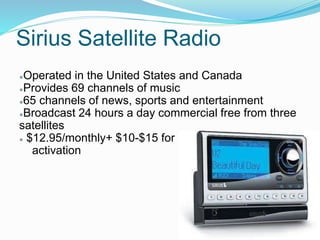
Sirius Satellite Radio
●Operated in the United States and Canada
●Provides 69 channels of music
●65 channels of news, sports and entertainment
●Broadcast 24 hours a day commercial free from three
satellites
● $12.95/monthly+ $10-$15 for
activation
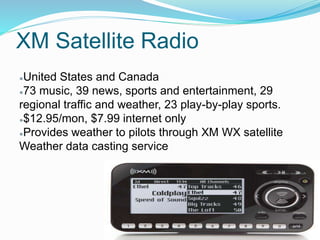
XM Satellite Radio
●United States and Canada
●73 music, 39 news, sports and entertainment, 29
regional traffic and weather, 23 play-by-play sports.
●$12.95/mon, $7.99 internet only
●Provides weather to pilots through XM WX satellite
Weather data casting service
Advantages
●Information about local traffic and weather
conditions
● Absence of static
● It produces crystal-clear sound
● Programs are not interrupted by commercials
Disadvantages
● Subscription Fee
● Signal Interruptions
● Signal Limitations
● Non-Local
Conclusion
●It will be an intelligent communications device that
will offer more services and conveniences than
can be provided by conventional analog
technology.
●For the broadcaster, digital radio is not just a way
to stay competitive with other forms of digital
sound, but one that offers numerous new business
opportunities as well.
●It is a bright future for listeners and broadcasters
alike: a future that truly promises to provide 'the
best sound on the air waves' for the world.
Any Queries????
THANK YOU

Sattelite Radio

  • 2.
    CONTENTS  What issatellite Radio  History  Current Providers  How Does It Works  Sirius Satellite Radio  XM Satellite Radio  Advantages  Disadvantages  Conclusion
  • 3.
    What Is SatelliteRadio? ●Satellite Radio is digital radio that receives signals from a broadcast communication satellite. ●Functions in any place if there is a line of sight between the antenna and the satellite ●Requires access to a commercial satellite for signal propagation ●Services are commercial business entity that offers packages of channels as part of service ●Requires a subscription from end users
  • 4.
    History ●Sirius Radio beganin 1990, while XM Radio started up in 1992. ●Starting in the early 21st century, when satellite radio hookups became more feasible, the competition between these two companies became fierce. ●The competition ended in 2007, when Sirius bought out XM Radio. ●The two major satellite radio providers in the United States, Sirius Radio and XM Radio, began operations in the early 1990s.
  • 5.
  • 6.
    How Does ItWork? ●Satellite radio uses stationary transmitters which have limited range to broadcast ,uses mobile satellites orbiting the earth. ●They pick up radio signals straight from orbiting satellites. ●The satellite bounces the transmitted radio frequency off of the satellite and out to the millions of satellite radio listeners around the world
  • 8.
    Sirius Satellite Radio ●Operatedin the United States and Canada ●Provides 69 channels of music ●65 channels of news, sports and entertainment ●Broadcast 24 hours a day commercial free from three satellites ● $12.95/monthly+ $10-$15 for activation
  • 9.
    XM Satellite Radio ●UnitedStates and Canada ●73 music, 39 news, sports and entertainment, 29 regional traffic and weather, 23 play-by-play sports. ●$12.95/mon, $7.99 internet only ●Provides weather to pilots through XM WX satellite Weather data casting service
  • 10.
    Advantages ●Information about localtraffic and weather conditions ● Absence of static ● It produces crystal-clear sound ● Programs are not interrupted by commercials
  • 11.
    Disadvantages ● Subscription Fee ●Signal Interruptions ● Signal Limitations ● Non-Local
  • 12.
    Conclusion ●It will bean intelligent communications device that will offer more services and conveniences than can be provided by conventional analog technology. ●For the broadcaster, digital radio is not just a way to stay competitive with other forms of digital sound, but one that offers numerous new business opportunities as well. ●It is a bright future for listeners and broadcasters alike: a future that truly promises to provide 'the best sound on the air waves' for the world.
  • 13.
  • 14.