DIT
Dar es Salaam institute of Technology (DIT)
ETU 07123
Introduction to Communication System
Ally, J
jumannea@gmail.com
DIT
Analogue Modulation
DIT
Introduction to Modulation
 Definitions
 Analog modulation
 Both the message signal and the transmitted signal are
analog signals
 Two classes: amplitude modulation, angle modulation
 Three signals:
 Message signal: the information signal to be modulated and
transmitted
 Carrier signal c(t) : high frequency sinusoidal signal
 Modulated signal: the signal to be transmitted, or the signal
obtained after modulation
DIT
Modulation
 It is the process of facilitating the transfer of
information over a medium.
 This is done by changing one or more the
parameters of a signal including power,
frequency, phase and amplitude depending
on the requirement of the transmission
system.
DIT
 Baseband, Passband
 Baseband: refers to the signals and systems before
modulation, which have frequencies/bandwidth much lower
than the carrier frequency
 Passband: refers to the signals and systems after (including)
modulation, which have frequencies/bandwidth around the
carrier frequency
 Baseband signal: is usually the message signal
 Passband signal: is usually the modulated signal, or
transmitted signal
Baseband and Passband signals
DIT
Baseband and Bandpass Signals
• Baseband signal is the original signal having the original
frequencies when delivered by transmitters.
• In Baseband communication, signals are transmitted
without modulation.
• Bandpass signal is a signal which is modulated by one of
the modulation schemes.
• Demodulation is the process of extracting the baseband
message from the carrier so that it may be processed
and interpreted by the intended receiver
DIT
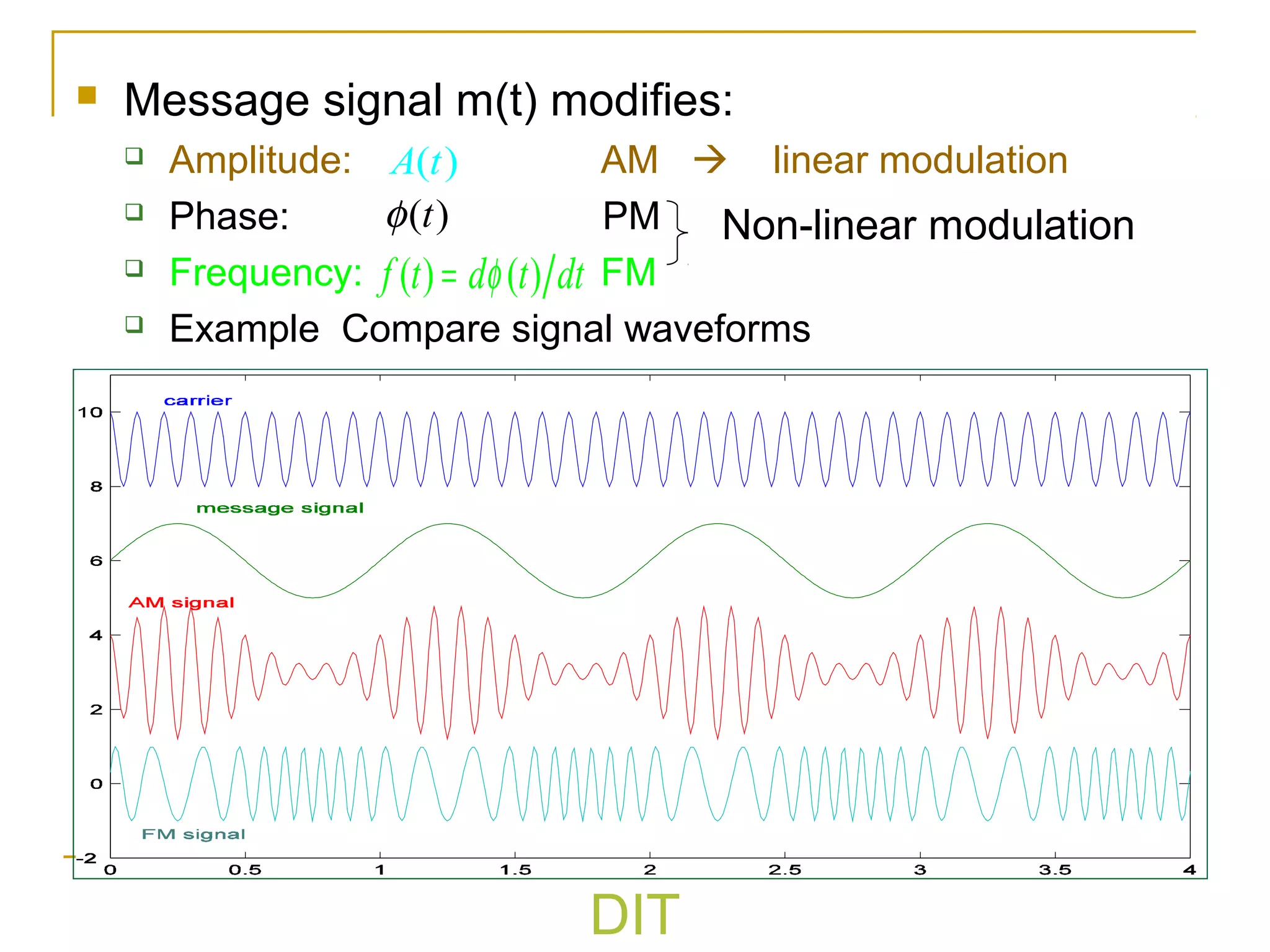
 Message signal m(t) modifies:
 Amplitude: AM  linear modulation
 Phase: PM
 Frequency: FM
 Example Compare signal waveforms
( )A t
( ) ( )f t d t dtφ=
Non-linear modulation)(tφ
DIT
Concept of Modulation
DIT
Checkpoints for studying each modulation
 Modulated signal (time-domain)
 Spectrum (frequency-domain)
 Parameters: bandwidth, power, etc
 Modulator and demodulator (Principles, block
diagrams or circuits)
 Major properties (advantages/disadvantages
over other modulations)
DIT
List of modulation methods we will learn
 Amplitude modulation methods and applications
1. AM (amplitude modulation): AM radio, short wave
radio broadcast,
2. DSBSC (double sideband suppressed carrier AM):
data modem, Color TV’s color signals
3. SSB (single sideband AM): telephone
4. VSB (vestigial sideband AM): TV picture signal
 Angle modulation methods and applications
1. FM (frequency modulation): FM radio broadcast, TV
sound signal, analog cellular phone
2. PM (phase modulation): not widely used, except in
digital communication systems (but that is different)
DIT
Amplitude Modulation (AM)
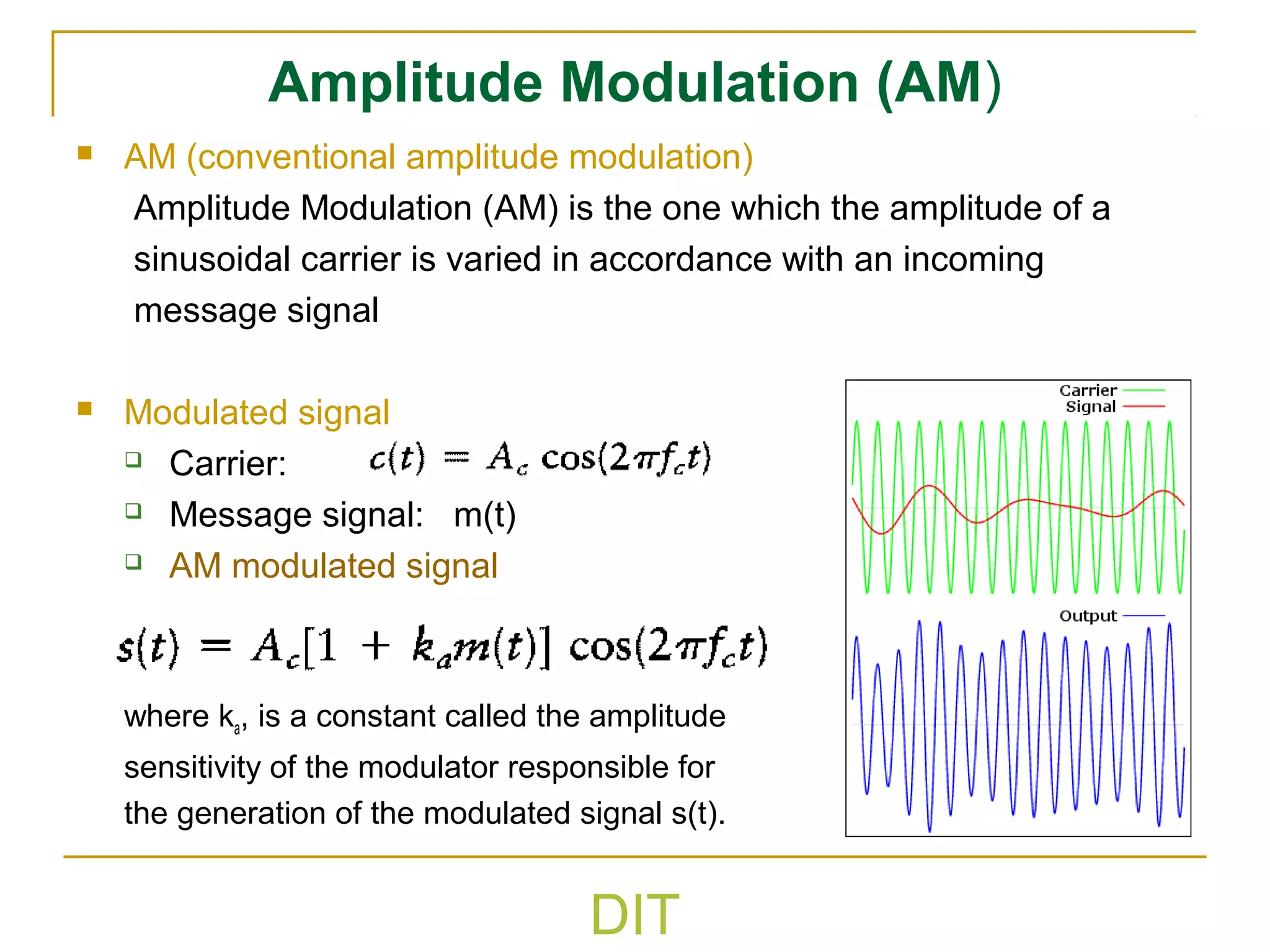
 AM (conventional amplitude modulation)
Amplitude Modulation (AM) is the one which the amplitude of a
sinusoidal carrier is varied in accordance with an incoming
message signal
 Modulated signal
 Carrier:
 Message signal: m(t)
 AM modulated signal
where ka, is a constant called the amplitude
sensitivity of the modulator responsible for
the generation of the modulated signal s(t).
DIT
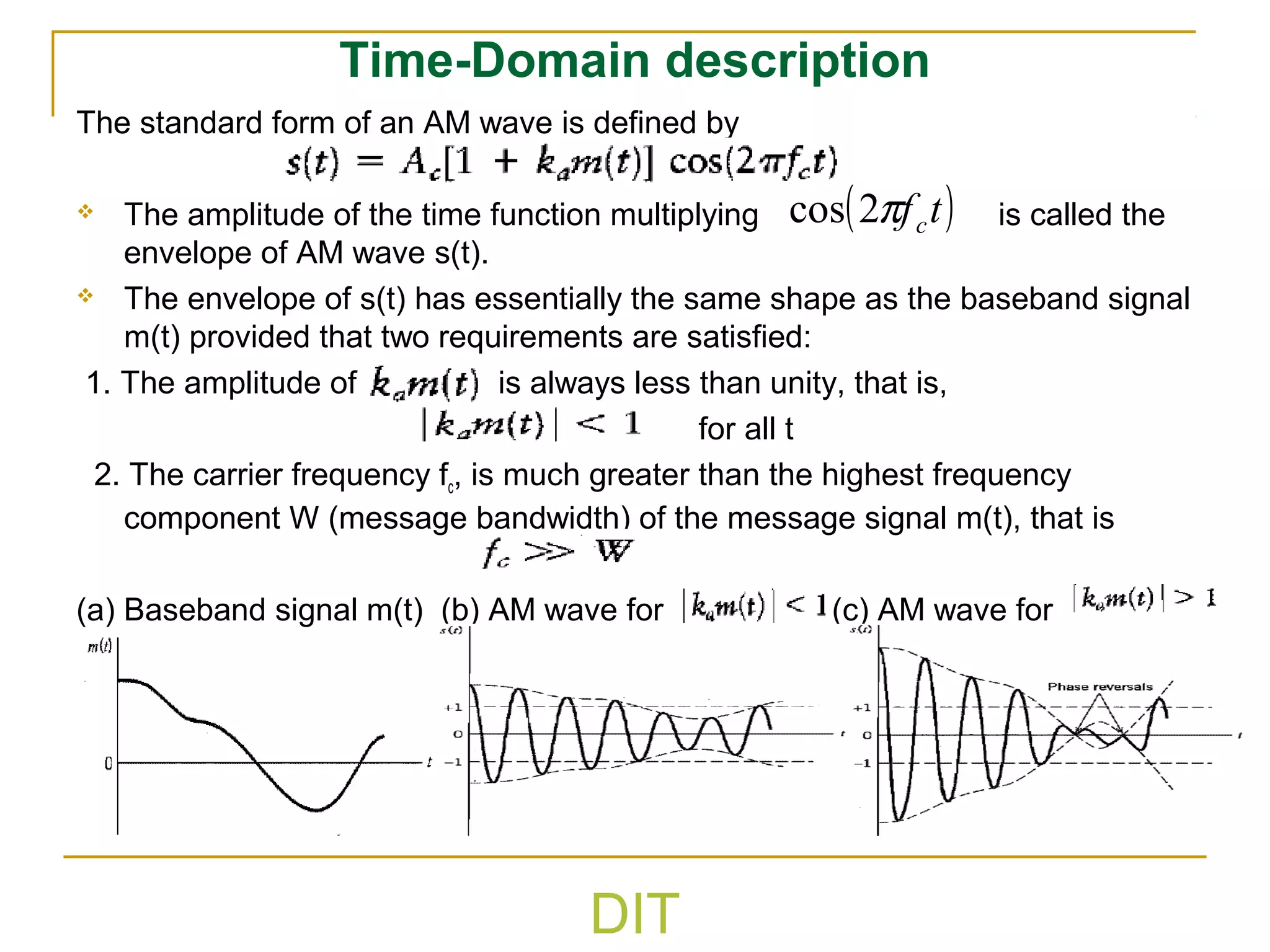
Time-Domain description
The standard form of an AM wave is defined by
 The amplitude of the time function multiplying is called the
envelope of AM wave s(t).
 The envelope of s(t) has essentially the same shape as the baseband signal
m(t) provided that two requirements are satisfied:
1. The amplitude of is always less than unity, that is,
for all t
2. The carrier frequency fc, is much greater than the highest frequency
component W (message bandwidth) of the message signal m(t), that is
(a) Baseband signal m(t) (b) AM wave for (c) AM wave for
( )tfcπ2cos
DIT
Frequency-Domain description
The Fourier transform of the AM wave s(t) is given by
(a) Spectrum of baseband signal
(b) Spectrum of AM wave
DIT
Generation of AM Waves
 Multipliers difficult to build in hardware
 AM waves typically generated using a nonlinear device to obtain the
desired multiplication
 Square law modulator sums carrier c(t) and information m(t) signals,
then squares them using a nonlinear device. Unwanted terms are
filtered out with a bandpass filter.
 Switched modulation sums c(t) and m(t) then passes sum through a
switch, which approximately multiplies it by a periodic square wave.
This generates the desired signal plus extra terms that are filtered
out.
m(t)
+
Accos(2πfct+φ)
Square
or Switch BPF
s(t)
DIT
Modulation Index
The degree of modulation is an important parameter and is known as
the modulation index. It is the ratio of the peak amplitude of the
modulating signal, Am to the peak amplitude of the carrier signal, Ac
(a) Under Modulation (ka < 1)
(b) Ideal Modulation (ka = 1)
(c) Over Modulation (ka > 1)
c
m
a
A
A
k =
DIT
Over Modulation
http://www.williamson-labs.com/480_am.htm
DIT
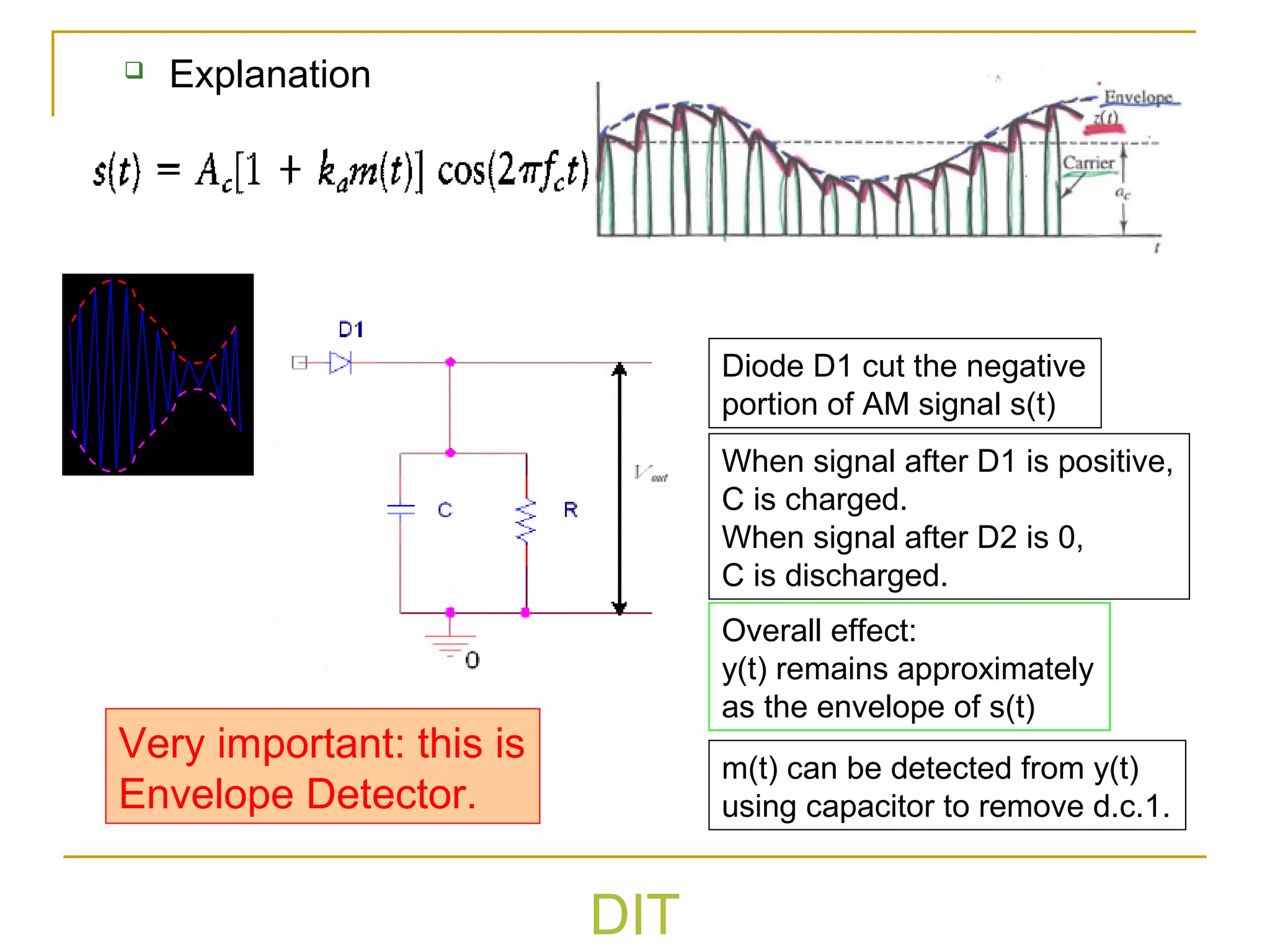
Detection of AM waves
 There are two devices for the detection of AM waves, namely, the
square-law detector and the envelope detector
 Square law detector, squares signal and then passes it through a
LPF
 Residual distortion proportional to m2
(t)
 Non-coherent (carrier phase not needed in RX)
 Envelope detection simple alternative method
DIT
 Explanation
Diode D1 cut the negative
portion of AM signal s(t)
When signal after D1 is positive,
C is charged.
When signal after D2 is 0,
C is discharged.
Overall effect:
y(t) remains approximately
as the envelope of s(t)
m(t) can be detected from y(t)
using capacitor to remove d.c.1.
Very important: this is
Envelope Detector.
DIT
 Bandwidth of AM signal BT = 2W
 AM signal’s bandwidth is twice message bandwidth
 This is also transmitted signal bandwidth, or required
minimum channel bandwidth Bc
 Negative frequency contents of m(t) becomes visible in
positive frequency
 Upper sideband (USB):
 Lower sideband (LSB):
 Transmission power: PT = PM+ Pcarrier
= PUSB + PLSB + Pcarrier
Wfff cc +≤≤
cc ffWf ≤≤−
DIT
AM Power Distribution
 In any electrical circuit, the power dissipated is
equal to the voltage squared divided by the
resistance.
 Mathematically, power in an unmodulated carrier:
 The upper and lower sideband powers is given by:
 The total power in AM wave is equal to:
R
A
P c
c
2
2
=
( )
482
2/ 2222
ccc
lsbusb
P
R
A
R
A
PP
µµµ
====






+=+=++=++=
2
1
244
2222
µµµµ
c
c
c
cc
clsbusbct P
P
P
PP
PPPPP
DIT
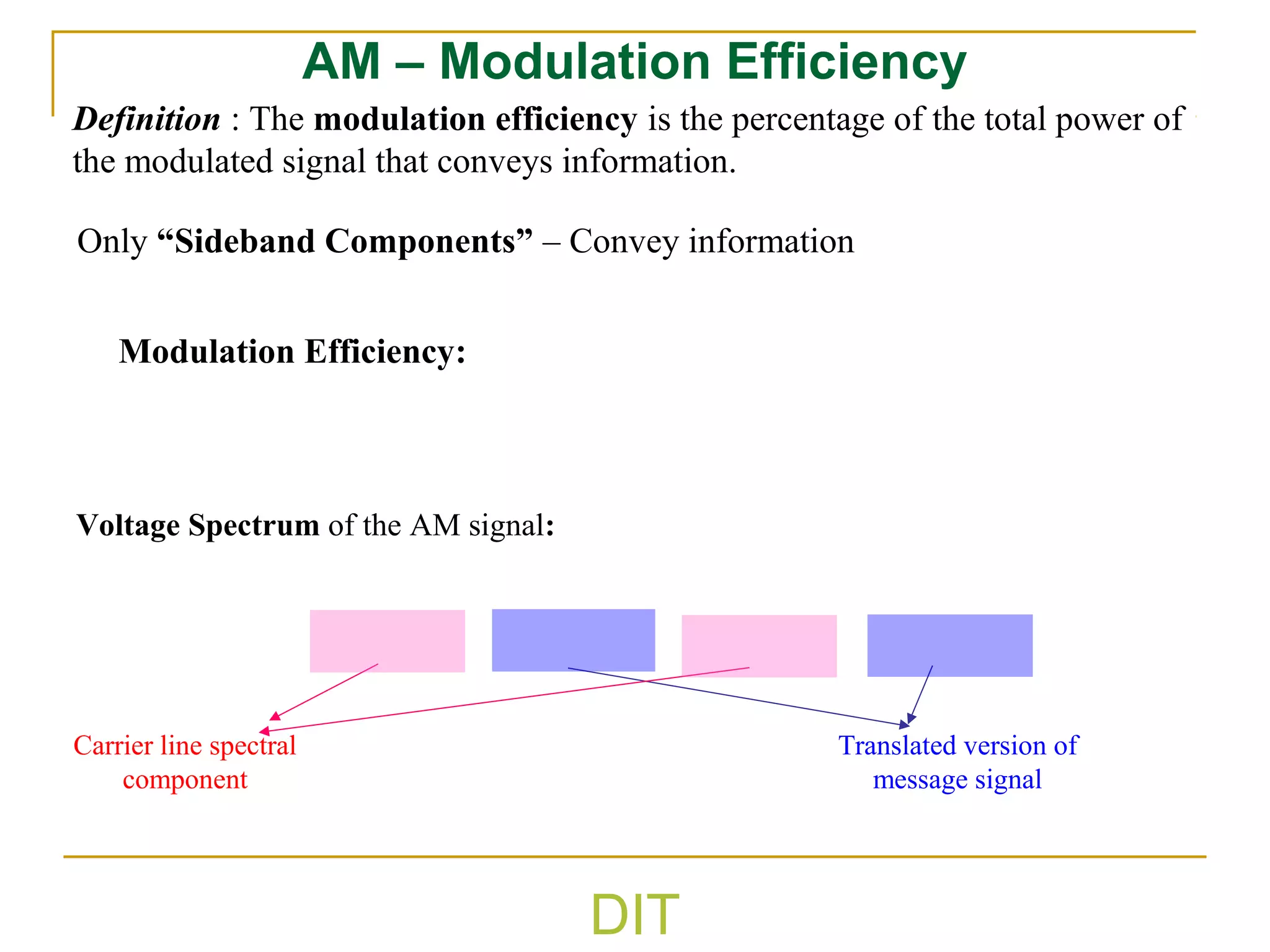
AM – Modulation Efficiency
Definition : The modulation efficiency is the percentage of the total power of
the modulated signal that conveys information.
Only “Sideband Components” – Convey information
Modulation Efficiency:
Voltage Spectrum of the AM signal:
Translated version of
message signal
Carrier line spectral
component
DIT
Major Properties of AM
 Advantages
 Simplicity in implementation, especially in receiver and
transmitter
 The major reason that AM was the first & most popular
broadcasting methods during early days
 Disadvantages
 Waste power and bandwidth
 Carrier components wastes a major portion power, but
carrier does not have message information
 Both USB and LSB are transmitted, which carry the same
message information
DIT
Ways for AM improvement
 To enhance power efficiency
 Reduce/remove carrier: DSB-SC
 Remove one/partial sideband: SSB, VSB
 To enhance bandwidth efficiency
 Remove one/partial sideband: SSB, VSB
 Multiplex two message signals together: QAM
 Cost for the improvement
 More expensive implementation
 The simple envelope detector is no longer applicable
DIT
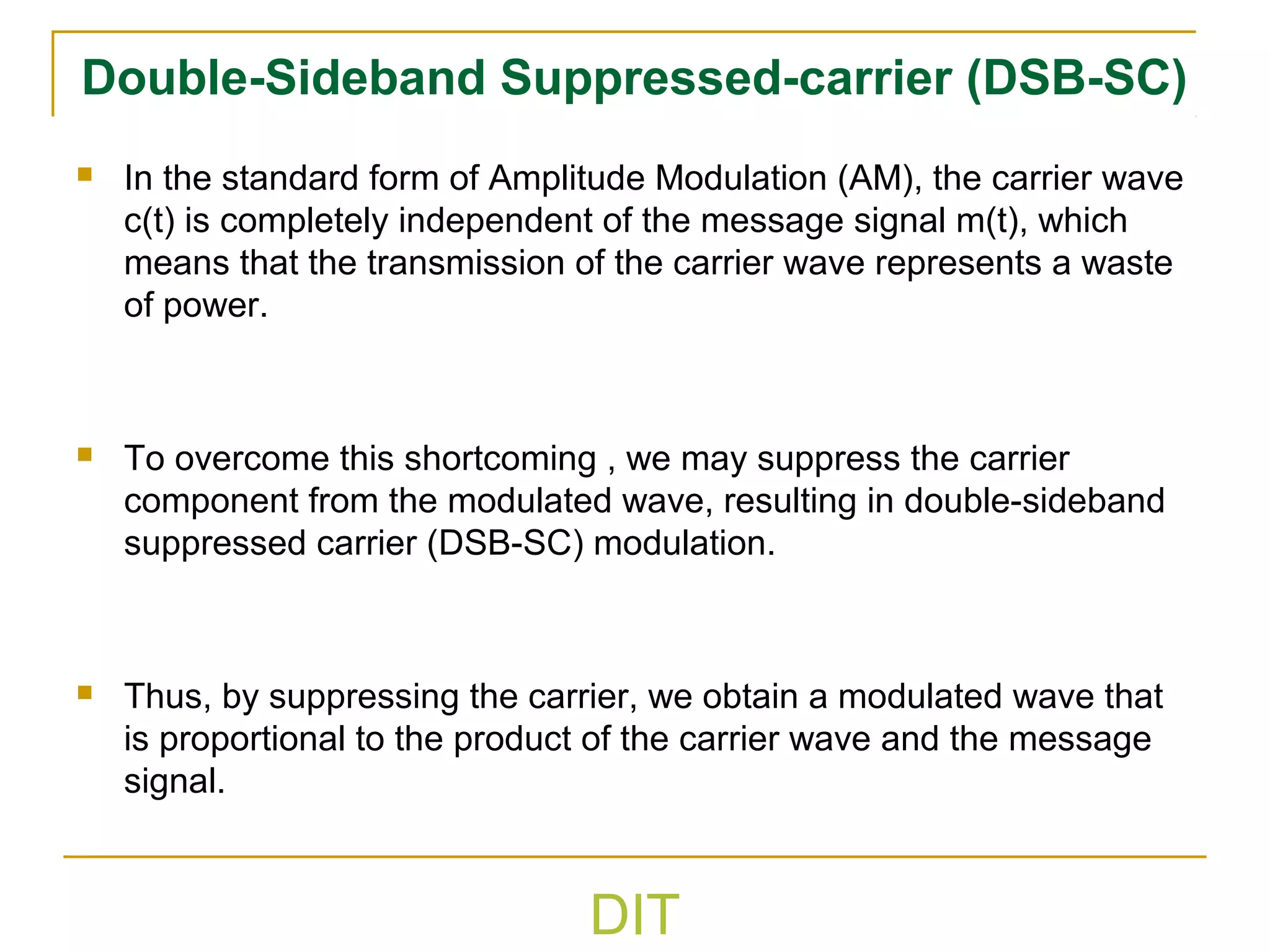
Double-Sideband Suppressed-carrier (DSB-SC)
 In the standard form of Amplitude Modulation (AM), the carrier wave
c(t) is completely independent of the message signal m(t), which
means that the transmission of the carrier wave represents a waste
of power.
 To overcome this shortcoming , we may suppress the carrier
component from the modulated wave, resulting in double-sideband
suppressed carrier (DSB-SC) modulation.
 Thus, by suppressing the carrier, we obtain a modulated wave that
is proportional to the product of the carrier wave and the message
signal.
DIT
Time-Domain Description
 The standard form of a DSB-SC wave is defined by
 This modulated wave undergoes a phase reversal whenever the
message signal m(t) crosses zero, as illustrated in figure below
(a) Baseband signal (b) DSB-SC modulated wave
( ) ( ) ( )tmtcts =
( ) ( ) ( )tmtfAts cc π2cos=
DIT
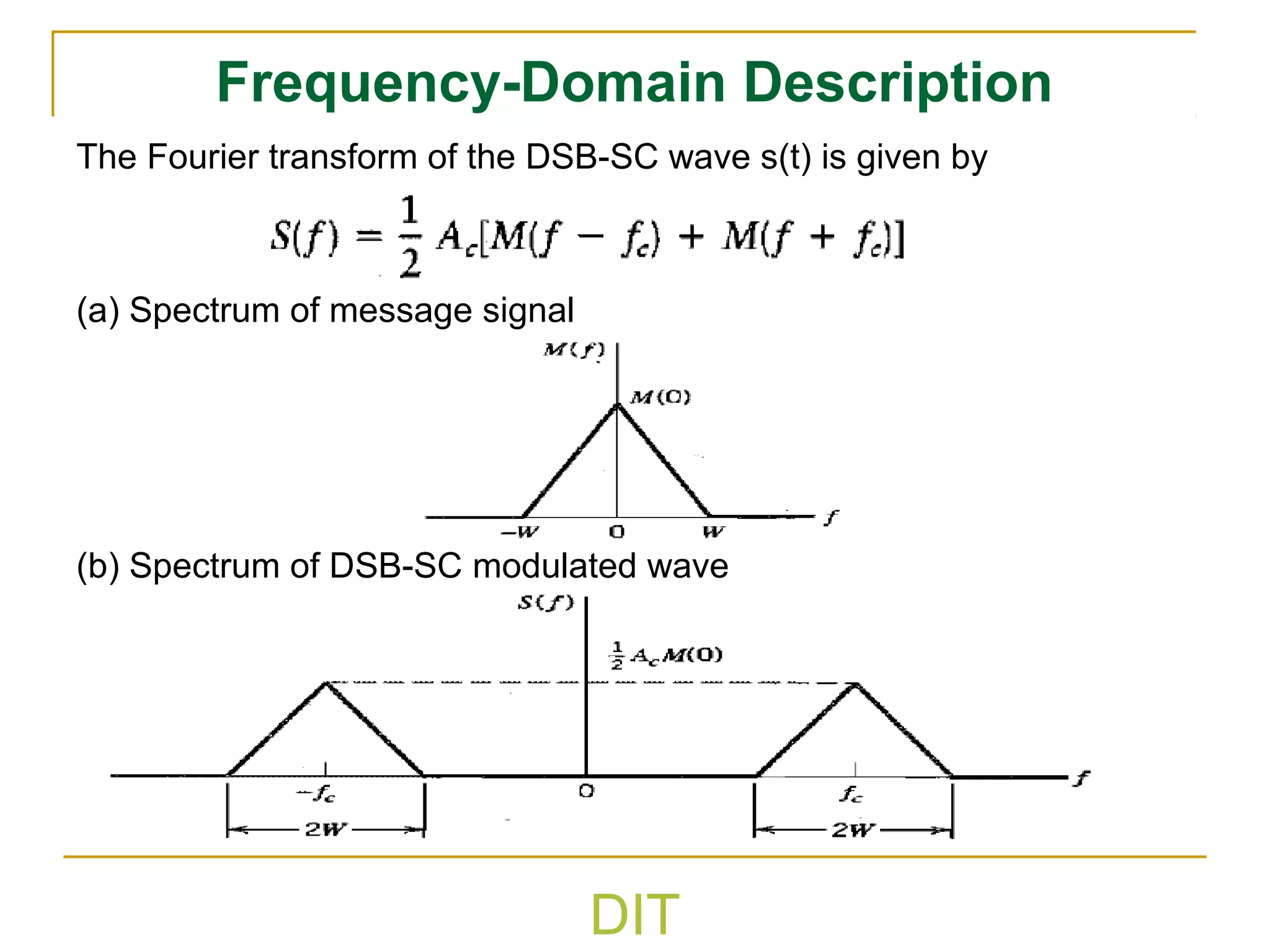
The Fourier transform of the DSB-SC wave s(t) is given by
(a) Spectrum of message signal
(b) Spectrum of DSB-SC modulated wave
Frequency-Domain Description
DIT
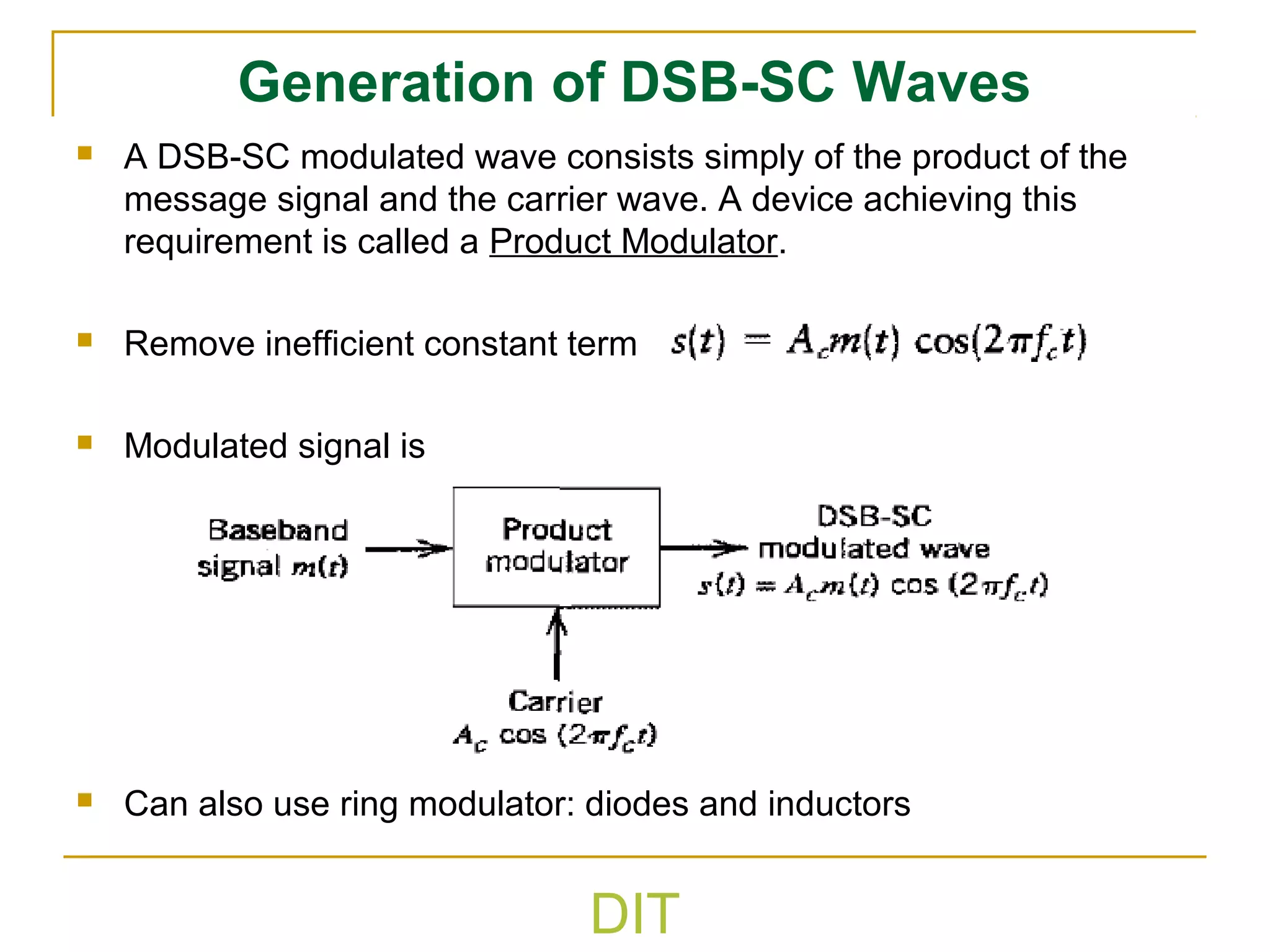
Generation of DSB-SC Waves
 A DSB-SC modulated wave consists simply of the product of the
message signal and the carrier wave. A device achieving this
requirement is called a Product Modulator.
 Remove inefficient constant term
 Modulated signal is
 Can also use ring modulator: diodes and inductors
DIT
Coherent Detection of DSB-SC Modulated Wave
 The baseband signal m(t) can be uniquely recovered from a DSB-
SC wave s(t) by first multiplying s(t) with a locally generated
sinusoidal wave and then low-pass filtering the product
 It is assumed that the local oscillator output is exactly coherent or
synchronized, in both frequency and phase, with the carrier wave
c(t) used in the product modulator to generate s(t).
 This method of demodulation is known as coherent detection or
synchronous detection.
DIT
Coherent Detection of DSB-SC Modulated Wave-2
 We find that the product modulator output is:
 The first term represents a DSB-SC modulated signal with a carrier
frequency 2fc, whereas the second term is proportional to the
baseband signal m(t).
 the first term is removed by the low-pass filter, this requirement is
satisfied by choosing fc > W. At the filter output we then obtain a
signal given by
 The demodulated signal is therefore proportional to m(t) when the
phase error is a constant.
DIT
Coherent Detection of DSB-SC Modulated Wave-3
 The amplitude of this demodulated signal is maximum when
and it is minimum (zero) when
 As long as the phase error is constant, the detector provides an
undistorted version of the original baseband signal m(t).
 In practice, however, we usually find that the phase error varies randomly
with time, due to random variations in the communication channel. The
result is that at the detector output, the multiplying factor also varies
randomly with time, which is obviously undesirable.
 Therefore, provision must be made in the system to maintain the local
oscillator in the receiver in perfect synchronism, in both frequency and
phase, with the carrier wave used to generate the DSB-SC modulated signal
in the transmitter.
 The resulting system complexity is the price that must be paid for
suppressing the carrier wave to save transmitter power.
φcos
DIT
Costas Loop (DSB-SC Demodulator)
Goal: Maintain οφ ≈∆
DIT
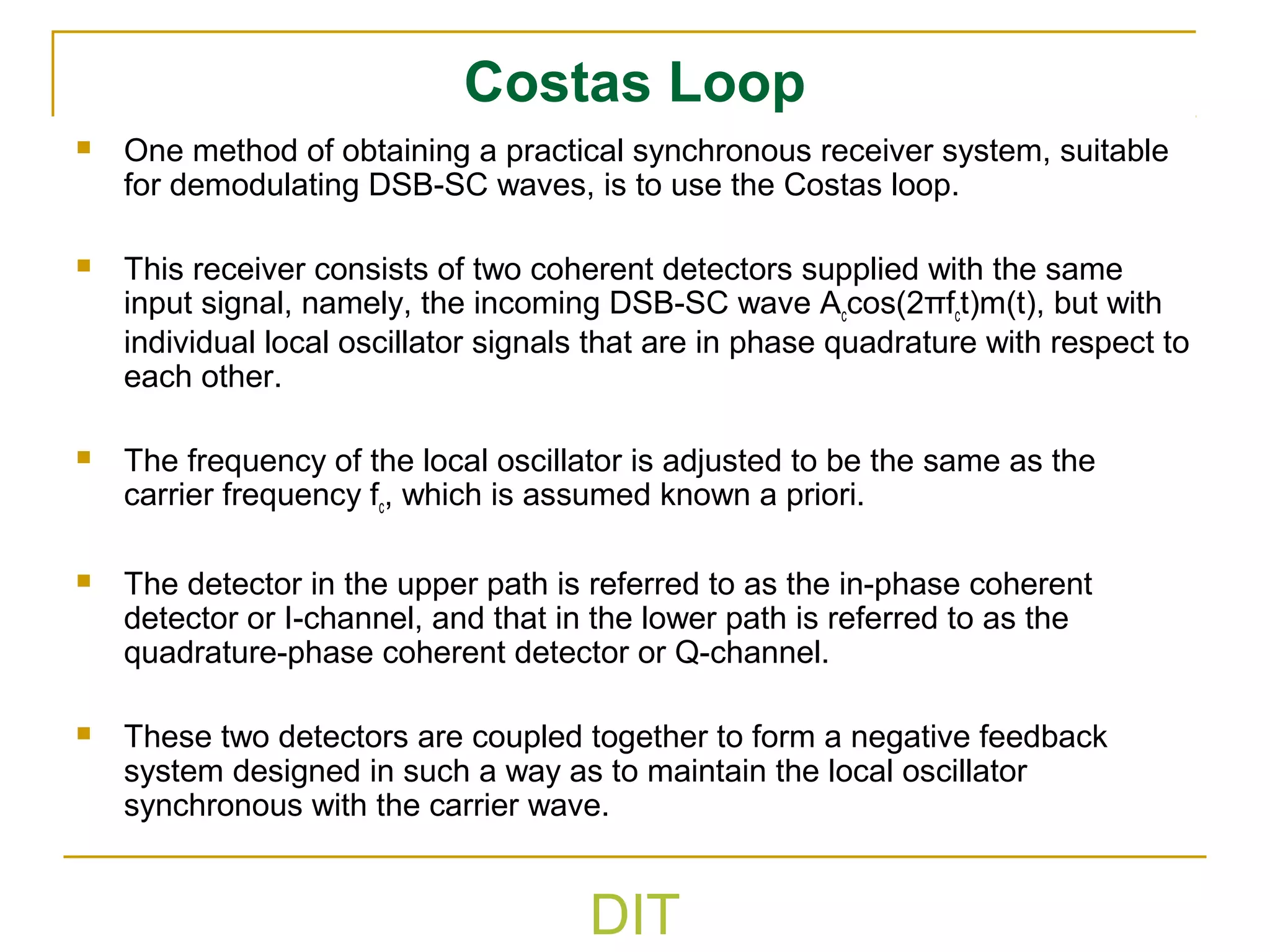
Costas Loop
 One method of obtaining a practical synchronous receiver system, suitable
for demodulating DSB-SC waves, is to use the Costas loop.
 This receiver consists of two coherent detectors supplied with the same
input signal, namely, the incoming DSB-SC wave Accos(2πfct)m(t), but with
individual local oscillator signals that are in phase quadrature with respect to
each other.
 The frequency of the local oscillator is adjusted to be the same as the
carrier frequency fc, which is assumed known a priori.
 The detector in the upper path is referred to as the in-phase coherent
detector or I-channel, and that in the lower path is referred to as the
quadrature-phase coherent detector or Q-channel.
 These two detectors are coupled together to form a negative feedback
system designed in such a way as to maintain the local oscillator
synchronous with the carrier wave.
DIT
Double Side Band Suppressed Carrier
Power in a AM signal is given by
( ) ( )
2
1
2
1 2222
tmAAts cc +=
Discrete carrier power Sideband power
Discrete carrier power can be eliminated (Suppressing carrier )if m(t) is
assumed to have a zero DC level
Then ttmAts cc ωcos)()( =
Spectrum 
( ) ( )[ ]cc
c
ffMffM
A
fS ++−=
2
)(
Since no power is wasted in carrier the efficiency is
Power 
( ) ( )
2
1 222
tmAts c=
( )
( )
%1001002
2
=×=
tm
tm
E
DIT
Noise in AM Receivers
 Power in s(t) is 0.5Ac
2
Pm
 Power in n(t) is N0B
SNR=Pm/Pn= Ac
2
Pm/(2N0B)= Ps/(N0B) (SNR at the receiver input)
 Power in m′(t) is 0.25Ac
2
Pm (half the power in s(t))
 Power in n′(t) is 0.5N0B (PSD 0.25N0 over BW 2B)
SNR=Pm´/Pn´= Ac
2
Pm/(2N0B)= Ps/(N0B) (SNR at the receiver output)
Product
Modulato
r
m´(t)+ n´(t)
Accos(2πfct+φ)
s(t)=Accos(2πfct+φ)m(t
) +
n(t)
LPF
1
White Gaussian noise
(AWGN)
-B B
DIT
Single-SideBand (SSB) Modulation
 Standard AM and DSB-SC Modulation are wasteful of
bandwidth because they both require a transmission
bandwidth equal to twice message the message
bandwidth.
 This means that insofar as the transmission of
information is concerned, only one sideband is
necessary, and no information is lost.
 Thus the channel needs to provide only the same
bandwidth as the message signal, a conclusion that is
intuitively satisfying.
 When only one sideband is transmitted, the modulation
is referred to as single-sideband modulation
DIT
Single Sideband Modulation(2)
 Only transmits upper or lower sideband of AM and DSBSC
 The transmitted signal can be written in terms m(t) and the
Hilbert Transform of m(t)
 Use same demodulator as DSBSC
 SSB has half the SNR of DSBSC for half the transmit
power: no SNR gain
 SSB can introduce significant distortion at DC where the
sidebands meet: not good for TV signals
USB
LSBM(f)
0 fc-fcB-B
USB
LSB
)]2sin()()2cos()([
2
)( φπφπ +±+= tftmtftm
A
ts chc
c
DIT
Baseband Representation of Modulated
Signals
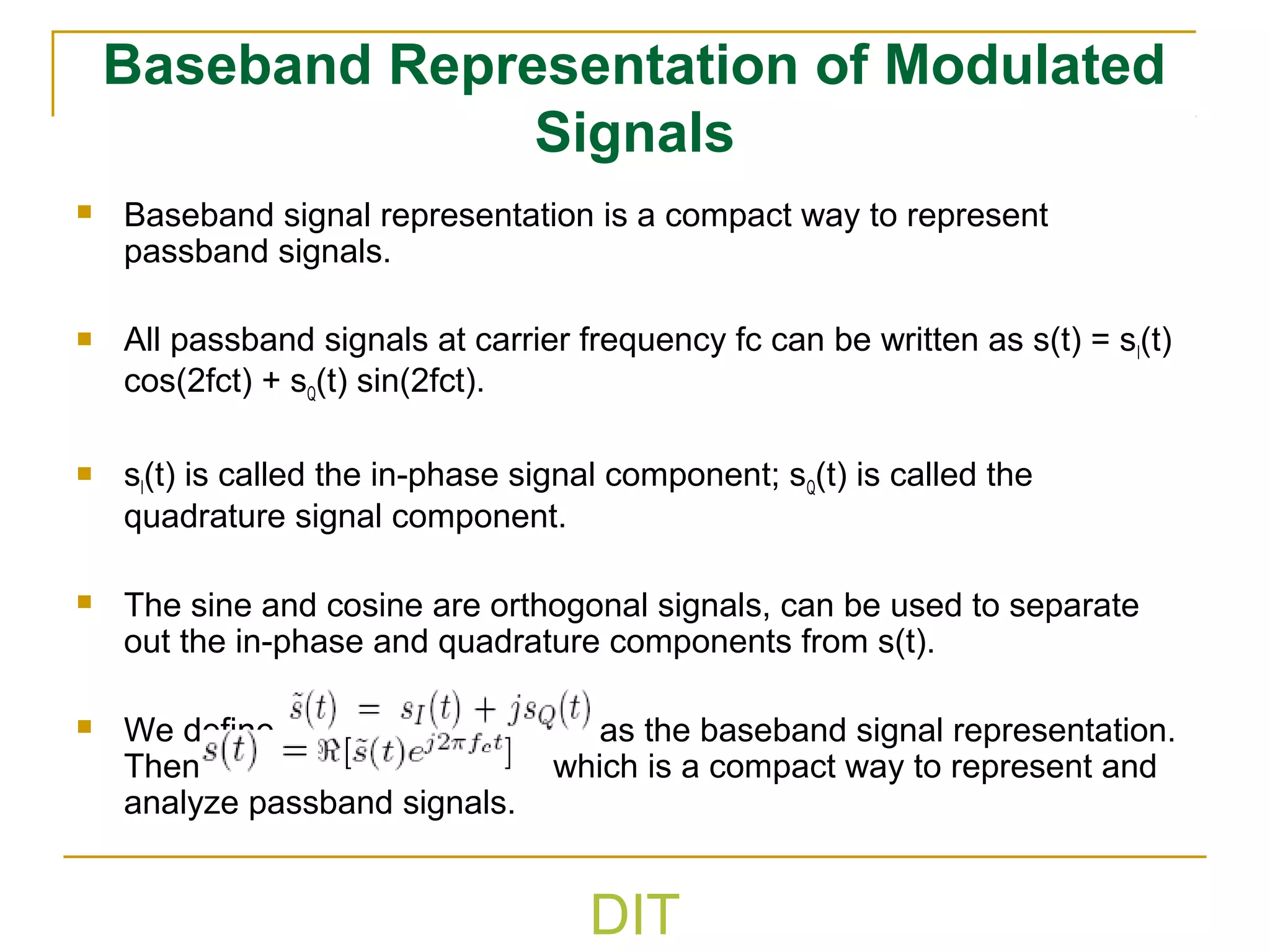
 Baseband signal representation is a compact way to represent
passband signals.
 All passband signals at carrier frequency fc can be written as s(t) = sI(t)
cos(2fct) + sQ(t) sin(2fct).
 sI(t) is called the in-phase signal component; sQ(t) is called the
quadrature signal component.
 The sine and cosine are orthogonal signals, can be used to separate
out the in-phase and quadrature components from s(t).
 We define as the baseband signal representation.
Then which is a compact way to represent and
analyze passband signals.
DIT
Generating of SSB modulated wave by phase
discrimination method
 The phase discrimination method of generating an SSB modulated
wave involves two separate simultaneous modulation processes and
subsequent combination of the resulting modulation products.
 The system uses two product modulators, I and Q, supplied with
carrier waves in phase quadrature to each other.
 The incoming baseband signal m(t) is applied to product modulator I,
producing a modulated DSBSC wave that contains reference phase
sidebands symmetrically spaced about carrier frequency fc.
 The hilbert transform mh(t) of m(t) is applied to product modulator Q,
producing DSBSC modulated wave that containssideband having
identical amplitude spectra to those of modulator I, but with phase
spectra such that vector addition or subtraction of the two modulator
outputs results in cancellation of one setof sidebands and
reinforcement of the other set.
 The use of plus sign yields SSB wave with only the upper sideband,
whereas the use of minus sign yields SSB wave with only upper
sideband.
DIT
Block diagram for generating of SSB modulated
wave by phase discrimination method
DIT
Demodulation of SSB wave
 To recover the baseband signal m(t) from the SSB wave s(t), we
have to shift the spectrum by the amounts so as to convert
the transmitted sideband back into the baseband signal.
 This can be accomplished using coherent detection, which
involves applying the SSB wave s(t), together with locally
generated carrier , assumed to be of unit amplitude for
convenience, to a product modulator and then low-pass filtering
the modulator output.
cf+
−
( )tfcπ2cos
,
DIT
Demodulation of SSB wave (2)
 The product modulator output is given by
 The first term is the desired message signal. The second term
represents an unwanted components in the product modulator
output that is removed by low-pass filtering.
 The detection of SSB modulated waves assume perfect
synchronization between the local carrier and that in the transmitter
both in frequency and phase. The effect of a phase error Ф in the
locally generated carrier wave is to modify the detector output as
follows
( ) ( ) ( )tstftv cπ2cos=
( ) ( ) ( ) ( ) ( )[ ]
( ) ( ) ( ) ( ) ( )[ ]tftmtftmAtmA
tftmtftmtfA
cccc
cccc
ππ
πππ
4sin~4cos
4
1
4
1
2sin~2cos2cos
2
1
+=
±=
( ) ( ) ( ) φφ sin~
4
1
cos
4
1
tmAtmAtv cco =
DIT
Demodulation of SSB wave (3)
 Owing to the phase error Ф, the detector output
vo(t) contains not only the message signal m(t)
but also its Hilbert transform mh(t).
 Consequently, the detector output suffers from
phase distortion. This phase distortion is usually
not serious with voice communications because
the human ear is relatively insensitive to phase
distortion.
 In the transmission of music and video signals,
on the other hand, phase distortion in the form of
a constant phase difference in all components
can be intolerable.
DIT
Vestigial Side-Band (VSB) Modulation
 Single-sideband modulation is well-suited for the
transmission of voice because of the energy gap that exists
in the spectrum of voice signals between zero and a few
hundred hertz.
 When the message signal contains significant components
at extremely low frequencies i.e. television signals, the
upper and lower sidebands meet at the carrier frequency.
This means SSB modulation is inappropriate for the
transmission of television signals.
 This difficulty suggests another scheme known as vestigial
sideband modulation (VSB), which is a compromise
between SSB and DSBSC modulation.
DIT
Vestigial Sideband
 VSB is similar to SSB but it retains a small portion (a vestige) of the
undesired sideband to reduce DC distortion. Transmits USB or LSB
and vestige of other sideband
 Reduces bandwidth by roughly a factor of 2
 VSB signals are generated using standard AM or DSBSC modulation,
then passing modulated signal through a band-pass filter i.e. it is the
special design of the band-pass filter that distinguishes VSB
modulation from SSB modulation.
 Demodulation uses either standard AM or DSBSC demodulation
 VSB used for image transmission in TV signals
USB
DIT
Generation of VSB modulated wave
 The transmission bandwidth of VSB modulation is given by
where W is the message bandwidth, and f, is the width of the vestigial
sideband
 To generate a VSB modulated wave, we pass a DSBSC modulated
wave through a sideband shaping filter.
 The exact design of this filter depends on the desired spectrum of the
VSB modulated wave.
 the VSB modulated wave is described in the time domain as
 This is the desired representation representation for a VSB modulated
wave containing a vestige of the lower sideband. The component
0.5Acm(t) constitutes the in-phase component of this VSB modulated
wave, and 0.5AcmQ(t) constitutes the quadrature components.
( ) ( ) ( ) ( ) ( )tftm
A
tftm
A
ts cQ
c
c
c
ππ 2sin
2
2cos
2
−=
DIT
Scheme for generation and demodulation
of a VSB modulated wave
 Block diagram of VSB modulator
 Block diagram of VSB demodulator
DIT
Envelope detection of a VSB wave plus
carrier
 In commercial television broadcasting, a sizable carrier
is transmitted together with the modulated wave.
 This makes it possible to demodulate the incoming
modulated wave by an envelope detector in the receiver.
 In commercial television broadcasting, the vestigial
sideband occupies a width of about 1.25 MHz, or about
one-quarter of a full sideband.
 This has been determined empirically as the width of
vestigial sideband required to keep the distortion due to
mQ(t) within tolerable limits when when the percentage
modulation is nearly 100.

Introduction to communication system lecture2

  • 1.
    DIT Dar es Salaaminstitute of Technology (DIT) ETU 07123 Introduction to Communication System Ally, J jumannea@gmail.com
  • 2.
  • 3.
    DIT Introduction to Modulation Definitions  Analog modulation  Both the message signal and the transmitted signal are analog signals  Two classes: amplitude modulation, angle modulation  Three signals:  Message signal: the information signal to be modulated and transmitted  Carrier signal c(t) : high frequency sinusoidal signal  Modulated signal: the signal to be transmitted, or the signal obtained after modulation
  • 4.
    DIT Modulation  It isthe process of facilitating the transfer of information over a medium.  This is done by changing one or more the parameters of a signal including power, frequency, phase and amplitude depending on the requirement of the transmission system.
  • 5.
    DIT  Baseband, Passband Baseband: refers to the signals and systems before modulation, which have frequencies/bandwidth much lower than the carrier frequency  Passband: refers to the signals and systems after (including) modulation, which have frequencies/bandwidth around the carrier frequency  Baseband signal: is usually the message signal  Passband signal: is usually the modulated signal, or transmitted signal Baseband and Passband signals
  • 6.
    DIT Baseband and BandpassSignals • Baseband signal is the original signal having the original frequencies when delivered by transmitters. • In Baseband communication, signals are transmitted without modulation. • Bandpass signal is a signal which is modulated by one of the modulation schemes. • Demodulation is the process of extracting the baseband message from the carrier so that it may be processed and interpreted by the intended receiver
  • 7.
    DIT  Message signalm(t) modifies:  Amplitude: AM  linear modulation  Phase: PM  Frequency: FM  Example Compare signal waveforms ( )A t ( ) ( )f t d t dtφ= Non-linear modulation)(tφ
  • 8.
  • 9.
    DIT Checkpoints for studyingeach modulation  Modulated signal (time-domain)  Spectrum (frequency-domain)  Parameters: bandwidth, power, etc  Modulator and demodulator (Principles, block diagrams or circuits)  Major properties (advantages/disadvantages over other modulations)
  • 10.
    DIT List of modulationmethods we will learn  Amplitude modulation methods and applications 1. AM (amplitude modulation): AM radio, short wave radio broadcast, 2. DSBSC (double sideband suppressed carrier AM): data modem, Color TV’s color signals 3. SSB (single sideband AM): telephone 4. VSB (vestigial sideband AM): TV picture signal  Angle modulation methods and applications 1. FM (frequency modulation): FM radio broadcast, TV sound signal, analog cellular phone 2. PM (phase modulation): not widely used, except in digital communication systems (but that is different)
  • 11.
    DIT Amplitude Modulation (AM) AM (conventional amplitude modulation) Amplitude Modulation (AM) is the one which the amplitude of a sinusoidal carrier is varied in accordance with an incoming message signal  Modulated signal  Carrier:  Message signal: m(t)  AM modulated signal where ka, is a constant called the amplitude sensitivity of the modulator responsible for the generation of the modulated signal s(t).
  • 12.
    DIT Time-Domain description The standardform of an AM wave is defined by  The amplitude of the time function multiplying is called the envelope of AM wave s(t).  The envelope of s(t) has essentially the same shape as the baseband signal m(t) provided that two requirements are satisfied: 1. The amplitude of is always less than unity, that is, for all t 2. The carrier frequency fc, is much greater than the highest frequency component W (message bandwidth) of the message signal m(t), that is (a) Baseband signal m(t) (b) AM wave for (c) AM wave for ( )tfcπ2cos
  • 13.
    DIT Frequency-Domain description The Fouriertransform of the AM wave s(t) is given by (a) Spectrum of baseband signal (b) Spectrum of AM wave
  • 14.
    DIT Generation of AMWaves  Multipliers difficult to build in hardware  AM waves typically generated using a nonlinear device to obtain the desired multiplication  Square law modulator sums carrier c(t) and information m(t) signals, then squares them using a nonlinear device. Unwanted terms are filtered out with a bandpass filter.  Switched modulation sums c(t) and m(t) then passes sum through a switch, which approximately multiplies it by a periodic square wave. This generates the desired signal plus extra terms that are filtered out. m(t) + Accos(2πfct+φ) Square or Switch BPF s(t)
  • 15.
    DIT Modulation Index The degreeof modulation is an important parameter and is known as the modulation index. It is the ratio of the peak amplitude of the modulating signal, Am to the peak amplitude of the carrier signal, Ac (a) Under Modulation (ka < 1) (b) Ideal Modulation (ka = 1) (c) Over Modulation (ka > 1) c m a A A k =
  • 16.
  • 17.
    DIT Detection of AMwaves  There are two devices for the detection of AM waves, namely, the square-law detector and the envelope detector  Square law detector, squares signal and then passes it through a LPF  Residual distortion proportional to m2 (t)  Non-coherent (carrier phase not needed in RX)  Envelope detection simple alternative method
  • 18.
    DIT  Explanation Diode D1cut the negative portion of AM signal s(t) When signal after D1 is positive, C is charged. When signal after D2 is 0, C is discharged. Overall effect: y(t) remains approximately as the envelope of s(t) m(t) can be detected from y(t) using capacitor to remove d.c.1. Very important: this is Envelope Detector.
  • 19.
    DIT  Bandwidth ofAM signal BT = 2W  AM signal’s bandwidth is twice message bandwidth  This is also transmitted signal bandwidth, or required minimum channel bandwidth Bc  Negative frequency contents of m(t) becomes visible in positive frequency  Upper sideband (USB):  Lower sideband (LSB):  Transmission power: PT = PM+ Pcarrier = PUSB + PLSB + Pcarrier Wfff cc +≤≤ cc ffWf ≤≤−
  • 20.
    DIT AM Power Distribution In any electrical circuit, the power dissipated is equal to the voltage squared divided by the resistance.  Mathematically, power in an unmodulated carrier:  The upper and lower sideband powers is given by:  The total power in AM wave is equal to: R A P c c 2 2 = ( ) 482 2/ 2222 ccc lsbusb P R A R A PP µµµ ====       +=+=++=++= 2 1 244 2222 µµµµ c c c cc clsbusbct P P P PP PPPPP
  • 21.
    DIT AM – ModulationEfficiency Definition : The modulation efficiency is the percentage of the total power of the modulated signal that conveys information. Only “Sideband Components” – Convey information Modulation Efficiency: Voltage Spectrum of the AM signal: Translated version of message signal Carrier line spectral component
  • 22.
    DIT Major Properties ofAM  Advantages  Simplicity in implementation, especially in receiver and transmitter  The major reason that AM was the first & most popular broadcasting methods during early days  Disadvantages  Waste power and bandwidth  Carrier components wastes a major portion power, but carrier does not have message information  Both USB and LSB are transmitted, which carry the same message information
  • 23.
    DIT Ways for AMimprovement  To enhance power efficiency  Reduce/remove carrier: DSB-SC  Remove one/partial sideband: SSB, VSB  To enhance bandwidth efficiency  Remove one/partial sideband: SSB, VSB  Multiplex two message signals together: QAM  Cost for the improvement  More expensive implementation  The simple envelope detector is no longer applicable
  • 24.
    DIT Double-Sideband Suppressed-carrier (DSB-SC) In the standard form of Amplitude Modulation (AM), the carrier wave c(t) is completely independent of the message signal m(t), which means that the transmission of the carrier wave represents a waste of power.  To overcome this shortcoming , we may suppress the carrier component from the modulated wave, resulting in double-sideband suppressed carrier (DSB-SC) modulation.  Thus, by suppressing the carrier, we obtain a modulated wave that is proportional to the product of the carrier wave and the message signal.
  • 25.
    DIT Time-Domain Description  Thestandard form of a DSB-SC wave is defined by  This modulated wave undergoes a phase reversal whenever the message signal m(t) crosses zero, as illustrated in figure below (a) Baseband signal (b) DSB-SC modulated wave ( ) ( ) ( )tmtcts = ( ) ( ) ( )tmtfAts cc π2cos=
  • 26.
    DIT The Fourier transformof the DSB-SC wave s(t) is given by (a) Spectrum of message signal (b) Spectrum of DSB-SC modulated wave Frequency-Domain Description
  • 27.
    DIT Generation of DSB-SCWaves  A DSB-SC modulated wave consists simply of the product of the message signal and the carrier wave. A device achieving this requirement is called a Product Modulator.  Remove inefficient constant term  Modulated signal is  Can also use ring modulator: diodes and inductors
  • 28.
    DIT Coherent Detection ofDSB-SC Modulated Wave  The baseband signal m(t) can be uniquely recovered from a DSB- SC wave s(t) by first multiplying s(t) with a locally generated sinusoidal wave and then low-pass filtering the product  It is assumed that the local oscillator output is exactly coherent or synchronized, in both frequency and phase, with the carrier wave c(t) used in the product modulator to generate s(t).  This method of demodulation is known as coherent detection or synchronous detection.
  • 29.
    DIT Coherent Detection ofDSB-SC Modulated Wave-2  We find that the product modulator output is:  The first term represents a DSB-SC modulated signal with a carrier frequency 2fc, whereas the second term is proportional to the baseband signal m(t).  the first term is removed by the low-pass filter, this requirement is satisfied by choosing fc > W. At the filter output we then obtain a signal given by  The demodulated signal is therefore proportional to m(t) when the phase error is a constant.
  • 30.
    DIT Coherent Detection ofDSB-SC Modulated Wave-3  The amplitude of this demodulated signal is maximum when and it is minimum (zero) when  As long as the phase error is constant, the detector provides an undistorted version of the original baseband signal m(t).  In practice, however, we usually find that the phase error varies randomly with time, due to random variations in the communication channel. The result is that at the detector output, the multiplying factor also varies randomly with time, which is obviously undesirable.  Therefore, provision must be made in the system to maintain the local oscillator in the receiver in perfect synchronism, in both frequency and phase, with the carrier wave used to generate the DSB-SC modulated signal in the transmitter.  The resulting system complexity is the price that must be paid for suppressing the carrier wave to save transmitter power. φcos
  • 31.
    DIT Costas Loop (DSB-SCDemodulator) Goal: Maintain οφ ≈∆
  • 32.
    DIT Costas Loop  Onemethod of obtaining a practical synchronous receiver system, suitable for demodulating DSB-SC waves, is to use the Costas loop.  This receiver consists of two coherent detectors supplied with the same input signal, namely, the incoming DSB-SC wave Accos(2πfct)m(t), but with individual local oscillator signals that are in phase quadrature with respect to each other.  The frequency of the local oscillator is adjusted to be the same as the carrier frequency fc, which is assumed known a priori.  The detector in the upper path is referred to as the in-phase coherent detector or I-channel, and that in the lower path is referred to as the quadrature-phase coherent detector or Q-channel.  These two detectors are coupled together to form a negative feedback system designed in such a way as to maintain the local oscillator synchronous with the carrier wave.
  • 33.
    DIT Double Side BandSuppressed Carrier Power in a AM signal is given by ( ) ( ) 2 1 2 1 2222 tmAAts cc += Discrete carrier power Sideband power Discrete carrier power can be eliminated (Suppressing carrier )if m(t) is assumed to have a zero DC level Then ttmAts cc ωcos)()( = Spectrum  ( ) ( )[ ]cc c ffMffM A fS ++−= 2 )( Since no power is wasted in carrier the efficiency is Power  ( ) ( ) 2 1 222 tmAts c= ( ) ( ) %1001002 2 =×= tm tm E
  • 34.
    DIT Noise in AMReceivers  Power in s(t) is 0.5Ac 2 Pm  Power in n(t) is N0B SNR=Pm/Pn= Ac 2 Pm/(2N0B)= Ps/(N0B) (SNR at the receiver input)  Power in m′(t) is 0.25Ac 2 Pm (half the power in s(t))  Power in n′(t) is 0.5N0B (PSD 0.25N0 over BW 2B) SNR=Pm´/Pn´= Ac 2 Pm/(2N0B)= Ps/(N0B) (SNR at the receiver output) Product Modulato r m´(t)+ n´(t) Accos(2πfct+φ) s(t)=Accos(2πfct+φ)m(t ) + n(t) LPF 1 White Gaussian noise (AWGN) -B B
  • 35.
    DIT Single-SideBand (SSB) Modulation Standard AM and DSB-SC Modulation are wasteful of bandwidth because they both require a transmission bandwidth equal to twice message the message bandwidth.  This means that insofar as the transmission of information is concerned, only one sideband is necessary, and no information is lost.  Thus the channel needs to provide only the same bandwidth as the message signal, a conclusion that is intuitively satisfying.  When only one sideband is transmitted, the modulation is referred to as single-sideband modulation
  • 36.
    DIT Single Sideband Modulation(2) Only transmits upper or lower sideband of AM and DSBSC  The transmitted signal can be written in terms m(t) and the Hilbert Transform of m(t)  Use same demodulator as DSBSC  SSB has half the SNR of DSBSC for half the transmit power: no SNR gain  SSB can introduce significant distortion at DC where the sidebands meet: not good for TV signals USB LSBM(f) 0 fc-fcB-B USB LSB )]2sin()()2cos()([ 2 )( φπφπ +±+= tftmtftm A ts chc c
  • 37.
    DIT Baseband Representation ofModulated Signals  Baseband signal representation is a compact way to represent passband signals.  All passband signals at carrier frequency fc can be written as s(t) = sI(t) cos(2fct) + sQ(t) sin(2fct).  sI(t) is called the in-phase signal component; sQ(t) is called the quadrature signal component.  The sine and cosine are orthogonal signals, can be used to separate out the in-phase and quadrature components from s(t).  We define as the baseband signal representation. Then which is a compact way to represent and analyze passband signals.
  • 38.
    DIT Generating of SSBmodulated wave by phase discrimination method  The phase discrimination method of generating an SSB modulated wave involves two separate simultaneous modulation processes and subsequent combination of the resulting modulation products.  The system uses two product modulators, I and Q, supplied with carrier waves in phase quadrature to each other.  The incoming baseband signal m(t) is applied to product modulator I, producing a modulated DSBSC wave that contains reference phase sidebands symmetrically spaced about carrier frequency fc.  The hilbert transform mh(t) of m(t) is applied to product modulator Q, producing DSBSC modulated wave that containssideband having identical amplitude spectra to those of modulator I, but with phase spectra such that vector addition or subtraction of the two modulator outputs results in cancellation of one setof sidebands and reinforcement of the other set.  The use of plus sign yields SSB wave with only the upper sideband, whereas the use of minus sign yields SSB wave with only upper sideband.
  • 39.
    DIT Block diagram forgenerating of SSB modulated wave by phase discrimination method
  • 40.
    DIT Demodulation of SSBwave  To recover the baseband signal m(t) from the SSB wave s(t), we have to shift the spectrum by the amounts so as to convert the transmitted sideband back into the baseband signal.  This can be accomplished using coherent detection, which involves applying the SSB wave s(t), together with locally generated carrier , assumed to be of unit amplitude for convenience, to a product modulator and then low-pass filtering the modulator output. cf+ − ( )tfcπ2cos ,
  • 41.
    DIT Demodulation of SSBwave (2)  The product modulator output is given by  The first term is the desired message signal. The second term represents an unwanted components in the product modulator output that is removed by low-pass filtering.  The detection of SSB modulated waves assume perfect synchronization between the local carrier and that in the transmitter both in frequency and phase. The effect of a phase error Ф in the locally generated carrier wave is to modify the detector output as follows ( ) ( ) ( )tstftv cπ2cos= ( ) ( ) ( ) ( ) ( )[ ] ( ) ( ) ( ) ( ) ( )[ ]tftmtftmAtmA tftmtftmtfA cccc cccc ππ πππ 4sin~4cos 4 1 4 1 2sin~2cos2cos 2 1 += ±= ( ) ( ) ( ) φφ sin~ 4 1 cos 4 1 tmAtmAtv cco =
  • 42.
    DIT Demodulation of SSBwave (3)  Owing to the phase error Ф, the detector output vo(t) contains not only the message signal m(t) but also its Hilbert transform mh(t).  Consequently, the detector output suffers from phase distortion. This phase distortion is usually not serious with voice communications because the human ear is relatively insensitive to phase distortion.  In the transmission of music and video signals, on the other hand, phase distortion in the form of a constant phase difference in all components can be intolerable.
  • 43.
    DIT Vestigial Side-Band (VSB)Modulation  Single-sideband modulation is well-suited for the transmission of voice because of the energy gap that exists in the spectrum of voice signals between zero and a few hundred hertz.  When the message signal contains significant components at extremely low frequencies i.e. television signals, the upper and lower sidebands meet at the carrier frequency. This means SSB modulation is inappropriate for the transmission of television signals.  This difficulty suggests another scheme known as vestigial sideband modulation (VSB), which is a compromise between SSB and DSBSC modulation.
  • 44.
    DIT Vestigial Sideband  VSBis similar to SSB but it retains a small portion (a vestige) of the undesired sideband to reduce DC distortion. Transmits USB or LSB and vestige of other sideband  Reduces bandwidth by roughly a factor of 2  VSB signals are generated using standard AM or DSBSC modulation, then passing modulated signal through a band-pass filter i.e. it is the special design of the band-pass filter that distinguishes VSB modulation from SSB modulation.  Demodulation uses either standard AM or DSBSC demodulation  VSB used for image transmission in TV signals USB
  • 45.
    DIT Generation of VSBmodulated wave  The transmission bandwidth of VSB modulation is given by where W is the message bandwidth, and f, is the width of the vestigial sideband  To generate a VSB modulated wave, we pass a DSBSC modulated wave through a sideband shaping filter.  The exact design of this filter depends on the desired spectrum of the VSB modulated wave.  the VSB modulated wave is described in the time domain as  This is the desired representation representation for a VSB modulated wave containing a vestige of the lower sideband. The component 0.5Acm(t) constitutes the in-phase component of this VSB modulated wave, and 0.5AcmQ(t) constitutes the quadrature components. ( ) ( ) ( ) ( ) ( )tftm A tftm A ts cQ c c c ππ 2sin 2 2cos 2 −=
  • 46.
    DIT Scheme for generationand demodulation of a VSB modulated wave  Block diagram of VSB modulator  Block diagram of VSB demodulator
  • 47.
    DIT Envelope detection ofa VSB wave plus carrier  In commercial television broadcasting, a sizable carrier is transmitted together with the modulated wave.  This makes it possible to demodulate the incoming modulated wave by an envelope detector in the receiver.  In commercial television broadcasting, the vestigial sideband occupies a width of about 1.25 MHz, or about one-quarter of a full sideband.  This has been determined empirically as the width of vestigial sideband required to keep the distortion due to mQ(t) within tolerable limits when when the percentage modulation is nearly 100.

Editor's Notes

  • #18 Detection of AM Waves • AM detection typically entails tradeoffs between performance and complexity (cost). Common techniques are square law and envelope detectors. • Square law detector squares the received signal followed by a low pass filter. This detection is simple but introduces an unwanted distortion term proportional to m2(t). • Envelope detector is a simple circuit for AM detection consisting of resistors, a capacitor, and a diode. • Envelope detection only works when |kam(t)| 18t (Can’t detect sign change). • RLC circuit must track envelope but not the carrier (f−1 c &amp;lt;&amp;lt; RLC &amp;lt;&amp;lt; B−1).
  • #28 Product Modulators for DSBSC Waves • Direct product difficult in hardware. • Product modulator uses two AM modulators and a summer. • A ring modulator uses diodes to approximate product of signal with a periodic square wave. This generates desired signal plus extra terms that are filtered out.
  • #29 Coherent Detection of DSBSC • DSBSC signal demodulated by passing it through a product modulator followed by a LPF • The phase offset between carriers in the modulator and demodulator can completely cancel received signal. • The carrier signal in the demodulator must be adjusted to have the same phase as the one in the modulator: this is called coherent detection. • Special circuitry in the receiver is required for this phase synchronization.
  • #32 Common circuit for phase synchronization • Uses a phase discriminator to determine the phase offset of the receiver oscillator • The discriminator output drives a voltage controlled oscillator (VCO), which adjusts the phase of its output carrier based on the input signal. • When the phase is synchronized, the VCO input is zero. • A Costas loop is an example of a feedback control system.