Presentation of 
PHARMACEUTICAL PRODUCT 
DEVELOPMENT 
 TOPICS:- 
 ICH guidelines of 
stability testing & 
 Protocols 
PRESENTED BY 
V.GOUTHAMI 
Dpt.of Pharmaceutics 
MALLA REDDY COLLEGE OF PHARMACY
ICH PARTNERS 
 EFPIA[European Federation of pharmaceutical 
Industries and Associations] 
 JPMA[Japan Pharmaceutical Manufactures 
Association] 
 PhRMA[Pharmaceutical Research and Manufactures 
Of America] 
 MHLW[Ministry Of Health Labor Welfare]Japan 
 USFDA 
 EU regulators
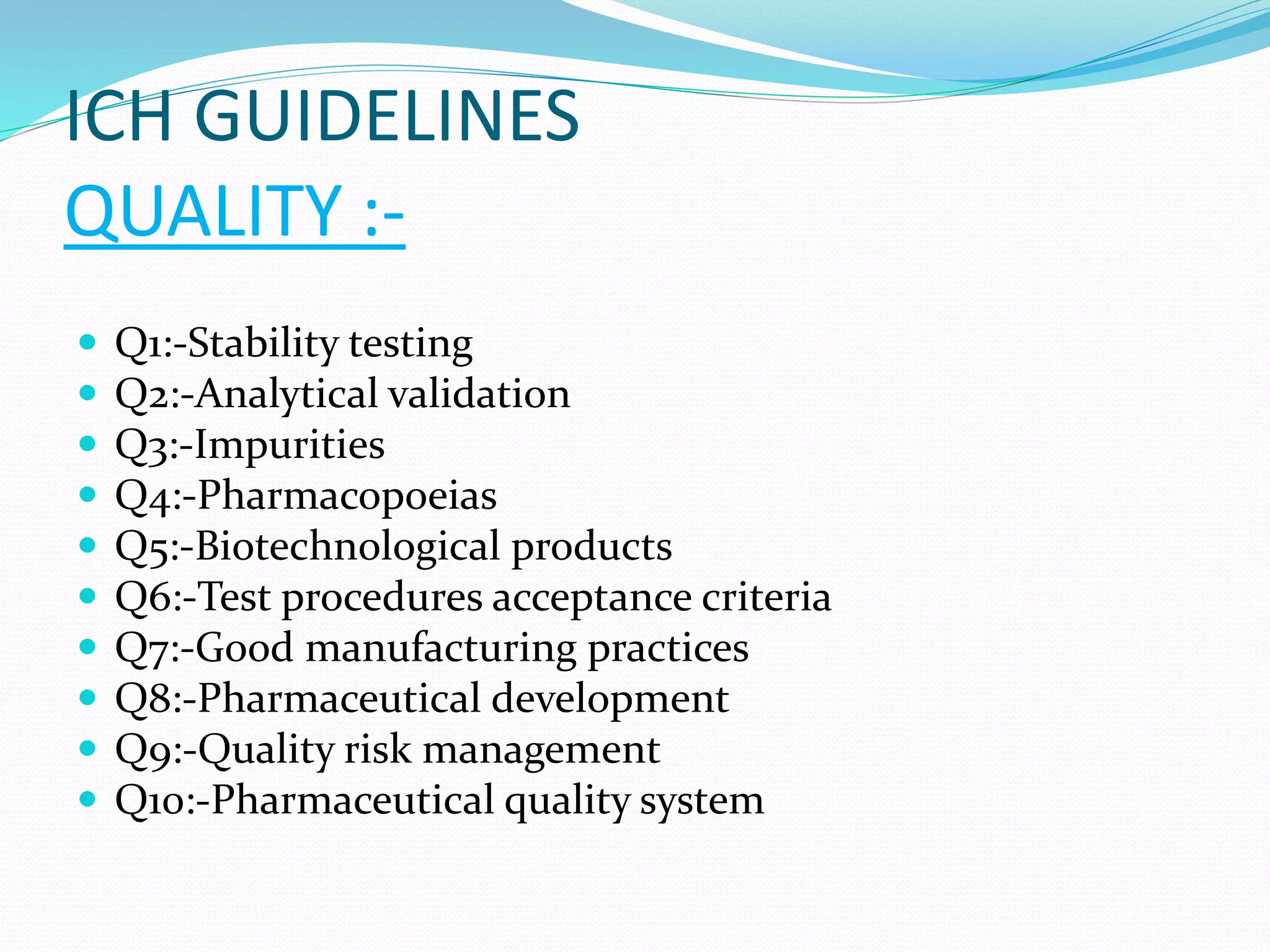
ICH GUIDELINES 
QUALITY :- 
 Q1:-Stability testing 
 Q2:-Analytical validation 
 Q3:-Impurities 
 Q4:-Pharmacopoeias 
 Q5:-Biotechnological products 
 Q6:-Test procedures acceptance criteria 
 Q7:-Good manufacturing practices 
 Q8:-Pharmaceutical development 
 Q9:-Quality risk management 
 Q10:-Pharmaceutical quality system
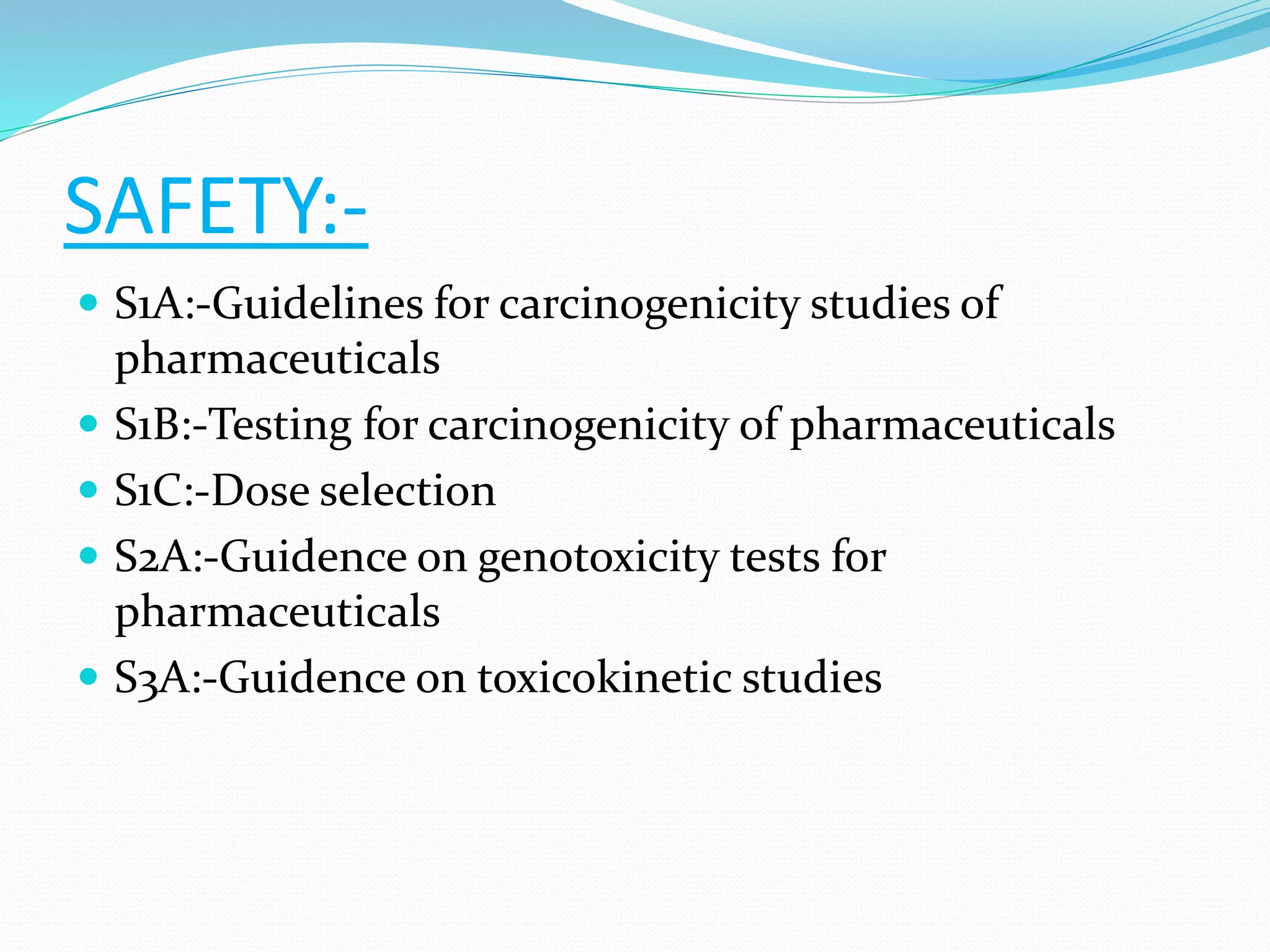
SAFETY:- 
 S1A:-Guidelines for carcinogenicity studies of 
pharmaceuticals 
 S1B:-Testing for carcinogenicity of pharmaceuticals 
 S1C:-Dose selection 
 S2A:-Guidence on genotoxicity tests for 
pharmaceuticals 
 S3A:-Guidence on toxicokinetic studies
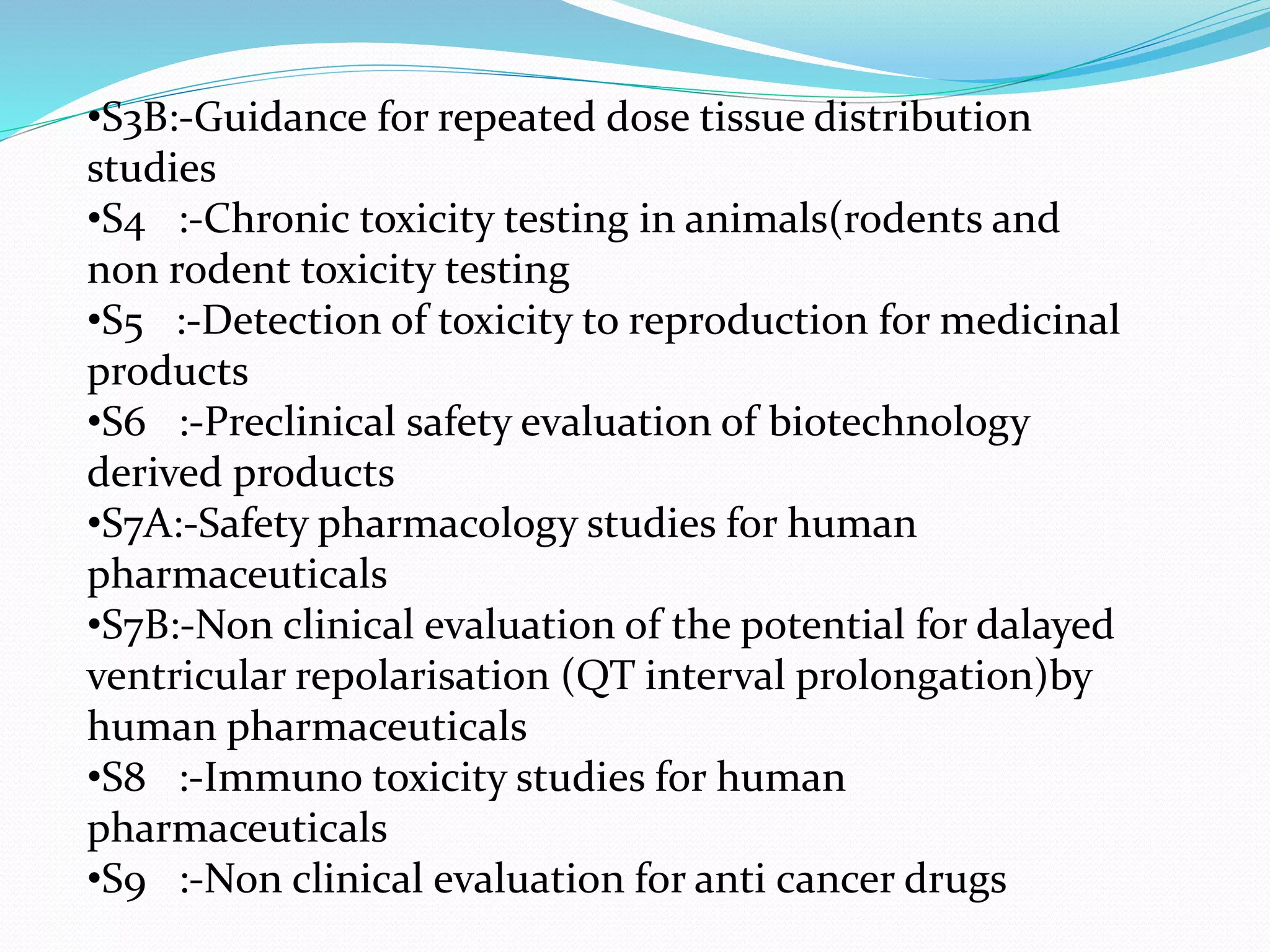
•S3B:-Guidance for repeated dose tissue distribution 
studies 
•S4 :-Chronic toxicity testing in animals(rodents and 
non rodent toxicity testing 
•S5 :-Detection of toxicity to reproduction for medicinal 
products 
•S6 :-Preclinical safety evaluation of biotechnology 
derived products 
•S7A:-Safety pharmacology studies for human 
pharmaceuticals 
•S7B:-Non clinical evaluation of the potential for dalayed 
ventricular repolarisation (QT interval prolongation)by 
human pharmaceuticals 
•S8 :-Immuno toxicity studies for human 
pharmaceuticals 
•S9 :-Non clinical evaluation for anti cancer drugs
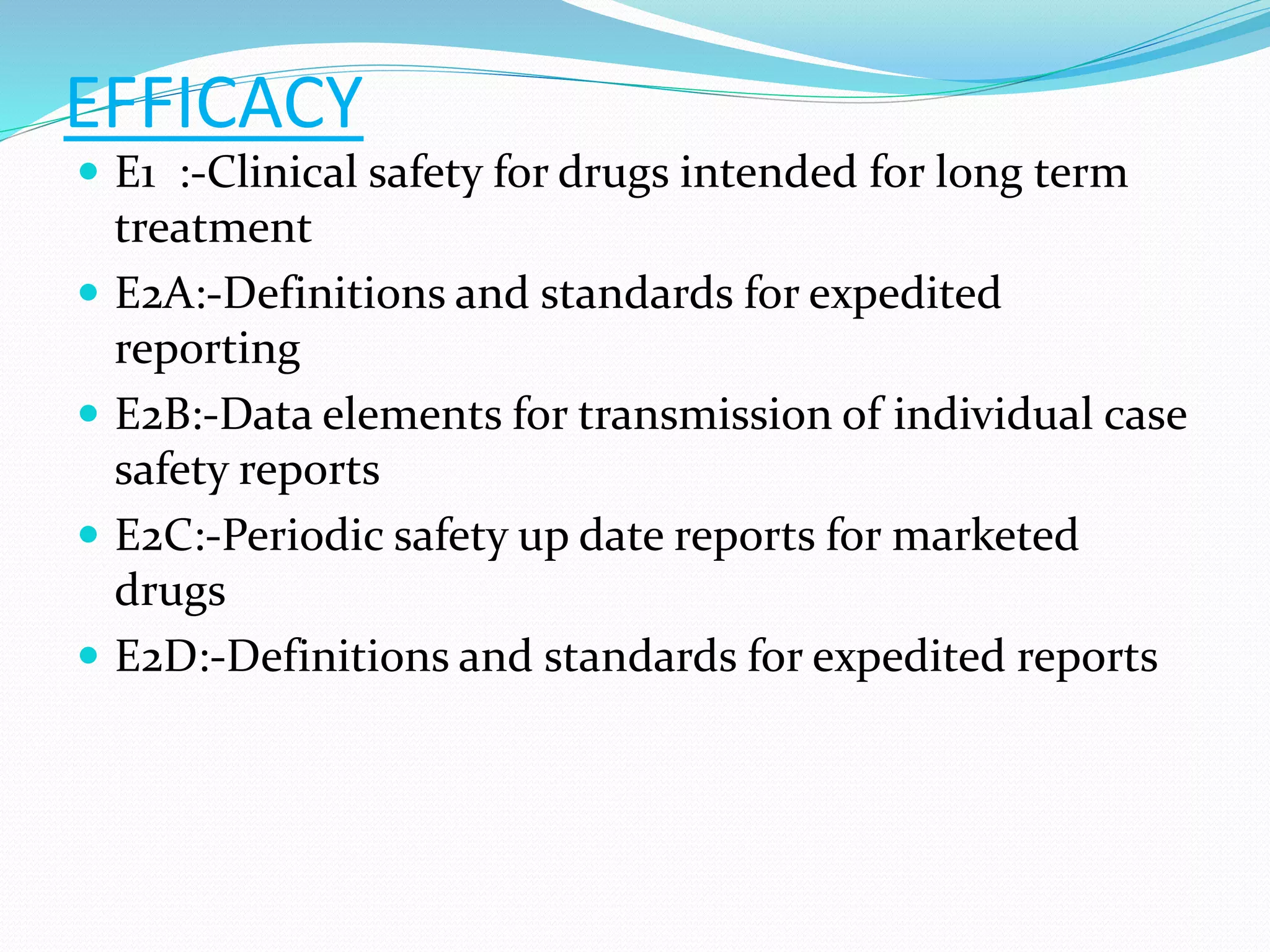
EFFICACY 
 E1 :-Clinical safety for drugs intended for long term 
treatment 
 E2A:-Definitions and standards for expedited 
reporting 
 E2B:-Data elements for transmission of individual case 
safety reports 
 E2C:-Periodic safety up date reports for marketed 
drugs 
 E2D:-Definitions and standards for expedited reports
•E2E:-Pharmacovigilance planning 
•E3 :-Structure and content of clinical study 
reports 
•E4 :-Dose-response information to support drug 
registration 
•E5 :-Ethinic factors in the acceptability of foreign 
clinical data 
•E6 :-Good clinical practice 
•E7 :-Studies in support of special populations 
•E8 :-General considerations for clinical trials 
•E9 :-Statistically principles for clinical trials 
•E10:-Choice of control group and related tissues 
in clinical trials 
•E11:-Clinical investigations of medicinal products
•E12:-Principles for clinical evaluation of new 
antihypertensive agent 
•E14:-The clinical evaluation of QT interval 
prolongation and pro arryhthmic potential for non-anti 
arrhythmic drugs 
•E15:-Definitions for pharmacogenomics, 
pharmacogenetics, genomic data and sample coding 
categories 
•E16:-Genomic biomarkers related to drug 
responds-context structure and format of 
qualification submission
Q1 
 Q1A:-Stability testing of new API $ FPP 
 Q1B:-Photo stability testing of new API $ FPP 
 Q1C:-Stability testing of new dosage forms 
 Q1D:-Bracketing and matrixing designs for stability 
testing of API $ FPP 
 Q1E:-Evaluation of stability data 
 Q1F:-Stability data package for registration in climatic 
zones III & IV
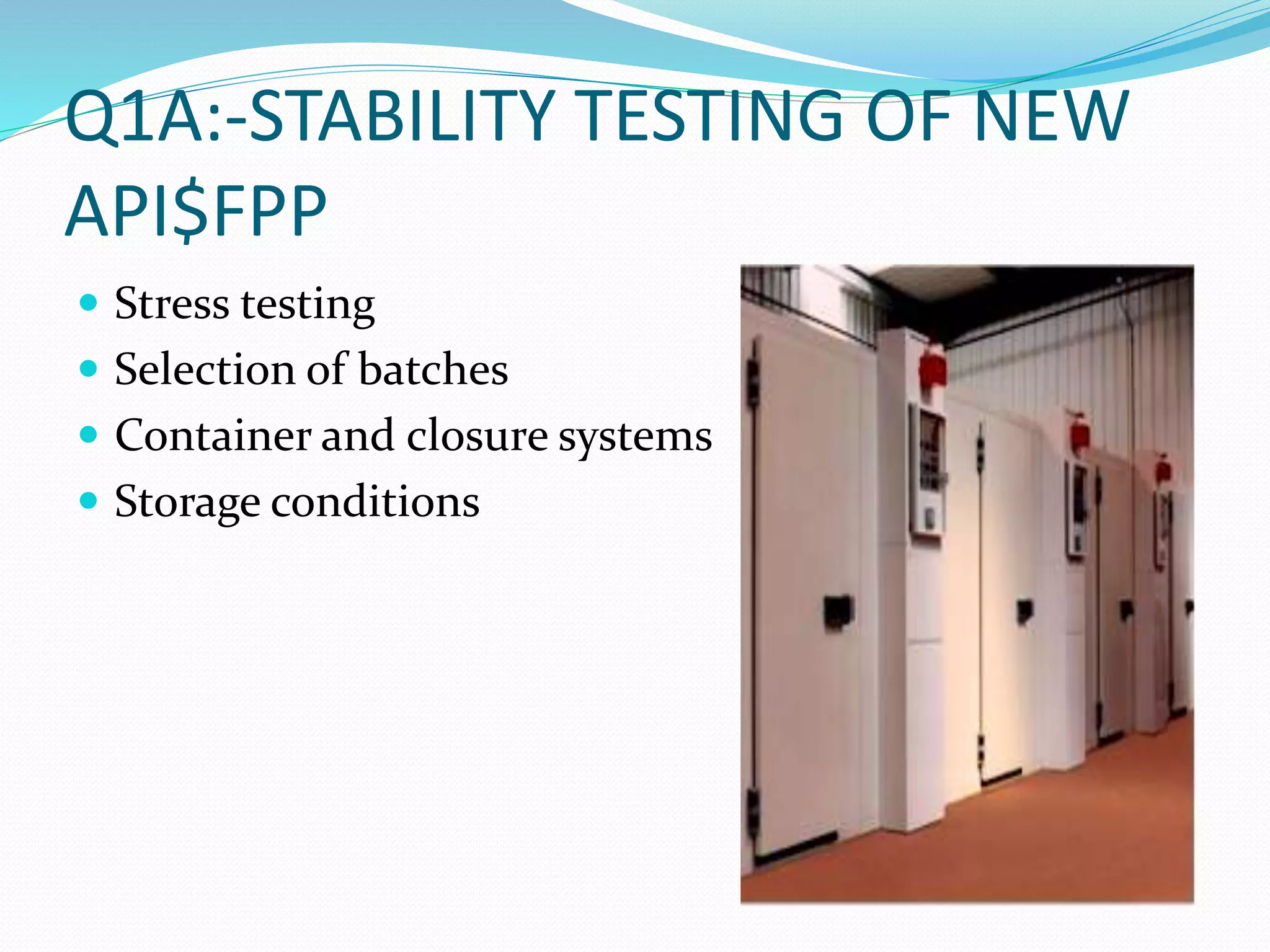
Q1A:-STABILITY TESTING OF NEW 
API$FPP 
 Stress testing 
 Selection of batches 
 Container and closure systems 
 Storage conditions
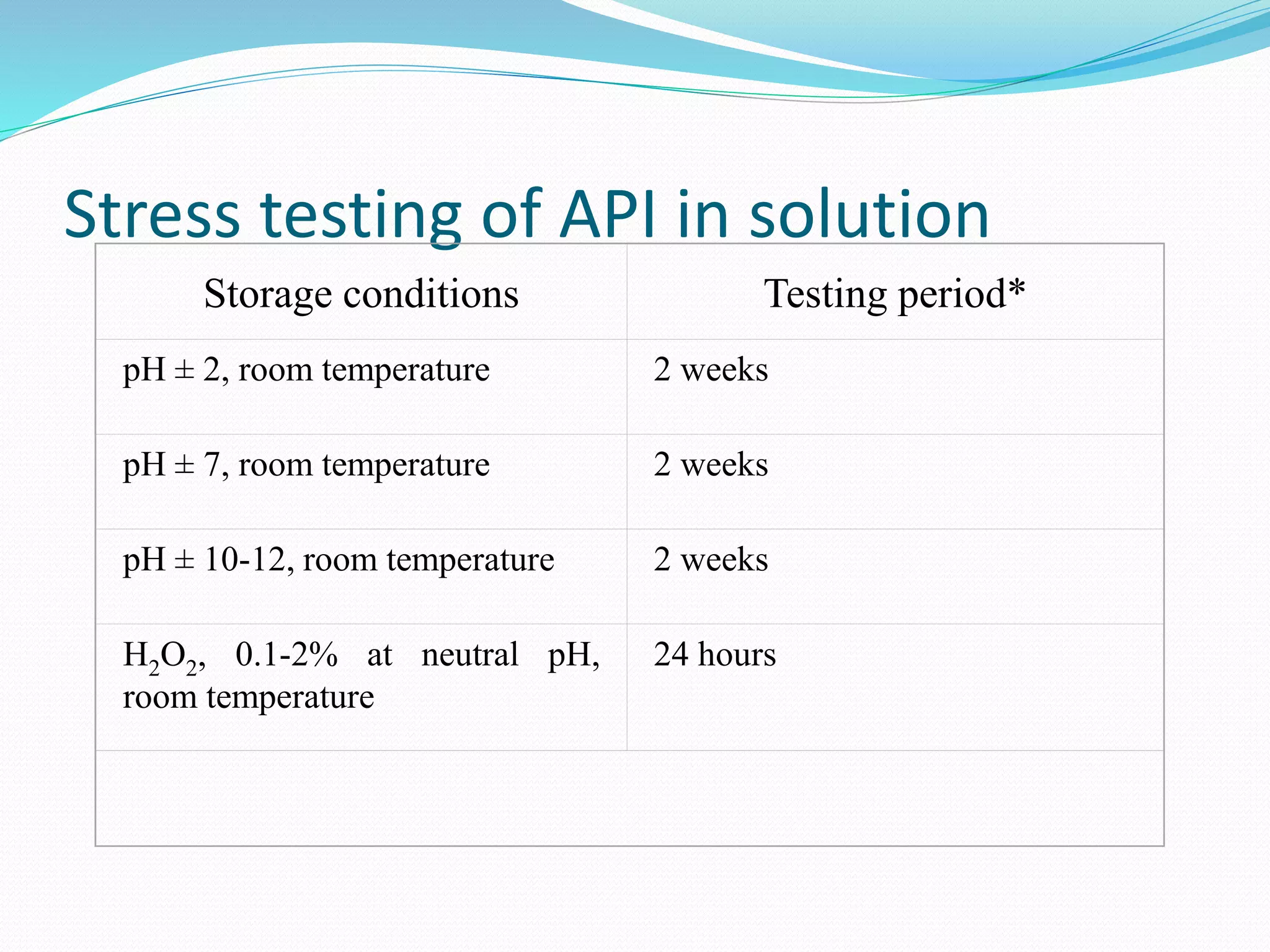
Stress testing of API in solution 
Storage conditions Testing period* 
pH ± 2, room temperature 2 weeks 
pH ± 7, room temperature 2 weeks 
pH ± 10-12, room temperature 2 weeks 
H2O2, 0.1-2% at neutral pH, 
room temperature 
24 hours
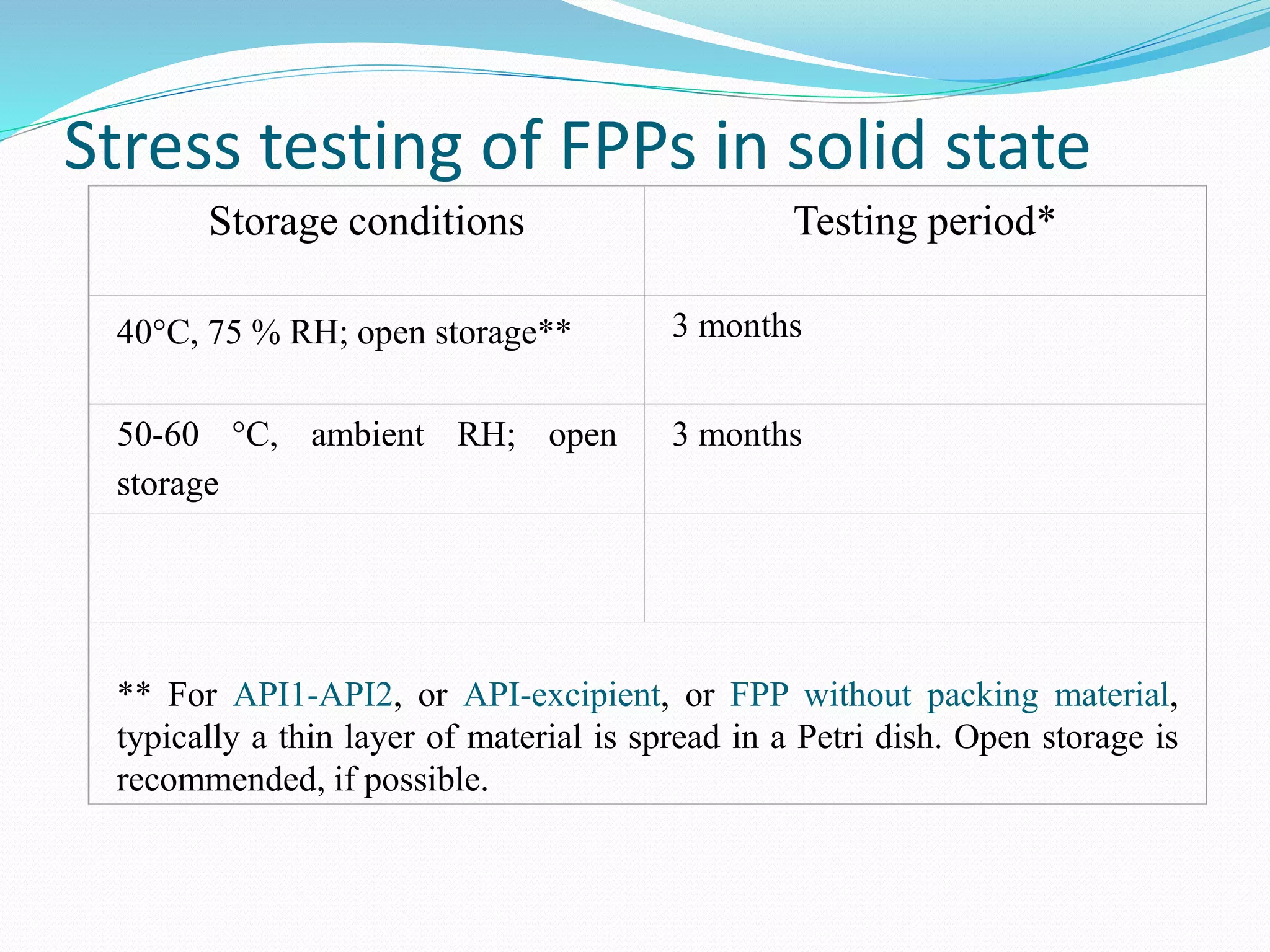
Stress testing of FPPs in solid state 
Storage conditions Testing period* 
40°C, 75 % RH; open storage** 3 months 
50-60 °C, ambient RH; open 
storage 
3 months 
** For API1-API2, or API-excipient, or FPP without packing material, 
typically a thin layer of material is spread in a Petri dish. Open storage is 
recommended, if possible.
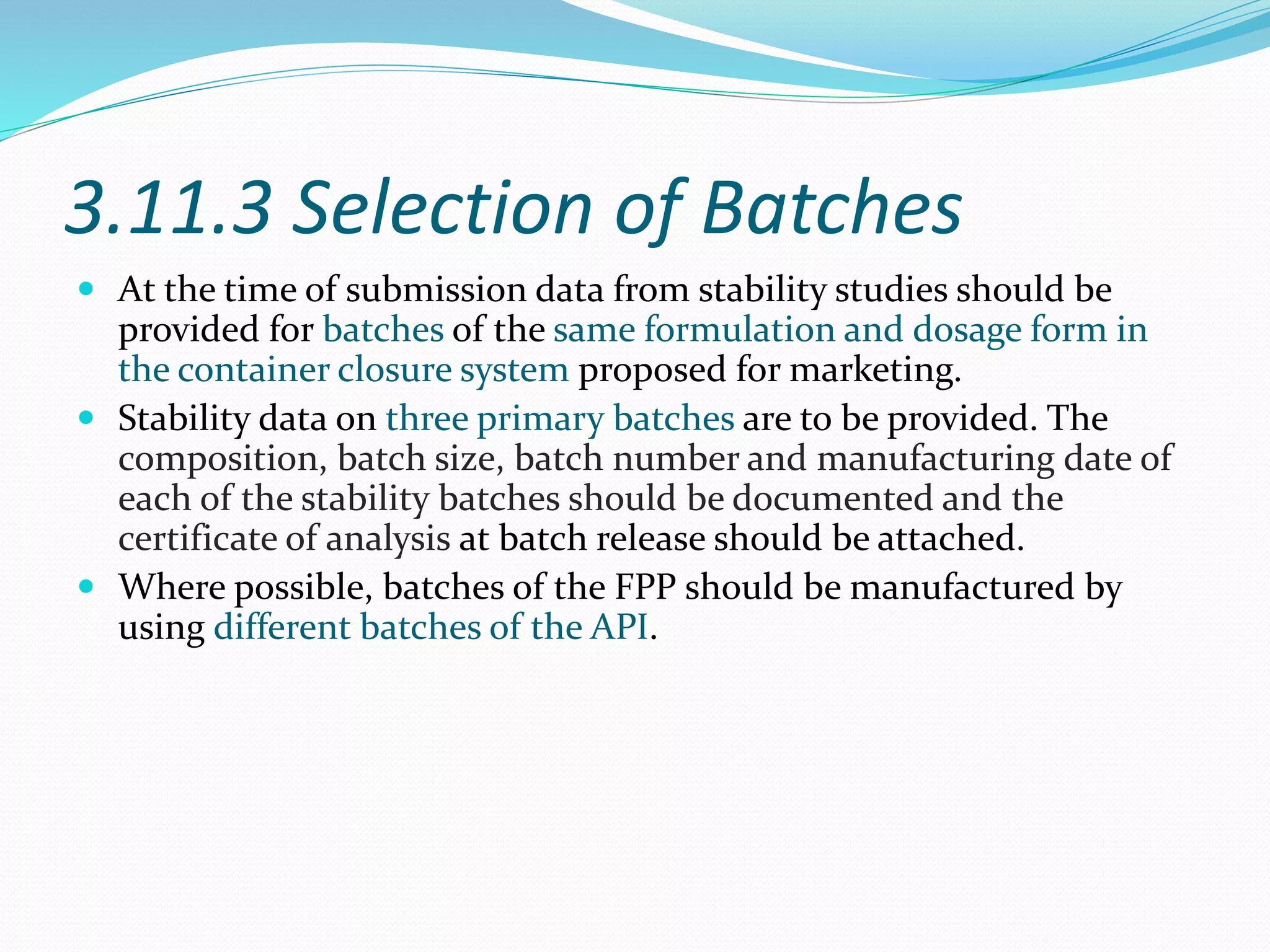
3.11.3 Selection of Batches 
 At the time of submission data from stability studies should be 
provided for batches of the same formulation and dosage form in 
the container closure system proposed for marketing. 
 Stability data on three primary batches are to be provided. The 
composition, batch size, batch number and manufacturing date of 
each of the stability batches should be documented and the 
certificate of analysis at batch release should be attached. 
 Where possible, batches of the FPP should be manufactured by 
using different batches of the API.
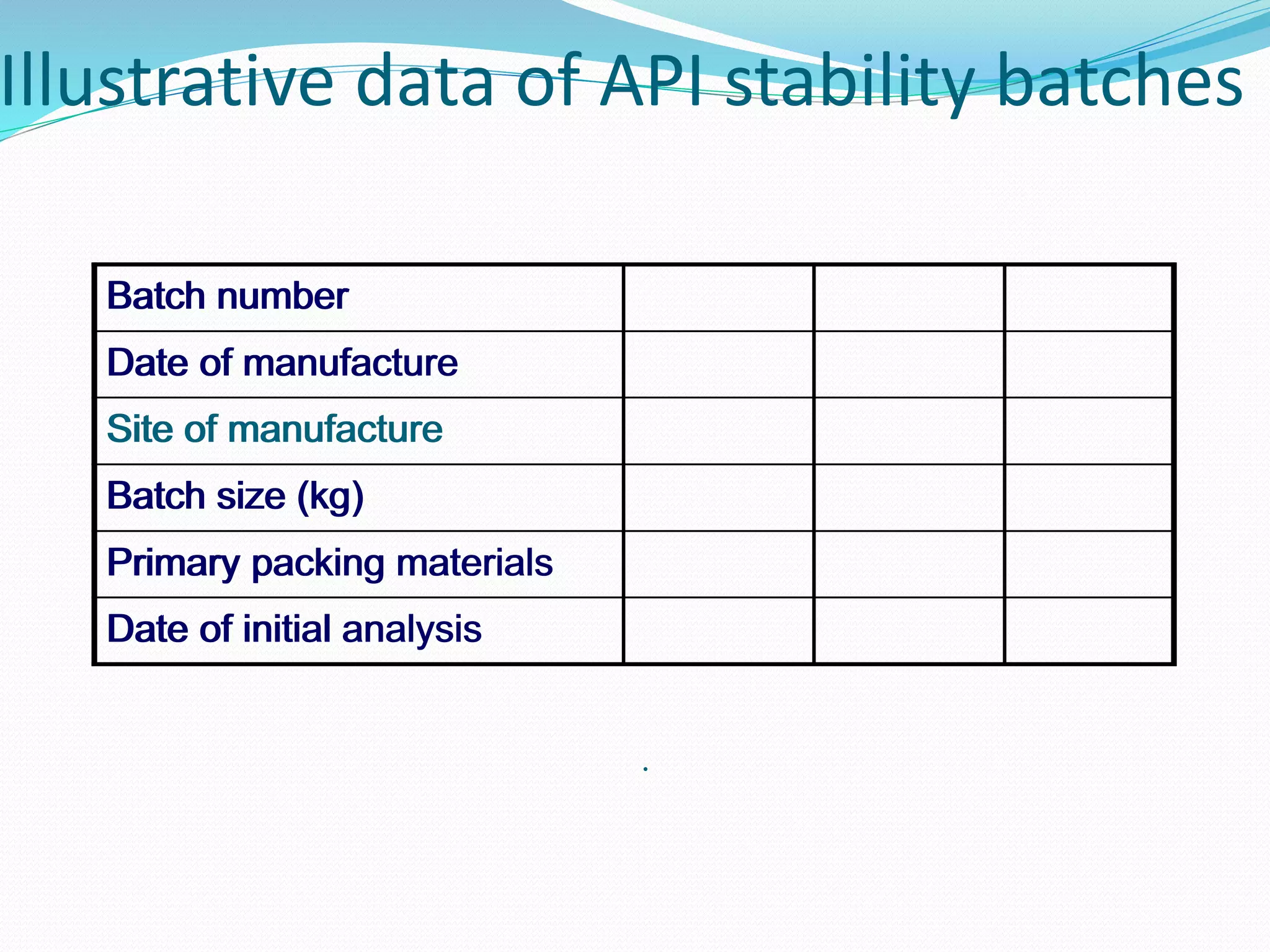
Illustrative data of API stability batches 
Batch number 
Date of manufacture 
Site of manufacture 
Batch size (kg) 
Primary packing materials 
Date of initial analysis 
.
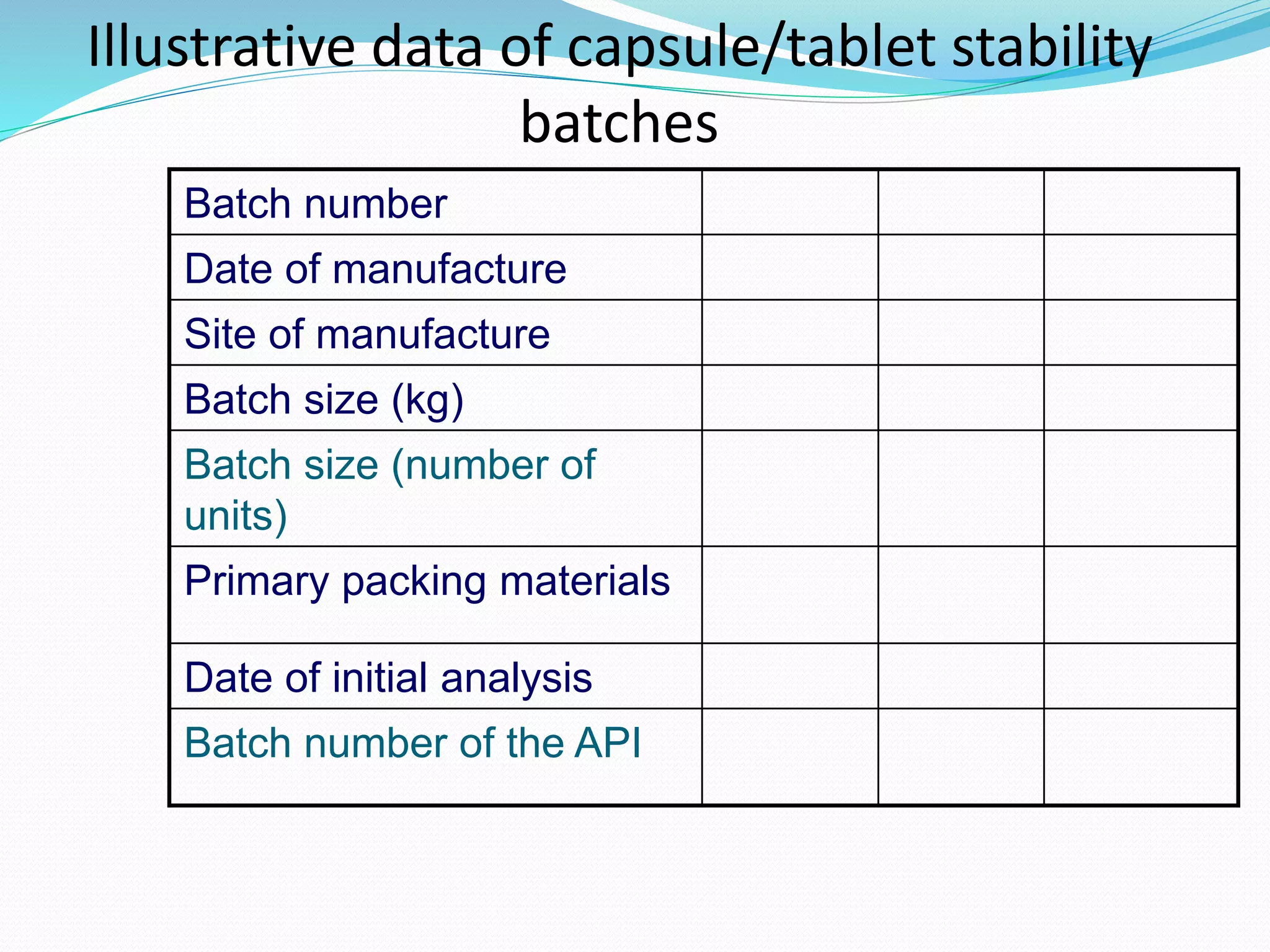
Illustrative data of capsule/tablet stability 
batches 
Batch number 
Date of manufacture 
Site of manufacture 
Batch size (kg) 
Batch size (number of 
units) 
Primary packing materials 
Date of initial analysis 
Batch number of the API
photo stability testing 
A systematic approach to photostability testing 
is recommended covering, as appropriate, 
studies such as: 
i) Tests on the drug substance; 
ii) Tests on the exposed drug product outside of 
the immediate pack; 
and if necessary ; 
iii) Tests on the drug product in the immediate 
pack; 
and if necessary ; 
iv) Tests on the drug product in the marketing 
Pack
Bracketing and matrixing designs 
Bracketing:-As defined in the glossary to the parent 
guideline, bracketing is the design of a stability 
schedule such that only samples on the extremes of 
certain design factors (e.g., strength, 
container size and/or fill) are tested at all time points as 
in a full design. The design assumes that the stability of 
any intermediate levels is represented by the stability of 
the extremes tested.
Matrixing 
As defined in the glossary of the parent guideline, matrixing is 
the design of a stability schedule such that a selected subset of 
the total number of possible samples for all factor combinations 
would be tested at a specified time point. At a subsequent time 
point, another subset of samples for all factor combinations 
would be tested. The design assumes that the stability of each 
subset of samples tested represents the stability of all samples at 
a given time point. The differences in the samples for the same 
drug product should be identified as, for example, covering 
different batches, different strengths, different sizes of the same 
container closure system etc
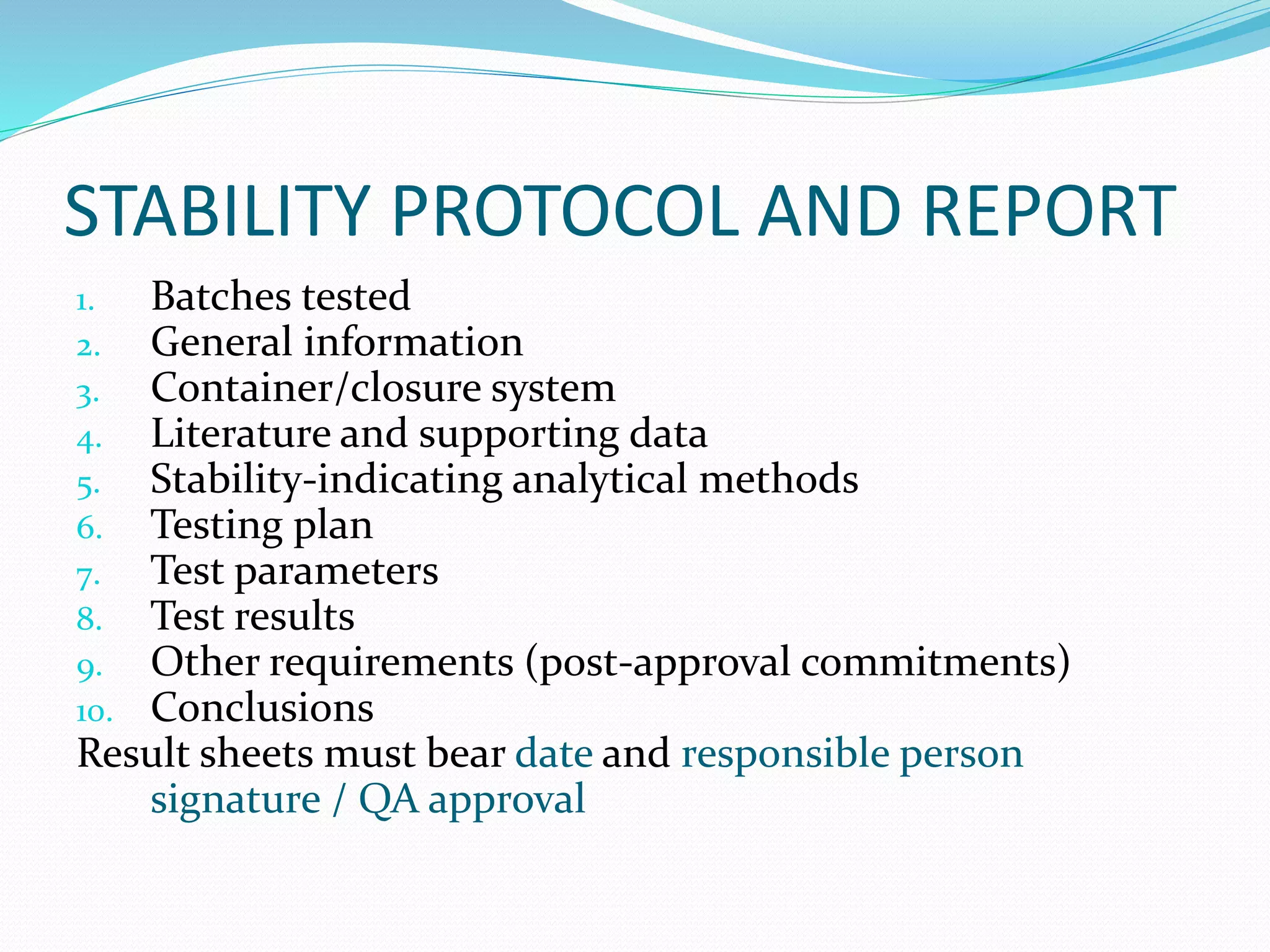
STABILITY PROTOCOL AND REPORT 
1. Batches tested 
2. General information 
3. Container/closure system 
4. Literature and supporting data 
5. Stability-indicating analytical methods 
6. Testing plan 
7. Test parameters 
8. Test results 
9. Other requirements (post-approval commitments) 
10. Conclusions 
Result sheets must bear date and responsible person 
signature / QA approval
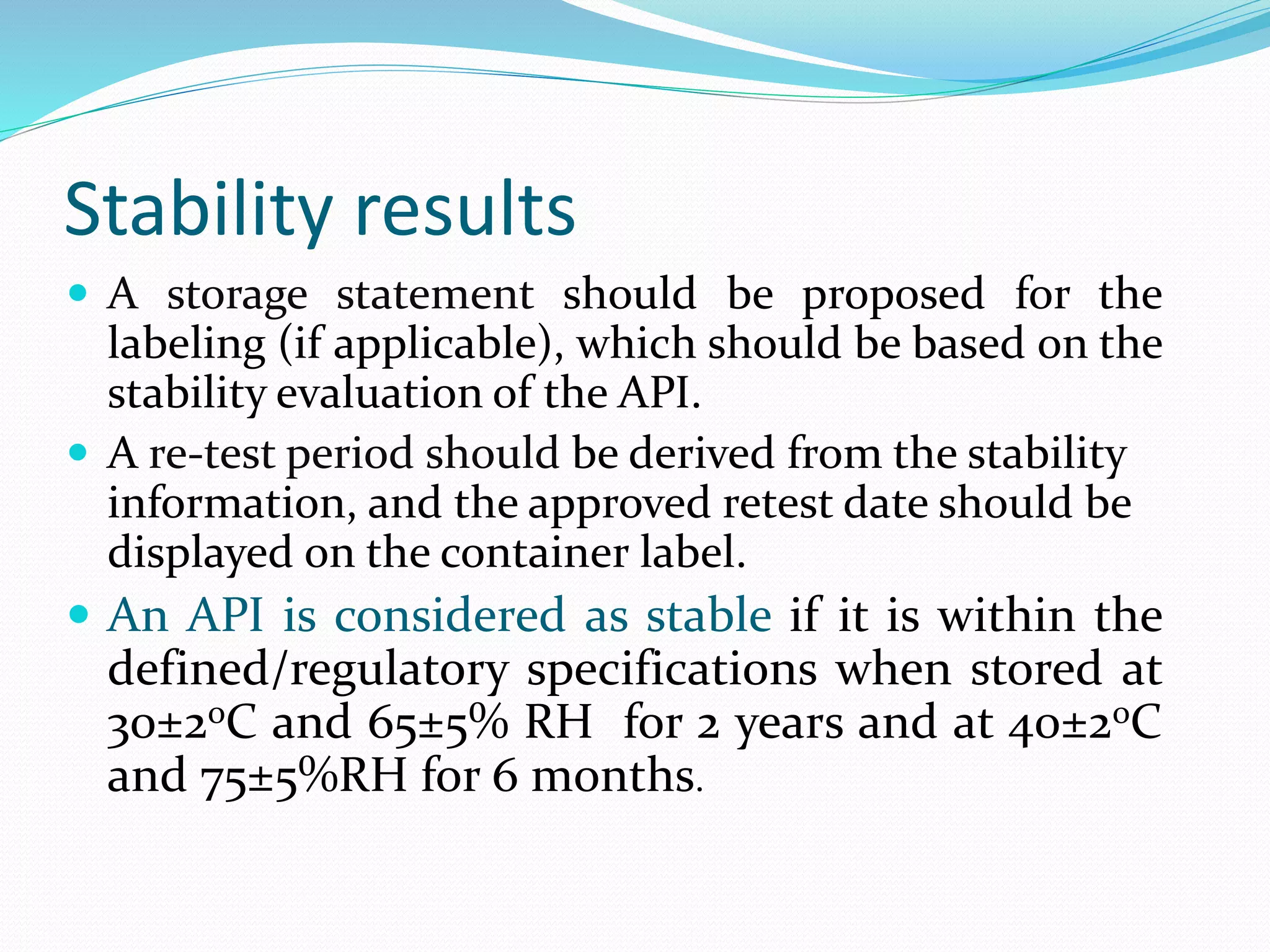
Stability results 
 A storage statement should be proposed for the 
labeling (if applicable), which should be based on the 
stability evaluation of the API. 
 A re-test period should be derived from the stability 
information, and the approved retest date should be 
displayed on the container label. 
 An API is considered as stable if it is within the 
defined/regulatory specifications when stored at 
30±2oC and 65±5% RH for 2 years and at 40±2oC 
and 75±5%RH for 6 months.
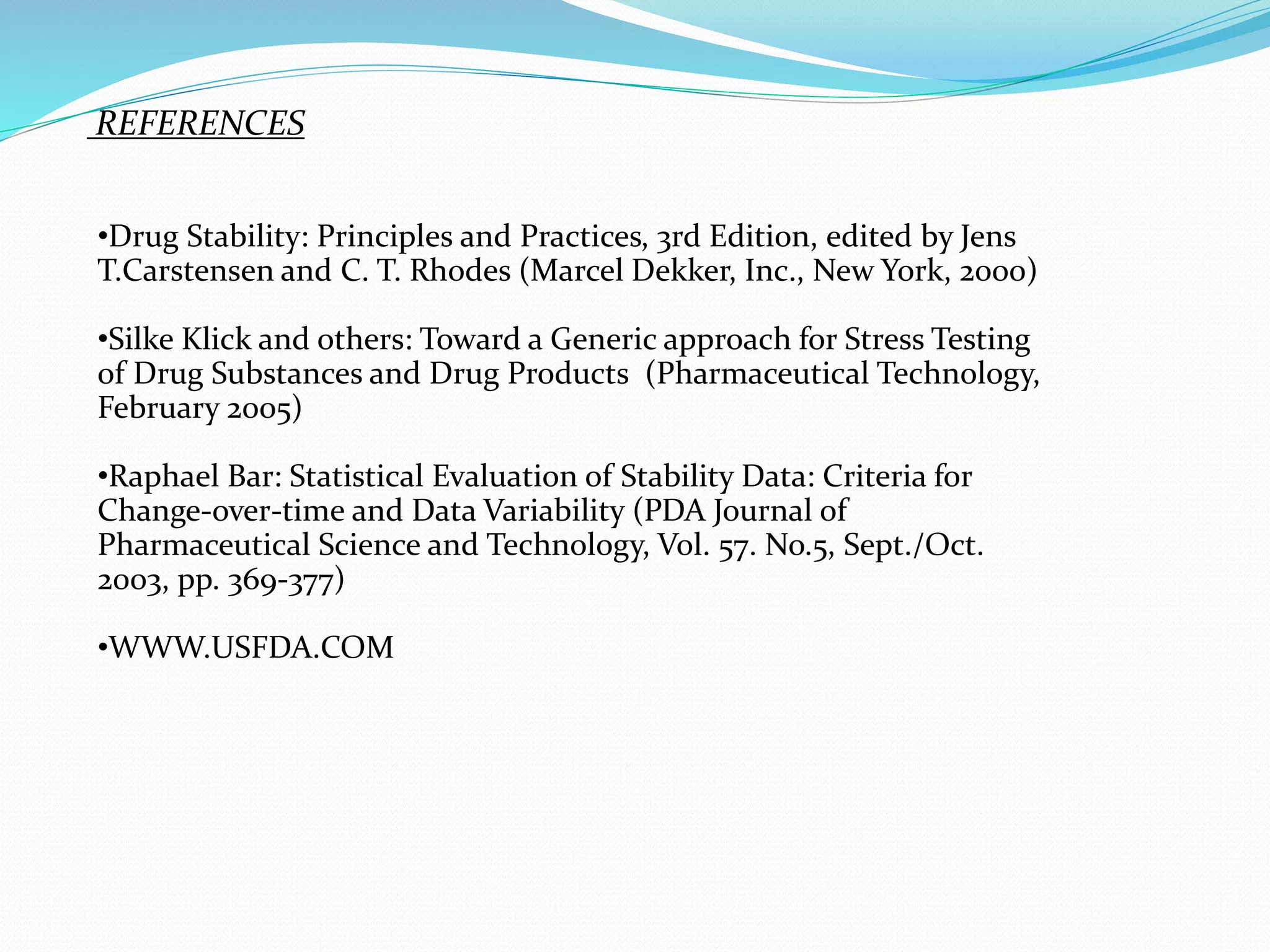
REFERENCES 
•Drug Stability: Principles and Practices, 3rd Edition, edited by Jens 
T.Carstensen and C. T. Rhodes (Marcel Dekker, Inc., New York, 2000) 
•Silke Klick and others: Toward a Generic approach for Stress Testing 
of Drug Substances and Drug Products (Pharmaceutical Technology, 
February 2005) 
•Raphael Bar: Statistical Evaluation of Stability Data: Criteria for 
Change-over-time and Data Variability (PDA Journal of 
Pharmaceutical Science and Technology, Vol. 57. No.5, Sept./Oct. 
2003, pp. 369-377) 
•WWW.USFDA.COM

Ich guidelines and protocols

  • 1.
    Presentation of PHARMACEUTICALPRODUCT DEVELOPMENT  TOPICS:-  ICH guidelines of stability testing &  Protocols PRESENTED BY V.GOUTHAMI Dpt.of Pharmaceutics MALLA REDDY COLLEGE OF PHARMACY
  • 2.
    ICH PARTNERS EFPIA[European Federation of pharmaceutical Industries and Associations]  JPMA[Japan Pharmaceutical Manufactures Association]  PhRMA[Pharmaceutical Research and Manufactures Of America]  MHLW[Ministry Of Health Labor Welfare]Japan  USFDA  EU regulators
  • 3.
    ICH GUIDELINES QUALITY:-  Q1:-Stability testing  Q2:-Analytical validation  Q3:-Impurities  Q4:-Pharmacopoeias  Q5:-Biotechnological products  Q6:-Test procedures acceptance criteria  Q7:-Good manufacturing practices  Q8:-Pharmaceutical development  Q9:-Quality risk management  Q10:-Pharmaceutical quality system
  • 4.
    SAFETY:-  S1A:-Guidelinesfor carcinogenicity studies of pharmaceuticals  S1B:-Testing for carcinogenicity of pharmaceuticals  S1C:-Dose selection  S2A:-Guidence on genotoxicity tests for pharmaceuticals  S3A:-Guidence on toxicokinetic studies
  • 5.
    •S3B:-Guidance for repeateddose tissue distribution studies •S4 :-Chronic toxicity testing in animals(rodents and non rodent toxicity testing •S5 :-Detection of toxicity to reproduction for medicinal products •S6 :-Preclinical safety evaluation of biotechnology derived products •S7A:-Safety pharmacology studies for human pharmaceuticals •S7B:-Non clinical evaluation of the potential for dalayed ventricular repolarisation (QT interval prolongation)by human pharmaceuticals •S8 :-Immuno toxicity studies for human pharmaceuticals •S9 :-Non clinical evaluation for anti cancer drugs
  • 6.
    EFFICACY  E1:-Clinical safety for drugs intended for long term treatment  E2A:-Definitions and standards for expedited reporting  E2B:-Data elements for transmission of individual case safety reports  E2C:-Periodic safety up date reports for marketed drugs  E2D:-Definitions and standards for expedited reports
  • 7.
    •E2E:-Pharmacovigilance planning •E3:-Structure and content of clinical study reports •E4 :-Dose-response information to support drug registration •E5 :-Ethinic factors in the acceptability of foreign clinical data •E6 :-Good clinical practice •E7 :-Studies in support of special populations •E8 :-General considerations for clinical trials •E9 :-Statistically principles for clinical trials •E10:-Choice of control group and related tissues in clinical trials •E11:-Clinical investigations of medicinal products
  • 8.
    •E12:-Principles for clinicalevaluation of new antihypertensive agent •E14:-The clinical evaluation of QT interval prolongation and pro arryhthmic potential for non-anti arrhythmic drugs •E15:-Definitions for pharmacogenomics, pharmacogenetics, genomic data and sample coding categories •E16:-Genomic biomarkers related to drug responds-context structure and format of qualification submission
  • 9.
    Q1  Q1A:-Stabilitytesting of new API $ FPP  Q1B:-Photo stability testing of new API $ FPP  Q1C:-Stability testing of new dosage forms  Q1D:-Bracketing and matrixing designs for stability testing of API $ FPP  Q1E:-Evaluation of stability data  Q1F:-Stability data package for registration in climatic zones III & IV
  • 10.
    Q1A:-STABILITY TESTING OFNEW API$FPP  Stress testing  Selection of batches  Container and closure systems  Storage conditions
  • 11.
    Stress testing ofAPI in solution Storage conditions Testing period* pH ± 2, room temperature 2 weeks pH ± 7, room temperature 2 weeks pH ± 10-12, room temperature 2 weeks H2O2, 0.1-2% at neutral pH, room temperature 24 hours
  • 12.
    Stress testing ofFPPs in solid state Storage conditions Testing period* 40°C, 75 % RH; open storage** 3 months 50-60 °C, ambient RH; open storage 3 months ** For API1-API2, or API-excipient, or FPP without packing material, typically a thin layer of material is spread in a Petri dish. Open storage is recommended, if possible.
  • 13.
    3.11.3 Selection ofBatches  At the time of submission data from stability studies should be provided for batches of the same formulation and dosage form in the container closure system proposed for marketing.  Stability data on three primary batches are to be provided. The composition, batch size, batch number and manufacturing date of each of the stability batches should be documented and the certificate of analysis at batch release should be attached.  Where possible, batches of the FPP should be manufactured by using different batches of the API.
  • 14.
    Illustrative data ofAPI stability batches Batch number Date of manufacture Site of manufacture Batch size (kg) Primary packing materials Date of initial analysis .
  • 15.
    Illustrative data ofcapsule/tablet stability batches Batch number Date of manufacture Site of manufacture Batch size (kg) Batch size (number of units) Primary packing materials Date of initial analysis Batch number of the API
  • 16.
    photo stability testing A systematic approach to photostability testing is recommended covering, as appropriate, studies such as: i) Tests on the drug substance; ii) Tests on the exposed drug product outside of the immediate pack; and if necessary ; iii) Tests on the drug product in the immediate pack; and if necessary ; iv) Tests on the drug product in the marketing Pack
  • 17.
    Bracketing and matrixingdesigns Bracketing:-As defined in the glossary to the parent guideline, bracketing is the design of a stability schedule such that only samples on the extremes of certain design factors (e.g., strength, container size and/or fill) are tested at all time points as in a full design. The design assumes that the stability of any intermediate levels is represented by the stability of the extremes tested.
  • 18.
    Matrixing As definedin the glossary of the parent guideline, matrixing is the design of a stability schedule such that a selected subset of the total number of possible samples for all factor combinations would be tested at a specified time point. At a subsequent time point, another subset of samples for all factor combinations would be tested. The design assumes that the stability of each subset of samples tested represents the stability of all samples at a given time point. The differences in the samples for the same drug product should be identified as, for example, covering different batches, different strengths, different sizes of the same container closure system etc
  • 19.
    STABILITY PROTOCOL ANDREPORT 1. Batches tested 2. General information 3. Container/closure system 4. Literature and supporting data 5. Stability-indicating analytical methods 6. Testing plan 7. Test parameters 8. Test results 9. Other requirements (post-approval commitments) 10. Conclusions Result sheets must bear date and responsible person signature / QA approval
  • 20.
    Stability results A storage statement should be proposed for the labeling (if applicable), which should be based on the stability evaluation of the API.  A re-test period should be derived from the stability information, and the approved retest date should be displayed on the container label.  An API is considered as stable if it is within the defined/regulatory specifications when stored at 30±2oC and 65±5% RH for 2 years and at 40±2oC and 75±5%RH for 6 months.
  • 21.
    REFERENCES •Drug Stability:Principles and Practices, 3rd Edition, edited by Jens T.Carstensen and C. T. Rhodes (Marcel Dekker, Inc., New York, 2000) •Silke Klick and others: Toward a Generic approach for Stress Testing of Drug Substances and Drug Products (Pharmaceutical Technology, February 2005) •Raphael Bar: Statistical Evaluation of Stability Data: Criteria for Change-over-time and Data Variability (PDA Journal of Pharmaceutical Science and Technology, Vol. 57. No.5, Sept./Oct. 2003, pp. 369-377) •WWW.USFDA.COM

Editor's Notes