Regulatory Aspects of Stability
Testing in Europe
Presented by: Guided by:
SAGAR SHAH Mrs. RENUKA MISHRA
Introduction
• The stability of pharmaceutical ingredient and the
products containing them depends on:
1)The chemical and physical properties of the material
concerned including the excipients and container
system)
2)Environmental factors such as temperature, humidity
and light and their effect on the substance in the
product.
• Some of the types of changes in product that may need
to considered are:
a) Physical changes: Appearance,consistency,clarity of
solution,colour,odour,taste,hardness,disintegration,dissol
ution,pH.
b) Chemical changes: Degradation product formation,
loss of potency, loss of excipients
c) Microbial changes: proliferation of microorganisms in
nonsterile products, maintenance of sterility,presevative
efficacy changes
A) To establish the storage condition and retest interval of
active ingredient and storage condition and shelf life for
manufactured product.
B) Part of information can also used to justify overages
included in products for stability reasons.
Committee of proprietary medicinal products(CPMP) indicates
that the objectives of the stability testing is:
“to provide evidence on how the quality of an API or
product varies with time under the influence of a variety of
environment factors such as temperature humidity and light
and enables recommended storage conditions, retest periods
and shelf life. “
Reason for stability studies:
Pharmaceutical expert reports
• It is an important tool in regulatory submission in
Europe. it should provide a critical assessment of all
data as given below:
For active ingredient:
• A summary of results and analytical data
• The variability of stability data of drug from different
batches
• Most appropriate storage conditions of API
• The significant degradation products with relevant
information in the pharmacotoxicological expert report.
• Discussion of data relating to potential effects of
manufacturing procedure (heating and exposure the
ionizing radiation) on stability of product.
• Assay result of product and degradation products
• A discussion of variability in stability found between
batches of finished product.
• Explanation of calculation data used to estimate the
shelflife.
• A justification of overages in the products indicating
whether thy are because of stability reason or to cover
the manufacturing losses.
• Justification for release and proposed shelflife and
storage conditions.
For Finished Product:
There should always interplay between stability
section and other parts of marketing authorization
application. for example, PER may need to discuss
number of items included in development
pharmaceutics section i.e.
• Compatibility of drug substance and excipients
• Effect of pH.
• Dissolution performance of conventional release
products
• A discussion of potential interaction, particularly between
semisolid and liquid product and their container system
• A discussion of particular impurity that could be present
in API,Product;impurity from starting
material,solvents,reagents.
• When a product containing a novel excipient, a full data
is required including stability data of excipient.
Sources of information
• The primary source of regulatory requirements in the
European community are the pharmaceutical regulation and
directives.
• There are two primary sites of information. the first is
eudralex at dg3.eudra.org/eudralex,which has all documents
for human medicines that form the rules governing medical
products in the European union in PDF.
• 2nd,the CPMP and ICH draft and adapted guidelines on
European agency for the Evaluation of Medicinal
Products(EMEA)/cpmp home page at www.eudra.org.
Guidelines
• The European community's CPMP adopted a guideline on
stability testing in July, 1988 and came in to effect in 1989.
• For a new drug substances and products containing them, it
has been replaced by ICH guidelines and it is expected that all
applications submitted since 1998 will include studies that
have been conducted as per ICH guidelines.
• A revision of the old cpmp stability guideline was adapted in
April 1998 and was in effect in October 1998.
• In the main of ICH guidelines, recent documents also include a
note for guidelines on photo stability testing and another for
new drug product.
Data requirements
• For this all analytical methods should be validated. It should
be capable of detecting and quantifying the degradation
products and the interaction products in the finished
products.
• The basic requirements to be included in application on the
stability the active ingredient and the finished products are
summarized below.
For active ingredients:
• Information on the batches tested(including date and place of
manufacturing. Batch size)
• Details of testing methodology, including
normal,stress,accelerated conditions.
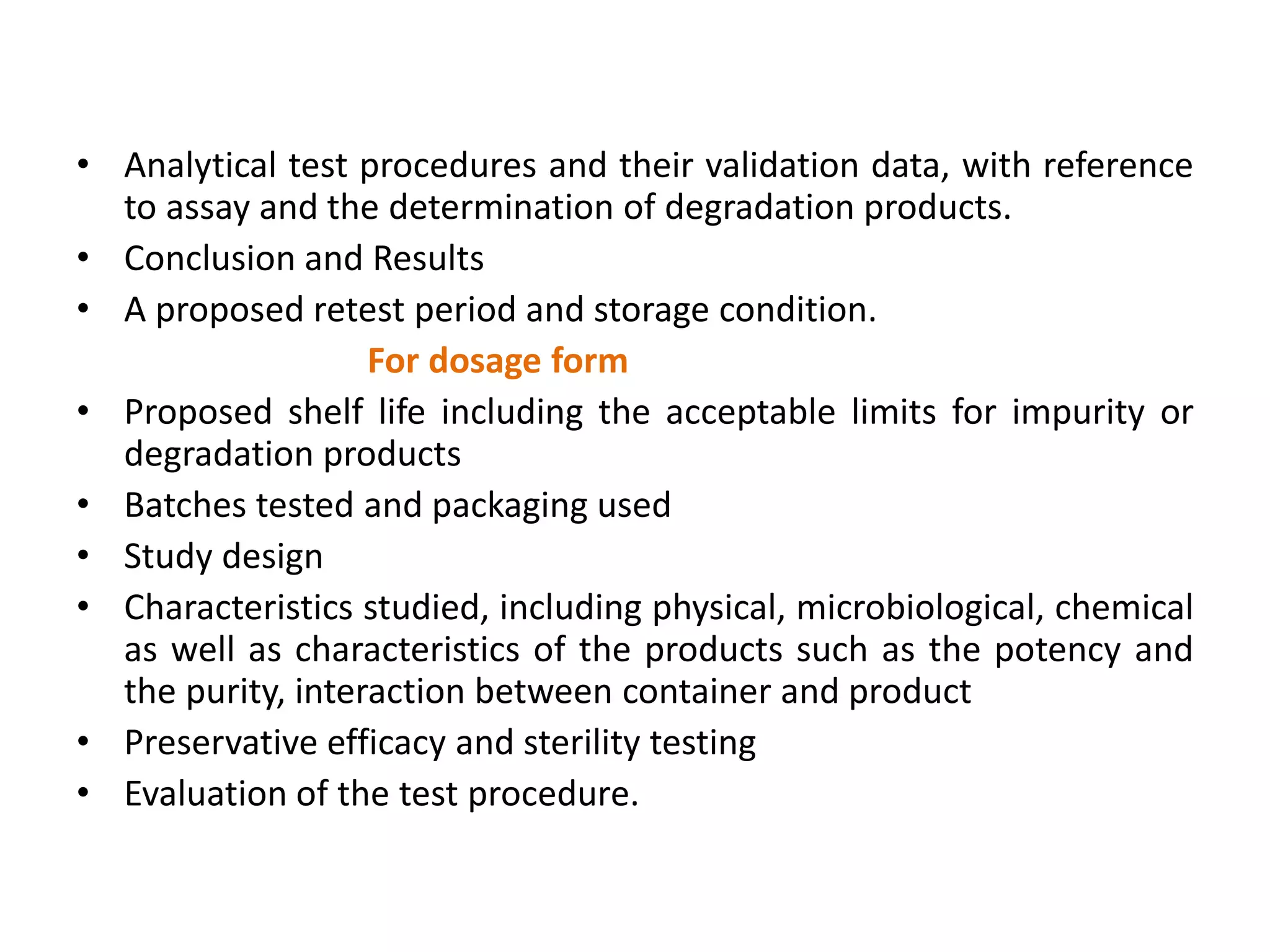
• Analytical test procedures and their validation data, with reference
to assay and the determination of degradation products.
• Conclusion and Results
• A proposed retest period and storage condition.
For dosage form
• Proposed shelf life including the acceptable limits for impurity or
degradation products
• Batches tested and packaging used
• Study design
• Characteristics studied, including physical, microbiological, chemical
as well as characteristics of the products such as the potency and
the purity, interaction between container and product
• Preservative efficacy and sterility testing
• Evaluation of the test procedure.
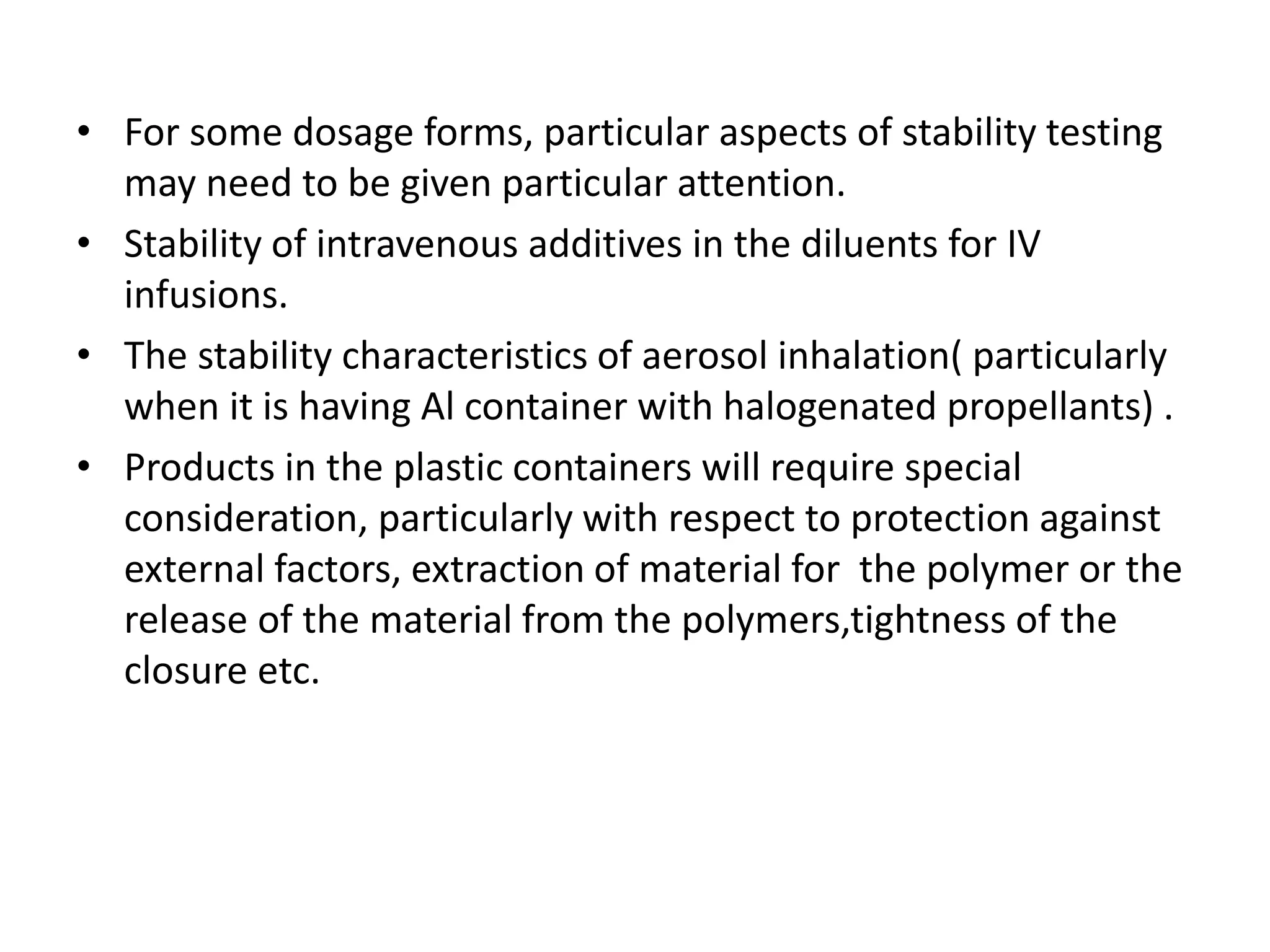
• For some dosage forms, particular aspects of stability testing
may need to be given particular attention.
• Stability of intravenous additives in the diluents for IV
infusions.
• The stability characteristics of aerosol inhalation( particularly
when it is having Al container with halogenated propellants) .
• Products in the plastic containers will require special
consideration, particularly with respect to protection against
external factors, extraction of material for the polymer or the
release of the material from the polymers,tightness of the
closure etc.
Impurities in new active substance
• The ICH guidelines on impurities in new active substance
requires characterization of reoccurring impurities and
degradation products found at or above an apparent level of
0.1%.data may be reported regarding studies undertaken on
an impurities below 0.1%,although this is not normally
required unless the potential impurities are expected to be
unusually potent or toxic or to have pharmacological effect.
Impurities in new medicinal products
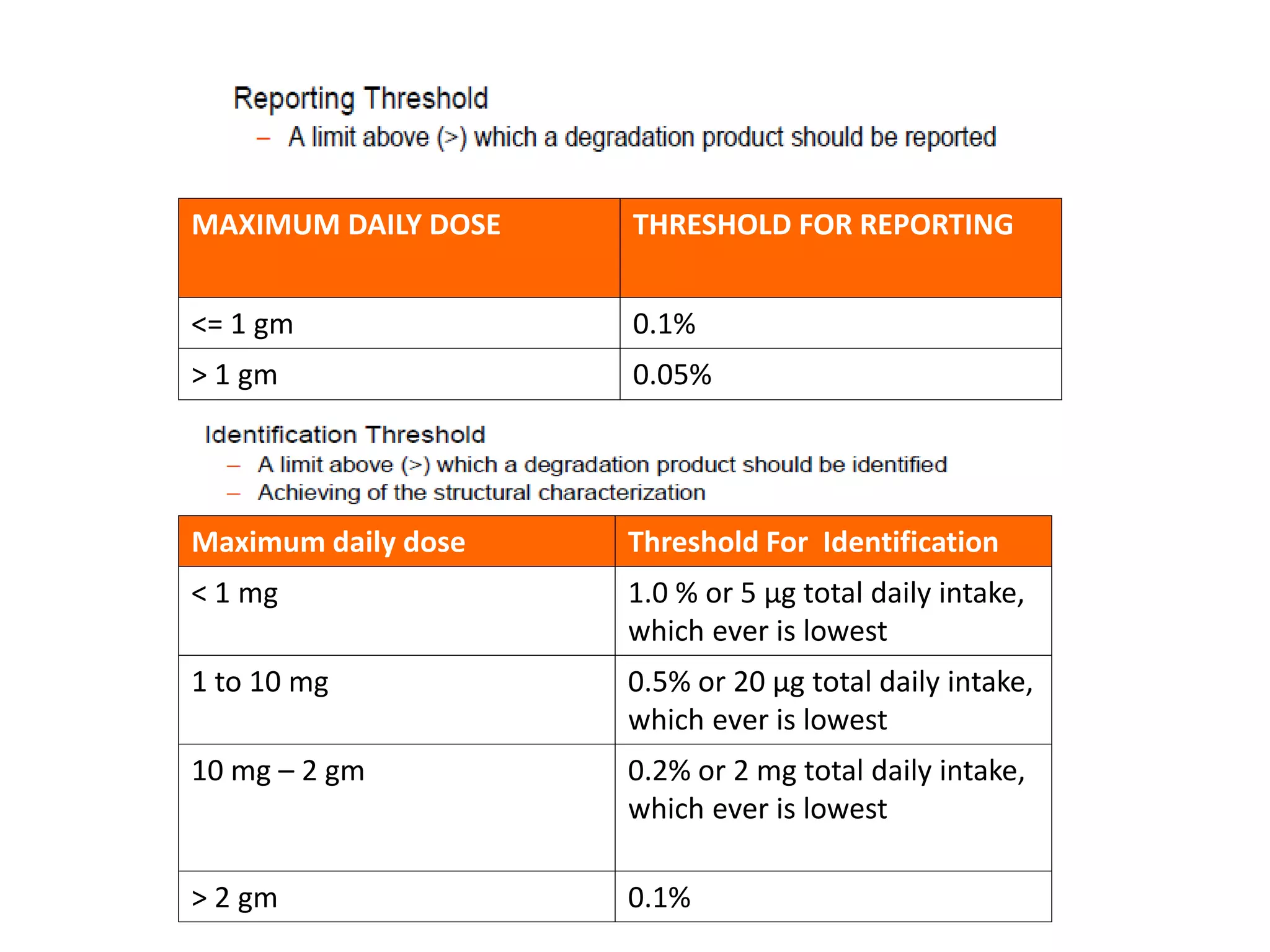
• The suggested thresholds are as follow:
MAXIMUM DAILY DOSE THRESHOLD FOR REPORTING
<= 1 gm 0.1%
> 1 gm 0.05%
Maximum daily dose Threshold For Identification
< 1 mg 1.0 % or 5 µg total daily intake,
which ever is lowest
1 to 10 mg 0.5% or 20 µg total daily intake,
which ever is lowest
10 mg – 2 gm 0.2% or 2 mg total daily intake,
which ever is lowest
> 2 gm 0.1%
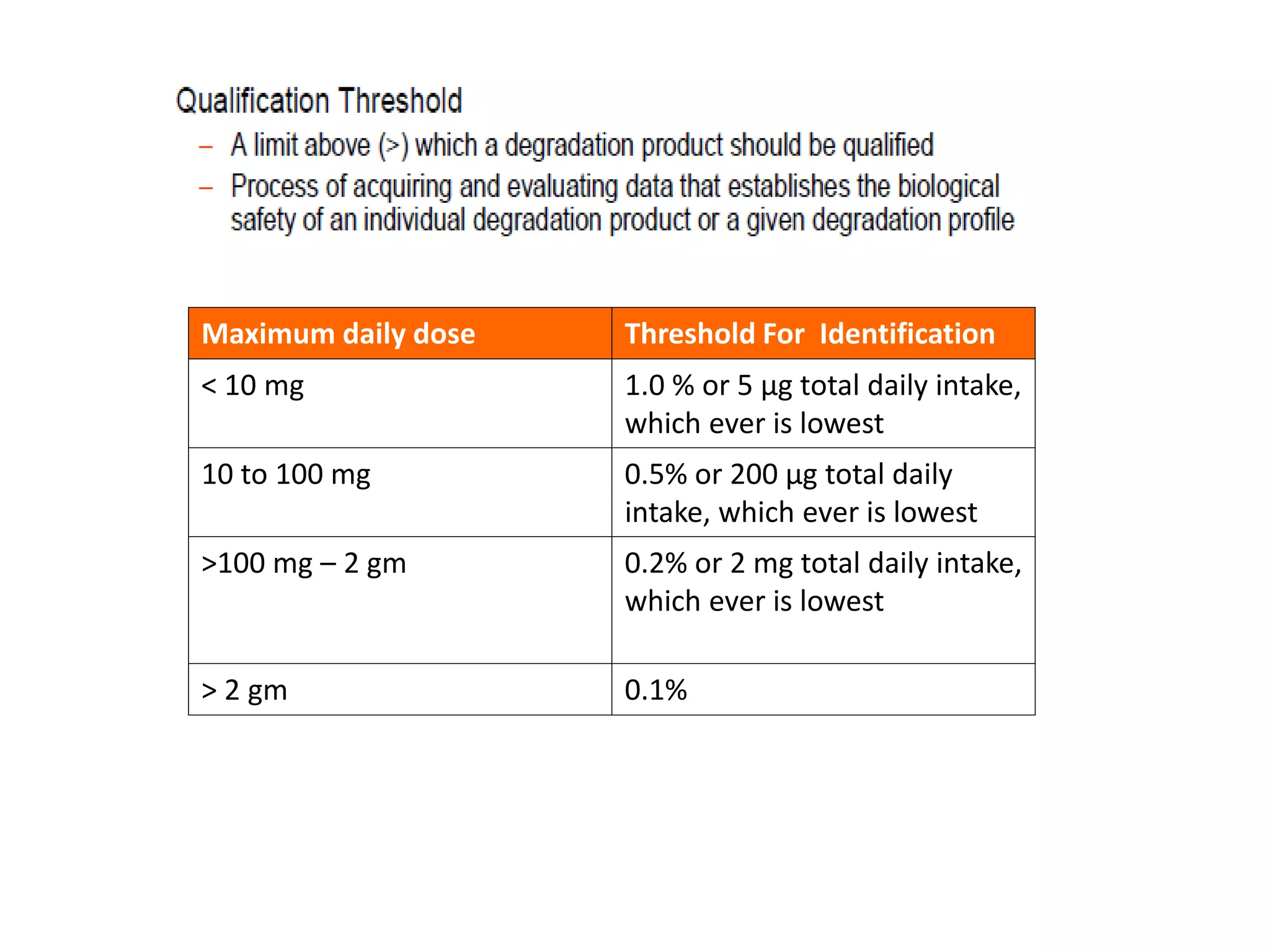
Maximum daily dose Threshold For Identification
< 10 mg 1.0 % or 5 µg total daily intake,
which ever is lowest
10 to 100 mg 0.5% or 200 µg total daily
intake, which ever is lowest
>100 mg – 2 gm 0.2% or 2 mg total daily intake,
which ever is lowest
> 2 gm 0.1%
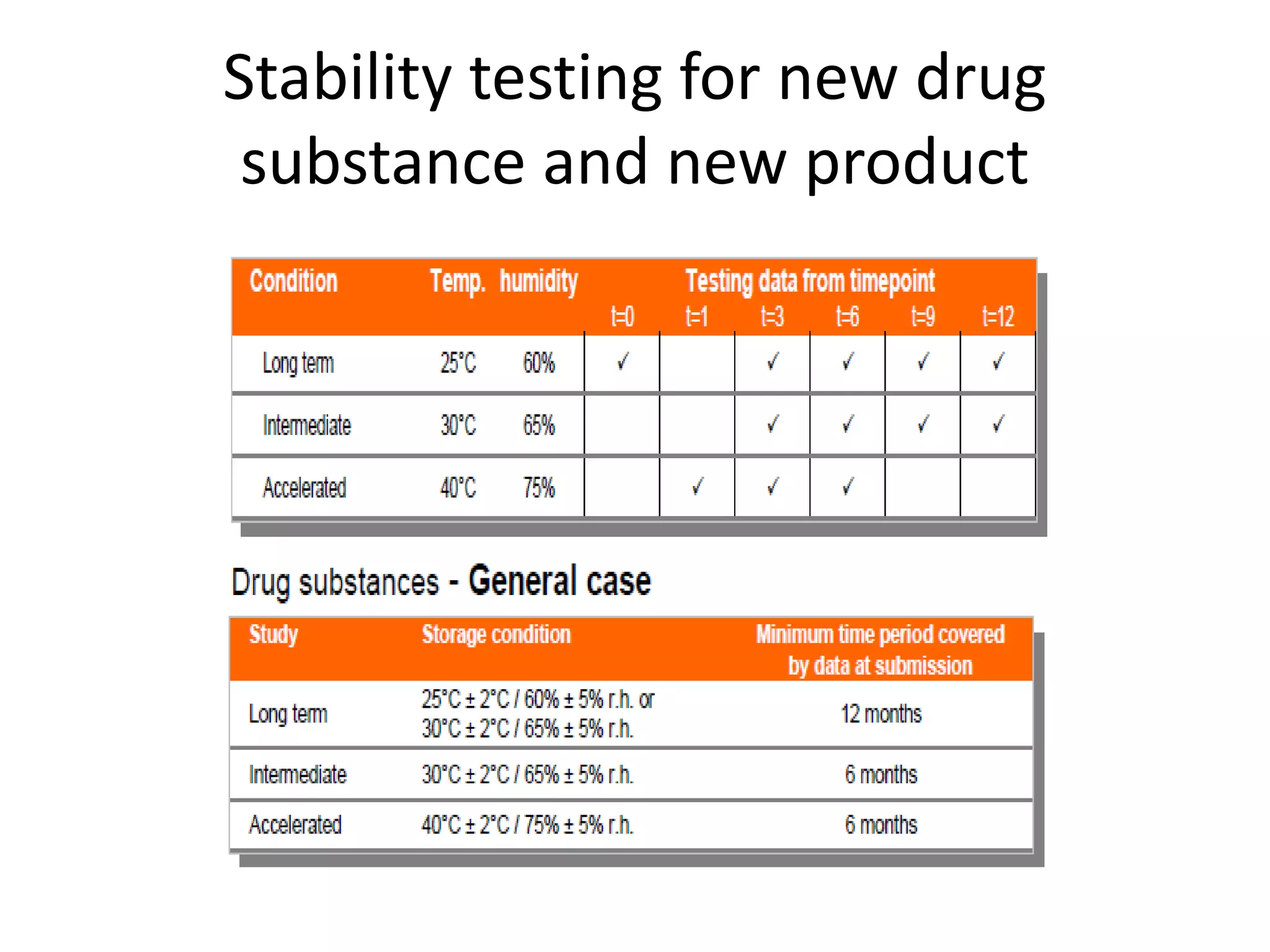
Stability testing for new drug
substance and new product
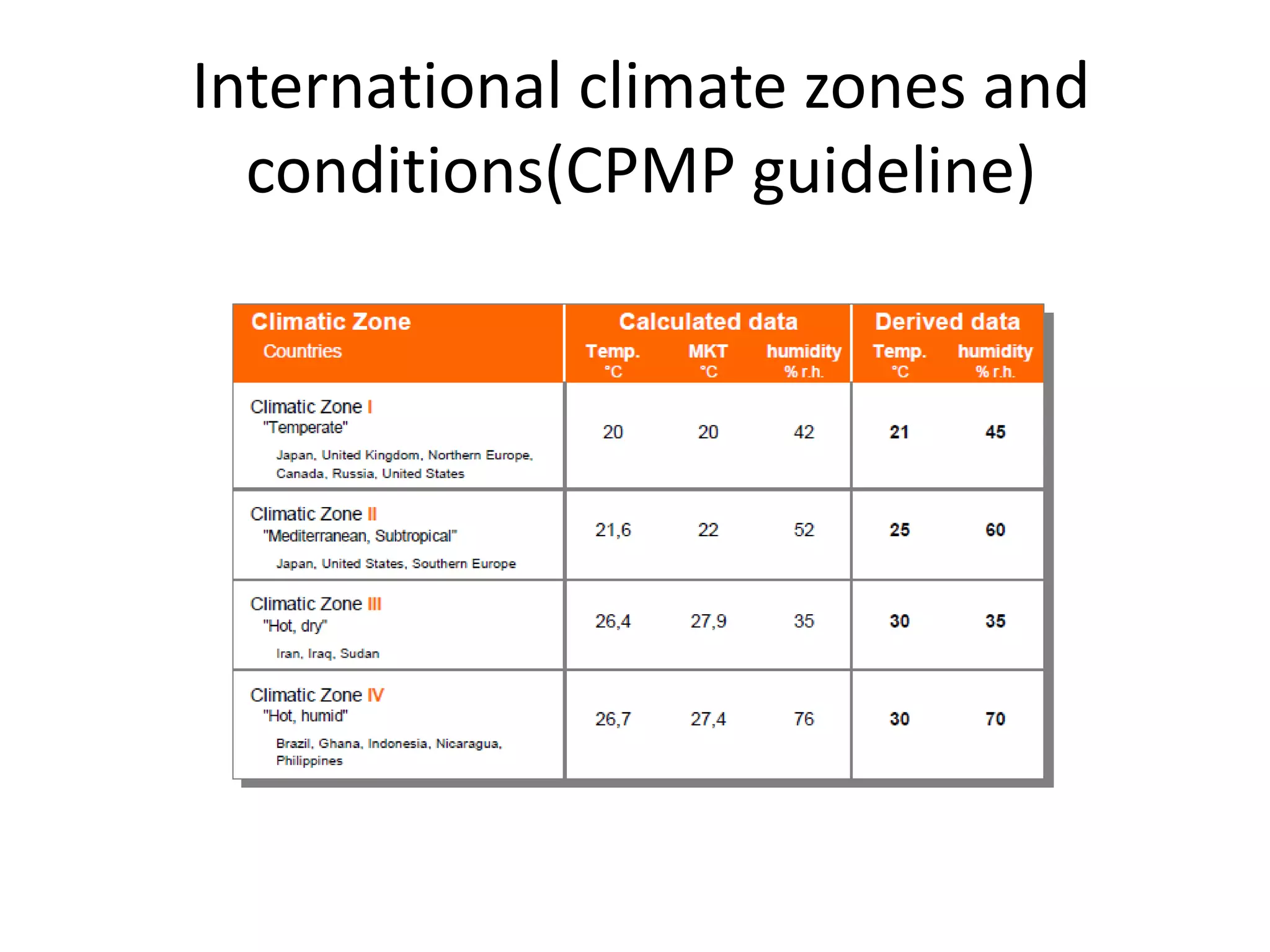
International climate zones and
conditions(CPMP guideline)
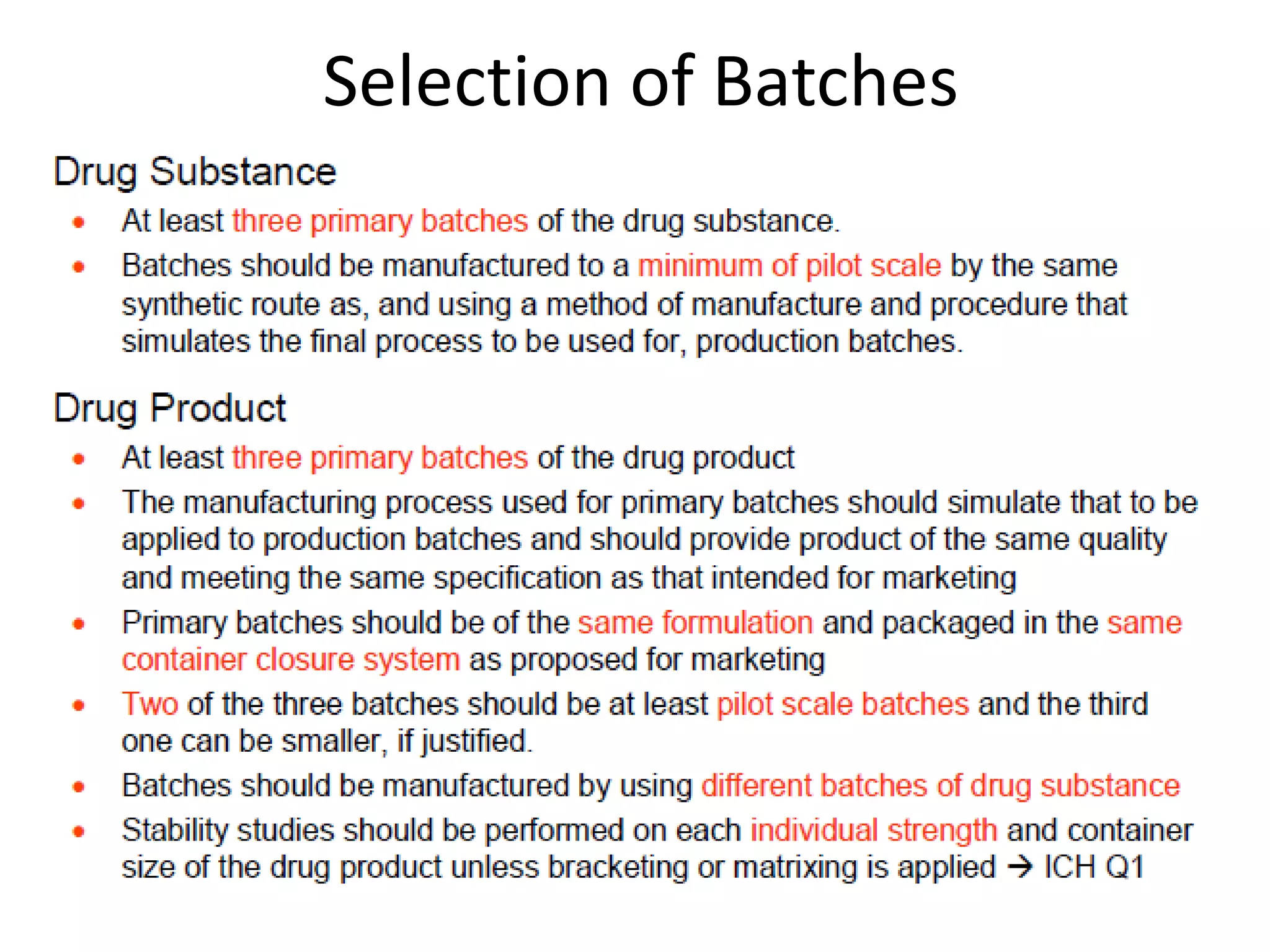
Selection of Batches
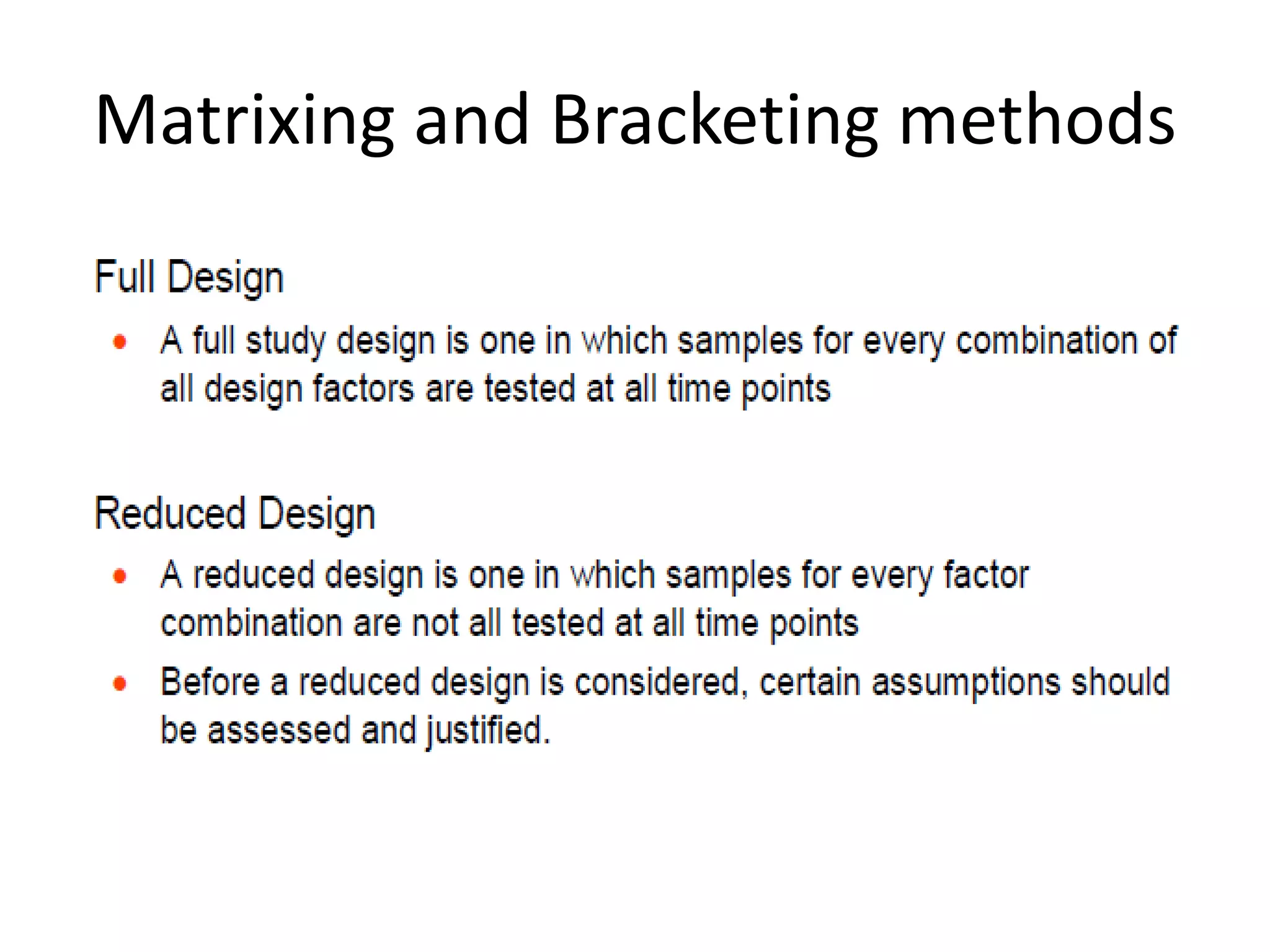
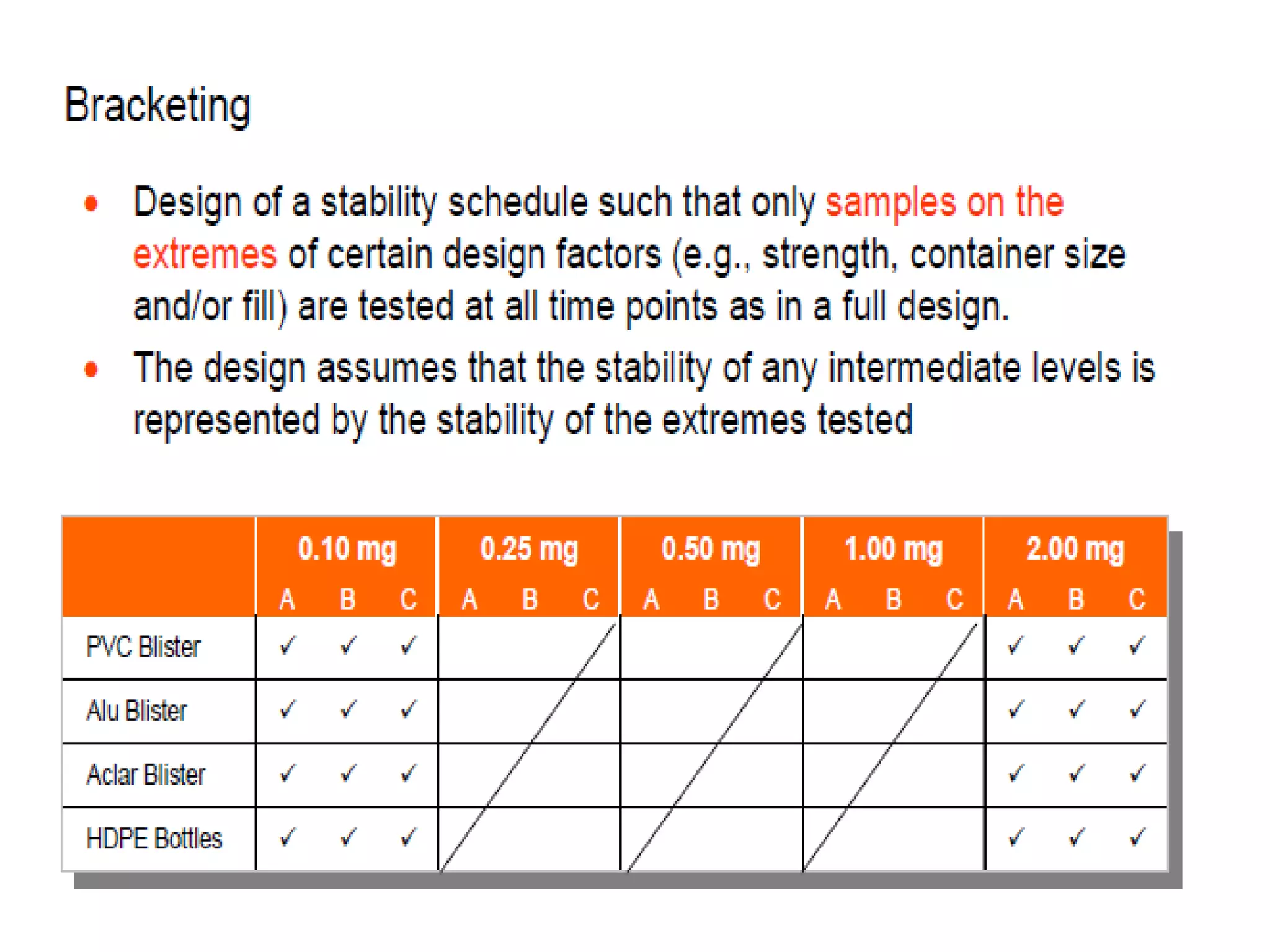
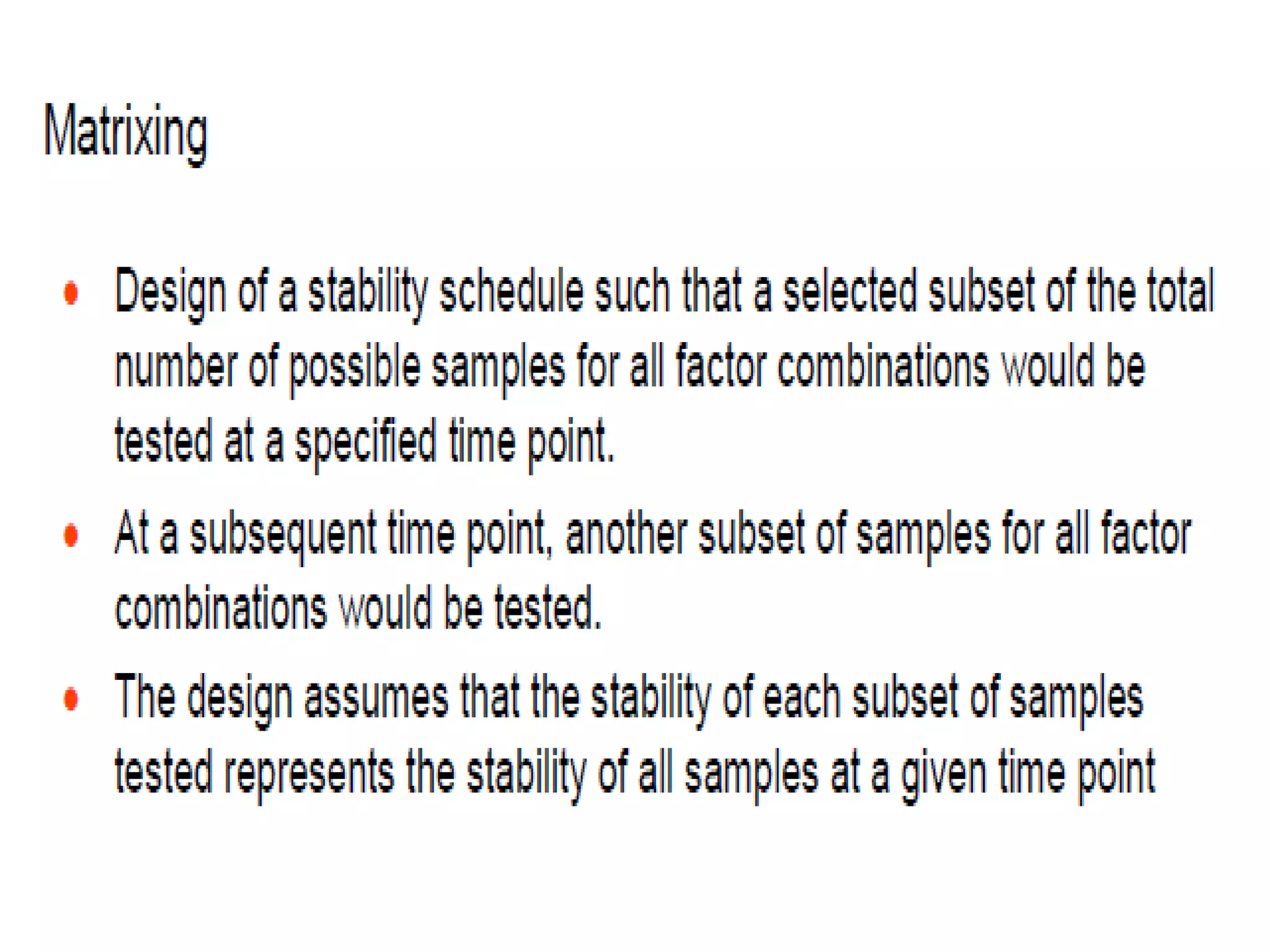
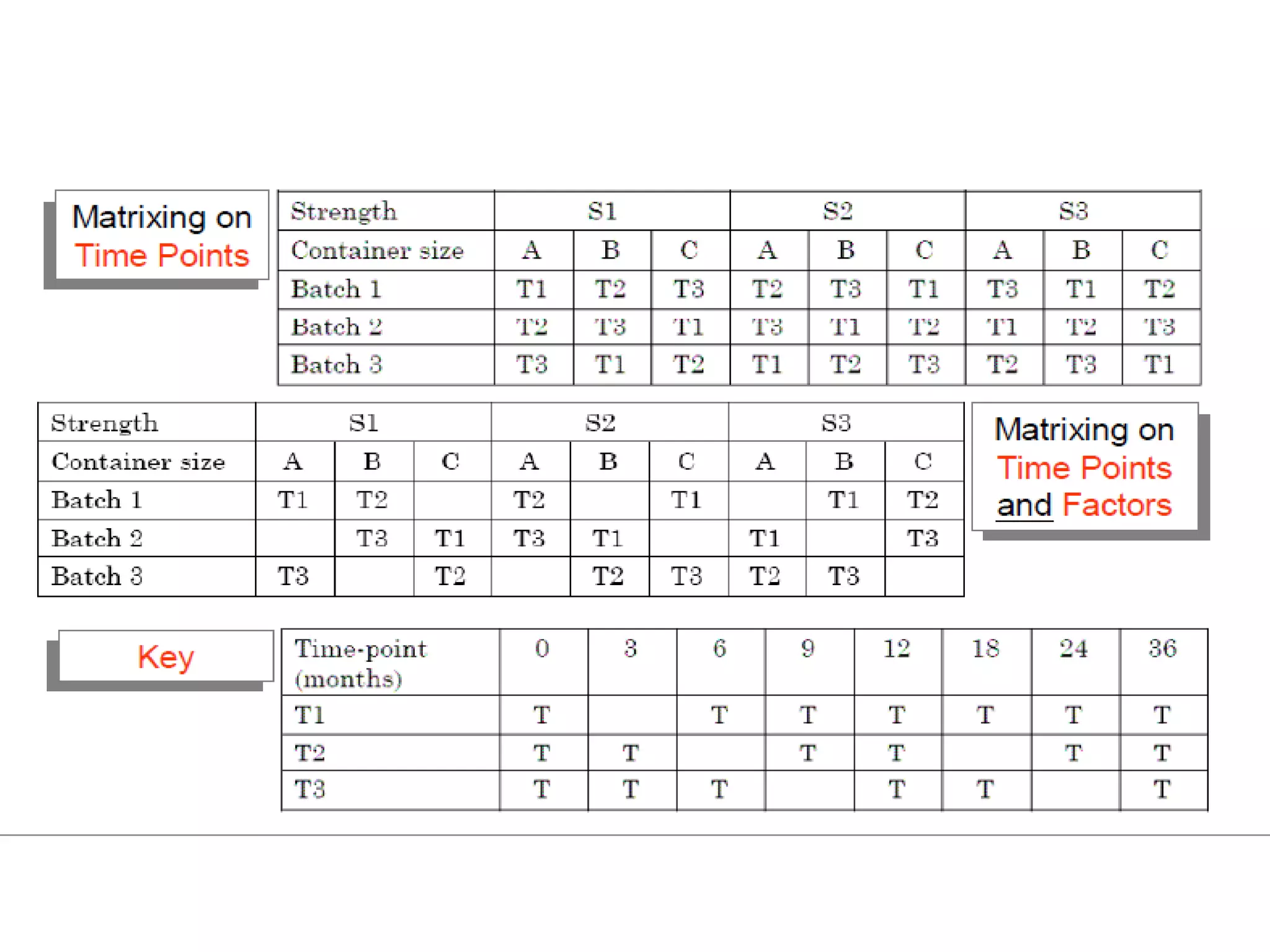
Matrixing and Bracketing methods
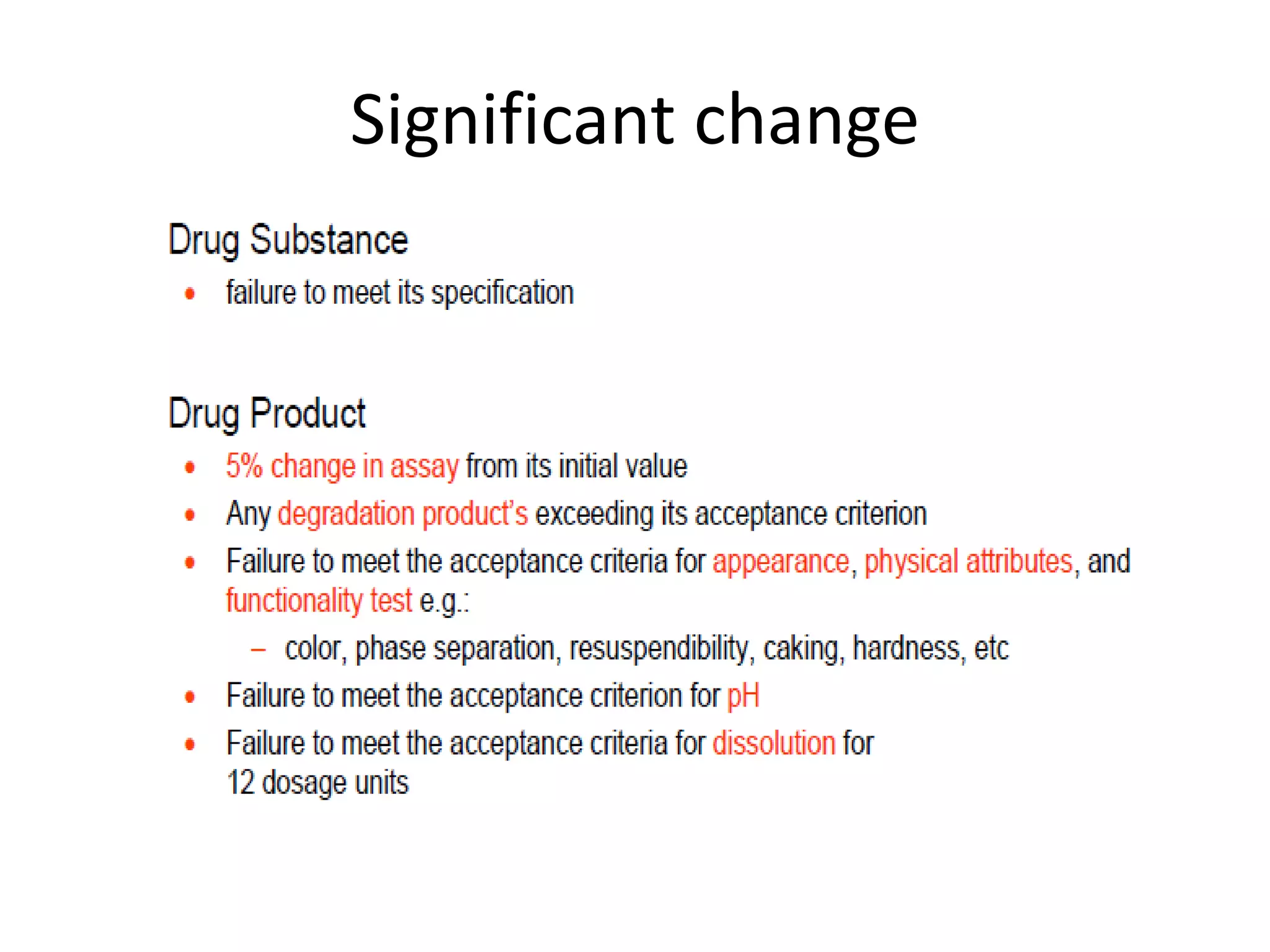
Significant change
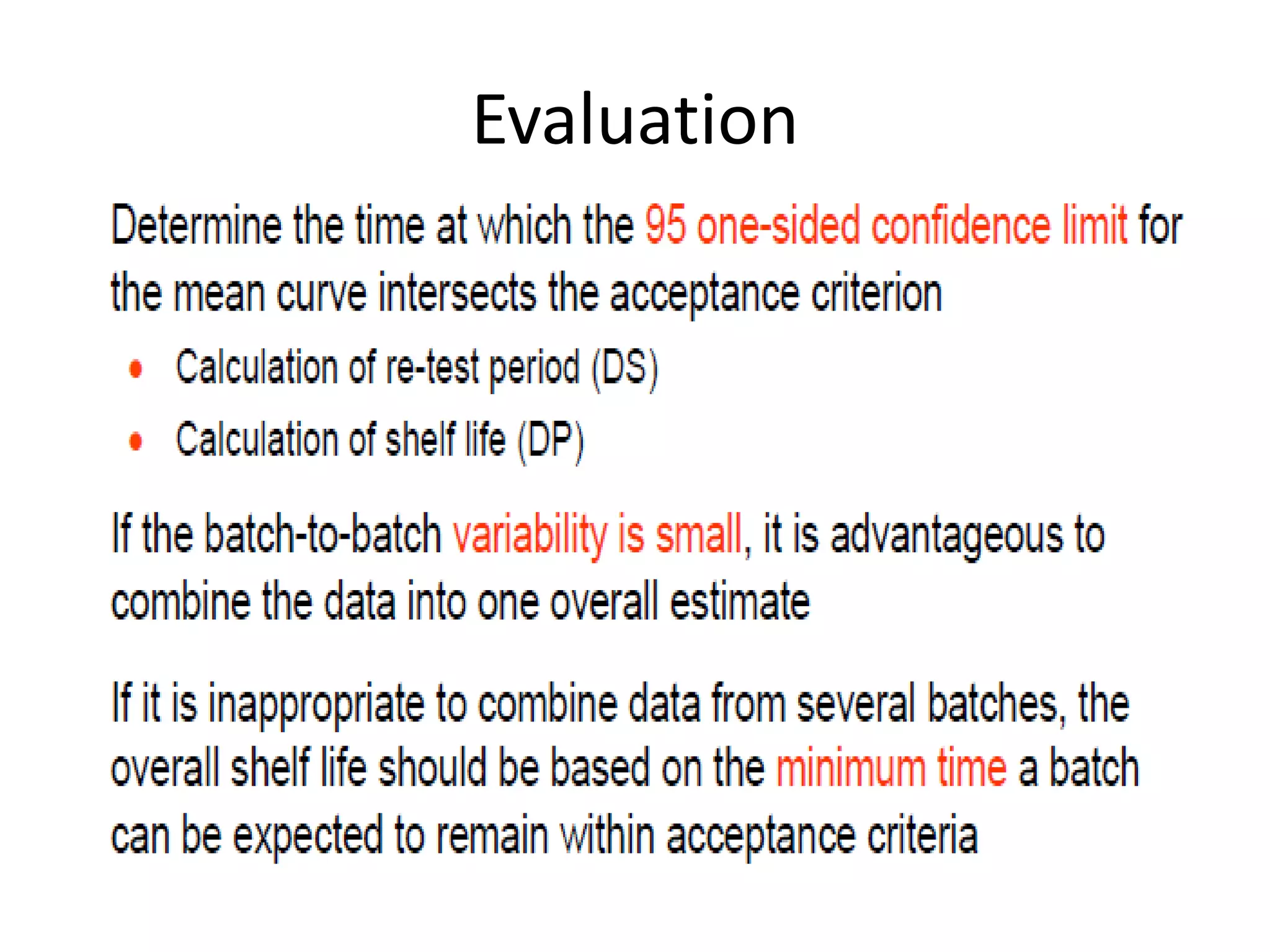
Evaluation
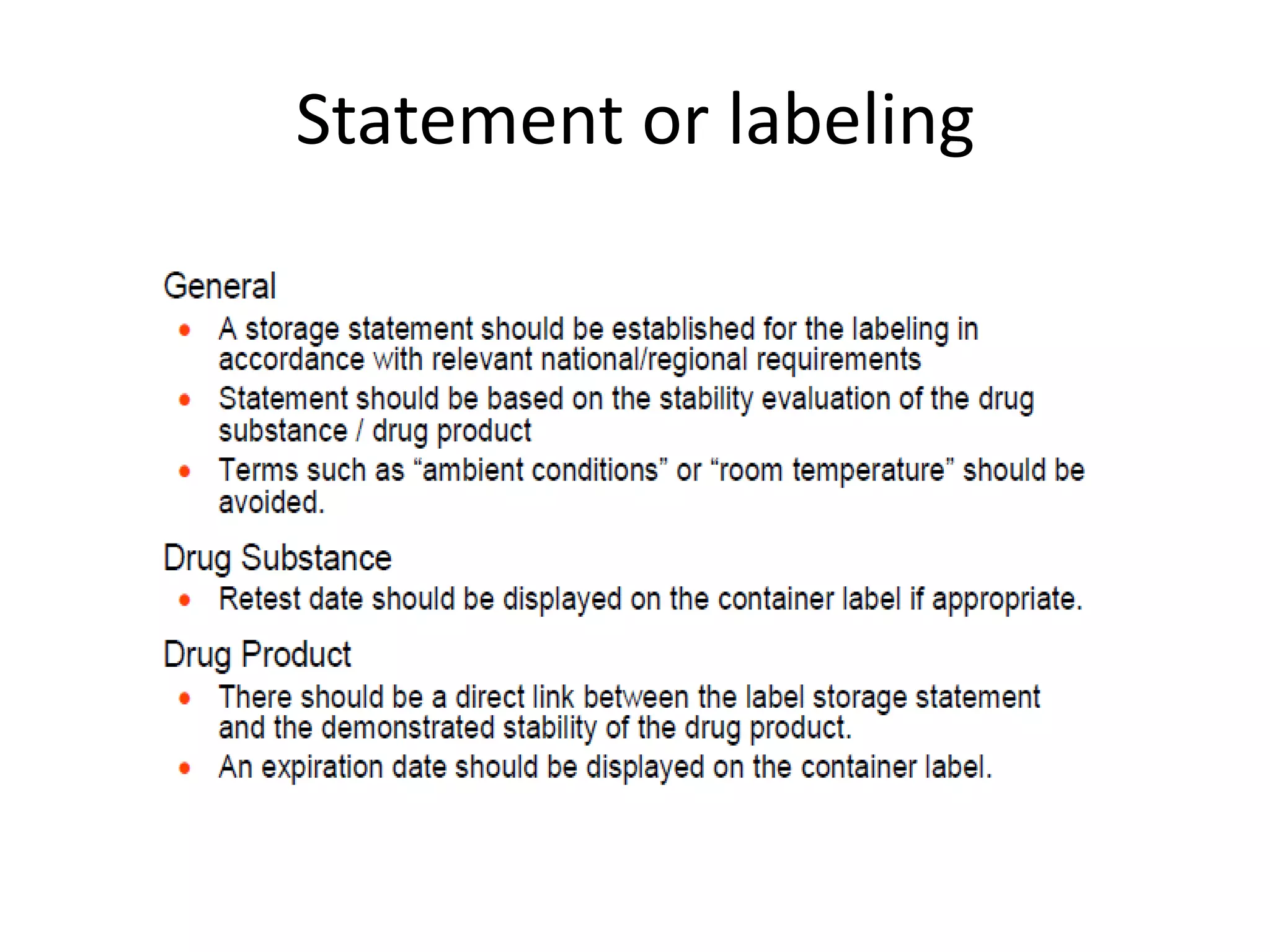
Statement or labeling
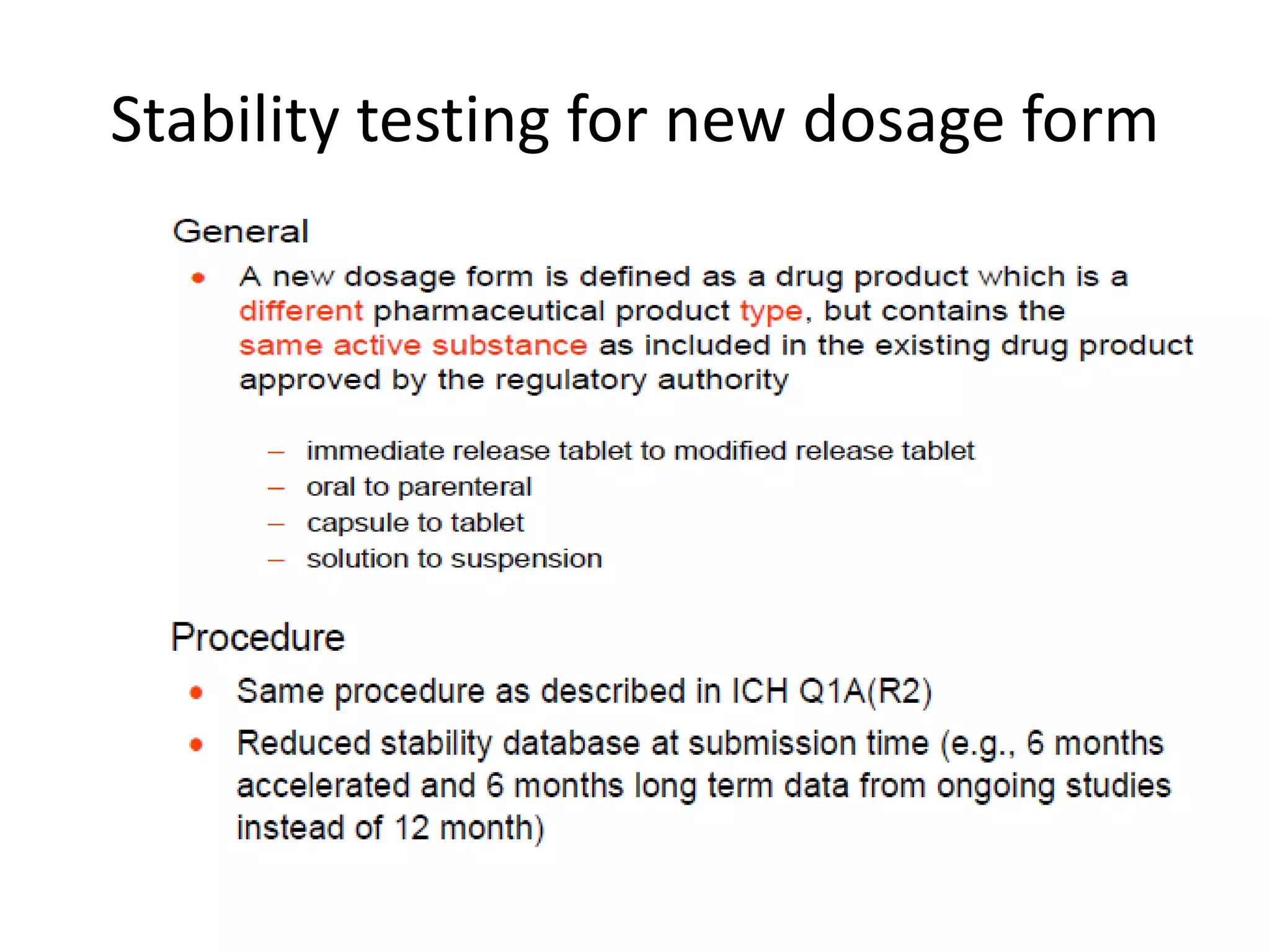
Stability testing for new dosage form
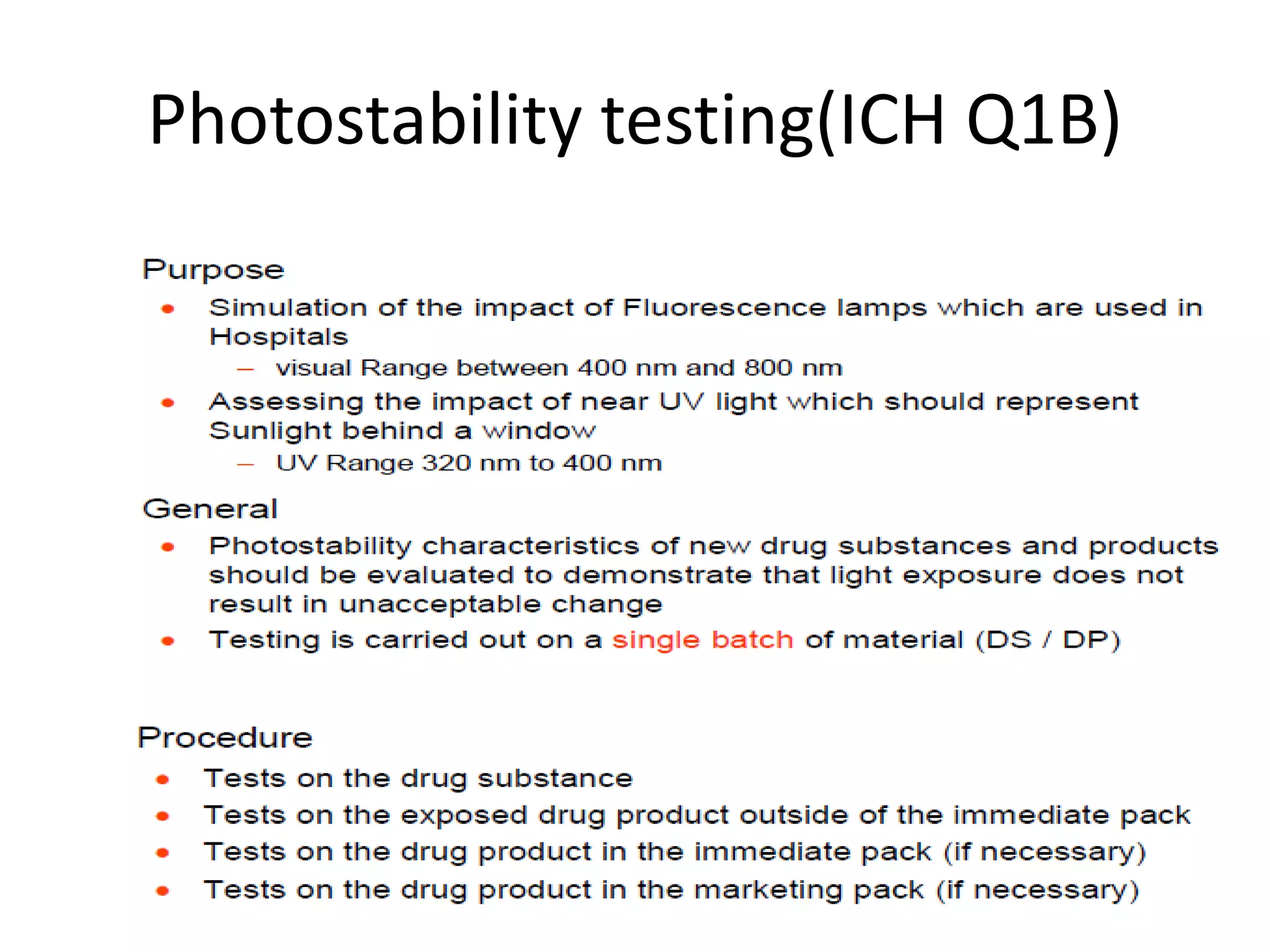
Photostability testing(ICH Q1B)

Tushar Ceutics

  • 1.
    Regulatory Aspects ofStability Testing in Europe Presented by: Guided by: SAGAR SHAH Mrs. RENUKA MISHRA
  • 2.
    Introduction • The stabilityof pharmaceutical ingredient and the products containing them depends on: 1)The chemical and physical properties of the material concerned including the excipients and container system) 2)Environmental factors such as temperature, humidity and light and their effect on the substance in the product. • Some of the types of changes in product that may need to considered are: a) Physical changes: Appearance,consistency,clarity of solution,colour,odour,taste,hardness,disintegration,dissol ution,pH. b) Chemical changes: Degradation product formation, loss of potency, loss of excipients c) Microbial changes: proliferation of microorganisms in nonsterile products, maintenance of sterility,presevative efficacy changes
  • 3.
    A) To establishthe storage condition and retest interval of active ingredient and storage condition and shelf life for manufactured product. B) Part of information can also used to justify overages included in products for stability reasons. Committee of proprietary medicinal products(CPMP) indicates that the objectives of the stability testing is: “to provide evidence on how the quality of an API or product varies with time under the influence of a variety of environment factors such as temperature humidity and light and enables recommended storage conditions, retest periods and shelf life. “ Reason for stability studies:
  • 4.
    Pharmaceutical expert reports •It is an important tool in regulatory submission in Europe. it should provide a critical assessment of all data as given below: For active ingredient: • A summary of results and analytical data • The variability of stability data of drug from different batches • Most appropriate storage conditions of API • The significant degradation products with relevant information in the pharmacotoxicological expert report.
  • 5.
    • Discussion ofdata relating to potential effects of manufacturing procedure (heating and exposure the ionizing radiation) on stability of product. • Assay result of product and degradation products • A discussion of variability in stability found between batches of finished product. • Explanation of calculation data used to estimate the shelflife. • A justification of overages in the products indicating whether thy are because of stability reason or to cover the manufacturing losses. • Justification for release and proposed shelflife and storage conditions. For Finished Product:
  • 6.
    There should alwaysinterplay between stability section and other parts of marketing authorization application. for example, PER may need to discuss number of items included in development pharmaceutics section i.e. • Compatibility of drug substance and excipients • Effect of pH. • Dissolution performance of conventional release products • A discussion of potential interaction, particularly between semisolid and liquid product and their container system • A discussion of particular impurity that could be present in API,Product;impurity from starting material,solvents,reagents. • When a product containing a novel excipient, a full data is required including stability data of excipient.
  • 7.
    Sources of information •The primary source of regulatory requirements in the European community are the pharmaceutical regulation and directives. • There are two primary sites of information. the first is eudralex at dg3.eudra.org/eudralex,which has all documents for human medicines that form the rules governing medical products in the European union in PDF. • 2nd,the CPMP and ICH draft and adapted guidelines on European agency for the Evaluation of Medicinal Products(EMEA)/cpmp home page at www.eudra.org.
  • 8.
    Guidelines • The Europeancommunity's CPMP adopted a guideline on stability testing in July, 1988 and came in to effect in 1989. • For a new drug substances and products containing them, it has been replaced by ICH guidelines and it is expected that all applications submitted since 1998 will include studies that have been conducted as per ICH guidelines. • A revision of the old cpmp stability guideline was adapted in April 1998 and was in effect in October 1998. • In the main of ICH guidelines, recent documents also include a note for guidelines on photo stability testing and another for new drug product.
  • 9.
    Data requirements • Forthis all analytical methods should be validated. It should be capable of detecting and quantifying the degradation products and the interaction products in the finished products. • The basic requirements to be included in application on the stability the active ingredient and the finished products are summarized below. For active ingredients: • Information on the batches tested(including date and place of manufacturing. Batch size) • Details of testing methodology, including normal,stress,accelerated conditions.
  • 10.
    • Analytical testprocedures and their validation data, with reference to assay and the determination of degradation products. • Conclusion and Results • A proposed retest period and storage condition. For dosage form • Proposed shelf life including the acceptable limits for impurity or degradation products • Batches tested and packaging used • Study design • Characteristics studied, including physical, microbiological, chemical as well as characteristics of the products such as the potency and the purity, interaction between container and product • Preservative efficacy and sterility testing • Evaluation of the test procedure.
  • 11.
    • For somedosage forms, particular aspects of stability testing may need to be given particular attention. • Stability of intravenous additives in the diluents for IV infusions. • The stability characteristics of aerosol inhalation( particularly when it is having Al container with halogenated propellants) . • Products in the plastic containers will require special consideration, particularly with respect to protection against external factors, extraction of material for the polymer or the release of the material from the polymers,tightness of the closure etc.
  • 12.
    Impurities in newactive substance • The ICH guidelines on impurities in new active substance requires characterization of reoccurring impurities and degradation products found at or above an apparent level of 0.1%.data may be reported regarding studies undertaken on an impurities below 0.1%,although this is not normally required unless the potential impurities are expected to be unusually potent or toxic or to have pharmacological effect. Impurities in new medicinal products • The suggested thresholds are as follow:
  • 13.
    MAXIMUM DAILY DOSETHRESHOLD FOR REPORTING <= 1 gm 0.1% > 1 gm 0.05% Maximum daily dose Threshold For Identification < 1 mg 1.0 % or 5 µg total daily intake, which ever is lowest 1 to 10 mg 0.5% or 20 µg total daily intake, which ever is lowest 10 mg – 2 gm 0.2% or 2 mg total daily intake, which ever is lowest > 2 gm 0.1%
  • 14.
    Maximum daily doseThreshold For Identification < 10 mg 1.0 % or 5 µg total daily intake, which ever is lowest 10 to 100 mg 0.5% or 200 µg total daily intake, which ever is lowest >100 mg – 2 gm 0.2% or 2 mg total daily intake, which ever is lowest > 2 gm 0.1%
  • 15.
    Stability testing fornew drug substance and new product
  • 16.
    International climate zonesand conditions(CPMP guideline)
  • 17.
  • 18.
  • 22.
  • 23.
  • 24.
  • 25.
    Stability testing fornew dosage form
  • 26.