ICH
                 Harmonization for Better Health


Benhur Pradeep

                                          http://www.myclinicalresearchbook.blogspot.com
Outline
 ICH
 Mission
 Need to Harmonize
 Initiation of ICH
 Structure
 Observers
 Organization
 Process of Harmonization
 Work Products
 The Guidelines – Q S E M
                             http://www.myclinicalresearchbook.blogspot.com
The purpose of clinical research is to create knowledge
 needed to improve healthcare. Without such
 knowledge,      action    for     healthcare  may      be
 impossible, wasteful, expensive or harmful because it will
 have no logical or empirical basis.


                                          http://www.myclinicalresearchbook.blogspot.com
ICH (April 1990)
 International conference on Harmonization

 It is a joint initiative involving regulators & industry as equal
  partners in the scientific & technical discussions of the testing
  procedures which are required to ensure and assess the
  safety, quality & efficacy of medicines.


                                               http://www.myclinicalresearchbook.blogspot.com
Mission
 To make recommendations towards acheiving greater
  harmonization in the interporetation and application of technical
  guidelines and requirements for pharmaceutical product
  registration, there by reducing duplicating of testing carries out
  during the research & development of new human medicines.


                                                http://www.myclinicalresearchbook.blogspot.com
Need to Harmonize
 Realisation was driven by tragedies, such as that with thalidomide
  in Europe in the 1960s.
 The 1960s and 1970s saw a rapid increase in laws, regulations and
  guidelines for reporting and evaluating the data on safety, quality
  and efficacy of new medicinal products.
 Divergence in technical requirements from country to country


                                                  http://www.myclinicalresearchbook.blogspot.com
Initiation of ICH
 Harmonization of regulatory requirements was pioneered by
  European Community (Now EU)
 Success acheived by Europe demonstrated that harmonization was
  possible
 At same time there were bilateral discussions between Europe,
  Japan & US, on possibilites for harmonization
 The birth of ICH took place at meeting in April 1990 in Brussels
 Topics selected for harmonization –
 - SAFETY
 - QUALITY &
 - EFFICACY
                                               http://www.myclinicalresearchbook.blogspot.com
Evolution of ICH
 Two decades of success, attributed by scientific concensus & the
  commitment between industry and regulatory parties.
 First decade saw significant progress in the development of
  tripartitie ICH guidelines on SAFETY, QUALITY & EFFICACY topics
  and also on Multidisciplanary topics (MedDRA, CTD)
 Expanded communication & dessemination of information on ICH
  guidelines with Non-ICH regions
 Estb. Global Cooperation Group (GCG) – in response to a growing
  interest from beyond the ICH region in the use of ICH guidelines


                                                http://www.myclinicalresearchbook.blogspot.com
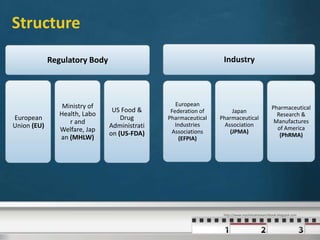
Structure
             Regulatory Body                                    Industry


                 Ministry of                     European
                                US Food &                                                     Pharmaceutical
                Health, Labo                   Federation of        Japan
                                                                                                Research &
European                           Drug       Pharmaceutical   Pharmaceutical
                   r and                         Industries      Association
                                                                                               Manufactures
Union (EU)                     Administrati                                                     of America
                Welfare, Jap                   Associations        (JPMA)
                               on (US-FDA)                                                       (PhRMA)
                an (MHLW)                          (EFPIA)


                                                                http://www.myclinicalresearchbook.blogspot.com
Observers
 WHO, EFTA (European Free Trade Association), Canada, Austrila –
  Non voting members

 IFPMA (International federations of Pharmaceutical Manufactures
  Association) representative


                                               http://www.myclinicalresearchbook.blogspot.com
Organization


               http://www.myclinicalresearchbook.blogspot.com
Steering Committee
 Governing body that overseas the harmonization activities
 Six co-sponsors has two seats on the SC
  (EU, EFPIA, MHLW, JPMA, USFDA, PhRMA)
 3 Observers are WHO, Health Canada, European Free Trade
  Association (EFTA)
 The IFPMA host the ICH secretarist & participartes as a non-voting
  member


                                                 http://www.myclinicalresearchbook.blogspot.com
GCG & MedDRA Management Board
 Global Cooperation Group represents from 5 Regional
  Harmonnizational Initatives (RHI‘s) APEC, ASEAN, EAC, GCC,
  PANDRH, SADC

 MedDRA mngt. Board:- Overall responsibility for direction of
  MedDRA.
 MedDRA an ICH stansardised dictonary of medical terminology
 The board oversees the activites of MedDRA “Maintenance and
  Support Services“ (MSSO) which serves as the repository,
  maintainer, developer and distributor of MedDRA

                                                http://www.myclinicalresearchbook.blogspot.com
Secretariat & Coordinators
 Secretariat located in Geneva, Switzerland, operating from IFPMA
  offices
 Secretariat staff is responsible for day to day management of
  ICH, namely preparations for & documentation of, meetings of the
  SC and its working group

 Coordinators: fundamental to the smooth running of ICH


                                               http://www.myclinicalresearchbook.blogspot.com
ICH Working Groups
 Each party establishes a contact network of experts with in their
  own organization or region in order to ensure that, in the
  discussions they reflect the views & policies of the co-sponsor they
  represent
 There are several different types of ICH working groups
  - EWG: Expert Working Group
  - IWG: Implementation Working Group
  - Informal Working Group
  - Discussion Group


                                                  http://www.myclinicalresearchbook.blogspot.com
Process of Harmonization
 ICH harmonization activities fall into 4 categories
  - 1. Formal ICH Procedure: New topic for Harmonization
  - 2. Q&A Procedure: Clarification on existing guideline
  - 3. Revision Procedure
  - 4. Maintenance Procedure


                                                http://www.myclinicalresearchbook.blogspot.com
Work Products
 1. ICH Guidelines
 2. MedDRA
 3. CTD
 4. Electronic Standards
 5. Consideration Documents
 6. Open Consultations


                               http://www.myclinicalresearchbook.blogspot.com
The Guidelines – Q S E M
 Quality (Q1-Q11)
  - chemical & Pharmaceutial QA

 Safety (S1-S10,M3)
  - dealing with invitro & invivo preclinical testing

 Efficacy (E1-E16, Except E13)
  - clinical studies in human beings

 Multidiscilplinary (M1-M8)
  - terminology, electronic standards, common documents
                                                    http://www.myclinicalresearchbook.blogspot.com
Quality
 Q1-Stability
 Q2-Analytical Validation
 Q3-Impurities
 Q4-Pharmacopoeias
 Q5-Quality of Biotechnological Products
 Q6-Specifications
 Q7-Good Manufacturing Practice
 Q8-Pharmaceutical Development
 Q9-Quality Risk Management
 Q10-Pharmaceutical Quality System
                                            http://www.myclinicalresearchbook.blogspot.com
Safety
 S1-Carcinogenicity Studies
 S2-Genotoxicity Studies
 S3-Toxicokinetics and Pharmacokinetics
 S4-Toxicity Testing
 S5-Reproductive Toxicology
 S6-Biotechnological Products
 S7-Pharmacology Studies
 S8-Immunotoxicology Studies
 S9-Nonclinical evaluation for anticancer pharmaceuticals
 S10-Photosafety Evaluation
                                                http://www.myclinicalresearchbook.blogspot.com
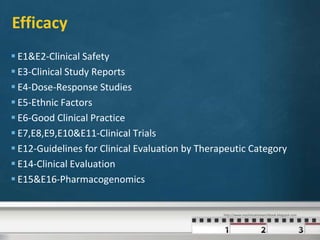
Efficacy
 E1&E2-Clinical Safety
 E3-Clinical Study Reports
 E4-Dose-Response Studies
 E5-Ethnic Factors
 E6-Good Clinical Practice
 E7,E8,E9,E10&E11-Clinical Trials
 E12-Guidelines for Clinical Evaluation by Therapeutic Category
 E14-Clinical Evaluation
 E15&E16-Pharmacogenomics


                                                 http://www.myclinicalresearchbook.blogspot.com
Multidisciplinary
 M1-MedDRA Terminology
 M2-Electronic Standards
 M3-Non-clinical Safety Studies
 M4-CTD
 M5-Data elements & Standards for Drug dictonaries
 M6-Gene Theraphy
 M7-Genotoxic Impurities
 M8-eCTD


                                              http://www.myclinicalresearchbook.blogspot.com
Conclusion
 ICH launched 20 years ago
 ICH brings together the drug regulatory authorities of
  Europe, Japan, and the United States, along with the
  pharmaceutical trade associations from these three regions, to
  discuss scientific and technical aspects of product registration.
 It is ICH’s mission to achieve greater harmonization in the
  interpretation and application of technical guidelines and
  requirements for product registration, thereby reducing
  duplication of testing and reporting carried out during the research
  and development of new medicines.


                                                 http://www.myclinicalresearchbook.blogspot.com
Thank You
                            Benhur Pradeep
                            Pradeep.ben84@gmail.com


                                                      http://www.myclinicalresearchbook.blogspot.com


www.presentationpoint.com

ICH

  • 1.
    ICH Harmonization for Better Health Benhur Pradeep http://www.myclinicalresearchbook.blogspot.com
  • 2.
    Outline  ICH  Mission Need to Harmonize  Initiation of ICH  Structure  Observers  Organization  Process of Harmonization  Work Products  The Guidelines – Q S E M http://www.myclinicalresearchbook.blogspot.com
  • 3.
    The purpose ofclinical research is to create knowledge needed to improve healthcare. Without such knowledge, action for healthcare may be impossible, wasteful, expensive or harmful because it will have no logical or empirical basis. http://www.myclinicalresearchbook.blogspot.com
  • 4.
    ICH (April 1990) International conference on Harmonization  It is a joint initiative involving regulators & industry as equal partners in the scientific & technical discussions of the testing procedures which are required to ensure and assess the safety, quality & efficacy of medicines. http://www.myclinicalresearchbook.blogspot.com
  • 5.
    Mission  To makerecommendations towards acheiving greater harmonization in the interporetation and application of technical guidelines and requirements for pharmaceutical product registration, there by reducing duplicating of testing carries out during the research & development of new human medicines. http://www.myclinicalresearchbook.blogspot.com
  • 6.
    Need to Harmonize Realisation was driven by tragedies, such as that with thalidomide in Europe in the 1960s.  The 1960s and 1970s saw a rapid increase in laws, regulations and guidelines for reporting and evaluating the data on safety, quality and efficacy of new medicinal products.  Divergence in technical requirements from country to country http://www.myclinicalresearchbook.blogspot.com
  • 7.
    Initiation of ICH Harmonization of regulatory requirements was pioneered by European Community (Now EU)  Success acheived by Europe demonstrated that harmonization was possible  At same time there were bilateral discussions between Europe, Japan & US, on possibilites for harmonization  The birth of ICH took place at meeting in April 1990 in Brussels  Topics selected for harmonization – - SAFETY - QUALITY & - EFFICACY http://www.myclinicalresearchbook.blogspot.com
  • 8.
    Evolution of ICH Two decades of success, attributed by scientific concensus & the commitment between industry and regulatory parties.  First decade saw significant progress in the development of tripartitie ICH guidelines on SAFETY, QUALITY & EFFICACY topics and also on Multidisciplanary topics (MedDRA, CTD)  Expanded communication & dessemination of information on ICH guidelines with Non-ICH regions  Estb. Global Cooperation Group (GCG) – in response to a growing interest from beyond the ICH region in the use of ICH guidelines http://www.myclinicalresearchbook.blogspot.com
  • 9.
    Structure Regulatory Body Industry Ministry of European US Food & Pharmaceutical Health, Labo Federation of Japan Research & European Drug Pharmaceutical Pharmaceutical r and Industries Association Manufactures Union (EU) Administrati of America Welfare, Jap Associations (JPMA) on (US-FDA) (PhRMA) an (MHLW) (EFPIA) http://www.myclinicalresearchbook.blogspot.com
  • 10.
    Observers  WHO, EFTA(European Free Trade Association), Canada, Austrila – Non voting members  IFPMA (International federations of Pharmaceutical Manufactures Association) representative http://www.myclinicalresearchbook.blogspot.com
  • 11.
    Organization http://www.myclinicalresearchbook.blogspot.com
  • 12.
    Steering Committee  Governingbody that overseas the harmonization activities  Six co-sponsors has two seats on the SC (EU, EFPIA, MHLW, JPMA, USFDA, PhRMA)  3 Observers are WHO, Health Canada, European Free Trade Association (EFTA)  The IFPMA host the ICH secretarist & participartes as a non-voting member http://www.myclinicalresearchbook.blogspot.com
  • 13.
    GCG & MedDRAManagement Board  Global Cooperation Group represents from 5 Regional Harmonnizational Initatives (RHI‘s) APEC, ASEAN, EAC, GCC, PANDRH, SADC  MedDRA mngt. Board:- Overall responsibility for direction of MedDRA.  MedDRA an ICH stansardised dictonary of medical terminology  The board oversees the activites of MedDRA “Maintenance and Support Services“ (MSSO) which serves as the repository, maintainer, developer and distributor of MedDRA http://www.myclinicalresearchbook.blogspot.com
  • 14.
    Secretariat & Coordinators Secretariat located in Geneva, Switzerland, operating from IFPMA offices  Secretariat staff is responsible for day to day management of ICH, namely preparations for & documentation of, meetings of the SC and its working group  Coordinators: fundamental to the smooth running of ICH http://www.myclinicalresearchbook.blogspot.com
  • 15.
    ICH Working Groups Each party establishes a contact network of experts with in their own organization or region in order to ensure that, in the discussions they reflect the views & policies of the co-sponsor they represent  There are several different types of ICH working groups - EWG: Expert Working Group - IWG: Implementation Working Group - Informal Working Group - Discussion Group http://www.myclinicalresearchbook.blogspot.com
  • 16.
    Process of Harmonization ICH harmonization activities fall into 4 categories - 1. Formal ICH Procedure: New topic for Harmonization - 2. Q&A Procedure: Clarification on existing guideline - 3. Revision Procedure - 4. Maintenance Procedure http://www.myclinicalresearchbook.blogspot.com
  • 17.
    Work Products  1.ICH Guidelines  2. MedDRA  3. CTD  4. Electronic Standards  5. Consideration Documents  6. Open Consultations http://www.myclinicalresearchbook.blogspot.com
  • 18.
    The Guidelines –Q S E M  Quality (Q1-Q11) - chemical & Pharmaceutial QA  Safety (S1-S10,M3) - dealing with invitro & invivo preclinical testing  Efficacy (E1-E16, Except E13) - clinical studies in human beings  Multidiscilplinary (M1-M8) - terminology, electronic standards, common documents http://www.myclinicalresearchbook.blogspot.com
  • 19.
    Quality  Q1-Stability  Q2-AnalyticalValidation  Q3-Impurities  Q4-Pharmacopoeias  Q5-Quality of Biotechnological Products  Q6-Specifications  Q7-Good Manufacturing Practice  Q8-Pharmaceutical Development  Q9-Quality Risk Management  Q10-Pharmaceutical Quality System http://www.myclinicalresearchbook.blogspot.com
  • 20.
    Safety  S1-Carcinogenicity Studies S2-Genotoxicity Studies  S3-Toxicokinetics and Pharmacokinetics  S4-Toxicity Testing  S5-Reproductive Toxicology  S6-Biotechnological Products  S7-Pharmacology Studies  S8-Immunotoxicology Studies  S9-Nonclinical evaluation for anticancer pharmaceuticals  S10-Photosafety Evaluation http://www.myclinicalresearchbook.blogspot.com
  • 21.
    Efficacy  E1&E2-Clinical Safety E3-Clinical Study Reports  E4-Dose-Response Studies  E5-Ethnic Factors  E6-Good Clinical Practice  E7,E8,E9,E10&E11-Clinical Trials  E12-Guidelines for Clinical Evaluation by Therapeutic Category  E14-Clinical Evaluation  E15&E16-Pharmacogenomics http://www.myclinicalresearchbook.blogspot.com
  • 22.
    Multidisciplinary  M1-MedDRA Terminology M2-Electronic Standards  M3-Non-clinical Safety Studies  M4-CTD  M5-Data elements & Standards for Drug dictonaries  M6-Gene Theraphy  M7-Genotoxic Impurities  M8-eCTD http://www.myclinicalresearchbook.blogspot.com
  • 23.
    Conclusion  ICH launched20 years ago  ICH brings together the drug regulatory authorities of Europe, Japan, and the United States, along with the pharmaceutical trade associations from these three regions, to discuss scientific and technical aspects of product registration.  It is ICH’s mission to achieve greater harmonization in the interpretation and application of technical guidelines and requirements for product registration, thereby reducing duplication of testing and reporting carried out during the research and development of new medicines. http://www.myclinicalresearchbook.blogspot.com
  • 24.
    Thank You Benhur Pradeep Pradeep.ben84@gmail.com http://www.myclinicalresearchbook.blogspot.com www.presentationpoint.com