Presented By: Ashish Rajendra Chaudhari
M-pharm Ist year
2
c
• Definition of Qbd
• Current vs Good approach to
pharmaceutical development
• Benefits of Qbd
• Objectives of Qbd
• Element of Qbd
• Ishikawa diagram
• Conclusion
• Reference
Content...
07-12-2019 3
The Quality Mantra....
“Quality can not be tested into products;
It has to be built in by design”
Dr. Joseph M. Juran.
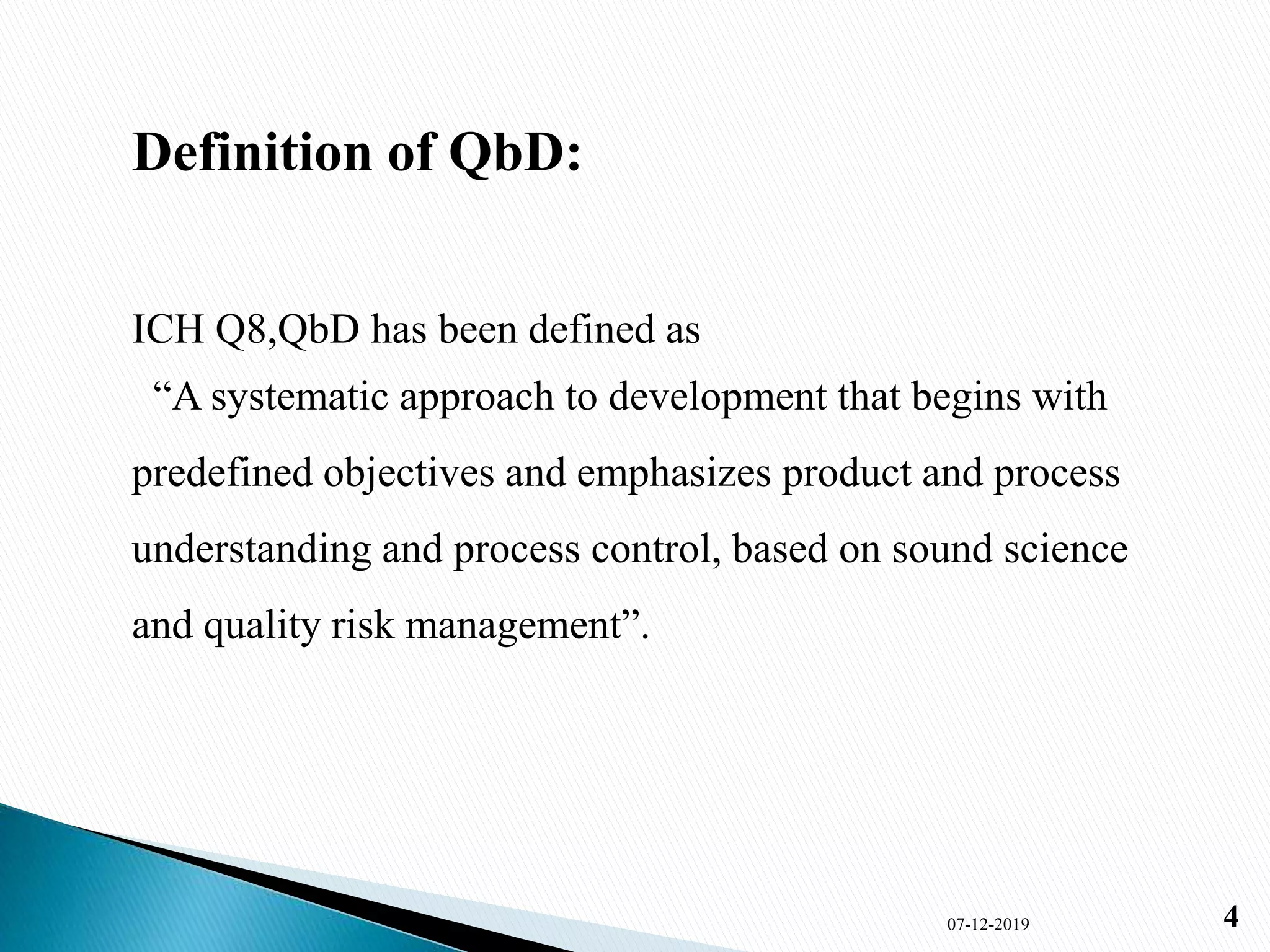
Definition of QbD:
ICH Q8,QbD has been defined as
“A systematic approach to development that begins with
predefined objectives and emphasizes product and process
understanding and process control, based on sound science
and quality risk management”.
07-12-2019 4
07-12-2019 5
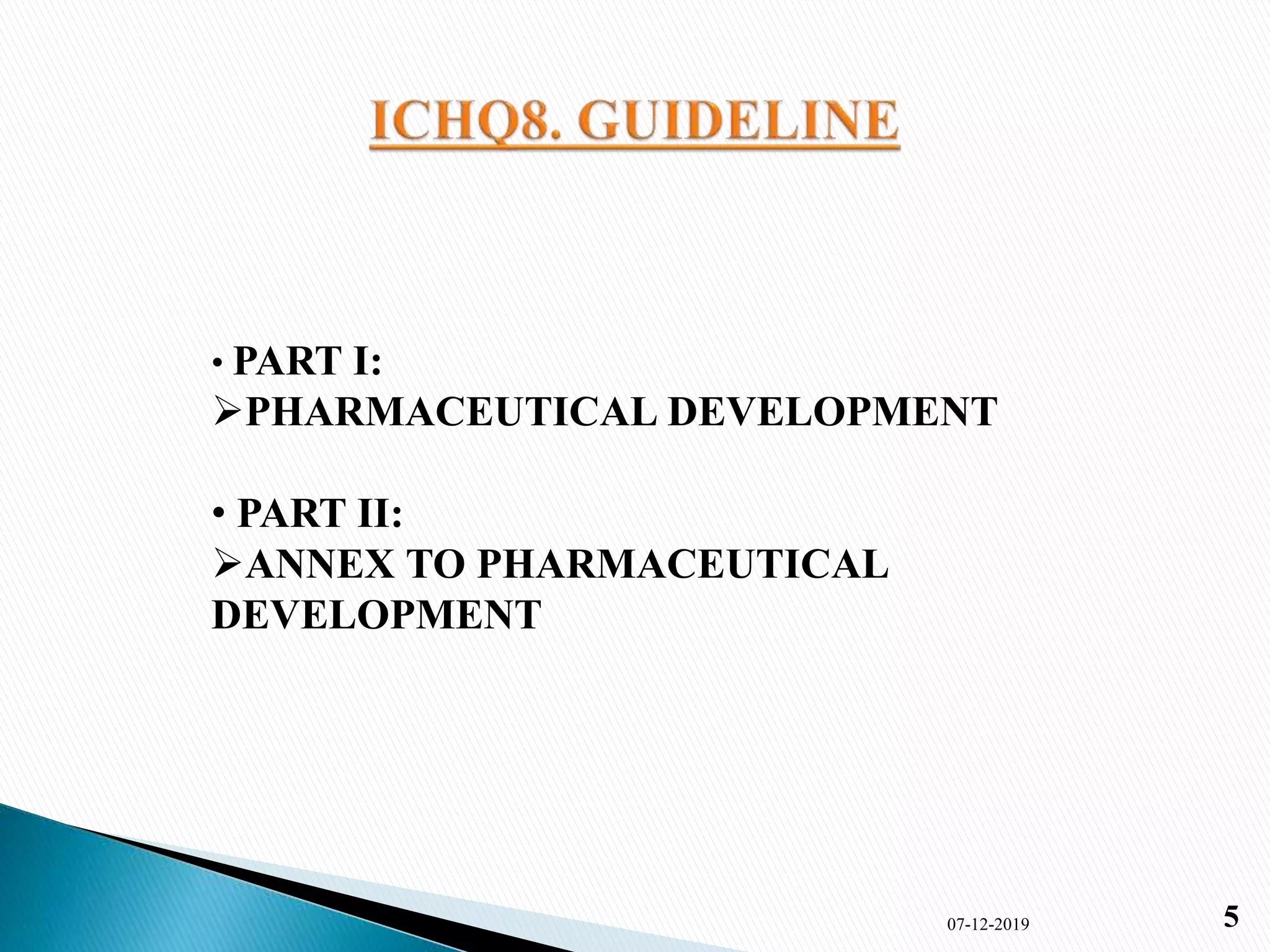
• PART I:
PHARMACEUTICAL DEVELOPMENT
• PART II:
ANNEX TO PHARMACEUTICAL
DEVELOPMENT
07-12-2019 6
2.1 Components of the Drug Product
2.1.1 Drug Substance
2.1.2 Excipients
2.2 Drug Product
2.2.1 Formulation Development
2.2.2 Overages
2.2.3 Physicochemical and Biological Properties
2.3 Manufacturing Process Development
2.4 Container Closure System
2.5 Microbiological Attributes
2.6 Compatibility
07-12-2019 7
2.1 Quality Target Product Profile
2.2 Critical Quality Attributes
2.3 Risk Assessment: Linking Material Attributes and
Process Parameters to Drug Product CQAs
2.4 Design Space
2.4.1 Selection of Variables
2.4.2 Describing a Design Space in a Submission
2.4.3 Unit Operation Design Space(s)
2.4.4 Relationship of Design Space to Scale and Equipment
2.4.5 Design Space Versus Proven Acceptable Ranges
2.4.6 Design Space and Edge of Failure
2.5 Control Strategy
8
ICH
Q8
ICH
Q9
ICH
Q10
ICH
Q11
QbD
QbD and ICH Guidelines
Pharmaceutical
development
Quality Risk
Management
Pharmaceutical
Quality System
Development &
mfg of drug
substance
07-12-2019 9
The Important terms related with QbD that are defined in ICH
Q8
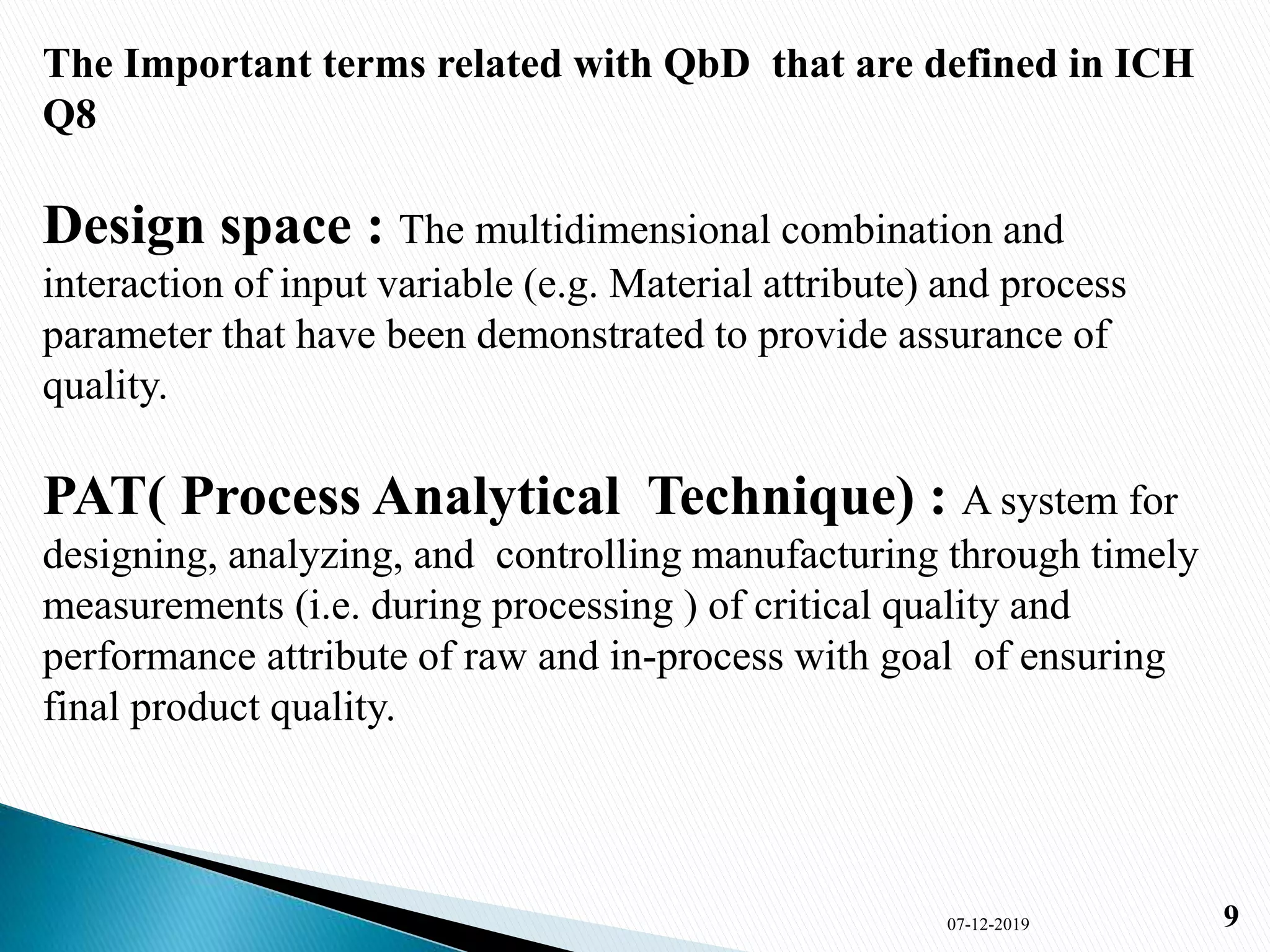
Design space : The multidimensional combination and
interaction of input variable (e.g. Material attribute) and process
parameter that have been demonstrated to provide assurance of
quality.
PAT( Process Analytical Technique) : A system for
designing, analyzing, and controlling manufacturing through timely
measurements (i.e. during processing ) of critical quality and
performance attribute of raw and in-process with goal of ensuring
final product quality.
07-12-2019
10
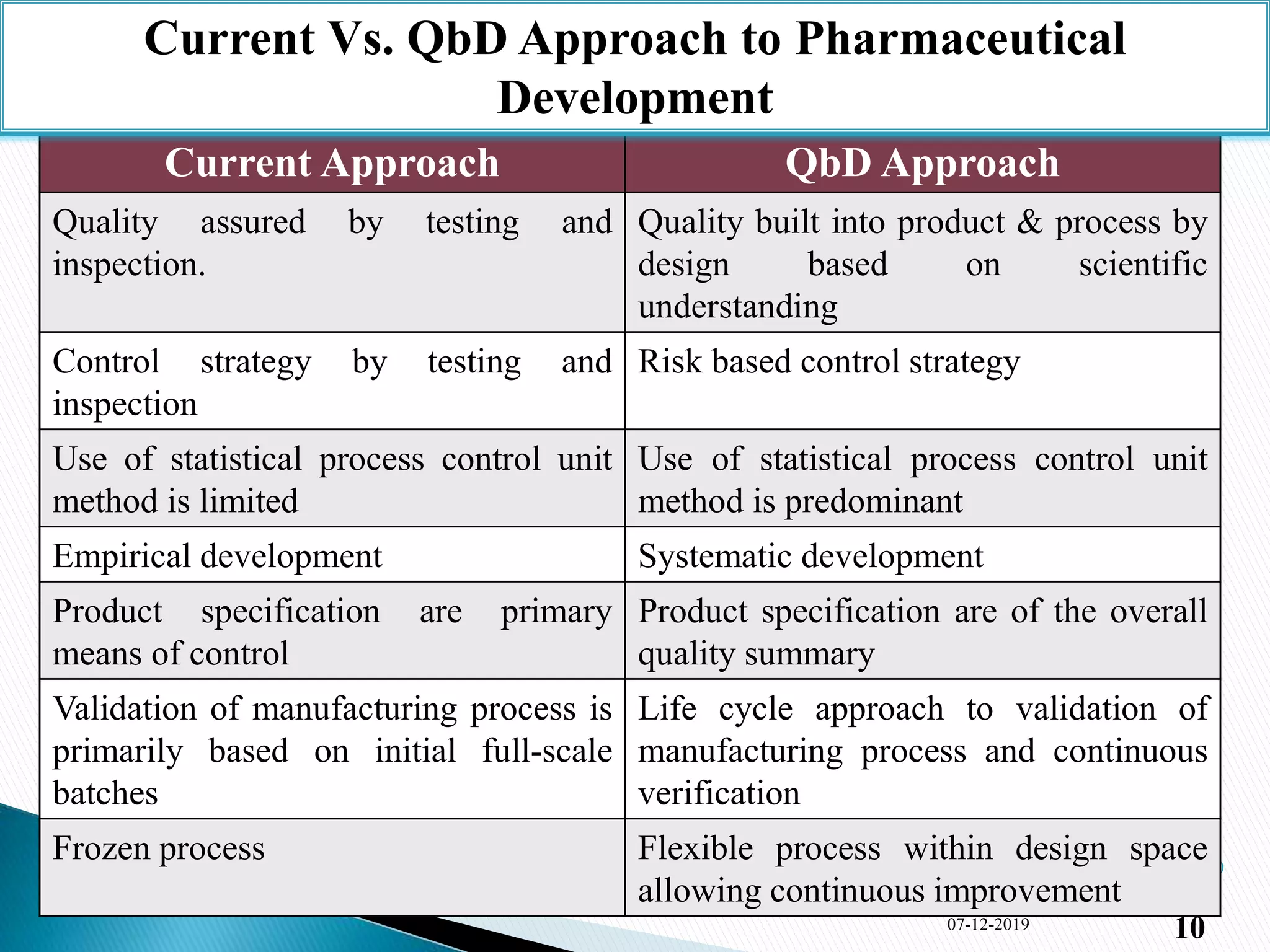
Current Approach QbD Approach
Quality assured by testing and
inspection.
Quality built into product & process by
design based on scientific
understanding
Control strategy by testing and
inspection
Risk based control strategy
Use of statistical process control unit
method is limited
Use of statistical process control unit
method is predominant
Empirical development Systematic development
Product specification are primary
means of control
Product specification are of the overall
quality summary
Validation of manufacturing process is
primarily based on initial full-scale
batches
Life cycle approach to validation of
manufacturing process and continuous
verification
Frozen process Flexible process within design space
allowing continuous improvement
Current Vs. QbD Approach to Pharmaceutical
Development
10
Benefits of QbD:
• Less validation burden.
• Better design of product.
• Fewer problems in manufacturing.
• Understanding and mitigation of risk.
• A reduction in overall cost of manufacturing.
• More efficient technology transfer to manufacturing.
• Enabling continuous improvement.
07-12-2019 11
Objectives of QbD :
• To encourages pharmaceutical companies to develop
sufficient understanding of their products and manufacture
processes.
• To ensure that their processes are robust.
• To demonstrate this enhanced understanding to the
pharmaceutical regulatory agencies.
07-12-2019 12
Advantages of QbD:
• Patient safety and product efficacy are focused.
• Scientific understanding of pharmaceutical process and
methods is done.
• It involve product design and process devlopement.
• Science based risk assessment is carried.
• Critical quality attributes are identified and their effect on final
quality of product is analysed.
• It offers robust method or process ..
• Method design concept helps to avoid cost involved with post
approval changes.
07-12-2019 13
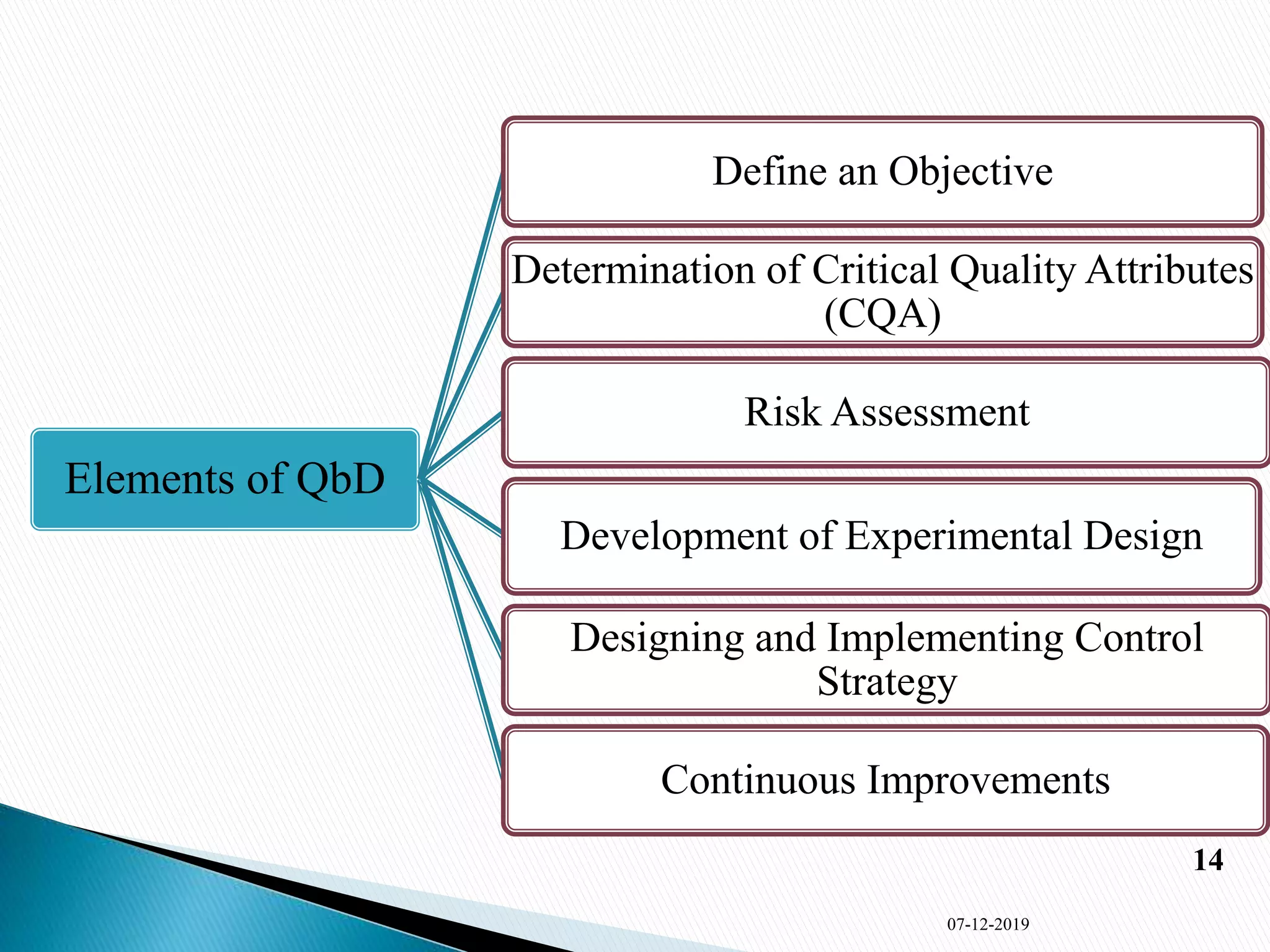
Elements of QbD
Define an Objective
Determination of Critical Quality Attributes
(CQA)
Risk Assessment
Development of Experimental Design
Designing and Implementing Control
Strategy
Continuous Improvements
07-12-2019
14
Define an objective:
As per ICH guideline Q8 R2 Quality Target Product Profile can be
defined as “Summary of the quality characteristics of a drug product
that ideally will be achieved to ensure that the desired quality, and
thus the safety and efficacy of a drug product is realised”.
The Quality target product profile forms the basis for design and the
development of the product .
07-12-2019 15
Intended use in clinical setting, route of administration, dosage
forms, delivery system.
Dosage strength (s), container closure system.
Therapeutic moiety release &
pharmacokineticcharacteristics (e.g., dissolution, aerodynamic
performance).
Drug product quality criteria like sterility, purity, stability
& drug release as appropriate for dosage from the intended
for marketing.
Consideration for the Quality Target Product
Profile (QTPP):
07-12-2019
16
Determination of Critical Quality Attributes
(CQA)
According to ICH Q8 R2 “A CQA is a physical, chemical,
biological, or, microbiological property or characteristics that
should be within an appropriate limit, range, or distribution to
ensure the desired product quality.
CQAs are generally linked with the drug substance, excipients
intermediates and drug products.
It is stated in ICH Q9 that in case of potential drug substance
CQAs are used to guide process development.
07-12-2019 17
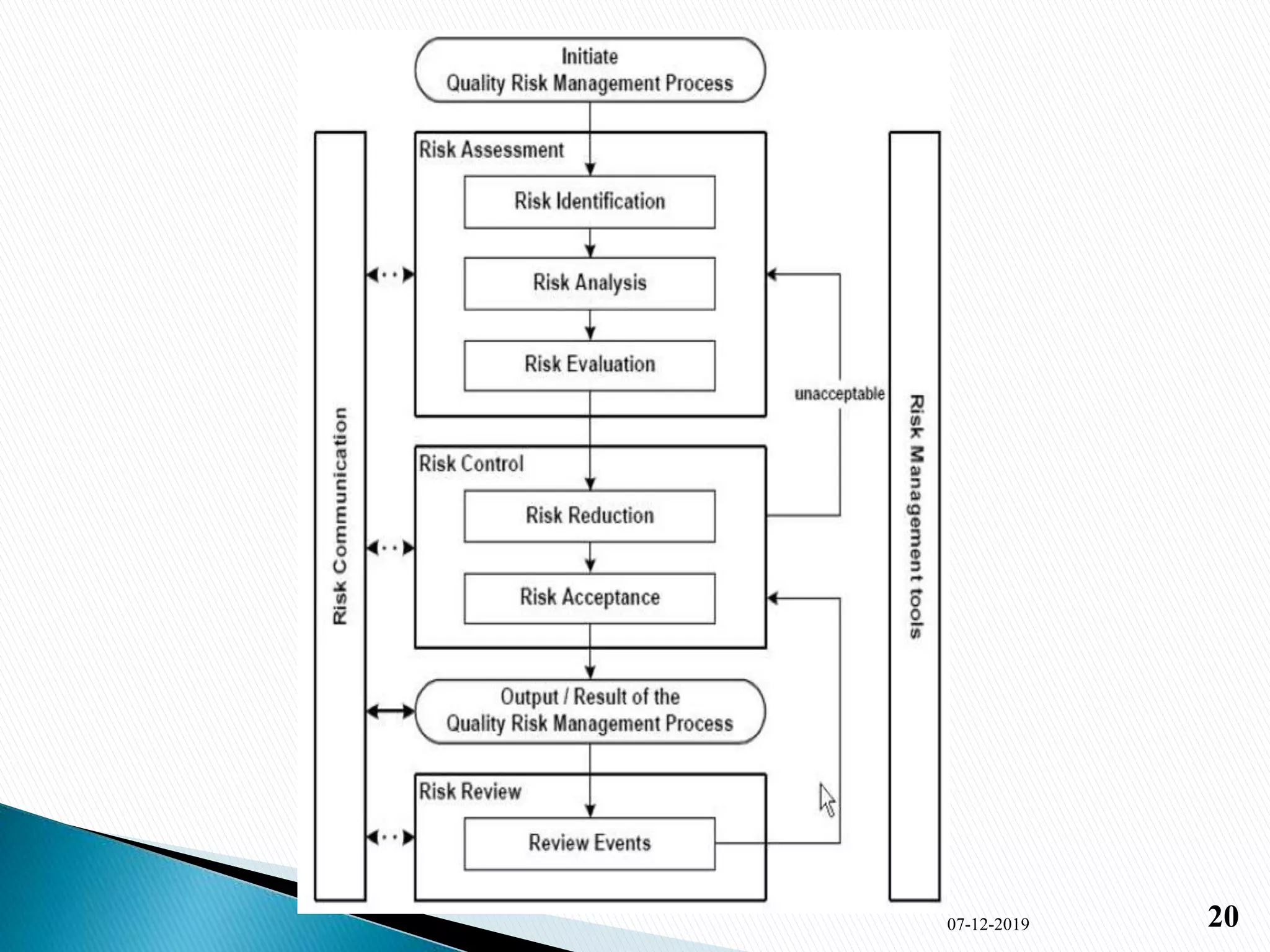
Risk Assessment:
Risk assessment consist of the identification of hazards and analysis
an evaluation of risk associated with exposure to those hazards.
Principle of management are:
• Scientific knowledge based evaluation of the risk to quality which
eventually link to the protection of the patient.
• Adequate effort should be taken; formality and documentation of
the quality risk management process should be done with the level
of risk involved
• It is joint responsibility of quality unit, business development,
engineering, regulatory affairs production operations, sales and
marketing, legal, statistics and clinical department.
07-12-2019 18
Methods of Risk Assessment
Methods of risk assessments are mentioned in ICH guideline Q9as
follows:
• Failure mode effects analysis (FMEA)
• Failure mode, effects and critically analysis (FMCEA)
• Fault tree analysis (FTA)
• Hazard analysis and critical control points (HACCP)
• Hazard operability analysis (HAZOP)
• Preliminary hazard analysis (PHA)
• Risk ranking and filtering
• Supporting statistical tools.
07-12-2019
19
07-12-2019 20
Development of Experimental Design
• Experimental design is the multidimensional
combination and interaction of input variables and
process parameters that have demonstrated to provide
assurance of quality.
• Pharmaceutical development scientist have just began to
making use of computer-aided process design (CAPD)
and process simulation to support process development
and optimization of manufacturing.
07-12-2019 21
Designing and implementing control strategy
Control strategy is required to ensure that material and process is
within the expected lower and upper limits. parameter and material
are routinely controlled during production in order to assurer
reproducibility.
07-12-2019 22
Continuous Improvements
• Product quality can be improved throughout the product
lifecycle; companies have opportunities to inventive approaches to
improve quality.
• Process performance can be monoitored to make sure
consistency in quality.
• The QbD approach avails the continuous improvement
throughout product life cycle this is distinguish point from the
conventionl method which must frozen process.
07-12-2019 23
07-12-2019 24
CONCLUSION
07-12-2019
25
• Quality by Design (QbD) is increasingly becoming an important
and widely used technique in pharmaceutical development.
• It means designing and developing formulations and
manufacturing processes to ensure predefined product quality
objectives.
• Implementing QbD concept in product development provide
quality medicines to patients, production improvements to
Manufacturers with significantly reduced batch failures and drug
regulatory bodies will have greater confidence in the robust
quality of products they are being asked to approve. As such QbD
ng a promising scientific tool in quality assurance in pharma
industry.
References
18/10/2019
26
• Sangshetti, J.N., Zaheer, Z., Mahaparale P.R., Chitlange S.S.,
August 2015, Quality By Design In Pharmaceuticals, Published
By Unique Publication, First Edition, Pp. 12-20,30-44,113-114.
• Jaiprakash N. Sangshetti A, Mrinmayee Deshpande A, Zahid
Zaheer A, Devanand B. Shinde B, Rohidas Arote C, Feb 2014
Review Article Quality By Design Approach: Regulatory Need,
Arabian Journal Of Chemistry
• ICH Q8 (R1) Pharmaceutical Development: Quality By
Design, May 2006.
• Ich Harmonised Tripartite Guideline, November 2005. Quality
Risk Management Q9.
27

Quality by design (qbd)

  • 1.
    Presented By: AshishRajendra Chaudhari M-pharm Ist year
  • 2.
    2 c • Definition ofQbd • Current vs Good approach to pharmaceutical development • Benefits of Qbd • Objectives of Qbd • Element of Qbd • Ishikawa diagram • Conclusion • Reference Content...
  • 3.
    07-12-2019 3 The QualityMantra.... “Quality can not be tested into products; It has to be built in by design” Dr. Joseph M. Juran.
  • 4.
    Definition of QbD: ICHQ8,QbD has been defined as “A systematic approach to development that begins with predefined objectives and emphasizes product and process understanding and process control, based on sound science and quality risk management”. 07-12-2019 4
  • 5.
    07-12-2019 5 • PARTI: PHARMACEUTICAL DEVELOPMENT • PART II: ANNEX TO PHARMACEUTICAL DEVELOPMENT
  • 6.
    07-12-2019 6 2.1 Componentsof the Drug Product 2.1.1 Drug Substance 2.1.2 Excipients 2.2 Drug Product 2.2.1 Formulation Development 2.2.2 Overages 2.2.3 Physicochemical and Biological Properties 2.3 Manufacturing Process Development 2.4 Container Closure System 2.5 Microbiological Attributes 2.6 Compatibility
  • 7.
    07-12-2019 7 2.1 QualityTarget Product Profile 2.2 Critical Quality Attributes 2.3 Risk Assessment: Linking Material Attributes and Process Parameters to Drug Product CQAs 2.4 Design Space 2.4.1 Selection of Variables 2.4.2 Describing a Design Space in a Submission 2.4.3 Unit Operation Design Space(s) 2.4.4 Relationship of Design Space to Scale and Equipment 2.4.5 Design Space Versus Proven Acceptable Ranges 2.4.6 Design Space and Edge of Failure 2.5 Control Strategy
  • 8.
    8 ICH Q8 ICH Q9 ICH Q10 ICH Q11 QbD QbD and ICHGuidelines Pharmaceutical development Quality Risk Management Pharmaceutical Quality System Development & mfg of drug substance
  • 9.
    07-12-2019 9 The Importantterms related with QbD that are defined in ICH Q8 Design space : The multidimensional combination and interaction of input variable (e.g. Material attribute) and process parameter that have been demonstrated to provide assurance of quality. PAT( Process Analytical Technique) : A system for designing, analyzing, and controlling manufacturing through timely measurements (i.e. during processing ) of critical quality and performance attribute of raw and in-process with goal of ensuring final product quality.
  • 10.
    07-12-2019 10 Current Approach QbDApproach Quality assured by testing and inspection. Quality built into product & process by design based on scientific understanding Control strategy by testing and inspection Risk based control strategy Use of statistical process control unit method is limited Use of statistical process control unit method is predominant Empirical development Systematic development Product specification are primary means of control Product specification are of the overall quality summary Validation of manufacturing process is primarily based on initial full-scale batches Life cycle approach to validation of manufacturing process and continuous verification Frozen process Flexible process within design space allowing continuous improvement Current Vs. QbD Approach to Pharmaceutical Development 10
  • 11.
    Benefits of QbD: •Less validation burden. • Better design of product. • Fewer problems in manufacturing. • Understanding and mitigation of risk. • A reduction in overall cost of manufacturing. • More efficient technology transfer to manufacturing. • Enabling continuous improvement. 07-12-2019 11
  • 12.
    Objectives of QbD: • To encourages pharmaceutical companies to develop sufficient understanding of their products and manufacture processes. • To ensure that their processes are robust. • To demonstrate this enhanced understanding to the pharmaceutical regulatory agencies. 07-12-2019 12
  • 13.
    Advantages of QbD: •Patient safety and product efficacy are focused. • Scientific understanding of pharmaceutical process and methods is done. • It involve product design and process devlopement. • Science based risk assessment is carried. • Critical quality attributes are identified and their effect on final quality of product is analysed. • It offers robust method or process .. • Method design concept helps to avoid cost involved with post approval changes. 07-12-2019 13
  • 14.
    Elements of QbD Definean Objective Determination of Critical Quality Attributes (CQA) Risk Assessment Development of Experimental Design Designing and Implementing Control Strategy Continuous Improvements 07-12-2019 14
  • 15.
    Define an objective: Asper ICH guideline Q8 R2 Quality Target Product Profile can be defined as “Summary of the quality characteristics of a drug product that ideally will be achieved to ensure that the desired quality, and thus the safety and efficacy of a drug product is realised”. The Quality target product profile forms the basis for design and the development of the product . 07-12-2019 15
  • 16.
    Intended use inclinical setting, route of administration, dosage forms, delivery system. Dosage strength (s), container closure system. Therapeutic moiety release & pharmacokineticcharacteristics (e.g., dissolution, aerodynamic performance). Drug product quality criteria like sterility, purity, stability & drug release as appropriate for dosage from the intended for marketing. Consideration for the Quality Target Product Profile (QTPP): 07-12-2019 16
  • 17.
    Determination of CriticalQuality Attributes (CQA) According to ICH Q8 R2 “A CQA is a physical, chemical, biological, or, microbiological property or characteristics that should be within an appropriate limit, range, or distribution to ensure the desired product quality. CQAs are generally linked with the drug substance, excipients intermediates and drug products. It is stated in ICH Q9 that in case of potential drug substance CQAs are used to guide process development. 07-12-2019 17
  • 18.
    Risk Assessment: Risk assessmentconsist of the identification of hazards and analysis an evaluation of risk associated with exposure to those hazards. Principle of management are: • Scientific knowledge based evaluation of the risk to quality which eventually link to the protection of the patient. • Adequate effort should be taken; formality and documentation of the quality risk management process should be done with the level of risk involved • It is joint responsibility of quality unit, business development, engineering, regulatory affairs production operations, sales and marketing, legal, statistics and clinical department. 07-12-2019 18
  • 19.
    Methods of RiskAssessment Methods of risk assessments are mentioned in ICH guideline Q9as follows: • Failure mode effects analysis (FMEA) • Failure mode, effects and critically analysis (FMCEA) • Fault tree analysis (FTA) • Hazard analysis and critical control points (HACCP) • Hazard operability analysis (HAZOP) • Preliminary hazard analysis (PHA) • Risk ranking and filtering • Supporting statistical tools. 07-12-2019 19
  • 20.
  • 21.
    Development of ExperimentalDesign • Experimental design is the multidimensional combination and interaction of input variables and process parameters that have demonstrated to provide assurance of quality. • Pharmaceutical development scientist have just began to making use of computer-aided process design (CAPD) and process simulation to support process development and optimization of manufacturing. 07-12-2019 21
  • 22.
    Designing and implementingcontrol strategy Control strategy is required to ensure that material and process is within the expected lower and upper limits. parameter and material are routinely controlled during production in order to assurer reproducibility. 07-12-2019 22
  • 23.
    Continuous Improvements • Productquality can be improved throughout the product lifecycle; companies have opportunities to inventive approaches to improve quality. • Process performance can be monoitored to make sure consistency in quality. • The QbD approach avails the continuous improvement throughout product life cycle this is distinguish point from the conventionl method which must frozen process. 07-12-2019 23
  • 24.
  • 25.
    CONCLUSION 07-12-2019 25 • Quality byDesign (QbD) is increasingly becoming an important and widely used technique in pharmaceutical development. • It means designing and developing formulations and manufacturing processes to ensure predefined product quality objectives. • Implementing QbD concept in product development provide quality medicines to patients, production improvements to Manufacturers with significantly reduced batch failures and drug regulatory bodies will have greater confidence in the robust quality of products they are being asked to approve. As such QbD ng a promising scientific tool in quality assurance in pharma industry.
  • 26.
    References 18/10/2019 26 • Sangshetti, J.N.,Zaheer, Z., Mahaparale P.R., Chitlange S.S., August 2015, Quality By Design In Pharmaceuticals, Published By Unique Publication, First Edition, Pp. 12-20,30-44,113-114. • Jaiprakash N. Sangshetti A, Mrinmayee Deshpande A, Zahid Zaheer A, Devanand B. Shinde B, Rohidas Arote C, Feb 2014 Review Article Quality By Design Approach: Regulatory Need, Arabian Journal Of Chemistry • ICH Q8 (R1) Pharmaceutical Development: Quality By Design, May 2006. • Ich Harmonised Tripartite Guideline, November 2005. Quality Risk Management Q9.
  • 27.