Subject- ADVANCED PHYSICAL
PHARMACEUTICS
Topic-VARIOUS TECHNIQUES FOR STUDY OF
CRYSTAL PROPERTIES
Presented By-
Tanmoy Prakash Pati
M.Pharm, 2nd Semester
(Pharmaceutics)
Dt-15.02.2017
 The characterisation and the studies of the
properties of crystals of materials are very
important in the context of technological
applications.
 These studies reveal the perfection of the
crystals, influence of the methods on the
growth of materials and identity of the
grown material. Study of the crystal habit
forms an important part as it influences the
physical properties.
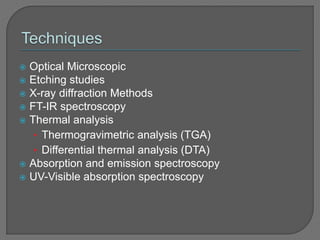
 Optical Microscopic
 Etching studies
 X-ray diffraction Methods
 FT-IR spectroscopy
 Thermal analysis
• Thermogravimetric analysis (TGA)
• Differential thermal analysis (DTA)
 Absorption and emission spectroscopy
 UV-Visible absorption spectroscopy
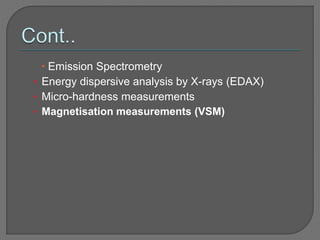
 Emission Spectrometry
• Energy dispersive analysis by X-rays (EDAX)
• Micro-hardness measurements
• Magnetisation measurements (VSM)
The grown crystals whether rnicroscopic or
macroscopic in size, optical microscopy is
employed as a standard method to examine the
growth habit of the crystal. The detailed studies of
the surface of the crystal reveal the growth pattern
and the occurrence of defects and impurities. There
are several approaches to study the features of the
surfaces. But a geometrical or structural
investigation is one of the most fundamental
aspects.
To investigate the perfection of the crystalline
materials, etching studies are suitable. The
observation of the crystal surface after the
etching reveals the growth pattern and perfection
of the crystal to a good extent. Etching is the
result of variations in surface reaction or
dissolution rates, brought about by
crystallographic orientation effects, lattice
imperfection and chemical composition.
Crystalline defects such as grain boundaries,
stacking faults, vacancy, dislocation and other
surface features are revealed by etching.
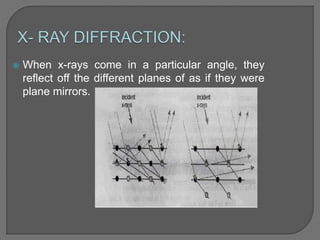
 When x-rays come in a particular angle, they
reflect off the different planes of as if they were
plane mirrors.
 This technique is one of the most important and widely
used spectroscopic techniques of analysing
quantitatively the structural units of the unknown
compound.IR spectroscopy is classified into three
regions of the electromagnetic spectrum.
UV-Visible absorption spectroscopy
This is one of the most important analytical
methods in many chemical, biological and clinical
laboratories. Most organic components and many
inorganic ions and complexes absorb radiation in
the UV-Visible region. From the observed spectra
one could identify the presence of the particular
elements in the spectra.
 A vibrating sample magnetometer (VSM) is a device in
which the sample is vibrated in a uniform magnetising
field and the magnetisation of the sample is detected.
12.13,14.The precise measurements of magnetisation
as a function of temperature, magnetic field strength
and crystallographic orientations can be done by this
instrument.
 Formulation And Evaluation Of Co-crystals Of Poorly Water Soluble
Drug, Subhangi A Bagde, Kanchan P. Upadhye, Gauri R. Dixit And
Suparna S. Bakhle
 Introduction
Co-crystals are solids that are crystalline materials composed of two or more
molecules in the same crystal lattice (or) Pharmaceutical co-crystals have, however,
been defined as ‘co-crystals that are formed between a molecular or ionic active
pharmaceutical ingredient (API) and a co-crystal former that is a solid under ambient
conditions
 Drug and Coformer Compatibility Studies
• Drug coformer compatibility studies were carried out using Differential Scanning
Calorimetry (DSC) and Fourier Transform Infrared Spectroscopy (FTIR)
 Formulation of co-crystals
• The most common method are based on solution method and grinding method. In
this work the co-crystals were prepared by cooling crystallization method.
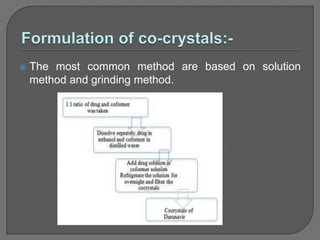
 The most common method are based on solution
method and grinding method.
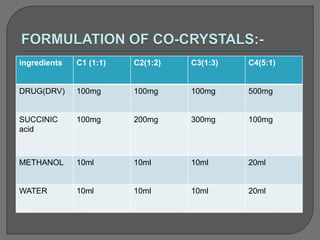
ingredients C1 (1:1) C2(1:2) C3(1:3) C4(5:1)
DRUG(DRV) 100mg 100mg 100mg 500mg
SUCCINIC
acid
100mg 200mg 300mg 100mg
METHANOL 10ml 10ml 10ml 20ml
WATER 10ml 10ml 10ml 20ml
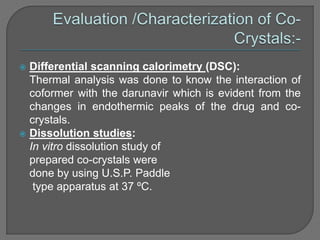
 Differential scanning calorimetry (DSC):
Thermal analysis was done to know the interaction of
coformer with the darunavir which is evident from the
changes in endothermic peaks of the drug and co-
crystals.
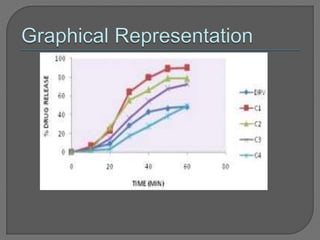
 Dissolution studies:
In vitro dissolution study of
prepared co-crystals were
done by using U.S.P. Paddle
type apparatus at 37 ºC.
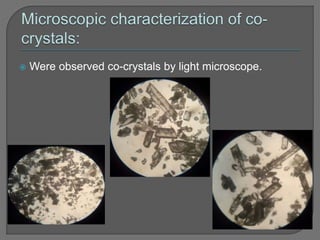
 Were observed co-crystals by light microscope.
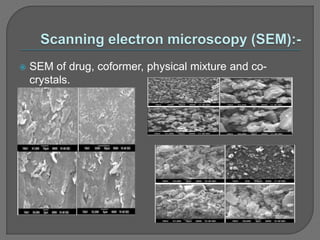
 SEM of drug, coformer, physical mixture and co-
crystals.
 In the present work prepared darunavir co-
crystals exhibited excellent physico-chemical
properties (solubility and dissolution) and
micrometric properties when compared with
pure drug.
 From the conducted study, we can conclude
that co-crystals with succinic acid prepared by
the use of co-crystallization technique
showed an improvement in the solubility,
dissolution rate and flowability and stability as
compared with pure drug.
 Shubhangi A. Bagde, Kanchan P. Upadhye, Gauri R. Dixit And
Suparna S. Bakhle, Formulation And Evaluation Of Co-
crystals Of Poorly Water Soluble Drug, International Journal
Of Pharmaceutical Sciences And Research, IJPSR (2016),
Vol. 7, Issue 12,2016 , Page no-4988-4997.
 Skoog,D.A.,‘Principles of Instrumental Analysis.Holt Saunders
1985.
 Wilson A.J.C Elements of X-rays Diffraction Procedure for
Polycrystalline and Amorphous Materials John Willey 1973.
 Smith A.L Applied Infrared Spectroscopy,2nd edition Holden
day 1977.
 Richardson J.H “Optical Microscopy”for the material Sciences
Dekker 1971.

Various techniques for study of Crystal Properties

  • 1.
    Subject- ADVANCED PHYSICAL PHARMACEUTICS Topic-VARIOUSTECHNIQUES FOR STUDY OF CRYSTAL PROPERTIES Presented By- Tanmoy Prakash Pati M.Pharm, 2nd Semester (Pharmaceutics) Dt-15.02.2017
  • 2.
     The characterisationand the studies of the properties of crystals of materials are very important in the context of technological applications.  These studies reveal the perfection of the crystals, influence of the methods on the growth of materials and identity of the grown material. Study of the crystal habit forms an important part as it influences the physical properties.
  • 3.
     Optical Microscopic Etching studies  X-ray diffraction Methods  FT-IR spectroscopy  Thermal analysis • Thermogravimetric analysis (TGA) • Differential thermal analysis (DTA)  Absorption and emission spectroscopy  UV-Visible absorption spectroscopy
  • 4.
     Emission Spectrometry •Energy dispersive analysis by X-rays (EDAX) • Micro-hardness measurements • Magnetisation measurements (VSM)
  • 5.
    The grown crystalswhether rnicroscopic or macroscopic in size, optical microscopy is employed as a standard method to examine the growth habit of the crystal. The detailed studies of the surface of the crystal reveal the growth pattern and the occurrence of defects and impurities. There are several approaches to study the features of the surfaces. But a geometrical or structural investigation is one of the most fundamental aspects.
  • 6.
    To investigate theperfection of the crystalline materials, etching studies are suitable. The observation of the crystal surface after the etching reveals the growth pattern and perfection of the crystal to a good extent. Etching is the result of variations in surface reaction or dissolution rates, brought about by crystallographic orientation effects, lattice imperfection and chemical composition. Crystalline defects such as grain boundaries, stacking faults, vacancy, dislocation and other surface features are revealed by etching.
  • 7.
     When x-rayscome in a particular angle, they reflect off the different planes of as if they were plane mirrors.
  • 8.
     This techniqueis one of the most important and widely used spectroscopic techniques of analysing quantitatively the structural units of the unknown compound.IR spectroscopy is classified into three regions of the electromagnetic spectrum.
  • 9.
    UV-Visible absorption spectroscopy Thisis one of the most important analytical methods in many chemical, biological and clinical laboratories. Most organic components and many inorganic ions and complexes absorb radiation in the UV-Visible region. From the observed spectra one could identify the presence of the particular elements in the spectra.
  • 10.
     A vibratingsample magnetometer (VSM) is a device in which the sample is vibrated in a uniform magnetising field and the magnetisation of the sample is detected. 12.13,14.The precise measurements of magnetisation as a function of temperature, magnetic field strength and crystallographic orientations can be done by this instrument.
  • 11.
     Formulation AndEvaluation Of Co-crystals Of Poorly Water Soluble Drug, Subhangi A Bagde, Kanchan P. Upadhye, Gauri R. Dixit And Suparna S. Bakhle  Introduction Co-crystals are solids that are crystalline materials composed of two or more molecules in the same crystal lattice (or) Pharmaceutical co-crystals have, however, been defined as ‘co-crystals that are formed between a molecular or ionic active pharmaceutical ingredient (API) and a co-crystal former that is a solid under ambient conditions  Drug and Coformer Compatibility Studies • Drug coformer compatibility studies were carried out using Differential Scanning Calorimetry (DSC) and Fourier Transform Infrared Spectroscopy (FTIR)  Formulation of co-crystals • The most common method are based on solution method and grinding method. In this work the co-crystals were prepared by cooling crystallization method.
  • 12.
     The mostcommon method are based on solution method and grinding method.
  • 13.
    ingredients C1 (1:1)C2(1:2) C3(1:3) C4(5:1) DRUG(DRV) 100mg 100mg 100mg 500mg SUCCINIC acid 100mg 200mg 300mg 100mg METHANOL 10ml 10ml 10ml 20ml WATER 10ml 10ml 10ml 20ml
  • 14.
     Differential scanningcalorimetry (DSC): Thermal analysis was done to know the interaction of coformer with the darunavir which is evident from the changes in endothermic peaks of the drug and co- crystals.  Dissolution studies: In vitro dissolution study of prepared co-crystals were done by using U.S.P. Paddle type apparatus at 37 ºC.
  • 16.
     Were observedco-crystals by light microscope.
  • 17.
     SEM ofdrug, coformer, physical mixture and co- crystals.
  • 18.
     In thepresent work prepared darunavir co- crystals exhibited excellent physico-chemical properties (solubility and dissolution) and micrometric properties when compared with pure drug.  From the conducted study, we can conclude that co-crystals with succinic acid prepared by the use of co-crystallization technique showed an improvement in the solubility, dissolution rate and flowability and stability as compared with pure drug.
  • 19.
     Shubhangi A.Bagde, Kanchan P. Upadhye, Gauri R. Dixit And Suparna S. Bakhle, Formulation And Evaluation Of Co- crystals Of Poorly Water Soluble Drug, International Journal Of Pharmaceutical Sciences And Research, IJPSR (2016), Vol. 7, Issue 12,2016 , Page no-4988-4997.  Skoog,D.A.,‘Principles of Instrumental Analysis.Holt Saunders 1985.  Wilson A.J.C Elements of X-rays Diffraction Procedure for Polycrystalline and Amorphous Materials John Willey 1973.  Smith A.L Applied Infrared Spectroscopy,2nd edition Holden day 1977.  Richardson J.H “Optical Microscopy”for the material Sciences Dekker 1971.