Masters of pharmacy, Pharmaceutical technology (Pharmaceutics)
Subject- Drug regulatory affairs (MPT-104T)
Lesion no- 2, CMC, post approval regulatory affairs By- Drx JAYESH M RAJPUT
Points:-
1) CMC (Chemistry, Manufacturing & control)
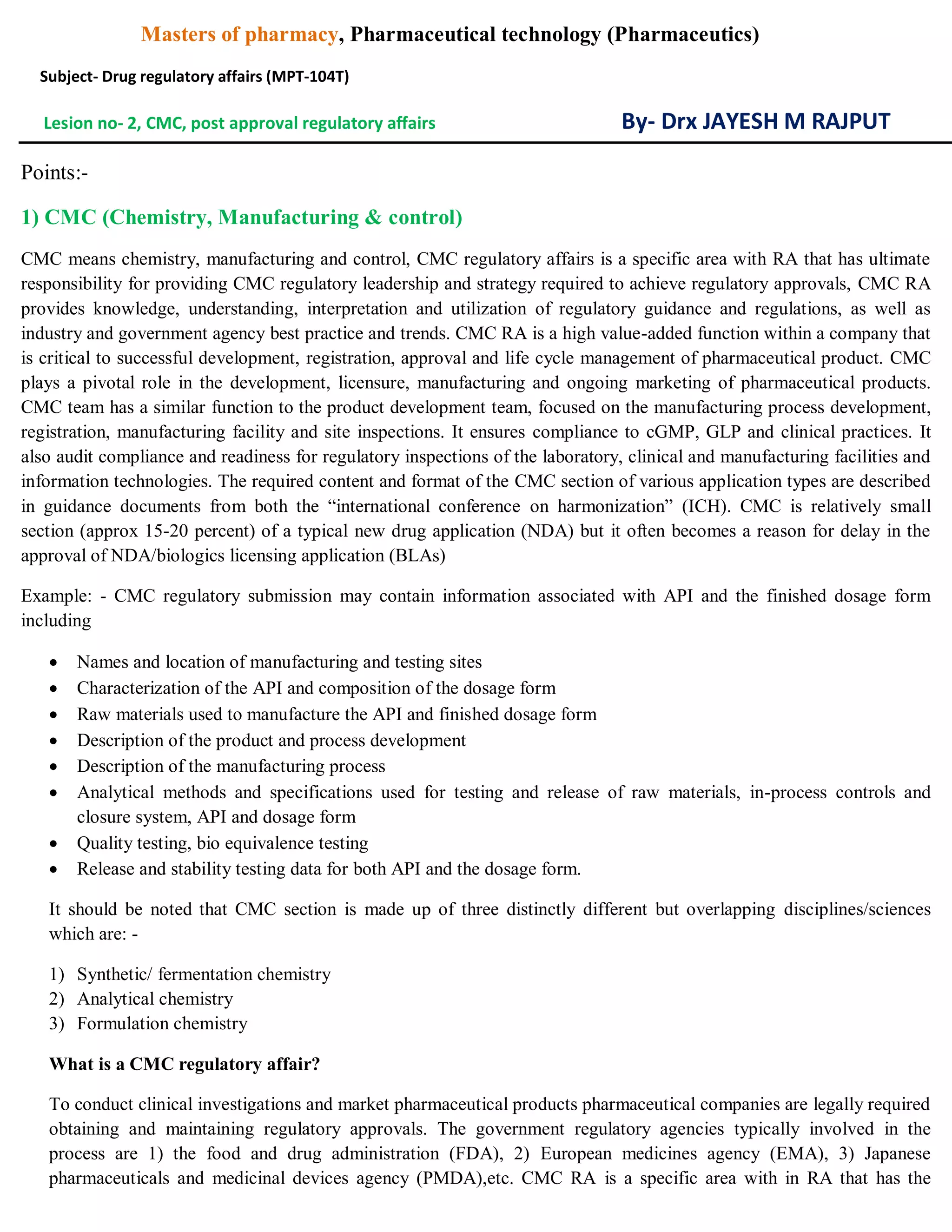
CMC means chemistry, manufacturing and control, CMC regulatory affairs is a specific area with RA that has ultimate
responsibility for providing CMC regulatory leadership and strategy required to achieve regulatory approvals, CMC RA
provides knowledge, understanding, interpretation and utilization of regulatory guidance and regulations, as well as
industry and government agency best practice and trends. CMC RA is a high value-added function within a company that
is critical to successful development, registration, approval and life cycle management of pharmaceutical product. CMC
plays a pivotal role in the development, licensure, manufacturing and ongoing marketing of pharmaceutical products.
CMC team has a similar function to the product development team, focused on the manufacturing process development,
registration, manufacturing facility and site inspections. It ensures compliance to cGMP, GLP and clinical practices. It
also audit compliance and readiness for regulatory inspections of the laboratory, clinical and manufacturing facilities and
information technologies. The required content and format of the CMC section of various application types are described
in guidance documents from both the “international conference on harmonization” (ICH). CMC is relatively small
section (approx 15-20 percent) of a typical new drug application (NDA) but it often becomes a reason for delay in the
approval of NDA/biologics licensing application (BLAs)
Example: - CMC regulatory submission may contain information associated with API and the finished dosage form
including
 Names and location of manufacturing and testing sites
 Characterization of the API and composition of the dosage form
 Raw materials used to manufacture the API and finished dosage form
 Description of the product and process development
 Description of the manufacturing process
 Analytical methods and specifications used for testing and release of raw materials, in-process controls and
closure system, API and dosage form
 Quality testing, bio equivalence testing
 Release and stability testing data for both API and the dosage form.
It should be noted that CMC section is made up of three distinctly different but overlapping disciplines/sciences
which are: -
1) Synthetic/ fermentation chemistry
2) Analytical chemistry
3) Formulation chemistry
What is a CMC regulatory affair?
To conduct clinical investigations and market pharmaceutical products pharmaceutical companies are legally required
obtaining and maintaining regulatory approvals. The government regulatory agencies typically involved in the
process are 1) the food and drug administration (FDA), 2) European medicines agency (EMA), 3) Japanese
pharmaceuticals and medicinal devices agency (PMDA),etc. CMC RA is a specific area with in RA that has the
ultimate responsibility for providing CMC regulatory leadership and strategy required to achieve regulatory
approvals. As a strategic function CMC RA collaborates closely with multiple scientific, technical, quality and
commercial areas within a company with external contract manufacturing organizations (CMOs). Information
regarding CMC for drugs is an important and detailed section in a dossier to support clinical studies and marketing
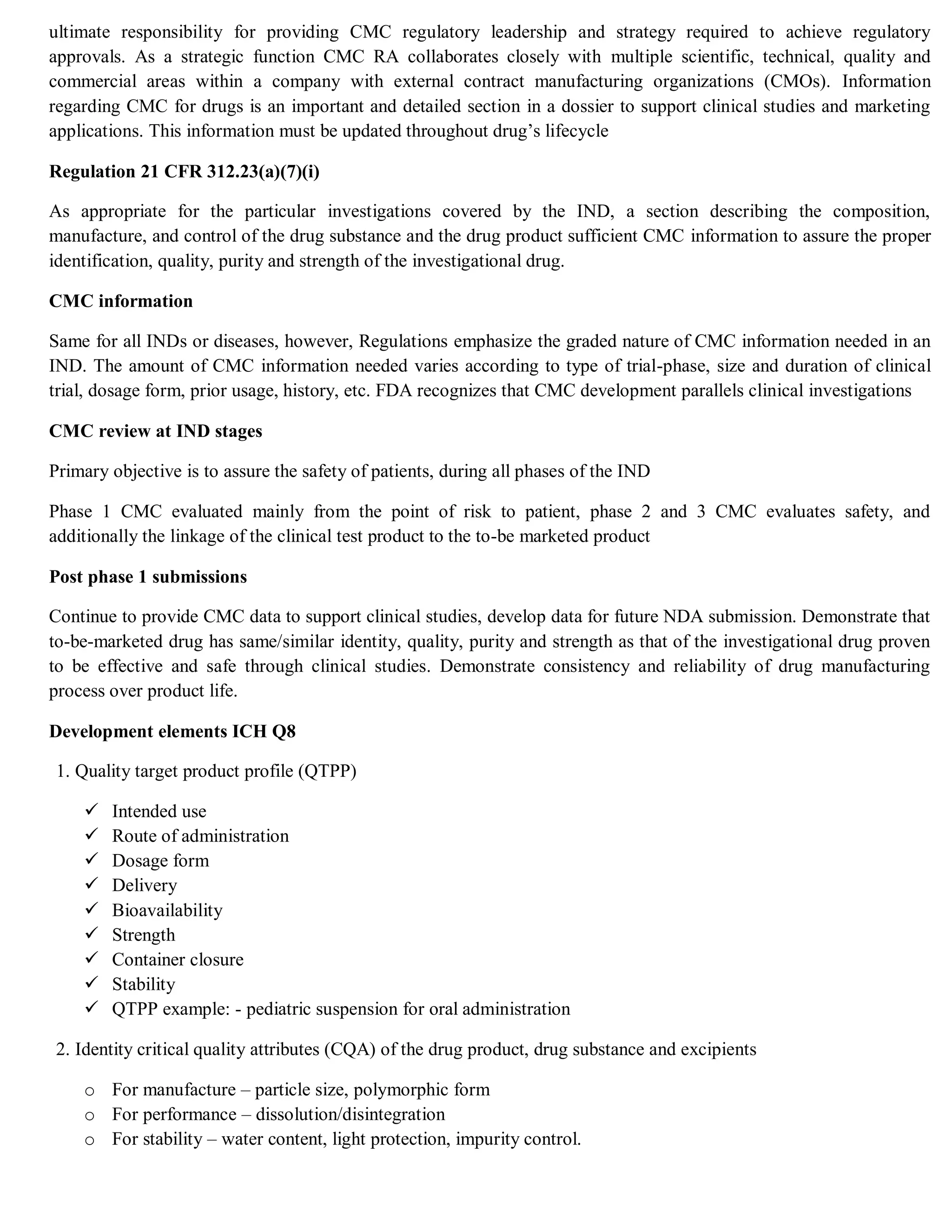
applications. This information must be updated throughout drug’s lifecycle
Regulation 21 CFR 312.23(a)(7)(i)
As appropriate for the particular investigations covered by the IND, a section describing the composition,
manufacture, and control of the drug substance and the drug product sufficient CMC information to assure the proper
identification, quality, purity and strength of the investigational drug.
CMC information
Same for all INDs or diseases, however, Regulations emphasize the graded nature of CMC information needed in an
IND. The amount of CMC information needed varies according to type of trial-phase, size and duration of clinical
trial, dosage form, prior usage, history, etc. FDA recognizes that CMC development parallels clinical investigations
CMC review at IND stages
Primary objective is to assure the safety of patients, during all phases of the IND
Phase 1 CMC evaluated mainly from the point of risk to patient, phase 2 and 3 CMC evaluates safety, and
additionally the linkage of the clinical test product to the to-be marketed product
Post phase 1 submissions
Continue to provide CMC data to support clinical studies, develop data for future NDA submission. Demonstrate that
to-be-marketed drug has same/similar identity, quality, purity and strength as that of the investigational drug proven
to be effective and safe through clinical studies. Demonstrate consistency and reliability of drug manufacturing
process over product life.
Development elements ICH Q8
1. Quality target product profile (QTPP)
 Intended use
 Route of administration
 Dosage form
 Delivery
 Bioavailability
 Strength
 Container closure
 Stability
 QTPP example: - pediatric suspension for oral administration
2. Identity critical quality attributes (CQA) of the drug product, drug substance and excipients
o For manufacture – particle size, polymorphic form
o For performance – dissolution/disintegration
o For stability – water content, light protection, impurity control.
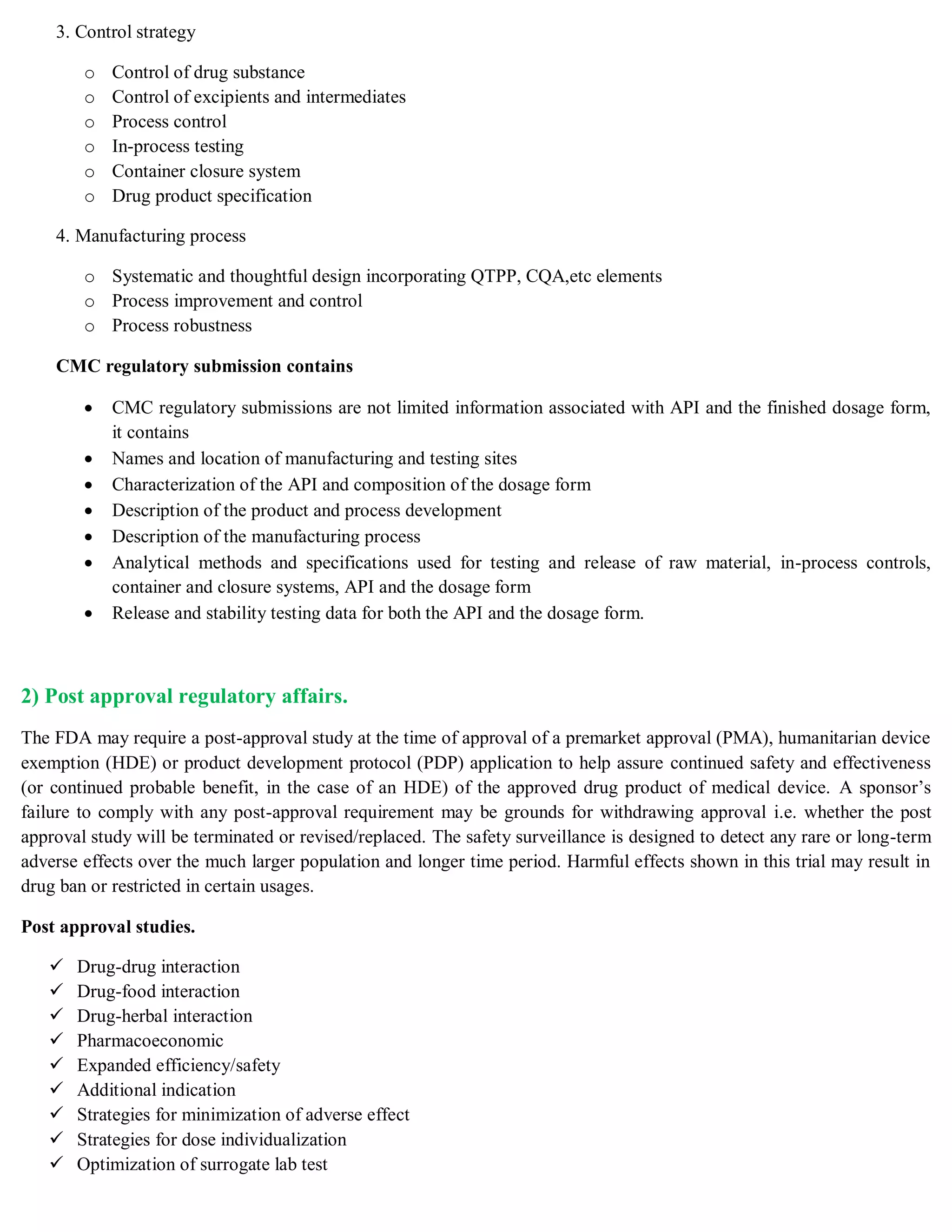
3. Control strategy
o Control of drug substance
o Control of excipients and intermediates
o Process control
o In-process testing
o Container closure system
o Drug product specification
4. Manufacturing process
o Systematic and thoughtful design incorporating QTPP, CQA,etc elements
o Process improvement and control
o Process robustness
CMC regulatory submission contains
 CMC regulatory submissions are not limited information associated with API and the finished dosage form,
it contains
 Names and location of manufacturing and testing sites
 Characterization of the API and composition of the dosage form
 Description of the product and process development
 Description of the manufacturing process
 Analytical methods and specifications used for testing and release of raw material, in-process controls,
container and closure systems, API and the dosage form
 Release and stability testing data for both the API and the dosage form.
2) Post approval regulatory affairs.
The FDA may require a post-approval study at the time of approval of a premarket approval (PMA), humanitarian device
exemption (HDE) or product development protocol (PDP) application to help assure continued safety and effectiveness
(or continued probable benefit, in the case of an HDE) of the approved drug product of medical device. A sponsor’s
failure to comply with any post-approval requirement may be grounds for withdrawing approval i.e. whether the post
approval study will be terminated or revised/replaced. The safety surveillance is designed to detect any rare or long-term
adverse effects over the much larger population and longer time period. Harmful effects shown in this trial may result in
drug ban or restricted in certain usages.
Post approval studies.
 Drug-drug interaction
 Drug-food interaction
 Drug-herbal interaction
 Pharmacoeconomic
 Expanded efficiency/safety
 Additional indication
 Strategies for minimization of adverse effect
 Strategies for dose individualization
 Optimization of surrogate lab test
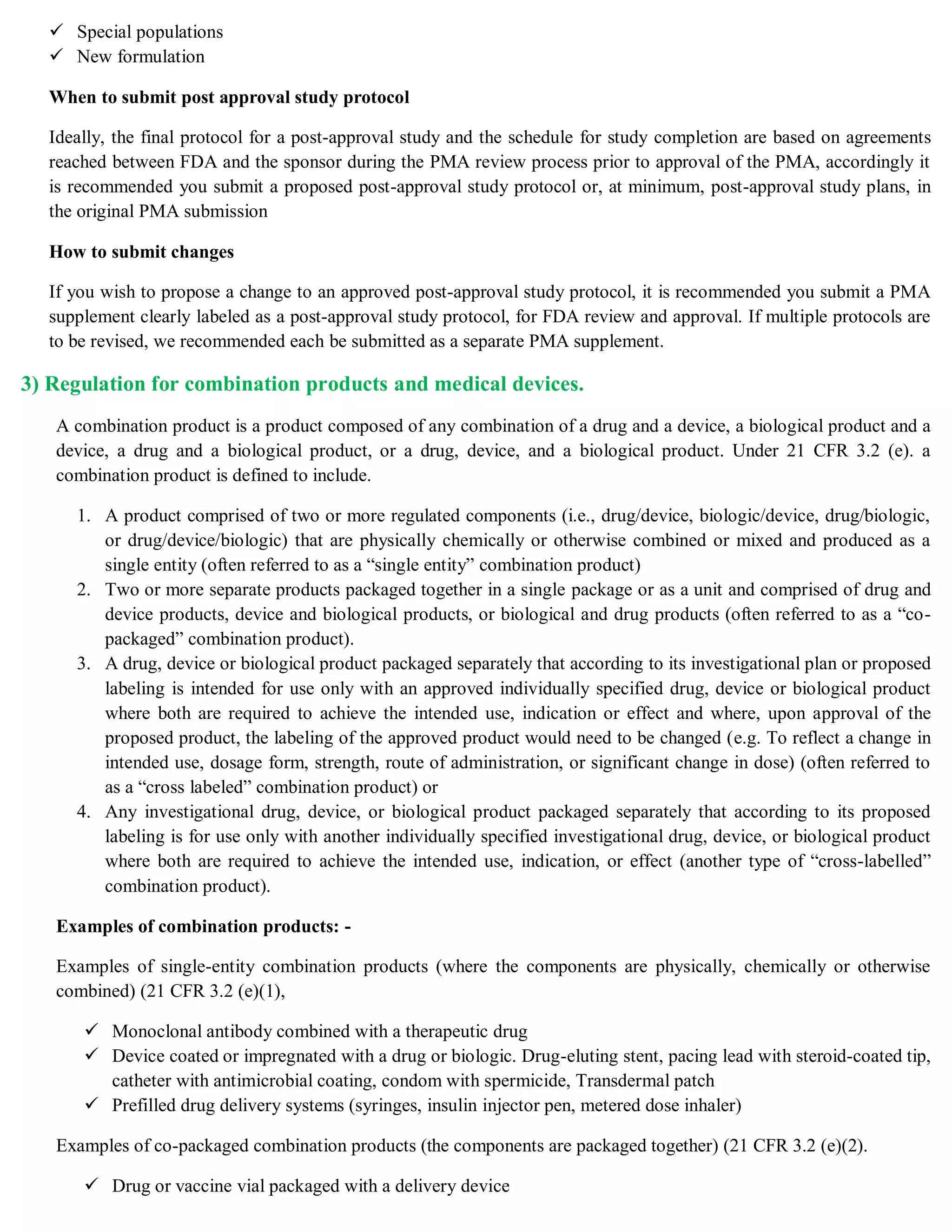
 Special populations
 New formulation
When to submit post approval study protocol
Ideally, the final protocol for a post-approval study and the schedule for study completion are based on agreements
reached between FDA and the sponsor during the PMA review process prior to approval of the PMA, accordingly it
is recommended you submit a proposed post-approval study protocol or, at minimum, post-approval study plans, in
the original PMA submission
How to submit changes
If you wish to propose a change to an approved post-approval study protocol, it is recommended you submit a PMA
supplement clearly labeled as a post-approval study protocol, for FDA review and approval. If multiple protocols are
to be revised, we recommended each be submitted as a separate PMA supplement.
3) Regulation for combination products and medical devices.
A combination product is a product composed of any combination of a drug and a device, a biological product and a
device, a drug and a biological product, or a drug, device, and a biological product. Under 21 CFR 3.2 (e). a
combination product is defined to include.
1. A product comprised of two or more regulated components (i.e., drug/device, biologic/device, drug/biologic,
or drug/device/biologic) that are physically chemically or otherwise combined or mixed and produced as a
single entity (often referred to as a “single entity” combination product)
2. Two or more separate products packaged together in a single package or as a unit and comprised of drug and
device products, device and biological products, or biological and drug products (often referred to as a “co-
packaged” combination product).
3. A drug, device or biological product packaged separately that according to its investigational plan or proposed
labeling is intended for use only with an approved individually specified drug, device or biological product
where both are required to achieve the intended use, indication or effect and where, upon approval of the
proposed product, the labeling of the approved product would need to be changed (e.g. To reflect a change in
intended use, dosage form, strength, route of administration, or significant change in dose) (often referred to
as a “cross labeled” combination product) or
4. Any investigational drug, device, or biological product packaged separately that according to its proposed
labeling is for use only with another individually specified investigational drug, device, or biological product
where both are required to achieve the intended use, indication, or effect (another type of “cross-labelled”
combination product).
Examples of combination products: -
Examples of single-entity combination products (where the components are physically, chemically or otherwise
combined) (21 CFR 3.2 (e)(1),
 Monoclonal antibody combined with a therapeutic drug
 Device coated or impregnated with a drug or biologic. Drug-eluting stent, pacing lead with steroid-coated tip,
catheter with antimicrobial coating, condom with spermicide, Transdermal patch
 Prefilled drug delivery systems (syringes, insulin injector pen, metered dose inhaler)
Examples of co-packaged combination products (the components are packaged together) (21 CFR 3.2 (e)(2).
 Drug or vaccine vial packaged with a delivery device
 Surgical tray with surgical instruments, drapes, and anesthetic or antimicrobial swabs
 First-aid kits containing devices (bandages, gauze), and drugs (antibiotic ointments, pain relievers)
 Example of a product that may be cross-labeled combination products (components are separately provided
but specifically labeled for use together) (21 CFR 3.2 (e) or (e)(4)
 Photosensitizing drug and activating laser/light source
Who regulate?
 In US the lead center is defined by the primary mode of action (PMOA)
 The lead center assignment can be from one of the following
 1. Center for drug evaluation and research (CDER)
 2. Center for devices and radiological health (CDRH)
 3. Center for biologics evaluation and research (CBER)
Example
 Drug eluting stent or wound dressing with antimicrobial-typically a device (CDRH)
 Asthma inhaler or medicinal patch typical a drug (CDER)
Currently marketed product consideration
For example, developer should consider
 Are the constituent parts already approved for an indication?
 Is the indication for a given constituent part similar to that proposed for the combination product?
 Does the combination product broaden the indication or intended target population beyond that of the
approved constituent part?
 Does the combination product expose the patient to a new route of administration or a new local or systemic
exposure profile for an existing indication?
 Is the drug formulation different than that used in the already approved drug?
 Does the device design need to be modified for the new use?
 Is the device constituent used in an area of the body that is different than its existing approval?
 Are the device and drug constituents chemically, physically or otherwise combined into a single entity?
 Does the device function as a delivery system, a method to prepare a final dosage form and/or does it provide
active therapeutic benefit?
 Is there any other change in design or formulation that may affect the safety/effectiveness of any existing
constituent part or the combination product as a whole?
 Is a marketed device being proposed for use with a drug constituent that is a new molecular entity?
 Is a marketed drug being proposed for use with a complex new device?
Device constitute consideration
For example it may be appropriate to conduct studies to evaluate the potential for the following: -
o Leachable/extractable of the device material into the drug/biologic substance or final combination product
o Changes in stability of the drug constituent when delivered by the device or when used as a coating on the
device
o Drug adhesion/absorption to the device materials that could change the delivered dose
o Presence of inactive breakdown products or manufacturing residues from device manufacture that may affect
safety or device actions that could change the drug performance characteristics at the time of use, or
o Changes in stability or activity of a drug constitute when used together with an energy emitting device
Combination product guidance document
Role of the office of combination product
 To serve as a focal point for combination product issues and for medical product classification and
assignment issues for agency staff and industry
 To develop guidance and regulations to clarify the regulation of combination products
 To classify medical products as drugs, devices, biological products, or combination products and assign them
to an FDA center for premarket review and regulation where their classification or assignment is unclear or
in dispute
 To ensure timely and effective premarket review of combination products by overseeing the timeless,
alignment of coordination of reviewers involving more than one agency center, including through monitoring
and management of the intercenter consult process
 To ensure consistent and appropriate postmarket regulation of combination products
 To resolve disputes regarding the timeliness of premarket review of combination products
What type of marketing application required for combination product?
Combination products are typically marketed under a marketing authorization type associated with the constituent
part that provides the primary mode of action (PMOA) for the combination product (i.e., a new drug application
(NDA) or abbreviated new drug application (ANDA) if it has a drug PMOA, a biologic license application (BLA) if
it has a biologic PMOA, or a premarket approval application (PMA) de novo certification, or premarket notification
(510 (K)) if it has a device PMOA. A single marketing application is generally sufficient for a combination product.
In some cases, however a sponsor may wish to submit separate marketing applications for different constituent parts
of a combination product, and FDA may consider this permissible.
Example of combination products
o Drug eluting stents
 Peripheral vascular stents
 Coronary stents
o Infusion pumps
 Implantable infusion pumps
 Ambulatory infusion pumps
o Orthopedic combination products
o Wound care combination products
o Inhalers and nebulizers
 Dry powder inhalers
 Metered dose inhalers
 Nebulizers (ultrasonic nebulizers, compressor nebulizers, mesh nebulizers)
o Transdermal patches
o Other products
Inhaler (data required to be submitted)
 Physical characterization
 Minimum fill justification
 Extractable/ leachable
 Delivery dose uniformity and fine particle mass through container life
 Delivered dose uniformity and fine particle mass over patient flow rate range
 Fine particle mass with spacer holding chamber use
 Single dose fine particle mass
 Particle/ droplet size distribution
 Actuator/ mouthpiece deposition
 Drug delivery rate and total drug delivered
 Shaking requirements
 Initial priming of the container
 Re-priming of the container
 Cleaning requirements
 Low temperature performance
 Performance after temperature cycling
 Effect of environmental moisture
 Robustness
 Delivery device development
 Preservative effectiveness/ efficacy
 Compatibility
Drug product specification
 Assay
 Moisture content
 Mean delivered dose
 Delivered dose uniformity
 Content uniformity/ uniformity of dosage units
 Fine particle mass
 Leak rate
 Microbial/ microbial limits
 Sterility
 Leachable
 Preservative content
 Number of actuations per container
4) CTD and ECTD format
CTD: - common technical document. It is a format set by ICH which was agreed by the regulatory agencies of Europe,
Japan, and the U.S. the FDA characterized the CTD as “an information package of clinical, non-clinical, manufacturing,
technical data in the same content that would be submitted for registering new drugs in all 3 ICH regions i.e., U.S,
European union and Japan” the concept of CTD was introduced by ICH in the year of 2000 for the public consultation.
Before 2000 there was no uniformity to submit dossier in regulatory authority. This creates many hassles for applicant as
well as auditors to submit and reviewing the dossier information in an organized manner. Hence concept of CTD was
come for harmonization in dossier submission. It is important to note that on July 1, 2003 use of the CTD format will
become mandatory across all three regions like EU, FDA and Japan.
Impact of CTD
The ICH CTD represents one of the most ambitious and successful international harmonization activities undertaken for
medicine products for human use. It will significantly reduce time and resources needed by industry to compile
applications for global registration. Applies to all NDAs, ANDAs, BLAs and INDs applications.
Benefits of CTD
 Easy “reviewable” applications
 Complete, well-organized submission
 More predictable format
 More consistent reviews
 Easier analysis across application
 Easier exchange of information
 Facilitates electronic submission
CTD structure
Module 1
Administrative information (region specific)
This module should contain documents specific to each region, the content and format of this module can be specified
by the relevant regulatory authorities.
Module 2
CTD summaries (QOS)
It should begin with a general introduction to the pharmaceutical, including its pharmacological class, mode of action
and proposed clinical use, i.e., information should not exceed one page. It contain 7 section in the following order
 2.1 CTD TOC (module 2-5) (table of content)
 2.2 CTD introduction
 2.3 quality overall summary
 2.4 nonclinical overview
 2.5 clinical overview
 2.6 non-clinical summary
 2.7 clinical summary
The organization of these summaries is described in 3 separate documents: -
A) M4 Q-the CTD quality
B) M4 S- the CTD safety
C) M4 E- the CTD efficacy
Module 3
Quality (CMC)
 3.1 TOC of module 3
 3.2 Body of data
 3.3 Drug substance
General information
Manufacture
Characterization
Control of drug substance
Reference standards or materials
Stability
 Drug product
Description and composition of the drug product
Pharmaceutical development
Manufacture
Control of excipients
Control of drug product
Reference standards or materials
Stability
Appendices (facilities and equipment, novel excipients)
Literature references
Module 4
Non-clinical study reports
 4.1 TOC of module 4
 4.2 study reports
4.2.1 Pharmacology
4.2.2 Pharmacokinetics
4.2.3 Toxicology
 4.3 literature references
Module 5
Clinical study reports
 5.1 TOC of module 5
 5.2 Tabular listing of clinical studies
 5.3 Clinical study reports
5.3.1 Reports of biopharmaceutical study (BA-BE)
5.3.2 Reports of PK (biomaterial) study
5.3.3 Reports of PK studies
5.3.4 Reports of PD studies
5.3.5 Reports of efficacy and safety studies
5.3.6 Reports of post marketing experience
5.3.7 Case report forms and individual patient listings
 5.4 literature references
E-CTD: - it is electronic version of CTD, so called as electronic common technical document. E-CTD composed
of 2 types of specifications
1. Content specification- as defined by ICH
2. Technical specification- electronic softwares
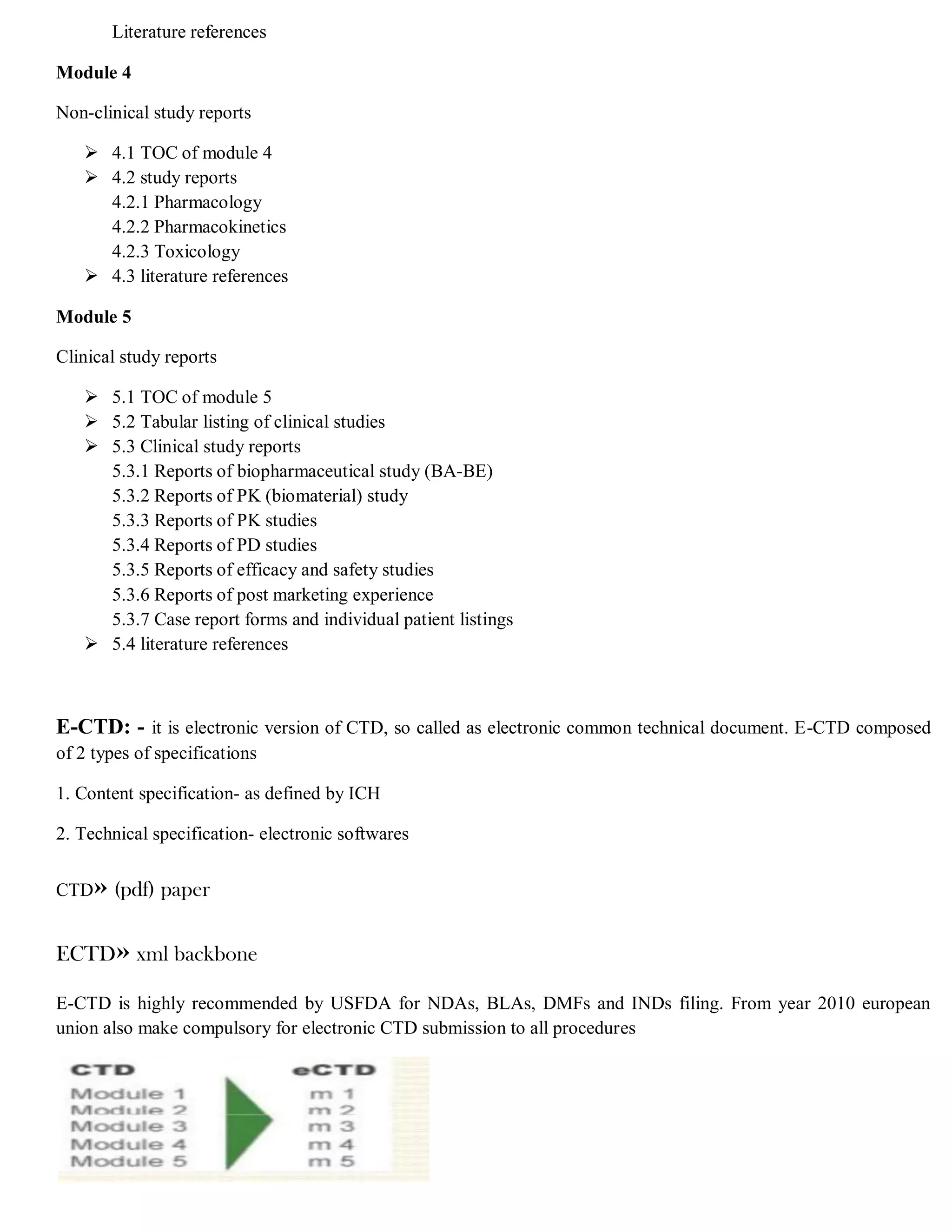
CTD» (pdf) paper
ECTD» xml backbone
E-CTD is highly recommended by USFDA for NDAs, BLAs, DMFs and INDs filing. From year 2010 european
union also make compulsory for electronic CTD submission to all procedures
E-CTD characteristics
 All modules 1 to 5 have granularity options (level of detail a document has)
 PDF documents linked via xml backbone
 Increased document granularity
 Transparency of entire submission
 Ease of navigation and review
Benefit of E-CTD
 Improve the submission and review process
 Increase accuracy of the submission
 Decrease total costs
 Immediate access to complete and up to date information
 Reduced workload
 Better communication with industry
Example of E-CTD software
1. ROSETTA regulatory software
2. PHARMAREADY e-CTD product which is fully validated, international regulatory complaint software
5) Industry and FDA liaison
Experienced drug regulatory affairs (DRA) personnel are essential in the process of new product development. They
are largely responsible for establishing a liaison with their counterparts at the U>S food and drug administration
(FDA) and other regulatory agencies globally. FDA is one of our nation’s oldest consumer protection agencies
dating back to 1862.
U.S. FDA: - the U.S FDA (food and drug administration) is an agency of the U.S department of health and human
services (DHHS) that is responsible for the safety regulation of: - most type of foods, dietary supplements, vaccines,
biological medical products, drugs, blood products, cosmetics.
The FDA also enforces other laws, notably section 361 of the public health service act and associated regulations,
many of which are not directly related to food and drugs. They include sanitation requirements on interstate travel
and control of disease on products ranging from certain household pets to sperm donation for assisted reproduction.
The FDA has its headquarters at white oak, Maryland. The agency also has 223 field offices and 13 laboratories
located throughout 50 states.
Who makes up the FDA?
The FDA consists of employees drawn from a wealth of science and public health professions. Biologists,
physicians, chemists, biomedical engineers, toxicologists, pharmacologists, veterinarians and specialists in the
public health education and communication.FDA employs approximately 11,516 people who work in locations
around the united states.
FDA advisory committee
They provide FDA with independent advice from outside experts on issues related to human and veterinary drugs,
vaccines and other biological products, medical devices and food. In general, advisory committee includes a chair,
several members, plus a consumer, industry, and sometimes a patient representative. Additional experts with special
knowledge may be added for individual committee meetings as needed. Although the committees provide advice to
the agency, FDA makes the final decisions.
FDA initiatives to speed drug approval
The FDA has instituted several programs designed to hasten a drug approval process for effective drugs. FDA
alternative to expendite new drug approval are described below: - subpart E section 312 of the code of federal
regulations establishes procedures to expendite the development, evaluation, and marketing of new therapies
intended to treat people with life threatening and severely debilitating illness (debilitating comes from the Latin
word debilis, means weak) especially where no satisfactory alternative exist.
FDA guidance documents/guidelines
 A regulatory professional must be aware of the guidance documents that FDA has made available to assist
industry to understand expectations regarding drug development and the approval process
 The website providing the complete list of FDA guidance is updated almost daily
 It may be accessed at http:/www.fda.gov/cder/guidance/index.htm.
Summary
 FDA and sponsor liaison is an art that is developed over years of experience gained from understanding
regulations, guidelines, and recommendation from regulatory experts
 It is vital that regulatory personnel attend meetings, conferences and courses of all aspects of regulatory
issues on the process of new product development.
 A knowledge of how global regulatory agencies operate is essential to the success of a DRA department
 All dealings with the regulatory agencies must be well conceived and adequately planned
 Whether the regulatory goal is to speed the approval process for a new product or to keep a product on the
market, the firm must know how best to work with all regulatory agencies involved.
6) ICH guidelines of ICH- Q, S, E, M.
The international conference on harmonization of technical requirements for registration of pharmaceuticals for
human use (ICH) is a unique project that brings together the regulatory authorities of Europe, Japan and the United
States and experts from the pharmaceutical industry in three regions to discuss scientific and technical aspects of
product registration. The international conference on harmonization of technical requirements for the registration of
pharmaceuticals for human use (ICH) was established in 1990 as a joint regulatory/industry project to improve.
Through harmonization the efficiency of the process for developing and registering new medicinal products in
Europe, Japan, and the United States. In order to make these products available to patients with a minimum of delay
the six parties of ICH represent the regulatory bodies and research based industry in the three regions. Europe, Japan
and the USA where the vast majority of new medicines are currently developed.
ICH PARTIES
o European commission- European union (EU)
o European federation of pharmaceutical industries and associations (EFPIA)
o Ministry of health, labor and welfare, Japan (MHLW)
o Japan pharmaceutical manufacturers association (JPMA)
o US food and drug administration (FDA)
o Pharmaceutical research and manufacturers of America (PHRMA)
Objectives
o More economical use of human, animal and material resources
o Elimination of unnecessary delay in the global development and availability of new medicines
o Maintaining safeguards on quality, safety, efficacy and regulatory obligations to protect public health.
Topic of ICH
o Four broad categories- QSEM
o Quality (Q)- those relating to chemical and pharmaceutical quality assurance (stability testing, impurity
testing, etc)
o Safety (S)- those relating to in vitro and in vivo pre-clinical studies (carcinogenicity testing, genotoxicity
testing, etc)
o Efficacy (E)- those relating to clinical studies in human subject (dose response studies, good clinical
practices, etc)
o Multidisciplinary (M)- cross- cutting topics which do not fit uniquely into one of the above categories
(MedDRA, ESTRI, M3, CTD, M5)
Overview of ICh
1. Quality (Q)
o Q1 A (R2)- stability testing of new drugs and products
o Q1 B- photo stability testing
o Q1 C- stability testing of new dosage forms
o Q1 D- bracketing and matrixing designs for stability testing of drug substances and drug products
o Q1 E- evaluation of stability data
o Q1 F- stability data package for registration in climatic zones 3 and 4
o Q2 A- definitions and terminology: analytical validation
o Q2 B- methodology
o Q3 A(R2)- impurities in new drug substances
o Q3 B(R2)- impurities in new drug product
o Q3 C(R3)- impurities guidelines for residual solvents
o Q4- pharmacopoeia
o Q4 A- pharmacopoeial harmonization
o Q5 A- viral safety evaluation
o Q5 B- genetic stability
o Q5 C- stability of biotechnology products
o Q5 D- cell substrates
o Q6 A- specifications, test procedures and acceptance criteria for new drug substances and products
o Q6 B- specification test procedure and acceptance criteria for biotechnological/ biological products
o Q7 A- GMP for active pharmaceutical ingredients
o Q8- pharmaceutical development
o Q9- quality risk management
o Q10- pharmaceutical quality system
2. Safety (S)
o S1 A- guideline on the need for carcinogenicity studies of pharmaceuticals
o S1 B- testing for carcinogenicity of pharmaceuticals
o S1 C(R2)- dose selection for carcinogenicity studies of pharmaceuticals
o S2 (R1)- guidance on genotoxicty testing and data interpretation for pharmaceuticals intended for human use
o S3 A- note for guidance on toxicokinetics the assessment of systemic exposure in toxicity studies
o S3 B- pharmacokinetics guidance for repeated dose tissue distribution studies
o S4- duration of chronic toxicity testing in animals (rodent and non-rodent toxicity testing)
o S5 (R2)- detection of toxicity to reproduction for medicinal products and toxicity to male fertility
o S6 (R1)- addendum to ICH S6- preclinical safety evaluation of biotechnology- derived pharmaceuticals
o S6- preclinical safety evaluation of biotechnology-derived pharmaceuticals
o S7 A- safety pharmacology studies for human pharmaceuticals
o S7 B- the non-clinical evaluation of the potential for delayed ventricular repolarization (QT interval
prolongation) by human pharmaceuticals
o S8- immunotoxicity studies for human pharmaceuticals
o S9- non-clinical evaluation for anticancer pharmaceuticals
3. Efficacy (E)
o E1- the extent of population exposure to assess clinical safety
o E2 A- clinical safety data management
o E2 B (R2)- maintanance of the ICH guideline on clinical safety data management
o E2 B (R3)- revision of the ICH guideline on clinical safety data management, data elements for transmission
of individual case safety reports
o E2 C (R1)- clinical safety data management periodic safety update reports for marketed drugs
o E2 D- post-approval safety data management definitions and standards for expedited reporting
o E2 E- pharmacovigilance planning
o E2 F- development safety update report
o E3- structure and content of clinical study reports
o E4- dose-response information to support drug registration
o E5 (R1)- ethnic factors in the acceptability of foreign clinical data
o E6 (R1)- guideline for good clinical practice
o E7- studies in support of special populations geriatrics
o E8- general considerations for clinical trials
o E9- statistical principles for clinical trials
o E10- choice of control group and related issues in clinical trials
o E11- clinical investigation of medicinal products in the pediatric population
o E12- principles for clinical evaluation of new antihypertensive drugs
o E14- the clinical evaluation of QT/QTC interval prolongation and proarrhthmic potential for non-
antiarrhyhmic drugs
o E15- definitions for genomic biomarker, pharmacogenomics, pharmacogenetics, genomic data and sample
coding categories
o E16- genomic biomarkers related to drug response
4. Multidisciplinary (M)
o M1-MedDRA- medical terminology
o M2-ESTRI- electronic standards for the transfer of regulatory information
o M3 (R2)- non-clinical safety studies for the conduct of human clinical trials and marketing authorization for
pharmaceutcals
o M4-CTD- the common technical document
o M5- data elements and standards for drug dictionaries
7) Regulatory requirements of EU (European Union)
A political union also called as Europe union formed in 1993 for purpose of achieving political and economic integration,
the EU includes 28 member states located in Europe. the EU total population is about 500 million people. The EU
operates through a system of 1) supranational independent institution, 2) intergovernmental negotiated decisions by its
member of the states. It is legal entity and can negotiate international agreement on behalf of its member states. In the EU
there are two regulatory steps by which a drug is approved in the market 1) clinical trials application (approved at
member state level), 2) marketing authorization (approved by both member state and centralized level)
Regulation in the industry
Pharmaceutical industry is most regulated of all the industries. Regulations are put in order to develop the most efficient
and safe pharmaceutical products. It takes more than 8 to 15 years to develop new drug products and costs more than
$800 million
When did regulation came?
During the 20th
century, there were no law’s and regulation to product public from the unfavorable effects of the drugs.
Misfortune, disaster and tragedy had triggered most of the advances in drug regulation. There are some examples of
disaster which leads to the formation of regulation in the industry. Thalidomide tragedy (1962), Elixir sulfanilamide
(1937) (taste of death)
The EU regulatory system for medicine
The European medicines regulatory system is based on a network of around 50 regulatory authorities from the 31 EEA
countries, the European commission and EMA. This network is what makes the EU regulatory system unique. The
network is supported by a pool of thousands of experts drawn from across Europe, allowing it to source the best possible
scientific expertise for the regulation of medicines in the EU and to provide scientific advice of the highest quality.
28 European Union member countries
 Austria
 Belgium
 Bulgaria
 Croatia
 Cyprus
 Czech republic
 Denmark
 Estonia
 Finland
 France
 Germany
 Greece
 Hungary
 Ireland
 Italy
 Latvia
 Lithuania
 Luxembourg
 Malta
 Netherlands
 Poland
 Portugal
 Romania
 Slovakia
 Slovenia
 Spain
 Sweden
 United kingdom
Marketing authorization
To protect public health and ensure the availability of high quality, safe and effective medicines for European
citizens, all medicines must be authorized before they can be placed on the market in the EU. The European system
offer different routes for such an authorization. The centralized procedure allows the marketing of a medicine on the
basis of a single EU-wide assessment and marketing authorization which is valid throughout the EU. Pharmaceutical
companies submit a single authorization application to EMA. The agency’s committee for medicinal products for
human use (CHMP) or committee for medicinal products for veterinary use (CVMP) then carries out a scientific
assessment of the application and gives a recommendation to the European commission on whether or not to grant a
marketing authorization. Once granted by the European Commission, the centralized marketing authorization is valid
in all EU member states. The use of the centrally authorized procedure is compulsory for most innovative medicines,
including medicines for rare diseases. Rules and requirements applicable to pharmaceuticals in the EU are the same,
irrespective of the authorization route for a medicine. A European public assessment report (EPAR), is published for
every human or veterinary medicine that has been granted or refused a marketing authorization following an
assessment by EMA.
Pricing and reimbursement
Once a marketing authorization has been granted, decisions about price and reimbursement take place at the level of
each member state considering the potential role and use of the medicine in the context of the national health system
of that country.
The role of the European Commission
The European commission pays an important role in the regulation of medicines in the EU. On the basis of scientific
assessments carried out by EMA, it grants or refuses, changes or suspends marketing authorizations for medicines
that have been submitted via the centralized procedure. The European commission can take action concerning other
aspects of medicine regulation: - right of initiative, implementation, and global outreach.
The Role of EMA
EMA is responsible for the scientific evaluation, primarily of innovative and high-technology medicines developed
by pharmaceutical companies for use in the EU. EMA was established in the year 1995 to ensure the best use of
scientific resources across Europe for the evaluation, supervision and pharmacovigilance of medicines. Experts
participate in the work of EMA as members of its scientific committees, working parties, scientific advisory groups
or as members of the national assessment teams that evaluate medicines. The experts are chosen on the basis of their
scientific expertise and many of them are made available to EMA by the NCAs in member states. Increasingly,
patients and healthcare professionals are involved in the work of the agency including in the evaluation of medicines.
Natural Component Authorities (NCAs)
The national component authorities (NCAs) are responsible for the regulation of human and veterinary medicines in
the EU coordinate their work in a forum called heads of medicines agencies (HMA). The heads of the NCAs work
closely with EMA and the European commission to maximize cooperation and ensure the European medicines regulatory
network functions efficiently. The HMA meets four times per year to address key strategies issues for the network, such
as the exchange of information, sharing of best practices, and to streamline mutual recognition and decentralized
procedures.
Guideline and scientific advice
EMA prepares scientific guidelines in the cooperation with experts from its scientific committees and working groups.
These guidelines reflect the latest thinking on developments in biomedical science. This is an important tool to help
develop and make available high-quality, effective and safe medicines, for the benefit of patients. Scientific advice can
also be given by NCAs.
Safety monitoring of medicines
The European regulatory system for medicines monitors the safety of all medicines that are available on the European
market throughout their life span. EMA has a committee dedicated to the safety of medicines for human use- the
pharmacovigilance risk assessment, or PRAC. If there is a safety issue with a medicine that is authorized in more than
one member state, the same regulatory action is taken across the EU and patients and healthcare professionals in all
member states are provided with the same guidance.
Clinical trials
The authorization and oversight of a clinical trial is the responsibility of the member state in which the trial is taking
place. The European clinical trials database (Eudra CT) tracks which clinical trials have been authorized in the EU. It is
used by NCAs and clinical trial sponsors to enter information protocols and results of clinical trials. A subset of this
information is made publicly available by EMA via the EU clinical trials register.
8) Regulatory requirements of medicines and healthcare products regulatory agency (MHRA)
The medicines and healthcare products regulatory agency (MHRA) is an executive agency of the department of health of
United Kingdom. The MHRA was set up in April 2003 to bring together the functions of the medicines control agency
(MCA) and the medical devices agency (MDA). The MHRA is responsible for ensuring that medicines and medical
devices work, and are acceptably safe.
Functions of MHRA
 Regulation of clinical trials
 Safety and efficacy monitoring
 Providing information to pubic and health professionals
 Licensing
 Enforcement of law
 Manufacturer and dealer licenses
 Clinical trial licenses
 Parallel import licenses
MHRA does not regulate dietary supplements, veterinary products and cosmetics.
What is marketing authorization?
Before any medicine can be used to treat people in the UK, a marketing authorization, from MHRA is required. The
MHRA operates a system of licensing before the marketing of medicines. Medicines which meet the standards of
safety, quality and efficacy are granted a marketing authorization (previously a product license), which is normally
necessary before they can be prescribed or sold.
Marketing authorization for what?
 New biological or chemical compounds
 Different brands of existing medicines
 Generics (identical but cheaper versions of existing branded medicines)
 New forms of existing medicines, such as syrups, patches, or injections
 New uses for existing medicines, such as different patient groups or different conditions.
Process of licensing
Firstly the applicant must file an application for clinical trials then it is evaluated by the MHRA in a specific time
duration if they do not satisfies with that they immediately rejects the application and if they are satisfies with that
then clinical trials are done then clinical trial results are checked by assessment of data by experts in the particular
field if they do not satisfies then no license is given and if they satisfies with the results they gives licensing for
marketing authorization.
Who can apply?
Applications are generally submitted by the pharmaceutical industry, but anyone with the necessary supporting data
may apply for a license.
Types of procedures
A) Centralized procedure: - in the European union (EU), a company may submit a single application to the
European medicines agency (EMEA) for a marketing authorization (license) that is valid simultaneously in all EU
member states.
B) National procedure: - each EU member state has its own procedures for the authorization of medicines that fall
outside the scope of the centralized procedure. Applicants must submit an application to the competent authority of
the member state. For e.g. In the UK, this is the MHRA.
C) Decentralized procedure: - using the decentralized procedure, companies may apply for simultaneous
authorization in more than one EU country of products that have not yet been authorized in any EU country and that
do not fall within the mandatory scope of the centralized procedure.
D) Mutual recognition procedure: - in the mutual recognition procedure, a medicine is first authorized in one EU
member state, in accordance with the national procedures of that country. Following this, further marketing
authorizations can be sought from other EU countries in a procedure whereby the countries concerned agree to
recognize the validity of the original, national marketing authorization.
Types of applications
1) Full applications: - applications for new active substances described as full applications
2) Abridged applications: -applications for medicines containing existing active substances are described as
abbreviated or abridged applications. Existing drugs with new forms, routes and indications. Sometimes, although
the drug is the same, the new product has a different strength or pharmaceutical form or is used by a different route
or for different clinical uses. Existing drugs in new combinations, new combinations of existing drugs may also be
proposed though they may need a full data package to support them. Well-established drugs and products the new
product may include a drug substance which has such a well-established medicinal use and an acceptable level of
safety that the applicant company can submit published data to support the safety and efficacy aspects of their
application. Examples here may include some over-the-counter (OTC) remedies.
3) Informed consent and change of ownership applications: - for commercial reasons companies may want to
take over or duplicate a product license held by another company. Where the first company agrees to this informed
consent approach the second company can get an exact copy license commonly known as a piggy-back license.
Alternatively, where the ownership of the company changes hands and the new owners need to take over the old
product licenses. These applications are called change of ownership applications.
Parallel importing authorization
The UK parallel import licensing scheme allows medicinal products authorized in other EU member states to be
marketed in the UK, provided the imported products have no therapeutic difference from the equivalence UK
products.
Types of parallel import application
1) Simple application: - this category will apply when the UK product and the product to be imported from a
member state are made under license from the same licensor. This is the traditional common origin criterion.
2) Standard application: - this category will apply when the UK and imported products do not share a common
origin (as defined above) and the application is not complex
3) Complex application: - this category will apply when the UK and imported products do not share a common
origin and the imported product contains a new excipients, the imported product contains an active ingredient made
by a different route from that used in the UK product, the imported product is e.g., a controlled release preparation, a
metered dose inhaler, a powder for inhalation. The import product is sterile product which is sterilized in a different
way from the UK product, the imported product is a sterile product in which the container is made from a different
material to the container of the UK product, the manufacturer of the active ingredient contained in the imported
product is different from the manufacturer of the active ingredient contained in the UK product.
How to submit application?
All applications must follow the common technical dossier (CTD) format which has been a requirement since 2003.
The preferred format for new marketing authorization (MA) applications is the electronic common technical dossier
(ECTD). eCTD applications must be created according to the current specifications. However, MHRA accept that
many companies are not yet ready to submit applications in eCTD format. Therefore, it accepts applications in PDF
format also.
Fast-tracking of application
Under certain circumstances MHRA facilitates fast tracking of MA applications, these circumstances are mainly
categorized in two headings
1) For major therapeutic breakthrough: - disease categories for which fast tracking of applications may be
applicable
 Chronic, debilitating diseases for which available treatments are ineffective or otherwise inadequate
 Severe or life-threatening diseases for which available treatments are ineffective or otherwise inadequate
 The emergence in a disease with wide-spread resistance to treatment with currently available therapeutic
agents
 The emergence of a new disease entity which has severe or life-threatening effects and for which currently
available treatments are ineffective or otherwise.
2) For shortfall of medicines: - MHRA facilitates fast tracking when there is shortage of the essential or life saving
medicines to avoid harm to public health. In this case of scarcity of medicines MHRA communicates with
department of health and verifies the shortage.
Note: - for both the above situations, a decision to fast track an application would mean that the assessment of the
application is commenced out of turn, ahead of its order in the sequence of submitted applications. The document for
such application should be consistent with legal requirements and guidelines relating to applications for marketing
authorizations.
Renewal of license
New marketing authorizations (MAs) are valid for five years and then may be renewed on the basis of a re-
evaluation of the risk- benefit balance, once renewed, the marketing authorization will be valid for an unlimited
period. Applications for renewal should be submitted at least six months before expiry.
Cancellation of license
If MAs holder does not file an application for renewal within specified time, MAs expires automatically. If the MAs
holder does not wish to renew the license, a letter should be sent indicating the cancellation to: - Administrative
support team, Medicines and healthcare products regulatory agency (MHRA). MHRA has authority to cancel license
of product if it affects public health.
9) Regulatory requirements of Therapeutics Goods Administration (TGA)
Therapeutics goods administration is the regulatory body for therapeutic goods in Australia. TGA is responsible for
conducting assessment and monitoring activities. To ensure that therapeutic goods available in Australia are of an
acceptable standard. Therapeutic goods act 1989, which came into effect on 15 Feb, 1991.
Objectives of TGA
 To provide a national framework for the regulation of therapeutic goods in Australia
 To ensure quality, safety and efficacy of the medicines
 To ensure quality, safety and performance of medical devices
 Essentially therapeutic goods must be entered on the Australian register of therapeutics goods (ARTG) before
they can be supplied in Australia
 ARTG is a computer database of information about therapeutic goods for human use approved for supply in or
export from Australia
 Australian manufacturers of all medicines must be licensed under part 4 of the Therapeutic goods act 1989
 Their manufacturing process must comply with the principles of recommends GMP
 Once approved for marketing in Australia, medicines are included in the ARTG
 It can be identified by the AUST R number (for registered medicines) or an AUST L number (listed medicines)
that appears on the packaging of medicines
Elements to regulate
1) Licensing and audit of manufacturers
Act requires each Australian manufacturer of medicinal products for human use to hold a manufacturing license
License holders are required to comply with the manufacturing principles of the act, including compliance with
GMP
2) Pre-Market assessment
This includes study of toxicity and dosage form of medicines. The product risk is determined by side effects,
inappropriate self-medication, and adverse effect for prolonged use.
3) Post- Market regulatory authority
The essential elements of this systematic risk-based approach include: -
 Monitoring of adverse reactions to medicines
 Targeted and random surveillance in the market place
 An effective, responsive and timely recalls procedure
 Audit of GMP
 Effective controls for the advertising of therapeutic goods
10) Regulatory requirements of Rest of the World (ROW) countries.
World regions excluding US, CA (Canada), EU (Europe), CH (Confoederatio Helvetica), AU (Australia), and NZ
(New-Zealand)
Regions and sub-regions of ROW countries
 AMEA- Asia, Middle East and English speaking Africa
 LATAM- Latin America
 RIC- Russia and former Soviet States, Greater china, Greater India, Israel, French-speaking Africa, South-
east Europe
Regulatory requirements in ROW countries
 Key function of RA (regulatory agency)
 Product registration
 Adverse drug reaction monitoring
 Licensing of premises, person and practices
 Main goal of the agency is to guarantee the safety, efficacy and quality of the available drug product
Asia
 India
 Sri-Lanka
 Bangladesh
ASEAN: - (10 countries group)
 Philippines
 Vietnam
 Singapore
 Malaysia
 Thailand
 Indonesia
 Laos
 Cambodia
 Brunei Darussalam
 Myanmar
Recent queries raised by various ROW markets
 Complete supporting data for process validation
 Cleaning validation report
 Preservative content and microbial limits
 Redispersibility and rheological properties
 Particle size distribution
Registration requirements for Rest of the world
Administrative documents: -
 Certificate of pharmaceutical product
 Product permission
 Manufacturing license
 WHO-GMP certificate
 Free sale certificate/ export certificate
 Artwork (carton, label and package leaflet)
API DMF open part
 Nomenclature
 General properties
 Name of the manufacturer and site of manufacture
 Route of synthesis, flow diagram in brief
 Structural elucidation impurities
 Container closure system
Manufacturing formula and process
 Manufacturing formula
 Description of manufacturing/packaging
 Scale, equipment by type, capacity, process parameters for steps
 Description of in process controls/test
Conclusion
 The main objective of the proposal is to provide clarity and consistency in naming (as far as possible) to
support the quality use of medicines
 The proposal also aims to minimize administrative costs for industry, thereby supporting the commercial
viability of supplying medicines to Australian consumers
 The regulatory system for complementary medicines must continue to ensure that the medicines having
highest possible level of confidence in their overall safety and quality.
_ _ _ _ _ _ _ _ _ _ _ _ _ _ _ _ _ _ _ _ _ _ _ _ _ _ _ The end _ _ _ _ _ _ _ _ _ _ _ _ _ _ _ _ _ _ _ _ _ _ _ _ _ _ _ _ _

CMC, post approval regulatory affairs, etc

  • 1.
    Masters of pharmacy,Pharmaceutical technology (Pharmaceutics) Subject- Drug regulatory affairs (MPT-104T) Lesion no- 2, CMC, post approval regulatory affairs By- Drx JAYESH M RAJPUT Points:- 1) CMC (Chemistry, Manufacturing & control) CMC means chemistry, manufacturing and control, CMC regulatory affairs is a specific area with RA that has ultimate responsibility for providing CMC regulatory leadership and strategy required to achieve regulatory approvals, CMC RA provides knowledge, understanding, interpretation and utilization of regulatory guidance and regulations, as well as industry and government agency best practice and trends. CMC RA is a high value-added function within a company that is critical to successful development, registration, approval and life cycle management of pharmaceutical product. CMC plays a pivotal role in the development, licensure, manufacturing and ongoing marketing of pharmaceutical products. CMC team has a similar function to the product development team, focused on the manufacturing process development, registration, manufacturing facility and site inspections. It ensures compliance to cGMP, GLP and clinical practices. It also audit compliance and readiness for regulatory inspections of the laboratory, clinical and manufacturing facilities and information technologies. The required content and format of the CMC section of various application types are described in guidance documents from both the “international conference on harmonization” (ICH). CMC is relatively small section (approx 15-20 percent) of a typical new drug application (NDA) but it often becomes a reason for delay in the approval of NDA/biologics licensing application (BLAs) Example: - CMC regulatory submission may contain information associated with API and the finished dosage form including  Names and location of manufacturing and testing sites  Characterization of the API and composition of the dosage form  Raw materials used to manufacture the API and finished dosage form  Description of the product and process development  Description of the manufacturing process  Analytical methods and specifications used for testing and release of raw materials, in-process controls and closure system, API and dosage form  Quality testing, bio equivalence testing  Release and stability testing data for both API and the dosage form. It should be noted that CMC section is made up of three distinctly different but overlapping disciplines/sciences which are: - 1) Synthetic/ fermentation chemistry 2) Analytical chemistry 3) Formulation chemistry What is a CMC regulatory affair? To conduct clinical investigations and market pharmaceutical products pharmaceutical companies are legally required obtaining and maintaining regulatory approvals. The government regulatory agencies typically involved in the process are 1) the food and drug administration (FDA), 2) European medicines agency (EMA), 3) Japanese pharmaceuticals and medicinal devices agency (PMDA),etc. CMC RA is a specific area with in RA that has the
  • 2.
    ultimate responsibility forproviding CMC regulatory leadership and strategy required to achieve regulatory approvals. As a strategic function CMC RA collaborates closely with multiple scientific, technical, quality and commercial areas within a company with external contract manufacturing organizations (CMOs). Information regarding CMC for drugs is an important and detailed section in a dossier to support clinical studies and marketing applications. This information must be updated throughout drug’s lifecycle Regulation 21 CFR 312.23(a)(7)(i) As appropriate for the particular investigations covered by the IND, a section describing the composition, manufacture, and control of the drug substance and the drug product sufficient CMC information to assure the proper identification, quality, purity and strength of the investigational drug. CMC information Same for all INDs or diseases, however, Regulations emphasize the graded nature of CMC information needed in an IND. The amount of CMC information needed varies according to type of trial-phase, size and duration of clinical trial, dosage form, prior usage, history, etc. FDA recognizes that CMC development parallels clinical investigations CMC review at IND stages Primary objective is to assure the safety of patients, during all phases of the IND Phase 1 CMC evaluated mainly from the point of risk to patient, phase 2 and 3 CMC evaluates safety, and additionally the linkage of the clinical test product to the to-be marketed product Post phase 1 submissions Continue to provide CMC data to support clinical studies, develop data for future NDA submission. Demonstrate that to-be-marketed drug has same/similar identity, quality, purity and strength as that of the investigational drug proven to be effective and safe through clinical studies. Demonstrate consistency and reliability of drug manufacturing process over product life. Development elements ICH Q8 1. Quality target product profile (QTPP)  Intended use  Route of administration  Dosage form  Delivery  Bioavailability  Strength  Container closure  Stability  QTPP example: - pediatric suspension for oral administration 2. Identity critical quality attributes (CQA) of the drug product, drug substance and excipients o For manufacture – particle size, polymorphic form o For performance – dissolution/disintegration o For stability – water content, light protection, impurity control.
  • 3.
    3. Control strategy oControl of drug substance o Control of excipients and intermediates o Process control o In-process testing o Container closure system o Drug product specification 4. Manufacturing process o Systematic and thoughtful design incorporating QTPP, CQA,etc elements o Process improvement and control o Process robustness CMC regulatory submission contains  CMC regulatory submissions are not limited information associated with API and the finished dosage form, it contains  Names and location of manufacturing and testing sites  Characterization of the API and composition of the dosage form  Description of the product and process development  Description of the manufacturing process  Analytical methods and specifications used for testing and release of raw material, in-process controls, container and closure systems, API and the dosage form  Release and stability testing data for both the API and the dosage form. 2) Post approval regulatory affairs. The FDA may require a post-approval study at the time of approval of a premarket approval (PMA), humanitarian device exemption (HDE) or product development protocol (PDP) application to help assure continued safety and effectiveness (or continued probable benefit, in the case of an HDE) of the approved drug product of medical device. A sponsor’s failure to comply with any post-approval requirement may be grounds for withdrawing approval i.e. whether the post approval study will be terminated or revised/replaced. The safety surveillance is designed to detect any rare or long-term adverse effects over the much larger population and longer time period. Harmful effects shown in this trial may result in drug ban or restricted in certain usages. Post approval studies.  Drug-drug interaction  Drug-food interaction  Drug-herbal interaction  Pharmacoeconomic  Expanded efficiency/safety  Additional indication  Strategies for minimization of adverse effect  Strategies for dose individualization  Optimization of surrogate lab test
  • 4.
     Special populations New formulation When to submit post approval study protocol Ideally, the final protocol for a post-approval study and the schedule for study completion are based on agreements reached between FDA and the sponsor during the PMA review process prior to approval of the PMA, accordingly it is recommended you submit a proposed post-approval study protocol or, at minimum, post-approval study plans, in the original PMA submission How to submit changes If you wish to propose a change to an approved post-approval study protocol, it is recommended you submit a PMA supplement clearly labeled as a post-approval study protocol, for FDA review and approval. If multiple protocols are to be revised, we recommended each be submitted as a separate PMA supplement. 3) Regulation for combination products and medical devices. A combination product is a product composed of any combination of a drug and a device, a biological product and a device, a drug and a biological product, or a drug, device, and a biological product. Under 21 CFR 3.2 (e). a combination product is defined to include. 1. A product comprised of two or more regulated components (i.e., drug/device, biologic/device, drug/biologic, or drug/device/biologic) that are physically chemically or otherwise combined or mixed and produced as a single entity (often referred to as a “single entity” combination product) 2. Two or more separate products packaged together in a single package or as a unit and comprised of drug and device products, device and biological products, or biological and drug products (often referred to as a “co- packaged” combination product). 3. A drug, device or biological product packaged separately that according to its investigational plan or proposed labeling is intended for use only with an approved individually specified drug, device or biological product where both are required to achieve the intended use, indication or effect and where, upon approval of the proposed product, the labeling of the approved product would need to be changed (e.g. To reflect a change in intended use, dosage form, strength, route of administration, or significant change in dose) (often referred to as a “cross labeled” combination product) or 4. Any investigational drug, device, or biological product packaged separately that according to its proposed labeling is for use only with another individually specified investigational drug, device, or biological product where both are required to achieve the intended use, indication, or effect (another type of “cross-labelled” combination product). Examples of combination products: - Examples of single-entity combination products (where the components are physically, chemically or otherwise combined) (21 CFR 3.2 (e)(1),  Monoclonal antibody combined with a therapeutic drug  Device coated or impregnated with a drug or biologic. Drug-eluting stent, pacing lead with steroid-coated tip, catheter with antimicrobial coating, condom with spermicide, Transdermal patch  Prefilled drug delivery systems (syringes, insulin injector pen, metered dose inhaler) Examples of co-packaged combination products (the components are packaged together) (21 CFR 3.2 (e)(2).  Drug or vaccine vial packaged with a delivery device
  • 5.
     Surgical traywith surgical instruments, drapes, and anesthetic or antimicrobial swabs  First-aid kits containing devices (bandages, gauze), and drugs (antibiotic ointments, pain relievers)  Example of a product that may be cross-labeled combination products (components are separately provided but specifically labeled for use together) (21 CFR 3.2 (e) or (e)(4)  Photosensitizing drug and activating laser/light source Who regulate?  In US the lead center is defined by the primary mode of action (PMOA)  The lead center assignment can be from one of the following  1. Center for drug evaluation and research (CDER)  2. Center for devices and radiological health (CDRH)  3. Center for biologics evaluation and research (CBER) Example  Drug eluting stent or wound dressing with antimicrobial-typically a device (CDRH)  Asthma inhaler or medicinal patch typical a drug (CDER) Currently marketed product consideration For example, developer should consider  Are the constituent parts already approved for an indication?  Is the indication for a given constituent part similar to that proposed for the combination product?  Does the combination product broaden the indication or intended target population beyond that of the approved constituent part?  Does the combination product expose the patient to a new route of administration or a new local or systemic exposure profile for an existing indication?  Is the drug formulation different than that used in the already approved drug?  Does the device design need to be modified for the new use?  Is the device constituent used in an area of the body that is different than its existing approval?  Are the device and drug constituents chemically, physically or otherwise combined into a single entity?  Does the device function as a delivery system, a method to prepare a final dosage form and/or does it provide active therapeutic benefit?  Is there any other change in design or formulation that may affect the safety/effectiveness of any existing constituent part or the combination product as a whole?  Is a marketed device being proposed for use with a drug constituent that is a new molecular entity?  Is a marketed drug being proposed for use with a complex new device? Device constitute consideration For example it may be appropriate to conduct studies to evaluate the potential for the following: - o Leachable/extractable of the device material into the drug/biologic substance or final combination product o Changes in stability of the drug constituent when delivered by the device or when used as a coating on the device o Drug adhesion/absorption to the device materials that could change the delivered dose o Presence of inactive breakdown products or manufacturing residues from device manufacture that may affect safety or device actions that could change the drug performance characteristics at the time of use, or o Changes in stability or activity of a drug constitute when used together with an energy emitting device
  • 6.
    Combination product guidancedocument Role of the office of combination product  To serve as a focal point for combination product issues and for medical product classification and assignment issues for agency staff and industry  To develop guidance and regulations to clarify the regulation of combination products  To classify medical products as drugs, devices, biological products, or combination products and assign them to an FDA center for premarket review and regulation where their classification or assignment is unclear or in dispute  To ensure timely and effective premarket review of combination products by overseeing the timeless, alignment of coordination of reviewers involving more than one agency center, including through monitoring and management of the intercenter consult process  To ensure consistent and appropriate postmarket regulation of combination products  To resolve disputes regarding the timeliness of premarket review of combination products What type of marketing application required for combination product? Combination products are typically marketed under a marketing authorization type associated with the constituent part that provides the primary mode of action (PMOA) for the combination product (i.e., a new drug application (NDA) or abbreviated new drug application (ANDA) if it has a drug PMOA, a biologic license application (BLA) if it has a biologic PMOA, or a premarket approval application (PMA) de novo certification, or premarket notification (510 (K)) if it has a device PMOA. A single marketing application is generally sufficient for a combination product. In some cases, however a sponsor may wish to submit separate marketing applications for different constituent parts of a combination product, and FDA may consider this permissible. Example of combination products o Drug eluting stents  Peripheral vascular stents  Coronary stents
  • 7.
    o Infusion pumps Implantable infusion pumps  Ambulatory infusion pumps o Orthopedic combination products o Wound care combination products o Inhalers and nebulizers  Dry powder inhalers  Metered dose inhalers  Nebulizers (ultrasonic nebulizers, compressor nebulizers, mesh nebulizers) o Transdermal patches o Other products Inhaler (data required to be submitted)  Physical characterization  Minimum fill justification  Extractable/ leachable  Delivery dose uniformity and fine particle mass through container life  Delivered dose uniformity and fine particle mass over patient flow rate range  Fine particle mass with spacer holding chamber use  Single dose fine particle mass  Particle/ droplet size distribution  Actuator/ mouthpiece deposition  Drug delivery rate and total drug delivered  Shaking requirements  Initial priming of the container  Re-priming of the container  Cleaning requirements  Low temperature performance  Performance after temperature cycling  Effect of environmental moisture  Robustness  Delivery device development  Preservative effectiveness/ efficacy  Compatibility Drug product specification  Assay  Moisture content  Mean delivered dose  Delivered dose uniformity  Content uniformity/ uniformity of dosage units  Fine particle mass  Leak rate  Microbial/ microbial limits  Sterility  Leachable
  • 8.
     Preservative content Number of actuations per container 4) CTD and ECTD format CTD: - common technical document. It is a format set by ICH which was agreed by the regulatory agencies of Europe, Japan, and the U.S. the FDA characterized the CTD as “an information package of clinical, non-clinical, manufacturing, technical data in the same content that would be submitted for registering new drugs in all 3 ICH regions i.e., U.S, European union and Japan” the concept of CTD was introduced by ICH in the year of 2000 for the public consultation. Before 2000 there was no uniformity to submit dossier in regulatory authority. This creates many hassles for applicant as well as auditors to submit and reviewing the dossier information in an organized manner. Hence concept of CTD was come for harmonization in dossier submission. It is important to note that on July 1, 2003 use of the CTD format will become mandatory across all three regions like EU, FDA and Japan. Impact of CTD The ICH CTD represents one of the most ambitious and successful international harmonization activities undertaken for medicine products for human use. It will significantly reduce time and resources needed by industry to compile applications for global registration. Applies to all NDAs, ANDAs, BLAs and INDs applications. Benefits of CTD  Easy “reviewable” applications  Complete, well-organized submission  More predictable format  More consistent reviews  Easier analysis across application  Easier exchange of information  Facilitates electronic submission CTD structure
  • 9.
    Module 1 Administrative information(region specific) This module should contain documents specific to each region, the content and format of this module can be specified by the relevant regulatory authorities. Module 2 CTD summaries (QOS) It should begin with a general introduction to the pharmaceutical, including its pharmacological class, mode of action and proposed clinical use, i.e., information should not exceed one page. It contain 7 section in the following order  2.1 CTD TOC (module 2-5) (table of content)  2.2 CTD introduction  2.3 quality overall summary  2.4 nonclinical overview  2.5 clinical overview  2.6 non-clinical summary  2.7 clinical summary The organization of these summaries is described in 3 separate documents: - A) M4 Q-the CTD quality B) M4 S- the CTD safety C) M4 E- the CTD efficacy Module 3 Quality (CMC)  3.1 TOC of module 3  3.2 Body of data  3.3 Drug substance General information Manufacture Characterization Control of drug substance Reference standards or materials Stability  Drug product Description and composition of the drug product Pharmaceutical development Manufacture Control of excipients Control of drug product Reference standards or materials Stability Appendices (facilities and equipment, novel excipients)
  • 10.
    Literature references Module 4 Non-clinicalstudy reports  4.1 TOC of module 4  4.2 study reports 4.2.1 Pharmacology 4.2.2 Pharmacokinetics 4.2.3 Toxicology  4.3 literature references Module 5 Clinical study reports  5.1 TOC of module 5  5.2 Tabular listing of clinical studies  5.3 Clinical study reports 5.3.1 Reports of biopharmaceutical study (BA-BE) 5.3.2 Reports of PK (biomaterial) study 5.3.3 Reports of PK studies 5.3.4 Reports of PD studies 5.3.5 Reports of efficacy and safety studies 5.3.6 Reports of post marketing experience 5.3.7 Case report forms and individual patient listings  5.4 literature references E-CTD: - it is electronic version of CTD, so called as electronic common technical document. E-CTD composed of 2 types of specifications 1. Content specification- as defined by ICH 2. Technical specification- electronic softwares CTD» (pdf) paper ECTD» xml backbone E-CTD is highly recommended by USFDA for NDAs, BLAs, DMFs and INDs filing. From year 2010 european union also make compulsory for electronic CTD submission to all procedures
  • 11.
    E-CTD characteristics  Allmodules 1 to 5 have granularity options (level of detail a document has)  PDF documents linked via xml backbone  Increased document granularity  Transparency of entire submission  Ease of navigation and review Benefit of E-CTD  Improve the submission and review process  Increase accuracy of the submission  Decrease total costs  Immediate access to complete and up to date information  Reduced workload  Better communication with industry Example of E-CTD software 1. ROSETTA regulatory software 2. PHARMAREADY e-CTD product which is fully validated, international regulatory complaint software 5) Industry and FDA liaison Experienced drug regulatory affairs (DRA) personnel are essential in the process of new product development. They are largely responsible for establishing a liaison with their counterparts at the U>S food and drug administration (FDA) and other regulatory agencies globally. FDA is one of our nation’s oldest consumer protection agencies dating back to 1862. U.S. FDA: - the U.S FDA (food and drug administration) is an agency of the U.S department of health and human services (DHHS) that is responsible for the safety regulation of: - most type of foods, dietary supplements, vaccines, biological medical products, drugs, blood products, cosmetics.
  • 12.
    The FDA alsoenforces other laws, notably section 361 of the public health service act and associated regulations, many of which are not directly related to food and drugs. They include sanitation requirements on interstate travel and control of disease on products ranging from certain household pets to sperm donation for assisted reproduction. The FDA has its headquarters at white oak, Maryland. The agency also has 223 field offices and 13 laboratories located throughout 50 states.
  • 13.
    Who makes upthe FDA? The FDA consists of employees drawn from a wealth of science and public health professions. Biologists, physicians, chemists, biomedical engineers, toxicologists, pharmacologists, veterinarians and specialists in the public health education and communication.FDA employs approximately 11,516 people who work in locations around the united states. FDA advisory committee They provide FDA with independent advice from outside experts on issues related to human and veterinary drugs, vaccines and other biological products, medical devices and food. In general, advisory committee includes a chair, several members, plus a consumer, industry, and sometimes a patient representative. Additional experts with special knowledge may be added for individual committee meetings as needed. Although the committees provide advice to the agency, FDA makes the final decisions. FDA initiatives to speed drug approval The FDA has instituted several programs designed to hasten a drug approval process for effective drugs. FDA alternative to expendite new drug approval are described below: - subpart E section 312 of the code of federal regulations establishes procedures to expendite the development, evaluation, and marketing of new therapies intended to treat people with life threatening and severely debilitating illness (debilitating comes from the Latin word debilis, means weak) especially where no satisfactory alternative exist. FDA guidance documents/guidelines  A regulatory professional must be aware of the guidance documents that FDA has made available to assist industry to understand expectations regarding drug development and the approval process  The website providing the complete list of FDA guidance is updated almost daily  It may be accessed at http:/www.fda.gov/cder/guidance/index.htm. Summary  FDA and sponsor liaison is an art that is developed over years of experience gained from understanding regulations, guidelines, and recommendation from regulatory experts  It is vital that regulatory personnel attend meetings, conferences and courses of all aspects of regulatory issues on the process of new product development.  A knowledge of how global regulatory agencies operate is essential to the success of a DRA department  All dealings with the regulatory agencies must be well conceived and adequately planned  Whether the regulatory goal is to speed the approval process for a new product or to keep a product on the market, the firm must know how best to work with all regulatory agencies involved. 6) ICH guidelines of ICH- Q, S, E, M. The international conference on harmonization of technical requirements for registration of pharmaceuticals for human use (ICH) is a unique project that brings together the regulatory authorities of Europe, Japan and the United States and experts from the pharmaceutical industry in three regions to discuss scientific and technical aspects of product registration. The international conference on harmonization of technical requirements for the registration of pharmaceuticals for human use (ICH) was established in 1990 as a joint regulatory/industry project to improve. Through harmonization the efficiency of the process for developing and registering new medicinal products in
  • 14.
    Europe, Japan, andthe United States. In order to make these products available to patients with a minimum of delay the six parties of ICH represent the regulatory bodies and research based industry in the three regions. Europe, Japan and the USA where the vast majority of new medicines are currently developed. ICH PARTIES o European commission- European union (EU) o European federation of pharmaceutical industries and associations (EFPIA) o Ministry of health, labor and welfare, Japan (MHLW) o Japan pharmaceutical manufacturers association (JPMA) o US food and drug administration (FDA) o Pharmaceutical research and manufacturers of America (PHRMA) Objectives o More economical use of human, animal and material resources o Elimination of unnecessary delay in the global development and availability of new medicines o Maintaining safeguards on quality, safety, efficacy and regulatory obligations to protect public health. Topic of ICH o Four broad categories- QSEM o Quality (Q)- those relating to chemical and pharmaceutical quality assurance (stability testing, impurity testing, etc) o Safety (S)- those relating to in vitro and in vivo pre-clinical studies (carcinogenicity testing, genotoxicity testing, etc) o Efficacy (E)- those relating to clinical studies in human subject (dose response studies, good clinical practices, etc) o Multidisciplinary (M)- cross- cutting topics which do not fit uniquely into one of the above categories (MedDRA, ESTRI, M3, CTD, M5) Overview of ICh 1. Quality (Q) o Q1 A (R2)- stability testing of new drugs and products o Q1 B- photo stability testing o Q1 C- stability testing of new dosage forms o Q1 D- bracketing and matrixing designs for stability testing of drug substances and drug products o Q1 E- evaluation of stability data o Q1 F- stability data package for registration in climatic zones 3 and 4 o Q2 A- definitions and terminology: analytical validation o Q2 B- methodology o Q3 A(R2)- impurities in new drug substances o Q3 B(R2)- impurities in new drug product o Q3 C(R3)- impurities guidelines for residual solvents o Q4- pharmacopoeia o Q4 A- pharmacopoeial harmonization o Q5 A- viral safety evaluation o Q5 B- genetic stability o Q5 C- stability of biotechnology products
  • 15.
    o Q5 D-cell substrates o Q6 A- specifications, test procedures and acceptance criteria for new drug substances and products o Q6 B- specification test procedure and acceptance criteria for biotechnological/ biological products o Q7 A- GMP for active pharmaceutical ingredients o Q8- pharmaceutical development o Q9- quality risk management o Q10- pharmaceutical quality system 2. Safety (S) o S1 A- guideline on the need for carcinogenicity studies of pharmaceuticals o S1 B- testing for carcinogenicity of pharmaceuticals o S1 C(R2)- dose selection for carcinogenicity studies of pharmaceuticals o S2 (R1)- guidance on genotoxicty testing and data interpretation for pharmaceuticals intended for human use o S3 A- note for guidance on toxicokinetics the assessment of systemic exposure in toxicity studies o S3 B- pharmacokinetics guidance for repeated dose tissue distribution studies o S4- duration of chronic toxicity testing in animals (rodent and non-rodent toxicity testing) o S5 (R2)- detection of toxicity to reproduction for medicinal products and toxicity to male fertility o S6 (R1)- addendum to ICH S6- preclinical safety evaluation of biotechnology- derived pharmaceuticals o S6- preclinical safety evaluation of biotechnology-derived pharmaceuticals o S7 A- safety pharmacology studies for human pharmaceuticals o S7 B- the non-clinical evaluation of the potential for delayed ventricular repolarization (QT interval prolongation) by human pharmaceuticals o S8- immunotoxicity studies for human pharmaceuticals o S9- non-clinical evaluation for anticancer pharmaceuticals 3. Efficacy (E) o E1- the extent of population exposure to assess clinical safety o E2 A- clinical safety data management o E2 B (R2)- maintanance of the ICH guideline on clinical safety data management o E2 B (R3)- revision of the ICH guideline on clinical safety data management, data elements for transmission of individual case safety reports o E2 C (R1)- clinical safety data management periodic safety update reports for marketed drugs o E2 D- post-approval safety data management definitions and standards for expedited reporting o E2 E- pharmacovigilance planning o E2 F- development safety update report o E3- structure and content of clinical study reports o E4- dose-response information to support drug registration o E5 (R1)- ethnic factors in the acceptability of foreign clinical data o E6 (R1)- guideline for good clinical practice o E7- studies in support of special populations geriatrics o E8- general considerations for clinical trials o E9- statistical principles for clinical trials o E10- choice of control group and related issues in clinical trials o E11- clinical investigation of medicinal products in the pediatric population o E12- principles for clinical evaluation of new antihypertensive drugs
  • 16.
    o E14- theclinical evaluation of QT/QTC interval prolongation and proarrhthmic potential for non- antiarrhyhmic drugs o E15- definitions for genomic biomarker, pharmacogenomics, pharmacogenetics, genomic data and sample coding categories o E16- genomic biomarkers related to drug response 4. Multidisciplinary (M) o M1-MedDRA- medical terminology o M2-ESTRI- electronic standards for the transfer of regulatory information o M3 (R2)- non-clinical safety studies for the conduct of human clinical trials and marketing authorization for pharmaceutcals o M4-CTD- the common technical document o M5- data elements and standards for drug dictionaries 7) Regulatory requirements of EU (European Union) A political union also called as Europe union formed in 1993 for purpose of achieving political and economic integration, the EU includes 28 member states located in Europe. the EU total population is about 500 million people. The EU operates through a system of 1) supranational independent institution, 2) intergovernmental negotiated decisions by its member of the states. It is legal entity and can negotiate international agreement on behalf of its member states. In the EU there are two regulatory steps by which a drug is approved in the market 1) clinical trials application (approved at member state level), 2) marketing authorization (approved by both member state and centralized level) Regulation in the industry Pharmaceutical industry is most regulated of all the industries. Regulations are put in order to develop the most efficient and safe pharmaceutical products. It takes more than 8 to 15 years to develop new drug products and costs more than $800 million When did regulation came? During the 20th century, there were no law’s and regulation to product public from the unfavorable effects of the drugs. Misfortune, disaster and tragedy had triggered most of the advances in drug regulation. There are some examples of disaster which leads to the formation of regulation in the industry. Thalidomide tragedy (1962), Elixir sulfanilamide (1937) (taste of death) The EU regulatory system for medicine The European medicines regulatory system is based on a network of around 50 regulatory authorities from the 31 EEA countries, the European commission and EMA. This network is what makes the EU regulatory system unique. The network is supported by a pool of thousands of experts drawn from across Europe, allowing it to source the best possible scientific expertise for the regulation of medicines in the EU and to provide scientific advice of the highest quality. 28 European Union member countries  Austria  Belgium  Bulgaria  Croatia
  • 17.
     Cyprus  Czechrepublic  Denmark  Estonia  Finland  France  Germany  Greece  Hungary  Ireland  Italy  Latvia  Lithuania  Luxembourg  Malta  Netherlands  Poland  Portugal  Romania  Slovakia  Slovenia  Spain  Sweden  United kingdom Marketing authorization To protect public health and ensure the availability of high quality, safe and effective medicines for European citizens, all medicines must be authorized before they can be placed on the market in the EU. The European system offer different routes for such an authorization. The centralized procedure allows the marketing of a medicine on the basis of a single EU-wide assessment and marketing authorization which is valid throughout the EU. Pharmaceutical companies submit a single authorization application to EMA. The agency’s committee for medicinal products for human use (CHMP) or committee for medicinal products for veterinary use (CVMP) then carries out a scientific assessment of the application and gives a recommendation to the European commission on whether or not to grant a marketing authorization. Once granted by the European Commission, the centralized marketing authorization is valid in all EU member states. The use of the centrally authorized procedure is compulsory for most innovative medicines, including medicines for rare diseases. Rules and requirements applicable to pharmaceuticals in the EU are the same, irrespective of the authorization route for a medicine. A European public assessment report (EPAR), is published for every human or veterinary medicine that has been granted or refused a marketing authorization following an assessment by EMA. Pricing and reimbursement Once a marketing authorization has been granted, decisions about price and reimbursement take place at the level of each member state considering the potential role and use of the medicine in the context of the national health system of that country.
  • 18.
    The role ofthe European Commission The European commission pays an important role in the regulation of medicines in the EU. On the basis of scientific assessments carried out by EMA, it grants or refuses, changes or suspends marketing authorizations for medicines that have been submitted via the centralized procedure. The European commission can take action concerning other aspects of medicine regulation: - right of initiative, implementation, and global outreach. The Role of EMA EMA is responsible for the scientific evaluation, primarily of innovative and high-technology medicines developed by pharmaceutical companies for use in the EU. EMA was established in the year 1995 to ensure the best use of scientific resources across Europe for the evaluation, supervision and pharmacovigilance of medicines. Experts participate in the work of EMA as members of its scientific committees, working parties, scientific advisory groups or as members of the national assessment teams that evaluate medicines. The experts are chosen on the basis of their scientific expertise and many of them are made available to EMA by the NCAs in member states. Increasingly, patients and healthcare professionals are involved in the work of the agency including in the evaluation of medicines. Natural Component Authorities (NCAs) The national component authorities (NCAs) are responsible for the regulation of human and veterinary medicines in the EU coordinate their work in a forum called heads of medicines agencies (HMA). The heads of the NCAs work closely with EMA and the European commission to maximize cooperation and ensure the European medicines regulatory network functions efficiently. The HMA meets four times per year to address key strategies issues for the network, such as the exchange of information, sharing of best practices, and to streamline mutual recognition and decentralized procedures. Guideline and scientific advice EMA prepares scientific guidelines in the cooperation with experts from its scientific committees and working groups. These guidelines reflect the latest thinking on developments in biomedical science. This is an important tool to help develop and make available high-quality, effective and safe medicines, for the benefit of patients. Scientific advice can also be given by NCAs. Safety monitoring of medicines The European regulatory system for medicines monitors the safety of all medicines that are available on the European market throughout their life span. EMA has a committee dedicated to the safety of medicines for human use- the pharmacovigilance risk assessment, or PRAC. If there is a safety issue with a medicine that is authorized in more than one member state, the same regulatory action is taken across the EU and patients and healthcare professionals in all member states are provided with the same guidance. Clinical trials The authorization and oversight of a clinical trial is the responsibility of the member state in which the trial is taking place. The European clinical trials database (Eudra CT) tracks which clinical trials have been authorized in the EU. It is used by NCAs and clinical trial sponsors to enter information protocols and results of clinical trials. A subset of this information is made publicly available by EMA via the EU clinical trials register.
  • 19.
    8) Regulatory requirementsof medicines and healthcare products regulatory agency (MHRA) The medicines and healthcare products regulatory agency (MHRA) is an executive agency of the department of health of United Kingdom. The MHRA was set up in April 2003 to bring together the functions of the medicines control agency (MCA) and the medical devices agency (MDA). The MHRA is responsible for ensuring that medicines and medical devices work, and are acceptably safe. Functions of MHRA  Regulation of clinical trials  Safety and efficacy monitoring  Providing information to pubic and health professionals  Licensing  Enforcement of law  Manufacturer and dealer licenses  Clinical trial licenses  Parallel import licenses MHRA does not regulate dietary supplements, veterinary products and cosmetics. What is marketing authorization? Before any medicine can be used to treat people in the UK, a marketing authorization, from MHRA is required. The MHRA operates a system of licensing before the marketing of medicines. Medicines which meet the standards of safety, quality and efficacy are granted a marketing authorization (previously a product license), which is normally necessary before they can be prescribed or sold. Marketing authorization for what?  New biological or chemical compounds  Different brands of existing medicines  Generics (identical but cheaper versions of existing branded medicines)  New forms of existing medicines, such as syrups, patches, or injections  New uses for existing medicines, such as different patient groups or different conditions. Process of licensing Firstly the applicant must file an application for clinical trials then it is evaluated by the MHRA in a specific time duration if they do not satisfies with that they immediately rejects the application and if they are satisfies with that then clinical trials are done then clinical trial results are checked by assessment of data by experts in the particular field if they do not satisfies then no license is given and if they satisfies with the results they gives licensing for marketing authorization. Who can apply? Applications are generally submitted by the pharmaceutical industry, but anyone with the necessary supporting data may apply for a license.
  • 20.
    Types of procedures A)Centralized procedure: - in the European union (EU), a company may submit a single application to the European medicines agency (EMEA) for a marketing authorization (license) that is valid simultaneously in all EU member states. B) National procedure: - each EU member state has its own procedures for the authorization of medicines that fall outside the scope of the centralized procedure. Applicants must submit an application to the competent authority of the member state. For e.g. In the UK, this is the MHRA. C) Decentralized procedure: - using the decentralized procedure, companies may apply for simultaneous authorization in more than one EU country of products that have not yet been authorized in any EU country and that do not fall within the mandatory scope of the centralized procedure. D) Mutual recognition procedure: - in the mutual recognition procedure, a medicine is first authorized in one EU member state, in accordance with the national procedures of that country. Following this, further marketing authorizations can be sought from other EU countries in a procedure whereby the countries concerned agree to recognize the validity of the original, national marketing authorization. Types of applications 1) Full applications: - applications for new active substances described as full applications 2) Abridged applications: -applications for medicines containing existing active substances are described as abbreviated or abridged applications. Existing drugs with new forms, routes and indications. Sometimes, although the drug is the same, the new product has a different strength or pharmaceutical form or is used by a different route or for different clinical uses. Existing drugs in new combinations, new combinations of existing drugs may also be proposed though they may need a full data package to support them. Well-established drugs and products the new product may include a drug substance which has such a well-established medicinal use and an acceptable level of safety that the applicant company can submit published data to support the safety and efficacy aspects of their application. Examples here may include some over-the-counter (OTC) remedies. 3) Informed consent and change of ownership applications: - for commercial reasons companies may want to take over or duplicate a product license held by another company. Where the first company agrees to this informed consent approach the second company can get an exact copy license commonly known as a piggy-back license. Alternatively, where the ownership of the company changes hands and the new owners need to take over the old product licenses. These applications are called change of ownership applications. Parallel importing authorization The UK parallel import licensing scheme allows medicinal products authorized in other EU member states to be marketed in the UK, provided the imported products have no therapeutic difference from the equivalence UK products. Types of parallel import application 1) Simple application: - this category will apply when the UK product and the product to be imported from a member state are made under license from the same licensor. This is the traditional common origin criterion. 2) Standard application: - this category will apply when the UK and imported products do not share a common origin (as defined above) and the application is not complex
  • 21.
    3) Complex application:- this category will apply when the UK and imported products do not share a common origin and the imported product contains a new excipients, the imported product contains an active ingredient made by a different route from that used in the UK product, the imported product is e.g., a controlled release preparation, a metered dose inhaler, a powder for inhalation. The import product is sterile product which is sterilized in a different way from the UK product, the imported product is a sterile product in which the container is made from a different material to the container of the UK product, the manufacturer of the active ingredient contained in the imported product is different from the manufacturer of the active ingredient contained in the UK product. How to submit application? All applications must follow the common technical dossier (CTD) format which has been a requirement since 2003. The preferred format for new marketing authorization (MA) applications is the electronic common technical dossier (ECTD). eCTD applications must be created according to the current specifications. However, MHRA accept that many companies are not yet ready to submit applications in eCTD format. Therefore, it accepts applications in PDF format also. Fast-tracking of application Under certain circumstances MHRA facilitates fast tracking of MA applications, these circumstances are mainly categorized in two headings 1) For major therapeutic breakthrough: - disease categories for which fast tracking of applications may be applicable  Chronic, debilitating diseases for which available treatments are ineffective or otherwise inadequate  Severe or life-threatening diseases for which available treatments are ineffective or otherwise inadequate  The emergence in a disease with wide-spread resistance to treatment with currently available therapeutic agents  The emergence of a new disease entity which has severe or life-threatening effects and for which currently available treatments are ineffective or otherwise. 2) For shortfall of medicines: - MHRA facilitates fast tracking when there is shortage of the essential or life saving medicines to avoid harm to public health. In this case of scarcity of medicines MHRA communicates with department of health and verifies the shortage. Note: - for both the above situations, a decision to fast track an application would mean that the assessment of the application is commenced out of turn, ahead of its order in the sequence of submitted applications. The document for such application should be consistent with legal requirements and guidelines relating to applications for marketing authorizations. Renewal of license New marketing authorizations (MAs) are valid for five years and then may be renewed on the basis of a re- evaluation of the risk- benefit balance, once renewed, the marketing authorization will be valid for an unlimited period. Applications for renewal should be submitted at least six months before expiry. Cancellation of license If MAs holder does not file an application for renewal within specified time, MAs expires automatically. If the MAs holder does not wish to renew the license, a letter should be sent indicating the cancellation to: - Administrative
  • 22.
    support team, Medicinesand healthcare products regulatory agency (MHRA). MHRA has authority to cancel license of product if it affects public health. 9) Regulatory requirements of Therapeutics Goods Administration (TGA) Therapeutics goods administration is the regulatory body for therapeutic goods in Australia. TGA is responsible for conducting assessment and monitoring activities. To ensure that therapeutic goods available in Australia are of an acceptable standard. Therapeutic goods act 1989, which came into effect on 15 Feb, 1991. Objectives of TGA  To provide a national framework for the regulation of therapeutic goods in Australia  To ensure quality, safety and efficacy of the medicines  To ensure quality, safety and performance of medical devices  Essentially therapeutic goods must be entered on the Australian register of therapeutics goods (ARTG) before they can be supplied in Australia  ARTG is a computer database of information about therapeutic goods for human use approved for supply in or export from Australia  Australian manufacturers of all medicines must be licensed under part 4 of the Therapeutic goods act 1989  Their manufacturing process must comply with the principles of recommends GMP  Once approved for marketing in Australia, medicines are included in the ARTG  It can be identified by the AUST R number (for registered medicines) or an AUST L number (listed medicines) that appears on the packaging of medicines Elements to regulate 1) Licensing and audit of manufacturers Act requires each Australian manufacturer of medicinal products for human use to hold a manufacturing license License holders are required to comply with the manufacturing principles of the act, including compliance with GMP 2) Pre-Market assessment This includes study of toxicity and dosage form of medicines. The product risk is determined by side effects, inappropriate self-medication, and adverse effect for prolonged use. 3) Post- Market regulatory authority The essential elements of this systematic risk-based approach include: -  Monitoring of adverse reactions to medicines  Targeted and random surveillance in the market place  An effective, responsive and timely recalls procedure  Audit of GMP  Effective controls for the advertising of therapeutic goods
  • 23.
    10) Regulatory requirementsof Rest of the World (ROW) countries. World regions excluding US, CA (Canada), EU (Europe), CH (Confoederatio Helvetica), AU (Australia), and NZ (New-Zealand) Regions and sub-regions of ROW countries  AMEA- Asia, Middle East and English speaking Africa  LATAM- Latin America  RIC- Russia and former Soviet States, Greater china, Greater India, Israel, French-speaking Africa, South- east Europe Regulatory requirements in ROW countries  Key function of RA (regulatory agency)  Product registration  Adverse drug reaction monitoring  Licensing of premises, person and practices  Main goal of the agency is to guarantee the safety, efficacy and quality of the available drug product Asia  India  Sri-Lanka  Bangladesh ASEAN: - (10 countries group)  Philippines  Vietnam  Singapore  Malaysia  Thailand  Indonesia  Laos  Cambodia  Brunei Darussalam  Myanmar Recent queries raised by various ROW markets  Complete supporting data for process validation  Cleaning validation report  Preservative content and microbial limits  Redispersibility and rheological properties  Particle size distribution Registration requirements for Rest of the world Administrative documents: -  Certificate of pharmaceutical product
  • 24.
     Product permission Manufacturing license  WHO-GMP certificate  Free sale certificate/ export certificate  Artwork (carton, label and package leaflet) API DMF open part  Nomenclature  General properties  Name of the manufacturer and site of manufacture  Route of synthesis, flow diagram in brief  Structural elucidation impurities  Container closure system Manufacturing formula and process  Manufacturing formula  Description of manufacturing/packaging  Description of manufacturing/packaging  Scale, equipment by type, capacity, process parameters for steps  Description of in process controls/test Conclusion  The main objective of the proposal is to provide clarity and consistency in naming (as far as possible) to support the quality use of medicines  The proposal also aims to minimize administrative costs for industry, thereby supporting the commercial viability of supplying medicines to Australian consumers  The regulatory system for complementary medicines must continue to ensure that the medicines having highest possible level of confidence in their overall safety and quality. _ _ _ _ _ _ _ _ _ _ _ _ _ _ _ _ _ _ _ _ _ _ _ _ _ _ _ The end _ _ _ _ _ _ _ _ _ _ _ _ _ _ _ _ _ _ _ _ _ _ _ _ _ _ _ _ _