

STABILIZATION AND
STABILITY TESTING
PRESENTED BY :- SHARON VIJAYANAND
FINAL YEAR, B.PHARM
C.L.BAID METHA COLLEGE OF PHARMACY.
STABILITY
 Extent to which a product retains its properties and
characteristics throughout its shelf life.
 Stability applies to the chemical, physical,
microbiological, toxicological and therapeutic
properties.
What is shelf life ?
TIME PERIOD during which active and the inactive
ingredients and drug products are expected to remain
within approved specification, provided that they are stored
under conditions defined on the container label.
STABILITY TESTING
 Evaluates the effect of environmental factors on the
quality of the drug substance.
 In other words, performing accurate tests to ensure
that the pharmaceutical product (e.g. tablets, capsules,
creams..) and their components ( API + excipients)
maintain their stability and efficacy during their
proposed shelf life.
STABILITY TESTING CHAMBER
Why should we perform stability
testing ?
 For legal, moral, economic, competitive reasons as
well as reasons for safety and efficacy it is
important to monitor, predict and evaluate drug
product stability.
IMPORTANCE OF STABILITY
TESTING
 Ensure safety and therapeutic efficacy
 Predict shelf life
 Determine storage conditions
 Suggest labelling instructions
 Provides data necessary for drug approval
 Determining suitable container closure system
 Evaluate and verify stability
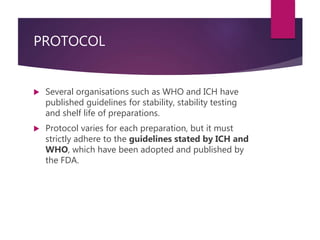
PROTOCOL
 Several organisations such as WHO and ICH have
published guidelines for stability, stability testing
and shelf life of preparations.
 Protocol varies for each preparation, but it must
strictly adhere to the guidelines stated by ICH and
WHO, which have been adopted and published by
the FDA.
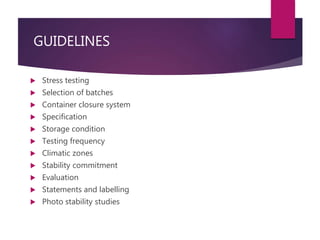
GUIDELINES
 Stress testing
 Selection of batches
 Container closure system
 Specification
 Storage condition
 Testing frequency
 Climatic zones
 Stability commitment
 Evaluation
 Statements and labelling
 Photo stability studies
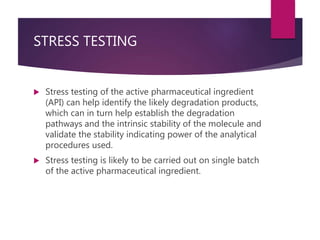
STRESS TESTING
 Stress testing of the active pharmaceutical ingredient
(API) can help identify the likely degradation products,
which can in turn help establish the degradation
pathways and the intrinsic stability of the molecule and
validate the stability indicating power of the analytical
procedures used.
 Stress testing is likely to be carried out on single batch
of the active pharmaceutical ingredient.
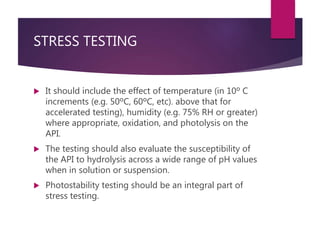
STRESS TESTING
 It should include the effect of temperature (in 10º C
increments (e.g. 50ºC, 60ºC, etc). above that for
accelerated testing), humidity (e.g. 75% RH or greater)
where appropriate, oxidation, and photolysis on the
API.
 The testing should also evaluate the susceptibility of
the API to hydrolysis across a wide range of pH values
when in solution or suspension.
 Photostability testing should be an integral part of
stress testing.
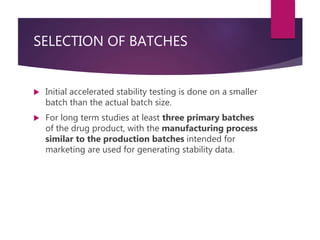
SELECTION OF BATCHES
 Initial accelerated stability testing is done on a smaller
batch than the actual batch size.
 For long term studies at least three primary batches
of the drug product, with the manufacturing process
similar to the production batches intended for
marketing are used for generating stability data.
CONTAINER CLOSURES SYSTEM
 Drug product should be packed in the same
container closure system as proposed for
marketing of the drug product.
SPECIFICATION
 Specification is a list of tests, references to analytical
procedures, and proposed acceptance criteria.
 Stability studies should include testing of those
attributes of the API that are susceptible to change
during storage and are likely to influence quality, safety,
and /or efficacy.
 All test methods used in the stability study should have
been previously qualified and validated
STORAGE CONDITIONS
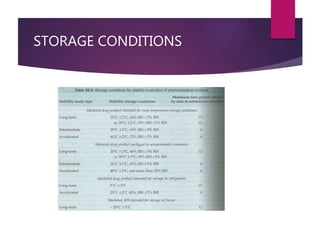
Stability guidance provides six intended storage conditions for
the drug products.
 Drug products intended for storage at room temperature
 Drug products packaged in impermeable containers
 Drug products packaged in semipermeable containers
 Drug products intended for storage in a refrigerator
 Drug products intended for storage in a freezer
 Drug products intended for storage below -20ºC
STORAGE CONDITIONS
STORAGE CONDITION
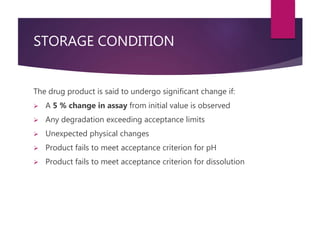
The drug product is said to undergo significant change if:
 A 5 % change in assay from initial value is observed
 Any degradation exceeding acceptance limits
 Unexpected physical changes
 Product fails to meet acceptance criterion for pH
 Product fails to meet acceptance criterion for dissolution
TESTING FREQUENCY
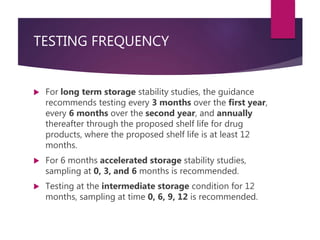
 For long term storage stability studies, the guidance
recommends testing every 3 months over the first year,
every 6 months over the second year, and annually
thereafter through the proposed shelf life for drug
products, where the proposed shelf life is at least 12
months.
 For 6 months accelerated storage stability studies,
sampling at 0, 3, and 6 months is recommended.
 Testing at the intermediate storage condition for 12
months, sampling at time 0, 6, 9, 12 is recommended.
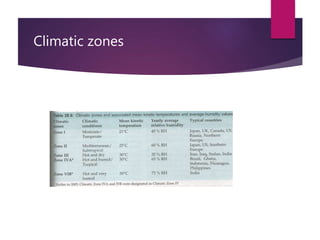
CLIMATIC ZONES (TEMPERATURE
&RH)
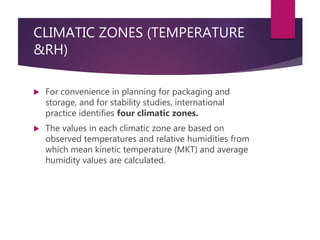
 For convenience in planning for packaging and
storage, and for stability studies, international
practice identifies four climatic zones.
 The values in each climatic zone are based on
observed temperatures and relative humidities from
which mean kinetic temperature (MKT) and average
humidity values are calculated.
Climatic zones
STABILITY COMMITMENT
 When available long-term stability data on primary
batches do not cover the proposed shelf life granted
at the time of approval, a commitment should be
made to continue the stability studies post approval to
firmly establish the shelf life.
 Where the submission includes long-term stability
data from three production batches covering the
proposed shelf life, a post approval commitment is
considered unnecessary.
EVALUATION
 A systematic approach should be adopted in the
presentation and evaluation of the stability information,
which should include, results from the physical, chemical,
biological, and microbiological tests, including particular
attributes of the dosage form (for example, dissolution rate
for solid oral dosage forms).
 The purpose of the stability study is to establish, based on
testing a minimum of three batches of the medicinal
product, a shelf life and label storage instructions
applicable to all future batches of the medicinal product
manufactured and packaged under similar circumstances.
STATEMENTS AND LABELLING
 A storage statement should be established for the labelling in
accordance with relevant national/regional requirements.
 The statement should be based on the stability evaluation of
the drug product.
 Where applicable, specific instruction should be provided,
particularly for drug products that cannot tolerate freezing.
 Terms such as ambient conditions or room temperature
should be avoided.
 An expiration date should be displayed on the container
label.
PHOTOSTABILITY STUDIES
Include,
 Test on drug substance
 Test on exposed drug product outside the
immediate pack
 Test on drug product with immediate pack
 Test on drug product in the marketing pack
PHOTOSTABILITY STUDIES –
LIGHT SOURCE
Two light sources are recommended,
 Artificial daylight fluorescent lamp combining both
visible and UV output.
 Cool white fluorescent and near UV lamp.
PHOTOSTABILITY STUDIES -
SIGNIFICANCE
 Identification of precautionary measures needed
during manufacture and packaging
 Container closure design for protection from light
and
 Storage conditions and light protection required
during shelf life of the marketed product
REFERENCES
 Lachman/Lieberman’s – the theory and practice of
industrial pharmacy, 4th edition.
 Guidance for Industry Q1A(R2) Stability Testing of New
Drug Substances and Products -U.S. Department of
Health and Human Services Food and Drug
Administration, Center for Drug Evaluation and Research
(CDER), Center for Biologics Evaluation and Research
(CBER), November 2003, ICH Revision 2.
 Formulative pharmacy notes by Dr.Grace Rathnam –
C.L.Baid Metha college of pharmacy.
THANK YOU!

Stability and stability testing

  • 1.
    STABILIZATION AND STABILITY TESTING PRESENTEDBY :- SHARON VIJAYANAND FINAL YEAR, B.PHARM C.L.BAID METHA COLLEGE OF PHARMACY.
  • 2.
    STABILITY  Extent towhich a product retains its properties and characteristics throughout its shelf life.  Stability applies to the chemical, physical, microbiological, toxicological and therapeutic properties. What is shelf life ? TIME PERIOD during which active and the inactive ingredients and drug products are expected to remain within approved specification, provided that they are stored under conditions defined on the container label.
  • 3.
    STABILITY TESTING  Evaluatesthe effect of environmental factors on the quality of the drug substance.  In other words, performing accurate tests to ensure that the pharmaceutical product (e.g. tablets, capsules, creams..) and their components ( API + excipients) maintain their stability and efficacy during their proposed shelf life.
  • 4.
  • 5.
    Why should weperform stability testing ?  For legal, moral, economic, competitive reasons as well as reasons for safety and efficacy it is important to monitor, predict and evaluate drug product stability.
  • 6.
    IMPORTANCE OF STABILITY TESTING Ensure safety and therapeutic efficacy  Predict shelf life  Determine storage conditions  Suggest labelling instructions  Provides data necessary for drug approval  Determining suitable container closure system  Evaluate and verify stability
  • 7.
    PROTOCOL  Several organisationssuch as WHO and ICH have published guidelines for stability, stability testing and shelf life of preparations.  Protocol varies for each preparation, but it must strictly adhere to the guidelines stated by ICH and WHO, which have been adopted and published by the FDA.
  • 8.
    GUIDELINES  Stress testing Selection of batches  Container closure system  Specification  Storage condition  Testing frequency  Climatic zones  Stability commitment  Evaluation  Statements and labelling  Photo stability studies
  • 9.
    STRESS TESTING  Stresstesting of the active pharmaceutical ingredient (API) can help identify the likely degradation products, which can in turn help establish the degradation pathways and the intrinsic stability of the molecule and validate the stability indicating power of the analytical procedures used.  Stress testing is likely to be carried out on single batch of the active pharmaceutical ingredient.
  • 10.
    STRESS TESTING  Itshould include the effect of temperature (in 10º C increments (e.g. 50ºC, 60ºC, etc). above that for accelerated testing), humidity (e.g. 75% RH or greater) where appropriate, oxidation, and photolysis on the API.  The testing should also evaluate the susceptibility of the API to hydrolysis across a wide range of pH values when in solution or suspension.  Photostability testing should be an integral part of stress testing.
  • 11.
    SELECTION OF BATCHES Initial accelerated stability testing is done on a smaller batch than the actual batch size.  For long term studies at least three primary batches of the drug product, with the manufacturing process similar to the production batches intended for marketing are used for generating stability data.
  • 12.
    CONTAINER CLOSURES SYSTEM Drug product should be packed in the same container closure system as proposed for marketing of the drug product.
  • 13.
    SPECIFICATION  Specification isa list of tests, references to analytical procedures, and proposed acceptance criteria.  Stability studies should include testing of those attributes of the API that are susceptible to change during storage and are likely to influence quality, safety, and /or efficacy.  All test methods used in the stability study should have been previously qualified and validated
  • 14.
    STORAGE CONDITIONS Stability guidanceprovides six intended storage conditions for the drug products.  Drug products intended for storage at room temperature  Drug products packaged in impermeable containers  Drug products packaged in semipermeable containers  Drug products intended for storage in a refrigerator  Drug products intended for storage in a freezer  Drug products intended for storage below -20ºC
  • 15.
  • 16.
    STORAGE CONDITION The drugproduct is said to undergo significant change if:  A 5 % change in assay from initial value is observed  Any degradation exceeding acceptance limits  Unexpected physical changes  Product fails to meet acceptance criterion for pH  Product fails to meet acceptance criterion for dissolution
  • 17.
    TESTING FREQUENCY  Forlong term storage stability studies, the guidance recommends testing every 3 months over the first year, every 6 months over the second year, and annually thereafter through the proposed shelf life for drug products, where the proposed shelf life is at least 12 months.  For 6 months accelerated storage stability studies, sampling at 0, 3, and 6 months is recommended.  Testing at the intermediate storage condition for 12 months, sampling at time 0, 6, 9, 12 is recommended.
  • 18.
    CLIMATIC ZONES (TEMPERATURE &RH) For convenience in planning for packaging and storage, and for stability studies, international practice identifies four climatic zones.  The values in each climatic zone are based on observed temperatures and relative humidities from which mean kinetic temperature (MKT) and average humidity values are calculated.
  • 19.
  • 20.
    STABILITY COMMITMENT  Whenavailable long-term stability data on primary batches do not cover the proposed shelf life granted at the time of approval, a commitment should be made to continue the stability studies post approval to firmly establish the shelf life.  Where the submission includes long-term stability data from three production batches covering the proposed shelf life, a post approval commitment is considered unnecessary.
  • 21.
    EVALUATION  A systematicapproach should be adopted in the presentation and evaluation of the stability information, which should include, results from the physical, chemical, biological, and microbiological tests, including particular attributes of the dosage form (for example, dissolution rate for solid oral dosage forms).  The purpose of the stability study is to establish, based on testing a minimum of three batches of the medicinal product, a shelf life and label storage instructions applicable to all future batches of the medicinal product manufactured and packaged under similar circumstances.
  • 22.
    STATEMENTS AND LABELLING A storage statement should be established for the labelling in accordance with relevant national/regional requirements.  The statement should be based on the stability evaluation of the drug product.  Where applicable, specific instruction should be provided, particularly for drug products that cannot tolerate freezing.  Terms such as ambient conditions or room temperature should be avoided.  An expiration date should be displayed on the container label.
  • 23.
    PHOTOSTABILITY STUDIES Include,  Teston drug substance  Test on exposed drug product outside the immediate pack  Test on drug product with immediate pack  Test on drug product in the marketing pack
  • 24.
    PHOTOSTABILITY STUDIES – LIGHTSOURCE Two light sources are recommended,  Artificial daylight fluorescent lamp combining both visible and UV output.  Cool white fluorescent and near UV lamp.
  • 25.
    PHOTOSTABILITY STUDIES - SIGNIFICANCE Identification of precautionary measures needed during manufacture and packaging  Container closure design for protection from light and  Storage conditions and light protection required during shelf life of the marketed product
  • 26.
    REFERENCES  Lachman/Lieberman’s –the theory and practice of industrial pharmacy, 4th edition.  Guidance for Industry Q1A(R2) Stability Testing of New Drug Substances and Products -U.S. Department of Health and Human Services Food and Drug Administration, Center for Drug Evaluation and Research (CDER), Center for Biologics Evaluation and Research (CBER), November 2003, ICH Revision 2.  Formulative pharmacy notes by Dr.Grace Rathnam – C.L.Baid Metha college of pharmacy.
  • 27.