Good Manufacturing Practice
Guidelines
ICH Q7A
Presented by
Malangsha S
shkrahul42@gmail.com
cGMP Vs GMP
Good Manufacturing Practice
Guidelines
ICH Q7A
Presented by
Malangsha S
shkrahul42@gmail.com
cGMP Vs GMP
cGMP Vs GMP
It is my understanding that , Ultimately GMP
& cGMP both the aim is same, means to
prevention of the product from bad quality
entering the market to endover peoples's life.
GMP applies to pharmaceutical and
healthcare products and help to maintain high
standards in these products.
cGMP is to remind accepting countries that all
guidelines must be followed with latest and
current production processes i.e employ
technologies and systems which are
It is my understanding that , Ultimately GMP
& cGMP both the aim is same, means to
prevention of the product from bad quality
entering the market to endover peoples's life.
GMP applies to pharmaceutical and
healthcare products and help to maintain high
standards in these products.
cGMP is to remind accepting countries that all
guidelines must be followed with latest and
current production processes i.e employ
technologies and systems which are
cGMP Vs GMP
up-to-date in order to comply with the
regulation.
FDA (Food and Drug Administration) included
the word “current” to ensure that regulated
firms use the most current Good
Manufacturing Practices (I believe that some
firms would actually use outdated versions of
the GMP’s to manufacture regulated
products.
(the FDA have made their standards
up-to-date in order to comply with the
regulation.
FDA (Food and Drug Administration) included
the word “current” to ensure that regulated
firms use the most current Good
Manufacturing Practices (I believe that some
firms would actually use outdated versions of
the GMP’s to manufacture regulated
products.
(the FDA have made their standards
cGMP Vs GMP
immediately identifiable i.e cGMP; Other
international bodies such as the ICH, WHO
use the term GMP, as do Canada, Japan and
the EMEA (European authority). In FDA view
cGMP means following 21 CFR 210 and 211
and no other.)
immediately identifiable i.e cGMP; Other
international bodies such as the ICH, WHO
use the term GMP, as do Canada, Japan and
the EMEA (European authority). In FDA view
cGMP means following 21 CFR 210 and 211
and no other.)
Objective of
• To produce products conforming to
predetermined specification
• To produce Product of consistent
quality
• To minimize contamination
• To produce products conforming to
predetermined specification
• To produce Product of consistent
quality
• To minimize contamination
What do mean by
Any substances or mixture of substances intended to be
used in the manufacture of drug (medicinal) product and
that, when used in the production of a drug, becomes an
active ingredient of the drug product. Such substances are
intended to furnish pharmacological activity or other
direct effect in the diagnosis, cure, mitigation, treatment,
or prevention of disease or to affect the structure and
function of the body.
Any substances or mixture of substances intended to be
used in the manufacture of drug (medicinal) product and
that, when used in the production of a drug, becomes an
active ingredient of the drug product. Such substances are
intended to furnish pharmacological activity or other
direct effect in the diagnosis, cure, mitigation, treatment,
or prevention of disease or to affect the structure and
function of the body.
Regulatory Agencies |
The United States
Food and Drug Administration
International Conference on
Harmonization. This consist of EU, US and Japan.
The United States
Food and Drug Administration
European Directorate of Quality
Medicines
ICH Modules
Q1 - Stability testing
Q2 – Validation of Analytical Procedures
Q3 – Impurities
Q4 – Evaluation – Pharmacopoeia TextsQ4 – Evaluation – Pharmacopoeia Texts
Q5 – Biotechnology Products
Q6 – Specifications
Q7 – Good Manufacturing Practices
Q8 – Pharmaceutical Development
Q9 – Quality Risk Management
Q10 – Pharmaceutical Quality System
Principles
Quality should be the responsibility of all persons involved in
manufacturing.
Responsibilities of the Quality Unit(s)
involved in all quality-related matters.
review and approve
QUALITY MANAGEMENT
Establishing a system to release packaging and labeling
materials
Internal Audits (Self Inspection)
Regular internal audits should be performed in accordance
with an approved schedule.
Performing product quality reviews
Document audit findings and corrective actions
Agreed corrective actions should be completed in a timely
and effective manner.
Responsibility for Production Activities
QUALITY MANAGEMENT
production facilities are clean and when appropriate disinfected
The responsibility for production activities should be
described in writing
All deviations are reported and critical deviations are
investigated and the conclusions recorded
the necessary calibrations are performed and records kept
new and, when appropriate, modified facilities and equipment
are qualified.
the necessary calibrations are performed and records kept
validation protocols and reports are reviewed and approved
Product Quality Review
Regular quality reviews of APIs should be conducted with the
objective of verifying the consistency of the process.
Personnel Qualifications
There should be an adequate number of personnel
qualified by appropriate education, training and/or
experience to perform and supervise the manufacture
of intermediates and APIs.
Personnel Hygiene
should practice good sanitation and health habits.
should avoid direct contact with intermediates or APIs.
PERSONNEL
Consultants should have sufficient education, training, and
experience, or any combination thereof, to advise on the
subject
Consultants
should avoid direct contact with intermediates or APIs.
Personnel suffering from an infectious disease or having
open lesions on the exposed surface of the body should not
engage in activities that could result in compromising the
quality of APIs.
BUILDINGS & FACILITIES
Buildings and facilities should be:
Located, Designed, and Constructed to facilitate
cleaning, maintenance, and operations as appropriate to
the type and stage of manufacture
minimize potential contamination.
designed to limit exposure to objectionable
microbiological contaminants
Utilities should be:
Qualified and appropriately monitored
action should be taken when limits are exceeded..
Drawings for these utility systems should be available
Water should be:
Water used in the manufacture of APIs should be
demonstrated to be suitable for its intended use.
BUILDINGS & FACILITIES
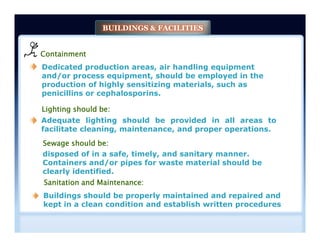
Containment
Dedicated production areas, air handling equipment
and/or process equipment, should be employed in the
production of highly sensitizing materials, such as
penicillins or cephalosporins.
Lighting should be:
Adequate lighting should be provided in all areas to
facilitate cleaning, maintenance, and proper operations.
Adequate lighting should be provided in all areas to
facilitate cleaning, maintenance, and proper operations.
disposed of in a safe, timely, and sanitary manner.
Containers and/or pipes for waste material should be
clearly identified.
Sewage should be:
Buildings should be properly maintained and repaired and
kept in a clean condition and establish written procedures
Sanitation and Maintenance:
Design and Construction
Equipment should be of appropriate design and adequate
size, and suitably located for its intended use
Equipment Maintenance and Cleaning
preventative maintenance of equipment.
PROCESS EQUIPMENT
Written procedures should be established
Cleaning procedures should contain sufficient details to
clean each type of equipment in a reproducible and
effective manner
Equipment should be identified as to its contents and its
cleanliness status
Acceptance criteria should be defined and justified.
Calibration
Control, weighing, measuring, monitoring and test equipment
that is critical for assuring the quality of intermediates or APIs
should be calibrated according to written procedures and an
established schedule.
Computerized Systems
installation qualification and operational qualification should
demonstrate the suitability to perform assigned tasks
PROCESS EQUIPMENT
GMP related computerized systems should be validated
installation qualification and operational qualification should
demonstrate the suitability to perform assigned tasks
Computerized systems should have sufficient controls to prevent
unauthorized access or changes to data.
Changes to the computerized system should be made
according to a change procedure
If system breakdowns or failures would result in the
permanent loss of records, a back-up system should be
provided.
Documentation System and Specifications
All documents related to the manufacture of intermediates or
APIs should be prepared, reviewed, approved and distributed
according to written procedures. Such documents can be in
paper or electronic form.
Equipment Cleaning and Use Record
Records of major equipment use, cleaning, sanitization
and/or sterilization and maintenance should show the date,
time (if appropriate), product, and batch number of each
batch processed in the equipment, and the person who
performed the cleaning and maintenance.
DOCUMENTATION &
RECORDS
Records of major equipment use, cleaning, sanitization
and/or sterilization and maintenance should show the date,
time (if appropriate), product, and batch number of each
batch processed in the equipment, and the person who
performed the cleaning and maintenance.
Records should be maintained including: name, identity,
quantity; name of the supplier; supplier's control number(s),
the number allocated on receipt & date of receipt;
Raw Material Records
Master (approved) labels should be maintained for
comparison to issued labels.
Master Production and Control Records)
To ensure uniformity from batch to batch, master production
instructions for each intermediate and API should be prepared,
dated, and signed by one person and independently checked,
dated, and signed by a person in the quality unit(s).
Batch Production and Control Records)
Batch production records should include complete
information relating to the production and control of each
batch.
DOCUMENTATION &
RECORDS
Batch production records should include complete
information relating to the production and control of each
batch.
Documentation of completion of each significant step in the
batch production
Laboratory Control Records
Laboratory control records should include complete data
derived from all tests conducted to ensure compliance with
established specifications and standards, including
examinations and assays,
These records should be numbered with a unique batch or
identification number, dated and signed when issued.
General Controls
There should be written procedures describing the receipt,
identification, quarantine, storage, handling, sampling, testing,
and approval or rejection of materials.
should have a system for evaluating the suppliers of critical
materials.
Changing the source of supply of critical raw materials
should be treated according to Change Control.
MATERIAL MANAGEMENT
Receipt and Quarantine
each container or grouping of containers of materials should
be examined visually
Changing the source of supply of critical raw materials
should be treated according to Change Control.
Materials should be held under quarantine until they have
been sampled, examined or tested as appropriate, and
released for use.
Each container or grouping of containers (batches) of
materials should be assigned and identified with a
distinctive code, batch, or receipt number.
Sampling and Testing
Sampling should be conducted at defined locations
MATERIAL MANAGEMENT
Containers from which samples are withdrawn should be marked
to indicate that a sample has been taken.
At least one test to verify the identity of each batch of material
should be conducted,
A supplier's Certificate of Analysis can be used in place of
performing other tests
Re-evaluation
Materials should be handled and stored in a manner to
prevent degradation, contamination, and cross-
contamination.
Materials should be re-evaluated as appropriate to
determine their suitability for use
Rejected materials should be identified and controlled under
a quarantine system
Storage
A supplier's Certificate of Analysis can be used in place of
performing other tests
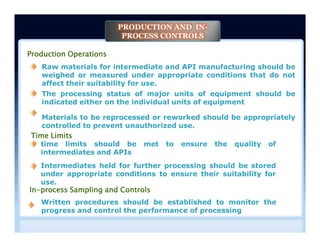
Production Operations
Raw materials for intermediate and API manufacturing should be
weighed or measured under appropriate conditions that do not
affect their suitability for use.
The processing status of major units of equipment should be
indicated either on the individual units of equipment
Materials to be reprocessed or reworked should be appropriately
controlled to prevent unauthorized use.
PRODUCTION AND IN-
PROCESS CONTROLS
In-process Sampling and Controls
time limits should be met to ensure the quality of
intermediates and APIs
Written procedures should be established to monitor the
progress and control the performance of processing
Intermediates held for further processing should be stored
under appropriate conditions to ensure their suitability for
use.
Time Limits
Materials to be reprocessed or reworked should be appropriately
controlled to prevent unauthorized use.
Production Operations
Raw materials for intermediate and API manufacturing should be
weighed or measured under appropriate conditions that do not
affect their suitability for use.
The processing status of major units of equipment should be
indicated either on the individual units of equipment
Materials to be reprocessed or reworked should be appropriately
controlled to prevent unauthorized use.
PRODUCTION AND IN-
PROCESS CONTROLS
In-process Sampling and Controls
time limits should be met to ensure the quality of
intermediates and APIs
Written procedures should be established to monitor the
progress and control the performance of processing
Intermediates held for further processing should be stored
under appropriate conditions to ensure their suitability for
use.
Time Limits
Materials to be reprocessed or reworked should be appropriately
controlled to prevent unauthorized use.
Blending Batches
Blending is defined as the process of combining materials within
the same specification to produce a homogeneous intermediate
or API.
Blending processes should be adequately controlled, tested for
conformance and documented
The batch record of the blending process should allow
traceability back to the individual batches that make up the
blend.
PRODUCTION AND IN-
PROCESS CONTROLS
Contamination Control
Precautions to avoid and prevent contamination
Residual materials can be carried over into successive
batches of the same intermediate or API if there is adequate
control.
The batch record of the blending process should allow
traceability back to the individual batches that make up the
blend.
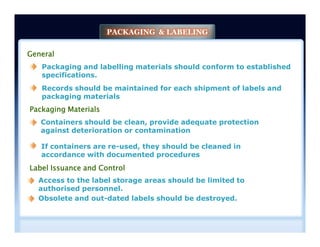
General
Packaging and labelling materials should conform to established
specifications.
Packaging Materials
Containers should be clean, provide adequate protection
against deterioration or contamination
Records should be maintained for each shipment of labels and
packaging materials
PACKAGING & LABELING
If containers are re-used, they should be cleaned in
accordance with documented procedures
Containers should be clean, provide adequate protection
against deterioration or contamination
Label Issuance and Control
Access to the label storage areas should be limited to
authorised personnel.
Obsolete and out-dated labels should be destroyed.
Packaging and Labelling Operations
Labels used on containers of intermediates or APIs should
indicate the name or identifying code, the batch number of the
product, and storage conditions, when such information is
critical to assure the quality of intermediate or API.
PACKAGING & LABELING
Labels used on containers of intermediates or APIs should
indicate the name or identifying code, the batch number of the
product, and storage conditions, when such information is
critical to assure the quality of intermediate or API.
For intermediates or APIs with a retest date, the retest date
should be indicated on the label and/or Certificate of
Analysis.
Warehousing Procedures
Facilities should be available for the storage of all materials
under appropriate conditions
Distribution Procedures
APIs and intermediates should only be released for
distribution to third parties after they have been released by
the quality unit(s).
separate storage areas should be assigned for their temporary
storage until the decision as to their future use has been taken.
STORAGE & DISTRIBUTION
transported in a manner that does not adversely affect their
quality.
APIs and intermediates should only be released for
distribution to third parties after they have been released by
the quality unit(s).
Special transport or storage conditions for an API or
intermediate should be stated on the label.
A system should be in place by which the distribution can be
readily determined to permit its recall.
General Controls
adequate laboratory facilities.
Any out-of-specification result obtained should be
investigated and documented according to a procedure
documented procedures describing sampling, testing, approval
or rejection of materials
primary reference standard & Secondary reference standards,
reagents and standard solutions
LABORATORY CONTROLS
Testing of Intermediates and APIs
primary reference standard & Secondary reference standards,
reagents and standard solutions
An impurity profile describing the identified and unidentified
impurities present should normally be established for each API.
Appropriate microbiological tests should be conducted on each
batch
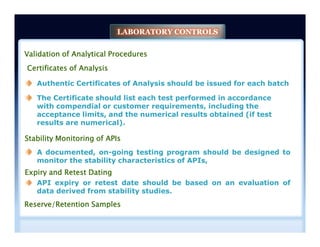
Validation of Analytical Procedures
Certificates of Analysis
Authentic Certificates of Analysis should be issued for each batch
The Certificate should list each test performed in accordance
with compendial or customer requirements, including the
acceptance limits, and the numerical results obtained (if test
results are numerical).
LABORATORY CONTROLS
The Certificate should list each test performed in accordance
with compendial or customer requirements, including the
acceptance limits, and the numerical results obtained (if test
results are numerical).
Stability Monitoring of APIs
Expiry and Retest Dating
Reserve/Retention Samples
A documented, on-going testing program should be designed to
monitor the stability characteristics of APIs,
API expiry or retest date should be based on an evaluation of
data derived from stability studies.
Validation Policy
Validation Documentation
The critical parameters/attributes should normally be identified
during the development stage or from historical data,
The company's overall policy, intentions, and approach to
validation,
A written validation protocol should specify critical process steps
and acceptance criteria as well as the type of validation to be
conducted
VALIDATION
Qualification
A written validation protocol should specify critical process steps
and acceptance criteria as well as the type of validation to be
conducted
A validation report cross-referencing the validation protocol
summarising the results obtained, commenting on any deviations
observed, should be prepared
Before starting process validation activities, appropriate qualification
of critical equipment and ancillary systems should be completed.
Design Qualification (DQ), Installation Qualification (IQ),
Operational Qualification (OQ) & Performance Qualification (PQ)
Approaches to Process Validation
Process Validation Program
retrospective validation
There are three approaches to validation.
Process Validation (PV), Prospective validation & Concurrent
validation
VALIDATION
The number of process runs
Periodic Review of Validated Systems
The number of process runs
Critical process parameters
Process validation should confirm that the impurity profile for
each API is within the limits specified.
Systems and processes should be periodically evaluated to verify
that they are still operating in a valid manner.
Cleaning Validation
In general, cleaning validation should be directed to situations or
process steps where contamination or carryover of materials
poses the greatest risk to API quality.
VALIDATION
Validation of cleaning procedures should reflect actual
equipment usage patterns
cleaning validation protocol
Validation of Analytical Methods
Sampling should include swabbing, rinsing, or alternative
methods
Analytical methods should be validated unless the method
employed is included in the relevant pharmacopoeia or other
recognised standard reference.
Appropriate qualification of analytical equipment
CHANGE CONTROL
change control system
Any proposals for GMP relevant changes should be drafted,
reviewed, and approved
Evaluate potential impact of the proposed change on the quality
CHANGECONTROL
Evaluate potential impact of the proposed change on the quality
When implementing approved changes, measures should be
taken to ensure that all documents affected by the changes are
revised.
REJECTION
Intermediates and APIs failing to meet established specifications
should be identified as such and quarantined. The final
disposition of rejected materials should be recorded.
Introducing back into the process and reprocessing by repeating
a crystallization step or other appropriate chemical or physical
manipulation steps is generally considered acceptable.
REPROCESSING
REJECTION AND REUSE OF
MATERIALS
Introducing back into the process and reprocessing by repeating
a crystallization step or other appropriate chemical or physical
manipulation steps is generally considered acceptable.
Before a decision is taken to rework batches that do not conform
to established standards or specifications, an investigation into
the reason for non-conformance should be performed.
REWORKING
All quality related complaints, whether received orally or in
writing, should be recorded and investigated according to a
written procedure.
There should be a written procedure that defines the
circumstances under which a recall of an intermediate or API
should be considered.
COMPLAINTS AND
RECALLS
The recall procedure should designate who should be involved in
evaluating the information, how a recall should be initiated, who
should be informed about the recall, and how the recalled
material should be treated.
There should be a written procedure that defines the
circumstances under which a recall of an intermediate or API
should be considered.
Recovery of Materials and Solvents
Solvents can be recovered and reused in the same processes or
in different processes,
RECOVERY & RETURNS
Fresh and recovered solvents and reagents can be combined if
adequate testing has shown
Solvents can be recovered and reused in the same processes or
in different processes,
Returned intermediates or APIs should be identified as such and
quarantined.
Records of returned intermediates or APIs should be maintained.
Returns
If the conditions under which returned intermediates or APIs
have been stored casts doubt on their quality, the returned
intermediates or APIs should be reprocessed, reworked, or
destroyed, as appropriate.
Solvents can be recovered and reused in the same processes or
in different processes,
cGMP Vs GMP presentation

cGMP Vs GMP presentation

  • 1.
    Good Manufacturing Practice Guidelines ICHQ7A Presented by Malangsha S shkrahul42@gmail.com cGMP Vs GMP Good Manufacturing Practice Guidelines ICH Q7A Presented by Malangsha S shkrahul42@gmail.com cGMP Vs GMP
  • 2.
    cGMP Vs GMP Itis my understanding that , Ultimately GMP & cGMP both the aim is same, means to prevention of the product from bad quality entering the market to endover peoples's life. GMP applies to pharmaceutical and healthcare products and help to maintain high standards in these products. cGMP is to remind accepting countries that all guidelines must be followed with latest and current production processes i.e employ technologies and systems which are It is my understanding that , Ultimately GMP & cGMP both the aim is same, means to prevention of the product from bad quality entering the market to endover peoples's life. GMP applies to pharmaceutical and healthcare products and help to maintain high standards in these products. cGMP is to remind accepting countries that all guidelines must be followed with latest and current production processes i.e employ technologies and systems which are
  • 3.
    cGMP Vs GMP up-to-datein order to comply with the regulation. FDA (Food and Drug Administration) included the word “current” to ensure that regulated firms use the most current Good Manufacturing Practices (I believe that some firms would actually use outdated versions of the GMP’s to manufacture regulated products. (the FDA have made their standards up-to-date in order to comply with the regulation. FDA (Food and Drug Administration) included the word “current” to ensure that regulated firms use the most current Good Manufacturing Practices (I believe that some firms would actually use outdated versions of the GMP’s to manufacture regulated products. (the FDA have made their standards
  • 4.
    cGMP Vs GMP immediatelyidentifiable i.e cGMP; Other international bodies such as the ICH, WHO use the term GMP, as do Canada, Japan and the EMEA (European authority). In FDA view cGMP means following 21 CFR 210 and 211 and no other.) immediately identifiable i.e cGMP; Other international bodies such as the ICH, WHO use the term GMP, as do Canada, Japan and the EMEA (European authority). In FDA view cGMP means following 21 CFR 210 and 211 and no other.)
  • 5.
    Objective of • Toproduce products conforming to predetermined specification • To produce Product of consistent quality • To minimize contamination • To produce products conforming to predetermined specification • To produce Product of consistent quality • To minimize contamination
  • 6.
    What do meanby Any substances or mixture of substances intended to be used in the manufacture of drug (medicinal) product and that, when used in the production of a drug, becomes an active ingredient of the drug product. Such substances are intended to furnish pharmacological activity or other direct effect in the diagnosis, cure, mitigation, treatment, or prevention of disease or to affect the structure and function of the body. Any substances or mixture of substances intended to be used in the manufacture of drug (medicinal) product and that, when used in the production of a drug, becomes an active ingredient of the drug product. Such substances are intended to furnish pharmacological activity or other direct effect in the diagnosis, cure, mitigation, treatment, or prevention of disease or to affect the structure and function of the body.
  • 7.
    Regulatory Agencies | TheUnited States Food and Drug Administration International Conference on Harmonization. This consist of EU, US and Japan. The United States Food and Drug Administration European Directorate of Quality Medicines
  • 8.
    ICH Modules Q1 -Stability testing Q2 – Validation of Analytical Procedures Q3 – Impurities Q4 – Evaluation – Pharmacopoeia TextsQ4 – Evaluation – Pharmacopoeia Texts Q5 – Biotechnology Products Q6 – Specifications Q7 – Good Manufacturing Practices Q8 – Pharmaceutical Development Q9 – Quality Risk Management Q10 – Pharmaceutical Quality System
  • 9.
    Principles Quality should bethe responsibility of all persons involved in manufacturing. Responsibilities of the Quality Unit(s) involved in all quality-related matters. review and approve QUALITY MANAGEMENT Establishing a system to release packaging and labeling materials Internal Audits (Self Inspection) Regular internal audits should be performed in accordance with an approved schedule. Performing product quality reviews Document audit findings and corrective actions Agreed corrective actions should be completed in a timely and effective manner.
  • 10.
    Responsibility for ProductionActivities QUALITY MANAGEMENT production facilities are clean and when appropriate disinfected The responsibility for production activities should be described in writing All deviations are reported and critical deviations are investigated and the conclusions recorded the necessary calibrations are performed and records kept new and, when appropriate, modified facilities and equipment are qualified. the necessary calibrations are performed and records kept validation protocols and reports are reviewed and approved Product Quality Review Regular quality reviews of APIs should be conducted with the objective of verifying the consistency of the process.
  • 11.
    Personnel Qualifications There shouldbe an adequate number of personnel qualified by appropriate education, training and/or experience to perform and supervise the manufacture of intermediates and APIs. Personnel Hygiene should practice good sanitation and health habits. should avoid direct contact with intermediates or APIs. PERSONNEL Consultants should have sufficient education, training, and experience, or any combination thereof, to advise on the subject Consultants should avoid direct contact with intermediates or APIs. Personnel suffering from an infectious disease or having open lesions on the exposed surface of the body should not engage in activities that could result in compromising the quality of APIs.
  • 12.
    BUILDINGS & FACILITIES Buildingsand facilities should be: Located, Designed, and Constructed to facilitate cleaning, maintenance, and operations as appropriate to the type and stage of manufacture minimize potential contamination. designed to limit exposure to objectionable microbiological contaminants Utilities should be: Qualified and appropriately monitored action should be taken when limits are exceeded.. Drawings for these utility systems should be available Water should be: Water used in the manufacture of APIs should be demonstrated to be suitable for its intended use.
  • 13.
    BUILDINGS & FACILITIES Containment Dedicatedproduction areas, air handling equipment and/or process equipment, should be employed in the production of highly sensitizing materials, such as penicillins or cephalosporins. Lighting should be: Adequate lighting should be provided in all areas to facilitate cleaning, maintenance, and proper operations. Adequate lighting should be provided in all areas to facilitate cleaning, maintenance, and proper operations. disposed of in a safe, timely, and sanitary manner. Containers and/or pipes for waste material should be clearly identified. Sewage should be: Buildings should be properly maintained and repaired and kept in a clean condition and establish written procedures Sanitation and Maintenance:
  • 14.
    Design and Construction Equipmentshould be of appropriate design and adequate size, and suitably located for its intended use Equipment Maintenance and Cleaning preventative maintenance of equipment. PROCESS EQUIPMENT Written procedures should be established Cleaning procedures should contain sufficient details to clean each type of equipment in a reproducible and effective manner Equipment should be identified as to its contents and its cleanliness status Acceptance criteria should be defined and justified.
  • 15.
    Calibration Control, weighing, measuring,monitoring and test equipment that is critical for assuring the quality of intermediates or APIs should be calibrated according to written procedures and an established schedule. Computerized Systems installation qualification and operational qualification should demonstrate the suitability to perform assigned tasks PROCESS EQUIPMENT GMP related computerized systems should be validated installation qualification and operational qualification should demonstrate the suitability to perform assigned tasks Computerized systems should have sufficient controls to prevent unauthorized access or changes to data. Changes to the computerized system should be made according to a change procedure If system breakdowns or failures would result in the permanent loss of records, a back-up system should be provided.
  • 16.
    Documentation System andSpecifications All documents related to the manufacture of intermediates or APIs should be prepared, reviewed, approved and distributed according to written procedures. Such documents can be in paper or electronic form. Equipment Cleaning and Use Record Records of major equipment use, cleaning, sanitization and/or sterilization and maintenance should show the date, time (if appropriate), product, and batch number of each batch processed in the equipment, and the person who performed the cleaning and maintenance. DOCUMENTATION & RECORDS Records of major equipment use, cleaning, sanitization and/or sterilization and maintenance should show the date, time (if appropriate), product, and batch number of each batch processed in the equipment, and the person who performed the cleaning and maintenance. Records should be maintained including: name, identity, quantity; name of the supplier; supplier's control number(s), the number allocated on receipt & date of receipt; Raw Material Records Master (approved) labels should be maintained for comparison to issued labels.
  • 17.
    Master Production andControl Records) To ensure uniformity from batch to batch, master production instructions for each intermediate and API should be prepared, dated, and signed by one person and independently checked, dated, and signed by a person in the quality unit(s). Batch Production and Control Records) Batch production records should include complete information relating to the production and control of each batch. DOCUMENTATION & RECORDS Batch production records should include complete information relating to the production and control of each batch. Documentation of completion of each significant step in the batch production Laboratory Control Records Laboratory control records should include complete data derived from all tests conducted to ensure compliance with established specifications and standards, including examinations and assays, These records should be numbered with a unique batch or identification number, dated and signed when issued.
  • 18.
    General Controls There shouldbe written procedures describing the receipt, identification, quarantine, storage, handling, sampling, testing, and approval or rejection of materials. should have a system for evaluating the suppliers of critical materials. Changing the source of supply of critical raw materials should be treated according to Change Control. MATERIAL MANAGEMENT Receipt and Quarantine each container or grouping of containers of materials should be examined visually Changing the source of supply of critical raw materials should be treated according to Change Control. Materials should be held under quarantine until they have been sampled, examined or tested as appropriate, and released for use. Each container or grouping of containers (batches) of materials should be assigned and identified with a distinctive code, batch, or receipt number.
  • 19.
    Sampling and Testing Samplingshould be conducted at defined locations MATERIAL MANAGEMENT Containers from which samples are withdrawn should be marked to indicate that a sample has been taken. At least one test to verify the identity of each batch of material should be conducted, A supplier's Certificate of Analysis can be used in place of performing other tests Re-evaluation Materials should be handled and stored in a manner to prevent degradation, contamination, and cross- contamination. Materials should be re-evaluated as appropriate to determine their suitability for use Rejected materials should be identified and controlled under a quarantine system Storage A supplier's Certificate of Analysis can be used in place of performing other tests
  • 20.
    Production Operations Raw materialsfor intermediate and API manufacturing should be weighed or measured under appropriate conditions that do not affect their suitability for use. The processing status of major units of equipment should be indicated either on the individual units of equipment Materials to be reprocessed or reworked should be appropriately controlled to prevent unauthorized use. PRODUCTION AND IN- PROCESS CONTROLS In-process Sampling and Controls time limits should be met to ensure the quality of intermediates and APIs Written procedures should be established to monitor the progress and control the performance of processing Intermediates held for further processing should be stored under appropriate conditions to ensure their suitability for use. Time Limits Materials to be reprocessed or reworked should be appropriately controlled to prevent unauthorized use.
  • 21.
    Production Operations Raw materialsfor intermediate and API manufacturing should be weighed or measured under appropriate conditions that do not affect their suitability for use. The processing status of major units of equipment should be indicated either on the individual units of equipment Materials to be reprocessed or reworked should be appropriately controlled to prevent unauthorized use. PRODUCTION AND IN- PROCESS CONTROLS In-process Sampling and Controls time limits should be met to ensure the quality of intermediates and APIs Written procedures should be established to monitor the progress and control the performance of processing Intermediates held for further processing should be stored under appropriate conditions to ensure their suitability for use. Time Limits Materials to be reprocessed or reworked should be appropriately controlled to prevent unauthorized use.
  • 22.
    Blending Batches Blending isdefined as the process of combining materials within the same specification to produce a homogeneous intermediate or API. Blending processes should be adequately controlled, tested for conformance and documented The batch record of the blending process should allow traceability back to the individual batches that make up the blend. PRODUCTION AND IN- PROCESS CONTROLS Contamination Control Precautions to avoid and prevent contamination Residual materials can be carried over into successive batches of the same intermediate or API if there is adequate control. The batch record of the blending process should allow traceability back to the individual batches that make up the blend.
  • 23.
    General Packaging and labellingmaterials should conform to established specifications. Packaging Materials Containers should be clean, provide adequate protection against deterioration or contamination Records should be maintained for each shipment of labels and packaging materials PACKAGING & LABELING If containers are re-used, they should be cleaned in accordance with documented procedures Containers should be clean, provide adequate protection against deterioration or contamination Label Issuance and Control Access to the label storage areas should be limited to authorised personnel. Obsolete and out-dated labels should be destroyed.
  • 24.
    Packaging and LabellingOperations Labels used on containers of intermediates or APIs should indicate the name or identifying code, the batch number of the product, and storage conditions, when such information is critical to assure the quality of intermediate or API. PACKAGING & LABELING Labels used on containers of intermediates or APIs should indicate the name or identifying code, the batch number of the product, and storage conditions, when such information is critical to assure the quality of intermediate or API. For intermediates or APIs with a retest date, the retest date should be indicated on the label and/or Certificate of Analysis.
  • 25.
    Warehousing Procedures Facilities shouldbe available for the storage of all materials under appropriate conditions Distribution Procedures APIs and intermediates should only be released for distribution to third parties after they have been released by the quality unit(s). separate storage areas should be assigned for their temporary storage until the decision as to their future use has been taken. STORAGE & DISTRIBUTION transported in a manner that does not adversely affect their quality. APIs and intermediates should only be released for distribution to third parties after they have been released by the quality unit(s). Special transport or storage conditions for an API or intermediate should be stated on the label. A system should be in place by which the distribution can be readily determined to permit its recall.
  • 26.
    General Controls adequate laboratoryfacilities. Any out-of-specification result obtained should be investigated and documented according to a procedure documented procedures describing sampling, testing, approval or rejection of materials primary reference standard & Secondary reference standards, reagents and standard solutions LABORATORY CONTROLS Testing of Intermediates and APIs primary reference standard & Secondary reference standards, reagents and standard solutions An impurity profile describing the identified and unidentified impurities present should normally be established for each API. Appropriate microbiological tests should be conducted on each batch
  • 27.
    Validation of AnalyticalProcedures Certificates of Analysis Authentic Certificates of Analysis should be issued for each batch The Certificate should list each test performed in accordance with compendial or customer requirements, including the acceptance limits, and the numerical results obtained (if test results are numerical). LABORATORY CONTROLS The Certificate should list each test performed in accordance with compendial or customer requirements, including the acceptance limits, and the numerical results obtained (if test results are numerical). Stability Monitoring of APIs Expiry and Retest Dating Reserve/Retention Samples A documented, on-going testing program should be designed to monitor the stability characteristics of APIs, API expiry or retest date should be based on an evaluation of data derived from stability studies.
  • 28.
    Validation Policy Validation Documentation Thecritical parameters/attributes should normally be identified during the development stage or from historical data, The company's overall policy, intentions, and approach to validation, A written validation protocol should specify critical process steps and acceptance criteria as well as the type of validation to be conducted VALIDATION Qualification A written validation protocol should specify critical process steps and acceptance criteria as well as the type of validation to be conducted A validation report cross-referencing the validation protocol summarising the results obtained, commenting on any deviations observed, should be prepared Before starting process validation activities, appropriate qualification of critical equipment and ancillary systems should be completed. Design Qualification (DQ), Installation Qualification (IQ), Operational Qualification (OQ) & Performance Qualification (PQ)
  • 29.
    Approaches to ProcessValidation Process Validation Program retrospective validation There are three approaches to validation. Process Validation (PV), Prospective validation & Concurrent validation VALIDATION The number of process runs Periodic Review of Validated Systems The number of process runs Critical process parameters Process validation should confirm that the impurity profile for each API is within the limits specified. Systems and processes should be periodically evaluated to verify that they are still operating in a valid manner.
  • 30.
    Cleaning Validation In general,cleaning validation should be directed to situations or process steps where contamination or carryover of materials poses the greatest risk to API quality. VALIDATION Validation of cleaning procedures should reflect actual equipment usage patterns cleaning validation protocol Validation of Analytical Methods Sampling should include swabbing, rinsing, or alternative methods Analytical methods should be validated unless the method employed is included in the relevant pharmacopoeia or other recognised standard reference. Appropriate qualification of analytical equipment
  • 31.
    CHANGE CONTROL change controlsystem Any proposals for GMP relevant changes should be drafted, reviewed, and approved Evaluate potential impact of the proposed change on the quality CHANGECONTROL Evaluate potential impact of the proposed change on the quality When implementing approved changes, measures should be taken to ensure that all documents affected by the changes are revised.
  • 32.
    REJECTION Intermediates and APIsfailing to meet established specifications should be identified as such and quarantined. The final disposition of rejected materials should be recorded. Introducing back into the process and reprocessing by repeating a crystallization step or other appropriate chemical or physical manipulation steps is generally considered acceptable. REPROCESSING REJECTION AND REUSE OF MATERIALS Introducing back into the process and reprocessing by repeating a crystallization step or other appropriate chemical or physical manipulation steps is generally considered acceptable. Before a decision is taken to rework batches that do not conform to established standards or specifications, an investigation into the reason for non-conformance should be performed. REWORKING
  • 33.
    All quality relatedcomplaints, whether received orally or in writing, should be recorded and investigated according to a written procedure. There should be a written procedure that defines the circumstances under which a recall of an intermediate or API should be considered. COMPLAINTS AND RECALLS The recall procedure should designate who should be involved in evaluating the information, how a recall should be initiated, who should be informed about the recall, and how the recalled material should be treated. There should be a written procedure that defines the circumstances under which a recall of an intermediate or API should be considered.
  • 34.
    Recovery of Materialsand Solvents Solvents can be recovered and reused in the same processes or in different processes, RECOVERY & RETURNS Fresh and recovered solvents and reagents can be combined if adequate testing has shown Solvents can be recovered and reused in the same processes or in different processes, Returned intermediates or APIs should be identified as such and quarantined. Records of returned intermediates or APIs should be maintained. Returns If the conditions under which returned intermediates or APIs have been stored casts doubt on their quality, the returned intermediates or APIs should be reprocessed, reworked, or destroyed, as appropriate. Solvents can be recovered and reused in the same processes or in different processes,