PHARMACEUTICAL QUALITY MANAGEMENT
GUIDED BY
Dr. A.D.KULKARNI
HOD OF pqa
PREPARED BY
VINAYAK R BODHANKAR
M PHARM (SEM-I)
P’CEUTICAL QUALITY ASSURANCE
ROLL NO. : 01
Sanjivani College of Pharmaceutical Education &
Research, Kopargaon
Contents
 Basics of Quality management
 Total Quality Management
- Introduction to TQM
- Principles of TQM
- Six basic concepts of TQM
- 6 C’s of TQM
 Six sigma
 References
Basics of Quality Management
 Quality word oriented from Latin word ‘Qualitus’ it means
General excellence OR distinctive feature.
 Definitions of “Quality”
 There are so many quality gurus who are first get aware about
need if quality and started the evaluation of quality management
at industrial level.
some of them are as follows....
 Dr. Joseph Juran
He believes that there are no shortcut of quality, it is
neither an accidental not it happens overnight.
Quality must be planned.
 Dr. W. Edward Deming
He is well known for the work that he carried out in
Japan in the field of quality. He Create purpose of
continuous improvement in product and services
 Philip B. Crosby
He defines the Quality as a “Conformance with the
requirements”
Dimensions of Quality
Performance
 Feature
 Reliability
 Perceived quality
 Aesthetics
 Durability
 Conformance
 serviceability
Quality Management
 Quality management ensures that an organization, product
or service is consistent.
 It has four main components:
 Quality planning
 Quality assurance
 Quality control
 Quality improvement
 Quality management is focused not only on product
and service quality, but also on the means to achieve it.
Principles of Quality management
 The International Standard for Quality management (ISO
9001:2015) adopts a number of management principles, that can
be used by top management to guide their organizations towards
improved performance.
 Customer focus
 Leadership
 Engagement of people
 Process approach
 Improvement
 Evidence based decision making
 Relationship management
 Criticism
Total Quality Management
 Total –Made up of the whole or Complete.
 Quality –Degree of Excellence a product or service provides
to the customer in present and future.
 Management –Act , art, or manner of handling ,
controlling, directing, etc.
 TQM is the art of managing the whole to achieve
excellence
 It is a system of management based on the principle that
every member of staff must be committed to maintaining
high standards of work in every aspect of a company's
operations.
Principles of TQM
 Total Quality Management has a number of basic
principles which can be converted to the figure below
Six basic concepts of TQM
1. A committed and involved management to provide long
term top – to – bottom organization support.
2. A focus on the customer, both internally and externally.
3. Effective involvement and utilization of the entire work
force.
4. Continuous improvement of the business and production
5. Treating suppliers of the business and production process.
6. Establishing the performance measures
6C’s of TQM
 The most important purpose for the implementation of
a TQM process is to get the assigned task completed at the
right time and with quality improvement.
 The Six Cs for successful implementation of a Total Quality
Management (TQM) process are depicted as follows:
Six sigma (6σ)
 Six Sigma (6σ) is a set of techniques and tools for process
improvement.
 It was introduced by engineer Bill Smith while working
at Motorola in 1986.
 Six Sigma strategies seek to improve the quality of the
output of a process by identifying and removing the causes
of defects and minimizing variability in
manufacturing and business processes.
 Six sigma is a business statistical Strategy used to
identifying defects and removing them from the process of
products to improve quality.
 Quality management program developed by Motorola in
the 1980s.
 Management philosophy focused on business process
improvements to:
 Eliminate waste, rework, and mistakes
 Increase customer satisfaction
 Increase profitability and competitiveness
Six sigma Methods
DMAIC
 It refers to a data-driven quality strategy for improving
processes. This methodology is used to improve an existing
business process.
 Define − Define the problem or project goal that needs to
be addressed.
 Measure − Measure the problem and process from which
it was produced.
 Analyze − Analyze data and process to determine root
causes of defects and opportunities.
 Improve − Improve the process by finding solutions to fix,
diminish and prevent future problems.
 Control − Implement, control, and sustain the
improvements solutions to keep the process on the new
course.
DMADV
 It refers to a data-driven quality strategy for designing
products & processes. This methodology is used to create
new product designs or process designs in such a way that
it results in a more predictable, mature and defect free
performance.
 Define − Define the Problem or Project Goal that needs to
be addressed.
 Measure − Measure and determine customers needs and
specifications.
 Analyze − Analyze the process to meet the customer
needs.
 Design − Design a process that will meet customers needs.
 Verify − Verify the design performance and ability to meet
customer needs.
Focus of Six sigma
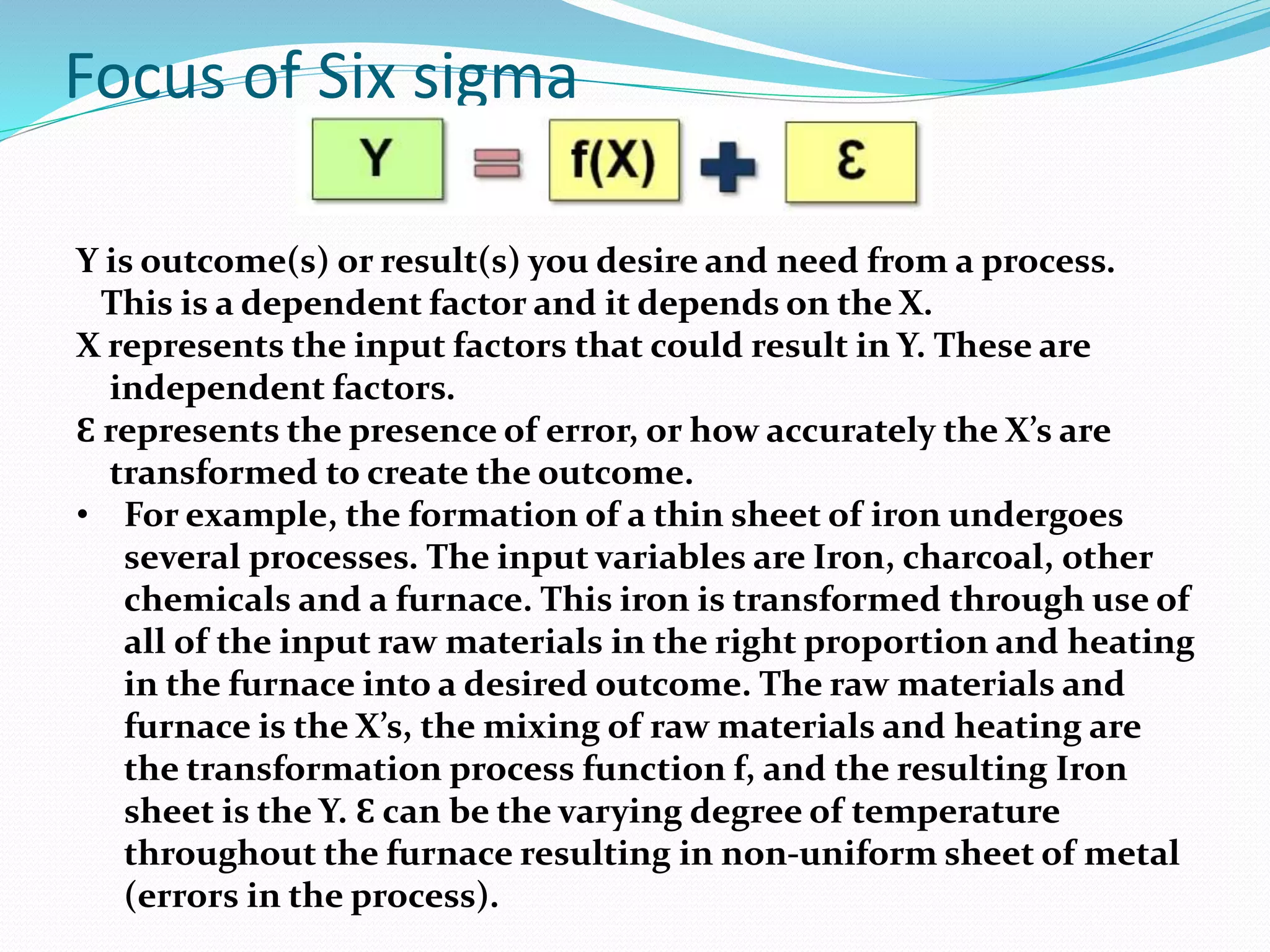
Y is outcome(s) or result(s) you desire and need from a process.
This is a dependent factor and it depends on the X.
X represents the input factors that could result in Y. These are
independent factors.
Ɛ represents the presence of error, or how accurately the X’s are
transformed to create the outcome.
• For example, the formation of a thin sheet of iron undergoes
several processes. The input variables are Iron, charcoal, other
chemicals and a furnace. This iron is transformed through use of
all of the input raw materials in the right proportion and heating
in the furnace into a desired outcome. The raw materials and
furnace is the X’s, the mixing of raw materials and heating are
the transformation process function f, and the resulting Iron
sheet is the Y. Ɛ can be the varying degree of temperature
throughout the furnace resulting in non-uniform sheet of metal
(errors in the process).
References :
 ISO : Quality Management Principle
 The Quality Management Sourcebook by Christine
Avery and Diane zabel.
 Juran’s Quality Handbook fifth edition
 https://en.m.wikipedia.org/wiki/Six _sigma
Six sigma

Six sigma

  • 1.
    PHARMACEUTICAL QUALITY MANAGEMENT GUIDEDBY Dr. A.D.KULKARNI HOD OF pqa PREPARED BY VINAYAK R BODHANKAR M PHARM (SEM-I) P’CEUTICAL QUALITY ASSURANCE ROLL NO. : 01 Sanjivani College of Pharmaceutical Education & Research, Kopargaon
  • 2.
    Contents  Basics ofQuality management  Total Quality Management - Introduction to TQM - Principles of TQM - Six basic concepts of TQM - 6 C’s of TQM  Six sigma  References
  • 3.
    Basics of QualityManagement  Quality word oriented from Latin word ‘Qualitus’ it means General excellence OR distinctive feature.  Definitions of “Quality”
  • 4.
     There areso many quality gurus who are first get aware about need if quality and started the evaluation of quality management at industrial level. some of them are as follows....  Dr. Joseph Juran He believes that there are no shortcut of quality, it is neither an accidental not it happens overnight. Quality must be planned.  Dr. W. Edward Deming He is well known for the work that he carried out in Japan in the field of quality. He Create purpose of continuous improvement in product and services  Philip B. Crosby He defines the Quality as a “Conformance with the requirements”
  • 5.
    Dimensions of Quality Performance Feature  Reliability  Perceived quality  Aesthetics  Durability  Conformance  serviceability
  • 6.
    Quality Management  Qualitymanagement ensures that an organization, product or service is consistent.  It has four main components:  Quality planning  Quality assurance  Quality control  Quality improvement  Quality management is focused not only on product and service quality, but also on the means to achieve it.
  • 7.
    Principles of Qualitymanagement  The International Standard for Quality management (ISO 9001:2015) adopts a number of management principles, that can be used by top management to guide their organizations towards improved performance.  Customer focus  Leadership  Engagement of people  Process approach  Improvement  Evidence based decision making  Relationship management  Criticism
  • 8.
    Total Quality Management Total –Made up of the whole or Complete.  Quality –Degree of Excellence a product or service provides to the customer in present and future.  Management –Act , art, or manner of handling , controlling, directing, etc.  TQM is the art of managing the whole to achieve excellence  It is a system of management based on the principle that every member of staff must be committed to maintaining high standards of work in every aspect of a company's operations.
  • 9.
    Principles of TQM Total Quality Management has a number of basic principles which can be converted to the figure below
  • 10.
    Six basic conceptsof TQM 1. A committed and involved management to provide long term top – to – bottom organization support. 2. A focus on the customer, both internally and externally. 3. Effective involvement and utilization of the entire work force. 4. Continuous improvement of the business and production 5. Treating suppliers of the business and production process. 6. Establishing the performance measures
  • 11.
    6C’s of TQM The most important purpose for the implementation of a TQM process is to get the assigned task completed at the right time and with quality improvement.  The Six Cs for successful implementation of a Total Quality Management (TQM) process are depicted as follows:
  • 12.
    Six sigma (6σ) Six Sigma (6σ) is a set of techniques and tools for process improvement.  It was introduced by engineer Bill Smith while working at Motorola in 1986.  Six Sigma strategies seek to improve the quality of the output of a process by identifying and removing the causes of defects and minimizing variability in manufacturing and business processes.  Six sigma is a business statistical Strategy used to identifying defects and removing them from the process of products to improve quality.
  • 13.
     Quality managementprogram developed by Motorola in the 1980s.  Management philosophy focused on business process improvements to:  Eliminate waste, rework, and mistakes  Increase customer satisfaction  Increase profitability and competitiveness
  • 14.
  • 15.
    DMAIC  It refersto a data-driven quality strategy for improving processes. This methodology is used to improve an existing business process.  Define − Define the problem or project goal that needs to be addressed.  Measure − Measure the problem and process from which it was produced.  Analyze − Analyze data and process to determine root causes of defects and opportunities.  Improve − Improve the process by finding solutions to fix, diminish and prevent future problems.  Control − Implement, control, and sustain the improvements solutions to keep the process on the new course.
  • 16.
    DMADV  It refersto a data-driven quality strategy for designing products & processes. This methodology is used to create new product designs or process designs in such a way that it results in a more predictable, mature and defect free performance.  Define − Define the Problem or Project Goal that needs to be addressed.  Measure − Measure and determine customers needs and specifications.  Analyze − Analyze the process to meet the customer needs.  Design − Design a process that will meet customers needs.  Verify − Verify the design performance and ability to meet customer needs.
  • 17.
    Focus of Sixsigma Y is outcome(s) or result(s) you desire and need from a process. This is a dependent factor and it depends on the X. X represents the input factors that could result in Y. These are independent factors. Ɛ represents the presence of error, or how accurately the X’s are transformed to create the outcome. • For example, the formation of a thin sheet of iron undergoes several processes. The input variables are Iron, charcoal, other chemicals and a furnace. This iron is transformed through use of all of the input raw materials in the right proportion and heating in the furnace into a desired outcome. The raw materials and furnace is the X’s, the mixing of raw materials and heating are the transformation process function f, and the resulting Iron sheet is the Y. Ɛ can be the varying degree of temperature throughout the furnace resulting in non-uniform sheet of metal (errors in the process).
  • 18.
    References :  ISO: Quality Management Principle  The Quality Management Sourcebook by Christine Avery and Diane zabel.  Juran’s Quality Handbook fifth edition  https://en.m.wikipedia.org/wiki/Six _sigma