1
ICH GUIDELINES FOR
STABILITY STUDIES
presented By:-
MR. SATPUTE VISHNU DATTATRAY.
M.PHARM 1st YEAR (2015-2016)
DEPARMENT OF QUALITY ASSURANCE
R.C.Patel Instiute of Pharmaceutical Education &
Research, Shirpur
6/14/2016
CONTENTS:-
 Q1A(R2)-Stability Testing of New Drug Substances &
Products
 Q1B- Photo stability Testing of New Drug Substances &
Products
 Q1C-Stability Testing for New Dosage Forms
 Q1D-Bracketing and Matrixing Designs for Stability Testing
of New Drug Substances and Products
 Q1E-Evaluation for stability data
 Q1F-Stability Data Package for Registration Applications in
Climatic Zones III and IV
 Conclusions
 References
26/14/2016
ICHguidelineQ1-A(stabilitystudies)
Objectives of the Guideline :-
The guideline defines the stability data package for a new drug substance
or drug product that is sufficient for a registration application within the
three regions of the EC, Japan, and the United States.
Scope:-
Addresses the information to be submitted in registration
applications for new molecular entities and associated drug product
General Principles :-
To provide evidence on how the quality of a drug substance or drug
product varies with time under the influence of a variety of environmental
factors such as temperature, humidity, and light.
To establish a retest period for the drug substance or a shelf life for the
drug product and recommending storage conditions.
36/14/2016
STRESSTESTING
 To validate the stability indicating power of the analytical procedures.
 To identify stability-affecting factors such as ambient temperature, humidity
and light and to select packing materials which protects the formulation
against such effects
 To identify potential degradants of the API and assess if they can be formed
during manufacture or storage of the formulation
 To select manufacturing process for particular drug substance
6/14/2016 4
6/14/2016 5
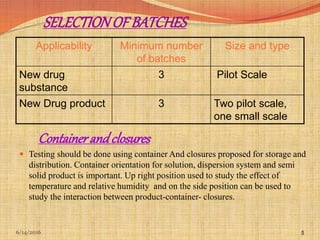
SELECTIONOF BATCHES
Containerandclosures
 Testing should be done using container And closures proposed for storage and
distribution. Container orientation for solution, dispersion system and semi
solid product is important. Up right position used to study the effect of
temperature and relative humidity and on the side position can be used to
study the interaction between product-container- closures.
Applicability Minimum number
of batches
Size and type
New drug
substance
3 Pilot Scale
New Drug product 3 Two pilot scale,
one small scale
5
6/14/2016 6
SPECIFICATION
• list of tests,
• reference to analytical procedure,
• proposed acceptance criteria
Test Attributes
• attributes that are susceptible to changed storage,
• influence quality, safety and/or efficacy
• Should cover physical, chemical, biological and microbiological attributes.
Testingfrequency
For long term stability:-
Normally be every three month over the first year, every six month over the
second year, and annually there after through the proposed shelf life.
For accelerated stability study:-
 A minimum three time point including initial and final time point (e.g. 0,3,and 6
month) from a six month study is recommended.
For intermediate stability study :-
A minimum of four point including initial and final point from a 12 month study.
Storagecondition
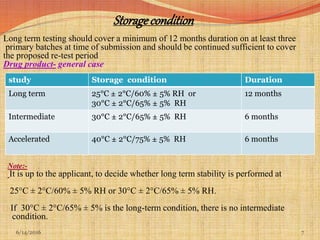
Long term testing should cover a minimum of 12 months duration on at least three
primary batches at time of submission and should be continued sufficient to cover
the proposed re-test period
Drug product- general case
Note:-
 It is up to the applicant, to decide whether long term stability is performed at
25°C ± 2°C/60% ± 5% RH or 30°C ± 2°C/65% ± 5% RH.
 If 30°C ± 2°C/65% ± 5% is the long-term condition, there is no intermediate
condition.
76/14/2016
study Storage condition Duration
Long term 25°C ± 2°C/60% ± 5% RH or
30°C ± 2°C/65% ± 5% RH
12 months
Intermediate 30°C ± 2°C/65% ± 5% RH 6 months
Accelerated 40°C ± 2°C/75% ± 5% RH 6 months
6/14/2016 8
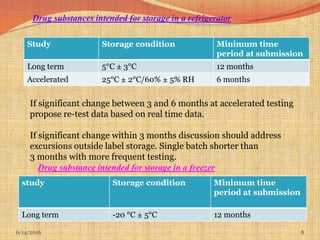
Study Storage condition Minimum time
period at submission
Long term 5°C ± 3°C 12 months
Accelerated 25°C ± 2°C/60% ± 5% RH 6 months
Drug substances intended for storage in a refrigerator
If significant change between 3 and 6 months at accelerated testing
propose re-test data based on real time data.
If significant change within 3 months discussion should address
excursions outside label storage. Single batch shorter than
3 months with more frequent testing.
study Storage condition Minimum time
period at submission
Long term -20 °C ± 5°C 12 months
Drug substance intended for storage in a freezer
StabilityCommitment
• long term stability data do not cover proposed re-test period granted at time
of approval, commitment should be made to continue post approval to
establish re-test period
• Not required for Submission which includes data from 3 production
batches, commitment to continue through proposed re-test period.
• Fewer than three production batches commitment continue with these
studies through proposed re-test period and place additional production
batches to a total of three on long term stability through proposed re-test
period
• No Production batches commitment to place first three production batches
on long term stability studies through proposed re-test period.
6/14/2016 9
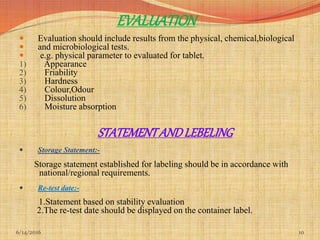
EVALUATION
 Evaluation should include results from the physical, chemical,biological
 and microbiological tests.
 e.g. physical parameter to evaluated for tablet.
1) Appearance
2) Friability
3) Hardness
4) Colour,Odour
5) Dissolution
6) Moisture absorption
STATEMENTANDLEBELING
 Storage Statement:-
Storage statement established for labeling should be in accordance with
national/regional requirements.
 Re-test date:-
1.Statement based on stability evaluation
2.The re-test date should be displayed on the container label.
6/14/2016 10
Photostabilitytesting: Q1-B
6/14/2016 11
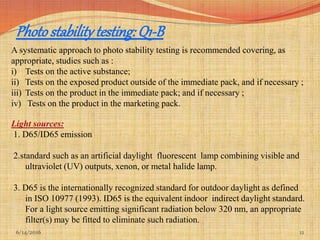
A systematic approach to photo stability testing is recommended covering, as
appropriate, studies such as :
i) Tests on the active substance;
ii) Tests on the exposed product outside of the immediate pack, and if necessary ;
iii) Tests on the product in the immediate pack; and if necessary ;
iv) Tests on the product in the marketing pack.
Light sources:
1. D65/ID65 emission
2.standard such as an artificial daylight fluorescent lamp combining visible and
ultraviolet (UV) outputs, xenon, or metal halide lamp.
3. D65 is the internationally recognized standard for outdoor daylight as defined
in ISO 10977 (1993). ID65 is the equivalent indoor indirect daylight standard.
For a light source emitting significant radiation below 320 nm, an appropriate
filter(s) may be fitted to eliminate such radiation.
NEWDOSAGEFORMS-Q1C
6/14/2016 12
definition:
A new dosage form is defined as a medicinal product which is a different
pharmaceutical product type, but containing the same active substance as
included in an existing product approved by the pertinent regulatory
authority.
Include:
products of a different route of administration (e.g., oral to parenteral), new
specific functionality/delivery systems (e.g., immediate release tablet to
modified release tablet) and different dosage forms of the same route of
administration (e.g., capsule to tablet, solution to suspension).
Stability protocols for new dosage forms should follow the guidance in the
parent stability guideline in principle. However, a reduced stability database
at submission time may be acceptable with proper justification.
e.g., 6 months accelerated and 6 months long term data from ongoing
studies may be acceptable in certain justified cases.
STABILITYTESTPARAMETERSFORVARIOUS
TYPESOF PRODUCTS
6/14/2016 13
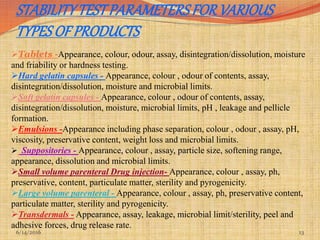
Tablets -Appearance, colour, odour, assay, disintegration/dissolution, moisture
and friability or hardness testing.
Hard gelatin capsules - Appearance, colour , odour of contents, assay,
disintegration/dissolution, moisture and microbial limits.
Soft gelatin capsules - Appearance, colour , odour of contents, assay,
disintegration/dissolution, moisture, microbial limits, pH , leakage and pellicle
formation.
Emulsions -Appearance including phase separation, colour , odour , assay, pH,
viscosity, preservative content, weight loss and microbial limits.
 Suppositories - Appearance, colour , assay, particle size, softening range,
appearance, dissolution and microbial limits.
Small volume parenteral Drug injection- Appearance, colour , assay, ph,
preservative, content, particulate matter, sterility and pyrogenicity.
Large volume parenteral - Appearance, colour , assay, ph, preservative content,
particulate matter, sterility and pyrogenicity.
Transdermals - Appearance, assay, leakage, microbial limit/sterility, peel and
adhesive forces, drug release rate.
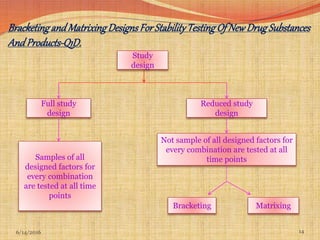
BracketingandMatrixingDesignsFor StabilityTestingOf NewDrugSubstances
AndProducts-Q1D.
6/14/2016 14
Full study
design
Reduced study
design
Samples of all
designed factors for
every combination
are tested at all time
points
Not sample of all designed factors for
every combination are tested at all
time points
Bracketing Matrixing
Study
design
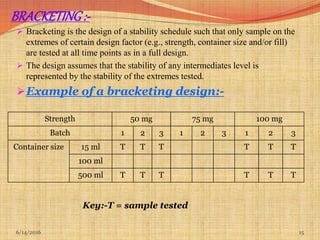
BRACKETING:-
 Bracketing is the design of a stability schedule such that only sample on the
extremes of certain design factor (e.g., strength, container size and/or fill)
are tested at all time points as in a full design.
 The design assumes that the stability of any intermediates level is
represented by the stability of the extremes tested.
Example of a bracketing design:-
Key:-T = sample tested
6/14/2016 15
Strength 50 mg 75 mg 100 mg
Batch 1 2 3 1 2 3 1 2 3
Container size 15 ml T T T T T T
100 ml
500 ml T T T T T T
MATRIXING:-
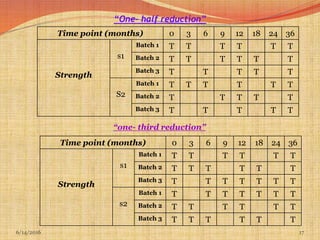
 Matrixing is the design of a stability schedule such that a selected subset of
the total number of possible samples for all factor combination would be
tested at a specified time point.
 At a subsequent time point, another subset of sample for all factor
combinations would be tested.
 The design assumes that the stability of each subset of samples tested
represents the stability of all samples at a given time.
6/14/2016 16
“One- half reduction”
6/14/2016 17
Time point (months) 0 3 6 9 12 18 24 36
Strength
s1
Batch 1 T T T T T T
Batch 2 T T T T T T
Batch 3 T T T T T
S2
Batch 1 T T T T T T
Batch 2 T T T T T
Batch 3 T T T T T
Time point (months) 0 3 6 9 12 18 24 36
Strength
s1
Batch 1 T T T T T T
Batch 2 T T T T T T
Batch 3 T T T T T T T
s2
Batch 1 T T T T T T T
Batch 2 T T T T T T
Batch 3 T T T T T T
“one- third reduction”
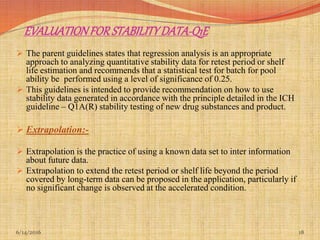
EVALUATIONFORSTABILITYDATA-Q1E
 The parent guidelines states that regression analysis is an appropriate
approach to analyzing quantitative stability data for retest period or shelf
life estimation and recommends that a statistical test for batch for pool
ability be performed using a level of significance of 0.25.
 This guidelines is intended to provide recommendation on how to use
stability data generated in accordance with the principle detailed in the ICH
guideline – Q1A(R) stability testing of new drug substances and product.
 Extrapolation:-
 Extrapolation is the practice of using a known data set to inter information
about future data.
 Extrapolation to extend the retest period or shelf life beyond the period
covered by long-term data can be proposed in the application, particularly if
no significant change is observed at the accelerated condition.
6/14/2016 18
STABILITYDATAPACKAGEFORREGISTRATIONAPPLICATIONSIN
CLIMATICZONESIII ANDIV-Q1F
 A product shelf life should be established according to climatic conditions
in which the product is to be marketed.
 Storage condition recommended by manufactures on the basis of stability
studies are meant to guarantee the maintenance of quality, safety and
efficacy throughout the shelf-life of product.
 Temperature and humidity determine the storage conditions and so they
greatly affect the stability of drug product.
 Climatic conditions in countries where the product is to be marketed should
be carefully.
6/14/2016 19
6/14/2016 20
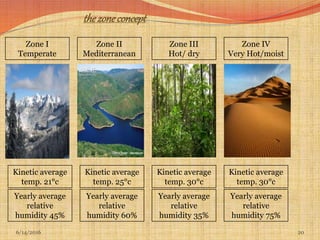
thezoneconcept
Zone I
Temperate
Zone II
Mediterranean
Zone III
Hot/ dry
Zone IV
Very Hot/moist
Kinetic average
temp. 21°c
Kinetic average
temp. 25°c
Kinetic average
temp. 30°c
Kinetic average
temp. 30°c
Yearly average
relative
humidity 45%
Yearly average
relative
humidity 60%
Yearly average
relative
humidity 35%
Yearly average
relative
humidity 75%
 Stability studies should be planned on the basis of pharmaceutical R+D
and regulatory requirements.
 Forced degradation studies reveal the intrinsic chemical properties of the
API, while formal stability studies establish the retest date.
 The shelf life (expiry date) of FPPs is derived from formal stability studies.
 Variability and time trends of stability data must be evaluated by the
manufacturer in order to propose a retest date or expiry date.
216/14/2016
REFERENCES:-
 ICH official web site. www.ich.org
 http://www.ich.org/products/guidlines/quality/article/quality-guidelines.html
 www.ema.europa.eu/pdfs/human/ich/273699en.pdf
 Manohar Potdar ‘Pharmaceutical Quality Assurance’ Nirali prakashan 8.1 -8.42
 The role of bracketing and matrixing in efficient design of stability protocols
December 01,2005 by Ray Munden Pharmaceutical Technology Europe
226/14/2016
6/14/2016 23

ICH Guidlines for stability studies

  • 1.
    1 ICH GUIDELINES FOR STABILITYSTUDIES presented By:- MR. SATPUTE VISHNU DATTATRAY. M.PHARM 1st YEAR (2015-2016) DEPARMENT OF QUALITY ASSURANCE R.C.Patel Instiute of Pharmaceutical Education & Research, Shirpur 6/14/2016
  • 2.
    CONTENTS:-  Q1A(R2)-Stability Testingof New Drug Substances & Products  Q1B- Photo stability Testing of New Drug Substances & Products  Q1C-Stability Testing for New Dosage Forms  Q1D-Bracketing and Matrixing Designs for Stability Testing of New Drug Substances and Products  Q1E-Evaluation for stability data  Q1F-Stability Data Package for Registration Applications in Climatic Zones III and IV  Conclusions  References 26/14/2016
  • 3.
    ICHguidelineQ1-A(stabilitystudies) Objectives of theGuideline :- The guideline defines the stability data package for a new drug substance or drug product that is sufficient for a registration application within the three regions of the EC, Japan, and the United States. Scope:- Addresses the information to be submitted in registration applications for new molecular entities and associated drug product General Principles :- To provide evidence on how the quality of a drug substance or drug product varies with time under the influence of a variety of environmental factors such as temperature, humidity, and light. To establish a retest period for the drug substance or a shelf life for the drug product and recommending storage conditions. 36/14/2016
  • 4.
    STRESSTESTING  To validatethe stability indicating power of the analytical procedures.  To identify stability-affecting factors such as ambient temperature, humidity and light and to select packing materials which protects the formulation against such effects  To identify potential degradants of the API and assess if they can be formed during manufacture or storage of the formulation  To select manufacturing process for particular drug substance 6/14/2016 4
  • 5.
    6/14/2016 5 SELECTIONOF BATCHES Containerandclosures Testing should be done using container And closures proposed for storage and distribution. Container orientation for solution, dispersion system and semi solid product is important. Up right position used to study the effect of temperature and relative humidity and on the side position can be used to study the interaction between product-container- closures. Applicability Minimum number of batches Size and type New drug substance 3 Pilot Scale New Drug product 3 Two pilot scale, one small scale 5
  • 6.
    6/14/2016 6 SPECIFICATION • listof tests, • reference to analytical procedure, • proposed acceptance criteria Test Attributes • attributes that are susceptible to changed storage, • influence quality, safety and/or efficacy • Should cover physical, chemical, biological and microbiological attributes. Testingfrequency For long term stability:- Normally be every three month over the first year, every six month over the second year, and annually there after through the proposed shelf life. For accelerated stability study:-  A minimum three time point including initial and final time point (e.g. 0,3,and 6 month) from a six month study is recommended. For intermediate stability study :- A minimum of four point including initial and final point from a 12 month study.
  • 7.
    Storagecondition Long term testingshould cover a minimum of 12 months duration on at least three primary batches at time of submission and should be continued sufficient to cover the proposed re-test period Drug product- general case Note:-  It is up to the applicant, to decide whether long term stability is performed at 25°C ± 2°C/60% ± 5% RH or 30°C ± 2°C/65% ± 5% RH.  If 30°C ± 2°C/65% ± 5% is the long-term condition, there is no intermediate condition. 76/14/2016 study Storage condition Duration Long term 25°C ± 2°C/60% ± 5% RH or 30°C ± 2°C/65% ± 5% RH 12 months Intermediate 30°C ± 2°C/65% ± 5% RH 6 months Accelerated 40°C ± 2°C/75% ± 5% RH 6 months
  • 8.
    6/14/2016 8 Study Storagecondition Minimum time period at submission Long term 5°C ± 3°C 12 months Accelerated 25°C ± 2°C/60% ± 5% RH 6 months Drug substances intended for storage in a refrigerator If significant change between 3 and 6 months at accelerated testing propose re-test data based on real time data. If significant change within 3 months discussion should address excursions outside label storage. Single batch shorter than 3 months with more frequent testing. study Storage condition Minimum time period at submission Long term -20 °C ± 5°C 12 months Drug substance intended for storage in a freezer
  • 9.
    StabilityCommitment • long termstability data do not cover proposed re-test period granted at time of approval, commitment should be made to continue post approval to establish re-test period • Not required for Submission which includes data from 3 production batches, commitment to continue through proposed re-test period. • Fewer than three production batches commitment continue with these studies through proposed re-test period and place additional production batches to a total of three on long term stability through proposed re-test period • No Production batches commitment to place first three production batches on long term stability studies through proposed re-test period. 6/14/2016 9
  • 10.
    EVALUATION  Evaluation shouldinclude results from the physical, chemical,biological  and microbiological tests.  e.g. physical parameter to evaluated for tablet. 1) Appearance 2) Friability 3) Hardness 4) Colour,Odour 5) Dissolution 6) Moisture absorption STATEMENTANDLEBELING  Storage Statement:- Storage statement established for labeling should be in accordance with national/regional requirements.  Re-test date:- 1.Statement based on stability evaluation 2.The re-test date should be displayed on the container label. 6/14/2016 10
  • 11.
    Photostabilitytesting: Q1-B 6/14/2016 11 Asystematic approach to photo stability testing is recommended covering, as appropriate, studies such as : i) Tests on the active substance; ii) Tests on the exposed product outside of the immediate pack, and if necessary ; iii) Tests on the product in the immediate pack; and if necessary ; iv) Tests on the product in the marketing pack. Light sources: 1. D65/ID65 emission 2.standard such as an artificial daylight fluorescent lamp combining visible and ultraviolet (UV) outputs, xenon, or metal halide lamp. 3. D65 is the internationally recognized standard for outdoor daylight as defined in ISO 10977 (1993). ID65 is the equivalent indoor indirect daylight standard. For a light source emitting significant radiation below 320 nm, an appropriate filter(s) may be fitted to eliminate such radiation.
  • 12.
    NEWDOSAGEFORMS-Q1C 6/14/2016 12 definition: A newdosage form is defined as a medicinal product which is a different pharmaceutical product type, but containing the same active substance as included in an existing product approved by the pertinent regulatory authority. Include: products of a different route of administration (e.g., oral to parenteral), new specific functionality/delivery systems (e.g., immediate release tablet to modified release tablet) and different dosage forms of the same route of administration (e.g., capsule to tablet, solution to suspension). Stability protocols for new dosage forms should follow the guidance in the parent stability guideline in principle. However, a reduced stability database at submission time may be acceptable with proper justification. e.g., 6 months accelerated and 6 months long term data from ongoing studies may be acceptable in certain justified cases.
  • 13.
    STABILITYTESTPARAMETERSFORVARIOUS TYPESOF PRODUCTS 6/14/2016 13 Tablets-Appearance, colour, odour, assay, disintegration/dissolution, moisture and friability or hardness testing. Hard gelatin capsules - Appearance, colour , odour of contents, assay, disintegration/dissolution, moisture and microbial limits. Soft gelatin capsules - Appearance, colour , odour of contents, assay, disintegration/dissolution, moisture, microbial limits, pH , leakage and pellicle formation. Emulsions -Appearance including phase separation, colour , odour , assay, pH, viscosity, preservative content, weight loss and microbial limits.  Suppositories - Appearance, colour , assay, particle size, softening range, appearance, dissolution and microbial limits. Small volume parenteral Drug injection- Appearance, colour , assay, ph, preservative, content, particulate matter, sterility and pyrogenicity. Large volume parenteral - Appearance, colour , assay, ph, preservative content, particulate matter, sterility and pyrogenicity. Transdermals - Appearance, assay, leakage, microbial limit/sterility, peel and adhesive forces, drug release rate.
  • 14.
    BracketingandMatrixingDesignsFor StabilityTestingOf NewDrugSubstances AndProducts-Q1D. 6/14/201614 Full study design Reduced study design Samples of all designed factors for every combination are tested at all time points Not sample of all designed factors for every combination are tested at all time points Bracketing Matrixing Study design
  • 15.
    BRACKETING:-  Bracketing isthe design of a stability schedule such that only sample on the extremes of certain design factor (e.g., strength, container size and/or fill) are tested at all time points as in a full design.  The design assumes that the stability of any intermediates level is represented by the stability of the extremes tested. Example of a bracketing design:- Key:-T = sample tested 6/14/2016 15 Strength 50 mg 75 mg 100 mg Batch 1 2 3 1 2 3 1 2 3 Container size 15 ml T T T T T T 100 ml 500 ml T T T T T T
  • 16.
    MATRIXING:-  Matrixing isthe design of a stability schedule such that a selected subset of the total number of possible samples for all factor combination would be tested at a specified time point.  At a subsequent time point, another subset of sample for all factor combinations would be tested.  The design assumes that the stability of each subset of samples tested represents the stability of all samples at a given time. 6/14/2016 16
  • 17.
    “One- half reduction” 6/14/201617 Time point (months) 0 3 6 9 12 18 24 36 Strength s1 Batch 1 T T T T T T Batch 2 T T T T T T Batch 3 T T T T T S2 Batch 1 T T T T T T Batch 2 T T T T T Batch 3 T T T T T Time point (months) 0 3 6 9 12 18 24 36 Strength s1 Batch 1 T T T T T T Batch 2 T T T T T T Batch 3 T T T T T T T s2 Batch 1 T T T T T T T Batch 2 T T T T T T Batch 3 T T T T T T “one- third reduction”
  • 18.
    EVALUATIONFORSTABILITYDATA-Q1E  The parentguidelines states that regression analysis is an appropriate approach to analyzing quantitative stability data for retest period or shelf life estimation and recommends that a statistical test for batch for pool ability be performed using a level of significance of 0.25.  This guidelines is intended to provide recommendation on how to use stability data generated in accordance with the principle detailed in the ICH guideline – Q1A(R) stability testing of new drug substances and product.  Extrapolation:-  Extrapolation is the practice of using a known data set to inter information about future data.  Extrapolation to extend the retest period or shelf life beyond the period covered by long-term data can be proposed in the application, particularly if no significant change is observed at the accelerated condition. 6/14/2016 18
  • 19.
    STABILITYDATAPACKAGEFORREGISTRATIONAPPLICATIONSIN CLIMATICZONESIII ANDIV-Q1F  Aproduct shelf life should be established according to climatic conditions in which the product is to be marketed.  Storage condition recommended by manufactures on the basis of stability studies are meant to guarantee the maintenance of quality, safety and efficacy throughout the shelf-life of product.  Temperature and humidity determine the storage conditions and so they greatly affect the stability of drug product.  Climatic conditions in countries where the product is to be marketed should be carefully. 6/14/2016 19
  • 20.
    6/14/2016 20 thezoneconcept Zone I Temperate ZoneII Mediterranean Zone III Hot/ dry Zone IV Very Hot/moist Kinetic average temp. 21°c Kinetic average temp. 25°c Kinetic average temp. 30°c Kinetic average temp. 30°c Yearly average relative humidity 45% Yearly average relative humidity 60% Yearly average relative humidity 35% Yearly average relative humidity 75%
  • 21.
     Stability studiesshould be planned on the basis of pharmaceutical R+D and regulatory requirements.  Forced degradation studies reveal the intrinsic chemical properties of the API, while formal stability studies establish the retest date.  The shelf life (expiry date) of FPPs is derived from formal stability studies.  Variability and time trends of stability data must be evaluated by the manufacturer in order to propose a retest date or expiry date. 216/14/2016
  • 22.
    REFERENCES:-  ICH officialweb site. www.ich.org  http://www.ich.org/products/guidlines/quality/article/quality-guidelines.html  www.ema.europa.eu/pdfs/human/ich/273699en.pdf  Manohar Potdar ‘Pharmaceutical Quality Assurance’ Nirali prakashan 8.1 -8.42  The role of bracketing and matrixing in efficient design of stability protocols December 01,2005 by Ray Munden Pharmaceutical Technology Europe 226/14/2016
  • 23.

Editor's Notes