PRESENTED BY:
DARSHIL SHAH
(M.PHARM 1st year)
GUIDED BY:
DR. HETAL THAKKAR
WHAT IS DRUG STABILITY:
 Ability of the pharmaceutical dosage form
to maintain the physical, chemical,
therapeutic and microbial properties during
the time of storage and usage by the
patient.
 It is measured by the rate of changes that
take place in the pharmaceutical dosage
forms
OBJECTIVE OF ICH GUIDELINES:
 The International Council for Harmonization of
Technical Requirements for Pharmaceuticals for
Human Use (ICH) is an initiative that brings together
regulatory authorities and pharmaceutical industry to
discuss scientific and technical aspects of
pharmaceutical product development and
registration.
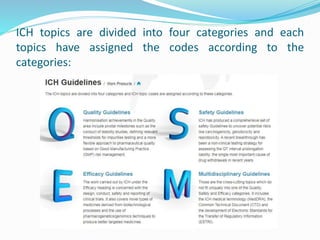
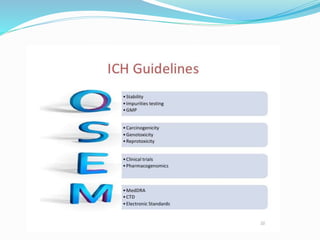
ICH topics are divided into four categories and each
topics have assigned the codes according to the
categories:
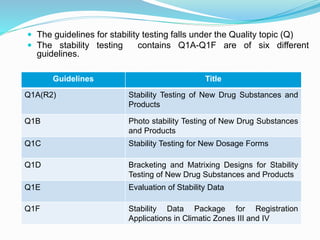
 The guidelines for stability testing falls under the Quality topic (Q)
 The stability testing contains Q1A-Q1F are of six different
guidelines.
Guidelines Title
Q1A(R2) Stability Testing of New Drug Substances and
Products
Q1B Photo stability Testing of New Drug Substances
and Products
Q1C Stability Testing for New Dosage Forms
Q1D Bracketing and Matrixing Designs for Stability
Testing of New Drug Substances and Products
Q1E Evaluation of Stability Data
Q1F Stability Data Package for Registration
Applications in Climatic Zones III and IV
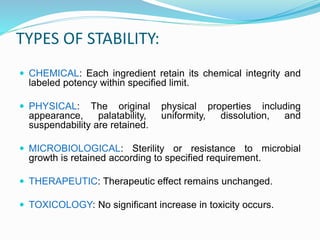
TYPES OF STABILITY:
 CHEMICAL: Each ingredient retain its chemical integrity and
labeled potency within specified limit.
 PHYSICAL: The original physical properties including
appearance, palatability, uniformity, dissolution, and
suspendability are retained.
 MICROBIOLOGICAL: Sterility or resistance to microbial
growth is retained according to specified requirement.
 THERAPEUTIC: Therapeutic effect remains unchanged.
 TOXICOLOGY: No significant increase in toxicity occurs.
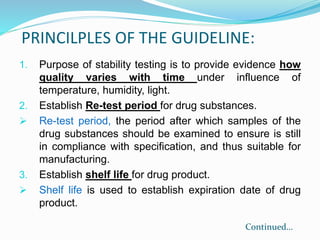
PRINCILPLES OF THE GUIDELINE:
1. Purpose of stability testing is to provide evidence how
quality varies with time under influence of
temperature, humidity, light.
2. Establish Re-test period for drug substances.
 Re-test period, the period after which samples of the
drug substances should be examined to ensure is still
in compliance with specification, and thus suitable for
manufacturing.
3. Establish shelf life for drug product.
 Shelf life is used to establish expiration date of drug
product.
Continued…
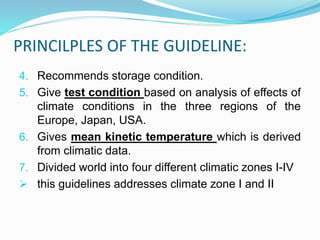
PRINCILPLES OF THE GUIDELINE:
4. Recommends storage condition.
5. Give test condition based on analysis of effects of
climate conditions in the three regions of the
Europe, Japan, USA.
6. Gives mean kinetic temperature which is derived
from climatic data.
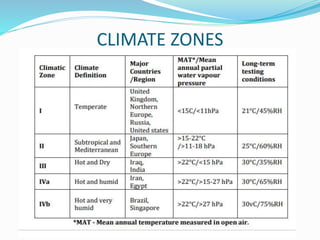
7. Divided world into four different climatic zones I-IV
 this guidelines addresses climate zone I and II
CLIMATE ZONES
STABILITY TESTING PROTOCOL:
 Stability testing is the systematic approach towards drug
development process.
 The protocol for stability testing is a pre-requisite for starting stability
testing and is necessarily a written document that describes the key
components of a regulated and well-controlled stability study.
 A well designed stability protocol should contain the following
information:
 Number of Batches
 Containers and closures
 Orientation of storage of containers
 Sampling time points
 Test storage conditions
 Test parameters
 Test methodology
 Acceptance criteria
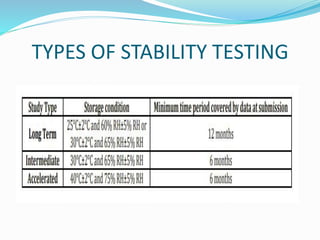
TYPES OF STABILITY TESTING
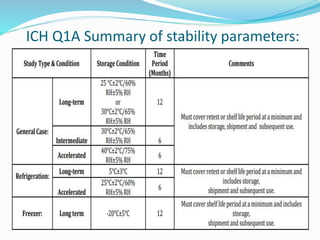
ICH Q1A Summary of stability parameters:
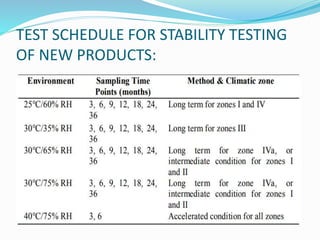
TEST SCHEDULE FOR STABILITY TESTING
OF NEW PRODUCTS:
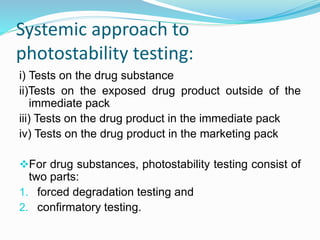
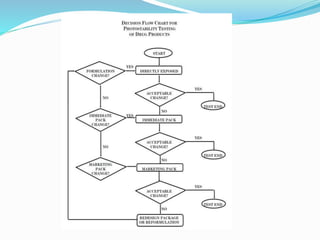
Systemic approach to
photostability testing:
i) Tests on the drug substance
ii)Tests on the exposed drug product outside of the
immediate pack
iii) Tests on the drug product in the immediate pack
iv) Tests on the drug product in the marketing pack
For drug substances, photostability testing consist of
two parts:
1. forced degradation testing and
2. confirmatory testing.
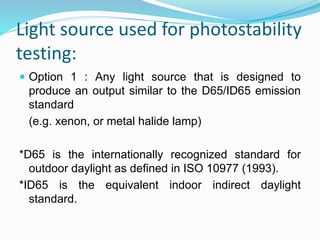
Light source used for photostability
testing:
 Option 1 : Any light source that is designed to
produce an output similar to the D65/ID65 emission
standard
(e.g. xenon, or metal halide lamp)
*D65 is the internationally recognized standard for
outdoor daylight as defined in ISO 10977 (1993).
*ID65 is the equivalent indoor indirect daylight
standard.
Light source used for photostability
testing:
 Option 2:the cool white fluorescent and near
ultraviolet lamp.
1. A cool white fluorescent lamp designed to produce
an output similar to that specified in ISO.
[D65 10977(1993)]
2. A near UV fluorescent lamp having a spectral
distribution from 320 nm to 400 nm
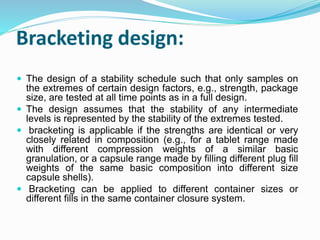
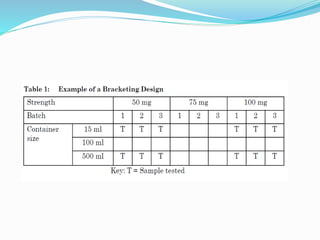
Bracketing design:
 The design of a stability schedule such that only samples on
the extremes of certain design factors, e.g., strength, package
size, are tested at all time points as in a full design.
 The design assumes that the stability of any intermediate
levels is represented by the stability of the extremes tested.
 bracketing is applicable if the strengths are identical or very
closely related in composition (e.g., for a tablet range made
with different compression weights of a similar basic
granulation, or a capsule range made by filling different plug fill
weights of the same basic composition into different size
capsule shells).
 Bracketing can be applied to different container sizes or
different fills in the same container closure system.
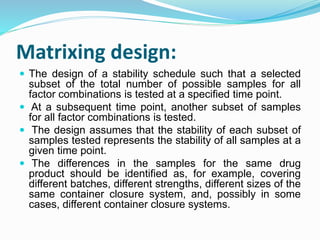
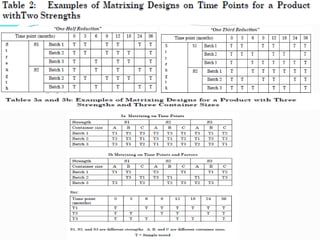
Matrixing design:
 The design of a stability schedule such that a selected
subset of the total number of possible samples for all
factor combinations is tested at a specified time point.
 At a subsequent time point, another subset of samples
for all factor combinations is tested.
 The design assumes that the stability of each subset of
samples tested represents the stability of all samples at a
given time point.
 The differences in the samples for the same drug
product should be identified as, for example, covering
different batches, different strengths, different sizes of the
same container closure system, and, possibly in some
cases, different container closure systems.
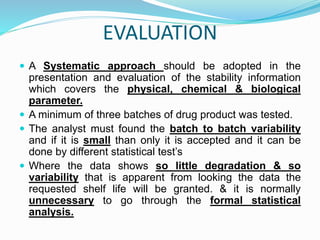
EVALUATION
 A Systematic approach should be adopted in the
presentation and evaluation of the stability information
which covers the physical, chemical & biological
parameter.
 A minimum of three batches of drug product was tested.
 The analyst must found the batch to batch variability
and if it is small than only it is accepted and it can be
done by different statistical test’s
 Where the data shows so little degradation & so
variability that is apparent from looking the data the
requested shelf life will be granted. & it is normally
unnecessary to go through the formal statistical
analysis.
Significant change for a drug product:
 A 5% change in assay from its initial value.
 Any degradation product exceeding its acceptance
criterion.
 Failure to meet the acceptance criteria for appearance,
physical attributes, and functionality test (e.g., color,
phase separation, resuspendibility, caking, hardness,
dose delivery per actuation); however, some changes in
physical attributes (e.g., softening of suppositories,
melting of creams) may be expected under accelerated
conditions.
STATEMENTS / LABELLING:
 A storage statement should be established based on
the stability evaluation of the drug substances.
 Terms such as “ambient conditions” or “room
temperature” should be avoided.
 Retest date should be displayed on the container
label if appropriate.
REFRENCES:
 https://www.ich.org/about/mission.html
 International journal of Applied Pharmaceutical and
Biological Research, 2017; 2(3): 67-75
 the World Health Organization (WHO) Technical
Report Series, No. 953, 2009 (1).
ICH Guidelines

ICH Guidelines

  • 1.
    PRESENTED BY: DARSHIL SHAH (M.PHARM1st year) GUIDED BY: DR. HETAL THAKKAR
  • 2.
    WHAT IS DRUGSTABILITY:  Ability of the pharmaceutical dosage form to maintain the physical, chemical, therapeutic and microbial properties during the time of storage and usage by the patient.  It is measured by the rate of changes that take place in the pharmaceutical dosage forms
  • 3.
    OBJECTIVE OF ICHGUIDELINES:  The International Council for Harmonization of Technical Requirements for Pharmaceuticals for Human Use (ICH) is an initiative that brings together regulatory authorities and pharmaceutical industry to discuss scientific and technical aspects of pharmaceutical product development and registration.
  • 4.
    ICH topics aredivided into four categories and each topics have assigned the codes according to the categories:
  • 6.
     The guidelinesfor stability testing falls under the Quality topic (Q)  The stability testing contains Q1A-Q1F are of six different guidelines. Guidelines Title Q1A(R2) Stability Testing of New Drug Substances and Products Q1B Photo stability Testing of New Drug Substances and Products Q1C Stability Testing for New Dosage Forms Q1D Bracketing and Matrixing Designs for Stability Testing of New Drug Substances and Products Q1E Evaluation of Stability Data Q1F Stability Data Package for Registration Applications in Climatic Zones III and IV
  • 7.
    TYPES OF STABILITY: CHEMICAL: Each ingredient retain its chemical integrity and labeled potency within specified limit.  PHYSICAL: The original physical properties including appearance, palatability, uniformity, dissolution, and suspendability are retained.  MICROBIOLOGICAL: Sterility or resistance to microbial growth is retained according to specified requirement.  THERAPEUTIC: Therapeutic effect remains unchanged.  TOXICOLOGY: No significant increase in toxicity occurs.
  • 8.
    PRINCILPLES OF THEGUIDELINE: 1. Purpose of stability testing is to provide evidence how quality varies with time under influence of temperature, humidity, light. 2. Establish Re-test period for drug substances.  Re-test period, the period after which samples of the drug substances should be examined to ensure is still in compliance with specification, and thus suitable for manufacturing. 3. Establish shelf life for drug product.  Shelf life is used to establish expiration date of drug product. Continued…
  • 9.
    PRINCILPLES OF THEGUIDELINE: 4. Recommends storage condition. 5. Give test condition based on analysis of effects of climate conditions in the three regions of the Europe, Japan, USA. 6. Gives mean kinetic temperature which is derived from climatic data. 7. Divided world into four different climatic zones I-IV  this guidelines addresses climate zone I and II
  • 10.
  • 11.
    STABILITY TESTING PROTOCOL: Stability testing is the systematic approach towards drug development process.  The protocol for stability testing is a pre-requisite for starting stability testing and is necessarily a written document that describes the key components of a regulated and well-controlled stability study.  A well designed stability protocol should contain the following information:  Number of Batches  Containers and closures  Orientation of storage of containers  Sampling time points  Test storage conditions  Test parameters  Test methodology  Acceptance criteria
  • 12.
  • 13.
    ICH Q1A Summaryof stability parameters:
  • 14.
    TEST SCHEDULE FORSTABILITY TESTING OF NEW PRODUCTS:
  • 15.
    Systemic approach to photostabilitytesting: i) Tests on the drug substance ii)Tests on the exposed drug product outside of the immediate pack iii) Tests on the drug product in the immediate pack iv) Tests on the drug product in the marketing pack For drug substances, photostability testing consist of two parts: 1. forced degradation testing and 2. confirmatory testing.
  • 16.
    Light source usedfor photostability testing:  Option 1 : Any light source that is designed to produce an output similar to the D65/ID65 emission standard (e.g. xenon, or metal halide lamp) *D65 is the internationally recognized standard for outdoor daylight as defined in ISO 10977 (1993). *ID65 is the equivalent indoor indirect daylight standard.
  • 17.
    Light source usedfor photostability testing:  Option 2:the cool white fluorescent and near ultraviolet lamp. 1. A cool white fluorescent lamp designed to produce an output similar to that specified in ISO. [D65 10977(1993)] 2. A near UV fluorescent lamp having a spectral distribution from 320 nm to 400 nm
  • 19.
    Bracketing design:  Thedesign of a stability schedule such that only samples on the extremes of certain design factors, e.g., strength, package size, are tested at all time points as in a full design.  The design assumes that the stability of any intermediate levels is represented by the stability of the extremes tested.  bracketing is applicable if the strengths are identical or very closely related in composition (e.g., for a tablet range made with different compression weights of a similar basic granulation, or a capsule range made by filling different plug fill weights of the same basic composition into different size capsule shells).  Bracketing can be applied to different container sizes or different fills in the same container closure system.
  • 21.
    Matrixing design:  Thedesign of a stability schedule such that a selected subset of the total number of possible samples for all factor combinations is tested at a specified time point.  At a subsequent time point, another subset of samples for all factor combinations is tested.  The design assumes that the stability of each subset of samples tested represents the stability of all samples at a given time point.  The differences in the samples for the same drug product should be identified as, for example, covering different batches, different strengths, different sizes of the same container closure system, and, possibly in some cases, different container closure systems.
  • 23.
    EVALUATION  A Systematicapproach should be adopted in the presentation and evaluation of the stability information which covers the physical, chemical & biological parameter.  A minimum of three batches of drug product was tested.  The analyst must found the batch to batch variability and if it is small than only it is accepted and it can be done by different statistical test’s  Where the data shows so little degradation & so variability that is apparent from looking the data the requested shelf life will be granted. & it is normally unnecessary to go through the formal statistical analysis.
  • 25.
    Significant change fora drug product:  A 5% change in assay from its initial value.  Any degradation product exceeding its acceptance criterion.  Failure to meet the acceptance criteria for appearance, physical attributes, and functionality test (e.g., color, phase separation, resuspendibility, caking, hardness, dose delivery per actuation); however, some changes in physical attributes (e.g., softening of suppositories, melting of creams) may be expected under accelerated conditions.
  • 26.
    STATEMENTS / LABELLING: A storage statement should be established based on the stability evaluation of the drug substances.  Terms such as “ambient conditions” or “room temperature” should be avoided.  Retest date should be displayed on the container label if appropriate.
  • 27.
    REFRENCES:  https://www.ich.org/about/mission.html  Internationaljournal of Applied Pharmaceutical and Biological Research, 2017; 2(3): 67-75  the World Health Organization (WHO) Technical Report Series, No. 953, 2009 (1).