REGULATORY REQUIREMENT
FOR EUROPE UNION
BY : SHRESTHA
1ST YEAR M.PHARMA
AL - AMEEN COLLEGE OF
PHARMACY
1
The Europe union
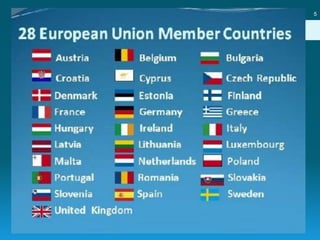
A political union also called as Europe union formed in 1993 for
purpose of achieving political and economic integration.
The EU includes 28 members states located in Europe .
The EU total population is about 500 millions people
The EU operates through a system of
1. Supranational independent institution
2. Intergovernmental negotiated decisions by its member of the
states .
It is legal entity and can negotiate international agreement on behalf
of its member states
In EU there are two regulatory steps by which a drug is approved in
the market
1. Clinical trials application [ approved at member state level]
2. Marketing authorization [approved by both member state and
centralized level]
2
REGULATION IN THE INDUSRTY
Pharmaceutical industry is most regulated of all the industries.
Regulations are put in order to develop the most efficient and safe
pharmaceutical products. It takes more than 8 to 15 years to develop a
new drug products and costs more than $ 800 million.
 WHEN DID REGULATION CAME …..?
During the 20th century , there were no law’s and regulation to protect
public from the unfavorable effects of the drugs.
Misfortune ,disaster and tragedy had triggered most of the advances in
drug regulation. There are some examples of disaster which leads to
the formation of regulation in the industry.
 Thalidomide tragedy (1962)
 Elixir sulfanilamide (1937) {taste of death}
3
The eu regulatory system for medicine
The European medicines regulatory system is based on a
network of around 50 regulatory authorities from the 31
EEA countries , the European Commission and EMA.
This network is what makes the EU regulatory system
unique.
The network is supported by a pool of thousands of
experts drawn from across Europe, allowing it to source the
best possible scientific expertise for the regulation of
medicines in the EU and to provide scientific advice of the
highest quality.
4
5
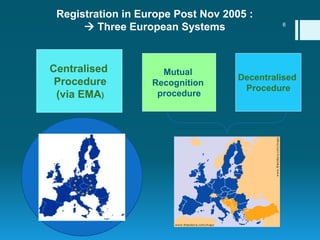
Registration in Europe Post Nov 2005 :
 Three European Systems
Centralised
Procedure
(via EMA)
Mutual
Recognition
procedure
Decentralised
Procedure
6
MARKETING AUTHORIZATION
To protect public health and ensure the availability of high quality,
safe and effective medicines for European citizens, all medicines
must be authorized before they can be placed on the market in the
EU. The European system offers different routes for such an
authorization.
The Centralized Procedure : allows the marketing of a medicine
on the basis of a single EU-wide assessment and marketing
authorization which is valid throughout the EU.
 Pharmaceutical companies submit a single authorization
application to EMA.
The Agency’s Committee for Medicinal Products for Human Use
(CHMP) or Committee for Medicinal Products for Veterinary Use
(CVMP) then carries out a scientific assessment of the application
and gives a recommendation to the European Commission on
whether or not to grant a marketing authorization.
7
 Once granted by the European Commission, the
centralized marketing authorization is valid in all EU
Member States. The use of the centrally authorized
procedure is compulsory for most innovative medicines,
including medicines for rare diseases.
Rules and requirements applicable to pharmaceuticals in the EU are
the same, irrespective of the authorization route for a medicine.
A European Public Assessment Report,( EPAR), is published for
every human or veterinary medicine that has been granted or refused
a marketing authorization following an assessment by EMA.
8
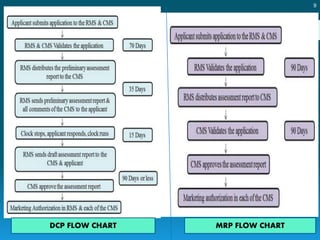
DCP FLOW CHART MRP FLOW CHART
9
PRICING AND REIMBURSEMENT
Once a marketing authorization has been granted,
decisions about price and reimbursement take place at the
level of each Member State considering the potential role
and use of the medicine in the context of the national
health system of that country.
10
THE ROLE OF THE EUROPEAN
COMMISSION
The European Commission plays an important role in the regulation
of medicines in the EU.
 On the basis of scientific assessments carried out by EMA, it grants
or refuses, changes or suspends marketing authorizations for
medicines that have been submitted via the centralized procedure.
 The European Commission can take action concerning other aspects
of medicine regulation:
 Right of initiative
 Implementation
 Global outreach
11
THE ROLE OF EMA
EMA is responsible for the scientific evaluation, primarily of
innovative and high-technology medicines developed by
pharmaceutical companies for use in the EU.
EMA was established in 1995 to ensure the best use of scientific
resources across Europe for the evaluation, supervision and
pharmacovigilance of medicines.
Experts participate in the work of EMA as members of its scientific
committees, working parties, scientific advisory groups or as
members of the national assessment teams that evaluate medicines.
The experts are chosen on the basis of their scientific expertise and
many of them are made available to EMA by the NCAs in Member
States.
Increasingly, patients and healthcare professionals are involved in
the work of the Agency including in the evaluation of medicines.
12
Structure of the European Medicines Agency (EMA)
COMP
Committee on
Orphan
Medicinal
Products
CHMP
Committee for
Medicinal Products
for Human Use
HMPC
Committee on
Herbal
Medicinal
Products
NATIONAL COMPETENT AUTHORITIES ( > 3 500 EUROPEAN EXPERTS )
PRAC
Pharmacovig.
and Risk
Assessment
Committee
CVMP
Committee for
Medicinal
Products for
veterinary use
EXECUTIVE
DIRECTOR
Guido Rasi
COMMUNICATION
S AND
NETWORKING
ADMINISTRATIONVETERINARY
MEDICINES
AND INSPECTIONS
PATIENT HEALTH
PROTECTION
HUMAN MEDICINES
DEVELOPMENT AND
EVALUATION
PDCO
Paediatric
Committee
CAT
Committee for
Advanced
Therapies
EMA(European medicine agency) Permanent
Staff
Experts Appointed By NCA(National Competition
authority)
13
NATIONAL COMPETENT
AUTHORITIES
The national competent authorities (NCAs), responsible for
the regulation of human and veterinary medicines in the EU,
coordinate their work in a forum called Heads of Medicines
Agencies (HMA).
The heads of the NCAs work closely with EMA and the European
Commission to maximize cooperation and ensure the European
medicines regulatory network functions efficiently.
The HMA meets four times per year to address key strategic issues
for the network, such as the exchange of information, sharing of
best practices, and to streamline mutual recognition and
decentralized procedures.
14
GUIDELINE AND SCIENTIFIC ADVICE
EMA prepares scientific guidelines in cooperation with experts from
its scientific committees and working groups.
These guidelines reflect the latest thinking on developments in
biomedical science.
This is an important tool to help develop and make available high-
quality, effective and
safe medicines, for the benefit of patients.
Scientific advice can also be given by NCAs.
15
SAFETY MONITORING OF MEDICINES
The European regulatory system for medicines monitors the safety
of all medicines that are available on the European market throughout
their life span.
EMA has a committee dedicated to the safety of medicines for
human use – the Pharmacovigilance Risk Assessment Committee, or
PRAC.
If there is a safety issue with a medicine that is authorized in more
than one Member State, the same regulatory action is taken across the
EU and patients and healthcare professionals in all Member States
are provided with the same guidance
16
CLINICAL TRIALS
The authorization and oversight of a clinical trial is the responsibility
of the Member State in which the trial is taking place. The European
Clinical Trials Database( Eudra CT) tracks which clinical trials have
been authorized in the EU.
 It is used by NCAs and clinical-trial sponsors to enter information
protocols and results of clinical trials.
 A subset of this information is made publicly available by EMA via
the EU clinical trials register.
17
REFERENCE…….
 DICTIONARY OF EUROPE UNION
 Economist guide to the European Union
 Europe union power point slide share
 European Commission. (2007). Making globalisation profitable.
Luxembourg: Office for Official Publications of the European
Communities.
18
THANK YOU
19

Regulatory requirement for europe union

  • 1.
    REGULATORY REQUIREMENT FOR EUROPEUNION BY : SHRESTHA 1ST YEAR M.PHARMA AL - AMEEN COLLEGE OF PHARMACY 1
  • 2.
    The Europe union Apolitical union also called as Europe union formed in 1993 for purpose of achieving political and economic integration. The EU includes 28 members states located in Europe . The EU total population is about 500 millions people The EU operates through a system of 1. Supranational independent institution 2. Intergovernmental negotiated decisions by its member of the states . It is legal entity and can negotiate international agreement on behalf of its member states In EU there are two regulatory steps by which a drug is approved in the market 1. Clinical trials application [ approved at member state level] 2. Marketing authorization [approved by both member state and centralized level] 2
  • 3.
    REGULATION IN THEINDUSRTY Pharmaceutical industry is most regulated of all the industries. Regulations are put in order to develop the most efficient and safe pharmaceutical products. It takes more than 8 to 15 years to develop a new drug products and costs more than $ 800 million.  WHEN DID REGULATION CAME …..? During the 20th century , there were no law’s and regulation to protect public from the unfavorable effects of the drugs. Misfortune ,disaster and tragedy had triggered most of the advances in drug regulation. There are some examples of disaster which leads to the formation of regulation in the industry.  Thalidomide tragedy (1962)  Elixir sulfanilamide (1937) {taste of death} 3
  • 4.
    The eu regulatorysystem for medicine The European medicines regulatory system is based on a network of around 50 regulatory authorities from the 31 EEA countries , the European Commission and EMA. This network is what makes the EU regulatory system unique. The network is supported by a pool of thousands of experts drawn from across Europe, allowing it to source the best possible scientific expertise for the regulation of medicines in the EU and to provide scientific advice of the highest quality. 4
  • 5.
  • 6.
    Registration in EuropePost Nov 2005 :  Three European Systems Centralised Procedure (via EMA) Mutual Recognition procedure Decentralised Procedure 6
  • 7.
    MARKETING AUTHORIZATION To protectpublic health and ensure the availability of high quality, safe and effective medicines for European citizens, all medicines must be authorized before they can be placed on the market in the EU. The European system offers different routes for such an authorization. The Centralized Procedure : allows the marketing of a medicine on the basis of a single EU-wide assessment and marketing authorization which is valid throughout the EU.  Pharmaceutical companies submit a single authorization application to EMA. The Agency’s Committee for Medicinal Products for Human Use (CHMP) or Committee for Medicinal Products for Veterinary Use (CVMP) then carries out a scientific assessment of the application and gives a recommendation to the European Commission on whether or not to grant a marketing authorization. 7
  • 8.
     Once grantedby the European Commission, the centralized marketing authorization is valid in all EU Member States. The use of the centrally authorized procedure is compulsory for most innovative medicines, including medicines for rare diseases. Rules and requirements applicable to pharmaceuticals in the EU are the same, irrespective of the authorization route for a medicine. A European Public Assessment Report,( EPAR), is published for every human or veterinary medicine that has been granted or refused a marketing authorization following an assessment by EMA. 8
  • 9.
    DCP FLOW CHARTMRP FLOW CHART 9
  • 10.
    PRICING AND REIMBURSEMENT Oncea marketing authorization has been granted, decisions about price and reimbursement take place at the level of each Member State considering the potential role and use of the medicine in the context of the national health system of that country. 10
  • 11.
    THE ROLE OFTHE EUROPEAN COMMISSION The European Commission plays an important role in the regulation of medicines in the EU.  On the basis of scientific assessments carried out by EMA, it grants or refuses, changes or suspends marketing authorizations for medicines that have been submitted via the centralized procedure.  The European Commission can take action concerning other aspects of medicine regulation:  Right of initiative  Implementation  Global outreach 11
  • 12.
    THE ROLE OFEMA EMA is responsible for the scientific evaluation, primarily of innovative and high-technology medicines developed by pharmaceutical companies for use in the EU. EMA was established in 1995 to ensure the best use of scientific resources across Europe for the evaluation, supervision and pharmacovigilance of medicines. Experts participate in the work of EMA as members of its scientific committees, working parties, scientific advisory groups or as members of the national assessment teams that evaluate medicines. The experts are chosen on the basis of their scientific expertise and many of them are made available to EMA by the NCAs in Member States. Increasingly, patients and healthcare professionals are involved in the work of the Agency including in the evaluation of medicines. 12
  • 13.
    Structure of theEuropean Medicines Agency (EMA) COMP Committee on Orphan Medicinal Products CHMP Committee for Medicinal Products for Human Use HMPC Committee on Herbal Medicinal Products NATIONAL COMPETENT AUTHORITIES ( > 3 500 EUROPEAN EXPERTS ) PRAC Pharmacovig. and Risk Assessment Committee CVMP Committee for Medicinal Products for veterinary use EXECUTIVE DIRECTOR Guido Rasi COMMUNICATION S AND NETWORKING ADMINISTRATIONVETERINARY MEDICINES AND INSPECTIONS PATIENT HEALTH PROTECTION HUMAN MEDICINES DEVELOPMENT AND EVALUATION PDCO Paediatric Committee CAT Committee for Advanced Therapies EMA(European medicine agency) Permanent Staff Experts Appointed By NCA(National Competition authority) 13
  • 14.
    NATIONAL COMPETENT AUTHORITIES The nationalcompetent authorities (NCAs), responsible for the regulation of human and veterinary medicines in the EU, coordinate their work in a forum called Heads of Medicines Agencies (HMA). The heads of the NCAs work closely with EMA and the European Commission to maximize cooperation and ensure the European medicines regulatory network functions efficiently. The HMA meets four times per year to address key strategic issues for the network, such as the exchange of information, sharing of best practices, and to streamline mutual recognition and decentralized procedures. 14
  • 15.
    GUIDELINE AND SCIENTIFICADVICE EMA prepares scientific guidelines in cooperation with experts from its scientific committees and working groups. These guidelines reflect the latest thinking on developments in biomedical science. This is an important tool to help develop and make available high- quality, effective and safe medicines, for the benefit of patients. Scientific advice can also be given by NCAs. 15
  • 16.
    SAFETY MONITORING OFMEDICINES The European regulatory system for medicines monitors the safety of all medicines that are available on the European market throughout their life span. EMA has a committee dedicated to the safety of medicines for human use – the Pharmacovigilance Risk Assessment Committee, or PRAC. If there is a safety issue with a medicine that is authorized in more than one Member State, the same regulatory action is taken across the EU and patients and healthcare professionals in all Member States are provided with the same guidance 16
  • 17.
    CLINICAL TRIALS The authorizationand oversight of a clinical trial is the responsibility of the Member State in which the trial is taking place. The European Clinical Trials Database( Eudra CT) tracks which clinical trials have been authorized in the EU.  It is used by NCAs and clinical-trial sponsors to enter information protocols and results of clinical trials.  A subset of this information is made publicly available by EMA via the EU clinical trials register. 17
  • 18.
    REFERENCE…….  DICTIONARY OFEUROPE UNION  Economist guide to the European Union  Europe union power point slide share  European Commission. (2007). Making globalisation profitable. Luxembourg: Office for Official Publications of the European Communities. 18
  • 19.

Editor's Notes

  • #3 Supranational: refers to the large amount of power given to an authority which in theory in placed higher than the state (authority is EU) Intergovernmental : focuses on importance of member states in the process of creating EU wide regulation
  • #10  Reference member state (RMS) Concerned member state (cms) Validate (check or prove the validity or accuracy of the product)
  • #11 REIMBURSEMENT : REPAYMENT OF THE MONEY U HAVE ALREADY PAID.
  • #13 NCA = NATIONAL COMPETITION AUTHORITY
  • #14 ORPHAN DRUGS : drugs developed to treat rare medical condition, the condition itself refer to orphan disease Prac : provides new development and future direction for regulation and guidance on safety and also discuss about thr risk management statergy
  • #18 NATIONAL COMPETITION AUTHORITY