ICH GUIDELINES FOR STABILITY STUDIES
PRESENTED BY
NAME : SHANTHI PRIYA GATTU
ROLL NO : 16DU1R0016
COURSE : B. Pharmacy
ST. ANNS COLLEGE OF PHARMACY, JNTUK
 Q1A(R2)-Stability Testing of New Drug Substances & Products
 Q1B- Photo stability Testing of New Drug Substances & Products
 Q1C-Stability Testing for New Dosage Forms
 Q1D-Bracketing and Matrixing Designs for Stability Testing of
New Drug Substances and Products
 Q1E-Evaluation for stability data
 Q1F-Stability Data Package for Registration Applications in
Climatic Zones III and IV
 Conclusions
CONTENTS
OBJECTIVES OF STABILITY TESTING
DEFINITION:
“A measure of how pharmaceutical products maintains its quality
attribute over a time.”
“To provide evidence on how the quality of a drug substance or drug product varies with
time under the influence of a variety of environmental factors such as temperature, humidity
& light, & enables recommended storage conditions, re-test periods &
shelf lives to be established”
DRUG STABILITY
SCOPE OF STABILITY TESTING
 Provide evidence as to how the quality of the drug product varies with
time.
 Establish shelf life for the drug product.
 Determine recommended storage conditions.
 Determine container closure system suitability.
RATIONALE OF STABILITY STUDIES
 Chemical degradation of the product leads
to lowering of the concentration of the
drug in the dosage form.
 Toxic products may be formed , due to
chemical degradation of the active
ingredient.
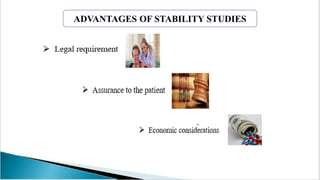
ADVANTAGES OF STABILITY STUDIES
 Loss of active drug (e.g. aspirin hydrolysis, oxidation of
adrenaline)
 Loss of vehicle (e.g. evaporation of water from o/w
creams, evaporation of alcohol from alcoholic mixtures)
 Loss of content uniformity (e.g. creaming of emulsions,
impaction of suspensions)
 Loss of elegance (e.g. fading of tablets and coloured solutions)
 Reduction in bioavailability (e.g. ageing of tablets resulting in
a change in dissolution profile)
 Production of potential toxic materials (e.g. breakdown
products from drug degradation)
ADVERSE EFFECTS OF INSTABILITY OF DRUGS
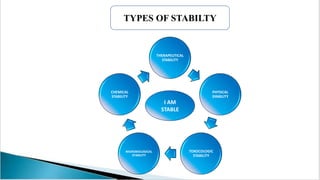
THERAPEUTICAL
STABILITY
PHYSICAL
SYABILITY
TOXOCOLOGIC
STABILITY
MICROBIOLOGICAL
STABILITY
CHEMICAL
STABILITY
I AM
STABLE
TYPES OF STABILTY
A DRUG MUST POSSES FOLLOWING TYPES OF STABILITY
CHEMICAL: Each active ingredient retains its chemical integrity and labelled potency within
the specified limit.
PHYSICAL: The physical stability properties includes appearance, palatability, uniformity,
dissolution and suspend ability are retained.
MICROBIOLOGICAL: Sterility or resistance to microbial growth is retained according to
specified requirement.
THERAPEUTIC: Therapeutic activity remains unchanged .
TOXICOLOGIC: No significant increase in toxicity occurs.
Stability studies are incorporated at all stages of the drug product life
cycle, can be segregated into 6 different stages
 STAGE 1- Early stage stress and accelerated testing with drug substances.
 STAGE 2- Stability on pre-formulation batches.
 STAGE 3- Stress testing on scale-up batches.
 STAGE 4- Accelerated and long term testing for registration purposes.
 STAGE 5- On-going stability testing
 STAGE 6- Follow-up stabilities
Objectives of the Guideline :-
The guideline defines the stability data package for a new drug substance or drug product that
is sufficient for a registration application within the three regions of the EC, Japan, and the United
States.
Scope:-
Addresses the information to be submitted in registration applications for new molecular entities and
associated drug product
General Principles :-
 To provide evidence on how the quality of a drug substance or drug product varies with time under
the influence of a variety of environmental factors such as temperature, humidity, and light.
 To establish a retest period for the drug substance or a shelf life for the drug product and
recommending storage conditions.
ICH guideline Q1-A(stability studies)
 To validate the stability indicating power of the analytical procedures.
 To identify stability-affecting factors such as ambient temperature, humidity and light and to select
packing materials which protects the formulation against such effects
 To identify potential degradants of the API and assess if they can be formed during manufacture or
storage of the formulation
 To select manufacturing process for particular drug substance
Testing should be done using container And closures proposed for storage and distribution.
Container orientation for solution, dispersion system and semi solid product is important. Up right
position used to study the effect of temperature and relative humidity and on the side position can be
used to study the interaction between product-container- closures.
STRESS TESTING
Container and closures
 Attributes that are susceptible to changed storage,
 Influence quality, safety and/or efficacy
 Should cover physical, chemical, biological and microbiological attributes.
SPECIFICATION
TEST ATTRIBUTES
 List of tests,
 Reference to analytical procedure,
 proposed acceptance criteria
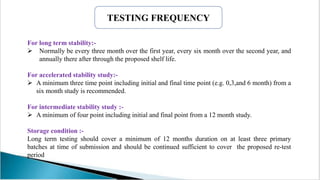
TESTING FREQUENCY
For long term stability:-
 Normally be every three month over the first year, every six month over the second year, and
annually there after through the proposed shelf life.
For accelerated stability study:-
 A minimum three time point including initial and final time point (e.g. 0,3,and 6 month) from a
six month study is recommended.
For intermediate stability study :-
 A minimum of four point including initial and final point from a 12 month study.
Storage condition :-
Long term testing should cover a minimum of 12 months duration on at least three primary
batches at time of submission and should be continued sufficient to cover the proposed re-test
period
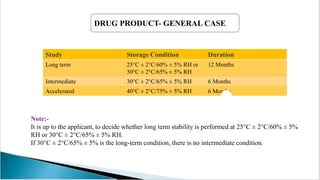
DRUG PRODUCT- GENERAL CASE
Study Storage Condition Duration
Long term 25°C ± 2°C/60% ± 5% RH or
30°C ± 2°C/65% ± 5% RH
12 Months
Intermediate 30°C ± 2°C/65% ± 5% RH 6 Months
Accelerated 40°C ± 2°C/75% ± 5% RH 6 Months
Note:-
It is up to the applicant, to decide whether long term stability is performed at 25°C ± 2°C/60% ± 5%
RH or 30°C ± 2°C/65% ± 5% RH.
If 30°C ± 2°C/65% ± 5% is the long-term condition, there is no intermediate condition.
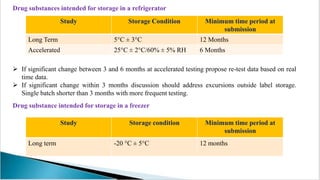
Drug substances intended for storage in a refrigerator
Study Storage Condition Minimum time period at
submission
Long Term 5°C ± 3°C 12 Months
Accelerated 25°C ± 2°C/60% ± 5% RH 6 Months
 If significant change between 3 and 6 months at accelerated testing propose re-test data based on real
time data.
 If significant change within 3 months discussion should address excursions outside label storage.
Single batch shorter than 3 months with more frequent testing.
Drug substance intended for storage in a freezer
Study Storage condition Minimum time period at
submission
Long term -20 °C ± 5°C 12 months
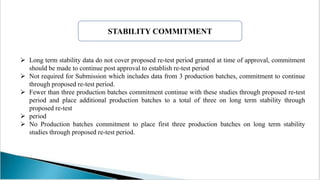
STABILITY COMMITMENT
 Long term stability data do not cover proposed re-test period granted at time of approval, commitment
should be made to continue post approval to establish re-test period
 Not required for Submission which includes data from 3 production batches, commitment to continue
through proposed re-test period.
 Fewer than three production batches commitment continue with these studies through proposed re-test
period and place additional production batches to a total of three on long term stability through
proposed re-test
 period
 No Production batches commitment to place first three production batches on long term stability
studies through proposed re-test period.
EVALUATION
Evaluation should include results from the physical, chemical, biological and
microbiological tests.
e.g. physical parameter to evaluated for tablet.
1) Appearance
2) Friability
3) Hardness
4) Colour, Odour
5) Dissolution
6) Moisture absorption
STATEMENT AND LABELING
Storage Statement:-
Storage statement established for labelling should be in accordance with national/regional
requirements.
Re-test date:-
1.Statement based on stability evaluation
2.The re-test date should be displayed on the container label.
PHOTO STABILITY TESTING: Q1-B
A systematic approach to photo stability testing is recommended covering, as appropriate, studies
such as :
i) Tests on the active substance;
ii) Tests on the exposed product outside of the immediate pack, and if necessary ;
iii) Tests on the product in the immediate pack; and if necessary ;
iv) Tests on the product in the marketing pack.
Light sources:
1. D65/ID65 emission
2.standard such as an artificial daylight fluorescent lamp combining visible and ultraviolet (UV)
outputs, xenon, or metal halide lamp.
3. D65 is the internationally recognized standard for outdoor daylight as defined in ISO 10977
(1993). ID65 is the equivalent indoor indirect daylight standard.
For a light source emitting significant radiation below 320 nm, an appropriate filter(s) may be
fitted to eliminate such radiation.
Definition:
A new dosage form is defined as a medicinal product which is a different pharmaceutical
product type, but containing the same active substance as included in an existing product approved by
the pertinent regulatory authority.
NEW DOSAGE FORMS-Q1 C
Include:
 products of a different route of administration (e.g., oral to parenteral), new specific
functionality/delivery systems (e.g., immediate release tablet to modified release tablet) and
different dosage forms of the same route of administration (e.g., capsule to tablet, solution to
suspension).
 Stability protocols for new dosage forms should follow the guidance in the parent stability
guideline in principle. However, a reduced stability database at submission time may be
acceptable with proper justification.
e.g., 6 months accelerated and 6 months long term data from ongoing studies may be acceptable in
certain justified cases.
STABILITY TEST PARAMETERS FOR VARIOUS TYPES OF PRODUCTS
Tablets - Appearance, colour, odour, assay, disintegration/dissolution, moisture and friability or hardness
testing.
Hard gelatin capsules - Appearance, colour , odour of contents, assay, disintegration/dissolution,
moisture and microbial limits.
Soft gelatin capsules - Appearance, colour , odour of contents, assay, disintegration/dissolution, moisture,
microbial limits, pH , leakage and pellicle formation.
Emulsions - Appearance including phase separation, colour , odour , assay, pH, viscosity, preservative
content, weight loss and microbial limits.
Suppositories - Appearance, colour , assay, particle size, softening range, appearance, dissolution and
microbial limits.
Small volume parenteral Drug injection- Appearance, colour , assay, ph, preservative, content,
particulate matter, sterility and pyrogenicity.
Large volume parenteral - Appearance, colour , assay, ph, preservative content,
particulate matter, sterility and pyrogenicity.
Transdermal - Appearance, assay, leakage, microbial limit/sterility, peel and adhesive forces, drug release
rate.
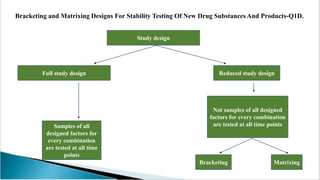
Bracketing and Matrixing Designs For Stability Testing Of New Drug Substances And Products-Q1D.
Study design
Reduced study designFull study design
Samples of all
designed factors for
every combination
are tested at all time
points
Not samples of all designed
factors for every combination
are tested at all time points
Bracketing Matrixing
BRACKETING :-
 Bracketing is the design of a stability schedule such that only sample on the extremes of certain design
factor (e.g., strength, container size and/or fill) are tested at all time points as in a full design.
 The design assumes that the stability of any intermediates level is represented by the stability of the
extremes tested.
MATRIXING:-
 Matrixing is the design of a stability schedule such that a selected subset of the total number of
possible samples for all factor combination would be tested at a specified time point.
 At a subsequent time point, another subset of sample for all factor combinations would be tested.
 The design assumes that the stability of each subset of samples tested represents the stability of all
samples at a given time.
EVALUATION FOR STABILITY DATA-Q1E
The parent guidelines states that regression analysis is an appropriate approach to analysing quantitative
stability data for retest period or shelf life estimation and recommends that a statistical test for batch for pool
ability be performed using a level of significance of 0.25.
This guidelines is intended to provide recommendation on how to use stability data generated in accordance
with the principle detailed in the ICH guideline – Q1A(R) stability testing of new drug substances and
product.
Extrapolation:-
 Extrapolation is the practice of using a known data set to inter information about future data.
 Extrapolation to extend the retest period or shelf life beyond the period covered by long-term data can
be proposed in the application, particularly if no significant change is observed at the accelerated
condition.
STABILITY DATA PACKAGE FOR REGISTRATION APPLICATIONS IN CLIMATIC ZONES III AND IV- Q1F
 A product shelf life should be established according to climatic conditions in which the product is to be
marketed.
 Storage condition recommended by manufactures on the basis of stability studies are meant to guarantee the
maintenance of quality, safety and
 efficacy throughout the shelf-life of product.
 Temperature and humidity determine the storage conditions and so they greatly affect the stability of drug
product.
 Climatic conditions in countries where the product is to be marketed should be carefully.
 Stability studies should be planned on the basis of pharmaceutical R+D and regulatory
requirements.
 Forced degradation studies reveal the intrinsic chemical properties of the API, while formal
stability studies establish the retest date.
 The shelf life (expiry date) of FPPs is derived from formal stability studies.
 Variability and time trends of stability data must be evaluated by the manufacturer in order to
propose a retest date or expiry date.
Conclusion
ICH guidelines for stability studies

ICH guidelines for stability studies

  • 1.
    ICH GUIDELINES FORSTABILITY STUDIES PRESENTED BY NAME : SHANTHI PRIYA GATTU ROLL NO : 16DU1R0016 COURSE : B. Pharmacy ST. ANNS COLLEGE OF PHARMACY, JNTUK
  • 2.
     Q1A(R2)-Stability Testingof New Drug Substances & Products  Q1B- Photo stability Testing of New Drug Substances & Products  Q1C-Stability Testing for New Dosage Forms  Q1D-Bracketing and Matrixing Designs for Stability Testing of New Drug Substances and Products  Q1E-Evaluation for stability data  Q1F-Stability Data Package for Registration Applications in Climatic Zones III and IV  Conclusions CONTENTS
  • 3.
    OBJECTIVES OF STABILITYTESTING DEFINITION: “A measure of how pharmaceutical products maintains its quality attribute over a time.” “To provide evidence on how the quality of a drug substance or drug product varies with time under the influence of a variety of environmental factors such as temperature, humidity & light, & enables recommended storage conditions, re-test periods & shelf lives to be established” DRUG STABILITY
  • 4.
    SCOPE OF STABILITYTESTING  Provide evidence as to how the quality of the drug product varies with time.  Establish shelf life for the drug product.  Determine recommended storage conditions.  Determine container closure system suitability. RATIONALE OF STABILITY STUDIES  Chemical degradation of the product leads to lowering of the concentration of the drug in the dosage form.  Toxic products may be formed , due to chemical degradation of the active ingredient.
  • 5.
  • 6.
     Loss ofactive drug (e.g. aspirin hydrolysis, oxidation of adrenaline)  Loss of vehicle (e.g. evaporation of water from o/w creams, evaporation of alcohol from alcoholic mixtures)  Loss of content uniformity (e.g. creaming of emulsions, impaction of suspensions)  Loss of elegance (e.g. fading of tablets and coloured solutions)  Reduction in bioavailability (e.g. ageing of tablets resulting in a change in dissolution profile)  Production of potential toxic materials (e.g. breakdown products from drug degradation) ADVERSE EFFECTS OF INSTABILITY OF DRUGS
  • 7.
  • 8.
    A DRUG MUSTPOSSES FOLLOWING TYPES OF STABILITY CHEMICAL: Each active ingredient retains its chemical integrity and labelled potency within the specified limit. PHYSICAL: The physical stability properties includes appearance, palatability, uniformity, dissolution and suspend ability are retained. MICROBIOLOGICAL: Sterility or resistance to microbial growth is retained according to specified requirement. THERAPEUTIC: Therapeutic activity remains unchanged . TOXICOLOGIC: No significant increase in toxicity occurs.
  • 9.
    Stability studies areincorporated at all stages of the drug product life cycle, can be segregated into 6 different stages  STAGE 1- Early stage stress and accelerated testing with drug substances.  STAGE 2- Stability on pre-formulation batches.  STAGE 3- Stress testing on scale-up batches.  STAGE 4- Accelerated and long term testing for registration purposes.  STAGE 5- On-going stability testing  STAGE 6- Follow-up stabilities
  • 10.
    Objectives of theGuideline :- The guideline defines the stability data package for a new drug substance or drug product that is sufficient for a registration application within the three regions of the EC, Japan, and the United States. Scope:- Addresses the information to be submitted in registration applications for new molecular entities and associated drug product General Principles :-  To provide evidence on how the quality of a drug substance or drug product varies with time under the influence of a variety of environmental factors such as temperature, humidity, and light.  To establish a retest period for the drug substance or a shelf life for the drug product and recommending storage conditions. ICH guideline Q1-A(stability studies)
  • 11.
     To validatethe stability indicating power of the analytical procedures.  To identify stability-affecting factors such as ambient temperature, humidity and light and to select packing materials which protects the formulation against such effects  To identify potential degradants of the API and assess if they can be formed during manufacture or storage of the formulation  To select manufacturing process for particular drug substance Testing should be done using container And closures proposed for storage and distribution. Container orientation for solution, dispersion system and semi solid product is important. Up right position used to study the effect of temperature and relative humidity and on the side position can be used to study the interaction between product-container- closures. STRESS TESTING Container and closures
  • 12.
     Attributes thatare susceptible to changed storage,  Influence quality, safety and/or efficacy  Should cover physical, chemical, biological and microbiological attributes. SPECIFICATION TEST ATTRIBUTES  List of tests,  Reference to analytical procedure,  proposed acceptance criteria
  • 13.
    TESTING FREQUENCY For longterm stability:-  Normally be every three month over the first year, every six month over the second year, and annually there after through the proposed shelf life. For accelerated stability study:-  A minimum three time point including initial and final time point (e.g. 0,3,and 6 month) from a six month study is recommended. For intermediate stability study :-  A minimum of four point including initial and final point from a 12 month study. Storage condition :- Long term testing should cover a minimum of 12 months duration on at least three primary batches at time of submission and should be continued sufficient to cover the proposed re-test period
  • 14.
    DRUG PRODUCT- GENERALCASE Study Storage Condition Duration Long term 25°C ± 2°C/60% ± 5% RH or 30°C ± 2°C/65% ± 5% RH 12 Months Intermediate 30°C ± 2°C/65% ± 5% RH 6 Months Accelerated 40°C ± 2°C/75% ± 5% RH 6 Months Note:- It is up to the applicant, to decide whether long term stability is performed at 25°C ± 2°C/60% ± 5% RH or 30°C ± 2°C/65% ± 5% RH. If 30°C ± 2°C/65% ± 5% is the long-term condition, there is no intermediate condition.
  • 15.
    Drug substances intendedfor storage in a refrigerator Study Storage Condition Minimum time period at submission Long Term 5°C ± 3°C 12 Months Accelerated 25°C ± 2°C/60% ± 5% RH 6 Months  If significant change between 3 and 6 months at accelerated testing propose re-test data based on real time data.  If significant change within 3 months discussion should address excursions outside label storage. Single batch shorter than 3 months with more frequent testing. Drug substance intended for storage in a freezer Study Storage condition Minimum time period at submission Long term -20 °C ± 5°C 12 months
  • 16.
    STABILITY COMMITMENT  Longterm stability data do not cover proposed re-test period granted at time of approval, commitment should be made to continue post approval to establish re-test period  Not required for Submission which includes data from 3 production batches, commitment to continue through proposed re-test period.  Fewer than three production batches commitment continue with these studies through proposed re-test period and place additional production batches to a total of three on long term stability through proposed re-test  period  No Production batches commitment to place first three production batches on long term stability studies through proposed re-test period.
  • 17.
    EVALUATION Evaluation should includeresults from the physical, chemical, biological and microbiological tests. e.g. physical parameter to evaluated for tablet. 1) Appearance 2) Friability 3) Hardness 4) Colour, Odour 5) Dissolution 6) Moisture absorption STATEMENT AND LABELING Storage Statement:- Storage statement established for labelling should be in accordance with national/regional requirements. Re-test date:- 1.Statement based on stability evaluation 2.The re-test date should be displayed on the container label.
  • 18.
    PHOTO STABILITY TESTING:Q1-B A systematic approach to photo stability testing is recommended covering, as appropriate, studies such as : i) Tests on the active substance; ii) Tests on the exposed product outside of the immediate pack, and if necessary ; iii) Tests on the product in the immediate pack; and if necessary ; iv) Tests on the product in the marketing pack. Light sources: 1. D65/ID65 emission 2.standard such as an artificial daylight fluorescent lamp combining visible and ultraviolet (UV) outputs, xenon, or metal halide lamp. 3. D65 is the internationally recognized standard for outdoor daylight as defined in ISO 10977 (1993). ID65 is the equivalent indoor indirect daylight standard. For a light source emitting significant radiation below 320 nm, an appropriate filter(s) may be fitted to eliminate such radiation.
  • 19.
    Definition: A new dosageform is defined as a medicinal product which is a different pharmaceutical product type, but containing the same active substance as included in an existing product approved by the pertinent regulatory authority. NEW DOSAGE FORMS-Q1 C Include:  products of a different route of administration (e.g., oral to parenteral), new specific functionality/delivery systems (e.g., immediate release tablet to modified release tablet) and different dosage forms of the same route of administration (e.g., capsule to tablet, solution to suspension).  Stability protocols for new dosage forms should follow the guidance in the parent stability guideline in principle. However, a reduced stability database at submission time may be acceptable with proper justification. e.g., 6 months accelerated and 6 months long term data from ongoing studies may be acceptable in certain justified cases.
  • 20.
    STABILITY TEST PARAMETERSFOR VARIOUS TYPES OF PRODUCTS Tablets - Appearance, colour, odour, assay, disintegration/dissolution, moisture and friability or hardness testing. Hard gelatin capsules - Appearance, colour , odour of contents, assay, disintegration/dissolution, moisture and microbial limits. Soft gelatin capsules - Appearance, colour , odour of contents, assay, disintegration/dissolution, moisture, microbial limits, pH , leakage and pellicle formation. Emulsions - Appearance including phase separation, colour , odour , assay, pH, viscosity, preservative content, weight loss and microbial limits. Suppositories - Appearance, colour , assay, particle size, softening range, appearance, dissolution and microbial limits. Small volume parenteral Drug injection- Appearance, colour , assay, ph, preservative, content, particulate matter, sterility and pyrogenicity. Large volume parenteral - Appearance, colour , assay, ph, preservative content, particulate matter, sterility and pyrogenicity. Transdermal - Appearance, assay, leakage, microbial limit/sterility, peel and adhesive forces, drug release rate.
  • 21.
    Bracketing and MatrixingDesigns For Stability Testing Of New Drug Substances And Products-Q1D. Study design Reduced study designFull study design Samples of all designed factors for every combination are tested at all time points Not samples of all designed factors for every combination are tested at all time points Bracketing Matrixing
  • 22.
    BRACKETING :-  Bracketingis the design of a stability schedule such that only sample on the extremes of certain design factor (e.g., strength, container size and/or fill) are tested at all time points as in a full design.  The design assumes that the stability of any intermediates level is represented by the stability of the extremes tested. MATRIXING:-  Matrixing is the design of a stability schedule such that a selected subset of the total number of possible samples for all factor combination would be tested at a specified time point.  At a subsequent time point, another subset of sample for all factor combinations would be tested.  The design assumes that the stability of each subset of samples tested represents the stability of all samples at a given time. EVALUATION FOR STABILITY DATA-Q1E The parent guidelines states that regression analysis is an appropriate approach to analysing quantitative stability data for retest period or shelf life estimation and recommends that a statistical test for batch for pool ability be performed using a level of significance of 0.25. This guidelines is intended to provide recommendation on how to use stability data generated in accordance with the principle detailed in the ICH guideline – Q1A(R) stability testing of new drug substances and product.
  • 23.
    Extrapolation:-  Extrapolation isthe practice of using a known data set to inter information about future data.  Extrapolation to extend the retest period or shelf life beyond the period covered by long-term data can be proposed in the application, particularly if no significant change is observed at the accelerated condition. STABILITY DATA PACKAGE FOR REGISTRATION APPLICATIONS IN CLIMATIC ZONES III AND IV- Q1F  A product shelf life should be established according to climatic conditions in which the product is to be marketed.  Storage condition recommended by manufactures on the basis of stability studies are meant to guarantee the maintenance of quality, safety and  efficacy throughout the shelf-life of product.  Temperature and humidity determine the storage conditions and so they greatly affect the stability of drug product.  Climatic conditions in countries where the product is to be marketed should be carefully.
  • 24.
     Stability studiesshould be planned on the basis of pharmaceutical R+D and regulatory requirements.  Forced degradation studies reveal the intrinsic chemical properties of the API, while formal stability studies establish the retest date.  The shelf life (expiry date) of FPPs is derived from formal stability studies.  Variability and time trends of stability data must be evaluated by the manufacturer in order to propose a retest date or expiry date. Conclusion