


ICH GUIDELINES


                 1
Flow of presentation
1   • Mission

2   • History

3   • Organization of ICH

4   • Process of harmonization

5   • ICH guidelines

6   • Benefits and concerns of ICH

7   • Future
                                     2
What is ICH?

"International Conference on
Harmonisation of Technical
Requirements for Registration
of Pharmaceuticals for
Human Use"
                                3
A Unique Approach
• International Conference on Harmonisation
  (ICH) was created in 1990
• Agreement between the EU, Japan and the
  USA to harmonize different regional
  requirements for registration of
  pharmaceutical drug products
• Unique because joint effort by regulators and
  associated pharmaceutical industry trade
  associations


                                                  4
Mission


“make recommendations towards achieving
greater harmonisation in the interpretation
and application of technical Guidelines and
requirements   for   pharmaceutical product
registration”


                                              5
Purpose of ICH
• Harmonisation of technical requirements
• Ensure safety, efficacy and quality of
  medicines
• Prevent duplication of clinical trials in humans
• Minimize the use of animal testing without
  compromising safety and effectiveness


                                                     6
History
Need to harmonise?
  – Industry becoming global
  – Duplicate test procedures
     • Time consuming
     • Expensive
  – Increasing R&D costs
  – Meeting public demand


                                  7
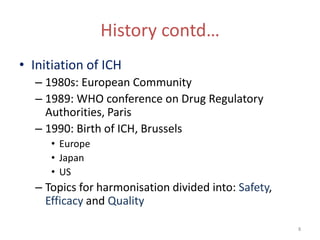
History contd…
• Initiation of ICH
  – 1980s: European Community
  – 1989: WHO conference on Drug Regulatory
    Authorities, Paris
  – 1990: Birth of ICH, Brussels
     • Europe
     • Japan
     • US
  – Topics for harmonisation divided into: Safety,
    Efficacy and Quality

                                                     8
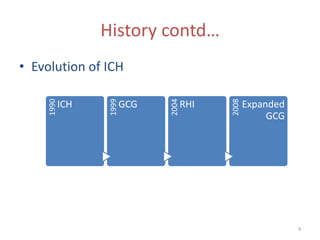
History contd…
• Evolution of ICH
     1990


                   1999


                                2004


                                             2008
            ICH           GCG          RHI          Expanded
                                                         GCG


                                                               9
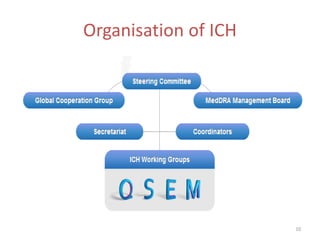
Organisation of ICH


                      10
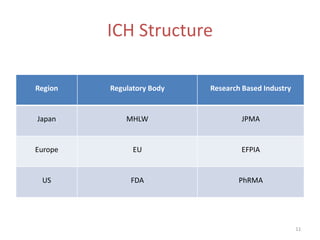
ICH Structure

Region   Regulatory Body   Research Based Industry


Japan        MHLW                  JPMA


Europe         EU                  EFPIA


 US           FDA                  PhRMA


                                                     11
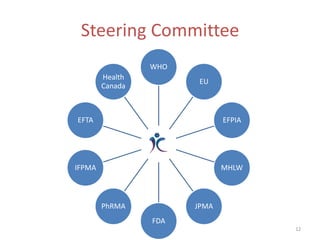
Steering Committee
                 WHO
        Health
                        EU
        Canada


EFTA                          EFPIA


IFPMA                         MHLW


        PhRMA          JPMA
                 FDA
                                      12
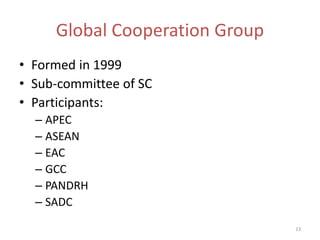
Global Cooperation Group
• Formed in 1999
• Sub-committee of SC
• Participants:
  – APEC
  – ASEAN
  – EAC
  – GCC
  – PANDRH
  – SADC
                                13
GCG Contd…
• Expansion of GCG: 2007
  – Australia
  – Brazil
  – China
  – Chinese Taipei
  – India
  – Korea
  – Russia
  – Singapore

                             14
MedDRA Management Board
• Oversees the activities of the MedDRA
  “Maintenance and Support Services
  Organisation” (MSSO)
• Members:
  –   EU
  –   EFPIA
  –   MHLW
  –   JPMA
  –   FDA
  –   PhRMA

                                          15
Secretariat
– Located in Geneva
– Working of ICH


               Coordinators
– Smooth running of ICH
– Nominated by each of 6 parties
– Acts as the main contact point with the ICH
  Secretariat

                                                16
ICH Working Groups
• EWG: developing a harmonised guideline that
  meets the objectives in the Concept Paper and
  Business Plan
• IWG: develop Q&As to facilitate
  implementation of existing guidelines
• InWG: developing/finalizing a Concept Paper,
  as well as developing a Business Plan
• DG: discuss specific scientific considerations or
  views
                                                  17
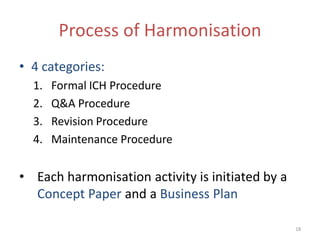
Process of Harmonisation
• 4 categories:
  1.   Formal ICH Procedure
  2.   Q&A Procedure
  3.   Revision Procedure
  4.   Maintenance Procedure


• Each harmonisation activity is initiated by a
  Concept Paper and a Business Plan

                                                  18
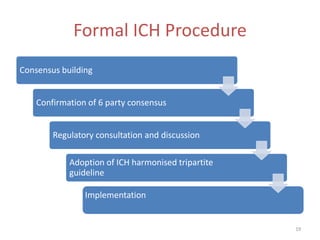
Formal ICH Procedure
Consensus building


    Confirmation of 6 party consensus


        Regulatory consultation and discussion

            Adoption of ICH harmonised tripartite
            guideline

                Implementation


                                                    19
Work
Products


       20
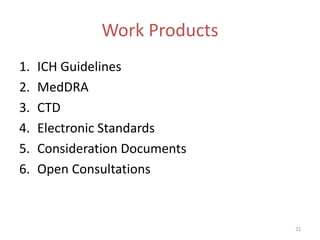
Work Products
1.   ICH Guidelines
2.   MedDRA
3.   CTD
4.   Electronic Standards
5.   Consideration Documents
6.   Open Consultations


                               21
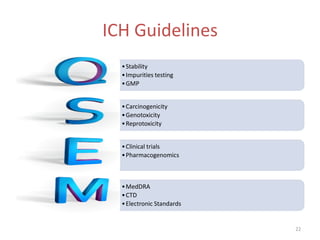
ICH Guidelines
  • Stability
  • Impurities testing
  • GMP


  • Carcinogenicity
  • Genotoxicity
  • Reprotoxicity


  • Clinical trials
  • Pharmacogenomics


  • MedDRA
  • CTD
  • Electronic Standards


                           22
MedDRA
• Medical dictionary of regulatory activities
• Prepared by ICH and owned by IFPMA
• Used for registration, documentation and
  safety monitoring of medical products
• MSSO is responsible to maintain, develop and
  distribute MedDRA


                                                 23
CTD


      24
Benefits of ICH Process
•   More than 50 harmonised guidelines
•   Streamline R&D process
•   Rapid access to new medicines
•   Benefits for the regulators
•   Reference and educational material for non-
    ICH members


                                                  25
Concerns about ICH
• Non-ICH members not considered in the
  decision making process
• Lack of sufficient consultation with academic
  scientists, health professionals and patient
  groups
• Role of WHO
• Role of IFPMA
• Implications in developing countries
                                                  26
Future
• The continued success and relevance of ICH
  will in large part depend on a much broader
  use of ICH guidelines and standards
• Expanded participation in the development
  and implementation of ICH products will play
  a key role in promoting a more globally
  consistent approach to drug development and
  oversight

                                             27
Future Contd…
• More important role of WHO and non-ICH
  members in the decision making process
• Recognition of challenges faced by developing
  countries trying to use ICH guidelines
• As more countries embrace ICH guidelines,
  promotion of a common regulatory language
  will facilitate further interactions among
  global drug regulatory authorities

                                              28
“If you want to go fast, go alone. If
you want to go far, go together”
                                    29
30

ICH GUIDELINES

  • 1.
  • 2.
    Flow of presentation 1 • Mission 2 • History 3 • Organization of ICH 4 • Process of harmonization 5 • ICH guidelines 6 • Benefits and concerns of ICH 7 • Future 2
  • 3.
    What is ICH? "InternationalConference on Harmonisation of Technical Requirements for Registration of Pharmaceuticals for Human Use" 3
  • 4.
    A Unique Approach •International Conference on Harmonisation (ICH) was created in 1990 • Agreement between the EU, Japan and the USA to harmonize different regional requirements for registration of pharmaceutical drug products • Unique because joint effort by regulators and associated pharmaceutical industry trade associations 4
  • 5.
    Mission “make recommendations towardsachieving greater harmonisation in the interpretation and application of technical Guidelines and requirements for pharmaceutical product registration” 5
  • 6.
    Purpose of ICH •Harmonisation of technical requirements • Ensure safety, efficacy and quality of medicines • Prevent duplication of clinical trials in humans • Minimize the use of animal testing without compromising safety and effectiveness 6
  • 7.
    History Need to harmonise? – Industry becoming global – Duplicate test procedures • Time consuming • Expensive – Increasing R&D costs – Meeting public demand 7
  • 8.
    History contd… • Initiationof ICH – 1980s: European Community – 1989: WHO conference on Drug Regulatory Authorities, Paris – 1990: Birth of ICH, Brussels • Europe • Japan • US – Topics for harmonisation divided into: Safety, Efficacy and Quality 8
  • 9.
    History contd… • Evolutionof ICH 1990 1999 2004 2008 ICH GCG RHI Expanded GCG 9
  • 10.
  • 11.
    ICH Structure Region Regulatory Body Research Based Industry Japan MHLW JPMA Europe EU EFPIA US FDA PhRMA 11
  • 12.
    Steering Committee WHO Health EU Canada EFTA EFPIA IFPMA MHLW PhRMA JPMA FDA 12
  • 13.
    Global Cooperation Group •Formed in 1999 • Sub-committee of SC • Participants: – APEC – ASEAN – EAC – GCC – PANDRH – SADC 13
  • 14.
    GCG Contd… • Expansionof GCG: 2007 – Australia – Brazil – China – Chinese Taipei – India – Korea – Russia – Singapore 14
  • 15.
    MedDRA Management Board •Oversees the activities of the MedDRA “Maintenance and Support Services Organisation” (MSSO) • Members: – EU – EFPIA – MHLW – JPMA – FDA – PhRMA 15
  • 16.
    Secretariat – Located inGeneva – Working of ICH Coordinators – Smooth running of ICH – Nominated by each of 6 parties – Acts as the main contact point with the ICH Secretariat 16
  • 17.
    ICH Working Groups •EWG: developing a harmonised guideline that meets the objectives in the Concept Paper and Business Plan • IWG: develop Q&As to facilitate implementation of existing guidelines • InWG: developing/finalizing a Concept Paper, as well as developing a Business Plan • DG: discuss specific scientific considerations or views 17
  • 18.
    Process of Harmonisation •4 categories: 1. Formal ICH Procedure 2. Q&A Procedure 3. Revision Procedure 4. Maintenance Procedure • Each harmonisation activity is initiated by a Concept Paper and a Business Plan 18
  • 19.
    Formal ICH Procedure Consensusbuilding Confirmation of 6 party consensus Regulatory consultation and discussion Adoption of ICH harmonised tripartite guideline Implementation 19
  • 20.
  • 21.
    Work Products 1. ICH Guidelines 2. MedDRA 3. CTD 4. Electronic Standards 5. Consideration Documents 6. Open Consultations 21
  • 22.
    ICH Guidelines • Stability • Impurities testing • GMP • Carcinogenicity • Genotoxicity • Reprotoxicity • Clinical trials • Pharmacogenomics • MedDRA • CTD • Electronic Standards 22
  • 23.
    MedDRA • Medical dictionaryof regulatory activities • Prepared by ICH and owned by IFPMA • Used for registration, documentation and safety monitoring of medical products • MSSO is responsible to maintain, develop and distribute MedDRA 23
  • 24.
    CTD 24
  • 25.
    Benefits of ICHProcess • More than 50 harmonised guidelines • Streamline R&D process • Rapid access to new medicines • Benefits for the regulators • Reference and educational material for non- ICH members 25
  • 26.
    Concerns about ICH •Non-ICH members not considered in the decision making process • Lack of sufficient consultation with academic scientists, health professionals and patient groups • Role of WHO • Role of IFPMA • Implications in developing countries 26
  • 27.
    Future • The continuedsuccess and relevance of ICH will in large part depend on a much broader use of ICH guidelines and standards • Expanded participation in the development and implementation of ICH products will play a key role in promoting a more globally consistent approach to drug development and oversight 27
  • 28.
    Future Contd… • Moreimportant role of WHO and non-ICH members in the decision making process • Recognition of challenges faced by developing countries trying to use ICH guidelines • As more countries embrace ICH guidelines, promotion of a common regulatory language will facilitate further interactions among global drug regulatory authorities 28
  • 29.
    “If you wantto go fast, go alone. If you want to go far, go together” 29
  • 30.