HEAT CONDUCTION THROUGH A PLANE WALL
• Let us consider a plane wall of homogeneous material through which heat
is flowing in x-direction.
• Let Q +x
L = thickness of the wall T0
A = cross-sectional area of the wall k
k = thermal conductivity of wall material T1
T0 , T1 = temperature maintained at surfaces 1 and 2. 1 2
L
k
• General heat conduction equation is:
𝜕2 𝑇
𝜕𝑥2
+
𝜕2 𝑇
𝜕𝑦2
+
𝜕2 𝑇
𝜕𝑧2
+
𝑞
𝑘
=
1
𝛼
.
𝜕𝑇
𝜕𝑡
• For one dimensional steady state system (
𝜕𝑇
𝜕𝑡
= 0)
• With no heat generation (
𝑞
𝑘
= 0)
• One dimensional flow (
𝜕2 𝑇
𝜕𝑦2 =
𝜕2 𝑇
𝜕𝑧2 = 0)
• Then, heat equation will be
𝜕2 𝑇
𝜕𝑥2 = 0 or
𝑑2 𝑇
𝑑𝑥2 = 0
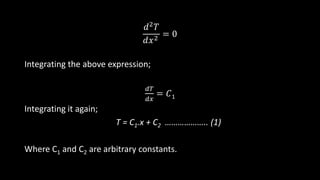
𝑑2 𝑇
𝑑𝑥2
= 0
Integrating the above expression;
𝑑𝑇
𝑑𝑥
= 𝐶1
Integrating it again;
T = C1.x + C2 ……………….. (1)
Where C1 and C2 are arbitrary constants.
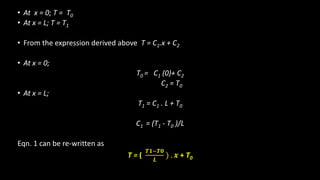
• At x = 0; T = T0
• At x = L; T = T1
• From the expression derived above T = C1.x + C2
• At x = 0;
T0 = C1 (0)+ C2
C2 = T0
• At x = L;
T1 = C1 . L + T0
C1 = (T1 - T0 )/L
Eqn. 1 can be re-written as
T = (
𝑻𝟏−𝑻𝟎
𝑳
) . 𝒙 + T0
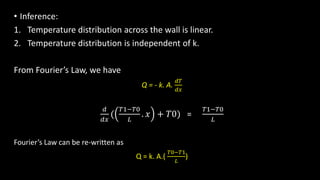
• Inference:
1. Temperature distribution across the wall is linear.
2. Temperature distribution is independent of k.
From Fourier’s Law, we have
Q = - k. A.
𝑑𝑇
𝑑𝑥
𝑑
𝑑𝑥
(
𝑇1−𝑇0
𝐿
. 𝑥 + 𝑇0) =
𝑇1−𝑇0
𝐿
Fourier’s Law can be re-written as
Q = k. A.(
𝑇0−𝑇1
𝐿
)
• Another way of writing the Fourier’s Law is
Q =
𝑇0−𝑇1
𝐿/𝑘𝐴
Where L/kA = Thermal Resistance of heat conduction (Rth)cond.
(Rth)cond. = (L/kA)

Heat conduction through a plane wall

  • 1.
    HEAT CONDUCTION THROUGHA PLANE WALL • Let us consider a plane wall of homogeneous material through which heat is flowing in x-direction. • Let Q +x L = thickness of the wall T0 A = cross-sectional area of the wall k k = thermal conductivity of wall material T1 T0 , T1 = temperature maintained at surfaces 1 and 2. 1 2 L k
  • 2.
    • General heatconduction equation is: 𝜕2 𝑇 𝜕𝑥2 + 𝜕2 𝑇 𝜕𝑦2 + 𝜕2 𝑇 𝜕𝑧2 + 𝑞 𝑘 = 1 𝛼 . 𝜕𝑇 𝜕𝑡 • For one dimensional steady state system ( 𝜕𝑇 𝜕𝑡 = 0) • With no heat generation ( 𝑞 𝑘 = 0) • One dimensional flow ( 𝜕2 𝑇 𝜕𝑦2 = 𝜕2 𝑇 𝜕𝑧2 = 0) • Then, heat equation will be 𝜕2 𝑇 𝜕𝑥2 = 0 or 𝑑2 𝑇 𝑑𝑥2 = 0
  • 3.
    𝑑2 𝑇 𝑑𝑥2 = 0 Integratingthe above expression; 𝑑𝑇 𝑑𝑥 = 𝐶1 Integrating it again; T = C1.x + C2 ……………….. (1) Where C1 and C2 are arbitrary constants.
  • 4.
    • At x= 0; T = T0 • At x = L; T = T1 • From the expression derived above T = C1.x + C2 • At x = 0; T0 = C1 (0)+ C2 C2 = T0 • At x = L; T1 = C1 . L + T0 C1 = (T1 - T0 )/L Eqn. 1 can be re-written as T = ( 𝑻𝟏−𝑻𝟎 𝑳 ) . 𝒙 + T0
  • 5.
    • Inference: 1. Temperaturedistribution across the wall is linear. 2. Temperature distribution is independent of k. From Fourier’s Law, we have Q = - k. A. 𝑑𝑇 𝑑𝑥 𝑑 𝑑𝑥 ( 𝑇1−𝑇0 𝐿 . 𝑥 + 𝑇0) = 𝑇1−𝑇0 𝐿 Fourier’s Law can be re-written as Q = k. A.( 𝑇0−𝑇1 𝐿 )
  • 6.
    • Another wayof writing the Fourier’s Law is Q = 𝑇0−𝑇1 𝐿/𝑘𝐴 Where L/kA = Thermal Resistance of heat conduction (Rth)cond. (Rth)cond. = (L/kA)