Heat Conduction through
Composite Walls
1
Significance
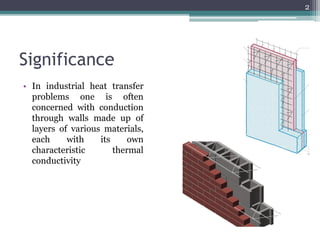
• In industrial heat transfer
problems one is often
concerned with conduction
through walls made up of
layers of various materials,
each with its own
characteristic thermal
conductivity
2
Objective
• To show how the various resistances to heat transfer are
combined into a total resistance
3
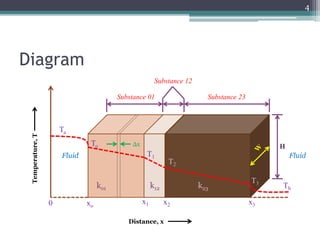
Diagram
Fluid Fluid
Distance, x
Temperature,
T
0 xo
x1 x2 x3
To
T1
T2
T3
Ta
ko1 k12 k23
Δx H
Substance 01
Substance 12
Substance 23
Tb
4
Nomenclature
• Three materials of different thicknesses, x1 – xo, x2 – x1, and x3 – x2
• Thermal conductivities k01, k12, and k23
• Ta = Ambient Temperature
• Tb = Fluid Temperature
• The heat transfer at the boundaries x = xo and x = x3, is given by Newton's
"law of cooling" with heat transfer coefficients h0 and h3
5
Energy Balance
• For a slab of volume WHΔx:
Heat entering at x = qx|xWH
Heat leaving at x + Δx = qx|x+ Δx WH
6
Energy Balance
• For Region 01:
qx|xWH - qx|x+ Δx WH = 0
• Dividing by WHΔx:
• Taking limit Δx→0,
7
Integration
• Integrating the previous equation:
• qo = Heat flux at the plane x = xo
• Similarly, for regions 12 and 23:
• With continuity conditions on qx at interfaces, so that the heat flux
is constant and the same for all three slabs
8
Applying Fourier’s Law
• Region 01:
• Region 12:
• Region 23:
9
Integration over the entire thickness
• We now assume that ko1, k12, and k23, are constants. Then we
integrate each equation over the entire thickness of the relevant slab
of material to get
• Region 01:
• Region 12:
(Eq-1)
(Eq-2)
10
Integration over the entire thickness
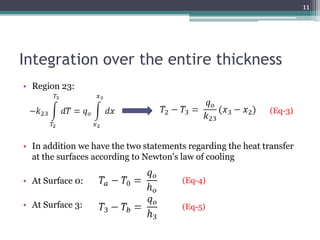
• Region 23:
• In addition we have the two statements regarding the heat transfer
at the surfaces according to Newton's law of cooling
• At Surface 0:
• At Surface 3:
(Eq-3)
(Eq-4)
(Eq-5)
11
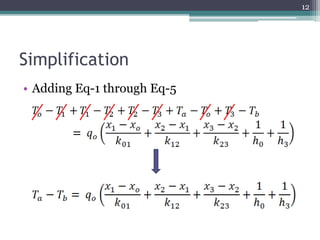
Simplification
• Adding Eq-1 through Eq-5
12
Final Expression
13
General Expression
• Sometimes this result is rewritten in a form reminiscent of Newton's law of
cooling, either in terms of the heat flux qo (J/m2-s) or the heat flow Qo
(J/s):
• The quantity U, called the "overall heat transfer coefficient," is given
then by the following famous formula for the "additivity of resistances“
• Here we have generalized the formula to a system with n slabs of material
14
15

Heat Conduction through Composite Walls.pdf

  • 1.
  • 2.
    Significance • In industrialheat transfer problems one is often concerned with conduction through walls made up of layers of various materials, each with its own characteristic thermal conductivity 2
  • 3.
    Objective • To showhow the various resistances to heat transfer are combined into a total resistance 3
  • 4.
    Diagram Fluid Fluid Distance, x Temperature, T 0xo x1 x2 x3 To T1 T2 T3 Ta ko1 k12 k23 Δx H Substance 01 Substance 12 Substance 23 Tb 4
  • 5.
    Nomenclature • Three materialsof different thicknesses, x1 – xo, x2 – x1, and x3 – x2 • Thermal conductivities k01, k12, and k23 • Ta = Ambient Temperature • Tb = Fluid Temperature • The heat transfer at the boundaries x = xo and x = x3, is given by Newton's "law of cooling" with heat transfer coefficients h0 and h3 5
  • 6.
    Energy Balance • Fora slab of volume WHΔx: Heat entering at x = qx|xWH Heat leaving at x + Δx = qx|x+ Δx WH 6
  • 7.
    Energy Balance • ForRegion 01: qx|xWH - qx|x+ Δx WH = 0 • Dividing by WHΔx: • Taking limit Δx→0, 7
  • 8.
    Integration • Integrating theprevious equation: • qo = Heat flux at the plane x = xo • Similarly, for regions 12 and 23: • With continuity conditions on qx at interfaces, so that the heat flux is constant and the same for all three slabs 8
  • 9.
    Applying Fourier’s Law •Region 01: • Region 12: • Region 23: 9
  • 10.
    Integration over theentire thickness • We now assume that ko1, k12, and k23, are constants. Then we integrate each equation over the entire thickness of the relevant slab of material to get • Region 01: • Region 12: (Eq-1) (Eq-2) 10
  • 11.
    Integration over theentire thickness • Region 23: • In addition we have the two statements regarding the heat transfer at the surfaces according to Newton's law of cooling • At Surface 0: • At Surface 3: (Eq-3) (Eq-4) (Eq-5) 11
  • 12.
  • 13.
  • 14.
    General Expression • Sometimesthis result is rewritten in a form reminiscent of Newton's law of cooling, either in terms of the heat flux qo (J/m2-s) or the heat flow Qo (J/s): • The quantity U, called the "overall heat transfer coefficient," is given then by the following famous formula for the "additivity of resistances“ • Here we have generalized the formula to a system with n slabs of material 14
  • 15.