Heat and mass transfer Conduction
Yashawantha K M, Dept. of Marine Engineering, SIT, Mangaluru Page 1
Three Dimensional heat transfer equation analysis (Cartesian co-ordinates)
Assumptions
• The solid is homogeneous and isotropic
• The physical parameters of solid materials are constant
• Steady state conduction
• Thermal conductivity k is constant
Consider a homogenous medium within which there is no bulk motion and the temperature
distribution T(x,y,z) is expressed in Cartesian coordinates.
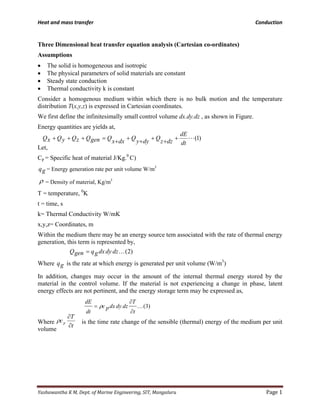
We first define the infinitesimally small control volume dx.dy.dz , as shown in Figure.
Energy quantities are yields at,
Let,
Cp = Specific heat of material J/Kg.0
C)
gq = Energy generation rate per unit volume W/m3
ρ = Density of material, Kg/m3
T = temperature, 0
K
t = time, s
k= Thermal Conductivity W/mK
x,y,z= Coordinates, m
Within the medium there may be an energy source tem associated with the rate of thermal energy
generation, this term is represented by,
Where gq is the rate at which energy is generated per unit volume (W/m3
)
In addition, changes may occur in the amount of the internal thermal energy stored by the
material in the control volume. If the material is not experiencing a change in phase, latent
energy effects are not pertinent, and the energy storage term may be expressed as,
Where is the time rate change of the sensible (thermal) energy of the medium per unit
volume
)1(L
dt
dE
dzz
Q
dyy
Q
dxx
QgenQzQyQxQ +
+
+
+
+
+
=+++
)2(KdzdydxgqgenQ =
)3(K
t
T
dzdydxpc
dt
dE
∂
∂
= ρ
t
T
cp
∂
∂
ρ
Heat and mass transfer Conduction
Yashawantha K M, Dept. of Marine Engineering, SIT, Mangaluru Page 2
Substituting in equation (1) we get,
Where the quantity (m2
/s) is called thermal diffusivity of the material.
x
T
dzdyk
x
Q
∂
∂
−=
y
T
dzdxkyQ
∂
∂
−=
z
T
dydxkzQ
∂
∂
−=
( )dxxQ
x
xQ
dxx
Q
∂
∂
+=
+ 2
2
x
T
dzdydxkxQ
dxx
Q
∂
∂
−=
+
( )dyyQ
x
yQ
dyy
Q
∂
∂
+=
+ 2
2
y
T
dzdydxkyQ
dyy
Q
∂
∂
−=
+
( )dzzQ
x
zQ
dzz
Q
∂
∂
+=
+
2
2
z
T
dzdydxkzQ
dzz
Q
∂
∂
−=
+
t
T
dzdydxpc
z
T
dzdydxk
y
T
dzdydxk
x
T
dzdydxkdzdydxgq
∂
∂
+
∂
∂
−
∂
∂
−
∂
∂
−= ρ
2
2
2
2
2
2
t
T
pcgq
z
T
k
y
T
k
x
T
k
∂
∂
=+
∂
∂
+
∂
∂
+
∂
∂
ρ
2
2
2
2
2
2
)4(
1
2
2
2
2
2
2
K
t
T
k
g
q
z
T
y
T
x
T
∂
∂
=+
∂
∂
+
∂
∂
+
∂
∂
α
p
c
k
ρ
α =
Heat and mass transfer Conduction
Yashawantha K M, Dept. of Marine Engineering, SIT, Mangaluru Page 3
Cylindrical co-ordinates
Spherical coordinates
Special cases
Steady state one dimensional heat flow (no heat generation)
Steady state one dimensional heat flow in cylindrical coordinates (no heat generation)
)5(
1
2
2
2
2
2
11
−−−−
∂
∂
=+
∂
∂
+
∂
∂
+





∂
∂
∂
∂
t
T
k
g
q
z
TT
rr
T
r
rr αφ
)6(
1
2
2
2sin2
1
sin
sin2
1
2
1
−−−−−−
∂
∂
=+
∂
∂
+





∂
∂
∂
∂
+





∂
∂
∂
∂
t
T
k
g
q
T
r
T
rr
T
r
rr αφθθ
θ
θθ
0
2
2
=
dx
Td
0
1
=





dr
dT
r
dr
d
r
Heat and mass transfer Conduction
Yashawantha K M, Dept. of Marine Engineering, SIT, Mangaluru Page 4
Steady state one dimensional heat flow in Spherical coordinates (no heat generation)
Steady state one dimensional heat flow (with heat generation)
Two dimensional steady state heat flow (without heat generation)
Heat conduction through a slab
Assumptions
• One dimensional steady state heat transfer
• No heat generation
• The solid is homogeneous and isotropic
• The physical parameters of solid materials are constant
• Steady state conduction
• Thermal conductivity k is constant
One dimensional heat transfer equation is,
Double integrating the equation,
C1 and C2 are the two constants, two boundary conditions are needed to determine the constants
Boundary conditions are,
Applying boundary conditions,
0
2
2
=+
k
g
q
dx
Td
0
2
2
2
2
=
∂
∂
+
∂
∂
y
T
x
T
0
2
1
=





dr
dT
r
dr
d
r
0
2
2
=
dx
Td
LxatTxT
xatTxT
==
==
2
1
)(
0)(
1C
dx
Td
=
21)( CxCxT +=
0)( 1 == xatTxT
Heat and mass transfer Conduction
Yashawantha K M, Dept. of Marine Engineering, SIT, Mangaluru Page 5
Differentiating
By Fourier law,
R
Ak
L
= (Refer HMTDB P.No-44) is called as thermal resistance of the slab for heat flow through
an area A across a temperature T1 – T2
This concept analogous to electric resistance in Ohm’s law as shown in figure
Heat transfer through hollow cylinder
21
21 0
CT
CT
=
+=
LxatTxT == 2)(
112 TLCT +=
L
TT
C 12
1
−
=
1
12
)( Tx
L
TT
xT +
−
=
L
TT
dx
xTd 12)( −
=
dx
dT
AkQ −=
L
TT
AkQ 21 −
=
Ak
L
TT
Q 21 −
=
R
TT
Q 21 −
=
Heat and mass transfer Conduction
Yashawantha K M, Dept. of Marine Engineering, SIT, Mangaluru Page 6
Assumptions
• One dimensional steady state heat transfer , in r direction only
• No heat generation
• The solid is homogeneous and isotropic
• The physical parameters of solid materials are constant
• Thermal conductivity k is constant
• Temperature within the cylinder does not vary with time
One dimensional heat conduction equation,
Double integrating
Boundary conditions,
Solving simultaneous equations,
Refer (HMTDB P.No 45)
By Fourier law,
0
1
=





dr
dT
r
dr
d
r
1C
dr
dT
r =
21 ln)( CrCrT +=
1)( rratTxT i == 2)( rratTxT o ==
21 ln)( CrCrT += 21 ln)( CrCrT +=
( )aCrCTi −−−−+= 211 ln )(ln 221 bCrCTo −−−−−−+=






−
=
1
2
1
ln
r
r
TT
C io
1
1
2
2 ln
ln
r
r
r
TT
TC io
i






−
−=












=
−
−
1
2
1
ln
ln
)(
r
r
r
r
TT
TrT
io
i
r
r
r
TT
Tr
r
r
TT
rT io
i
io
ln
ln
ln
ln
)(
1
2
1
2






−
−+






−
=
dr
dT
AkQ −=
r
C
LrkQ 12 Π−=






−
Π−=
1
2ln
2
r
r
TT
LkQ io
r
C
dr
dT 1=












=
−
−
1
2
1
ln
ln
)(
r
r
r
r
TT
rTT
oi
i
Heat and mass transfer Conduction
Yashawantha K M, Dept. of Marine Engineering, SIT, Mangaluru Page 7
R
Lk
r
r
=
Π






2
ln
1
2
is called as thermal resistance of the cylinder for heat flow through an area A
across a temperature Ti – To
Heat transfer through Sphere
r1, r2, inner and outer radii
Ti, To, inner and outer surface temperature
L, Length of cylinder
• One dimensional steady state heat transfer , in r direction only
• No heat generation
• The solid is homogeneous and isotropic
• The physical parameters of solid materials are constant
• Thermal conductivity k is constant
One dimensional heat conduction equation,
Double integrating
Boundary conditions,
Lk
r
r
TT
Q oi
Π






−
=
2
ln
1
2
R
TT
Q oi −
=
02
2
1
=





dr
dT
r
dr
d
r
1
2 C
dr
dT
r =
2
1)( C
r
C
rT +−=
1)( rratTxT i == 2)( rratTxT o ==
2
1
r
C
dr
dT
=
)(
1
1
2 aC
r
C
Ti −−−−−+−= )(
2
1
2 bC
r
C
To −−−−−+−=
Heat and mass transfer Conduction
Yashawantha K M, Dept. of Marine Engineering, SIT, Mangaluru Page 8
Solving simultaneous equations,
Refer (HMTDB P.No 45)
By Fourier law,
R
k
rr
=














Π
−
4
1
1
2
1
(Refer HMTDB P.No-45) is called as thermal resistance of the Sphere for heat
flow through an area A across a temperature Ti – To
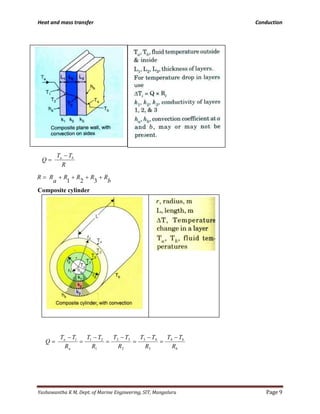
Composite slab
Where,
a
a
Ah
R
1
=
1
1
1
Ak
L
R =
2
2
2
Ak
L
R =
3
3
3
Ak
L
R =
b
b
Ah
R
1
=
(Refer HMTDB P.No-45)
12
1
11
rr
TT
C oi
−
−
=












−
−
+=
12
1
2
11
1
rr
TT
r
TC oi
i












−
−
=
−
−
12
1
11
11
)(
rr
rr
TT
TrT
oi
i
dr
dT
AkQ −=
2
124
r
C
rkQ Π−=














−
−
Π=
1
1
2
1
4
rr
o
T
i
T
kQ














Π
−
−
=
k
rr
TT
Q oi
4
1
1
2
1
R
TT
Q oi −
=












−
−
++












−
−
−=
12
1
12
11
1
11
1
)(
rr
TT
r
T
rr
TT
r
rT oi
i
oi












−
−
=
−
−
21
1
11
11
)(
rr
rr
TT
rTT
oi
i
b
b
a
a
R
TT
R
TT
R
TT
R
TT
R
TT
Q
−
=
−
=
−
=
−
=
−
= 4
3
43
2
32
1
211
Heat and mass transfer Conduction
Yashawantha K M, Dept. of Marine Engineering, SIT, Mangaluru Page 9
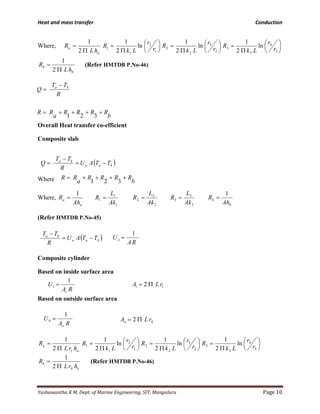
Composite cylinder
R
TT
Q ba −
=
b
RRRR
a
RR ++++=
321
b
b
a
a
R
TT
R
TT
R
TT
R
TT
R
TT
Q
−
=
−
=
−
=
−
=
−
= 4
3
43
2
32
1
211
Heat and mass transfer Conduction
Yashawantha K M, Dept. of Marine Engineering, SIT, Mangaluru Page 10
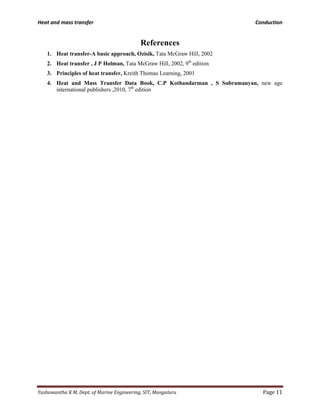
Where,
a
a
hL
R
Π
=
2
1






Π
=
1
2
1
1 ln
2
1
r
r
Lk
R 





Π
=
2
3
2
2 ln
2
1
r
r
Lk
R 





Π
=
3
4
3
3 ln
2
1
r
r
Lk
R
b
b
hL
R
Π
=
2
1
(Refer HMTDB P.No-46)
Overall Heat transfer co-efficient
Composite slab
Where
Where,
a
a
Ah
R
1
=
1
1
1
Ak
L
R =
2
2
2
Ak
L
R =
3
3
3
Ak
L
R =
b
b
Ah
R
1
=
(Refer HMTDB P.No-45)
Composite cylinder
Based on inside surface area
Based on outside surface area
a
a
hrL
R
12
1
Π
= 





Π
=
1
2
1
1 ln
2
1
r
r
Lk
R 





Π
=
2
3
2
2 ln
2
1
r
r
Lk
R 





Π
=
3
4
3
3 ln
2
1
r
r
Lk
R
b
b
hrL
R
42
1
Π
= (Refer HMTDB P.No-46)
b
RRRR
a
RR ++++=
321
R
TT
Q ba −
=
b
RRRR
a
RR ++++=
321
( )bao
ba
TTAU
R
TT
Q −=
−
=
( )bao
ba
TTAU
R
TT
−=
−
RA
Uo
1
=
RA
U
i
i
1
= 12 rLAi Π=
RA
U
o
1
0 = 42 rLAo Π=
Heat and mass transfer Conduction
Yashawantha K M, Dept. of Marine Engineering, SIT, Mangaluru Page 11
References
1. Heat transfer-A basic approach, Ozisik, Tata McGraw Hill, 2002
2. Heat transfer , J P Holman, Tata McGraw Hill, 2002, 9th
edition
3. Principles of heat transfer, Kreith Thomas Learning, 2001
4. Heat and Mass Transfer Data Book, C.P Kothandarman , S Subramanyan, new age
international publishers ,2010, 7th
edition

Heat conduction equation

  • 1.
    Heat and masstransfer Conduction Yashawantha K M, Dept. of Marine Engineering, SIT, Mangaluru Page 1 Three Dimensional heat transfer equation analysis (Cartesian co-ordinates) Assumptions • The solid is homogeneous and isotropic • The physical parameters of solid materials are constant • Steady state conduction • Thermal conductivity k is constant Consider a homogenous medium within which there is no bulk motion and the temperature distribution T(x,y,z) is expressed in Cartesian coordinates. We first define the infinitesimally small control volume dx.dy.dz , as shown in Figure. Energy quantities are yields at, Let, Cp = Specific heat of material J/Kg.0 C) gq = Energy generation rate per unit volume W/m3 ρ = Density of material, Kg/m3 T = temperature, 0 K t = time, s k= Thermal Conductivity W/mK x,y,z= Coordinates, m Within the medium there may be an energy source tem associated with the rate of thermal energy generation, this term is represented by, Where gq is the rate at which energy is generated per unit volume (W/m3 ) In addition, changes may occur in the amount of the internal thermal energy stored by the material in the control volume. If the material is not experiencing a change in phase, latent energy effects are not pertinent, and the energy storage term may be expressed as, Where is the time rate change of the sensible (thermal) energy of the medium per unit volume )1(L dt dE dzz Q dyy Q dxx QgenQzQyQxQ + + + + + + =+++ )2(KdzdydxgqgenQ = )3(K t T dzdydxpc dt dE ∂ ∂ = ρ t T cp ∂ ∂ ρ
  • 2.
    Heat and masstransfer Conduction Yashawantha K M, Dept. of Marine Engineering, SIT, Mangaluru Page 2 Substituting in equation (1) we get, Where the quantity (m2 /s) is called thermal diffusivity of the material. x T dzdyk x Q ∂ ∂ −= y T dzdxkyQ ∂ ∂ −= z T dydxkzQ ∂ ∂ −= ( )dxxQ x xQ dxx Q ∂ ∂ += + 2 2 x T dzdydxkxQ dxx Q ∂ ∂ −= + ( )dyyQ x yQ dyy Q ∂ ∂ += + 2 2 y T dzdydxkyQ dyy Q ∂ ∂ −= + ( )dzzQ x zQ dzz Q ∂ ∂ += + 2 2 z T dzdydxkzQ dzz Q ∂ ∂ −= + t T dzdydxpc z T dzdydxk y T dzdydxk x T dzdydxkdzdydxgq ∂ ∂ + ∂ ∂ − ∂ ∂ − ∂ ∂ −= ρ 2 2 2 2 2 2 t T pcgq z T k y T k x T k ∂ ∂ =+ ∂ ∂ + ∂ ∂ + ∂ ∂ ρ 2 2 2 2 2 2 )4( 1 2 2 2 2 2 2 K t T k g q z T y T x T ∂ ∂ =+ ∂ ∂ + ∂ ∂ + ∂ ∂ α p c k ρ α =
  • 3.
    Heat and masstransfer Conduction Yashawantha K M, Dept. of Marine Engineering, SIT, Mangaluru Page 3 Cylindrical co-ordinates Spherical coordinates Special cases Steady state one dimensional heat flow (no heat generation) Steady state one dimensional heat flow in cylindrical coordinates (no heat generation) )5( 1 2 2 2 2 2 11 −−−− ∂ ∂ =+ ∂ ∂ + ∂ ∂ +      ∂ ∂ ∂ ∂ t T k g q z TT rr T r rr αφ )6( 1 2 2 2sin2 1 sin sin2 1 2 1 −−−−−− ∂ ∂ =+ ∂ ∂ +      ∂ ∂ ∂ ∂ +      ∂ ∂ ∂ ∂ t T k g q T r T rr T r rr αφθθ θ θθ 0 2 2 = dx Td 0 1 =      dr dT r dr d r
  • 4.
    Heat and masstransfer Conduction Yashawantha K M, Dept. of Marine Engineering, SIT, Mangaluru Page 4 Steady state one dimensional heat flow in Spherical coordinates (no heat generation) Steady state one dimensional heat flow (with heat generation) Two dimensional steady state heat flow (without heat generation) Heat conduction through a slab Assumptions • One dimensional steady state heat transfer • No heat generation • The solid is homogeneous and isotropic • The physical parameters of solid materials are constant • Steady state conduction • Thermal conductivity k is constant One dimensional heat transfer equation is, Double integrating the equation, C1 and C2 are the two constants, two boundary conditions are needed to determine the constants Boundary conditions are, Applying boundary conditions, 0 2 2 =+ k g q dx Td 0 2 2 2 2 = ∂ ∂ + ∂ ∂ y T x T 0 2 1 =      dr dT r dr d r 0 2 2 = dx Td LxatTxT xatTxT == == 2 1 )( 0)( 1C dx Td = 21)( CxCxT += 0)( 1 == xatTxT
  • 5.
    Heat and masstransfer Conduction Yashawantha K M, Dept. of Marine Engineering, SIT, Mangaluru Page 5 Differentiating By Fourier law, R Ak L = (Refer HMTDB P.No-44) is called as thermal resistance of the slab for heat flow through an area A across a temperature T1 – T2 This concept analogous to electric resistance in Ohm’s law as shown in figure Heat transfer through hollow cylinder 21 21 0 CT CT = += LxatTxT == 2)( 112 TLCT += L TT C 12 1 − = 1 12 )( Tx L TT xT + − = L TT dx xTd 12)( − = dx dT AkQ −= L TT AkQ 21 − = Ak L TT Q 21 − = R TT Q 21 − =
  • 6.
    Heat and masstransfer Conduction Yashawantha K M, Dept. of Marine Engineering, SIT, Mangaluru Page 6 Assumptions • One dimensional steady state heat transfer , in r direction only • No heat generation • The solid is homogeneous and isotropic • The physical parameters of solid materials are constant • Thermal conductivity k is constant • Temperature within the cylinder does not vary with time One dimensional heat conduction equation, Double integrating Boundary conditions, Solving simultaneous equations, Refer (HMTDB P.No 45) By Fourier law, 0 1 =      dr dT r dr d r 1C dr dT r = 21 ln)( CrCrT += 1)( rratTxT i == 2)( rratTxT o == 21 ln)( CrCrT += 21 ln)( CrCrT += ( )aCrCTi −−−−+= 211 ln )(ln 221 bCrCTo −−−−−−+=       − = 1 2 1 ln r r TT C io 1 1 2 2 ln ln r r r TT TC io i       − −=             = − − 1 2 1 ln ln )( r r r r TT TrT io i r r r TT Tr r r TT rT io i io ln ln ln ln )( 1 2 1 2       − −+       − = dr dT AkQ −= r C LrkQ 12 Π−=       − Π−= 1 2ln 2 r r TT LkQ io r C dr dT 1=             = − − 1 2 1 ln ln )( r r r r TT rTT oi i
  • 7.
    Heat and masstransfer Conduction Yashawantha K M, Dept. of Marine Engineering, SIT, Mangaluru Page 7 R Lk r r = Π       2 ln 1 2 is called as thermal resistance of the cylinder for heat flow through an area A across a temperature Ti – To Heat transfer through Sphere r1, r2, inner and outer radii Ti, To, inner and outer surface temperature L, Length of cylinder • One dimensional steady state heat transfer , in r direction only • No heat generation • The solid is homogeneous and isotropic • The physical parameters of solid materials are constant • Thermal conductivity k is constant One dimensional heat conduction equation, Double integrating Boundary conditions, Lk r r TT Q oi Π       − = 2 ln 1 2 R TT Q oi − = 02 2 1 =      dr dT r dr d r 1 2 C dr dT r = 2 1)( C r C rT +−= 1)( rratTxT i == 2)( rratTxT o == 2 1 r C dr dT = )( 1 1 2 aC r C Ti −−−−−+−= )( 2 1 2 bC r C To −−−−−+−=
  • 8.
    Heat and masstransfer Conduction Yashawantha K M, Dept. of Marine Engineering, SIT, Mangaluru Page 8 Solving simultaneous equations, Refer (HMTDB P.No 45) By Fourier law, R k rr =               Π − 4 1 1 2 1 (Refer HMTDB P.No-45) is called as thermal resistance of the Sphere for heat flow through an area A across a temperature Ti – To Composite slab Where, a a Ah R 1 = 1 1 1 Ak L R = 2 2 2 Ak L R = 3 3 3 Ak L R = b b Ah R 1 = (Refer HMTDB P.No-45) 12 1 11 rr TT C oi − − =             − − += 12 1 2 11 1 rr TT r TC oi i             − − = − − 12 1 11 11 )( rr rr TT TrT oi i dr dT AkQ −= 2 124 r C rkQ Π−=               − − Π= 1 1 2 1 4 rr o T i T kQ               Π − − = k rr TT Q oi 4 1 1 2 1 R TT Q oi − =             − − ++             − − −= 12 1 12 11 1 11 1 )( rr TT r T rr TT r rT oi i oi             − − = − − 21 1 11 11 )( rr rr TT rTT oi i b b a a R TT R TT R TT R TT R TT Q − = − = − = − = − = 4 3 43 2 32 1 211
  • 9.
    Heat and masstransfer Conduction Yashawantha K M, Dept. of Marine Engineering, SIT, Mangaluru Page 9 Composite cylinder R TT Q ba − = b RRRR a RR ++++= 321 b b a a R TT R TT R TT R TT R TT Q − = − = − = − = − = 4 3 43 2 32 1 211
  • 10.
    Heat and masstransfer Conduction Yashawantha K M, Dept. of Marine Engineering, SIT, Mangaluru Page 10 Where, a a hL R Π = 2 1       Π = 1 2 1 1 ln 2 1 r r Lk R       Π = 2 3 2 2 ln 2 1 r r Lk R       Π = 3 4 3 3 ln 2 1 r r Lk R b b hL R Π = 2 1 (Refer HMTDB P.No-46) Overall Heat transfer co-efficient Composite slab Where Where, a a Ah R 1 = 1 1 1 Ak L R = 2 2 2 Ak L R = 3 3 3 Ak L R = b b Ah R 1 = (Refer HMTDB P.No-45) Composite cylinder Based on inside surface area Based on outside surface area a a hrL R 12 1 Π =       Π = 1 2 1 1 ln 2 1 r r Lk R       Π = 2 3 2 2 ln 2 1 r r Lk R       Π = 3 4 3 3 ln 2 1 r r Lk R b b hrL R 42 1 Π = (Refer HMTDB P.No-46) b RRRR a RR ++++= 321 R TT Q ba − = b RRRR a RR ++++= 321 ( )bao ba TTAU R TT Q −= − = ( )bao ba TTAU R TT −= − RA Uo 1 = RA U i i 1 = 12 rLAi Π= RA U o 1 0 = 42 rLAo Π=
  • 11.
    Heat and masstransfer Conduction Yashawantha K M, Dept. of Marine Engineering, SIT, Mangaluru Page 11 References 1. Heat transfer-A basic approach, Ozisik, Tata McGraw Hill, 2002 2. Heat transfer , J P Holman, Tata McGraw Hill, 2002, 9th edition 3. Principles of heat transfer, Kreith Thomas Learning, 2001 4. Heat and Mass Transfer Data Book, C.P Kothandarman , S Subramanyan, new age international publishers ,2010, 7th edition