Subject:Heat Transfer(2151909)
Topic:Heat Transfer by Conduction
 Fourier’s law of heat conduction.
 One dimensional steady state conduction heat transfer
 Heat conduction through plane wall.
 Heat conduction through composite wall.
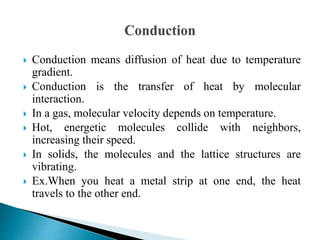
 Conduction means diffusion of heat due to temperature
gradient.
 Conduction is the transfer of heat by molecular
interaction.
 In a gas, molecular velocity depends on temperature.
 Hot, energetic molecules collide with neighbors,
increasing their speed.
 In solids, the molecules and the lattice structures are
vibrating.
 Ex.When you heat a metal strip at one end, the heat
travels to the other end.
 “The rate of flow of heat through a simple homogeneous solid
is directly proportional to the area of the section at right angle
to the direction of heat flow and to change of temperature
w.r.t. the length of path of heat flow.
Q α A*dt/dx
Q=-K*A*dt/dx
Where,K=constant of proportionality and is known as thermal
conductivity of the material.
 Some assumptions made for
Fourier’s Law:
◦ Heat transfer takes place under
steady state condition.
◦ There is no internal heat
generation.
◦ The material of the body is
homogeneous and isotropic.
◦ There is unidirectional heat flow
and the temperature profile is
linear.
 The term steady state refers to the condition in a heat
conducting medium when temperature at fixed point do not
change with time.
 In this type of heat transfer temperature field can be described
as one space coordinate.
 In Fourier’s law temperature is a function of one axis,
therefore we have to take assumptions.
The Plane Wall
.. .. . . … . .
. . . . .. . . . . .
. . . . . . . . . .
.
.. . . . . . . . .
. .. . . . . . .
. . . . . . .
…. . . . . . .. ..
.. . . . . .. . .. .
. . . .. . . . . . .
. .
k
T∞,2
Ts,1
Ts,2
x=0 x=LHot
fluid
Cold
fluid
0





dx
dT
k
dx
d
 
kAL
TT
TT
L
kA
dx
dT
kAq
ss
ssx
/
2,1,
2,1,


Const. K;solution is:
 OHM’s LAW :Flow of Electricity
 V=IR elect
 Voltage Drop = Current flow×Resistance
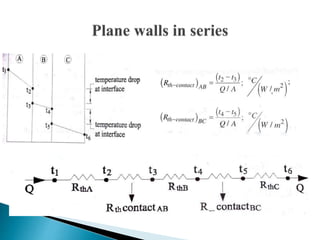
 Temp Drop=Heat Flow×Resistance
thermqRT 
 T∞,1
K A
K B
K C
A B C
h2
T∞,2
LA L B L C
h1
1 2
3 4
TUA
Ahk
L
k
L
k
L
Ah
TT
R
TT
q
C
C
B
B
A
At
x 




 

21
2,1,2,1,
11

AR
Uwhere
tot
1
, Overall heat transfer coefficient
Heat Transfer
Heat Transfer
Heat Transfer
Heat Transfer

Heat Transfer

  • 1.
  • 2.
     Fourier’s lawof heat conduction.  One dimensional steady state conduction heat transfer  Heat conduction through plane wall.  Heat conduction through composite wall.
  • 3.
     Conduction meansdiffusion of heat due to temperature gradient.  Conduction is the transfer of heat by molecular interaction.  In a gas, molecular velocity depends on temperature.  Hot, energetic molecules collide with neighbors, increasing their speed.  In solids, the molecules and the lattice structures are vibrating.  Ex.When you heat a metal strip at one end, the heat travels to the other end.
  • 4.
     “The rateof flow of heat through a simple homogeneous solid is directly proportional to the area of the section at right angle to the direction of heat flow and to change of temperature w.r.t. the length of path of heat flow. Q α A*dt/dx Q=-K*A*dt/dx Where,K=constant of proportionality and is known as thermal conductivity of the material.
  • 5.
     Some assumptionsmade for Fourier’s Law: ◦ Heat transfer takes place under steady state condition. ◦ There is no internal heat generation. ◦ The material of the body is homogeneous and isotropic. ◦ There is unidirectional heat flow and the temperature profile is linear.
  • 6.
     The termsteady state refers to the condition in a heat conducting medium when temperature at fixed point do not change with time.  In this type of heat transfer temperature field can be described as one space coordinate.  In Fourier’s law temperature is a function of one axis, therefore we have to take assumptions.
  • 7.
    The Plane Wall .... . . … . . . . . . .. . . . . . . . . . . . . . . . . .. . . . . . . . . . .. . . . . . . . . . . . . . …. . . . . . .. .. .. . . . . .. . .. . . . . .. . . . . . . . . k T∞,2 Ts,1 Ts,2 x=0 x=LHot fluid Cold fluid 0      dx dT k dx d   kAL TT TT L kA dx dT kAq ss ssx / 2,1, 2,1,   Const. K;solution is:
  • 8.
     OHM’s LAW:Flow of Electricity  V=IR elect  Voltage Drop = Current flow×Resistance
  • 9.
     Temp Drop=HeatFlow×Resistance thermqRT 
  • 10.
     T∞,1 K A KB K C A B C h2 T∞,2 LA L B L C h1 1 2 3 4
  • 11.