CHAPTER 2 (CONTD.)
 Slow Cooling of an Isomorphous Alloy
 Rapid Cooling of an Isomorphous Alloy
 Binary Eutectic System
MTE/III SEMESTER/MSE/MTE 2101 1
SLOW COOLING OF AN ISOMORPHOUS ALLOY
 Also, called as Equilibrium Cooling.
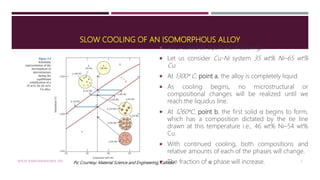
 Let us consider Cu-Ni system 35 wt% Ni–65 wt%
Cu.
 At 1300° C; point a, the alloy is completely liquid.
 As cooling begins, no microstructural or
compositional changes will be realized until we
reach the liquidus line.
 At 1260°C; point b, the first solid α begins to form,
which has a composition dictated by the tie line
drawn at this temperature i.e., 46 wt% Ni–54 wt%
Cu.
 With continued cooling, both compositions and
relative amounts of each of the phases will change.
 The fraction of α phase will increase.MTE/III SEMESTER/MSE/MTE 2101 2
Pic Courtesy: Material Science and Engineering, Callister.
 At 1250°C, point c, the compositions of the liquid
and α phases are 32 wt% Ni–68 wt% Cu [L(32 Ni)]
and 43 wt% Ni–57 wt% Cu [ (43 Ni)].
 The solidification process is virtually complete
at1220°C about point d; the composition of the
solid is approximately 35 wt% Ni–65 wt% Cu.
 Upon crossing the solidus line, this remaining
liquid solidifies; the final product then is a
polycrystalline -phase solid solution that has a
uniform 35 wt% Ni–65 wt% Cu composition at
point e.
MTE/III SEMESTER/MSE/MTE 2101 3
Pic Courtesy: Material Science and Engineering, Callister.
RAPID COOLING OF AN ISOMORPHOUS ALLOY
 Also, called as Non Equilibrium Cooling.
 Let us consider Cu-Ni system 35 wt% Ni–65
wt% Cu.
 At 1300° C; point a´, the alloy is completely
liquid.
 As cooling begins, no microstructural or
compositional changes will be realized until we
reach the liquidus line.
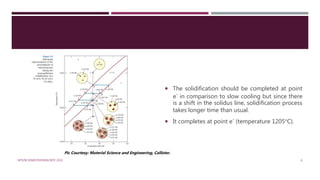
 At point b´, (approximately 1260°C), α-phase
particles begin to form, which, from the tie line
constructed, have a composition of 46 wt% Ni–
54 wt% Cu [ (46 Ni)].
MTE/III SEMESTER/MSE/MTE 2101 4Pic Courtesy: Material Science and Engineering, Callister.
 Upon further cooling to point c´ (about 1260°C
), the liquid composition has shifted to 29 wt%
Ni–71 wt% Cu; furthermore, at this temperature
the composition of the αphase that solidified is
40 wt% Ni–60 wt% Cu [ (40 Ni)].
 Because of the rapid cooling, the solidus line
shifted (indicated in dashed line) and solid
composition has increased.
 At point d´ (temperature 1220°C), the
solidification should complete but there is still
little amount of liquid is left.
MTE/III SEMESTER/MSE/MTE 2101 5
Pic Courtesy: Material Science and Engineering, Callister.
 The solidification should be completed at point
e´ in comparison to slow cooling but since there
is a shift in the solidus line, solidification process
takes longer time than usual.
 It completes at point e´ (temperature 1205°C).
MTE/III SEMESTER/MSE/MTE 2101 6
Pic Courtesy: Material Science and Engineering, Callister.
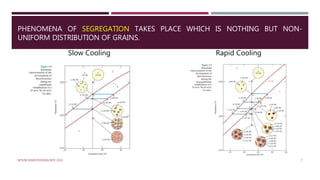
PHENOMENA OF SEGREGATION TAKES PLACE WHICH IS NOTHING BUT NON-
UNIFORM DISTRIBUTION OF GRAINS.
Slow Cooling Rapid Cooling
MTE/III SEMESTER/MSE/MTE 2101 7
BINARY EUTECTIC
SYSTEMS
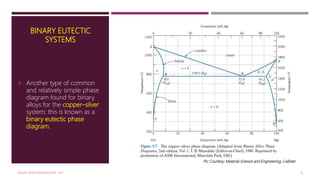
 Another type of common
and relatively simple phase
diagram found for binary
alloys for the copper–silver
system; this is known as a
binary eutectic phase
diagram.
MTE/III SEMESTER/MSE/MTE 2101 8
Pic Courtesy: Material Science and Engineering, Callister
Features of Phase Diagram
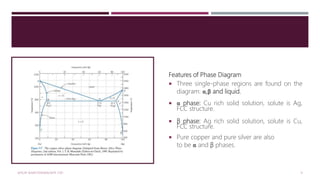
 Three single-phase regions are found on the
diagram: α,β and liquid.
 α phase: Cu rich solid solution, solute is Ag,
FCC structure.
 β phase: Ag rich solid solution, solute is Cu,
FCC structure.
 Pure copper and pure silver are also
to be α and β phases.
MTE/III SEMESTER/MSE/MTE 2101 9
Features of Phase Diagram (Contd.)
 The solubility in each of these solid phases is
limited, in that at any temperature below line
BEG only a limited concentration of silver will
dissolve in copper (for the α phase) similarly
copper in silver (for the β phase).
 The solubility limit for the α phase
to the boundary line, labelled CBA, between
the α/(α+β) and α/(α+L) phase regions; it
increases with temperature to a maximum [8.0
wt% Ag at 779°C] at point B and decreases
back to zero at the melting temperature of
pure copper, point A 1085°C.
MTE/III SEMESTER/MSE/MTE 2101 10
Features of Phase Diagram (Contd.)
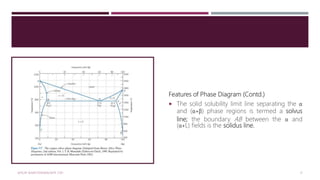
 The solid solubility limit line separating the α
and (α+β) phase regions is termed a solvus
line; the boundary AB between the α and
(α+L) fields is the solidus line.
MTE/III SEMESTER/MSE/MTE 2101 11
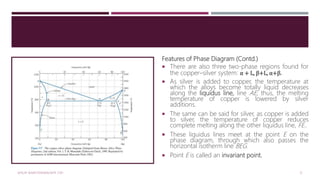
Features of Phase Diagram (Contd.)
 There are also three two-phase regions found for
the copper–silver system: α + L, β+L, α+β.
 As silver is added to copper, the temperature at
which the alloys become totally liquid decreases
along the liquidus line, line AE; thus, the melting
temperature of copper is lowered by silver
additions.
 The same can be said for silver, as copper is added
to silver, the temperature of copper reduces
complete melting along the other liquidus line, FE..
 These liquidus lines meet at the point E on the
phase diagram, through which also passes the
horizontal isotherm line BEG.
 Point E is called an invariant point.
MTE/III SEMESTER/MSE/MTE 2101 12
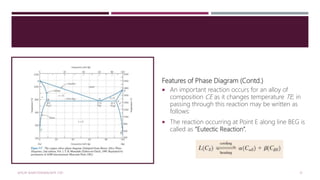
Features of Phase Diagram (Contd.)
 An important reaction occurs for an alloy of
composition CE as it changes temperature TE; in
passing through this reaction may be written as
follows:
 The reaction occurring at Point E along line BEG is
called as “Eutectic Reaction”.
MTE/III SEMESTER/MSE/MTE 2101 13

Two Component System

  • 1.
    CHAPTER 2 (CONTD.) Slow Cooling of an Isomorphous Alloy  Rapid Cooling of an Isomorphous Alloy  Binary Eutectic System MTE/III SEMESTER/MSE/MTE 2101 1
  • 2.
    SLOW COOLING OFAN ISOMORPHOUS ALLOY  Also, called as Equilibrium Cooling.  Let us consider Cu-Ni system 35 wt% Ni–65 wt% Cu.  At 1300° C; point a, the alloy is completely liquid.  As cooling begins, no microstructural or compositional changes will be realized until we reach the liquidus line.  At 1260°C; point b, the first solid α begins to form, which has a composition dictated by the tie line drawn at this temperature i.e., 46 wt% Ni–54 wt% Cu.  With continued cooling, both compositions and relative amounts of each of the phases will change.  The fraction of α phase will increase.MTE/III SEMESTER/MSE/MTE 2101 2 Pic Courtesy: Material Science and Engineering, Callister.
  • 3.
     At 1250°C,point c, the compositions of the liquid and α phases are 32 wt% Ni–68 wt% Cu [L(32 Ni)] and 43 wt% Ni–57 wt% Cu [ (43 Ni)].  The solidification process is virtually complete at1220°C about point d; the composition of the solid is approximately 35 wt% Ni–65 wt% Cu.  Upon crossing the solidus line, this remaining liquid solidifies; the final product then is a polycrystalline -phase solid solution that has a uniform 35 wt% Ni–65 wt% Cu composition at point e. MTE/III SEMESTER/MSE/MTE 2101 3 Pic Courtesy: Material Science and Engineering, Callister.
  • 4.
    RAPID COOLING OFAN ISOMORPHOUS ALLOY  Also, called as Non Equilibrium Cooling.  Let us consider Cu-Ni system 35 wt% Ni–65 wt% Cu.  At 1300° C; point a´, the alloy is completely liquid.  As cooling begins, no microstructural or compositional changes will be realized until we reach the liquidus line.  At point b´, (approximately 1260°C), α-phase particles begin to form, which, from the tie line constructed, have a composition of 46 wt% Ni– 54 wt% Cu [ (46 Ni)]. MTE/III SEMESTER/MSE/MTE 2101 4Pic Courtesy: Material Science and Engineering, Callister.
  • 5.
     Upon furthercooling to point c´ (about 1260°C ), the liquid composition has shifted to 29 wt% Ni–71 wt% Cu; furthermore, at this temperature the composition of the αphase that solidified is 40 wt% Ni–60 wt% Cu [ (40 Ni)].  Because of the rapid cooling, the solidus line shifted (indicated in dashed line) and solid composition has increased.  At point d´ (temperature 1220°C), the solidification should complete but there is still little amount of liquid is left. MTE/III SEMESTER/MSE/MTE 2101 5 Pic Courtesy: Material Science and Engineering, Callister.
  • 6.
     The solidificationshould be completed at point e´ in comparison to slow cooling but since there is a shift in the solidus line, solidification process takes longer time than usual.  It completes at point e´ (temperature 1205°C). MTE/III SEMESTER/MSE/MTE 2101 6 Pic Courtesy: Material Science and Engineering, Callister.
  • 7.
    PHENOMENA OF SEGREGATIONTAKES PLACE WHICH IS NOTHING BUT NON- UNIFORM DISTRIBUTION OF GRAINS. Slow Cooling Rapid Cooling MTE/III SEMESTER/MSE/MTE 2101 7
  • 8.
    BINARY EUTECTIC SYSTEMS  Anothertype of common and relatively simple phase diagram found for binary alloys for the copper–silver system; this is known as a binary eutectic phase diagram. MTE/III SEMESTER/MSE/MTE 2101 8 Pic Courtesy: Material Science and Engineering, Callister
  • 9.
    Features of PhaseDiagram  Three single-phase regions are found on the diagram: α,β and liquid.  α phase: Cu rich solid solution, solute is Ag, FCC structure.  β phase: Ag rich solid solution, solute is Cu, FCC structure.  Pure copper and pure silver are also to be α and β phases. MTE/III SEMESTER/MSE/MTE 2101 9
  • 10.
    Features of PhaseDiagram (Contd.)  The solubility in each of these solid phases is limited, in that at any temperature below line BEG only a limited concentration of silver will dissolve in copper (for the α phase) similarly copper in silver (for the β phase).  The solubility limit for the α phase to the boundary line, labelled CBA, between the α/(α+β) and α/(α+L) phase regions; it increases with temperature to a maximum [8.0 wt% Ag at 779°C] at point B and decreases back to zero at the melting temperature of pure copper, point A 1085°C. MTE/III SEMESTER/MSE/MTE 2101 10
  • 11.
    Features of PhaseDiagram (Contd.)  The solid solubility limit line separating the α and (α+β) phase regions is termed a solvus line; the boundary AB between the α and (α+L) fields is the solidus line. MTE/III SEMESTER/MSE/MTE 2101 11
  • 12.
    Features of PhaseDiagram (Contd.)  There are also three two-phase regions found for the copper–silver system: α + L, β+L, α+β.  As silver is added to copper, the temperature at which the alloys become totally liquid decreases along the liquidus line, line AE; thus, the melting temperature of copper is lowered by silver additions.  The same can be said for silver, as copper is added to silver, the temperature of copper reduces complete melting along the other liquidus line, FE..  These liquidus lines meet at the point E on the phase diagram, through which also passes the horizontal isotherm line BEG.  Point E is called an invariant point. MTE/III SEMESTER/MSE/MTE 2101 12
  • 13.
    Features of PhaseDiagram (Contd.)  An important reaction occurs for an alloy of composition CE as it changes temperature TE; in passing through this reaction may be written as follows:  The reaction occurring at Point E along line BEG is called as “Eutectic Reaction”. MTE/III SEMESTER/MSE/MTE 2101 13