Lectures on Heat Transfer:
Introduction - Fundamentals
by
Dr. M. Thirumaleshwar
formerly:
Professor, Dept. of Mechanical Engineering,
St. Joseph Engg. College, Vamanjoor,
Mangalore
Preface
• This file contains Introduction to Heat
Transfer and Fundamental laws governing
heat transfer.
• The slides were prepared while teaching• The slides were prepared while teaching
Heat Transfer course to the M.Tech.
students in Mechanical Engineering Dept.
of St. Joseph Engineering College,
Vamanjoor, Mangalore, India, during Sept.
– Dec. 2010.
Aug. 2016 2MT/SJEC/M.Tech.
• It is hoped that these Slides will be useful
to teachers, students, researchers and
professionals working in this field.
• For students, it should be particularly
useful to study, quickly review the subject,useful to study, quickly review the subject,
and to prepare for the examinations.
•
Aug. 2016 3MT/SJEC/M.Tech.
References
• 1. Cengel Y. A. Heat Transfer: A Practical
Approach, 2nd Ed. McGraw Hill Co., 2003
• 2.Cengel, Y. A. and Ghajar, A. J., Heat and
Mass Transfer - Fundamentals and Applications,
5th Ed., McGraw-Hill, New York, NY, 2014.
Aug. 2016 MT/SJEC/M.Tech. 4
5th Ed., McGraw-Hill, New York, NY, 2014.
• 3. Incropera , Dewitt, Bergman, Lavine:
Fundamentals of Heat and Mass Transfer, 6th
Ed., Wiley Intl.
• 4. Necati Ozisik: Heat Transfer – A Basic
Approach, McGraw Hill
References… contd.
• 5. M. Thirumaleshwar: Fundamentals of Heat &
Mass Transfer, Pearson Edu., 2006
• 6. M. Thirumaleshwar: Software Solutions to
Problems on Heat Transfer – CONDUCTION-Problems on Heat Transfer – CONDUCTION-
Part-I, Bookboon, 2013
• http://bookboon.com/en/software-solutions-to-problems-on-
heat-transfer-ebook
Aug. 2016 MT/SJEC/M.Tech. 5
Heat Transfer
Introduction - Fundamentals
• Applications - Modes of heat transfer-
Fundamental laws – governing rate
equations – concept of thermal resistance
Aug. 2016 MT/SJEC/M.Tech. 6
equations – concept of thermal resistance
– general heat conduction equation –
different boundary conditions.
Applications of Heat Transfer:
• Mechanical Engineering: Boilers, Heat
Exchangers, Turbine systems, Internal
combustion engines etc.
• Metallurgical Engineering: Furnaces,
Aug. 2016 MT/SJEC/M.Tech. 7
• Metallurgical Engineering: Furnaces,
Heat treatment of components etc.
• Electrical Engineering: Cooling systems
for electric motors, generators,
transformers etc.
Applications of Heat Transfer(Contd.)..
• Chemical Engineering: Process equipments
used in Refineries, Chemical plants etc.
• Nuclear Engineering: In removal of heat
generated by nuclear fission using liquid metal
Aug. 2016 MT/SJEC/M.Tech. 8
generated by nuclear fission using liquid metal
coolants, design of nuclear fuel rods against
possible burn – out etc.
• Aerospace Engineering & Space Technology:
In the design of aircraft systems and
components, Rockets, Missiles etc.
Applications of Heat Transfer(Contd.)..
• Cryogenic Engineering: In the production,
storage, transportation and utilization of
cryogenic liquids (at very low temperatures
ranging from 100 K to 4 K or even lower) for
various Industrial, Research and Defence
applications.
Aug. 2016 MT/SJEC/M.Tech. 9
applications.
• Civil Engineering: In the design of Suspension
bridges, railway tracks, Airconditioning and
Insulation of buildings etc.
• Principles and methods of Heat Transfer are
widely applied in many, many areas that affect
our lives.
Fundamental Laws governing
Heat Transfer:
– 1. First Law of Thermodynamics – gives
conservation of energy.
– 2. Second Law of Thermodynamics – gives
direction of heat flow.
Aug. 2016 MT/SJEC/M.Tech. 10
direction of heat flow.
– 3. Equation of continuity – gives
conservation of mass.
– 4. Equation of flow – Newton’s Second Law
of motion—Navier Stokes’ Equations
Fundamental Laws governing
Heat Transfer (contd.):
– 5. Rate equations governing the three
modes of Heat Transfer:
– Conduction – Fourier’s Law of Conduction
– Convection – Newton’s Law of cooling
Aug. 2016 MT/SJEC/M.Tech. 11
– Convection – Newton’s Law of cooling
– Radiation – Stefan – Boltzmann’s Law
– 6. Empirical relations for fluid properties
such as specific heat, thermal conductivity,
viscosity etc.
– 7. Equation of State for the fluid.
Modes of Heat Transfer
• Three main modes:
• Conduction …. heat flow by direct contact
• Convection … heat carried by moving fluid
• Radiation … heat flow does not need an• Radiation … heat flow does not need an
intervening medium
• In practical cases, a combination of one or
more of the above modes are present
Aug. 2016 MT/SJEC/M.Tech. 12
Conduction:
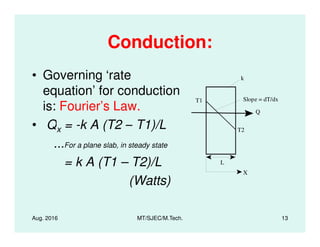
• Governing ‘rate
equation’ for conduction
is: Fourier’s Law.
• Q = -k A (T2 – T1)/L
k
T1
Q
Slope = dT/dx
Aug. 2016 MT/SJEC/M.Tech. 13
• Qx = -k A (T2 – T1)/L
...For a plane slab, in steady state
= k A (T1 – T2)/L
(Watts)
T2
X
L
Assumptions behind Fourier’s
Law:
• Fourier’s Law is an empirical law,
derived from experimental
observations and not from
fundamental, theoretical
considerations.
• Fourier’s Law is defined for steady
Aug. 2016 MT/SJEC/M.Tech. 14
• Fourier’s Law is defined for steady
state, one dimensional heat flow.
• It is assumed that the bounding
surfaces between which heat flows
are isothermal and that the
temperature gradient is constant
i.e. the temperature profile is linear.
Assumptions behind Fourier’s
Law (contd.):
• There is no internal heat generation in the
material.
• The material is homogeneous (i.e. constant
density) and isotropic (i.e. thermal conductivity
Aug. 2016 MT/SJEC/M.Tech. 15
density) and isotropic (i.e. thermal conductivity
is the same in all directions).
• Fourier’s Law is applicable to all states of
matter i.e. solid, liquid or gas.
• Fourier’s Law helps to define ‘thermal
conductivity’
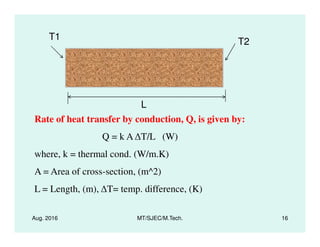
Rate of heat transfer by conduction, Q, is given by:
L
T1
T2
Aug. 2016 MT/SJEC/M.Tech. 16
Rate of heat transfer by conduction, Q, is given by:
Q = k A T/L (W)
where, k = thermal cond. (W/m.K)
A = Area of cross-section, (m^2)
L = Length, (m), T= temp. difference, (K)
Aug. 2016 MT/SJEC/M.Tech. 17
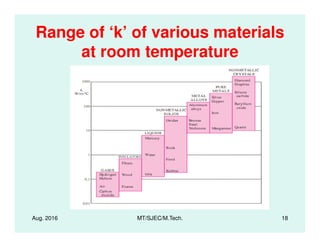
Range of ‘k’ of various materials
at room temperature
Aug. 2016 MT/SJEC/M.Tech. 18
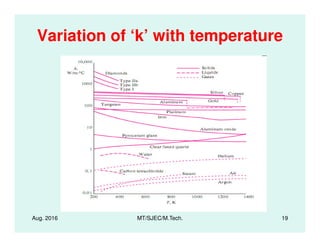
Variation of ‘k’ with temperature
Aug. 2016 MT/SJEC/M.Tech. 19
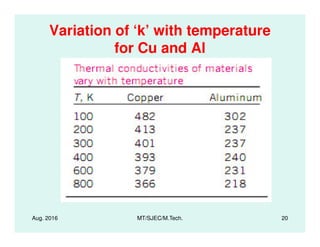
Variation of ‘k’ with temperature
for Cu and Al
Aug. 2016 MT/SJEC/M.Tech. 20
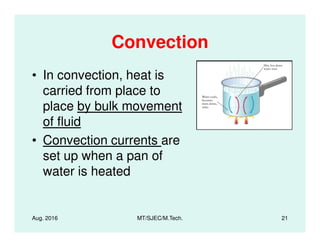
Convection
• In convection, heat is
carried from place to
place by bulk movement
of fluidof fluid
• Convection currents are
set up when a pan of
water is heated
Aug. 2016 MT/SJEC/M.Tech. 21
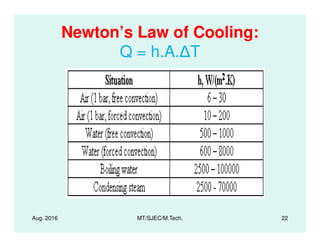
Newton’s Law of Cooling:
Q = h.A. T
Aug. 2016 MT/SJEC/M.Tech. 22
Radiation
• energy is transferred by means of
electromagnetic waves.
• can take place through vacuum.
Aug. 2016 MT/SJEC/M.Tech. 23
• can take place through vacuum.
• electromagnetic waves can propagate
through empty space.
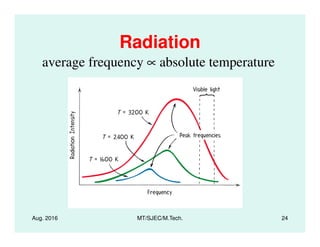
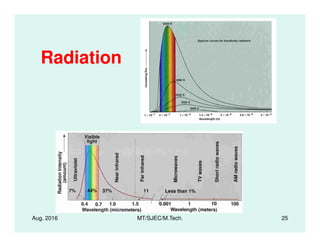
Radiation
average frequency ∝ absolute temperature
Aug. 2016 MT/SJEC/M.Tech. 24
Radiation
Aug. 2016 MT/SJEC/M.Tech. 25
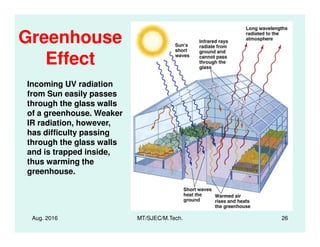
Greenhouse
Effect
Incoming UV radiation
from Sun easily passes
through the glass walls
of a greenhouse. Weaker
IR radiation, however,
Aug. 2016 MT/SJEC/M.Tech. 26
IR radiation, however,
has difficulty passing
through the glass walls
and is trapped inside,
thus warming the
greenhouse.
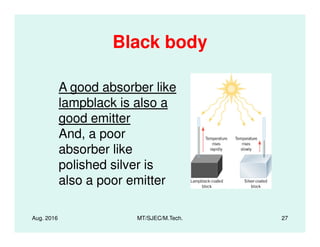
Black body
A good absorber like
lampblack is also a
good emitter
Aug. 2016 MT/SJEC/M.Tech. 27
good emitter
And, a poor
absorber like
polished silver is
also a poor emitter
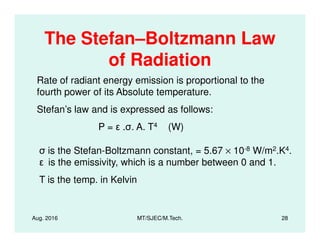
The Stefan–Boltzmann Law
of Radiation
Rate of radiant energy emission is proportional to the
fourth power of its Absolute temperature.
Stefan’s law and is expressed as follows:
P = . . A. T4 (W)
Aug. 2016 MT/SJEC/M.Tech. 28
P = . . A. T4 (W)
is the Stefan-Boltzmann constant, = 5.67 × 10⁻⁸ W/m2.K4.
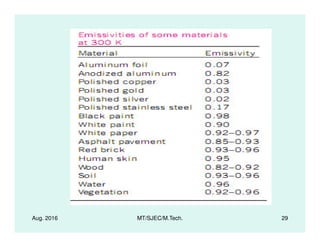
is the emissivity, which is a number between 0 and 1.
T is the temp. in Kelvin
Aug. 2016 MT/SJEC/M.Tech. 29
Radiation Heat Transfer
between bodies
• If the surrounding is at TS then the net
power radiated is:
P = A [ T4 - TS
4]
• Assuming on a dark, dry, night, T = 3 K:
Aug. 2016 MT/SJEC/M.Tech. 30
• Assuming on a dark, dry, night, TS = 3 K:
• Frost may form even if air temperature >
0 C since radiation cools the surface
faster than conduction heat lost from the
ground or air.
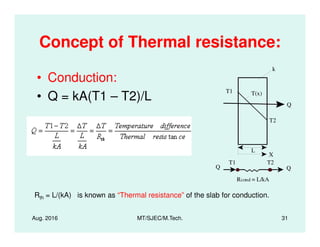
Concept of Thermal resistance:
• Conduction:
• Q = kA(T1 – T2)/L
k
T1
T2
T(x)
Q
Aug. 2016 MT/SJEC/M.Tech. 31
T2
X
L
Q
T1 T2
Rcond = L/kA
Q
Rth = L/(kA) is known as “Thermal resistance” of the slab for conduction.
Concept of Thermal resistance
(contd.):
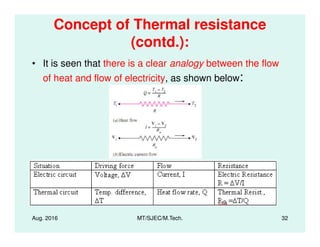
• It is seen that there is a clear analogy between the flow
of heat and flow of electricity, as shown below:
Aug. 2016 MT/SJEC/M.Tech. 32
Concept of Thermal resistance
(contd.):
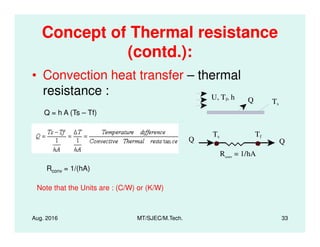
• Convection heat transfer – thermal
resistance : U, Tf, h
Ts
Q
Q = h A (Ts – Tf)
Aug. 2016 MT/SJEC/M.Tech. 33
Q Q
Ts Tf
Rconv = 1/hA
Rconv = 1/(hA)
Note that the Units are : (C/W) or (K/W)
Concept of Thermal resistance
(contd.):
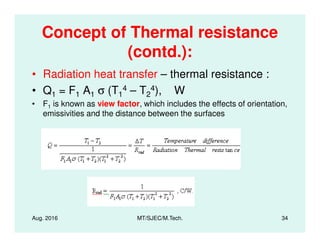
• Radiation heat transfer – thermal resistance :
• Q1 = F1 A1 σ (T1
4 – T2
4), W
• F1 is known as view factor, which includes the effects of orientation,
emissivities and the distance between the surfaces
Aug. 2016 MT/SJEC/M.Tech. 34
Practical applications of Thermal
resistance concept:
• To analyse the problems where one or
more modes of heat transfer occur
simultaneously
• To analyse the problems where multiple
Aug. 2016 MT/SJEC/M.Tech. 35
• To analyse the problems where multiple
layers of materials of different thermal
conductivities are used; ex: in furnace
walls
Limitations for the use of
thermal resistance concept:
• Thermal concept can be used only
when all the following conditions are
satisfied:
Aug. 2016 MT/SJEC/M.Tech. 36
• One dimensional conduction
• Steady state conduction
• No internal heat generation
Thermal diffusivity (αααα):
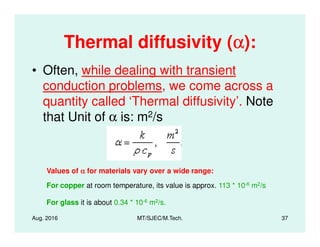
• Often, while dealing with transient
conduction problems, we come across a
quantity called ‘Thermal diffusivity’. Note
that Unit of α is: m2/s
Aug. 2016 MT/SJEC/M.Tech. 37
that Unit of α is: m /s
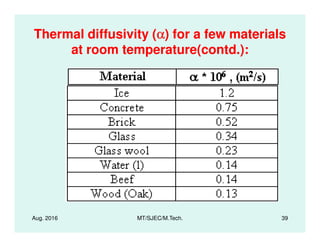
Values of αααα for materials vary over a wide range:
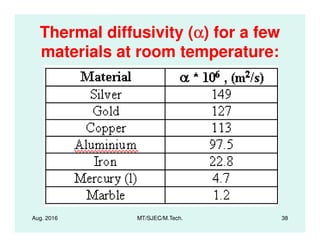
For copper at room temperature, its value is approx. 113 * 10-6 m2/s
For glass it is about 0.34 * 10-6 m2/s.
Thermal diffusivity (αααα) for a few
materials at room temperature:
Aug. 2016 MT/SJEC/M.Tech. 38
Thermal diffusivity (αααα) for a few materials
at room temperature(contd.):
Aug. 2016 MT/SJEC/M.Tech. 39
GENERAL DIFFERENTIAL EQUATION
FOR HEAT CONDUCTION
• This is also known as ‘heat diffusion equation’ or,
simply ‘heat equation’.
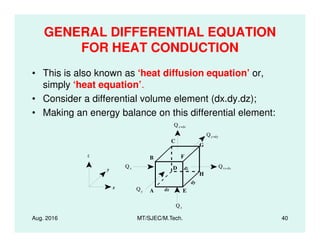
• Consider a differential volume element (dx.dy.dz);
• Making an energy balance on this differential element:
Q
Aug. 2016 MT/SJEC/M.Tech. 40
E
B
C
D
A
H
G
F
dx
dy
dzy
z
x
Qx Qx+dx
Qy
Qy+dy
Qz+dz
Qz
GENERAL DIFFERENTIAL EQUATION
FOR HEAT CONDUCTION (contd.)
B
C
G
Fz
Qy+dy
Qz+dz
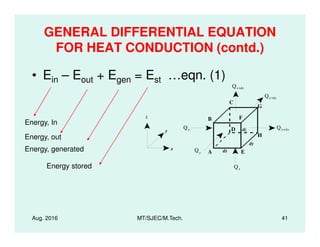
• Ein – Eout + Egen = Est …eqn. (1)
Energy, In
Aug. 2016 MT/SJEC/M.Tech. 41
E
D
A
H
dx
dy
dzy
x
Qx Qx+dx
Qy
Qz
Energy, In
Energy, out
Energy, generated
Energy stored
GENERAL DIFFERENTIAL EQUATION
FOR HEAT CONDUCTION (contd.)
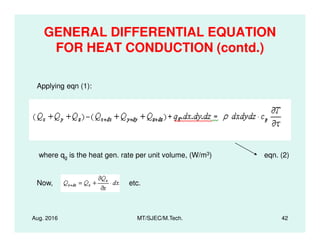
Applying eqn (1):
Aug. 2016 MT/SJEC/M.Tech. 42
where qg is the heat gen. rate per unit volume, (W/m3)
Now, etc.
eqn. (2)
GENERAL DIFFERENTIAL EQUATION
FOR HEAT CONDUCTION (contd.)
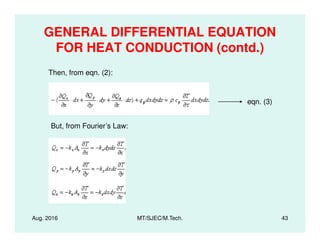
Then, from eqn. (2):
But, from Fourier’s Law:
eqn. (3)
Aug. 2016 MT/SJEC/M.Tech. 43
But, from Fourier’s Law:
GENERAL DIFFERENTIAL EQUATION
FOR HEAT CONDUCTION (contd.)
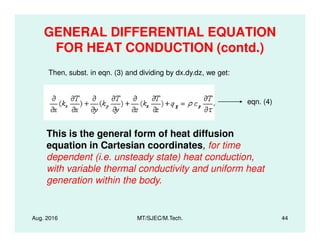
Then, subst. in eqn. (3) and dividing by dx.dy.dz, we get:
eqn. (4)
Aug. 2016 MT/SJEC/M.Tech. 44
This is the general form of heat diffusion
equation in Cartesian coordinates, for time
dependent (i.e. unsteady state) heat conduction,
with variable thermal conductivity and uniform heat
generation within the body.
GENERAL DIFFERENTIAL EQUATION
FOR HEAT CONDUCTION (contd.)
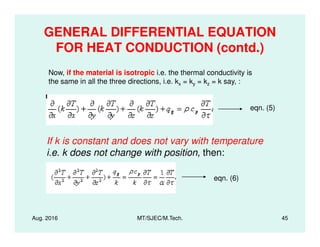
Now, if the material is isotropic i.e. the thermal conductivity is
the same in all the three directions, i.e. kx = ky = kz = k say, :
eqn. (5)
Aug. 2016 MT/SJEC/M.Tech. 45
If k is constant and does not vary with temperature
i.e. k does not change with position, then:
eqn. (6)
GENERAL DIFFERENTIAL EQUATION
FOR HEAT CONDUCTION (contd.)
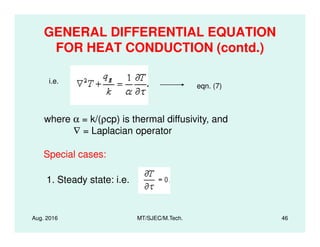
i.e.
eqn. (7)
where α = k/(ρcp) is thermal diffusivity, and
Aug. 2016 MT/SJEC/M.Tech. 46
where α = k/(ρcp) is thermal diffusivity, and
∇ = Laplacian operator
Special cases:
1. Steady state: i.e.
GENERAL DIFFERENTIAL EQUATION
FOR HEAT CONDUCTION (contd.)
eqn. (8)
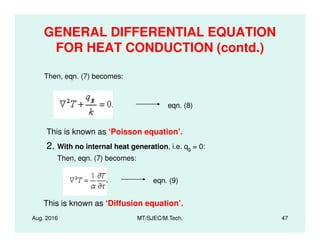
Then, eqn. (7) becomes:
Aug. 2016 MT/SJEC/M.Tech. 47
This is known as ‘Poisson equation’.
2. With no internal heat generation, i.e. qg = 0:
Then, eqn. (7) becomes:
eqn. (9)
This is known as ‘Diffusion equation’.
GENERAL DIFFERENTIAL EQUATION
FOR HEAT CONDUCTION (contd.)
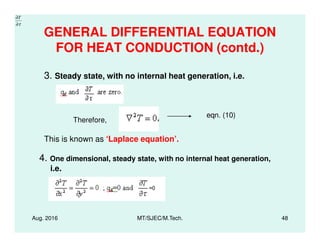
3. Steady state, with no internal heat generation, i.e.
eqn. (10)
τ∂
∂T
Therefore,
Aug. 2016 MT/SJEC/M.Tech. 48
This is known as ‘Laplace equation’.
4. One dimensional, steady state, with no internal heat generation,
i.e.
Therefore,
GENERAL DIFFERENTIAL EQUATION
FOR HEAT CONDUCTION (contd.)
eqn. (11)
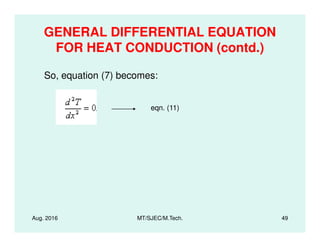
So, equation (7) becomes:
Aug. 2016 MT/SJEC/M.Tech. 49
GENERAL DIFFERENTIAL EQUATION
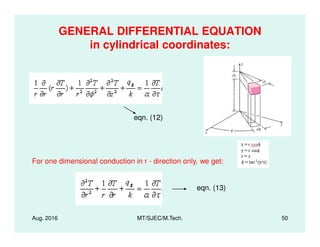
in cylindrical coordinates:
eqn. (12)
Aug. 2016 MT/SJEC/M.Tech. 50
For one dimensional conduction in r - direction only, we get:
eqn. (13)
GENERAL DIFFERENTIAL EQUATION
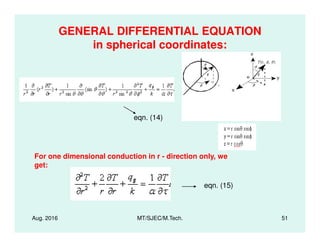
in spherical coordinates:
eqn. (14)
Aug. 2016 MT/SJEC/M.Tech. 51
For one dimensional conduction in r - direction only, we
get:
eqn. (15)
Boundary and Initial conditions:
Commonly encountered Boundary Conditions (B.C’s) are:
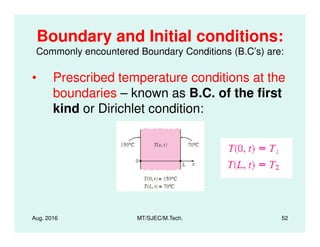
• Prescribed temperature conditions at the
boundaries – known as B.C. of the first
kind or Dirichlet condition:
Aug. 2016 MT/SJEC/M.Tech. 52
Boundary and Initial conditions:
Commonly encountered Boundary Conditions (B.C’s) are:
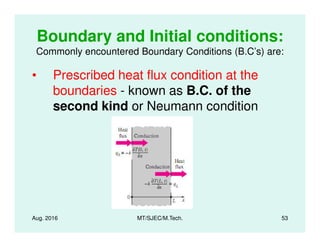
• Prescribed heat flux condition at the
boundaries - known as B.C. of the
second kind or Neumann condition
Aug. 2016 MT/SJEC/M.Tech. 53
Prescribed heat flux condition at the
boundaries:
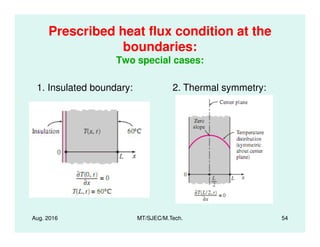
Two special cases:
1. Insulated boundary: 2. Thermal symmetry:
Aug. 2016 MT/SJEC/M.Tech. 54
Boundary and Initial conditions:
Commonly encountered Boundary Conditions (B.C’s) are:
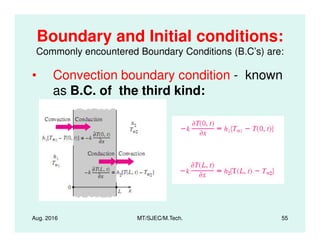
• Convection boundary condition - known
as B.C. of the third kind:
Aug. 2016 MT/SJEC/M.Tech. 55
Boundary and Initial conditions:
Commonly encountered Boundary Conditions (B.C’s) are:
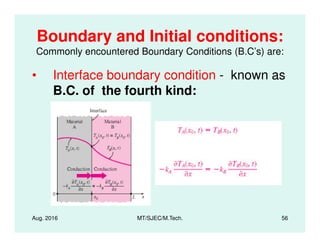
• Interface boundary condition - known as
B.C. of the fourth kind:
Aug. 2016 MT/SJEC/M.Tech. 56
• Example3.1: Temperature variation in a slab is
given by: T(x) = 100 + 200 x –500 x2, where x is in
metres; x = 0 at the left face and x = 0.3 m at the
right face. Thermal conductivity of the material k =
45 W/(m.C). Also, cp = 4 kJ/(kg.K) and ρρρρ = 1600
kg/m3. Determine:
• Temperature at both surfaces
• Heat transfer at left face and its direction
• Heat transfer at right face and its direction
Aug. 2016 MT/SJEC/M.Tech. 57
• Heat transfer at right face and its direction
• Is there any heat generation in the slab? If so, how
much?
• Max. temperature in the slab and its location
• Time rate of change of temperature at x = 0.1 m if
the heat generation rate is suddenly doubled
• Draw the temperature profile in the slab
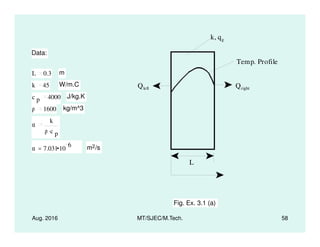
k, qg
Temp. Profile
QrightQleft
Data:
L 0.3 m
k 45 W/m.C
c p 4000 J/kg.K
ρ 1600 kg/m^3
α
k
Aug. 2016 MT/SJEC/M.Tech. 58
L
α
k
ρ c p
.
α 7.031 10
6
= m2/s
Fig. Ex. 3.1 (a)
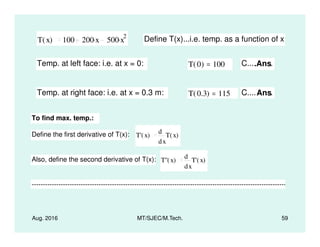
T x( ) 100 200 x. 500 x
2. Define T(x)...i.e. temp. as a function of x
Temp. at left face: i.e. at x = 0: T 0( ) 100= C....Ans.
Temp. at right face: i.e. at x = 0.3 m: T 0.3( ) 115= C....Ans.
To find max. temp.:
Aug. 2016 MT/SJEC/M.Tech. 59
Define the first derivative of T(x): T' x( )
x
T x( )
d
d
Also, define the second derivative of T(x): T'' x( )
x
T' x( )
d
d
--------------------------------------------------------------------------------------------------------------------------
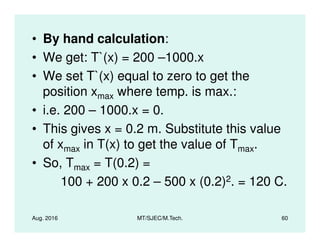
• By hand calculation:
• We get: T`(x) = 200 –1000.x
• We set T`(x) equal to zero to get the
position xmax where temp. is max.:
• i.e. 200 – 1000.x = 0.
• This gives x = 0.2 m. Substitute this value
Aug. 2016 MT/SJEC/M.Tech. 60
• This gives x = 0.2 m. Substitute this value
of xmax in T(x) to get the value of Tmax.
• So, Tmax = T(0.2) =
100 + 200 x 0.2 – 500 x (0.2)2. = 120 C.
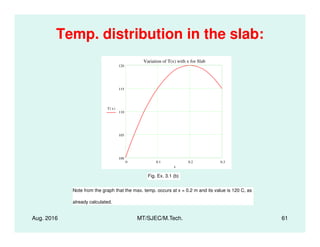
Temp. distribution in the slab:
T x( )
110
115
120
Variation of T(x) with x for Slab
Aug. 2016 MT/SJEC/M.Tech. 61
x
0 0.1 0.2 0.3
100
105
Fig. Ex. 3.1 (b)
Note from the graph that the max. temp. occurs at x = 0.2 m and its value is 120 C, as
already calculated.
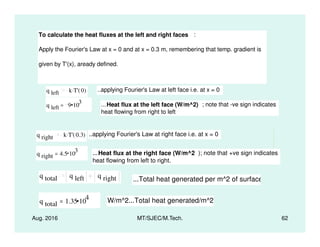
To calculate the heat fluxes at the left and right faces :
Apply the Fourier's Law at x = 0 and at x = 0.3 m, remembering that temp. gradient is
given by T'(x), aready defined.
q left k T' 0( ). ..applying Fourier's Law at left face i.e. at x = 0
q left 9 10
3
= ...Heat flux at the left face (W/m^2) ; note that -ve sign indicates
heat flowing from right to left
Aug. 2016 MT/SJEC/M.Tech. 62
q right k T' 0.3( ). ..applying Fourier's Law at right face i.e. at x = 0
q right 4.5 10
3
= ...Heat flux at the right face (W/m^2 ); note that +ve sign indicates
heat flowing from left to right.
q total q left q right ...Total heat generated per m^2 of surface
q total 1.35 10
4
= W/m^2...Total heat generated/m^2
• To calculate the time rate of change of temperature
at x = 0.1 m when qg is suddenly doubled:
• We have the time dependent differential equation for
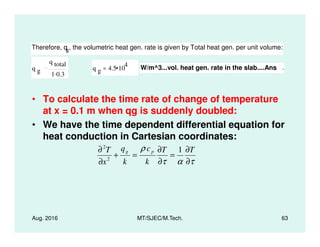
Therefore, qg, the volumetric heat gen. rate is given by Total heat gen. per unit volume:
q g
q total
1 0.3.
q g 4.5 10
4
= W/m^3...vol. heat gen. rate in the slab....Ans .
Aug. 2016 MT/SJEC/M.Tech. 63
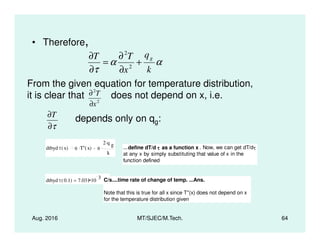
• We have the time dependent differential equation for
heat conduction in Cartesian coordinates:
τατ
ρ
∂
∂
=
∂
∂
=+
∂
∂ TT
k
c
k
q
x
T pg 1
2
2
• Therefore,
αα
τ k
q
x
TT g
+
∂
∂
=
∂
∂
2
2
From the given equation for temperature distribution,
it is clear that does not depend on x, i.e.
depends only on qg:
2
2
x
T
∂
∂
τ∂
∂T
Aug. 2016 MT/SJEC/M.Tech. 64
depends only on qg:
τ∂
dtbyd τ x( ) α T'' x( ). α
2 q g
.
k
. ...define dT/d ττττ as a function x . Now, we can get dT/dτ
at any x by simply substituting that value of x in the
function defined
dtbyd τ 0.1( ) 7.031 10
3
= C/s....time rate of change of temp. ...Ans.
Note that this is true for all x since T''(x) does not depend on x
for the temperature distribution given
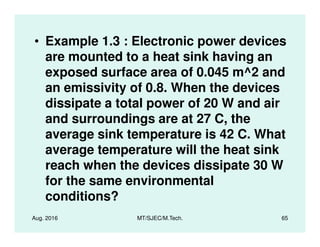
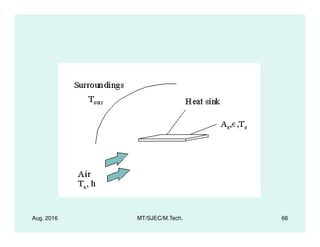
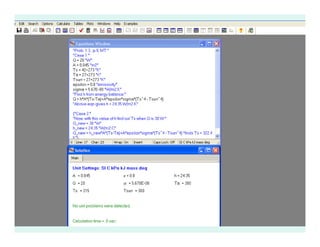
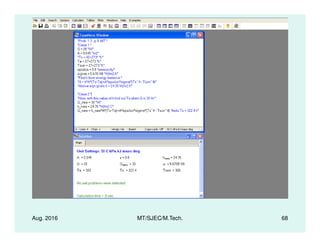
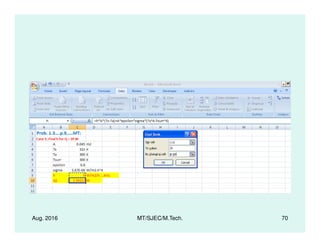
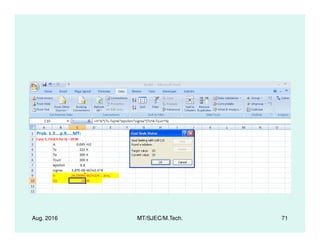
• Example 1.3 : Electronic power devices
are mounted to a heat sink having an
exposed surface area of 0.045 m^2 and
an emissivity of 0.8. When the devices
dissipate a total power of 20 W and air
and surroundings are at 27 C, theand surroundings are at 27 C, the
average sink temperature is 42 C. What
average temperature will the heat sink
reach when the devices dissipate 30 W
for the same environmental
conditions?
Aug. 2016 MT/SJEC/M.Tech. 65
Aug. 2016 MT/SJEC/M.Tech. 66
Aug. 2016 MT/SJEC/M.Tech. 67
Aug. 2016 MT/SJEC/M.Tech. 68
Aug. 2016 MT/SJEC/M.Tech. 69
Aug. 2016 MT/SJEC/M.Tech. 70
Aug. 2016 MT/SJEC/M.Tech. 71
Aug. 2016 MT/SJEC/M.Tech. 72
Aug. 2016 MT/SJEC/M.Tech. 73
Aug. 2016 MT/SJEC/M.Tech. 74
Aug. 2016 MT/SJEC/M.Tech. 75
Aug. 2016 MT/SJEC/M.Tech. 76
Aug. 2016 MT/SJEC/M.Tech. 77
Aug. 2016 MT/SJEC/M.Tech. 78
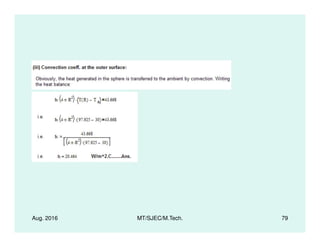
Aug. 2016 MT/SJEC/M.Tech. 79
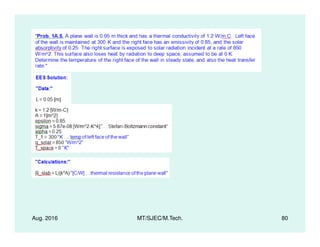
Aug. 2016 MT/SJEC/M.Tech. 80
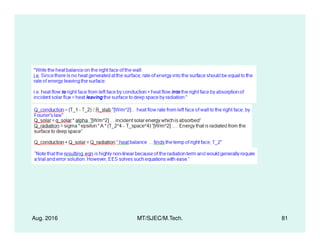
Aug. 2016 MT/SJEC/M.Tech. 81
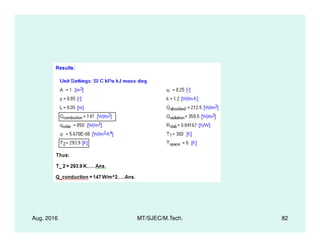
Aug. 2016 MT/SJEC/M.Tech. 82
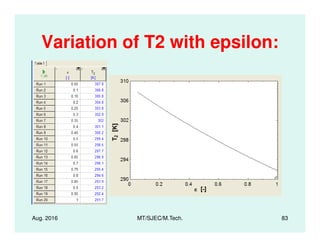
Variation of T2 with epsilon:
Aug. 2016 MT/SJEC/M.Tech. 83

Lectures on Heat Transfer - Introduction - Applications - Fundamentals - Governing Laws

  • 1.
    Lectures on HeatTransfer: Introduction - Fundamentals by Dr. M. Thirumaleshwar formerly: Professor, Dept. of Mechanical Engineering, St. Joseph Engg. College, Vamanjoor, Mangalore
  • 2.
    Preface • This filecontains Introduction to Heat Transfer and Fundamental laws governing heat transfer. • The slides were prepared while teaching• The slides were prepared while teaching Heat Transfer course to the M.Tech. students in Mechanical Engineering Dept. of St. Joseph Engineering College, Vamanjoor, Mangalore, India, during Sept. – Dec. 2010. Aug. 2016 2MT/SJEC/M.Tech.
  • 3.
    • It ishoped that these Slides will be useful to teachers, students, researchers and professionals working in this field. • For students, it should be particularly useful to study, quickly review the subject,useful to study, quickly review the subject, and to prepare for the examinations. • Aug. 2016 3MT/SJEC/M.Tech.
  • 4.
    References • 1. CengelY. A. Heat Transfer: A Practical Approach, 2nd Ed. McGraw Hill Co., 2003 • 2.Cengel, Y. A. and Ghajar, A. J., Heat and Mass Transfer - Fundamentals and Applications, 5th Ed., McGraw-Hill, New York, NY, 2014. Aug. 2016 MT/SJEC/M.Tech. 4 5th Ed., McGraw-Hill, New York, NY, 2014. • 3. Incropera , Dewitt, Bergman, Lavine: Fundamentals of Heat and Mass Transfer, 6th Ed., Wiley Intl. • 4. Necati Ozisik: Heat Transfer – A Basic Approach, McGraw Hill
  • 5.
    References… contd. • 5.M. Thirumaleshwar: Fundamentals of Heat & Mass Transfer, Pearson Edu., 2006 • 6. M. Thirumaleshwar: Software Solutions to Problems on Heat Transfer – CONDUCTION-Problems on Heat Transfer – CONDUCTION- Part-I, Bookboon, 2013 • http://bookboon.com/en/software-solutions-to-problems-on- heat-transfer-ebook Aug. 2016 MT/SJEC/M.Tech. 5
  • 6.
    Heat Transfer Introduction -Fundamentals • Applications - Modes of heat transfer- Fundamental laws – governing rate equations – concept of thermal resistance Aug. 2016 MT/SJEC/M.Tech. 6 equations – concept of thermal resistance – general heat conduction equation – different boundary conditions.
  • 7.
    Applications of HeatTransfer: • Mechanical Engineering: Boilers, Heat Exchangers, Turbine systems, Internal combustion engines etc. • Metallurgical Engineering: Furnaces, Aug. 2016 MT/SJEC/M.Tech. 7 • Metallurgical Engineering: Furnaces, Heat treatment of components etc. • Electrical Engineering: Cooling systems for electric motors, generators, transformers etc.
  • 8.
    Applications of HeatTransfer(Contd.).. • Chemical Engineering: Process equipments used in Refineries, Chemical plants etc. • Nuclear Engineering: In removal of heat generated by nuclear fission using liquid metal Aug. 2016 MT/SJEC/M.Tech. 8 generated by nuclear fission using liquid metal coolants, design of nuclear fuel rods against possible burn – out etc. • Aerospace Engineering & Space Technology: In the design of aircraft systems and components, Rockets, Missiles etc.
  • 9.
    Applications of HeatTransfer(Contd.).. • Cryogenic Engineering: In the production, storage, transportation and utilization of cryogenic liquids (at very low temperatures ranging from 100 K to 4 K or even lower) for various Industrial, Research and Defence applications. Aug. 2016 MT/SJEC/M.Tech. 9 applications. • Civil Engineering: In the design of Suspension bridges, railway tracks, Airconditioning and Insulation of buildings etc. • Principles and methods of Heat Transfer are widely applied in many, many areas that affect our lives.

  • 10.
    Fundamental Laws governing HeatTransfer: – 1. First Law of Thermodynamics – gives conservation of energy. – 2. Second Law of Thermodynamics – gives direction of heat flow. Aug. 2016 MT/SJEC/M.Tech. 10 direction of heat flow. – 3. Equation of continuity – gives conservation of mass. – 4. Equation of flow – Newton’s Second Law of motion—Navier Stokes’ Equations
  • 11.
    Fundamental Laws governing HeatTransfer (contd.): – 5. Rate equations governing the three modes of Heat Transfer: – Conduction – Fourier’s Law of Conduction – Convection – Newton’s Law of cooling Aug. 2016 MT/SJEC/M.Tech. 11 – Convection – Newton’s Law of cooling – Radiation – Stefan – Boltzmann’s Law – 6. Empirical relations for fluid properties such as specific heat, thermal conductivity, viscosity etc. – 7. Equation of State for the fluid.
  • 12.
    Modes of HeatTransfer • Three main modes: • Conduction …. heat flow by direct contact • Convection … heat carried by moving fluid • Radiation … heat flow does not need an• Radiation … heat flow does not need an intervening medium • In practical cases, a combination of one or more of the above modes are present Aug. 2016 MT/SJEC/M.Tech. 12
  • 13.
    Conduction: • Governing ‘rate equation’for conduction is: Fourier’s Law. • Q = -k A (T2 – T1)/L k T1 Q Slope = dT/dx Aug. 2016 MT/SJEC/M.Tech. 13 • Qx = -k A (T2 – T1)/L ...For a plane slab, in steady state = k A (T1 – T2)/L (Watts) T2 X L
  • 14.
    Assumptions behind Fourier’s Law: •Fourier’s Law is an empirical law, derived from experimental observations and not from fundamental, theoretical considerations. • Fourier’s Law is defined for steady Aug. 2016 MT/SJEC/M.Tech. 14 • Fourier’s Law is defined for steady state, one dimensional heat flow. • It is assumed that the bounding surfaces between which heat flows are isothermal and that the temperature gradient is constant i.e. the temperature profile is linear.
  • 15.
    Assumptions behind Fourier’s Law(contd.): • There is no internal heat generation in the material. • The material is homogeneous (i.e. constant density) and isotropic (i.e. thermal conductivity Aug. 2016 MT/SJEC/M.Tech. 15 density) and isotropic (i.e. thermal conductivity is the same in all directions). • Fourier’s Law is applicable to all states of matter i.e. solid, liquid or gas. • Fourier’s Law helps to define ‘thermal conductivity’
  • 16.
    Rate of heattransfer by conduction, Q, is given by: L T1 T2 Aug. 2016 MT/SJEC/M.Tech. 16 Rate of heat transfer by conduction, Q, is given by: Q = k A T/L (W) where, k = thermal cond. (W/m.K) A = Area of cross-section, (m^2) L = Length, (m), T= temp. difference, (K)
  • 17.
  • 18.
    Range of ‘k’of various materials at room temperature Aug. 2016 MT/SJEC/M.Tech. 18
  • 19.
    Variation of ‘k’with temperature Aug. 2016 MT/SJEC/M.Tech. 19
  • 20.
    Variation of ‘k’with temperature for Cu and Al Aug. 2016 MT/SJEC/M.Tech. 20
  • 21.
    Convection • In convection,heat is carried from place to place by bulk movement of fluidof fluid • Convection currents are set up when a pan of water is heated Aug. 2016 MT/SJEC/M.Tech. 21
  • 22.
    Newton’s Law ofCooling: Q = h.A. T Aug. 2016 MT/SJEC/M.Tech. 22
  • 23.
    Radiation • energy istransferred by means of electromagnetic waves. • can take place through vacuum. Aug. 2016 MT/SJEC/M.Tech. 23 • can take place through vacuum. • electromagnetic waves can propagate through empty space.
  • 24.
    Radiation average frequency ∝absolute temperature Aug. 2016 MT/SJEC/M.Tech. 24
  • 25.
  • 26.
    Greenhouse Effect Incoming UV radiation fromSun easily passes through the glass walls of a greenhouse. Weaker IR radiation, however, Aug. 2016 MT/SJEC/M.Tech. 26 IR radiation, however, has difficulty passing through the glass walls and is trapped inside, thus warming the greenhouse.
  • 27.
    Black body A goodabsorber like lampblack is also a good emitter Aug. 2016 MT/SJEC/M.Tech. 27 good emitter And, a poor absorber like polished silver is also a poor emitter
  • 28.
    The Stefan–Boltzmann Law ofRadiation Rate of radiant energy emission is proportional to the fourth power of its Absolute temperature. Stefan’s law and is expressed as follows: P = . . A. T4 (W) Aug. 2016 MT/SJEC/M.Tech. 28 P = . . A. T4 (W) is the Stefan-Boltzmann constant, = 5.67 × 10⁻⁸ W/m2.K4. is the emissivity, which is a number between 0 and 1. T is the temp. in Kelvin
  • 29.
  • 30.
    Radiation Heat Transfer betweenbodies • If the surrounding is at TS then the net power radiated is: P = A [ T4 - TS 4] • Assuming on a dark, dry, night, T = 3 K: Aug. 2016 MT/SJEC/M.Tech. 30 • Assuming on a dark, dry, night, TS = 3 K: • Frost may form even if air temperature > 0 C since radiation cools the surface faster than conduction heat lost from the ground or air.
  • 31.
    Concept of Thermalresistance: • Conduction: • Q = kA(T1 – T2)/L k T1 T2 T(x) Q Aug. 2016 MT/SJEC/M.Tech. 31 T2 X L Q T1 T2 Rcond = L/kA Q Rth = L/(kA) is known as “Thermal resistance” of the slab for conduction.
  • 32.
    Concept of Thermalresistance (contd.): • It is seen that there is a clear analogy between the flow of heat and flow of electricity, as shown below: Aug. 2016 MT/SJEC/M.Tech. 32
  • 33.
    Concept of Thermalresistance (contd.): • Convection heat transfer – thermal resistance : U, Tf, h Ts Q Q = h A (Ts – Tf) Aug. 2016 MT/SJEC/M.Tech. 33 Q Q Ts Tf Rconv = 1/hA Rconv = 1/(hA) Note that the Units are : (C/W) or (K/W)
  • 34.
    Concept of Thermalresistance (contd.): • Radiation heat transfer – thermal resistance : • Q1 = F1 A1 σ (T1 4 – T2 4), W • F1 is known as view factor, which includes the effects of orientation, emissivities and the distance between the surfaces Aug. 2016 MT/SJEC/M.Tech. 34
  • 35.
    Practical applications ofThermal resistance concept: • To analyse the problems where one or more modes of heat transfer occur simultaneously • To analyse the problems where multiple Aug. 2016 MT/SJEC/M.Tech. 35 • To analyse the problems where multiple layers of materials of different thermal conductivities are used; ex: in furnace walls
  • 36.
    Limitations for theuse of thermal resistance concept: • Thermal concept can be used only when all the following conditions are satisfied: Aug. 2016 MT/SJEC/M.Tech. 36 • One dimensional conduction • Steady state conduction • No internal heat generation
  • 37.
    Thermal diffusivity (αααα): •Often, while dealing with transient conduction problems, we come across a quantity called ‘Thermal diffusivity’. Note that Unit of α is: m2/s Aug. 2016 MT/SJEC/M.Tech. 37 that Unit of α is: m /s Values of αααα for materials vary over a wide range: For copper at room temperature, its value is approx. 113 * 10-6 m2/s For glass it is about 0.34 * 10-6 m2/s.
  • 38.
    Thermal diffusivity (αααα)for a few materials at room temperature: Aug. 2016 MT/SJEC/M.Tech. 38
  • 39.
    Thermal diffusivity (αααα)for a few materials at room temperature(contd.): Aug. 2016 MT/SJEC/M.Tech. 39
  • 40.
    GENERAL DIFFERENTIAL EQUATION FORHEAT CONDUCTION • This is also known as ‘heat diffusion equation’ or, simply ‘heat equation’. • Consider a differential volume element (dx.dy.dz); • Making an energy balance on this differential element: Q Aug. 2016 MT/SJEC/M.Tech. 40 E B C D A H G F dx dy dzy z x Qx Qx+dx Qy Qy+dy Qz+dz Qz
  • 41.
    GENERAL DIFFERENTIAL EQUATION FORHEAT CONDUCTION (contd.) B C G Fz Qy+dy Qz+dz • Ein – Eout + Egen = Est …eqn. (1) Energy, In Aug. 2016 MT/SJEC/M.Tech. 41 E D A H dx dy dzy x Qx Qx+dx Qy Qz Energy, In Energy, out Energy, generated Energy stored
  • 42.
    GENERAL DIFFERENTIAL EQUATION FORHEAT CONDUCTION (contd.) Applying eqn (1): Aug. 2016 MT/SJEC/M.Tech. 42 where qg is the heat gen. rate per unit volume, (W/m3) Now, etc. eqn. (2)
  • 43.
    GENERAL DIFFERENTIAL EQUATION FORHEAT CONDUCTION (contd.) Then, from eqn. (2): But, from Fourier’s Law: eqn. (3) Aug. 2016 MT/SJEC/M.Tech. 43 But, from Fourier’s Law:
  • 44.
    GENERAL DIFFERENTIAL EQUATION FORHEAT CONDUCTION (contd.) Then, subst. in eqn. (3) and dividing by dx.dy.dz, we get: eqn. (4) Aug. 2016 MT/SJEC/M.Tech. 44 This is the general form of heat diffusion equation in Cartesian coordinates, for time dependent (i.e. unsteady state) heat conduction, with variable thermal conductivity and uniform heat generation within the body.
  • 45.
    GENERAL DIFFERENTIAL EQUATION FORHEAT CONDUCTION (contd.) Now, if the material is isotropic i.e. the thermal conductivity is the same in all the three directions, i.e. kx = ky = kz = k say, : eqn. (5) Aug. 2016 MT/SJEC/M.Tech. 45 If k is constant and does not vary with temperature i.e. k does not change with position, then: eqn. (6)
  • 46.
    GENERAL DIFFERENTIAL EQUATION FORHEAT CONDUCTION (contd.) i.e. eqn. (7) where α = k/(ρcp) is thermal diffusivity, and Aug. 2016 MT/SJEC/M.Tech. 46 where α = k/(ρcp) is thermal diffusivity, and ∇ = Laplacian operator Special cases: 1. Steady state: i.e.
  • 47.
    GENERAL DIFFERENTIAL EQUATION FORHEAT CONDUCTION (contd.) eqn. (8) Then, eqn. (7) becomes: Aug. 2016 MT/SJEC/M.Tech. 47 This is known as ‘Poisson equation’. 2. With no internal heat generation, i.e. qg = 0: Then, eqn. (7) becomes: eqn. (9) This is known as ‘Diffusion equation’.
  • 48.
    GENERAL DIFFERENTIAL EQUATION FORHEAT CONDUCTION (contd.) 3. Steady state, with no internal heat generation, i.e. eqn. (10) τ∂ ∂T Therefore, Aug. 2016 MT/SJEC/M.Tech. 48 This is known as ‘Laplace equation’. 4. One dimensional, steady state, with no internal heat generation, i.e. Therefore,
  • 49.
    GENERAL DIFFERENTIAL EQUATION FORHEAT CONDUCTION (contd.) eqn. (11) So, equation (7) becomes: Aug. 2016 MT/SJEC/M.Tech. 49
  • 50.
    GENERAL DIFFERENTIAL EQUATION incylindrical coordinates: eqn. (12) Aug. 2016 MT/SJEC/M.Tech. 50 For one dimensional conduction in r - direction only, we get: eqn. (13)
  • 51.
    GENERAL DIFFERENTIAL EQUATION inspherical coordinates: eqn. (14) Aug. 2016 MT/SJEC/M.Tech. 51 For one dimensional conduction in r - direction only, we get: eqn. (15)
  • 52.
    Boundary and Initialconditions: Commonly encountered Boundary Conditions (B.C’s) are: • Prescribed temperature conditions at the boundaries – known as B.C. of the first kind or Dirichlet condition: Aug. 2016 MT/SJEC/M.Tech. 52
  • 53.
    Boundary and Initialconditions: Commonly encountered Boundary Conditions (B.C’s) are: • Prescribed heat flux condition at the boundaries - known as B.C. of the second kind or Neumann condition Aug. 2016 MT/SJEC/M.Tech. 53
  • 54.
    Prescribed heat fluxcondition at the boundaries: Two special cases: 1. Insulated boundary: 2. Thermal symmetry: Aug. 2016 MT/SJEC/M.Tech. 54
  • 55.
    Boundary and Initialconditions: Commonly encountered Boundary Conditions (B.C’s) are: • Convection boundary condition - known as B.C. of the third kind: Aug. 2016 MT/SJEC/M.Tech. 55
  • 56.
    Boundary and Initialconditions: Commonly encountered Boundary Conditions (B.C’s) are: • Interface boundary condition - known as B.C. of the fourth kind: Aug. 2016 MT/SJEC/M.Tech. 56
  • 57.
    • Example3.1: Temperaturevariation in a slab is given by: T(x) = 100 + 200 x –500 x2, where x is in metres; x = 0 at the left face and x = 0.3 m at the right face. Thermal conductivity of the material k = 45 W/(m.C). Also, cp = 4 kJ/(kg.K) and ρρρρ = 1600 kg/m3. Determine: • Temperature at both surfaces • Heat transfer at left face and its direction • Heat transfer at right face and its direction Aug. 2016 MT/SJEC/M.Tech. 57 • Heat transfer at right face and its direction • Is there any heat generation in the slab? If so, how much? • Max. temperature in the slab and its location • Time rate of change of temperature at x = 0.1 m if the heat generation rate is suddenly doubled • Draw the temperature profile in the slab
  • 58.
    k, qg Temp. Profile QrightQleft Data: L0.3 m k 45 W/m.C c p 4000 J/kg.K ρ 1600 kg/m^3 α k Aug. 2016 MT/SJEC/M.Tech. 58 L α k ρ c p . α 7.031 10 6 = m2/s Fig. Ex. 3.1 (a)
  • 59.
    T x( )100 200 x. 500 x 2. Define T(x)...i.e. temp. as a function of x Temp. at left face: i.e. at x = 0: T 0( ) 100= C....Ans. Temp. at right face: i.e. at x = 0.3 m: T 0.3( ) 115= C....Ans. To find max. temp.: Aug. 2016 MT/SJEC/M.Tech. 59 Define the first derivative of T(x): T' x( ) x T x( ) d d Also, define the second derivative of T(x): T'' x( ) x T' x( ) d d --------------------------------------------------------------------------------------------------------------------------
  • 60.
    • By handcalculation: • We get: T`(x) = 200 –1000.x • We set T`(x) equal to zero to get the position xmax where temp. is max.: • i.e. 200 – 1000.x = 0. • This gives x = 0.2 m. Substitute this value Aug. 2016 MT/SJEC/M.Tech. 60 • This gives x = 0.2 m. Substitute this value of xmax in T(x) to get the value of Tmax. • So, Tmax = T(0.2) = 100 + 200 x 0.2 – 500 x (0.2)2. = 120 C.
  • 61.
    Temp. distribution inthe slab: T x( ) 110 115 120 Variation of T(x) with x for Slab Aug. 2016 MT/SJEC/M.Tech. 61 x 0 0.1 0.2 0.3 100 105 Fig. Ex. 3.1 (b) Note from the graph that the max. temp. occurs at x = 0.2 m and its value is 120 C, as already calculated.
  • 62.
    To calculate theheat fluxes at the left and right faces : Apply the Fourier's Law at x = 0 and at x = 0.3 m, remembering that temp. gradient is given by T'(x), aready defined. q left k T' 0( ). ..applying Fourier's Law at left face i.e. at x = 0 q left 9 10 3 = ...Heat flux at the left face (W/m^2) ; note that -ve sign indicates heat flowing from right to left Aug. 2016 MT/SJEC/M.Tech. 62 q right k T' 0.3( ). ..applying Fourier's Law at right face i.e. at x = 0 q right 4.5 10 3 = ...Heat flux at the right face (W/m^2 ); note that +ve sign indicates heat flowing from left to right. q total q left q right ...Total heat generated per m^2 of surface q total 1.35 10 4 = W/m^2...Total heat generated/m^2
  • 63.
    • To calculatethe time rate of change of temperature at x = 0.1 m when qg is suddenly doubled: • We have the time dependent differential equation for Therefore, qg, the volumetric heat gen. rate is given by Total heat gen. per unit volume: q g q total 1 0.3. q g 4.5 10 4 = W/m^3...vol. heat gen. rate in the slab....Ans . Aug. 2016 MT/SJEC/M.Tech. 63 • We have the time dependent differential equation for heat conduction in Cartesian coordinates: τατ ρ ∂ ∂ = ∂ ∂ =+ ∂ ∂ TT k c k q x T pg 1 2 2
  • 64.
    • Therefore, αα τ k q x TTg + ∂ ∂ = ∂ ∂ 2 2 From the given equation for temperature distribution, it is clear that does not depend on x, i.e. depends only on qg: 2 2 x T ∂ ∂ τ∂ ∂T Aug. 2016 MT/SJEC/M.Tech. 64 depends only on qg: τ∂ dtbyd τ x( ) α T'' x( ). α 2 q g . k . ...define dT/d ττττ as a function x . Now, we can get dT/dτ at any x by simply substituting that value of x in the function defined dtbyd τ 0.1( ) 7.031 10 3 = C/s....time rate of change of temp. ...Ans. Note that this is true for all x since T''(x) does not depend on x for the temperature distribution given
  • 65.
    • Example 1.3: Electronic power devices are mounted to a heat sink having an exposed surface area of 0.045 m^2 and an emissivity of 0.8. When the devices dissipate a total power of 20 W and air and surroundings are at 27 C, theand surroundings are at 27 C, the average sink temperature is 42 C. What average temperature will the heat sink reach when the devices dissipate 30 W for the same environmental conditions? Aug. 2016 MT/SJEC/M.Tech. 65
  • 66.
  • 67.
  • 68.
  • 69.
  • 70.
  • 71.
  • 72.
  • 73.
  • 74.
  • 75.
  • 76.
  • 77.
  • 78.
  • 79.
  • 80.
  • 81.
  • 82.
  • 83.
    Variation of T2with epsilon: Aug. 2016 MT/SJEC/M.Tech. 83