HEAT TRANSFER
HEAT AND TEMPERATURE
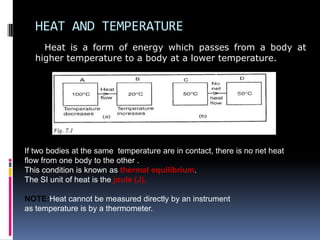
Heat is a form of energy which passes from a body at
higher temperature to a body at a lower temperature.
If two bodies at the same temperature are in contact, there is no net heat
flow from one body to the other .
This condition is known as thermal equilibrium.
The SI unit of heat is the joule (J).
NOTE:Heat cannot be measured directly by an instrument
as temperature is by a thermometer.
Modes of Heat Transfer
Heat can travel through a medium and also
through vacuum.
There are three modes of heat transfer,
a) Conduction
b) Convection
c) Radiation
CONDUCTION
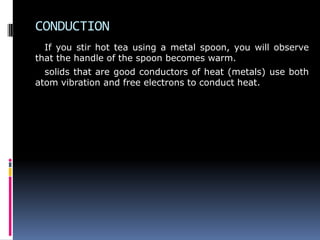
If you stir hot tea using a metal spoon, you will observe
that the handle of the spoon becomes warm.
solids that are good conductors of heat (metals) use both
atom vibration and free electrons to conduct heat.
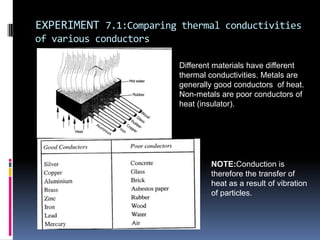
EXPERIMENT 7.1:Comparing thermal conductivities
of various conductors
Different materials have different
thermal conductivities. Metals are
generally good conductors of heat.
Non-metals are poor conductors of
heat (insulator).
NOTE:Conduction is
therefore the transfer of
heat as a result of vibration
of particles.
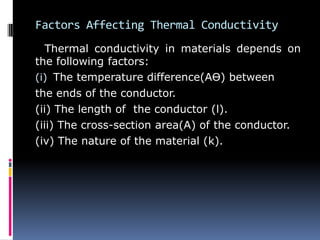
Factors Affecting Thermal Conductivity
Thermal conductivity in materials depends on
the following factors:
(i) The temperature difference(AӨ) between
the ends of the conductor.
(ii) The length of the conductor (l).
(iii) The cross-section area(A) of the conductor.
(iv) The nature of the material (k).
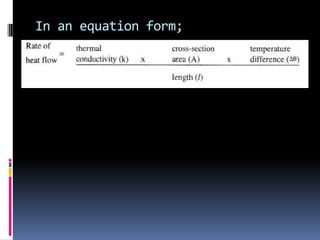
In an equation form;
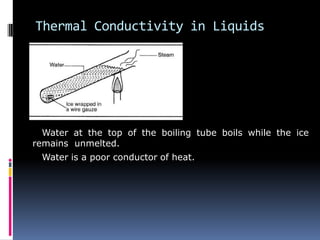
Thermal Conductivity in Liquids
Water at the top of the boiling tube boils while the ice
remains unmelted.
Water is a poor conductor of heat.
Why Liquids are Poor Conductors of Heat ?
This is because there are large inter-molecular distances
between liquid molecules.There are also fewer and rare
collisions between the molecules.
Electrolytes, e.g., saltsolution,are better conductors of
heat than pure liquids because of an increased
compactness of the particles.
Thermal Conductivity in Gases
Gases are worse conductors of heat because of
large inter-molecular distance.
Some applications of Good and Poor
Conductors of Heat
• Good conductors are used to make cooking
utensils ,soldering irons etc.
• Bad conductors are applied in, fire fighting and
making handles for cooking pots.
CONVECTION
Convection is the process by which heat is
transferred through fluids (liquids and gases).
(i) Natural convection; Involves change in
density of the fluid with temperature.
(ii) Forced convection: Mixing of hot and cold
parts of the fluid through some external stirring,
like a fan or pump.
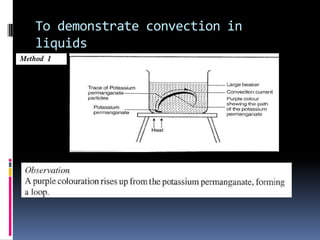
To demonstrate convection in
liquids
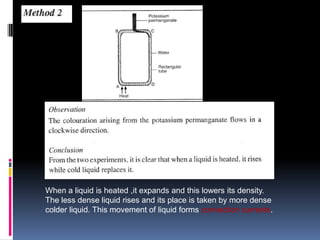
When a liquid is heated ,it expands and this lowers its density.
The less dense liquid rises and its place is taken by more dense
colder liquid. This movement of liquid forms convection currents.
Convection Current in Gases
Convection currents are set up when air or gas
is heated.
Molecular Explanation of Convection in
Fluids
Molecules in fluids are further apart and have
negligible cohesive force.
Convection currents are set up much faster in
gases than in liquids because of the extremely
low cohesive forces existing between the
molecules of the gases.
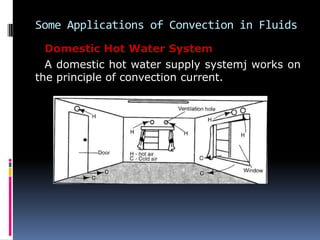
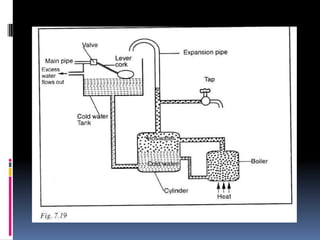
Some Applications of Convection in Fluids
Domestic Hot Water System
A domestic hot water supply systemj works on
the principle of convection current.
RADIATION
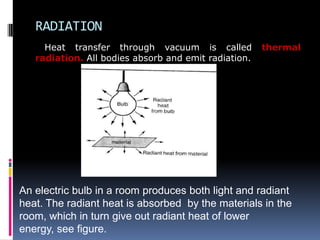
Heat transfer through vacuum is called thermal
radiation. All bodies absorb and emit radiation.
An electric bulb in a room produces both light and radiant
heat. The radiant heat is absorbed by the materials in the
room, which in turn give out radiant heat of lower
energy, see figure.
Nature of Radiant Heat
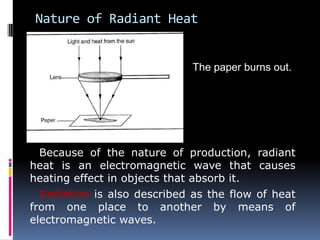
Because of the nature of production, radiant
heat is an electromagnetic wave that causes
heating effect in objects that absorb it.
Radiation is also described as the flow of heat
from one place to another by means of
electromagnetic waves.
The paper burns out.
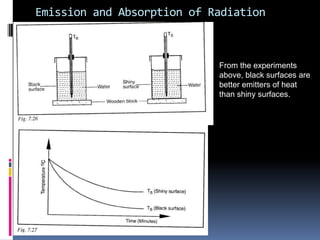
Emission and Absorption of Radiation
From the experiments
above, black surfaces are
better emitters of heat
than shiny surfaces.
Applications of Thermal Radiation
1.Electric kettles ,iron boxes and cooking pans
have polished surfaces to reduce heat loss
through radiation.
2. Petrol tanks are painted silvery bright to
reflect away as much heat as possible.
3. Houses in hot areas have their walls and
roofs painted with bright colours to reflect away
heat, while those in cold regions have walls and
roofs painted with dull colours.
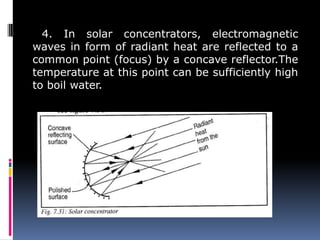
4. In solar concentrators, electromagnetic
waves in form of radiant heat are reflected to a
common point (focus) by a concave reflector.The
temperature at this point can be sufficiently high
to boil water.
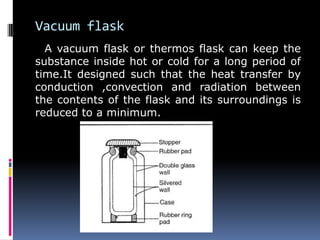
Vacuum flask
A vacuum flask or thermos flask can keep the
substance inside hot or cold for a long period of
time.It designed such that the heat transfer by
conduction ,convection and radiation between
the contents of the flask and its surroundings is
reduced to a minimum.
SUCCESS NOTES
 Heat is a form of energy which flows as a
result of temperature difference between two
regions.
 There are three modes of heat transfer namely
conduction,convection and radiation.
 In conduction and convection a material is
required while in radiation,heat travels
through a vacuum.
 Thermal conductivity depends on:
• Temperature difference-the greater the
temperature difference the higher the rate of
conduction.
• Cross- sectional area-thicker materials
conduct heat faster than thin ones.
• Length- rate of conduction decreases with
increase in length of material.
• Nature of material-different materials conduct
heat differently.
 Metals are good conductors of heat than non-
metals.
 Water is not o good conductor of heat.
 The amount of radiation absorbed by a given
surface depends on its nature. Black/dull
surfaces are better absorbers of radiation than
polished surfaces.
QUESTIONS
1.Explain ?
(a) Soup cools faster in a steel
bowl than in a glass bowl.
Since metals are better conductors of heat
than non-metals,steel bowl, a metal alloy,
conducts heat away faster from the soup than
glass. Hence, the soup in steel bowl cools faster.
(b) Air conditioner unit is placed near the top
of the ceiling in a room.
Convection currents occur when hot air rises
and cold air sinks. The warmer air which is less
dense rises to the top and after being cooled
down by the air conditioner unit, the cooler air
sinks. The convection currents cause the room to
be cooled efficiently.
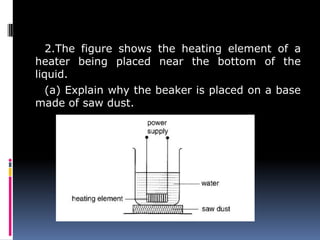
2.The figure shows the heating element of a
heater being placed near the bottom of the
liquid.
(a) Explain why the beaker is placed on a base
made of saw dust.
Saw dust is a poor conductor of heat, so it can
reduce heat loss from the beaker through
conduction.
b.)What is the advantage of placing the
heating element near the bottom of the liquid?
It allows convection currents to be set up
quickly. The cooler liquid which sinks can be
heated up quickly by the heating element placed
near the bottom.
4) Mrs. Chen has two woks. A black one made
of iron and a shiny one made of stainless steel.
She prefers using the black one because she
says it allows her to cook faster.
(a) Is she right? Explain your answer.
Yes. Black is a better absorber and emitter of
heat so food cooks faster in black wok.
b)What forms of heat transfer take place when
she fries vegetables in the wok?
Conduction and radiation from the flame to the
wok.Conduction from the wok surface to the
food.
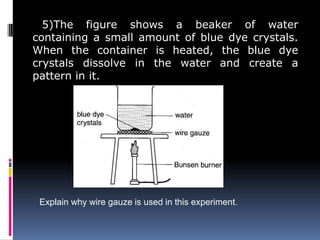
5)The figure shows a beaker of water
containing a small amount of blue dye crystals.
When the container is heated, the blue dye
crystals dissolve in the water and create a
pattern in it.
Explain why wire gauze is used in this experiment.
It is used to spread heat of a Bunsen flame.
(i) Wire gauze to glass of beaker.
(ii) within water in the beaker
i) Conduction
ii) Convection
Hw.page 196
Revision Exercise 7

Heat transfer

  • 1.
  • 2.
    HEAT AND TEMPERATURE Heatis a form of energy which passes from a body at higher temperature to a body at a lower temperature. If two bodies at the same temperature are in contact, there is no net heat flow from one body to the other . This condition is known as thermal equilibrium. The SI unit of heat is the joule (J). NOTE:Heat cannot be measured directly by an instrument as temperature is by a thermometer.
  • 3.
    Modes of HeatTransfer Heat can travel through a medium and also through vacuum. There are three modes of heat transfer, a) Conduction b) Convection c) Radiation
  • 4.
    CONDUCTION If you stirhot tea using a metal spoon, you will observe that the handle of the spoon becomes warm. solids that are good conductors of heat (metals) use both atom vibration and free electrons to conduct heat.
  • 5.
    EXPERIMENT 7.1:Comparing thermalconductivities of various conductors Different materials have different thermal conductivities. Metals are generally good conductors of heat. Non-metals are poor conductors of heat (insulator). NOTE:Conduction is therefore the transfer of heat as a result of vibration of particles.
  • 6.
    Factors Affecting ThermalConductivity Thermal conductivity in materials depends on the following factors: (i) The temperature difference(AӨ) between the ends of the conductor. (ii) The length of the conductor (l). (iii) The cross-section area(A) of the conductor. (iv) The nature of the material (k).
  • 7.
  • 8.
    Thermal Conductivity inLiquids Water at the top of the boiling tube boils while the ice remains unmelted. Water is a poor conductor of heat.
  • 9.
    Why Liquids arePoor Conductors of Heat ? This is because there are large inter-molecular distances between liquid molecules.There are also fewer and rare collisions between the molecules. Electrolytes, e.g., saltsolution,are better conductors of heat than pure liquids because of an increased compactness of the particles.
  • 10.
    Thermal Conductivity inGases Gases are worse conductors of heat because of large inter-molecular distance.
  • 11.
    Some applications ofGood and Poor Conductors of Heat • Good conductors are used to make cooking utensils ,soldering irons etc. • Bad conductors are applied in, fire fighting and making handles for cooking pots.
  • 12.
    CONVECTION Convection is theprocess by which heat is transferred through fluids (liquids and gases). (i) Natural convection; Involves change in density of the fluid with temperature. (ii) Forced convection: Mixing of hot and cold parts of the fluid through some external stirring, like a fan or pump.
  • 13.
  • 14.
    When a liquidis heated ,it expands and this lowers its density. The less dense liquid rises and its place is taken by more dense colder liquid. This movement of liquid forms convection currents.
  • 15.
    Convection Current inGases Convection currents are set up when air or gas is heated.
  • 16.
    Molecular Explanation ofConvection in Fluids Molecules in fluids are further apart and have negligible cohesive force. Convection currents are set up much faster in gases than in liquids because of the extremely low cohesive forces existing between the molecules of the gases.
  • 17.
    Some Applications ofConvection in Fluids Domestic Hot Water System A domestic hot water supply systemj works on the principle of convection current.
  • 19.
    RADIATION Heat transfer throughvacuum is called thermal radiation. All bodies absorb and emit radiation. An electric bulb in a room produces both light and radiant heat. The radiant heat is absorbed by the materials in the room, which in turn give out radiant heat of lower energy, see figure.
  • 20.
    Nature of RadiantHeat Because of the nature of production, radiant heat is an electromagnetic wave that causes heating effect in objects that absorb it. Radiation is also described as the flow of heat from one place to another by means of electromagnetic waves. The paper burns out.
  • 21.
    Emission and Absorptionof Radiation From the experiments above, black surfaces are better emitters of heat than shiny surfaces.
  • 22.
    Applications of ThermalRadiation 1.Electric kettles ,iron boxes and cooking pans have polished surfaces to reduce heat loss through radiation. 2. Petrol tanks are painted silvery bright to reflect away as much heat as possible. 3. Houses in hot areas have their walls and roofs painted with bright colours to reflect away heat, while those in cold regions have walls and roofs painted with dull colours.
  • 23.
    4. In solarconcentrators, electromagnetic waves in form of radiant heat are reflected to a common point (focus) by a concave reflector.The temperature at this point can be sufficiently high to boil water.
  • 25.
    Vacuum flask A vacuumflask or thermos flask can keep the substance inside hot or cold for a long period of time.It designed such that the heat transfer by conduction ,convection and radiation between the contents of the flask and its surroundings is reduced to a minimum.
  • 26.
    SUCCESS NOTES  Heatis a form of energy which flows as a result of temperature difference between two regions.  There are three modes of heat transfer namely conduction,convection and radiation.  In conduction and convection a material is required while in radiation,heat travels through a vacuum.  Thermal conductivity depends on: • Temperature difference-the greater the temperature difference the higher the rate of conduction. • Cross- sectional area-thicker materials conduct heat faster than thin ones.
  • 27.
    • Length- rateof conduction decreases with increase in length of material. • Nature of material-different materials conduct heat differently.  Metals are good conductors of heat than non- metals.  Water is not o good conductor of heat.  The amount of radiation absorbed by a given surface depends on its nature. Black/dull surfaces are better absorbers of radiation than polished surfaces.
  • 28.
    QUESTIONS 1.Explain ? (a) Soupcools faster in a steel bowl than in a glass bowl.
  • 29.
    Since metals arebetter conductors of heat than non-metals,steel bowl, a metal alloy, conducts heat away faster from the soup than glass. Hence, the soup in steel bowl cools faster.
  • 30.
    (b) Air conditionerunit is placed near the top of the ceiling in a room.
  • 31.
    Convection currents occurwhen hot air rises and cold air sinks. The warmer air which is less dense rises to the top and after being cooled down by the air conditioner unit, the cooler air sinks. The convection currents cause the room to be cooled efficiently.
  • 32.
    2.The figure showsthe heating element of a heater being placed near the bottom of the liquid. (a) Explain why the beaker is placed on a base made of saw dust.
  • 33.
    Saw dust isa poor conductor of heat, so it can reduce heat loss from the beaker through conduction.
  • 34.
    b.)What is theadvantage of placing the heating element near the bottom of the liquid?
  • 35.
    It allows convectioncurrents to be set up quickly. The cooler liquid which sinks can be heated up quickly by the heating element placed near the bottom.
  • 36.
    4) Mrs. Chenhas two woks. A black one made of iron and a shiny one made of stainless steel. She prefers using the black one because she says it allows her to cook faster. (a) Is she right? Explain your answer.
  • 37.
    Yes. Black isa better absorber and emitter of heat so food cooks faster in black wok.
  • 38.
    b)What forms ofheat transfer take place when she fries vegetables in the wok?
  • 39.
    Conduction and radiationfrom the flame to the wok.Conduction from the wok surface to the food.
  • 40.
    5)The figure showsa beaker of water containing a small amount of blue dye crystals. When the container is heated, the blue dye crystals dissolve in the water and create a pattern in it. Explain why wire gauze is used in this experiment.
  • 41.
    It is usedto spread heat of a Bunsen flame.
  • 42.
    (i) Wire gauzeto glass of beaker. (ii) within water in the beaker
  • 43.
  • 44.