:-
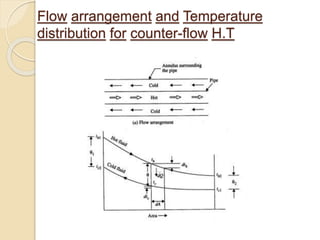
Flow arrangement and Temperature
distribution for counter-flow H.T
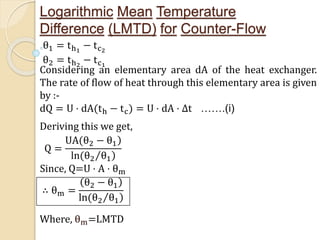
Logarithmic Mean Temperature
Difference (LMTD) for Counter-Flow
Considering an elementary area dA of the heat exchanger.
The rate of flow of heat through this elementary area is given
by :-
Deriving this we get,
Where, θm=LMTD
θ1 = th1
− tc2
θ2 = th2
− tc1
dQ = U ⋅ dA(th − tc) = U ⋅ dA ⋅ Δt …….(i)
Q =
)UA(θ2 − θ1
)ln(θ2 θ1
Since, Q=U ⋅ A ⋅ θm
∴ θm =
θ2 − θ1
)ln(θ2 θ1
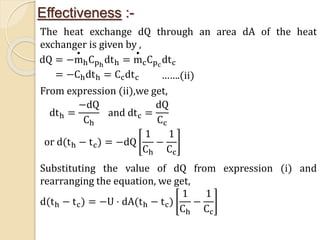
Effectiveness :-
The heat exchange dQ through an area dA of the heat
exchanger is given by ,
…….(ii)
From expression (ii),we get,
Substituting the value of dQ from expression (i) and
rearranging the equation, we get,
d(th − tc) = −U ⋅ dA(th − tc)
1
Ch
−
1
Cc
dQ = −m
•
hCph
dth = m
•
cCpc
dtc
= −Chdth = Ccdtc
dth =
−dQ
Ch
and dtc =
dQ
Cc
or d(th − tc) = −dQ
1
Ch
−
1
Cc
d(th − tc)
(th − tc)
= − U ⋅ dA
1
Ch
−
1
Cc
ln
(th2−tc1)
(th1−tc2)
= −U ⋅ A
1
Ch
−
1
Cc
∴ ln
(th2−tc1)
(th1−tc2)
=
UA
CC
1 −
Cc
Ch
∴
(th2
− tc1
)
(th1
− tc2
)
= exp
UA
CC
1 −
Cc
Ch
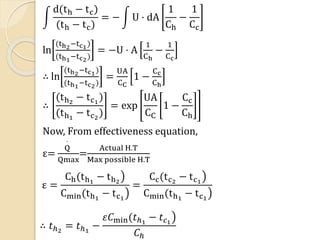
Now, From effectiveness equation,
ε=
Q
⋅
Qmax
=
Actual H.T
Max possible H.T
ε =
Ch(th1
− th2
Cmin(th1
− tc1
=
Cc(tc2
− tc1
Cmin(th1
− tc1
∴ 𝑡ℎ2
= 𝑡ℎ1
−
𝜀𝐶min(𝑡ℎ1
− 𝑡 𝑐1
𝐶ℎ
∴ tc2
=
εCmin(th1
− tc1
Cc
+ tc1
Substituting the values of tc2
and th2
, we get
Since,Cmin Cmax=R and UA/Cmin=NTU
ε =
1 − exp −NTU(1 − R)
1 − Rexp −NTU(1 − R)
ε =
1 − exp (−U A Cmin) 1 − Cmin Cmax
1 −
Cmin
Cmax
exp (−U A Cmin) 1 − Cmin Cmax
Here, we find that effectiveness of parallel flow and counter-
flow .
ε =
1−exp −NTU(1−R)
1−Rexp − NTU(1−R)
…..Counter flow
ε =
1−exp −NTU(1+R)
1+R
…….(parallel flow)
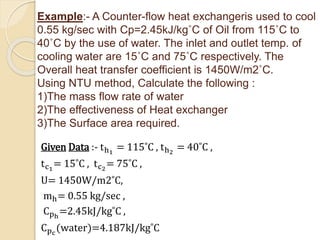
Example:- A Counter-flow heat exchangeris used to cool
0.55 kg/sec with Cp=2.45kJ/kg˚C of Oil from 115˚C to
40˚C by the use of water. The inlet and outlet temp. of
cooling water are 15˚C and 75˚C respectively. The
Overall heat transfer coefficient is 1450W/m2˚C.
Using NTU method, Calculate the following :
1)The mass flow rate of water
2)The effectiveness of Heat exchanger
3)The Surface area required.
Given Data :- th1
= 115˚C , th2
= 40˚C ,
tc1
= 15˚C , tc2
= 75˚C ,
U= 1450W/m2˚C,
mh= 0.55 kg/sec ,
Cph
=2.45kJ/kg˚C ,
Cpc
(water)=4.187kJ/kg˚C
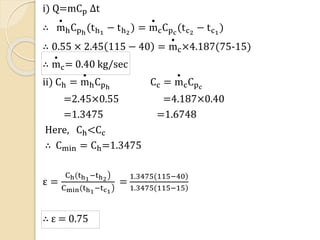
i) Q=mCp Δt
∴ m
•
hCph
(th1
− th2
) = m
•
cCpc
(tc2
− tc1
)
∴ 0.55 × 2.45 115 − 40 = m
•
c×4.187(75-15)
∴ m
•
c= 0.40 kg/sec
ii) Ch = m
•
hCph
Cc = m
•
cCpc
=2.45×0.55 =4.187×0.40
=1.3475 =1.6748
Here, Ch<Cc
∴ Cmin = Ch=1.3475
ε =
Ch(th1−th2
Cmin(th1−tc1
=
)1.3475(115−40
)1.3475(115−15
∴ ε = 0.75
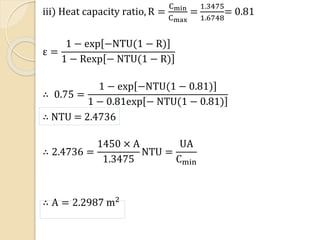
iii) Heat capacity ratio, R =
Cmin
Cmax
=
1.3475
1.6748
= 0.81
ε =
1 − exp −NTU(1 − R)
1 − Rexp − NTU(1 − R)
∴ 0.75 =
1 − exp −NTU(1 − 0.81)
1 − 0.81exp − NTU(1 − 0.81)
∴ NTU = 2.4736
∴ 2.4736 =
1450 × A
1.3475
NTU =
UA
Cmin
∴ A = 2.2987 m2
Effectiveness for Counterflow heat exchanger

Effectiveness for Counterflow heat exchanger

  • 1.
  • 2.
    Flow arrangement andTemperature distribution for counter-flow H.T
  • 3.
    Logarithmic Mean Temperature Difference(LMTD) for Counter-Flow Considering an elementary area dA of the heat exchanger. The rate of flow of heat through this elementary area is given by :- Deriving this we get, Where, θm=LMTD θ1 = th1 − tc2 θ2 = th2 − tc1 dQ = U ⋅ dA(th − tc) = U ⋅ dA ⋅ Δt …….(i) Q = )UA(θ2 − θ1 )ln(θ2 θ1 Since, Q=U ⋅ A ⋅ θm ∴ θm = θ2 − θ1 )ln(θ2 θ1
  • 4.
    Effectiveness :- The heatexchange dQ through an area dA of the heat exchanger is given by , …….(ii) From expression (ii),we get, Substituting the value of dQ from expression (i) and rearranging the equation, we get, d(th − tc) = −U ⋅ dA(th − tc) 1 Ch − 1 Cc dQ = −m • hCph dth = m • cCpc dtc = −Chdth = Ccdtc dth = −dQ Ch and dtc = dQ Cc or d(th − tc) = −dQ 1 Ch − 1 Cc
  • 5.
    d(th − tc) (th− tc) = − U ⋅ dA 1 Ch − 1 Cc ln (th2−tc1) (th1−tc2) = −U ⋅ A 1 Ch − 1 Cc ∴ ln (th2−tc1) (th1−tc2) = UA CC 1 − Cc Ch ∴ (th2 − tc1 ) (th1 − tc2 ) = exp UA CC 1 − Cc Ch Now, From effectiveness equation, ε= Q ⋅ Qmax = Actual H.T Max possible H.T ε = Ch(th1 − th2 Cmin(th1 − tc1 = Cc(tc2 − tc1 Cmin(th1 − tc1 ∴ 𝑡ℎ2 = 𝑡ℎ1 − 𝜀𝐶min(𝑡ℎ1 − 𝑡 𝑐1 𝐶ℎ
  • 6.
    ∴ tc2 = εCmin(th1 − tc1 Cc +tc1 Substituting the values of tc2 and th2 , we get Since,Cmin Cmax=R and UA/Cmin=NTU ε = 1 − exp −NTU(1 − R) 1 − Rexp −NTU(1 − R) ε = 1 − exp (−U A Cmin) 1 − Cmin Cmax 1 − Cmin Cmax exp (−U A Cmin) 1 − Cmin Cmax
  • 7.
    Here, we findthat effectiveness of parallel flow and counter- flow . ε = 1−exp −NTU(1−R) 1−Rexp − NTU(1−R) …..Counter flow ε = 1−exp −NTU(1+R) 1+R …….(parallel flow)
  • 8.
    Example:- A Counter-flowheat exchangeris used to cool 0.55 kg/sec with Cp=2.45kJ/kg˚C of Oil from 115˚C to 40˚C by the use of water. The inlet and outlet temp. of cooling water are 15˚C and 75˚C respectively. The Overall heat transfer coefficient is 1450W/m2˚C. Using NTU method, Calculate the following : 1)The mass flow rate of water 2)The effectiveness of Heat exchanger 3)The Surface area required. Given Data :- th1 = 115˚C , th2 = 40˚C , tc1 = 15˚C , tc2 = 75˚C , U= 1450W/m2˚C, mh= 0.55 kg/sec , Cph =2.45kJ/kg˚C , Cpc (water)=4.187kJ/kg˚C
  • 9.
    i) Q=mCp Δt ∴m • hCph (th1 − th2 ) = m • cCpc (tc2 − tc1 ) ∴ 0.55 × 2.45 115 − 40 = m • c×4.187(75-15) ∴ m • c= 0.40 kg/sec ii) Ch = m • hCph Cc = m • cCpc =2.45×0.55 =4.187×0.40 =1.3475 =1.6748 Here, Ch<Cc ∴ Cmin = Ch=1.3475 ε = Ch(th1−th2 Cmin(th1−tc1 = )1.3475(115−40 )1.3475(115−15 ∴ ε = 0.75
  • 10.
    iii) Heat capacityratio, R = Cmin Cmax = 1.3475 1.6748 = 0.81 ε = 1 − exp −NTU(1 − R) 1 − Rexp − NTU(1 − R) ∴ 0.75 = 1 − exp −NTU(1 − 0.81) 1 − 0.81exp − NTU(1 − 0.81) ∴ NTU = 2.4736 ∴ 2.4736 = 1450 × A 1.3475 NTU = UA Cmin ∴ A = 2.2987 m2