Lectures on Heat Transfer --
HEAT TRANSFER FROM EXTENDED
SURFACES (FINS)
by
Dr. M. ThirumaleshwarDr. M. Thirumaleshwar
formerly:
Professor, Dept. of Mechanical Engineering,
St. Joseph Engg. College, Vamanjoor,
Mangalore
India
Preface
• This file contains slides on Heat Transfer
from Extended Surfaces (FINS).
• The slides were prepared while teaching
Heat Transfer course to the M.Tech.
students in Mechanical Engineering Dept.
of St. Joseph Engineering College,
Vamanjoor, Mangalore, India, during Sept.
– Dec. 2010.
Aug. 2016 2MT/SJEC/M.Tech.
• It is hoped that these Slides will be useful
to teachers, students, researchers and
professionals working in this field.
• For students, it should be particularly
useful to study, quickly review the subject,useful to study, quickly review the subject,
and to prepare for the examinations.
•
Aug. 2016 3MT/SJEC/M.Tech.
References
• 1. M. Thirumaleshwar: Fundamentals of Heat &
Mass Transfer, Pearson Edu., 2006
• https://books.google.co.in/books?id=b2238B-
AsqcC&printsec=frontcover&source=gbs_atb#v=onepage&q&f=false
• 2. Cengel Y. A. Heat Transfer: A Practical
Approach, 2nd Ed. McGraw Hill Co., 2003
Aug. 2016 MT/SJEC/M.Tech. 4
Approach, 2nd Ed. McGraw Hill Co., 2003
• 3. Cengel, Y. A. and Ghajar, A. J., Heat and
Mass Transfer - Fundamentals and Applications,
5th Ed., McGraw-Hill, New York, NY, 2014.
References… contd.
• 4. Incropera , Dewitt, Bergman, Lavine:
Fundamentals of Heat and Mass Transfer, 6th
Ed., Wiley Intl.
• 5. M. Thirumaleshwar: Software Solutions to• 5. M. Thirumaleshwar: Software Solutions to
Problems on Heat Transfer – CONDUCTION-
Part-II, Bookboon, 2013
• http://bookboon.com/en/software-solutions-problems-on-heat-
transfer-cii-ebook
Aug. 2016 MT/SJEC/M.Tech. 5
Extended surfaces- Fins:
Outline:
Governing differential eqn – different boundary
conditions – temp. distribution and heat transfer
rate for: infinitely long fin, fin with insulated end,
fin losing heat from its end, and fin with specified
Aug. 2016 MT/SJEC/M.Tech. 6
temperatures at its ends – performance of fins -
‘fin efficiency’ and ‘fin effectiveness’ – fins of
non-uniform cross-section- thermal resistance
and total surface efficiency of fins – estimation of
error in temperature measurement - Problems
• Fins are generally used to enhance the heat
transfer from a given surface.
• Addition of fins can increase the heat transfer
from the surface by several folds.
• Typical application areas of Fins are
HEAT TRANSFER FROM EXTENDED
SURFACES (FINS)
Aug. 2016 MT/SJEC/M.Tech. 7
• Typical application areas of Fins are:
• Radiators for automobiles
• Air-cooling of cylinder heads of Internal
Combustion engines (e.g. scooters, motor
cycles, aircraft engines etc.), air compressors
etc.
• Economizers of steam power plants
• Heat exchangers of a wide variety, used
in different industries
• Cooling of electric motors, transformers
Fins – Applications (contd.)
Aug. 2016 MT/SJEC/M.Tech. 8
• Cooling of electric motors, transformers
etc.
• Cooling of electronic equipments, chips,
I.C. boards etc.
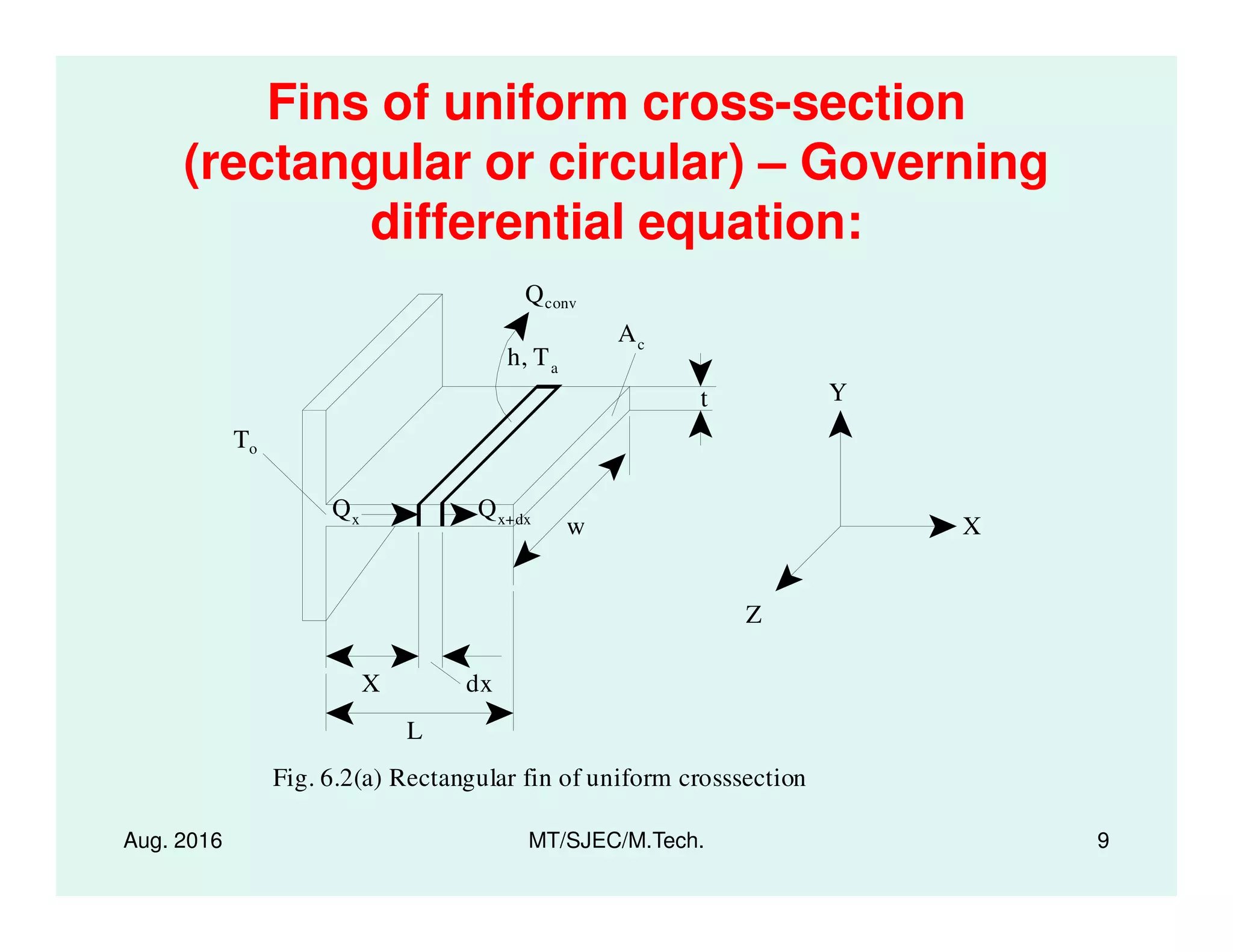
Fins of uniform cross-section
(rectangular or circular) – Governing
differential equation:
Qconv
To
t Y
Ac
h, Ta
Aug. 2016 MT/SJEC/M.Tech. 9
L
dx
Qx Qx+dx
w
X
X
Z
Fig. 6.2(a) Rectangular fin of uniform crosssection
Fins of uniform cross-section
(rectangular or circular) – Governing
differential equation:
• Assumptions:
• Steady state conduction,
with no heat generation
in the fin
• Thickness ‘t’ is small
Aug. 2016 MT/SJEC/M.Tech. 10
• Thickness ‘t’ is small
compared to length L
and width w, i.e. one-
dimensional conduction
in the x-direction only.
• Thermal conductivity, k
of the fin material is
constant.
Fins of uniform cross-section
(rectangular or circular) – Governing
differential equation:
• Assumptions (contd.):
• Isotropic (i.e. const. k in all
directions) and homogeneous
(i.e. const. density) material.
• Uniform heat transfer coeff. h,
over the entire length of fin.
Aug. 2016 MT/SJEC/M.Tech. 11
• Uniform heat transfer coeff. h,
over the entire length of fin.
• No bond resistance in the
joint between the fin and the
base wall, and
• Negligible radiation effect.
Fins of uniform cross-section
(rectangular or circular) – Governing
differential equation:
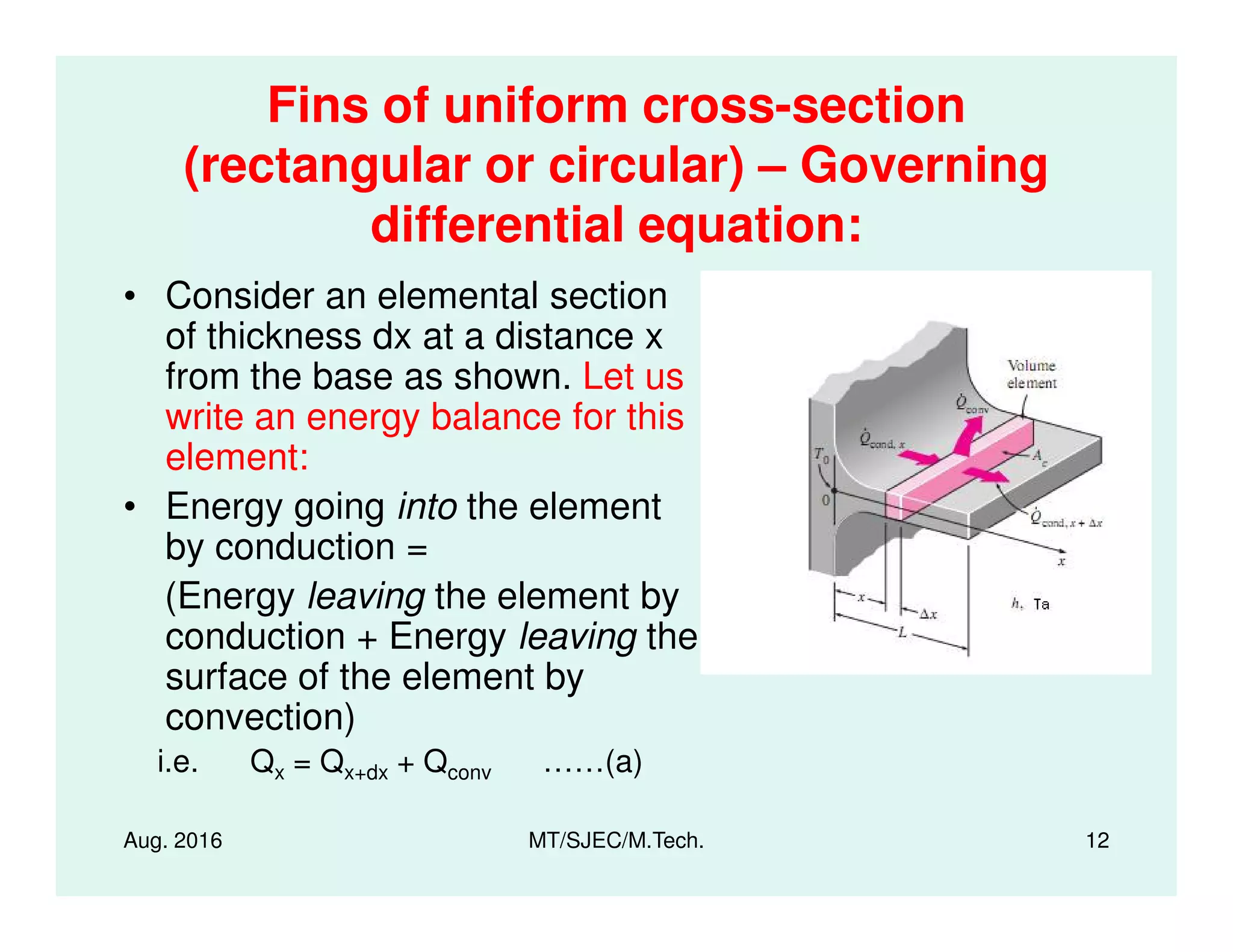
• Consider an elemental section
of thickness dx at a distance x
from the base as shown. Let us
write an energy balance for this
element:
Aug. 2016 MT/SJEC/M.Tech. 12
element:
• Energy going into the element
by conduction =
(Energy leaving the element by
conduction + Energy leaving the
surface of the element by
convection)
i.e. Qx = Qx+dx + Qconv ……(a)
Fins of uniform cross-section
(rectangular or circular) – Governing
differential equation:
• We have:
Aug. 2016 MT/SJEC/M.Tech. 13
Fins of uniform cross-section
(rectangular or circular) – Governing
differential equation:
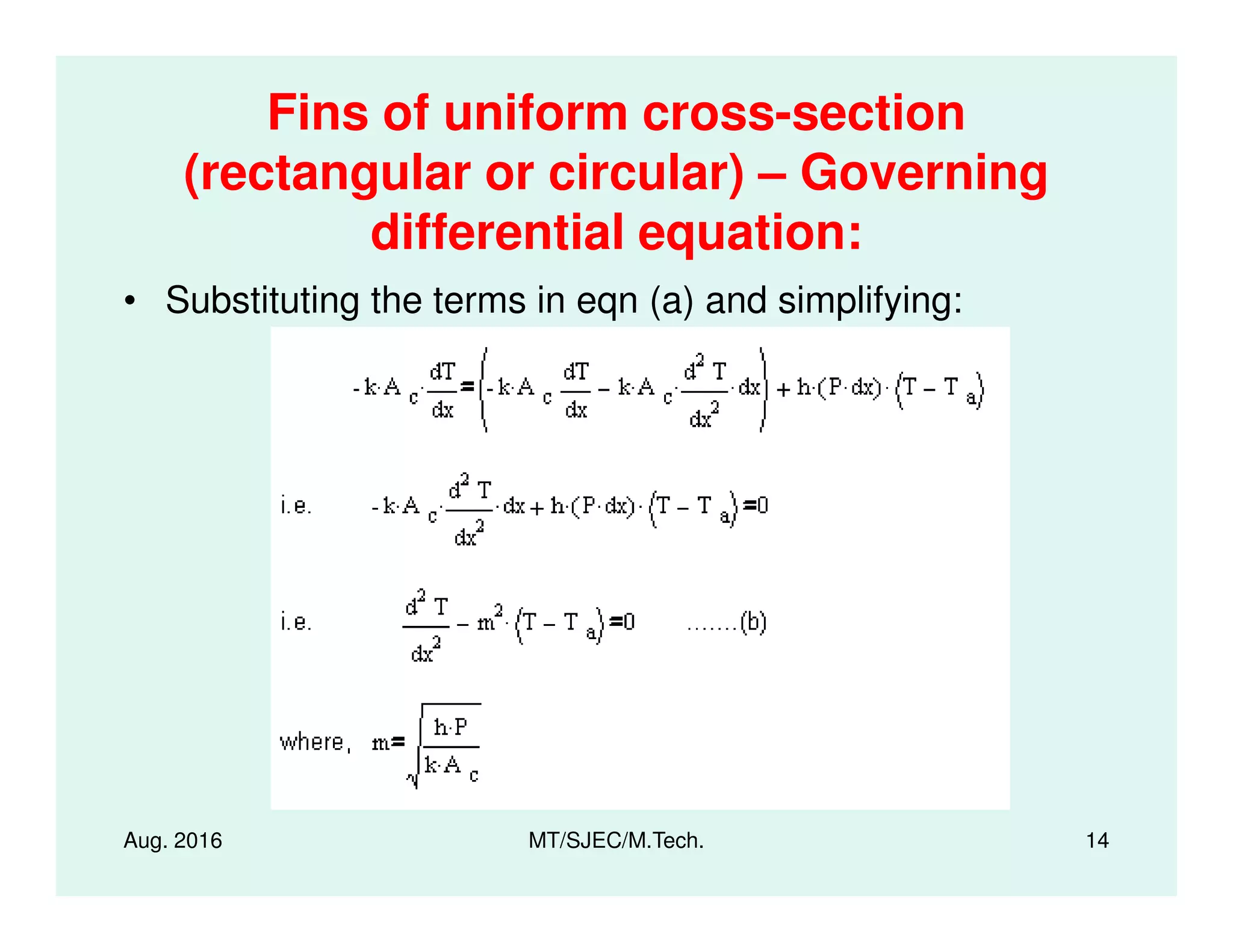
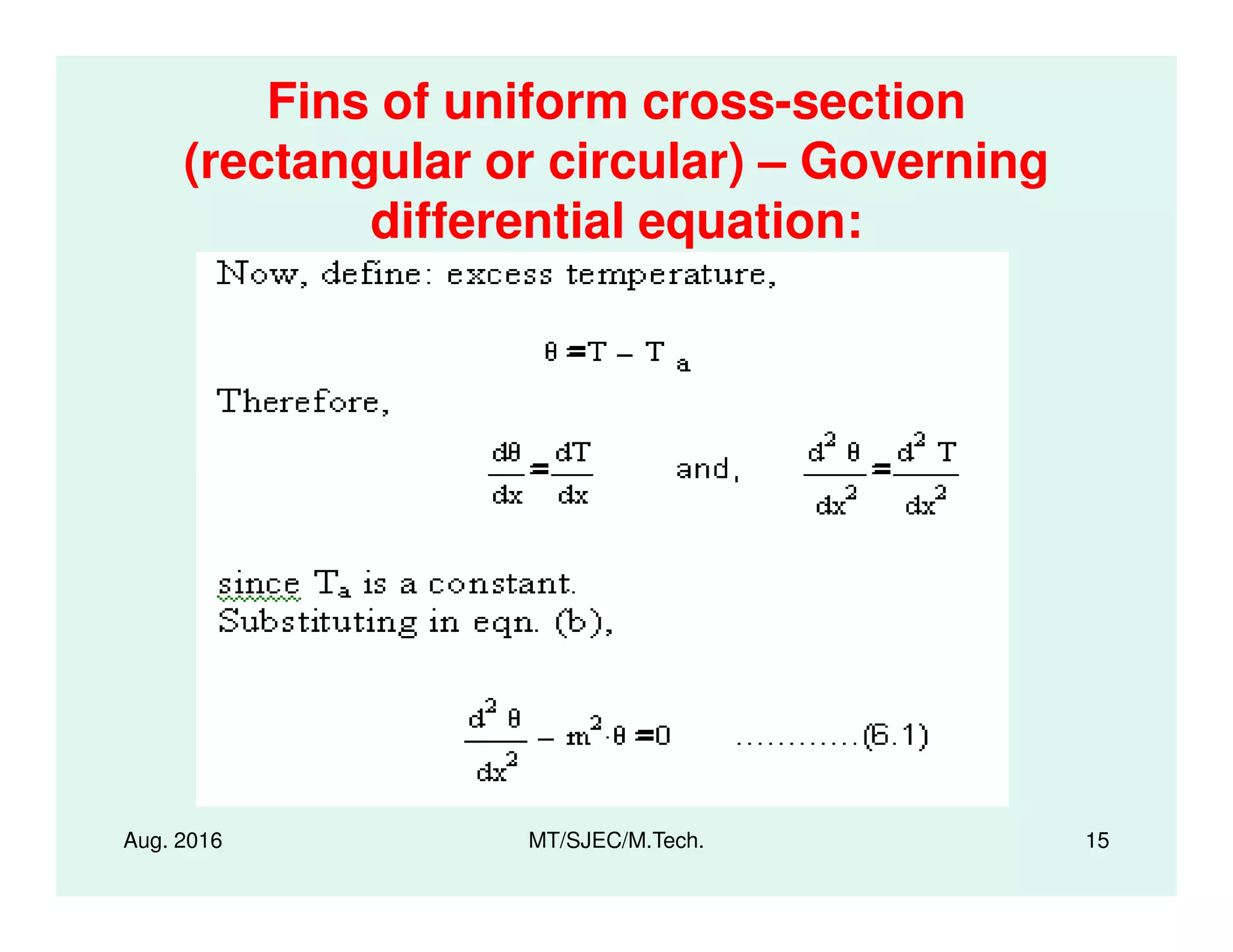
• Substituting the terms in eqn (a) and simplifying:
Aug. 2016 MT/SJEC/M.Tech. 14
Fins of uniform cross-section
(rectangular or circular) – Governing
differential equation:
Aug. 2016 MT/SJEC/M.Tech. 15
Fins of uniform cross-section
(rectangular or circular) – Governing
differential equation:
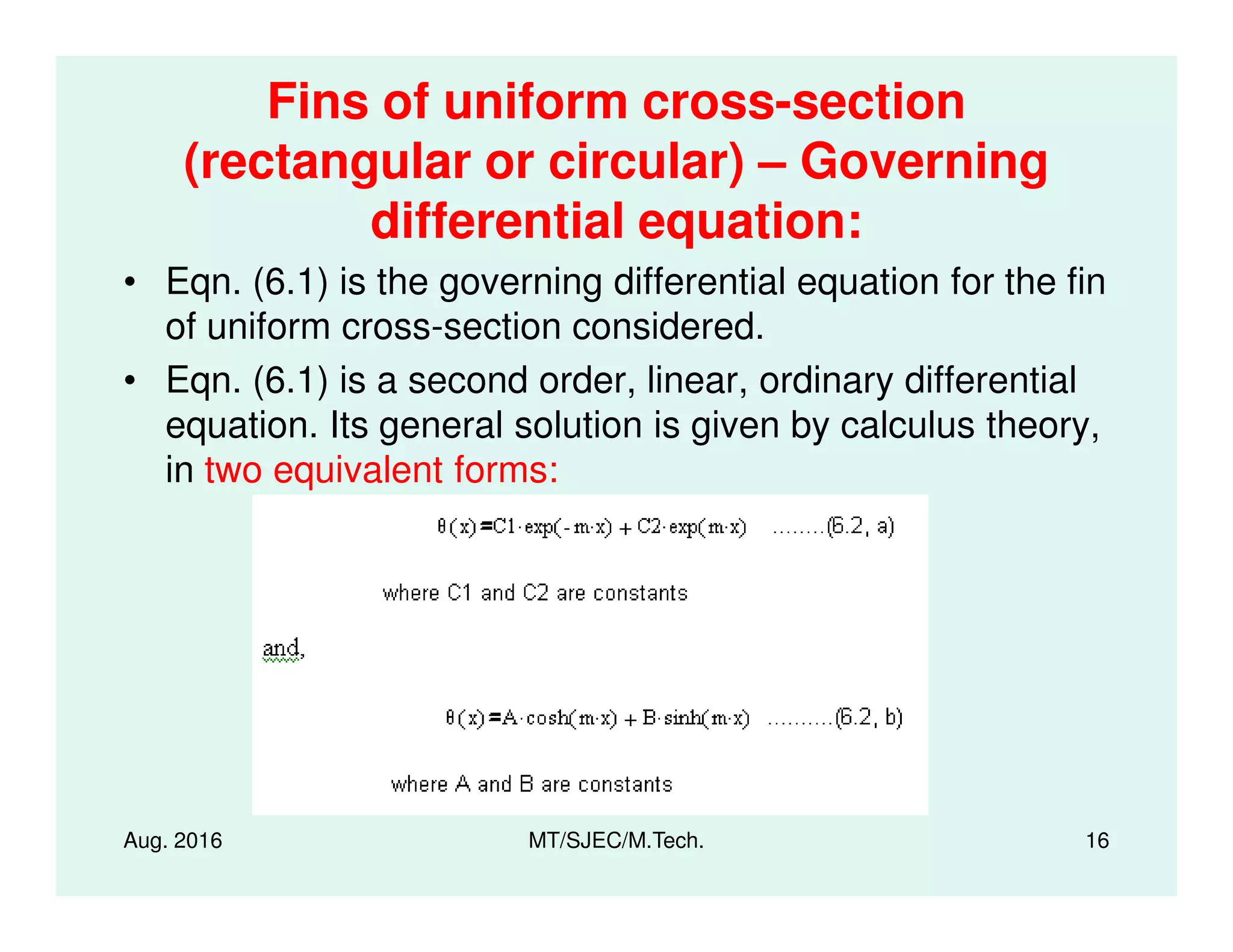
• Eqn. (6.1) is the governing differential equation for the fin
of uniform cross-section considered.
• Eqn. (6.1) is a second order, linear, ordinary differential
equation. Its general solution is given by calculus theory,
in two equivalent forms:
Aug. 2016 MT/SJEC/M.Tech. 16
in two equivalent forms:
Fins of uniform cross-section
(rectangular or circular) – Governing
differential equation:
• To calculate the set of constants C1 and
C2, or A and B, we need two boundary
conditions:
Aug. 2016 MT/SJEC/M.Tech. 17
• One of the B.C’s is that the temperature of
the fin at its base.
• i.e. B. C. (i): at x = 0, T = To
• Regarding the second boundary condition,
there are several possibilities:
Fins of uniform cross-section
(rectangular or circular) – Governing
differential equation:
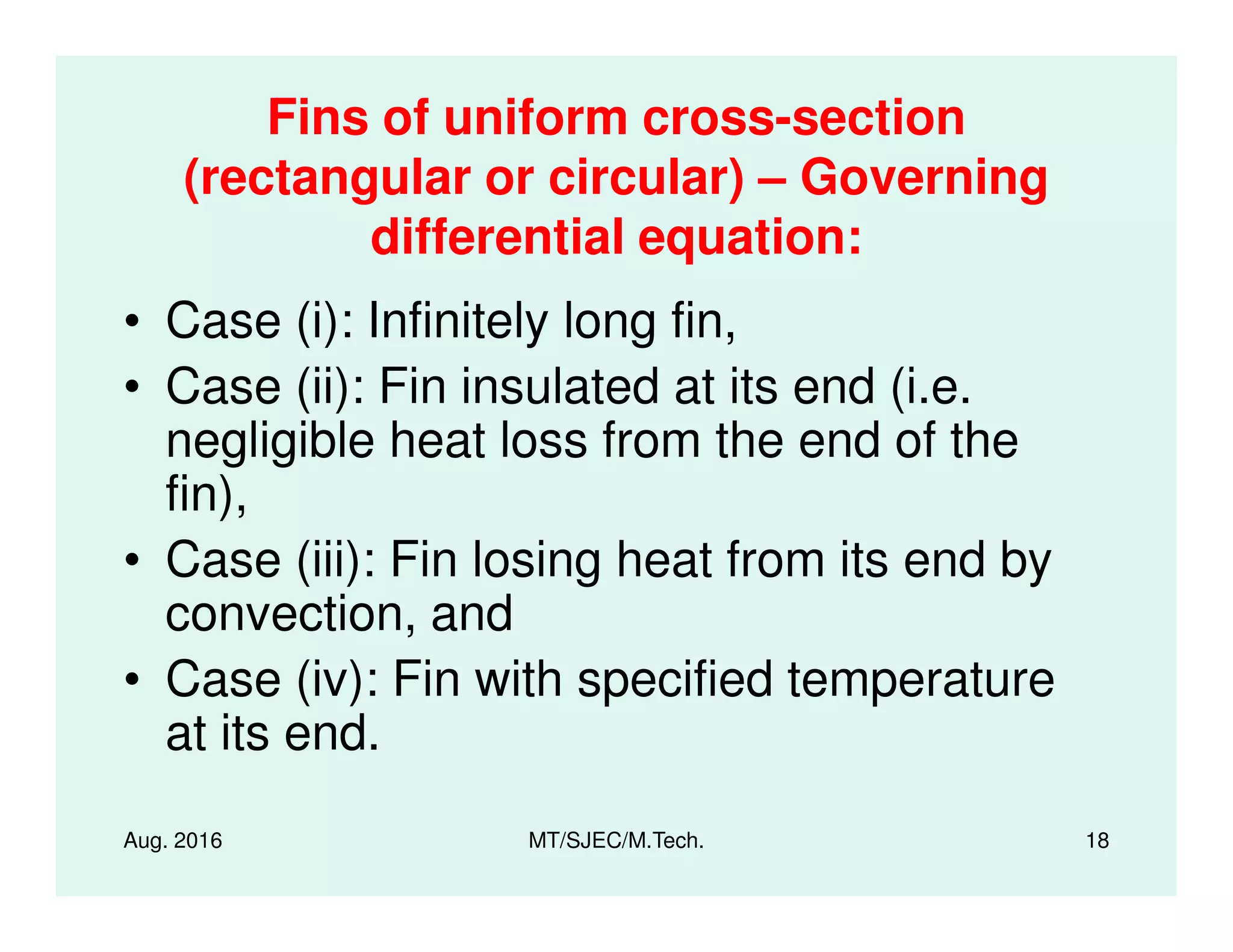
• Case (i): Infinitely long fin,
• Case (ii): Fin insulated at its end (i.e.
negligible heat loss from the end of the
fin),
Aug. 2016 MT/SJEC/M.Tech. 18
fin),
• Case (iii): Fin losing heat from its end by
convection, and
• Case (iv): Fin with specified temperature
at its end.
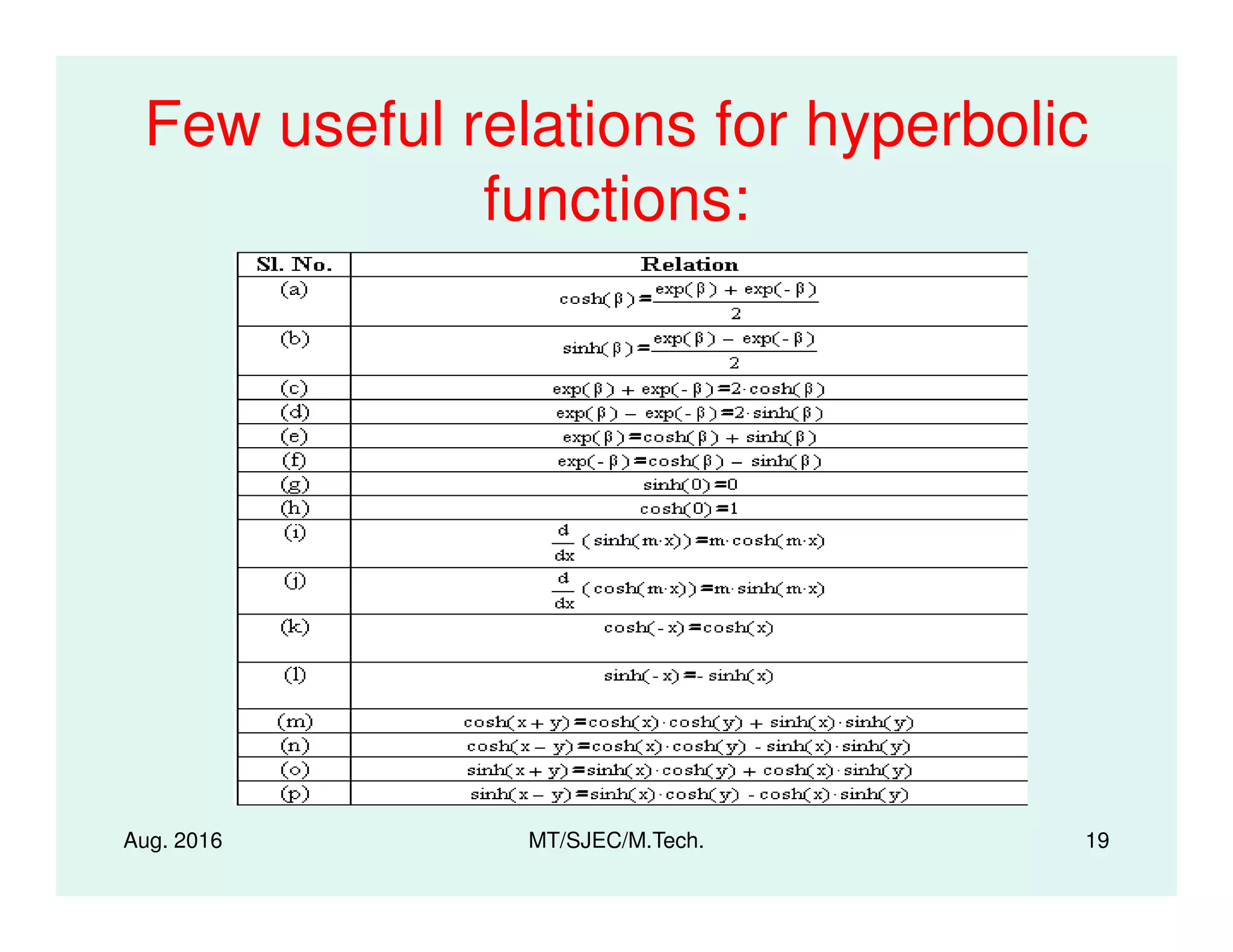
Few useful relations for hyperbolic
functions:
Aug. 2016 MT/SJEC/M.Tech. 19
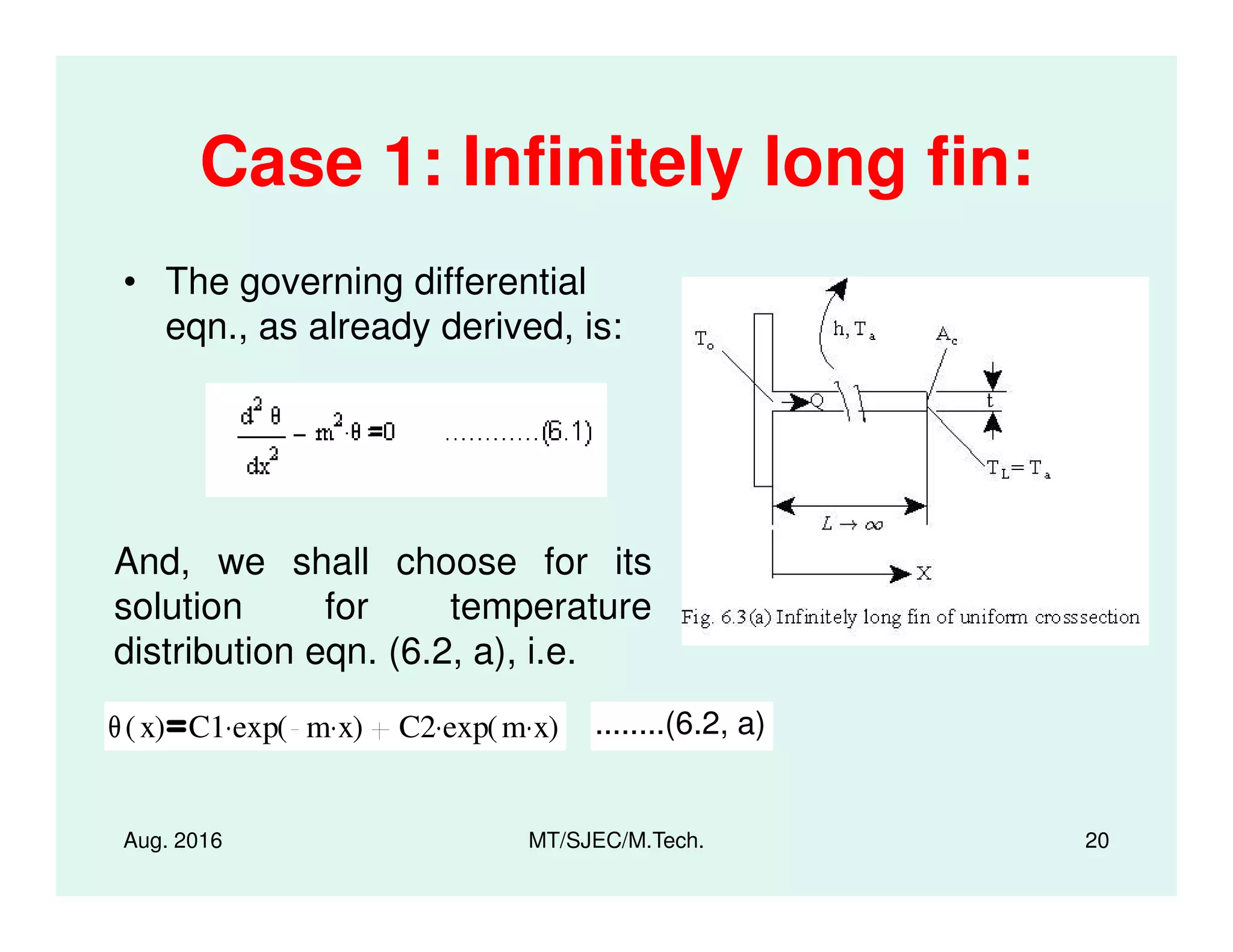
Case 1: Infinitely long fin:
• The governing differential
eqn., as already derived, is:
Aug. 2016 MT/SJEC/M.Tech. 20
And, we shall choose for its
solution for temperature
distribution eqn. (6.2, a), i.e.
θ x( ) C1 exp m x.( ). C2 exp m x.( ). ........(6.2, a)
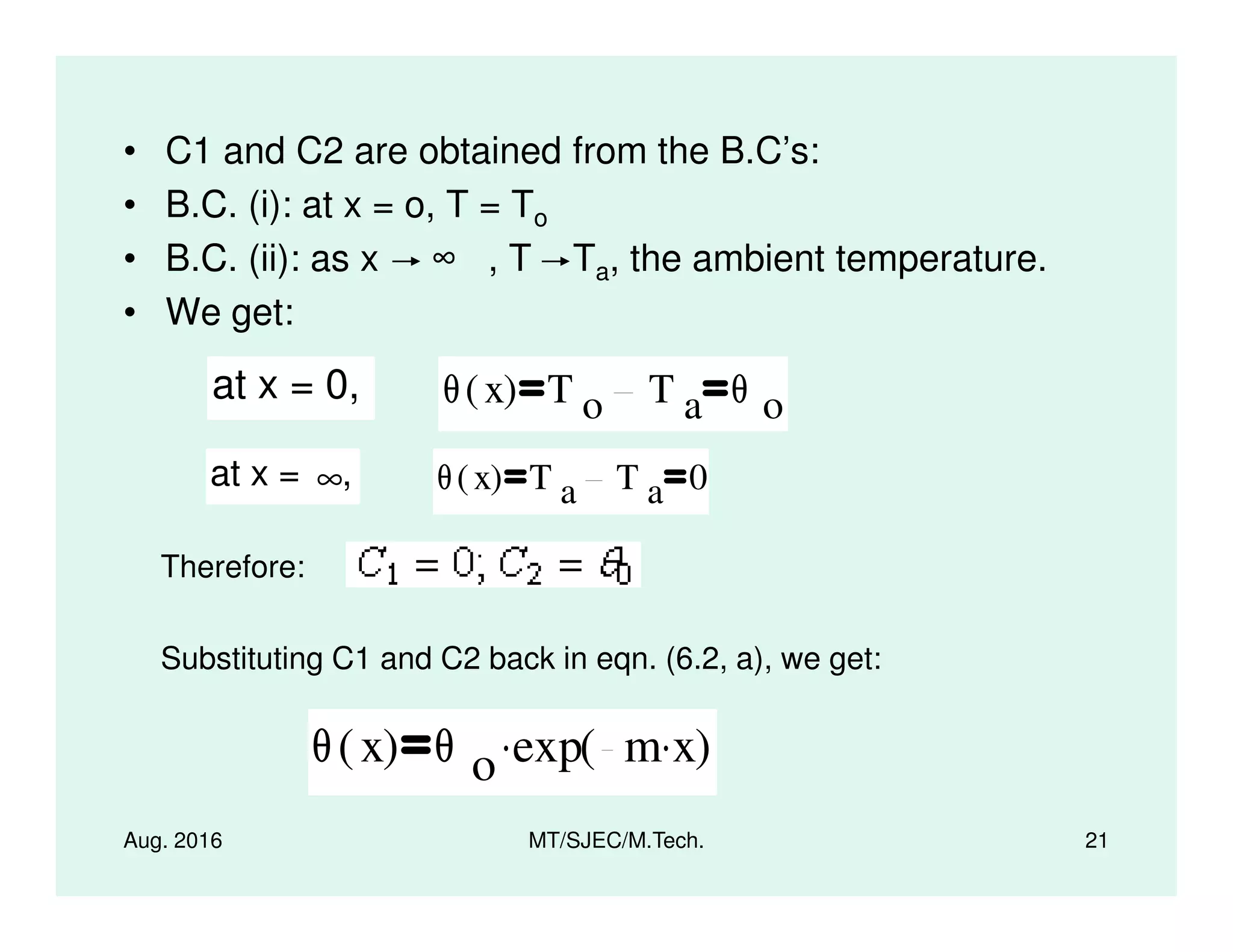
• C1 and C2 are obtained from the B.C’s:
• B.C. (i): at x = o, T = To
• B.C. (ii): as x , T Ta, the ambient temperature.
• We get:
at x = 0, θ x( ) T o T a θ o
at x = ∞, θ x( ) T a T a 0
Aug. 2016 MT/SJEC/M.Tech. 21
at x = ∞, θ x( ) T a T a 0
Therefore:
Substituting C1 and C2 back in eqn. (6.2, a), we get:
θ x( ) θ o exp m x.( ).
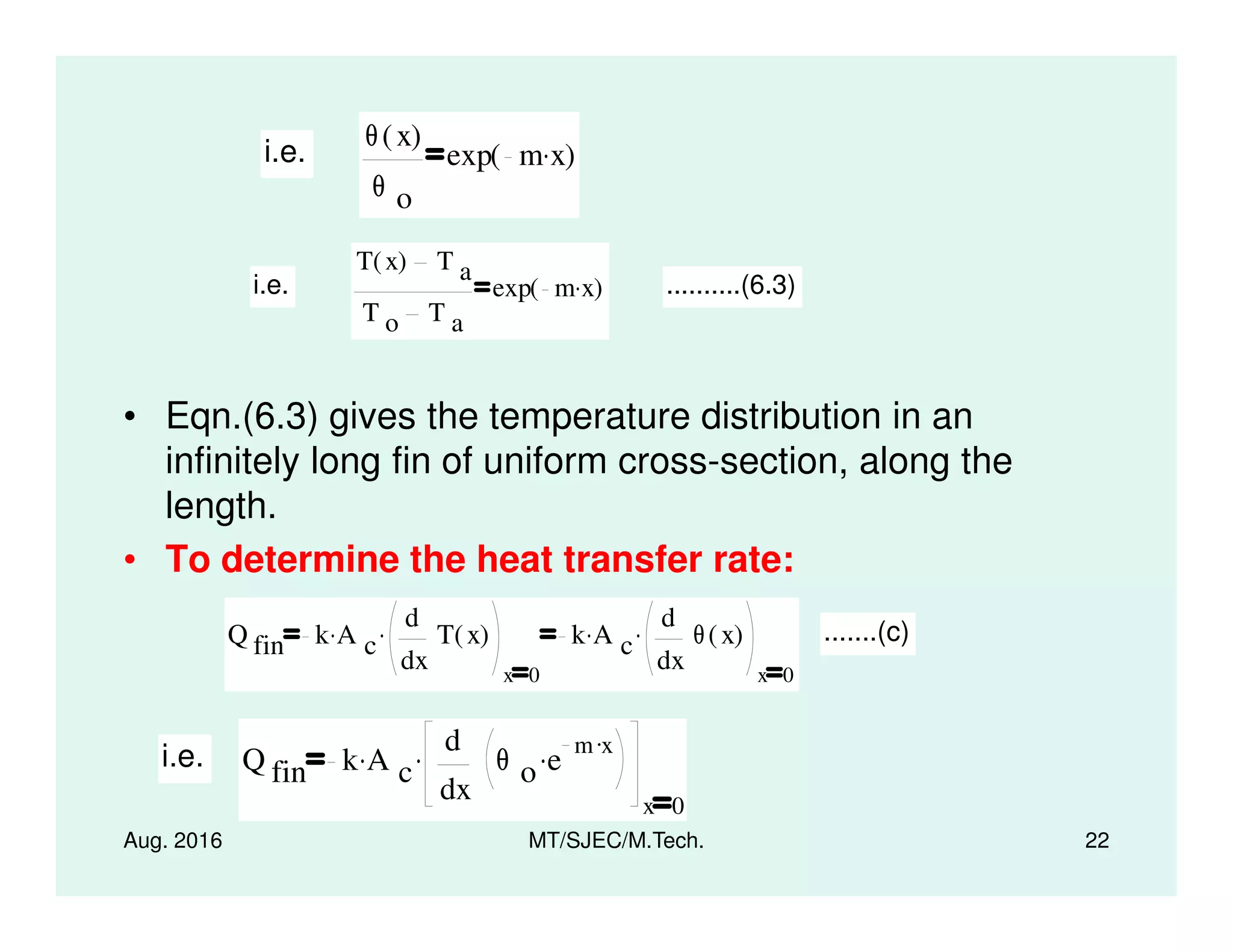
• Eqn.(6.3) gives the temperature distribution in an
infinitely long fin of uniform cross-section, along the
i.e.
θ x( )
θ o
exp m x.( )
i.e.
T x( ) T a
T o T a
exp m x.( ) ..........(6.3)
Aug. 2016 MT/SJEC/M.Tech. 22
infinitely long fin of uniform cross-section, along the
length.
• To determine the heat transfer rate:
Q fin k A c
. d
dx
T x( )
x 0
. k A c
. d
dx
θ x( )
x 0
. .......(c)
i.e. Q fin k A c
. d
dx
θ o e
m x.
.
x 0
.
• Substituting for m:
i.e. Q fin k A c
. m. θ o
. ........(6.4)
Q fin k A c
. h P.
k A c
.
. θ o
.
Aug. 2016 MT/SJEC/M.Tech. 23
i.e. Q fin h P. k. A c
. θ o
. h P. k. A c
. T o T a
. ......(6.5)
Eqn. (6.4) or (6.5) gives the heat transfer rate through the fin.
Case 2: Fin of finite length with
insulated end:
• To determine the
temperature distribution:
• The governing
differential eqn:
To
t
Ac
h, Ta
(dT/dx)x=L = 0
Q
d
2
θ 2.
Aug. 2016 MT/SJEC/M.Tech. 24
L
X
Fig. 6.4(a) Fin of finite length, end insulated
(dT/dx)x=L = 0
d
2
θ
dx
2
m
2
θ. 0 ............(6.1)
And, we shall choose for its solution for
temperature distribution, eqn. (6.2, b),
i.e.
θ x( ) A cosh m x.( ). B sinh m x.( ). ..........(6.2, b)
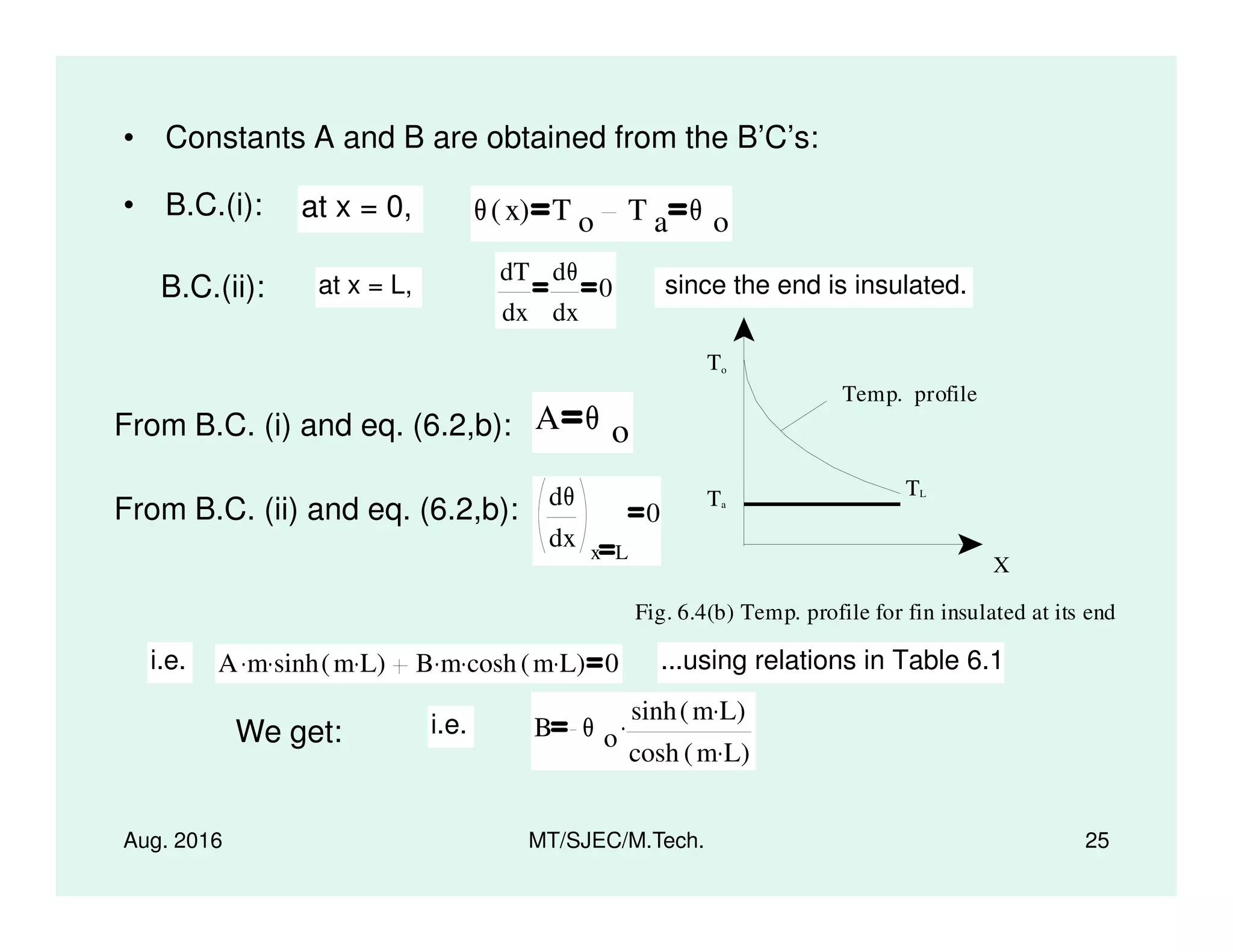
• Constants A and B are obtained from the B’C’s:
• B.C.(i): at x = 0, θ x( ) T o T a θ o
B.C.(ii): at x = L,
dT
dx
dθ
dx
0 since the end is insulated.
From B.C. (i) and eq. (6.2,b): A θ o
Temp. profile
T
To
Aug. 2016 MT/SJEC/M.Tech. 25
From B.C. (ii) and eq. (6.2,b): dθ
dx x L
0
i.e. A m. sinh m L.( ). B m. cosh m L.( ). 0 ...using relations in Table 6.1
i.e. B θ o
sinh m L.( )
cosh m L.( )
.We get:
X
Fig. 6.4(b) Temp. profile for fin insulated at its end
Ta
TL
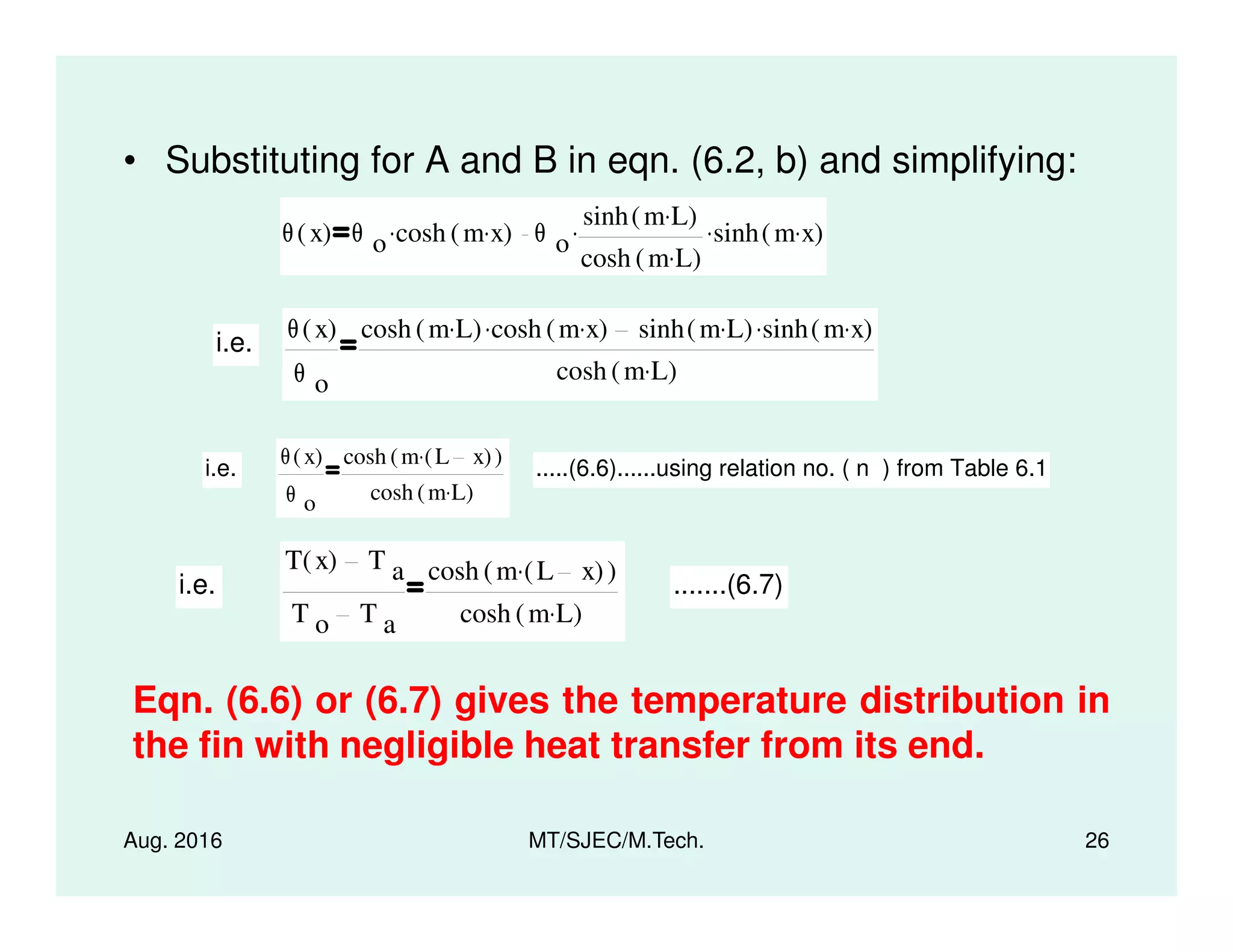
• Substituting for A and B in eqn. (6.2, b) and simplifying:
θ x( ) θ o cosh m x.( ). θ o
sinh m L.( )
cosh m L.( )
. sinh m x.( ).
i.e.
θ x( )
θ o
cosh m L.( ) cosh m x.( ). sinh m L.( ) sinh m x.( ).
cosh m L.( )
i.e.
θ x( ) cosh m L x( ).( )
.....(6.6)......using relation no. ( n ) from Table 6.1
Aug. 2016 MT/SJEC/M.Tech. 26
i.e.
θ o cosh m L.( )
.....(6.6)......using relation no. ( n ) from Table 6.1
i.e.
T x( ) T a
T o T a
cosh m L x( ).( )
cosh m L.( )
.......(6.7)
Eqn. (6.6) or (6.7) gives the temperature distribution in
the fin with negligible heat transfer from its end.
• Temperature at the end of the fin:
• This is easily determined by putting x = L in eqn. (6.6) or (6.7):
θ L( )
θ o
1
cosh m L.( )
.....(6.6, a)......since cosh(0) = 1
i.e.
T L T a
T o T a
1
cosh m L.( )
.....(6.7, a)
and,
Aug. 2016 MT/SJEC/M.Tech. 27
or, T L
T o T a
cosh m L.( )
T a ......(6.7, b)
Eqn. (6.7,b) gives the temperature at the end of a
fin (i.e. at x = L, when the end of the fin is insulated.
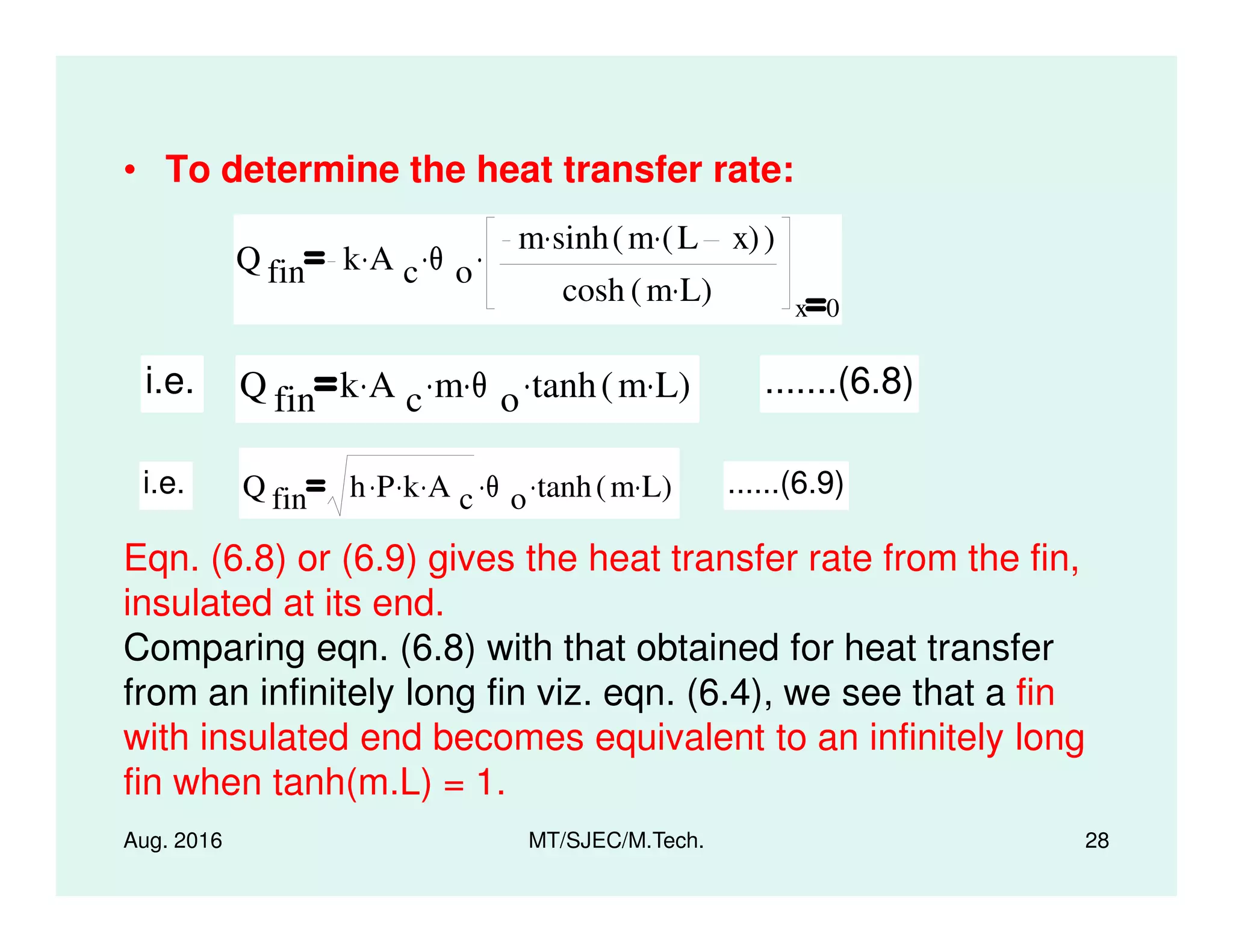
• To determine the heat transfer rate:
Q fin k A c
. θ o
. m sinh m L x( ).( ).
cosh m L.( ) x 0
.
i.e. Q fin k A c
. m. θ o
. tanh m L.( ). .......(6.8)
i.e. Q h P. k. A. θ. tanh m L.( ). ......(6.9)
Aug. 2016 MT/SJEC/M.Tech. 28
i.e. Q fin h P. k. A c
. θ o
. tanh m L.( ). ......(6.9)
Eqn. (6.8) or (6.9) gives the heat transfer rate from the fin,
insulated at its end.
Comparing eqn. (6.8) with that obtained for heat transfer
from an infinitely long fin viz. eqn. (6.4), we see that a fin
with insulated end becomes equivalent to an infinitely long
fin when tanh(m.L) = 1.
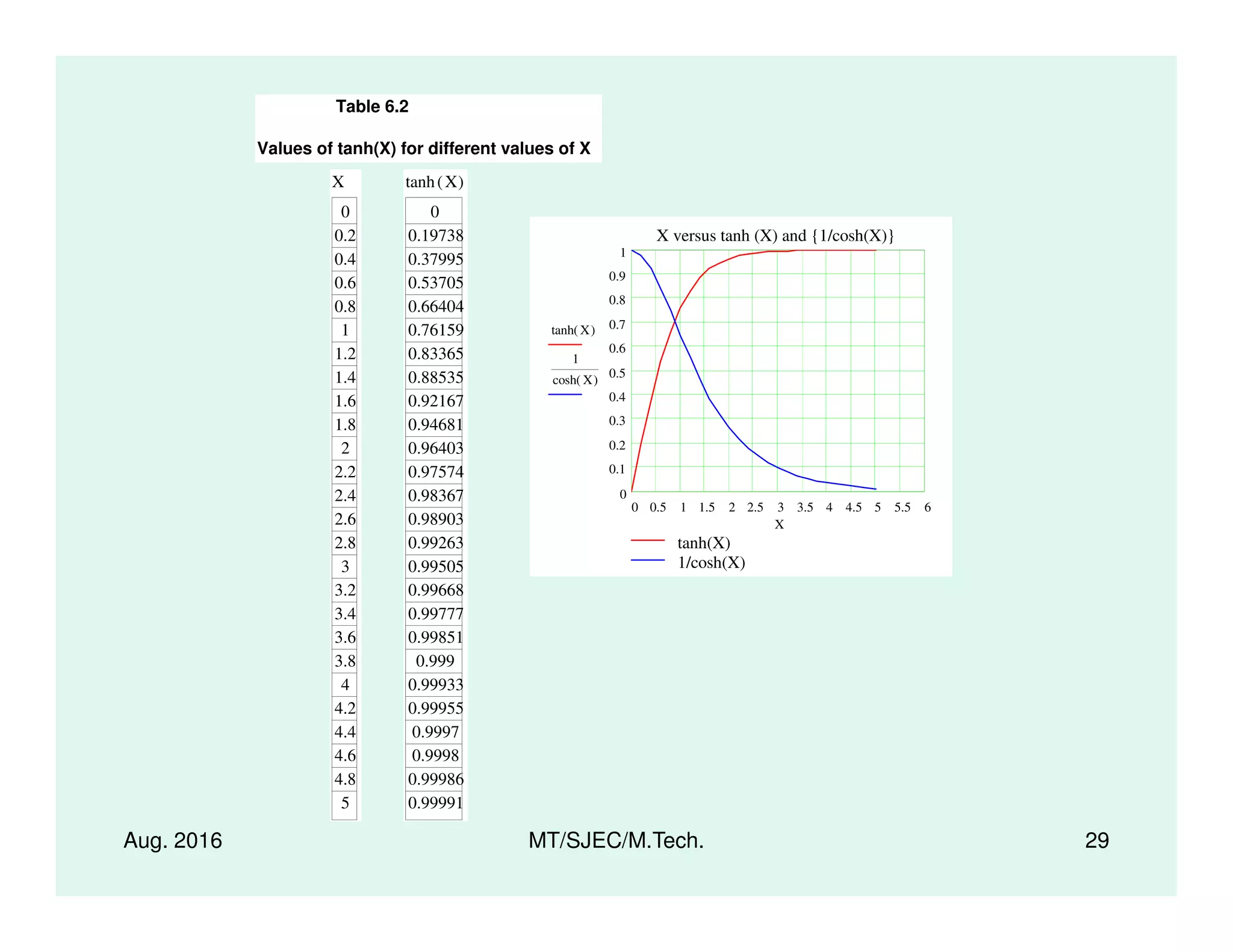
Table 6.2
Values of tanh(X) for different values of X
X
0
0.2
0.4
0.6
0.8
1
1.2
1.4
1.6
1.8
2
2.2
tanh X( )
0
0.19738
0.37995
0.53705
0.66404
0.76159
0.83365
0.88535
0.92167
0.94681
0.96403
0.97574
tanh X( )
1
cosh X( )
0.1
0.2
0.3
0.4
0.5
0.6
0.7
0.8
0.9
1
X versus tanh (X) and {1/cosh(X)}
Aug. 2016 MT/SJEC/M.Tech. 29
2.2
2.4
2.6
2.8
3
3.2
3.4
3.6
3.8
4
4.2
4.4
4.6
4.8
5
0.97574
0.98367
0.98903
0.99263
0.99505
0.99668
0.99777
0.99851
0.999
0.99933
0.99955
0.9997
0.9998
0.99986
0.99991
X
0 0.5 1 1.5 2 2.5 3 3.5 4 4.5 5 5.5 6
0
0.1
tanh(X)
1/cosh(X)
• It is observed from the Table that when
(m.L) for the insulated-end fin reaches a
value of about 2.8, heat transfer rate
becomes about 99% of that obtained for
an infinitely long fin.
• And, beyond a value of (m.L) more than 5,
the fin with insulated end can be
Aug. 2016 MT/SJEC/M.Tech. 30
the fin with insulated end can be
considered as infinitely long.
• Therefore, from the heat transfer point of
view, there is no great advantage in
having a fin with (m.L) greater than 2.8 or
3.
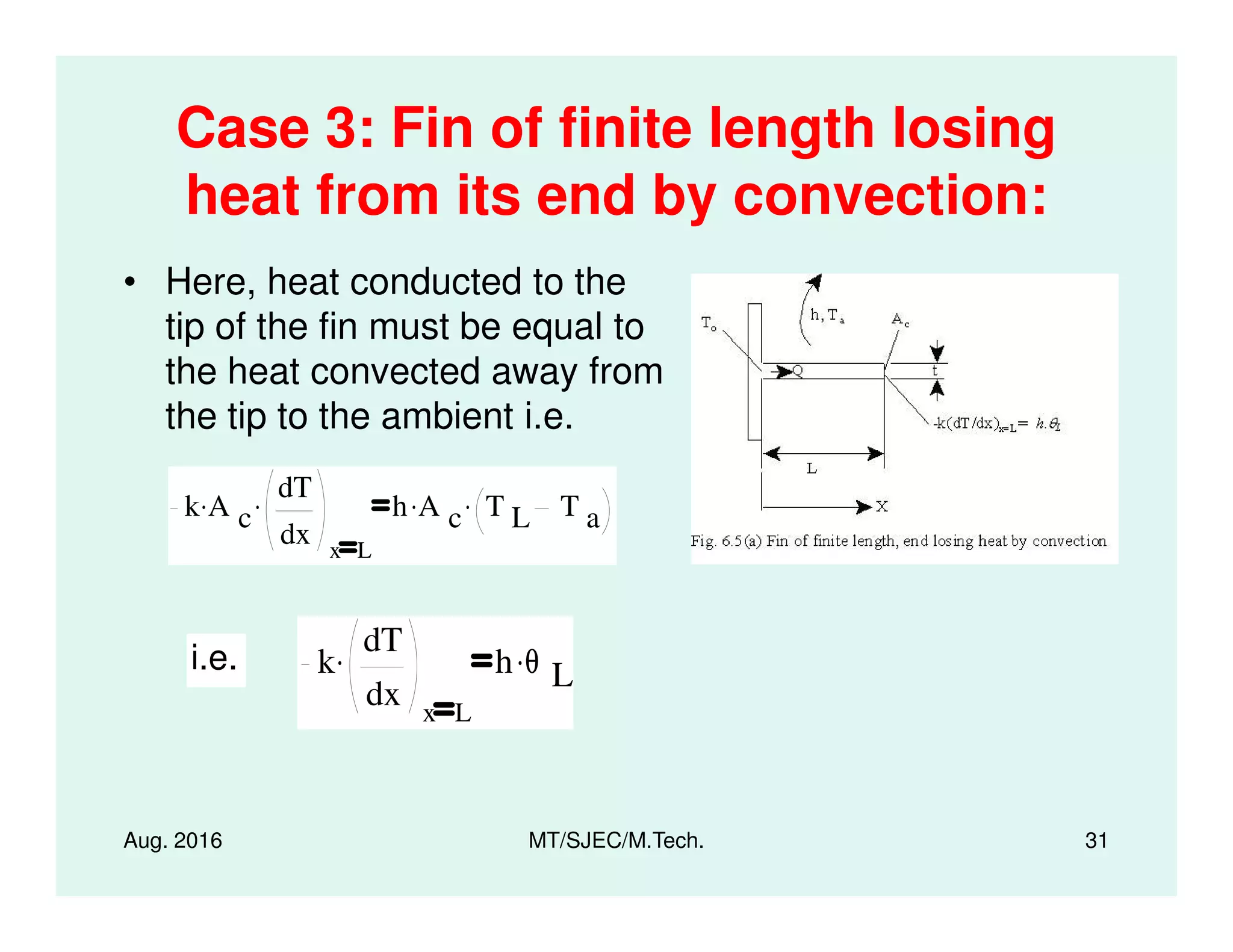
Case 3: Fin of finite length losing
heat from its end by convection:
• Here, heat conducted to the
tip of the fin must be equal to
the heat convected away from
the tip to the ambient i.e.
dT
Aug. 2016 MT/SJEC/M.Tech. 31
k A c
. dT
dx x L
. h A c
. T L T a
.
i.e. k
dT
dx x L
. h θ L
.
• To determine the temperature distribution:
• The governing differential eqn., as already derived, is
given by eqn. (6.1), viz.
d
2
θ
dx
2
m
2
θ. 0 ............(6.1)
Temp. profile
X
Ta
TL
To
Convection
Aug. 2016 MT/SJEC/M.Tech. 32
And, we shall choose for its solution for temperature
distribution, eqn. (6.2, b), i.e.
θ x( ) A cosh m x.( ). B sinh m x.( ). ..........(6.2, b)
B.C.(i): at x = 0, θ x( ) T o T a θ o
X
Fig. 6.5(b) Temp. profile for fin losing heat at its end
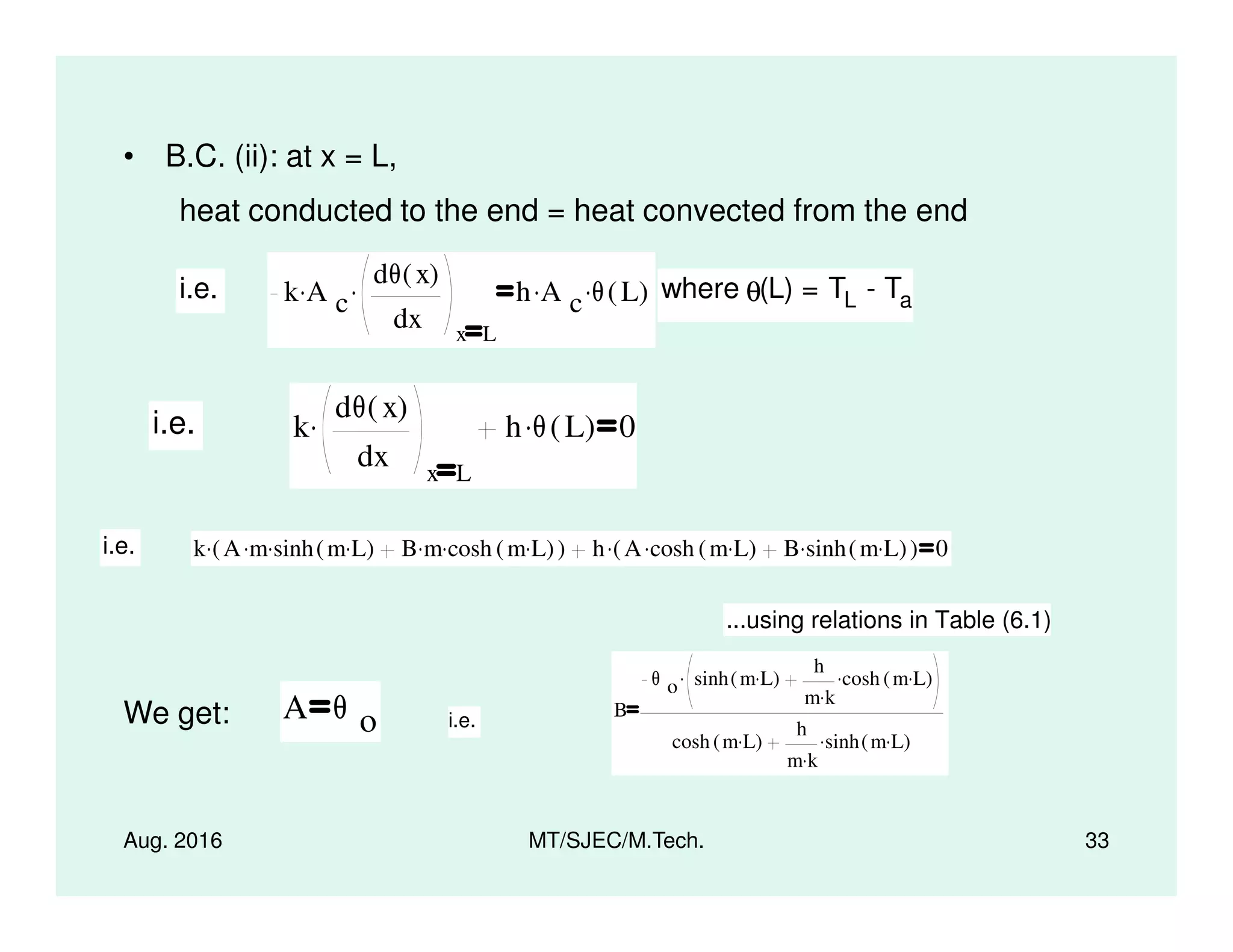
• B.C. (ii): at x = L,
heat conducted to the end = heat convected from the end
i.e. k A c
. dθ x( )
dx x L
. h A c
. θ L( ). where θ(L) = TL - Ta
i.e. k
dθ x( )
dx x L
. h θ L( ). 0
Aug. 2016 MT/SJEC/M.Tech. 33
x L
i.e. k A m. sinh m L.( ). B m. cosh m L.( ).( ). h A cosh m L.( ). B sinh m L.( ).( ). 0
...using relations in Table (6.1)
A θ oWe get: B
θ o sinh m L.( )
h
m k.
cosh m L.( )..
cosh m L.( )
h
m k.
sinh m L.( ).
i.e.
• Substituting for A and B in eqn. 6.2(b) and proceeding as earlier, we
get::
i.e.
θ x( )
θ o
cosh m L x( ).( )
h
m k.
sinh m L x( ).( ).
cosh m L.( )
h
m k.
sinh m L.( ).
..(6.10).....using relations (n) and (p)
from Table (6.1)
And, the heat transfer rate:
tanh m L.( )
h
Aug. 2016 MT/SJEC/M.Tech. 34
i.e. Q fin k A c
. m. θ o
.
tanh m L.( )
h
m k.
1
h
m k.
tanh m L.( ).
. ......(6.11)
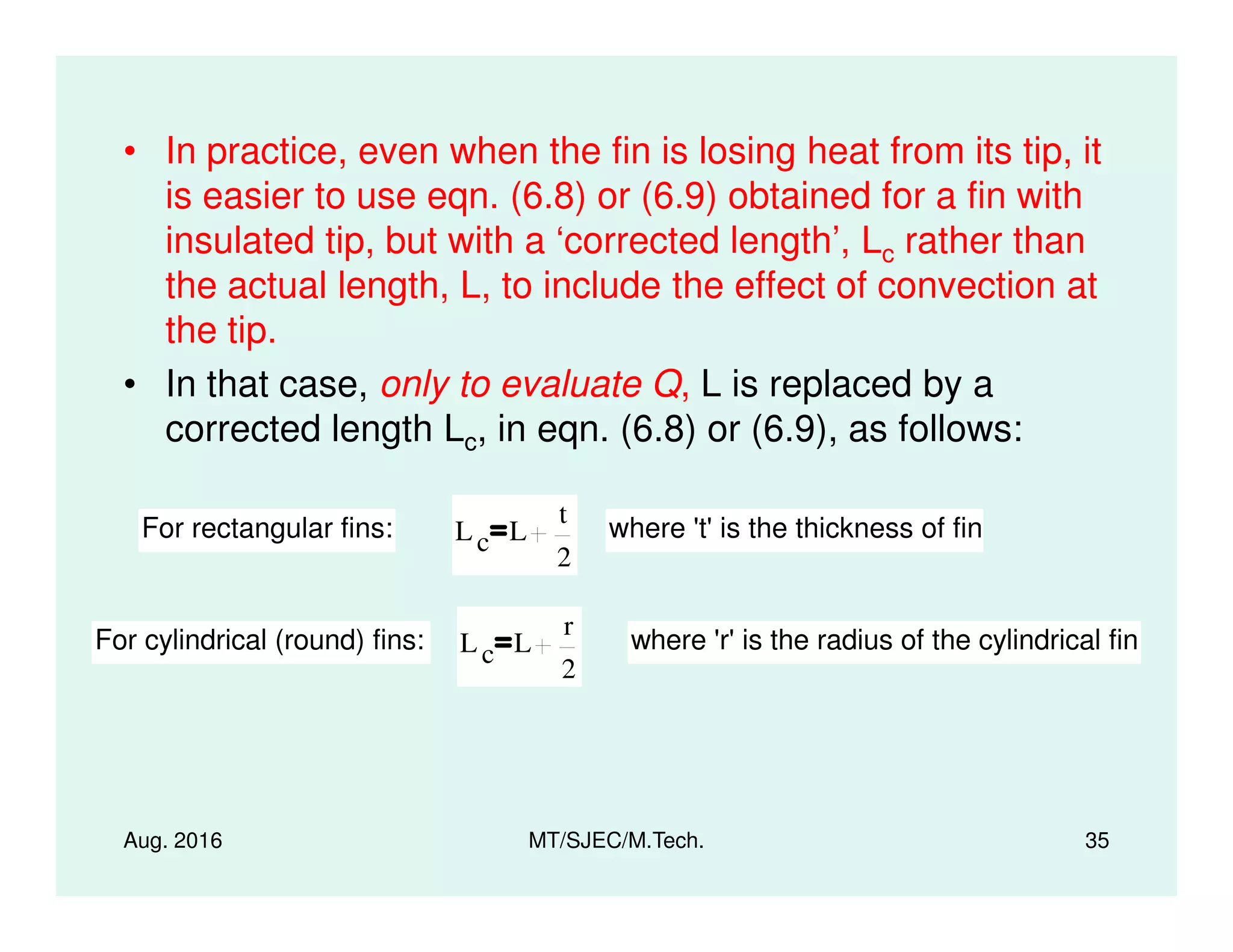
• In practice, even when the fin is losing heat from its tip, it
is easier to use eqn. (6.8) or (6.9) obtained for a fin with
insulated tip, but with a ‘corrected length’, Lc rather than
the actual length, L, to include the effect of convection at
the tip.
• In that case, only to evaluate Q, L is replaced by a
corrected length Lc, in eqn. (6.8) or (6.9), as follows:
Aug. 2016 MT/SJEC/M.Tech. 35
For rectangular fins: L c L
t
2
where 't'is the thickness of fin
For cylindrical (round) fins: L c L
r
2
where 'r'is the radius of the cylindrical fin
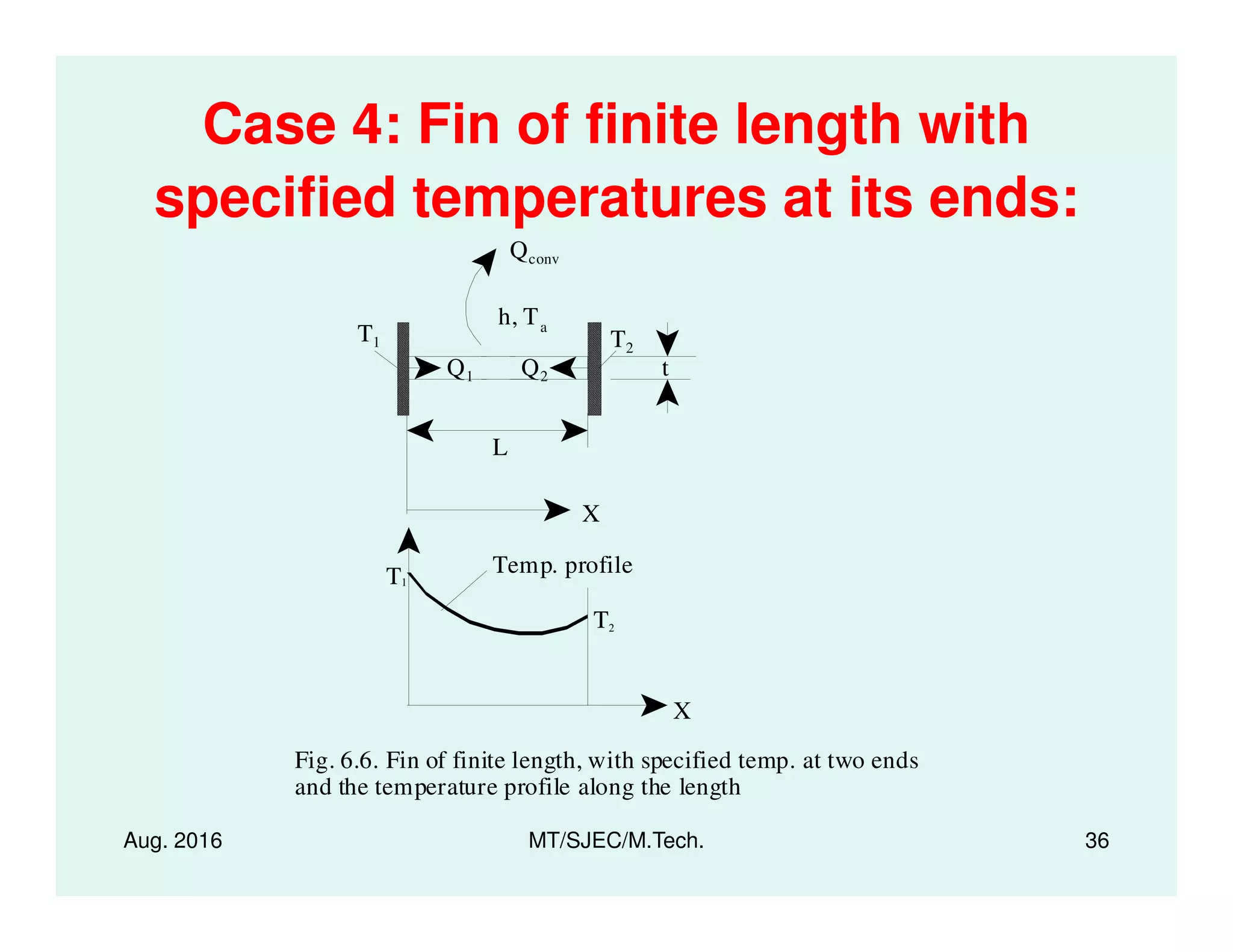
Case 4: Fin of finite length with
specified temperatures at its ends:
T1
L
t
h, Ta
Q1
T2
Q2
Qconv
Aug. 2016 MT/SJEC/M.Tech. 36
Temp. profile
X
Fig. 6.6. Fin of finite length, with specified temp. at two ends
and the temperature profile along the length
X
T1
T2
To determine the temperature distribution:
• The governing differential eqn., as already derived, is
given by eqn. (6.1), viz.
d
2
θ
dx
2
m
2
θ. 0 ............(6.1)
And, we shall choose for its solution for temperature
distribution, eqn. (6.2, b), i.e.
Aug. 2016 MT/SJEC/M.Tech. 37
distribution, eqn. (6.2, b), i.e.
θ x( ) A cosh m x.( ). B sinh m x.( ). ..........(6.2, b)
Constants A and B are obtained from the B’C’s:
B.C.(i): at x = 0: T T1 i.e. θ θ 1
B.C.(ii): at x = : T T2 i.e. θ θ 2
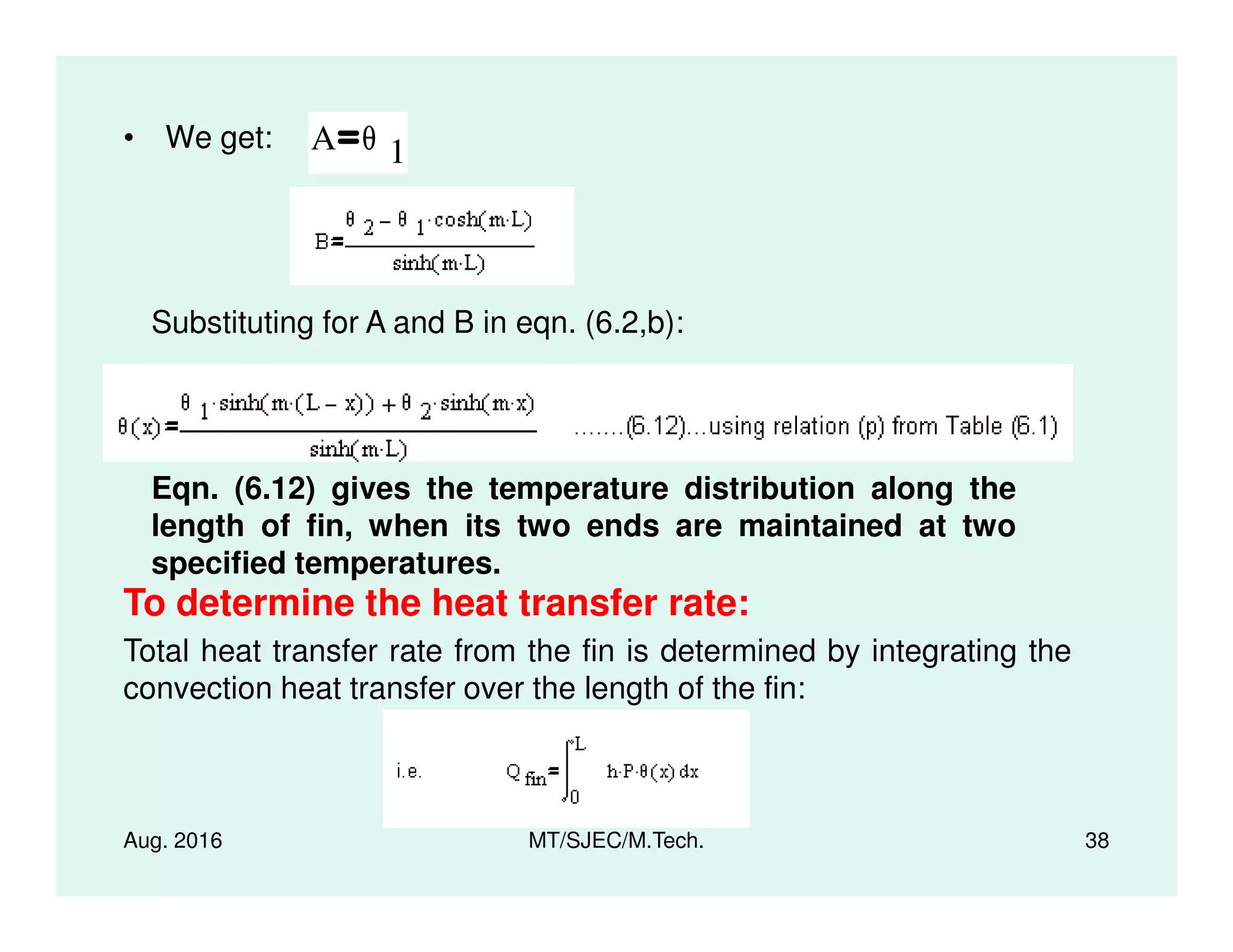
• We get: A θ 1
Substituting for A and B in eqn. (6.2,b):
Eqn. (6.12) gives the temperature distribution along the
Aug. 2016 MT/SJEC/M.Tech. 38
To determine the heat transfer rate:
Total heat transfer rate from the fin is determined by integrating the
convection heat transfer over the length of the fin:
Eqn. (6.12) gives the temperature distribution along the
length of fin, when its two ends are maintained at two
specified temperatures.
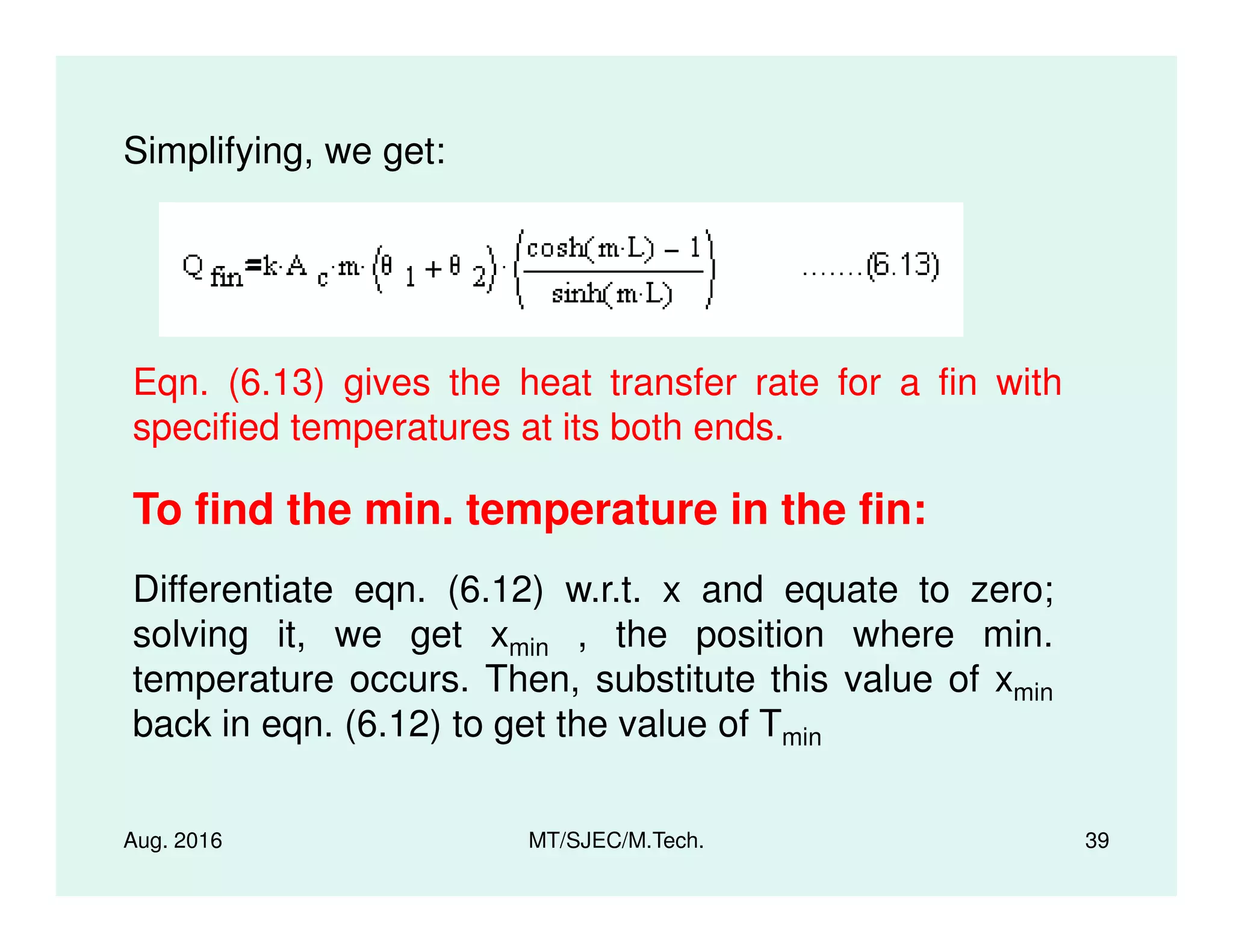
Simplifying, we get:
Eqn. (6.13) gives the heat transfer rate for a fin with
specified temperatures at its both ends.
Aug. 2016 MT/SJEC/M.Tech. 39
To find the min. temperature in the fin:
Differentiate eqn. (6.12) w.r.t. x and equate to zero;
solving it, we get xmin , the position where min.
temperature occurs. Then, substitute this value of xmin
back in eqn. (6.12) to get the value of Tmin
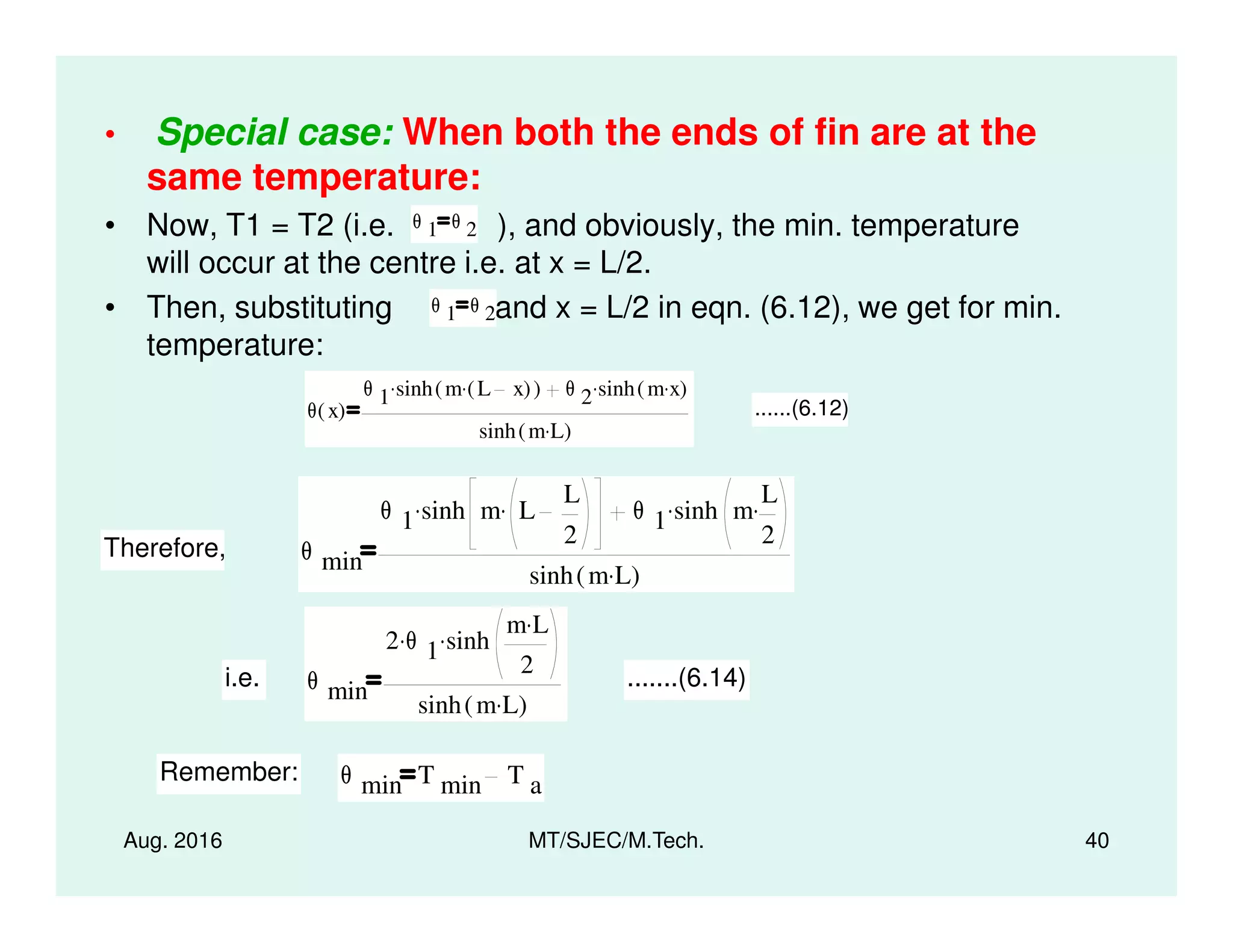
• Special case: When both the ends of fin are at the
same temperature:
• Now, T1 = T2 (i.e. ), and obviously, the min. temperature
will occur at the centre i.e. at x = L/2.
• Then, substituting and x = L/2 in eqn. (6.12), we get for min.
temperature:
θ 1 θ 2
θ 1 θ 2
θ x( )
θ 1 sinh m L x( ).( ). θ 2 sinh m x.( ).
sinh m L.( )
......(6.12)
Aug. 2016 MT/SJEC/M.Tech. 40
Therefore, θ min
θ 1 sinh m L
L
2
.. θ 1 sinh m
L
2
..
sinh m L.( )
i.e. θ min
2 θ 1
. sinh
m L.
2
.
sinh m L.( )
.......(6.14)
Remember: θ min T min T a
Performance of fins:
• 1. Fin efficiency: fin efficiency is defined as the
amount of heat actually transferred by a given fin to
the ideal amount of heat that would be transferred if
the entire fin were at its base temperature. i.e.
η f
Q fin
Q max
....(6.16)
Aug. 2016 MT/SJEC/M.Tech. 41
(a) For an infinitely long fin:
For an infinitely long fin, actual heat transferred is given by eqn. (6.5):
i.e. Q fin h P. k. A c
. θ o
. h P. k. A c
. T o T a
. ......(6.5)
• To calculate Qmax, if the entire fin surface were to be at a
temperature of To, the convective heat transfer from the
surface would be:
Q max h P. L. T o T a
. .........eqn. (A)
Dividing eqn. (6.5) by eqn. (A):
Aug. 2016 MT/SJEC/M.Tech. 42
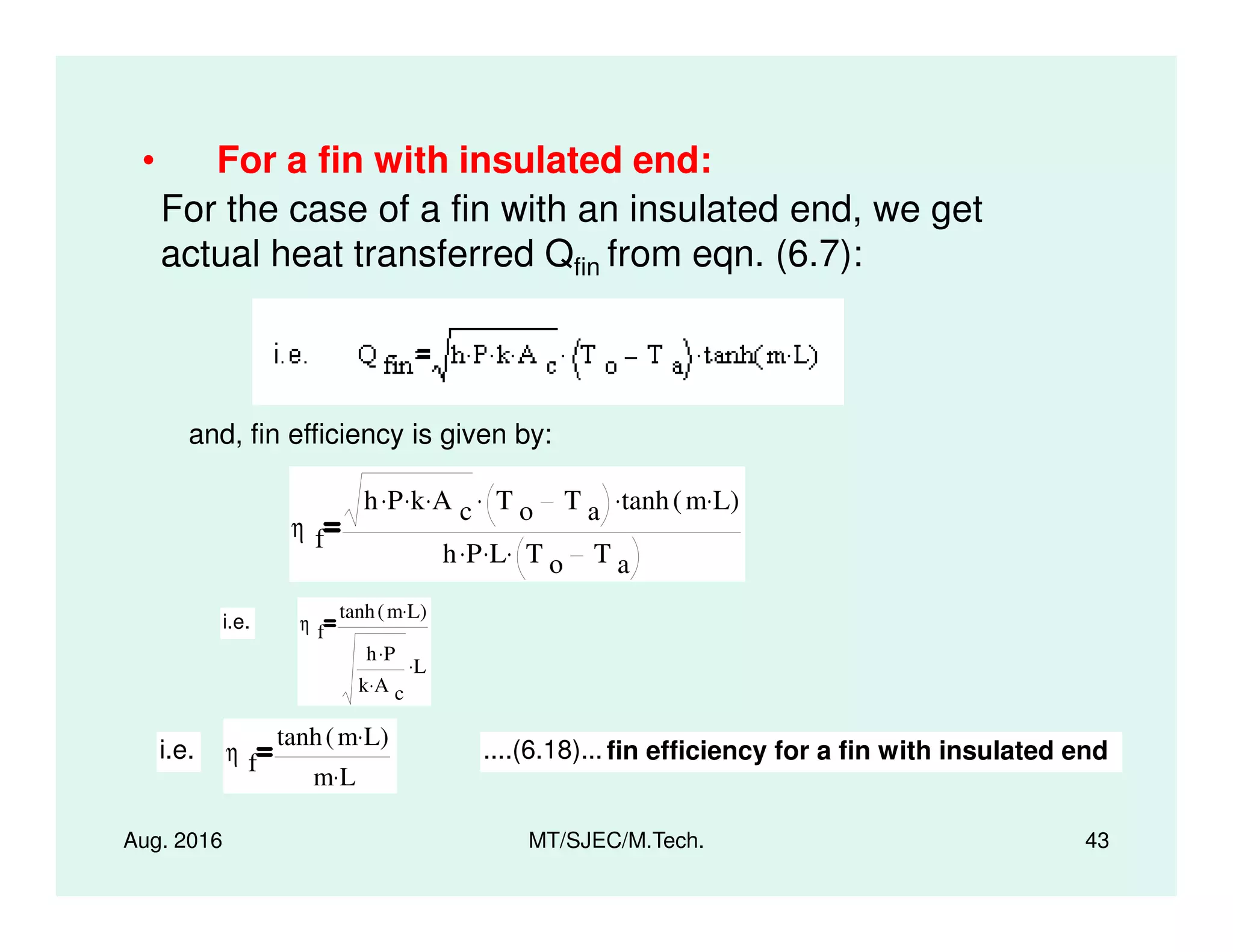
• For a fin with insulated end:
For the case of a fin with an insulated end, we get
actual heat transferred Qfin from eqn. (6.7):
and, fin efficiency is given by:
. .
Aug. 2016 MT/SJEC/M.Tech. 43
η f
h P. k. A c
. T o T a
. tanh m L.( ).
h P. L. T o T a
.
i.e. η f
tanh m L.( )
h P.
k A c
.
L.
i.e. η f
tanh m L.( )
m L.
....(6.18)...fin efficiency for a fin with insulated end
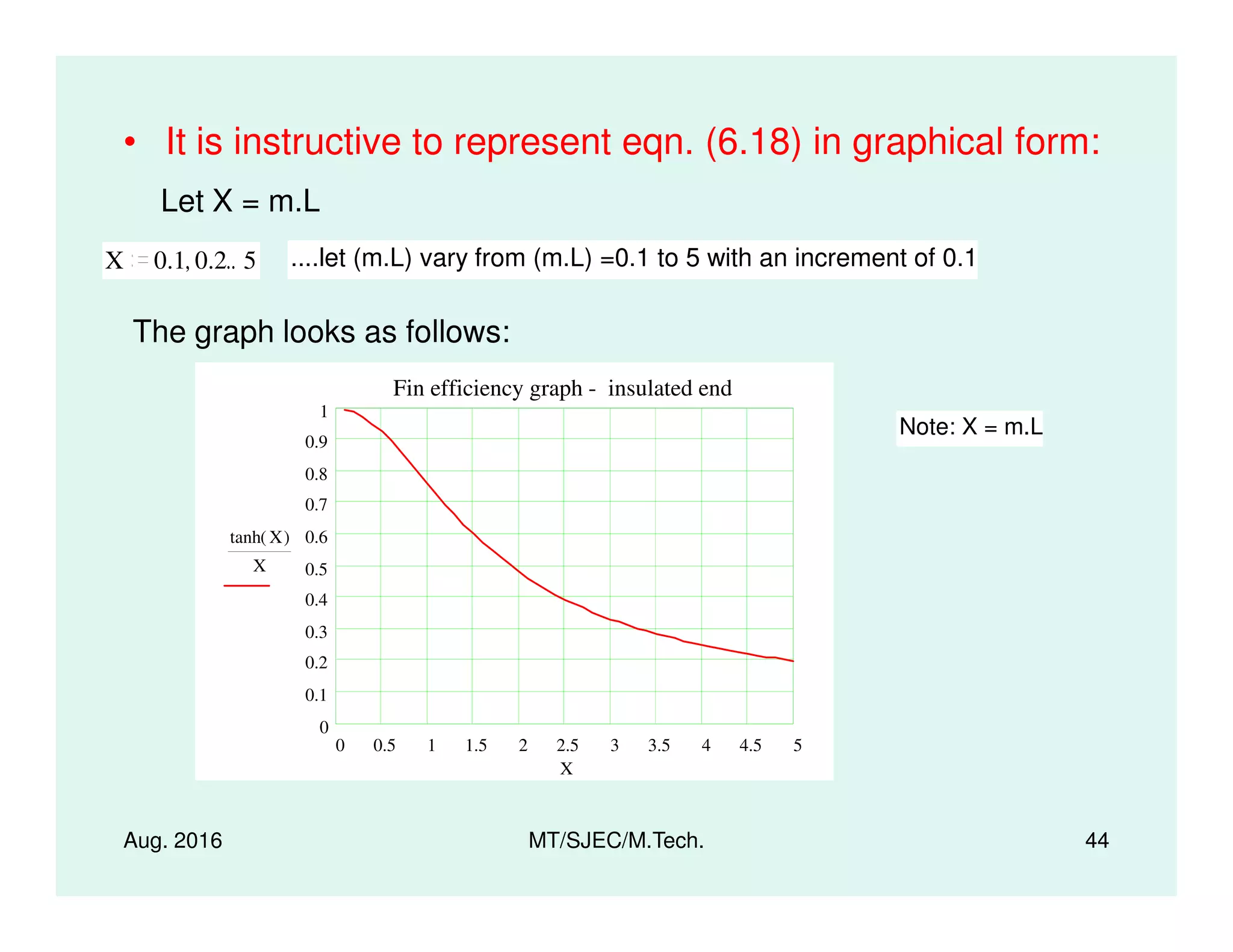
• It is instructive to represent eqn. (6.18) in graphical form:
Let X = m.L
X 0.1 0.2, 5.. ....let (m.L) vary from (m.L) =0.1 to 5 with an increment of 0.1
The graph looks as follows:
0.8
0.9
1
Fin efficiency graph - insulated end
Note: X = m.L
Aug. 2016 MT/SJEC/M.Tech. 44
tanh X( )
X
X
0 0.5 1 1.5 2 2.5 3 3.5 4 4.5 5
0
0.1
0.2
0.3
0.4
0.5
0.6
0.7
0.8
Fins of non-uniform cross-section:
t
w
L
r1
w
L L
t
r2
t
(a) Straight rectangular fin (b) Straight triangular fin (c) Circular fin of rectangular section
Aug. 2016 MT/SJEC/M.Tech. 45
Fig. 6.8 Typical fins: (a) and (d) of uniform cross-section , and
(b), (c) and (e): of nonuniform cross-section
L
D D
L
(e) Pin fin, conical section(d) Pin fin, circular section
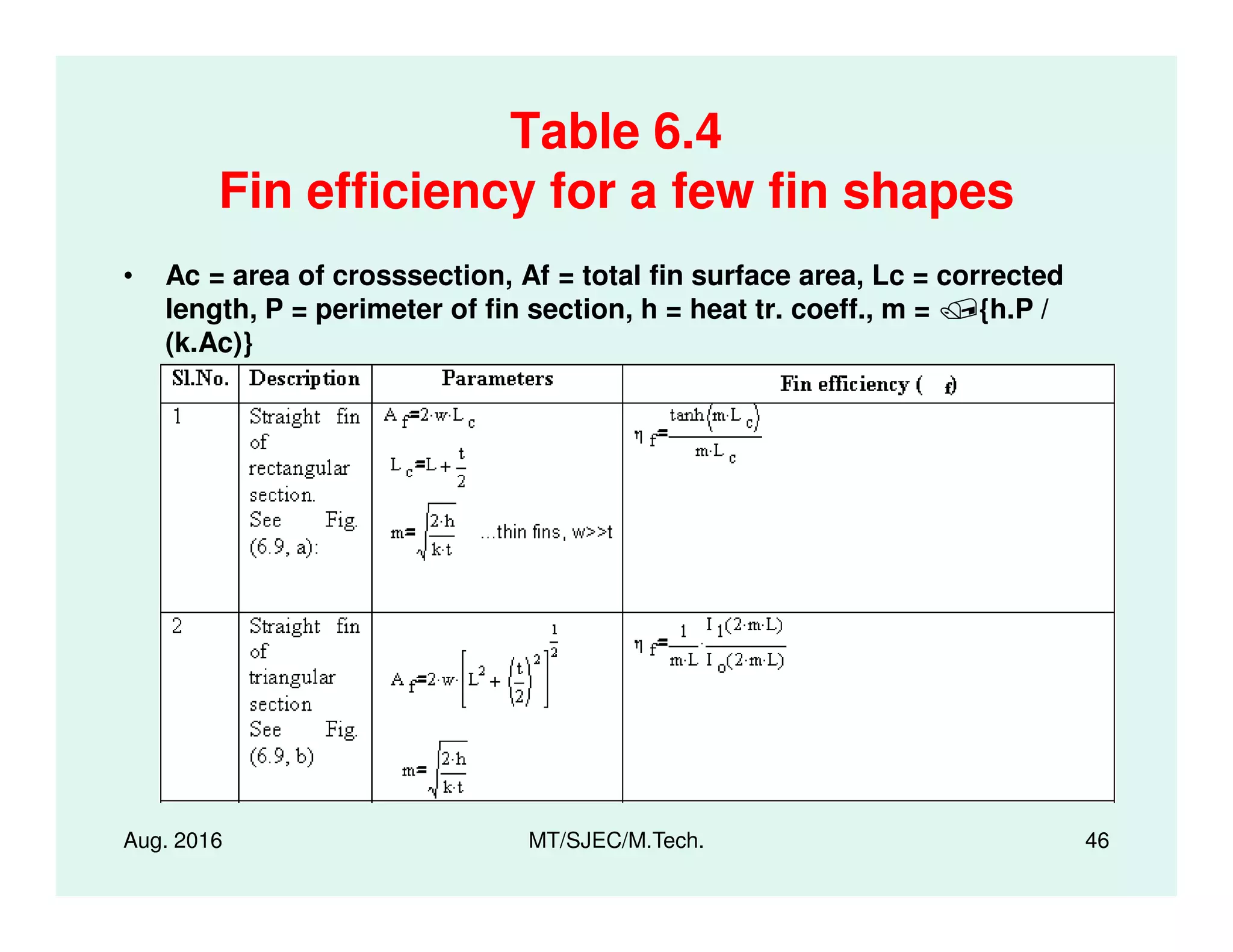
Table 6.4
Fin efficiency for a few fin shapes
• Ac = area of crosssection, Af = total fin surface area, Lc = corrected
length, P = perimeter of fin section, h = heat tr. coeff., m = {h.P /
(k.Ac)}
Aug. 2016 MT/SJEC/M.Tech. 46
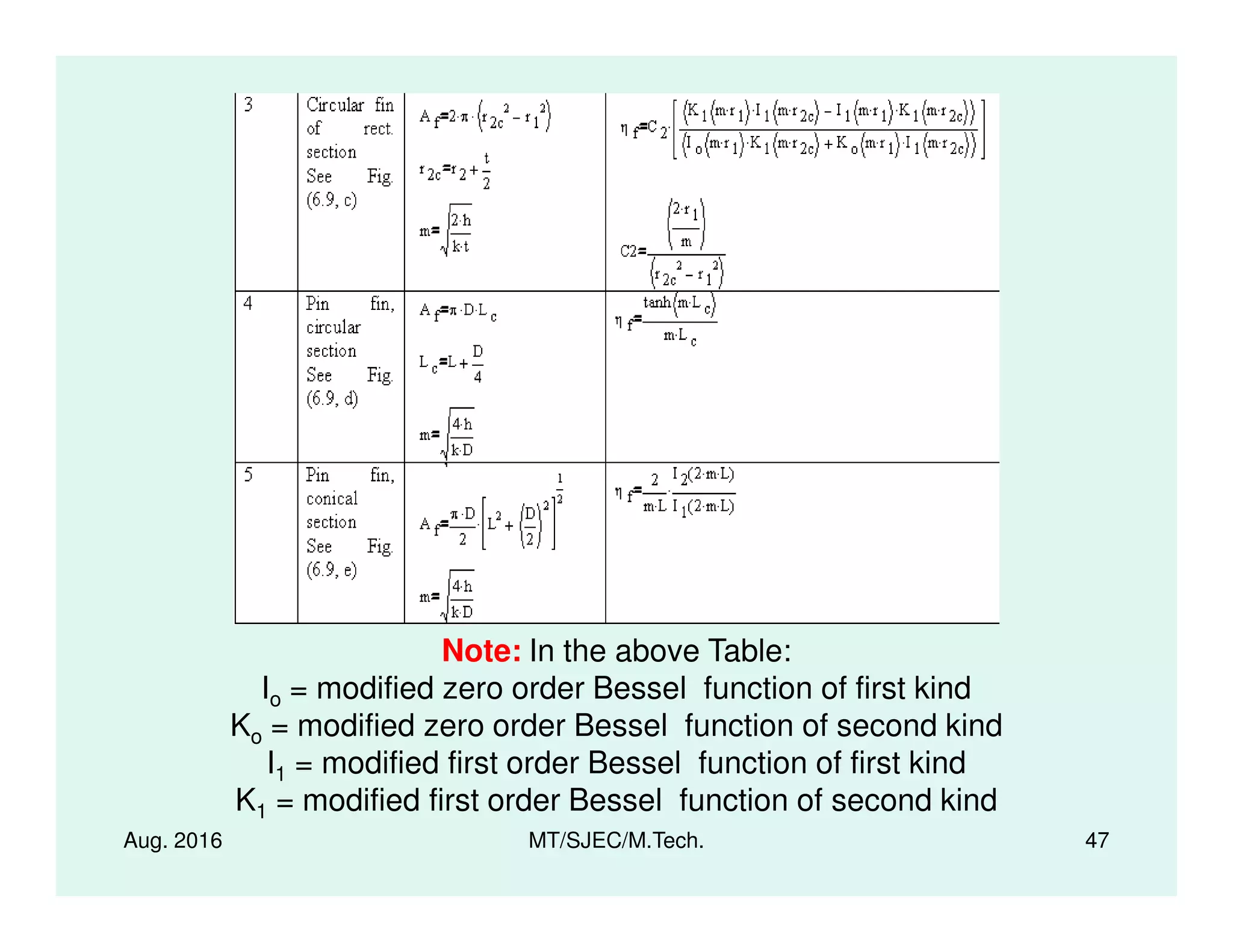
Aug. 2016 MT/SJEC/M.Tech. 47
Note: In the above Table:
Io = modified zero order Bessel function of first kind
Ko = modified zero order Bessel function of second kind
I1 = modified first order Bessel function of first kind
K1 = modified first order Bessel function of second kind
Fin efficiency graphs:
• As can be seen from the above Table, expressions for
fin efficiency of fins of non-uniform cross-sections are
rather complicated and involve Bessel functions.
• In practice, to find out the heat transfer from such fins,
we use ‘Fin efficiency charts’.
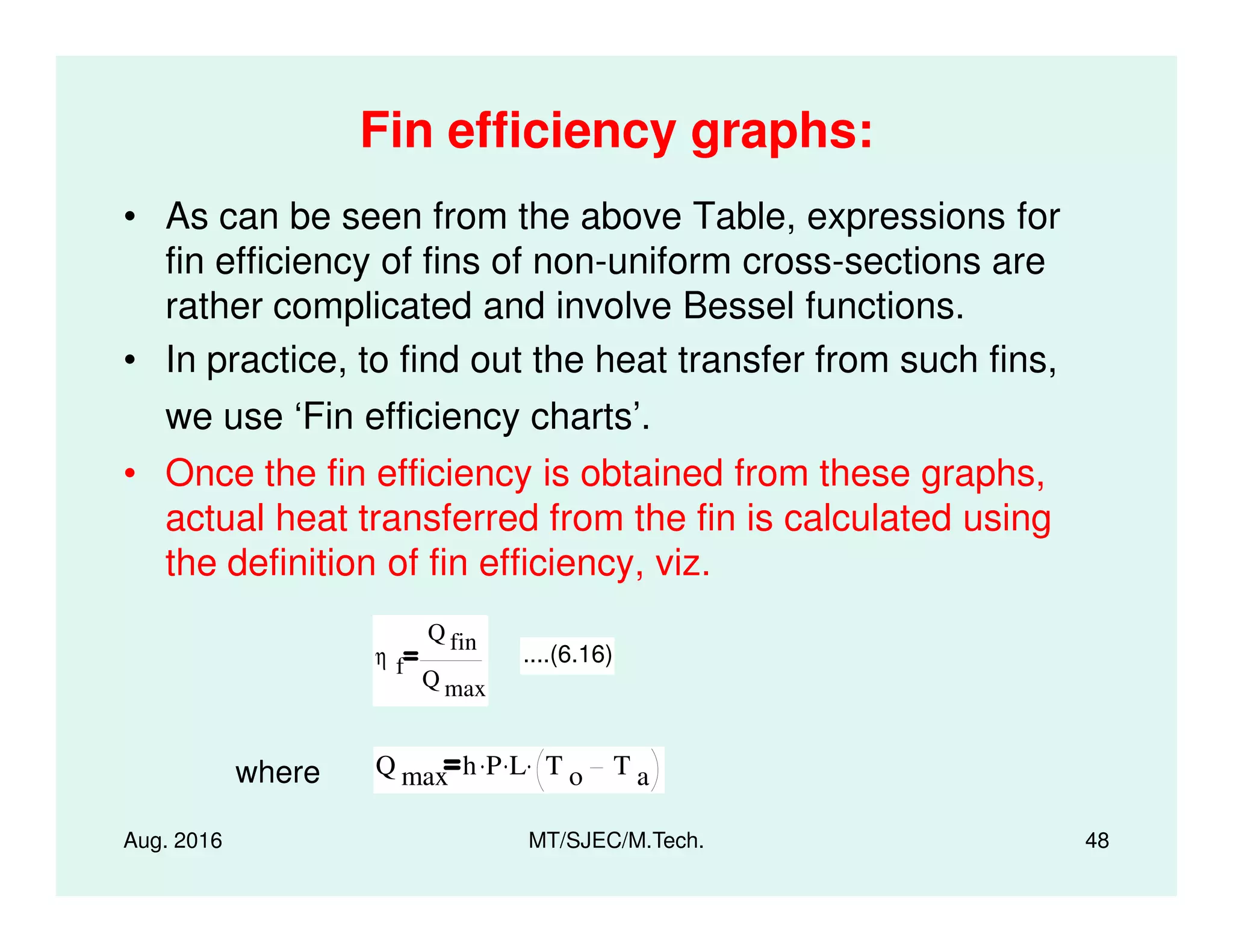
• Once the fin efficiency is obtained from these graphs,
Aug. 2016 MT/SJEC/M.Tech. 48
• Once the fin efficiency is obtained from these graphs,
actual heat transferred from the fin is calculated using
the definition of fin efficiency, viz.
η f
Q fin
Q max
....(6.16)
Q max h P. L. T o T a
.
where
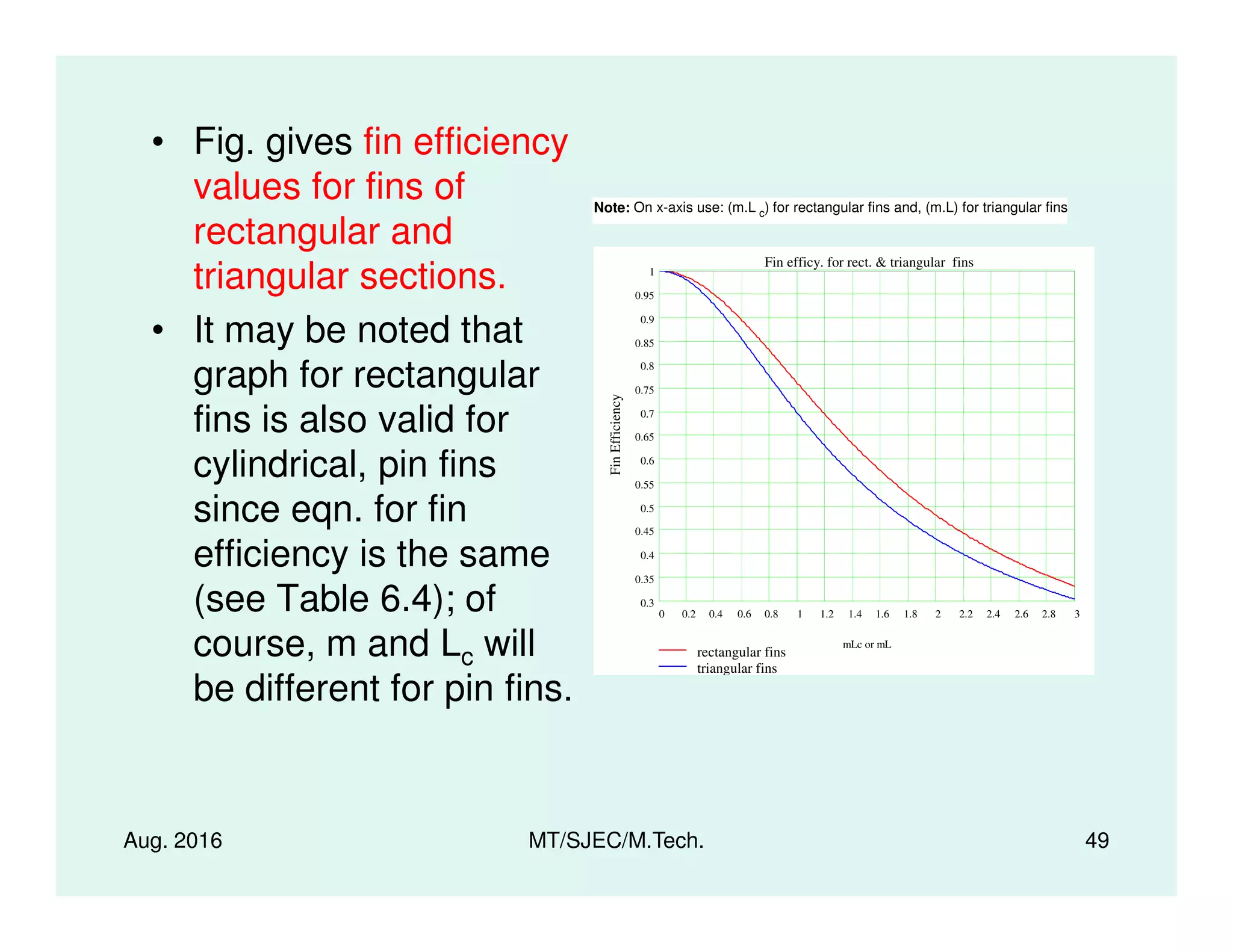
• Fig. gives fin efficiency
values for fins of
rectangular and
triangular sections.
• It may be noted that
graph for rectangular
fins is also valid for
cylindrical, pin fins
Note: On x-axis use: (m.L c) for rectangular fins and, (m.L) for triangular fins
0.6
0.65
0.7
0.75
0.8
0.85
0.9
0.95
1
Fin efficy. for rect. & triangular fins
FinEfficiency
Aug. 2016 MT/SJEC/M.Tech. 49
cylindrical, pin fins
since eqn. for fin
efficiency is the same
(see Table 6.4); of
course, m and Lc will
be different for pin fins.
0 0.2 0.4 0.6 0.8 1 1.2 1.4 1.6 1.8 2 2.2 2.4 2.6 2.8 3
0.3
0.35
0.4
0.45
0.5
0.55
rectangular fins
triangular fins
mLc or mL
Aug. 2016 MT/SJEC/M.Tech. 50
Aug. 2016 MT/SJEC/M.Tech. 51
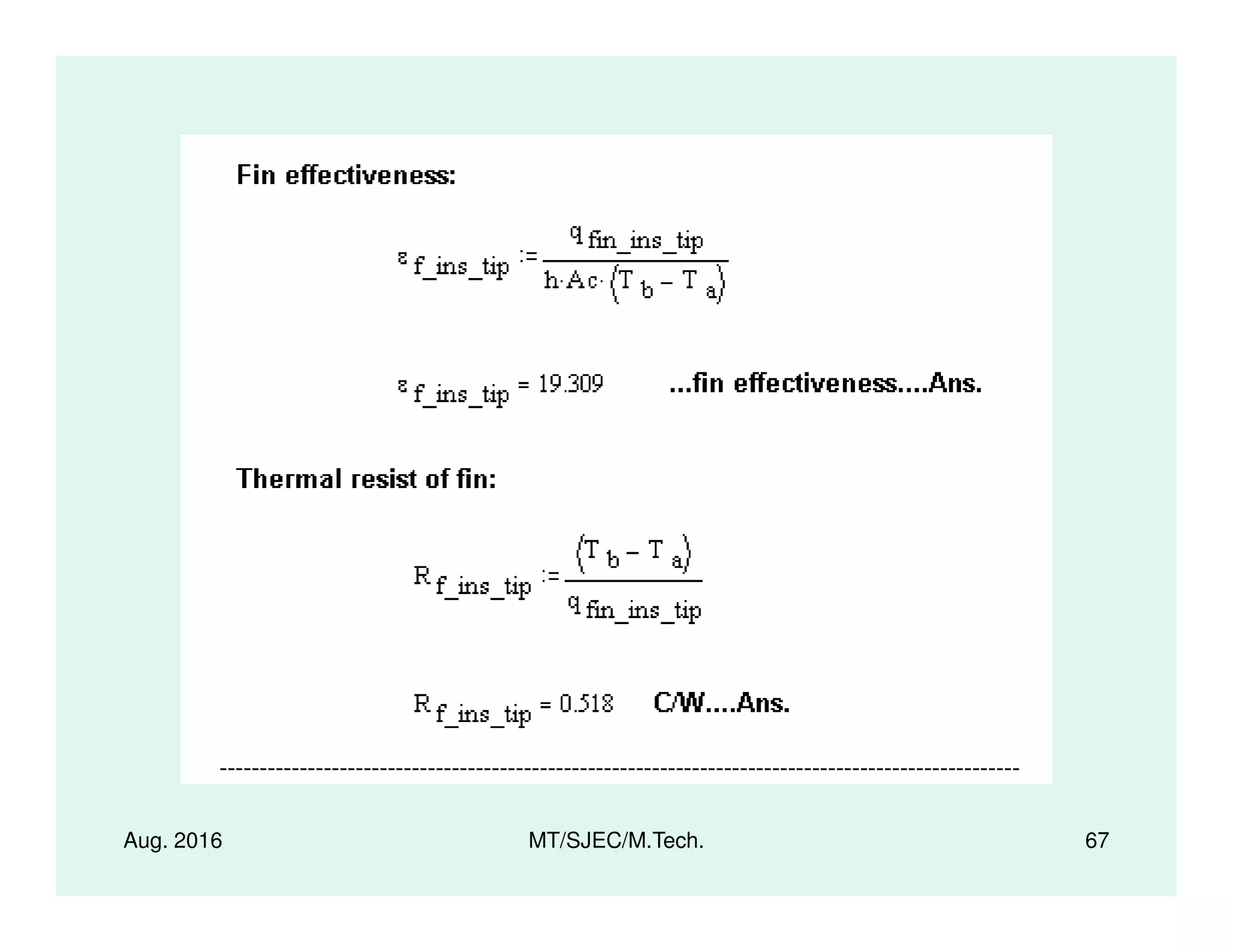
Fin effectiveness,ε f
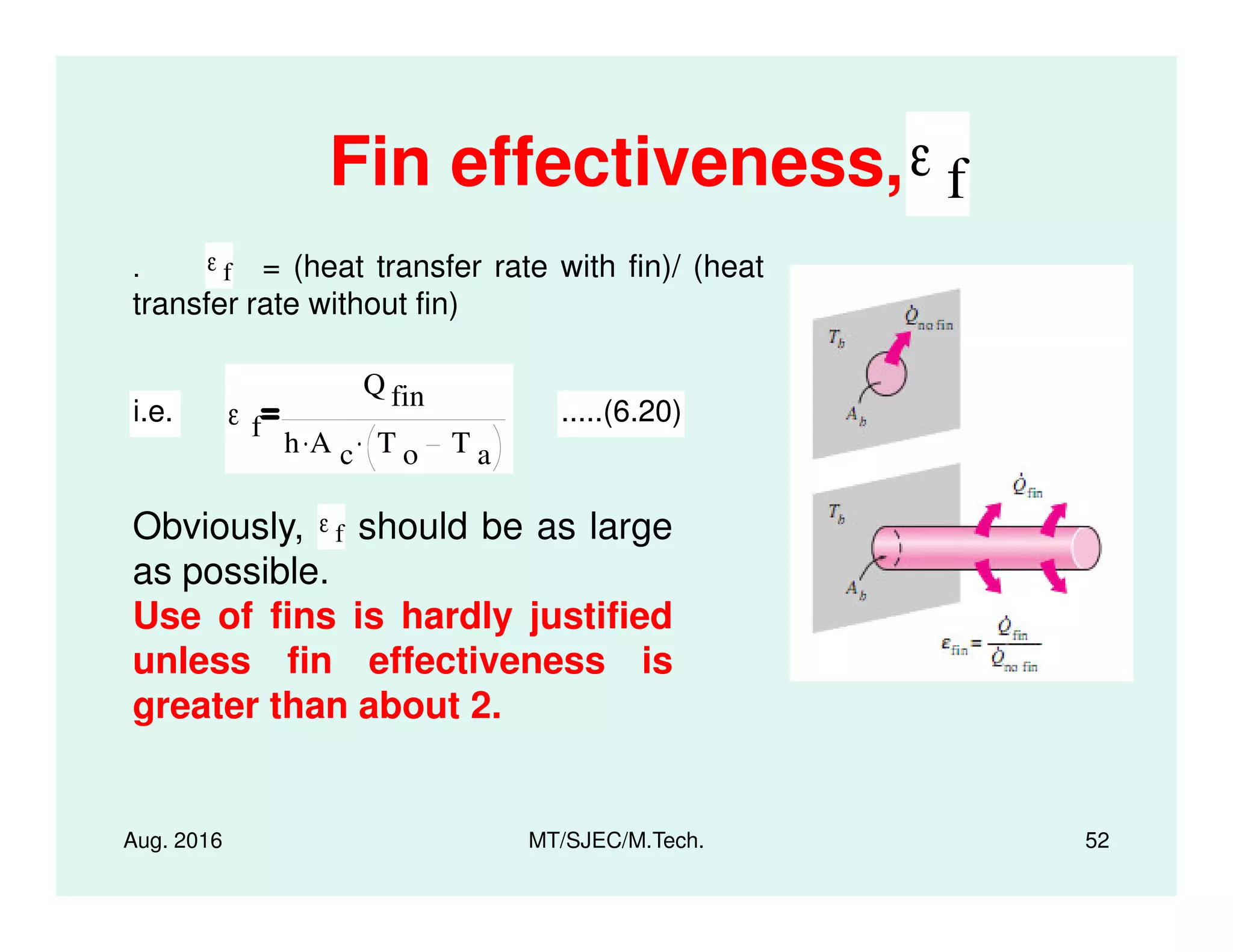
. = (heat transfer rate with fin)/ (heat
transfer rate without fin)
ε f
i.e. ε f
Q fin
h A c
. T o T a
.
.....(6.20)
Aug. 2016 MT/SJEC/M.Tech. 52
Obviously, should be as large
as possible.
Use of fins is hardly justified
unless fin effectiveness is
greater than about 2.
ε f
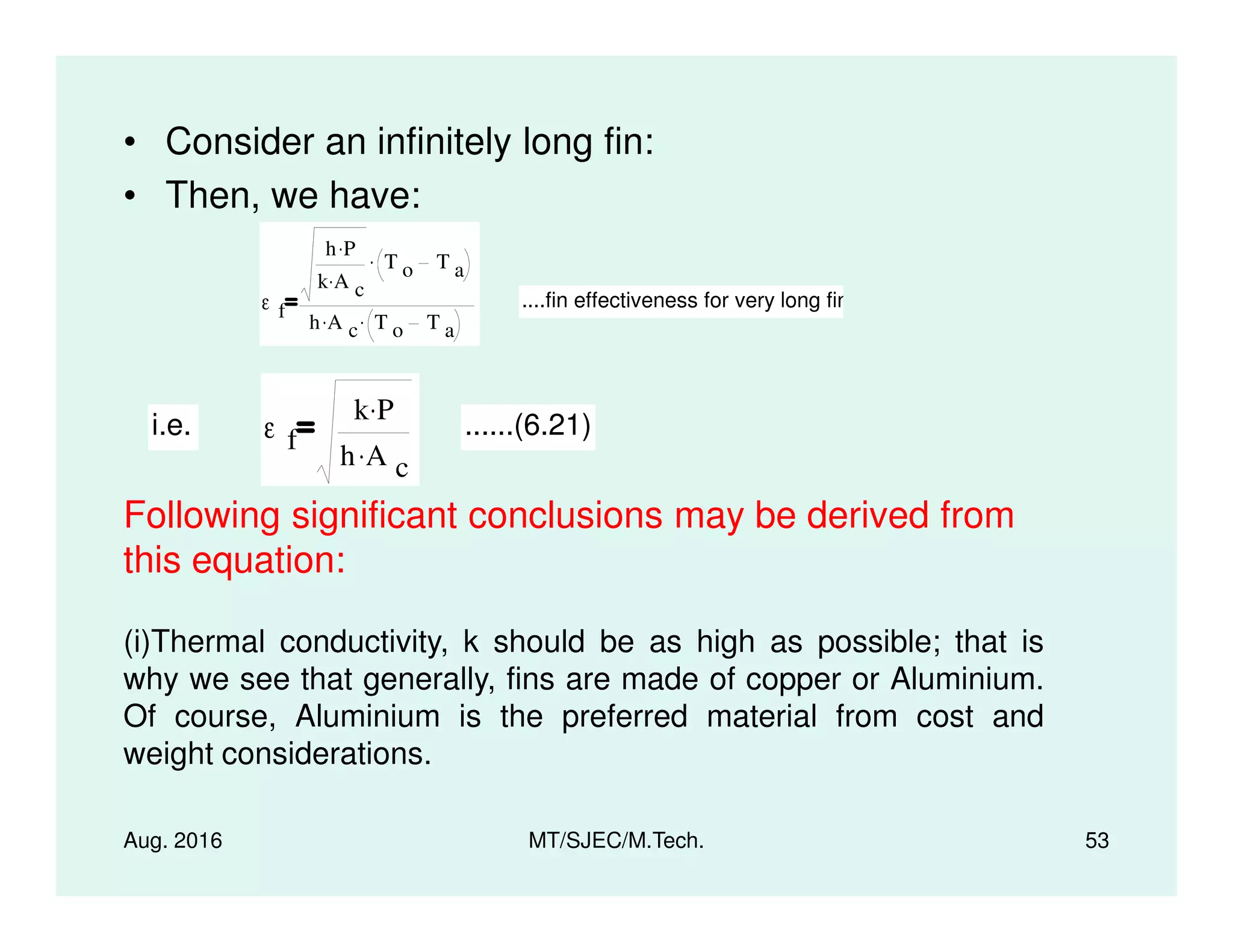
• Consider an infinitely long fin:
• Then, we have:
ε f
h P.
k A c
.
T o T a
.
h A c
. T o T a
.
....fin effectiveness for very long fin
i.e. ε f
k P.
h A c
.
......(6.21)
Aug. 2016 MT/SJEC/M.Tech. 53
c
Following significant conclusions may be derived from
this equation:
(i)Thermal conductivity, k should be as high as possible; that is
why we see that generally, fins are made of copper or Aluminium.
Of course, Aluminium is the preferred material from cost and
weight considerations.
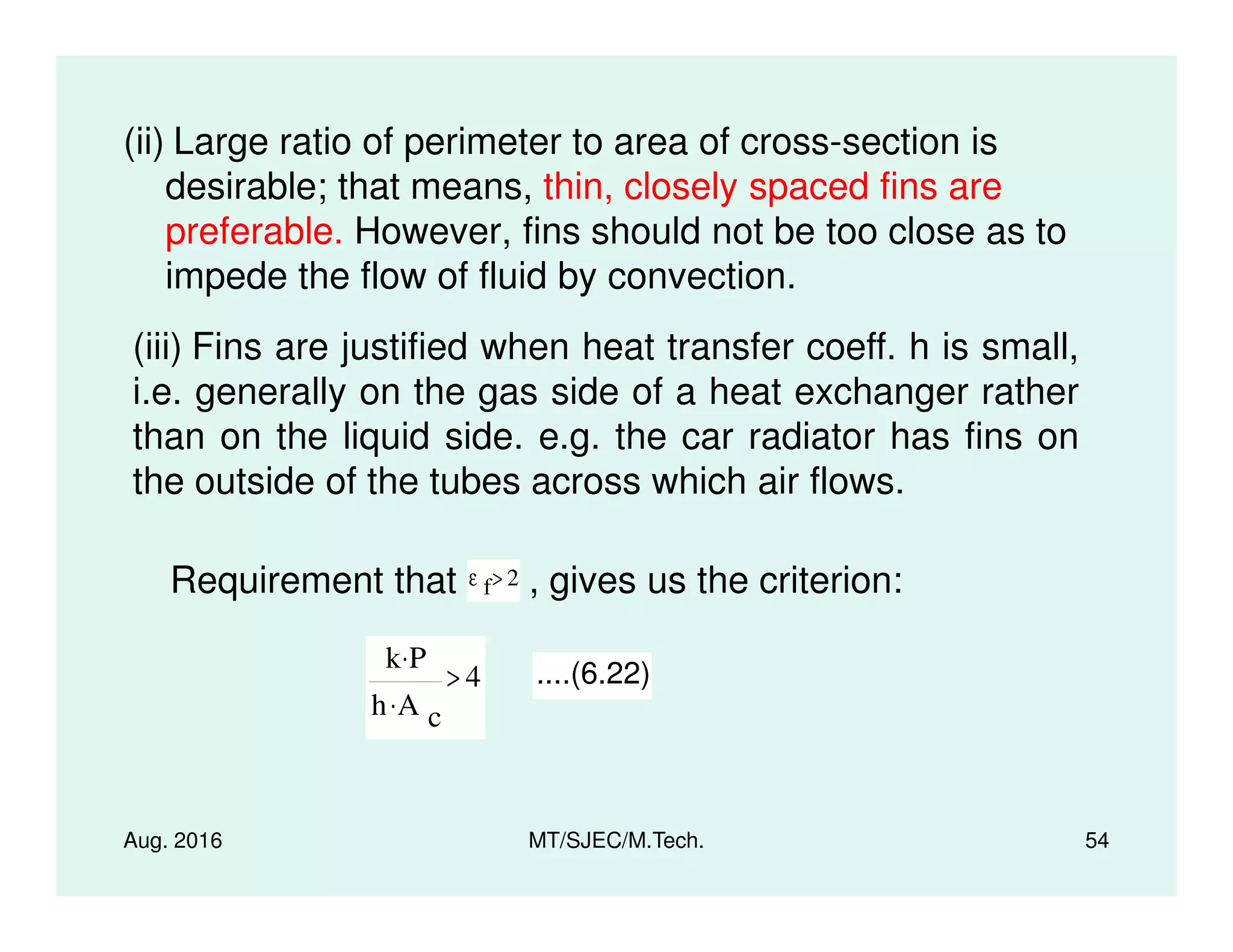
(ii) Large ratio of perimeter to area of cross-section is
desirable; that means, thin, closely spaced fins are
preferable. However, fins should not be too close as to
impede the flow of fluid by convection.
(iii) Fins are justified when heat transfer coeff. h is small,
i.e. generally on the gas side of a heat exchanger rather
than on the liquid side. e.g. the car radiator has fins on
the outside of the tubes across which air flows.
Aug. 2016 MT/SJEC/M.Tech. 54
the outside of the tubes across which air flows.
Requirement that , gives us the criterion:ε f 2>
k P.
h A c
.
4> ....(6.22)
Thermal resistance of a fin:
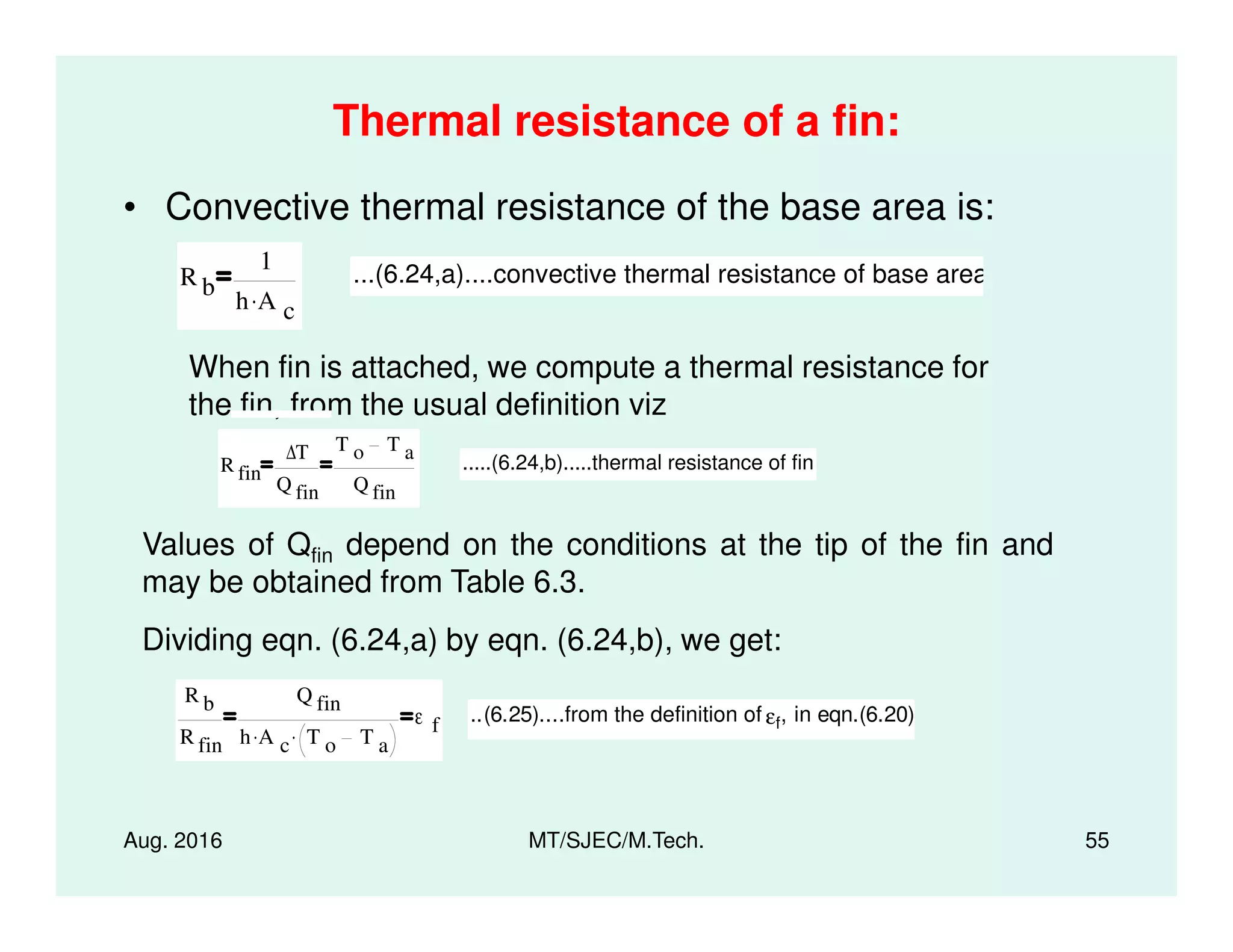
• Convective thermal resistance of the base area is:
R b
1
h A c
.
...(6.24,a)....convective thermal resistance of base area
When fin is attached, we compute a thermal resistance for
the fin, from the usual definition vizc
R fin
∆T
Q
T o T a
Q
.....(6.24,b).....thermal resistance of fin
Aug. 2016 MT/SJEC/M.Tech. 55
R fin
Q fin Q fin
Values of Qfin depend on the conditions at the tip of the fin and
may be obtained from Table 6.3.
Dividing eqn. (6.24,a) by eqn. (6.24,b), we get:
R b
R fin
Q fin
h A c
. T o T a
.
ε f ..(6.25)....from the definition of εf, in eqn.(6.20)
Total surface efficiency (or, overall surface
efficiency, or area-weighted fin efficiency)
• Total heat exchange area (At) may be considered as
made up of two areas:
the base or ‘prime’ surface area, Ap, on which there
are no fins, and the total fin surface area (N.Af) ,
where
Aug. 2016 MT/SJEC/M.Tech. 56
where
N is the total no. of fins, and Af is the surface area of
each fin.
• Now, the ‘prime’ surface (or, un-finned surface) is
100% effective; but, all the fin surface area provided
is not 100% effective, since there is always a
temperature gradient along the fin.
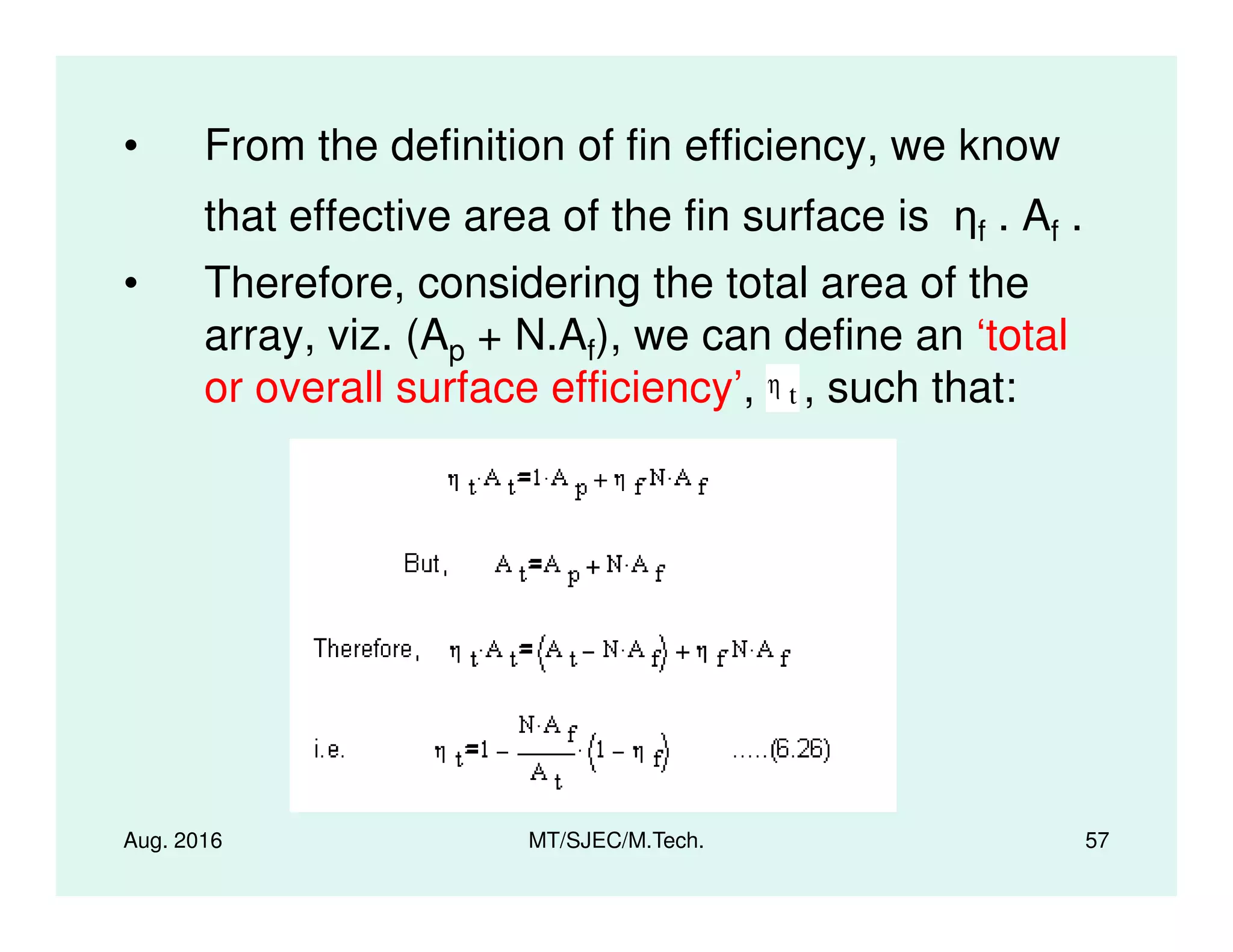
• From the definition of fin efficiency, we know
that effective area of the fin surface is f . Af .
• Therefore, considering the total area of the
array, viz. (Ap + N.Af), we can define an ‘total
or overall surface efficiency’, , such that:η t
Aug. 2016 MT/SJEC/M.Tech. 57
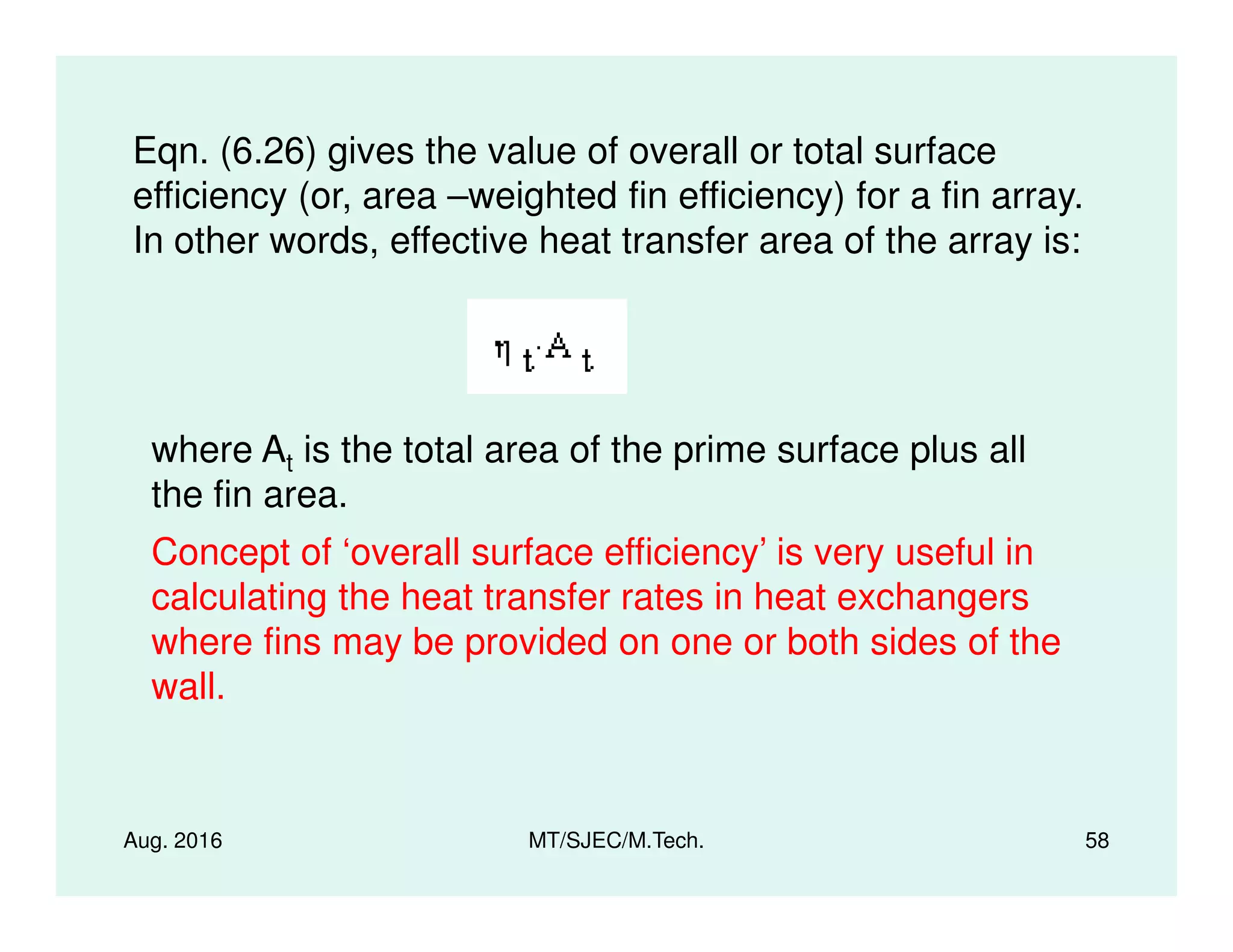
Eqn. (6.26) gives the value of overall or total surface
efficiency (or, area –weighted fin efficiency) for a fin array.
In other words, effective heat transfer area of the array is:
where At is the total area of the prime surface plus all
the fin area.
Aug. 2016 MT/SJEC/M.Tech. 58
t
the fin area.
Concept of ‘overall surface efficiency’ is very useful in
calculating the heat transfer rates in heat exchangers
where fins may be provided on one or both sides of the
wall.
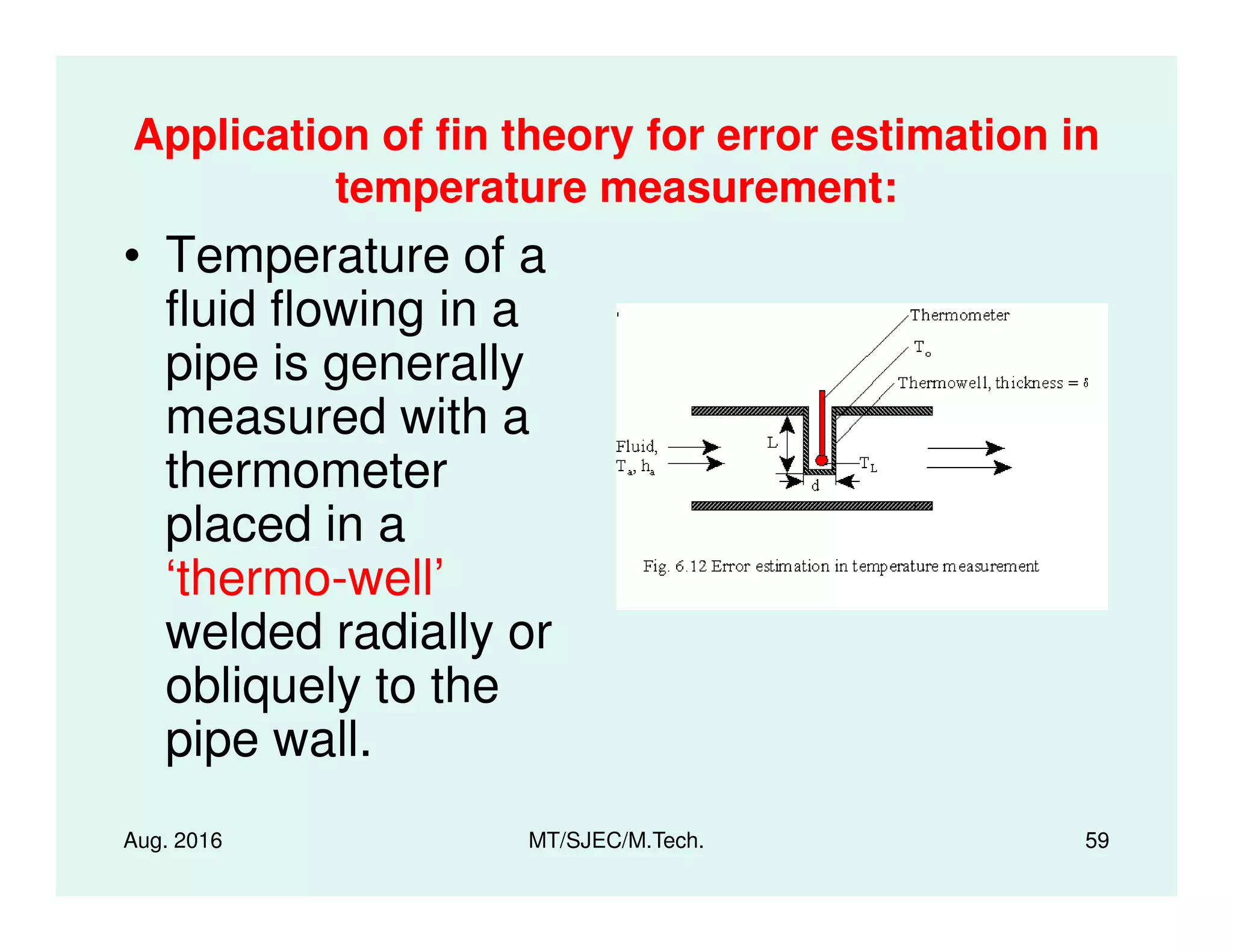
Application of fin theory for error estimation in
temperature measurement:
• Temperature of a
fluid flowing in a
pipe is generally
measured with a
thermometer
Aug. 2016 MT/SJEC/M.Tech. 59
thermometer
placed in a
‘thermo-well’
welded radially or
obliquely to the
pipe wall.
• If the temperature of a hot
fluid flowing in the pipe is
Ta, obviously, the
temperature indicated by
the thermometer, TL will
not be equal to Ta , but
less than T , because of
Aug. 2016 MT/SJEC/M.Tech. 60
a
less than Ta , because of
heat loss along the wall of
the thermo-well from its tip
to the root (and, vice-
versa, for a cold fluid
flowing in the pipe).
• Considering the thermo-well to be a fin protruding from the pipe wall,
with an insulated tip (i.e. no heat transfer from its tip), we can write,
from eqn. (6.7):
T x( ) T a
T o T a
cosh m L x( ).( )
cosh m L.( )
.......(6.7)
At the tip, i.e. at x = L, T(x) = TL.
Substituting x = L in eqn. (6.7):
Aug. 2016 MT/SJEC/M.Tech. 61
T L T a
T o T a
1
cosh m L.( )
.....(a)
And, the error in thermometer reading is given by:
T L T a
T o T a
cosh m L.( )
.....(b)
• From eqn. (b), we observe that to reduce the temperature error, we
should have the factor 1/cosh(m.L) as small as possible. To achieve
this, looking at the graph of 1/cosh (m.L) vs. (m.L) given earlier, it is
clear that (m.L) should be as large as possible. i.e.
h P.
k A c
.
L. must be as large as possible.
This leads to the following conclusions:
Aug. 2016 MT/SJEC/M.Tech. 62
This leads to the following conclusions:
• value of heat transfer coeff., h should be large
• value of thermal conductivity, k should be small
• thermo-well should be long and thin-walled. (thermo-well may be
placed obliquely inside the pipe, to make it long).
• Again, for the thermo-well, treated as a fin, we have:
Aug. 2016 MT/SJEC/M.Tech. 63
i.e. fin parameter, 'm'does not depend upon thermo-
well pocket diameter, when the wall thickness is very
small compared to its diameter.
Ref: Incropera et al, 6th ed., p.176
Aug. 2016 MT/SJEC/M.Tech. 64
Aug. 2016 MT/SJEC/M.Tech. 65
Aug. 2016 MT/SJEC/M.Tech. 66
Aug. 2016 MT/SJEC/M.Tech. 67
Aug. 2016 MT/SJEC/M.Tech. 68
Aug. 2016 MT/SJEC/M.Tech. 69
Aug. 2016 MT/SJEC/M.Tech. 70
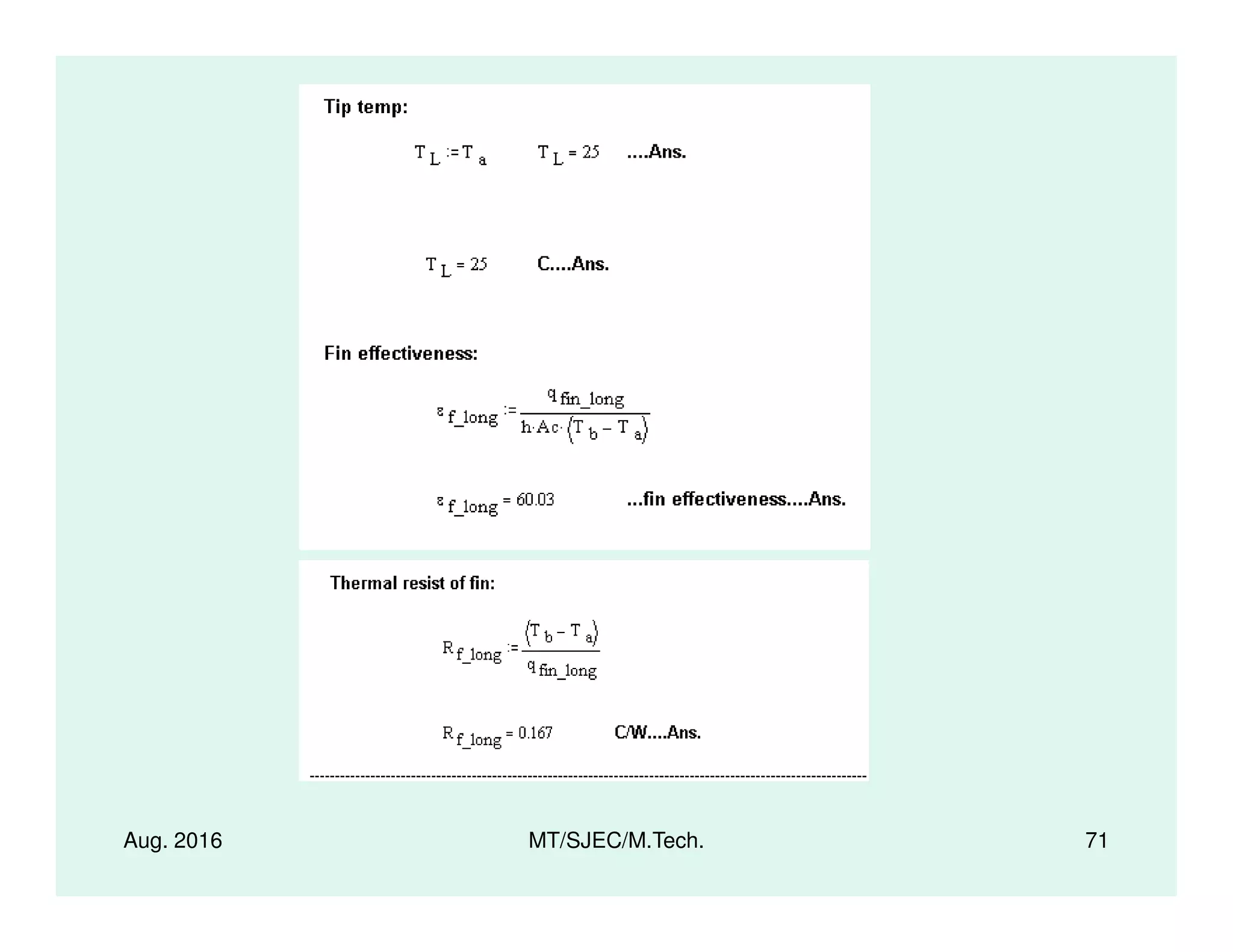
Aug. 2016 MT/SJEC/M.Tech. 71
Aug. 2016 MT/SJEC/M.Tech. 72
Aug. 2016 MT/SJEC/M.Tech. 73
Aug. 2016 MT/SJEC/M.Tech. 74
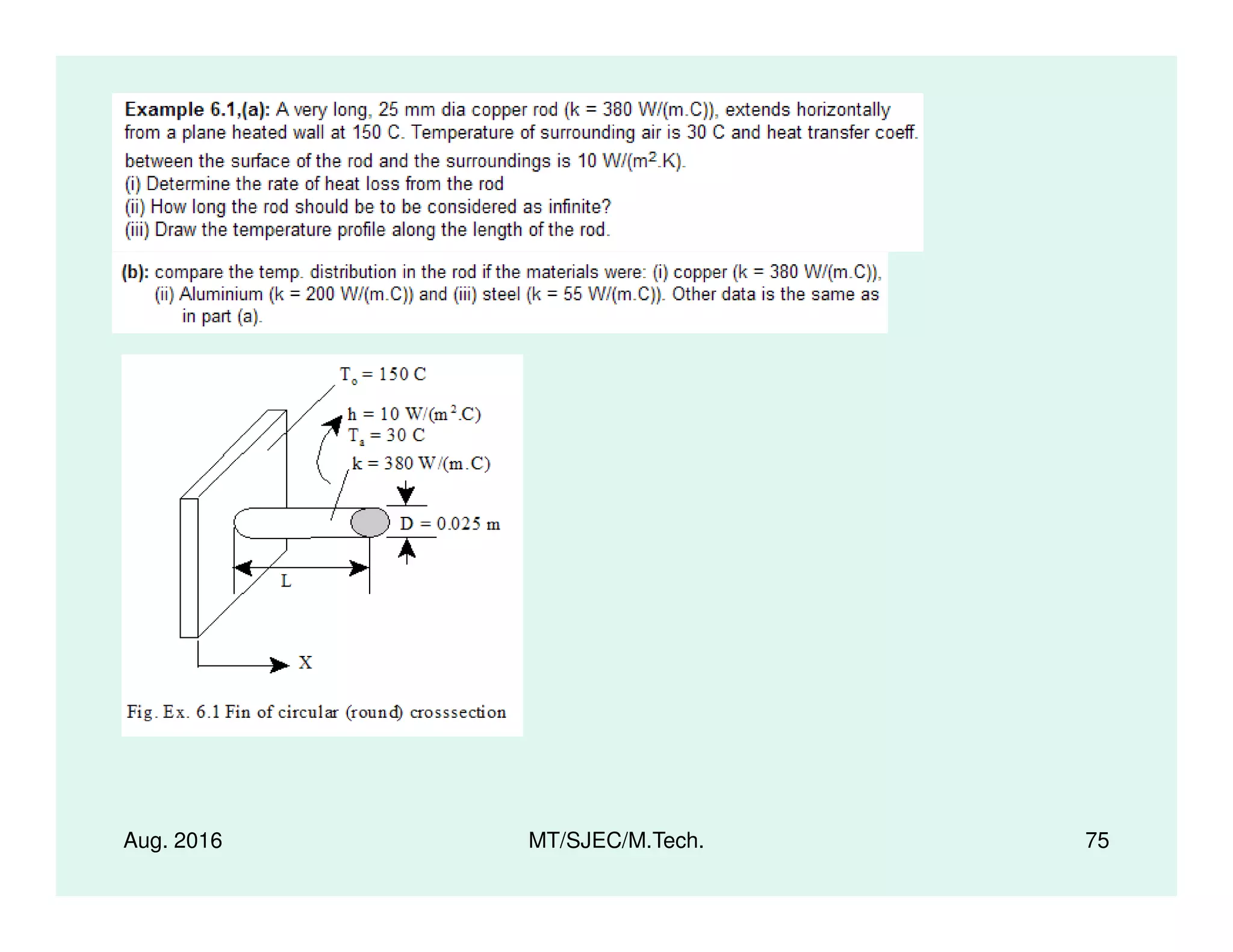
Aug. 2016 MT/SJEC/M.Tech. 75
Aug. 2016 MT/SJEC/M.Tech. 76
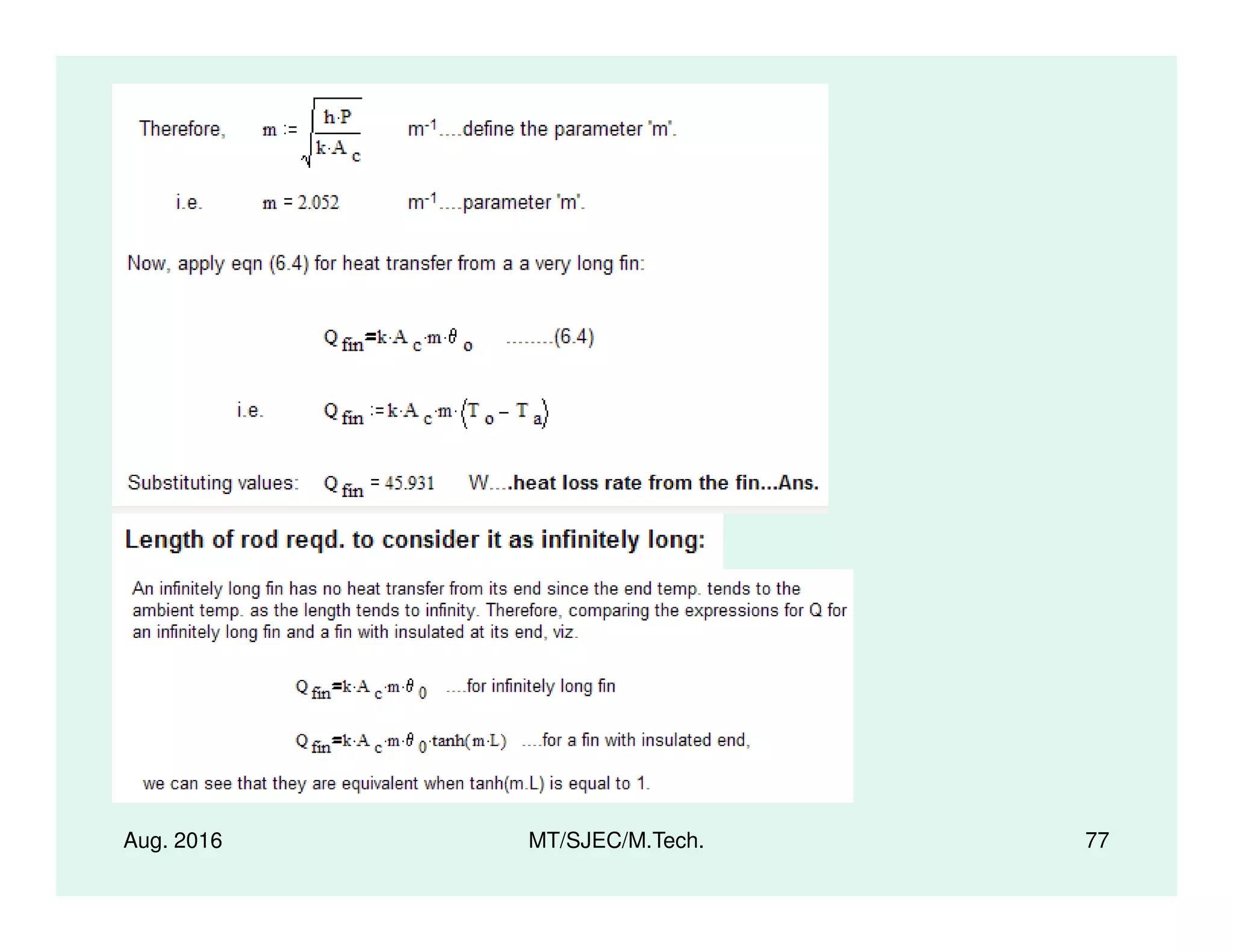
Aug. 2016 MT/SJEC/M.Tech. 77
Aug. 2016 MT/SJEC/M.Tech. 78
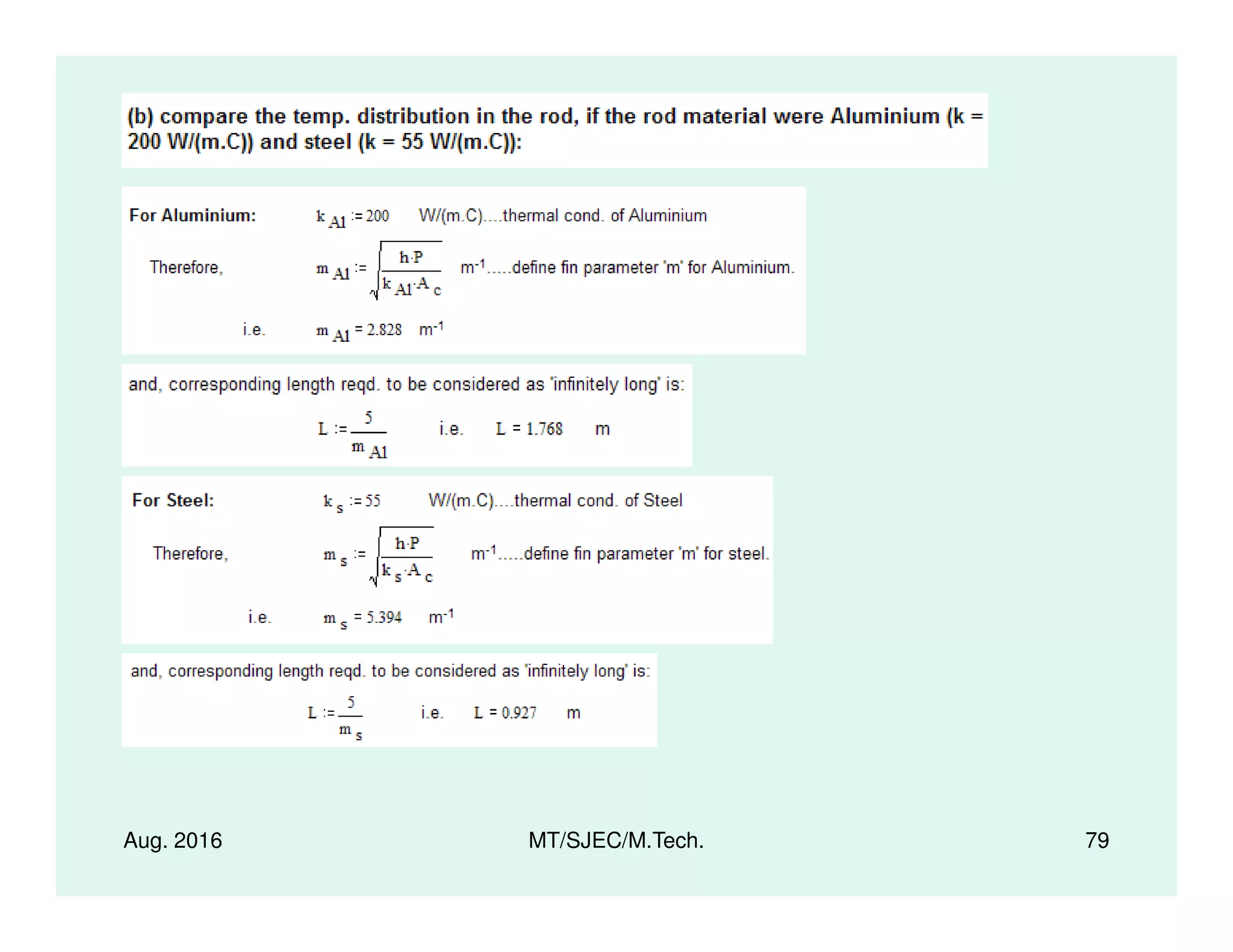
Aug. 2016 MT/SJEC/M.Tech. 79
It may be observed that:
(i) higher the thermal conductivity, higher is
Aug. 2016 MT/SJEC/M.Tech. 80
(i) higher the thermal conductivity, higher is
the steady state temperature attained at a
given location.
(ii) to attain the same temp. on the rod,
longer length is required for a material of
lower thermal conductivity.
(iii) it is verified that fin can be considered
as 'infinitely long'if the lengths are 2.437,
1.768 and 0.927 m for copper, Aluminium
and steel,respectively. i e. the end
temperature becomes equal to the ambient
temp.
Aug. 2016 MT/SJEC/M.Tech. 81
Aug. 2016 MT/SJEC/M.Tech. 82
Aug. 2016 MT/SJEC/M.Tech. 83
Aug. 2016 MT/SJEC/M.Tech. 84
Aug. 2016 MT/SJEC/M.Tech. 85
Aug. 2016 MT/SJEC/M.Tech. 86
Aug. 2016 MT/SJEC/M.Tech. 87

Heat transfer from extended surfaces (or fins)

  • 1.
    Lectures on HeatTransfer -- HEAT TRANSFER FROM EXTENDED SURFACES (FINS) by Dr. M. ThirumaleshwarDr. M. Thirumaleshwar formerly: Professor, Dept. of Mechanical Engineering, St. Joseph Engg. College, Vamanjoor, Mangalore India
  • 2.
    Preface • This filecontains slides on Heat Transfer from Extended Surfaces (FINS). • The slides were prepared while teaching Heat Transfer course to the M.Tech. students in Mechanical Engineering Dept. of St. Joseph Engineering College, Vamanjoor, Mangalore, India, during Sept. – Dec. 2010. Aug. 2016 2MT/SJEC/M.Tech.
  • 3.
    • It ishoped that these Slides will be useful to teachers, students, researchers and professionals working in this field. • For students, it should be particularly useful to study, quickly review the subject,useful to study, quickly review the subject, and to prepare for the examinations. • Aug. 2016 3MT/SJEC/M.Tech.
  • 4.
    References • 1. M.Thirumaleshwar: Fundamentals of Heat & Mass Transfer, Pearson Edu., 2006 • https://books.google.co.in/books?id=b2238B- AsqcC&printsec=frontcover&source=gbs_atb#v=onepage&q&f=false • 2. Cengel Y. A. Heat Transfer: A Practical Approach, 2nd Ed. McGraw Hill Co., 2003 Aug. 2016 MT/SJEC/M.Tech. 4 Approach, 2nd Ed. McGraw Hill Co., 2003 • 3. Cengel, Y. A. and Ghajar, A. J., Heat and Mass Transfer - Fundamentals and Applications, 5th Ed., McGraw-Hill, New York, NY, 2014.
  • 5.
    References… contd. • 4.Incropera , Dewitt, Bergman, Lavine: Fundamentals of Heat and Mass Transfer, 6th Ed., Wiley Intl. • 5. M. Thirumaleshwar: Software Solutions to• 5. M. Thirumaleshwar: Software Solutions to Problems on Heat Transfer – CONDUCTION- Part-II, Bookboon, 2013 • http://bookboon.com/en/software-solutions-problems-on-heat- transfer-cii-ebook Aug. 2016 MT/SJEC/M.Tech. 5
  • 6.
    Extended surfaces- Fins: Outline: Governingdifferential eqn – different boundary conditions – temp. distribution and heat transfer rate for: infinitely long fin, fin with insulated end, fin losing heat from its end, and fin with specified Aug. 2016 MT/SJEC/M.Tech. 6 temperatures at its ends – performance of fins - ‘fin efficiency’ and ‘fin effectiveness’ – fins of non-uniform cross-section- thermal resistance and total surface efficiency of fins – estimation of error in temperature measurement - Problems
  • 7.
    • Fins aregenerally used to enhance the heat transfer from a given surface. • Addition of fins can increase the heat transfer from the surface by several folds. • Typical application areas of Fins are HEAT TRANSFER FROM EXTENDED SURFACES (FINS) Aug. 2016 MT/SJEC/M.Tech. 7 • Typical application areas of Fins are: • Radiators for automobiles • Air-cooling of cylinder heads of Internal Combustion engines (e.g. scooters, motor cycles, aircraft engines etc.), air compressors etc.
  • 8.
    • Economizers ofsteam power plants • Heat exchangers of a wide variety, used in different industries • Cooling of electric motors, transformers Fins – Applications (contd.) Aug. 2016 MT/SJEC/M.Tech. 8 • Cooling of electric motors, transformers etc. • Cooling of electronic equipments, chips, I.C. boards etc.
  • 9.
    Fins of uniformcross-section (rectangular or circular) – Governing differential equation: Qconv To t Y Ac h, Ta Aug. 2016 MT/SJEC/M.Tech. 9 L dx Qx Qx+dx w X X Z Fig. 6.2(a) Rectangular fin of uniform crosssection
  • 10.
    Fins of uniformcross-section (rectangular or circular) – Governing differential equation: • Assumptions: • Steady state conduction, with no heat generation in the fin • Thickness ‘t’ is small Aug. 2016 MT/SJEC/M.Tech. 10 • Thickness ‘t’ is small compared to length L and width w, i.e. one- dimensional conduction in the x-direction only. • Thermal conductivity, k of the fin material is constant.
  • 11.
    Fins of uniformcross-section (rectangular or circular) – Governing differential equation: • Assumptions (contd.): • Isotropic (i.e. const. k in all directions) and homogeneous (i.e. const. density) material. • Uniform heat transfer coeff. h, over the entire length of fin. Aug. 2016 MT/SJEC/M.Tech. 11 • Uniform heat transfer coeff. h, over the entire length of fin. • No bond resistance in the joint between the fin and the base wall, and • Negligible radiation effect.
  • 12.
    Fins of uniformcross-section (rectangular or circular) – Governing differential equation: • Consider an elemental section of thickness dx at a distance x from the base as shown. Let us write an energy balance for this element: Aug. 2016 MT/SJEC/M.Tech. 12 element: • Energy going into the element by conduction = (Energy leaving the element by conduction + Energy leaving the surface of the element by convection) i.e. Qx = Qx+dx + Qconv ……(a)
  • 13.
    Fins of uniformcross-section (rectangular or circular) – Governing differential equation: • We have: Aug. 2016 MT/SJEC/M.Tech. 13
  • 14.
    Fins of uniformcross-section (rectangular or circular) – Governing differential equation: • Substituting the terms in eqn (a) and simplifying: Aug. 2016 MT/SJEC/M.Tech. 14
  • 15.
    Fins of uniformcross-section (rectangular or circular) – Governing differential equation: Aug. 2016 MT/SJEC/M.Tech. 15
  • 16.
    Fins of uniformcross-section (rectangular or circular) – Governing differential equation: • Eqn. (6.1) is the governing differential equation for the fin of uniform cross-section considered. • Eqn. (6.1) is a second order, linear, ordinary differential equation. Its general solution is given by calculus theory, in two equivalent forms: Aug. 2016 MT/SJEC/M.Tech. 16 in two equivalent forms:
  • 17.
    Fins of uniformcross-section (rectangular or circular) – Governing differential equation: • To calculate the set of constants C1 and C2, or A and B, we need two boundary conditions: Aug. 2016 MT/SJEC/M.Tech. 17 • One of the B.C’s is that the temperature of the fin at its base. • i.e. B. C. (i): at x = 0, T = To • Regarding the second boundary condition, there are several possibilities:
  • 18.
    Fins of uniformcross-section (rectangular or circular) – Governing differential equation: • Case (i): Infinitely long fin, • Case (ii): Fin insulated at its end (i.e. negligible heat loss from the end of the fin), Aug. 2016 MT/SJEC/M.Tech. 18 fin), • Case (iii): Fin losing heat from its end by convection, and • Case (iv): Fin with specified temperature at its end.
  • 19.
    Few useful relationsfor hyperbolic functions: Aug. 2016 MT/SJEC/M.Tech. 19
  • 20.
    Case 1: Infinitelylong fin: • The governing differential eqn., as already derived, is: Aug. 2016 MT/SJEC/M.Tech. 20 And, we shall choose for its solution for temperature distribution eqn. (6.2, a), i.e. θ x( ) C1 exp m x.( ). C2 exp m x.( ). ........(6.2, a)
  • 21.
    • C1 andC2 are obtained from the B.C’s: • B.C. (i): at x = o, T = To • B.C. (ii): as x , T Ta, the ambient temperature. • We get: at x = 0, θ x( ) T o T a θ o at x = ∞, θ x( ) T a T a 0 Aug. 2016 MT/SJEC/M.Tech. 21 at x = ∞, θ x( ) T a T a 0 Therefore: Substituting C1 and C2 back in eqn. (6.2, a), we get: θ x( ) θ o exp m x.( ).
  • 22.
    • Eqn.(6.3) givesthe temperature distribution in an infinitely long fin of uniform cross-section, along the i.e. θ x( ) θ o exp m x.( ) i.e. T x( ) T a T o T a exp m x.( ) ..........(6.3) Aug. 2016 MT/SJEC/M.Tech. 22 infinitely long fin of uniform cross-section, along the length. • To determine the heat transfer rate: Q fin k A c . d dx T x( ) x 0 . k A c . d dx θ x( ) x 0 . .......(c) i.e. Q fin k A c . d dx θ o e m x. . x 0 .
  • 23.
    • Substituting form: i.e. Q fin k A c . m. θ o . ........(6.4) Q fin k A c . h P. k A c . . θ o . Aug. 2016 MT/SJEC/M.Tech. 23 i.e. Q fin h P. k. A c . θ o . h P. k. A c . T o T a . ......(6.5) Eqn. (6.4) or (6.5) gives the heat transfer rate through the fin.
  • 24.
    Case 2: Finof finite length with insulated end: • To determine the temperature distribution: • The governing differential eqn: To t Ac h, Ta (dT/dx)x=L = 0 Q d 2 θ 2. Aug. 2016 MT/SJEC/M.Tech. 24 L X Fig. 6.4(a) Fin of finite length, end insulated (dT/dx)x=L = 0 d 2 θ dx 2 m 2 θ. 0 ............(6.1) And, we shall choose for its solution for temperature distribution, eqn. (6.2, b), i.e. θ x( ) A cosh m x.( ). B sinh m x.( ). ..........(6.2, b)
  • 25.
    • Constants Aand B are obtained from the B’C’s: • B.C.(i): at x = 0, θ x( ) T o T a θ o B.C.(ii): at x = L, dT dx dθ dx 0 since the end is insulated. From B.C. (i) and eq. (6.2,b): A θ o Temp. profile T To Aug. 2016 MT/SJEC/M.Tech. 25 From B.C. (ii) and eq. (6.2,b): dθ dx x L 0 i.e. A m. sinh m L.( ). B m. cosh m L.( ). 0 ...using relations in Table 6.1 i.e. B θ o sinh m L.( ) cosh m L.( ) .We get: X Fig. 6.4(b) Temp. profile for fin insulated at its end Ta TL
  • 26.
    • Substituting forA and B in eqn. (6.2, b) and simplifying: θ x( ) θ o cosh m x.( ). θ o sinh m L.( ) cosh m L.( ) . sinh m x.( ). i.e. θ x( ) θ o cosh m L.( ) cosh m x.( ). sinh m L.( ) sinh m x.( ). cosh m L.( ) i.e. θ x( ) cosh m L x( ).( ) .....(6.6)......using relation no. ( n ) from Table 6.1 Aug. 2016 MT/SJEC/M.Tech. 26 i.e. θ o cosh m L.( ) .....(6.6)......using relation no. ( n ) from Table 6.1 i.e. T x( ) T a T o T a cosh m L x( ).( ) cosh m L.( ) .......(6.7) Eqn. (6.6) or (6.7) gives the temperature distribution in the fin with negligible heat transfer from its end.
  • 27.
    • Temperature atthe end of the fin: • This is easily determined by putting x = L in eqn. (6.6) or (6.7): θ L( ) θ o 1 cosh m L.( ) .....(6.6, a)......since cosh(0) = 1 i.e. T L T a T o T a 1 cosh m L.( ) .....(6.7, a) and, Aug. 2016 MT/SJEC/M.Tech. 27 or, T L T o T a cosh m L.( ) T a ......(6.7, b) Eqn. (6.7,b) gives the temperature at the end of a fin (i.e. at x = L, when the end of the fin is insulated.
  • 28.
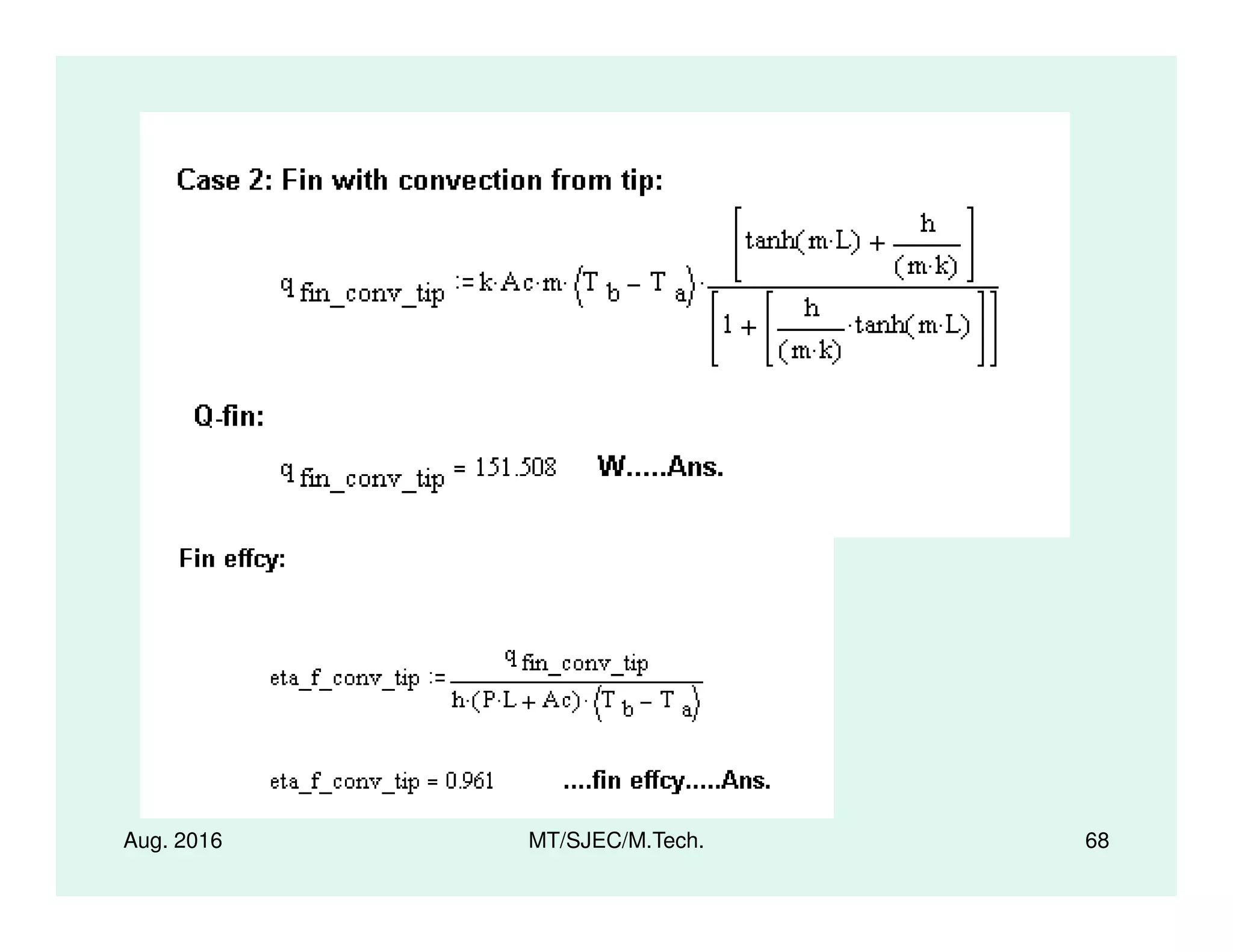
    • To determinethe heat transfer rate: Q fin k A c . θ o . m sinh m L x( ).( ). cosh m L.( ) x 0 . i.e. Q fin k A c . m. θ o . tanh m L.( ). .......(6.8) i.e. Q h P. k. A. θ. tanh m L.( ). ......(6.9) Aug. 2016 MT/SJEC/M.Tech. 28 i.e. Q fin h P. k. A c . θ o . tanh m L.( ). ......(6.9) Eqn. (6.8) or (6.9) gives the heat transfer rate from the fin, insulated at its end. Comparing eqn. (6.8) with that obtained for heat transfer from an infinitely long fin viz. eqn. (6.4), we see that a fin with insulated end becomes equivalent to an infinitely long fin when tanh(m.L) = 1.
  • 29.
    Table 6.2 Values oftanh(X) for different values of X X 0 0.2 0.4 0.6 0.8 1 1.2 1.4 1.6 1.8 2 2.2 tanh X( ) 0 0.19738 0.37995 0.53705 0.66404 0.76159 0.83365 0.88535 0.92167 0.94681 0.96403 0.97574 tanh X( ) 1 cosh X( ) 0.1 0.2 0.3 0.4 0.5 0.6 0.7 0.8 0.9 1 X versus tanh (X) and {1/cosh(X)} Aug. 2016 MT/SJEC/M.Tech. 29 2.2 2.4 2.6 2.8 3 3.2 3.4 3.6 3.8 4 4.2 4.4 4.6 4.8 5 0.97574 0.98367 0.98903 0.99263 0.99505 0.99668 0.99777 0.99851 0.999 0.99933 0.99955 0.9997 0.9998 0.99986 0.99991 X 0 0.5 1 1.5 2 2.5 3 3.5 4 4.5 5 5.5 6 0 0.1 tanh(X) 1/cosh(X)
  • 30.
    • It isobserved from the Table that when (m.L) for the insulated-end fin reaches a value of about 2.8, heat transfer rate becomes about 99% of that obtained for an infinitely long fin. • And, beyond a value of (m.L) more than 5, the fin with insulated end can be Aug. 2016 MT/SJEC/M.Tech. 30 the fin with insulated end can be considered as infinitely long. • Therefore, from the heat transfer point of view, there is no great advantage in having a fin with (m.L) greater than 2.8 or 3.
  • 31.
    Case 3: Finof finite length losing heat from its end by convection: • Here, heat conducted to the tip of the fin must be equal to the heat convected away from the tip to the ambient i.e. dT Aug. 2016 MT/SJEC/M.Tech. 31 k A c . dT dx x L . h A c . T L T a . i.e. k dT dx x L . h θ L .
  • 32.
    • To determinethe temperature distribution: • The governing differential eqn., as already derived, is given by eqn. (6.1), viz. d 2 θ dx 2 m 2 θ. 0 ............(6.1) Temp. profile X Ta TL To Convection Aug. 2016 MT/SJEC/M.Tech. 32 And, we shall choose for its solution for temperature distribution, eqn. (6.2, b), i.e. θ x( ) A cosh m x.( ). B sinh m x.( ). ..........(6.2, b) B.C.(i): at x = 0, θ x( ) T o T a θ o X Fig. 6.5(b) Temp. profile for fin losing heat at its end
  • 33.
    • B.C. (ii):at x = L, heat conducted to the end = heat convected from the end i.e. k A c . dθ x( ) dx x L . h A c . θ L( ). where θ(L) = TL - Ta i.e. k dθ x( ) dx x L . h θ L( ). 0 Aug. 2016 MT/SJEC/M.Tech. 33 x L i.e. k A m. sinh m L.( ). B m. cosh m L.( ).( ). h A cosh m L.( ). B sinh m L.( ).( ). 0 ...using relations in Table (6.1) A θ oWe get: B θ o sinh m L.( ) h m k. cosh m L.( ).. cosh m L.( ) h m k. sinh m L.( ). i.e.
  • 34.
    • Substituting forA and B in eqn. 6.2(b) and proceeding as earlier, we get:: i.e. θ x( ) θ o cosh m L x( ).( ) h m k. sinh m L x( ).( ). cosh m L.( ) h m k. sinh m L.( ). ..(6.10).....using relations (n) and (p) from Table (6.1) And, the heat transfer rate: tanh m L.( ) h Aug. 2016 MT/SJEC/M.Tech. 34 i.e. Q fin k A c . m. θ o . tanh m L.( ) h m k. 1 h m k. tanh m L.( ). . ......(6.11)
  • 35.
    • In practice,even when the fin is losing heat from its tip, it is easier to use eqn. (6.8) or (6.9) obtained for a fin with insulated tip, but with a ‘corrected length’, Lc rather than the actual length, L, to include the effect of convection at the tip. • In that case, only to evaluate Q, L is replaced by a corrected length Lc, in eqn. (6.8) or (6.9), as follows: Aug. 2016 MT/SJEC/M.Tech. 35 For rectangular fins: L c L t 2 where 't'is the thickness of fin For cylindrical (round) fins: L c L r 2 where 'r'is the radius of the cylindrical fin
  • 36.
    Case 4: Finof finite length with specified temperatures at its ends: T1 L t h, Ta Q1 T2 Q2 Qconv Aug. 2016 MT/SJEC/M.Tech. 36 Temp. profile X Fig. 6.6. Fin of finite length, with specified temp. at two ends and the temperature profile along the length X T1 T2
  • 37.
    To determine thetemperature distribution: • The governing differential eqn., as already derived, is given by eqn. (6.1), viz. d 2 θ dx 2 m 2 θ. 0 ............(6.1) And, we shall choose for its solution for temperature distribution, eqn. (6.2, b), i.e. Aug. 2016 MT/SJEC/M.Tech. 37 distribution, eqn. (6.2, b), i.e. θ x( ) A cosh m x.( ). B sinh m x.( ). ..........(6.2, b) Constants A and B are obtained from the B’C’s: B.C.(i): at x = 0: T T1 i.e. θ θ 1 B.C.(ii): at x = : T T2 i.e. θ θ 2
  • 38.
    • We get:A θ 1 Substituting for A and B in eqn. (6.2,b): Eqn. (6.12) gives the temperature distribution along the Aug. 2016 MT/SJEC/M.Tech. 38 To determine the heat transfer rate: Total heat transfer rate from the fin is determined by integrating the convection heat transfer over the length of the fin: Eqn. (6.12) gives the temperature distribution along the length of fin, when its two ends are maintained at two specified temperatures.
  • 39.
    Simplifying, we get: Eqn.(6.13) gives the heat transfer rate for a fin with specified temperatures at its both ends. Aug. 2016 MT/SJEC/M.Tech. 39 To find the min. temperature in the fin: Differentiate eqn. (6.12) w.r.t. x and equate to zero; solving it, we get xmin , the position where min. temperature occurs. Then, substitute this value of xmin back in eqn. (6.12) to get the value of Tmin
  • 40.
    • Special case:When both the ends of fin are at the same temperature: • Now, T1 = T2 (i.e. ), and obviously, the min. temperature will occur at the centre i.e. at x = L/2. • Then, substituting and x = L/2 in eqn. (6.12), we get for min. temperature: θ 1 θ 2 θ 1 θ 2 θ x( ) θ 1 sinh m L x( ).( ). θ 2 sinh m x.( ). sinh m L.( ) ......(6.12) Aug. 2016 MT/SJEC/M.Tech. 40 Therefore, θ min θ 1 sinh m L L 2 .. θ 1 sinh m L 2 .. sinh m L.( ) i.e. θ min 2 θ 1 . sinh m L. 2 . sinh m L.( ) .......(6.14) Remember: θ min T min T a
  • 41.
    Performance of fins: •1. Fin efficiency: fin efficiency is defined as the amount of heat actually transferred by a given fin to the ideal amount of heat that would be transferred if the entire fin were at its base temperature. i.e. η f Q fin Q max ....(6.16) Aug. 2016 MT/SJEC/M.Tech. 41 (a) For an infinitely long fin: For an infinitely long fin, actual heat transferred is given by eqn. (6.5): i.e. Q fin h P. k. A c . θ o . h P. k. A c . T o T a . ......(6.5)
  • 42.
    • To calculateQmax, if the entire fin surface were to be at a temperature of To, the convective heat transfer from the surface would be: Q max h P. L. T o T a . .........eqn. (A) Dividing eqn. (6.5) by eqn. (A): Aug. 2016 MT/SJEC/M.Tech. 42
  • 43.
    • For afin with insulated end: For the case of a fin with an insulated end, we get actual heat transferred Qfin from eqn. (6.7): and, fin efficiency is given by: . . Aug. 2016 MT/SJEC/M.Tech. 43 η f h P. k. A c . T o T a . tanh m L.( ). h P. L. T o T a . i.e. η f tanh m L.( ) h P. k A c . L. i.e. η f tanh m L.( ) m L. ....(6.18)...fin efficiency for a fin with insulated end
  • 44.
    • It isinstructive to represent eqn. (6.18) in graphical form: Let X = m.L X 0.1 0.2, 5.. ....let (m.L) vary from (m.L) =0.1 to 5 with an increment of 0.1 The graph looks as follows: 0.8 0.9 1 Fin efficiency graph - insulated end Note: X = m.L Aug. 2016 MT/SJEC/M.Tech. 44 tanh X( ) X X 0 0.5 1 1.5 2 2.5 3 3.5 4 4.5 5 0 0.1 0.2 0.3 0.4 0.5 0.6 0.7 0.8
  • 45.
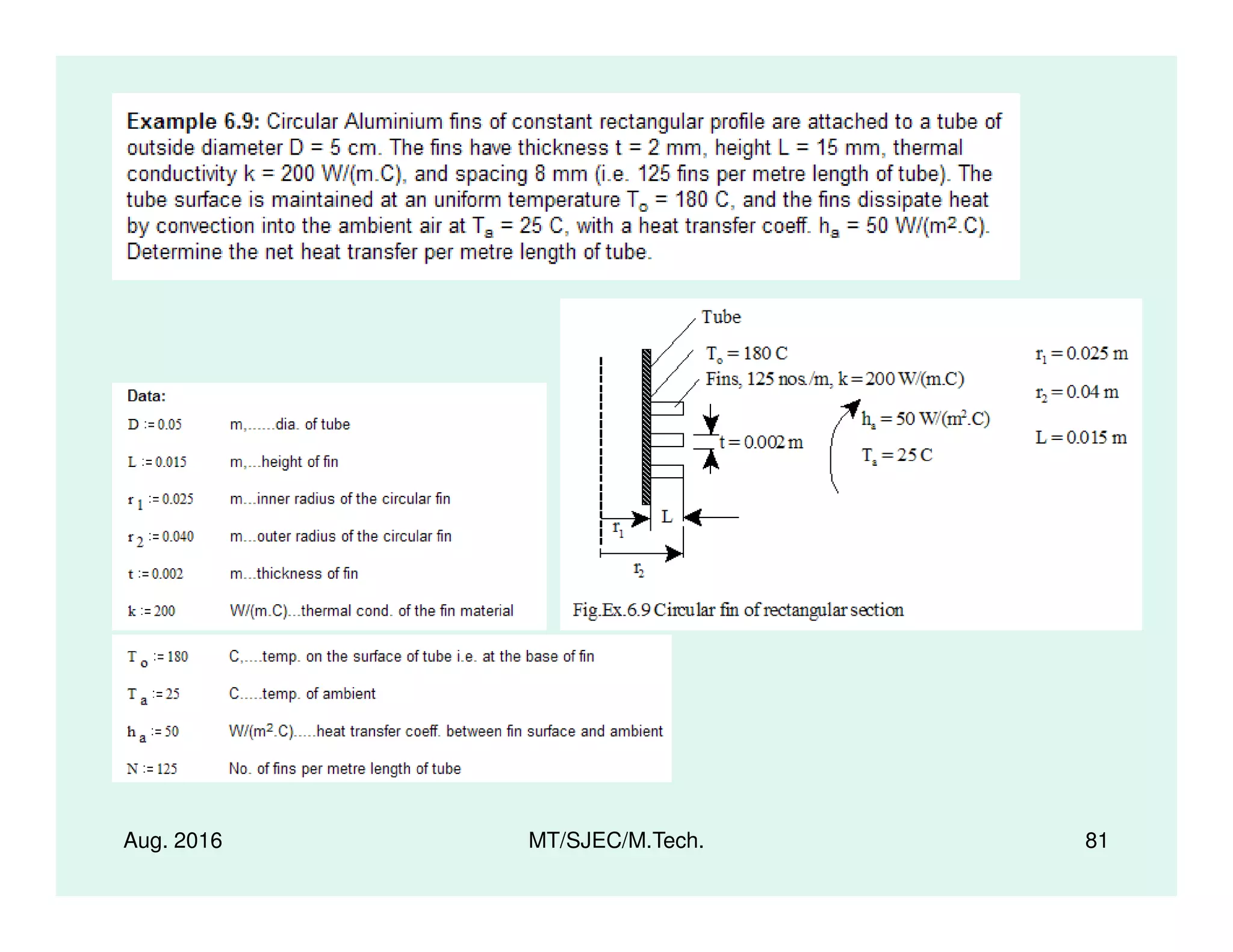
    Fins of non-uniformcross-section: t w L r1 w L L t r2 t (a) Straight rectangular fin (b) Straight triangular fin (c) Circular fin of rectangular section Aug. 2016 MT/SJEC/M.Tech. 45 Fig. 6.8 Typical fins: (a) and (d) of uniform cross-section , and (b), (c) and (e): of nonuniform cross-section L D D L (e) Pin fin, conical section(d) Pin fin, circular section
  • 46.
    Table 6.4 Fin efficiencyfor a few fin shapes • Ac = area of crosssection, Af = total fin surface area, Lc = corrected length, P = perimeter of fin section, h = heat tr. coeff., m = {h.P / (k.Ac)} Aug. 2016 MT/SJEC/M.Tech. 46
  • 47.
    Aug. 2016 MT/SJEC/M.Tech.47 Note: In the above Table: Io = modified zero order Bessel function of first kind Ko = modified zero order Bessel function of second kind I1 = modified first order Bessel function of first kind K1 = modified first order Bessel function of second kind
  • 48.
    Fin efficiency graphs: •As can be seen from the above Table, expressions for fin efficiency of fins of non-uniform cross-sections are rather complicated and involve Bessel functions. • In practice, to find out the heat transfer from such fins, we use ‘Fin efficiency charts’. • Once the fin efficiency is obtained from these graphs, Aug. 2016 MT/SJEC/M.Tech. 48 • Once the fin efficiency is obtained from these graphs, actual heat transferred from the fin is calculated using the definition of fin efficiency, viz. η f Q fin Q max ....(6.16) Q max h P. L. T o T a . where
  • 49.
    • Fig. givesfin efficiency values for fins of rectangular and triangular sections. • It may be noted that graph for rectangular fins is also valid for cylindrical, pin fins Note: On x-axis use: (m.L c) for rectangular fins and, (m.L) for triangular fins 0.6 0.65 0.7 0.75 0.8 0.85 0.9 0.95 1 Fin efficy. for rect. & triangular fins FinEfficiency Aug. 2016 MT/SJEC/M.Tech. 49 cylindrical, pin fins since eqn. for fin efficiency is the same (see Table 6.4); of course, m and Lc will be different for pin fins. 0 0.2 0.4 0.6 0.8 1 1.2 1.4 1.6 1.8 2 2.2 2.4 2.6 2.8 3 0.3 0.35 0.4 0.45 0.5 0.55 rectangular fins triangular fins mLc or mL
  • 50.
  • 51.
  • 52.
    Fin effectiveness,ε f .= (heat transfer rate with fin)/ (heat transfer rate without fin) ε f i.e. ε f Q fin h A c . T o T a . .....(6.20) Aug. 2016 MT/SJEC/M.Tech. 52 Obviously, should be as large as possible. Use of fins is hardly justified unless fin effectiveness is greater than about 2. ε f
  • 53.
    • Consider aninfinitely long fin: • Then, we have: ε f h P. k A c . T o T a . h A c . T o T a . ....fin effectiveness for very long fin i.e. ε f k P. h A c . ......(6.21) Aug. 2016 MT/SJEC/M.Tech. 53 c Following significant conclusions may be derived from this equation: (i)Thermal conductivity, k should be as high as possible; that is why we see that generally, fins are made of copper or Aluminium. Of course, Aluminium is the preferred material from cost and weight considerations.
  • 54.
    (ii) Large ratioof perimeter to area of cross-section is desirable; that means, thin, closely spaced fins are preferable. However, fins should not be too close as to impede the flow of fluid by convection. (iii) Fins are justified when heat transfer coeff. h is small, i.e. generally on the gas side of a heat exchanger rather than on the liquid side. e.g. the car radiator has fins on the outside of the tubes across which air flows. Aug. 2016 MT/SJEC/M.Tech. 54 the outside of the tubes across which air flows. Requirement that , gives us the criterion:ε f 2> k P. h A c . 4> ....(6.22)
  • 55.
    Thermal resistance ofa fin: • Convective thermal resistance of the base area is: R b 1 h A c . ...(6.24,a)....convective thermal resistance of base area When fin is attached, we compute a thermal resistance for the fin, from the usual definition vizc R fin ∆T Q T o T a Q .....(6.24,b).....thermal resistance of fin Aug. 2016 MT/SJEC/M.Tech. 55 R fin Q fin Q fin Values of Qfin depend on the conditions at the tip of the fin and may be obtained from Table 6.3. Dividing eqn. (6.24,a) by eqn. (6.24,b), we get: R b R fin Q fin h A c . T o T a . ε f ..(6.25)....from the definition of εf, in eqn.(6.20)
  • 56.
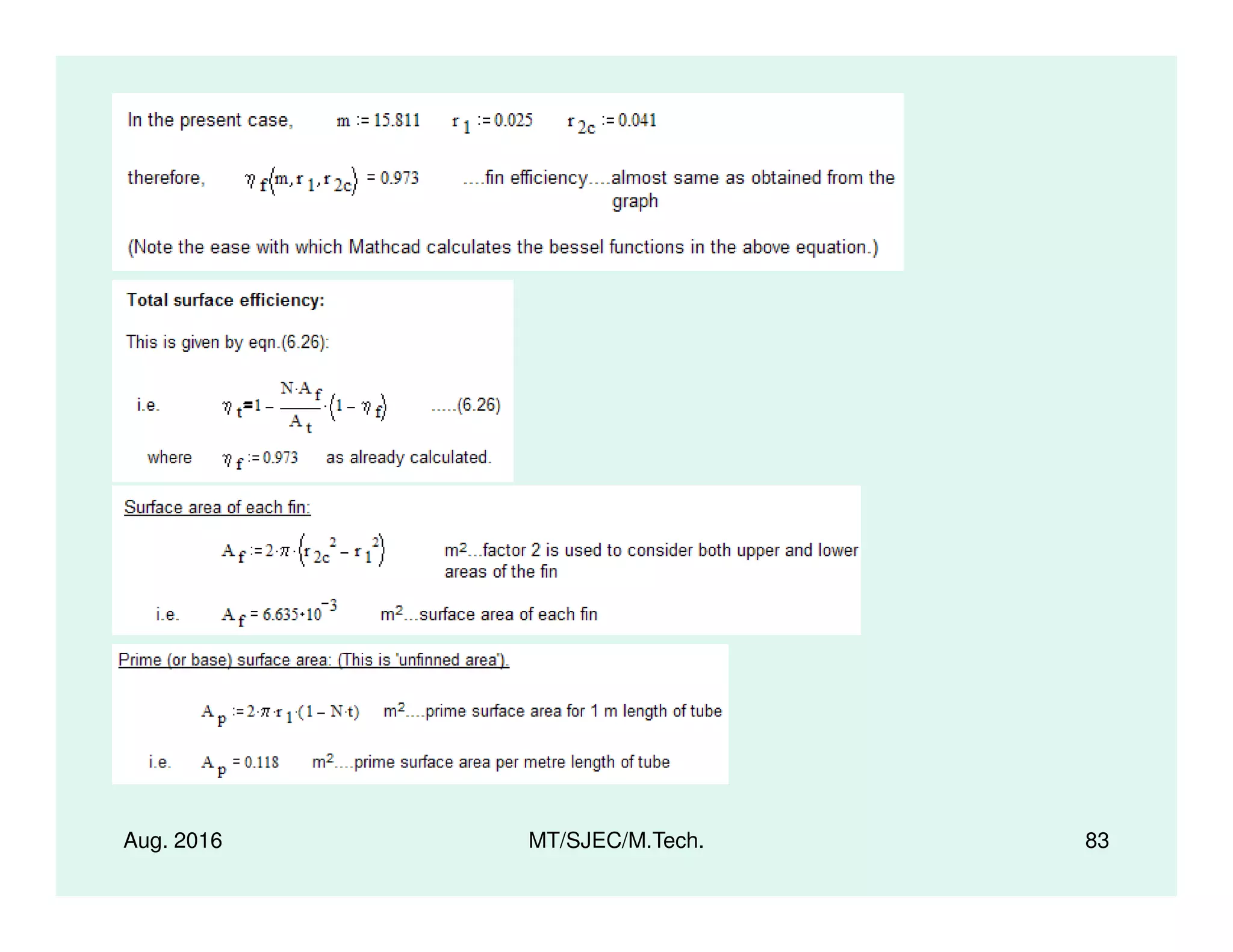
    Total surface efficiency(or, overall surface efficiency, or area-weighted fin efficiency) • Total heat exchange area (At) may be considered as made up of two areas: the base or ‘prime’ surface area, Ap, on which there are no fins, and the total fin surface area (N.Af) , where Aug. 2016 MT/SJEC/M.Tech. 56 where N is the total no. of fins, and Af is the surface area of each fin. • Now, the ‘prime’ surface (or, un-finned surface) is 100% effective; but, all the fin surface area provided is not 100% effective, since there is always a temperature gradient along the fin.
  • 57.
    • From thedefinition of fin efficiency, we know that effective area of the fin surface is f . Af . • Therefore, considering the total area of the array, viz. (Ap + N.Af), we can define an ‘total or overall surface efficiency’, , such that:η t Aug. 2016 MT/SJEC/M.Tech. 57
  • 58.
    Eqn. (6.26) givesthe value of overall or total surface efficiency (or, area –weighted fin efficiency) for a fin array. In other words, effective heat transfer area of the array is: where At is the total area of the prime surface plus all the fin area. Aug. 2016 MT/SJEC/M.Tech. 58 t the fin area. Concept of ‘overall surface efficiency’ is very useful in calculating the heat transfer rates in heat exchangers where fins may be provided on one or both sides of the wall.
  • 59.
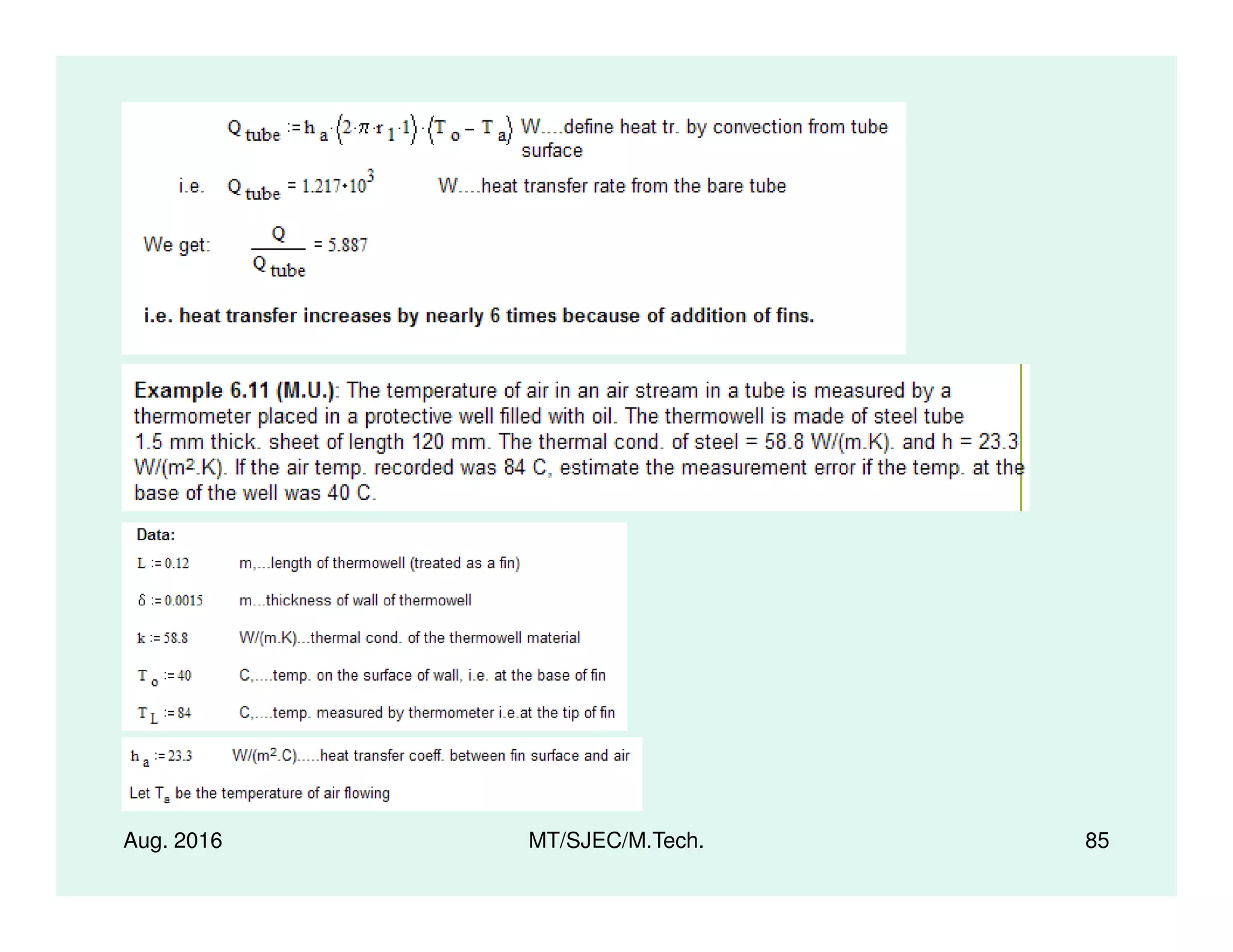
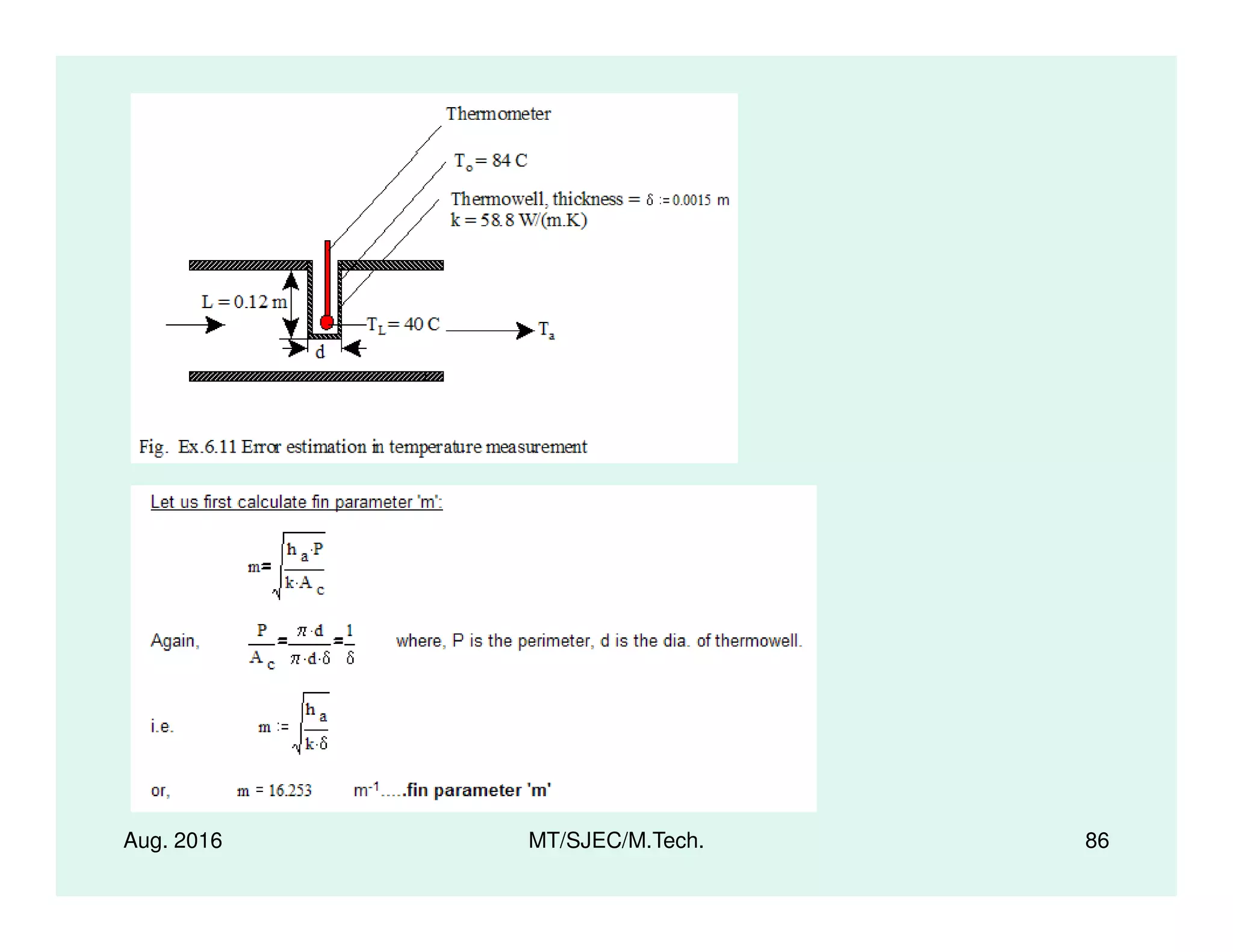
    Application of fintheory for error estimation in temperature measurement: • Temperature of a fluid flowing in a pipe is generally measured with a thermometer Aug. 2016 MT/SJEC/M.Tech. 59 thermometer placed in a ‘thermo-well’ welded radially or obliquely to the pipe wall.
  • 60.
    • If thetemperature of a hot fluid flowing in the pipe is Ta, obviously, the temperature indicated by the thermometer, TL will not be equal to Ta , but less than T , because of Aug. 2016 MT/SJEC/M.Tech. 60 a less than Ta , because of heat loss along the wall of the thermo-well from its tip to the root (and, vice- versa, for a cold fluid flowing in the pipe).
  • 61.
    • Considering thethermo-well to be a fin protruding from the pipe wall, with an insulated tip (i.e. no heat transfer from its tip), we can write, from eqn. (6.7): T x( ) T a T o T a cosh m L x( ).( ) cosh m L.( ) .......(6.7) At the tip, i.e. at x = L, T(x) = TL. Substituting x = L in eqn. (6.7): Aug. 2016 MT/SJEC/M.Tech. 61 T L T a T o T a 1 cosh m L.( ) .....(a) And, the error in thermometer reading is given by: T L T a T o T a cosh m L.( ) .....(b)
  • 62.
    • From eqn.(b), we observe that to reduce the temperature error, we should have the factor 1/cosh(m.L) as small as possible. To achieve this, looking at the graph of 1/cosh (m.L) vs. (m.L) given earlier, it is clear that (m.L) should be as large as possible. i.e. h P. k A c . L. must be as large as possible. This leads to the following conclusions: Aug. 2016 MT/SJEC/M.Tech. 62 This leads to the following conclusions: • value of heat transfer coeff., h should be large • value of thermal conductivity, k should be small • thermo-well should be long and thin-walled. (thermo-well may be placed obliquely inside the pipe, to make it long).
  • 63.
    • Again, forthe thermo-well, treated as a fin, we have: Aug. 2016 MT/SJEC/M.Tech. 63 i.e. fin parameter, 'm'does not depend upon thermo- well pocket diameter, when the wall thickness is very small compared to its diameter.
  • 64.
    Ref: Incropera etal, 6th ed., p.176 Aug. 2016 MT/SJEC/M.Tech. 64
  • 65.
  • 66.
  • 67.
  • 68.
  • 69.
  • 70.
  • 71.
  • 72.
  • 73.
  • 74.
  • 75.
  • 76.
  • 77.
  • 78.
  • 79.
  • 80.
    It may beobserved that: (i) higher the thermal conductivity, higher is Aug. 2016 MT/SJEC/M.Tech. 80 (i) higher the thermal conductivity, higher is the steady state temperature attained at a given location. (ii) to attain the same temp. on the rod, longer length is required for a material of lower thermal conductivity. (iii) it is verified that fin can be considered as 'infinitely long'if the lengths are 2.437, 1.768 and 0.927 m for copper, Aluminium and steel,respectively. i e. the end temperature becomes equal to the ambient temp.
  • 81.
  • 82.
  • 83.
  • 84.
  • 85.
  • 86.
  • 87.