GANDHINAGAR INSTITUTE OF
TECHNOLOGY
Heat transfer(2151909)
Active learning assignment
On
Heat conduction
Prepared by:-
1). Sonani Manav 140120119223
2). Suthar Chandresh 140120119229
3). Tade Govind 140120119230
Guided by :- Prof . Nikita Gupta
Content
• Heat flow in Cartesian co-ordinate
• Heat flow in cylindrical co-ordinate
• Heat flow in spherical co-ordinate
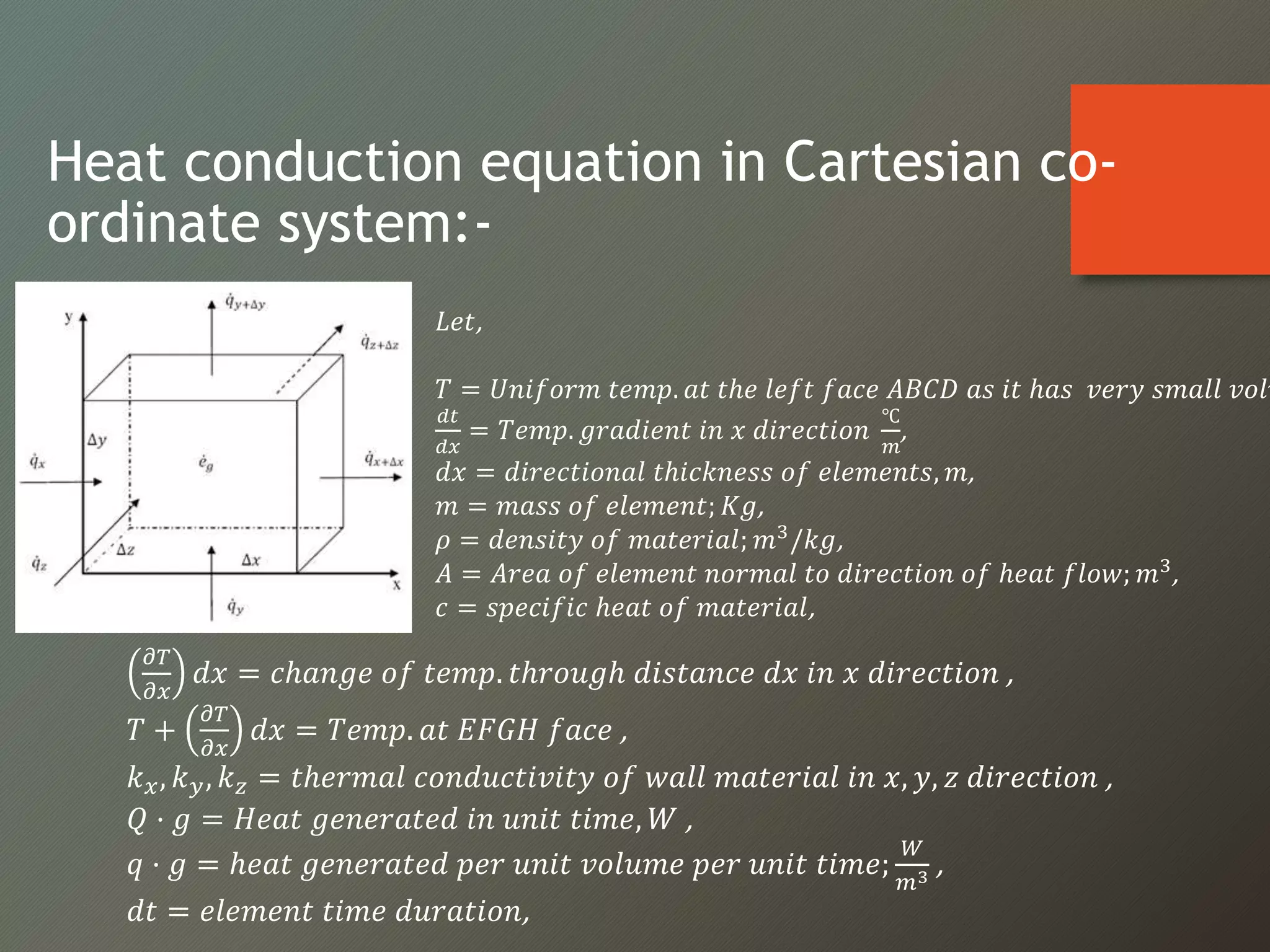
Heat conduction equation in Cartesian co-
ordinate system:-
𝐿𝑒𝑡,
𝑇 = 𝑈𝑛𝑖𝑓𝑜𝑟𝑚 𝑡𝑒𝑚𝑝. 𝑎𝑡 𝑡ℎ𝑒 𝑙𝑒𝑓𝑡 𝑓𝑎𝑐𝑒 𝐴𝐵𝐶𝐷 𝑎𝑠 𝑖𝑡 ℎ𝑎𝑠 𝑣𝑒𝑟𝑦 𝑠𝑚𝑎𝑙𝑙 𝑣𝑜𝑙𝑢
𝑑𝑡
𝑑𝑥
= 𝑇𝑒𝑚𝑝. 𝑔𝑟𝑎𝑑𝑖𝑒𝑛𝑡 𝑖𝑛 𝑥 𝑑𝑖𝑟𝑒𝑐𝑡𝑖𝑜𝑛
℃
𝑚
,
𝑑𝑥 = 𝑑𝑖𝑟𝑒𝑐𝑡𝑖𝑜𝑛𝑎𝑙 𝑡ℎ𝑖𝑐𝑘𝑛𝑒𝑠𝑠 𝑜𝑓 𝑒𝑙𝑒𝑚𝑒𝑛𝑡𝑠, 𝑚,
𝑚 = 𝑚𝑎𝑠𝑠 𝑜𝑓 𝑒𝑙𝑒𝑚𝑒𝑛𝑡; 𝐾𝑔,
𝜌 = 𝑑𝑒𝑛𝑠𝑖𝑡𝑦 𝑜𝑓 𝑚𝑎𝑡𝑒𝑟𝑖𝑎𝑙; 𝑚3
/𝑘𝑔,
𝐴 = 𝐴𝑟𝑒𝑎 𝑜𝑓 𝑒𝑙𝑒𝑚𝑒𝑛𝑡 𝑛𝑜𝑟𝑚𝑎𝑙 𝑡𝑜 𝑑𝑖𝑟𝑒𝑐𝑡𝑖𝑜𝑛 𝑜𝑓 ℎ𝑒𝑎𝑡 𝑓𝑙𝑜𝑤; 𝑚3
,
𝑐 = 𝑠𝑝𝑒𝑐𝑖𝑓𝑖𝑐 ℎ𝑒𝑎𝑡 𝑜𝑓 𝑚𝑎𝑡𝑒𝑟𝑖𝑎𝑙,
𝜕𝑇
𝜕𝑥
𝑑𝑥 = 𝑐ℎ𝑎𝑛𝑔𝑒 𝑜𝑓 𝑡𝑒𝑚𝑝. 𝑡ℎ𝑟𝑜𝑢𝑔ℎ 𝑑𝑖𝑠𝑡𝑎𝑛𝑐𝑒 𝑑𝑥 𝑖𝑛 𝑥 𝑑𝑖𝑟𝑒𝑐𝑡𝑖𝑜𝑛 ,
𝑇 +
𝜕𝑇
𝜕𝑥
𝑑𝑥 = 𝑇𝑒𝑚𝑝. 𝑎𝑡 𝐸𝐹𝐺𝐻 𝑓𝑎𝑐𝑒 ,
𝑘 𝑥, 𝑘 𝑦, 𝑘 𝑧 = 𝑡ℎ𝑒𝑟𝑚𝑎𝑙 𝑐𝑜𝑛𝑑𝑢𝑐𝑡𝑖𝑣𝑖𝑡𝑦 𝑜𝑓 𝑤𝑎𝑙𝑙 𝑚𝑎𝑡𝑒𝑟𝑖𝑎𝑙 𝑖𝑛 𝑥, 𝑦, 𝑧 𝑑𝑖𝑟𝑒𝑐𝑡𝑖𝑜𝑛 ,
𝑄 · 𝑔 = 𝐻𝑒𝑎𝑡 𝑔𝑒𝑛𝑒𝑟𝑎𝑡𝑒𝑑 𝑖𝑛 𝑢𝑛𝑖𝑡 𝑡𝑖𝑚𝑒, 𝑊 ,
𝑞 · 𝑔 = ℎ𝑒𝑎𝑡 𝑔𝑒𝑛𝑒𝑟𝑎𝑡𝑒𝑑 𝑝𝑒𝑟 𝑢𝑛𝑖𝑡 𝑣𝑜𝑙𝑢𝑚𝑒 𝑝𝑒𝑟 𝑢𝑛𝑖𝑡 𝑡𝑖𝑚𝑒;
𝑊
𝑚3 ,
𝑑𝑡 = 𝑒𝑙𝑒𝑚𝑒𝑛𝑡 𝑡𝑖𝑚𝑒 𝑑𝑢𝑟𝑎𝑡𝑖𝑜𝑛,
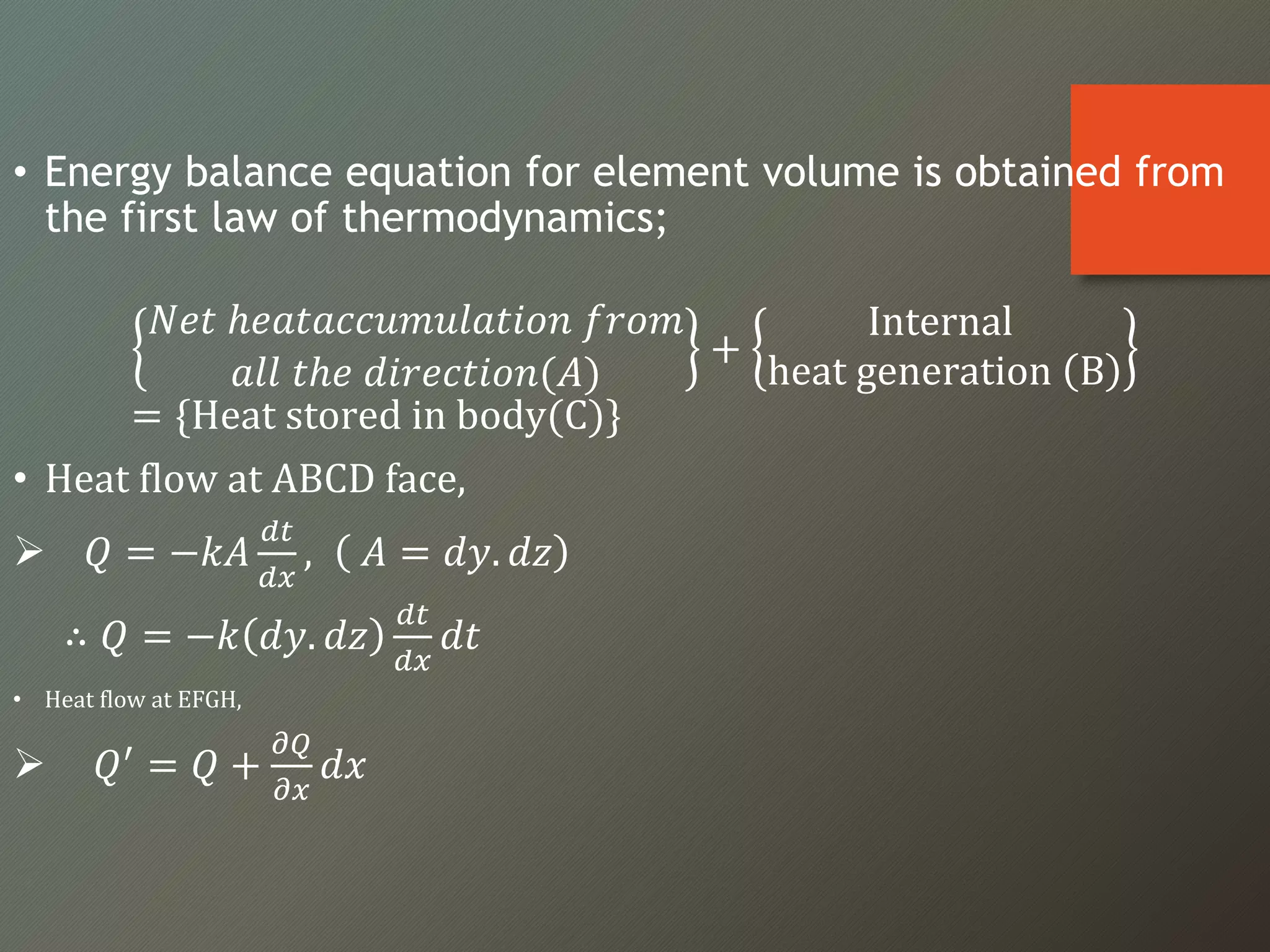
• Energy balance equation for element volume is obtained from
the first law of thermodynamics;
𝑁𝑒𝑡 ℎ𝑒𝑎𝑡𝑎𝑐𝑐𝑢𝑚𝑢𝑙𝑎𝑡𝑖𝑜𝑛 𝑓𝑟𝑜𝑚
𝑎𝑙𝑙 𝑡ℎ𝑒 𝑑𝑖𝑟𝑒𝑐𝑡𝑖𝑜𝑛(𝐴)
+
Internal
heat generation B
= {Heat stored in body(C)}
• Heat flow at ABCD face,
 𝑄 = −𝑘𝐴
𝑑𝑡
𝑑𝑥
, 𝐴 = 𝑑𝑦. 𝑑𝑧
∴ 𝑄 = −𝑘 𝑑𝑦. 𝑑𝑧
𝑑𝑡
𝑑𝑥
𝑑𝑡
• Heat flow at EFGH,
 𝑄′ = 𝑄 +
𝜕𝑄
𝜕𝑥
𝑑𝑥
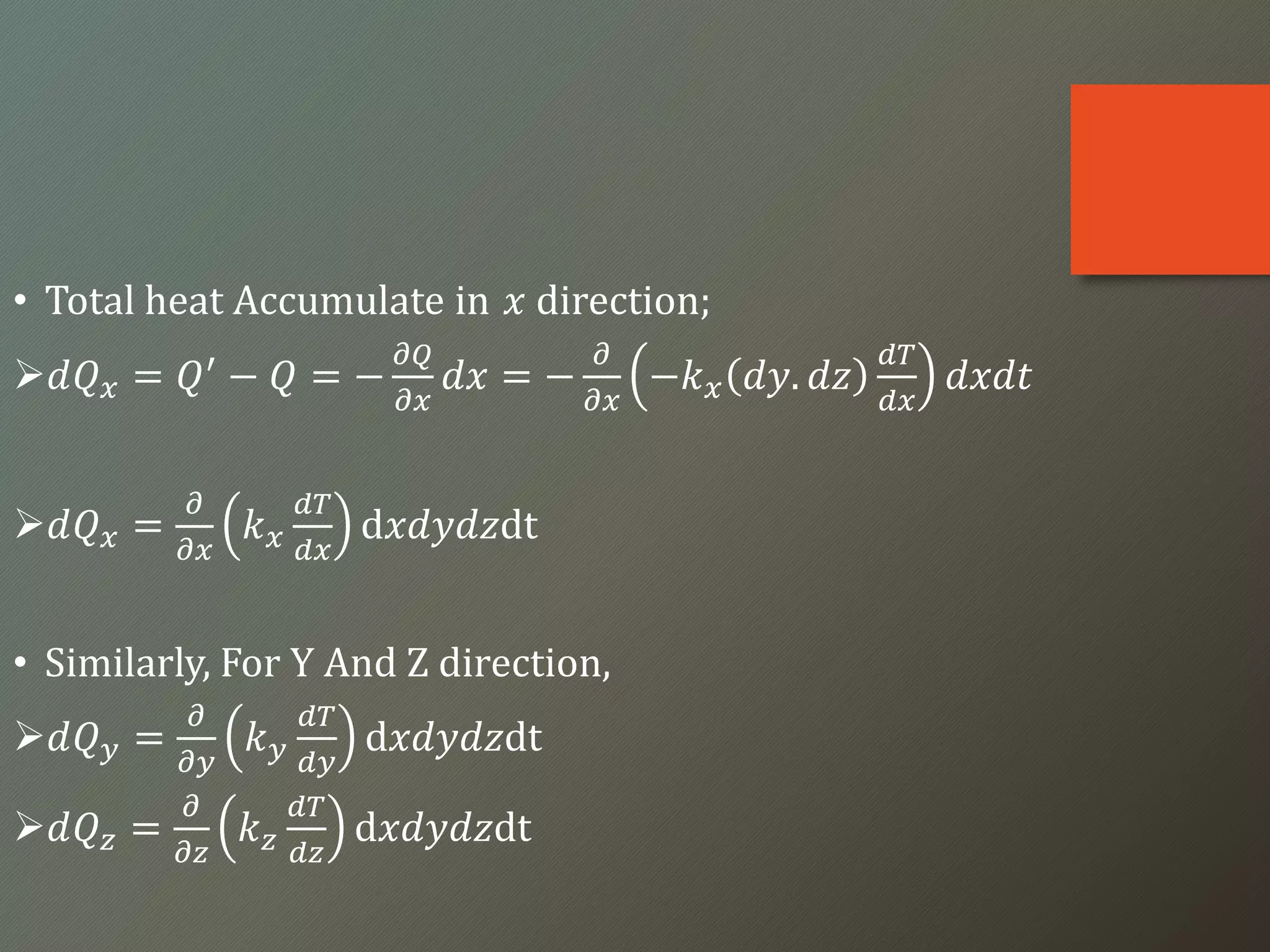
• Total heat Accumulate in 𝑥 direction;
𝑑𝑄 𝑥 = 𝑄′ − 𝑄 = −
𝜕𝑄
𝜕𝑥
𝑑𝑥 = −
𝜕
𝜕𝑥
−𝑘 𝑥 𝑑𝑦. 𝑑𝑧
𝑑𝑇
𝑑𝑥
𝑑𝑥𝑑𝑡
𝑑𝑄 𝑥 =
𝜕
𝜕𝑥
𝑘 𝑥
𝑑𝑇
𝑑𝑥
d𝑥𝑑𝑦𝑑𝑧dt
• Similarly, For Y And Z direction,
𝑑𝑄 𝑦 =
𝜕
𝜕𝑦
𝑘 𝑦
𝑑𝑇
𝑑𝑦
d𝑥𝑑𝑦𝑑𝑧dt
𝑑𝑄 𝑧 =
𝜕
𝜕𝑧
𝑘 𝑧
𝑑𝑇
𝑑𝑧
d𝑥𝑑𝑦𝑑𝑧dt
• Net Heat accumulation in the wall =
𝜕
𝜕𝑥
𝑘 𝑥
𝑑𝑇
𝑑𝑥
+
𝜕
𝜕𝑦
𝑘 𝑦
𝑑𝑇
𝑑𝑦
+
• This is known as general heat conduction equation for
“NON-HOMOGENEOUS ANISTROPIC MATERIAL”, “Self heat
generating”, ‘unsteady three-dimensional heat flow’.
• Heat conduction equation for constant thermal
conductivity(k):
In case of homogeneous and isotropic material, 𝑘 𝑥 =
𝑘 𝑦 = 𝑘 𝑧 = 𝑘 and equation becomes
𝜕2 𝑡
𝜕𝑥2
+
𝜕2 𝑡
𝜕𝑦2
+
𝜕2 𝑡
𝜕𝑧2
+
𝑞 𝑔
k
=
𝜌𝑐
𝑘
𝜕𝑡
𝜕𝜏
=
1
𝛼
𝜕𝑡
𝜕𝜏
Where 𝛼 =
k
𝜌𝑐
=
Thermal conductivity
Thermal capacity
;
m2
sec
The ter𝑚, 𝛼 =
k
𝜌𝑐
is known as thermal diffusivity
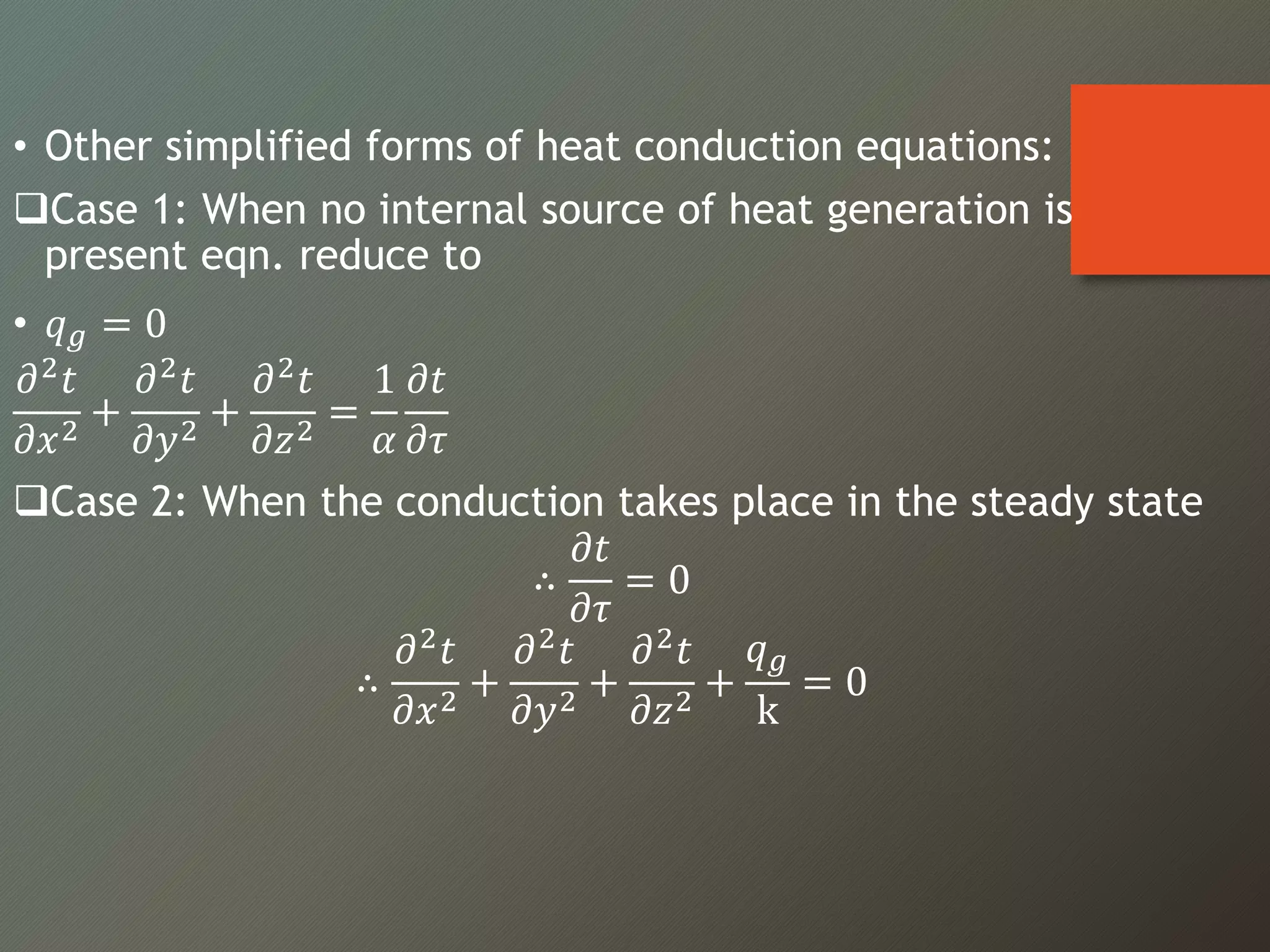
• Other simplified forms of heat conduction equations:
Case 1: When no internal source of heat generation is
present eqn. reduce to
• 𝑞 𝑔 = 0
𝜕2 𝑡
𝜕𝑥2
+
𝜕2 𝑡
𝜕𝑦2
+
𝜕2 𝑡
𝜕𝑧2
=
1
𝛼
𝜕𝑡
𝜕𝜏
Case 2: When the conduction takes place in the steady state
∴
𝜕𝑡
𝜕𝜏
= 0
∴
𝜕2
𝑡
𝜕𝑥2
+
𝜕2
𝑡
𝜕𝑦2
+
𝜕2
𝑡
𝜕𝑧2
+
𝑞 𝑔
k
= 0
Case 3: Steady state and one dimensional heat transfer:
∴
𝜕2 𝑡
𝜕𝑥2
+
𝑞 𝑔
k
= 0
Case 4: Steady state one dimensional, without internal heat
generation;
∴
𝜕2 𝑡
𝜕𝑥2
= 0
Case 5: Steady state, two dimensional, without internal
heat generation:
∴
𝜕2
𝑡
𝜕𝑥2
+
𝜕2
𝑡
𝜕𝑦2
= 0
Case 6: Unsteady state, One dimensional, without internal
heat generation:
∴
𝜕2 𝑡
𝜕𝑥2
=
1
𝛼
𝜕𝑡
𝜕𝜏
Heat conduction equation in cylindrical co-
ordinates
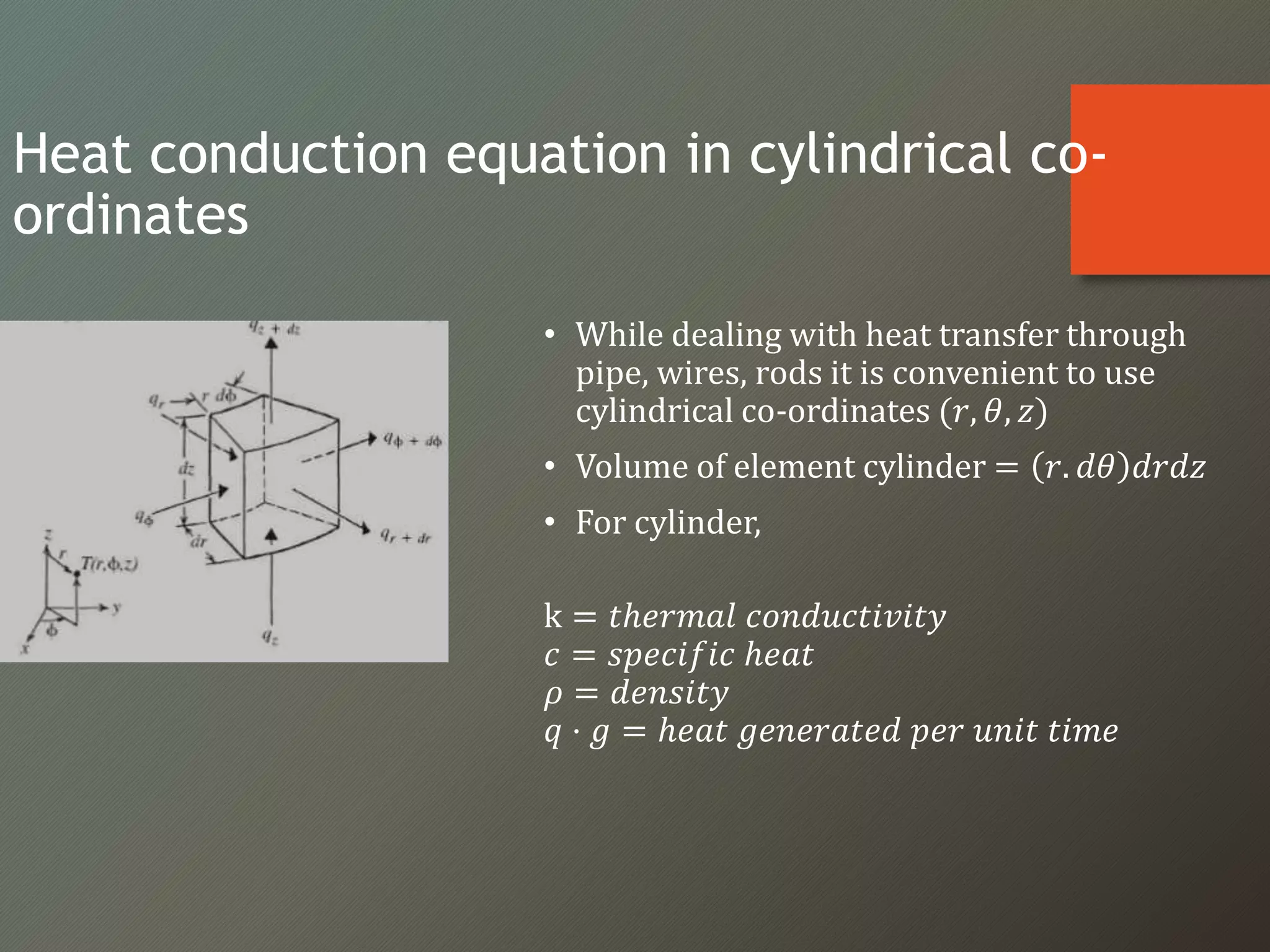
• While dealing with heat transfer through
pipe, wires, rods it is convenient to use
cylindrical co-ordinates (𝑟, 𝜃, 𝑧)
• Volume of element cylinder = 𝑟. 𝑑𝜃 𝑑𝑟𝑑𝑧
• For cylinder,
k = 𝑡ℎ𝑒𝑟𝑚𝑎𝑙 𝑐𝑜𝑛𝑑𝑢𝑐𝑡𝑖𝑣𝑖𝑡𝑦
𝑐 = 𝑠𝑝𝑒𝑐𝑖𝑓𝑖𝑐 ℎ𝑒𝑎𝑡
𝜌 = 𝑑𝑒𝑛𝑠𝑖𝑡𝑦
𝑞 · 𝑔 = ℎ𝑒𝑎𝑡 𝑔𝑒𝑛𝑒𝑟𝑎𝑡𝑒𝑑 𝑝𝑒𝑟 𝑢𝑛𝑖𝑡 𝑡𝑖𝑚𝑒
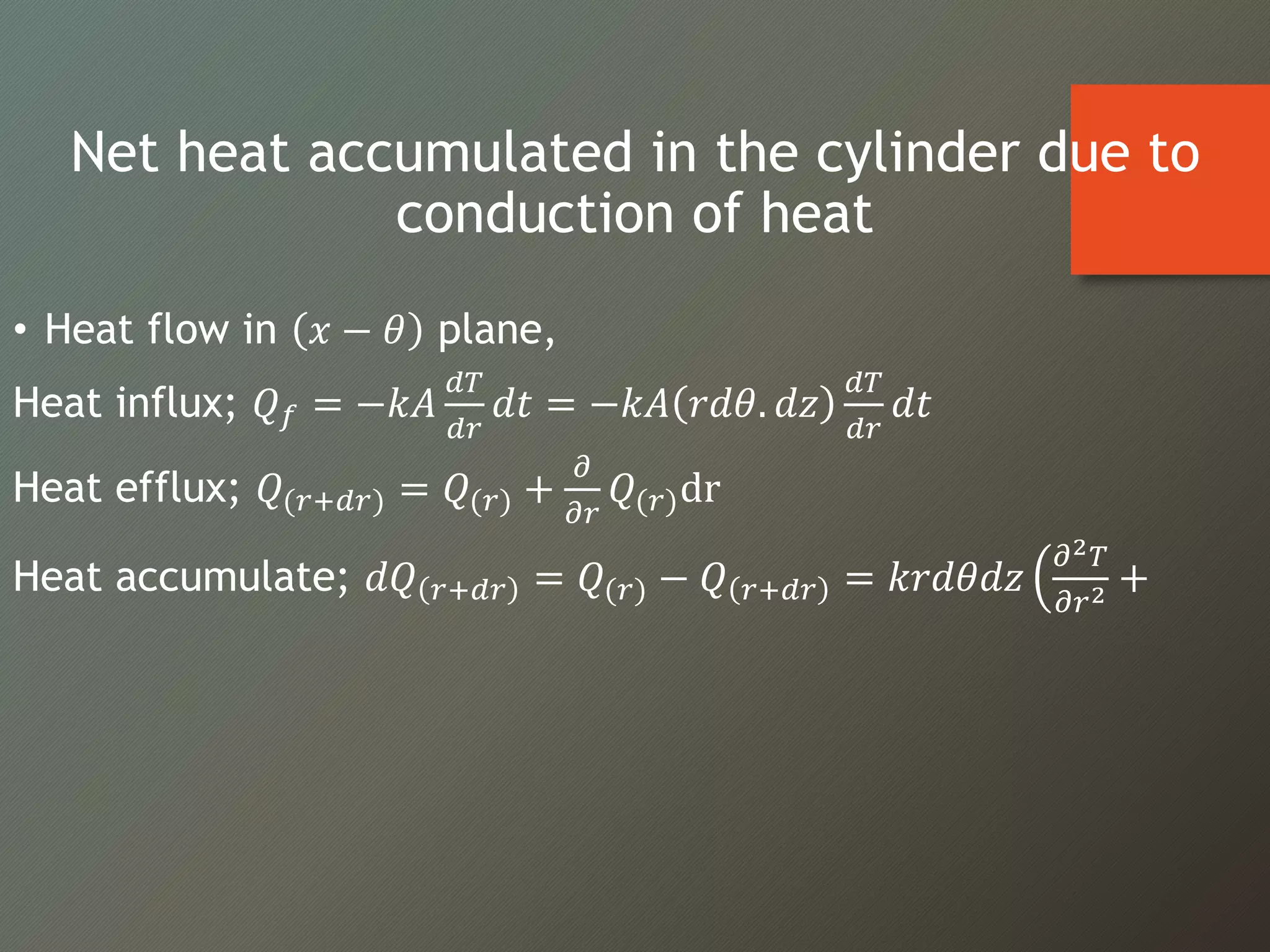
Net heat accumulated in the cylinder due to
conduction of heat
• Heat flow in 𝑥 − 𝜃 plane,
Heat influx; 𝑄 𝑓 = −𝑘𝐴
𝑑𝑇
𝑑𝑟
𝑑𝑡 = −𝑘𝐴 𝑟𝑑𝜃. 𝑑𝑧
𝑑𝑇
𝑑𝑟
𝑑𝑡
Heat efflux; 𝑄(𝑟+𝑑𝑟) = 𝑄(𝑟) +
𝜕
𝜕𝑟
𝑄(𝑟)dr
Heat accumulate; 𝑑𝑄 𝑟+𝑑𝑟 = 𝑄(𝑟) − 𝑄 𝑟+𝑑𝑟 = 𝑘𝑟𝑑𝜃𝑑𝑧
𝜕2 𝑇
𝜕𝑟2 +
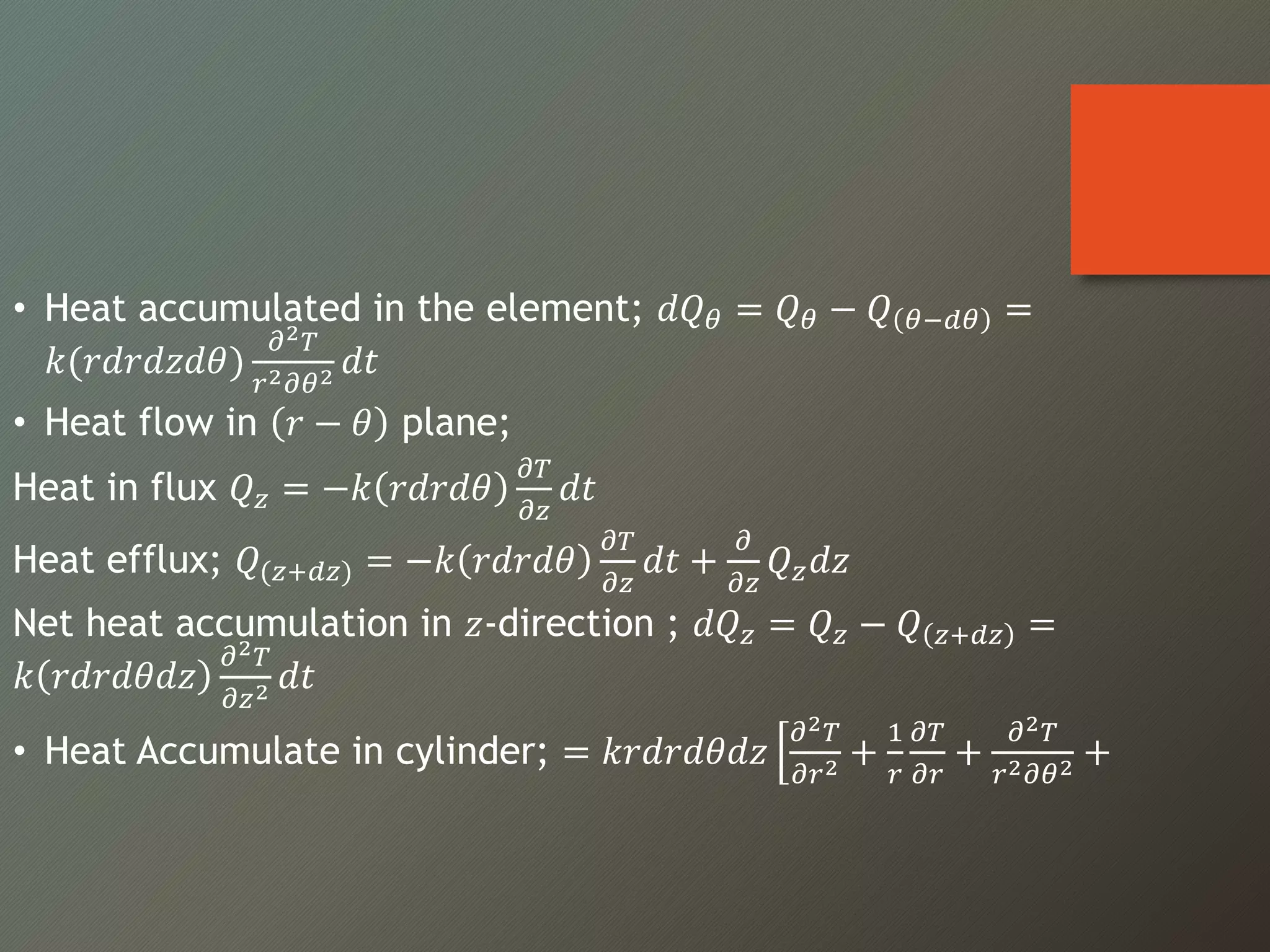
• Heat accumulated in the element; 𝑑𝑄 𝜃 = 𝑄 𝜃 − 𝑄 𝜃−𝑑𝜃 =
𝑘(𝑟𝑑𝑟𝑑𝑧𝑑𝜃)
𝜕2 𝑇
𝑟2 𝜕𝜃2 𝑑𝑡
• Heat flow in 𝑟 − 𝜃 plane;
Heat in flux 𝑄 𝑧 = −𝑘 𝑟𝑑𝑟𝑑𝜃
𝜕𝑇
𝜕𝑧
𝑑𝑡
Heat efflux; 𝑄(𝑧+𝑑𝑧) = −𝑘 𝑟𝑑𝑟𝑑𝜃
𝜕𝑇
𝜕𝑧
𝑑𝑡 +
𝜕
𝜕𝑧
𝑄 𝑧 𝑑𝑧
Net heat accumulation in 𝑧-direction ; 𝑑𝑄 𝑧 = 𝑄 𝑧 − 𝑄 𝑧+𝑑𝑧 =
𝑘 𝑟𝑑𝑟𝑑𝜃𝑑𝑧
𝜕2 𝑇
𝜕𝑧2 𝑑𝑡
• Heat Accumulate in cylinder; = 𝑘𝑟𝑑𝑟𝑑𝜃𝑑𝑧
𝜕2 𝑇
𝜕𝑟2 +
1
𝑟
𝜕𝑇
𝜕𝑟
+
𝜕2 𝑇
𝑟2 𝜕𝜃2 +
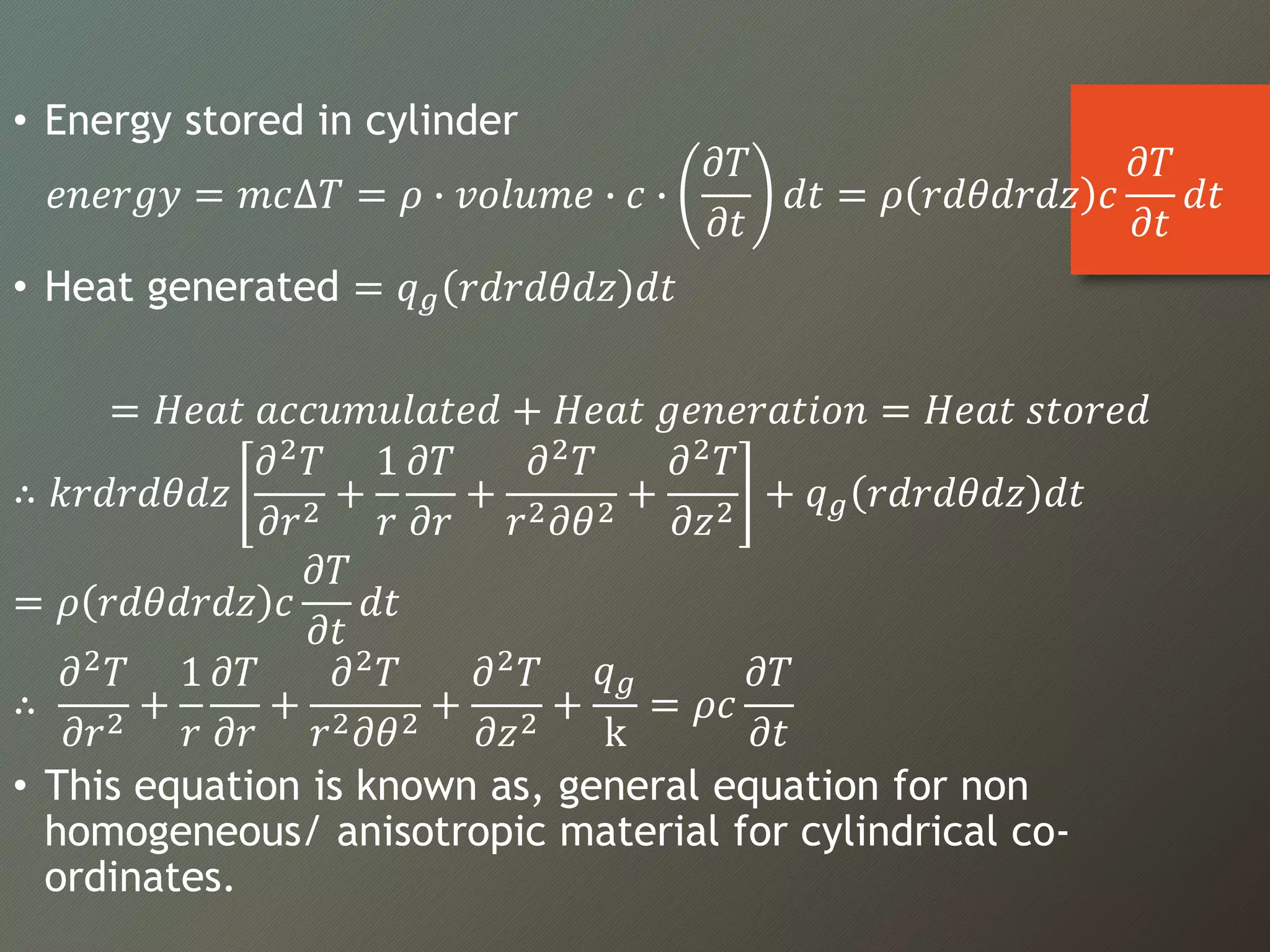
• Energy stored in cylinder
𝑒𝑛𝑒𝑟𝑔𝑦 = 𝑚𝑐∆𝑇 = 𝜌 ∙ 𝑣𝑜𝑙𝑢𝑚𝑒 ∙ 𝑐 ∙
𝜕𝑇
𝜕𝑡
𝑑𝑡 = 𝜌 𝑟𝑑𝜃𝑑𝑟𝑑𝑧 𝑐
𝜕𝑇
𝜕𝑡
𝑑𝑡
• Heat generated = 𝑞 𝑔 𝑟𝑑𝑟𝑑𝜃𝑑𝑧 𝑑𝑡
= 𝐻𝑒𝑎𝑡 𝑎𝑐𝑐𝑢𝑚𝑢𝑙𝑎𝑡𝑒𝑑 + 𝐻𝑒𝑎𝑡 𝑔𝑒𝑛𝑒𝑟𝑎𝑡𝑖𝑜𝑛 = 𝐻𝑒𝑎𝑡 𝑠𝑡𝑜𝑟𝑒𝑑
∴ 𝑘𝑟𝑑𝑟𝑑𝜃𝑑𝑧
𝜕2 𝑇
𝜕𝑟2
+
1
𝑟
𝜕𝑇
𝜕𝑟
+
𝜕2 𝑇
𝑟2 𝜕𝜃2
+
𝜕2 𝑇
𝜕𝑧2
+ 𝑞 𝑔 𝑟𝑑𝑟𝑑𝜃𝑑𝑧 𝑑𝑡
= 𝜌 𝑟𝑑𝜃𝑑𝑟𝑑𝑧 𝑐
𝜕𝑇
𝜕𝑡
𝑑𝑡
∴
𝜕2 𝑇
𝜕𝑟2
+
1
𝑟
𝜕𝑇
𝜕𝑟
+
𝜕2 𝑇
𝑟2 𝜕𝜃2
+
𝜕2 𝑇
𝜕𝑧2
+
𝑞 𝑔
k
= 𝜌𝑐
𝜕𝑇
𝜕𝑡
• This equation is known as, general equation for non
homogeneous/ anisotropic material for cylindrical co-
ordinates.
General heat conduction equation for spherical
co-ordinates system
• While dealing with
problems of heat
conduction having a
spherical geometry. It is
convenient to use spherical
co-ordinates system;
• Heat flow through
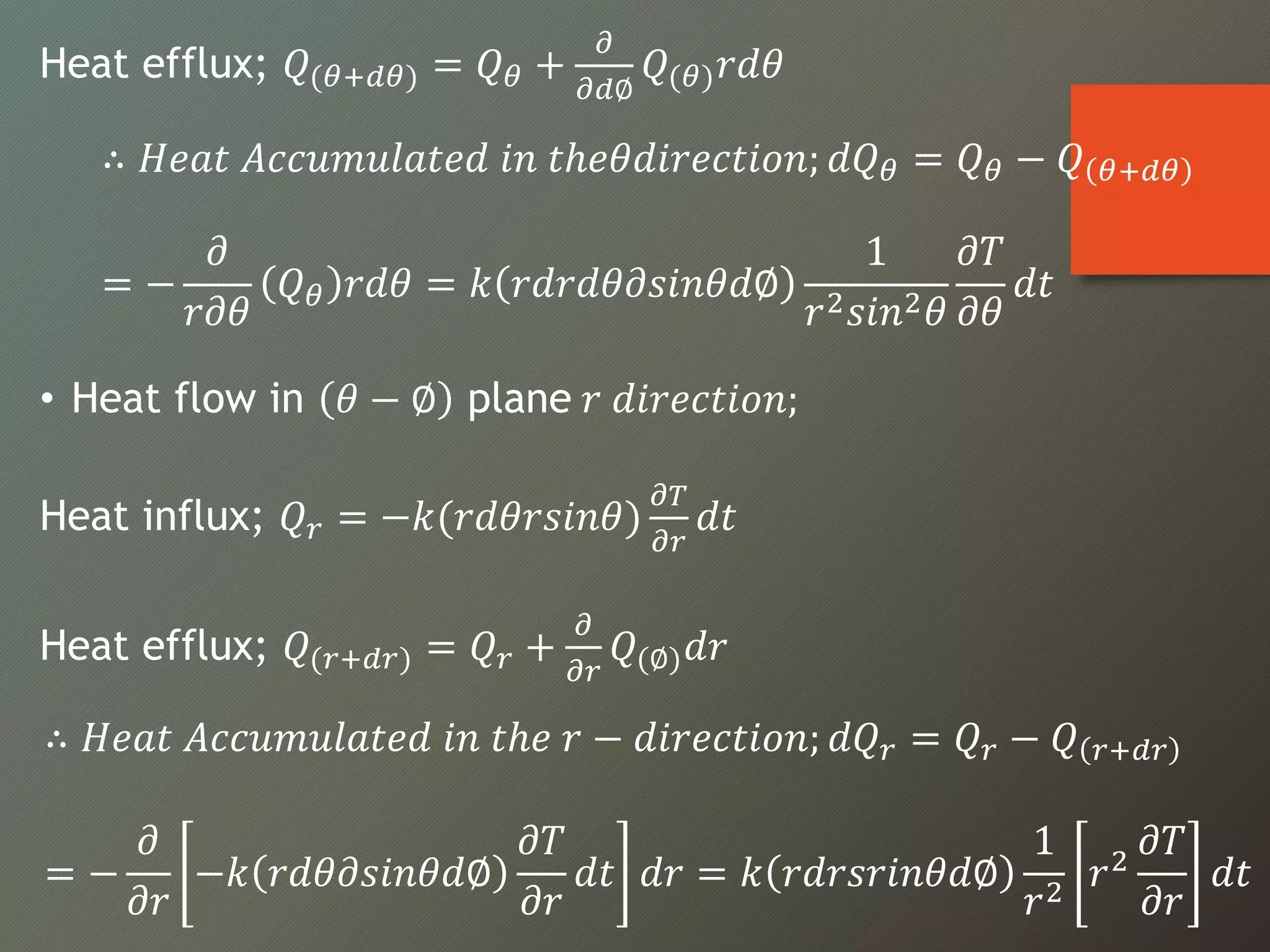
• Heat flow in 𝑟 − 𝜃 plane ∅ 𝑑𝑖𝑟𝑒𝑐𝑡𝑖𝑜𝑛;
Heat influx; 𝑄∅ = −𝑘(𝑟𝑑𝑟𝑑𝜃)
𝜕𝑇
𝜕𝑠𝑖𝑛𝜃𝑑∅
𝑑𝑡
Heat efflux; 𝑄(∅+𝑑∅) = 𝑄∅ +
𝜕
𝜕𝑠𝑖𝑛𝜃𝑑∅
𝑄(∅) 𝑟𝑠𝑖𝑛𝜃𝑑∅
∴ 𝐻𝑒𝑎𝑡 𝐴𝑐𝑐𝑢𝑚𝑢𝑙𝑎𝑡𝑒𝑑 𝑖𝑛 𝑡ℎ𝑒 ∅𝑑𝑖𝑟𝑒𝑐𝑡𝑖𝑜𝑛; 𝑑𝑄∅
= −
𝜕
𝜕𝑠𝑖𝑛𝜃𝑑∅
𝑄∅ 𝑟𝑠𝑖𝑛𝜃𝑑∅ = 𝑘(𝑟𝑑𝑟𝑑𝜃𝜕𝑠𝑖𝑛𝜃𝑑∅)
𝜕2 𝑇
𝑟2 𝑠𝑖𝑛2 𝜃𝜕𝜃2
𝑑𝑡
• Heat flow in 𝑟 − ∅ plane 𝜃 − 𝑑𝑖𝑟𝑒𝑐𝑡𝑖𝑜𝑛
Heat influx; 𝑄 𝜃 = −𝑘(𝑟𝑑𝑟𝑠𝑖𝑛𝜃𝑑𝜃)
𝜕𝑇
𝜕𝑠𝑑𝜃
𝑑𝑡
Heat efflux; 𝑄(𝜃+𝑑𝜃) = 𝑄 𝜃 +
𝜕
𝜕𝑑∅
𝑄(𝜃) 𝑟𝑑𝜃
∴ 𝐻𝑒𝑎𝑡 𝐴𝑐𝑐𝑢𝑚𝑢𝑙𝑎𝑡𝑒𝑑 𝑖𝑛 𝑡ℎ𝑒𝜃𝑑𝑖𝑟𝑒𝑐𝑡𝑖𝑜𝑛; 𝑑𝑄 𝜃 = 𝑄 𝜃 − 𝑄 𝜃+𝑑𝜃
= −
𝜕
𝑟𝜕𝜃
𝑄 𝜃 𝑟𝑑𝜃 = 𝑘 𝑟𝑑𝑟𝑑𝜃𝜕𝑠𝑖𝑛𝜃𝑑∅
1
𝑟2 𝑠𝑖𝑛2 𝜃
𝜕𝑇
𝜕𝜃
𝑑𝑡
• Heat flow in 𝜃 − ∅ plane 𝑟 𝑑𝑖𝑟𝑒𝑐𝑡𝑖𝑜𝑛;
Heat influx; 𝑄 𝑟 = −𝑘(𝑟𝑑𝜃𝑟𝑠𝑖𝑛𝜃)
𝜕𝑇
𝜕𝑟
𝑑𝑡
Heat efflux; 𝑄(𝑟+𝑑𝑟) = 𝑄 𝑟 +
𝜕
𝜕𝑟
𝑄(∅) 𝑑𝑟
∴ 𝐻𝑒𝑎𝑡 𝐴𝑐𝑐𝑢𝑚𝑢𝑙𝑎𝑡𝑒𝑑 𝑖𝑛 𝑡ℎ𝑒 𝑟 − 𝑑𝑖𝑟𝑒𝑐𝑡𝑖𝑜𝑛; 𝑑𝑄 𝑟 = 𝑄 𝑟 − 𝑄 𝑟+𝑑𝑟
= −
𝜕
𝜕𝑟
−𝑘 𝑟𝑑𝜃𝜕𝑠𝑖𝑛𝜃𝑑∅
𝜕𝑇
𝜕𝑟
𝑑𝑡 𝑑𝑟 = 𝑘 𝑟𝑑𝑟𝑠𝑟𝑖𝑛𝜃𝑑∅
1
𝑟2
𝑟2
𝜕𝑇
𝜕𝑟
𝑑𝑡
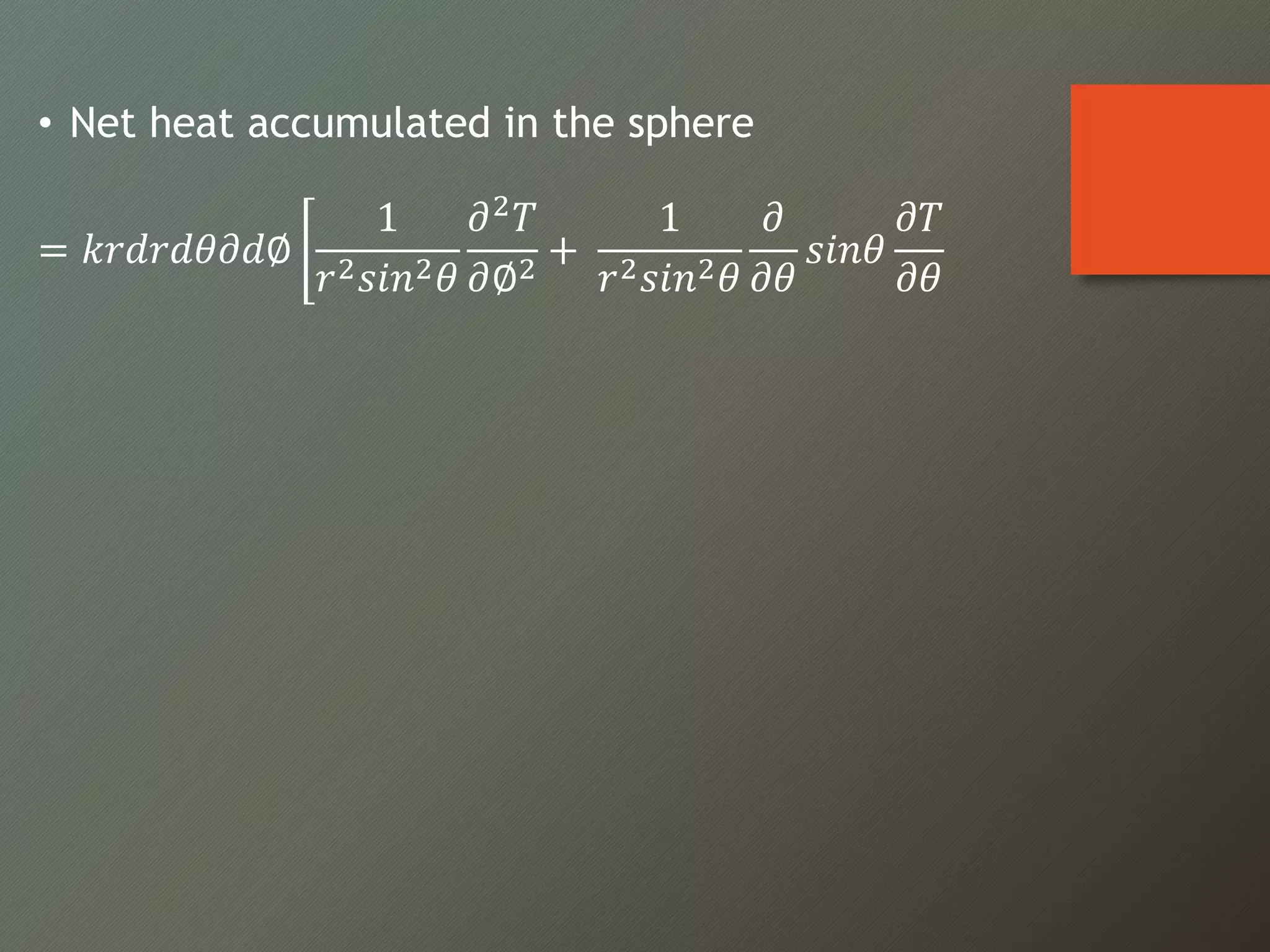
• Net heat accumulated in the sphere
= 𝑘𝑟𝑑𝑟𝑑𝜃𝜕𝑑∅
1
𝑟2 𝑠𝑖𝑛2 𝜃
𝜕2
𝑇
𝜕∅2
+
1
𝑟2 𝑠𝑖𝑛2 𝜃
𝜕
𝜕𝜃
𝑠𝑖𝑛𝜃
𝜕𝑇
𝜕𝜃
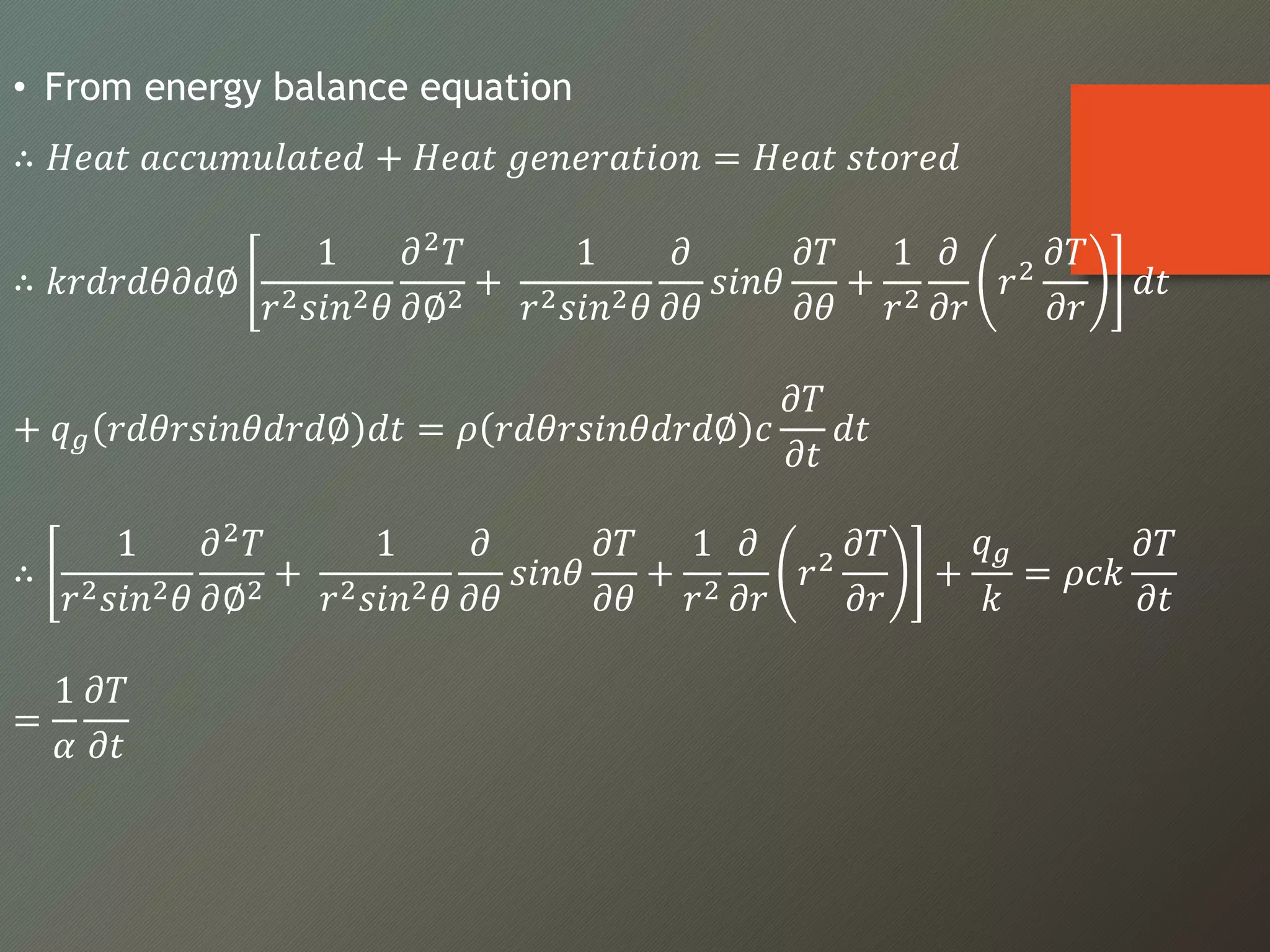
• From energy balance equation
∴ 𝐻𝑒𝑎𝑡 𝑎𝑐𝑐𝑢𝑚𝑢𝑙𝑎𝑡𝑒𝑑 + 𝐻𝑒𝑎𝑡 𝑔𝑒𝑛𝑒𝑟𝑎𝑡𝑖𝑜𝑛 = 𝐻𝑒𝑎𝑡 𝑠𝑡𝑜𝑟𝑒𝑑
∴ 𝑘𝑟𝑑𝑟𝑑𝜃𝜕𝑑∅
1
𝑟2 𝑠𝑖𝑛2 𝜃
𝜕2
𝑇
𝜕∅2 +
1
𝑟2 𝑠𝑖𝑛2 𝜃
𝜕
𝜕𝜃
𝑠𝑖𝑛𝜃
𝜕𝑇
𝜕𝜃
+
1
𝑟2
𝜕
𝜕𝑟
𝑟2
𝜕𝑇
𝜕𝑟
𝑑𝑡
+ 𝑞 𝑔 𝑟𝑑𝜃𝑟𝑠𝑖𝑛𝜃𝑑𝑟𝑑∅ 𝑑𝑡 = 𝜌 𝑟𝑑𝜃𝑟𝑠𝑖𝑛𝜃𝑑𝑟𝑑∅ 𝑐
𝜕𝑇
𝜕𝑡
𝑑𝑡
∴
1
𝑟2 𝑠𝑖𝑛2 𝜃
𝜕2
𝑇
𝜕∅2 +
1
𝑟2 𝑠𝑖𝑛2 𝜃
𝜕
𝜕𝜃
𝑠𝑖𝑛𝜃
𝜕𝑇
𝜕𝜃
+
1
𝑟2
𝜕
𝜕𝑟
𝑟2
𝜕𝑇
𝜕𝑟
+
𝑞 𝑔
𝑘
= 𝜌𝑐𝑘
𝜕𝑇
𝜕𝑡
=
1
𝛼
𝜕𝑇
𝜕𝑡
Heat conduction equation

Heat conduction equation

  • 1.
    GANDHINAGAR INSTITUTE OF TECHNOLOGY Heattransfer(2151909) Active learning assignment On Heat conduction Prepared by:- 1). Sonani Manav 140120119223 2). Suthar Chandresh 140120119229 3). Tade Govind 140120119230 Guided by :- Prof . Nikita Gupta
  • 2.
    Content • Heat flowin Cartesian co-ordinate • Heat flow in cylindrical co-ordinate • Heat flow in spherical co-ordinate
  • 3.
    Heat conduction equationin Cartesian co- ordinate system:- 𝐿𝑒𝑡, 𝑇 = 𝑈𝑛𝑖𝑓𝑜𝑟𝑚 𝑡𝑒𝑚𝑝. 𝑎𝑡 𝑡ℎ𝑒 𝑙𝑒𝑓𝑡 𝑓𝑎𝑐𝑒 𝐴𝐵𝐶𝐷 𝑎𝑠 𝑖𝑡 ℎ𝑎𝑠 𝑣𝑒𝑟𝑦 𝑠𝑚𝑎𝑙𝑙 𝑣𝑜𝑙𝑢 𝑑𝑡 𝑑𝑥 = 𝑇𝑒𝑚𝑝. 𝑔𝑟𝑎𝑑𝑖𝑒𝑛𝑡 𝑖𝑛 𝑥 𝑑𝑖𝑟𝑒𝑐𝑡𝑖𝑜𝑛 ℃ 𝑚 , 𝑑𝑥 = 𝑑𝑖𝑟𝑒𝑐𝑡𝑖𝑜𝑛𝑎𝑙 𝑡ℎ𝑖𝑐𝑘𝑛𝑒𝑠𝑠 𝑜𝑓 𝑒𝑙𝑒𝑚𝑒𝑛𝑡𝑠, 𝑚, 𝑚 = 𝑚𝑎𝑠𝑠 𝑜𝑓 𝑒𝑙𝑒𝑚𝑒𝑛𝑡; 𝐾𝑔, 𝜌 = 𝑑𝑒𝑛𝑠𝑖𝑡𝑦 𝑜𝑓 𝑚𝑎𝑡𝑒𝑟𝑖𝑎𝑙; 𝑚3 /𝑘𝑔, 𝐴 = 𝐴𝑟𝑒𝑎 𝑜𝑓 𝑒𝑙𝑒𝑚𝑒𝑛𝑡 𝑛𝑜𝑟𝑚𝑎𝑙 𝑡𝑜 𝑑𝑖𝑟𝑒𝑐𝑡𝑖𝑜𝑛 𝑜𝑓 ℎ𝑒𝑎𝑡 𝑓𝑙𝑜𝑤; 𝑚3 , 𝑐 = 𝑠𝑝𝑒𝑐𝑖𝑓𝑖𝑐 ℎ𝑒𝑎𝑡 𝑜𝑓 𝑚𝑎𝑡𝑒𝑟𝑖𝑎𝑙, 𝜕𝑇 𝜕𝑥 𝑑𝑥 = 𝑐ℎ𝑎𝑛𝑔𝑒 𝑜𝑓 𝑡𝑒𝑚𝑝. 𝑡ℎ𝑟𝑜𝑢𝑔ℎ 𝑑𝑖𝑠𝑡𝑎𝑛𝑐𝑒 𝑑𝑥 𝑖𝑛 𝑥 𝑑𝑖𝑟𝑒𝑐𝑡𝑖𝑜𝑛 , 𝑇 + 𝜕𝑇 𝜕𝑥 𝑑𝑥 = 𝑇𝑒𝑚𝑝. 𝑎𝑡 𝐸𝐹𝐺𝐻 𝑓𝑎𝑐𝑒 , 𝑘 𝑥, 𝑘 𝑦, 𝑘 𝑧 = 𝑡ℎ𝑒𝑟𝑚𝑎𝑙 𝑐𝑜𝑛𝑑𝑢𝑐𝑡𝑖𝑣𝑖𝑡𝑦 𝑜𝑓 𝑤𝑎𝑙𝑙 𝑚𝑎𝑡𝑒𝑟𝑖𝑎𝑙 𝑖𝑛 𝑥, 𝑦, 𝑧 𝑑𝑖𝑟𝑒𝑐𝑡𝑖𝑜𝑛 , 𝑄 · 𝑔 = 𝐻𝑒𝑎𝑡 𝑔𝑒𝑛𝑒𝑟𝑎𝑡𝑒𝑑 𝑖𝑛 𝑢𝑛𝑖𝑡 𝑡𝑖𝑚𝑒, 𝑊 , 𝑞 · 𝑔 = ℎ𝑒𝑎𝑡 𝑔𝑒𝑛𝑒𝑟𝑎𝑡𝑒𝑑 𝑝𝑒𝑟 𝑢𝑛𝑖𝑡 𝑣𝑜𝑙𝑢𝑚𝑒 𝑝𝑒𝑟 𝑢𝑛𝑖𝑡 𝑡𝑖𝑚𝑒; 𝑊 𝑚3 , 𝑑𝑡 = 𝑒𝑙𝑒𝑚𝑒𝑛𝑡 𝑡𝑖𝑚𝑒 𝑑𝑢𝑟𝑎𝑡𝑖𝑜𝑛,
  • 4.
    • Energy balanceequation for element volume is obtained from the first law of thermodynamics; 𝑁𝑒𝑡 ℎ𝑒𝑎𝑡𝑎𝑐𝑐𝑢𝑚𝑢𝑙𝑎𝑡𝑖𝑜𝑛 𝑓𝑟𝑜𝑚 𝑎𝑙𝑙 𝑡ℎ𝑒 𝑑𝑖𝑟𝑒𝑐𝑡𝑖𝑜𝑛(𝐴) + Internal heat generation B = {Heat stored in body(C)} • Heat flow at ABCD face,  𝑄 = −𝑘𝐴 𝑑𝑡 𝑑𝑥 , 𝐴 = 𝑑𝑦. 𝑑𝑧 ∴ 𝑄 = −𝑘 𝑑𝑦. 𝑑𝑧 𝑑𝑡 𝑑𝑥 𝑑𝑡 • Heat flow at EFGH,  𝑄′ = 𝑄 + 𝜕𝑄 𝜕𝑥 𝑑𝑥
  • 5.
    • Total heatAccumulate in 𝑥 direction; 𝑑𝑄 𝑥 = 𝑄′ − 𝑄 = − 𝜕𝑄 𝜕𝑥 𝑑𝑥 = − 𝜕 𝜕𝑥 −𝑘 𝑥 𝑑𝑦. 𝑑𝑧 𝑑𝑇 𝑑𝑥 𝑑𝑥𝑑𝑡 𝑑𝑄 𝑥 = 𝜕 𝜕𝑥 𝑘 𝑥 𝑑𝑇 𝑑𝑥 d𝑥𝑑𝑦𝑑𝑧dt • Similarly, For Y And Z direction, 𝑑𝑄 𝑦 = 𝜕 𝜕𝑦 𝑘 𝑦 𝑑𝑇 𝑑𝑦 d𝑥𝑑𝑦𝑑𝑧dt 𝑑𝑄 𝑧 = 𝜕 𝜕𝑧 𝑘 𝑧 𝑑𝑇 𝑑𝑧 d𝑥𝑑𝑦𝑑𝑧dt
  • 6.
    • Net Heataccumulation in the wall = 𝜕 𝜕𝑥 𝑘 𝑥 𝑑𝑇 𝑑𝑥 + 𝜕 𝜕𝑦 𝑘 𝑦 𝑑𝑇 𝑑𝑦 +
  • 7.
    • This isknown as general heat conduction equation for “NON-HOMOGENEOUS ANISTROPIC MATERIAL”, “Self heat generating”, ‘unsteady three-dimensional heat flow’. • Heat conduction equation for constant thermal conductivity(k): In case of homogeneous and isotropic material, 𝑘 𝑥 = 𝑘 𝑦 = 𝑘 𝑧 = 𝑘 and equation becomes 𝜕2 𝑡 𝜕𝑥2 + 𝜕2 𝑡 𝜕𝑦2 + 𝜕2 𝑡 𝜕𝑧2 + 𝑞 𝑔 k = 𝜌𝑐 𝑘 𝜕𝑡 𝜕𝜏 = 1 𝛼 𝜕𝑡 𝜕𝜏 Where 𝛼 = k 𝜌𝑐 = Thermal conductivity Thermal capacity ; m2 sec The ter𝑚, 𝛼 = k 𝜌𝑐 is known as thermal diffusivity
  • 8.
    • Other simplifiedforms of heat conduction equations: Case 1: When no internal source of heat generation is present eqn. reduce to • 𝑞 𝑔 = 0 𝜕2 𝑡 𝜕𝑥2 + 𝜕2 𝑡 𝜕𝑦2 + 𝜕2 𝑡 𝜕𝑧2 = 1 𝛼 𝜕𝑡 𝜕𝜏 Case 2: When the conduction takes place in the steady state ∴ 𝜕𝑡 𝜕𝜏 = 0 ∴ 𝜕2 𝑡 𝜕𝑥2 + 𝜕2 𝑡 𝜕𝑦2 + 𝜕2 𝑡 𝜕𝑧2 + 𝑞 𝑔 k = 0
  • 9.
    Case 3: Steadystate and one dimensional heat transfer: ∴ 𝜕2 𝑡 𝜕𝑥2 + 𝑞 𝑔 k = 0 Case 4: Steady state one dimensional, without internal heat generation; ∴ 𝜕2 𝑡 𝜕𝑥2 = 0 Case 5: Steady state, two dimensional, without internal heat generation: ∴ 𝜕2 𝑡 𝜕𝑥2 + 𝜕2 𝑡 𝜕𝑦2 = 0 Case 6: Unsteady state, One dimensional, without internal heat generation: ∴ 𝜕2 𝑡 𝜕𝑥2 = 1 𝛼 𝜕𝑡 𝜕𝜏
  • 10.
    Heat conduction equationin cylindrical co- ordinates • While dealing with heat transfer through pipe, wires, rods it is convenient to use cylindrical co-ordinates (𝑟, 𝜃, 𝑧) • Volume of element cylinder = 𝑟. 𝑑𝜃 𝑑𝑟𝑑𝑧 • For cylinder, k = 𝑡ℎ𝑒𝑟𝑚𝑎𝑙 𝑐𝑜𝑛𝑑𝑢𝑐𝑡𝑖𝑣𝑖𝑡𝑦 𝑐 = 𝑠𝑝𝑒𝑐𝑖𝑓𝑖𝑐 ℎ𝑒𝑎𝑡 𝜌 = 𝑑𝑒𝑛𝑠𝑖𝑡𝑦 𝑞 · 𝑔 = ℎ𝑒𝑎𝑡 𝑔𝑒𝑛𝑒𝑟𝑎𝑡𝑒𝑑 𝑝𝑒𝑟 𝑢𝑛𝑖𝑡 𝑡𝑖𝑚𝑒
  • 11.
    Net heat accumulatedin the cylinder due to conduction of heat • Heat flow in 𝑥 − 𝜃 plane, Heat influx; 𝑄 𝑓 = −𝑘𝐴 𝑑𝑇 𝑑𝑟 𝑑𝑡 = −𝑘𝐴 𝑟𝑑𝜃. 𝑑𝑧 𝑑𝑇 𝑑𝑟 𝑑𝑡 Heat efflux; 𝑄(𝑟+𝑑𝑟) = 𝑄(𝑟) + 𝜕 𝜕𝑟 𝑄(𝑟)dr Heat accumulate; 𝑑𝑄 𝑟+𝑑𝑟 = 𝑄(𝑟) − 𝑄 𝑟+𝑑𝑟 = 𝑘𝑟𝑑𝜃𝑑𝑧 𝜕2 𝑇 𝜕𝑟2 +
  • 12.
    • Heat accumulatedin the element; 𝑑𝑄 𝜃 = 𝑄 𝜃 − 𝑄 𝜃−𝑑𝜃 = 𝑘(𝑟𝑑𝑟𝑑𝑧𝑑𝜃) 𝜕2 𝑇 𝑟2 𝜕𝜃2 𝑑𝑡 • Heat flow in 𝑟 − 𝜃 plane; Heat in flux 𝑄 𝑧 = −𝑘 𝑟𝑑𝑟𝑑𝜃 𝜕𝑇 𝜕𝑧 𝑑𝑡 Heat efflux; 𝑄(𝑧+𝑑𝑧) = −𝑘 𝑟𝑑𝑟𝑑𝜃 𝜕𝑇 𝜕𝑧 𝑑𝑡 + 𝜕 𝜕𝑧 𝑄 𝑧 𝑑𝑧 Net heat accumulation in 𝑧-direction ; 𝑑𝑄 𝑧 = 𝑄 𝑧 − 𝑄 𝑧+𝑑𝑧 = 𝑘 𝑟𝑑𝑟𝑑𝜃𝑑𝑧 𝜕2 𝑇 𝜕𝑧2 𝑑𝑡 • Heat Accumulate in cylinder; = 𝑘𝑟𝑑𝑟𝑑𝜃𝑑𝑧 𝜕2 𝑇 𝜕𝑟2 + 1 𝑟 𝜕𝑇 𝜕𝑟 + 𝜕2 𝑇 𝑟2 𝜕𝜃2 +
  • 13.
    • Energy storedin cylinder 𝑒𝑛𝑒𝑟𝑔𝑦 = 𝑚𝑐∆𝑇 = 𝜌 ∙ 𝑣𝑜𝑙𝑢𝑚𝑒 ∙ 𝑐 ∙ 𝜕𝑇 𝜕𝑡 𝑑𝑡 = 𝜌 𝑟𝑑𝜃𝑑𝑟𝑑𝑧 𝑐 𝜕𝑇 𝜕𝑡 𝑑𝑡 • Heat generated = 𝑞 𝑔 𝑟𝑑𝑟𝑑𝜃𝑑𝑧 𝑑𝑡 = 𝐻𝑒𝑎𝑡 𝑎𝑐𝑐𝑢𝑚𝑢𝑙𝑎𝑡𝑒𝑑 + 𝐻𝑒𝑎𝑡 𝑔𝑒𝑛𝑒𝑟𝑎𝑡𝑖𝑜𝑛 = 𝐻𝑒𝑎𝑡 𝑠𝑡𝑜𝑟𝑒𝑑 ∴ 𝑘𝑟𝑑𝑟𝑑𝜃𝑑𝑧 𝜕2 𝑇 𝜕𝑟2 + 1 𝑟 𝜕𝑇 𝜕𝑟 + 𝜕2 𝑇 𝑟2 𝜕𝜃2 + 𝜕2 𝑇 𝜕𝑧2 + 𝑞 𝑔 𝑟𝑑𝑟𝑑𝜃𝑑𝑧 𝑑𝑡 = 𝜌 𝑟𝑑𝜃𝑑𝑟𝑑𝑧 𝑐 𝜕𝑇 𝜕𝑡 𝑑𝑡 ∴ 𝜕2 𝑇 𝜕𝑟2 + 1 𝑟 𝜕𝑇 𝜕𝑟 + 𝜕2 𝑇 𝑟2 𝜕𝜃2 + 𝜕2 𝑇 𝜕𝑧2 + 𝑞 𝑔 k = 𝜌𝑐 𝜕𝑇 𝜕𝑡 • This equation is known as, general equation for non homogeneous/ anisotropic material for cylindrical co- ordinates.
  • 14.
    General heat conductionequation for spherical co-ordinates system • While dealing with problems of heat conduction having a spherical geometry. It is convenient to use spherical co-ordinates system;
  • 15.
    • Heat flowthrough • Heat flow in 𝑟 − 𝜃 plane ∅ 𝑑𝑖𝑟𝑒𝑐𝑡𝑖𝑜𝑛; Heat influx; 𝑄∅ = −𝑘(𝑟𝑑𝑟𝑑𝜃) 𝜕𝑇 𝜕𝑠𝑖𝑛𝜃𝑑∅ 𝑑𝑡 Heat efflux; 𝑄(∅+𝑑∅) = 𝑄∅ + 𝜕 𝜕𝑠𝑖𝑛𝜃𝑑∅ 𝑄(∅) 𝑟𝑠𝑖𝑛𝜃𝑑∅ ∴ 𝐻𝑒𝑎𝑡 𝐴𝑐𝑐𝑢𝑚𝑢𝑙𝑎𝑡𝑒𝑑 𝑖𝑛 𝑡ℎ𝑒 ∅𝑑𝑖𝑟𝑒𝑐𝑡𝑖𝑜𝑛; 𝑑𝑄∅ = − 𝜕 𝜕𝑠𝑖𝑛𝜃𝑑∅ 𝑄∅ 𝑟𝑠𝑖𝑛𝜃𝑑∅ = 𝑘(𝑟𝑑𝑟𝑑𝜃𝜕𝑠𝑖𝑛𝜃𝑑∅) 𝜕2 𝑇 𝑟2 𝑠𝑖𝑛2 𝜃𝜕𝜃2 𝑑𝑡 • Heat flow in 𝑟 − ∅ plane 𝜃 − 𝑑𝑖𝑟𝑒𝑐𝑡𝑖𝑜𝑛 Heat influx; 𝑄 𝜃 = −𝑘(𝑟𝑑𝑟𝑠𝑖𝑛𝜃𝑑𝜃) 𝜕𝑇 𝜕𝑠𝑑𝜃 𝑑𝑡
  • 16.
    Heat efflux; 𝑄(𝜃+𝑑𝜃)= 𝑄 𝜃 + 𝜕 𝜕𝑑∅ 𝑄(𝜃) 𝑟𝑑𝜃 ∴ 𝐻𝑒𝑎𝑡 𝐴𝑐𝑐𝑢𝑚𝑢𝑙𝑎𝑡𝑒𝑑 𝑖𝑛 𝑡ℎ𝑒𝜃𝑑𝑖𝑟𝑒𝑐𝑡𝑖𝑜𝑛; 𝑑𝑄 𝜃 = 𝑄 𝜃 − 𝑄 𝜃+𝑑𝜃 = − 𝜕 𝑟𝜕𝜃 𝑄 𝜃 𝑟𝑑𝜃 = 𝑘 𝑟𝑑𝑟𝑑𝜃𝜕𝑠𝑖𝑛𝜃𝑑∅ 1 𝑟2 𝑠𝑖𝑛2 𝜃 𝜕𝑇 𝜕𝜃 𝑑𝑡 • Heat flow in 𝜃 − ∅ plane 𝑟 𝑑𝑖𝑟𝑒𝑐𝑡𝑖𝑜𝑛; Heat influx; 𝑄 𝑟 = −𝑘(𝑟𝑑𝜃𝑟𝑠𝑖𝑛𝜃) 𝜕𝑇 𝜕𝑟 𝑑𝑡 Heat efflux; 𝑄(𝑟+𝑑𝑟) = 𝑄 𝑟 + 𝜕 𝜕𝑟 𝑄(∅) 𝑑𝑟 ∴ 𝐻𝑒𝑎𝑡 𝐴𝑐𝑐𝑢𝑚𝑢𝑙𝑎𝑡𝑒𝑑 𝑖𝑛 𝑡ℎ𝑒 𝑟 − 𝑑𝑖𝑟𝑒𝑐𝑡𝑖𝑜𝑛; 𝑑𝑄 𝑟 = 𝑄 𝑟 − 𝑄 𝑟+𝑑𝑟 = − 𝜕 𝜕𝑟 −𝑘 𝑟𝑑𝜃𝜕𝑠𝑖𝑛𝜃𝑑∅ 𝜕𝑇 𝜕𝑟 𝑑𝑡 𝑑𝑟 = 𝑘 𝑟𝑑𝑟𝑠𝑟𝑖𝑛𝜃𝑑∅ 1 𝑟2 𝑟2 𝜕𝑇 𝜕𝑟 𝑑𝑡
  • 17.
    • Net heataccumulated in the sphere = 𝑘𝑟𝑑𝑟𝑑𝜃𝜕𝑑∅ 1 𝑟2 𝑠𝑖𝑛2 𝜃 𝜕2 𝑇 𝜕∅2 + 1 𝑟2 𝑠𝑖𝑛2 𝜃 𝜕 𝜕𝜃 𝑠𝑖𝑛𝜃 𝜕𝑇 𝜕𝜃
  • 18.
    • From energybalance equation ∴ 𝐻𝑒𝑎𝑡 𝑎𝑐𝑐𝑢𝑚𝑢𝑙𝑎𝑡𝑒𝑑 + 𝐻𝑒𝑎𝑡 𝑔𝑒𝑛𝑒𝑟𝑎𝑡𝑖𝑜𝑛 = 𝐻𝑒𝑎𝑡 𝑠𝑡𝑜𝑟𝑒𝑑 ∴ 𝑘𝑟𝑑𝑟𝑑𝜃𝜕𝑑∅ 1 𝑟2 𝑠𝑖𝑛2 𝜃 𝜕2 𝑇 𝜕∅2 + 1 𝑟2 𝑠𝑖𝑛2 𝜃 𝜕 𝜕𝜃 𝑠𝑖𝑛𝜃 𝜕𝑇 𝜕𝜃 + 1 𝑟2 𝜕 𝜕𝑟 𝑟2 𝜕𝑇 𝜕𝑟 𝑑𝑡 + 𝑞 𝑔 𝑟𝑑𝜃𝑟𝑠𝑖𝑛𝜃𝑑𝑟𝑑∅ 𝑑𝑡 = 𝜌 𝑟𝑑𝜃𝑟𝑠𝑖𝑛𝜃𝑑𝑟𝑑∅ 𝑐 𝜕𝑇 𝜕𝑡 𝑑𝑡 ∴ 1 𝑟2 𝑠𝑖𝑛2 𝜃 𝜕2 𝑇 𝜕∅2 + 1 𝑟2 𝑠𝑖𝑛2 𝜃 𝜕 𝜕𝜃 𝑠𝑖𝑛𝜃 𝜕𝑇 𝜕𝜃 + 1 𝑟2 𝜕 𝜕𝑟 𝑟2 𝜕𝑇 𝜕𝑟 + 𝑞 𝑔 𝑘 = 𝜌𝑐𝑘 𝜕𝑇 𝜕𝑡 = 1 𝛼 𝜕𝑇 𝜕𝑡