Lectures on Heat Transfer --
One-Dimensional, Steady-State
Heat Conduction with Heat
Generation
by
Dr. M. ThirumaleshwarDr. M. Thirumaleshwar
formerly:
Professor, Dept. of Mechanical Engineering,
St. Joseph Engg. College, Vamanjoor,
Mangalore
Preface
• This file contains slides on One-
dimensional, steady-state heat
conduction with heat generation.
• The slides were prepared while teaching• The slides were prepared while teaching
Heat Transfer course to the M.Tech.
students in Mechanical Engineering Dept.
of St. Joseph Engineering College,
Vamanjoor, Mangalore, India, during Sept.
– Dec. 2010.
August, 2016 2MT/SJEC/M.Tech.
• It is hoped that these Slides will be useful
to teachers, students, researchers and
professionals working in this field.
• For students, it should be particularly
useful to study, quickly review the subject,useful to study, quickly review the subject,
and to prepare for the examinations.
•
August, 2016 3MT/SJEC/M.Tech.
References
• 1. M. Thirumaleshwar: Fundamentals of Heat &
Mass Transfer, Pearson Edu., 2006
• https://books.google.co.in/books?id=b2238B-
AsqcC&printsec=frontcover&source=gbs_atb#v=onepage&q&f=false
• 2. Cengel Y. A. Heat Transfer: A Practical
Approach, 2nd Ed. McGraw Hill Co., 2003
August, 2016 MT/SJEC/M.Tech. 4
Approach, 2nd Ed. McGraw Hill Co., 2003
• 3. Cengel, Y. A. and Ghajar, A. J., Heat and
Mass Transfer - Fundamentals and Applications,
5th Ed., McGraw-Hill, New York, NY, 2014.
References… contd.
• 4. Incropera , Dewitt, Bergman, Lavine:
Fundamentals of Heat and Mass Transfer, 6th
Ed., Wiley Intl.
• 5. M. Thirumaleshwar: Software Solutions to• 5. M. Thirumaleshwar: Software Solutions to
Problems on Heat Transfer – CONDUCTION-
Part-II, Bookboon, 2013
• http://bookboon.com/en/software-solutions-problems-on-heat-
transfer-cii-ebook
August, 2016 MT/SJEC/M.Tech. 5
One-Dimensional, Steady-State
Heat Conduction with Heat
Generation
• Examples - Plane slab – different BC’s -
Cylindrical Systems – Solid cylinder – hollow
cylinder – different BC’s – Sphere with heat
August, 2016 MT/SJEC/M.Tech. 6
cylinder – different BC’s – Sphere with heat
generation- k varying linearly with T
Examples of situations with internal
heat generation are:
• Joule heating in an electrical conductor
due to the flow of current in it
• Energy generation in a nuclear fuel rod
August, 2016 MT/SJEC/M.Tech. 7
due to absorption of neutrons
• Exothermic chemical reaction within a
system (e.g. combustion), liberating heat
at a given rate throughout the system
Examples (contd.)
• Heat liberated in ‘shielding’ used in
Nuclear reactors due to absorption of
electromagnetic radiation such as
gamma rays
• Curing of concrete
August, 2016 MT/SJEC/M.Tech. 8
• Curing of concrete
• Magnetization of iron
• Ripening of fruits and in biological decay
processes
Plane slab with uniform internal
heat generation:
• We shall consider three cases of
boundary conditions:
• 1. Both the sides of the slab are at the
same temperature
August, 2016 MT/SJEC/M.Tech. 9
same temperature
• 2. Two sides of the slab are at different
temperatures, and
• 3. One of the sides is insulated
Plane slab with uniform internal heat
generation- both the sides at the same
temperature:
• Assumptions:
• One dimensional conduction i.e. thickness L is small
compared to the dimensions in the y and z directions
• Steady state conduction i.e. temperature at any point
within the slab does not change with time; of course,
temperatures at different points within the slab will be
August, 2016 MT/SJEC/M.Tech. 10
within the slab does not change with time; of course,
temperatures at different points within the slab will be
different.
• Uniform internal heat generation rate, qg (W/m3)
• Material of the slab is homogeneous (i.e. constant
density) and isotropic (i.e. value of k is same in all
directions).
Plane slab with uniform internal heat
generation- both the sides at the same
temperature:
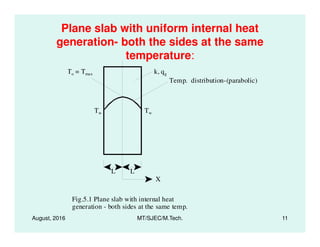
k, qg
Tw
To = Tmax
Tw
Temp. distribution-(parabolic)
August, 2016 MT/SJEC/M.Tech. 11
X
Fig.5.1 Plane slab with internal heat
generation - both sides at the same temp.
LL
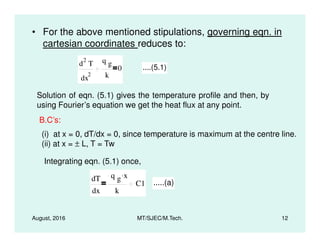
• For the above mentioned stipulations, governing eqn. in
cartesian coordinates reduces to:
d
2
T
dx
2
q g
k
0 ....(5.1)
Solution of eqn. (5.1) gives the temperature profile and then, by
using Fourier’s equation we get the heat flux at any point.
B.C’s:
August, 2016 MT/SJEC/M.Tech. 12
B.C’s:
(i) at x = 0, dT/dx = 0, since temperature is maximum at the centre line.
(ii) at x = ± L, T = Tw
Integrating eqn. (5.1) once,
dT
dx
q g x.
k
C1 .....(a)
• Integrating again,
T
q g x
2.
2 k.
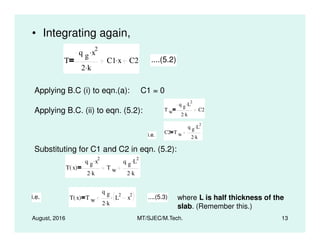
C1 x. C2 ....(5.2)
Applying B.C (i) to eqn.(a): C1 = 0
Applying B.C. (ii) to eqn. (5.2): T w
q g L
2.
2 k.
C2
2.
August, 2016 MT/SJEC/M.Tech. 13
C2 T w
q g L
2.
2 k.i.e.
Substituting for C1 and C2 in eqn. (5.2):
T x( )
q g x
2.
2 k.
T w
q g L
2.
2 k.
i.e. T x( ) T w
q g
2 k.
L
2
x
2. ....(5.3) where L is half thickness of the
slab. (Remember this.)
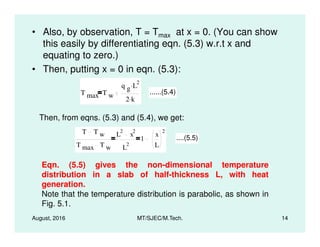
• Also, by observation, T = Tmax at x = 0. (You can show
this easily by differentiating eqn. (5.3) w.r.t x and
equating to zero.)
• Then, putting x = 0 in eqn. (5.3):
T max T w
q g L
2.
2 k.
......(5.4)
Then, from eqns. (5.3) and (5.4), we get:
August, 2016 MT/SJEC/M.Tech. 14
T T w
T max T w
L
2
x
2
L
2
1
x
L
2
....(5.5)
Eqn. (5.5) gives the non-dimensional temperature
distribution in a slab of half-thickness L, with heat
generation.
Note that the temperature distribution is parabolic, as shown in
Fig. 5.1.
Convection boundary condition:
• In many practical applications, heat is carried
away at the boundaries by a fluid at a
temperature Tf flowing on the surface with a
convective heat transfer coefficient, h. (e.g.
current carrying conductor cooled by ambient air
or nuclear fuel rod cooled by a liquid metal
August, 2016 MT/SJEC/M.Tech. 15
or nuclear fuel rod cooled by a liquid metal
coolant).
• Then, by an energy balance at the surface:
• heat conducted from within the body to the
surface = the heat convected away by the fluid
at the surface.
Convection boundary condition:
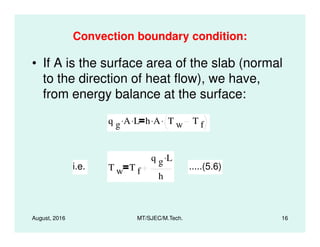
• If A is the surface area of the slab (normal
to the direction of heat flow), we have,
from energy balance at the surface:
q g A. L. h A. T w T f
.
August, 2016 MT/SJEC/M.Tech. 16
q g A. L. h A. T w T f
.
i.e. T w T f
q g L.
h
.....(5.6)
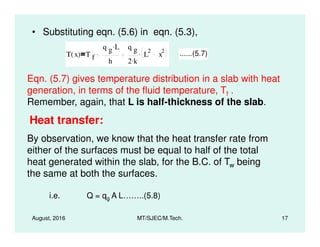
• Substituting eqn. (5.6) in eqn. (5.3),
T x( ) T f
q g L.
h
q g
2 k.
L
2
x
2. ......(5.7)
Eqn. (5.7) gives temperature distribution in a slab with heat
generation, in terms of the fluid temperature, Tf .
Remember, again, that L is half-thickness of the slab.
Heat transfer:
August, 2016 MT/SJEC/M.Tech. 17
Heat transfer:
By observation, we know that the heat transfer rate from
either of the surfaces must be equal to half of the total
heat generated within the slab, for the B.C. of Tw being
the same at both the surfaces.
i.e. Q = qg A L……..(5.8)
Plane slab with uniform internal heat
generation – two sides at different
temperatures:
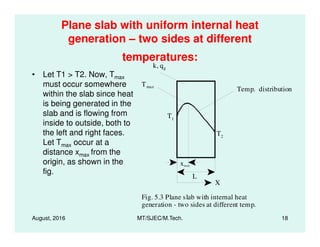
• Let T1 > T2. Now, Tmax
must occur somewhere
within the slab since heat
is being generated in the
slab and is flowing from
inside to outside, both to
k, qg
Tmax
T1
Temp. distribution
August, 2016 MT/SJEC/M.Tech. 18
inside to outside, both to
the left and right faces.
Let Tmax occur at a
distance xmax from the
origin, as shown in the
fig.
X
Fig. 5.3 Plane slab with internal heat
generation - two sides at different temp.
T2
L
xmax
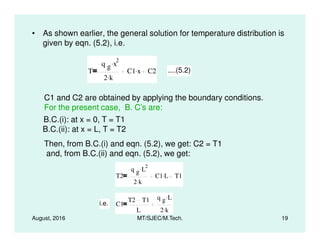
• As shown earlier, the general solution for temperature distribution is
given by eqn. (5.2), i.e.
T
q g x
2.
2 k.
C1 x. C2 ....(5.2)
C1 and C2 are obtained by applying the boundary conditions.
For the present case, B. C’s are:
B.C.(i): at x = 0, T = T1
August, 2016 MT/SJEC/M.Tech. 19
B.C.(i): at x = 0, T = T1
B.C.(ii): at x = L, T = T2
Then, from B.C.(i) and eqn. (5.2), we get: C2 = T1
and, from B.C.(ii) and eqn. (5.2), we get:
T2
q g L
2.
2 k.
C1 L. T1
i.e. C1
T2 T1
L
q g L.
2 k.
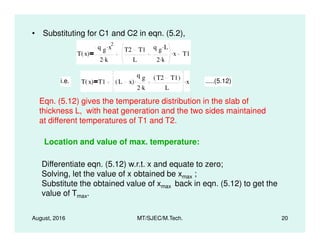
• Substituting for C1 and C2 in eqn. (5.2),
T x( )
q g x
2.
2 k.
T2 T1
L
q g L.
2 k.
x. T1
i.e. T x( ) T1 L x( )
q g
2 k.
. T2 T1( )
L
x. .....(5.12)
Eqn. (5.12) gives the temperature distribution in the slab of
thickness L, with heat generation and the two sides maintained
at different temperatures of T1 and T2.
August, 2016 MT/SJEC/M.Tech. 20
at different temperatures of T1 and T2.
Location and value of max. temperature:
Differentiate eqn. (5.12) w.r.t. x and equate to zero;
Solving, let the value of x obtained be xmax ;
Substitute the obtained value of xmax back in eqn. (5.12) to get the
value of Tmax.
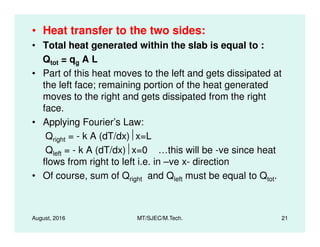
• Heat transfer to the two sides:
• Total heat generated within the slab is equal to :
Qtot = qg A L
• Part of this heat moves to the left and gets dissipated at
the left face; remaining portion of the heat generated
moves to the right and gets dissipated from the right
face.
• Applying Fourier’s Law:
August, 2016 MT/SJEC/M.Tech. 21
• Applying Fourier’s Law:
Qright = - k A (dT/dx)x=L
Qleft = - k A (dT/dx)x=0 …this will be -ve since heat
flows from right to left i.e. in –ve x- direction
• Of course, sum of Qright and Qleft must be equal to Qtot.
Convection boundary condition:
• Let heat be carried away at the left face by a
fluid at a temperature Ta flowing on the surface
with a convective heat transfer coefficient, ha,
and on the right face, by a fluid at a temperature
Tb flowing on the surface with a convective heat
transfer coefficient, hb.
August, 2016 MT/SJEC/M.Tech. 22
• Note that heat generated in the slab in the
volume between x = 0 and x = xmax has to move
to the left face and the heat generated in the
volume between x = xmax and x = L has to move
to the right face, since no heat can cross the
plane of max. temperature.
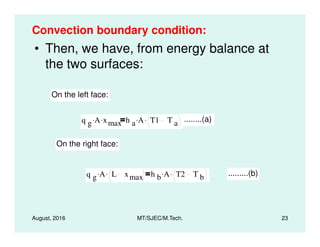
Convection boundary condition:
• Then, we have, from energy balance at
the two surfaces:
On the left face:
q g A. xmax
. h a A. T1 T a
. ........(a)
August, 2016 MT/SJEC/M.Tech. 23
q g A xmax h a A T1 T a ........(a)
On the right face:
q g A. L xmax
. h b A. T2 T b
. .........(b)
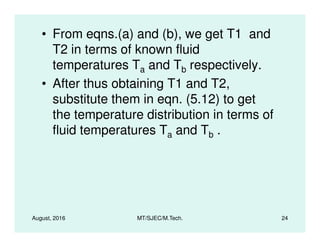
• From eqns.(a) and (b), we get T1 and
T2 in terms of known fluid
temperatures Ta and Tb respectively.
• After thus obtaining T1 and T2,
substitute them in eqn. (5.12) to get
the temperature distribution in terms of
fluid temperatures T and T .
August, 2016 MT/SJEC/M.Tech. 24
fluid temperatures Ta and Tb .
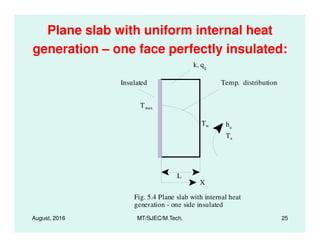
Plane slab with uniform internal heat
generation – one face perfectly insulated:
k, qg
Tw
Tmax
Temp. distributionInsulated
h
August, 2016 MT/SJEC/M.Tech. 25
X
Fig. 5.4 Plane slab with internal heat
generation - one side insulated
Tw
L
Ta
ha
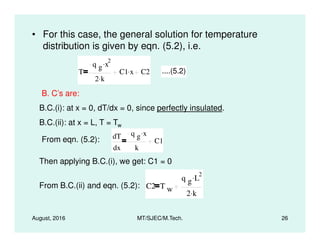
• For this case, the general solution for temperature
distribution is given by eqn. (5.2), i.e.
T
q g x
2.
2 k.
C1 x. C2 ....(5.2)
B. C’s are:
B.C.(i): at x = 0, dT/dx = 0, since perfectly insulated.
B.C.(ii): at x = L, T = Tw
August, 2016 MT/SJEC/M.Tech. 26
B.C.(ii): at x = L, T = Tw
From eqn. (5.2): dT
dx
q g x.
k
C1
Then applying B.C.(i), we get: C1 = 0
From B.C.(ii) and eqn. (5.2):
dx k
C2 T w
q g L
2.
2 k.
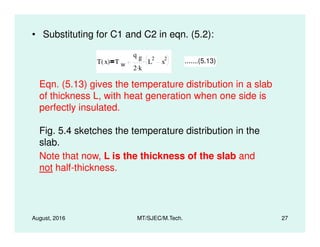
• Substituting for C1 and C2 in eqn. (5.2):
T x( ) T w
q g
2 k.
L
2
x
2. .......(5.13)
Eqn. (5.13) gives the temperature distribution in a slab
of thickness L, with heat generation when one side is
perfectly insulated.
August, 2016 MT/SJEC/M.Tech. 27
Fig. 5.4 sketches the temperature distribution in the
slab.
Note that now, L is the thickness of the slab and
not half-thickness.
In case of convection boundary
condition:
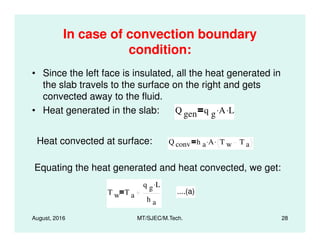
• Since the left face is insulated, all the heat generated in
the slab travels to the surface on the right and gets
convected away to the fluid.
• Heat generated in the slab: Q gen q g A. L.
August, 2016 MT/SJEC/M.Tech. 28
Heat convected at surface: Q conv h a A. T w T a
.
Equating the heat generated and heat convected, we get:
T w T a
q g L.
h a
....(a)
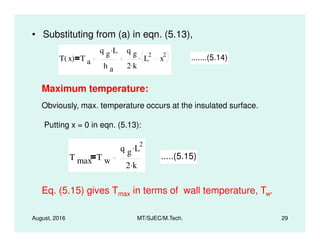
• Substituting from (a) in eqn. (5.13),
T x( ) T a
q g L.
h a
q g
2 k.
L
2
x
2. .......(5.14)
Maximum temperature:
Obviously, max. temperature occurs at the insulated surface.
Putting x = 0 in eqn. (5.13):
August, 2016 MT/SJEC/M.Tech. 29
Putting x = 0 in eqn. (5.13):
T max T w
q g L
2.
2 k.
.....(5.15)
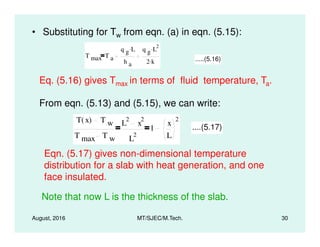
Eq. (5.15) gives Tmax in terms of wall temperature, Tw.
• Substituting for Tw from eqn. (a) in eqn. (5.15):
T max T a
q g L.
h a
q g L
2.
2 k. .....(5.16)
Eq. (5.16) gives Tmax in terms of fluid temperature, Ta.
From eqn. (5.13) and (5.15), we can write:
T x( ) T w L
2
x
2
1
x
2
....(5.17)
August, 2016 MT/SJEC/M.Tech. 30
T x( ) T w
T max T w
L x
L
2
1
x
L
....(5.17)
Eqn. (5.17) gives non-dimensional temperature
distribution for a slab with heat generation, and one
face insulated.
Note that now L is the thickness of the slab.
Solid cylinder with
internal heat
generation:
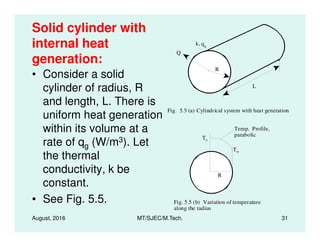
• Consider a solid
cylinder of radius, R
and length, L. There is
uniform heat generation
within its volume at a
Q
LTi
To
k, qg
Fig. 5.5 (a) Cylindrical system with heat generation
L
R
August, 2016 MT/SJEC/M.Tech. 31
within its volume at a
rate of qg (W/m3). Let
the thermal
conductivity, k be
constant.
• See Fig. 5.5.
Temp. Profile,
parabolic
To
Fig. 5.5 (b) Variation of temperature
along the radius
R
Tw
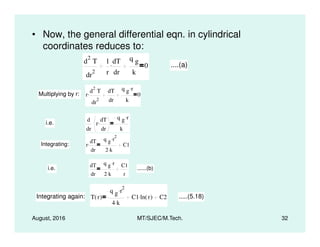
• Now, the general differential eqn. in cylindrical
coordinates reduces to:
d
2
T
dr
2
1
r
dT
dr
.
q g
k
0 ....(a)
Multiplying by r: r
d
2
T
dr
2
. dT
dr
q g r.
k
0
i.e.
d
r
dT.
q g r.
August, 2016 MT/SJEC/M.Tech. 32
i.e.
dr
r
dr
.
k
Integrating: r
dT
dr
.
q g r
2.
2 k.
C1
i.e.
dT
dr
q g r.
2 k.
C1
r
......(b)
Integrating again: T r( )
q g r
2.
4 k.
C1 ln r( ). C2 .....(5.18)
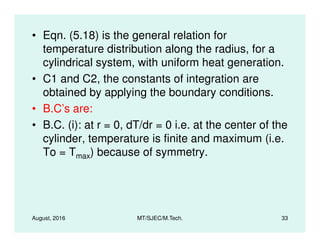
• Eqn. (5.18) is the general relation for
temperature distribution along the radius, for a
cylindrical system, with uniform heat generation.
• C1 and C2, the constants of integration are
obtained by applying the boundary conditions.
• B.C’s are:
• B.C. (i): at r = 0, dT/dr = 0 i.e. at the center of the
August, 2016 MT/SJEC/M.Tech. 33
• B.C. (i): at r = 0, dT/dr = 0 i.e. at the center of the
cylinder, temperature is finite and maximum (i.e.
To = Tmax) because of symmetry.
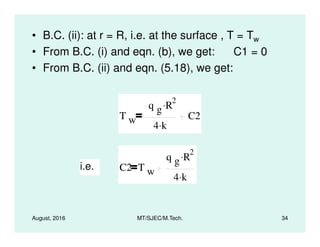
• B.C. (ii): at r = R, i.e. at the surface , T = Tw
• From B.C. (i) and eqn. (b), we get: C1 = 0
• From B.C. (ii) and eqn. (5.18), we get:
T w
q g R
2.
4 k.
C2
August, 2016 MT/SJEC/M.Tech. 34
w
4 k.
i.e. C2 T w
q g R
2.
4 k.
• Eqn. (5.19) is the relation for temperature distribution
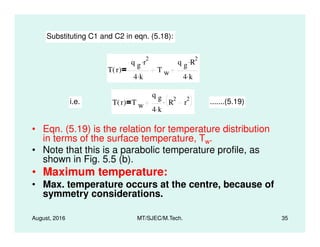
Substituting C1 and C2 in eqn. (5.18):
T r( )
q g r
2.
4 k.
T w
q g R
2.
4 k.
i.e. T r( ) T w
q g
4 k.
R
2
r
2. .......(5.19)
August, 2016 MT/SJEC/M.Tech. 35
• Eqn. (5.19) is the relation for temperature distribution
in terms of the surface temperature, Tw.
• Note that this is a parabolic temperature profile, as
shown in Fig. 5.5 (b).
• Maximum temperature:
• Max. temperature occurs at the centre, because of
symmetry considerations.
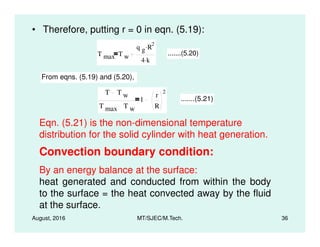
• Therefore, putting r = 0 in eqn. (5.19):
T max T w
q g R
2.
4 k.
.......(5.20)
From eqns. (5.19) and (5.20),
T T w
T max T w
1
r
R
2
.......(5.21)
Eqn. (5.21) is the non-dimensional temperature
August, 2016 MT/SJEC/M.Tech. 36
Eqn. (5.21) is the non-dimensional temperature
distribution for the solid cylinder with heat generation.
Convection boundary condition:
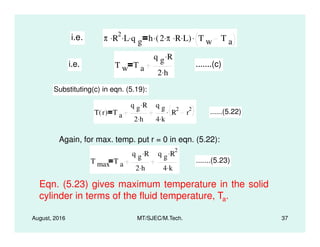
By an energy balance at the surface:
heat generated and conducted from within the body
to the surface = the heat convected away by the fluid
at the surface.
i.e. π R
2. L. q g
. h 2 π. R. L.( ). T w T a
.
i.e. T w T a
q g R.
2 h.
.......(c)
Substituting(c) in eqn. (5.19):
T r( ) T a
q g R.
2 h.
q g
4 k.
R
2
r
2. ......(5.22)
August, 2016 MT/SJEC/M.Tech. 37
Again, for max. temp. put r = 0 in eqn. (5.22):
T max T a
q g R.
2 h.
q g R
2.
4 k.
.......(5.23)
Eqn. (5.23) gives maximum temperature in the solid
cylinder in terms of the fluid temperature, Ta.
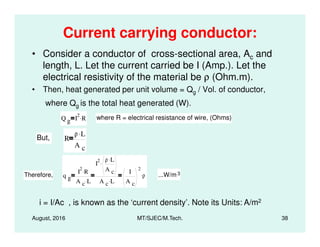
Current carrying conductor:
• Consider a conductor of cross-sectional area, Ac and
length, L. Let the current carried be I (Amp.). Let the
electrical resistivity of the material be ρ (Ohm.m).
• Then, heat generated per unit volume = Qg / Vol. of conductor,
where Qg is the total heat generated (W).
Q g I
2
R. where R = electrical resistance of wire, (Ohms)
August, 2016 MT/SJEC/M.Tech. 38
g
But, R
ρ L.
A c
Therefore, q g
I
2
R.
A c L.
I
2 ρ L.
A c
.
A c L.
I
A c
2
ρ. ...W/m3
i = I/Ac , is known as the ‘current density’. Note its Units: A/m2
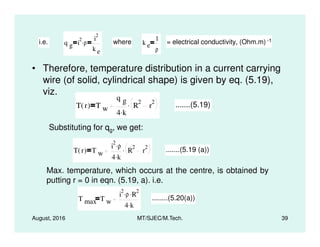
• Therefore, temperature distribution in a current carrying
wire (of solid, cylindrical shape) is given by eq. (5.19),
viz.
i.e. q g i
2
ρ. i
2
k e
where k e
1
ρ
= electrical conductivity, (Ohm.m) -1
T r( ) T w
q g
4 k.
R
2
r
2. .......(5.19)
Substituting for q , we get:
August, 2016 MT/SJEC/M.Tech. 39
Substituting for qg, we get:
T r( ) T w
i
2
ρ.
4 k.
R
2
r
2. .......(5.19 (a))
Max. temperature, which occurs at the centre, is obtained by
putting r = 0 in eqn. (5.19, a). i.e.
T max T w
i
2
ρ. R
2.
4 k.
........(5.20(a))
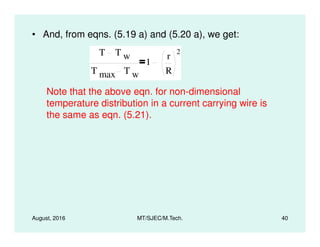
• And, from eqns. (5.19 a) and (5.20 a), we get:
T T w
T max T w
1
r
R
2
Note that the above eqn. for non-dimensional
temperature distribution in a current carrying wire is
the same as eqn. (5.21).
August, 2016 MT/SJEC/M.Tech. 40
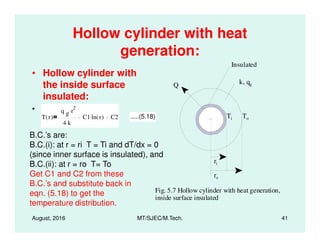
Hollow cylinder with heat
generation:
• Hollow cylinder with
the inside surface
insulated:
• We have:
k, qgQ
To Ti To
Insulated
T r( )
q g r
2.
4 k.
C1 ln r( ). C2 .....(5.18)
August, 2016 MT/SJEC/M.Tech. 41
Fig. 5.7 Hollow cylinder with heat generation,
inside surface insulated
ri
ro
4 k.
B.C.’s are:
B.C.(i): at r = ri T = Ti and dT/dx = 0
(since inner surface is insulated), and
B.C.(ii): at r = ro T= To
Get C1 and C2 from these
B.C.’s and substitute back in
eqn. (5.18) to get the
temperature distribution.
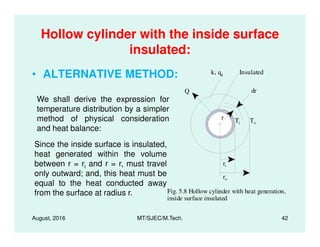
Hollow cylinder with the inside surface
insulated:
• ALTERNATIVE METHOD: k, qg
Q
To Ti To
Insulated
dr
r
We shall derive the expression for
temperature distribution by a simpler
method of physical consideration
August, 2016 MT/SJEC/M.Tech. 42
Fig. 5.8 Hollow cylinder with heat generation,
inside surface insulated
To Ti To
ri
ro
Since the inside surface is insulated,
heat generated within the volume
between r = ri and r = r, must travel
only outward; and, this heat must be
equal to the heat conducted away
from the surface at radius r.
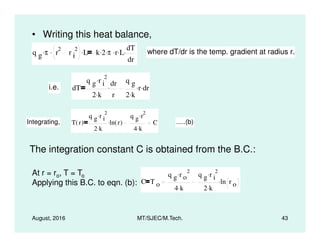
and heat balance:
• Writing this heat balance,
q g π. r
2
r i
2. L. k 2. π. r. L. dT
dr
. where dT/dr is the temp. gradient at radius r.
i.e. dT
q g r i
2.
2 k.
dr
r
.
q g
2 k.
r. dr.
Integrating, T r( )
q g r i
2.
ln r( ).
q g r
2.
C .....(b)
August, 2016 MT/SJEC/M.Tech. 43
Integrating, T r( )
2 k.
ln r( ).
4 k.
C .....(b)
The integration constant C is obtained from the B.C.:
At r = ro, T = To
Applying this B.C. to eqn. (b): C T o
q g r o
2.
4 k.
q g r i
2.
2 k.
ln r o
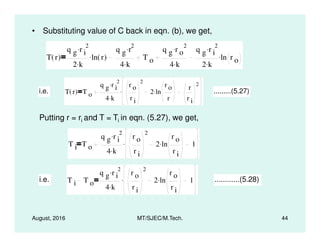
.
• Substituting value of C back in eqn. (b), we get,
T r( )
q g r i
2.
2 k.
ln r( ).
q g r
2.
4 k.
T o
q g r o
2.
4 k.
q g r i
2.
2 k.
ln r o
.
i.e. T r( ) T o
q g r i
2.
4 k.
r o
r i
2
2 ln
r o
r
. r
r i
2
. .........(5.27)
Putting r = ri and T = Ti in eqn. (5.27), we get,
August, 2016 MT/SJEC/M.Tech. 44
T i T o
q g r i
2.
4 k.
r o
r i
2
2 ln
r o
r i
. 1.
i.e. T i T o
q g r i
2.
4 k.
r o
r i
2
2 ln
r o
r i
. 1. ............(5.28)
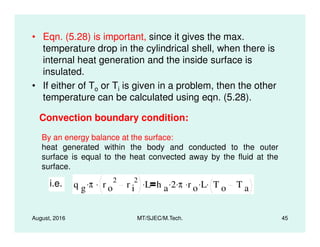
• Eqn. (5.28) is important, since it gives the max.
temperature drop in the cylindrical shell, when there is
internal heat generation and the inside surface is
insulated.
• If either of To or Ti is given in a problem, then the other
temperature can be calculated using eqn. (5.28).
Convection boundary condition:
August, 2016 MT/SJEC/M.Tech. 45
By an energy balance at the surface:
heat generated within the body and conducted to the outer
surface is equal to the heat convected away by the fluid at the
surface.
i.e. q g π. r o
2
r i
2. L. h a 2. π. r o
. L. T o T a
.
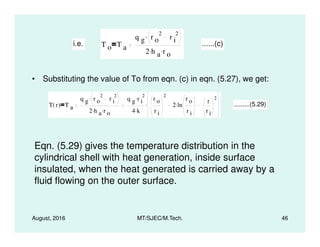
• Substituting the value of To from eqn. (c) in eqn. (5.27), we get:
i.e. T o T a
q g r o
2
r i
2.
2 h a
. r o
.
......(c)
T r( ) T a
q g r o
2
r i
2.
2 h a
. r o
.
q g r i
2.
4 k.
r o
r i
2
2 ln
r o
r i
. r
r i
2
. .........(5.29)
August, 2016 MT/SJEC/M.Tech. 46
Eqn. (5.29) gives the temperature distribution in the
cylindrical shell with heat generation, inside surface
insulated, when the heat generated is carried away by a
fluid flowing on the outer surface.
Hollow cylinder with the outside surface
insulated:
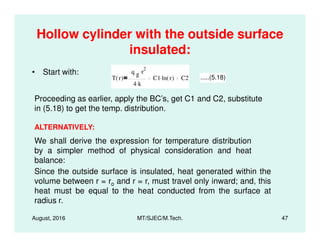
• Start with:
T r( )
q g r
2.
4 k.
C1 ln r( ). C2 .....(5.18)
Proceeding as earlier, apply the BC’s, get C1 and C2, substitute
in (5.18) to get the temp. distribution.
ALTERNATIVELY:
August, 2016 MT/SJEC/M.Tech. 47
ALTERNATIVELY:
Since the outside surface is insulated, heat generated within the
volume between r = ro and r = r, must travel only inward; and, this
heat must be equal to the heat conducted from the surface at
radius r.
We shall derive the expression for temperature distribution
by a simpler method of physical consideration and heat
balance:
• Writing this heat balance,
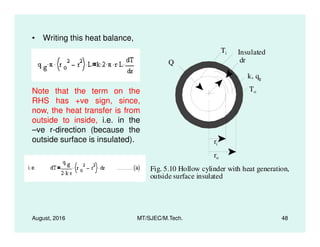
k, qg
Q
Ti
To
Insulated
dr
Note that the term on the
RHS has +ve sign, since,
now, the heat transfer is from
outside to inside, i.e. in the
August, 2016 MT/SJEC/M.Tech. 48
Fig. 5.10 Hollow cylinder with heat generation,
outside surface insulated
ri
ro
outside to inside, i.e. in the
–ve r-direction (because the
outside surface is insulated).
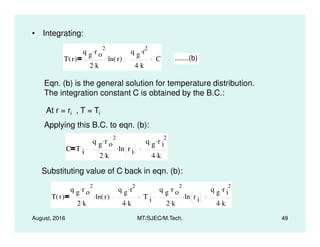
• Integrating:
T r( )
q g r o
2.
2 k.
ln r( ).
q g r
2.
4 k.
C .......(b)
Eqn. (b) is the general solution for temperature distribution.
The integration constant C is obtained by the B.C.:
At r = ri , T = Ti
Applying this B.C. to eqn. (b):
August, 2016 MT/SJEC/M.Tech. 49
Applying this B.C. to eqn. (b):
C T i
q g r o
2.
2 k.
ln r i
.
q g r i
2.
4 k.
Substituting value of C back in eqn. (b):
T r( )
q g r o
2.
2 k.
ln r( ).
q g r
2.
4 k.
T i
q g r o
2.
2 k.
ln r i
.
q g r i
2.
4 k.
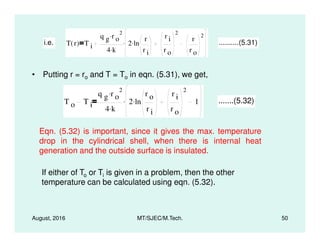
• Putting r = ro and T = To in eqn. (5.31), we get,
i.e. T r( ) T i
q g r o
2.
4 k.
2 ln
r
r i
.
r i
r o
2
r
r o
2
. ..........(5.31)
T o T i
q g r o
2.
4 k.
2 ln
r o
r i
.
r i
r o
2
1. .......(5.32)
August, 2016 MT/SJEC/M.Tech. 50
Eqn. (5.32) is important, since it gives the max. temperature
drop in the cylindrical shell, when there is internal heat
generation and the outside surface is insulated.
If either of To or Ti is given in a problem, then the other
temperature can be calculated using eqn. (5.32).
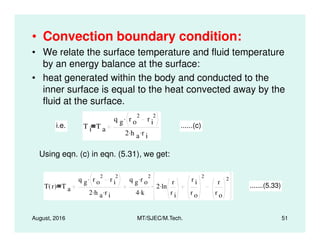
• Convection boundary condition:
• We relate the surface temperature and fluid temperature
by an energy balance at the surface:
• heat generated within the body and conducted to the
inner surface is equal to the heat convected away by the
fluid at the surface.
i.e. T T
q g r o
2
r i
2.
......(c)
August, 2016 MT/SJEC/M.Tech. 51
i.e. T i T a
g o i
2 h a
. r i
.
......(c)
Using eqn. (c) in eqn. (5.31), we get:
T r( ) T a
q g r o
2
r i
2.
2 h a
. r i
.
q g r o
2.
4 k.
2 ln
r
r i
.
r i
r o
2
r
r o
2
. .......(5.33)
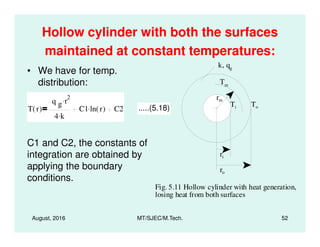
Hollow cylinder with both the surfaces
maintained at constant temperatures:
• We have for temp.
distribution:
k, qg
To Ti To
rm
Tm
T r( )
q g r
2.
4 k.
C1 ln r( ). C2 .....(5.18)
August, 2016 MT/SJEC/M.Tech. 52
Fig. 5.11 Hollow cylinder with heat generation,
losing heat from both surfaces
ri
ro
C1 and C2, the constants of
integration are obtained by
applying the boundary
conditions.
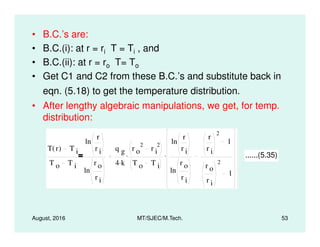
• B.C.’s are:
• B.C.(i): at r = ri T = Ti , and
• B.C.(ii): at r = ro T= To
• Get C1 and C2 from these B.C.’s and substitute back in
eqn. (5.18) to get the temperature distribution.
• After lengthy algebraic manipulations, we get, for temp.
distribution:
August, 2016 MT/SJEC/M.Tech. 53
T r( ) T i
T o T i
ln
r
r i
ln
r o
r i
q g
4 k.
r o
2
r i
2
T o T i
.
ln
r
r i
ln
r o
r i
r
r i
2
1
r o
r i
2
1
. ......(5.35)
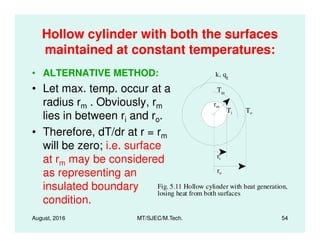
Hollow cylinder with both the surfaces
maintained at constant temperatures:
• ALTERNATIVE METHOD:
• Let max. temp. occur at a
radius rm . Obviously, rm
lies in between ri and ro.
k, qg
To Ti To
rm
Tm
August, 2016 MT/SJEC/M.Tech. 54
i o
• Therefore, dT/dr at r = rm
will be zero; i.e. surface
at rm may be considered
as representing an
insulated boundary
condition.
Fig. 5.11 Hollow cylinder with heat generation,
losing heat from both surfaces
ri
ro
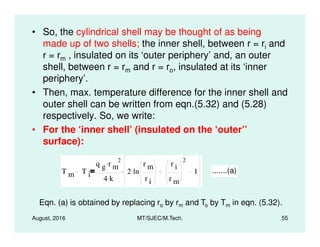
• So, the cylindrical shell may be thought of as being
made up of two shells; the inner shell, between r = ri and
r = rm , insulated on its ‘outer periphery’ and, an outer
shell, between r = rm and r = ro, insulated at its ‘inner
periphery’.
• Then, max. temperature difference for the inner shell and
outer shell can be written from eqn.(5.32) and (5.28)
respectively. So, we write:
August, 2016 MT/SJEC/M.Tech. 55
• For the ‘inner shell’ (insulated on the ‘outer’’
surface):
T m T i
q g r m
2.
4 k.
2 ln
r m
r i
.
r i
r m
2
1. .......(a)
Eqn. (a) is obtained by replacing ro by rm and To by Tm in eqn. (5.32).
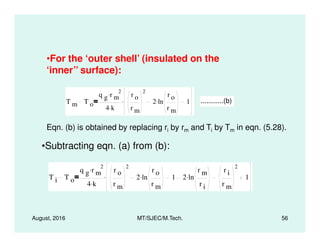
•For the ‘outer shell’ (insulated on the
‘inner’’ surface):
T m T o
q g r m
2.
4 k.
r o
r m
2
2 ln
r o
r m
. 1. ............(b)
Eqn. (b) is obtained by replacing r by r and T by T in eqn. (5.28).
August, 2016 MT/SJEC/M.Tech. 56
Eqn. (b) is obtained by replacing ri by rm and Ti by Tm in eqn. (5.28).
•Subtracting eqn. (a) from (b):
T i T o
q g r m
2.
4 k.
r o
r m
2
2 ln
r o
r m
. 1 2 ln
r m
r i
.
r i
r m
2
1.
i.e. T i T o
q g r m
2.
4 k.
r o
r m
2
r i
r m
2
2 ln
r m
r o
. 2 ln
r m
r i
.. ....(c)
Eqn. (c) must be solved for rm.
After some manipulation, we get:
August, 2016 MT/SJEC/M.Tech. 57
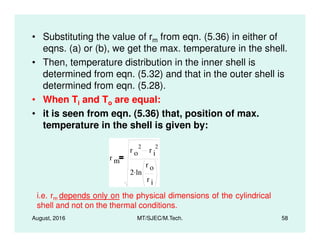
i.e. r m
q g r o
2
r i
2. 4 k. T i T o
.
q g 2. ln
r o
r i
.
........(5.36)
• Substituting the value of rm from eqn. (5.36) in either of
eqns. (a) or (b), we get the max. temperature in the shell.
• Then, temperature distribution in the inner shell is
determined from eqn. (5.32) and that in the outer shell is
determined from eqn. (5.28).
• When Ti and To are equal:
• it is seen from eqn. (5.36) that, position of max.
temperature in the shell is given by:
August, 2016 MT/SJEC/M.Tech. 58
temperature in the shell is given by:
r m
r o
2
r i
2
2 ln
r o
r i
.
i.e. rm depends only on the physical dimensions of the cylindrical
shell and not on the thermal conditions.
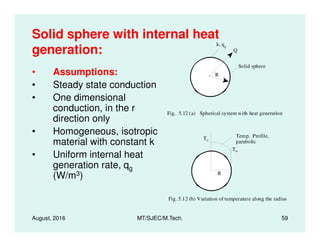
Solid sphere with internal heat
generation:
• Assumptions:
• Steady state conduction
• One dimensional
conduction, in the r
direction only
Q
LTi
To
k, qg
Fig. 5.12 (a) Spherical system with heat generation
R
Solid sphere
August, 2016 MT/SJEC/M.Tech. 59
direction only
• Homogeneous, isotropic
material with constant k
• Uniform internal heat
generation rate, qg
(W/m3)
Temp. Profile,
parabolic
To
Fig. 5.12 (b) Variation of temperature along the radius
R
Tw
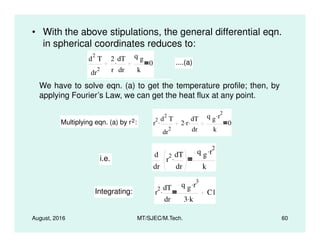
• With the above stipulations, the general differential eqn.
in spherical coordinates reduces to:
d
2
T
dr
2
2
r
dT
dr
.
q g
k
0 ....(a)
We have to solve eqn. (a) to get the temperature profile; then, by
applying Fourier’s Law, we can get the heat flux at any point.
Multiplying eqn. (a) by r2: r
2 d
2
T. 2 r. dT.
q g r
2.
0
August, 2016 MT/SJEC/M.Tech. 60
Multiplying eqn. (a) by r2: r
dr
2
. 2 r.
dr
.
k
0
i.e.
d
dr
r
2 dT
dr
.
q g r
2.
k
Integrating: r
2 dT
dr
.
q g r
3.
3 k.
C1
i.e.
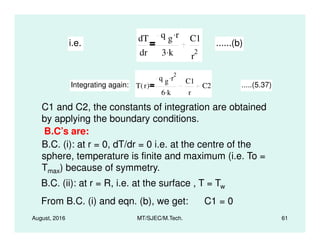
dT
dr
q g r.
3 k.
C1
r
2
......(b)
Integrating again: T r( )
q g r
2.
6 k.
C1
r
C2 .....(5.37)
C1 and C2, the constants of integration are obtained
by applying the boundary conditions.
August, 2016 MT/SJEC/M.Tech. 61
by applying the boundary conditions.
B.C’s are:
B.C. (i): at r = 0, dT/dr = 0 i.e. at the centre of the
sphere, temperature is finite and maximum (i.e. To =
Tmax) because of symmetry.
B.C. (ii): at r = R, i.e. at the surface , T = Tw
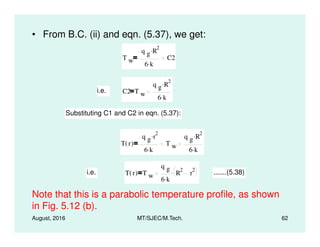
From B.C. (i) and eqn. (b), we get: C1 = 0
• From B.C. (ii) and eqn. (5.37), we get:
T w
q g R
2.
6 k.
C2
i.e. C2 T w
q g R
2.
6 k.
Substituting C1 and C2 in eqn. (5.37):
August, 2016 MT/SJEC/M.Tech. 62
T r( )
q g r
2.
6 k.
T w
q g R
2.
6 k.
i.e. T r( ) T w
q g
6 k.
R
2
r
2. .......(5.38)
Note that this is a parabolic temperature profile, as shown
in Fig. 5.12 (b).
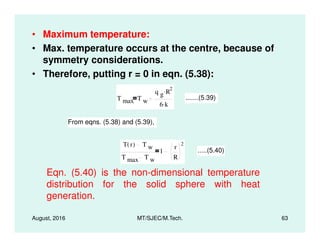
• Maximum temperature:
• Max. temperature occurs at the centre, because of
symmetry considerations.
• Therefore, putting r = 0 in eqn. (5.38):
T max T w
q g R
2.
6 k.
.......(5.39)
From eqns. (5.38) and (5.39),
August, 2016 MT/SJEC/M.Tech. 63
From eqns. (5.38) and (5.39),
T r( ) T w
T max T w
1
r
R
2
.....(5.40)
Eqn. (5.40) is the non-dimensional temperature
distribution for the solid sphere with heat
generation.
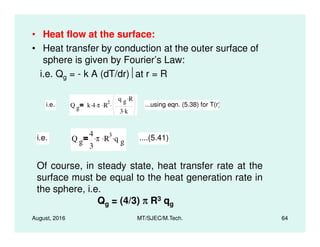
• Heat flow at the surface:
• Heat transfer by conduction at the outer surface of
sphere is given by Fourier’s Law:
i.e. Qg = - k A (dT/dr)at r = R
i.e. Q g k 4. π. R
2.
q g R.
3 k.
. ...using eqn. (5.38) for T(r)
August, 2016 MT/SJEC/M.Tech. 64
i.e. Q g
4
3
π. R
3. q g
. ....(5.41)
Of course, in steady state, heat transfer rate at the
surface must be equal to the heat generation rate in
the sphere, i.e.
Qg = (4/3) ππππ R3 qg
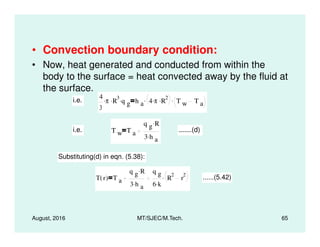
• Convection boundary condition:
• Now, heat generated and conducted from within the
body to the surface = heat convected away by the fluid at
the surface.
i.e.
4
3
π. R
3. q g
. h a 4 π. R
2.. T w T a
.
q g R.
August, 2016 MT/SJEC/M.Tech. 65
i.e. T w T a
q g R.
3 h a
.
.......(d)
Substituting(d) in eqn. (5.38):
T r( ) T a
q g R.
3 h a
.
q g
6 k.
R
2
r
2. ......(5.42)
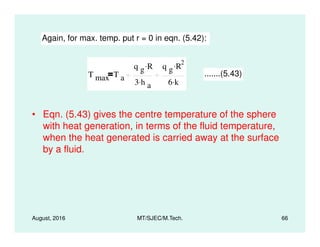
• Eqn. (5.43) gives the centre temperature of the sphere
with heat generation, in terms of the fluid temperature,
Again, for max. temp. put r = 0 in eqn. (5.42):
T max T a
q g R.
3 h a
.
q g R
2.
6 k.
.......(5.43)
August, 2016 MT/SJEC/M.Tech. 66
with heat generation, in terms of the fluid temperature,
when the heat generated is carried away at the surface
by a fluid.
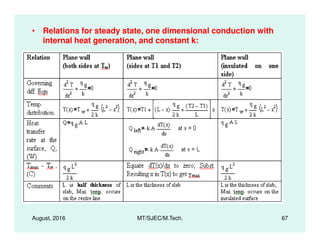
• Relations for steady state, one dimensional conduction with
internal heat generation, and constant k:
August, 2016 MT/SJEC/M.Tech. 67
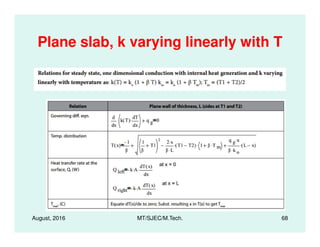
Plane slab, k varying linearly with T
August, 2016 MT/SJEC/M.Tech. 68
Relations for steady state, one dimensional conduction
with internal heat generation, and constant k
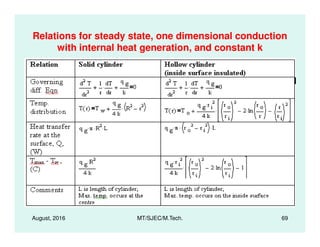
August, 2016 MT/SJEC/M.Tech. 69
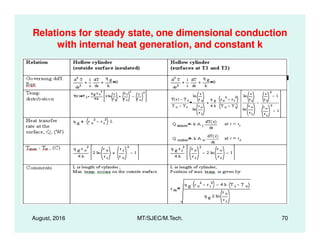
Relations for steady state, one dimensional conduction
with internal heat generation, and constant k
August, 2016 MT/SJEC/M.Tech. 70
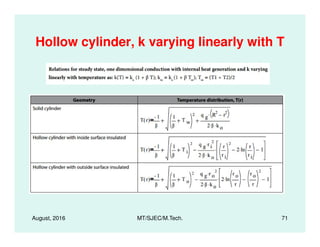
Hollow cylinder, k varying linearly with T
August, 2016 MT/SJEC/M.Tech. 71
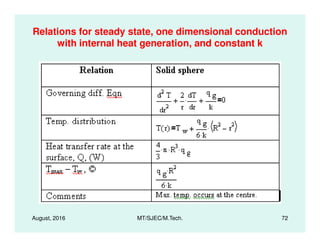
Relations for steady state, one dimensional conduction
with internal heat generation, and constant k
August, 2016 MT/SJEC/M.Tech. 72
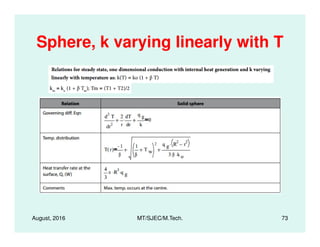
Sphere, k varying linearly with T
August, 2016 MT/SJEC/M.Tech. 73
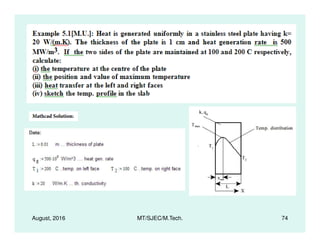
August, 2016 MT/SJEC/M.Tech. 74
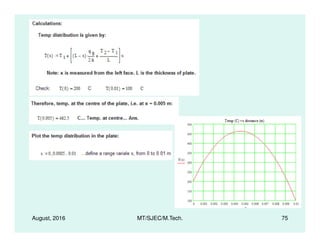
August, 2016 MT/SJEC/M.Tech. 75
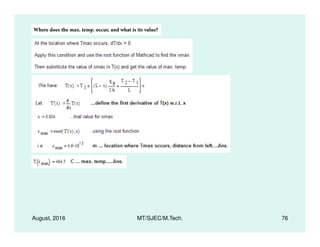
August, 2016 MT/SJEC/M.Tech. 76
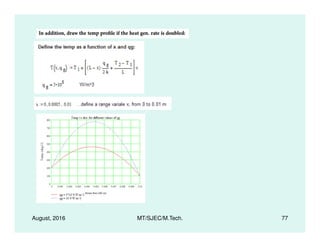
August, 2016 MT/SJEC/M.Tech. 77
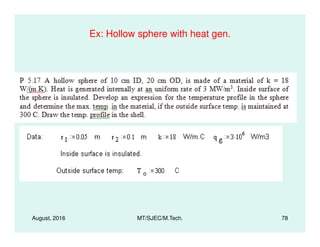
Ex: Hollow sphere with heat gen.
August, 2016 MT/SJEC/M.Tech. 78
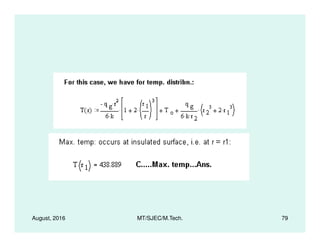
August, 2016 MT/SJEC/M.Tech. 79
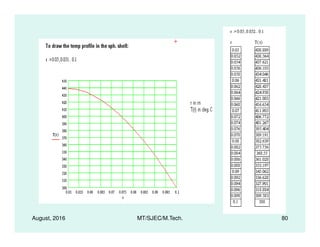
August, 2016 MT/SJEC/M.Tech. 80
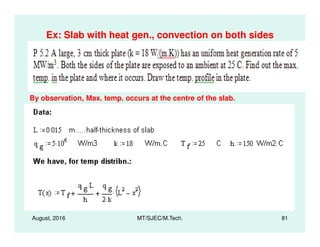
Ex: Slab with heat gen., convection on both sides
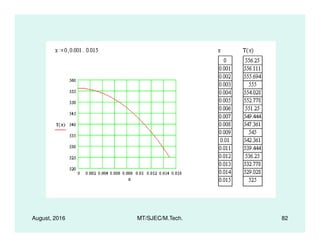
By observation, Max. temp. occurs at the centre of the slab.
August, 2016 MT/SJEC/M.Tech. 81
August, 2016 MT/SJEC/M.Tech. 82

One dim, steady-state, heat conduction_with_heat_generation

  • 1.
    Lectures on HeatTransfer -- One-Dimensional, Steady-State Heat Conduction with Heat Generation by Dr. M. ThirumaleshwarDr. M. Thirumaleshwar formerly: Professor, Dept. of Mechanical Engineering, St. Joseph Engg. College, Vamanjoor, Mangalore
  • 2.
    Preface • This filecontains slides on One- dimensional, steady-state heat conduction with heat generation. • The slides were prepared while teaching• The slides were prepared while teaching Heat Transfer course to the M.Tech. students in Mechanical Engineering Dept. of St. Joseph Engineering College, Vamanjoor, Mangalore, India, during Sept. – Dec. 2010. August, 2016 2MT/SJEC/M.Tech.
  • 3.
    • It ishoped that these Slides will be useful to teachers, students, researchers and professionals working in this field. • For students, it should be particularly useful to study, quickly review the subject,useful to study, quickly review the subject, and to prepare for the examinations. • August, 2016 3MT/SJEC/M.Tech.
  • 4.
    References • 1. M.Thirumaleshwar: Fundamentals of Heat & Mass Transfer, Pearson Edu., 2006 • https://books.google.co.in/books?id=b2238B- AsqcC&printsec=frontcover&source=gbs_atb#v=onepage&q&f=false • 2. Cengel Y. A. Heat Transfer: A Practical Approach, 2nd Ed. McGraw Hill Co., 2003 August, 2016 MT/SJEC/M.Tech. 4 Approach, 2nd Ed. McGraw Hill Co., 2003 • 3. Cengel, Y. A. and Ghajar, A. J., Heat and Mass Transfer - Fundamentals and Applications, 5th Ed., McGraw-Hill, New York, NY, 2014.
  • 5.
    References… contd. • 4.Incropera , Dewitt, Bergman, Lavine: Fundamentals of Heat and Mass Transfer, 6th Ed., Wiley Intl. • 5. M. Thirumaleshwar: Software Solutions to• 5. M. Thirumaleshwar: Software Solutions to Problems on Heat Transfer – CONDUCTION- Part-II, Bookboon, 2013 • http://bookboon.com/en/software-solutions-problems-on-heat- transfer-cii-ebook August, 2016 MT/SJEC/M.Tech. 5
  • 6.
    One-Dimensional, Steady-State Heat Conductionwith Heat Generation • Examples - Plane slab – different BC’s - Cylindrical Systems – Solid cylinder – hollow cylinder – different BC’s – Sphere with heat August, 2016 MT/SJEC/M.Tech. 6 cylinder – different BC’s – Sphere with heat generation- k varying linearly with T
  • 7.
    Examples of situationswith internal heat generation are: • Joule heating in an electrical conductor due to the flow of current in it • Energy generation in a nuclear fuel rod August, 2016 MT/SJEC/M.Tech. 7 due to absorption of neutrons • Exothermic chemical reaction within a system (e.g. combustion), liberating heat at a given rate throughout the system
  • 8.
    Examples (contd.) • Heatliberated in ‘shielding’ used in Nuclear reactors due to absorption of electromagnetic radiation such as gamma rays • Curing of concrete August, 2016 MT/SJEC/M.Tech. 8 • Curing of concrete • Magnetization of iron • Ripening of fruits and in biological decay processes
  • 9.
    Plane slab withuniform internal heat generation: • We shall consider three cases of boundary conditions: • 1. Both the sides of the slab are at the same temperature August, 2016 MT/SJEC/M.Tech. 9 same temperature • 2. Two sides of the slab are at different temperatures, and • 3. One of the sides is insulated
  • 10.
    Plane slab withuniform internal heat generation- both the sides at the same temperature: • Assumptions: • One dimensional conduction i.e. thickness L is small compared to the dimensions in the y and z directions • Steady state conduction i.e. temperature at any point within the slab does not change with time; of course, temperatures at different points within the slab will be August, 2016 MT/SJEC/M.Tech. 10 within the slab does not change with time; of course, temperatures at different points within the slab will be different. • Uniform internal heat generation rate, qg (W/m3) • Material of the slab is homogeneous (i.e. constant density) and isotropic (i.e. value of k is same in all directions).
  • 11.
    Plane slab withuniform internal heat generation- both the sides at the same temperature: k, qg Tw To = Tmax Tw Temp. distribution-(parabolic) August, 2016 MT/SJEC/M.Tech. 11 X Fig.5.1 Plane slab with internal heat generation - both sides at the same temp. LL
  • 12.
    • For theabove mentioned stipulations, governing eqn. in cartesian coordinates reduces to: d 2 T dx 2 q g k 0 ....(5.1) Solution of eqn. (5.1) gives the temperature profile and then, by using Fourier’s equation we get the heat flux at any point. B.C’s: August, 2016 MT/SJEC/M.Tech. 12 B.C’s: (i) at x = 0, dT/dx = 0, since temperature is maximum at the centre line. (ii) at x = ± L, T = Tw Integrating eqn. (5.1) once, dT dx q g x. k C1 .....(a)
  • 13.
    • Integrating again, T qg x 2. 2 k. C1 x. C2 ....(5.2) Applying B.C (i) to eqn.(a): C1 = 0 Applying B.C. (ii) to eqn. (5.2): T w q g L 2. 2 k. C2 2. August, 2016 MT/SJEC/M.Tech. 13 C2 T w q g L 2. 2 k.i.e. Substituting for C1 and C2 in eqn. (5.2): T x( ) q g x 2. 2 k. T w q g L 2. 2 k. i.e. T x( ) T w q g 2 k. L 2 x 2. ....(5.3) where L is half thickness of the slab. (Remember this.)
  • 14.
    • Also, byobservation, T = Tmax at x = 0. (You can show this easily by differentiating eqn. (5.3) w.r.t x and equating to zero.) • Then, putting x = 0 in eqn. (5.3): T max T w q g L 2. 2 k. ......(5.4) Then, from eqns. (5.3) and (5.4), we get: August, 2016 MT/SJEC/M.Tech. 14 T T w T max T w L 2 x 2 L 2 1 x L 2 ....(5.5) Eqn. (5.5) gives the non-dimensional temperature distribution in a slab of half-thickness L, with heat generation. Note that the temperature distribution is parabolic, as shown in Fig. 5.1.
  • 15.
    Convection boundary condition: •In many practical applications, heat is carried away at the boundaries by a fluid at a temperature Tf flowing on the surface with a convective heat transfer coefficient, h. (e.g. current carrying conductor cooled by ambient air or nuclear fuel rod cooled by a liquid metal August, 2016 MT/SJEC/M.Tech. 15 or nuclear fuel rod cooled by a liquid metal coolant). • Then, by an energy balance at the surface: • heat conducted from within the body to the surface = the heat convected away by the fluid at the surface.
  • 16.
    Convection boundary condition: •If A is the surface area of the slab (normal to the direction of heat flow), we have, from energy balance at the surface: q g A. L. h A. T w T f . August, 2016 MT/SJEC/M.Tech. 16 q g A. L. h A. T w T f . i.e. T w T f q g L. h .....(5.6)
  • 17.
    • Substituting eqn.(5.6) in eqn. (5.3), T x( ) T f q g L. h q g 2 k. L 2 x 2. ......(5.7) Eqn. (5.7) gives temperature distribution in a slab with heat generation, in terms of the fluid temperature, Tf . Remember, again, that L is half-thickness of the slab. Heat transfer: August, 2016 MT/SJEC/M.Tech. 17 Heat transfer: By observation, we know that the heat transfer rate from either of the surfaces must be equal to half of the total heat generated within the slab, for the B.C. of Tw being the same at both the surfaces. i.e. Q = qg A L……..(5.8)
  • 18.
    Plane slab withuniform internal heat generation – two sides at different temperatures: • Let T1 > T2. Now, Tmax must occur somewhere within the slab since heat is being generated in the slab and is flowing from inside to outside, both to k, qg Tmax T1 Temp. distribution August, 2016 MT/SJEC/M.Tech. 18 inside to outside, both to the left and right faces. Let Tmax occur at a distance xmax from the origin, as shown in the fig. X Fig. 5.3 Plane slab with internal heat generation - two sides at different temp. T2 L xmax
  • 19.
    • As shownearlier, the general solution for temperature distribution is given by eqn. (5.2), i.e. T q g x 2. 2 k. C1 x. C2 ....(5.2) C1 and C2 are obtained by applying the boundary conditions. For the present case, B. C’s are: B.C.(i): at x = 0, T = T1 August, 2016 MT/SJEC/M.Tech. 19 B.C.(i): at x = 0, T = T1 B.C.(ii): at x = L, T = T2 Then, from B.C.(i) and eqn. (5.2), we get: C2 = T1 and, from B.C.(ii) and eqn. (5.2), we get: T2 q g L 2. 2 k. C1 L. T1 i.e. C1 T2 T1 L q g L. 2 k.
  • 20.
    • Substituting forC1 and C2 in eqn. (5.2), T x( ) q g x 2. 2 k. T2 T1 L q g L. 2 k. x. T1 i.e. T x( ) T1 L x( ) q g 2 k. . T2 T1( ) L x. .....(5.12) Eqn. (5.12) gives the temperature distribution in the slab of thickness L, with heat generation and the two sides maintained at different temperatures of T1 and T2. August, 2016 MT/SJEC/M.Tech. 20 at different temperatures of T1 and T2. Location and value of max. temperature: Differentiate eqn. (5.12) w.r.t. x and equate to zero; Solving, let the value of x obtained be xmax ; Substitute the obtained value of xmax back in eqn. (5.12) to get the value of Tmax.
  • 21.
    • Heat transferto the two sides: • Total heat generated within the slab is equal to : Qtot = qg A L • Part of this heat moves to the left and gets dissipated at the left face; remaining portion of the heat generated moves to the right and gets dissipated from the right face. • Applying Fourier’s Law: August, 2016 MT/SJEC/M.Tech. 21 • Applying Fourier’s Law: Qright = - k A (dT/dx)x=L Qleft = - k A (dT/dx)x=0 …this will be -ve since heat flows from right to left i.e. in –ve x- direction • Of course, sum of Qright and Qleft must be equal to Qtot.
  • 22.
    Convection boundary condition: •Let heat be carried away at the left face by a fluid at a temperature Ta flowing on the surface with a convective heat transfer coefficient, ha, and on the right face, by a fluid at a temperature Tb flowing on the surface with a convective heat transfer coefficient, hb. August, 2016 MT/SJEC/M.Tech. 22 • Note that heat generated in the slab in the volume between x = 0 and x = xmax has to move to the left face and the heat generated in the volume between x = xmax and x = L has to move to the right face, since no heat can cross the plane of max. temperature.
  • 23.
    Convection boundary condition: •Then, we have, from energy balance at the two surfaces: On the left face: q g A. xmax . h a A. T1 T a . ........(a) August, 2016 MT/SJEC/M.Tech. 23 q g A xmax h a A T1 T a ........(a) On the right face: q g A. L xmax . h b A. T2 T b . .........(b)
  • 24.
    • From eqns.(a)and (b), we get T1 and T2 in terms of known fluid temperatures Ta and Tb respectively. • After thus obtaining T1 and T2, substitute them in eqn. (5.12) to get the temperature distribution in terms of fluid temperatures T and T . August, 2016 MT/SJEC/M.Tech. 24 fluid temperatures Ta and Tb .
  • 25.
    Plane slab withuniform internal heat generation – one face perfectly insulated: k, qg Tw Tmax Temp. distributionInsulated h August, 2016 MT/SJEC/M.Tech. 25 X Fig. 5.4 Plane slab with internal heat generation - one side insulated Tw L Ta ha
  • 26.
    • For thiscase, the general solution for temperature distribution is given by eqn. (5.2), i.e. T q g x 2. 2 k. C1 x. C2 ....(5.2) B. C’s are: B.C.(i): at x = 0, dT/dx = 0, since perfectly insulated. B.C.(ii): at x = L, T = Tw August, 2016 MT/SJEC/M.Tech. 26 B.C.(ii): at x = L, T = Tw From eqn. (5.2): dT dx q g x. k C1 Then applying B.C.(i), we get: C1 = 0 From B.C.(ii) and eqn. (5.2): dx k C2 T w q g L 2. 2 k.
  • 27.
    • Substituting forC1 and C2 in eqn. (5.2): T x( ) T w q g 2 k. L 2 x 2. .......(5.13) Eqn. (5.13) gives the temperature distribution in a slab of thickness L, with heat generation when one side is perfectly insulated. August, 2016 MT/SJEC/M.Tech. 27 Fig. 5.4 sketches the temperature distribution in the slab. Note that now, L is the thickness of the slab and not half-thickness.
  • 28.
    In case ofconvection boundary condition: • Since the left face is insulated, all the heat generated in the slab travels to the surface on the right and gets convected away to the fluid. • Heat generated in the slab: Q gen q g A. L. August, 2016 MT/SJEC/M.Tech. 28 Heat convected at surface: Q conv h a A. T w T a . Equating the heat generated and heat convected, we get: T w T a q g L. h a ....(a)
  • 29.
    • Substituting from(a) in eqn. (5.13), T x( ) T a q g L. h a q g 2 k. L 2 x 2. .......(5.14) Maximum temperature: Obviously, max. temperature occurs at the insulated surface. Putting x = 0 in eqn. (5.13): August, 2016 MT/SJEC/M.Tech. 29 Putting x = 0 in eqn. (5.13): T max T w q g L 2. 2 k. .....(5.15) Eq. (5.15) gives Tmax in terms of wall temperature, Tw.
  • 30.
    • Substituting forTw from eqn. (a) in eqn. (5.15): T max T a q g L. h a q g L 2. 2 k. .....(5.16) Eq. (5.16) gives Tmax in terms of fluid temperature, Ta. From eqn. (5.13) and (5.15), we can write: T x( ) T w L 2 x 2 1 x 2 ....(5.17) August, 2016 MT/SJEC/M.Tech. 30 T x( ) T w T max T w L x L 2 1 x L ....(5.17) Eqn. (5.17) gives non-dimensional temperature distribution for a slab with heat generation, and one face insulated. Note that now L is the thickness of the slab.
  • 31.
    Solid cylinder with internalheat generation: • Consider a solid cylinder of radius, R and length, L. There is uniform heat generation within its volume at a Q LTi To k, qg Fig. 5.5 (a) Cylindrical system with heat generation L R August, 2016 MT/SJEC/M.Tech. 31 within its volume at a rate of qg (W/m3). Let the thermal conductivity, k be constant. • See Fig. 5.5. Temp. Profile, parabolic To Fig. 5.5 (b) Variation of temperature along the radius R Tw
  • 32.
    • Now, thegeneral differential eqn. in cylindrical coordinates reduces to: d 2 T dr 2 1 r dT dr . q g k 0 ....(a) Multiplying by r: r d 2 T dr 2 . dT dr q g r. k 0 i.e. d r dT. q g r. August, 2016 MT/SJEC/M.Tech. 32 i.e. dr r dr . k Integrating: r dT dr . q g r 2. 2 k. C1 i.e. dT dr q g r. 2 k. C1 r ......(b) Integrating again: T r( ) q g r 2. 4 k. C1 ln r( ). C2 .....(5.18)
  • 33.
    • Eqn. (5.18)is the general relation for temperature distribution along the radius, for a cylindrical system, with uniform heat generation. • C1 and C2, the constants of integration are obtained by applying the boundary conditions. • B.C’s are: • B.C. (i): at r = 0, dT/dr = 0 i.e. at the center of the August, 2016 MT/SJEC/M.Tech. 33 • B.C. (i): at r = 0, dT/dr = 0 i.e. at the center of the cylinder, temperature is finite and maximum (i.e. To = Tmax) because of symmetry.
  • 34.
    • B.C. (ii):at r = R, i.e. at the surface , T = Tw • From B.C. (i) and eqn. (b), we get: C1 = 0 • From B.C. (ii) and eqn. (5.18), we get: T w q g R 2. 4 k. C2 August, 2016 MT/SJEC/M.Tech. 34 w 4 k. i.e. C2 T w q g R 2. 4 k.
  • 35.
    • Eqn. (5.19)is the relation for temperature distribution Substituting C1 and C2 in eqn. (5.18): T r( ) q g r 2. 4 k. T w q g R 2. 4 k. i.e. T r( ) T w q g 4 k. R 2 r 2. .......(5.19) August, 2016 MT/SJEC/M.Tech. 35 • Eqn. (5.19) is the relation for temperature distribution in terms of the surface temperature, Tw. • Note that this is a parabolic temperature profile, as shown in Fig. 5.5 (b). • Maximum temperature: • Max. temperature occurs at the centre, because of symmetry considerations.
  • 36.
    • Therefore, puttingr = 0 in eqn. (5.19): T max T w q g R 2. 4 k. .......(5.20) From eqns. (5.19) and (5.20), T T w T max T w 1 r R 2 .......(5.21) Eqn. (5.21) is the non-dimensional temperature August, 2016 MT/SJEC/M.Tech. 36 Eqn. (5.21) is the non-dimensional temperature distribution for the solid cylinder with heat generation. Convection boundary condition: By an energy balance at the surface: heat generated and conducted from within the body to the surface = the heat convected away by the fluid at the surface.
  • 37.
    i.e. π R 2.L. q g . h 2 π. R. L.( ). T w T a . i.e. T w T a q g R. 2 h. .......(c) Substituting(c) in eqn. (5.19): T r( ) T a q g R. 2 h. q g 4 k. R 2 r 2. ......(5.22) August, 2016 MT/SJEC/M.Tech. 37 Again, for max. temp. put r = 0 in eqn. (5.22): T max T a q g R. 2 h. q g R 2. 4 k. .......(5.23) Eqn. (5.23) gives maximum temperature in the solid cylinder in terms of the fluid temperature, Ta.
  • 38.
    Current carrying conductor: •Consider a conductor of cross-sectional area, Ac and length, L. Let the current carried be I (Amp.). Let the electrical resistivity of the material be ρ (Ohm.m). • Then, heat generated per unit volume = Qg / Vol. of conductor, where Qg is the total heat generated (W). Q g I 2 R. where R = electrical resistance of wire, (Ohms) August, 2016 MT/SJEC/M.Tech. 38 g But, R ρ L. A c Therefore, q g I 2 R. A c L. I 2 ρ L. A c . A c L. I A c 2 ρ. ...W/m3 i = I/Ac , is known as the ‘current density’. Note its Units: A/m2
  • 39.
    • Therefore, temperaturedistribution in a current carrying wire (of solid, cylindrical shape) is given by eq. (5.19), viz. i.e. q g i 2 ρ. i 2 k e where k e 1 ρ = electrical conductivity, (Ohm.m) -1 T r( ) T w q g 4 k. R 2 r 2. .......(5.19) Substituting for q , we get: August, 2016 MT/SJEC/M.Tech. 39 Substituting for qg, we get: T r( ) T w i 2 ρ. 4 k. R 2 r 2. .......(5.19 (a)) Max. temperature, which occurs at the centre, is obtained by putting r = 0 in eqn. (5.19, a). i.e. T max T w i 2 ρ. R 2. 4 k. ........(5.20(a))
  • 40.
    • And, fromeqns. (5.19 a) and (5.20 a), we get: T T w T max T w 1 r R 2 Note that the above eqn. for non-dimensional temperature distribution in a current carrying wire is the same as eqn. (5.21). August, 2016 MT/SJEC/M.Tech. 40
  • 41.
    Hollow cylinder withheat generation: • Hollow cylinder with the inside surface insulated: • We have: k, qgQ To Ti To Insulated T r( ) q g r 2. 4 k. C1 ln r( ). C2 .....(5.18) August, 2016 MT/SJEC/M.Tech. 41 Fig. 5.7 Hollow cylinder with heat generation, inside surface insulated ri ro 4 k. B.C.’s are: B.C.(i): at r = ri T = Ti and dT/dx = 0 (since inner surface is insulated), and B.C.(ii): at r = ro T= To Get C1 and C2 from these B.C.’s and substitute back in eqn. (5.18) to get the temperature distribution.
  • 42.
    Hollow cylinder withthe inside surface insulated: • ALTERNATIVE METHOD: k, qg Q To Ti To Insulated dr r We shall derive the expression for temperature distribution by a simpler method of physical consideration August, 2016 MT/SJEC/M.Tech. 42 Fig. 5.8 Hollow cylinder with heat generation, inside surface insulated To Ti To ri ro Since the inside surface is insulated, heat generated within the volume between r = ri and r = r, must travel only outward; and, this heat must be equal to the heat conducted away from the surface at radius r. and heat balance:
  • 43.
    • Writing thisheat balance, q g π. r 2 r i 2. L. k 2. π. r. L. dT dr . where dT/dr is the temp. gradient at radius r. i.e. dT q g r i 2. 2 k. dr r . q g 2 k. r. dr. Integrating, T r( ) q g r i 2. ln r( ). q g r 2. C .....(b) August, 2016 MT/SJEC/M.Tech. 43 Integrating, T r( ) 2 k. ln r( ). 4 k. C .....(b) The integration constant C is obtained from the B.C.: At r = ro, T = To Applying this B.C. to eqn. (b): C T o q g r o 2. 4 k. q g r i 2. 2 k. ln r o .
  • 44.
    • Substituting valueof C back in eqn. (b), we get, T r( ) q g r i 2. 2 k. ln r( ). q g r 2. 4 k. T o q g r o 2. 4 k. q g r i 2. 2 k. ln r o . i.e. T r( ) T o q g r i 2. 4 k. r o r i 2 2 ln r o r . r r i 2 . .........(5.27) Putting r = ri and T = Ti in eqn. (5.27), we get, August, 2016 MT/SJEC/M.Tech. 44 T i T o q g r i 2. 4 k. r o r i 2 2 ln r o r i . 1. i.e. T i T o q g r i 2. 4 k. r o r i 2 2 ln r o r i . 1. ............(5.28)
  • 45.
    • Eqn. (5.28)is important, since it gives the max. temperature drop in the cylindrical shell, when there is internal heat generation and the inside surface is insulated. • If either of To or Ti is given in a problem, then the other temperature can be calculated using eqn. (5.28). Convection boundary condition: August, 2016 MT/SJEC/M.Tech. 45 By an energy balance at the surface: heat generated within the body and conducted to the outer surface is equal to the heat convected away by the fluid at the surface. i.e. q g π. r o 2 r i 2. L. h a 2. π. r o . L. T o T a .
  • 46.
    • Substituting thevalue of To from eqn. (c) in eqn. (5.27), we get: i.e. T o T a q g r o 2 r i 2. 2 h a . r o . ......(c) T r( ) T a q g r o 2 r i 2. 2 h a . r o . q g r i 2. 4 k. r o r i 2 2 ln r o r i . r r i 2 . .........(5.29) August, 2016 MT/SJEC/M.Tech. 46 Eqn. (5.29) gives the temperature distribution in the cylindrical shell with heat generation, inside surface insulated, when the heat generated is carried away by a fluid flowing on the outer surface.
  • 47.
    Hollow cylinder withthe outside surface insulated: • Start with: T r( ) q g r 2. 4 k. C1 ln r( ). C2 .....(5.18) Proceeding as earlier, apply the BC’s, get C1 and C2, substitute in (5.18) to get the temp. distribution. ALTERNATIVELY: August, 2016 MT/SJEC/M.Tech. 47 ALTERNATIVELY: Since the outside surface is insulated, heat generated within the volume between r = ro and r = r, must travel only inward; and, this heat must be equal to the heat conducted from the surface at radius r. We shall derive the expression for temperature distribution by a simpler method of physical consideration and heat balance:
  • 48.
    • Writing thisheat balance, k, qg Q Ti To Insulated dr Note that the term on the RHS has +ve sign, since, now, the heat transfer is from outside to inside, i.e. in the August, 2016 MT/SJEC/M.Tech. 48 Fig. 5.10 Hollow cylinder with heat generation, outside surface insulated ri ro outside to inside, i.e. in the –ve r-direction (because the outside surface is insulated).
  • 49.
    • Integrating: T r() q g r o 2. 2 k. ln r( ). q g r 2. 4 k. C .......(b) Eqn. (b) is the general solution for temperature distribution. The integration constant C is obtained by the B.C.: At r = ri , T = Ti Applying this B.C. to eqn. (b): August, 2016 MT/SJEC/M.Tech. 49 Applying this B.C. to eqn. (b): C T i q g r o 2. 2 k. ln r i . q g r i 2. 4 k. Substituting value of C back in eqn. (b): T r( ) q g r o 2. 2 k. ln r( ). q g r 2. 4 k. T i q g r o 2. 2 k. ln r i . q g r i 2. 4 k.
  • 50.
    • Putting r= ro and T = To in eqn. (5.31), we get, i.e. T r( ) T i q g r o 2. 4 k. 2 ln r r i . r i r o 2 r r o 2 . ..........(5.31) T o T i q g r o 2. 4 k. 2 ln r o r i . r i r o 2 1. .......(5.32) August, 2016 MT/SJEC/M.Tech. 50 Eqn. (5.32) is important, since it gives the max. temperature drop in the cylindrical shell, when there is internal heat generation and the outside surface is insulated. If either of To or Ti is given in a problem, then the other temperature can be calculated using eqn. (5.32).
  • 51.
    • Convection boundarycondition: • We relate the surface temperature and fluid temperature by an energy balance at the surface: • heat generated within the body and conducted to the inner surface is equal to the heat convected away by the fluid at the surface. i.e. T T q g r o 2 r i 2. ......(c) August, 2016 MT/SJEC/M.Tech. 51 i.e. T i T a g o i 2 h a . r i . ......(c) Using eqn. (c) in eqn. (5.31), we get: T r( ) T a q g r o 2 r i 2. 2 h a . r i . q g r o 2. 4 k. 2 ln r r i . r i r o 2 r r o 2 . .......(5.33)
  • 52.
    Hollow cylinder withboth the surfaces maintained at constant temperatures: • We have for temp. distribution: k, qg To Ti To rm Tm T r( ) q g r 2. 4 k. C1 ln r( ). C2 .....(5.18) August, 2016 MT/SJEC/M.Tech. 52 Fig. 5.11 Hollow cylinder with heat generation, losing heat from both surfaces ri ro C1 and C2, the constants of integration are obtained by applying the boundary conditions.
  • 53.
    • B.C.’s are: •B.C.(i): at r = ri T = Ti , and • B.C.(ii): at r = ro T= To • Get C1 and C2 from these B.C.’s and substitute back in eqn. (5.18) to get the temperature distribution. • After lengthy algebraic manipulations, we get, for temp. distribution: August, 2016 MT/SJEC/M.Tech. 53 T r( ) T i T o T i ln r r i ln r o r i q g 4 k. r o 2 r i 2 T o T i . ln r r i ln r o r i r r i 2 1 r o r i 2 1 . ......(5.35)
  • 54.
    Hollow cylinder withboth the surfaces maintained at constant temperatures: • ALTERNATIVE METHOD: • Let max. temp. occur at a radius rm . Obviously, rm lies in between ri and ro. k, qg To Ti To rm Tm August, 2016 MT/SJEC/M.Tech. 54 i o • Therefore, dT/dr at r = rm will be zero; i.e. surface at rm may be considered as representing an insulated boundary condition. Fig. 5.11 Hollow cylinder with heat generation, losing heat from both surfaces ri ro
  • 55.
    • So, thecylindrical shell may be thought of as being made up of two shells; the inner shell, between r = ri and r = rm , insulated on its ‘outer periphery’ and, an outer shell, between r = rm and r = ro, insulated at its ‘inner periphery’. • Then, max. temperature difference for the inner shell and outer shell can be written from eqn.(5.32) and (5.28) respectively. So, we write: August, 2016 MT/SJEC/M.Tech. 55 • For the ‘inner shell’ (insulated on the ‘outer’’ surface): T m T i q g r m 2. 4 k. 2 ln r m r i . r i r m 2 1. .......(a) Eqn. (a) is obtained by replacing ro by rm and To by Tm in eqn. (5.32).
  • 56.
    •For the ‘outershell’ (insulated on the ‘inner’’ surface): T m T o q g r m 2. 4 k. r o r m 2 2 ln r o r m . 1. ............(b) Eqn. (b) is obtained by replacing r by r and T by T in eqn. (5.28). August, 2016 MT/SJEC/M.Tech. 56 Eqn. (b) is obtained by replacing ri by rm and Ti by Tm in eqn. (5.28). •Subtracting eqn. (a) from (b): T i T o q g r m 2. 4 k. r o r m 2 2 ln r o r m . 1 2 ln r m r i . r i r m 2 1.
  • 57.
    i.e. T iT o q g r m 2. 4 k. r o r m 2 r i r m 2 2 ln r m r o . 2 ln r m r i .. ....(c) Eqn. (c) must be solved for rm. After some manipulation, we get: August, 2016 MT/SJEC/M.Tech. 57 i.e. r m q g r o 2 r i 2. 4 k. T i T o . q g 2. ln r o r i . ........(5.36)
  • 58.
    • Substituting thevalue of rm from eqn. (5.36) in either of eqns. (a) or (b), we get the max. temperature in the shell. • Then, temperature distribution in the inner shell is determined from eqn. (5.32) and that in the outer shell is determined from eqn. (5.28). • When Ti and To are equal: • it is seen from eqn. (5.36) that, position of max. temperature in the shell is given by: August, 2016 MT/SJEC/M.Tech. 58 temperature in the shell is given by: r m r o 2 r i 2 2 ln r o r i . i.e. rm depends only on the physical dimensions of the cylindrical shell and not on the thermal conditions.
  • 59.
    Solid sphere withinternal heat generation: • Assumptions: • Steady state conduction • One dimensional conduction, in the r direction only Q LTi To k, qg Fig. 5.12 (a) Spherical system with heat generation R Solid sphere August, 2016 MT/SJEC/M.Tech. 59 direction only • Homogeneous, isotropic material with constant k • Uniform internal heat generation rate, qg (W/m3) Temp. Profile, parabolic To Fig. 5.12 (b) Variation of temperature along the radius R Tw
  • 60.
    • With theabove stipulations, the general differential eqn. in spherical coordinates reduces to: d 2 T dr 2 2 r dT dr . q g k 0 ....(a) We have to solve eqn. (a) to get the temperature profile; then, by applying Fourier’s Law, we can get the heat flux at any point. Multiplying eqn. (a) by r2: r 2 d 2 T. 2 r. dT. q g r 2. 0 August, 2016 MT/SJEC/M.Tech. 60 Multiplying eqn. (a) by r2: r dr 2 . 2 r. dr . k 0 i.e. d dr r 2 dT dr . q g r 2. k Integrating: r 2 dT dr . q g r 3. 3 k. C1
  • 61.
    i.e. dT dr q g r. 3k. C1 r 2 ......(b) Integrating again: T r( ) q g r 2. 6 k. C1 r C2 .....(5.37) C1 and C2, the constants of integration are obtained by applying the boundary conditions. August, 2016 MT/SJEC/M.Tech. 61 by applying the boundary conditions. B.C’s are: B.C. (i): at r = 0, dT/dr = 0 i.e. at the centre of the sphere, temperature is finite and maximum (i.e. To = Tmax) because of symmetry. B.C. (ii): at r = R, i.e. at the surface , T = Tw From B.C. (i) and eqn. (b), we get: C1 = 0
  • 62.
    • From B.C.(ii) and eqn. (5.37), we get: T w q g R 2. 6 k. C2 i.e. C2 T w q g R 2. 6 k. Substituting C1 and C2 in eqn. (5.37): August, 2016 MT/SJEC/M.Tech. 62 T r( ) q g r 2. 6 k. T w q g R 2. 6 k. i.e. T r( ) T w q g 6 k. R 2 r 2. .......(5.38) Note that this is a parabolic temperature profile, as shown in Fig. 5.12 (b).
  • 63.
    • Maximum temperature: •Max. temperature occurs at the centre, because of symmetry considerations. • Therefore, putting r = 0 in eqn. (5.38): T max T w q g R 2. 6 k. .......(5.39) From eqns. (5.38) and (5.39), August, 2016 MT/SJEC/M.Tech. 63 From eqns. (5.38) and (5.39), T r( ) T w T max T w 1 r R 2 .....(5.40) Eqn. (5.40) is the non-dimensional temperature distribution for the solid sphere with heat generation.
  • 64.
    • Heat flowat the surface: • Heat transfer by conduction at the outer surface of sphere is given by Fourier’s Law: i.e. Qg = - k A (dT/dr)at r = R i.e. Q g k 4. π. R 2. q g R. 3 k. . ...using eqn. (5.38) for T(r) August, 2016 MT/SJEC/M.Tech. 64 i.e. Q g 4 3 π. R 3. q g . ....(5.41) Of course, in steady state, heat transfer rate at the surface must be equal to the heat generation rate in the sphere, i.e. Qg = (4/3) ππππ R3 qg
  • 65.
    • Convection boundarycondition: • Now, heat generated and conducted from within the body to the surface = heat convected away by the fluid at the surface. i.e. 4 3 π. R 3. q g . h a 4 π. R 2.. T w T a . q g R. August, 2016 MT/SJEC/M.Tech. 65 i.e. T w T a q g R. 3 h a . .......(d) Substituting(d) in eqn. (5.38): T r( ) T a q g R. 3 h a . q g 6 k. R 2 r 2. ......(5.42)
  • 66.
    • Eqn. (5.43)gives the centre temperature of the sphere with heat generation, in terms of the fluid temperature, Again, for max. temp. put r = 0 in eqn. (5.42): T max T a q g R. 3 h a . q g R 2. 6 k. .......(5.43) August, 2016 MT/SJEC/M.Tech. 66 with heat generation, in terms of the fluid temperature, when the heat generated is carried away at the surface by a fluid.
  • 67.
    • Relations forsteady state, one dimensional conduction with internal heat generation, and constant k: August, 2016 MT/SJEC/M.Tech. 67
  • 68.
    Plane slab, kvarying linearly with T August, 2016 MT/SJEC/M.Tech. 68
  • 69.
    Relations for steadystate, one dimensional conduction with internal heat generation, and constant k August, 2016 MT/SJEC/M.Tech. 69
  • 70.
    Relations for steadystate, one dimensional conduction with internal heat generation, and constant k August, 2016 MT/SJEC/M.Tech. 70
  • 71.
    Hollow cylinder, kvarying linearly with T August, 2016 MT/SJEC/M.Tech. 71
  • 72.
    Relations for steadystate, one dimensional conduction with internal heat generation, and constant k August, 2016 MT/SJEC/M.Tech. 72
  • 73.
    Sphere, k varyinglinearly with T August, 2016 MT/SJEC/M.Tech. 73
  • 74.
  • 75.
  • 76.
  • 77.
  • 78.
    Ex: Hollow spherewith heat gen. August, 2016 MT/SJEC/M.Tech. 78
  • 79.
  • 80.
  • 81.
    Ex: Slab withheat gen., convection on both sides By observation, Max. temp. occurs at the centre of the slab. August, 2016 MT/SJEC/M.Tech. 81
  • 82.