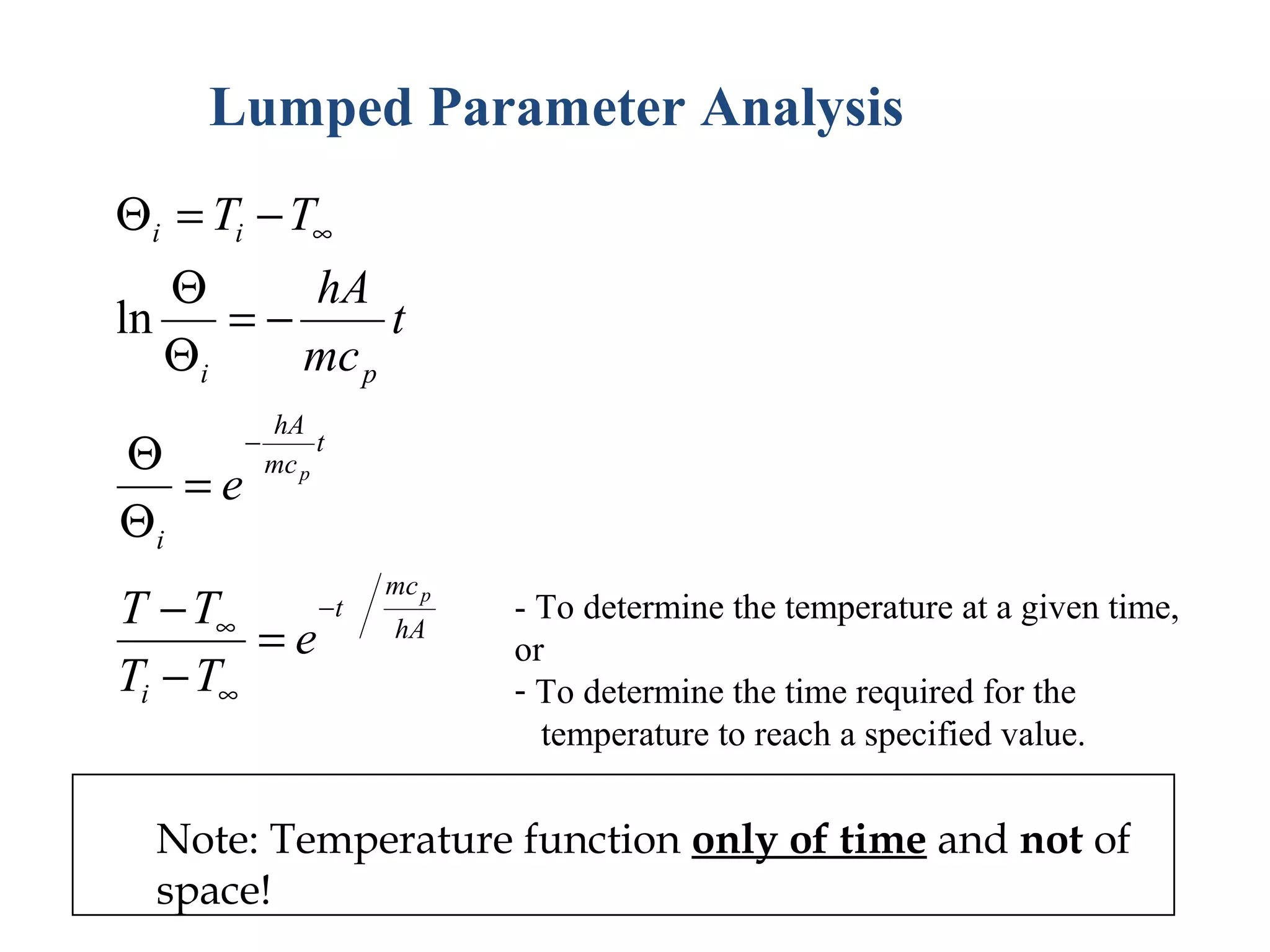
The document discusses lumped parameter analysis for modeling unsteady heat transfer. Lumped parameter analysis can be used when the Biot number is less than 0.1, indicating the internal resistance to heat transfer is negligible. Under these conditions, the body can be treated as isothermal and the temperature at any point depends only on time. The governing equation and its solution are presented, allowing the temperature to be determined at a given time or the time required to reach a specified temperature. The lumped parameter method models transient heat transfer without considering variations in temperature within the solid.
Subject :Heat Transfer(2151909)
Topic :Lumped Parameter Analysis
GANDHINAGAR INSTITUTE
OF TECHNOLOGY(012)
2.
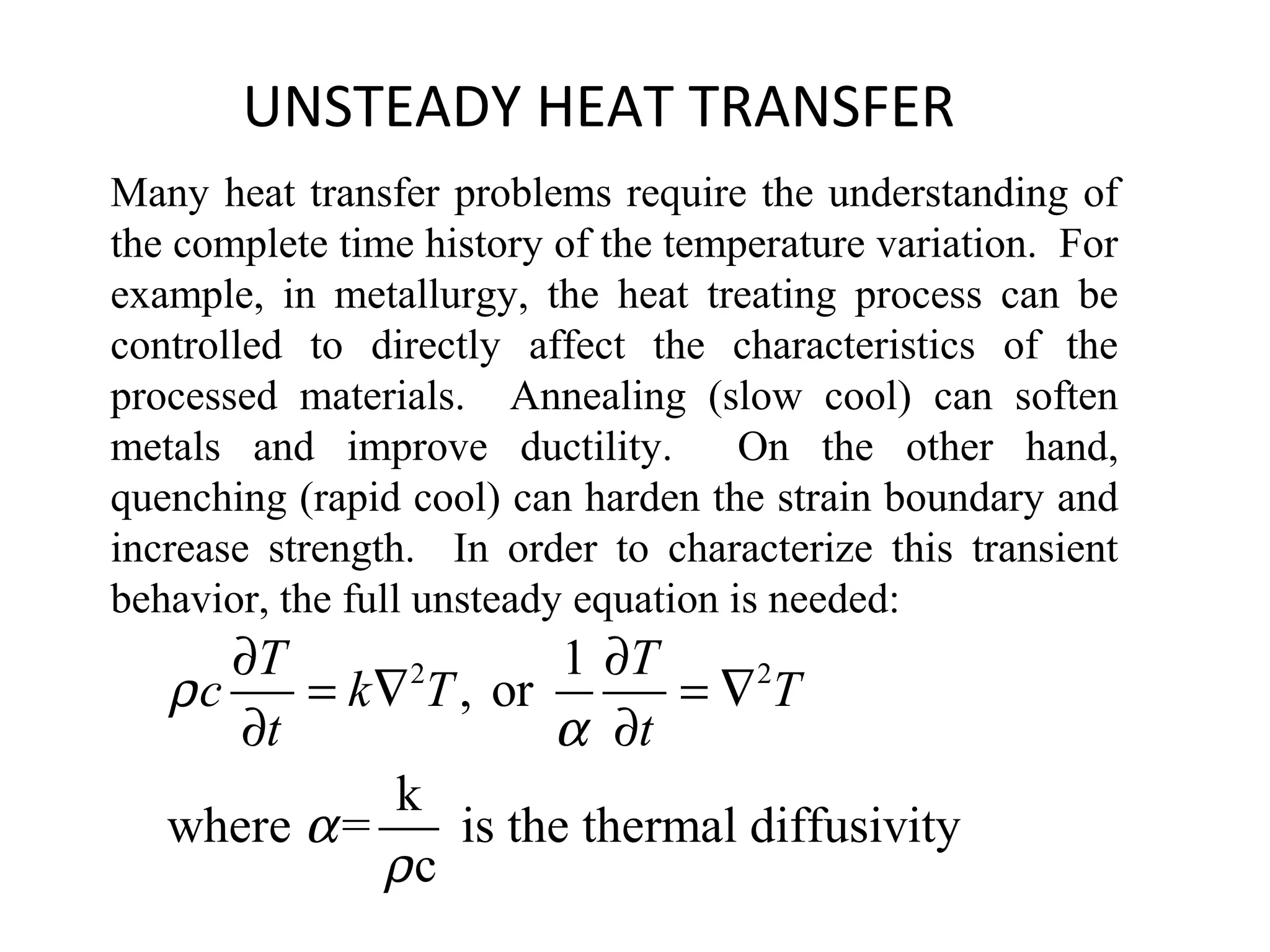
UNSTEADY HEAT TRANSFER
Manyheat transfer problems require the understanding of
the complete time history of the temperature variation. For
example, in metallurgy, the heat treating process can be
controlled to directly affect the characteristics of the
processed materials. Annealing (slow cool) can soften
metals and improve ductility. On the other hand,
quenching (rapid cool) can harden the strain boundary and
increase strength. In order to characterize this transient
behavior, the full unsteady equation is needed:
2 21
, or
k
where = is the thermal diffusivity
c
T T
c k T T
t t
ρ
α
α
ρ
∂ ∂
= ∇ = ∇
∂ ∂
3.
“A heated/cooled bodyat Ti is suddenly exposed to fluid at T∞ with a
known heat transfer coefficient . Either evaluate the temperature at a
given time, or find time for a given temperature.”
4.
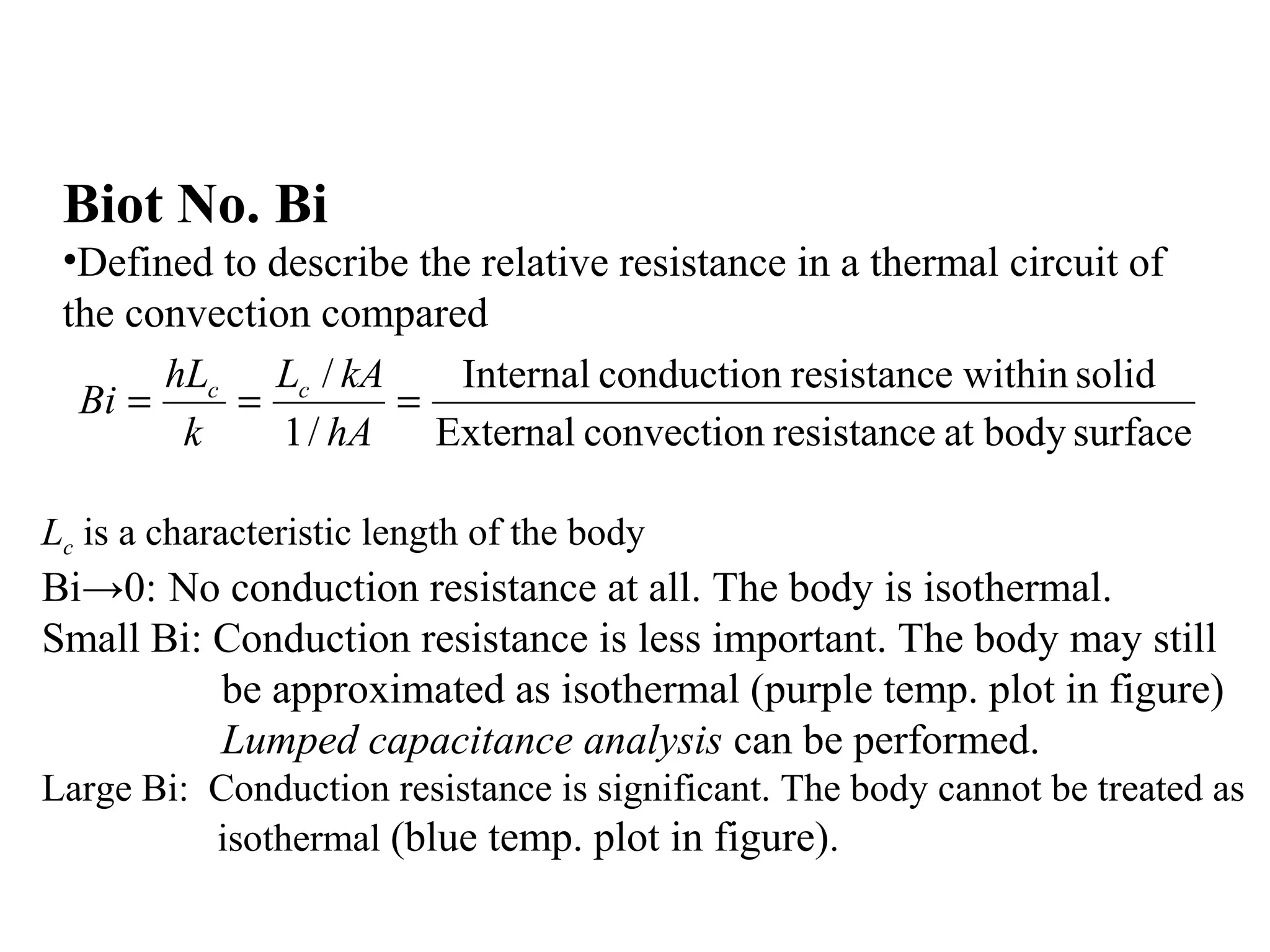
Biot No. Bi
•Definedto describe the relative resistance in a thermal circuit of
the convection compared
Lc is a characteristic length of the body
Bi→0: No conduction resistance at all. The body is isothermal.
Small Bi: Conduction resistance is less important. The body may still
be approximated as isothermal (purple temp. plot in figure)
Lumped capacitance analysis can be performed.
Large Bi: Conduction resistance is significant. The body cannot be treated as
isothermal (blue temp. plot in figure).
surfacebodyatresistanceconvectionExternal
solidwithinresistanceconductionInternal
/1
/
===
hA
kAL
k
hL
Bi cc
5.
Transient heat transferwith no internal
resistance: Lumped Parameter Analysis
Solid
Valid for Bi<0.1
Total Resistance= Rexternal + Rinternal
GE:
dT
dt
= −
hA
mcp
T − T∞( ) BC: T t = 0( )= Ti
Solution: let Θ = T − T∞, therefore
dΘ
dt
= −
hA
mcp
Θ
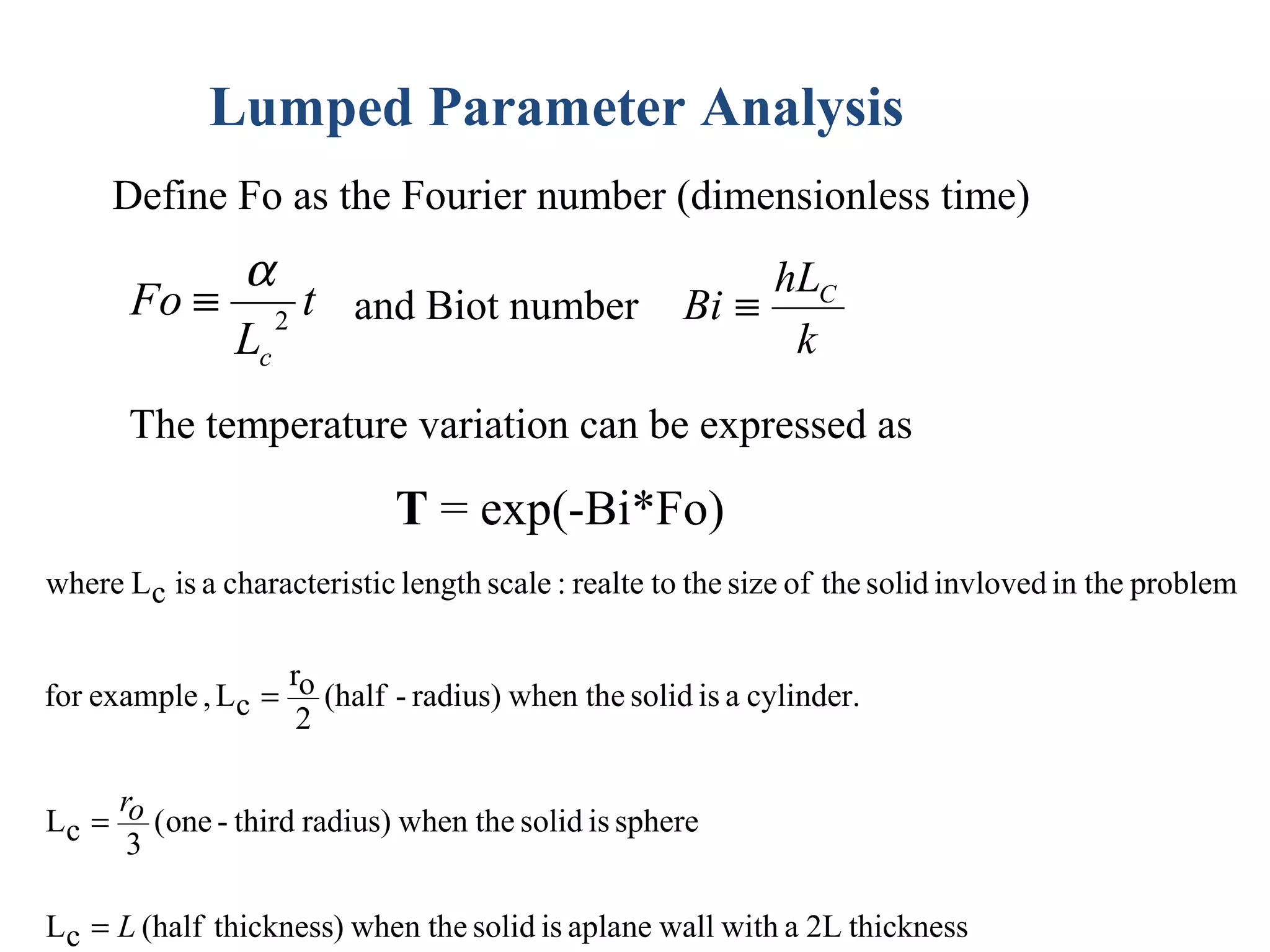
Lumped Parameter Analysis
t
L
Fo
c
2
α
≡
k
hL
BiC
≡
thickness2Lawithwallaplaneissolidthewhen)thickness(halfcL
sphereissolidthewhenradius)third-one(
3cL
cylinder.aissolidthewhenradius)-(half
2
or
cL,examplefor
problemtheininvlovedsolidtheofsizethetorealte:scalelengthsticcharacteriaiscLwhere
L
or
=
=
=
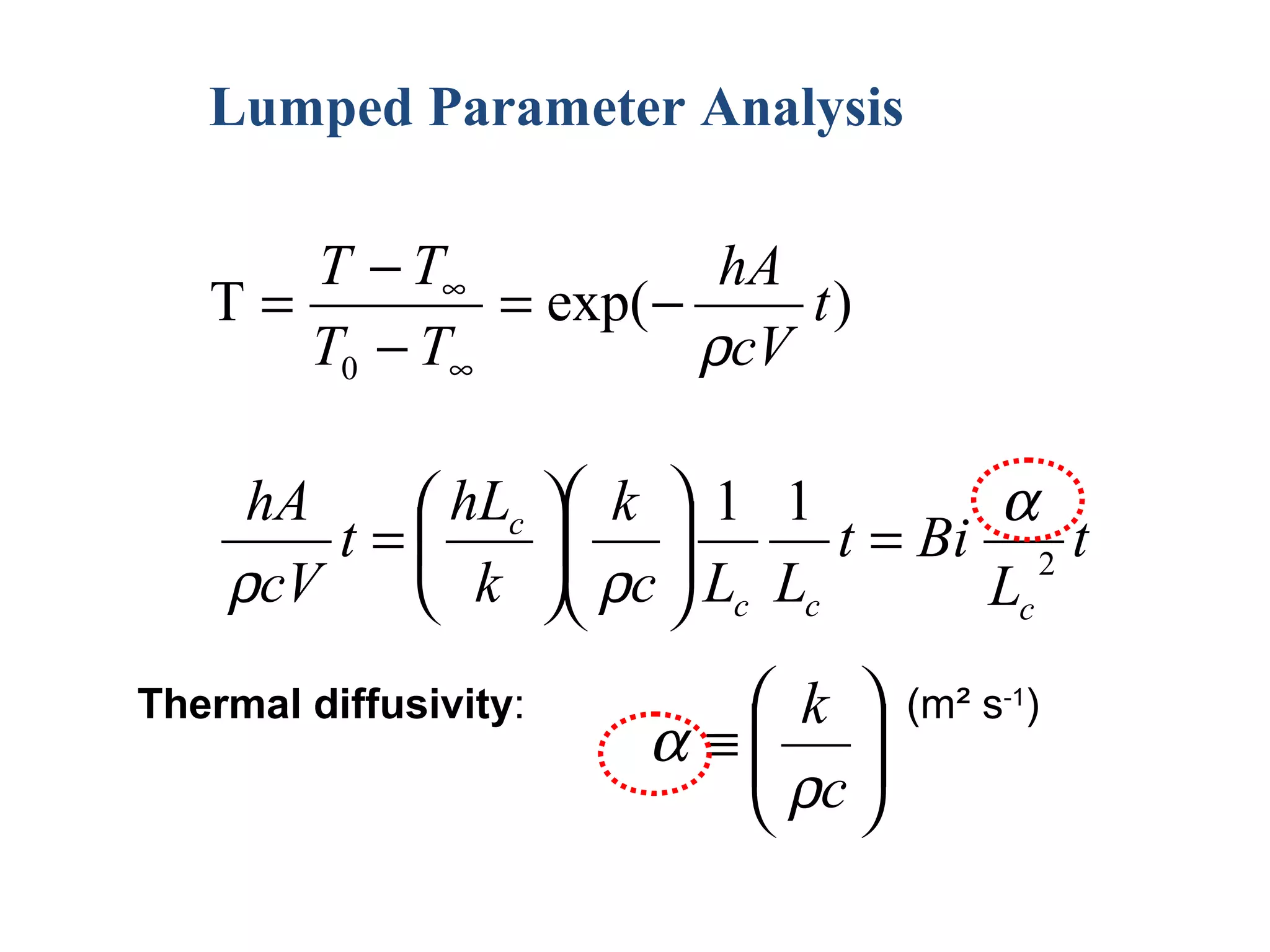
T = exp(-Bi*Fo)
Define Fo as the Fourier number (dimensionless time)
and Biot number
The temperature variation can be expressed as