CHAPTER 2
SOLIDIFICATION MECHANISMS AND PHASE DIAGRAMS
 Homogeneous and heterogeneous nucleation
 Nucleation and Crystal Growth
 Solid solutions and types
 Phase diagrams
 Lever rule and its applications
 Iron-Carbide system
MTE/III SEMESTER/MSE/MTE 2101 1
CONTENTS
 Introduction
 Definition of solidification
 Melting of Metals
 Cooling curves
 Nucleation and Crystal Growth
MTE/III SEMESTER/MSE/MTE 2101 2
INTRODUCTION
 It is the process where liquid metal transforms into solid upon cooling.
 The properties of the solidified metal depends on its microstructure and the microstructure in turn depends
on the Solidification Mechanism.
 The rate of cooling of liquid metals, the type of mould used, the temperature at which the molten metal is
poured into the mould are all a part of solidification process.
 Transformation from liquid metal to solid metal is accompanied by shrinkage of volume.
MTE/III SEMESTER/MSE/MTE 2101 3
DEFINITION
 The transformation of metals and alloys from liquid state to solid state
(crystalline state) is called solidification or crystallization.
MTE/III SEMESTER/MSE/MTE 2101 4
MELTING OF METALS
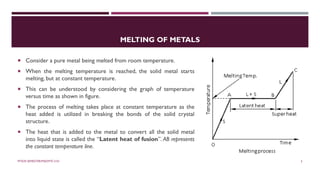
 Consider a pure metal being melted from room temperature.
 When the melting temperature is reached, the solid metal starts
melting, but at constant temperature.
 This can be understood by considering the graph of temperature
versus time as shown in figure.
 The process of melting takes place at constant temperature as the
heat added is utilized in breaking the bonds of the solid crystal
structure.
 The heat that is added to the metal to convert all the solid metal
into liquid state is called the “Latent heat of fusion”. AB represents
the constant temperature line.
MTE/III SEMESTER/MSE/MTE 2101 5
FREEZING OR SOLIDIFICATION OR CRYSTALLIZATION OF METALS
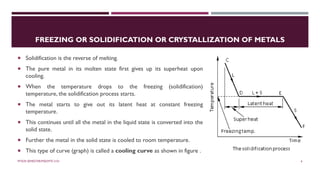
 Solidification is the reverse of melting.
 The pure metal in its molten state first gives up its superheat upon
cooling.
 When the temperature drops to the freezing (solidification)
temperature, the solidification process starts.
 The metal starts to give out its latent heat at constant freezing
temperature.
 This continues until all the metal in the liquid state is converted into the
solid state.
 Further the metal in the solid state is cooled to room temperature.
 This type of curve (graph) is called a cooling curve as shown in figure .
MTE/III SEMESTER/MSE/MTE 2101 6
COOLING CURVE FOR PURE METAL AND ALLOY
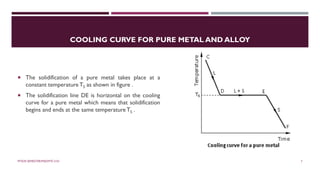
 The solidification of a pure metal takes place at a
constant temperature TS as shown in figure .
 The solidification line DE is horizontal on the cooling
curve for a pure metal which means that solidification
begins and ends at the same temperatureTS .
MTE/III SEMESTER/MSE/MTE 2101 7
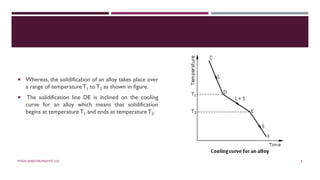
 Whereas, the solidification of an alloy takes place over
a range of temperatureT1 to T2 as shown in figure.
 The solidification line DE is inclined on the cooling
curve for an alloy which means that solidification
begins at temperatureT1 and ends at temperatureT2.
MTE/III SEMESTER/MSE/MTE 2101 8
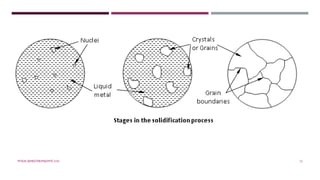
 The solidification of metal can be divided into:
Nucleation of minute crystals – The formation of stable nuclei in the liquid melt.
Growth of nuclei into crystals and formation of grain structure.
MTE/III SEMESTER/MSE/MTE 2101 9
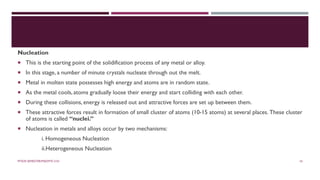
Nucleation
 This is the starting point of the solidification process of any metal or alloy.
 In this stage, a number of minute crystals nucleate through out the melt.
 Metal in molten state possesses high energy and atoms are in random state.
 As the metal cools, atoms gradually loose their energy and start colliding with each other.
 During these collisions, energy is released out and attractive forces are set up between them.
 These attractive forces result in formation of small cluster of atoms (10-15 atoms) at several places. These cluster
of atoms is called “nuclei.”
 Nucleation in metals and alloys occur by two mechanisms:
i. Homogeneous Nucleation
ii.Heterogeneous Nucleation
MTE/III SEMESTER/MSE/MTE 2101 10
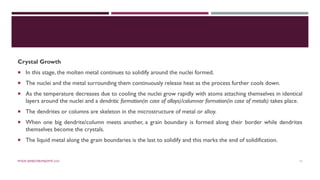
Crystal Growth
 In this stage, the molten metal continues to solidify around the nuclei formed.
 The nuclei and the metal surrounding them continuously release heat as the process further cools down.
 As the temperature decreases due to cooling the nuclei grow rapidly with atoms attaching themselves in identical
layers around the nuclei and a dendritic formation(in case of alloys)/columnar formation(in case of metals) takes place.
 The dendrites or columns are skeleton in the microstructure of metal or alloy.
 When one big dendrite/column meets another, a grain boundary is formed along their border while dendrites
themselves become the crystals.
 The liquid metal along the grain boundaries is the last to solidify and this marks the end of solidification.
MTE/III SEMESTER/MSE/MTE 2101 11
MTE/III SEMESTER/MSE/MTE 2101 12

Solidification Mechanisms 1

  • 1.
    CHAPTER 2 SOLIDIFICATION MECHANISMSAND PHASE DIAGRAMS  Homogeneous and heterogeneous nucleation  Nucleation and Crystal Growth  Solid solutions and types  Phase diagrams  Lever rule and its applications  Iron-Carbide system MTE/III SEMESTER/MSE/MTE 2101 1
  • 2.
    CONTENTS  Introduction  Definitionof solidification  Melting of Metals  Cooling curves  Nucleation and Crystal Growth MTE/III SEMESTER/MSE/MTE 2101 2
  • 3.
    INTRODUCTION  It isthe process where liquid metal transforms into solid upon cooling.  The properties of the solidified metal depends on its microstructure and the microstructure in turn depends on the Solidification Mechanism.  The rate of cooling of liquid metals, the type of mould used, the temperature at which the molten metal is poured into the mould are all a part of solidification process.  Transformation from liquid metal to solid metal is accompanied by shrinkage of volume. MTE/III SEMESTER/MSE/MTE 2101 3
  • 4.
    DEFINITION  The transformationof metals and alloys from liquid state to solid state (crystalline state) is called solidification or crystallization. MTE/III SEMESTER/MSE/MTE 2101 4
  • 5.
    MELTING OF METALS Consider a pure metal being melted from room temperature.  When the melting temperature is reached, the solid metal starts melting, but at constant temperature.  This can be understood by considering the graph of temperature versus time as shown in figure.  The process of melting takes place at constant temperature as the heat added is utilized in breaking the bonds of the solid crystal structure.  The heat that is added to the metal to convert all the solid metal into liquid state is called the “Latent heat of fusion”. AB represents the constant temperature line. MTE/III SEMESTER/MSE/MTE 2101 5
  • 6.
    FREEZING OR SOLIDIFICATIONOR CRYSTALLIZATION OF METALS  Solidification is the reverse of melting.  The pure metal in its molten state first gives up its superheat upon cooling.  When the temperature drops to the freezing (solidification) temperature, the solidification process starts.  The metal starts to give out its latent heat at constant freezing temperature.  This continues until all the metal in the liquid state is converted into the solid state.  Further the metal in the solid state is cooled to room temperature.  This type of curve (graph) is called a cooling curve as shown in figure . MTE/III SEMESTER/MSE/MTE 2101 6
  • 7.
    COOLING CURVE FORPURE METAL AND ALLOY  The solidification of a pure metal takes place at a constant temperature TS as shown in figure .  The solidification line DE is horizontal on the cooling curve for a pure metal which means that solidification begins and ends at the same temperatureTS . MTE/III SEMESTER/MSE/MTE 2101 7
  • 8.
     Whereas, thesolidification of an alloy takes place over a range of temperatureT1 to T2 as shown in figure.  The solidification line DE is inclined on the cooling curve for an alloy which means that solidification begins at temperatureT1 and ends at temperatureT2. MTE/III SEMESTER/MSE/MTE 2101 8
  • 9.
     The solidificationof metal can be divided into: Nucleation of minute crystals – The formation of stable nuclei in the liquid melt. Growth of nuclei into crystals and formation of grain structure. MTE/III SEMESTER/MSE/MTE 2101 9
  • 10.
    Nucleation  This isthe starting point of the solidification process of any metal or alloy.  In this stage, a number of minute crystals nucleate through out the melt.  Metal in molten state possesses high energy and atoms are in random state.  As the metal cools, atoms gradually loose their energy and start colliding with each other.  During these collisions, energy is released out and attractive forces are set up between them.  These attractive forces result in formation of small cluster of atoms (10-15 atoms) at several places. These cluster of atoms is called “nuclei.”  Nucleation in metals and alloys occur by two mechanisms: i. Homogeneous Nucleation ii.Heterogeneous Nucleation MTE/III SEMESTER/MSE/MTE 2101 10
  • 11.
    Crystal Growth  Inthis stage, the molten metal continues to solidify around the nuclei formed.  The nuclei and the metal surrounding them continuously release heat as the process further cools down.  As the temperature decreases due to cooling the nuclei grow rapidly with atoms attaching themselves in identical layers around the nuclei and a dendritic formation(in case of alloys)/columnar formation(in case of metals) takes place.  The dendrites or columns are skeleton in the microstructure of metal or alloy.  When one big dendrite/column meets another, a grain boundary is formed along their border while dendrites themselves become the crystals.  The liquid metal along the grain boundaries is the last to solidify and this marks the end of solidification. MTE/III SEMESTER/MSE/MTE 2101 11
  • 12.