Heat Transfer
One-Dimensional, Steady-State Heat
Conduction without Heat
Generation
by
Dr. S.KALIAPPAN M.E, Ph.D.
Professor & Head
Deptartment of Mechanical Engineering,
Velammal Institute of Technology,
Chennai-601204
04/01/2025 1
Conduction or Diffusion
Convection
Radiation
Modes of Heat & Mass Transfer
04/01/2025 2
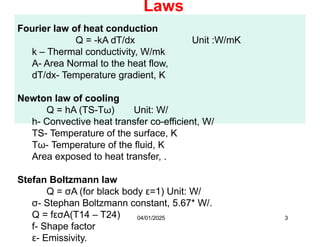
Fourier law of heat conduction
Q = -kA dT/dx Unit :W/mK
k – Thermal conductivity, W/mk
A- Area Normal to the heat flow,
dT/dx- Temperature gradient, K
Newton law of cooling
Q = hA (TS-Tω) Unit: W/
h- Convective heat transfer co-efficient, W/
TS- Temperature of the surface, K
Tω- Temperature of the fluid, K
Area exposed to heat transfer, .
Stefan Boltzmann law
Q = σA (for black body ε=1) Unit: W/
σ- Stephan Boltzmann constant, 5.67* W/.
Q = fεσA(T14 – T24)
f- Shape factor
ε- Emissivity.
Laws
04/01/2025 3
One-Dimensional, Steady-State
Heat Conduction without Heat
Generation
• Plane slab - composite slabs – contact
resistance – cylindrical Systems – composite
cylinders - spherical systems – composite
spheres - critical thickness of insulation –
optimum thickness – systems with variable
thermal conductivity
4
04/01/2025
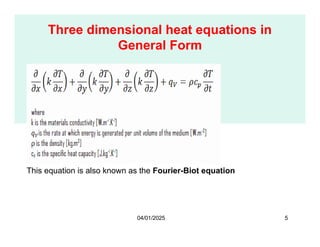
Three dimensional heat equations in
General Form
This equation is also known as the Fourier-Biot equation
04/01/2025 5
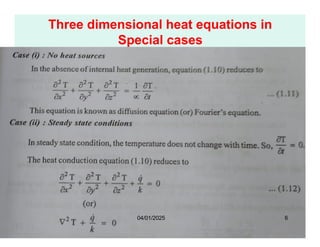
Three dimensional heat equations in
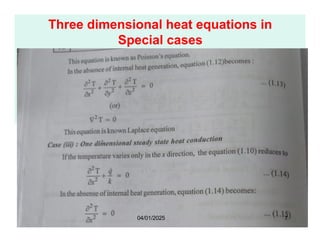
Special cases
04/01/2025 6
Three dimensional heat equations in
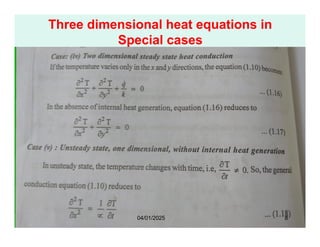
Special cases
04/01/2025 7
Three dimensional heat equations in
Special cases
04/01/2025 8
Thermal conductivity, k
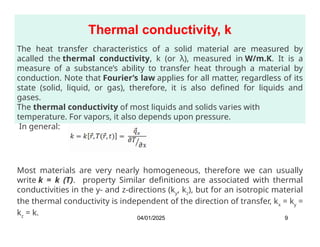
The heat transfer characteristics of a solid material are measured by
acalled the thermal conductivity, k (or λ), measured in W/m.K. It is a
measure of a substance’s ability to transfer heat through a material by
conduction. Note that Fourier’s law applies for all matter, regardless of its
state (solid, liquid, or gas), therefore, it is also defined for liquids and
gases.
The thermal conductivity of most liquids and solids varies with
temperature. For vapors, it also depends upon pressure.
In general:
Most materials are very nearly homogeneous, therefore we can usually
write k = k (T). property Similar definitions are associated with thermal
conductivities in the y- and z-directions (ky
, kz
), but for an isotropic material
the thermal conductivity is independent of the direction of transfer, kx
= ky
=
kz
= k.
04/01/2025 9
Thermal conductivity, k
Constant Thermal Conductivity:
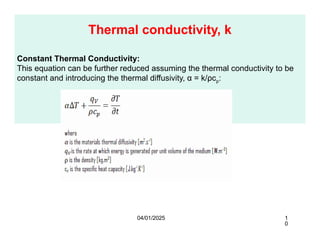
This equation can be further reduced assuming the thermal conductivity to be
constant and introducing the thermal diffusivity, α = k/ρcp:
04/01/2025 1
0
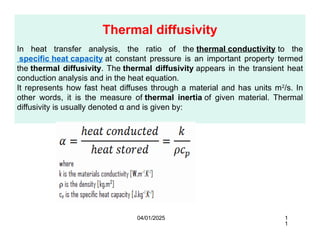
Thermal diffusivity
In heat transfer analysis, the ratio of the thermal conductivity to the
specific heat capacity at constant pressure is an important property termed
the thermal diffusivity. The thermal diffusivity appears in the transient heat
conduction analysis and in the heat equation.
It represents how fast heat diffuses through a material and has units m2
/s. In
other words, it is the measure of thermal inertia of given material. Thermal
diffusivity is usually denoted α and is given by:
04/01/2025 1
1
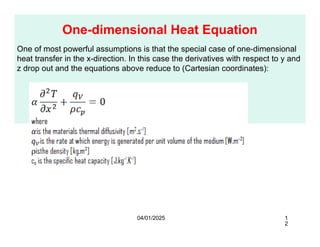
One-dimensional Heat Equation
One of most powerful assumptions is that the special case of one-dimensional
heat transfer in the x-direction. In this case the derivatives with respect to y and
z drop out and the equations above reduce to (Cartesian coordinates):
04/01/2025 1
2
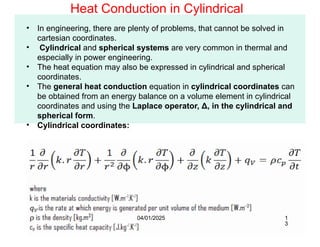
Heat Conduction in Cylindrical
• In engineering, there are plenty of problems, that cannot be solved in
cartesian coordinates.
• Cylindrical and spherical systems are very common in thermal and
especially in power engineering.
• The heat equation may also be expressed in cylindrical and spherical
coordinates.
• The general heat conduction equation in cylindrical coordinates can
be obtained from an energy balance on a volume element in cylindrical
coordinates and using the Laplace operator, Δ, in the cylindrical and
spherical form.
• Cylindrical coordinates:
04/01/2025 1
3
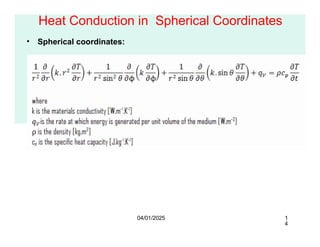
Heat Conduction in Spherical Coordinates
• Spherical coordinates:
04/01/2025 1
4
Boundary and Initial Conditions
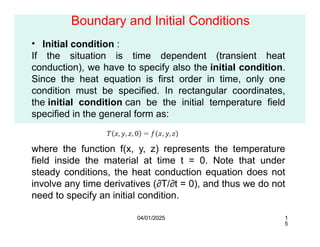
• Initial condition :
If the situation is time dependent (transient heat
conduction), we have to specify also the initial condition.
Since the heat equation is first order in time, only one
condition must be specified. In rectangular coordinates,
the initial condition can be the initial temperature field
specified in the general form as:
where the function f(x, y, z) represents the temperature
field inside the material at time t = 0. Note that under
steady conditions, the heat conduction equation does not
involve any time derivatives (∂T/∂t = 0), and thus we do not
need to specify an initial condition.
04/01/2025 1
5
Boundary and Initial Conditions
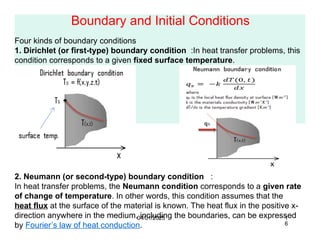
Four kinds of boundary conditions
1. Dirichlet (or first-type) boundary condition :In heat transfer problems, this
condition corresponds to a given fixed surface temperature.
2. Neumann (or second-type) boundary condition :
In heat transfer problems, the Neumann condition corresponds to a given rate
of change of temperature. In other words, this condition assumes that the
heat flux at the surface of the material is known. The heat flux in the positive x-
direction anywhere in the medium, including the boundaries, can be expressed
by Fourier’s law of heat conduction.
04/01/2025 1
6
Boundary and Initial Conditions
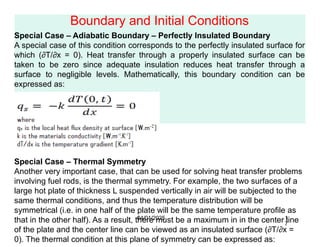
Special Case – Adiabatic Boundary – Perfectly Insulated Boundary
A special case of this condition corresponds to the perfectly insulated surface for
which (∂T/∂x = 0). Heat transfer through a properly insulated surface can be
taken to be zero since adequate insulation reduces heat transfer through a
surface to negligible levels. Mathematically, this boundary condition can be
expressed as:
Special Case – Thermal Symmetry
Another very important case, that can be used for solving heat transfer problems
involving fuel rods, is the thermal symmetry. For example, the two surfaces of a
large hot plate of thickness L suspended vertically in air will be subjected to the
same thermal conditions, and thus the temperature distribution will be
symmetrical (i.e. in one half of the plate will be the same temperature profile as
that in the other half). As a result, there must be a maximum in in the center line
of the plate and the center line can be viewed as an insulated surface (∂T/∂x =
0). The thermal condition at this plane of symmetry can be expressed as:
04/01/2025 1
7
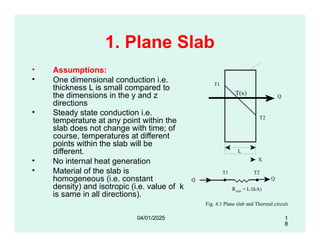
1. Plane Slab
Q
T1
T2
T(x)
• Assumptions:
• One dimensional conduction i.e.
thickness L is small compared to
the dimensions in the y and z
directions
• Steady state conduction i.e.
temperature at any point within the
slab does not change with time; of
course, temperatures at different
points within the slab will be
different.
• No internal heat generation
• Material of the slab is
homogeneous (i.e. constant
density) and isotropic (i.e. value of k
is same in all directions).
X
T1 T2
slab
R = L/(kA)
L
Q
Q
Fig. 4.1 Plane slab and Thermal circuit
1
8
04/01/2025
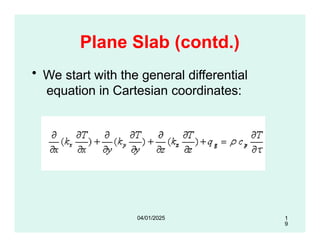
Plane Slab (contd.)
• We start with the general differential
equation in Cartesian coordinates:
1
9
04/01/2025
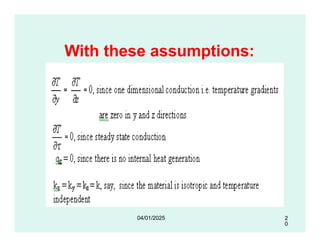
With these assumptions:
2
0
04/01/2025
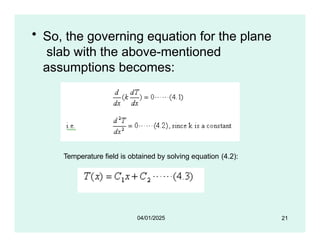
• So, the governing equation for the plane
slab with the above-mentioned
assumptions becomes:
Temperature field is obtained by solving equation (4.2):
21
04/01/2025
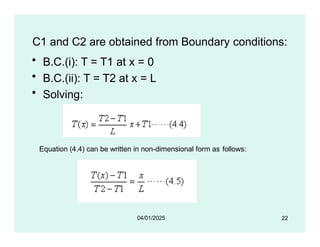
C1 and C2 are obtained from Boundary conditions:
• B.C.(i): T = T1 at x = 0
• B.C.(ii): T = T2 at x = L
• Solving:
Equation (4.4) can be written in non-dimensional form as follows:
22
04/01/2025
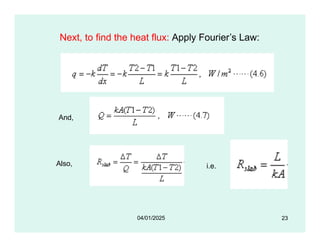
Next, to find the heat flux: Apply Fourier’s Law:
And,
Also, i.e.
23
04/01/2025
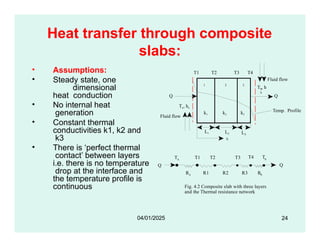
Heat transfer through composite
slabs:
T , h
b
b
Fluid flow
Fluid flow
Ta, ha
1 2 3
k1 k2 k3
Q Q
T1 T2 T3 T4
Temp. Profile
• Assumptions:
• Steady state, one
dimensional
heat conduction
• No internal heat
generation
• Constant thermal
conductivities k1, k2 and
k3
• There is ‘perfect thermal
contact’ between layers
i.e. there is no temperature
drop at the interface and
the temperature profile is
continuous
L1 L2
X
L3
Fig. 4.2 Composite slab with three layers
and the Thermal resistance network
Q
b
T1 T2 T3 T4 T
a
R R1 R2 R3 R
24
b
Ta
Q
04/01/2025
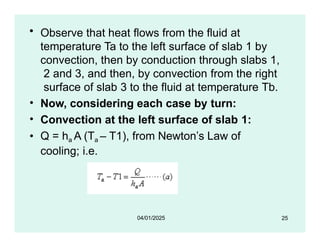
• Observe that heat flows from the fluid at
temperature Ta to the left surface of slab 1 by
convection, then by conduction through slabs 1,
2 and 3, and then, by convection from the right
surface of slab 3 to the fluid at temperature Tb.
• Now, considering each case by turn:
• Convection at the left surface of slab 1:
• Q = ha A (Ta – T1), from Newton’s Law of
cooling; i.e.
25
04/01/2025
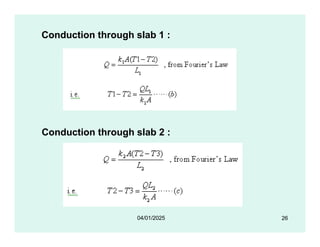
Conduction through slab 1 :
Conduction through slab 2 :
26
04/01/2025
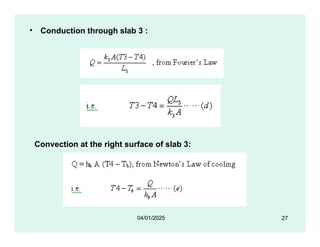
• Conduction through slab 3 :
Convection at the right surface of slab 3:
27
04/01/2025
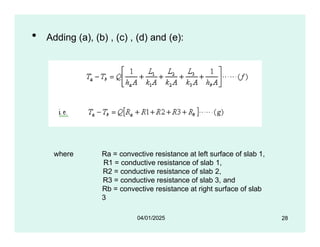
• Adding (a), (b) , (c) , (d) and (e):
where
28
Ra = convective resistance at left surface of slab 1,
R1 = conductive resistance of slab 1,
R2 = conductive resistance of slab 2,
R3 = conductive resistance of slab 3, and
Rb = convective resistance at right surface of slab
3
04/01/2025
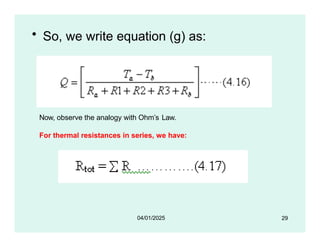
• So, we write equation (g) as:
Now, observe the analogy with Ohm’s Law.
For thermal resistances in series, we have:
29
04/01/2025
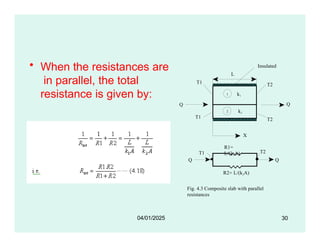
• When the resistances are
in parallel, the total
resistance is given by:
Q
L
k1
k2
1
2
T1 T2
T1 T2
Q
Insulated
Q
T1 T2
X
R1=
L/(k1A)
Q
R2= L/(k2A)
Fig. 4.3 Composite slab with parallel
resistances
30
04/01/2025
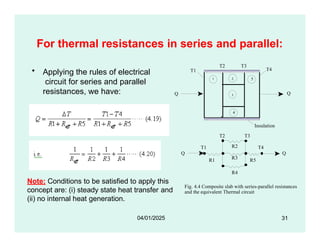
For thermal resistances in series and parallel:
• Applying the rules of electrical
circuit for series and parallel
resistances, we have:
1 2
3
Q
T4
T1
T2 T3
5
Q
4
Insulation
Q Q
T1
T2 T3
T4
R1
R2
R3 R5
R4
Fig. 4.4 Composite slab with series-parallel resistances
and the equivalent Thermal circuit
Note: Conditions to be satisfied to apply this
concept are: (i) steady state heat transfer and
(ii) no internal heat generation.
31
04/01/2025
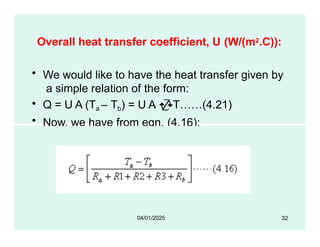
Overall heat transfer coefficient, U (W/(m2.C)):
• We would like to have the heat transfer given by
a simple relation of the form:
• Q = U A (Ta – Tb) = U A T……(4.21)
• Now, we have from eqn. (4.16):
32
04/01/2025
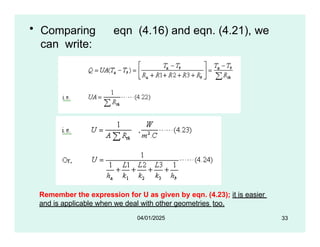
• Comparing eqn (4.16) and eqn. (4.21), we
can write:
Remember the expression for U as given by eqn. (4.23); it is easier
and is applicable when we deal with other geometries too.
33
04/01/2025
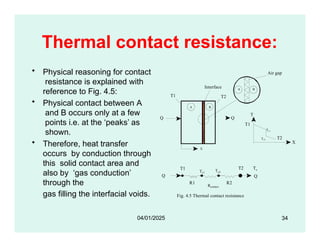
Thermal contact resistance:
A B
Q
T1
Interface
T2
Air gap
A B
Q
T
• Physical reasoning for contact
resistance is explained with
reference to Fig. 4.5:
• Physical contact between A
and B occurs only at a few
points i.e. at the ‘peaks’ as
shown.
• Therefore, heat transfer
occurs by conduction through
this solid contact area and
also by ‘gas conduction’
through the
gas filling the interfacial voids.
X
X
Q
Tc1
Rcontact
R1 R2
T1 T2 Ta
Q
T1
T2
Tc1
Tc2
Tc2
Fig. 4.5 Thermal contact resistance
34
04/01/2025
• In effect, resistance to heat transfer is by two
mechanisms:
• by solid conduction at the peaks, and
• by gas conduction through the interfacial gas in the
voids.
• Of these two, solid conduction is usually negligible.
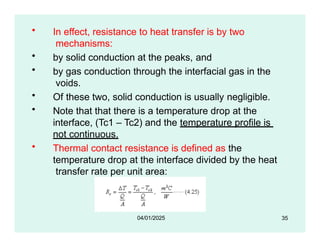
• Note that that there is a temperature drop at the
interface, (Tc1 – Tc2) and the temperature profile is
not continuous.
• Thermal contact resistance is defined as the
temperature drop at the interface divided by the heat
transfer rate per unit area:
35
04/01/2025
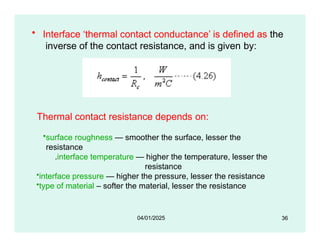
• Interface ‘thermal contact conductance’ is defined as the
inverse of the contact resistance, and is given by:
Thermal contact resistance depends on:
•surface roughness — smoother the surface, lesser the
resistance
.interface temperature — higher the temperature, lesser the
resistance
•interface pressure — higher the pressure, lesser the resistance
•type of material – softer the material, lesser the resistance
36
04/01/2025
• Thermal contact resistance may be reduced
by:
• making the mating surfaces very smooth
• inserting a layer of conducting grease at the
interface
• inserting a ‘shim’ (thin foil) made of a soft material
such as indium, lead, tin or silver between the
surfaces
• filling the interstitial voids with a gas of higher thermal
conductivity than that of air (ex: helium)
• increasing the interface pressure
• in case of permanently bonded joints, contact
resistance can be reduced by using an epoxy or soft
solder rich in lead, or a hard solder of gold/tin alloy
• Values of Rc are given in Heat Transfer Handbooks.
37
04/01/2025
38
04/01/2025
39
04/01/2025
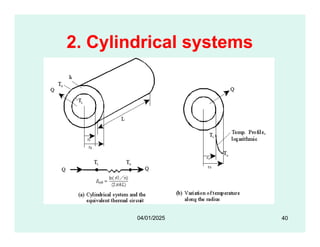
2. Cylindrical systems
40
04/01/2025
Cylindrical systems (contd.)
• Assumptions:
• Steady state conduction
• One dimensional conduction, in the r-
direction only
• Homogeneous, isotropic material with
constant k
• No internal heat generation
41
04/01/2025
Cylindrical systems (contd.)
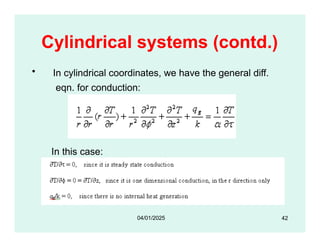
• In cylindrical coordinates, we have the general diff.
eqn. for conduction:
In this case:
42
04/01/2025
Cylindrical systems (contd.)
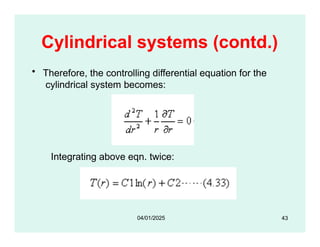
• Therefore, the controlling differential equation for the
cylindrical system becomes:
Integrating above eqn. twice:
43
04/01/2025
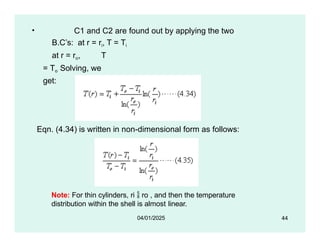
• C1 and C2 are found out by applying the two
B.C’s: at r = ri, T = Ti
at r = ro, T
= To Solving, we
get:
Eqn. (4.34) is written in non-dimensional form as follows:
Note: For thin cylinders, ri  ro , and then the temperature
distribution within the shell is almost linear.
44
04/01/2025
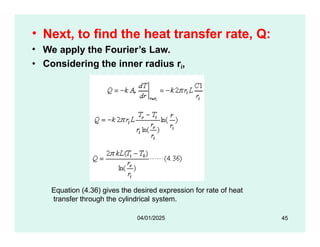
• Next, to find the heat transfer rate, Q:
• We apply the Fourier’s Law.
• Considering the inner radius ri,
Equation (4.36) gives the desired expression for rate of heat
transfer through the cylindrical system.
45
04/01/2025
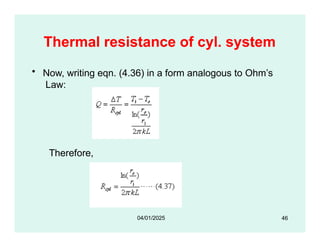
Thermal resistance of cyl. system
• Now, writing eqn. (4.36) in a form analogous to Ohm’s
Law:
Therefore,
46
04/01/2025
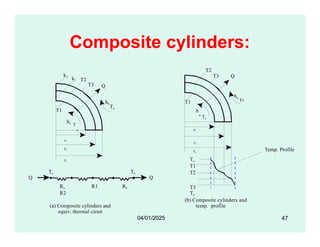
Composite cylinders:
Q
hb
T1
T3
Tb
k1
k2
h
T1
a
Ta
hb
Tb
T2
T2
T3 Q
r1
Ta Tb
Q
Q
r2
r3
ha
T
a
Rb
Ra R1
R2
(a) Composite cylinders and
equiv. thermal ciruit
r1
Temp. Profile
(b) Composite cylinders and
temp. profile
T2
T3
Tb
r2
r3
Ta
T1
47
04/01/2025
Composite cylinders (contd.):
• Assumptions:
• Steady state heat flow
• One dimensional conduction in the r direction only
• No internal heat generation
• Perfect thermal contact between layers
• Under these stipulations, we note that heat flow rate is
constant and the same through each layer.
• Let us write separately the heat flow equations for
each layer:
48
04/01/2025
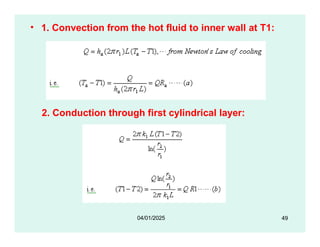
• 1. Convection from the hot fluid to inner wall at T1:
2. Conduction through first cylindrical layer:
49
04/01/2025
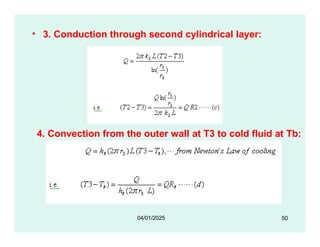
• 3. Conduction through second cylindrical layer:
4. Convection from the outer wall at T3 to cold fluid at Tb:
50
04/01/2025
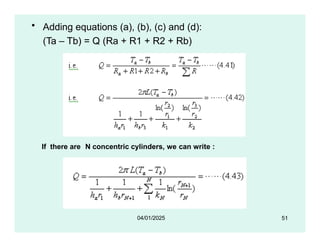
• Adding equations (a), (b), (c) and (d):
(Ta – Tb) = Q (Ra + R1 + R2 + Rb)
If there are N concentric cylinders, we can write :
51
04/01/2025
Overall heat transfer coefficient for the
cylindrical system:
• We would like to write the heat transfer rate in terms of
the known overall temperature difference, as follows:
Q = U A Toverall = U A (Ta – Tb)
where U is an overall heat transfer coefficient and A is
the area normal to the direction of heat flow.
• In the case of a cylindrical system, area normal to the
direction of heat flow is 2rL, and clearly, this varies
with
r. Therefore, while dealing with cylindrical systems, we
have to specify as to which area U is based on i.e.
whether it is based on inside area or outside area.
52
04/01/2025
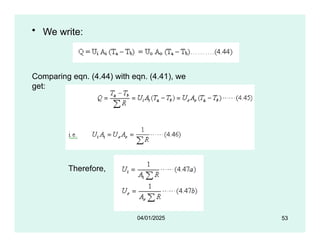
• We write:
Comparing eqn. (4.44) with eqn. (4.41), we
get:
Therefore,
53
04/01/2025
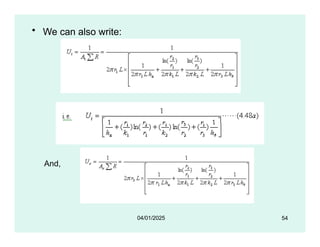
• We can also write:
And,
54
04/01/2025
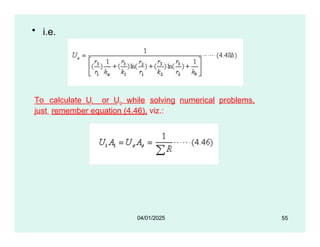
• i.e.
To calculate Ui or Uo while solving numerical problems,
just remember equation (4.46), viz.:
55
04/01/2025
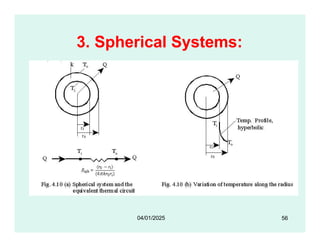
3. Spherical Systems:
56
04/01/2025
Spherical Systems (contd.):
• Assumptions:
• Steady state conduction
• One dimensional conduction, in the r direction only
• Homogeneous, isotropic material with constant k
• No internal heat generation
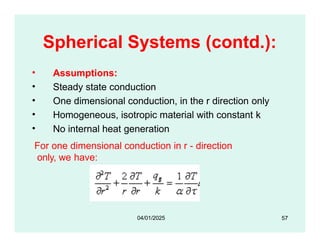
For one dimensional conduction in r - direction
only, we have:
57
04/01/2025
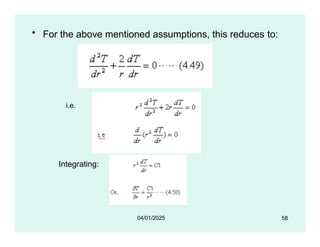
• For the above mentioned assumptions, this reduces to:
i.e.
Integrating:
58
04/01/2025
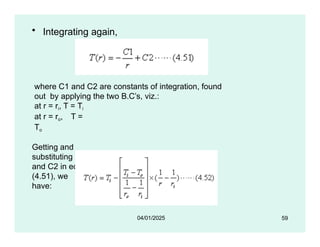
• Integrating again,
where C1 and C2 are constants of integration, found
out by applying the two B.C’s, viz.:
at r = ri, T = Ti
at r = ro, T =
To
Getting and
substituting C1
and C2 in eqn.
(4.51), we
have:
59
04/01/2025
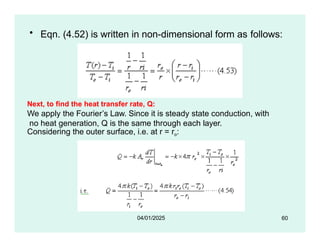
• Eqn. (4.52) is written in non-dimensional form as follows:
Next, to find the heat transfer rate, Q:
We apply the Fourier’s Law. Since it is steady state conduction, with
no heat generation, Q is the same through each layer.
Considering the outer surface, i.e. at r = ro:
60
04/01/2025
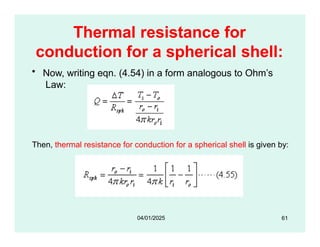
Thermal resistance for
conduction for a spherical shell:
• Now, writing eqn. (4.54) in a form analogous to Ohm’s
Law:
Then, thermal resistance for conduction for a spherical shell is given by:
61
04/01/2025
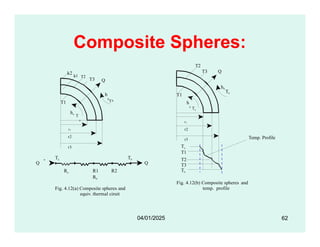
Composite Spheres:
Q
h
T1
T3
ha
T
a
b
Tb
r1
hb
h
T1
a
Ta
Tb
T2
k2
k1 T2
T3 Q
r1
Ta Tb
Q
Q
r2
r3
Ra R1 R2
Rb
Fig. 4.12(a) Composite spheres and
equiv. thermal ciruit
r2
Temp. Profile
Fig. 4.12(b) Composite spheres and
temp. profile
r3
Ta
T1
T2
T3
Tb
62
04/01/2025
Composite Spheres:
• Assumptions:
• Steady state heat flow
• One dimensional conduction in the r direction only
• No internal heat generation
• Perfect thermal contact between layers
• Under the given stipulations, it is clear that heat flow
rate, Q through each layer is the same.
• Let us write separately the heat flow equations for
each layer:
63
04/01/2025
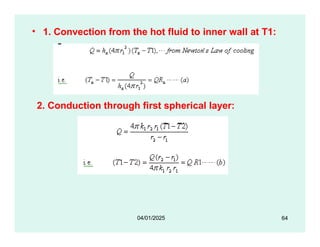
• 1. Convection from the hot fluid to inner wall at T1:
2. Conduction through first spherical layer:
64
04/01/2025
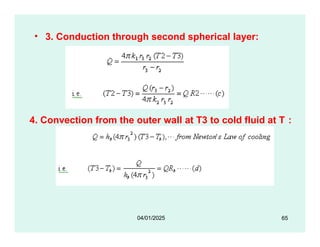
• 3. Conduction through second spherical layer:
4. Convection from the outer wall at T3 to cold fluid at T :
65
04/01/2025
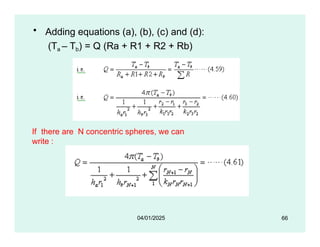
• Adding equations (a), (b), (c) and (d):
(Ta – Tb) = Q (Ra + R1 + R2 + Rb)
If there are N concentric spheres, we can
write :
66
04/01/2025
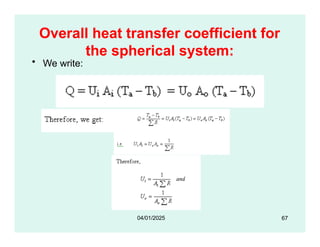
Overall heat transfer coefficient for
the spherical system:
• We write:
67
04/01/2025
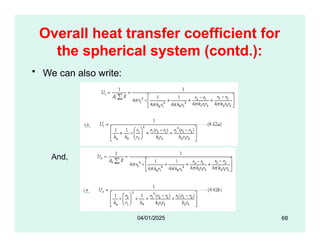
Overall heat transfer coefficient for
the spherical system (contd.):
• We can also write:
And,
68
04/01/2025
Overall heat transfer coefficient for
the spherical system (contd.):
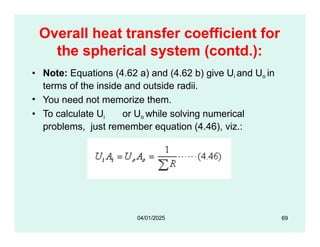
• Note: Equations (4.62 a) and (4.62 b) give Ui and Uo in
terms of the inside and outside radii.
• You need not memorize them.
• To calculate Ui or Uo while solving numerical
problems, just remember equation (4.46), viz.:
69
04/01/2025
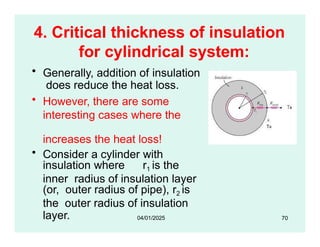
4. Critical thickness of insulation
for cylindrical system:
• Generally, addition of insulation
does reduce the heat loss.
• However, there are some
interesting cases where the
increases the heat loss!
• Consider a cylinder with
insulation where r1 is the
inner radius of insulation layer
(or, outer radius of pipe), r2 is
the outer radius of insulation
layer. 70
04/01/2025
Critical thickness of
insulation(contd.):
• Resistance to heat transfer is made up of two
components viz. conductive resistance through
the cylindrical insulation layer [ R= ln(r2/r1)/ (2  k
L) ] and convective resistance between the wall
surface and the surroundings [Ro = 1/(h. Ao )].
• As the insulation thickness is increased i.e. as
insulation radius r2 is increased, conductive
resistance of insulation increases; however,
convective resistance, given by [Ro =1/(h. Ao)]
goes on decreasing since Ao, the outside
surface area goes on increasing with
increasing radius.
71
04/01/2025
Critical thickness of insulation (contd.):
• Therefore, the total resistance may increase or
decrease, depending on the relative rates of change of
these two resistances.
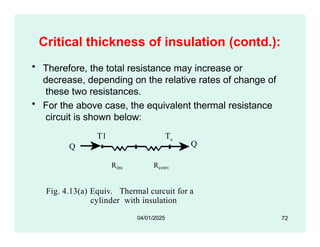
• For the above case, the equivalent thermal resistance
circuit is shown below:
T1 Ta
Q
Q
Rins Rconv
Fig. 4.13(a) Equiv. Thermal curcuit for a
cylinder with insulation
72
04/01/2025
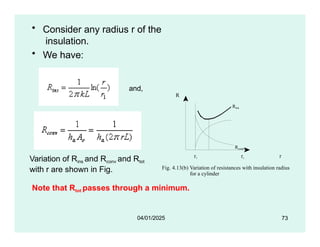
• Consider any radius r of the
insulation.
• We have:
and,
R
Rtot
Rins
Variation of Rins and Rconv and Rtot
with r are shown in Fig.
Rconv
73
r1 rc r
Fig. 4.13(b) Variation of resistances with insulation radius
for a cylinder
Note that Rtot passes through a minimum.
04/01/2025
• The insulation radius at which the resistance to heat
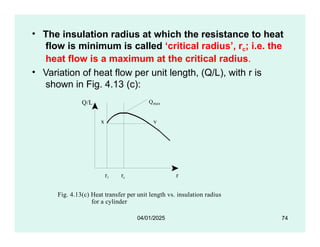
flow is minimum is called ‘critical radius’, rc; i.e. the
heat flow is a maximum at the critical radius.
• Variation of heat flow per unit length, (Q/L), with r is
shown in Fig. 4.13 (c):
Q/L Qmax
y
x
r1 rc r
Fig. 4.13(c) Heat transfer per unit length vs. insulation radius
for a cylinder
74
04/01/2025
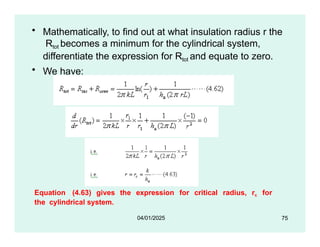
• Mathematically, to find out at what insulation radius r the
Rtot becomes a minimum for the cylindrical system,
differentiate the expression for Rtot and equate to zero.
• We have:
Equation (4.63) gives the expression for critical radius, rc for
the cylindrical system.
75
04/01/2025
• To confirm that at r = rc , Rtot indeed is minimum, find out
the value of (d2 Rtot /dr2 ) at r = rc, and it will be found
to be positive; i.e at r = rc , the Rtot is a minimum.
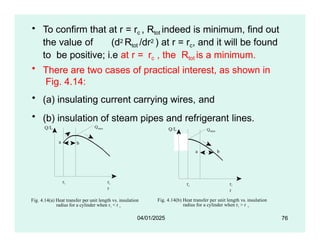
• There are two cases of practical interest, as shown in
Fig. 4.14:
• (a) insulating current carrying wires, and
• (b) insulation of steam pipes and refrigerant lines.
r1 rc
r
Fig. 4.14(a) Heat transfer per unit length vs. insulation
radius for a cylinder when r1 < r c
Q/L Qmax
a b
Q/L Qmax
a b
rc r1
r
Fig. 4.14(b) Heat transfer per unit length vs. insulation
radius for a cylinder when r1 > r c
76
04/01/2025
Critical thickness of insulation
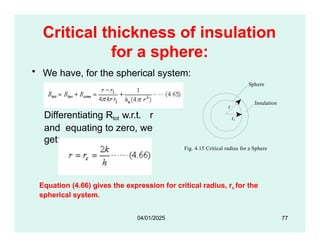
for a sphere:
r1
r
Insulation
• We have, for the spherical system:
Sphere
Fig. 4.15 Critical radius for a Sphere
Differentiating Rtot w.r.t. r
and equating to zero, we
get:
Equation (4.66) gives the expression for critical radius, rc for the
spherical system.
77
04/01/2025
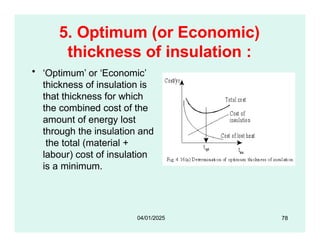
5. Optimum (or Economic)
thickness of insulation :
• ‘Optimum’ or ‘Economic’
thickness of insulation is
that thickness for which
the combined cost of the
amount of energy lost
through the insulation and
the total (material +
labour) cost of insulation
is a minimum.
78
04/01/2025
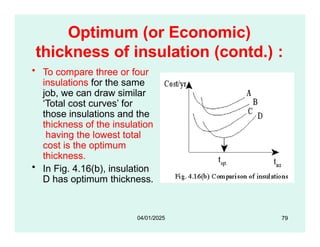
Optimum (or Economic)
thickness of insulation (contd.) :
• To compare three or four
insulations for the same
job, we can draw similar
‘Total cost curves’ for
those insulations and the
thickness of the insulation
having the lowest total
cost is the optimum
thickness.
• In Fig. 4.16(b), insulation
D has optimum thickness.
79
04/01/2025
6. Effect of variable thermal
conductivity:
• When the k of a material varies rapidly with
temperature or when the temperature range of
operation is large, it becomes necessary to take into
account the variation of k with temperature.
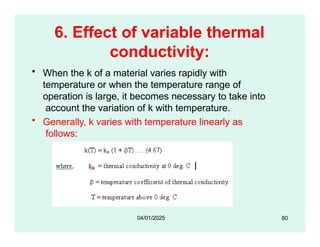
• Generally, k varies with temperature linearly as
follows:
80
04/01/2025
Plane slab with variable thermal
conductivity:
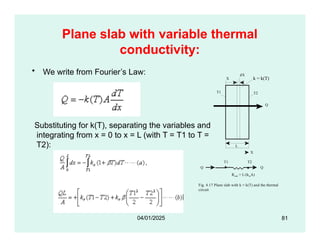
• We write from Fourier’s Law:
k = k(T)
Q
T1 T2
X
dX
Substituting for k(T), separating the variables and
integrating from x = 0 to x = L (with T = T1 to T =
T2):
X
T1 T2
L
Q
Q
Rslab = L/(kmA)
Fig. 4.17 Plane slab with k = k(T) and the thermal
circuit
81
04/01/2025
Plane slab with variable thermal
conductivity:
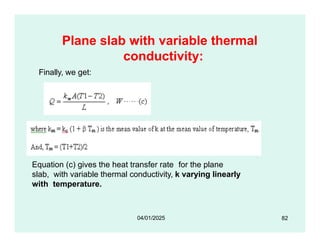
Finally, we get:
Equation (c) gives the heat transfer rate for the plane
slab, with variable thermal conductivity, k varying linearly
with temperature.
82
04/01/2025
Plane slab with variable thermal
conductivity :
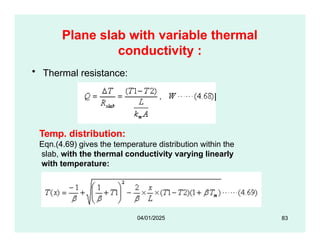
• Thermal resistance:
Temp. distribution:
Eqn.(4.69) gives the temperature distribution within the
slab, with the thermal conductivity varying linearly
with temperature:
83
04/01/2025
Plane slab with variable thermal
conductivity :
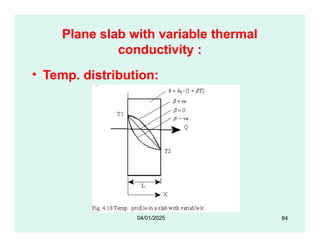
• Temp. distribution:
84
04/01/2025
Hollow cylinder with variable
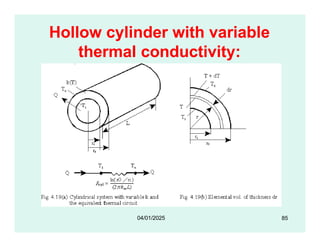
thermal conductivity:
85
04/01/2025
Hollow cylinder with variable
thermal conductivity:
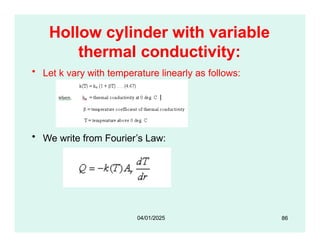
• Let k vary with temperature linearly as follows:
• We write from Fourier’s Law:
86
04/01/2025
Hollow cylinder with variable
thermal conductivity:
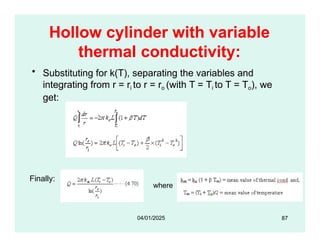
• Substituting for k(T), separating the variables and
integrating from r = ri to r = ro (with T = Ti to T = To), we
get:
Finally:
where
87
04/01/2025
Hollow cylinder with variable
thermal conductivity:
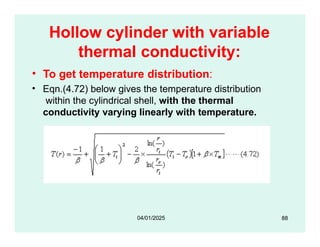
• To get temperature distribution:
• Eqn.(4.72) below gives the temperature distribution
within the cylindrical shell, with the thermal
conductivity varying linearly with temperature.
88
04/01/2025
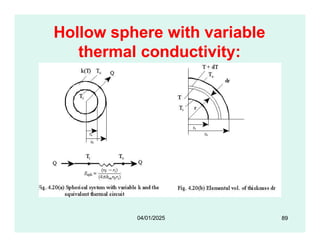
Hollow sphere with variable
thermal conductivity:
89
04/01/2025
Hollow sphere with variable
thermal conductivity:
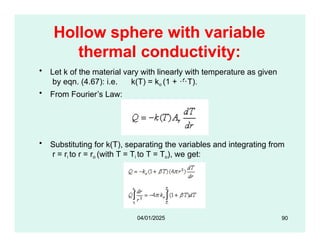
• Let k of the material vary with linearly with temperature as given
by eqn. (4.67): i.e. k(T) = ko (1 + T).
• From Fourier’s Law:
• Substituting for k(T), separating the variables and integrating from
r = ri to r = ro (with T = Ti to T = To), we get:
90
04/01/2025
Hollow sphere with variable
thermal conductivity:
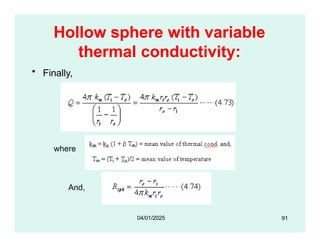
• Finally,
where
And,
91
04/01/2025
Hollow sphere with variable
thermal conductivity:
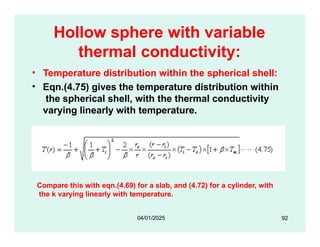
• Temperature distribution within the spherical shell:
• Eqn.(4.75) gives the temperature distribution within
the spherical shell, with the thermal conductivity
varying linearly with temperature.
Compare this with eqn.(4.69) for a slab, and (4.72) for a cylinder, with
the k varying linearly with temperature.
92
04/01/2025
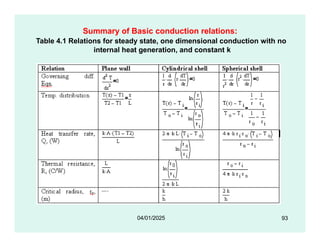
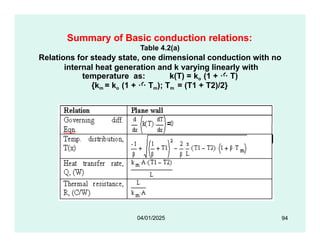
Summary of Basic conduction relations:
Table 4.1 Relations for steady state, one dimensional conduction with no
internal heat generation, and constant k
93
04/01/2025
Summary of Basic conduction relations:
Table 4.2(a)
Relations for steady state, one dimensional conduction with no
internal heat generation and k varying linearly with
temperature as: k(T) = ko (1 +  T)
{km = ko (1 +  Tm); Tm = (T1 + T2)/2}
94
04/01/2025
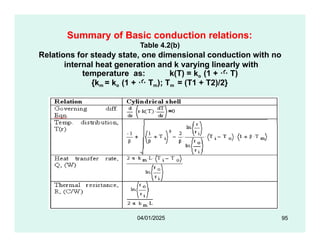
Summary of Basic conduction relations:
Table 4.2(b)
Relations for steady state, one dimensional conduction with no
internal heat generation and k varying linearly with
temperature as: k(T) = ko (1 +  T)
{km = ko (1 +  Tm); Tm = (T1 + T2)/2}
95
04/01/2025
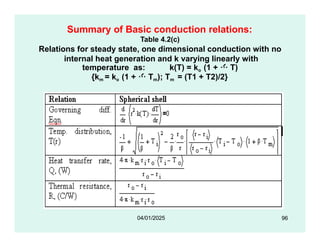
Summary of Basic conduction relations:
Table 4.2(c)
Relations for steady state, one dimensional conduction with no
internal heat generation and k varying linearly with
temperature as: k(T) = ko (1 +  T)
{km = ko (1 +  Tm); Tm = (T1 + T2)/2}
96
04/01/2025
One-Dimensional, Steady-State
Heat Conduction with Heat
Generation
• Examples - Plane slab – different BC’s -
Cylindrical Systems – Solid cylinder – hollow
cylinder – different BC’s – Sphere with heat
generation- k varying linearly with T
04/01/2025 97
Examples of situations with internal
heat generation are:
• Heating in an electrical conductor due
to the flow of current in it
• Energy generation in a nuclear fuel rod
due to absorption of neutrons
• Exothermic chemical reaction within a
system (e.g. combustion), liberating heat
at a given rate throughout the system
• Heat liberated in ‘shielding’ used in
Nuclear reactors due to absorption of
electromagnetic radiation such as
gamma rays
04/01/2025 98
Plane slab with uniform internal
heat generation:
• We shall consider three cases of
boundary conditions:
• 1. Both the sides of the slab are at the
same temperature
• 2. Two sides of the slab are at different
temperatures, and
• 3. One of the sides is insulated
04/01/2025 99
Plane slab with uniform internal heat
generation- both the sides at the same
temperature:
• Assumptions:
• One dimensional conduction i.e. thickness L is small
compared to the dimensions in the y and z directions
• Steady state conduction i.e. temperature at any point
within the slab does not change with time; of course,
temperatures at different points within the slab will
be different.
• Uniform internal heat generation rate, qg (W/m3)
• Material of the slab is homogeneous (i.e. constant
density) and isotropic (i.e. value of k is same in
all directions).
04/01/2025 100
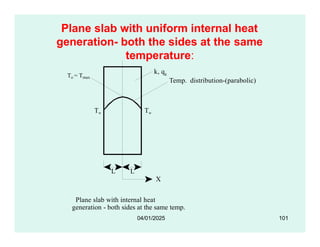
Plane slab with uniform internal heat
generation- both the sides at the same
temperature:
k, qg
Tw
To = Tmax
Tw
Temp. distribution-(parabolic)
X
Plane slab with internal heat
generation - both sides at the same temp.
L
L
04/01/2025 101
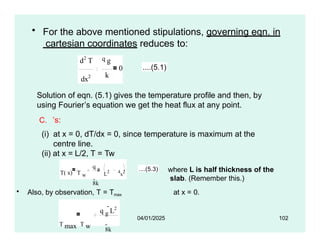
• For the above mentioned stipulations, governing eqn. in
cartesian coordinates reduces to:
dx2 k
d2
T q g
0 ....(5.1)
• Also, by observation, T = Tmax at x = 0.
Solution of eqn. (5.1) gives the temperature profile and then, by
using Fourier’s equation we get the heat flux at any point.
C. ’s:
(i) at x = 0, dT/dx = 0, since temperature is maximum at the
centre line.
(ii) at x = L/2, T = Tw
04/01/2025 102
T( x) T w
q g
8k
 L2 4
x2 ....(5.3) where L is half thickness of the
slab. (Remember this.)
q g
L2
T max T w 8k
04/01/2025 103
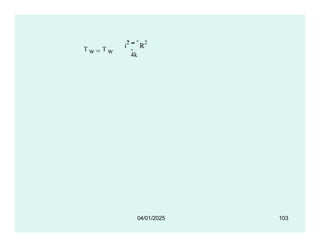
i
2  R
2
T w = T w 4k
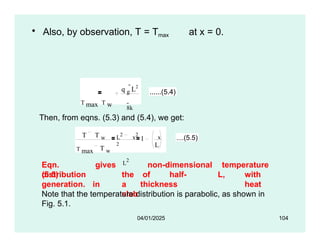
• Also, by observation, T = Tmax at x = 0.
q g
L2
T max T w 8k
......(5.4)
Then, from eqns. (5.3) and (5.4), we get:
T T w
T max T w
1
L
L
2
x
2
x
2
L
2
....(5.5)
04/01/2025 104
Eqn.
(5.5)
distribution
gives
the
in a
slab
non-dimensional
of half-
thickness
temperature
L, with
heat
generation.
Note that the temperature distribution is parabolic, as shown in
Fig. 5.1.
Convection boundary condition:
• In many practical applications, heat is carried
away at the boundaries by a fluid at a
temperature Tf flowing on the surface with a
convective heat transfer coefficient, h. (e.g.
current carrying conductor cooled by ambient air
or nuclear fuel rod cooled by a liquid metal
coolant).
• Then, by an energy balance at the surface:
• heat conducted from within the body to the
surface = the heat convected away by the
fluid at the surface.
04/01/2025 105
Convection boundary condition:
• If A is the surface area of the slab (normal
to the direction of heat flow), we have,
from energy balance at the surface:
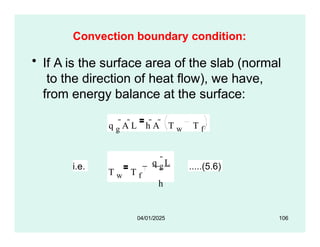
q g
A L h A  T w T f
i.e.
T w T f
q g
L
h
.....(5.6)
04/01/2025 106
• Substituting eqn. (5.6) in eqn.
(5.3),
h 2k
T( x) T f
L
x
2 2
q g
L q g  ......(5.7)
Eqn. (5.7) gives temperature distribution in a slab with heat
generation, in terms of the fluid temperature, Tf .
Remember, again, that L is half-thickness of the slab.
Heat transfer:
By observation, we know that the heat transfer rate from
either of the surfaces must be equal to half of the total
heat generated within the slab, for the B.C. of Tw being
the same at both the surfaces.
i.e. Q = qg A L……..(5.8)
04/01/2025 107
Plane slab with uniform internal heat
generation – two sides at different
temperatures:
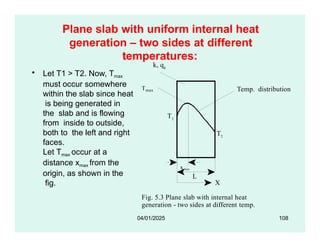
k, qg
• Let T1 > T2. Now, Tmax
Tmax
T1
Temp. distribution
must occur somewhere
within the slab since heat
is being generated in
the slab and is flowing
from inside to outside,
both to the left and right
faces.
Let Tmax occur at a
distance xmax from the
origin, as shown in the
fig. X
Fig. 5.3 Plane slab with internal heat
generation - two sides at different temp.
T2
L
xmax
04/01/2025 108
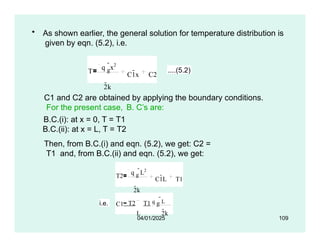
• As shown earlier, the general solution for temperature distribution is
given by eqn. (5.2), i.e.
T
q g
x2
2k
C1x C2
....(5.2)
C1 and C2 are obtained by applying the boundary conditions.
For the present case, B. C’s are:
B.C.(i): at x = 0, T = T1
B.C.(ii): at x = L, T = T2
Then, from B.C.(i) and eqn. (5.2), we get: C2 =
T1 and, from B.C.(ii) and eqn. (5.2), we get:
T2
q g
L2
2k
C1L T1
i.e. C1 T2 T1 q g
L
L 2k
04/01/2025 109
• Substituting for C1 and C2 in eqn. (5.2),
T( x
)
q g
x2
2k
T2
T1
L
q g
L
2k
x
T1
i.e.
T( x) T1 ( L x) 
q g
( T2 T1)
2k L
x
.....(5.12)
Eqn. (5.12) gives the temperature distribution in the slab of
thickness L, with heat generation and the two sides
maintained at different temperatures of T1 and T2.
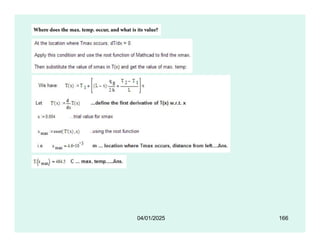
Location and value of max. temperature:
Differentiate eqn. (5.12) w.r.t. x and equate to zero;
Solving, let the value of x obtained be xmax ;
Substitute the obtained value of xmax back in eqn. (5.12) to get the
value of Tmax.
04/01/2025 110
• Heat transfer to the two sides:
• Total heat generated within the slab is equal to :
Qtot = qg A L
• Part of this heat moves to the left and gets dissipated at
the left face; remaining portion of the heat generated
moves to the right and gets dissipated from the right
face.
• Applying Fourier’s Law:
Qright = - k A (dT/dx)x=L
Qleft = - k A (dT/dx)x=0 …this will be -ve since heat
flows from right to left i.e. in –ve x- direction
• Of course, sum of Qright and Qleft must be equal to
Qtot.
04/01/2025 111
Convection boundary condition:
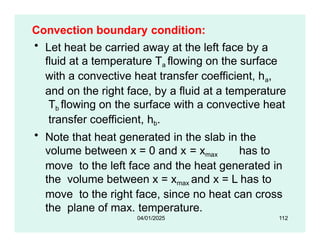
• Let heat be carried away at the left face by a
fluid at a temperature Ta flowing on the surface
with a convective heat transfer coefficient, ha,
and on the right face, by a fluid at a temperature
Tb flowing on the surface with a convective heat
transfer coefficient, hb.
• Note that heat generated in the slab in the
volume between x = 0 and x = xmax has to
move to the left face and the heat generated in
the volume between x = xmax and x = L has to
move to the right face, since no heat can cross
the plane of max. temperature.
04/01/2025 112
Convection boundary condition:
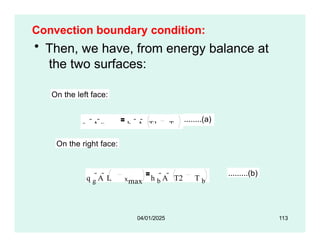
• Then, we have, from energy balance at
the two surfaces:
On the left face:
q g
A xmax h a
A T1 T a
........(a)
On the right face:
xmax
q g
A  L h b
A  T2 T b
.........(b)
04/01/2025 113
• From eqns.(a) and (b), we get T1
and T2 in terms of known fluid
temperatures Ta and Tb respectively.
• After thus obtaining T1 and T2,
substitute them in eqn. (5.12) to get
the temperature distribution in terms of
fluid temperatures Ta and Tb .
04/01/2025 114
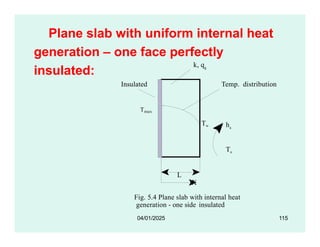
Plane slab with uniform internal heat
generation – one face perfectly
insulated:
Tmax
k, qg
Insulated Temp. distribution
Tw
L
X
Fig. 5.4 Plane slab with internal heat
generation - one side insulated
ha
Ta
04/01/2025 115
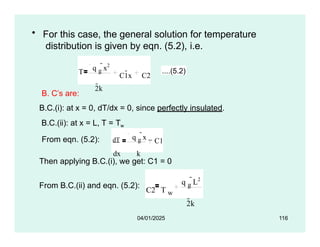
• For this case, the general solution for temperature
distribution is given by eqn. (5.2), i.e.
T
q g
x2
2k
C1x C2
....(5.2)
B. C’s are:
B.C.(i): at x = 0, dT/dx = 0, since perfectly insulated.
B.C.(ii): at x = L, T = Tw
From eqn. (5.2): dT q g
x
dx k
C1
Then applying B.C.(i), we get: C1 = 0
From B.C.(ii) and eqn. (5.2):
C2 T w
q g
L2
2k
04/01/2025 116
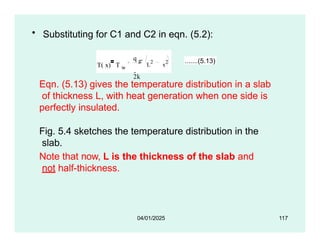
• Substituting for C1 and C2 in eqn. (5.2):
T( x) T w
q g
2k
 L
2
x
2 .......(5.13)
Eqn. (5.13) gives the temperature distribution in a slab
of thickness L, with heat generation when one side is
perfectly insulated.
Fig. 5.4 sketches the temperature distribution in the
slab.
Note that now, L is the thickness of the slab and
not half-thickness.
04/01/2025 117
In case of convection boundary
condition:
• Since the left face is insulated, all the heat generated in
the slab travels to the surface on the right and gets
convected away to the fluid.
• Heat generated in the slab:
Q gen q g
A L
Heat convected at surface: Q conv h a
A T w T a
T w T a
Equating the heat generated and heat convected, we get:
q g
L
h a
....(a)
04/01/2025 118
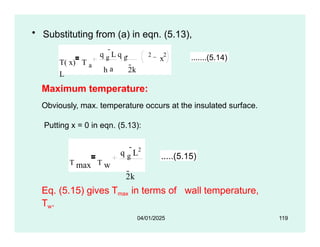
• Substituting from (a) in eqn. (5.13),
a
h 2k
T( x) T a
L
x
2 2
q g
L q g  .......(5.14)
Maximum temperature:
Obviously, max. temperature occurs at the insulated surface.
Putting x = 0 in eqn. (5.13):
T max T w
q g
L2
2k
.....(5.15)
04/01/2025 119
Eq. (5.15) gives Tmax in terms of wall temperature,
Tw.
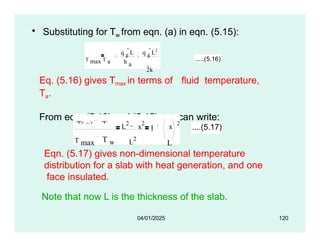
• Substituting for Tw from eqn. (a) in eqn. (5.15):
T max T a
q g
L
h a
q g
L2
2k
.....(5.16)
Eq. (5.16) gives Tmax in terms of fluid temperature,
Ta.
From eqn. (5.13) and (5.15), we can write:
T( x) T w
T max T w L
2
1
L
2
x
2
x
2
L
....(5.17)
04/01/2025 120
Eqn. (5.17) gives non-dimensional temperature
distribution for a slab with heat generation, and one
face insulated.
Note that now L is the thickness of the slab.
Solid cylinder with
internal heat
generation:
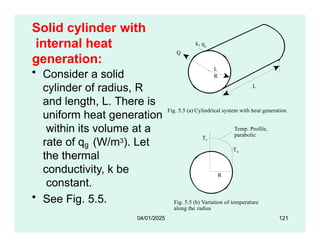
Q
Ti
To
k, qg
Fig. 5.5 (a) Cylindrical system with heat generation
L
L
R
• Consider a solid
cylinder of radius, R
and length, L. There is
uniform heat generation
within its volume at a
rate of q (W/m3). Let
g
the thermal
conductivity, k be
constant.
• See Fig. 5.5.
Temp. Profile,
parabolic
To
Fig. 5.5 (b) Variation of temperature
along the radius
R
Tw
04/01/2025 121
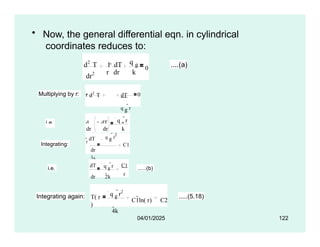
• Now, the general differential eqn. in cylindrical
coordinates reduces to:
dr2
d2
T 1  dT
r dr k
q g
0 ....(a)
Multiplying by r: r d2
T dT
q g
r
dr
2
dr
k
0
i.e. d  dT q g
r
Integrating:
dr dr k
 2
r dT q g r
dr
2k
C1
i.e.
dT q g
r
dr 2k
C1
r
......(b)
Integrating again: T( r
)
q g
r2
4k
C1ln( r) C2
.....(5.18)
04/01/2025 122
• Eqn. (5.18) is the general relation for
temperature distribution along the radius, for a
cylindrical system, with uniform heat generation.
• C1 and C2, the constants of integration are
obtained by applying the boundary conditions.
• B.C’s are:
• B.C. (i): at r = 0, dT/dr = 0 i.e. at the center of the
cylinder, temperature is finite and maximum (i.e.
To = Tmax) because of symmetry.
04/01/2025 123
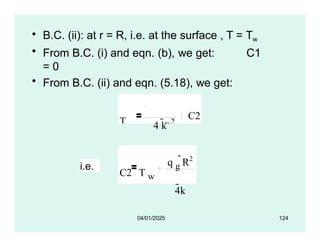
T w
• B.C. (ii): at r = R, i.e. at the surface , T = Tw
• From B.C. (i) and eqn. (b), we get: C1
= 0
• From B.C. (ii) and eqn. (5.18), we get:
q g
R
2
C2
4 k
i.e.
C2 T w
q g
R2
4k
04/01/2025 124
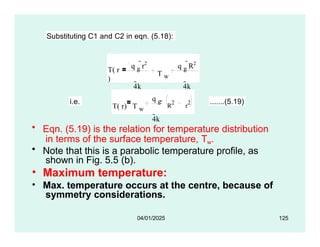
Substituting C1 and C2 in eqn. (5.18):
T( r
)
q g
r2
4k
T w
q g
R2
4k
i.e.
T( r) T w
q g
4k
 R
2
r
2 .......(5.19)
• Eqn. (5.19) is the relation for temperature distribution
in terms of the surface temperature, Tw.
• Note that this is a parabolic temperature profile, as
shown in Fig. 5.5 (b).
• Maximum temperature:
• Max. temperature occurs at the centre, because of
symmetry considerations.
04/01/2025 125
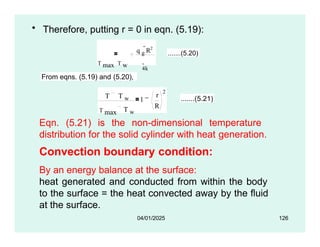
• Therefore, putting r = 0 in eqn. (5.19):
q g
R2
T max T w 4k
.......(5.20)
From eqns. (5.19) and (5.20),
T T w
T max T w
1
r
R
2
.......(5.21)
Eqn. (5.21) is the non-dimensional temperature
distribution for the solid cylinder with heat generation.
Convection boundary condition:
By an energy balance at the surface:
heat generated and conducted from within the body
to the surface = the heat convected away by the fluid
at the surface.
04/01/2025 126
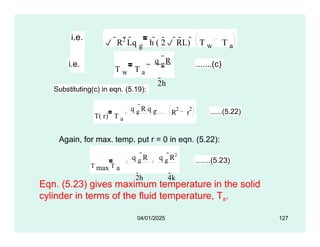
i.e.
 R2 Lq g h ( 2 RL)  T w T a
i.e.
T w T a
q g
R
2h
.......(c)
Substituting(c) in eqn. (5.19):
T( r) T a
R r
2 2
q g
R q g 
2h 4k
......(5.22)
Again, for max. temp. put r = 0 in eqn. (5.22):
T max T a
q g
R q g
R2
2h 4k
.......(5.23)
04/01/2025 127
Eqn. (5.23) gives maximum temperature in the solid
cylinder in terms of the fluid temperature, Ta.
Current carrying conductor:
• Consider a conductor of cross-sectional area, Ac
and length, L. Let the current carried be I (Amp.). Let
the electrical resistivity of the material be 
(Ohm.m).
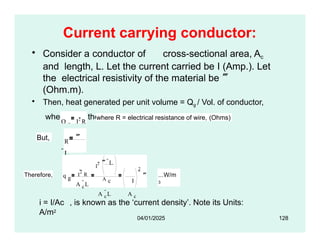
• Then, heat generated per unit volume = Qg / Vol. of conductor,
where Qg is the total heat generated (W).
Q g I2 R
where R = electrical resistance of wire, (Ohms)
But, R

L
A c
Therefore, q g
2
R
I 
A c
L
I
2   L
A c I
A c
L A c
2
04/01/2025 128

 ...W/m
3
i = I/Ac , is known as the ‘current density’. Note its Units:
A/m2
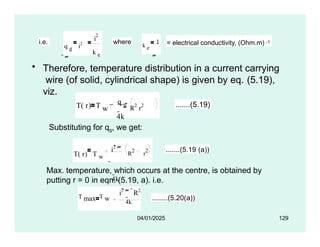
• Therefore, temperature distribution in a current carrying
wire (of solid, cylindrical shape) is given by eq. (5.19),
viz.
i.e.
q g i2

i
2
k e
where k e
1

= electrical conductivity, (Ohm.m) -1
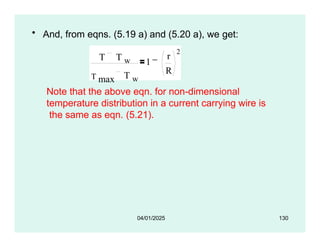
T( r) T w
4k
q g  R
2
r
2 .......(5.19)
Substituting for qg, we get:
T( r) T w R
2
r
2
i2 

4k
.......(5.19 (a))
Max. temperature, which occurs at the centre, is obtained by
putting r = 0 in eqn. (5.19, a). i.e.
i2  R2
T max T w 4k
........(5.20(a))
04/01/2025 129
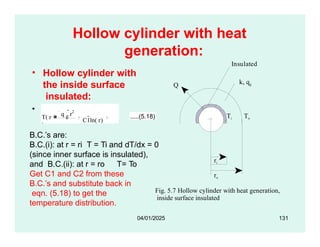
• And, from eqns. (5.19 a) and (5.20 a), we get:
T T w
T max T w
1
r
R
2
Note that the above eqn. for non-dimensional
temperature distribution in a current carrying wire is
the same as eqn. (5.21).
04/01/2025 130
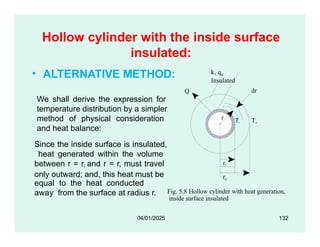
Hollow cylinder with heat
generation:
the inside surface
insulated:
• We have:
k, qg
Q
To Ti To
Insulated
• Hollow cylinder with
T( r
)
q g
r2
4k
C1ln( r)
C2
.....(5.18)
Fig. 5.7 Hollow cylinder with heat generation,
inside surface insulated
ri
ro
B.C.’s are:
B.C.(i): at r = ri T = Ti and dT/dx = 0
(since inner surface is insulated),
and B.C.(ii): at r = ro T= To
Get C1 and C2 from these
04/01/2025 131
B.C.’s and substitute back in
eqn. (5.18) to get the
temperature distribution.
Hollow cylinder with the inside surface
insulated:
• ALTERNATIVE METHOD:
Q
Ti To
k, qg
Insulated
dr
r
Fig. 5.8 Hollow cylinder with heat generation,
inside surface insulated
ri
ro
equal to the heat conducted
away from the surface at radius r.
04/01/2025 132
We shall derive the expression for
temperature distribution by a simpler
method of physical consideration
and heat balance:
Since the inside surface is insulated,
heat generated within the volume
between r = ri and r = r, must travel
only outward; and, this heat must be
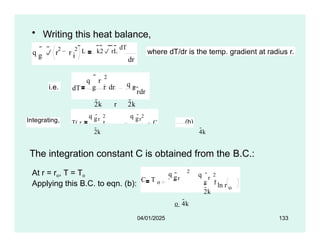
• Writing this heat balance,
g
q  r r i
2 2
  L k2 rL dT
dr
where dT/dr is the temp. gradient at radius r.
i.e. dT
q r
2

g i  dr q g
2k r 2k
rdr
Integrating, T( r
)
q gr
2
i ln( r)
q gr
2
C .....(b)
2k 4k
The integration constant C is obtained from the B.C.:
At r = ro, T = To
Applying this B.C. to eqn. (b):
q
C T o
2
r
q
g
o 4k
r
2
2k
g i ln r o
04/01/2025 133
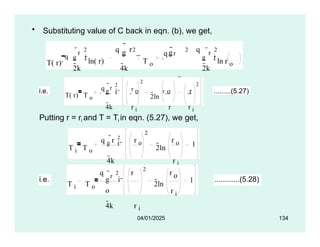
• Substituting value of C back in eqn. (b), we get,
T( r)
q
2k
g i ln( r)
g
q r

4k
T o
q r
q
g
o 4k
r
2 2 2 r
2
2k
g i ln r o
i.e.
T( r) T o
q r 2
2
2ln
r
2
g i 
r o o r
4k r i r r i
.........(5.27)
Putting r = ri and T = Ti in eqn. (5.27), we get,
T i T o
q g
r 2
r o
4k
r i
2
r o
r i
2ln 1
i 
i.e.
T i T o
q r
2 r
2
r o
r i
2ln
1
g i 
o
4k r i
............(5.28)
04/01/2025 134
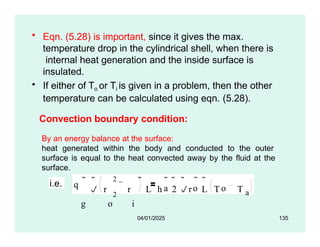
• Eqn. (5.28) is important, since it gives the max.
temperature drop in the cylindrical shell, when there is
internal heat generation and the inside surface is
insulated.
• If either of To or Ti is given in a problem, then the other
temperature can be calculated using eqn. (5.28).
Convection boundary condition:
By an energy balance at the surface:
heat generated within the body and conducted to the outer
surface is equal to the heat convected away by the fluid at the
surface.
i.e. q
2
2
g o i
 
a o o
 r r L h 2 r L T T a
     
04/01/2025 135
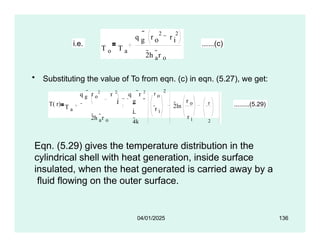
• Substituting the value of To from eqn. (c) in eqn. (5.27), we get:
i.e.
T o T a
q r r
g o i
2 2

2h a
r o
......(c)
T( r) T a
q g
 r o
2
r 2
i
2h a
r o
q r 2
g
i
4k

r o
2
r i
2ln
r o
r i
r
2
r i
.........(5.29)
Eqn. (5.29) gives the temperature distribution in the
cylindrical shell with heat generation, inside surface
insulated, when the heat generated is carried away by a
fluid flowing on the outer surface.
04/01/2025 136
Hollow cylinder with the outside surface
insulated:
• Start with:
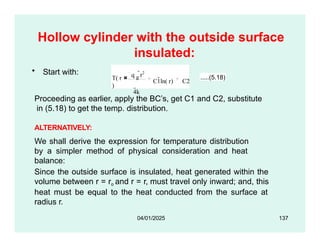
T( r
)
q g
r2
4k
C1ln( r) C2
.....(5.18)
Proceeding as earlier, apply the BC’s, get C1 and C2, substitute
in (5.18) to get the temp. distribution.
ALTERNATIVELY:
We shall derive the expression for temperature distribution
by a simpler method of physical consideration and heat
balance:
Since the outside surface is insulated, heat generated within the
volume between r = ro and r = r, must travel only inward; and, this
heat must be equal to the heat conducted from the surface at
radius r.
04/01/2025 137
• Writing this heat balance,
Q
Ti Insulate
d dr
k, qg
To
Note that the term on the
RHS has +ve sign,
since, now, the heat
transfer is from
Fig. 5.10 Hollow cylinder with heat generation,
outside surface insulated
ri
ro
outside to inside, i.e. in the
–ve r-direction (because
the outside surface is
insulated).
04/01/2025 138
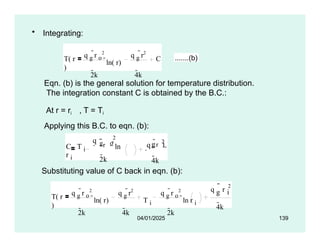
• Integrating:
T( r
)
q g
r o
2
2k
ln( r)
q g
r2
4k
C .......(b)
Eqn. (b) is the general solution for temperature distribution.
The integration constant C is obtained by the B.C.:
At r = ri , T = Ti
Applying this B.C. to eqn. (b):
2
r
2k
q
C T i
g o ln
r i
q r
2
g i
4k
Substituting value of C back in eqn. (b):
T( r
)
q g
r o
2
2k
ln( r)
q g
r2
4k
T i
q g
r o
2
2k
ln r i
q r
2

g i
4k
04/01/2025 139
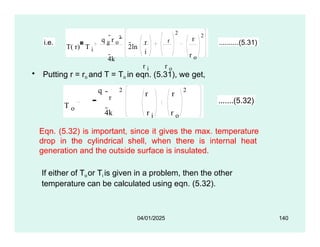
• Putting r = ro and T = To in eqn. (5.31), we get,
i.e.
T( r) T i
q g
r o
2
4k
2ln
r r
i
r i r o
2
r
r o
2
 ..........(5.31)
T o
r
r r
2 2
q
4k r i r o
.......(5.32)
Eqn. (5.32) is important, since it gives the max. temperature
drop in the cylindrical shell, when there is internal heat
generation and the outside surface is insulated.
If either of Toor Ti is given in a problem, then the other
temperature can be calculated using eqn. (5.32).
04/01/2025 140
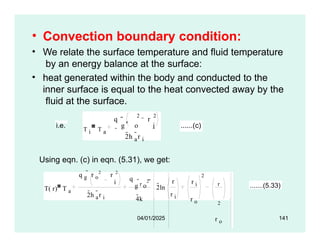
• Convection boundary condition:
• We relate the surface temperature and fluid temperature
by an energy balance at the surface:
• heat generated within the body and conducted to the
inner surface is equal to the heat convected away by the
fluid at the surface.
q r
2 2
 r
i.e. T i T a
g o i ......(c)
2h a
r i
Using eqn. (c) in eqn. (5.31), we get:
T( r) T a
q g
 r o
2
r 2
i
2h a
r i
q
g
r o
2
4k

2ln
r
r i
r i
r o
2
r
2
r o
.......(5.33)
04/01/2025 141
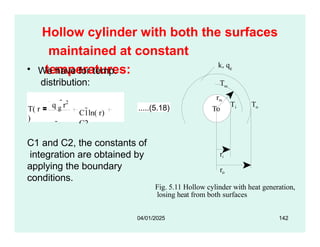
Hollow cylinder with both the surfaces
maintained at constant
temperatures:
• We have for temp.
distribution:
i
T To
rm
To
k, qg
Tm
T( r
)
q g
r2
4k
C1ln( r)
C2
.....(5.18)
Fig. 5.11 Hollow cylinder with heat generation,
losing heat from both surfaces
ri
ro
C1 and C2, the constants of
integration are obtained by
applying the boundary
conditions.
04/01/2025 142
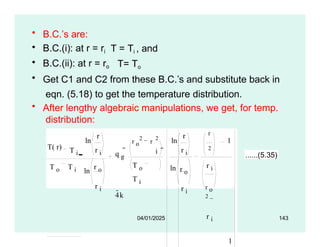
T = Ti , and
T= To
• B.C.’s are:
• B.C.(i): at r = ri
• B.C.(ii): at r = ro
• Get C1 and C2 from these B.C.’s and substitute back in
eqn. (5.18) to get the temperature distribution.
• After lengthy algebraic manipulations, we get, for temp.
distribution:
T( r) T i
ln
r
r i q g
4k

r o
2
r
2
i
T o
T i

ln
ln
r
r i
r o
r i
r
2
r i
r o
2
r i
1
T o T i ln
r o
r i
1
04/01/2025 143
......(5.35)
Hollow cylinder with both the surfaces
maintained at constant temperatures:
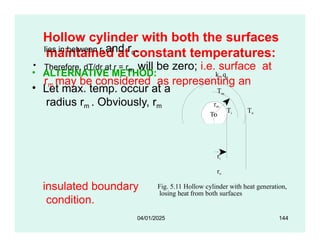
• ALTERNATIVE METHOD:
• Let max. temp. occur at a
radius rm . Obviously, rm
Ti To
rm
To
k, qg
Tm
lies in between ri and ro.
• Therefore, dT/dr at r = rm will be zero; i.e. surface at
rm may be considered as representing an
insulated boundary
condition.
Fig. 5.11 Hollow cylinder with heat generation,
losing heat from both surfaces
ri
ro
04/01/2025 144
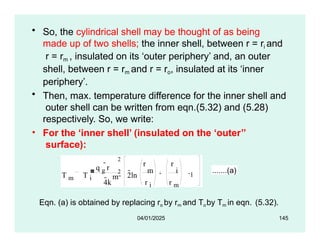
• So, the cylindrical shell may be thought of as being
made up of two shells; the inner shell, between r = ri and
r = rm , insulated on its ‘outer periphery’ and, an outer
shell, between r = rm and r = ro, insulated at its ‘inner
periphery’.
• Then, max. temperature difference for the inner shell and
outer shell can be written from eqn.(5.32) and (5.28)
respectively. So, we write:
• For the ‘inner shell’ (insulated on the ‘outer’’
surface):
T m T i
q g
r
4k r i
2ln
r r
r m
m i 1
2
2
m 
.......(a)
04/01/2025 145
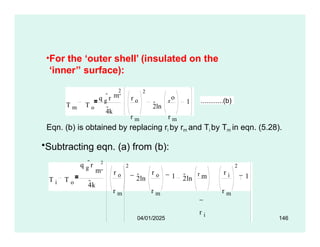
Eqn. (a) is obtained by replacing ro by rm and Toby Tm in eqn. (5.32).
•For the ‘outer shell’ (insulated on the
‘inner’’ surface):
T m T o
q g
r
4k
2
o
r o
r m r m
2ln
r 1
2
m 
............(b)
Eqn. (b) is obtained by replacing ri by rm and Ti by Tm in eqn. (5.28).
•Subtracting eqn. (a) from (b):
T i T o
q g
r 2
m 
4k
r o
r m
2
2ln
r o
r m
1 2ln
r m
r i
r i
r m
2
1
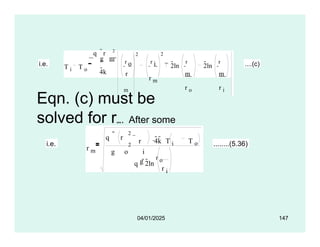
04/01/2025 146
i.e. T i T o
q r 2
g m 
4k
r o
r
m
2
r i
r m
2
2ln
r
m
r o
2ln
r
m
r i
....(c)
Eqn. (c) must be
solved for rm. After some
manipulation, we get:
i.e.
r m
q r
2
2
g o i

r 4k T i T o
g
r i
q 2ln
r o
........(5.36)
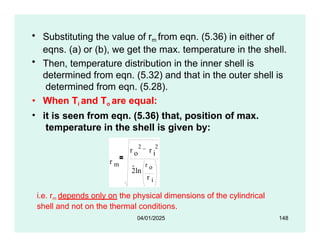
04/01/2025 147
• Substituting the value of rm from eqn. (5.36) in either of
eqns. (a) or (b), we get the max. temperature in the shell.
• Then, temperature distribution in the inner shell is
determined from eqn. (5.32) and that in the outer shell is
determined from eqn. (5.28).
• When Ti and To are equal:
• it is seen from eqn. (5.36) that, position of max.
temperature in the shell is given by:
r m
r r
o i
2 2
2ln
r o
r i
i.e. rm depends only on the physical dimensions of the cylindrical
shell and not on the thermal conditions.
04/01/2025 148
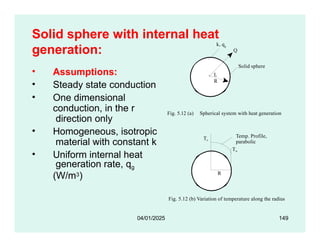
Solid sphere with internal heat
generation: Q
Ti
To
k, qg
Fig. 5.12 (a) Spherical system with heat generation
L
R
Solid sphere
• Assumptions:
• Steady state conduction
• One dimensional
conduction, in the r
direction only
• Homogeneous, isotropic
material with constant k
• Uniform internal heat
generation rate, qg
(W/m3)
To
Fig. 5.12 (b) Variation of temperature along the radius
R
Temp. Profile,
parabolic
Tw
04/01/2025 149
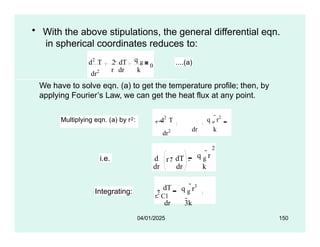
• With the above stipulations, the general differential eqn.
in spherical coordinates reduces to:
dr2
d2
T 2  dT
r dr k
q g
0 ....(a)
We have to solve eqn. (a) to get the temperature profile; then, by
applying Fourier’s Law, we can get the heat flux at any point.
Multiplying eqn. (a) by r2: d2
T
dT
q g
r2
r
2 2r0
dr2 dr k
i.e. r
dr dr
d 2  dT
2
q g
r
k
Integrating:
dT q g
r3
dr 3k
r
2 C1
04/01/2025 150
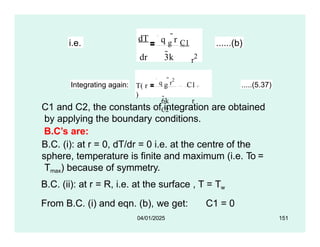
i.e.
dT
dr 3k
q g
r C1
r
2
......(b)
Integrating again: T( r
)
q g
r
2
C1
6k r
C2
.....(5.37)
C1 and C2, the constants of integration are obtained
by applying the boundary conditions.
B.C’s are:
B.C. (i): at r = 0, dT/dr = 0 i.e. at the centre of the
sphere, temperature is finite and maximum (i.e. To =
Tmax) because of symmetry.
B.C. (ii): at r = R, i.e. at the surface , T = Tw
From B.C. (i) and eqn. (b), we get: C1 = 0
04/01/2025 151
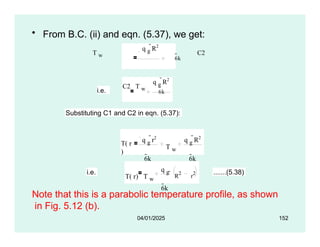
• From B.C. (ii) and eqn. (5.37), we get:
q g
R2
T w
6k
C2
i.e.
q g
R2
C2 T w
6k
Substituting C1 and C2 in eqn. (5.37):
T( r
)
q g
r2
6k
T w
q g
R2
6k
i.e.
T( r) T w
q g
6k
 R2
r2 .......(5.38)
04/01/2025 152
Note that this is a parabolic temperature profile, as shown
in Fig. 5.12 (b).
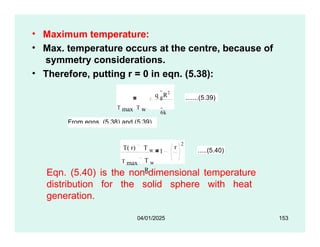
• Maximum temperature:
• Max. temperature occurs at the centre, because of
symmetry considerations.
• Therefore, putting r = 0 in eqn. (5.38):
q g
R2
T max T w 6k
.......(5.39)
From eqns. (5.38) and (5.39),
T( r) T w
T max
1
r
T w
R
2
.....(5.40)
04/01/2025 153
Eqn. (5.40) is the non-dimensional temperature
distribution for the solid sphere with heat
generation.
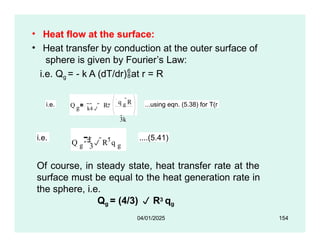
• Heat flow at the surface:
• Heat transfer by conduction at the outer surface of
sphere is given by Fourier’s Law:
i.e. Qg = - k A (dT/dr)at r = R
i.e. Q g R
k4 
q g
R
3k
2  ...using eqn. (5.38) for T(r
i.e.
3
Q g
4  R3 q g
....(5.41)
04/01/2025 154
Of course, in steady state, heat transfer rate at the
surface must be equal to the heat generation rate in
the sphere, i.e.
Qg = (4/3)  R3 qg
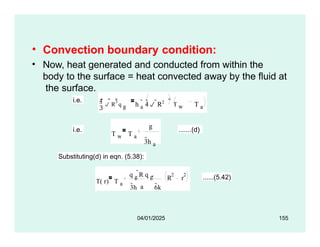
• Convection boundary condition:
• Now, heat generated and conducted from within the
body to the surface = heat convected away by the fluid at
the surface.
i.e.

4  R
3 q g h a
 4 R2
T a
 T w
i.e.
T w T a
g
3h a
.......(d)
Substituting(d) in eqn. (5.38):
T( r) T a
a
3h 6k
R r
2 2
q g
R q g  ......(5.42)
04/01/2025 155
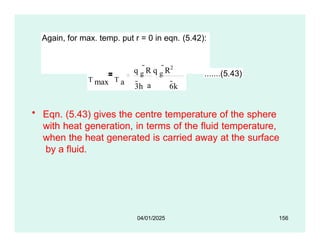
Again, for max. temp. put r = 0 in eqn. (5.42):
T max T a a
q g
R q g
R2
3h 6k
.......(5.43)
• Eqn. (5.43) gives the centre temperature of the sphere
with heat generation, in terms of the fluid temperature,
when the heat generated is carried away at the surface
by a fluid.
04/01/2025 156
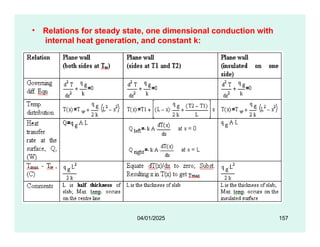
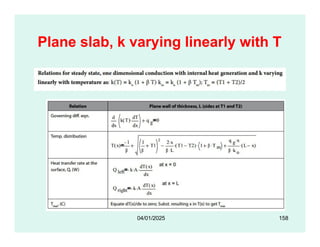
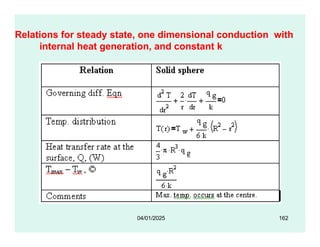
• Relations for steady state, one dimensional conduction with
internal heat generation, and constant k:
04/01/2025 157
Plane slab, k varying linearly with T
04/01/2025 158
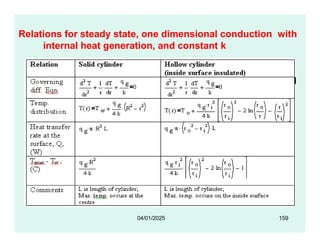
Relations for steady state, one dimensional conduction with
internal heat generation, and constant k
04/01/2025 159
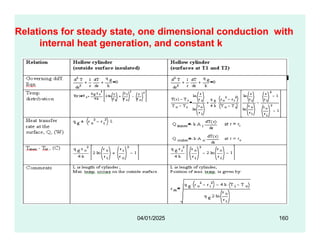
Relations for steady state, one dimensional conduction with
internal heat generation, and constant k
04/01/2025 160
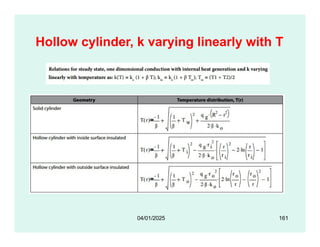
Hollow cylinder, k varying linearly with T
04/01/2025 161
Relations for steady state, one dimensional conduction with
internal heat generation, and constant k
04/01/2025 162
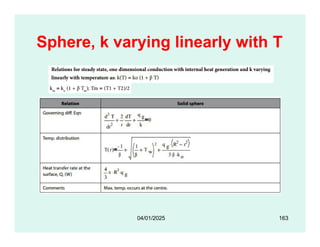
Sphere, k varying linearly with T
04/01/2025 163
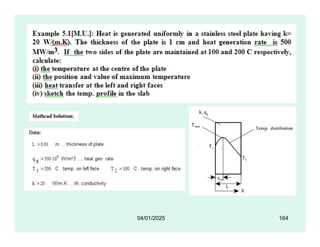
04/01/2025 164
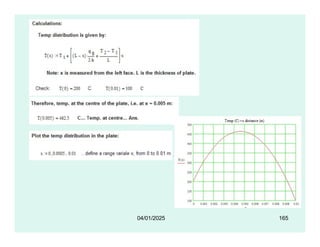
04/01/2025 165
04/01/2025 166
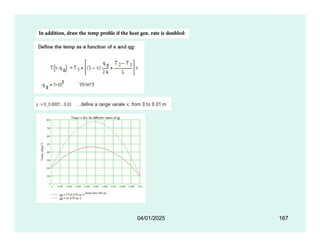
04/01/2025 167
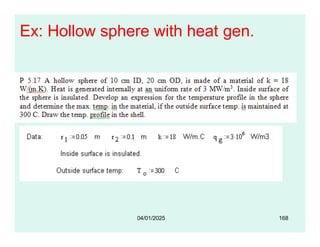
Ex: Hollow sphere with heat gen.
04/01/2025 168
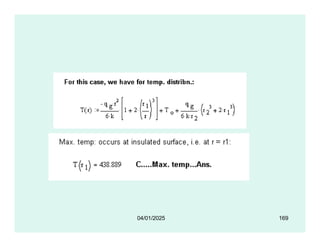
04/01/2025 169
04/01/2025 170
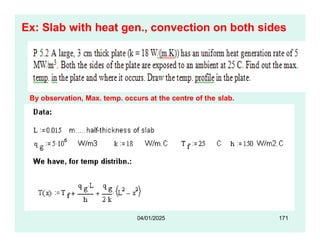
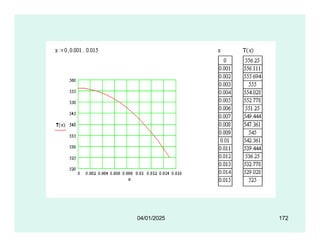
Ex: Slab with heat gen., convection on both sides
By observation, Max. temp. occurs at the centre of the slab.
04/01/2025 171
04/01/2025 172
TRANSIENT HEAT CONDUCTION:
04/01/2025 173
• In transient conduction, temperature depends
not only on position in the solid, but also on
time.
• So, mathematically, this can be written as T =
T(x,y,z,), where  represents the time
coordinate.
• Typical examples of transient
conduction:
• heat exchangers
• boiler tubes
• cooling of I.C.Engine cylinder heads
Examples (contd.):
04/01/2025 174
• heat treatment of engineering
components and quenching of ingots
• heating of electric irons
• heating and cooling of buildings
• freezing of foods, etc.
Lumped system analysis
(Newtonian heating or cooling):
• In lumped system analysis, the internal
conduction resistance of the body to heat
flow (i.e. L/(k.A)) is negligible compared
to the convective resistance (i.e. 1/(h.A))
at the surface.
• So, the temperature of the body, no doubt,
varies with time, but at any given instant,
the temperature within the body is uniform
and is independent of position. i.e. T =
T() only.
04/01/2025 175
Lumped system analysis
(Newtonian heating or cooling):
• Practical examples of such cases are:
heat treatment of small metal pieces,
measurement of temperature with a
thermocouple or thermometer etc, where
the internal resistance of the object for
heat conduction may be considered as
negligible.
04/01/2025 176
Analysis:
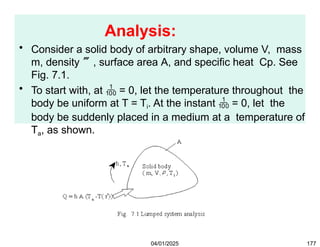
• Consider a solid body of arbitrary shape, volume V, mass
m, density , surface area A, and specific heat Cp. See
Fig. 7.1.
• To start with, at  = 0, let the temperature throughout the
body be uniform at T = Ti. At the instant  = 0, let the
body be suddenly placed in a medium at a temperature of
Ta, as shown.
04/01/2025 177
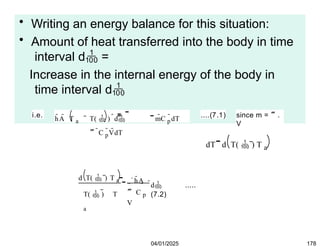
• Writing an energy balance for this situation:
• Amount of heat transferred into the body in time
interval d =
Increase in the internal energy of the body in
time interval d
i.e.
hA T a T(  ) d mC p
dT
 C p
VdT
....(7.1) since m = .
V
dT d T(  ) T a
Now, since Ta is a constant, we can write:
Therefore,
d T(  ) T a
T(  ) T
a
hA
 C p
V
  d .....
(7.2)
04/01/2025 178
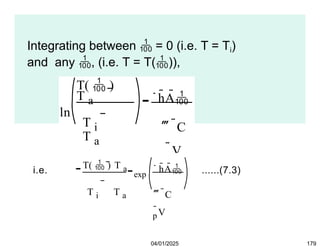
Integrating between  = 0 (i.e. T = Ti)
and any , (i.e. T = T()),
T(  )
T a
ln
T i
T a
hA
 C
p
V
i.e.
T(  ) T a
T i T a
exp
hA
 C
p
V
......(7.3)
04/01/2025 179
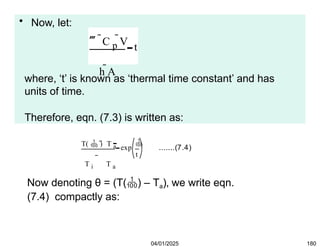
• Now, let:
 C p
V
h A
t
where, ‘t’ is known as ‘thermal time constant’ and has
units of time.
Therefore, eqn. (7.3) is written as:
T(  ) T a
T i T a
exp

t
.......(7.4)
04/01/2025 180
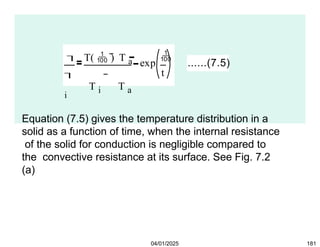
Now denoting θ = (T() – Ta), we write eqn.
(7.4) compactly as:


i
T(  ) T a
T i T a
exp

t
......(7.5)
04/01/2025 181
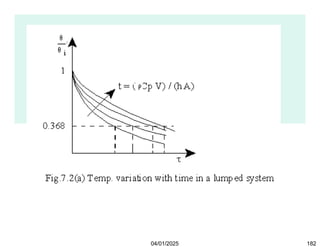
Equation (7.5) gives the temperature distribution in a
solid as a function of time, when the internal resistance
of the solid for conduction is negligible compared to
the convective resistance at its surface. See Fig. 7.2
(a)
04/01/2025 182
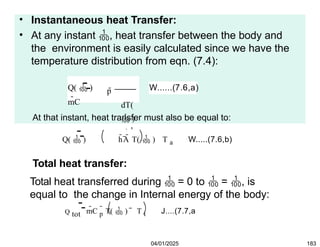
• Instantaneous heat Transfer:
• At any instant , heat transfer between the body and
the environment is easily calculated since we have the
temperature distribution from eqn. (7.4):
p
Q(  )
mC

dT(
 )
d
W......(7.6,a)
At that instant, heat transfer must also be equal to:
Q(  ) hA T(  ) T a W.....(7.6,b)
Total heat transfer:
Total heat transferred during  = 0 to  = , is
equal to the change in Internal energy of the body:
Q tot mC p
 T(  ) T i J....(7.7,a
04/01/2025 183
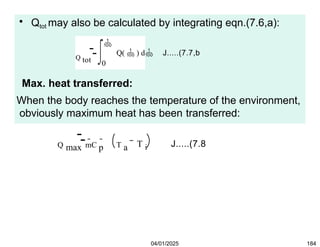
Q tot
• Qtot may also be calculated by integrating eqn.(7.6,a):

Q(  ) d J.....(7.7,b
0
Max. heat transferred:
When the body reaches the temperature of the environment,
obviously maximum heat has been transferred:
Q max mC p T a T i J.....(7.8
04/01/2025 184
If Qmax is negative, it means that the body has lost heat,
and if Qmax is positive, then body has gained heat.
Criteria for lumped system analysis
(Biot number and Fourier
number):
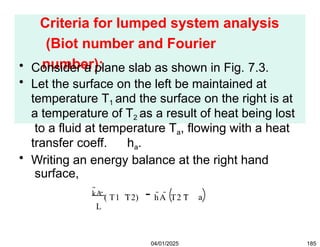
• Consider a plane slab as shown in Fig. 7.3.
• Let the surface on the left be maintained at
temperature T1 and the surface on the right is at
a temperature of T2 as a result of heat being lost
to a fluid at temperature Ta, flowing with a heat
transfer coeff. ha.
• Writing an energy balance at the right hand
surface,
a
kA ( T1 T2) hA T2 T
L
04/01/2025 185
Criteria for lumped system analysis
(Biot number and Fourier
number):
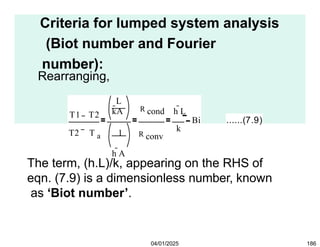
Rearranging,
T1 T2
T2 T a 1
h A
R conv
k
L
kA R cond h L
Bi ......(7.9)
04/01/2025 186
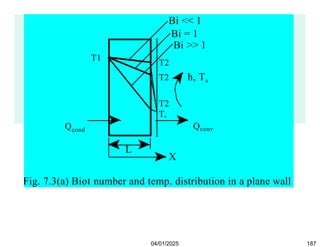
The term, (h.L)/k, appearing on the RHS of
eqn. (7.9) is a dimensionless number, known
as ‘Biot number’.
Fig. 7.3(a) Biot number and temp. distribution in a plane wall
X
T1
T2 h, Ta
T2
Ta
Bi << 1
Bi = 1
Bi >> 1
T2
Qconv
Qcond
L
04/01/2025 187
• Note from Fig. (7.3, a) the temperature profile for
Bi << 1.
• It suggests that one can assume a uniform temperature
distribution within the solid if Bi << 1.
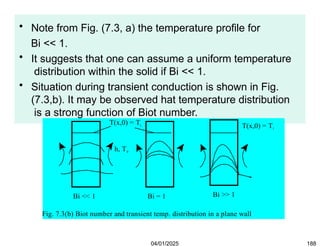
• Situation during transient conduction is shown in Fig.
(7.3,b). It may be observed hat temperature distribution
is a strong function of Biot number.
Fig. 7.3(b) Biot number and transient temp. distribution in a plane wall
h, Ta
Bi << 1 Bi = 1 Bi >> 1
T(x,0) = Ti T(x,0) = Ti
04/01/2025 188
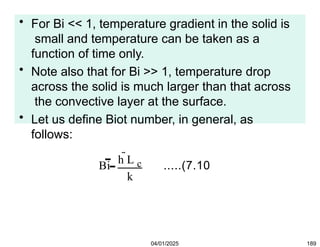
• For Bi << 1, temperature gradient in the solid is
small and temperature can be taken as a
function of time only.
• Note also that for Bi >> 1, temperature drop
across the solid is much larger than that across
the convective layer at the surface.
• Let us define Biot number, in general, as
follows:
Bi
h L c
k
.....(7.10
04/01/2025 189
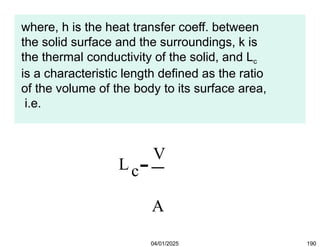
where, h is the heat transfer coeff. between
the solid surface and the surroundings, k is
the thermal conductivity of the solid, and Lc
is a characteristic length defined as the ratio
of the volume of the body to its surface area,
i.e.
Lc
V
A
04/01/2025 190
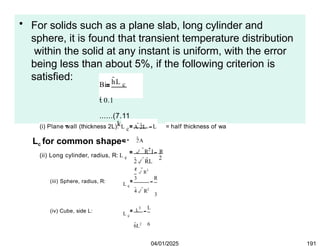
• For solids such as a plane slab, long cylinder and
sphere, it is found that transient temperature distribution
within the solid at any instant is uniform, with the error
being less than about 5%, if the following criterion is
satisfied: hL c
Bi
 0.1
......(7.11
k
Lc for common shapes:
(i) Plane wall (thickness 2L): L c A 2L
2A
L = half thickness of wa
(ii) Long cylinder, radius, R: L c
2 RL
 R2 L R
2
(iii) Sphere, radius, R:
L c
4  R3
3
4 R2
R
3
(iv) Cube, side L: L c
L
3
6L2
L
6
04/01/2025 191
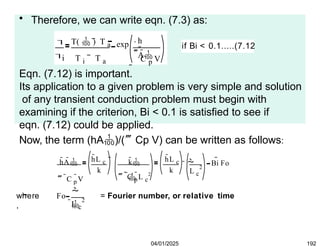
• Therefore, we can write eqn. (7.3) as:


i
T(  ) T a
T i T a
h
A
C p V
exp
 

if Bi < 0.1.....(7.12
Eqn. (7.12) is important.
Its application to a given problem is very simple and solution
of any transient conduction problem must begin with
examining if the criterion, Bi < 0.1 is satisfied to see if
eqn. (7.12) could be applied.
Now, the term (hA)/(Cp V) can be written as follows:
hA
 C p
V  C p
L c
2

hL c hL c
k k 2
L c
k  

Bi Fo

where
,
Fo


2
L c
= Fourier number, or relative time
04/01/2025 192
• Fourier number, like Biot number, is an
important parameter in transient heat
transfer problems.
• It is also known as ‘dimensionless time’.
• Fourier number signifies the degree of
penetration of heating or cooling
effect through a solid.
• For small Fo, large  will be required to
get significant temperature changes.
04/01/2025 193
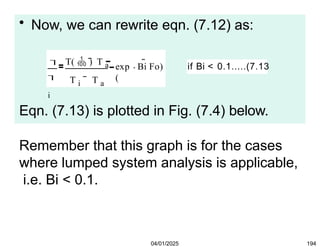
• Now, we can rewrite eqn. (7.12) as:


i
T(  ) T a
T i T a

exp
(
Bi Fo) if Bi < 0.1.....(7.13
04/01/2025 194
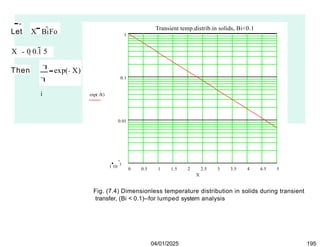
Eqn. (7.13) is plotted in Fig. (7.4) below.
Remember that this graph is for the cases
where lumped system analysis is applicable,
i.e. Bi < 0.1.
Let X BiFo
X 0 0.1 5
Then


i
exp( X)
exp( X)
X
0 0.5 1 1.5 2 2.5 3 3.5 4 4.5 5
1 10
3
0.01
0.1
1
Transient temp.distrib.in solids, Bi<0.1
04/01/2025 195
Fig. (7.4) Dimensionless temperature distribution in solids during transient
transfer, (Bi < 0.1)--for lumped system analysis
Response time of a thermocouple:
04/01/2025 196
• Lumped system analysis is usefully
applied in the case of temperature
measurement with a thermometer or a
thermocouple. Obviously, it is desirable
that the thermocouple indicates the source
temperature as fast as possible.
• ‘Response time’ of a thermocouple is
defined as the time taken by it to reach the
source temperature.
Response time of a thermocouple:
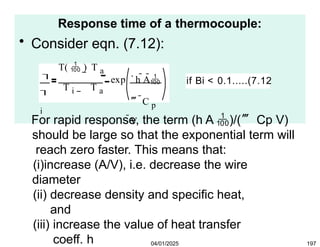
• Consider eqn. (7.12):


i
T(  ) T a
exp
T i T a
h A
 C p
V
if Bi < 0.1.....(7.12
04/01/2025 197
For rapid response, the term (h A )/( Cp V)
should be large so that the exponential term will
reach zero faster. This means that:
(i)increase (A/V), i.e. decrease the wire
diameter
(ii) decrease density and specific heat,
and
(iii) increase the value of heat transfer
coeff. h
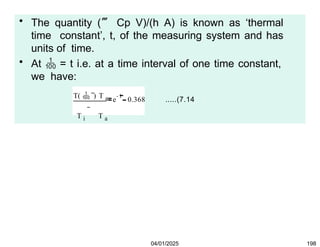
• The quantity ( Cp V)/(h A) is known as ‘thermal
time constant’, t, of the measuring system and has
units of time.
• At  = t i.e. at a time interval of one time constant,
we have:
T(  ) T a
T i T a
1
e 0.368 .....(7.14
04/01/2025 198
From eqn. (7.14), it is clear that after an interval of time
equal to one time constant of the given temperature
measuring system, the temperature difference between the
body (thermocouple) and the source would be 36.8% of
the initial temperature difference. i.e. the temperature
difference would be reduced by 63.2%.
Time required by a thermocouple to attain
63.2% of the value of initial temperature
difference is called its ‘sensitivity’.
For good response, obviously the response
time of thermocouple should be low.
As a thumb rule, it is recommended that while
using a thermocouple to measure temperatures,
reading of the thermocouple should be taken
after a time equal to about four time periods has
elapsed.
04/01/2025 199
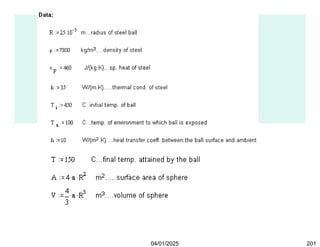
• Example 7.1 (M.U.): A steel ball 5 cm
dia, initially at an uniform temperature
of 450 C is suddenly placed in an
environment at 100 C. Heat transfer
coeff. h, between the steel ball and the
fluid is 10 W/(m2.K). For steel, cp = 0.46
kJ/(kg.K), ρ = 7800 kg/m3, k = 35
W/(m.K). Calculate the time required for
the ball to reach a temperature of 150
C. Also find the rate of cooling after 1
hr. Show graphically how the temp. of
the sphere falls with time.
04/01/2025 200
04/01/2025 201
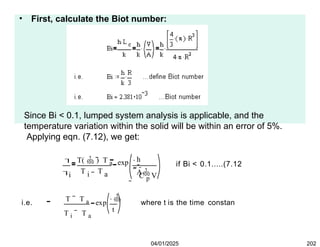
• First, calculate the Biot number:
Since Bi < 0.1, lumped system analysis is applicable, and the
temperature variation within the solid will be within an error of 5%.
Applying eqn. (7.12), we get:


i
T(  ) T a
T T
i a
h
A
C p V
exp
 

if Bi < 0.1.....(7.12
i.e.
T T a
T i T a
exp

t
where t is the time constan
04/01/2025 202
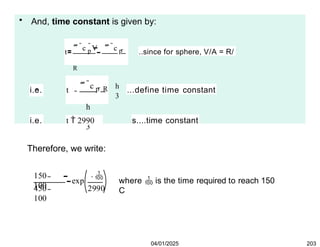
• And, time constant is given by:
t
 c p
V  c p 
R
Ah h
3
..since for sphere, V/A = R/
i.e. t  c p  R
h
3
...define time constant
i.e. t  2990 s....time constant
Therefore, we write:
150
100
450
100
exp

2990
where  is the time required to reach 150
C
04/01/2025 203
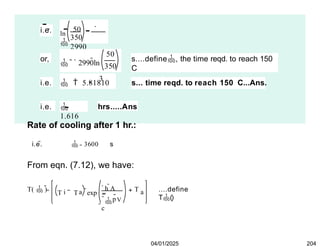
i.e. ln
50

350
2990
or,
50
350
 2990ln
s....define, the time reqd. to reach 150
C
i.e.
3
  5.81810 s... time reqd. to reach 150 C...Ans.
i.e. 
1.616
hrs.....Ans
Rate of cooling after 1 hr.:
i.e.  3600 s
From eqn. (7.12), we have:
T(  ) i a
h A
p

c
V
T T exp
T a ....define
T()
04/01/2025 204
i.e.
dT
d

i
T T a
hA
 Vc p
 hA
 Vc p
exp
C/s.....rate of coolin
d
T(  ) 0.035
d
C/s....rate of cooling after 1 hr..Ans
i.e.
-ve sign indicates that as time increases, temperature falls.
To sketch the fall in temp. of sphere with time:
Temp. as a function of time is given by eqn. (7.12):


i
T(  ) T a
T T
i a
h
A
c p V
exp
 

if Bi < 0.1.....(7.12
i.e. T(  ) T a i a
hA
 c p
V
T T exp ....eqn. (A
04/01/2025 205
• We will plot eqn. (A) against different times, :
0 0.5 1 1.5 2

2.5 3 3.5 4
500
450
400
350
T(  3600)
300
250
200
150
100
Trans. cooling of sphere-lumped system
 in hrs. and
T() in deg.C
Fig. Ex. 7.1 Transient cooling of a sphere considred as a lumped system
04/01/2025 206
Note from the fig. how the cooling progresses with time.
After about 4 hrs. duration, the sphere approaches the temp.
of the ambient.
You can also verify from the graph that the time required for the
sphere to reach 150 C is 1.616 hrs, as calculated earlier.
• Example 7.4 (M.U.): A Thermocouple (TC)
junction is in the form of 8 mm sphere.
Properties of the material are: cp = 420 J/(kg.
K), ρ = 8000 kg/m3, k = 40 W/(m.K), and heat
transfer coeff., h = 45 W/(m2.K). Find, if the
junction is initially at a temp. of 28 C and
inserted in a stream of hot air at 300 C:
(i) the time const. of the TC
(ii)The TC is taken out from the hot air after
10 s and kept in still air at 30 C. Assuming ‘h’
in air as 10 W/(m2.K), find the temp. attained
by the junction 15 s after removing from hot
air stream.
04/01/2025 207
04/01/2025 208
• First, calculate the Biot number:
Bi h L c

4 R2
4 (  ) R3
h  V h  3
k k A k
i.e. Bi h  R
k 3
...define Biot numb
i.e.
Bi  1.5 10 3 ...Biot number
Since Bi < 0.1, lumped system analysis is applicable, and the
temperature variation within the solid will be within an error of 5%.
See Fig. Ex. 7.4 (a).
Time constant is given by:
t
 c p
V  c p 
R
A h h
3
..since for sphere, V/A = R/
i.e.
 c p  R
t ...define time constant, t
h 3
i.e. t  99.556 s....time constant.....Ans.
04/01/2025 209
Fig. Ex.7.4 (a) Temperature measurement, with thermocouple
plac ed in the air stream
Thermocouple, D = 8 mm
Ti = 28 C
Ta = 300 C Air
h = 45 W/(m2
.K)
04/01/2025 210
• Temp. of TC after 10s:
 10 s....time duration for which TC is kept in the stream at
300
We use eqn. (7.12). i.e.


i
T(  ) T a
T T
i a
h A

C p V
exp
 

if Bi < 0.1.....(7.12)
i.e.
T T a 
exp
T i T a t
where t is the time constan
Therefore, T T i a

t
T exp a
T C....define temp. of TC after 10 s in the
04/01/2025 211
strea
m
i.e. T  53.994 C....temp. of TC 10 s after it is placed in the stream at 30
(b) Now, this TC is removed from the stream at 300 C and placed
in still air at 30 C. So, the temp. of 53.994C becomes initial temp. Ti
for this case:
i.e. new Ti: T i 53.994
C....initial temp. when the TC is placed in stil
And,
new:
 15 s....duration for which T C is kept in still air
And, new Ta: T a 30
C....new temp. of ambient
And, new h: h 10 W/(m 2.K)....heat tr. coeff. in still air
See Fig. Ex. 7.4 (b).
Thermocouple, D = 8 mm
Ti = 53.994 C
Still air
Ta = 30 C
h = 10
W/(m2
.K)
Fig. Ex.7.4 (b) Temperature measurement, with
thermocouple placed in still air
04/01/2025 212
And, new time constant:
i.e. t
 c p  R
h
3
...define time constant
i.e. t  448 s....tim e constant
Therefore, i a

t
T T T exp a
T C....define temp. of T C after 15 s in still
04/01/2025 213
i.e. T  53.204 C....temp. of TC 15 s after it is placed in still air
at 30 C...Ans.
One-dimensional transient conduction in large
plane walls, long cylinders and spheres when
Biot number > 0.1:
• When the temperature gradient in the solid is not
negligible (i.e. Bi > 0.1), lumped system analysis
is not applicable.
• One term approximation solutions:
• Fig. 7.6 shows schematic diagram and
coordinate systems for a large, plane slab, long
cylinder and a sphere.
• Consider a plane slab of thickness 2L, shown in
Fig (a) above. Initially, i.e. at  = 0, the slab is
at an uniform temperature, Ti.
04/01/2025 214
One-dimensional transient conduction in large
plane walls, long cylinders and spheres when
Biot number > 0.1:
• Suddenly, at  = 0, both the surfaces of the slab
are subjected to convection heat transfer with
an ambient at temperature Ta , with a heat
transfer coeff. h, as shown.
• Because of symmetry, we need to consider only
half the slab, and that is the reason why we
chose the origin of the coordinate system on the
mid-plane.
• Then, we can write the mathematical formulation
of the problem for plane slab as follows:
04/01/2025 215
04/01/2025 216
2
dx2
d T 1  dT

d
in 0< x <L, for > 0.......(7.23,
a
dT
dx
0 at x = 0, for > 0.......(7.23,
b)
k dT
dx
h T T a at x = L, for > 0 ......(7.23,
c)
T T i
for  = 0, in 0 < x < L .....(7.23,
d)
04/01/2025 217
The solution of the above problem, however, is rather
involved and consists of infinite series. So, it is more
convenient to present the solution either in tabular form or
charts.
For this purpose, we define the following dimensionless parameters:
• While using the tabular or chart solutions, note one
important difference in defining Biot number:
• Characteristic length in Biot number is taken as half
thickness L for a plane wall, Radius R for a long
cylinder and sphere instead of being calculated as
V/A, as done in lumped system analysis.
(i) Dimensionless temperature:
T( x  )
T a
 ( x  )
T i
T a
(ii) Dimensionless distance from the centre: X
x
L
(iii) Dimensionless heat transfer coefficient: Bi hL
k
...Biot number
(iv) Dimensionless time:


Fo
L
2
....Fourier number
04/01/2025 218
• It is observed that for Fo > 0.2, considering only the first
term of the series and neglecting other terms, involves
an error of less than 2%.
• Generally, we are interested in times, Fo > 0.2.
• So, it becomes very useful and convenient to use one
term approximation solution, for all these three cases,
as follows:
Plane wall:
T( x  ) T a
T i T a
 ( x  ) A 1 e
1
2
 Fo

  1
x

cos
L
 ...Fo > 0.2....(7.24, a
Long cylinder: T( r  ) T a
T i T a
 ( x  ) A 1 e
1
2
 Fo


J 0

 1 r
R
 ...Fo > 0.2....(7.24, b
sphere:
T( r  ) T a
T i T a
1
 ( x  ) A 1
e
 1
r
2 Fo
sin
R

 1
r
R
...Fo > 0.2....(7.24, c
04/01/2025 219
• In the above equations, A1 and λ1 are functions of Biot
number only.
• A1 and λ1 are calculated from the following relations:
(Values are available in Tables, Ref: Cengel)
Functions J0 and J1are the zeroth and first order Bessel functions of
the first kind, available from Handbooks.
04/01/2025 220
04/01/2025 221
• Now, at the centre of a plane wall, cylinder and sphere,
we have the condition x = 0 or r = 0.
• Then, noting that cos(0) = 1, J0 (0) = 1, and limit of
sin(x)/x is also 1, eqns. (7.24) become:
• At the centre of plane wall, cylinder and
sphere:
(x = 0)
Centre of plane wall:

0
T 0 T a
T T
i a
A 1 e
2
 1
Fo
 ....(7.25, a
Centre of long cylinder:
(r = 0)

0
T 0 T a
T T
i a
A 1 e
2
 1
Fo
 ...(7.25, b
Centre of sphere
(r = 0)
T 0
T a
: 0
T i
T a
A 1 e
2
 1
Fo
 ...(7.25, c
04/01/2025 222
Therefore, first step in the solution is to
calculate the Biot number;
• Once the Biot number is known, constants A1
and λ1 are found out from Tables and then use
relations given in eqns. (7.24) and (7.25) to
calculate the temperature at any desired
location.
• The one-term solutions are presented in chart
form in the next section.
• But, generally, it is difficult to read these charts
accurately.
• So, relations given in eqns. (7.24) and (7.25)
along with Tables for A1 and λ1 should be
preferred to the charts.
04/01/2025 223
• Calculation of amount of heat
transferred, Q:
• Let Q be the amount of heat lost (or gained) by
the body, during the time interval  = 0 to 
= ,
i.e. from the beginning upto a given time.
• Let Qmax be the maximum possible heat
transfer.
• Obviously, maximum amount of heat has
been transferred when the body has
reached equilibrium with the ambient.
04/01/2025 224
• i.e.
Q max  VC p
 T i T a mC p
 T i T a J.....(7.26
where  is the density, V is the volume, (V) is the
mass,
Cp is the specific heat of the body.
Based on the one term approximation discussed above,
(Q/ Qmax) is calculated for the three cases, from the
following:
Plane wall:
Q
Q max
1

0
1

sin  1 ......(7.27, a
Cylinder:
Q
1 2
Q max



J 1 
1
0

1
.....(7.27, b
Sphere:
Q
1 3 
0
Q max

sin  1  1
cos  1
3
1
  .....(7.27, c
04/01/2025 225
• Note:
• (i) Remember well the definition of Biot
number- i.e. Bi = (hL/k), where L is half
thickness of the slab, and Bi = (hR/k),
where R is the outer radius of the cylinder or
the
sphere.
• (ii) Foregoing results are equally applicable to
a plane wall of thickness L, insulated on one
side and suddenly subjected to convection at
the other side. This is so because, the
boundary condition dT/dx = 0 at x = 0 for the
mid-plane of a slab of thickness 2L (see eqn.
7.23, b), is equally applicable to a slab of
thickness L, insulated at x = 0.
04/01/2025 226
• Note (contd.):
• (iii) These results are also applicable to
determine the temperature response of a
body when temperature of its surface is
suddenly changed to Ts . This case is
equivalent to having convection at the
surface with a heat transfer coeff., h = ∞;
now, Ta is replaced by the prescribed
surface temperature, Ts.
• Remember that these results are valid
for the situation where Fourier number,
Fo > 0.2.
04/01/2025 227
Heisler and Grober charts:
04/01/2025 228
• The one term approximation solutions
(eqn. (7.25)) were represented in graphical
form by Heisler in 1947. They were
supplemented by Grober in 1961, with
graphs for heat transfer (eqn. (7.27)).
• These graphs are shown in following
slides for plane wall, long cylinder and a
sphere, respectively.
Heisler and Grober charts:
04/01/2025 229
• About the charts:
• First chart in each of these figures gives the non-
dimensionalised centre temperature T0. i.e. at x
= 0 for the slab of thickness 2L, and at r = 0 for
the cylinder and sphere, at a given time .
• Temperature at any other position at the same
time , is calculated using the next graph,
called ‘position correction chart’.
• Third chart gives Q/Qmax.
Temperature of Plate at mid-plane:
04/01/2025 230
Temperature of Plate at any plane:
04/01/2025 231
Heat transfer for Plate:
04/01/2025 232
Temperature of Cylinder at mid-point:
04/01/2025 233
Temperature of Cylinder at any radius:
04/01/2025 234
Heat transfer for Cylinder:
04/01/2025 235
Temperature of Sphere at mid-point:
04/01/2025 236
Temperature of Sphere at any radius:
04/01/2025 237
Heat transfer for Sphere:
04/01/2025 238
How to use these charts?
04/01/2025 239
• Procedure of using these charts to solve
a numerical problem is as follows:
• First of all, calculate Bi from the data, with the
usual definition of Bi i.e. Bi = (h.Lc)/k, where Lc
is the characteristic dimension, given as: Lc =
(V/A).
• i.e. Lc = L, half-thickness for a plane wall, Lc =
R/2 for a cylinder, and Lc=R/3 for a sphere.
• If Bi < 0.1, use lumped system analysis;
otherwise, go for one term approx. or chart
solution.
How to use these charts?
04/01/2025 240
• If Bi > 0.1, calculate the Biot number
again with the appropriate definition of Bi
i.e. Bi =(hL/k) for a plane wall where L is
half-thickness, and Bi = (hR/k) for a
cylinder or sphere, where R is the outer
radius. Also, calculate Fourier number,
Fo = ./L2 for the plane wall, and
Fo =
./R2 for a cylinder or sphere.
• To calculate the centre temperature, use
the first chart in the set given,
depending upon the geometry being
• Fo is on the x-axis; draw a vertical line to intersect the
(1/Bi) line; from the point of intersection, move
horizontally to the left to the y-axis to read the value of
o = (To –Ta)/(Ti – Ta). Here, To is the centre
temperature, which can now be calculated since Ti
and Ta are known.
• To calculate the temperature at any other position, use
second fig. of the set, as appropriate:
• Enter the chart with 1/Bi on the x-axis, move vertically
up to intersect the (x/L) (or (r/R)) curve, and from the
point of intersection, move to the left to read on the y-
axis, the value of  = (T –Ta)/(To – Ta). Here, T
is the desired temperature at the indicated position.
04/01/2025 241
• To find out the amount of heat transferred Q,
during a particular time interval  from the
beginning (i.e.  = 0), use the third fig. of
the set, depending upon the geometry.
• Enter the x-axis with the value of (Bi2 .Fo) and
move vertically up to intersect the curve
representing the appropriate Bi, and move to
the left to read on the y-axis, the value of
Q/Qmax.
• Q is then easily found out since Qmax =
m.Cp.(Ti – Ta).
• And,Q = (Q/Qmax ). Qmax .
04/01/2025 242
• Note the following in connection with these
charts:
• These charts are valid for Fourier number Fo >
0.2
• Note from the ‘position correction charts’ that at
Bi < 0.1 (i.e. 1/Bi > 10), temperature within the
body can be taken as uniform, without
introducing an error of more than 5%. This was
precisely the condition for application of ‘lumped
system analysis’.
• It is difficult to read these charts accurately,
since logarithmic scales are involved; also, the
graphs are rather crowded with lines. So, use of
one term approximation with tabulated values
of A1 and 1 should be preferred.
04/01/2025 243
• Example 7.7: A steel plate ( = 1.2 x 10⁻⁵
m2/s, k = 43 W/(m.C)), of thickness 2L = 10
cm, initially at an uniform temperature of
250 C is suddenly immersed in an oil bath
at Ta = 45 C. Convection heat transfer
coeff. between the fluid and the surfaces is
700 W/(m2.C).
• How long will it take for the centre plane to
cool to 100 C?
• What fraction of the energy is removed
during this time?
• Draw the temp. profile in the slab at
different times.
04/01/2025 244
• Data:
04/01/2025 245
• It is noted that Biot number is > 0.1; so, lumped system analysis is
not applicable.
• We will adopt Heisler chart solution and then check the results from
one term approximation solution.
• To find the time reqd. for the centre to reach 100 C:
• For using the charts, Bi = hL/k, which is already calculated.
Fourier number: Fo


L
2
04/01/2025 246
• Now, with this value of , enter the y-axis of Fig. (7.7,a).
Move horizontally to intersect the 1/Bi = 1.229 line; from the
point of intersection, move vertically down to x-axis to read Fo
= 2.4.
04/01/2025 247
• Surface temperature:
• At the surface, x/L =1. Enter
Fig. (7.7, b) on the x-axis
with a value of 1/Bi = 1.229,
move up to intersect the
curve of x/L = 1, then move
to left to read on y-axis the
value of Θ = 0.7
04/01/2025 248
• Fraction of max. heat transferred, Q/Qmax:
• We will use Grober's chart, Fig. (7.7, c):
• We need Bi2Fo to enter the x-axis:
We get:
Bi2 Fo  1.59
With the value of 1.59, enter the x-axis of Fig. (7.7, c), move vertically
up to intersect the curve of Bi = 0.814, then move horizontally to
read Q/Qmax = 0.8
04/01/2025 249
i.e. from Fig. (7.7, c), we get:
Q
Q max
0.8
i.e. 80% of the energy is remov ed by the time the centre temp. has reache
100 C.....Ans.
04/01/2025 250
• Verify by one term approximation solution:
and
Therefore, eqn. (7.25, a) becomes:
04/01/2025 251
Compare this value with the one got from Heisler's chart,
viz. 500 s. The error is in reading the chart.
04/01/2025 252
Compare this with the value of 83.5 C obtained earlier.
04/01/2025 253
Fraction of max. heat transferred, Q/Qmax:
i.e. 75.9% of the energy is removed by the time the
centre temp. has reached 100 C.....Ans.
Compare this with the value of 80% obtained earlier;
again, the error is in reading the charts.
04/01/2025 254
• To draw temp. profile in the plate at different
times:
• We have, for temp. distribution at any location:
Plane wall:
T( x  )
T a
 ( x  )
T i
T a
A 1 e
1

 1
x
cos
L

2Fo
 ...Fo > 0.2....(7.24, a
(x = 0)
And, Centre of plane wall:

0
T 0 T a
T T
i a
A 1 e
2
 1
Fo
 ....(7.25, a
Fourie r number as a function
o:f
Fo(
 )


L
2
...for slab
04/01/2025 255
• By writing Fourier no. as a function of , and
incuding it in eqn. (A) below as shown, it is ensured that
for each new , the
corresponding new Fo is calculated.
Then, T( x
 )
T a T i T a
 A 1
e
 1
2 Fo (  )
if x 0
T a i
T T a 1
2   1
x
L
e
 1 Fo (  )
cos
 A
otherwis
e
.....eqn. (A
04/01/2025 256
• Note that this
graph shows
temp.
distribution for
one half of
the plate; for
the other half,
the temp.
distribution will
be identical.
• (ii) See from the
fig. how cooling
progresses with
time. After a
time period of 25
min. the
temperatures in
the plate are
almost uniform
at 45 C.
04/01/2025 257
• Example 7.8: A long, 15 cm diameter cylindrical shaft
made of stainless steel 304 (k = 14.9 W/(m.C), r = 7900
kg/m3, Cp = 477 J/(kg.C), and a = 3.95 x 10⁻⁶ m2/s),
comes out of an oven at an uniform temperature of 450
C. The shaft is then allowed to cool slowly in a
chamber at 150 C with an average heat transfer coeff.
of 85 W/(m2.C).
• (i) Determine the temperature at the centre of the shaft
25 min. after the start of the cooling process.
• (ii) Determine the surface temp.at that time, and
• (iii) Determine the heat transfer per unit length of the
shaft during this time period.
• (iv) draw the temp. profile along the radius for different
times
04/01/2025 258
04/01/2025 259
Working with Heisler Charts is left a an exercise to students.
However, we shall solve the problem with one-term
approximation formulas for a cylinder:
04/01/2025 260
04/01/2025 261
04/01/2025 262
04/01/2025 263
04/01/2025 264
Note:
(i) see from the fig. how
cooling progresses
with time. After a time
period of 2 hrs. the
temperatures along
the radius are almost
uniform, but is yet to
reach ambient temp.
of 150 C.
(ii) observe that after 25
min. temp. at the
centre (r = 0) is 296.7
C and at the surface
( r = 0.075 m), the
temp. is 269.9 C as
already calculated.
04/01/2025 265
Unit 1 Conduction one dimensional heat condution

  • 1.
    Heat Transfer One-Dimensional, Steady-StateHeat Conduction without Heat Generation by Dr. S.KALIAPPAN M.E, Ph.D. Professor & Head Deptartment of Mechanical Engineering, Velammal Institute of Technology, Chennai-601204 04/01/2025 1
  • 2.
    Conduction or Diffusion Convection Radiation Modesof Heat & Mass Transfer 04/01/2025 2
  • 3.
    Fourier law ofheat conduction Q = -kA dT/dx Unit :W/mK k – Thermal conductivity, W/mk A- Area Normal to the heat flow, dT/dx- Temperature gradient, K Newton law of cooling Q = hA (TS-Tω) Unit: W/ h- Convective heat transfer co-efficient, W/ TS- Temperature of the surface, K Tω- Temperature of the fluid, K Area exposed to heat transfer, . Stefan Boltzmann law Q = σA (for black body ε=1) Unit: W/ σ- Stephan Boltzmann constant, 5.67* W/. Q = fεσA(T14 – T24) f- Shape factor ε- Emissivity. Laws 04/01/2025 3
  • 4.
    One-Dimensional, Steady-State Heat Conductionwithout Heat Generation • Plane slab - composite slabs – contact resistance – cylindrical Systems – composite cylinders - spherical systems – composite spheres - critical thickness of insulation – optimum thickness – systems with variable thermal conductivity 4 04/01/2025
  • 5.
    Three dimensional heatequations in General Form This equation is also known as the Fourier-Biot equation 04/01/2025 5
  • 6.
    Three dimensional heatequations in Special cases 04/01/2025 6
  • 7.
    Three dimensional heatequations in Special cases 04/01/2025 7
  • 8.
    Three dimensional heatequations in Special cases 04/01/2025 8
  • 9.
    Thermal conductivity, k Theheat transfer characteristics of a solid material are measured by acalled the thermal conductivity, k (or λ), measured in W/m.K. It is a measure of a substance’s ability to transfer heat through a material by conduction. Note that Fourier’s law applies for all matter, regardless of its state (solid, liquid, or gas), therefore, it is also defined for liquids and gases. The thermal conductivity of most liquids and solids varies with temperature. For vapors, it also depends upon pressure. In general: Most materials are very nearly homogeneous, therefore we can usually write k = k (T). property Similar definitions are associated with thermal conductivities in the y- and z-directions (ky , kz ), but for an isotropic material the thermal conductivity is independent of the direction of transfer, kx = ky = kz = k. 04/01/2025 9
  • 10.
    Thermal conductivity, k ConstantThermal Conductivity: This equation can be further reduced assuming the thermal conductivity to be constant and introducing the thermal diffusivity, α = k/ρcp: 04/01/2025 1 0
  • 11.
    Thermal diffusivity In heattransfer analysis, the ratio of the thermal conductivity to the specific heat capacity at constant pressure is an important property termed the thermal diffusivity. The thermal diffusivity appears in the transient heat conduction analysis and in the heat equation. It represents how fast heat diffuses through a material and has units m2 /s. In other words, it is the measure of thermal inertia of given material. Thermal diffusivity is usually denoted α and is given by: 04/01/2025 1 1
  • 12.
    One-dimensional Heat Equation Oneof most powerful assumptions is that the special case of one-dimensional heat transfer in the x-direction. In this case the derivatives with respect to y and z drop out and the equations above reduce to (Cartesian coordinates): 04/01/2025 1 2
  • 13.
    Heat Conduction inCylindrical • In engineering, there are plenty of problems, that cannot be solved in cartesian coordinates. • Cylindrical and spherical systems are very common in thermal and especially in power engineering. • The heat equation may also be expressed in cylindrical and spherical coordinates. • The general heat conduction equation in cylindrical coordinates can be obtained from an energy balance on a volume element in cylindrical coordinates and using the Laplace operator, Δ, in the cylindrical and spherical form. • Cylindrical coordinates: 04/01/2025 1 3
  • 14.
    Heat Conduction inSpherical Coordinates • Spherical coordinates: 04/01/2025 1 4
  • 15.
    Boundary and InitialConditions • Initial condition : If the situation is time dependent (transient heat conduction), we have to specify also the initial condition. Since the heat equation is first order in time, only one condition must be specified. In rectangular coordinates, the initial condition can be the initial temperature field specified in the general form as: where the function f(x, y, z) represents the temperature field inside the material at time t = 0. Note that under steady conditions, the heat conduction equation does not involve any time derivatives (∂T/∂t = 0), and thus we do not need to specify an initial condition. 04/01/2025 1 5
  • 16.
    Boundary and InitialConditions Four kinds of boundary conditions 1. Dirichlet (or first-type) boundary condition :In heat transfer problems, this condition corresponds to a given fixed surface temperature. 2. Neumann (or second-type) boundary condition : In heat transfer problems, the Neumann condition corresponds to a given rate of change of temperature. In other words, this condition assumes that the heat flux at the surface of the material is known. The heat flux in the positive x- direction anywhere in the medium, including the boundaries, can be expressed by Fourier’s law of heat conduction. 04/01/2025 1 6
  • 17.
    Boundary and InitialConditions Special Case – Adiabatic Boundary – Perfectly Insulated Boundary A special case of this condition corresponds to the perfectly insulated surface for which (∂T/∂x = 0). Heat transfer through a properly insulated surface can be taken to be zero since adequate insulation reduces heat transfer through a surface to negligible levels. Mathematically, this boundary condition can be expressed as: Special Case – Thermal Symmetry Another very important case, that can be used for solving heat transfer problems involving fuel rods, is the thermal symmetry. For example, the two surfaces of a large hot plate of thickness L suspended vertically in air will be subjected to the same thermal conditions, and thus the temperature distribution will be symmetrical (i.e. in one half of the plate will be the same temperature profile as that in the other half). As a result, there must be a maximum in in the center line of the plate and the center line can be viewed as an insulated surface (∂T/∂x = 0). The thermal condition at this plane of symmetry can be expressed as: 04/01/2025 1 7
  • 18.
    1. Plane Slab Q T1 T2 T(x) •Assumptions: • One dimensional conduction i.e. thickness L is small compared to the dimensions in the y and z directions • Steady state conduction i.e. temperature at any point within the slab does not change with time; of course, temperatures at different points within the slab will be different. • No internal heat generation • Material of the slab is homogeneous (i.e. constant density) and isotropic (i.e. value of k is same in all directions). X T1 T2 slab R = L/(kA) L Q Q Fig. 4.1 Plane slab and Thermal circuit 1 8 04/01/2025
  • 19.
    Plane Slab (contd.) •We start with the general differential equation in Cartesian coordinates: 1 9 04/01/2025
  • 20.
  • 21.
    • So, thegoverning equation for the plane slab with the above-mentioned assumptions becomes: Temperature field is obtained by solving equation (4.2): 21 04/01/2025
  • 22.
    C1 and C2are obtained from Boundary conditions: • B.C.(i): T = T1 at x = 0 • B.C.(ii): T = T2 at x = L • Solving: Equation (4.4) can be written in non-dimensional form as follows: 22 04/01/2025
  • 23.
    Next, to findthe heat flux: Apply Fourier’s Law: And, Also, i.e. 23 04/01/2025
  • 24.
    Heat transfer throughcomposite slabs: T , h b b Fluid flow Fluid flow Ta, ha 1 2 3 k1 k2 k3 Q Q T1 T2 T3 T4 Temp. Profile • Assumptions: • Steady state, one dimensional heat conduction • No internal heat generation • Constant thermal conductivities k1, k2 and k3 • There is ‘perfect thermal contact’ between layers i.e. there is no temperature drop at the interface and the temperature profile is continuous L1 L2 X L3 Fig. 4.2 Composite slab with three layers and the Thermal resistance network Q b T1 T2 T3 T4 T a R R1 R2 R3 R 24 b Ta Q 04/01/2025
  • 25.
    • Observe thatheat flows from the fluid at temperature Ta to the left surface of slab 1 by convection, then by conduction through slabs 1, 2 and 3, and then, by convection from the right surface of slab 3 to the fluid at temperature Tb. • Now, considering each case by turn: • Convection at the left surface of slab 1: • Q = ha A (Ta – T1), from Newton’s Law of cooling; i.e. 25 04/01/2025
  • 26.
    Conduction through slab1 : Conduction through slab 2 : 26 04/01/2025
  • 27.
    • Conduction throughslab 3 : Convection at the right surface of slab 3: 27 04/01/2025
  • 28.
    • Adding (a),(b) , (c) , (d) and (e): where 28 Ra = convective resistance at left surface of slab 1, R1 = conductive resistance of slab 1, R2 = conductive resistance of slab 2, R3 = conductive resistance of slab 3, and Rb = convective resistance at right surface of slab 3 04/01/2025
  • 29.
    • So, wewrite equation (g) as: Now, observe the analogy with Ohm’s Law. For thermal resistances in series, we have: 29 04/01/2025
  • 30.
    • When theresistances are in parallel, the total resistance is given by: Q L k1 k2 1 2 T1 T2 T1 T2 Q Insulated Q T1 T2 X R1= L/(k1A) Q R2= L/(k2A) Fig. 4.3 Composite slab with parallel resistances 30 04/01/2025
  • 31.
    For thermal resistancesin series and parallel: • Applying the rules of electrical circuit for series and parallel resistances, we have: 1 2 3 Q T4 T1 T2 T3 5 Q 4 Insulation Q Q T1 T2 T3 T4 R1 R2 R3 R5 R4 Fig. 4.4 Composite slab with series-parallel resistances and the equivalent Thermal circuit Note: Conditions to be satisfied to apply this concept are: (i) steady state heat transfer and (ii) no internal heat generation. 31 04/01/2025
  • 32.
    Overall heat transfercoefficient, U (W/(m2.C)): • We would like to have the heat transfer given by a simple relation of the form: • Q = U A (Ta – Tb) = U A T……(4.21) • Now, we have from eqn. (4.16): 32 04/01/2025
  • 33.
    • Comparing eqn(4.16) and eqn. (4.21), we can write: Remember the expression for U as given by eqn. (4.23); it is easier and is applicable when we deal with other geometries too. 33 04/01/2025
  • 34.
    Thermal contact resistance: AB Q T1 Interface T2 Air gap A B Q T • Physical reasoning for contact resistance is explained with reference to Fig. 4.5: • Physical contact between A and B occurs only at a few points i.e. at the ‘peaks’ as shown. • Therefore, heat transfer occurs by conduction through this solid contact area and also by ‘gas conduction’ through the gas filling the interfacial voids. X X Q Tc1 Rcontact R1 R2 T1 T2 Ta Q T1 T2 Tc1 Tc2 Tc2 Fig. 4.5 Thermal contact resistance 34 04/01/2025
  • 35.
    • In effect,resistance to heat transfer is by two mechanisms: • by solid conduction at the peaks, and • by gas conduction through the interfacial gas in the voids. • Of these two, solid conduction is usually negligible. • Note that that there is a temperature drop at the interface, (Tc1 – Tc2) and the temperature profile is not continuous. • Thermal contact resistance is defined as the temperature drop at the interface divided by the heat transfer rate per unit area: 35 04/01/2025
  • 36.
    • Interface ‘thermalcontact conductance’ is defined as the inverse of the contact resistance, and is given by: Thermal contact resistance depends on: •surface roughness — smoother the surface, lesser the resistance .interface temperature — higher the temperature, lesser the resistance •interface pressure — higher the pressure, lesser the resistance •type of material – softer the material, lesser the resistance 36 04/01/2025
  • 37.
    • Thermal contactresistance may be reduced by: • making the mating surfaces very smooth • inserting a layer of conducting grease at the interface • inserting a ‘shim’ (thin foil) made of a soft material such as indium, lead, tin or silver between the surfaces • filling the interstitial voids with a gas of higher thermal conductivity than that of air (ex: helium) • increasing the interface pressure • in case of permanently bonded joints, contact resistance can be reduced by using an epoxy or soft solder rich in lead, or a hard solder of gold/tin alloy • Values of Rc are given in Heat Transfer Handbooks. 37 04/01/2025
  • 38.
  • 39.
  • 40.
  • 41.
    Cylindrical systems (contd.) •Assumptions: • Steady state conduction • One dimensional conduction, in the r- direction only • Homogeneous, isotropic material with constant k • No internal heat generation 41 04/01/2025
  • 42.
    Cylindrical systems (contd.) •In cylindrical coordinates, we have the general diff. eqn. for conduction: In this case: 42 04/01/2025
  • 43.
    Cylindrical systems (contd.) •Therefore, the controlling differential equation for the cylindrical system becomes: Integrating above eqn. twice: 43 04/01/2025
  • 44.
    • C1 andC2 are found out by applying the two B.C’s: at r = ri, T = Ti at r = ro, T = To Solving, we get: Eqn. (4.34) is written in non-dimensional form as follows: Note: For thin cylinders, ri  ro , and then the temperature distribution within the shell is almost linear. 44 04/01/2025
  • 45.
    • Next, tofind the heat transfer rate, Q: • We apply the Fourier’s Law. • Considering the inner radius ri, Equation (4.36) gives the desired expression for rate of heat transfer through the cylindrical system. 45 04/01/2025
  • 46.
    Thermal resistance ofcyl. system • Now, writing eqn. (4.36) in a form analogous to Ohm’s Law: Therefore, 46 04/01/2025
  • 47.
    Composite cylinders: Q hb T1 T3 Tb k1 k2 h T1 a Ta hb Tb T2 T2 T3 Q r1 TaTb Q Q r2 r3 ha T a Rb Ra R1 R2 (a) Composite cylinders and equiv. thermal ciruit r1 Temp. Profile (b) Composite cylinders and temp. profile T2 T3 Tb r2 r3 Ta T1 47 04/01/2025
  • 48.
    Composite cylinders (contd.): •Assumptions: • Steady state heat flow • One dimensional conduction in the r direction only • No internal heat generation • Perfect thermal contact between layers • Under these stipulations, we note that heat flow rate is constant and the same through each layer. • Let us write separately the heat flow equations for each layer: 48 04/01/2025
  • 49.
    • 1. Convectionfrom the hot fluid to inner wall at T1: 2. Conduction through first cylindrical layer: 49 04/01/2025
  • 50.
    • 3. Conductionthrough second cylindrical layer: 4. Convection from the outer wall at T3 to cold fluid at Tb: 50 04/01/2025
  • 51.
    • Adding equations(a), (b), (c) and (d): (Ta – Tb) = Q (Ra + R1 + R2 + Rb) If there are N concentric cylinders, we can write : 51 04/01/2025
  • 52.
    Overall heat transfercoefficient for the cylindrical system: • We would like to write the heat transfer rate in terms of the known overall temperature difference, as follows: Q = U A Toverall = U A (Ta – Tb) where U is an overall heat transfer coefficient and A is the area normal to the direction of heat flow. • In the case of a cylindrical system, area normal to the direction of heat flow is 2rL, and clearly, this varies with r. Therefore, while dealing with cylindrical systems, we have to specify as to which area U is based on i.e. whether it is based on inside area or outside area. 52 04/01/2025
  • 53.
    • We write: Comparingeqn. (4.44) with eqn. (4.41), we get: Therefore, 53 04/01/2025
  • 54.
    • We canalso write: And, 54 04/01/2025
  • 55.
    • i.e. To calculateUi or Uo while solving numerical problems, just remember equation (4.46), viz.: 55 04/01/2025
  • 56.
  • 57.
    Spherical Systems (contd.): •Assumptions: • Steady state conduction • One dimensional conduction, in the r direction only • Homogeneous, isotropic material with constant k • No internal heat generation For one dimensional conduction in r - direction only, we have: 57 04/01/2025
  • 58.
    • For theabove mentioned assumptions, this reduces to: i.e. Integrating: 58 04/01/2025
  • 59.
    • Integrating again, whereC1 and C2 are constants of integration, found out by applying the two B.C’s, viz.: at r = ri, T = Ti at r = ro, T = To Getting and substituting C1 and C2 in eqn. (4.51), we have: 59 04/01/2025
  • 60.
    • Eqn. (4.52)is written in non-dimensional form as follows: Next, to find the heat transfer rate, Q: We apply the Fourier’s Law. Since it is steady state conduction, with no heat generation, Q is the same through each layer. Considering the outer surface, i.e. at r = ro: 60 04/01/2025
  • 61.
    Thermal resistance for conductionfor a spherical shell: • Now, writing eqn. (4.54) in a form analogous to Ohm’s Law: Then, thermal resistance for conduction for a spherical shell is given by: 61 04/01/2025
  • 62.
    Composite Spheres: Q h T1 T3 ha T a b Tb r1 hb h T1 a Ta Tb T2 k2 k1 T2 T3Q r1 Ta Tb Q Q r2 r3 Ra R1 R2 Rb Fig. 4.12(a) Composite spheres and equiv. thermal ciruit r2 Temp. Profile Fig. 4.12(b) Composite spheres and temp. profile r3 Ta T1 T2 T3 Tb 62 04/01/2025
  • 63.
    Composite Spheres: • Assumptions: •Steady state heat flow • One dimensional conduction in the r direction only • No internal heat generation • Perfect thermal contact between layers • Under the given stipulations, it is clear that heat flow rate, Q through each layer is the same. • Let us write separately the heat flow equations for each layer: 63 04/01/2025
  • 64.
    • 1. Convectionfrom the hot fluid to inner wall at T1: 2. Conduction through first spherical layer: 64 04/01/2025
  • 65.
    • 3. Conductionthrough second spherical layer: 4. Convection from the outer wall at T3 to cold fluid at T : 65 04/01/2025
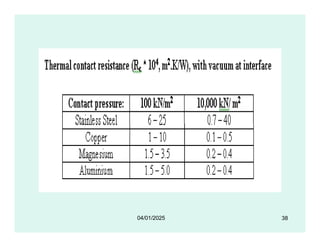
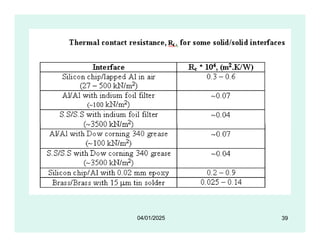
  • 66.
    • Adding equations(a), (b), (c) and (d): (Ta – Tb) = Q (Ra + R1 + R2 + Rb) If there are N concentric spheres, we can write : 66 04/01/2025
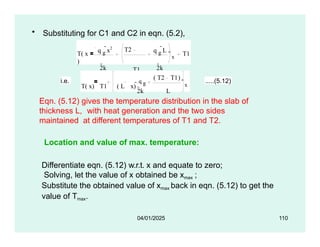
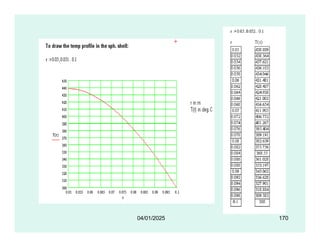
  • 67.
    Overall heat transfercoefficient for the spherical system: • We write: 67 04/01/2025
  • 68.
    Overall heat transfercoefficient for the spherical system (contd.): • We can also write: And, 68 04/01/2025
  • 69.
    Overall heat transfercoefficient for the spherical system (contd.): • Note: Equations (4.62 a) and (4.62 b) give Ui and Uo in terms of the inside and outside radii. • You need not memorize them. • To calculate Ui or Uo while solving numerical problems, just remember equation (4.46), viz.: 69 04/01/2025
  • 70.
    4. Critical thicknessof insulation for cylindrical system: • Generally, addition of insulation does reduce the heat loss. • However, there are some interesting cases where the increases the heat loss! • Consider a cylinder with insulation where r1 is the inner radius of insulation layer (or, outer radius of pipe), r2 is the outer radius of insulation layer. 70 04/01/2025
  • 71.
    Critical thickness of insulation(contd.): •Resistance to heat transfer is made up of two components viz. conductive resistance through the cylindrical insulation layer [ R= ln(r2/r1)/ (2  k L) ] and convective resistance between the wall surface and the surroundings [Ro = 1/(h. Ao )]. • As the insulation thickness is increased i.e. as insulation radius r2 is increased, conductive resistance of insulation increases; however, convective resistance, given by [Ro =1/(h. Ao)] goes on decreasing since Ao, the outside surface area goes on increasing with increasing radius. 71 04/01/2025
  • 72.
    Critical thickness ofinsulation (contd.): • Therefore, the total resistance may increase or decrease, depending on the relative rates of change of these two resistances. • For the above case, the equivalent thermal resistance circuit is shown below: T1 Ta Q Q Rins Rconv Fig. 4.13(a) Equiv. Thermal curcuit for a cylinder with insulation 72 04/01/2025
  • 73.
    • Consider anyradius r of the insulation. • We have: and, R Rtot Rins Variation of Rins and Rconv and Rtot with r are shown in Fig. Rconv 73 r1 rc r Fig. 4.13(b) Variation of resistances with insulation radius for a cylinder Note that Rtot passes through a minimum. 04/01/2025
  • 74.
    • The insulationradius at which the resistance to heat flow is minimum is called ‘critical radius’, rc; i.e. the heat flow is a maximum at the critical radius. • Variation of heat flow per unit length, (Q/L), with r is shown in Fig. 4.13 (c): Q/L Qmax y x r1 rc r Fig. 4.13(c) Heat transfer per unit length vs. insulation radius for a cylinder 74 04/01/2025
  • 75.
    • Mathematically, tofind out at what insulation radius r the Rtot becomes a minimum for the cylindrical system, differentiate the expression for Rtot and equate to zero. • We have: Equation (4.63) gives the expression for critical radius, rc for the cylindrical system. 75 04/01/2025
  • 76.
    • To confirmthat at r = rc , Rtot indeed is minimum, find out the value of (d2 Rtot /dr2 ) at r = rc, and it will be found to be positive; i.e at r = rc , the Rtot is a minimum. • There are two cases of practical interest, as shown in Fig. 4.14: • (a) insulating current carrying wires, and • (b) insulation of steam pipes and refrigerant lines. r1 rc r Fig. 4.14(a) Heat transfer per unit length vs. insulation radius for a cylinder when r1 < r c Q/L Qmax a b Q/L Qmax a b rc r1 r Fig. 4.14(b) Heat transfer per unit length vs. insulation radius for a cylinder when r1 > r c 76 04/01/2025
  • 77.
    Critical thickness ofinsulation for a sphere: r1 r Insulation • We have, for the spherical system: Sphere Fig. 4.15 Critical radius for a Sphere Differentiating Rtot w.r.t. r and equating to zero, we get: Equation (4.66) gives the expression for critical radius, rc for the spherical system. 77 04/01/2025
  • 78.
    5. Optimum (orEconomic) thickness of insulation : • ‘Optimum’ or ‘Economic’ thickness of insulation is that thickness for which the combined cost of the amount of energy lost through the insulation and the total (material + labour) cost of insulation is a minimum. 78 04/01/2025
  • 79.
    Optimum (or Economic) thicknessof insulation (contd.) : • To compare three or four insulations for the same job, we can draw similar ‘Total cost curves’ for those insulations and the thickness of the insulation having the lowest total cost is the optimum thickness. • In Fig. 4.16(b), insulation D has optimum thickness. 79 04/01/2025
  • 80.
    6. Effect ofvariable thermal conductivity: • When the k of a material varies rapidly with temperature or when the temperature range of operation is large, it becomes necessary to take into account the variation of k with temperature. • Generally, k varies with temperature linearly as follows: 80 04/01/2025
  • 81.
    Plane slab withvariable thermal conductivity: • We write from Fourier’s Law: k = k(T) Q T1 T2 X dX Substituting for k(T), separating the variables and integrating from x = 0 to x = L (with T = T1 to T = T2): X T1 T2 L Q Q Rslab = L/(kmA) Fig. 4.17 Plane slab with k = k(T) and the thermal circuit 81 04/01/2025
  • 82.
    Plane slab withvariable thermal conductivity: Finally, we get: Equation (c) gives the heat transfer rate for the plane slab, with variable thermal conductivity, k varying linearly with temperature. 82 04/01/2025
  • 83.
    Plane slab withvariable thermal conductivity : • Thermal resistance: Temp. distribution: Eqn.(4.69) gives the temperature distribution within the slab, with the thermal conductivity varying linearly with temperature: 83 04/01/2025
  • 84.
    Plane slab withvariable thermal conductivity : • Temp. distribution: 84 04/01/2025
  • 85.
    Hollow cylinder withvariable thermal conductivity: 85 04/01/2025
  • 86.
    Hollow cylinder withvariable thermal conductivity: • Let k vary with temperature linearly as follows: • We write from Fourier’s Law: 86 04/01/2025
  • 87.
    Hollow cylinder withvariable thermal conductivity: • Substituting for k(T), separating the variables and integrating from r = ri to r = ro (with T = Ti to T = To), we get: Finally: where 87 04/01/2025
  • 88.
    Hollow cylinder withvariable thermal conductivity: • To get temperature distribution: • Eqn.(4.72) below gives the temperature distribution within the cylindrical shell, with the thermal conductivity varying linearly with temperature. 88 04/01/2025
  • 89.
    Hollow sphere withvariable thermal conductivity: 89 04/01/2025
  • 90.
    Hollow sphere withvariable thermal conductivity: • Let k of the material vary with linearly with temperature as given by eqn. (4.67): i.e. k(T) = ko (1 + T). • From Fourier’s Law: • Substituting for k(T), separating the variables and integrating from r = ri to r = ro (with T = Ti to T = To), we get: 90 04/01/2025
  • 91.
    Hollow sphere withvariable thermal conductivity: • Finally, where And, 91 04/01/2025
  • 92.
    Hollow sphere withvariable thermal conductivity: • Temperature distribution within the spherical shell: • Eqn.(4.75) gives the temperature distribution within the spherical shell, with the thermal conductivity varying linearly with temperature. Compare this with eqn.(4.69) for a slab, and (4.72) for a cylinder, with the k varying linearly with temperature. 92 04/01/2025
  • 93.
    Summary of Basicconduction relations: Table 4.1 Relations for steady state, one dimensional conduction with no internal heat generation, and constant k 93 04/01/2025
  • 94.
    Summary of Basicconduction relations: Table 4.2(a) Relations for steady state, one dimensional conduction with no internal heat generation and k varying linearly with temperature as: k(T) = ko (1 +  T) {km = ko (1 +  Tm); Tm = (T1 + T2)/2} 94 04/01/2025
  • 95.
    Summary of Basicconduction relations: Table 4.2(b) Relations for steady state, one dimensional conduction with no internal heat generation and k varying linearly with temperature as: k(T) = ko (1 +  T) {km = ko (1 +  Tm); Tm = (T1 + T2)/2} 95 04/01/2025
  • 96.
    Summary of Basicconduction relations: Table 4.2(c) Relations for steady state, one dimensional conduction with no internal heat generation and k varying linearly with temperature as: k(T) = ko (1 +  T) {km = ko (1 +  Tm); Tm = (T1 + T2)/2} 96 04/01/2025
  • 97.
    One-Dimensional, Steady-State Heat Conductionwith Heat Generation • Examples - Plane slab – different BC’s - Cylindrical Systems – Solid cylinder – hollow cylinder – different BC’s – Sphere with heat generation- k varying linearly with T 04/01/2025 97
  • 98.
    Examples of situationswith internal heat generation are: • Heating in an electrical conductor due to the flow of current in it • Energy generation in a nuclear fuel rod due to absorption of neutrons • Exothermic chemical reaction within a system (e.g. combustion), liberating heat at a given rate throughout the system • Heat liberated in ‘shielding’ used in Nuclear reactors due to absorption of electromagnetic radiation such as gamma rays 04/01/2025 98
  • 99.
    Plane slab withuniform internal heat generation: • We shall consider three cases of boundary conditions: • 1. Both the sides of the slab are at the same temperature • 2. Two sides of the slab are at different temperatures, and • 3. One of the sides is insulated 04/01/2025 99
  • 100.
    Plane slab withuniform internal heat generation- both the sides at the same temperature: • Assumptions: • One dimensional conduction i.e. thickness L is small compared to the dimensions in the y and z directions • Steady state conduction i.e. temperature at any point within the slab does not change with time; of course, temperatures at different points within the slab will be different. • Uniform internal heat generation rate, qg (W/m3) • Material of the slab is homogeneous (i.e. constant density) and isotropic (i.e. value of k is same in all directions). 04/01/2025 100
  • 101.
    Plane slab withuniform internal heat generation- both the sides at the same temperature: k, qg Tw To = Tmax Tw Temp. distribution-(parabolic) X Plane slab with internal heat generation - both sides at the same temp. L L 04/01/2025 101
  • 102.
    • For theabove mentioned stipulations, governing eqn. in cartesian coordinates reduces to: dx2 k d2 T q g 0 ....(5.1) • Also, by observation, T = Tmax at x = 0. Solution of eqn. (5.1) gives the temperature profile and then, by using Fourier’s equation we get the heat flux at any point. C. ’s: (i) at x = 0, dT/dx = 0, since temperature is maximum at the centre line. (ii) at x = L/2, T = Tw 04/01/2025 102 T( x) T w q g 8k  L2 4 x2 ....(5.3) where L is half thickness of the slab. (Remember this.) q g L2 T max T w 8k
  • 103.
    04/01/2025 103 i 2 R 2 T w = T w 4k
  • 104.
    • Also, byobservation, T = Tmax at x = 0. q g L2 T max T w 8k ......(5.4) Then, from eqns. (5.3) and (5.4), we get: T T w T max T w 1 L L 2 x 2 x 2 L 2 ....(5.5) 04/01/2025 104 Eqn. (5.5) distribution gives the in a slab non-dimensional of half- thickness temperature L, with heat generation. Note that the temperature distribution is parabolic, as shown in Fig. 5.1.
  • 105.
    Convection boundary condition: •In many practical applications, heat is carried away at the boundaries by a fluid at a temperature Tf flowing on the surface with a convective heat transfer coefficient, h. (e.g. current carrying conductor cooled by ambient air or nuclear fuel rod cooled by a liquid metal coolant). • Then, by an energy balance at the surface: • heat conducted from within the body to the surface = the heat convected away by the fluid at the surface. 04/01/2025 105
  • 106.
    Convection boundary condition: •If A is the surface area of the slab (normal to the direction of heat flow), we have, from energy balance at the surface: q g A L h A  T w T f i.e. T w T f q g L h .....(5.6) 04/01/2025 106
  • 107.
    • Substituting eqn.(5.6) in eqn. (5.3), h 2k T( x) T f L x 2 2 q g L q g  ......(5.7) Eqn. (5.7) gives temperature distribution in a slab with heat generation, in terms of the fluid temperature, Tf . Remember, again, that L is half-thickness of the slab. Heat transfer: By observation, we know that the heat transfer rate from either of the surfaces must be equal to half of the total heat generated within the slab, for the B.C. of Tw being the same at both the surfaces. i.e. Q = qg A L……..(5.8) 04/01/2025 107
  • 108.
    Plane slab withuniform internal heat generation – two sides at different temperatures: k, qg • Let T1 > T2. Now, Tmax Tmax T1 Temp. distribution must occur somewhere within the slab since heat is being generated in the slab and is flowing from inside to outside, both to the left and right faces. Let Tmax occur at a distance xmax from the origin, as shown in the fig. X Fig. 5.3 Plane slab with internal heat generation - two sides at different temp. T2 L xmax 04/01/2025 108
  • 109.
    • As shownearlier, the general solution for temperature distribution is given by eqn. (5.2), i.e. T q g x2 2k C1x C2 ....(5.2) C1 and C2 are obtained by applying the boundary conditions. For the present case, B. C’s are: B.C.(i): at x = 0, T = T1 B.C.(ii): at x = L, T = T2 Then, from B.C.(i) and eqn. (5.2), we get: C2 = T1 and, from B.C.(ii) and eqn. (5.2), we get: T2 q g L2 2k C1L T1 i.e. C1 T2 T1 q g L L 2k 04/01/2025 109
  • 110.
    • Substituting forC1 and C2 in eqn. (5.2), T( x ) q g x2 2k T2 T1 L q g L 2k x T1 i.e. T( x) T1 ( L x)  q g ( T2 T1) 2k L x .....(5.12) Eqn. (5.12) gives the temperature distribution in the slab of thickness L, with heat generation and the two sides maintained at different temperatures of T1 and T2. Location and value of max. temperature: Differentiate eqn. (5.12) w.r.t. x and equate to zero; Solving, let the value of x obtained be xmax ; Substitute the obtained value of xmax back in eqn. (5.12) to get the value of Tmax. 04/01/2025 110
  • 111.
    • Heat transferto the two sides: • Total heat generated within the slab is equal to : Qtot = qg A L • Part of this heat moves to the left and gets dissipated at the left face; remaining portion of the heat generated moves to the right and gets dissipated from the right face. • Applying Fourier’s Law: Qright = - k A (dT/dx)x=L Qleft = - k A (dT/dx)x=0 …this will be -ve since heat flows from right to left i.e. in –ve x- direction • Of course, sum of Qright and Qleft must be equal to Qtot. 04/01/2025 111
  • 112.
    Convection boundary condition: •Let heat be carried away at the left face by a fluid at a temperature Ta flowing on the surface with a convective heat transfer coefficient, ha, and on the right face, by a fluid at a temperature Tb flowing on the surface with a convective heat transfer coefficient, hb. • Note that heat generated in the slab in the volume between x = 0 and x = xmax has to move to the left face and the heat generated in the volume between x = xmax and x = L has to move to the right face, since no heat can cross the plane of max. temperature. 04/01/2025 112
  • 113.
    Convection boundary condition: •Then, we have, from energy balance at the two surfaces: On the left face: q g A xmax h a A T1 T a ........(a) On the right face: xmax q g A  L h b A  T2 T b .........(b) 04/01/2025 113
  • 114.
    • From eqns.(a)and (b), we get T1 and T2 in terms of known fluid temperatures Ta and Tb respectively. • After thus obtaining T1 and T2, substitute them in eqn. (5.12) to get the temperature distribution in terms of fluid temperatures Ta and Tb . 04/01/2025 114
  • 115.
    Plane slab withuniform internal heat generation – one face perfectly insulated: Tmax k, qg Insulated Temp. distribution Tw L X Fig. 5.4 Plane slab with internal heat generation - one side insulated ha Ta 04/01/2025 115
  • 116.
    • For thiscase, the general solution for temperature distribution is given by eqn. (5.2), i.e. T q g x2 2k C1x C2 ....(5.2) B. C’s are: B.C.(i): at x = 0, dT/dx = 0, since perfectly insulated. B.C.(ii): at x = L, T = Tw From eqn. (5.2): dT q g x dx k C1 Then applying B.C.(i), we get: C1 = 0 From B.C.(ii) and eqn. (5.2): C2 T w q g L2 2k 04/01/2025 116
  • 117.
    • Substituting forC1 and C2 in eqn. (5.2): T( x) T w q g 2k  L 2 x 2 .......(5.13) Eqn. (5.13) gives the temperature distribution in a slab of thickness L, with heat generation when one side is perfectly insulated. Fig. 5.4 sketches the temperature distribution in the slab. Note that now, L is the thickness of the slab and not half-thickness. 04/01/2025 117
  • 118.
    In case ofconvection boundary condition: • Since the left face is insulated, all the heat generated in the slab travels to the surface on the right and gets convected away to the fluid. • Heat generated in the slab: Q gen q g A L Heat convected at surface: Q conv h a A T w T a T w T a Equating the heat generated and heat convected, we get: q g L h a ....(a) 04/01/2025 118
  • 119.
    • Substituting from(a) in eqn. (5.13), a h 2k T( x) T a L x 2 2 q g L q g  .......(5.14) Maximum temperature: Obviously, max. temperature occurs at the insulated surface. Putting x = 0 in eqn. (5.13): T max T w q g L2 2k .....(5.15) 04/01/2025 119 Eq. (5.15) gives Tmax in terms of wall temperature, Tw.
  • 120.
    • Substituting forTw from eqn. (a) in eqn. (5.15): T max T a q g L h a q g L2 2k .....(5.16) Eq. (5.16) gives Tmax in terms of fluid temperature, Ta. From eqn. (5.13) and (5.15), we can write: T( x) T w T max T w L 2 1 L 2 x 2 x 2 L ....(5.17) 04/01/2025 120 Eqn. (5.17) gives non-dimensional temperature distribution for a slab with heat generation, and one face insulated. Note that now L is the thickness of the slab.
  • 121.
    Solid cylinder with internalheat generation: Q Ti To k, qg Fig. 5.5 (a) Cylindrical system with heat generation L L R • Consider a solid cylinder of radius, R and length, L. There is uniform heat generation within its volume at a rate of q (W/m3). Let g the thermal conductivity, k be constant. • See Fig. 5.5. Temp. Profile, parabolic To Fig. 5.5 (b) Variation of temperature along the radius R Tw 04/01/2025 121
  • 122.
    • Now, thegeneral differential eqn. in cylindrical coordinates reduces to: dr2 d2 T 1  dT r dr k q g 0 ....(a) Multiplying by r: r d2 T dT q g r dr 2 dr k 0 i.e. d  dT q g r Integrating: dr dr k  2 r dT q g r dr 2k C1 i.e. dT q g r dr 2k C1 r ......(b) Integrating again: T( r ) q g r2 4k C1ln( r) C2 .....(5.18) 04/01/2025 122
  • 123.
    • Eqn. (5.18)is the general relation for temperature distribution along the radius, for a cylindrical system, with uniform heat generation. • C1 and C2, the constants of integration are obtained by applying the boundary conditions. • B.C’s are: • B.C. (i): at r = 0, dT/dr = 0 i.e. at the center of the cylinder, temperature is finite and maximum (i.e. To = Tmax) because of symmetry. 04/01/2025 123
  • 124.
    T w • B.C.(ii): at r = R, i.e. at the surface , T = Tw • From B.C. (i) and eqn. (b), we get: C1 = 0 • From B.C. (ii) and eqn. (5.18), we get: q g R 2 C2 4 k i.e. C2 T w q g R2 4k 04/01/2025 124
  • 125.
    Substituting C1 andC2 in eqn. (5.18): T( r ) q g r2 4k T w q g R2 4k i.e. T( r) T w q g 4k  R 2 r 2 .......(5.19) • Eqn. (5.19) is the relation for temperature distribution in terms of the surface temperature, Tw. • Note that this is a parabolic temperature profile, as shown in Fig. 5.5 (b). • Maximum temperature: • Max. temperature occurs at the centre, because of symmetry considerations. 04/01/2025 125
  • 126.
    • Therefore, puttingr = 0 in eqn. (5.19): q g R2 T max T w 4k .......(5.20) From eqns. (5.19) and (5.20), T T w T max T w 1 r R 2 .......(5.21) Eqn. (5.21) is the non-dimensional temperature distribution for the solid cylinder with heat generation. Convection boundary condition: By an energy balance at the surface: heat generated and conducted from within the body to the surface = the heat convected away by the fluid at the surface. 04/01/2025 126
  • 127.
    i.e.  R2 Lqg h ( 2 RL)  T w T a i.e. T w T a q g R 2h .......(c) Substituting(c) in eqn. (5.19): T( r) T a R r 2 2 q g R q g  2h 4k ......(5.22) Again, for max. temp. put r = 0 in eqn. (5.22): T max T a q g R q g R2 2h 4k .......(5.23) 04/01/2025 127 Eqn. (5.23) gives maximum temperature in the solid cylinder in terms of the fluid temperature, Ta.
  • 128.
    Current carrying conductor: •Consider a conductor of cross-sectional area, Ac and length, L. Let the current carried be I (Amp.). Let the electrical resistivity of the material be  (Ohm.m). • Then, heat generated per unit volume = Qg / Vol. of conductor, where Qg is the total heat generated (W). Q g I2 R where R = electrical resistance of wire, (Ohms) But, R  L A c Therefore, q g 2 R I  A c L I 2   L A c I A c L A c 2 04/01/2025 128   ...W/m 3 i = I/Ac , is known as the ‘current density’. Note its Units: A/m2
  • 129.
    • Therefore, temperaturedistribution in a current carrying wire (of solid, cylindrical shape) is given by eq. (5.19), viz. i.e. q g i2  i 2 k e where k e 1  = electrical conductivity, (Ohm.m) -1 T( r) T w 4k q g  R 2 r 2 .......(5.19) Substituting for qg, we get: T( r) T w R 2 r 2 i2   4k .......(5.19 (a)) Max. temperature, which occurs at the centre, is obtained by putting r = 0 in eqn. (5.19, a). i.e. i2  R2 T max T w 4k ........(5.20(a)) 04/01/2025 129
  • 130.
    • And, fromeqns. (5.19 a) and (5.20 a), we get: T T w T max T w 1 r R 2 Note that the above eqn. for non-dimensional temperature distribution in a current carrying wire is the same as eqn. (5.21). 04/01/2025 130
  • 131.
    Hollow cylinder withheat generation: the inside surface insulated: • We have: k, qg Q To Ti To Insulated • Hollow cylinder with T( r ) q g r2 4k C1ln( r) C2 .....(5.18) Fig. 5.7 Hollow cylinder with heat generation, inside surface insulated ri ro B.C.’s are: B.C.(i): at r = ri T = Ti and dT/dx = 0 (since inner surface is insulated), and B.C.(ii): at r = ro T= To Get C1 and C2 from these 04/01/2025 131 B.C.’s and substitute back in eqn. (5.18) to get the temperature distribution.
  • 132.
    Hollow cylinder withthe inside surface insulated: • ALTERNATIVE METHOD: Q Ti To k, qg Insulated dr r Fig. 5.8 Hollow cylinder with heat generation, inside surface insulated ri ro equal to the heat conducted away from the surface at radius r. 04/01/2025 132 We shall derive the expression for temperature distribution by a simpler method of physical consideration and heat balance: Since the inside surface is insulated, heat generated within the volume between r = ri and r = r, must travel only outward; and, this heat must be
  • 133.
    • Writing thisheat balance, g q  r r i 2 2   L k2 rL dT dr where dT/dr is the temp. gradient at radius r. i.e. dT q r 2  g i  dr q g 2k r 2k rdr Integrating, T( r ) q gr 2 i ln( r) q gr 2 C .....(b) 2k 4k The integration constant C is obtained from the B.C.: At r = ro, T = To Applying this B.C. to eqn. (b): q C T o 2 r q g o 4k r 2 2k g i ln r o 04/01/2025 133
  • 134.
    • Substituting valueof C back in eqn. (b), we get, T( r) q 2k g i ln( r) g q r  4k T o q r q g o 4k r 2 2 2 r 2 2k g i ln r o i.e. T( r) T o q r 2 2 2ln r 2 g i  r o o r 4k r i r r i .........(5.27) Putting r = ri and T = Ti in eqn. (5.27), we get, T i T o q g r 2 r o 4k r i 2 r o r i 2ln 1 i  i.e. T i T o q r 2 r 2 r o r i 2ln 1 g i  o 4k r i ............(5.28) 04/01/2025 134
  • 135.
    • Eqn. (5.28)is important, since it gives the max. temperature drop in the cylindrical shell, when there is internal heat generation and the inside surface is insulated. • If either of To or Ti is given in a problem, then the other temperature can be calculated using eqn. (5.28). Convection boundary condition: By an energy balance at the surface: heat generated within the body and conducted to the outer surface is equal to the heat convected away by the fluid at the surface. i.e. q 2 2 g o i   a o o  r r L h 2 r L T T a       04/01/2025 135
  • 136.
    • Substituting thevalue of To from eqn. (c) in eqn. (5.27), we get: i.e. T o T a q r r g o i 2 2  2h a r o ......(c) T( r) T a q g  r o 2 r 2 i 2h a r o q r 2 g i 4k  r o 2 r i 2ln r o r i r 2 r i .........(5.29) Eqn. (5.29) gives the temperature distribution in the cylindrical shell with heat generation, inside surface insulated, when the heat generated is carried away by a fluid flowing on the outer surface. 04/01/2025 136
  • 137.
    Hollow cylinder withthe outside surface insulated: • Start with: T( r ) q g r2 4k C1ln( r) C2 .....(5.18) Proceeding as earlier, apply the BC’s, get C1 and C2, substitute in (5.18) to get the temp. distribution. ALTERNATIVELY: We shall derive the expression for temperature distribution by a simpler method of physical consideration and heat balance: Since the outside surface is insulated, heat generated within the volume between r = ro and r = r, must travel only inward; and, this heat must be equal to the heat conducted from the surface at radius r. 04/01/2025 137
  • 138.
    • Writing thisheat balance, Q Ti Insulate d dr k, qg To Note that the term on the RHS has +ve sign, since, now, the heat transfer is from Fig. 5.10 Hollow cylinder with heat generation, outside surface insulated ri ro outside to inside, i.e. in the –ve r-direction (because the outside surface is insulated). 04/01/2025 138
  • 139.
    • Integrating: T( r ) qg r o 2 2k ln( r) q g r2 4k C .......(b) Eqn. (b) is the general solution for temperature distribution. The integration constant C is obtained by the B.C.: At r = ri , T = Ti Applying this B.C. to eqn. (b): 2 r 2k q C T i g o ln r i q r 2 g i 4k Substituting value of C back in eqn. (b): T( r ) q g r o 2 2k ln( r) q g r2 4k T i q g r o 2 2k ln r i q r 2  g i 4k 04/01/2025 139
  • 140.
    • Putting r= ro and T = To in eqn. (5.31), we get, i.e. T( r) T i q g r o 2 4k 2ln r r i r i r o 2 r r o 2  ..........(5.31) T o r r r 2 2 q 4k r i r o .......(5.32) Eqn. (5.32) is important, since it gives the max. temperature drop in the cylindrical shell, when there is internal heat generation and the outside surface is insulated. If either of Toor Ti is given in a problem, then the other temperature can be calculated using eqn. (5.32). 04/01/2025 140
  • 141.
    • Convection boundarycondition: • We relate the surface temperature and fluid temperature by an energy balance at the surface: • heat generated within the body and conducted to the inner surface is equal to the heat convected away by the fluid at the surface. q r 2 2  r i.e. T i T a g o i ......(c) 2h a r i Using eqn. (c) in eqn. (5.31), we get: T( r) T a q g  r o 2 r 2 i 2h a r i q g r o 2 4k  2ln r r i r i r o 2 r 2 r o .......(5.33) 04/01/2025 141
  • 142.
    Hollow cylinder withboth the surfaces maintained at constant temperatures: • We have for temp. distribution: i T To rm To k, qg Tm T( r ) q g r2 4k C1ln( r) C2 .....(5.18) Fig. 5.11 Hollow cylinder with heat generation, losing heat from both surfaces ri ro C1 and C2, the constants of integration are obtained by applying the boundary conditions. 04/01/2025 142
  • 143.
    T = Ti, and T= To • B.C.’s are: • B.C.(i): at r = ri • B.C.(ii): at r = ro • Get C1 and C2 from these B.C.’s and substitute back in eqn. (5.18) to get the temperature distribution. • After lengthy algebraic manipulations, we get, for temp. distribution: T( r) T i ln r r i q g 4k  r o 2 r 2 i T o T i  ln ln r r i r o r i r 2 r i r o 2 r i 1 T o T i ln r o r i 1 04/01/2025 143 ......(5.35)
  • 144.
    Hollow cylinder withboth the surfaces maintained at constant temperatures: • ALTERNATIVE METHOD: • Let max. temp. occur at a radius rm . Obviously, rm Ti To rm To k, qg Tm lies in between ri and ro. • Therefore, dT/dr at r = rm will be zero; i.e. surface at rm may be considered as representing an insulated boundary condition. Fig. 5.11 Hollow cylinder with heat generation, losing heat from both surfaces ri ro 04/01/2025 144
  • 145.
    • So, thecylindrical shell may be thought of as being made up of two shells; the inner shell, between r = ri and r = rm , insulated on its ‘outer periphery’ and, an outer shell, between r = rm and r = ro, insulated at its ‘inner periphery’. • Then, max. temperature difference for the inner shell and outer shell can be written from eqn.(5.32) and (5.28) respectively. So, we write: • For the ‘inner shell’ (insulated on the ‘outer’’ surface): T m T i q g r 4k r i 2ln r r r m m i 1 2 2 m  .......(a) 04/01/2025 145 Eqn. (a) is obtained by replacing ro by rm and Toby Tm in eqn. (5.32).
  • 146.
    •For the ‘outershell’ (insulated on the ‘inner’’ surface): T m T o q g r 4k 2 o r o r m r m 2ln r 1 2 m  ............(b) Eqn. (b) is obtained by replacing ri by rm and Ti by Tm in eqn. (5.28). •Subtracting eqn. (a) from (b): T i T o q g r 2 m  4k r o r m 2 2ln r o r m 1 2ln r m r i r i r m 2 1 04/01/2025 146
  • 147.
    i.e. T iT o q r 2 g m  4k r o r m 2 r i r m 2 2ln r m r o 2ln r m r i ....(c) Eqn. (c) must be solved for rm. After some manipulation, we get: i.e. r m q r 2 2 g o i  r 4k T i T o g r i q 2ln r o ........(5.36) 04/01/2025 147
  • 148.
    • Substituting thevalue of rm from eqn. (5.36) in either of eqns. (a) or (b), we get the max. temperature in the shell. • Then, temperature distribution in the inner shell is determined from eqn. (5.32) and that in the outer shell is determined from eqn. (5.28). • When Ti and To are equal: • it is seen from eqn. (5.36) that, position of max. temperature in the shell is given by: r m r r o i 2 2 2ln r o r i i.e. rm depends only on the physical dimensions of the cylindrical shell and not on the thermal conditions. 04/01/2025 148
  • 149.
    Solid sphere withinternal heat generation: Q Ti To k, qg Fig. 5.12 (a) Spherical system with heat generation L R Solid sphere • Assumptions: • Steady state conduction • One dimensional conduction, in the r direction only • Homogeneous, isotropic material with constant k • Uniform internal heat generation rate, qg (W/m3) To Fig. 5.12 (b) Variation of temperature along the radius R Temp. Profile, parabolic Tw 04/01/2025 149
  • 150.
    • With theabove stipulations, the general differential eqn. in spherical coordinates reduces to: dr2 d2 T 2  dT r dr k q g 0 ....(a) We have to solve eqn. (a) to get the temperature profile; then, by applying Fourier’s Law, we can get the heat flux at any point. Multiplying eqn. (a) by r2: d2 T dT q g r2 r 2 2r0 dr2 dr k i.e. r dr dr d 2  dT 2 q g r k Integrating: dT q g r3 dr 3k r 2 C1 04/01/2025 150
  • 151.
    i.e. dT dr 3k q g rC1 r 2 ......(b) Integrating again: T( r ) q g r 2 C1 6k r C2 .....(5.37) C1 and C2, the constants of integration are obtained by applying the boundary conditions. B.C’s are: B.C. (i): at r = 0, dT/dr = 0 i.e. at the centre of the sphere, temperature is finite and maximum (i.e. To = Tmax) because of symmetry. B.C. (ii): at r = R, i.e. at the surface , T = Tw From B.C. (i) and eqn. (b), we get: C1 = 0 04/01/2025 151
  • 152.
    • From B.C.(ii) and eqn. (5.37), we get: q g R2 T w 6k C2 i.e. q g R2 C2 T w 6k Substituting C1 and C2 in eqn. (5.37): T( r ) q g r2 6k T w q g R2 6k i.e. T( r) T w q g 6k  R2 r2 .......(5.38) 04/01/2025 152 Note that this is a parabolic temperature profile, as shown in Fig. 5.12 (b).
  • 153.
    • Maximum temperature: •Max. temperature occurs at the centre, because of symmetry considerations. • Therefore, putting r = 0 in eqn. (5.38): q g R2 T max T w 6k .......(5.39) From eqns. (5.38) and (5.39), T( r) T w T max 1 r T w R 2 .....(5.40) 04/01/2025 153 Eqn. (5.40) is the non-dimensional temperature distribution for the solid sphere with heat generation.
  • 154.
    • Heat flowat the surface: • Heat transfer by conduction at the outer surface of sphere is given by Fourier’s Law: i.e. Qg = - k A (dT/dr)at r = R i.e. Q g R k4  q g R 3k 2  ...using eqn. (5.38) for T(r i.e. 3 Q g 4  R3 q g ....(5.41) 04/01/2025 154 Of course, in steady state, heat transfer rate at the surface must be equal to the heat generation rate in the sphere, i.e. Qg = (4/3)  R3 qg
  • 155.
    • Convection boundarycondition: • Now, heat generated and conducted from within the body to the surface = heat convected away by the fluid at the surface. i.e.  4  R 3 q g h a  4 R2 T a  T w i.e. T w T a g 3h a .......(d) Substituting(d) in eqn. (5.38): T( r) T a a 3h 6k R r 2 2 q g R q g  ......(5.42) 04/01/2025 155
  • 156.
    Again, for max.temp. put r = 0 in eqn. (5.42): T max T a a q g R q g R2 3h 6k .......(5.43) • Eqn. (5.43) gives the centre temperature of the sphere with heat generation, in terms of the fluid temperature, when the heat generated is carried away at the surface by a fluid. 04/01/2025 156
  • 157.
    • Relations forsteady state, one dimensional conduction with internal heat generation, and constant k: 04/01/2025 157
  • 158.
    Plane slab, kvarying linearly with T 04/01/2025 158
  • 159.
    Relations for steadystate, one dimensional conduction with internal heat generation, and constant k 04/01/2025 159
  • 160.
    Relations for steadystate, one dimensional conduction with internal heat generation, and constant k 04/01/2025 160
  • 161.
    Hollow cylinder, kvarying linearly with T 04/01/2025 161
  • 162.
    Relations for steadystate, one dimensional conduction with internal heat generation, and constant k 04/01/2025 162
  • 163.
    Sphere, k varyinglinearly with T 04/01/2025 163
  • 164.
  • 165.
  • 166.
  • 167.
  • 168.
    Ex: Hollow spherewith heat gen. 04/01/2025 168
  • 169.
  • 170.
  • 171.
    Ex: Slab withheat gen., convection on both sides By observation, Max. temp. occurs at the centre of the slab. 04/01/2025 171
  • 172.
  • 173.
    TRANSIENT HEAT CONDUCTION: 04/01/2025173 • In transient conduction, temperature depends not only on position in the solid, but also on time. • So, mathematically, this can be written as T = T(x,y,z,), where  represents the time coordinate. • Typical examples of transient conduction: • heat exchangers • boiler tubes • cooling of I.C.Engine cylinder heads
  • 174.
    Examples (contd.): 04/01/2025 174 •heat treatment of engineering components and quenching of ingots • heating of electric irons • heating and cooling of buildings • freezing of foods, etc.
  • 175.
    Lumped system analysis (Newtonianheating or cooling): • In lumped system analysis, the internal conduction resistance of the body to heat flow (i.e. L/(k.A)) is negligible compared to the convective resistance (i.e. 1/(h.A)) at the surface. • So, the temperature of the body, no doubt, varies with time, but at any given instant, the temperature within the body is uniform and is independent of position. i.e. T = T() only. 04/01/2025 175
  • 176.
    Lumped system analysis (Newtonianheating or cooling): • Practical examples of such cases are: heat treatment of small metal pieces, measurement of temperature with a thermocouple or thermometer etc, where the internal resistance of the object for heat conduction may be considered as negligible. 04/01/2025 176
  • 177.
    Analysis: • Consider asolid body of arbitrary shape, volume V, mass m, density , surface area A, and specific heat Cp. See Fig. 7.1. • To start with, at  = 0, let the temperature throughout the body be uniform at T = Ti. At the instant  = 0, let the body be suddenly placed in a medium at a temperature of Ta, as shown. 04/01/2025 177
  • 178.
    • Writing anenergy balance for this situation: • Amount of heat transferred into the body in time interval d = Increase in the internal energy of the body in time interval d i.e. hA T a T(  ) d mC p dT  C p VdT ....(7.1) since m = . V dT d T(  ) T a Now, since Ta is a constant, we can write: Therefore, d T(  ) T a T(  ) T a hA  C p V   d ..... (7.2) 04/01/2025 178
  • 179.
    Integrating between = 0 (i.e. T = Ti) and any , (i.e. T = T()), T(  ) T a ln T i T a hA  C p V i.e. T(  ) T a T i T a exp hA  C p V ......(7.3) 04/01/2025 179
  • 180.
    • Now, let: C p V h A t where, ‘t’ is known as ‘thermal time constant’ and has units of time. Therefore, eqn. (7.3) is written as: T(  ) T a T i T a exp  t .......(7.4) 04/01/2025 180 Now denoting θ = (T() – Ta), we write eqn. (7.4) compactly as:
  • 181.
      i T(  )T a T i T a exp  t ......(7.5) 04/01/2025 181 Equation (7.5) gives the temperature distribution in a solid as a function of time, when the internal resistance of the solid for conduction is negligible compared to the convective resistance at its surface. See Fig. 7.2 (a)
  • 182.
  • 183.
    • Instantaneous heatTransfer: • At any instant , heat transfer between the body and the environment is easily calculated since we have the temperature distribution from eqn. (7.4): p Q(  ) mC  dT(  ) d W......(7.6,a) At that instant, heat transfer must also be equal to: Q(  ) hA T(  ) T a W.....(7.6,b) Total heat transfer: Total heat transferred during  = 0 to  = , is equal to the change in Internal energy of the body: Q tot mC p  T(  ) T i J....(7.7,a 04/01/2025 183
  • 184.
    Q tot • Qtotmay also be calculated by integrating eqn.(7.6,a):  Q(  ) d J.....(7.7,b 0 Max. heat transferred: When the body reaches the temperature of the environment, obviously maximum heat has been transferred: Q max mC p T a T i J.....(7.8 04/01/2025 184 If Qmax is negative, it means that the body has lost heat, and if Qmax is positive, then body has gained heat.
  • 185.
    Criteria for lumpedsystem analysis (Biot number and Fourier number): • Consider a plane slab as shown in Fig. 7.3. • Let the surface on the left be maintained at temperature T1 and the surface on the right is at a temperature of T2 as a result of heat being lost to a fluid at temperature Ta, flowing with a heat transfer coeff. ha. • Writing an energy balance at the right hand surface, a kA ( T1 T2) hA T2 T L 04/01/2025 185
  • 186.
    Criteria for lumpedsystem analysis (Biot number and Fourier number): Rearranging, T1 T2 T2 T a 1 h A R conv k L kA R cond h L Bi ......(7.9) 04/01/2025 186 The term, (h.L)/k, appearing on the RHS of eqn. (7.9) is a dimensionless number, known as ‘Biot number’.
  • 187.
    Fig. 7.3(a) Biotnumber and temp. distribution in a plane wall X T1 T2 h, Ta T2 Ta Bi << 1 Bi = 1 Bi >> 1 T2 Qconv Qcond L 04/01/2025 187
  • 188.
    • Note fromFig. (7.3, a) the temperature profile for Bi << 1. • It suggests that one can assume a uniform temperature distribution within the solid if Bi << 1. • Situation during transient conduction is shown in Fig. (7.3,b). It may be observed hat temperature distribution is a strong function of Biot number. Fig. 7.3(b) Biot number and transient temp. distribution in a plane wall h, Ta Bi << 1 Bi = 1 Bi >> 1 T(x,0) = Ti T(x,0) = Ti 04/01/2025 188
  • 189.
    • For Bi<< 1, temperature gradient in the solid is small and temperature can be taken as a function of time only. • Note also that for Bi >> 1, temperature drop across the solid is much larger than that across the convective layer at the surface. • Let us define Biot number, in general, as follows: Bi h L c k .....(7.10 04/01/2025 189
  • 190.
    where, h isthe heat transfer coeff. between the solid surface and the surroundings, k is the thermal conductivity of the solid, and Lc is a characteristic length defined as the ratio of the volume of the body to its surface area, i.e. Lc V A 04/01/2025 190
  • 191.
    • For solidssuch as a plane slab, long cylinder and sphere, it is found that transient temperature distribution within the solid at any instant is uniform, with the error being less than about 5%, if the following criterion is satisfied: hL c Bi  0.1 ......(7.11 k Lc for common shapes: (i) Plane wall (thickness 2L): L c A 2L 2A L = half thickness of wa (ii) Long cylinder, radius, R: L c 2 RL  R2 L R 2 (iii) Sphere, radius, R: L c 4  R3 3 4 R2 R 3 (iv) Cube, side L: L c L 3 6L2 L 6 04/01/2025 191
  • 192.
    • Therefore, wecan write eqn. (7.3) as:   i T(  ) T a T i T a h A C p V exp    if Bi < 0.1.....(7.12 Eqn. (7.12) is important. Its application to a given problem is very simple and solution of any transient conduction problem must begin with examining if the criterion, Bi < 0.1 is satisfied to see if eqn. (7.12) could be applied. Now, the term (hA)/(Cp V) can be written as follows: hA  C p V  C p L c 2  hL c hL c k k 2 L c k    Bi Fo  where , Fo   2 L c = Fourier number, or relative time 04/01/2025 192
  • 193.
    • Fourier number,like Biot number, is an important parameter in transient heat transfer problems. • It is also known as ‘dimensionless time’. • Fourier number signifies the degree of penetration of heating or cooling effect through a solid. • For small Fo, large  will be required to get significant temperature changes. 04/01/2025 193
  • 194.
    • Now, wecan rewrite eqn. (7.12) as:   i T(  ) T a T i T a  exp ( Bi Fo) if Bi < 0.1.....(7.13 04/01/2025 194 Eqn. (7.13) is plotted in Fig. (7.4) below. Remember that this graph is for the cases where lumped system analysis is applicable, i.e. Bi < 0.1.
  • 195.
    Let X BiFo X0 0.1 5 Then   i exp( X) exp( X) X 0 0.5 1 1.5 2 2.5 3 3.5 4 4.5 5 1 10 3 0.01 0.1 1 Transient temp.distrib.in solids, Bi<0.1 04/01/2025 195 Fig. (7.4) Dimensionless temperature distribution in solids during transient transfer, (Bi < 0.1)--for lumped system analysis
  • 196.
    Response time ofa thermocouple: 04/01/2025 196 • Lumped system analysis is usefully applied in the case of temperature measurement with a thermometer or a thermocouple. Obviously, it is desirable that the thermocouple indicates the source temperature as fast as possible. • ‘Response time’ of a thermocouple is defined as the time taken by it to reach the source temperature.
  • 197.
    Response time ofa thermocouple: • Consider eqn. (7.12):   i T(  ) T a exp T i T a h A  C p V if Bi < 0.1.....(7.12 04/01/2025 197 For rapid response, the term (h A )/( Cp V) should be large so that the exponential term will reach zero faster. This means that: (i)increase (A/V), i.e. decrease the wire diameter (ii) decrease density and specific heat, and (iii) increase the value of heat transfer coeff. h
  • 198.
    • The quantity( Cp V)/(h A) is known as ‘thermal time constant’, t, of the measuring system and has units of time. • At  = t i.e. at a time interval of one time constant, we have: T(  ) T a T i T a 1 e 0.368 .....(7.14 04/01/2025 198 From eqn. (7.14), it is clear that after an interval of time equal to one time constant of the given temperature measuring system, the temperature difference between the body (thermocouple) and the source would be 36.8% of the initial temperature difference. i.e. the temperature difference would be reduced by 63.2%.
  • 199.
    Time required bya thermocouple to attain 63.2% of the value of initial temperature difference is called its ‘sensitivity’. For good response, obviously the response time of thermocouple should be low. As a thumb rule, it is recommended that while using a thermocouple to measure temperatures, reading of the thermocouple should be taken after a time equal to about four time periods has elapsed. 04/01/2025 199
  • 200.
    • Example 7.1(M.U.): A steel ball 5 cm dia, initially at an uniform temperature of 450 C is suddenly placed in an environment at 100 C. Heat transfer coeff. h, between the steel ball and the fluid is 10 W/(m2.K). For steel, cp = 0.46 kJ/(kg.K), ρ = 7800 kg/m3, k = 35 W/(m.K). Calculate the time required for the ball to reach a temperature of 150 C. Also find the rate of cooling after 1 hr. Show graphically how the temp. of the sphere falls with time. 04/01/2025 200
  • 201.
  • 202.
    • First, calculatethe Biot number: Since Bi < 0.1, lumped system analysis is applicable, and the temperature variation within the solid will be within an error of 5%. Applying eqn. (7.12), we get:   i T(  ) T a T T i a h A C p V exp    if Bi < 0.1.....(7.12 i.e. T T a T i T a exp  t where t is the time constan 04/01/2025 202
  • 203.
    • And, timeconstant is given by: t  c p V  c p  R Ah h 3 ..since for sphere, V/A = R/ i.e. t  c p  R h 3 ...define time constant i.e. t  2990 s....time constant Therefore, we write: 150 100 450 100 exp  2990 where  is the time required to reach 150 C 04/01/2025 203
  • 204.
    i.e. ln 50  350 2990 or, 50 350  2990ln s....define,the time reqd. to reach 150 C i.e. 3   5.81810 s... time reqd. to reach 150 C...Ans. i.e.  1.616 hrs.....Ans Rate of cooling after 1 hr.: i.e.  3600 s From eqn. (7.12), we have: T(  ) i a h A p  c V T T exp T a ....define T() 04/01/2025 204
  • 205.
    i.e. dT d  i T T a hA Vc p  hA  Vc p exp C/s.....rate of coolin d T(  ) 0.035 d C/s....rate of cooling after 1 hr..Ans i.e. -ve sign indicates that as time increases, temperature falls. To sketch the fall in temp. of sphere with time: Temp. as a function of time is given by eqn. (7.12):   i T(  ) T a T T i a h A c p V exp    if Bi < 0.1.....(7.12 i.e. T(  ) T a i a hA  c p V T T exp ....eqn. (A 04/01/2025 205
  • 206.
    • We willplot eqn. (A) against different times, : 0 0.5 1 1.5 2  2.5 3 3.5 4 500 450 400 350 T(  3600) 300 250 200 150 100 Trans. cooling of sphere-lumped system  in hrs. and T() in deg.C Fig. Ex. 7.1 Transient cooling of a sphere considred as a lumped system 04/01/2025 206 Note from the fig. how the cooling progresses with time. After about 4 hrs. duration, the sphere approaches the temp. of the ambient. You can also verify from the graph that the time required for the sphere to reach 150 C is 1.616 hrs, as calculated earlier.
  • 207.
    • Example 7.4(M.U.): A Thermocouple (TC) junction is in the form of 8 mm sphere. Properties of the material are: cp = 420 J/(kg. K), ρ = 8000 kg/m3, k = 40 W/(m.K), and heat transfer coeff., h = 45 W/(m2.K). Find, if the junction is initially at a temp. of 28 C and inserted in a stream of hot air at 300 C: (i) the time const. of the TC (ii)The TC is taken out from the hot air after 10 s and kept in still air at 30 C. Assuming ‘h’ in air as 10 W/(m2.K), find the temp. attained by the junction 15 s after removing from hot air stream. 04/01/2025 207
  • 208.
  • 209.
    • First, calculatethe Biot number: Bi h L c  4 R2 4 (  ) R3 h  V h  3 k k A k i.e. Bi h  R k 3 ...define Biot numb i.e. Bi  1.5 10 3 ...Biot number Since Bi < 0.1, lumped system analysis is applicable, and the temperature variation within the solid will be within an error of 5%. See Fig. Ex. 7.4 (a). Time constant is given by: t  c p V  c p  R A h h 3 ..since for sphere, V/A = R/ i.e.  c p  R t ...define time constant, t h 3 i.e. t  99.556 s....time constant.....Ans. 04/01/2025 209
  • 210.
    Fig. Ex.7.4 (a)Temperature measurement, with thermocouple plac ed in the air stream Thermocouple, D = 8 mm Ti = 28 C Ta = 300 C Air h = 45 W/(m2 .K) 04/01/2025 210
  • 211.
    • Temp. ofTC after 10s:  10 s....time duration for which TC is kept in the stream at 300 We use eqn. (7.12). i.e.   i T(  ) T a T T i a h A  C p V exp    if Bi < 0.1.....(7.12) i.e. T T a  exp T i T a t where t is the time constan Therefore, T T i a  t T exp a T C....define temp. of TC after 10 s in the 04/01/2025 211 strea m i.e. T  53.994 C....temp. of TC 10 s after it is placed in the stream at 30 (b) Now, this TC is removed from the stream at 300 C and placed in still air at 30 C. So, the temp. of 53.994C becomes initial temp. Ti for this case:
  • 212.
    i.e. new Ti:T i 53.994 C....initial temp. when the TC is placed in stil And, new:  15 s....duration for which T C is kept in still air And, new Ta: T a 30 C....new temp. of ambient And, new h: h 10 W/(m 2.K)....heat tr. coeff. in still air See Fig. Ex. 7.4 (b). Thermocouple, D = 8 mm Ti = 53.994 C Still air Ta = 30 C h = 10 W/(m2 .K) Fig. Ex.7.4 (b) Temperature measurement, with thermocouple placed in still air 04/01/2025 212
  • 213.
    And, new timeconstant: i.e. t  c p  R h 3 ...define time constant i.e. t  448 s....tim e constant Therefore, i a  t T T T exp a T C....define temp. of T C after 15 s in still 04/01/2025 213 i.e. T  53.204 C....temp. of TC 15 s after it is placed in still air at 30 C...Ans.
  • 214.
    One-dimensional transient conductionin large plane walls, long cylinders and spheres when Biot number > 0.1: • When the temperature gradient in the solid is not negligible (i.e. Bi > 0.1), lumped system analysis is not applicable. • One term approximation solutions: • Fig. 7.6 shows schematic diagram and coordinate systems for a large, plane slab, long cylinder and a sphere. • Consider a plane slab of thickness 2L, shown in Fig (a) above. Initially, i.e. at  = 0, the slab is at an uniform temperature, Ti. 04/01/2025 214
  • 215.
    One-dimensional transient conductionin large plane walls, long cylinders and spheres when Biot number > 0.1: • Suddenly, at  = 0, both the surfaces of the slab are subjected to convection heat transfer with an ambient at temperature Ta , with a heat transfer coeff. h, as shown. • Because of symmetry, we need to consider only half the slab, and that is the reason why we chose the origin of the coordinate system on the mid-plane. • Then, we can write the mathematical formulation of the problem for plane slab as follows: 04/01/2025 215
  • 216.
  • 217.
    2 dx2 d T 1 dT  d in 0< x <L, for > 0.......(7.23, a dT dx 0 at x = 0, for > 0.......(7.23, b) k dT dx h T T a at x = L, for > 0 ......(7.23, c) T T i for  = 0, in 0 < x < L .....(7.23, d) 04/01/2025 217 The solution of the above problem, however, is rather involved and consists of infinite series. So, it is more convenient to present the solution either in tabular form or charts. For this purpose, we define the following dimensionless parameters:
  • 218.
    • While usingthe tabular or chart solutions, note one important difference in defining Biot number: • Characteristic length in Biot number is taken as half thickness L for a plane wall, Radius R for a long cylinder and sphere instead of being calculated as V/A, as done in lumped system analysis. (i) Dimensionless temperature: T( x  ) T a  ( x  ) T i T a (ii) Dimensionless distance from the centre: X x L (iii) Dimensionless heat transfer coefficient: Bi hL k ...Biot number (iv) Dimensionless time:   Fo L 2 ....Fourier number 04/01/2025 218
  • 219.
    • It isobserved that for Fo > 0.2, considering only the first term of the series and neglecting other terms, involves an error of less than 2%. • Generally, we are interested in times, Fo > 0.2. • So, it becomes very useful and convenient to use one term approximation solution, for all these three cases, as follows: Plane wall: T( x  ) T a T i T a  ( x  ) A 1 e 1 2  Fo    1 x  cos L  ...Fo > 0.2....(7.24, a Long cylinder: T( r  ) T a T i T a  ( x  ) A 1 e 1 2  Fo   J 0   1 r R  ...Fo > 0.2....(7.24, b sphere: T( r  ) T a T i T a 1  ( x  ) A 1 e  1 r 2 Fo sin R   1 r R ...Fo > 0.2....(7.24, c 04/01/2025 219
  • 220.
    • In theabove equations, A1 and λ1 are functions of Biot number only. • A1 and λ1 are calculated from the following relations: (Values are available in Tables, Ref: Cengel) Functions J0 and J1are the zeroth and first order Bessel functions of the first kind, available from Handbooks. 04/01/2025 220
  • 221.
  • 222.
    • Now, atthe centre of a plane wall, cylinder and sphere, we have the condition x = 0 or r = 0. • Then, noting that cos(0) = 1, J0 (0) = 1, and limit of sin(x)/x is also 1, eqns. (7.24) become: • At the centre of plane wall, cylinder and sphere: (x = 0) Centre of plane wall:  0 T 0 T a T T i a A 1 e 2  1 Fo  ....(7.25, a Centre of long cylinder: (r = 0)  0 T 0 T a T T i a A 1 e 2  1 Fo  ...(7.25, b Centre of sphere (r = 0) T 0 T a : 0 T i T a A 1 e 2  1 Fo  ...(7.25, c 04/01/2025 222
  • 223.
    Therefore, first stepin the solution is to calculate the Biot number; • Once the Biot number is known, constants A1 and λ1 are found out from Tables and then use relations given in eqns. (7.24) and (7.25) to calculate the temperature at any desired location. • The one-term solutions are presented in chart form in the next section. • But, generally, it is difficult to read these charts accurately. • So, relations given in eqns. (7.24) and (7.25) along with Tables for A1 and λ1 should be preferred to the charts. 04/01/2025 223
  • 224.
    • Calculation ofamount of heat transferred, Q: • Let Q be the amount of heat lost (or gained) by the body, during the time interval  = 0 to  = , i.e. from the beginning upto a given time. • Let Qmax be the maximum possible heat transfer. • Obviously, maximum amount of heat has been transferred when the body has reached equilibrium with the ambient. 04/01/2025 224
  • 225.
    • i.e. Q max VC p  T i T a mC p  T i T a J.....(7.26 where  is the density, V is the volume, (V) is the mass, Cp is the specific heat of the body. Based on the one term approximation discussed above, (Q/ Qmax) is calculated for the three cases, from the following: Plane wall: Q Q max 1  0 1  sin  1 ......(7.27, a Cylinder: Q 1 2 Q max    J 1  1 0  1 .....(7.27, b Sphere: Q 1 3  0 Q max  sin  1  1 cos  1 3 1   .....(7.27, c 04/01/2025 225
  • 226.
    • Note: • (i)Remember well the definition of Biot number- i.e. Bi = (hL/k), where L is half thickness of the slab, and Bi = (hR/k), where R is the outer radius of the cylinder or the sphere. • (ii) Foregoing results are equally applicable to a plane wall of thickness L, insulated on one side and suddenly subjected to convection at the other side. This is so because, the boundary condition dT/dx = 0 at x = 0 for the mid-plane of a slab of thickness 2L (see eqn. 7.23, b), is equally applicable to a slab of thickness L, insulated at x = 0. 04/01/2025 226
  • 227.
    • Note (contd.): •(iii) These results are also applicable to determine the temperature response of a body when temperature of its surface is suddenly changed to Ts . This case is equivalent to having convection at the surface with a heat transfer coeff., h = ∞; now, Ta is replaced by the prescribed surface temperature, Ts. • Remember that these results are valid for the situation where Fourier number, Fo > 0.2. 04/01/2025 227
  • 228.
    Heisler and Grobercharts: 04/01/2025 228 • The one term approximation solutions (eqn. (7.25)) were represented in graphical form by Heisler in 1947. They were supplemented by Grober in 1961, with graphs for heat transfer (eqn. (7.27)). • These graphs are shown in following slides for plane wall, long cylinder and a sphere, respectively.
  • 229.
    Heisler and Grobercharts: 04/01/2025 229 • About the charts: • First chart in each of these figures gives the non- dimensionalised centre temperature T0. i.e. at x = 0 for the slab of thickness 2L, and at r = 0 for the cylinder and sphere, at a given time . • Temperature at any other position at the same time , is calculated using the next graph, called ‘position correction chart’. • Third chart gives Q/Qmax.
  • 230.
    Temperature of Plateat mid-plane: 04/01/2025 230
  • 231.
    Temperature of Plateat any plane: 04/01/2025 231
  • 232.
    Heat transfer forPlate: 04/01/2025 232
  • 233.
    Temperature of Cylinderat mid-point: 04/01/2025 233
  • 234.
    Temperature of Cylinderat any radius: 04/01/2025 234
  • 235.
    Heat transfer forCylinder: 04/01/2025 235
  • 236.
    Temperature of Sphereat mid-point: 04/01/2025 236
  • 237.
    Temperature of Sphereat any radius: 04/01/2025 237
  • 238.
    Heat transfer forSphere: 04/01/2025 238
  • 239.
    How to usethese charts? 04/01/2025 239 • Procedure of using these charts to solve a numerical problem is as follows: • First of all, calculate Bi from the data, with the usual definition of Bi i.e. Bi = (h.Lc)/k, where Lc is the characteristic dimension, given as: Lc = (V/A). • i.e. Lc = L, half-thickness for a plane wall, Lc = R/2 for a cylinder, and Lc=R/3 for a sphere. • If Bi < 0.1, use lumped system analysis; otherwise, go for one term approx. or chart solution.
  • 240.
    How to usethese charts? 04/01/2025 240 • If Bi > 0.1, calculate the Biot number again with the appropriate definition of Bi i.e. Bi =(hL/k) for a plane wall where L is half-thickness, and Bi = (hR/k) for a cylinder or sphere, where R is the outer radius. Also, calculate Fourier number, Fo = ./L2 for the plane wall, and Fo = ./R2 for a cylinder or sphere. • To calculate the centre temperature, use the first chart in the set given, depending upon the geometry being
  • 241.
    • Fo ison the x-axis; draw a vertical line to intersect the (1/Bi) line; from the point of intersection, move horizontally to the left to the y-axis to read the value of o = (To –Ta)/(Ti – Ta). Here, To is the centre temperature, which can now be calculated since Ti and Ta are known. • To calculate the temperature at any other position, use second fig. of the set, as appropriate: • Enter the chart with 1/Bi on the x-axis, move vertically up to intersect the (x/L) (or (r/R)) curve, and from the point of intersection, move to the left to read on the y- axis, the value of  = (T –Ta)/(To – Ta). Here, T is the desired temperature at the indicated position. 04/01/2025 241
  • 242.
    • To findout the amount of heat transferred Q, during a particular time interval  from the beginning (i.e.  = 0), use the third fig. of the set, depending upon the geometry. • Enter the x-axis with the value of (Bi2 .Fo) and move vertically up to intersect the curve representing the appropriate Bi, and move to the left to read on the y-axis, the value of Q/Qmax. • Q is then easily found out since Qmax = m.Cp.(Ti – Ta). • And,Q = (Q/Qmax ). Qmax . 04/01/2025 242
  • 243.
    • Note thefollowing in connection with these charts: • These charts are valid for Fourier number Fo > 0.2 • Note from the ‘position correction charts’ that at Bi < 0.1 (i.e. 1/Bi > 10), temperature within the body can be taken as uniform, without introducing an error of more than 5%. This was precisely the condition for application of ‘lumped system analysis’. • It is difficult to read these charts accurately, since logarithmic scales are involved; also, the graphs are rather crowded with lines. So, use of one term approximation with tabulated values of A1 and 1 should be preferred. 04/01/2025 243
  • 244.
    • Example 7.7:A steel plate ( = 1.2 x 10⁻⁵ m2/s, k = 43 W/(m.C)), of thickness 2L = 10 cm, initially at an uniform temperature of 250 C is suddenly immersed in an oil bath at Ta = 45 C. Convection heat transfer coeff. between the fluid and the surfaces is 700 W/(m2.C). • How long will it take for the centre plane to cool to 100 C? • What fraction of the energy is removed during this time? • Draw the temp. profile in the slab at different times. 04/01/2025 244
  • 245.
  • 246.
    • It isnoted that Biot number is > 0.1; so, lumped system analysis is not applicable. • We will adopt Heisler chart solution and then check the results from one term approximation solution. • To find the time reqd. for the centre to reach 100 C: • For using the charts, Bi = hL/k, which is already calculated. Fourier number: Fo   L 2 04/01/2025 246
  • 247.
    • Now, withthis value of , enter the y-axis of Fig. (7.7,a). Move horizontally to intersect the 1/Bi = 1.229 line; from the point of intersection, move vertically down to x-axis to read Fo = 2.4. 04/01/2025 247
  • 248.
    • Surface temperature: •At the surface, x/L =1. Enter Fig. (7.7, b) on the x-axis with a value of 1/Bi = 1.229, move up to intersect the curve of x/L = 1, then move to left to read on y-axis the value of Θ = 0.7 04/01/2025 248
  • 249.
    • Fraction ofmax. heat transferred, Q/Qmax: • We will use Grober's chart, Fig. (7.7, c): • We need Bi2Fo to enter the x-axis: We get: Bi2 Fo  1.59 With the value of 1.59, enter the x-axis of Fig. (7.7, c), move vertically up to intersect the curve of Bi = 0.814, then move horizontally to read Q/Qmax = 0.8 04/01/2025 249
  • 250.
    i.e. from Fig.(7.7, c), we get: Q Q max 0.8 i.e. 80% of the energy is remov ed by the time the centre temp. has reache 100 C.....Ans. 04/01/2025 250
  • 251.
    • Verify byone term approximation solution: and Therefore, eqn. (7.25, a) becomes: 04/01/2025 251
  • 252.
    Compare this valuewith the one got from Heisler's chart, viz. 500 s. The error is in reading the chart. 04/01/2025 252
  • 253.
    Compare this withthe value of 83.5 C obtained earlier. 04/01/2025 253
  • 254.
    Fraction of max.heat transferred, Q/Qmax: i.e. 75.9% of the energy is removed by the time the centre temp. has reached 100 C.....Ans. Compare this with the value of 80% obtained earlier; again, the error is in reading the charts. 04/01/2025 254
  • 255.
    • To drawtemp. profile in the plate at different times: • We have, for temp. distribution at any location: Plane wall: T( x  ) T a  ( x  ) T i T a A 1 e 1   1 x cos L  2Fo  ...Fo > 0.2....(7.24, a (x = 0) And, Centre of plane wall:  0 T 0 T a T T i a A 1 e 2  1 Fo  ....(7.25, a Fourie r number as a function o:f Fo(  )   L 2 ...for slab 04/01/2025 255
  • 256.
    • By writingFourier no. as a function of , and incuding it in eqn. (A) below as shown, it is ensured that for each new , the corresponding new Fo is calculated. Then, T( x  ) T a T i T a  A 1 e  1 2 Fo (  ) if x 0 T a i T T a 1 2   1 x L e  1 Fo (  ) cos  A otherwis e .....eqn. (A 04/01/2025 256
  • 257.
    • Note thatthis graph shows temp. distribution for one half of the plate; for the other half, the temp. distribution will be identical. • (ii) See from the fig. how cooling progresses with time. After a time period of 25 min. the temperatures in the plate are almost uniform at 45 C. 04/01/2025 257
  • 258.
    • Example 7.8:A long, 15 cm diameter cylindrical shaft made of stainless steel 304 (k = 14.9 W/(m.C), r = 7900 kg/m3, Cp = 477 J/(kg.C), and a = 3.95 x 10⁻⁶ m2/s), comes out of an oven at an uniform temperature of 450 C. The shaft is then allowed to cool slowly in a chamber at 150 C with an average heat transfer coeff. of 85 W/(m2.C). • (i) Determine the temperature at the centre of the shaft 25 min. after the start of the cooling process. • (ii) Determine the surface temp.at that time, and • (iii) Determine the heat transfer per unit length of the shaft during this time period. • (iv) draw the temp. profile along the radius for different times 04/01/2025 258
  • 259.
  • 260.
    Working with HeislerCharts is left a an exercise to students. However, we shall solve the problem with one-term approximation formulas for a cylinder: 04/01/2025 260
  • 261.
  • 262.
  • 263.
  • 264.
  • 265.
    Note: (i) see fromthe fig. how cooling progresses with time. After a time period of 2 hrs. the temperatures along the radius are almost uniform, but is yet to reach ambient temp. of 150 C. (ii) observe that after 25 min. temp. at the centre (r = 0) is 296.7 C and at the surface ( r = 0.075 m), the temp. is 269.9 C as already calculated. 04/01/2025 265