SELECTION OF SHELL AND
TUBE HEAT EXCHANGER
(STHE)
GAUTHAM S
PROCESS ENGINEER
Principal Components of STHE
 Shell
 Shell cover
 Tubes
 Channel
 Channel cover
 Tubesheet
 Baffles and
 nozzles
Other Components
 Tie-in rods and spacers
 Pass partition plates / Channel partitions
 Impingement plates/rods
 Longitudinal baffles
 Sealing strips and
 Supports
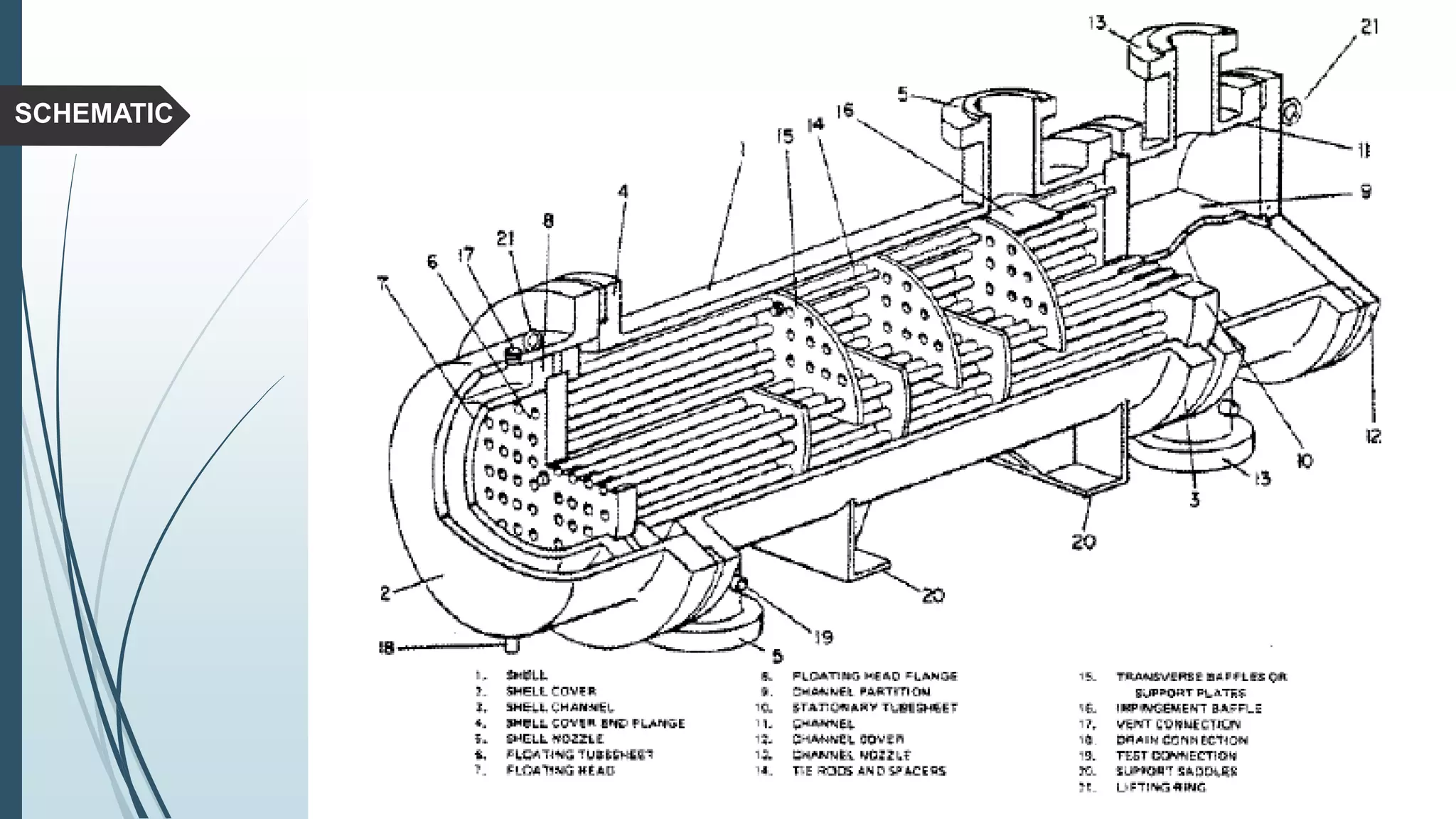
SCHEMATIC
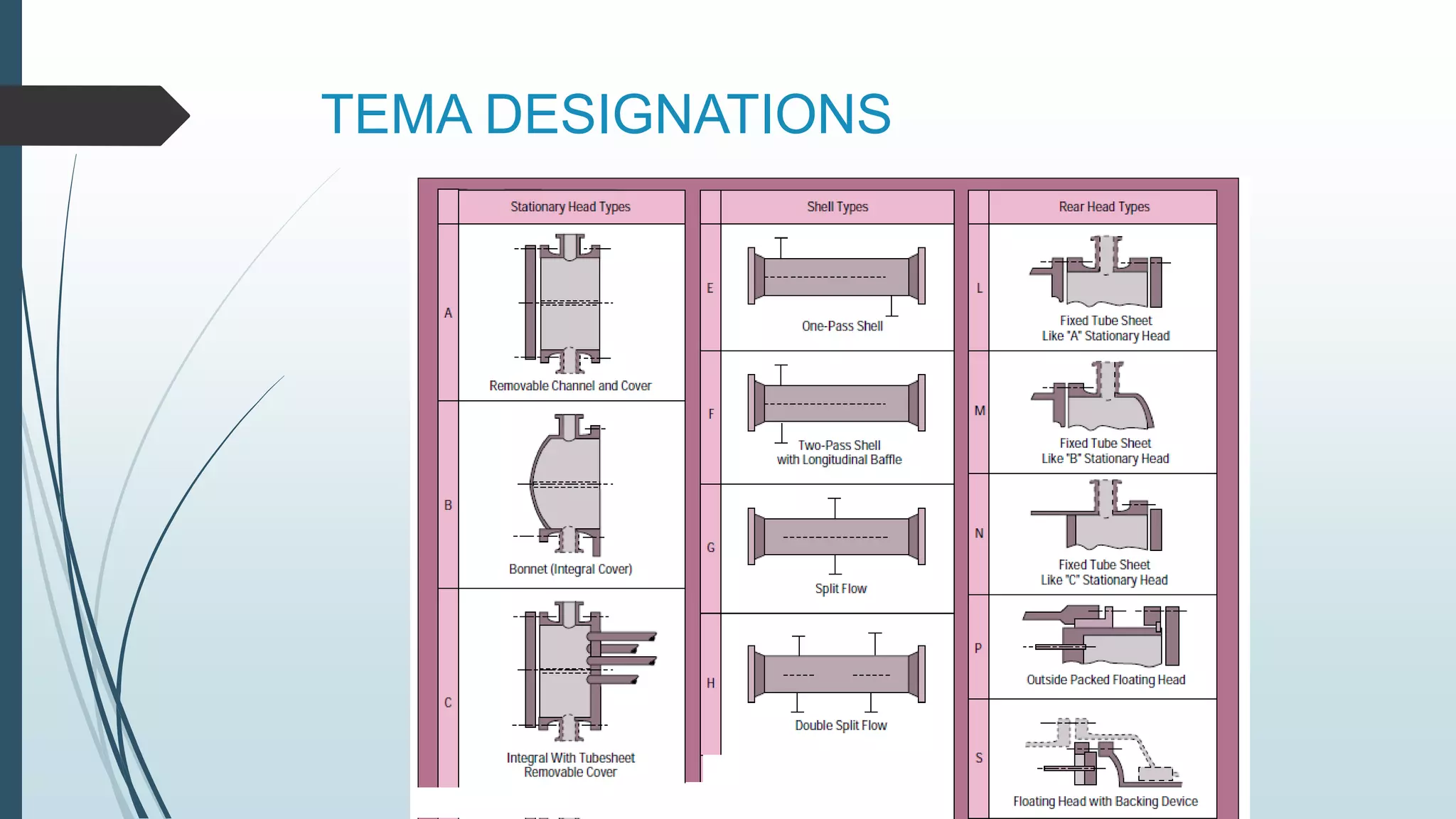
TEMA DESIGNATIONS
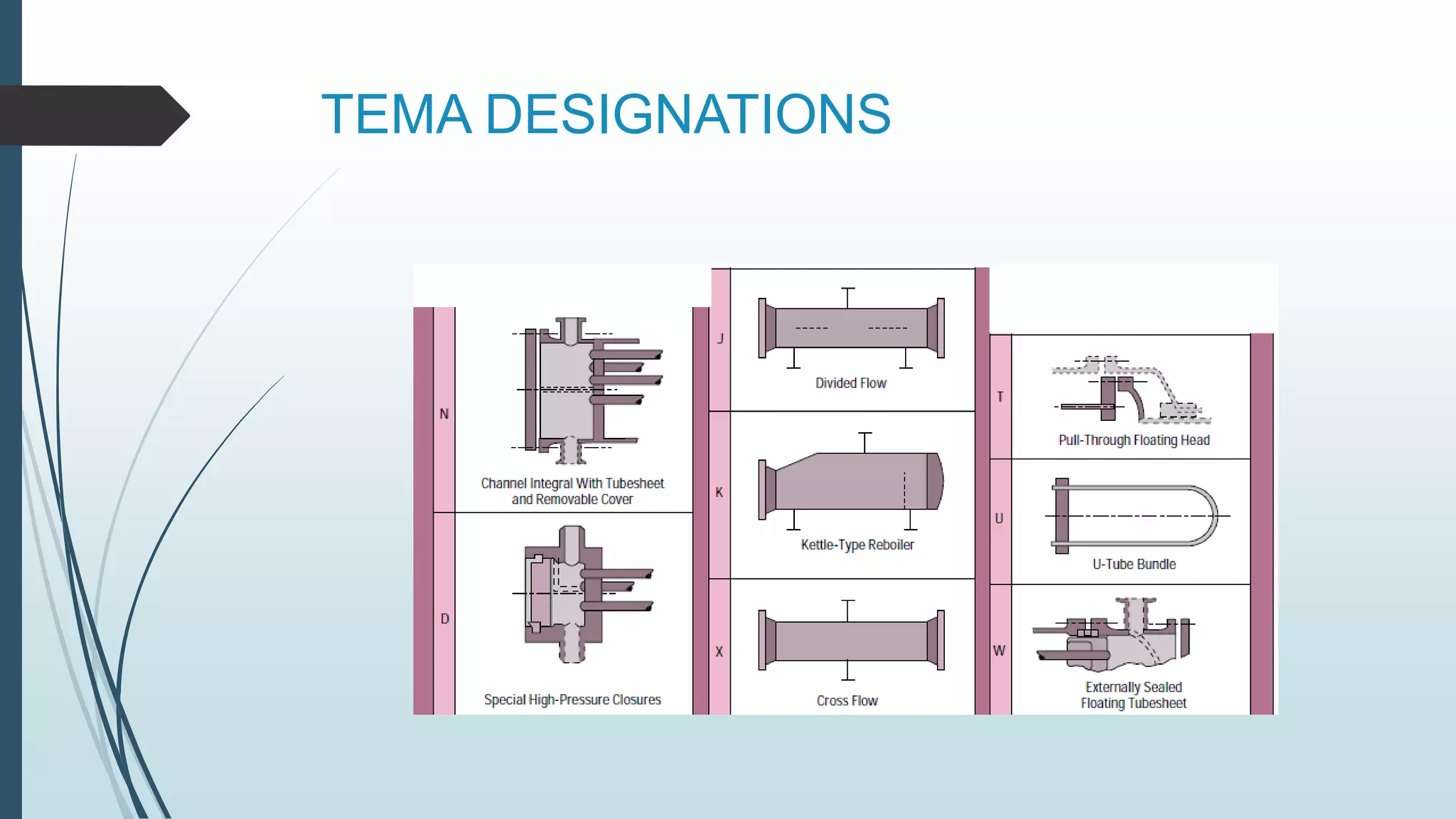
TEMA DESIGNATIONS
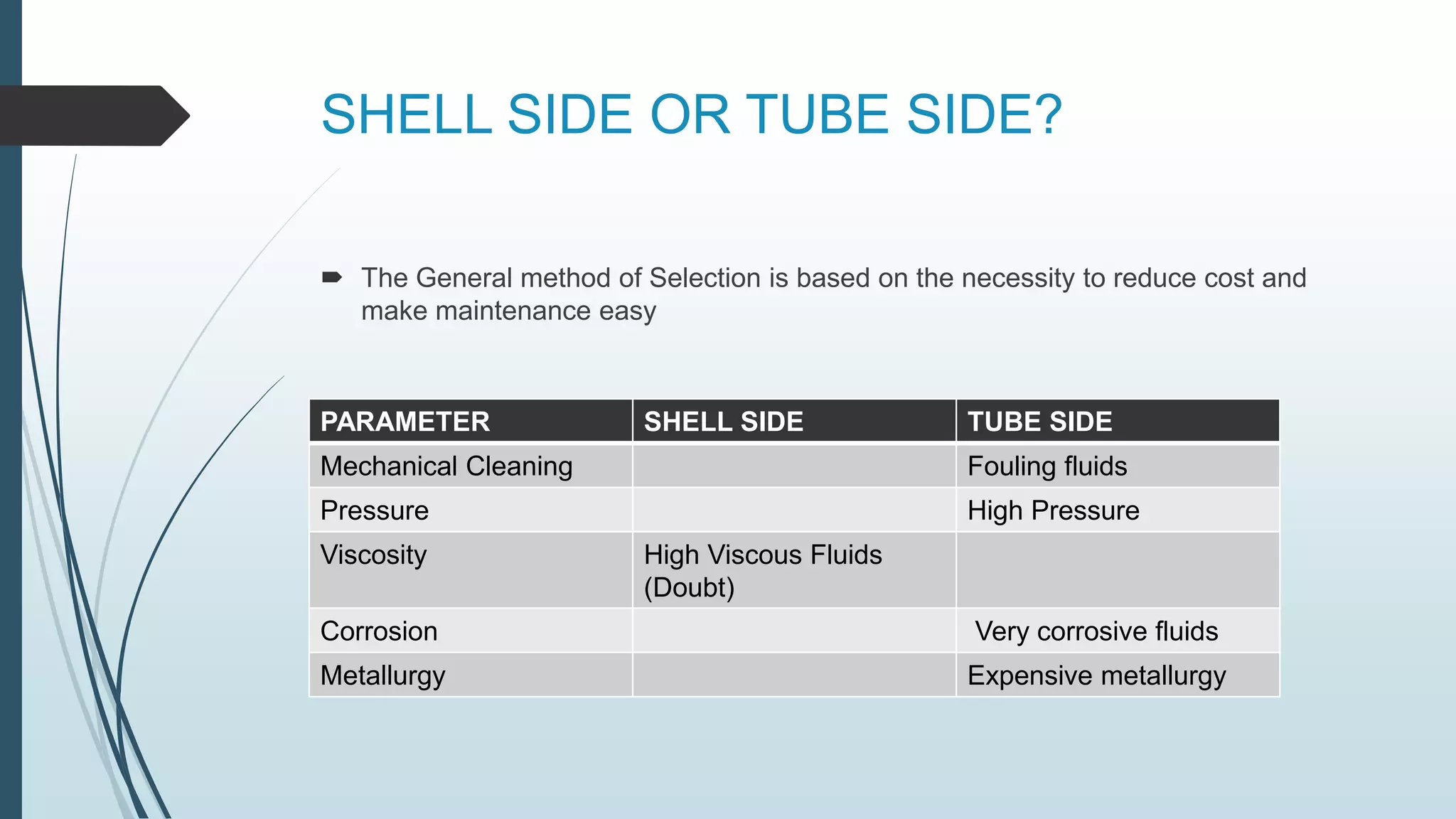
SHELL SIDE OR TUBE SIDE?
 The General method of Selection is based on the necessity to reduce cost and
make maintenance easy
PARAMETER SHELL SIDE TUBE SIDE
Mechanical Cleaning Fouling fluids
Pressure High Pressure
Viscosity High Viscous Fluids
(Doubt)
Corrosion Very corrosive fluids
Metallurgy Expensive metallurgy
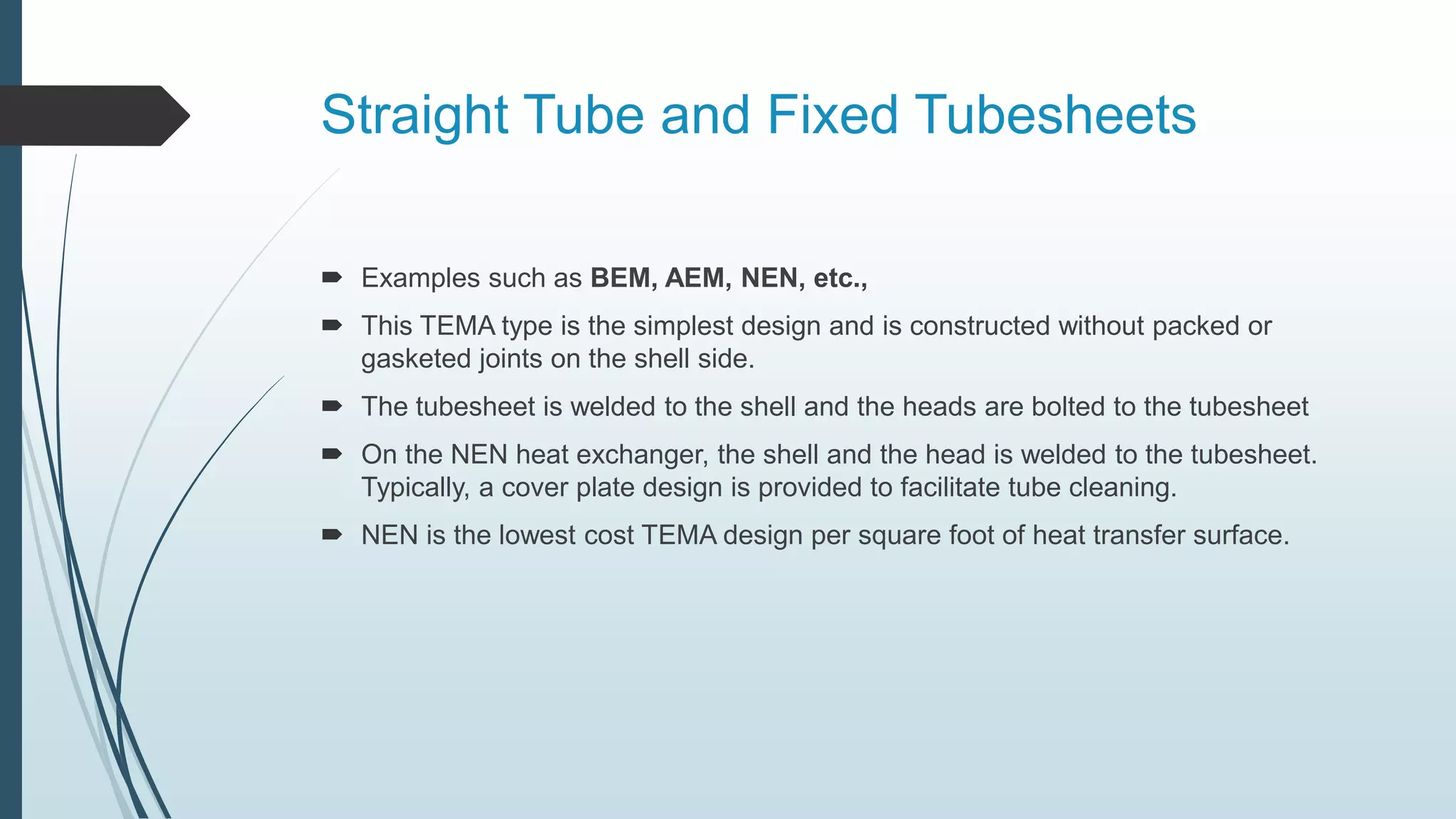
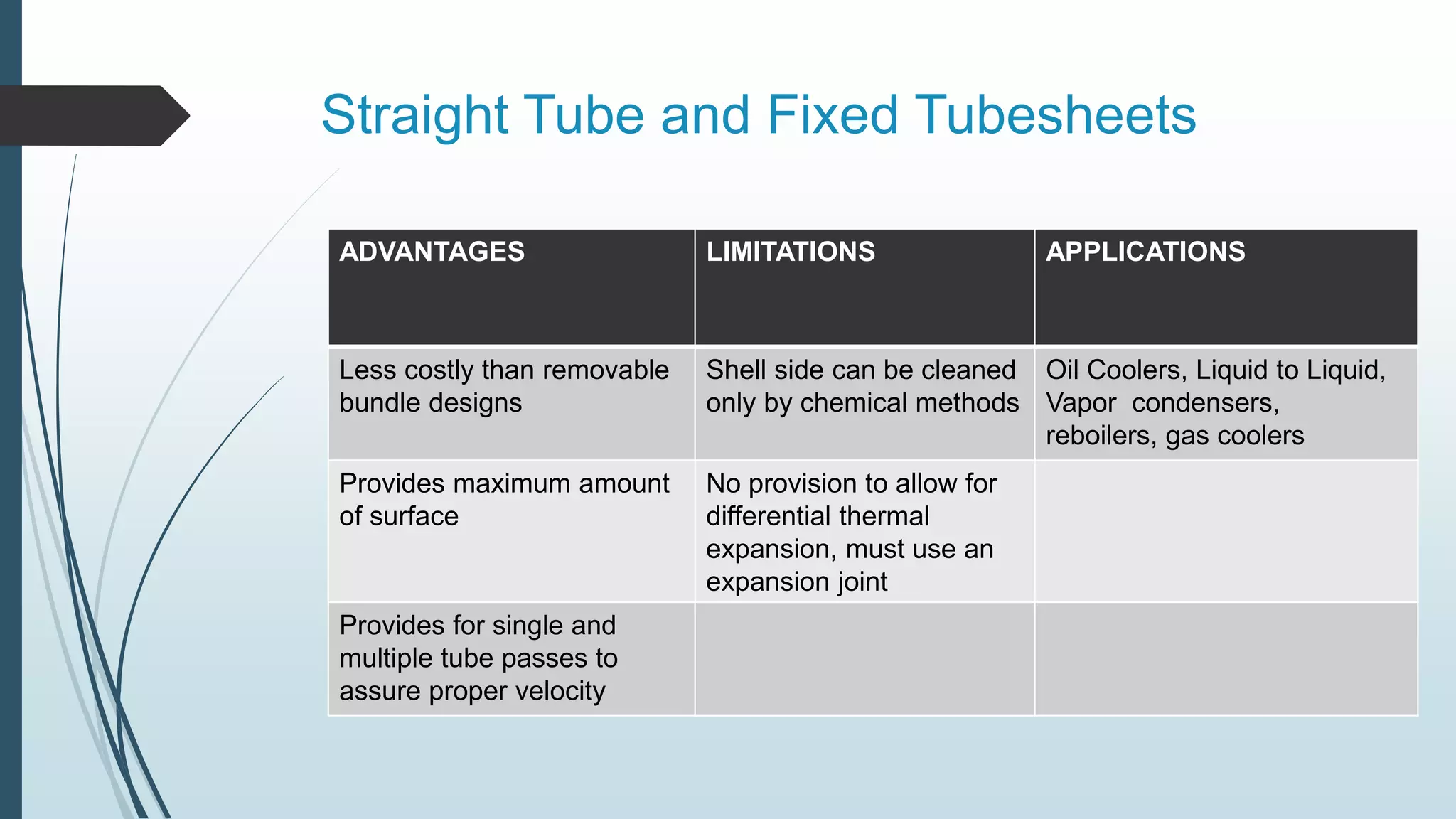
Straight Tube and Fixed Tubesheets
 Examples such as BEM, AEM, NEN, etc.,
 This TEMA type is the simplest design and is constructed without packed or
gasketed joints on the shell side.
 The tubesheet is welded to the shell and the heads are bolted to the tubesheet
 On the NEN heat exchanger, the shell and the head is welded to the tubesheet.
Typically, a cover plate design is provided to facilitate tube cleaning.
 NEN is the lowest cost TEMA design per square foot of heat transfer surface.
Straight Tube and Fixed Tubesheets
ADVANTAGES LIMITATIONS APPLICATIONS
Less costly than removable
bundle designs
Shell side can be cleaned
only by chemical methods
Oil Coolers, Liquid to Liquid,
Vapor condensers,
reboilers, gas coolers
Provides maximum amount
of surface
No provision to allow for
differential thermal
expansion, must use an
expansion joint
Provides for single and
multiple tube passes to
assure proper velocity
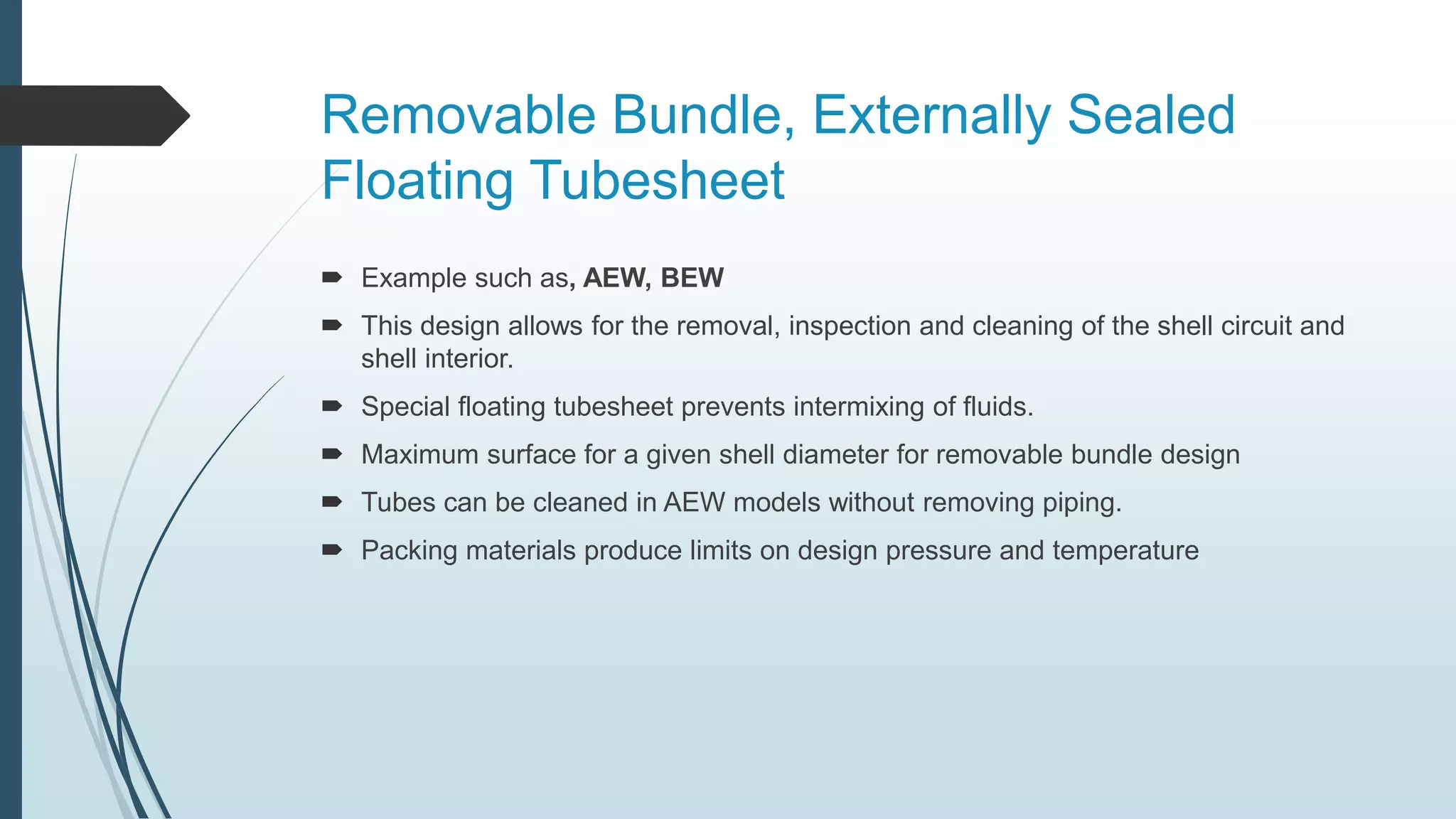
Removable Bundle, Externally Sealed
Floating Tubesheet
 Example such as, AEW, BEW
 This design allows for the removal, inspection and cleaning of the shell circuit and
shell interior.
 Special floating tubesheet prevents intermixing of fluids.
 Maximum surface for a given shell diameter for removable bundle design
 Tubes can be cleaned in AEW models without removing piping.
 Packing materials produce limits on design pressure and temperature
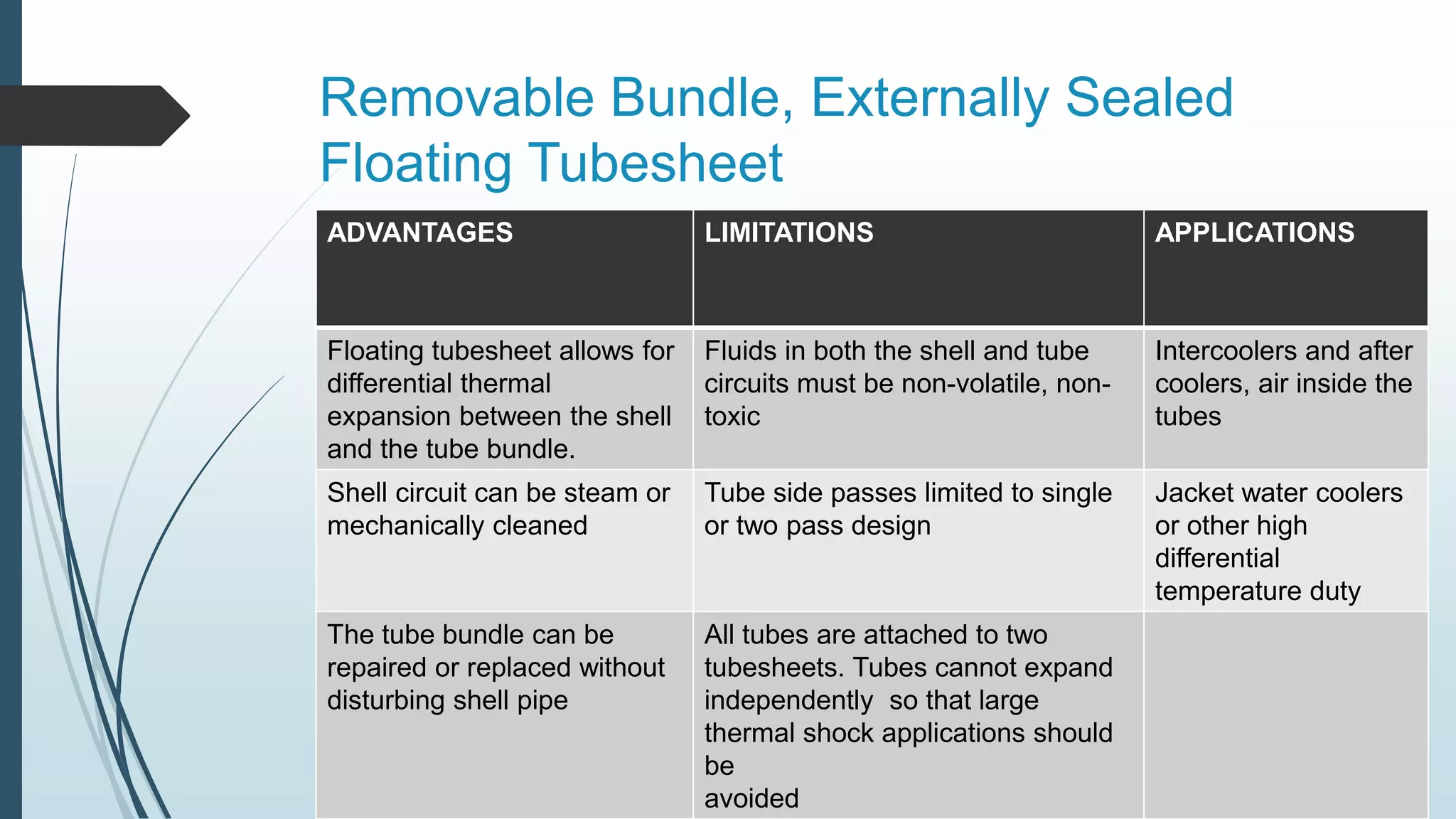
Removable Bundle, Externally Sealed
Floating Tubesheet
ADVANTAGES LIMITATIONS APPLICATIONS
Floating tubesheet allows for
differential thermal
expansion between the shell
and the tube bundle.
Fluids in both the shell and tube
circuits must be non-volatile, non-
toxic
Intercoolers and after
coolers, air inside the
tubes
Shell circuit can be steam or
mechanically cleaned
Tube side passes limited to single
or two pass design
Jacket water coolers
or other high
differential
temperature duty
The tube bundle can be
repaired or replaced without
disturbing shell pipe
All tubes are attached to two
tubesheets. Tubes cannot expand
independently so that large
thermal shock applications should
be
avoided
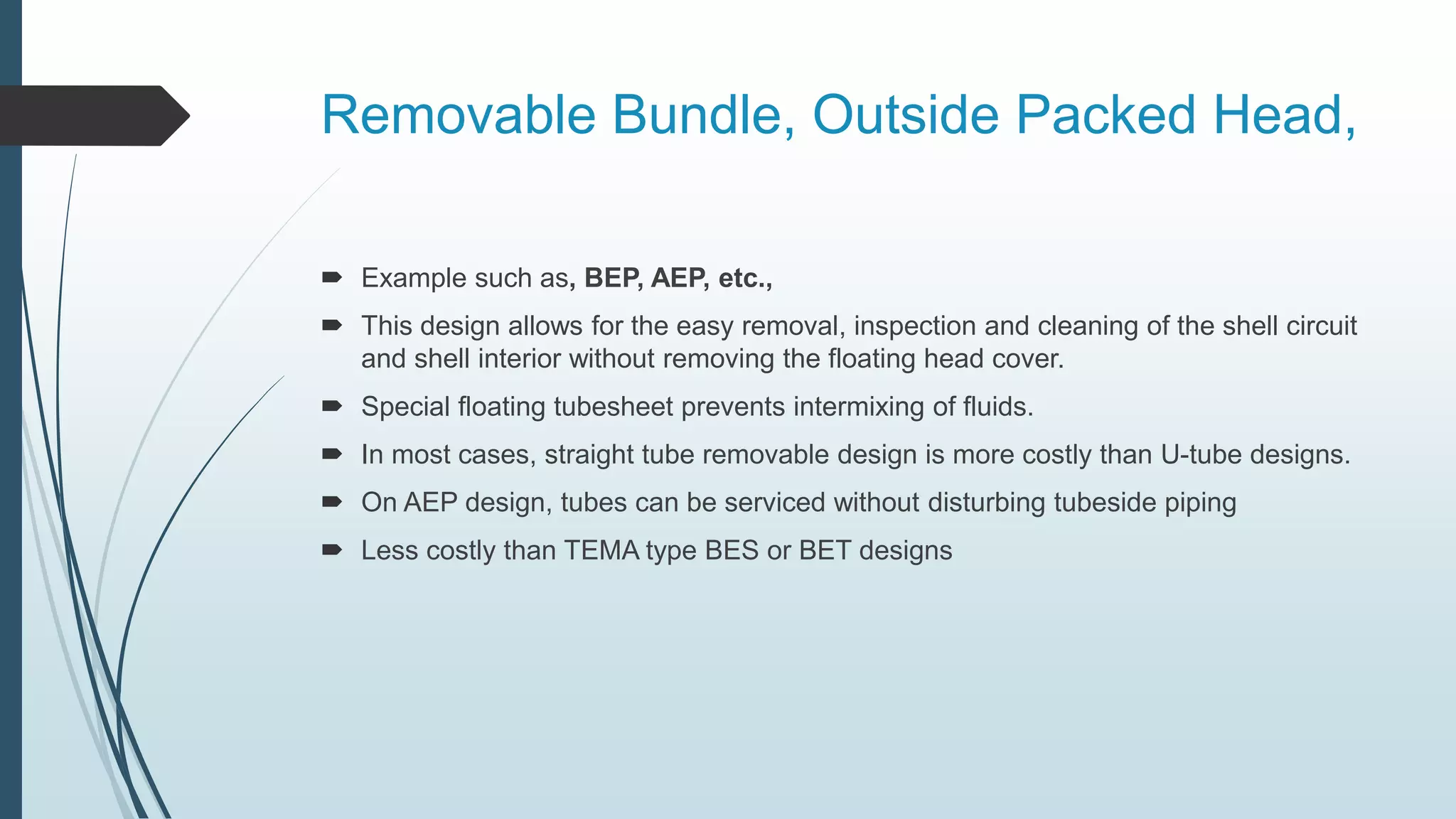
Removable Bundle, Outside Packed Head,
 Example such as, BEP, AEP, etc.,
 This design allows for the easy removal, inspection and cleaning of the shell circuit
and shell interior without removing the floating head cover.
 Special floating tubesheet prevents intermixing of fluids.
 In most cases, straight tube removable design is more costly than U-tube designs.
 On AEP design, tubes can be serviced without disturbing tubeside piping
 Less costly than TEMA type BES or BET designs
Removable Bundle, Outside Packed Head
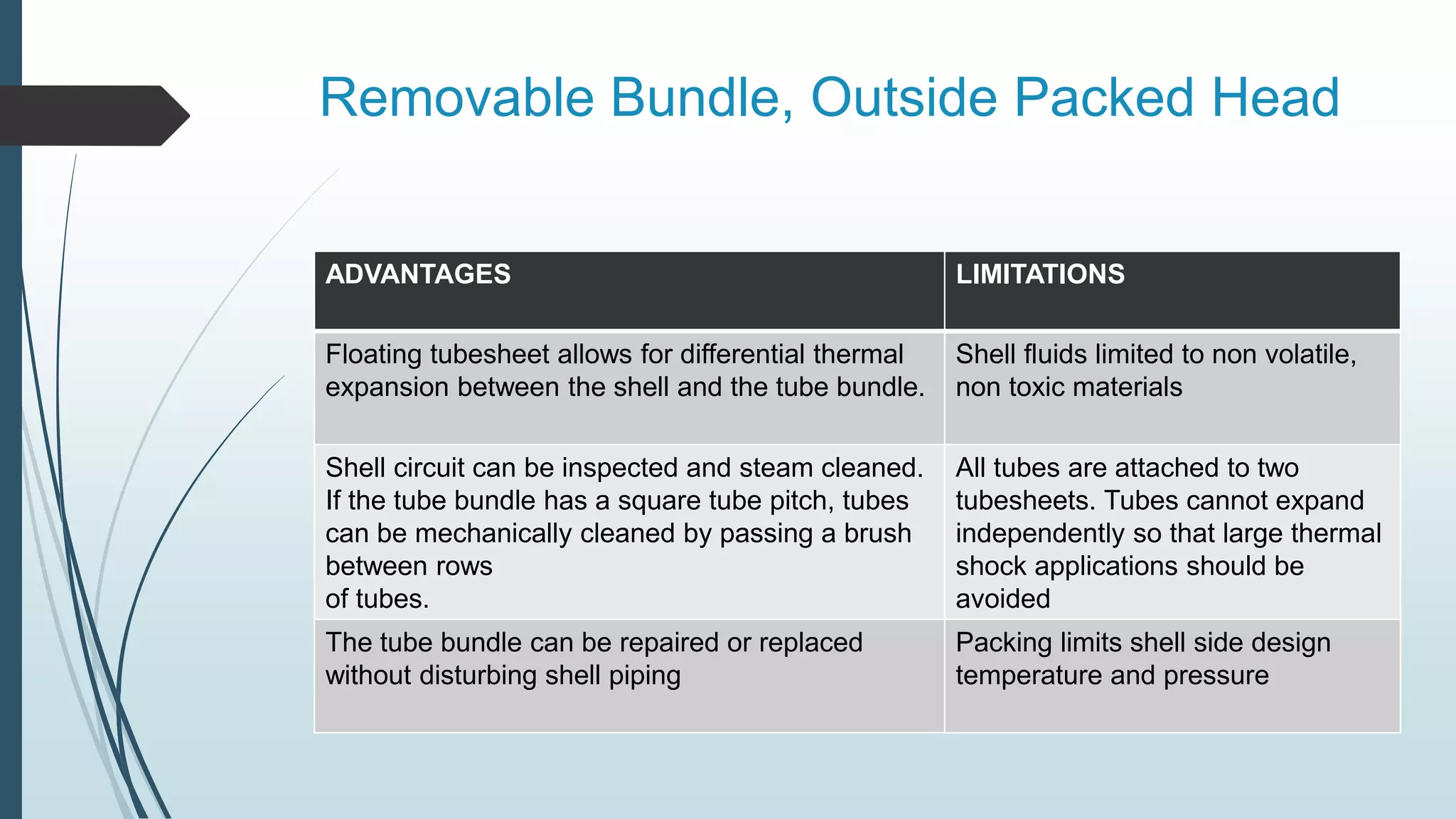
ADVANTAGES LIMITATIONS
Floating tubesheet allows for differential thermal
expansion between the shell and the tube bundle.
Shell fluids limited to non volatile,
non toxic materials
Shell circuit can be inspected and steam cleaned.
If the tube bundle has a square tube pitch, tubes
can be mechanically cleaned by passing a brush
between rows
of tubes.
All tubes are attached to two
tubesheets. Tubes cannot expand
independently so that large thermal
shock applications should be
avoided
The tube bundle can be repaired or replaced
without disturbing shell piping
Packing limits shell side design
temperature and pressure
Removable Bundle, Internal Split Ring
Floating Head
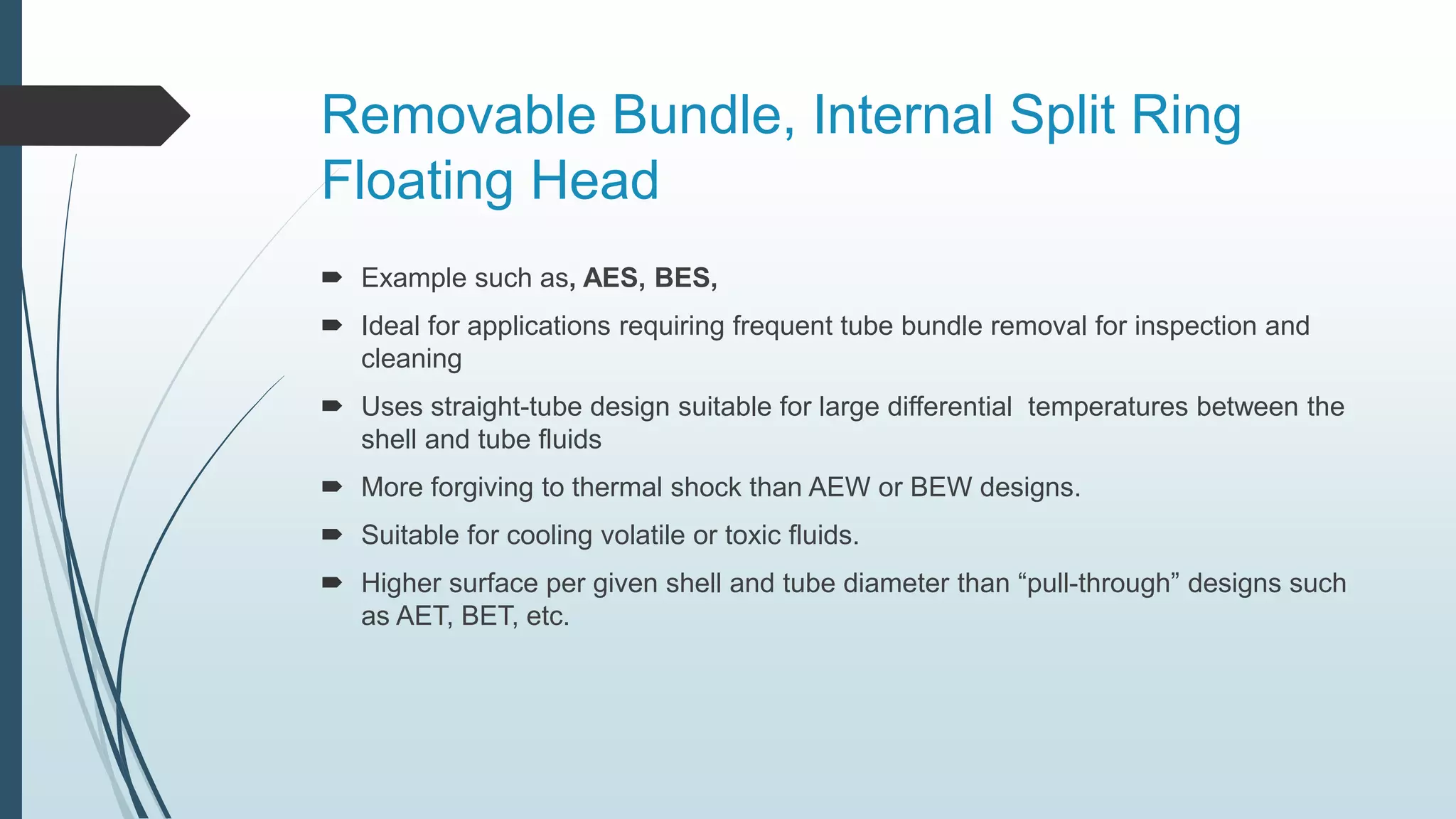
 Example such as, AES, BES,
 Ideal for applications requiring frequent tube bundle removal for inspection and
cleaning
 Uses straight-tube design suitable for large differential temperatures between the
shell and tube fluids
 More forgiving to thermal shock than AEW or BEW designs.
 Suitable for cooling volatile or toxic fluids.
 Higher surface per given shell and tube diameter than “pull-through” designs such
as AET, BET, etc.
Removable Bundle, Internal Split Ring
Floating Head
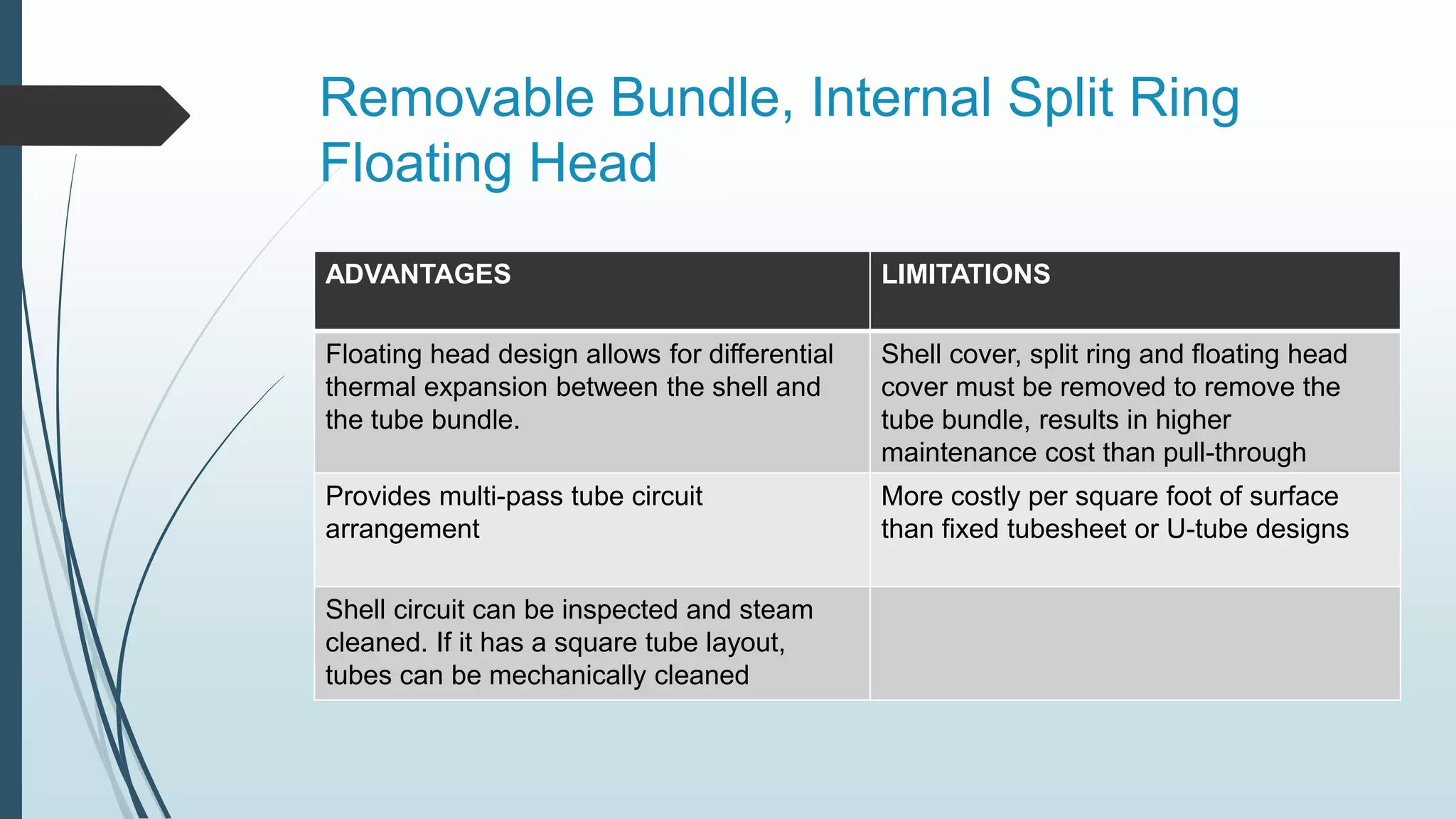
ADVANTAGES LIMITATIONS
Floating head design allows for differential
thermal expansion between the shell and
the tube bundle.
Shell cover, split ring and floating head
cover must be removed to remove the
tube bundle, results in higher
maintenance cost than pull-through
Provides multi-pass tube circuit
arrangement
More costly per square foot of surface
than fixed tubesheet or U-tube designs
Shell circuit can be inspected and steam
cleaned. If it has a square tube layout,
tubes can be mechanically cleaned
Removable Bundle, Pull-Through Floating
Head,
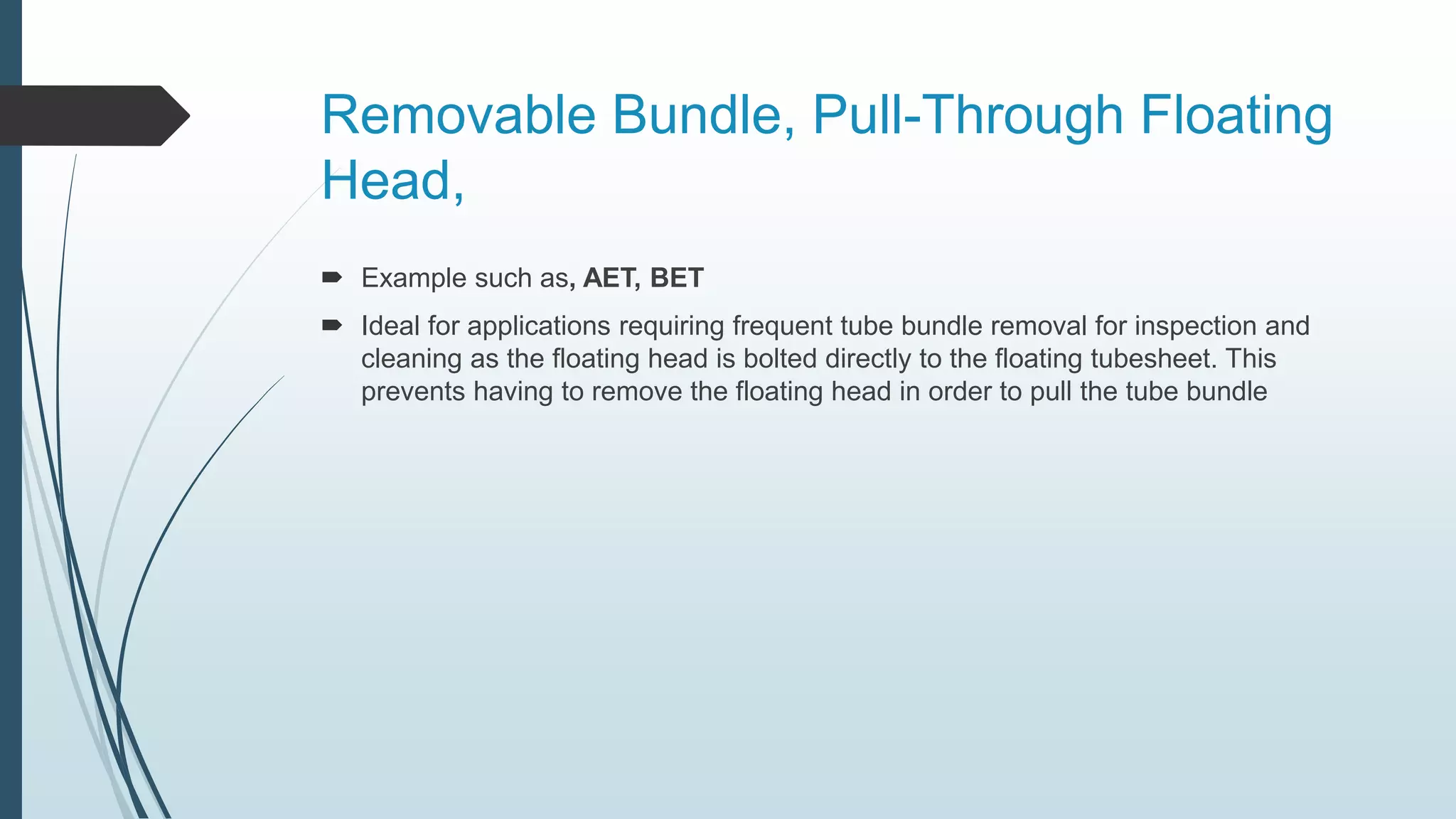
 Example such as, AET, BET
 Ideal for applications requiring frequent tube bundle removal for inspection and
cleaning as the floating head is bolted directly to the floating tubesheet. This
prevents having to remove the floating head in order to pull the tube bundle
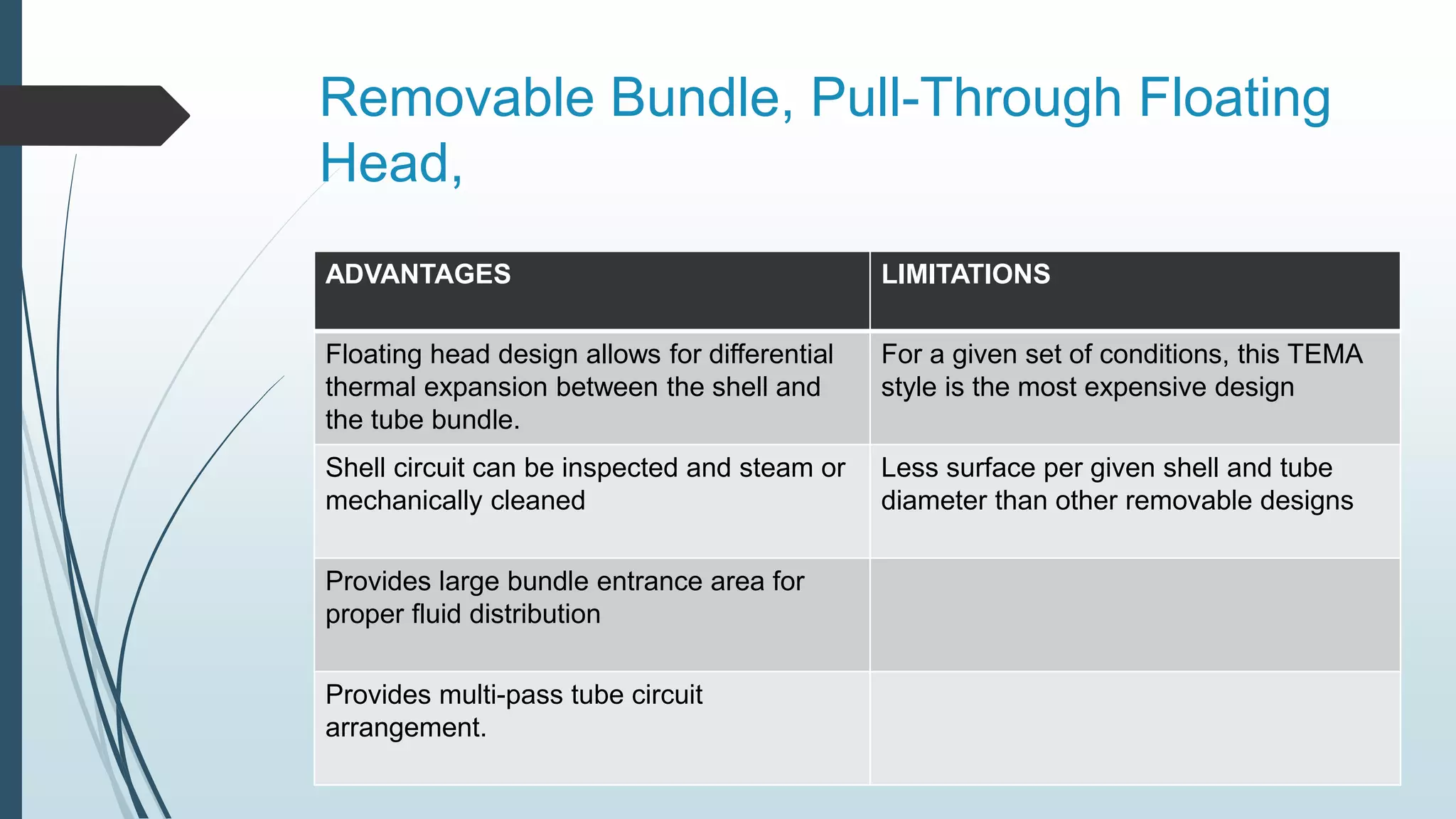
Removable Bundle, Pull-Through Floating
Head,
ADVANTAGES LIMITATIONS
Floating head design allows for differential
thermal expansion between the shell and
the tube bundle.
For a given set of conditions, this TEMA
style is the most expensive design
Shell circuit can be inspected and steam or
mechanically cleaned
Less surface per given shell and tube
diameter than other removable designs
Provides large bundle entrance area for
proper fluid distribution
Provides multi-pass tube circuit
arrangement.
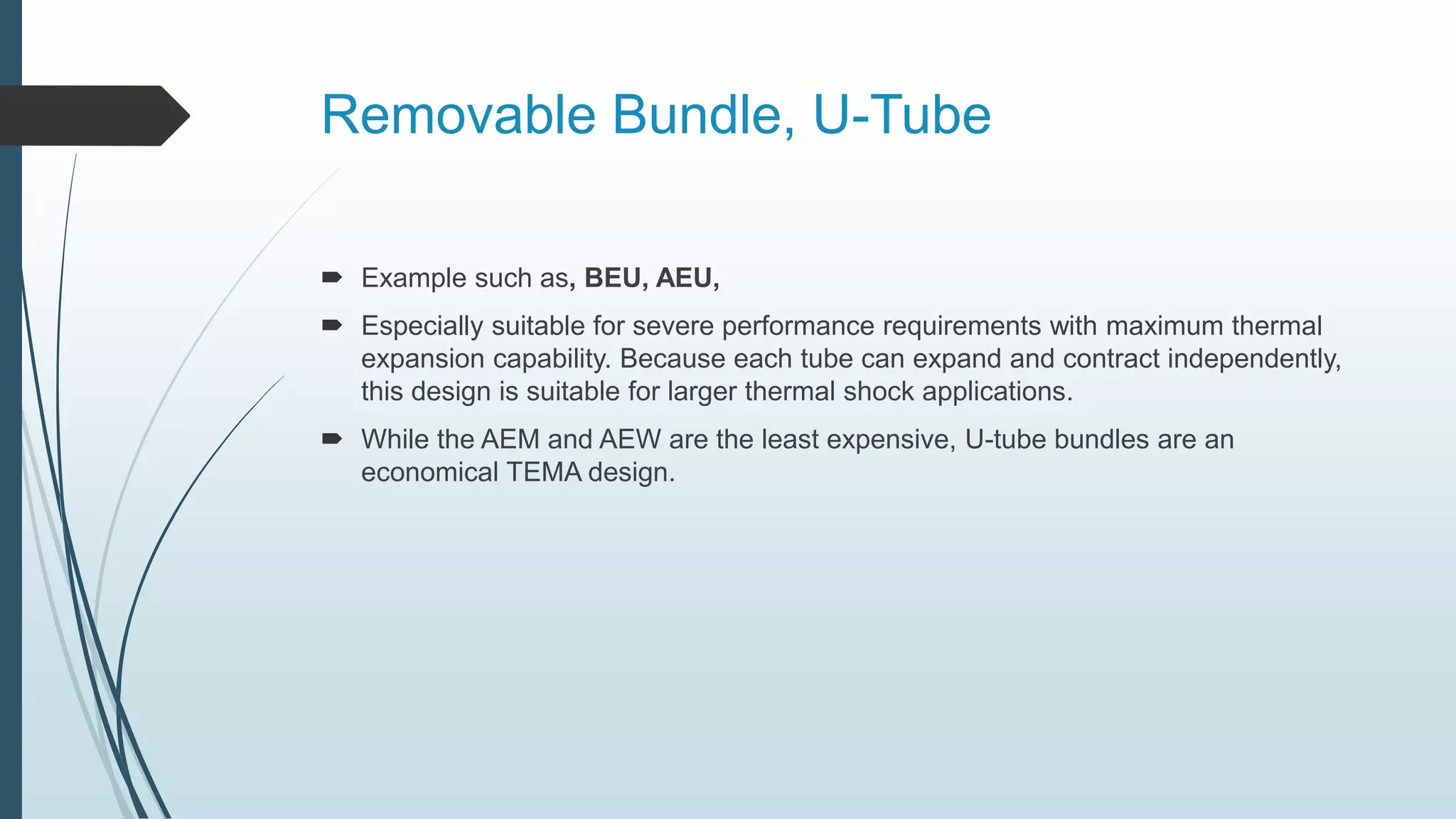
Removable Bundle, U-Tube
 Example such as, BEU, AEU,
 Especially suitable for severe performance requirements with maximum thermal
expansion capability. Because each tube can expand and contract independently,
this design is suitable for larger thermal shock applications.
 While the AEM and AEW are the least expensive, U-tube bundles are an
economical TEMA design.
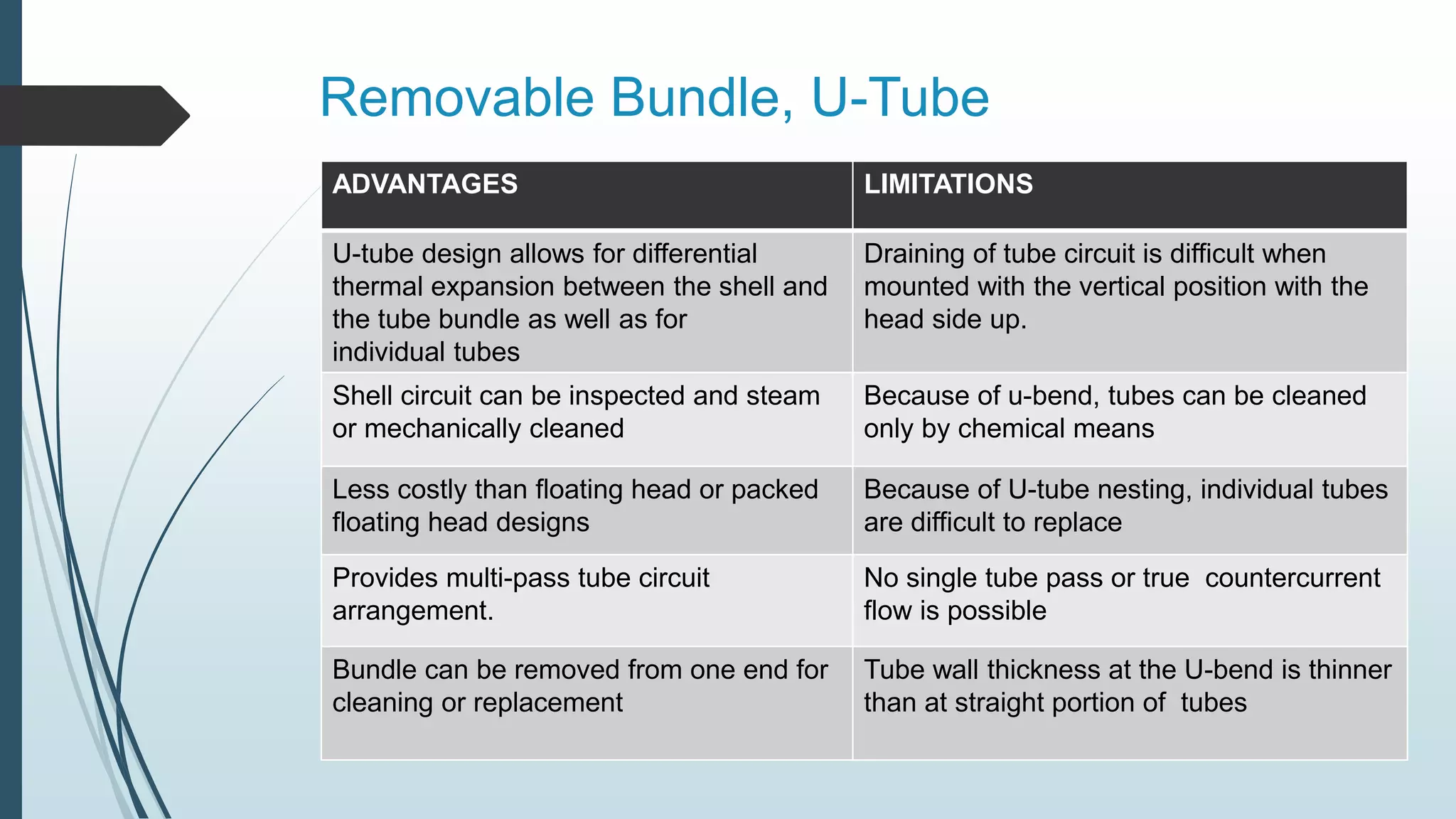
Removable Bundle, U-Tube
ADVANTAGES LIMITATIONS
U-tube design allows for differential
thermal expansion between the shell and
the tube bundle as well as for
individual tubes
Draining of tube circuit is difficult when
mounted with the vertical position with the
head side up.
Shell circuit can be inspected and steam
or mechanically cleaned
Because of u-bend, tubes can be cleaned
only by chemical means
Less costly than floating head or packed
floating head designs
Because of U-tube nesting, individual tubes
are difficult to replace
Provides multi-pass tube circuit
arrangement.
No single tube pass or true countercurrent
flow is possible
Bundle can be removed from one end for
cleaning or replacement
Tube wall thickness at the U-bend is thinner
than at straight portion of tubes
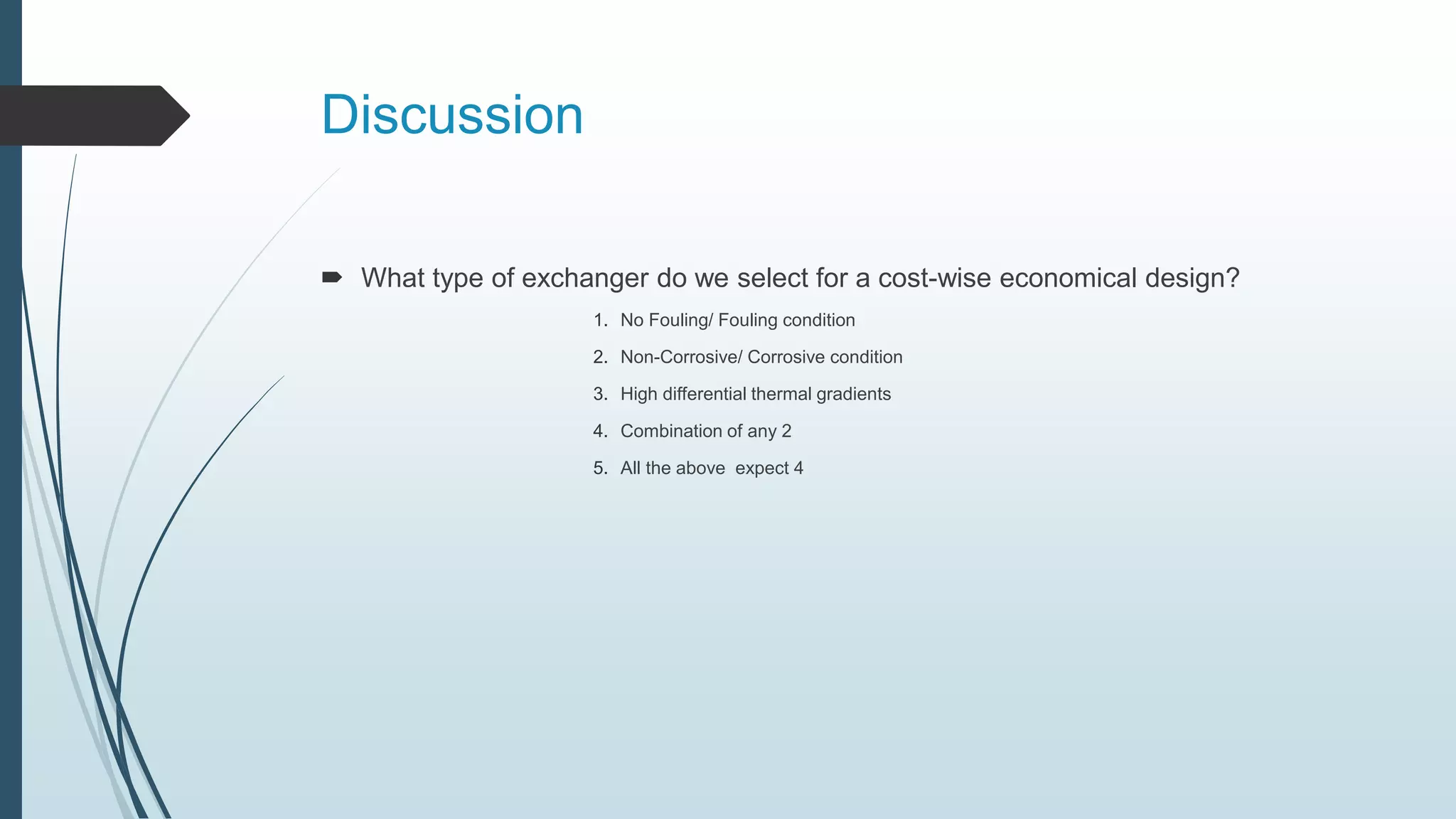
Discussion
 What type of exchanger do we select for a cost-wise economical design?
1. No Fouling/ Fouling condition
2. Non-Corrosive/ Corrosive condition
3. High differential thermal gradients
4. Combination of any 2
5. All the above expect 4
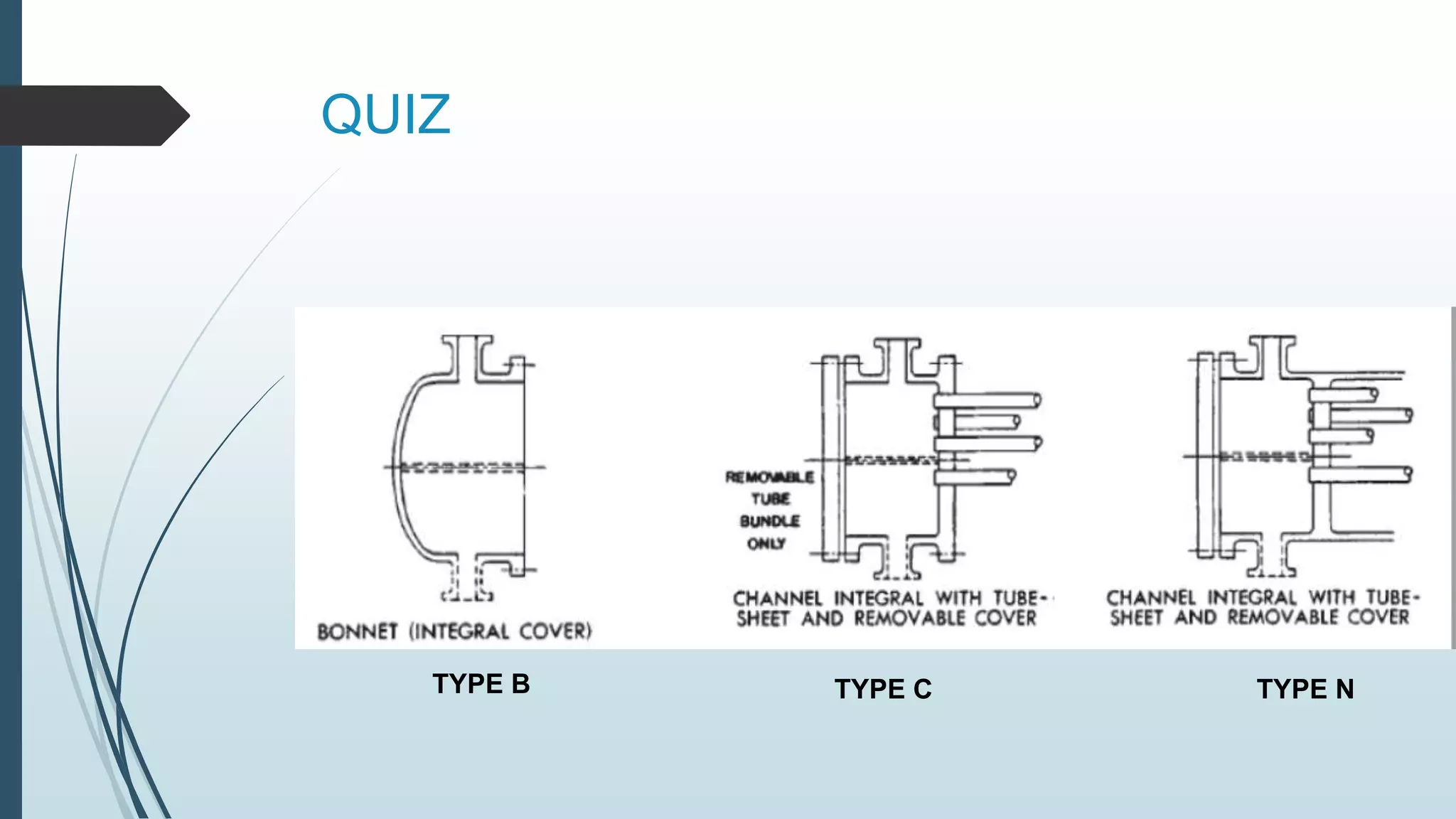
Front Head Selection
QUIZ
TYPE B TYPE C TYPE N
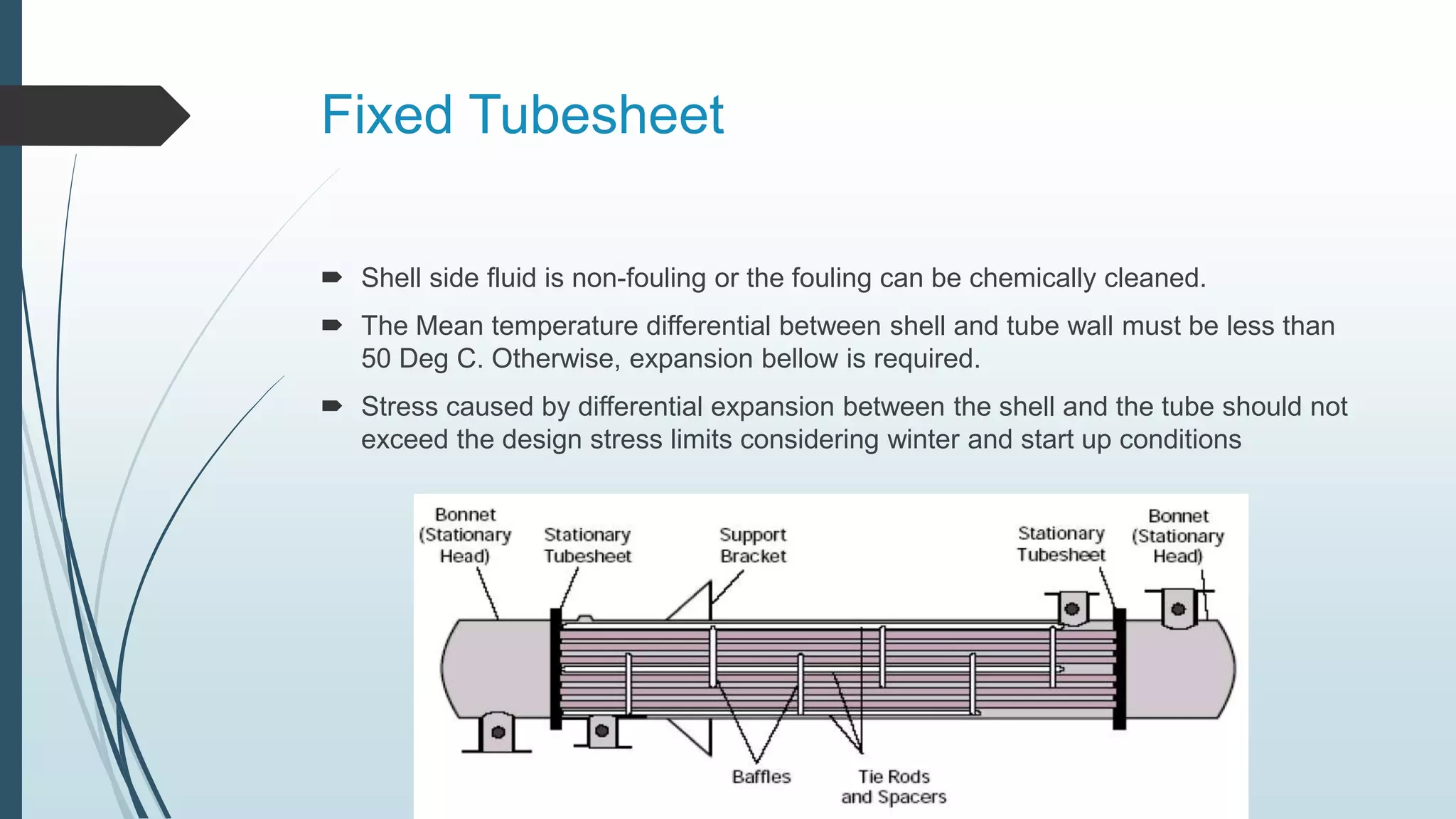
Fixed Tubesheet
 Shell side fluid is non-fouling or the fouling can be chemically cleaned.
 The Mean temperature differential between shell and tube wall must be less than
50 Deg C. Otherwise, expansion bellow is required.
 Stress caused by differential expansion between the shell and the tube should not
exceed the design stress limits considering winter and start up conditions
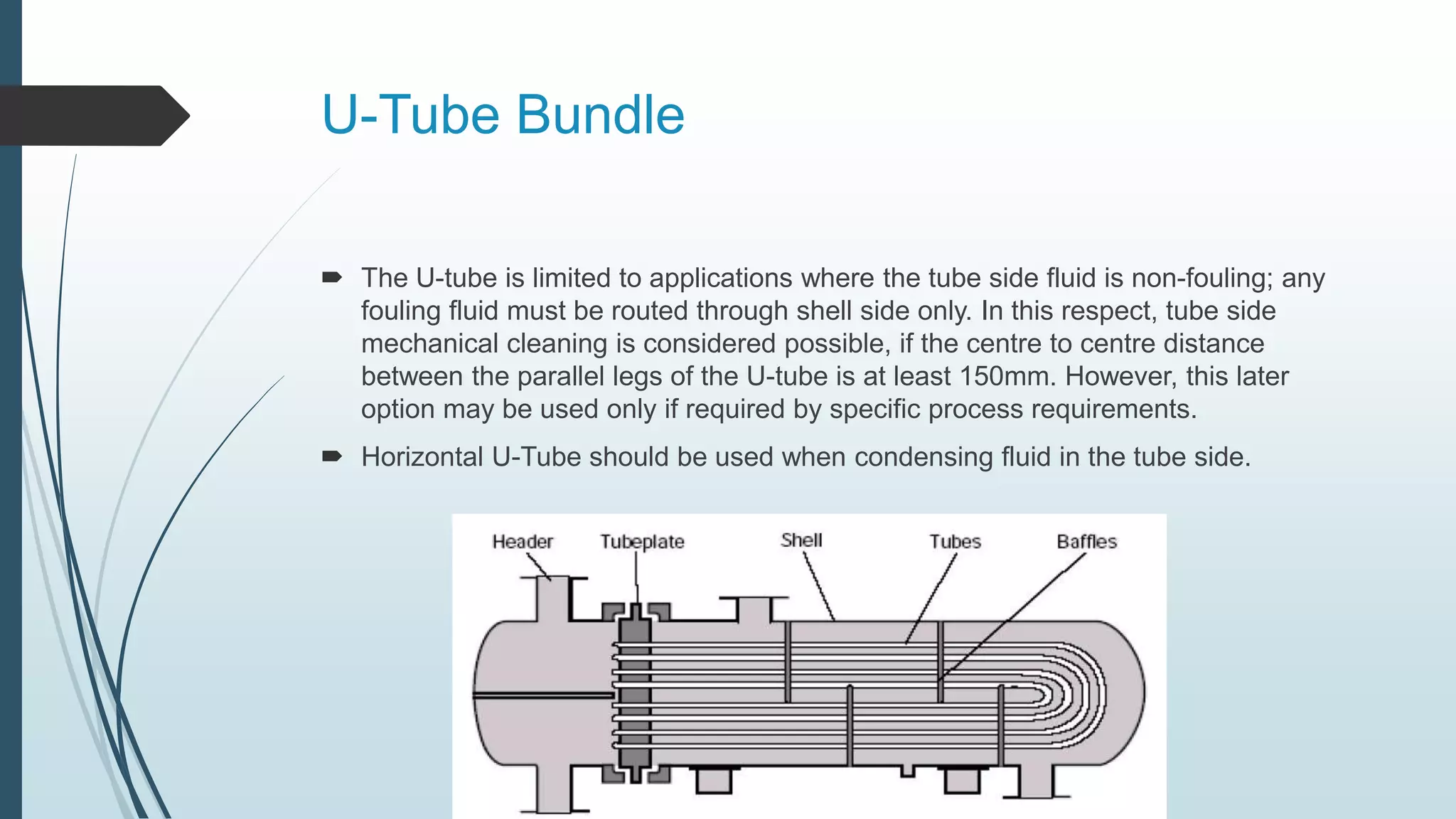
U-Tube Bundle
 The U-tube is limited to applications where the tube side fluid is non-fouling; any
fouling fluid must be routed through shell side only. In this respect, tube side
mechanical cleaning is considered possible, if the centre to centre distance
between the parallel legs of the U-tube is at least 150mm. However, this later
option may be used only if required by specific process requirements.
 Horizontal U-Tube should be used when condensing fluid in the tube side.
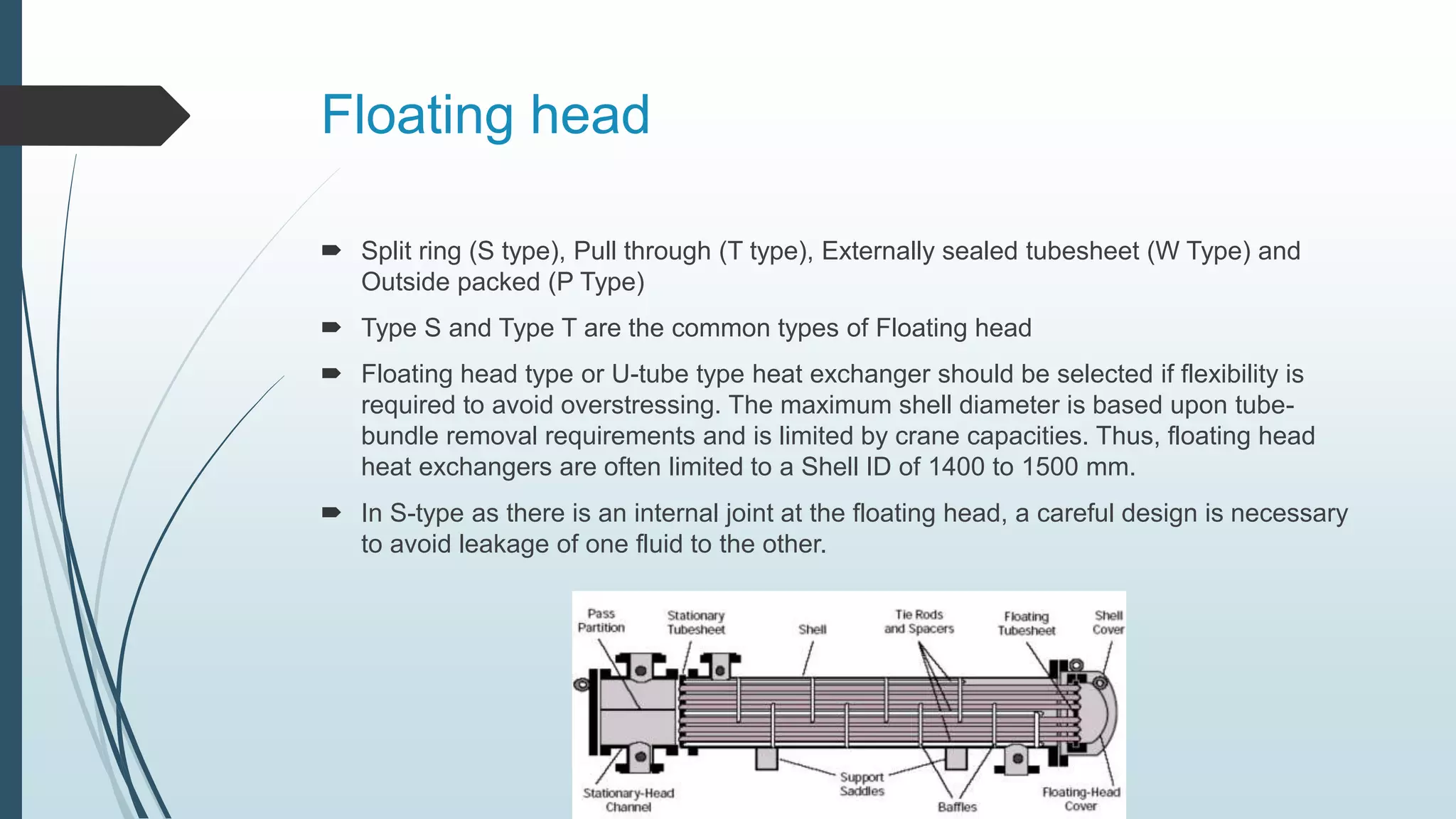
Floating head
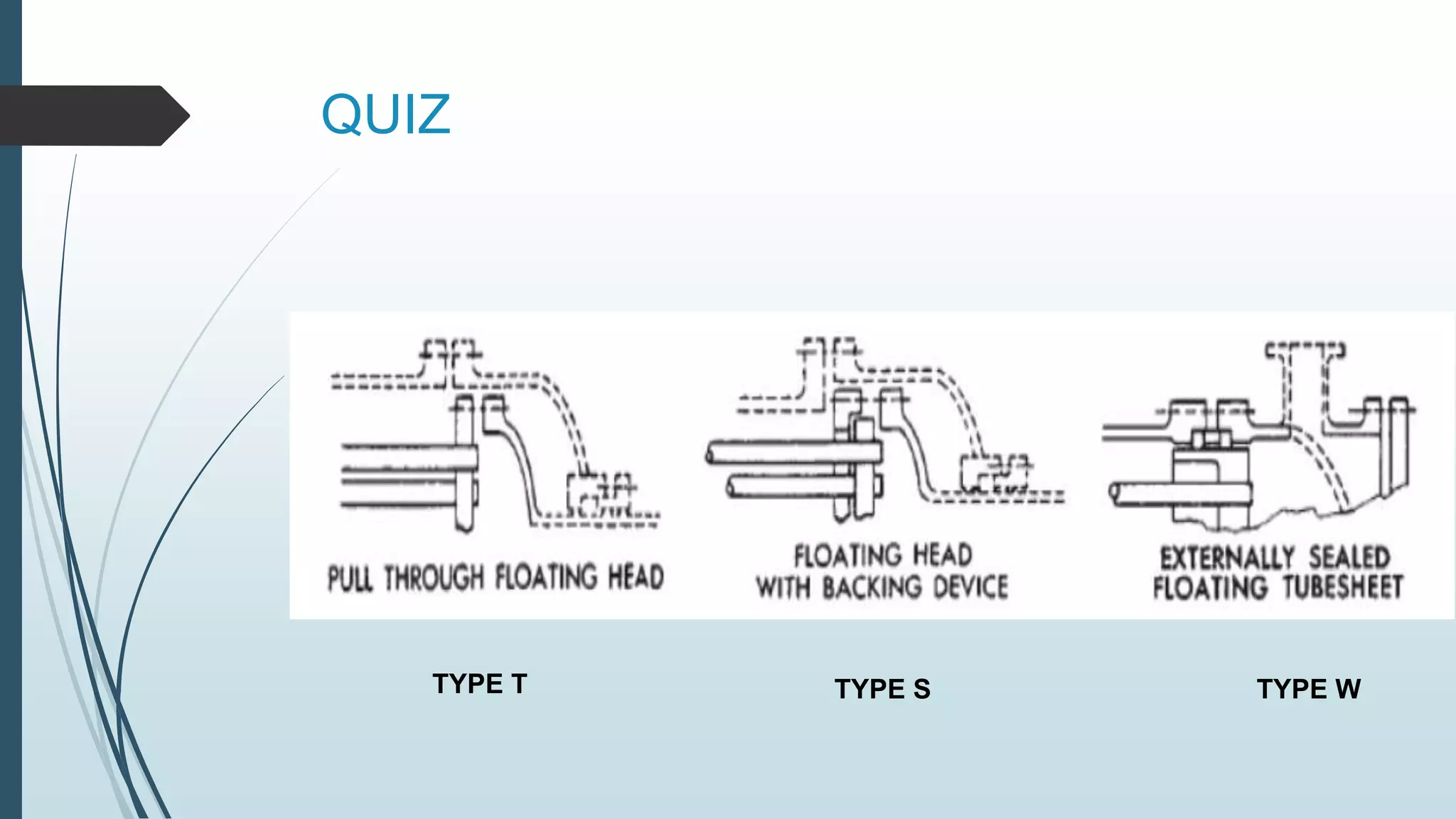
 Split ring (S type), Pull through (T type), Externally sealed tubesheet (W Type) and
Outside packed (P Type)
 Type S and Type T are the common types of Floating head
 Floating head type or U-tube type heat exchanger should be selected if flexibility is
required to avoid overstressing. The maximum shell diameter is based upon tube-
bundle removal requirements and is limited by crane capacities. Thus, floating head
heat exchangers are often limited to a Shell ID of 1400 to 1500 mm.
 In S-type as there is an internal joint at the floating head, a careful design is necessary
to avoid leakage of one fluid to the other.
Shell Selection
QUIZ
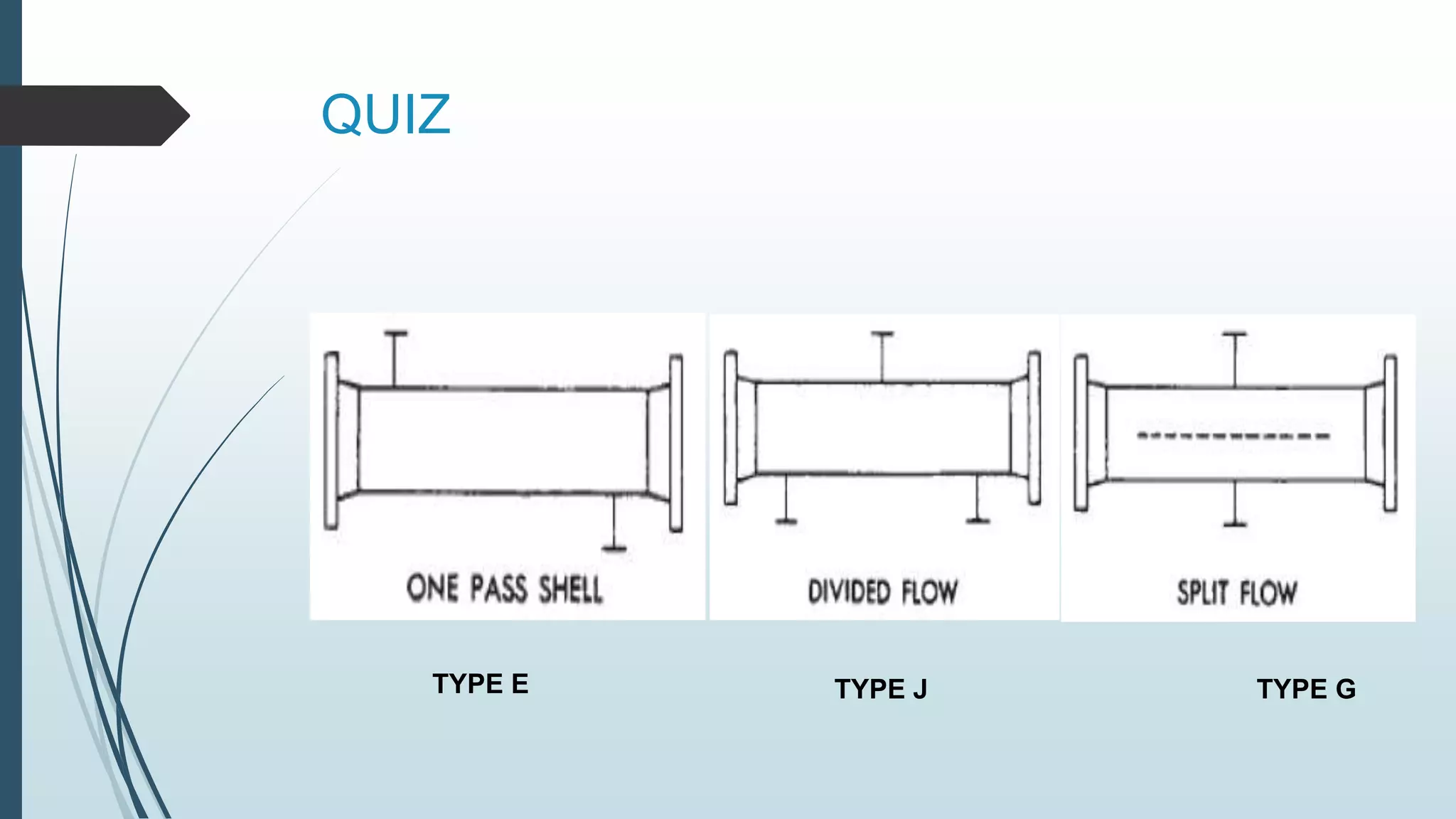
TYPE E TYPE J TYPE G
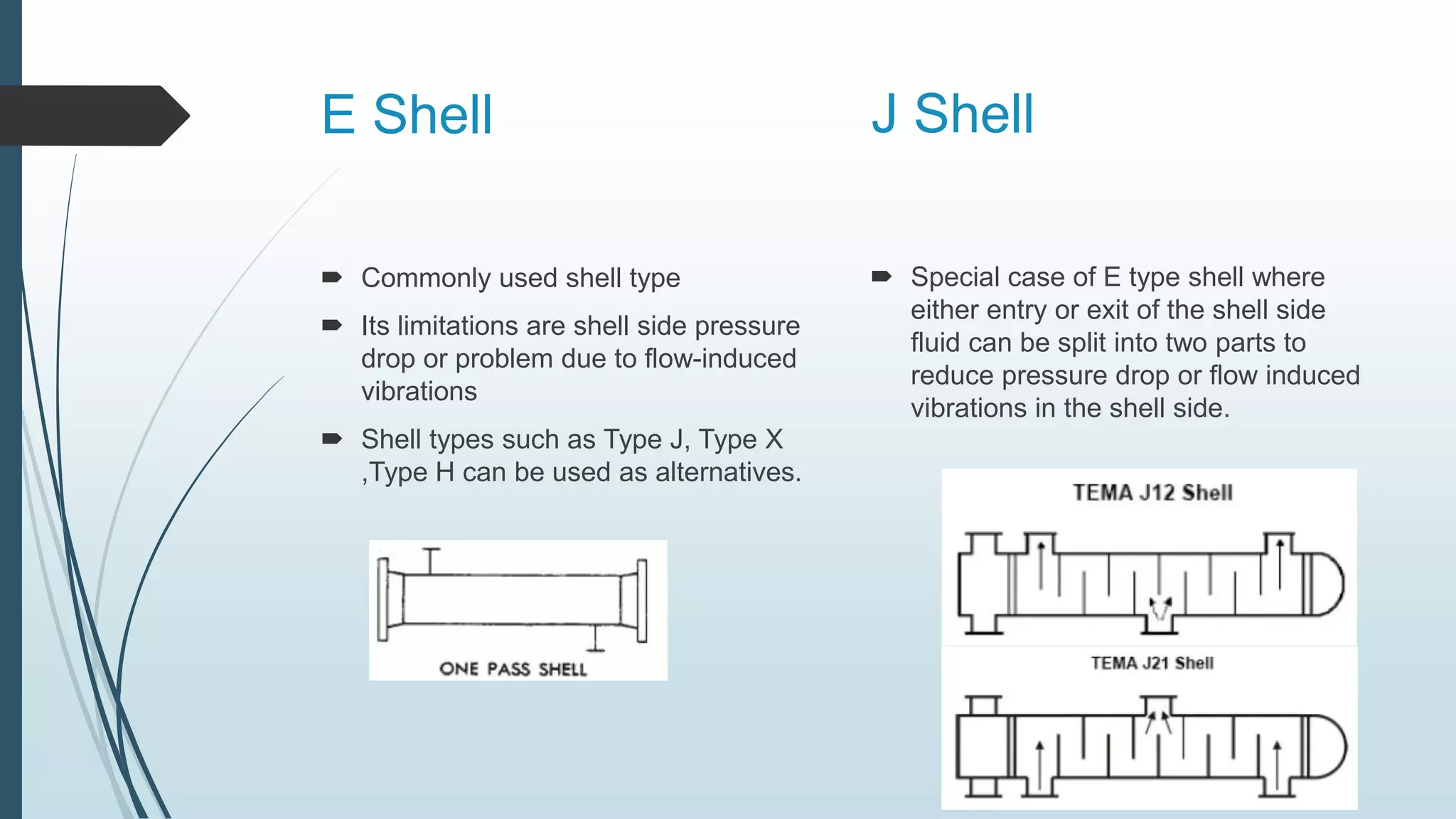
E Shell
 Commonly used shell type
 Its limitations are shell side pressure
drop or problem due to flow-induced
vibrations
 Shell types such as Type J, Type X
,Type H can be used as alternatives.
 Special case of E type shell where
either entry or exit of the shell side
fluid can be split into two parts to
reduce pressure drop or flow induced
vibrations in the shell side.
J Shell
G Shell
 G shells have a longitudinal baffle
axially
 “G” shells are used for a maximum
tube length of twice the maximum
unsupported span as per TEMA as
there is one full support plate in the
tube bundle.
 It is used for horizontal
thermosyphon reboilers in order to
reduce the pressure drop as well as
to avoid flow mal-distribution
 H shells have a longitudinal baffle
axially
 “H” shells are used for a maximum
tube length of four times of the
maximum unsupported span due to
presence of 2 full support plates in
the tube bundle.
 It is used for horizontal
thermosyphon reboilers in order to
reduce the pressure drop as well as
to avoid flow mal-distribution
H Shell
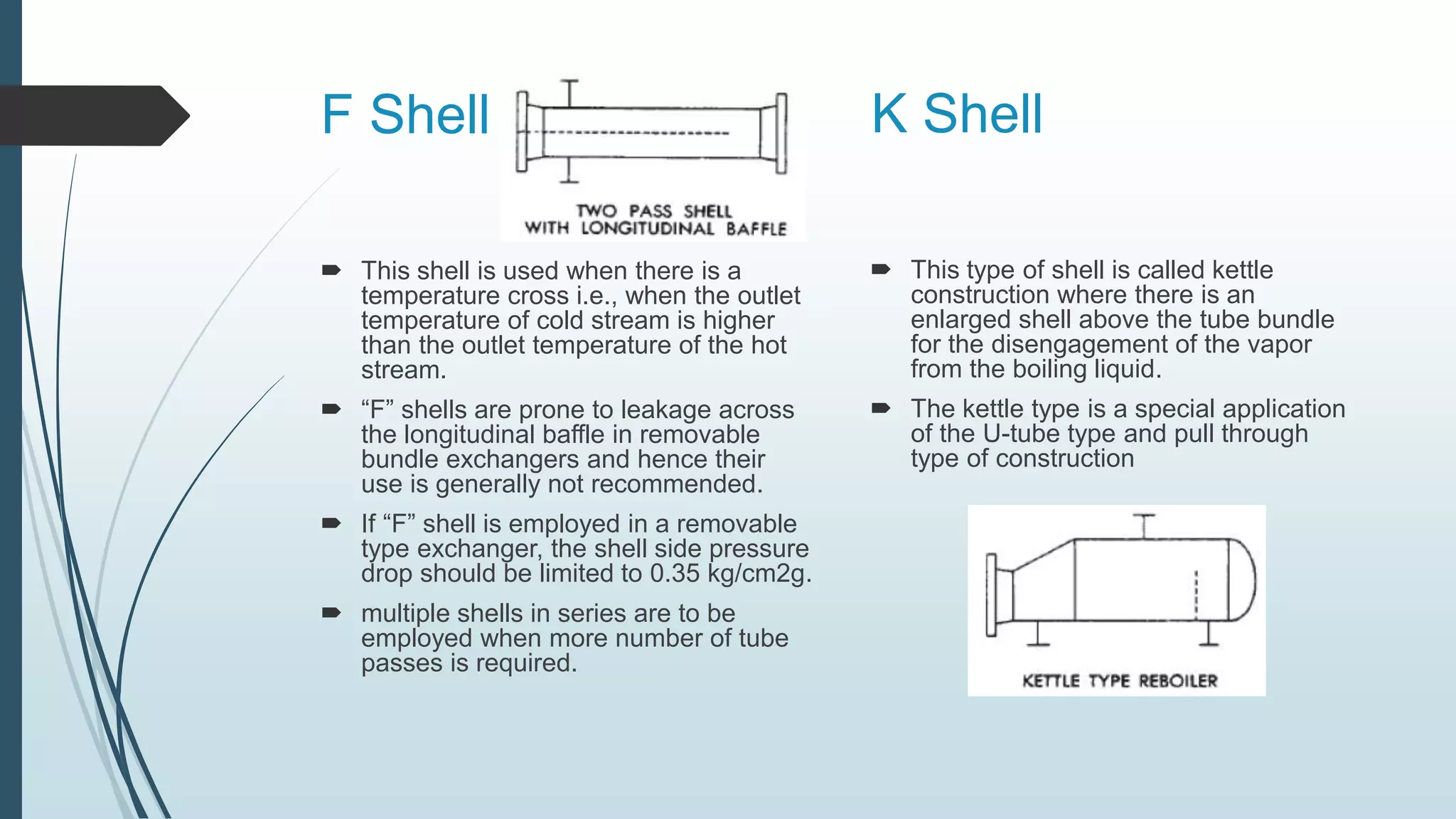
F Shell
 This shell is used when there is a
temperature cross i.e., when the outlet
temperature of cold stream is higher
than the outlet temperature of the hot
stream.
 “F” shells are prone to leakage across
the longitudinal baffle in removable
bundle exchangers and hence their
use is generally not recommended.
 If “F” shell is employed in a removable
type exchanger, the shell side pressure
drop should be limited to 0.35 kg/cm2g.
 multiple shells in series are to be
employed when more number of tube
passes is required.
 This type of shell is called kettle
construction where there is an
enlarged shell above the tube bundle
for the disengagement of the vapor
from the boiling liquid.
 The kettle type is a special application
of the U-tube type and pull through
type of construction
K Shell
Rear End Selection
QUIZ
TYPE T TYPE S TYPE W
Rear End Selection
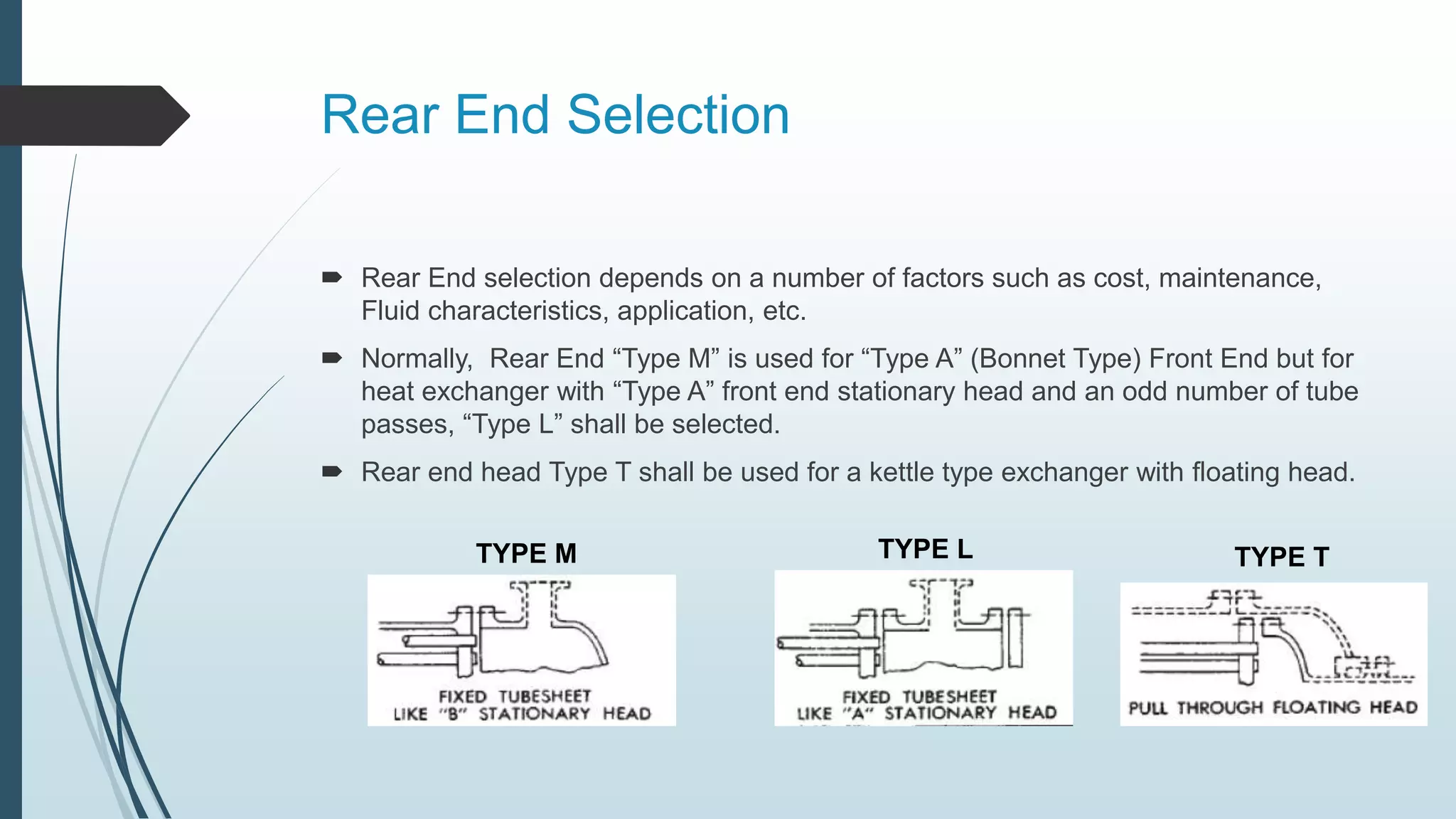
 Rear End selection depends on a number of factors such as cost, maintenance,
Fluid characteristics, application, etc.
 Normally, Rear End “Type M” is used for “Type A” (Bonnet Type) Front End but for
heat exchanger with “Type A” front end stationary head and an odd number of tube
passes, “Type L” shall be selected.
 Rear end head Type T shall be used for a kettle type exchanger with floating head.
TYPE M TYPE L TYPE T
Appendix – A (Baffle Design)
 Longitudinal baffles, cross baffles and support baffles are the 3 types of baffles.
 Commonly used baffle is single segmental but if it is necessary to reduce the shell
side pressure drop then double segmental baffle is used
 To reduce flow induced vibrations on the shell side, the no tube in windows design
with single segmental baffle can be used.
 Optimum baffle spacing is between 0.3 to 0.6 of Shell ID. The minimum baffle
spacing as per TEMA is one fifth of the shell inside diameter or 4” whichever is
lower
Appendix-B (Tube layout and Pitch)
 Triangular, rotated triangular, square and rotated square are different tube layouts
 Triangular or rotated triangular tube layouts is commonly used as it can
accommodate more number of tubes but it is limited to clean services
 Square and rotated square tube layouts is used for dirty shell side service and
when mechanical cleaning of shell side is necessary
 The minimum tube pitch should be 1.25 times tube OD.
 For square and rotated square layouts, a minimum cleaning lane of 6mm should
be provided.
THANK
YOU

Selection of Shell and tube heat exchanger (STHE)

  • 1.
    SELECTION OF SHELLAND TUBE HEAT EXCHANGER (STHE) GAUTHAM S PROCESS ENGINEER
  • 2.
    Principal Components ofSTHE  Shell  Shell cover  Tubes  Channel  Channel cover  Tubesheet  Baffles and  nozzles
  • 3.
    Other Components  Tie-inrods and spacers  Pass partition plates / Channel partitions  Impingement plates/rods  Longitudinal baffles  Sealing strips and  Supports
  • 4.
  • 5.
  • 6.
  • 7.
    SHELL SIDE ORTUBE SIDE?  The General method of Selection is based on the necessity to reduce cost and make maintenance easy PARAMETER SHELL SIDE TUBE SIDE Mechanical Cleaning Fouling fluids Pressure High Pressure Viscosity High Viscous Fluids (Doubt) Corrosion Very corrosive fluids Metallurgy Expensive metallurgy
  • 8.
    Straight Tube andFixed Tubesheets  Examples such as BEM, AEM, NEN, etc.,  This TEMA type is the simplest design and is constructed without packed or gasketed joints on the shell side.  The tubesheet is welded to the shell and the heads are bolted to the tubesheet  On the NEN heat exchanger, the shell and the head is welded to the tubesheet. Typically, a cover plate design is provided to facilitate tube cleaning.  NEN is the lowest cost TEMA design per square foot of heat transfer surface.
  • 9.
    Straight Tube andFixed Tubesheets ADVANTAGES LIMITATIONS APPLICATIONS Less costly than removable bundle designs Shell side can be cleaned only by chemical methods Oil Coolers, Liquid to Liquid, Vapor condensers, reboilers, gas coolers Provides maximum amount of surface No provision to allow for differential thermal expansion, must use an expansion joint Provides for single and multiple tube passes to assure proper velocity
  • 10.
    Removable Bundle, ExternallySealed Floating Tubesheet  Example such as, AEW, BEW  This design allows for the removal, inspection and cleaning of the shell circuit and shell interior.  Special floating tubesheet prevents intermixing of fluids.  Maximum surface for a given shell diameter for removable bundle design  Tubes can be cleaned in AEW models without removing piping.  Packing materials produce limits on design pressure and temperature
  • 11.
    Removable Bundle, ExternallySealed Floating Tubesheet ADVANTAGES LIMITATIONS APPLICATIONS Floating tubesheet allows for differential thermal expansion between the shell and the tube bundle. Fluids in both the shell and tube circuits must be non-volatile, non- toxic Intercoolers and after coolers, air inside the tubes Shell circuit can be steam or mechanically cleaned Tube side passes limited to single or two pass design Jacket water coolers or other high differential temperature duty The tube bundle can be repaired or replaced without disturbing shell pipe All tubes are attached to two tubesheets. Tubes cannot expand independently so that large thermal shock applications should be avoided
  • 12.
    Removable Bundle, OutsidePacked Head,  Example such as, BEP, AEP, etc.,  This design allows for the easy removal, inspection and cleaning of the shell circuit and shell interior without removing the floating head cover.  Special floating tubesheet prevents intermixing of fluids.  In most cases, straight tube removable design is more costly than U-tube designs.  On AEP design, tubes can be serviced without disturbing tubeside piping  Less costly than TEMA type BES or BET designs
  • 13.
    Removable Bundle, OutsidePacked Head ADVANTAGES LIMITATIONS Floating tubesheet allows for differential thermal expansion between the shell and the tube bundle. Shell fluids limited to non volatile, non toxic materials Shell circuit can be inspected and steam cleaned. If the tube bundle has a square tube pitch, tubes can be mechanically cleaned by passing a brush between rows of tubes. All tubes are attached to two tubesheets. Tubes cannot expand independently so that large thermal shock applications should be avoided The tube bundle can be repaired or replaced without disturbing shell piping Packing limits shell side design temperature and pressure
  • 14.
    Removable Bundle, InternalSplit Ring Floating Head  Example such as, AES, BES,  Ideal for applications requiring frequent tube bundle removal for inspection and cleaning  Uses straight-tube design suitable for large differential temperatures between the shell and tube fluids  More forgiving to thermal shock than AEW or BEW designs.  Suitable for cooling volatile or toxic fluids.  Higher surface per given shell and tube diameter than “pull-through” designs such as AET, BET, etc.
  • 15.
    Removable Bundle, InternalSplit Ring Floating Head ADVANTAGES LIMITATIONS Floating head design allows for differential thermal expansion between the shell and the tube bundle. Shell cover, split ring and floating head cover must be removed to remove the tube bundle, results in higher maintenance cost than pull-through Provides multi-pass tube circuit arrangement More costly per square foot of surface than fixed tubesheet or U-tube designs Shell circuit can be inspected and steam cleaned. If it has a square tube layout, tubes can be mechanically cleaned
  • 16.
    Removable Bundle, Pull-ThroughFloating Head,  Example such as, AET, BET  Ideal for applications requiring frequent tube bundle removal for inspection and cleaning as the floating head is bolted directly to the floating tubesheet. This prevents having to remove the floating head in order to pull the tube bundle
  • 17.
    Removable Bundle, Pull-ThroughFloating Head, ADVANTAGES LIMITATIONS Floating head design allows for differential thermal expansion between the shell and the tube bundle. For a given set of conditions, this TEMA style is the most expensive design Shell circuit can be inspected and steam or mechanically cleaned Less surface per given shell and tube diameter than other removable designs Provides large bundle entrance area for proper fluid distribution Provides multi-pass tube circuit arrangement.
  • 18.
    Removable Bundle, U-Tube Example such as, BEU, AEU,  Especially suitable for severe performance requirements with maximum thermal expansion capability. Because each tube can expand and contract independently, this design is suitable for larger thermal shock applications.  While the AEM and AEW are the least expensive, U-tube bundles are an economical TEMA design.
  • 19.
    Removable Bundle, U-Tube ADVANTAGESLIMITATIONS U-tube design allows for differential thermal expansion between the shell and the tube bundle as well as for individual tubes Draining of tube circuit is difficult when mounted with the vertical position with the head side up. Shell circuit can be inspected and steam or mechanically cleaned Because of u-bend, tubes can be cleaned only by chemical means Less costly than floating head or packed floating head designs Because of U-tube nesting, individual tubes are difficult to replace Provides multi-pass tube circuit arrangement. No single tube pass or true countercurrent flow is possible Bundle can be removed from one end for cleaning or replacement Tube wall thickness at the U-bend is thinner than at straight portion of tubes
  • 20.
    Discussion  What typeof exchanger do we select for a cost-wise economical design? 1. No Fouling/ Fouling condition 2. Non-Corrosive/ Corrosive condition 3. High differential thermal gradients 4. Combination of any 2 5. All the above expect 4
  • 21.
  • 22.
  • 23.
    Fixed Tubesheet  Shellside fluid is non-fouling or the fouling can be chemically cleaned.  The Mean temperature differential between shell and tube wall must be less than 50 Deg C. Otherwise, expansion bellow is required.  Stress caused by differential expansion between the shell and the tube should not exceed the design stress limits considering winter and start up conditions
  • 24.
    U-Tube Bundle  TheU-tube is limited to applications where the tube side fluid is non-fouling; any fouling fluid must be routed through shell side only. In this respect, tube side mechanical cleaning is considered possible, if the centre to centre distance between the parallel legs of the U-tube is at least 150mm. However, this later option may be used only if required by specific process requirements.  Horizontal U-Tube should be used when condensing fluid in the tube side.
  • 25.
    Floating head  Splitring (S type), Pull through (T type), Externally sealed tubesheet (W Type) and Outside packed (P Type)  Type S and Type T are the common types of Floating head  Floating head type or U-tube type heat exchanger should be selected if flexibility is required to avoid overstressing. The maximum shell diameter is based upon tube- bundle removal requirements and is limited by crane capacities. Thus, floating head heat exchangers are often limited to a Shell ID of 1400 to 1500 mm.  In S-type as there is an internal joint at the floating head, a careful design is necessary to avoid leakage of one fluid to the other.
  • 26.
  • 27.
  • 28.
    E Shell  Commonlyused shell type  Its limitations are shell side pressure drop or problem due to flow-induced vibrations  Shell types such as Type J, Type X ,Type H can be used as alternatives.  Special case of E type shell where either entry or exit of the shell side fluid can be split into two parts to reduce pressure drop or flow induced vibrations in the shell side. J Shell
  • 29.
    G Shell  Gshells have a longitudinal baffle axially  “G” shells are used for a maximum tube length of twice the maximum unsupported span as per TEMA as there is one full support plate in the tube bundle.  It is used for horizontal thermosyphon reboilers in order to reduce the pressure drop as well as to avoid flow mal-distribution  H shells have a longitudinal baffle axially  “H” shells are used for a maximum tube length of four times of the maximum unsupported span due to presence of 2 full support plates in the tube bundle.  It is used for horizontal thermosyphon reboilers in order to reduce the pressure drop as well as to avoid flow mal-distribution H Shell

  • 30.
    F Shell  Thisshell is used when there is a temperature cross i.e., when the outlet temperature of cold stream is higher than the outlet temperature of the hot stream.  “F” shells are prone to leakage across the longitudinal baffle in removable bundle exchangers and hence their use is generally not recommended.  If “F” shell is employed in a removable type exchanger, the shell side pressure drop should be limited to 0.35 kg/cm2g.  multiple shells in series are to be employed when more number of tube passes is required.  This type of shell is called kettle construction where there is an enlarged shell above the tube bundle for the disengagement of the vapor from the boiling liquid.  The kettle type is a special application of the U-tube type and pull through type of construction K Shell
  • 31.
  • 32.
  • 33.
    Rear End Selection Rear End selection depends on a number of factors such as cost, maintenance, Fluid characteristics, application, etc.  Normally, Rear End “Type M” is used for “Type A” (Bonnet Type) Front End but for heat exchanger with “Type A” front end stationary head and an odd number of tube passes, “Type L” shall be selected.  Rear end head Type T shall be used for a kettle type exchanger with floating head. TYPE M TYPE L TYPE T
  • 34.
    Appendix – A(Baffle Design)  Longitudinal baffles, cross baffles and support baffles are the 3 types of baffles.  Commonly used baffle is single segmental but if it is necessary to reduce the shell side pressure drop then double segmental baffle is used  To reduce flow induced vibrations on the shell side, the no tube in windows design with single segmental baffle can be used.  Optimum baffle spacing is between 0.3 to 0.6 of Shell ID. The minimum baffle spacing as per TEMA is one fifth of the shell inside diameter or 4” whichever is lower
  • 35.
    Appendix-B (Tube layoutand Pitch)  Triangular, rotated triangular, square and rotated square are different tube layouts  Triangular or rotated triangular tube layouts is commonly used as it can accommodate more number of tubes but it is limited to clean services  Square and rotated square tube layouts is used for dirty shell side service and when mechanical cleaning of shell side is necessary  The minimum tube pitch should be 1.25 times tube OD.  For square and rotated square layouts, a minimum cleaning lane of 6mm should be provided.
  • 36.