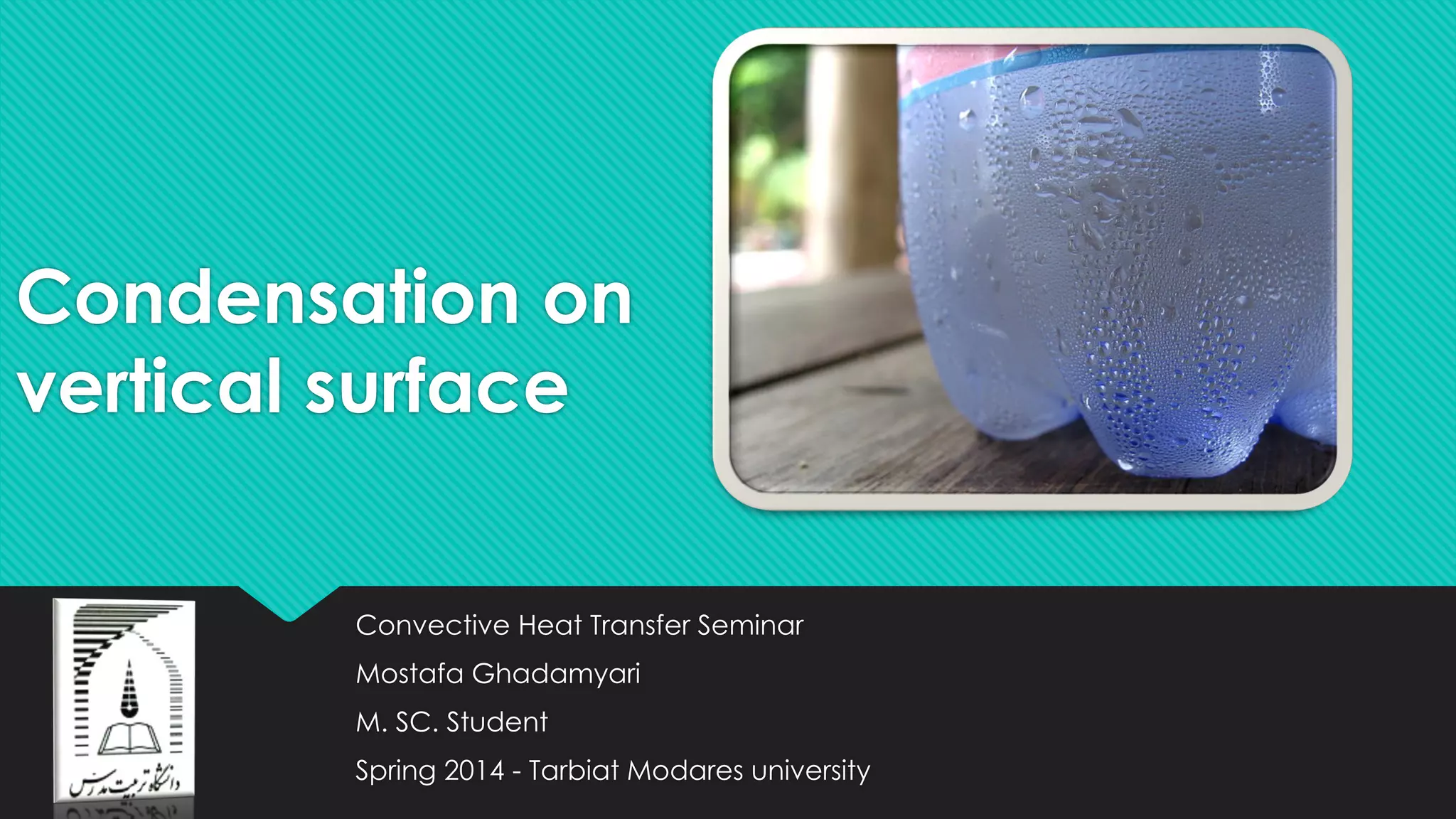
Condensation on
vertical surface
Convective Heat Transfer Seminar
Mostafa Ghadamyari
M. SC. Student
Spring 2014 - Tarbiat Modares university
Outline
 Here, We will discuss about:
 Condensation definition
 Different types of condensation
 Film Surface Condensation
 Laminar film equation derivation
 Laminar film heat transfer coefficient diagram
 Turbulent Film heat transfer coefficient diagram
2/12
Condensation definition
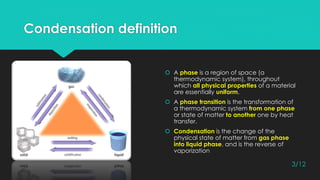
 A phase is a region of space (a
thermodynamic system), throughout
which all physical properties of a material
are essentially uniform.
 A phase transition is the transformation of
a thermodynamic system from one phase
or state of matter to another one by heat
transfer.
 Condensation is the change of the
physical state of matter from gas phase
into liquid phase, and is the reverse of
vaporization
3/12
Modes of condensation
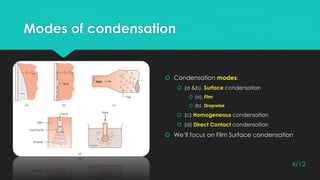
 Condensation modes:
 (a &b). Surface condensation
 (a). Film
 (b). Dropwise
 (c) Homogeneous condensation
 (d) Direct Contact condensation
 We’ll focus on Film Surface condensation
4/12
Dropwise and Film Surface condensation
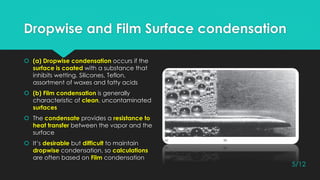
 (a) Dropwise condensation occurs if the
surface is coated with a substance that
inhibits wetting, Silicones, Teflon,
assortment of waxes and fatty acids
 (b) Film condensation is generally
characteristic of clean, uncontaminated
surfaces
 The condensate provides a resistance to
heat transfer between the vapor and the
surface
 It’s desirable but difficult to maintain
dropwise condensation, so calculations
are often based on Film condensation
5/12
Film condensation
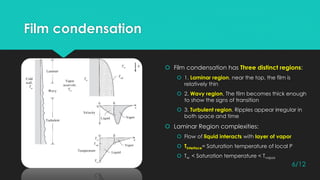
 Film condensation has Three distinct regions:
 1. Laminar region, near the top, the film is
relatively thin
 2. Wavy region, The film becomes thick enough
to show the signs of transition
 3. Turbulent region, Ripples appear irregular in
both space and time
 Laminar Region complexities:
 Flow of liquid interacts with layer of vapor
 Tinterface= Saturation temperature of local P
 Tw < Saturation temperature < Tvapor
6/12
Laminar Film – Momentum Equation
 Momentum equation for simplified laminar film:
 Because of slenderness of the film:
 Substituting:
 Assuming negligible Inertia [Solved by Nusselt]:
  
   
        
2
2
(1) l l l
v v dP v
u v g
x y dy x
   

   
       
2
2
(3) ( )l l l v
Sinking Effect
FrictionInertia
v v v
u v g
x y x
(2) / vdP dy g
 



 
    
2 21
(4) ( , ) ( ) ( )
2
l g
l
g x x
v x y 7/12
Laminar Film – First thermodynamics law
 The first law of thermodynamics:
 Substituting conduction & (2):
 Substituting (1)
 Integrating from y=0
 Local mass flow rate:
 Vertical enthalpy inflow:
 Assume linear temperature distribution:
 
   

   
3
0
(1) (y) ( )
3
l
l l v
l
g
vdx

   ,0
(2) [ ( )]l f P l satH v h c T T dx
      ''
(3) 0 ( ) hg wH H dH d q dy

  
'
,
3
[ ( )]
8
(4) ( )
fg
fg P l sat ts
h
a w
l
w h c T T
k
T T dy d
 
 



3
'
( )
(5)
( )
l l sat w
fg l v
kv T T
dy d
h g

 
 
  
  
1/4
'
4 (T T )
(6) ( )
( )
l l sat w
fg l v
kv
y y
h g


 

1sat
sat w
T T x
T T
8/12
Laminar flow – Results
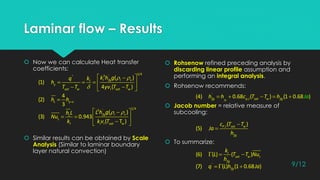
 Now we can calculate Heat transfer
coefficients:
 Similar results can be obtained by Scale
Analysis (Similar to laminar boundary
layer natural convection)
 Rohsenow refined preceding analysis by
discarding linear profile assumption and
performing an integral analysis.
 Rohsenow recommends:
 Jacob number = relative measure of
subcooling:
 To summarize:
 

 
    
  
1/43 '''
( )
(1)
4 ( )
l fg l vl
y
sat w l sat w
k h gq k
h
T T yv T T

4
(2)
3
L y Lh h
  
   
 
1/43 '
( )
(3) 0.943
( T )
fg l vL
L
l l l sat w
L h gh L
Nu
k kv T
    '
,(4) 0.68 ( ) (1 0.68 )fgfg p l sat w fgh h c T h JaT

 , ( )
(5) P l sat w
fg
c T T
Ja
h
  '
(6) ( ) ( )l
sat w L
fg
k
L T T Nu
h
  '
(7) ( ) (1 0.68 )fgq L h Ja 9/12
Laminar Film - Diagram
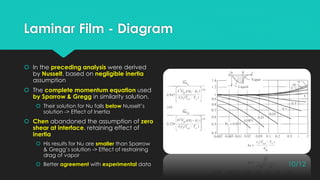
 In the preceding analysis were derived
by Nusselt, based on negligible inertia
assumption
 The complete momentum equation used
by Sparrow & Gregg in similarity solution.
 Their solution for Nu falls below Nusselt’s
solution -> Effect of Inertia
 Chen abandoned the assumption of zero
shear at interface, retaining effect of
inertia
 His results for Nu are smaller than Sparrow
& Gregg’s solution -> Effect of restraining
drag of vapor
 Better agreement with experimental data 10/12
Turbulent Film - Diagram
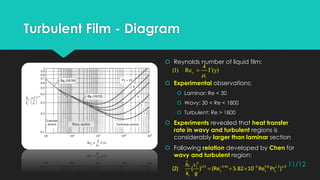
 Reynolds number of liquid film:
 Experimental observations:
 Laminar: Re < 30
 Wavy: 30 < Re < 1800
 Turbulent: Re > 1800
 Experiments revealed that heat transfer
rate in wavy and turbulent regions is
considerably larger than laminar section
 Following relation developed by Chen for
wavy and turbulent region:
4
(1) Re (y)y
l
 
  
  
2
1/3 0.44 6 0.8 1.3 1/2
(2) ( ) (Re 5.82 10 Re Pr )
L l
L L L
l
h
k g
11/12
Summary
 Condensation is phase change from Gas to Liquid
 There’re different types of condensation:
 Surface (Film, Droplet), Homogeneous, Direct contact
 Film surface condensation has three regions:
 Laminar, Wavy, Turbulent
 Laminar film condensation first solved by Nusselt by neglecting Inertia effect
 Complete momentum equation used by Sparrow and Gregg in similarity solution
 Chen Solution for laminar film contains vapor drag effect and inertia effect of liquid
 Chen reviewed and developed a relation for Wavy and Turbulent regions
12/12
Thank you!
13

Condensation on vertical surface

  • 1.
    Condensation on vertical surface ConvectiveHeat Transfer Seminar Mostafa Ghadamyari M. SC. Student Spring 2014 - Tarbiat Modares university
  • 2.
    Outline  Here, Wewill discuss about:  Condensation definition  Different types of condensation  Film Surface Condensation  Laminar film equation derivation  Laminar film heat transfer coefficient diagram  Turbulent Film heat transfer coefficient diagram 2/12
  • 3.
    Condensation definition  Aphase is a region of space (a thermodynamic system), throughout which all physical properties of a material are essentially uniform.  A phase transition is the transformation of a thermodynamic system from one phase or state of matter to another one by heat transfer.  Condensation is the change of the physical state of matter from gas phase into liquid phase, and is the reverse of vaporization 3/12
  • 4.
    Modes of condensation Condensation modes:  (a &b). Surface condensation  (a). Film  (b). Dropwise  (c) Homogeneous condensation  (d) Direct Contact condensation  We’ll focus on Film Surface condensation 4/12
  • 5.
    Dropwise and FilmSurface condensation  (a) Dropwise condensation occurs if the surface is coated with a substance that inhibits wetting, Silicones, Teflon, assortment of waxes and fatty acids  (b) Film condensation is generally characteristic of clean, uncontaminated surfaces  The condensate provides a resistance to heat transfer between the vapor and the surface  It’s desirable but difficult to maintain dropwise condensation, so calculations are often based on Film condensation 5/12
  • 6.
    Film condensation  Filmcondensation has Three distinct regions:  1. Laminar region, near the top, the film is relatively thin  2. Wavy region, The film becomes thick enough to show the signs of transition  3. Turbulent region, Ripples appear irregular in both space and time  Laminar Region complexities:  Flow of liquid interacts with layer of vapor  Tinterface= Saturation temperature of local P  Tw < Saturation temperature < Tvapor 6/12
  • 7.
    Laminar Film –Momentum Equation  Momentum equation for simplified laminar film:  Because of slenderness of the film:  Substituting:  Assuming negligible Inertia [Solved by Nusselt]:                 2 2 (1) l l l v v dP v u v g x y dy x                  2 2 (3) ( )l l l v Sinking Effect FrictionInertia v v v u v g x y x (2) / vdP dy g             2 21 (4) ( , ) ( ) ( ) 2 l g l g x x v x y 7/12
  • 8.
    Laminar Film –First thermodynamics law  The first law of thermodynamics:  Substituting conduction & (2):  Substituting (1)  Integrating from y=0  Local mass flow rate:  Vertical enthalpy inflow:  Assume linear temperature distribution:            3 0 (1) (y) ( ) 3 l l l v l g vdx     ,0 (2) [ ( )]l f P l satH v h c T T dx       '' (3) 0 ( ) hg wH H dH d q dy     ' , 3 [ ( )] 8 (4) ( ) fg fg P l sat ts h a w l w h c T T k T T dy d        3 ' ( ) (5) ( ) l l sat w fg l v kv T T dy d h g            1/4 ' 4 (T T ) (6) ( ) ( ) l l sat w fg l v kv y y h g      1sat sat w T T x T T 8/12
  • 9.
    Laminar flow –Results  Now we can calculate Heat transfer coefficients:  Similar results can be obtained by Scale Analysis (Similar to laminar boundary layer natural convection)  Rohsenow refined preceding analysis by discarding linear profile assumption and performing an integral analysis.  Rohsenow recommends:  Jacob number = relative measure of subcooling:  To summarize:              1/43 ''' ( ) (1) 4 ( ) l fg l vl y sat w l sat w k h gq k h T T yv T T  4 (2) 3 L y Lh h          1/43 ' ( ) (3) 0.943 ( T ) fg l vL L l l l sat w L h gh L Nu k kv T     ' ,(4) 0.68 ( ) (1 0.68 )fgfg p l sat w fgh h c T h JaT   , ( ) (5) P l sat w fg c T T Ja h   ' (6) ( ) ( )l sat w L fg k L T T Nu h   ' (7) ( ) (1 0.68 )fgq L h Ja 9/12
  • 10.
    Laminar Film -Diagram  In the preceding analysis were derived by Nusselt, based on negligible inertia assumption  The complete momentum equation used by Sparrow & Gregg in similarity solution.  Their solution for Nu falls below Nusselt’s solution -> Effect of Inertia  Chen abandoned the assumption of zero shear at interface, retaining effect of inertia  His results for Nu are smaller than Sparrow & Gregg’s solution -> Effect of restraining drag of vapor  Better agreement with experimental data 10/12
  • 11.
    Turbulent Film -Diagram  Reynolds number of liquid film:  Experimental observations:  Laminar: Re < 30  Wavy: 30 < Re < 1800  Turbulent: Re > 1800  Experiments revealed that heat transfer rate in wavy and turbulent regions is considerably larger than laminar section  Following relation developed by Chen for wavy and turbulent region: 4 (1) Re (y)y l         2 1/3 0.44 6 0.8 1.3 1/2 (2) ( ) (Re 5.82 10 Re Pr ) L l L L L l h k g 11/12
  • 12.
    Summary  Condensation isphase change from Gas to Liquid  There’re different types of condensation:  Surface (Film, Droplet), Homogeneous, Direct contact  Film surface condensation has three regions:  Laminar, Wavy, Turbulent  Laminar film condensation first solved by Nusselt by neglecting Inertia effect  Complete momentum equation used by Sparrow and Gregg in similarity solution  Chen Solution for laminar film contains vapor drag effect and inertia effect of liquid  Chen reviewed and developed a relation for Wavy and Turbulent regions 12/12
  • 13.