Heat Transfer
Conduction,   Convection and
Radiation
Heat Transfer
• Heat is a form of energy.
• Heat travels from higher
  temperature(hotter) region to lower
  temperature(cooler) region.
• Two bodies are in thermal equilibrium
  when there is no net transfer of thermal
  energy.

http://www.physicslessons.com/exp12b.htm
Thermal Equilibrium
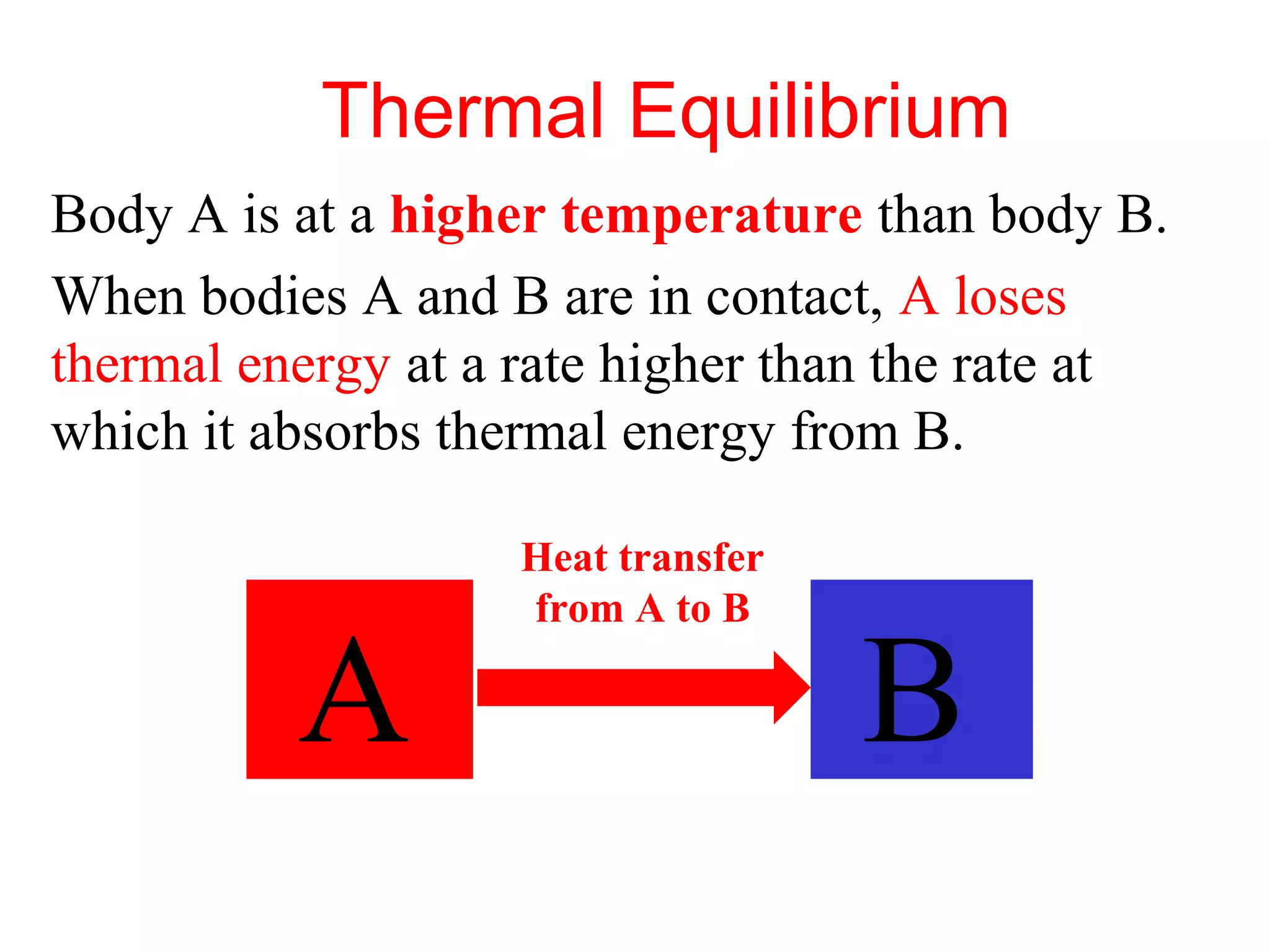
Body A is at a higher temperature than body B.
When bodies A and B are in contact, A loses
thermal energy at a rate higher than the rate at
which it absorbs thermal energy from B.

                    Heat transfer
                    from A to B

          A                         B
Thermal Equilibrium
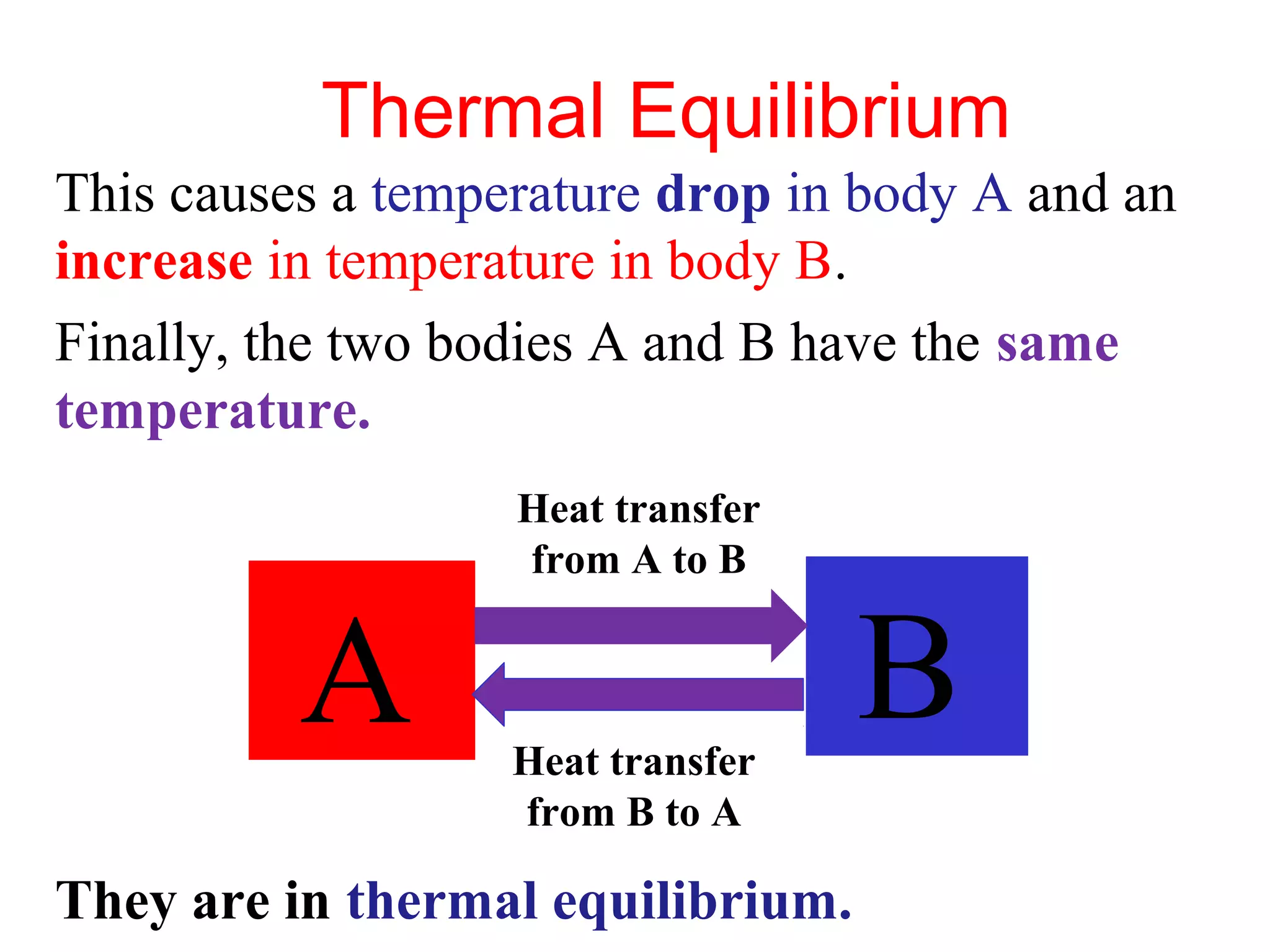
This causes a temperature drop in body A and an
increase in temperature in body B.
Finally, the two bodies A and B have the same
temperature.
                   Heat transfer
                   from A to B


          A        Heat transfer
                                   B
                   from B to A

They are in thermal equilibrium.
Thermal Equilibrium
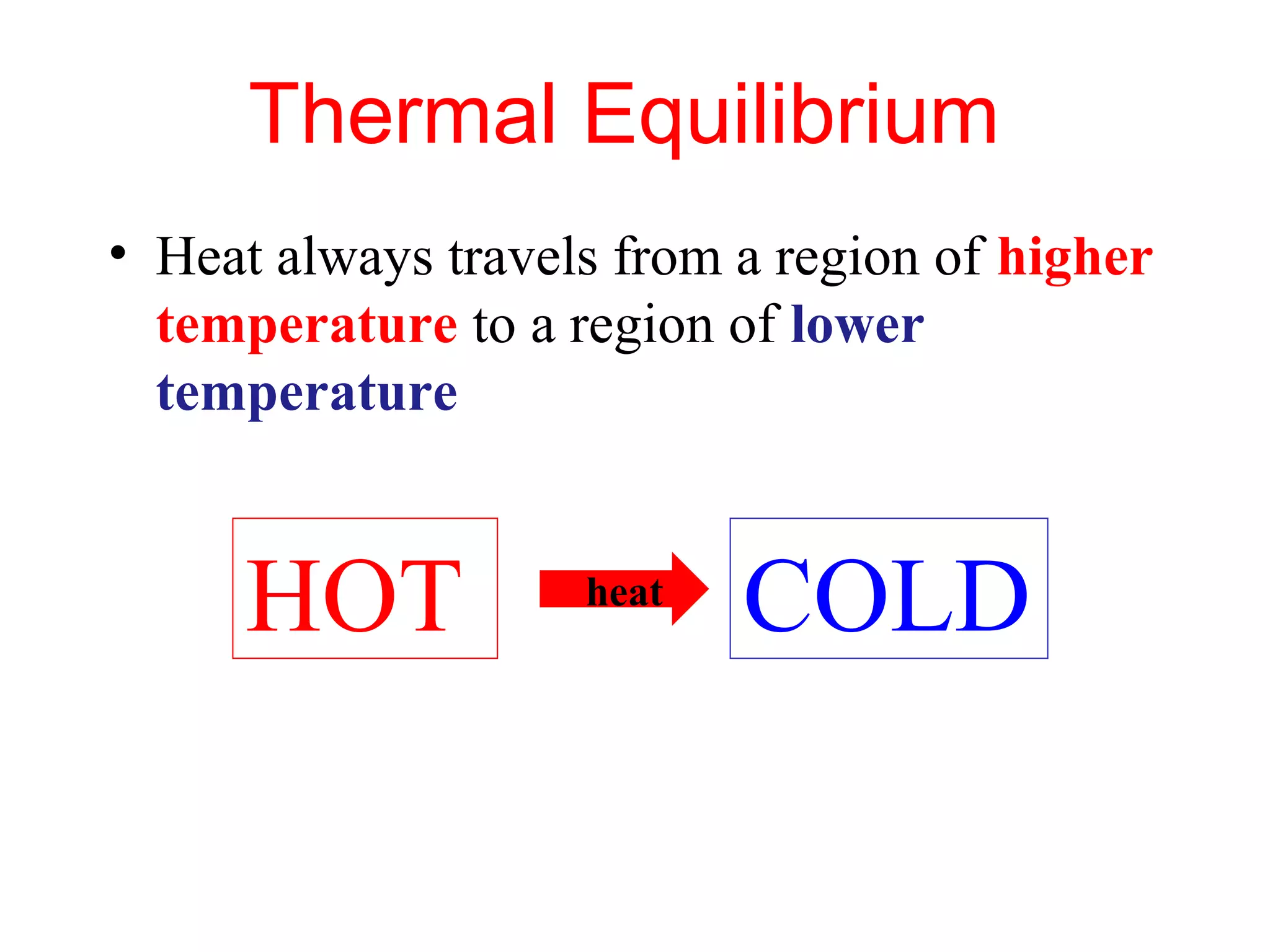
• Heat always travels from a region of higher
  temperature to a region of lower
  temperature


     HOT            heat
                           COLD
Thermal Inequilibrium
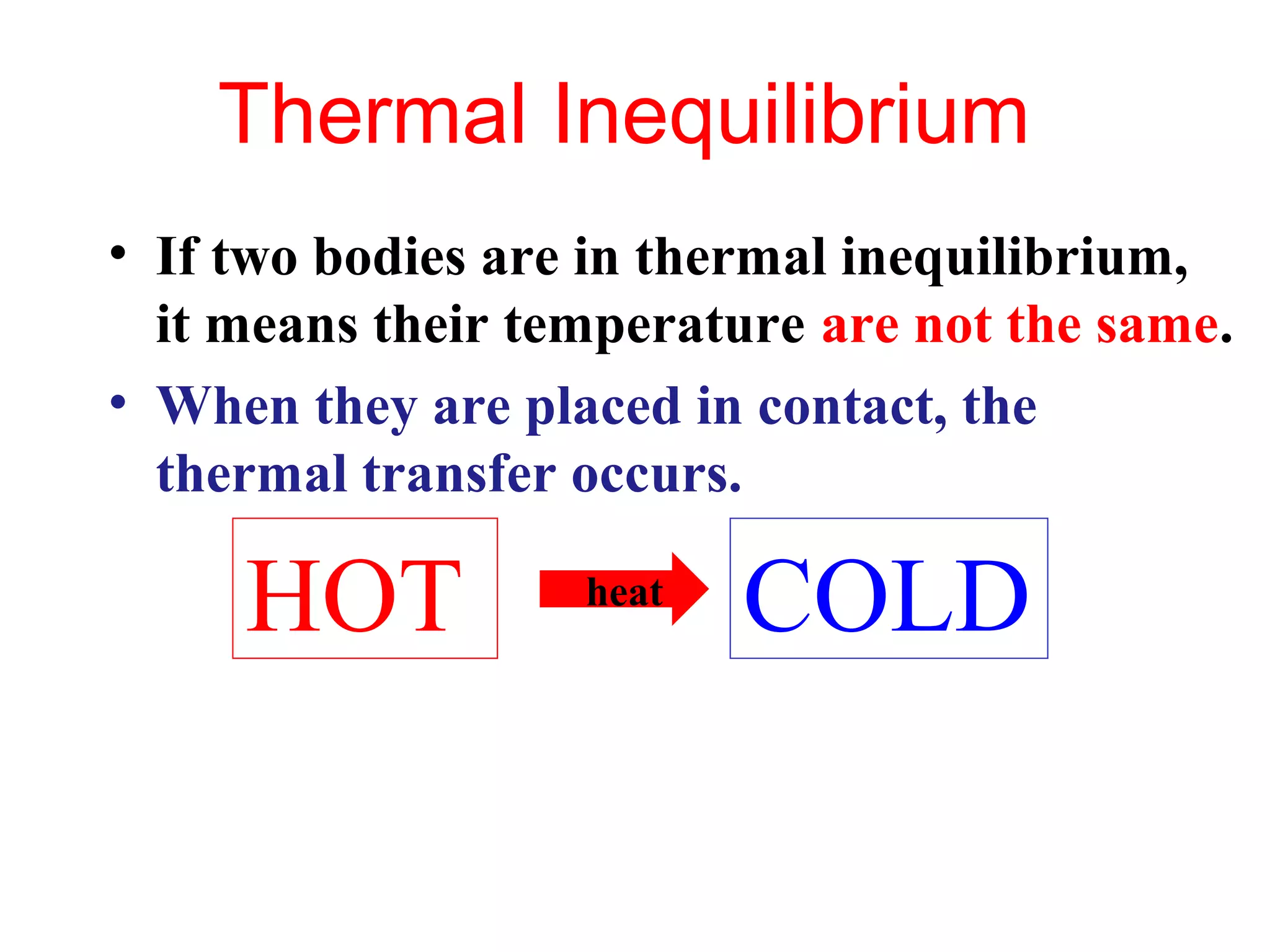
• If two bodies are in thermal inequilibrium,
  it means their temperature are not the same.
• When they are placed in contact, the
  thermal transfer occurs.

     HOT           heat
                          COLD
Heat Transfer
    Methods
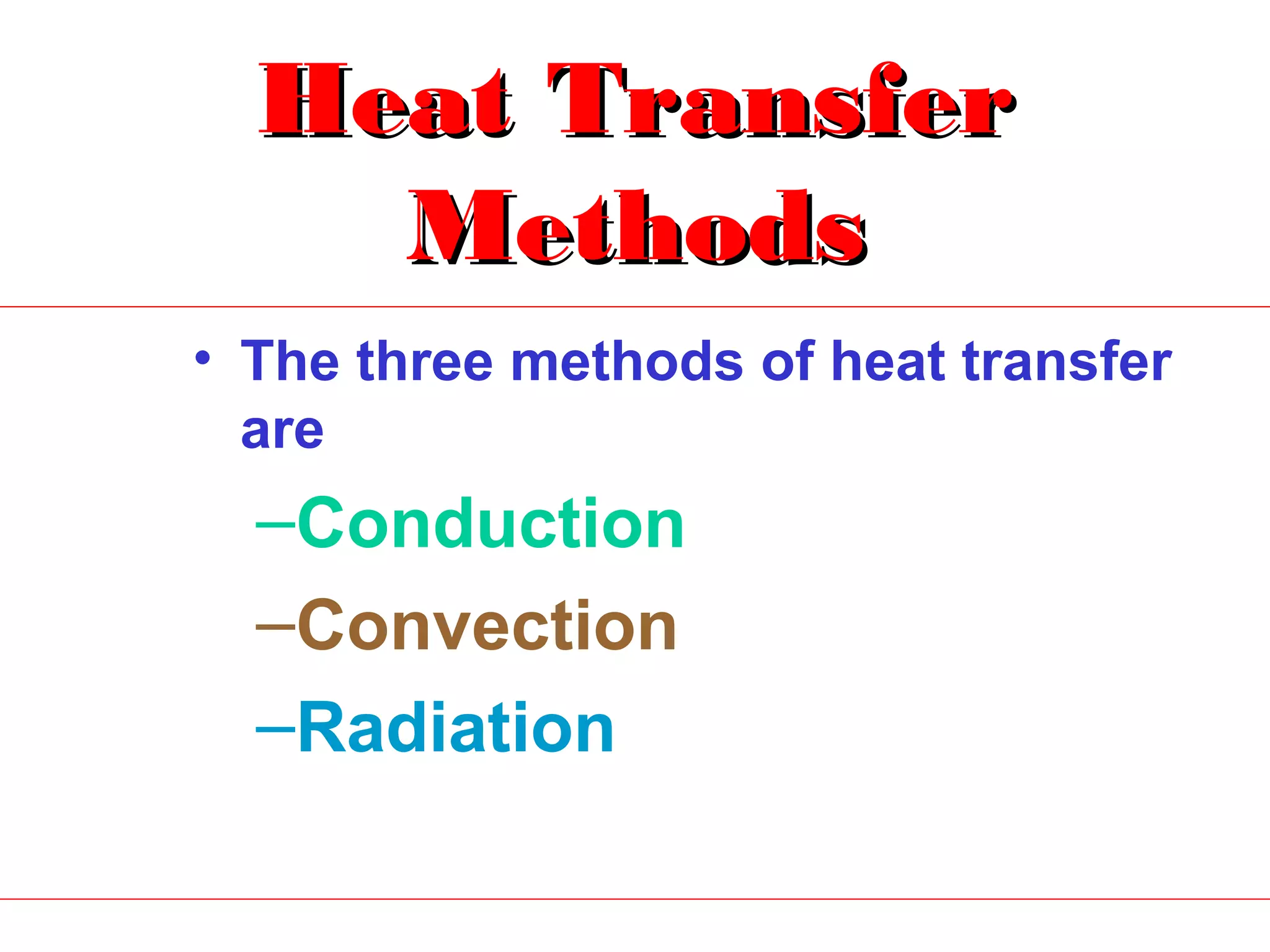
• The three methods of heat transfer
  are
  –Conduction
  –Convection
  –Radiation
Heat Transfer
          Methods
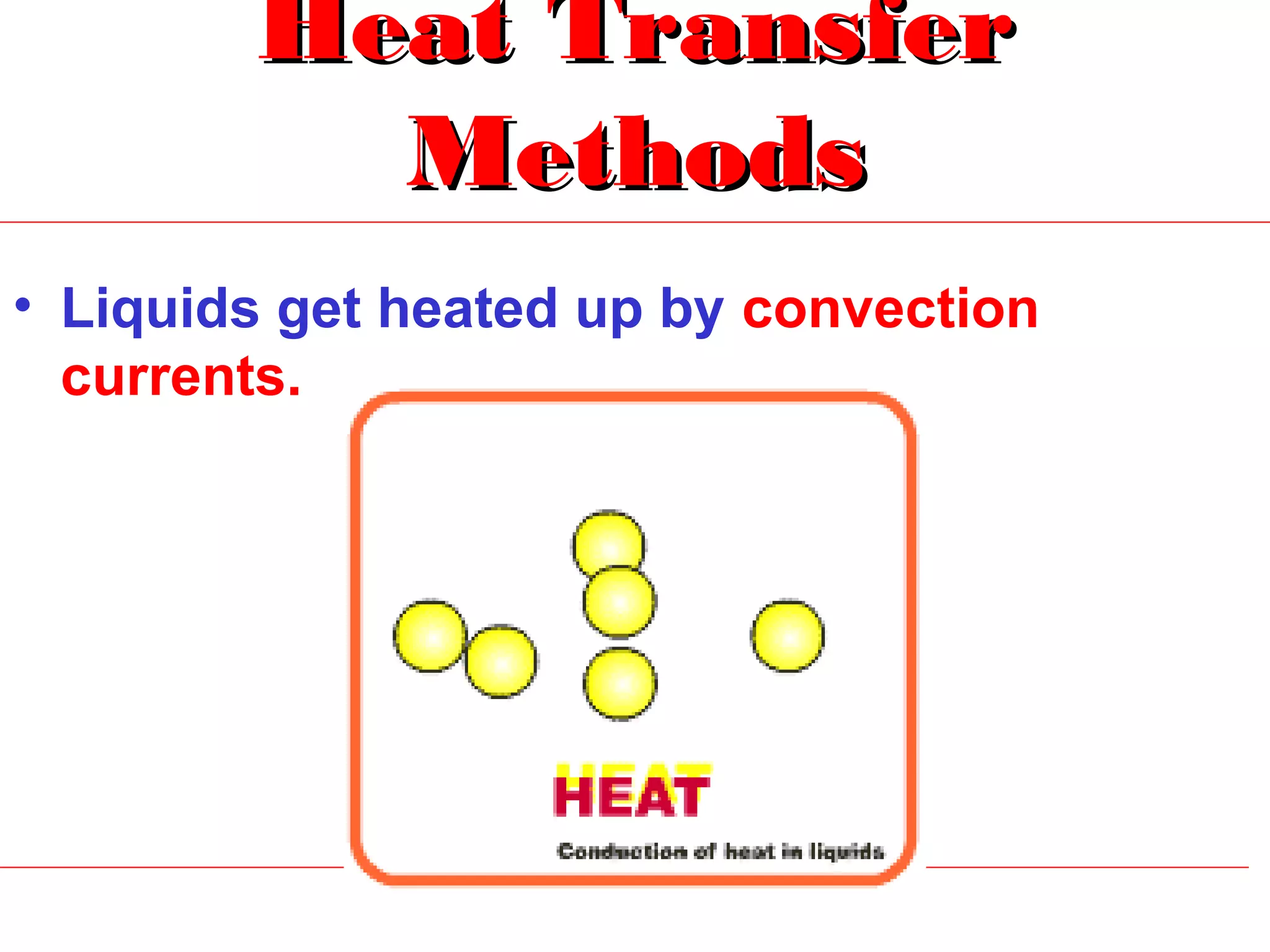
• Liquids get heated up by convection
  currents.
Heat Transfer
           Methods
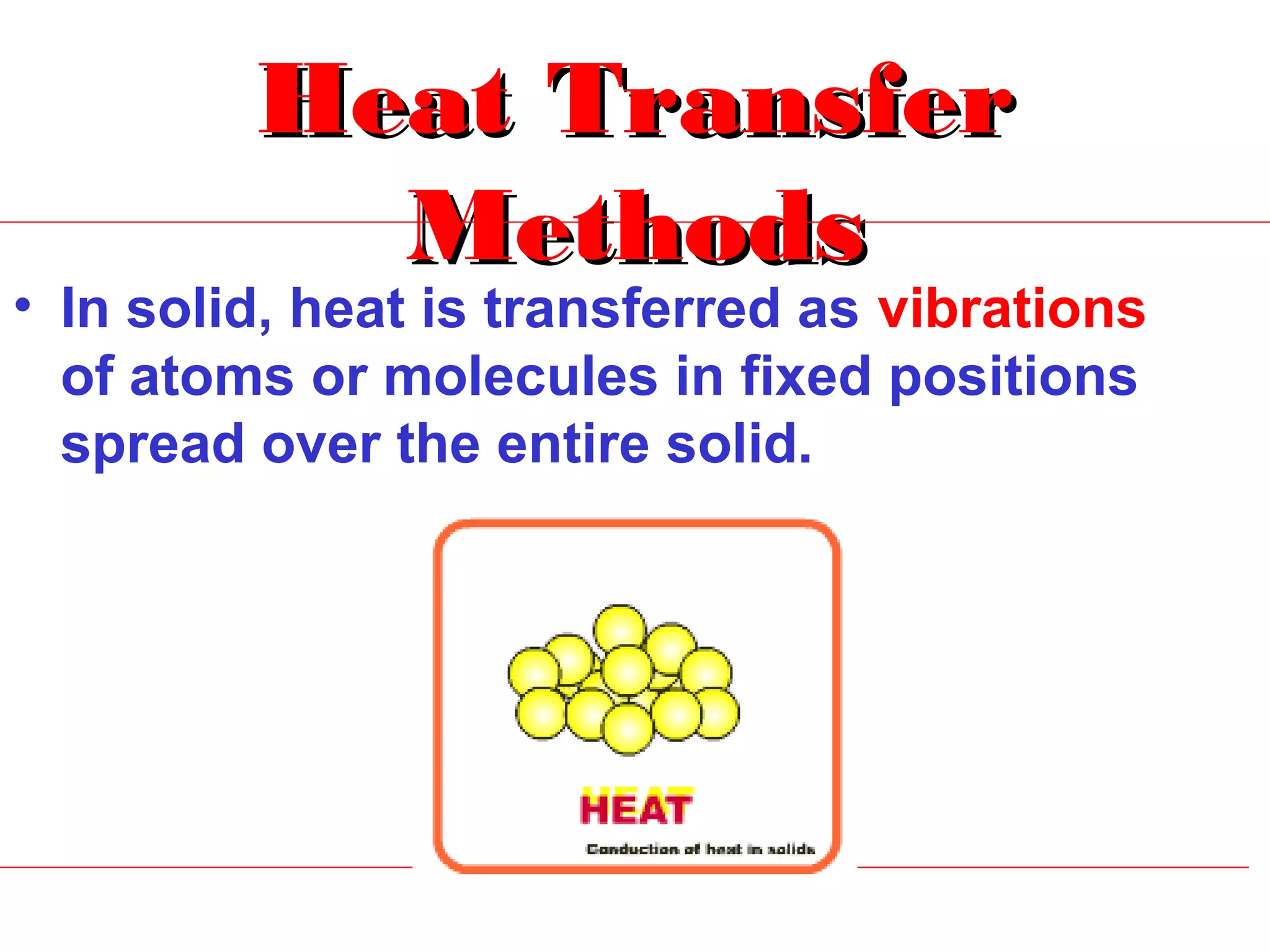
• In solid, heat is transferred as vibrations
  of atoms or molecules in fixed positions
  spread over the entire solid.
Heat Transfer
          Methods
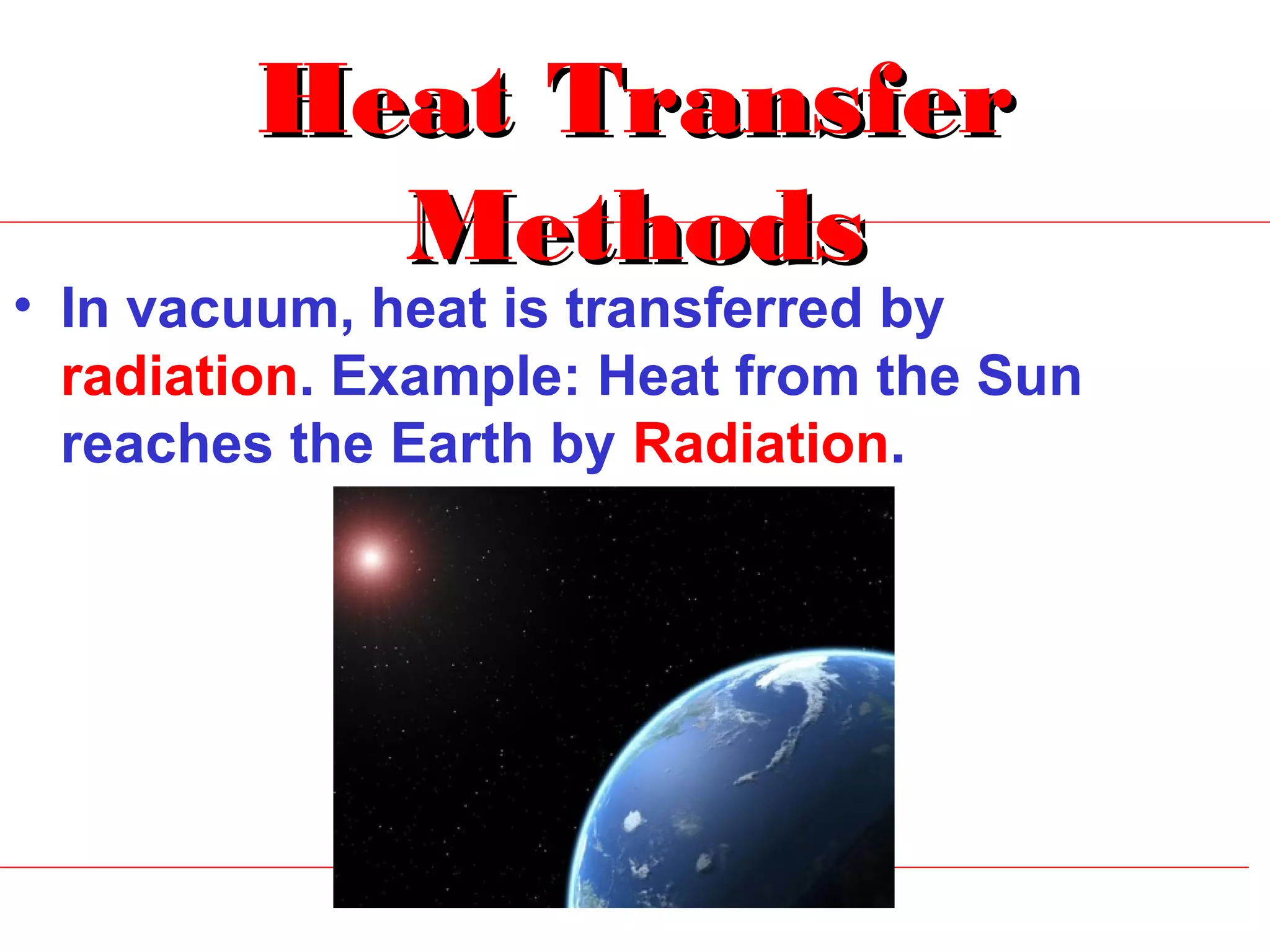
• In vacuum, heat is transferred by
  radiation. Example: Heat from the Sun
  reaches the Earth by Radiation.
Conduction
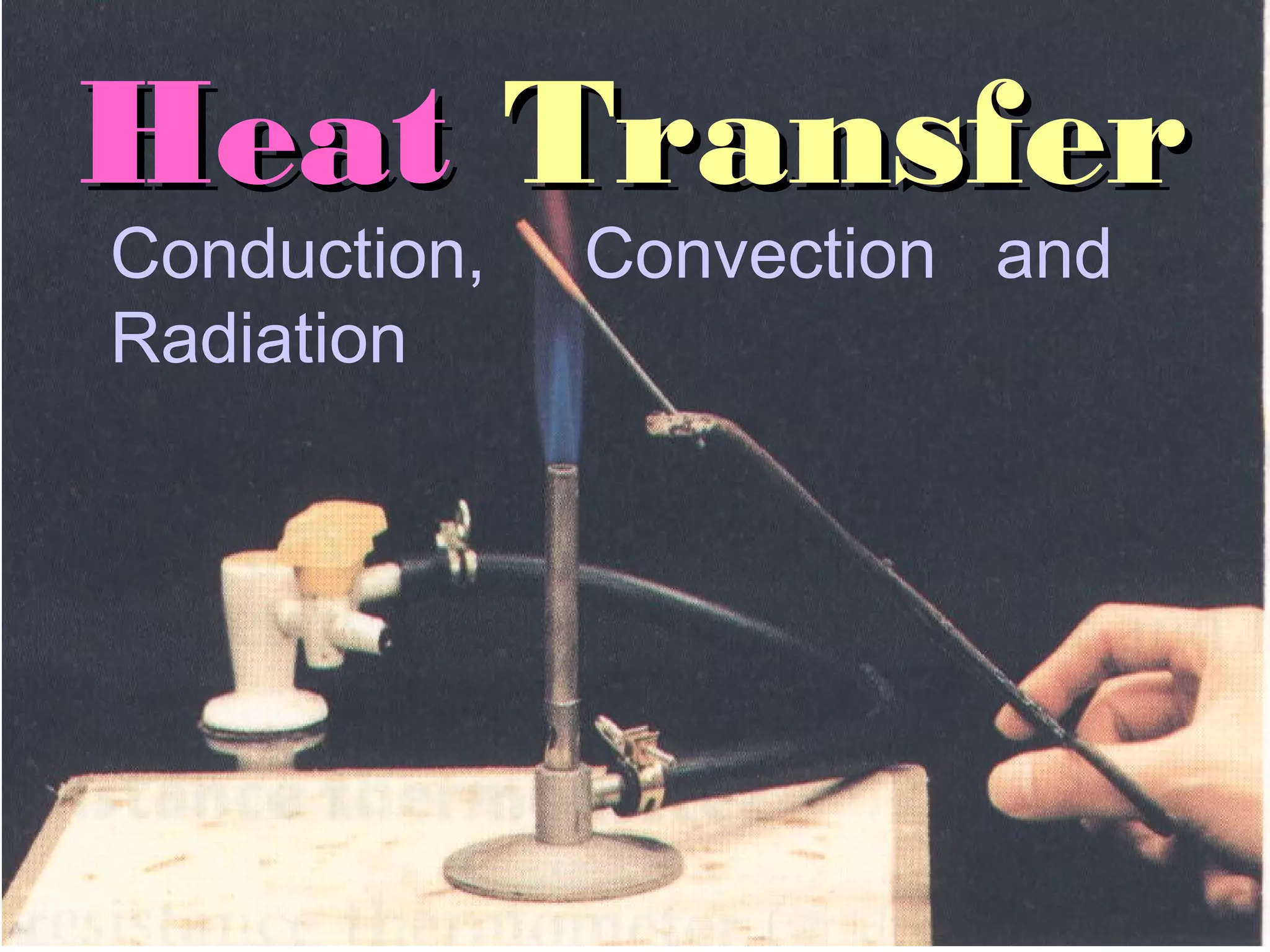
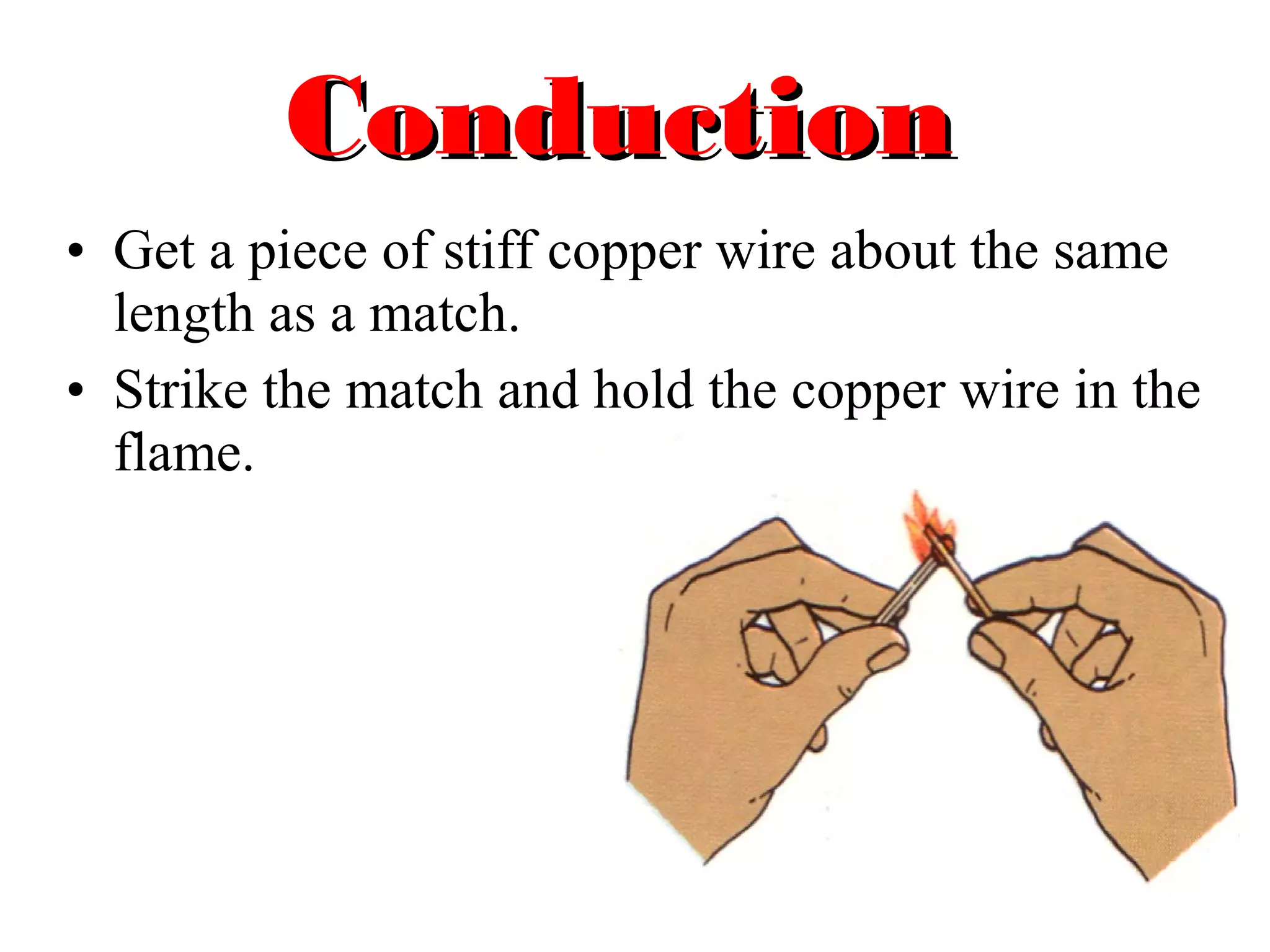
• Get a piece of stiff copper wire about the same
  length as a match.
• Strike the match and hold the copper wire in the
  flame.
Conduction
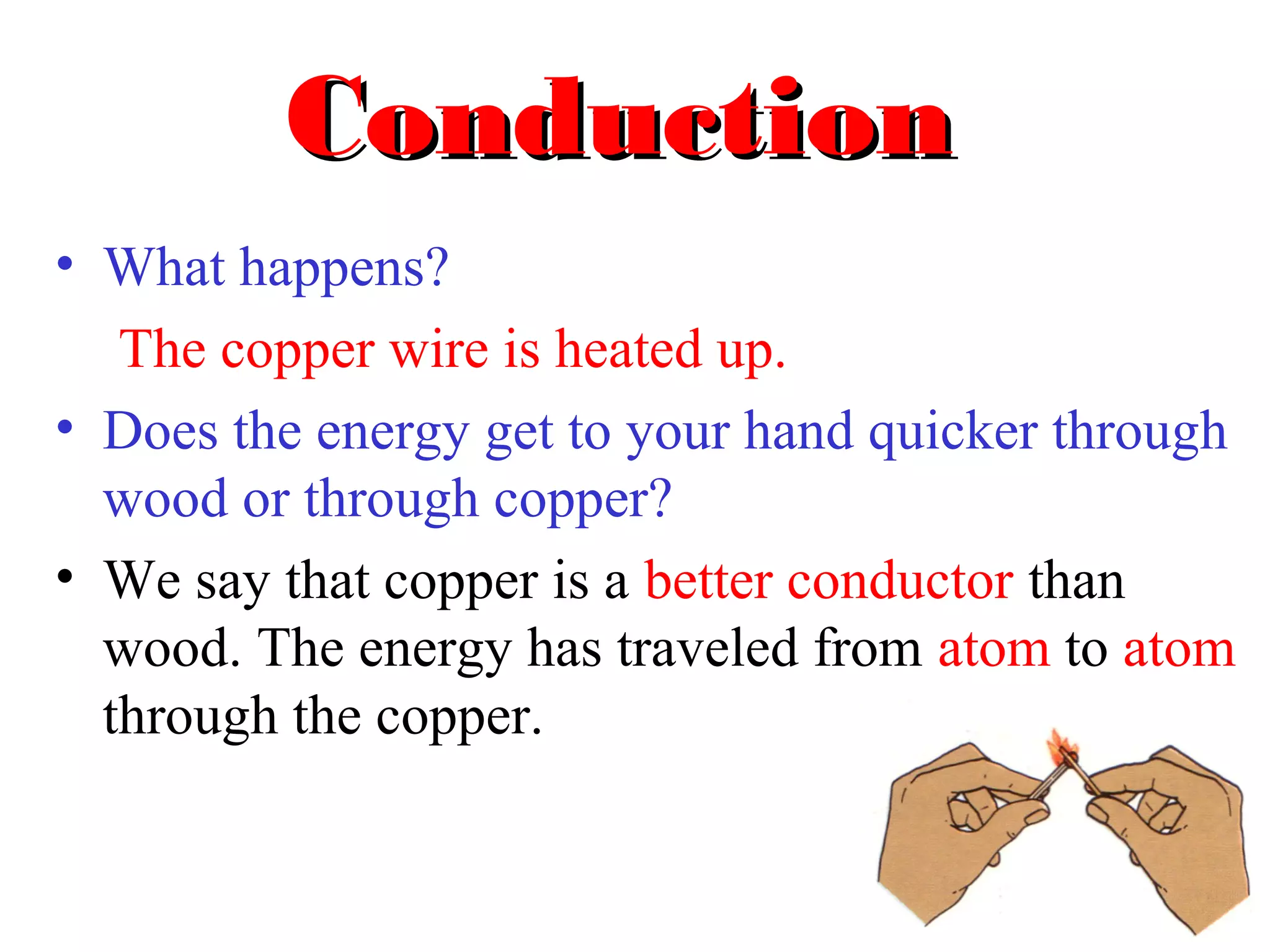
• What happens?
   The copper wire is heated up.
• Does the energy get to your hand quicker through
  wood or through copper?
• We say that copper is a better conductor than
  wood. The energy has traveled from atom to atom
  through the copper.
Conduction
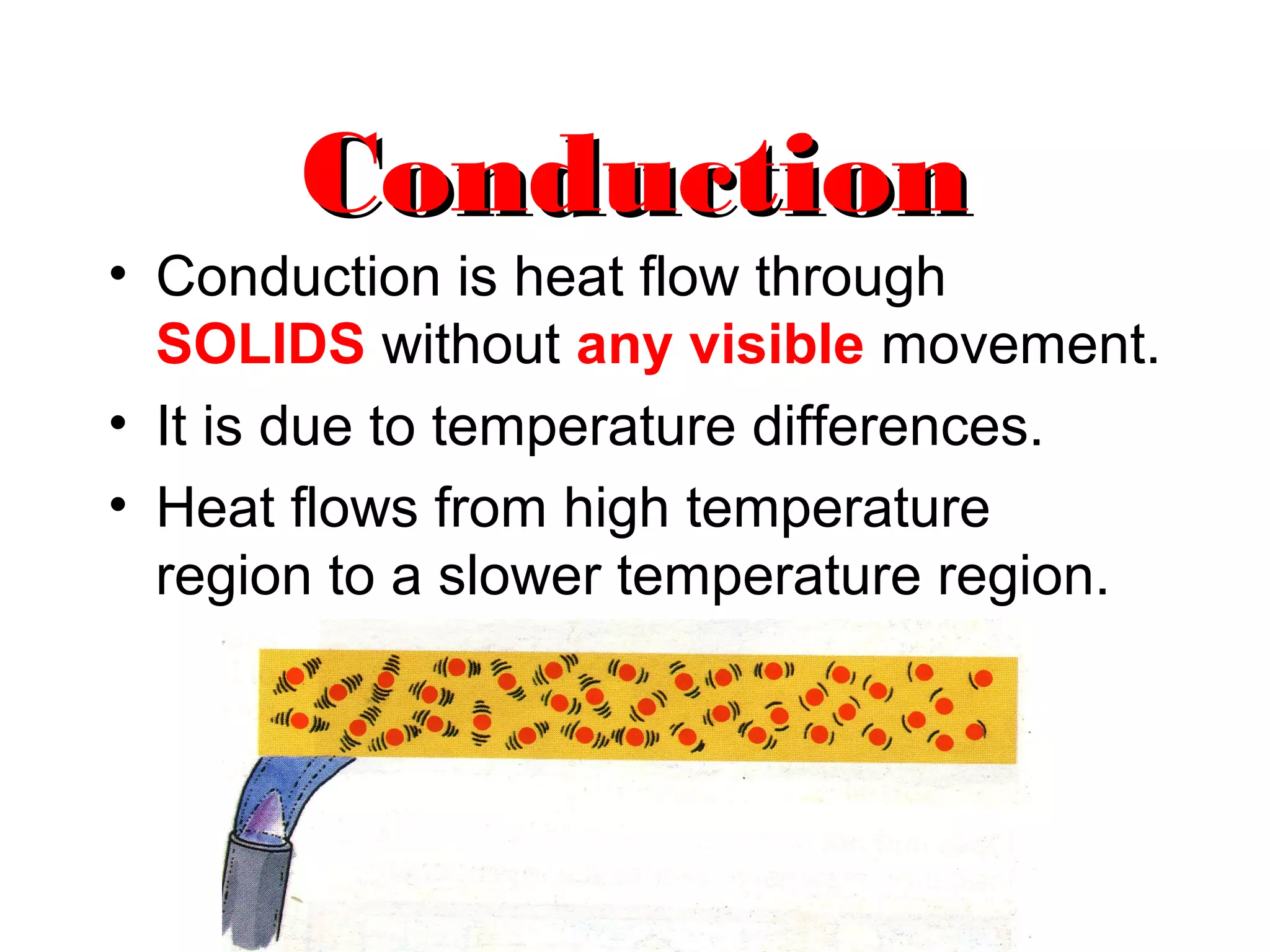
• Conduction is heat flow through
  SOLIDS without any visible movement.
• It is due to temperature differences.
• Heat flows from high temperature
  region to a slower temperature region.
Conduction
Conduction
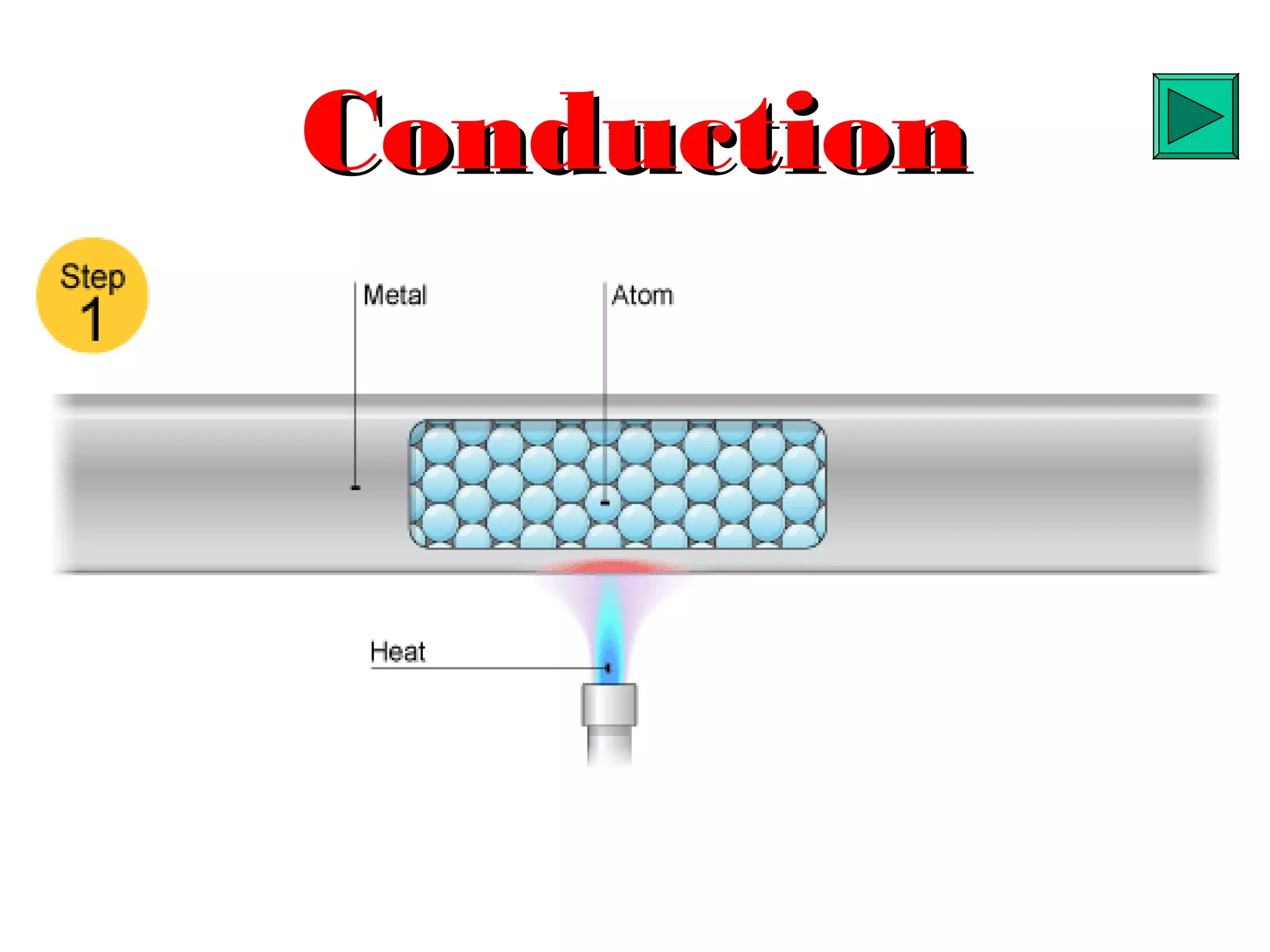
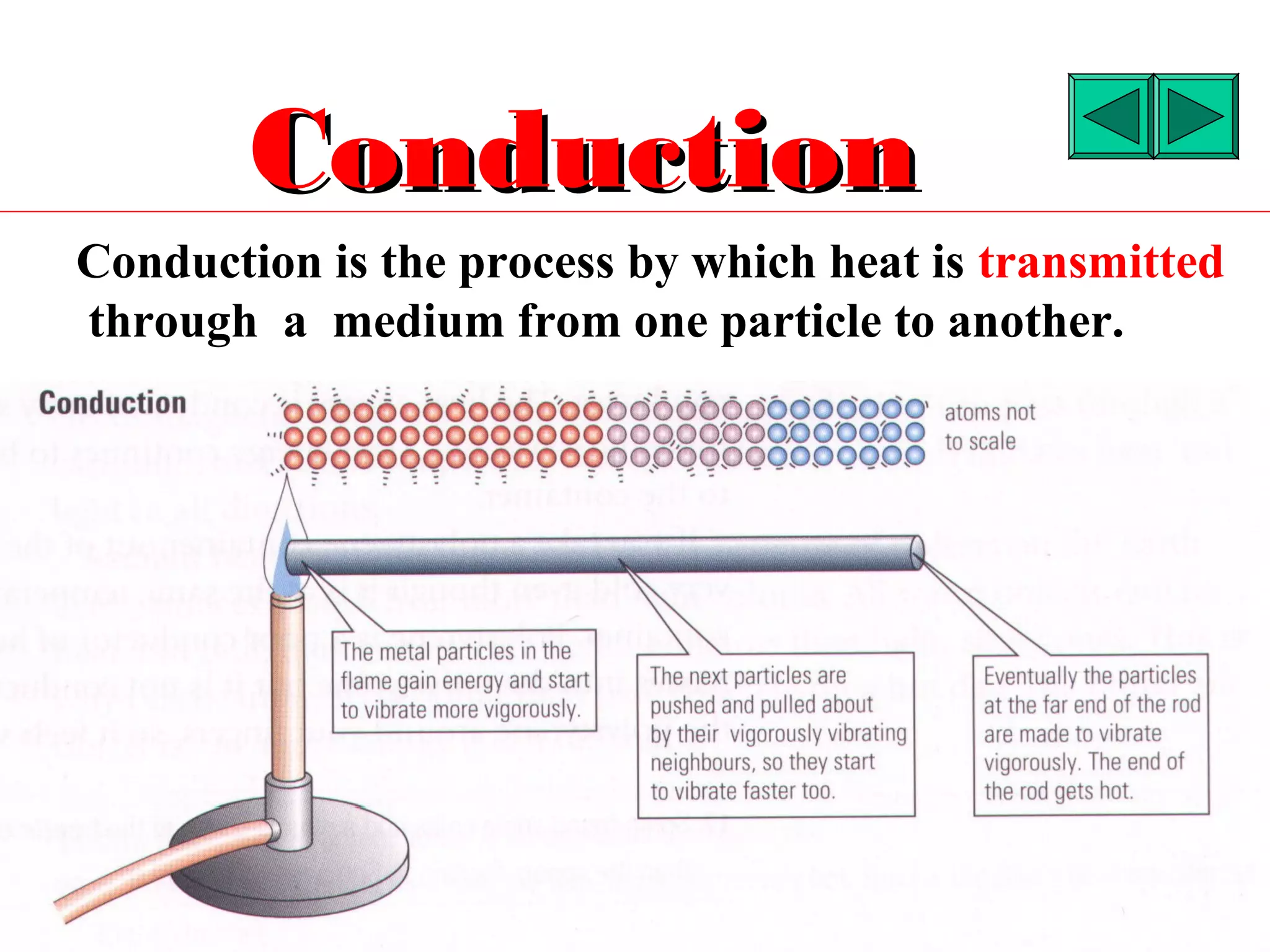
Conduction is the process by which heat is transmitted
through a medium from one particle to another.
Conduction
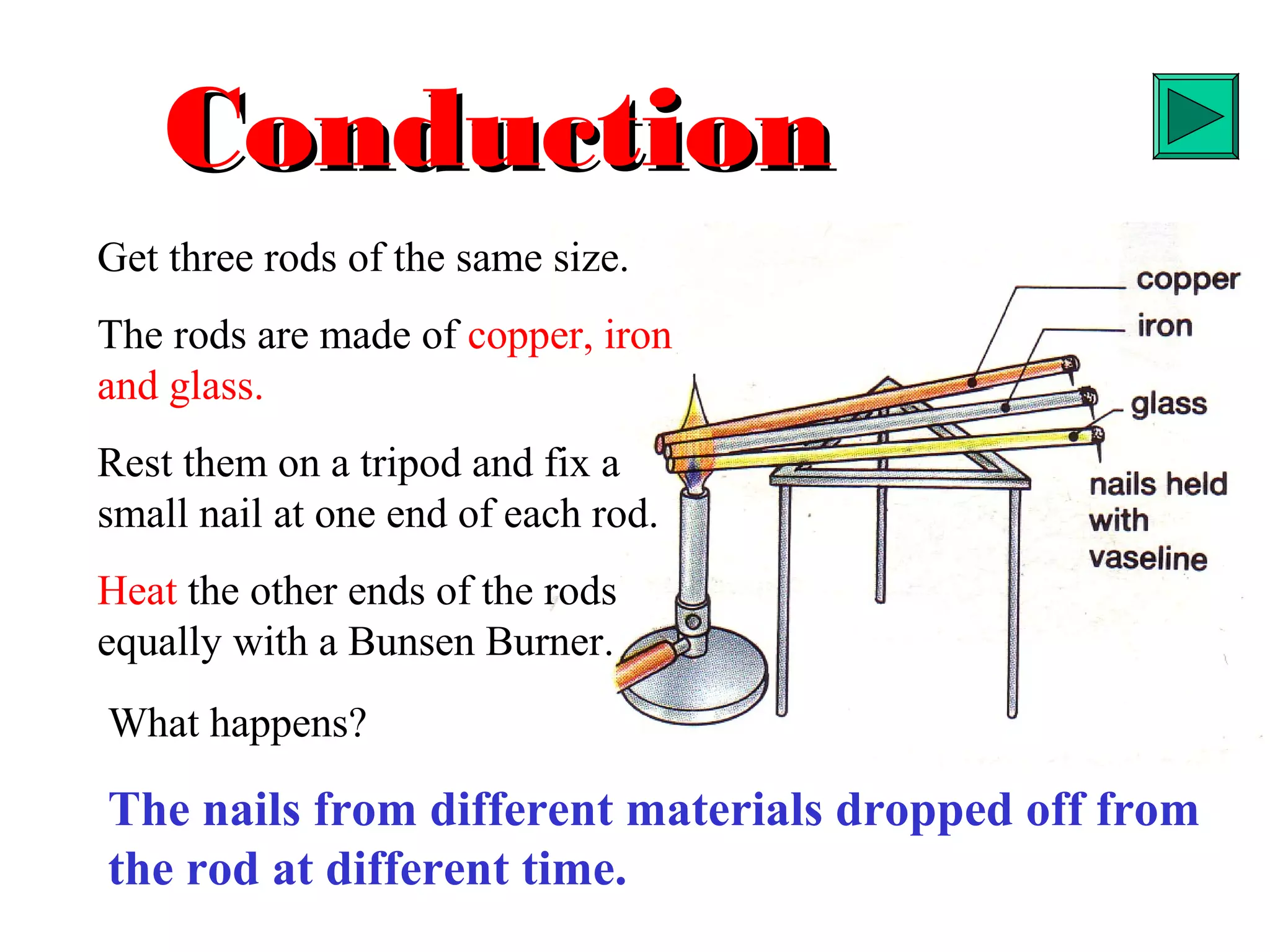
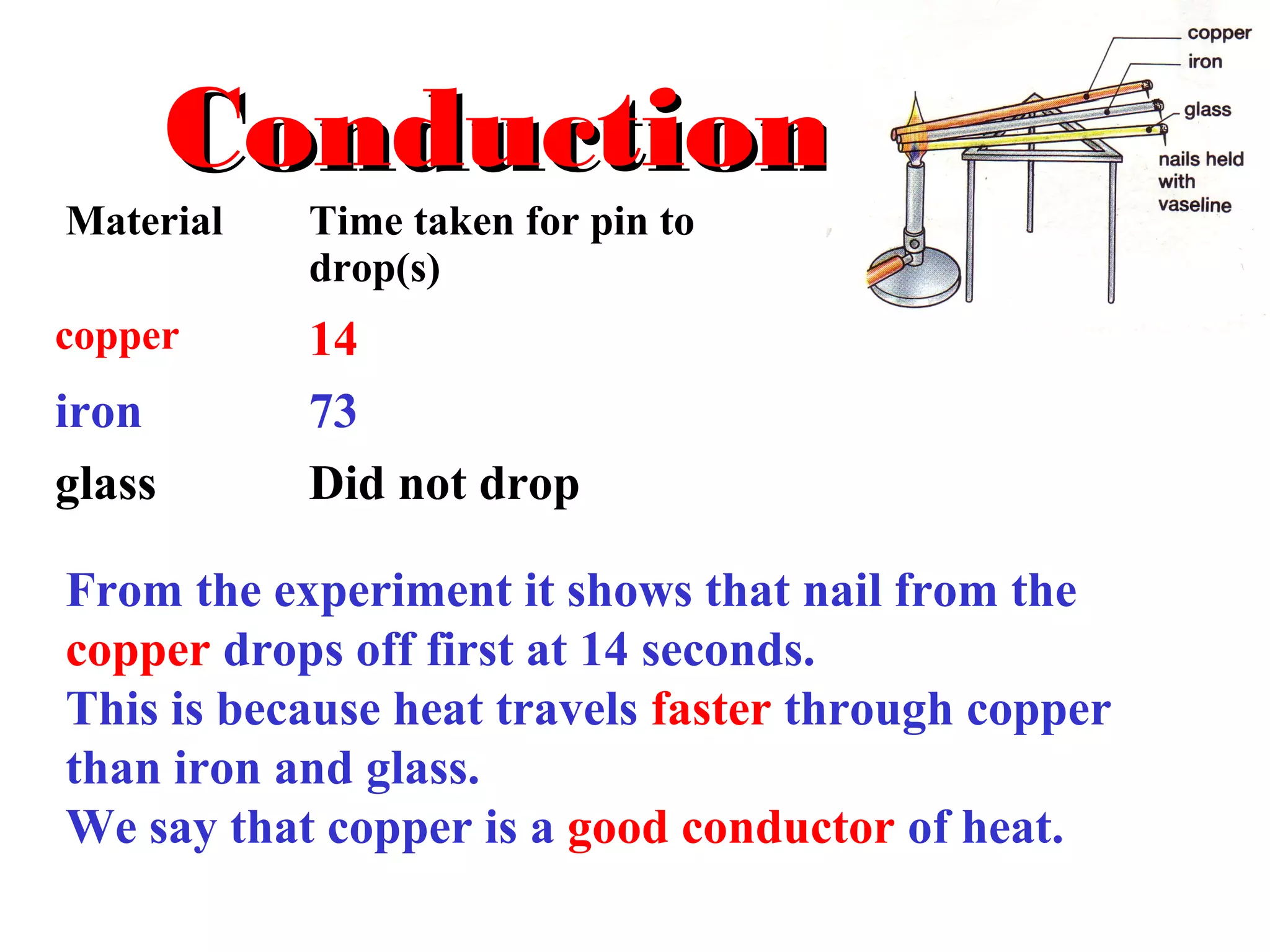
Get three rods of the same size.
The rods are made of copper, iron
and glass.
Rest them on a tripod and fix a
small nail at one end of each rod.
Heat the other ends of the rods
equally with a Bunsen Burner.
What happens?

The nails from different materials dropped off from
the rod at different time.
Conduction
Material   Time taken for pin to
           drop(s)
copper     14
iron       73
glass      Did not drop

From the experiment it shows that nail from the
copper drops off first at 14 seconds.
This is because heat travels faster through copper
than iron and glass.
We say that copper is a good conductor of heat.
Conductors
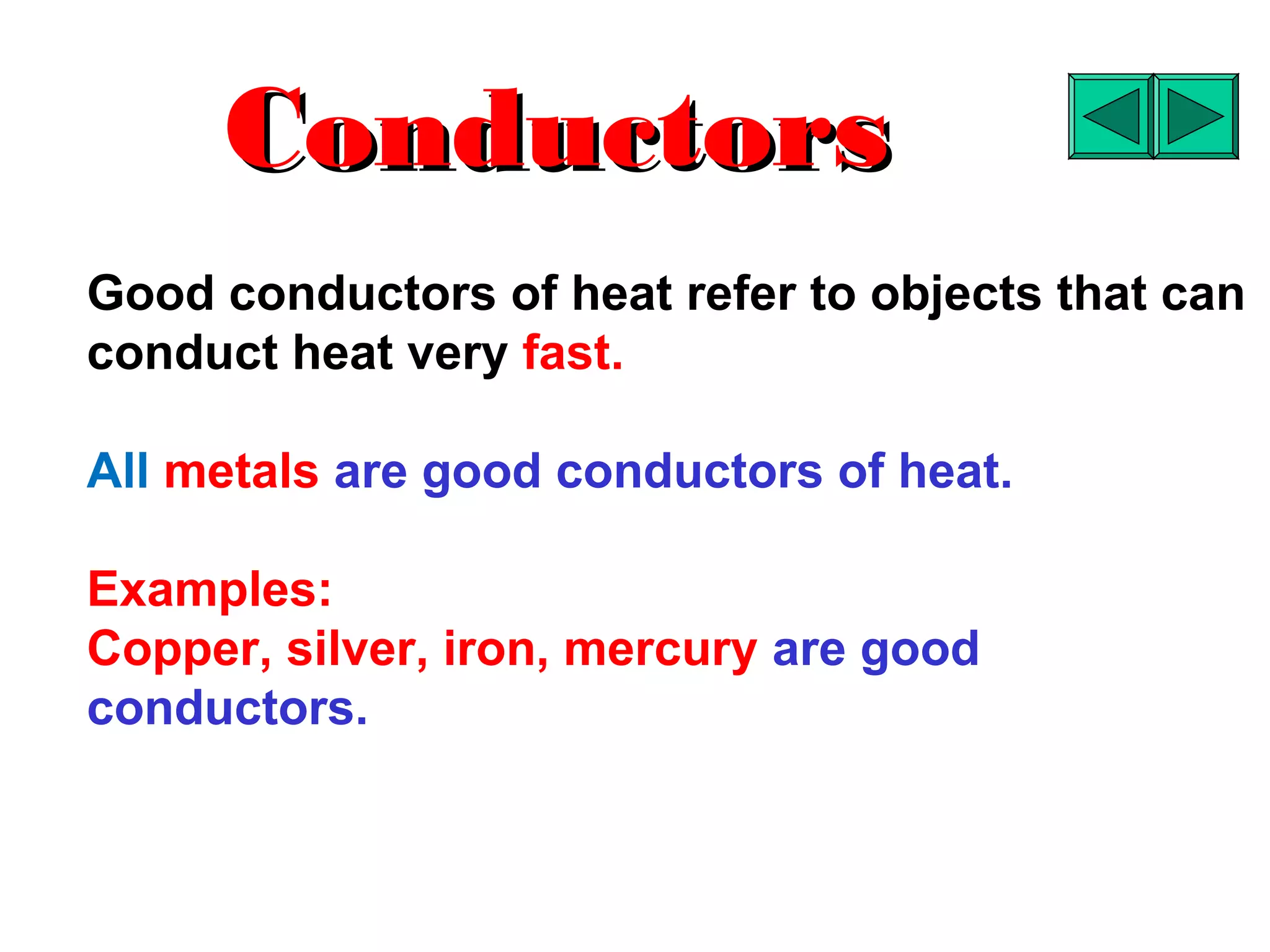
Good conductors of heat refer to objects that can
conduct heat very fast.

All metals are good conductors of heat.

Examples:
Copper, silver, iron, mercury are good
conductors.
Insulators
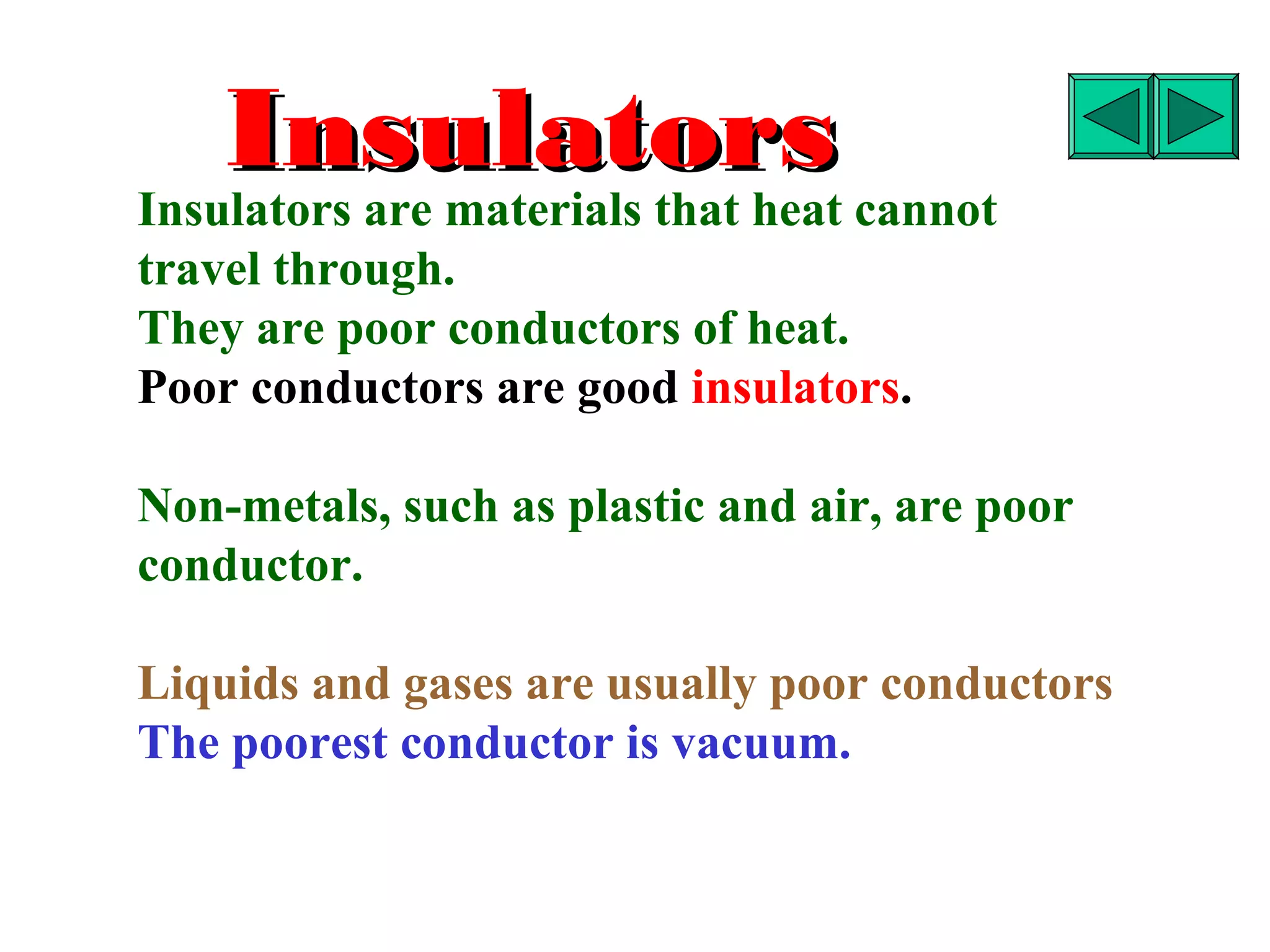
Insulators are materials that heat cannot
travel through.
They are poor conductors of heat.
Poor conductors are good insulators.

Non-metals, such as plastic and air, are poor
conductor.

Liquids and gases are usually poor conductors
The poorest conductor is vacuum.
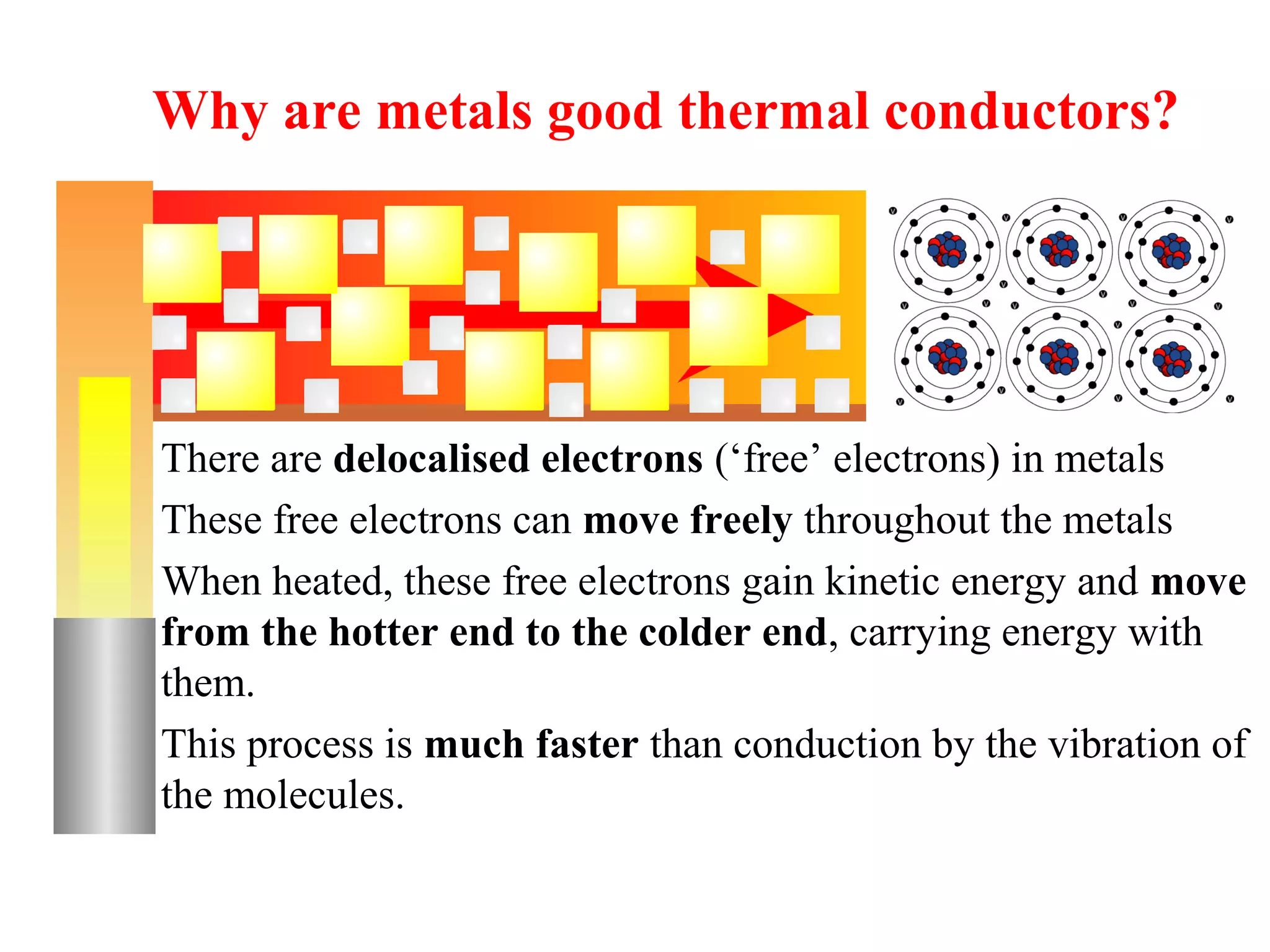
Why are metals good thermal conductors?


There are delocalised electrons (‘free’ electrons) in metals
These free electrons can move freely throughout the metals
When heated, these free electrons gain kinetic energy and move
from the hotter end to the colder end, carrying energy with
them.
This process is much faster than conduction by the vibration of
the molecules.
Insulators
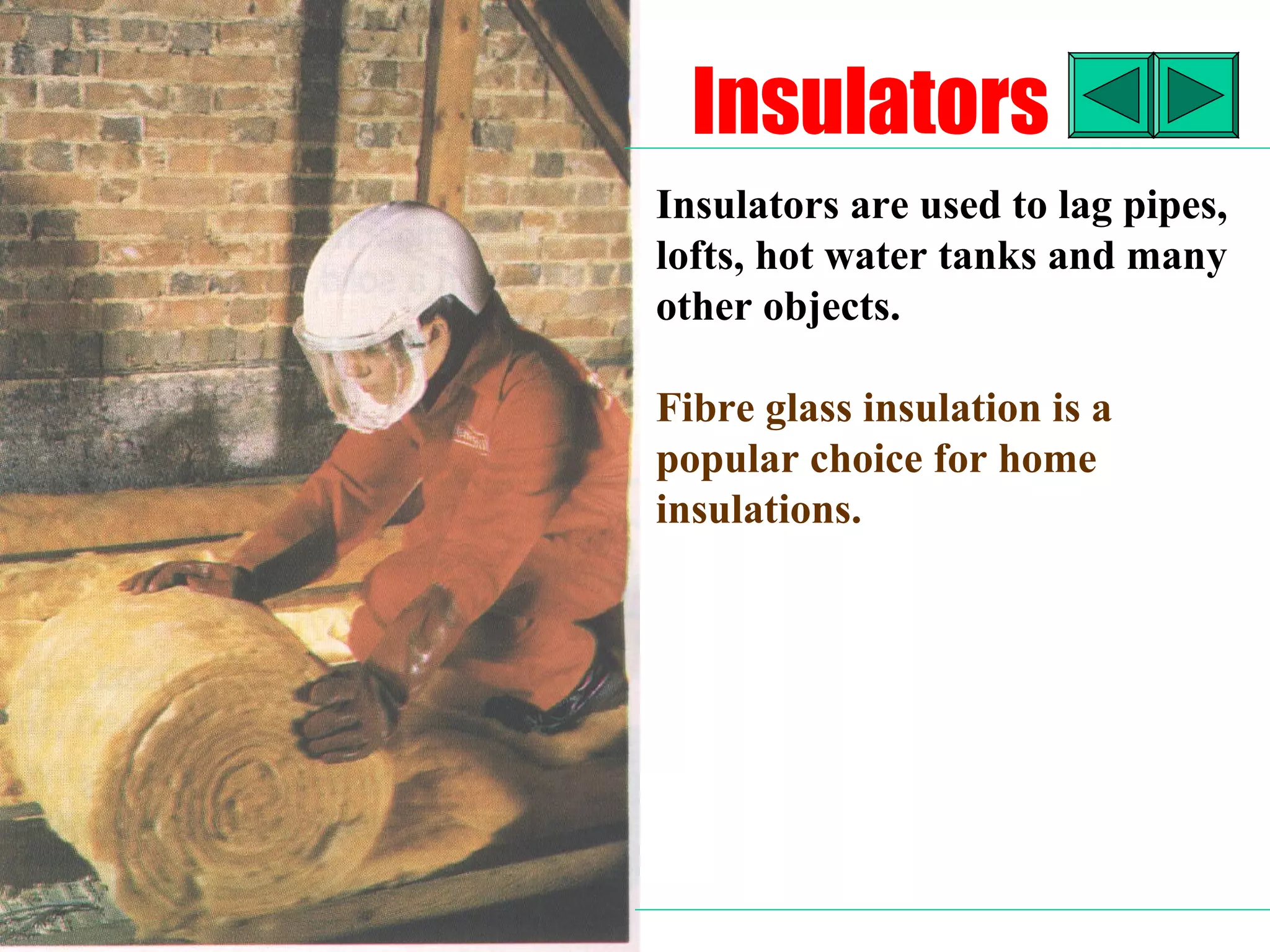
Insulators are used to lag pipes,
lofts, hot water tanks and many
other objects.

Fibre glass insulation is a
popular choice for home
insulations.
Test Yourselves
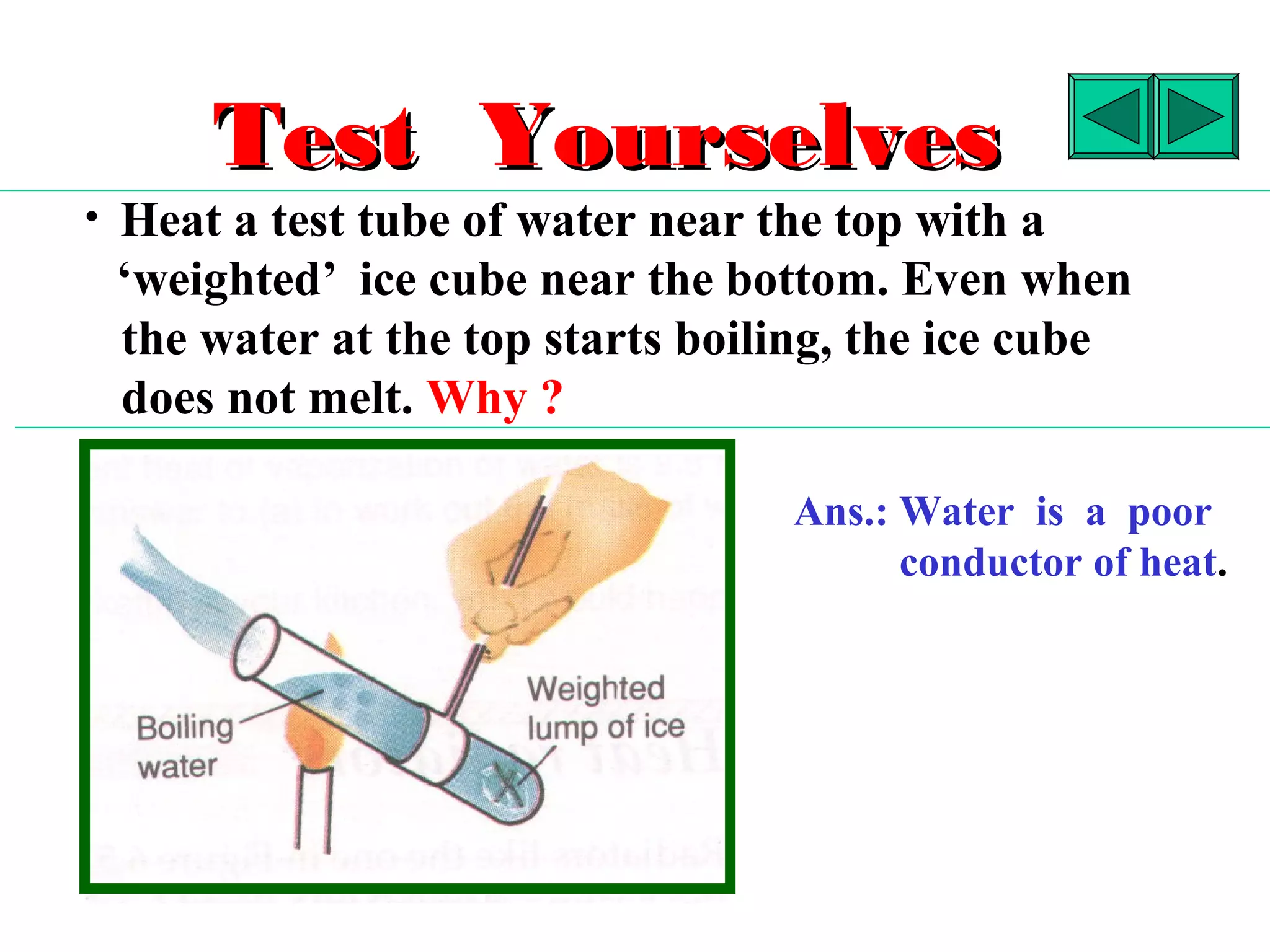
• Heat a test tube of water near the top with a
 ‘weighted’ ice cube near the bottom. Even when
 the water at the top starts boiling, the ice cube
 does not melt. Why ?

                                  Ans.: Water is a poor
                                        conductor of heat.
Is air good conductor or
insulator
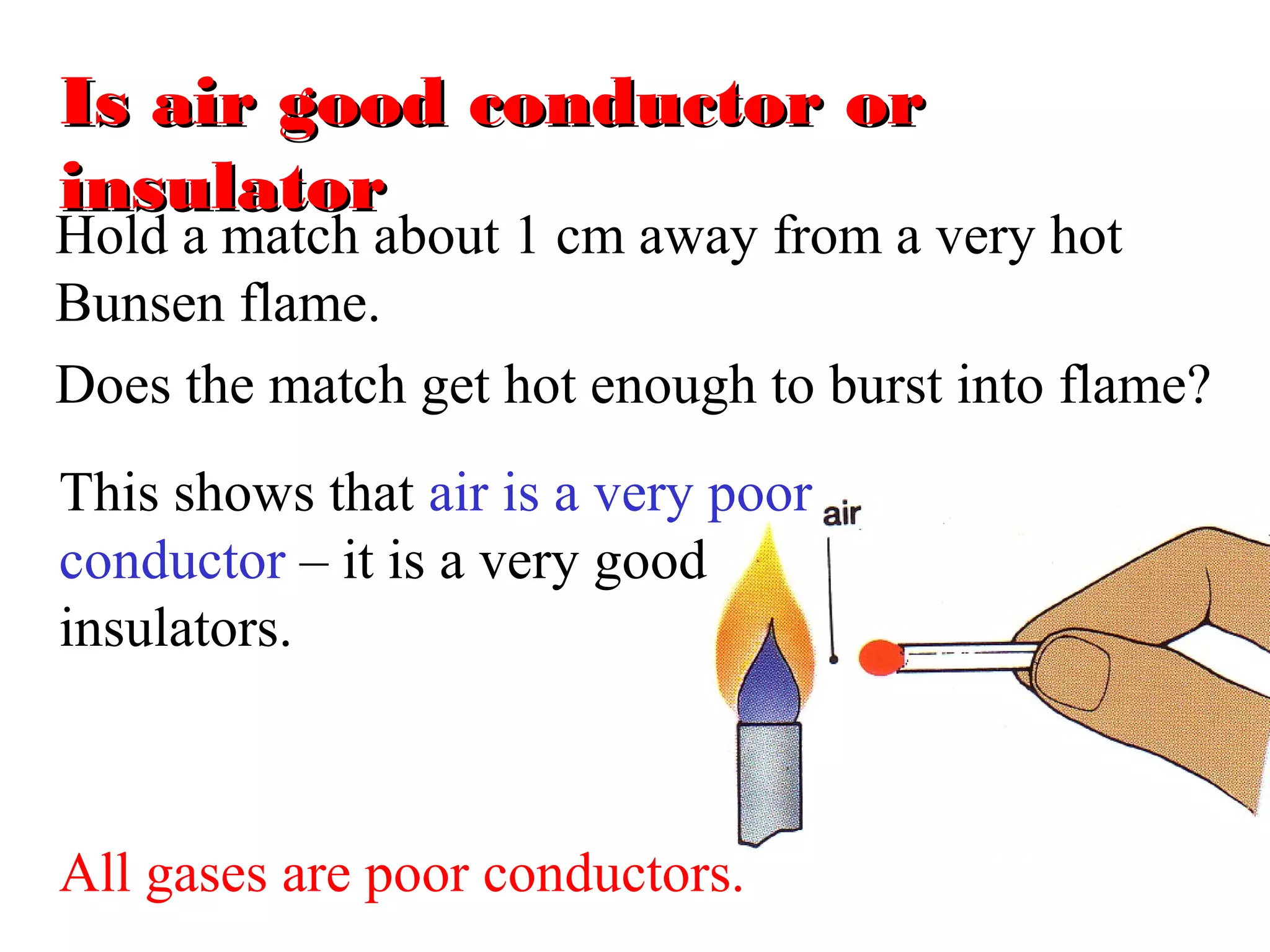
Hold a match about 1 cm away from a very hot
Bunsen flame.
Does the match get hot enough to burst into flame?
This shows that air is a very poor
conductor – it is a very good
insulators.


All gases are poor conductors.
Application of conduction
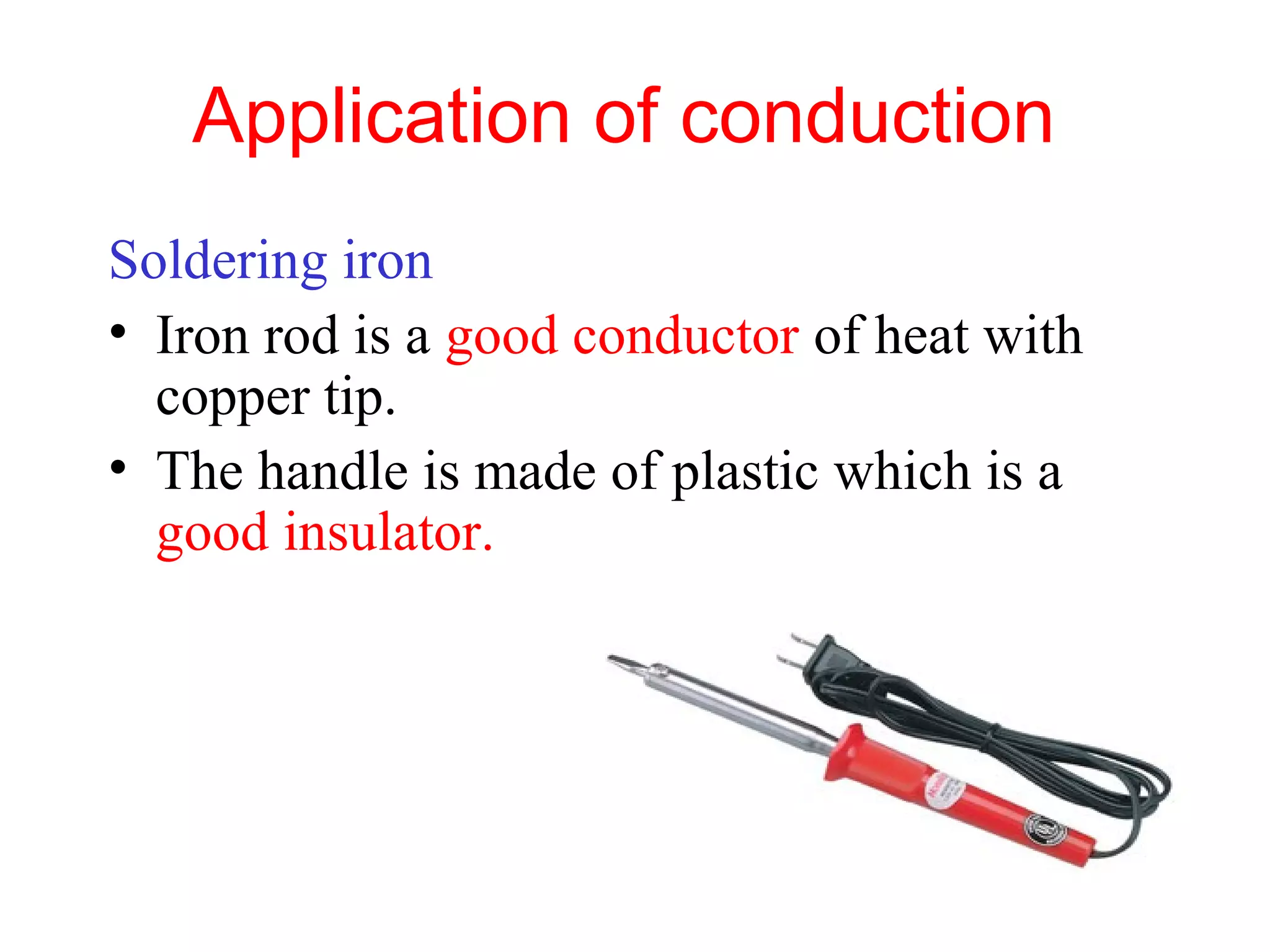
Soldering iron
• Iron rod is a good conductor of heat with
  copper tip.
• The handle is made of plastic which is a
  good insulator.
Application of conduction
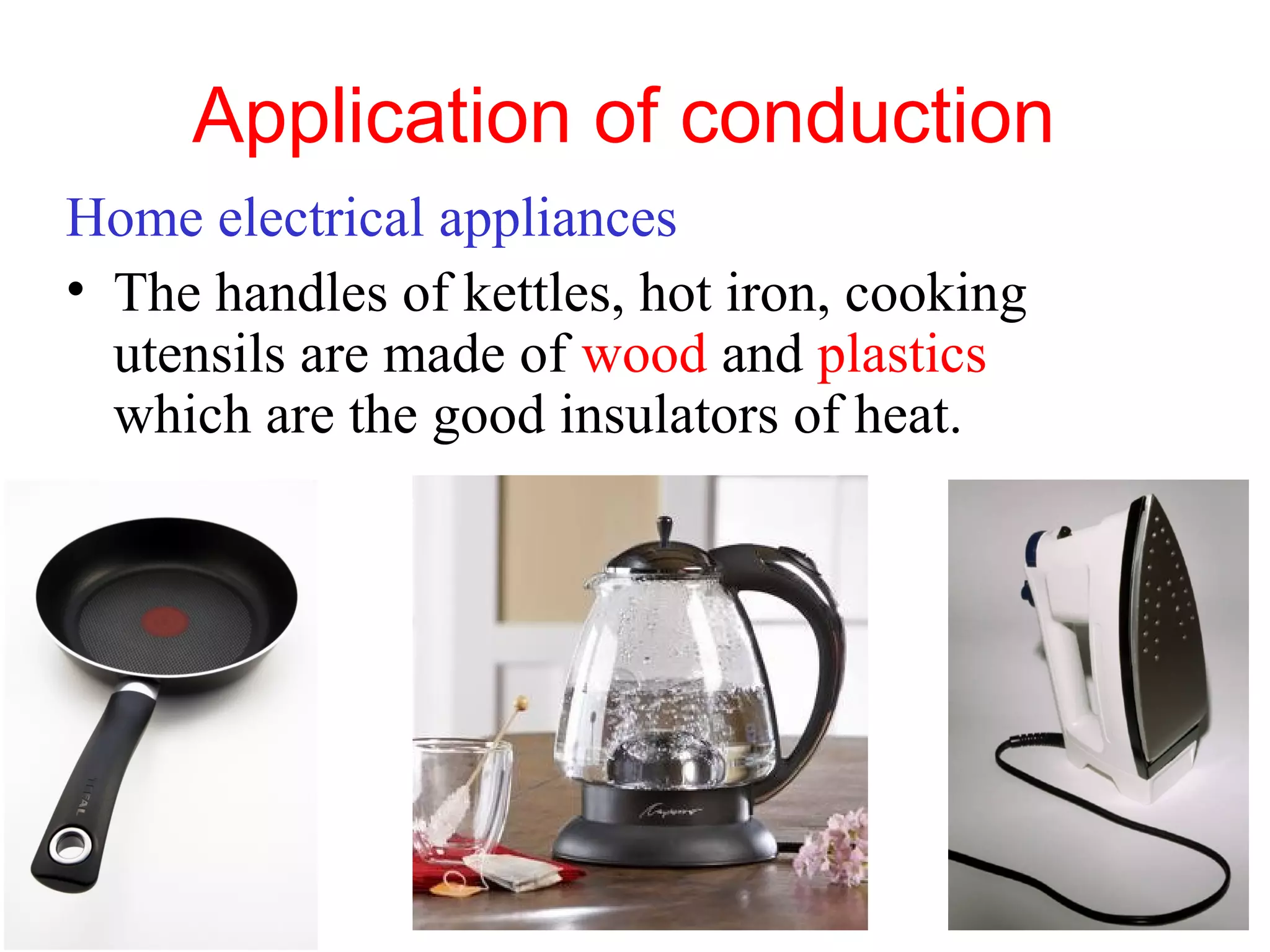
Home electrical appliances
• The handles of kettles, hot iron, cooking
  utensils are made of wood and plastics
  which are the good insulators of heat.
Insulation
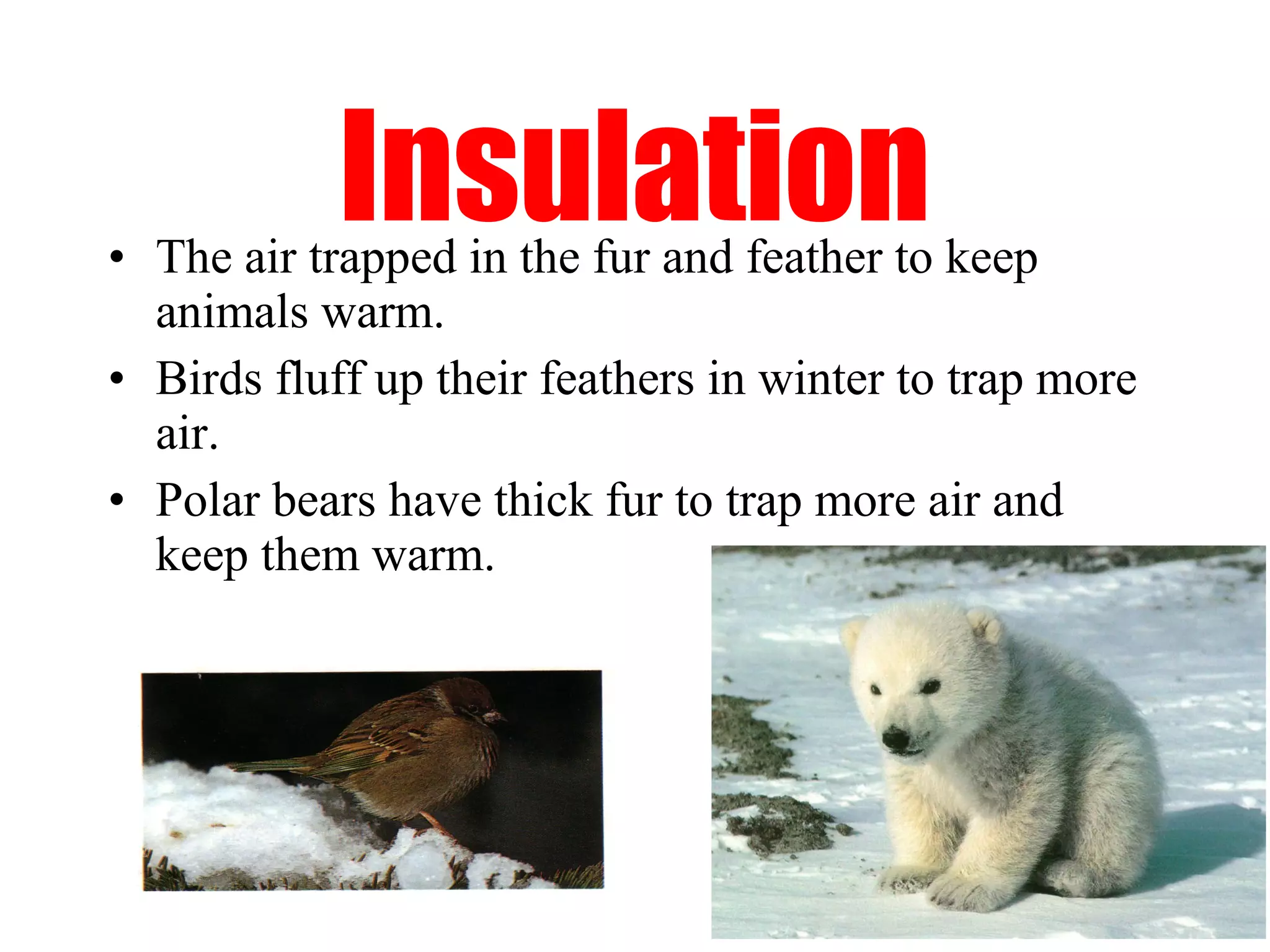
• The air trapped in the fur and feather to keep
  animals warm.
• Birds fluff up their feathers in winter to trap more
  air.
• Polar bears have thick fur to trap more air and
  keep them warm.
Insulation
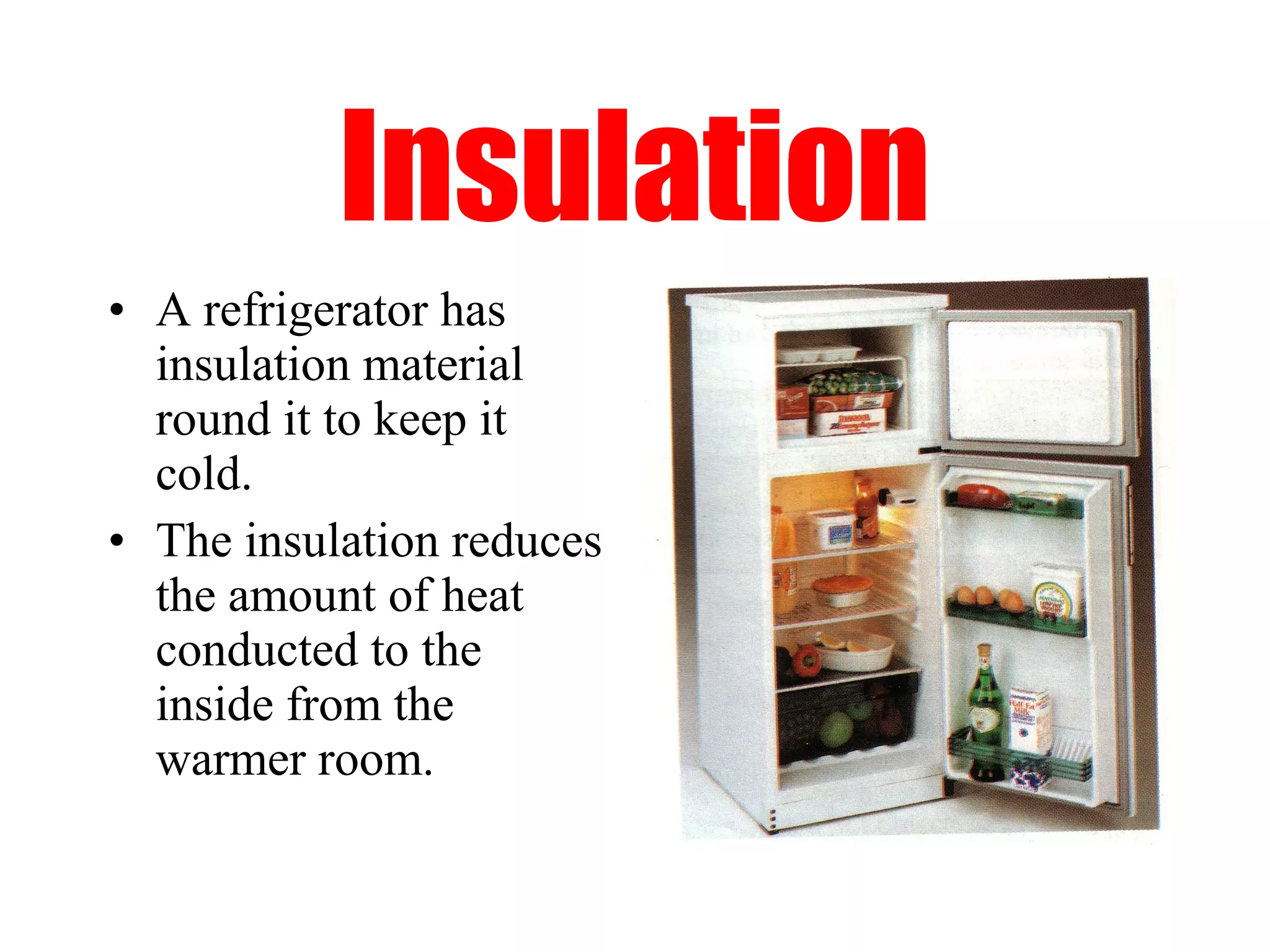
• A refrigerator has
  insulation material
  round it to keep it
  cold.
• The insulation reduces
  the amount of heat
  conducted to the
  inside from the
  warmer room.
Insulation
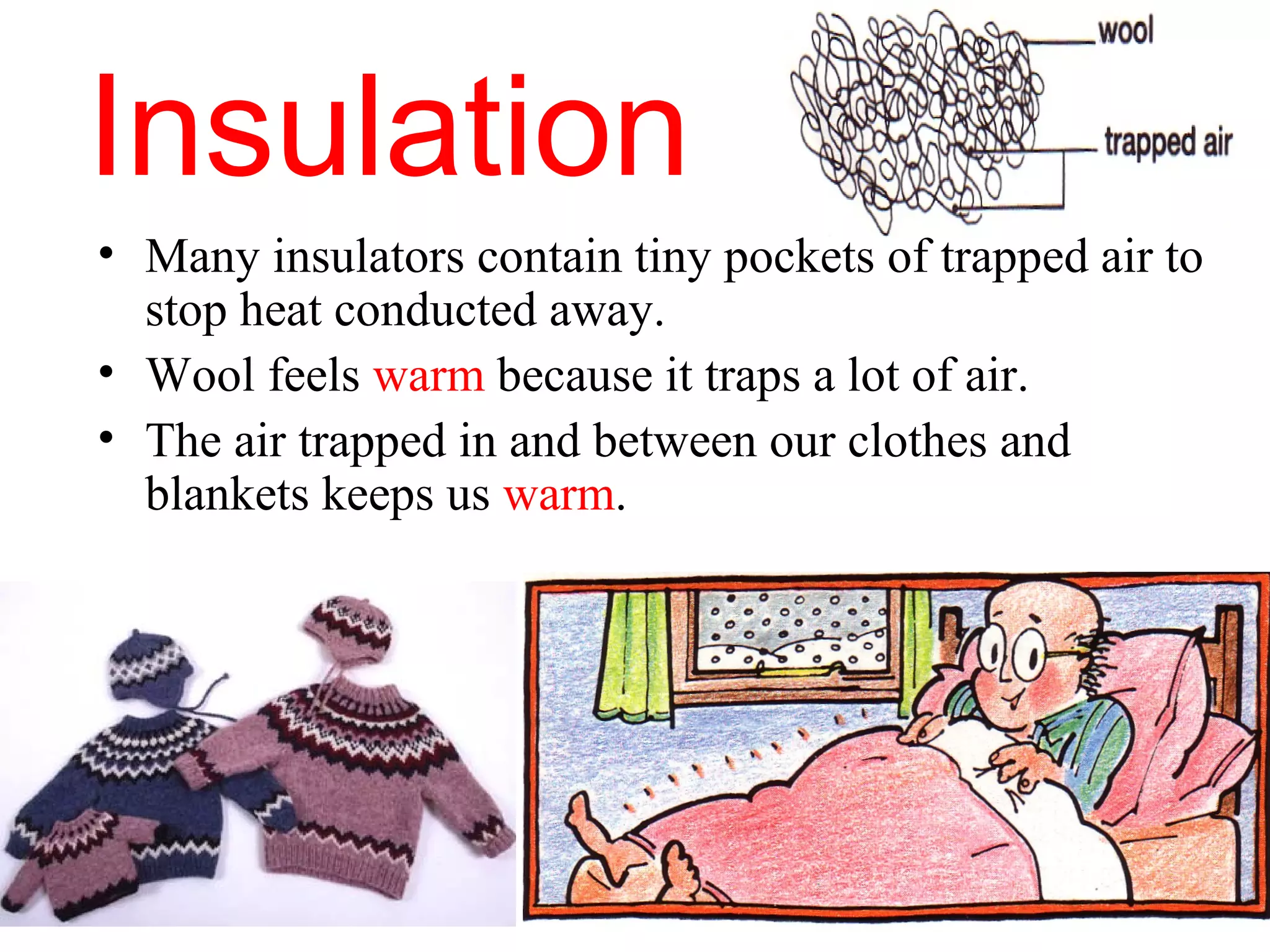
• Many insulators contain tiny pockets of trapped air to
  stop heat conducted away.
• Wool feels warm because it traps a lot of air.
• The air trapped in and between our clothes and
  blankets keeps us warm.
Insulation
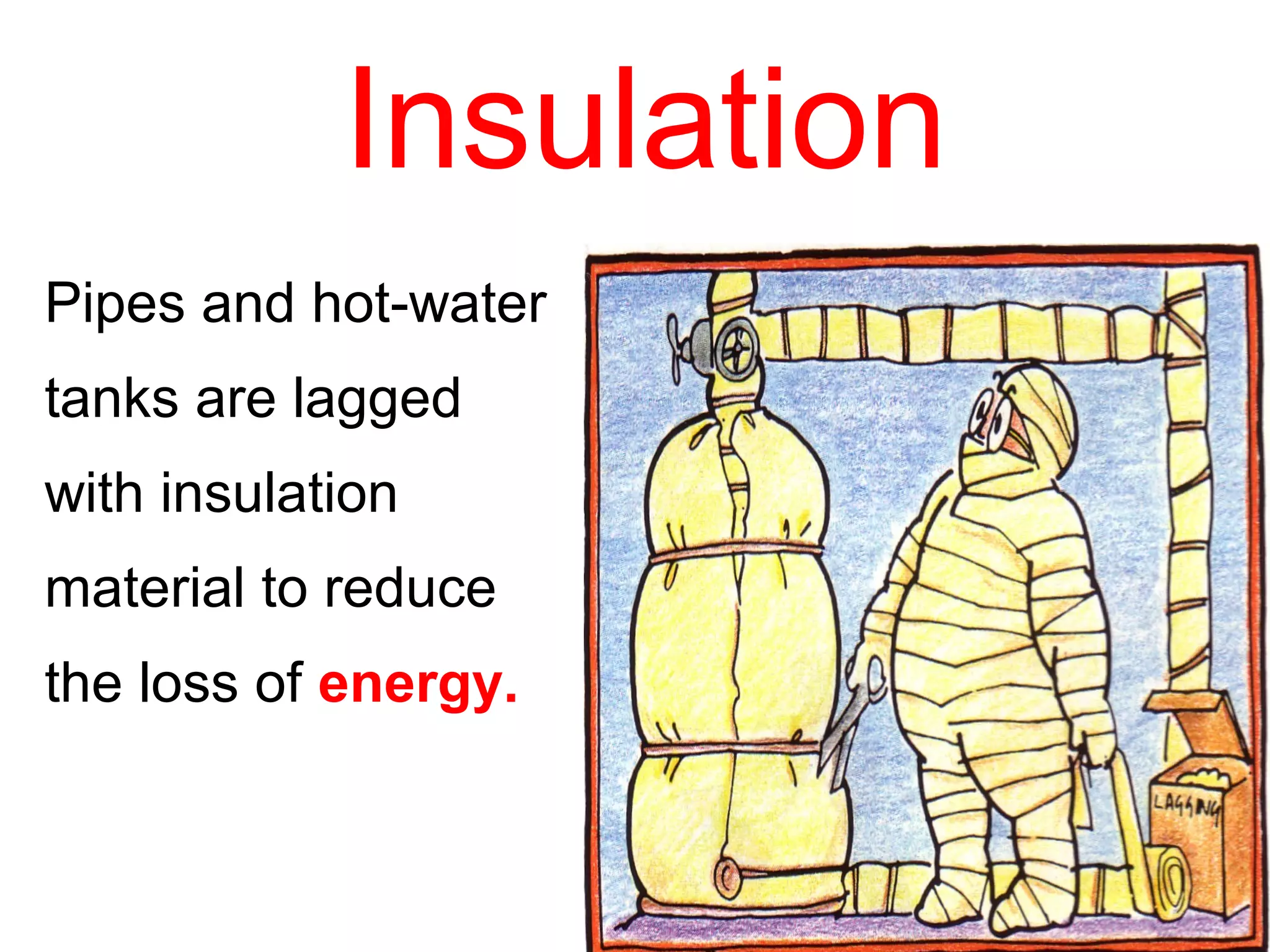
Pipes and hot-water
tanks are lagged
with insulation
material to reduce
the loss of energy.
Insulation


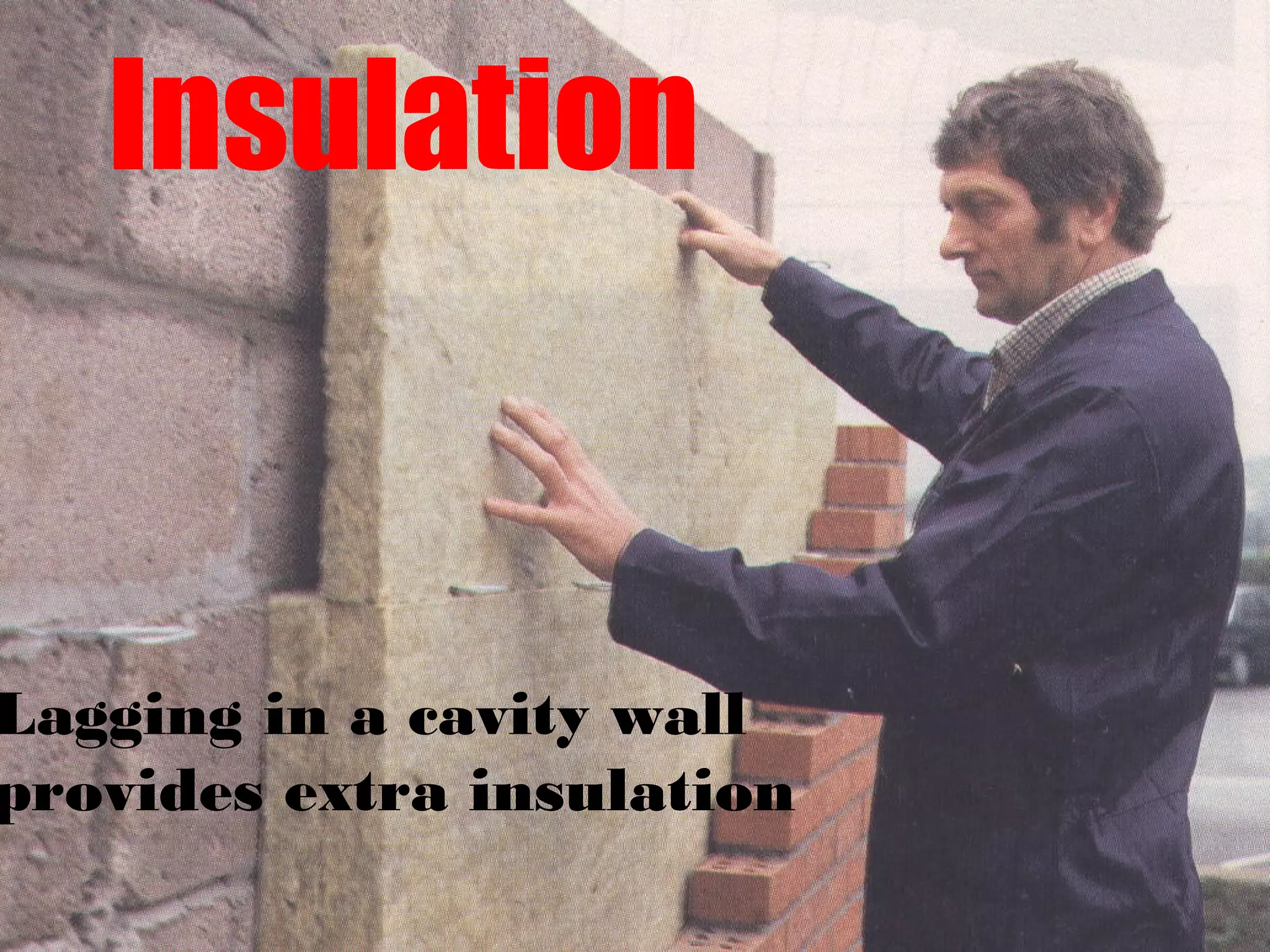
Lagging in a cavity wall
provides extra insulation
Convection
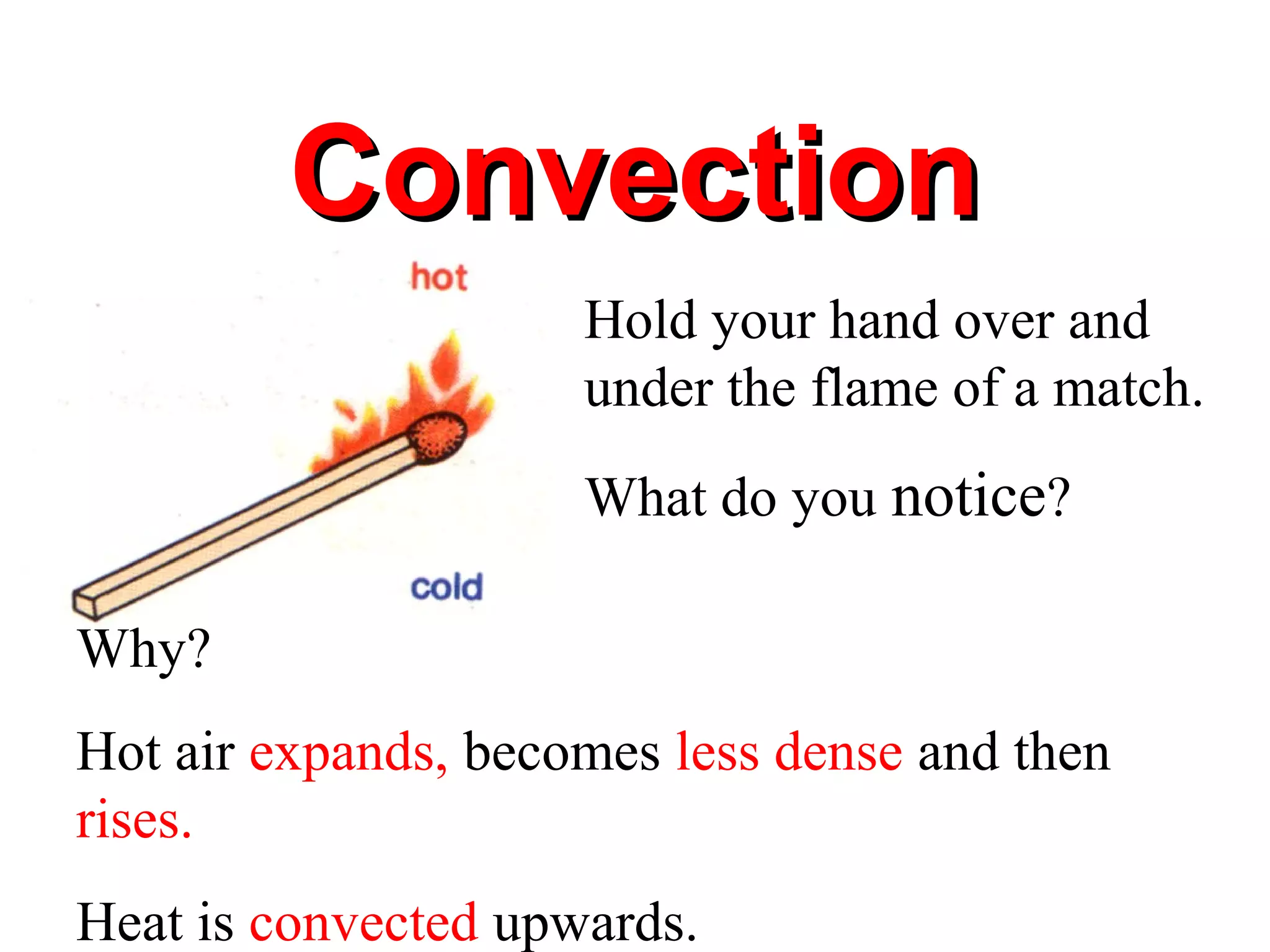
                     Hold your hand over and
                     under the flame of a match.
                     What do you notice?

Why?
Hot air expands, becomes less dense and then
rises.
Heat is convected upwards.
Convection
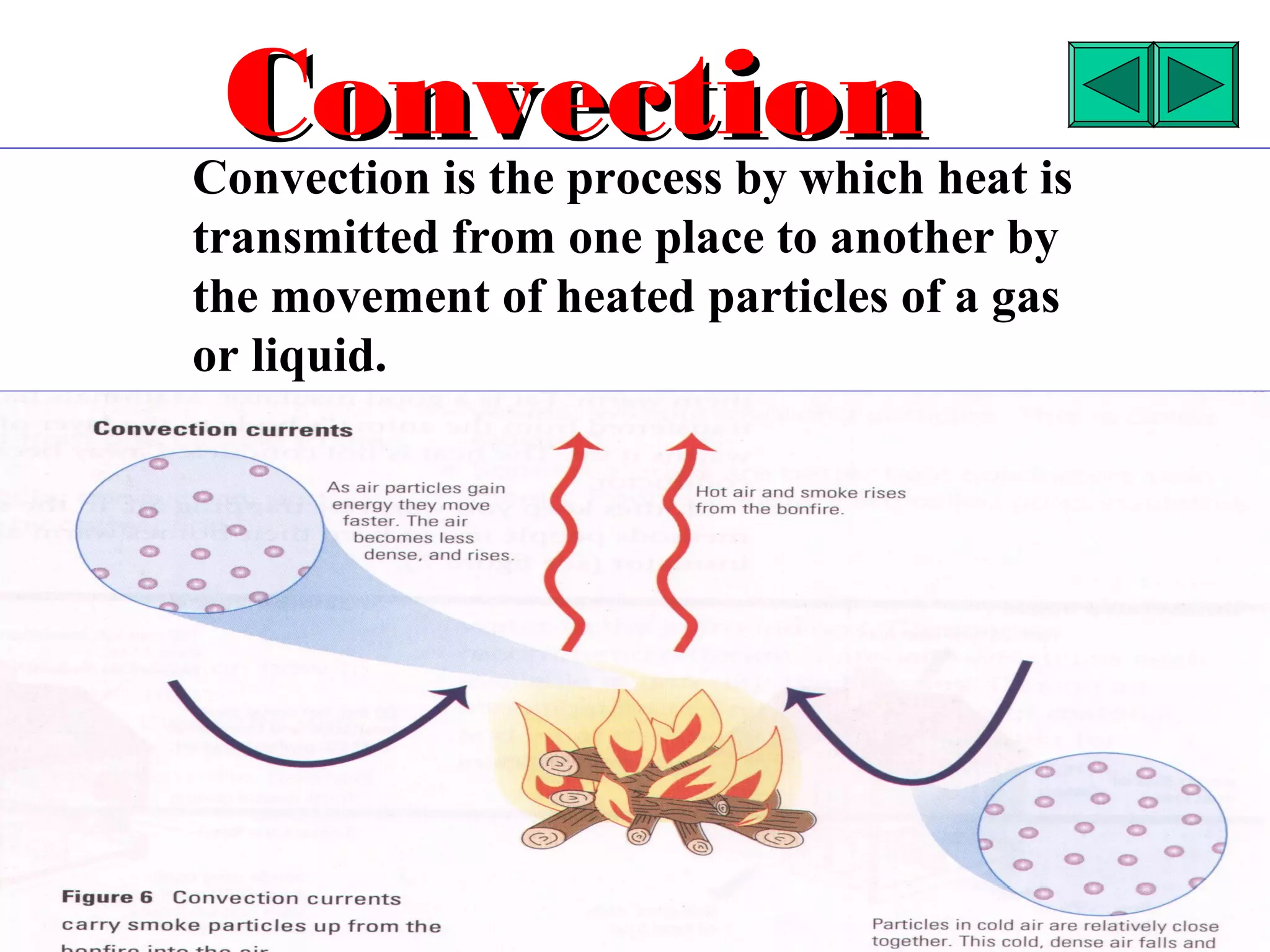
Convection is the process by which heat is
transmitted from one place to another by
the movement of heated particles of a gas
or liquid.
Convection
 in Liquids
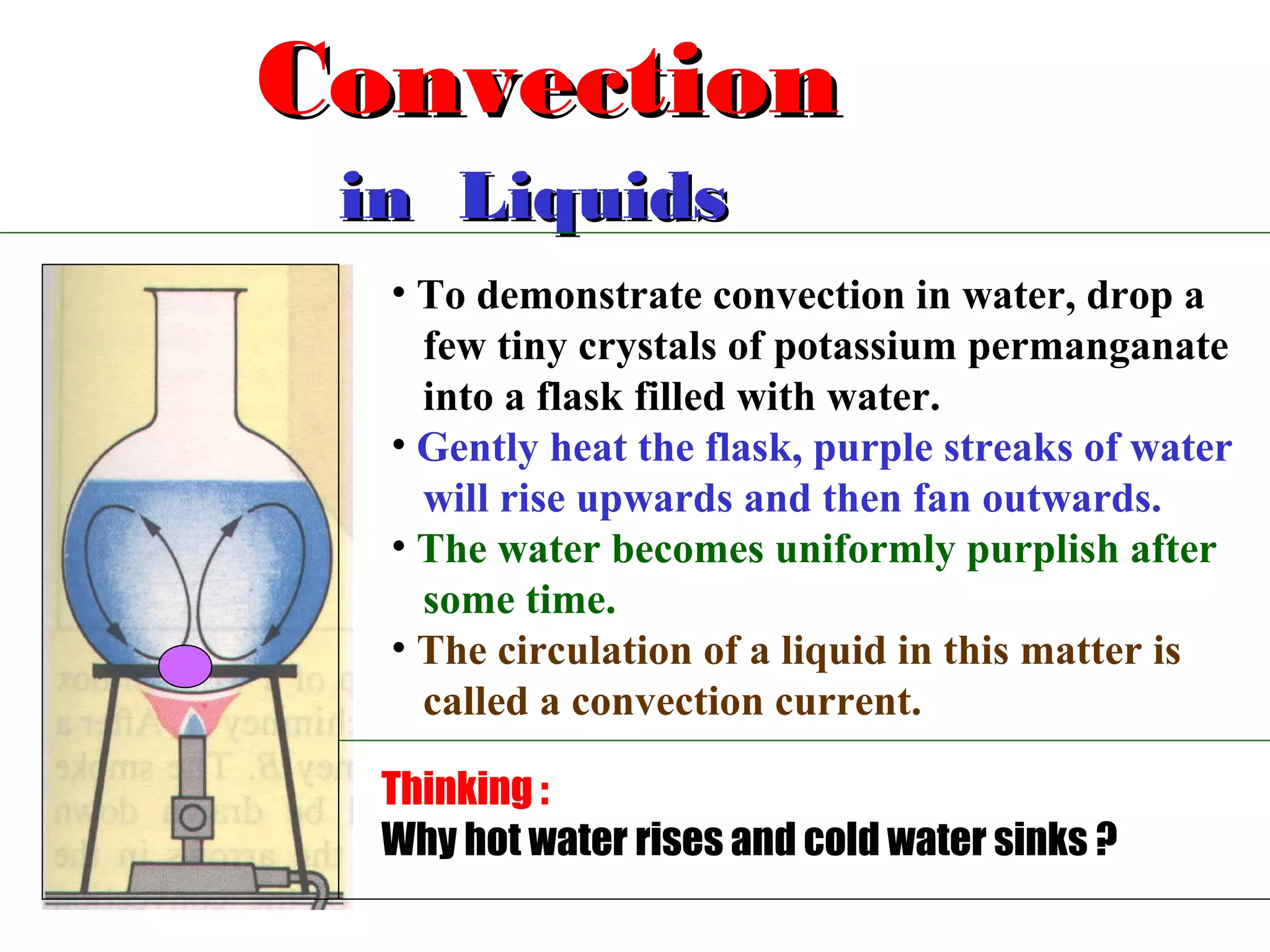
  • To demonstrate convection in water, drop a
    few tiny crystals of potassium permanganate
    into a flask filled with water.
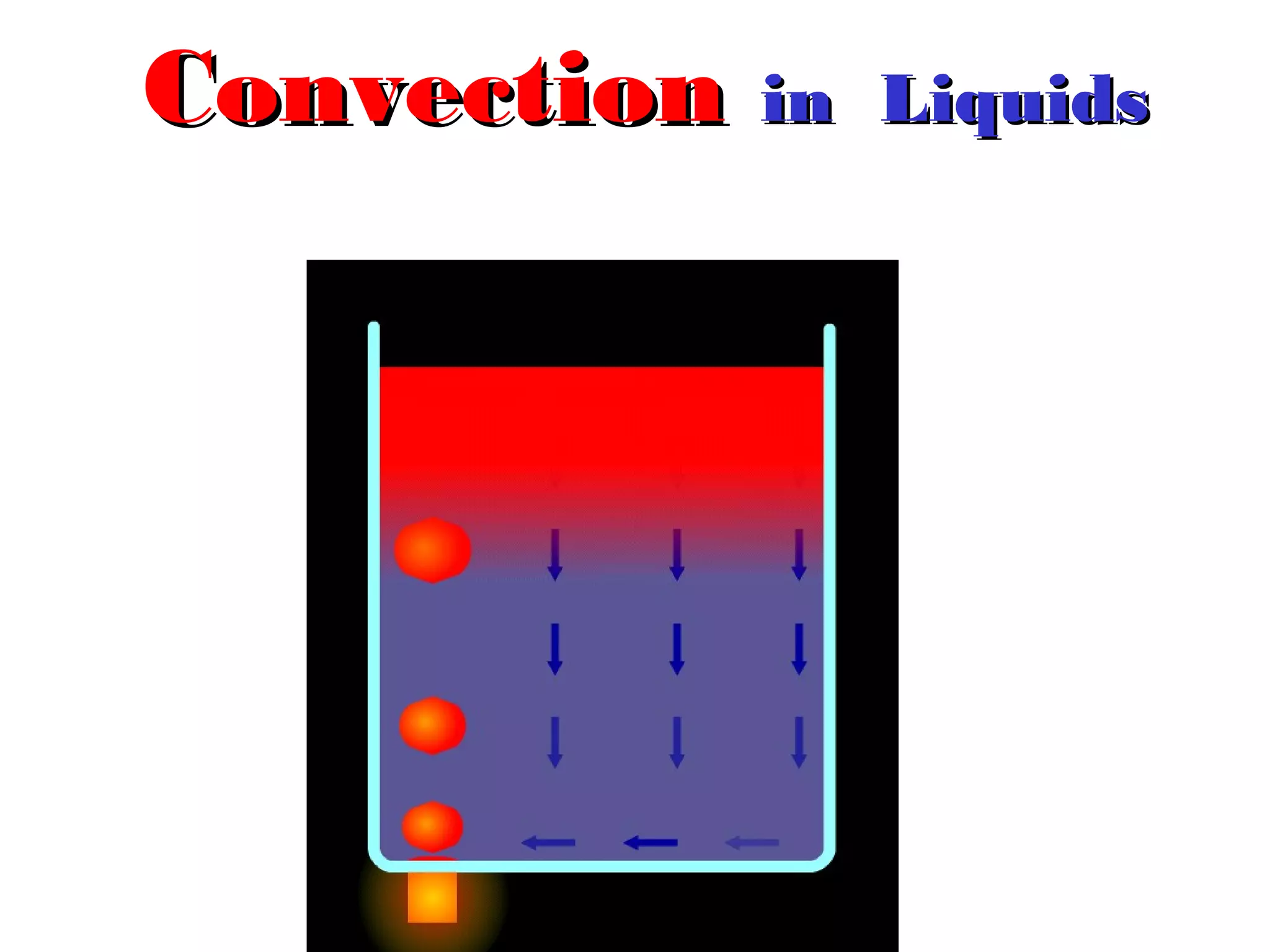
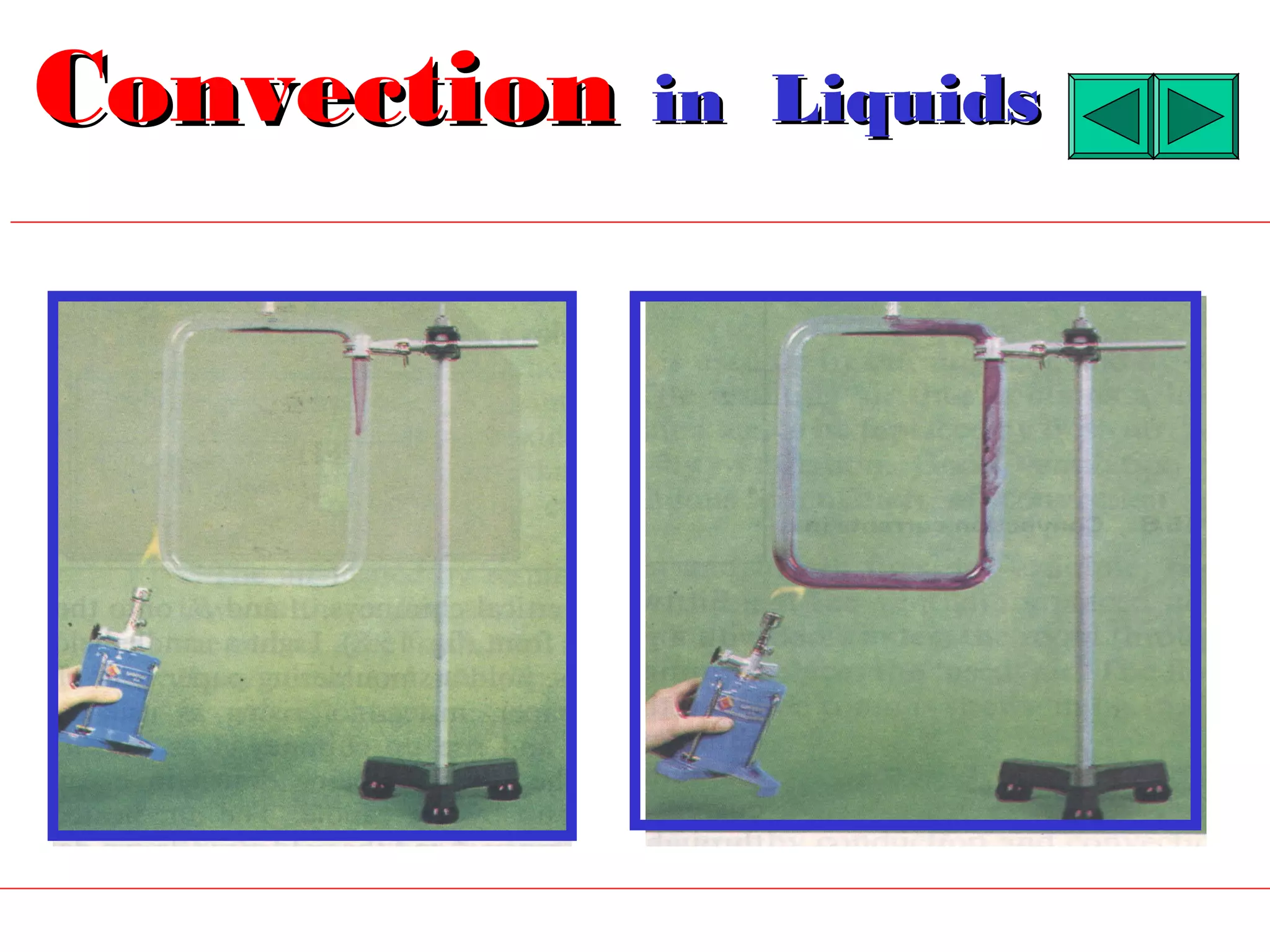
  • Gently heat the flask, purple streaks of water
    will rise upwards and then fan outwards.
  • The water becomes uniformly purplish after
    some time.
  • The circulation of a liquid in this matter is
    called a convection current.

  Thinking :
  Why hot water rises and cold water sinks ?
Convection in   Liquids
Convection
                           in Gases
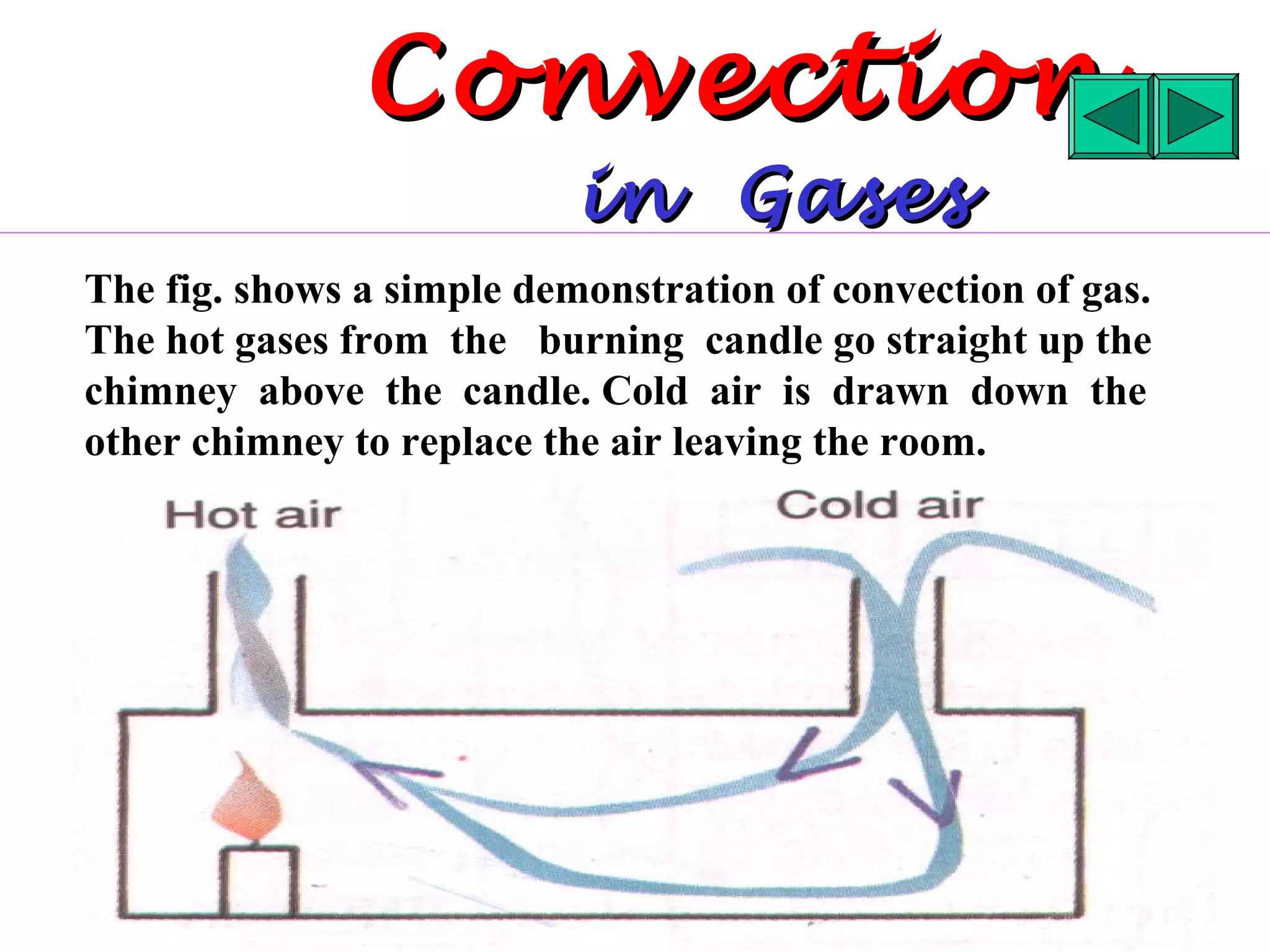
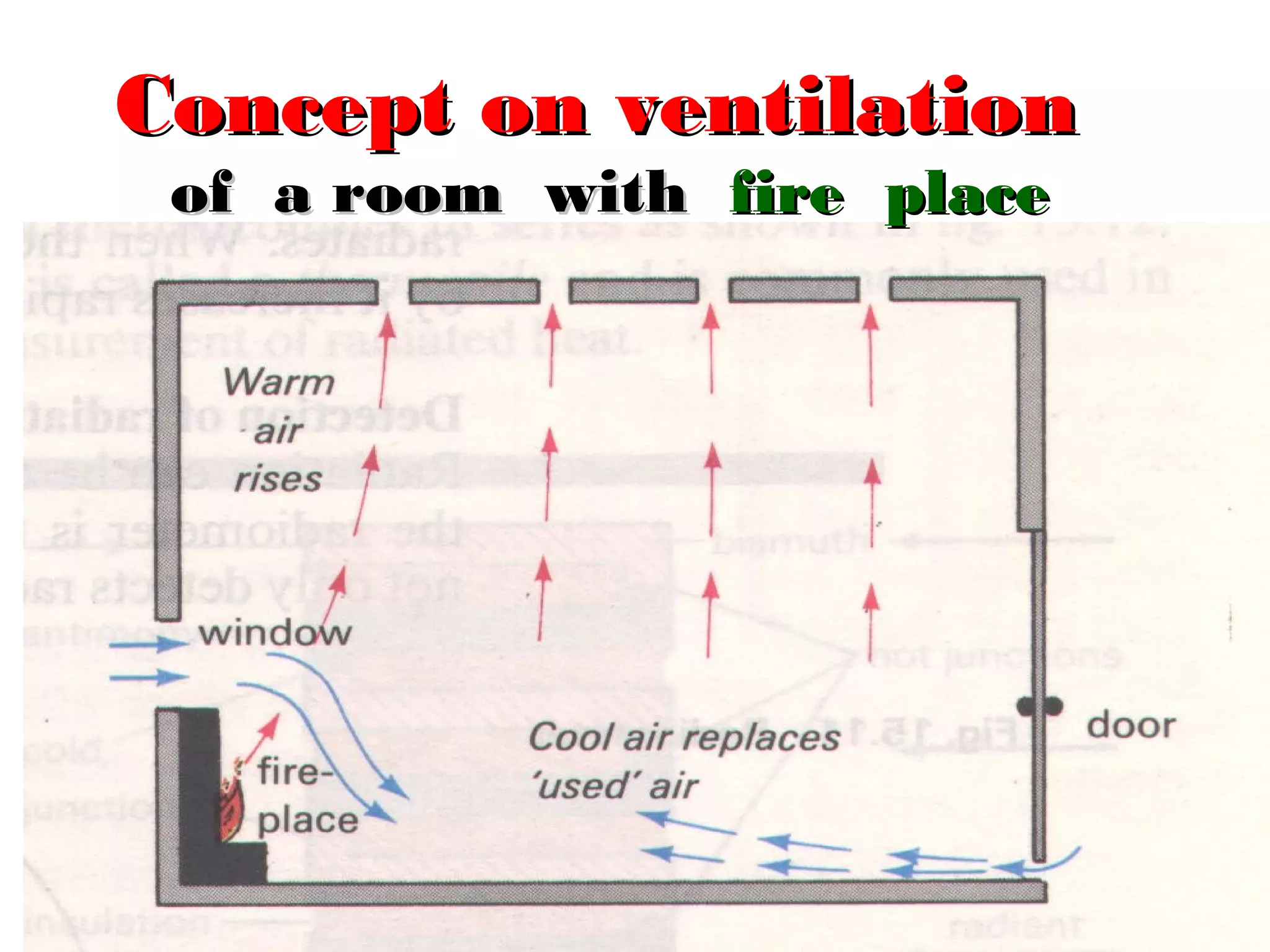
The fig. shows a simple demonstration of convection of gas.
The hot gases from the burning candle go straight up the
chimney above the candle. Cold air is drawn down the
other chimney to replace the air leaving the room.
Concept on ventilation
 of a room with fire place
Test Yourselves
1. Usually, it is better to install air conditioner in
   the higher portion of the wall. Please explain
   this statement with reasons.

2. How are winds forms ?

3. Why is the heating coil of an electric kettle
   placed near the bottom of the vessel ?
Application
    of
convection
  Sea Breeze


  Land Breeze
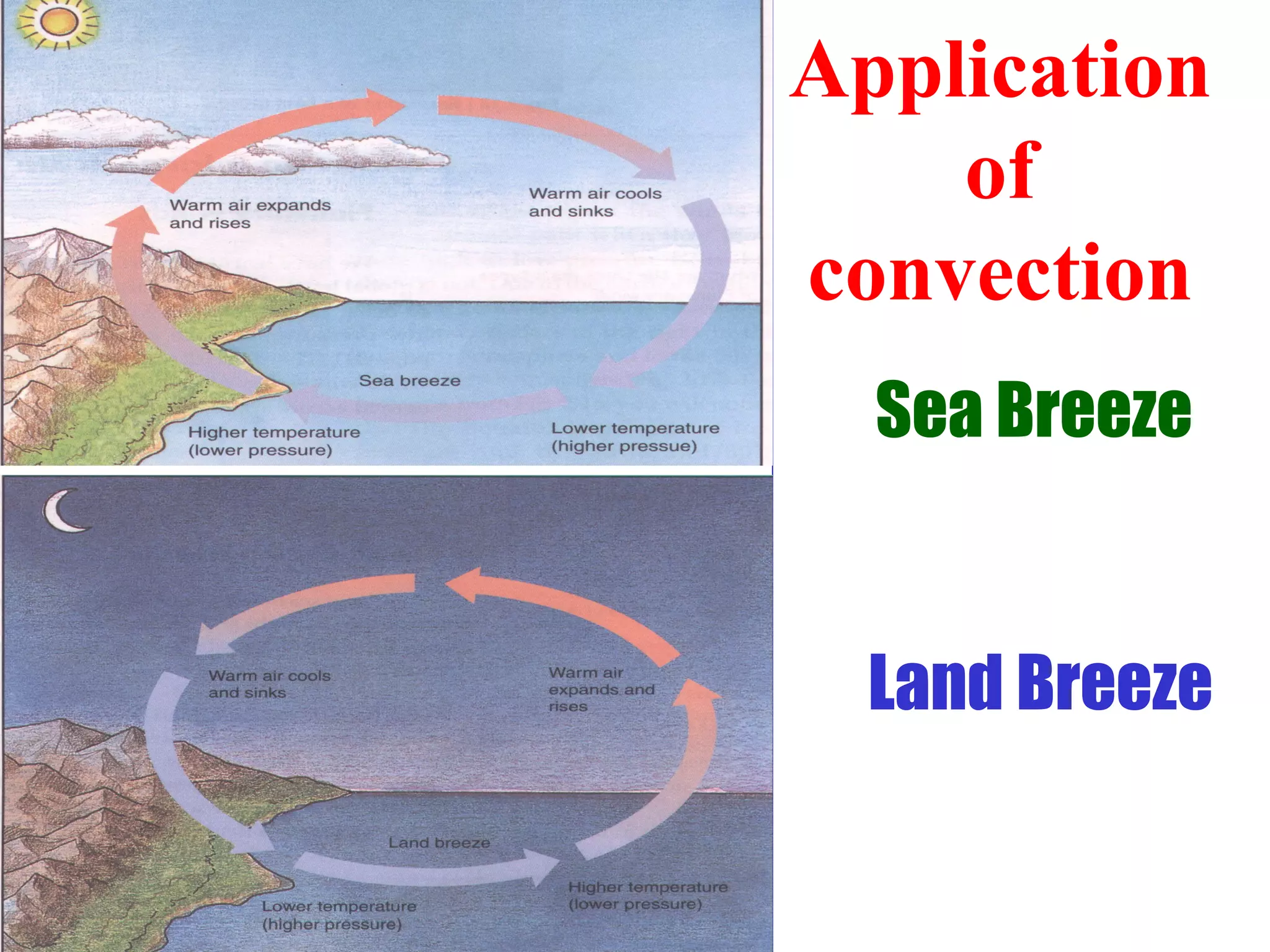
Sea Breeze
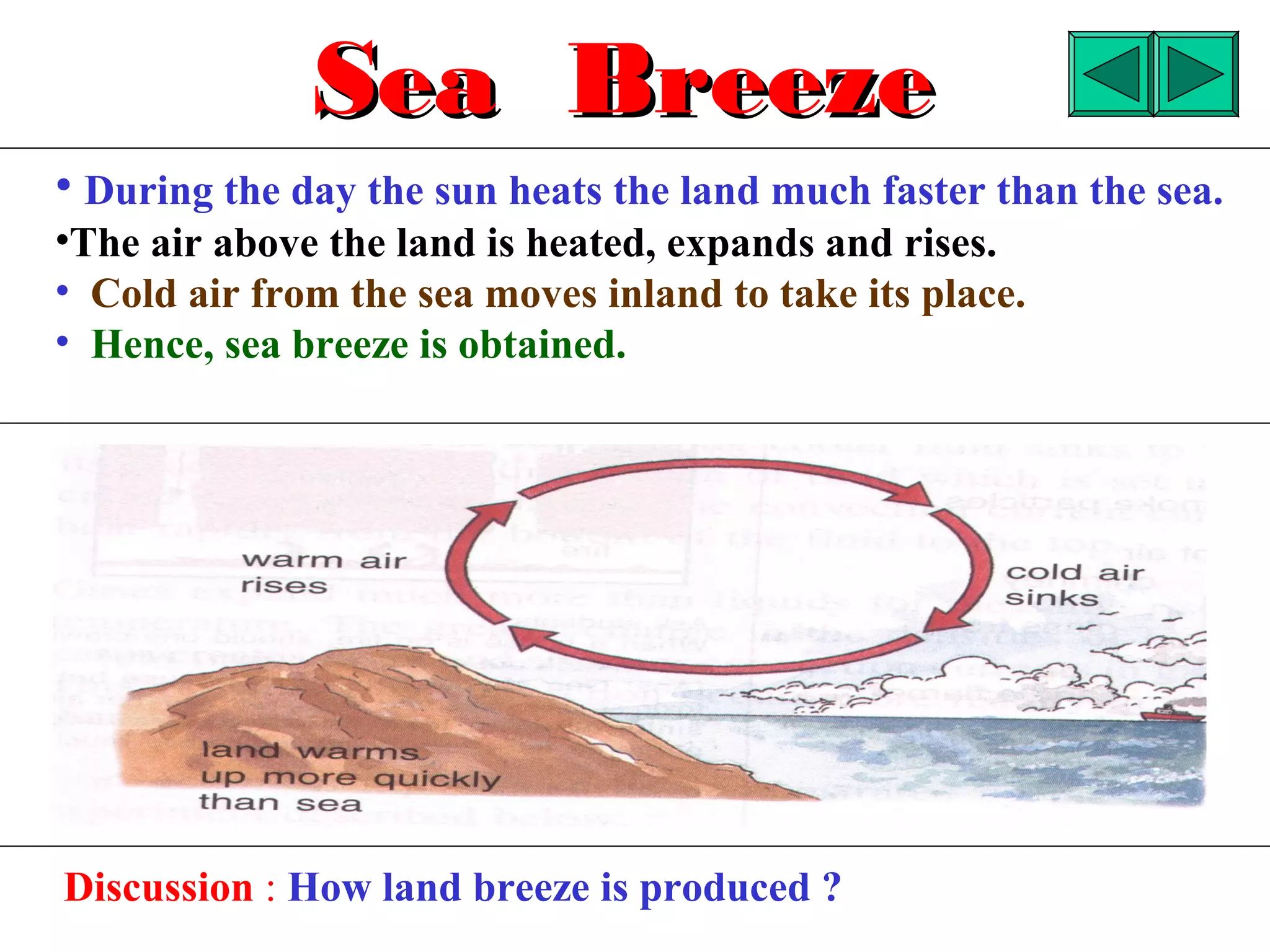
• During the day the sun heats the land much faster than the sea.
•The air above the land is heated, expands and rises.
• Cold air from the sea moves inland to take its place.
• Hence, sea breeze is obtained.


Discussion : How land breeze is produced ?
Land Breeze
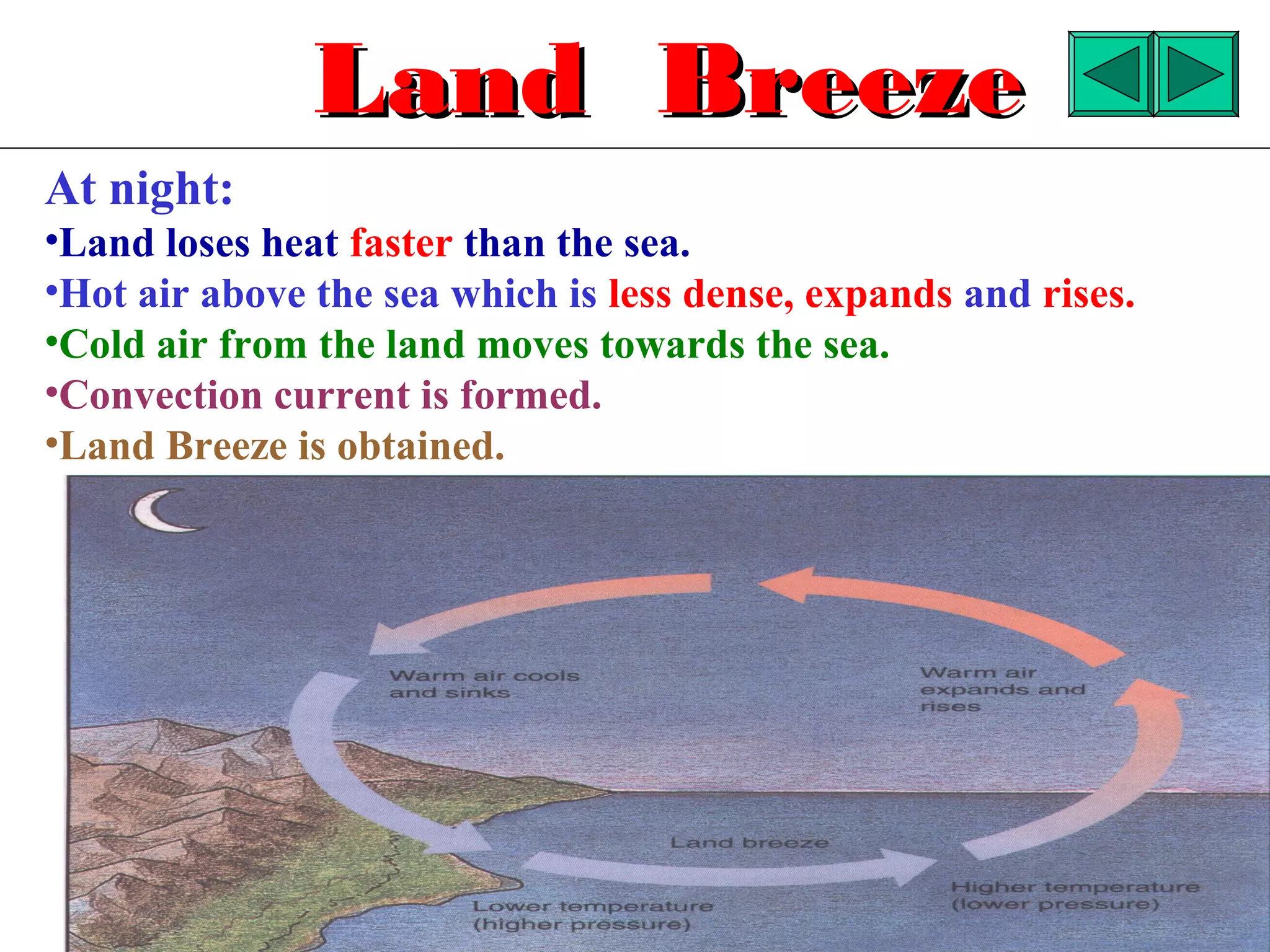
At night:
•Land loses heat faster than the sea.
•Hot air above the sea which is less dense, expands and rises.
•Cold air from the land moves towards the sea.
•Convection current is formed.
•Land Breeze is obtained.
Application of convection
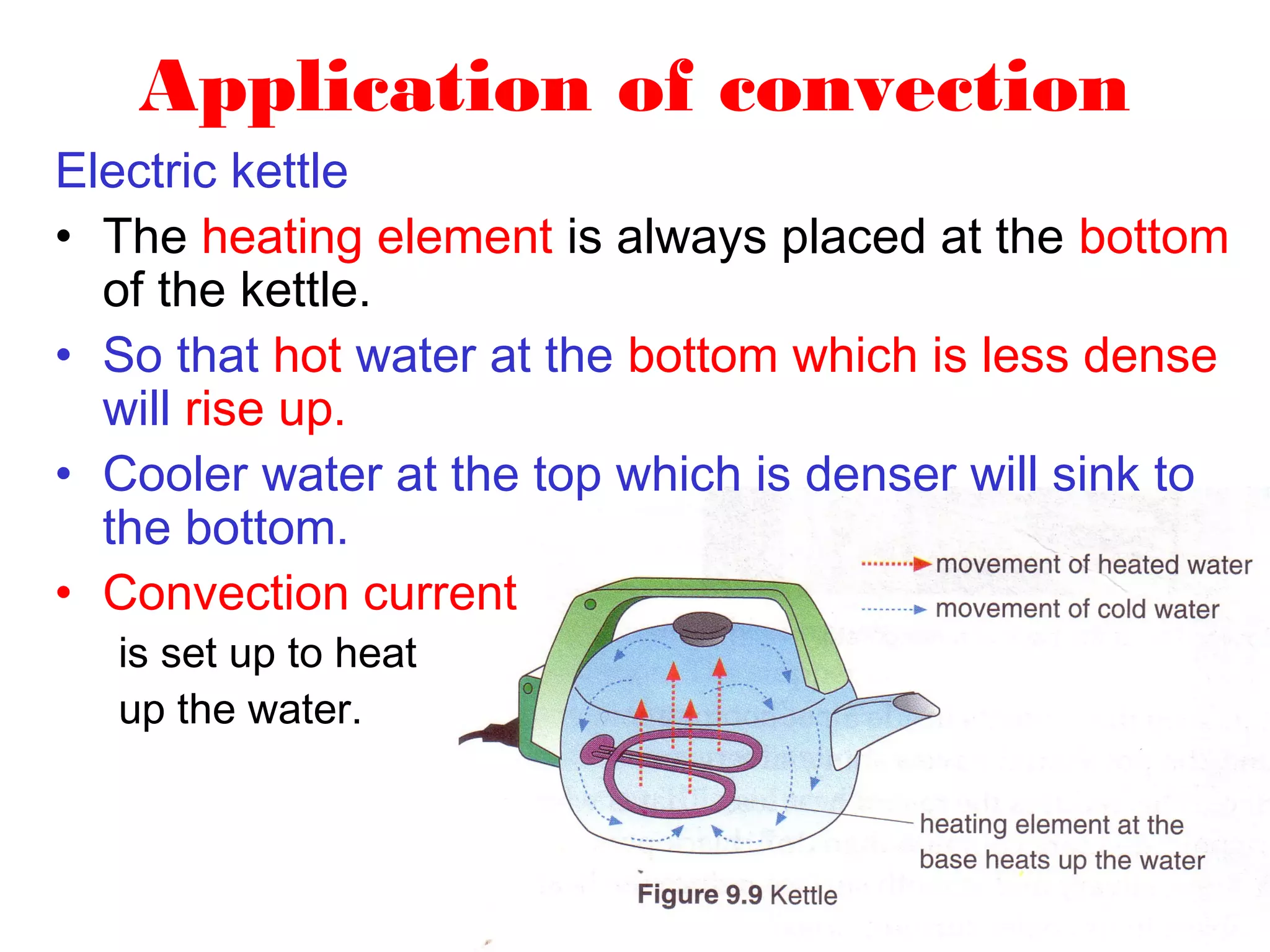
Electric kettle
• The heating element is always placed at the bottom
  of the kettle.
• So that hot water at the bottom which is less dense
  will rise up.
• Cooler water at the top which is denser will sink to
  the bottom.
• Convection current
  is set up to heat
  up the water.
Application of convection
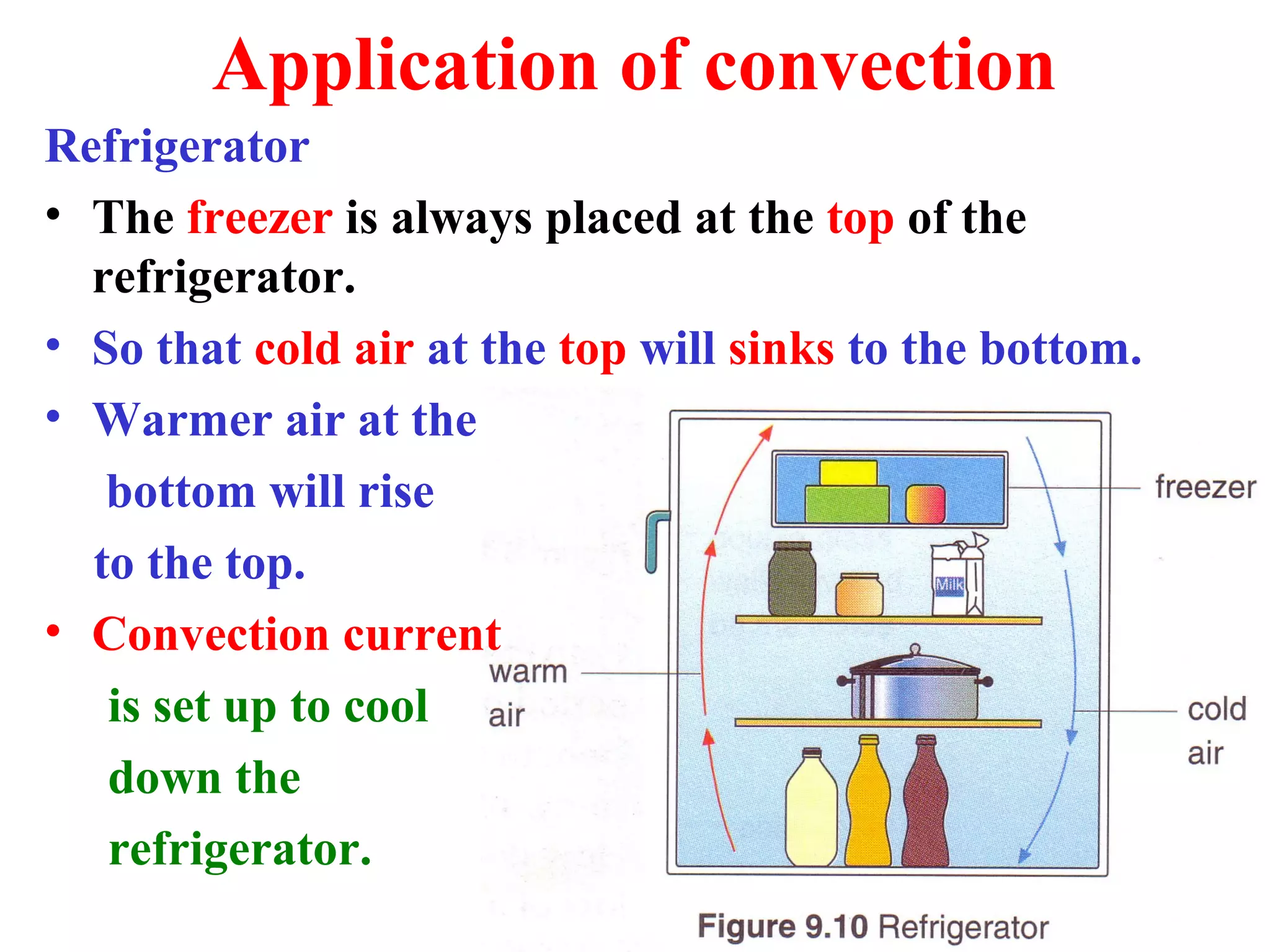
Refrigerator
• The freezer is always placed at the top of the
  refrigerator.
• So that cold air at the top will sinks to the bottom.
• Warmer air at the
   bottom will rise
  to the top.
• Convection current
   is set up to cool
   down the
   refrigerator.
Radiation
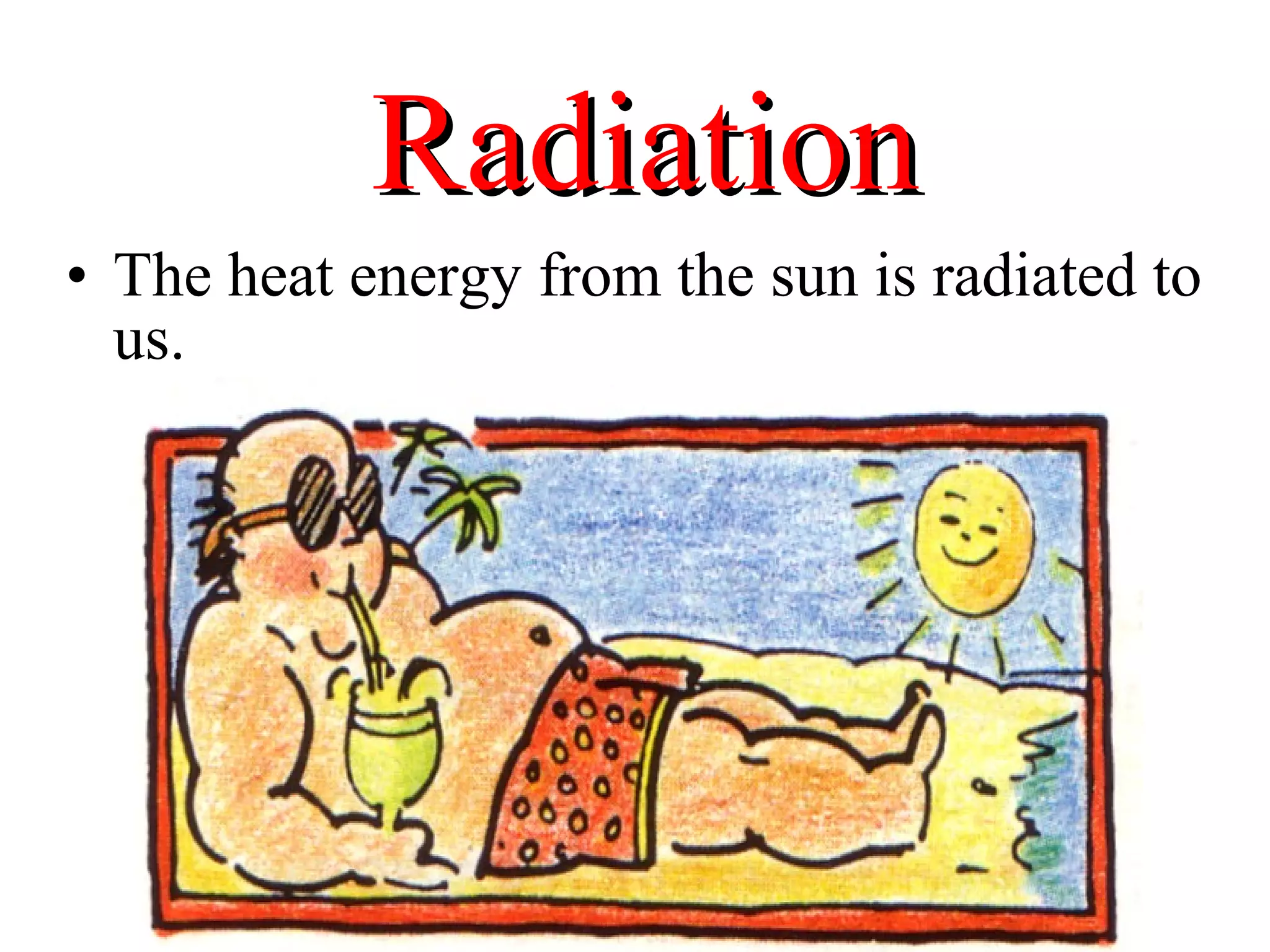
• The heat energy from the sun is radiated to
  us.
Radiation
Radiation is a method of heat transfer
that does not require any medium.
It can take place in a vacuum.
In radiation, heat transmits energy in
the form of waves.
Emit Heat
Radiation
• All objects emit /radiate or absorb heat.
• The heat is transferred in a form of
  infra-red radiation.
• Heating an object up make it radiate
  more energy.
• A dull dark surface is a better emitter or
  radiator than a shiny one.
What type of surface
is the best absorber of
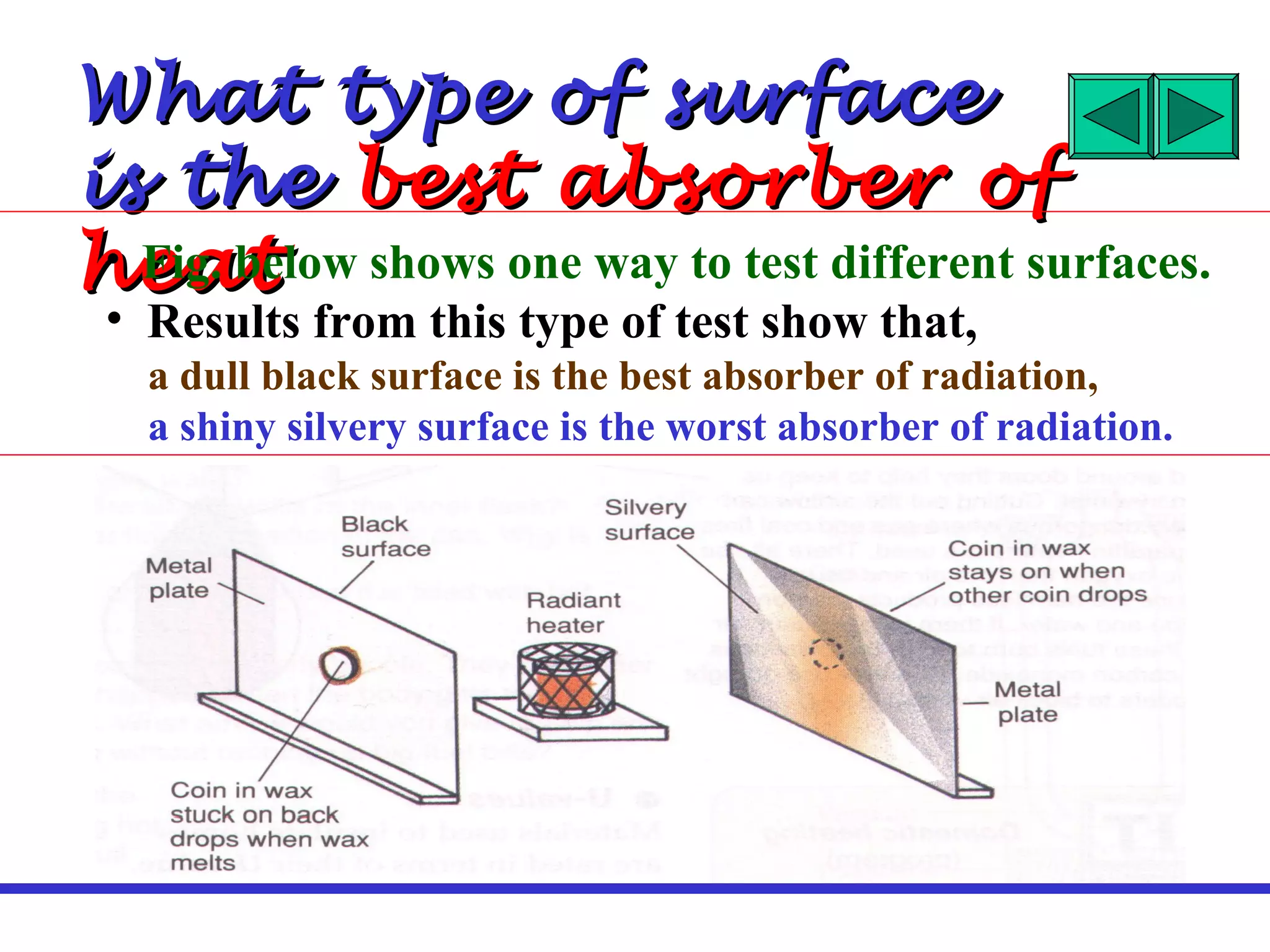
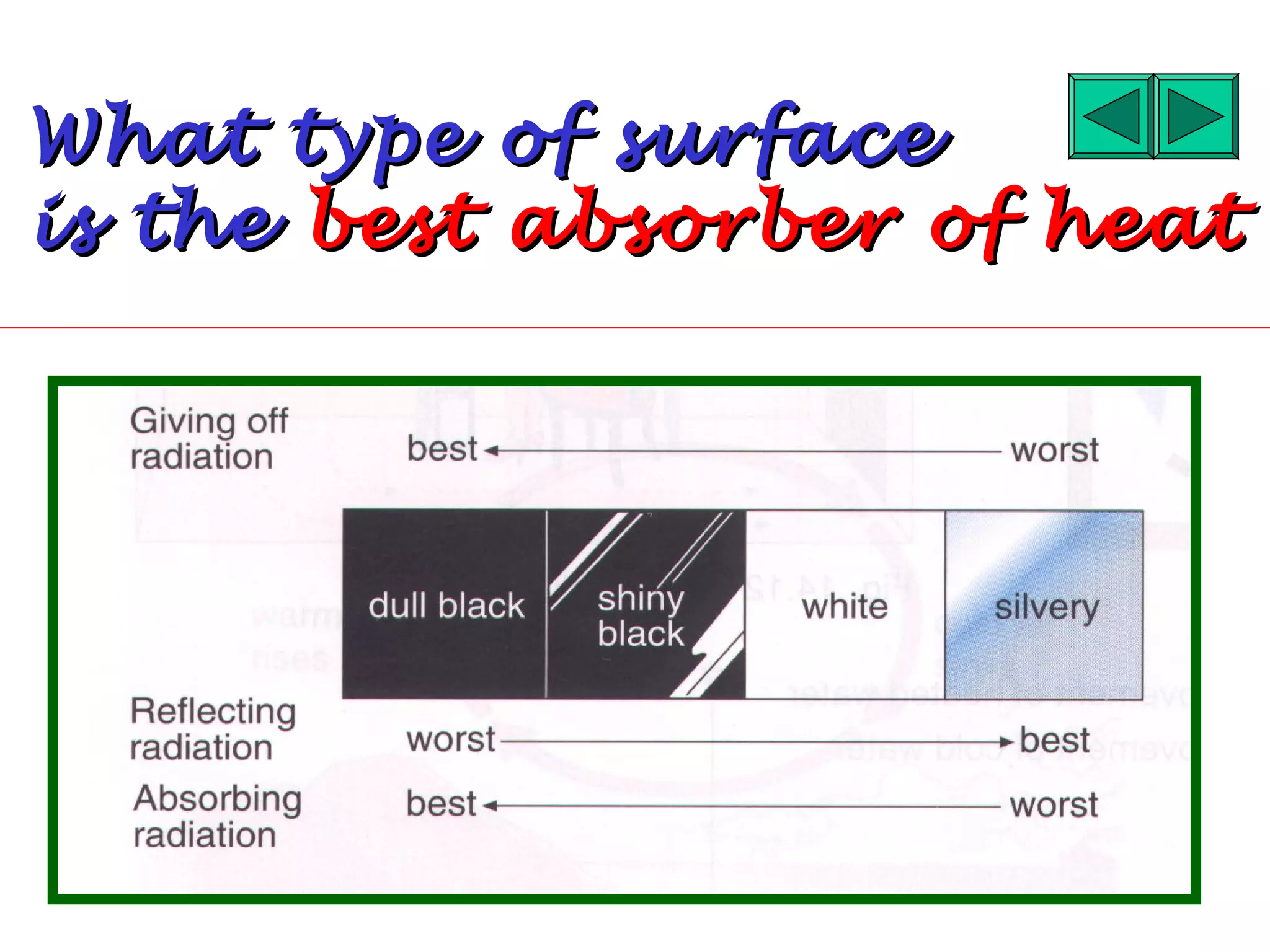
heat shows one way to test different surfaces.
 • Fig. below
 • Results from this type of test show that,
   a dull black surface is the best absorber of radiation,
   a shiny silvery surface is the worst absorber of radiation.
What type     of surface
is the best   absorber of heat
Test Yourselves
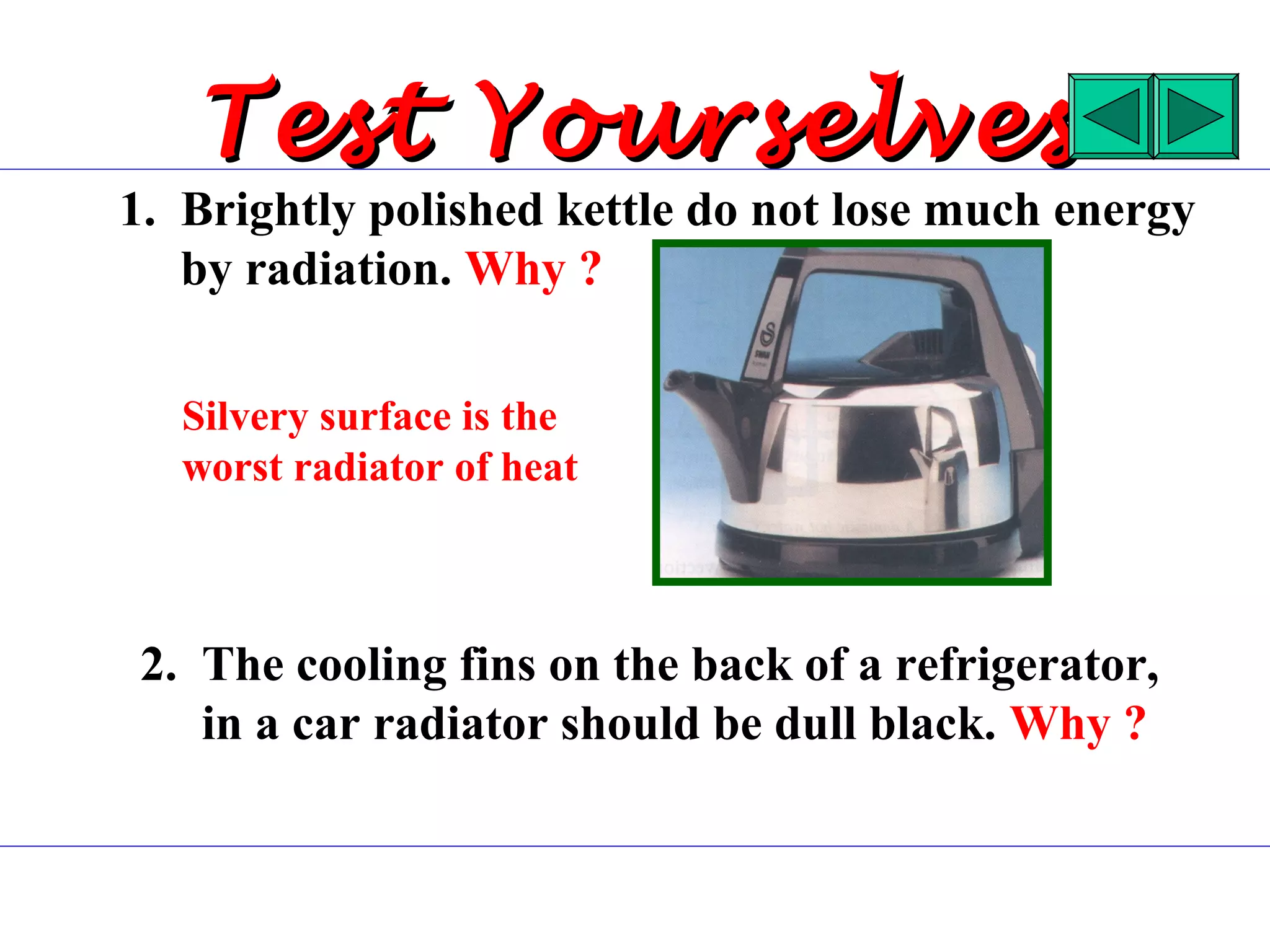
1. Brightly polished kettle do not lose much energy
   by radiation. Why ?

   Silvery surface is the
   worst radiator of heat


 2. The cooling fins on the back of a refrigerator,
    in a car radiator should be dull black. Why ?
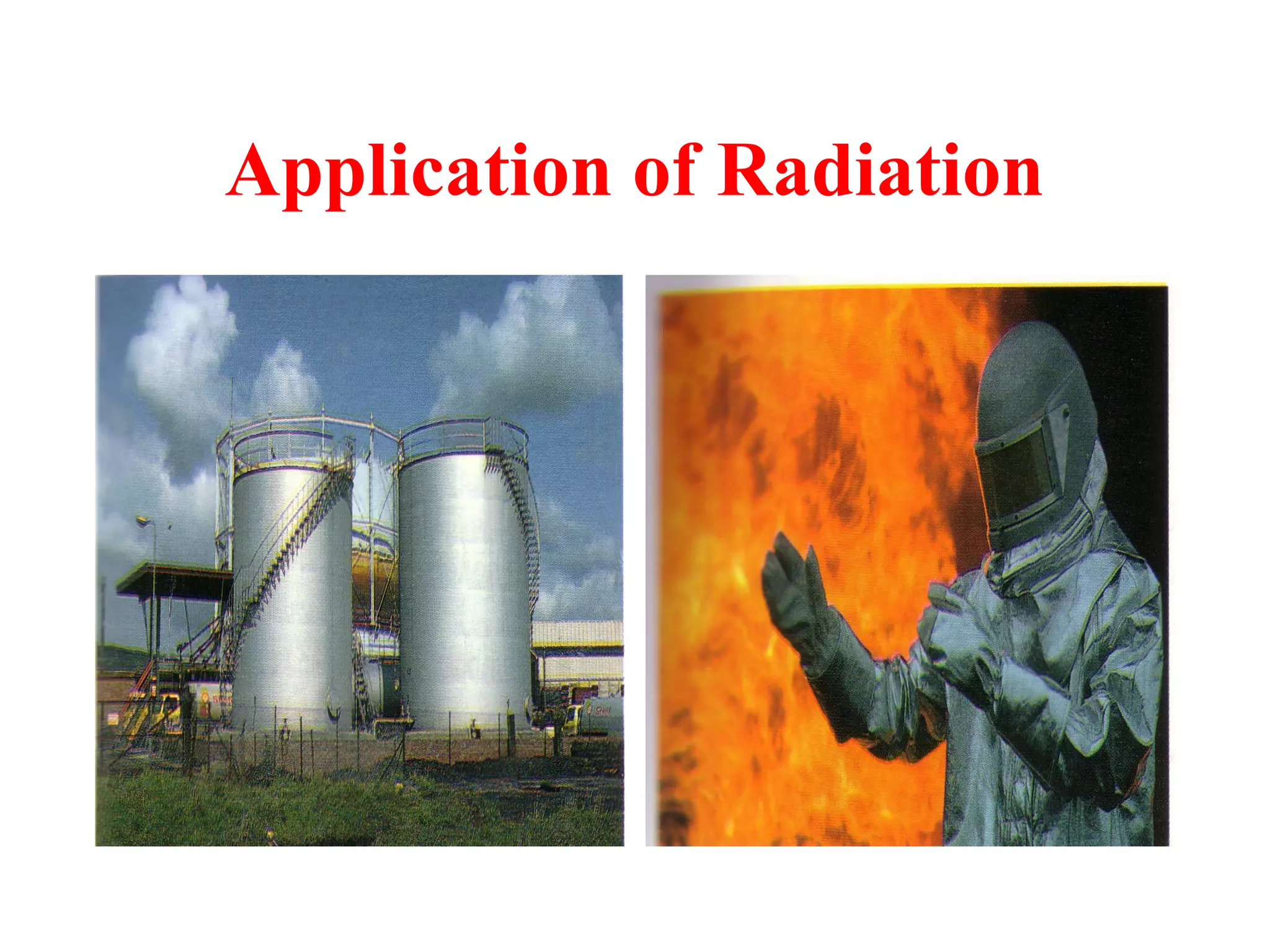
Application of Radiation
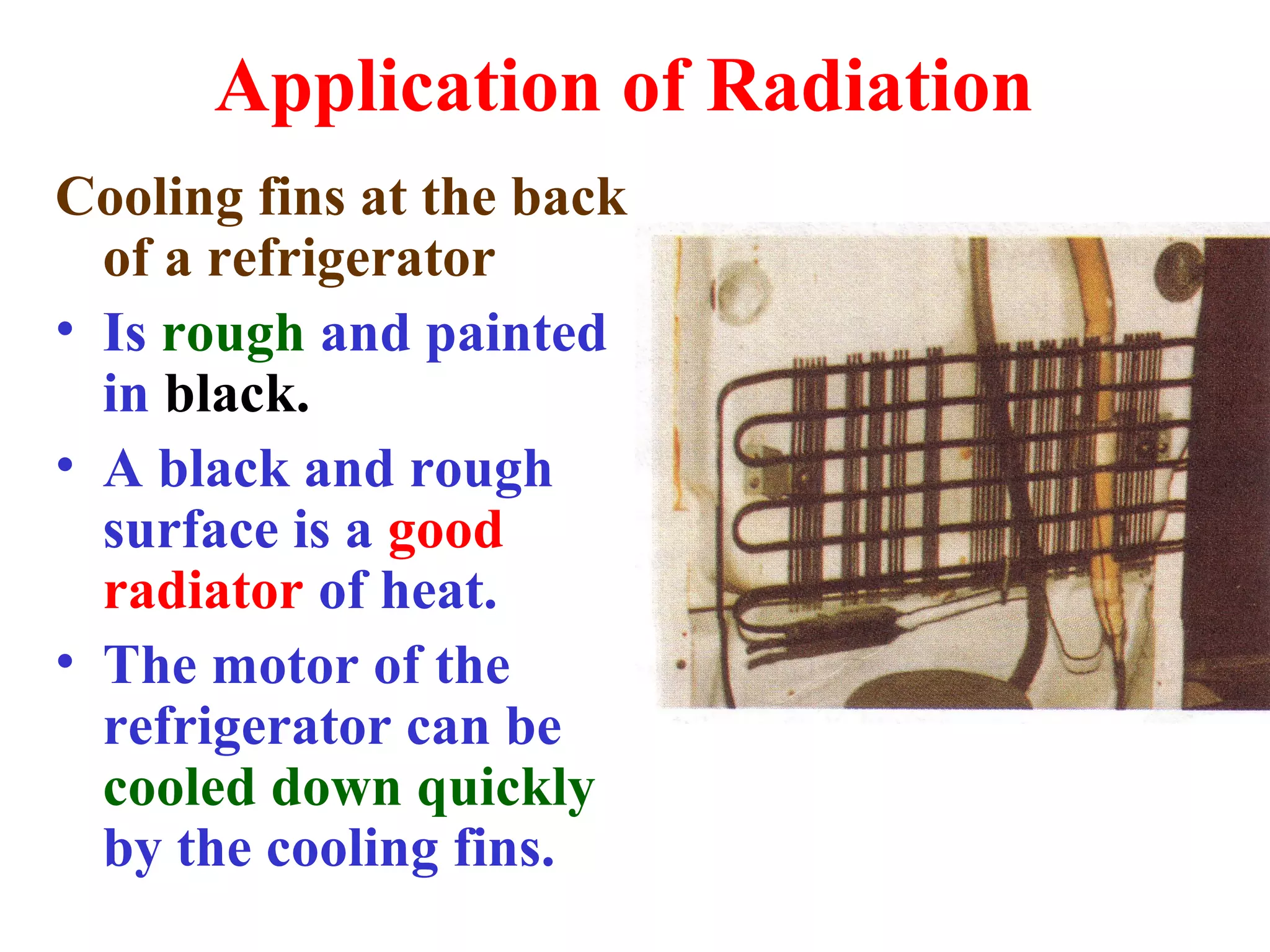
Cooling fins at the back
  of a refrigerator
• Is rough and painted
  in black.
• A black and rough
  surface is a good
  radiator of heat.
• The motor of the
  refrigerator can be
  cooled down quickly
  by the cooling fins.
Application of Radiation
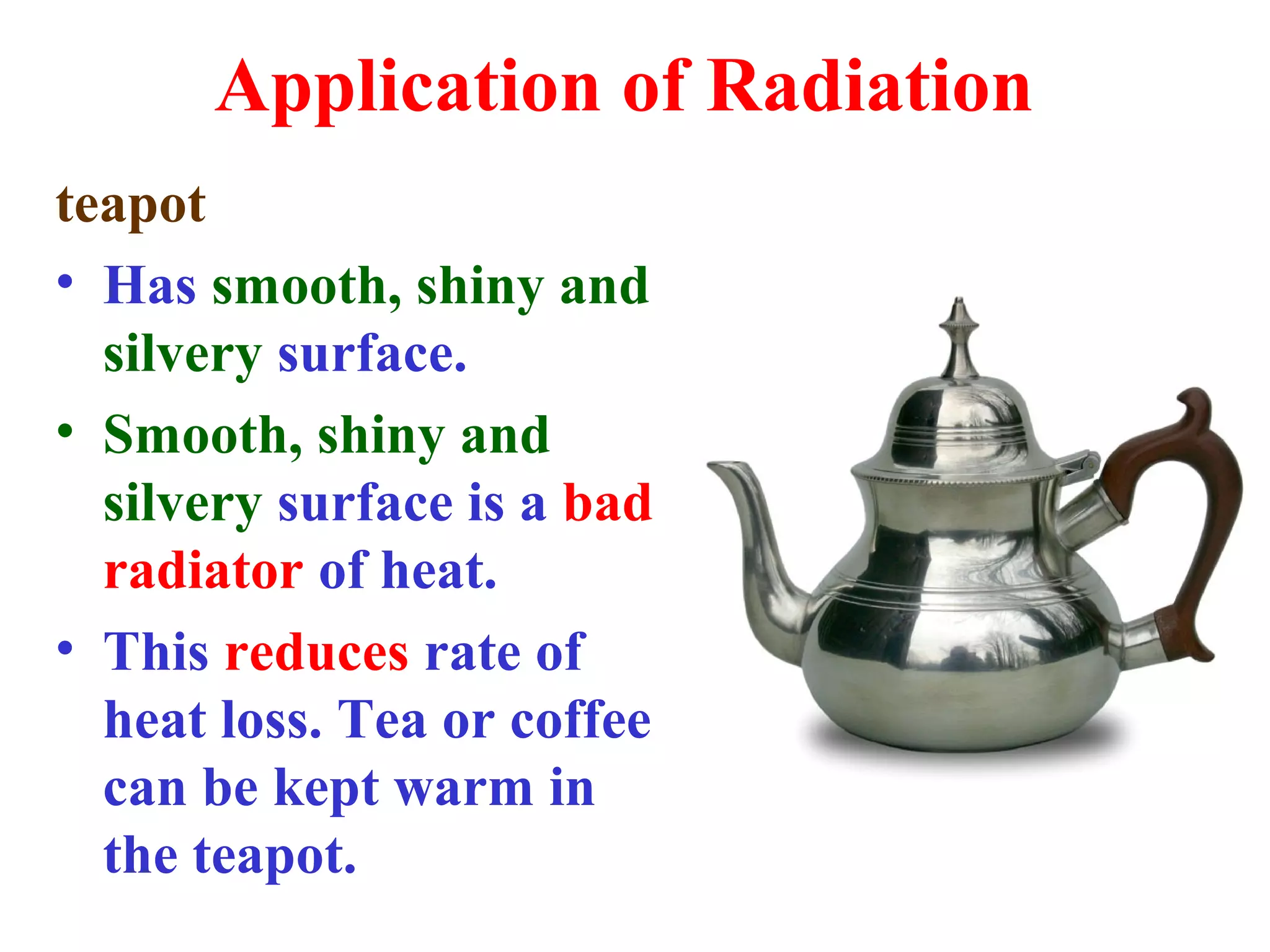
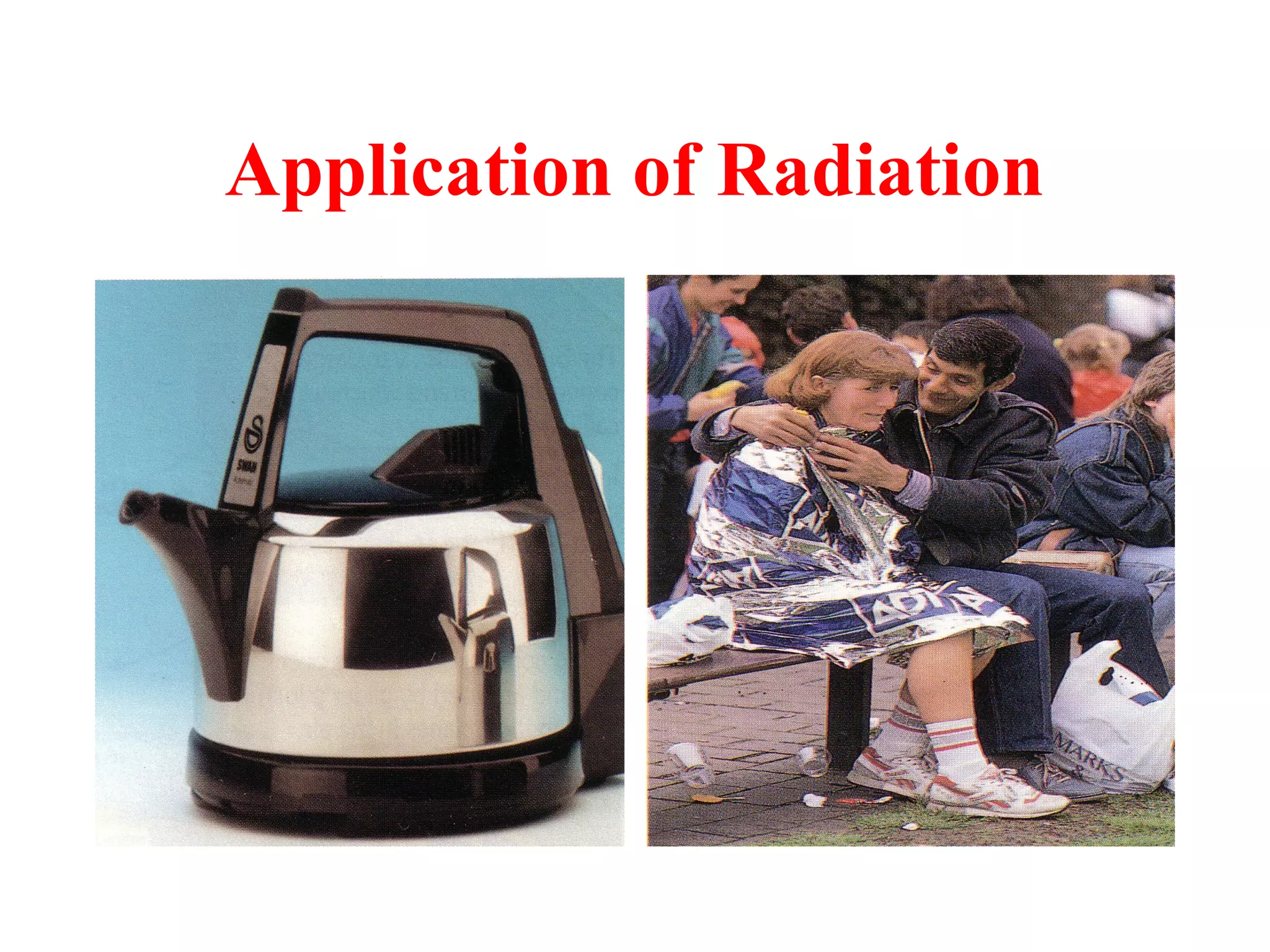
teapot
• Has smooth, shiny and
  silvery surface.
• Smooth, shiny and
  silvery surface is a bad
  radiator of heat.
• This reduces rate of
  heat loss. Tea or coffee
  can be kept warm in
  the teapot.
Application of Radiation
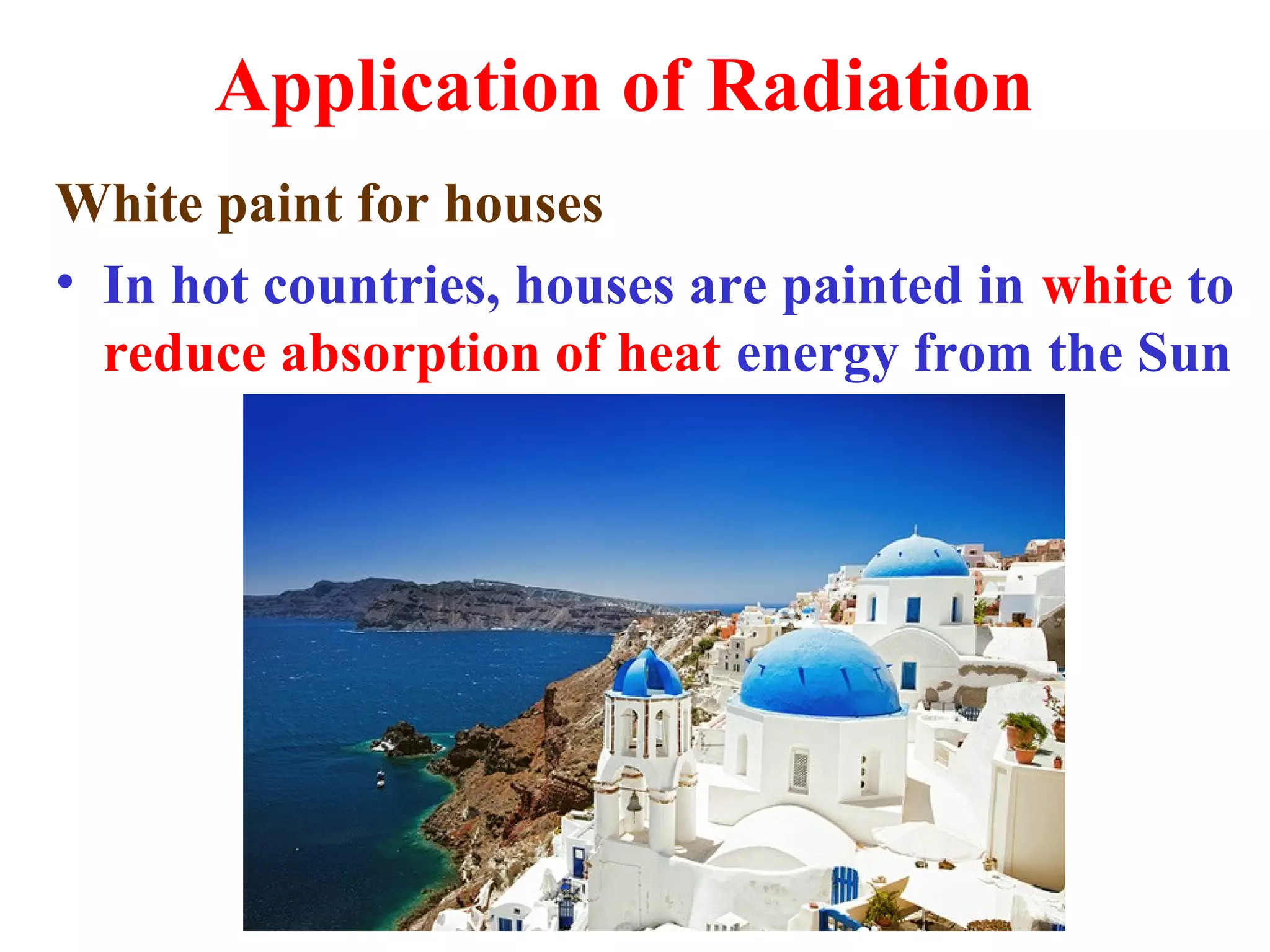
White paint for houses
• In hot countries, houses are painted in white to
  reduce absorption of heat energy from the Sun
Application of Radiation
Vacuum Flask
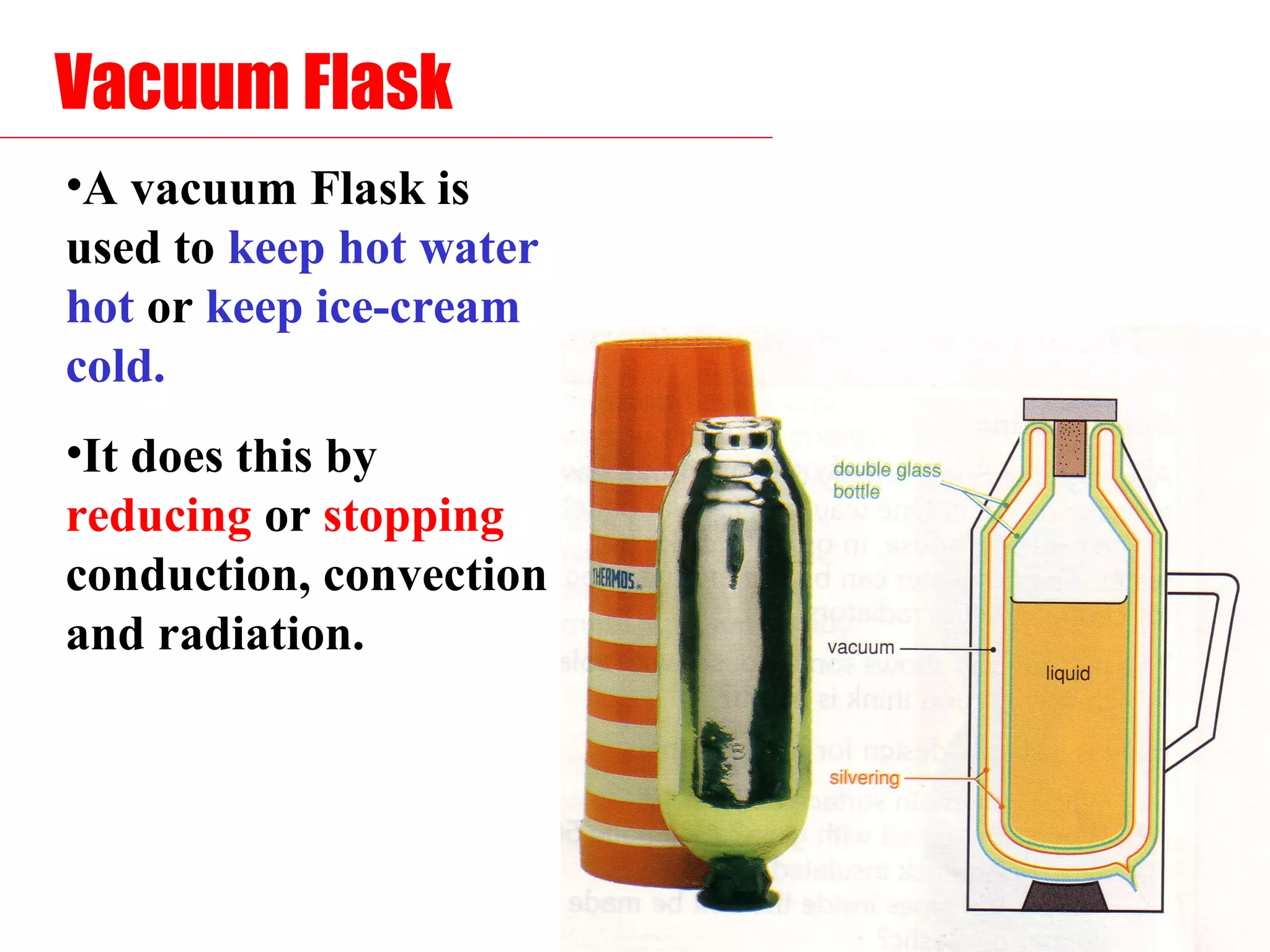
•A vacuum Flask is
used to keep hot water
hot or keep ice-cream
cold.
•It does this by
reducing or stopping
conduction, convection
and radiation.
Vacuum Flask
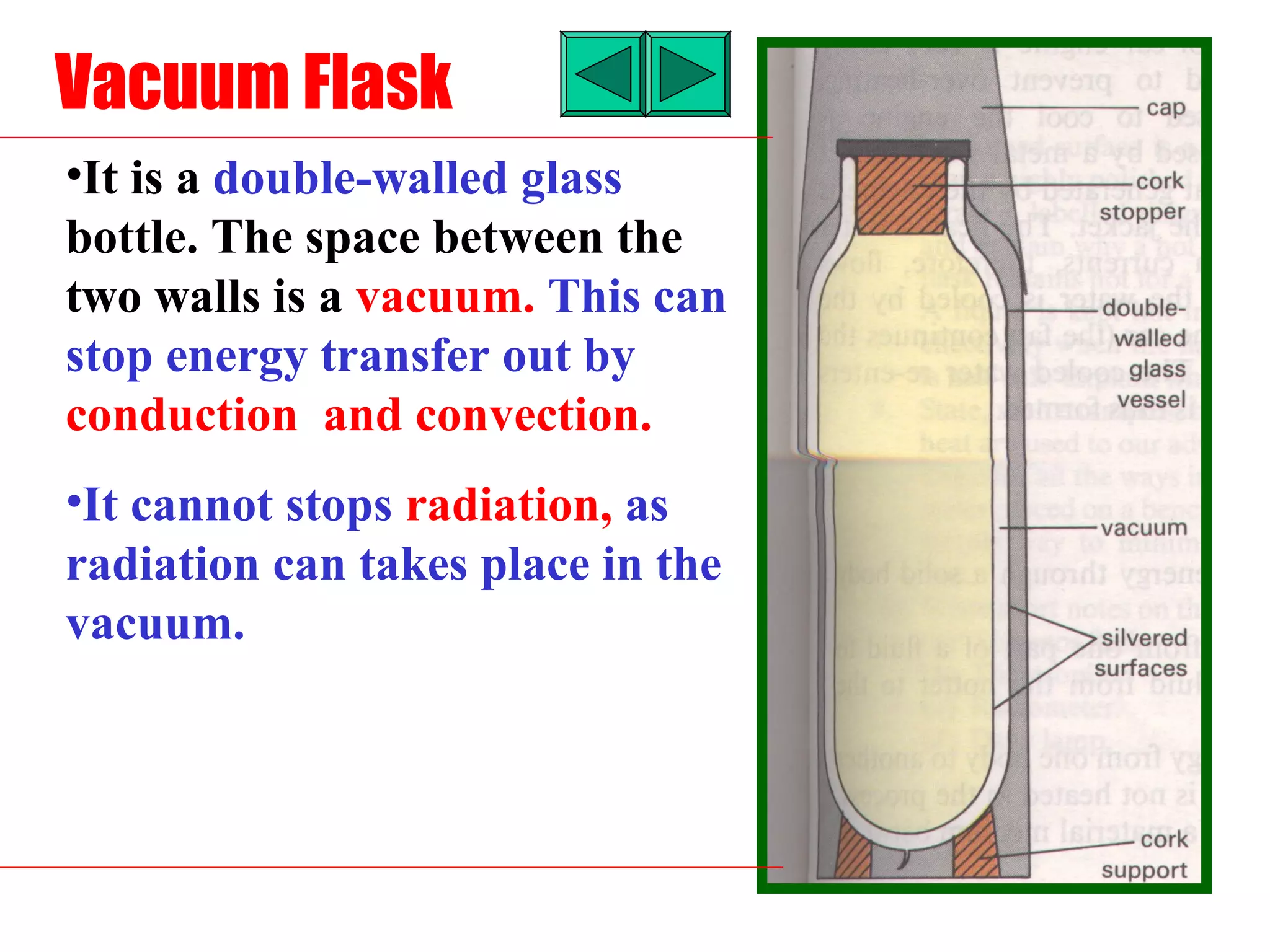
•It is a double-walled glass
bottle. The space between the
two walls is a vacuum. This can
stop energy transfer out by
conduction and convection.
•It cannot stops radiation, as
radiation can takes place in the
vacuum.
Vacuum Flask
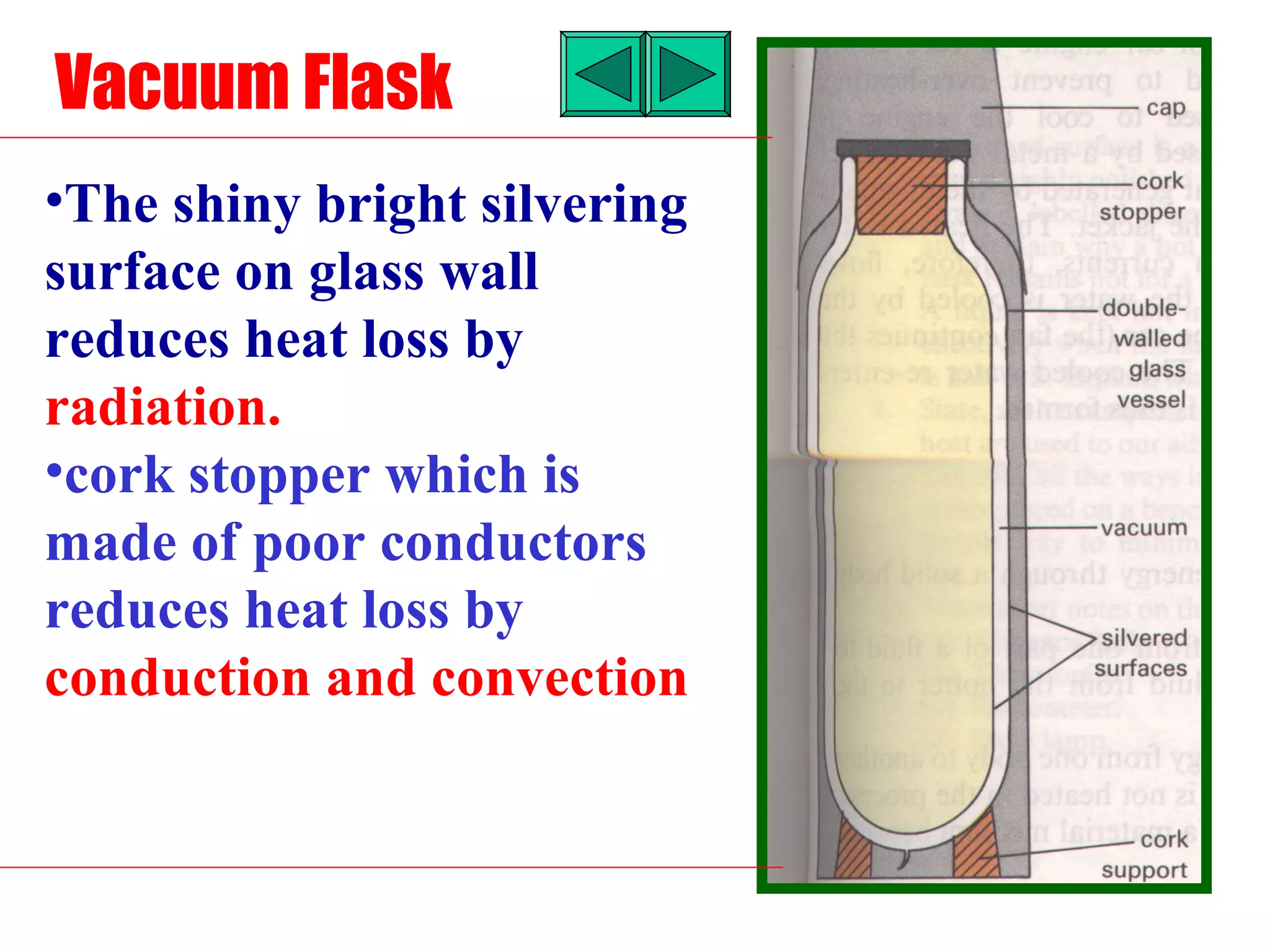
•The shiny bright silvering
surface on glass wall
reduces heat loss by
radiation.
•cork stopper which is
made of poor conductors
reduces heat loss by
conduction and convection

Coduction, convection and radiation

  • 1.
    Heat Transfer Conduction, Convection and Radiation
  • 2.
    Heat Transfer • Heatis a form of energy. • Heat travels from higher temperature(hotter) region to lower temperature(cooler) region. • Two bodies are in thermal equilibrium when there is no net transfer of thermal energy. http://www.physicslessons.com/exp12b.htm
  • 3.
    Thermal Equilibrium Body Ais at a higher temperature than body B. When bodies A and B are in contact, A loses thermal energy at a rate higher than the rate at which it absorbs thermal energy from B. Heat transfer from A to B A B
  • 4.
    Thermal Equilibrium This causesa temperature drop in body A and an increase in temperature in body B. Finally, the two bodies A and B have the same temperature. Heat transfer from A to B A Heat transfer B from B to A They are in thermal equilibrium.
  • 5.
    Thermal Equilibrium • Heatalways travels from a region of higher temperature to a region of lower temperature HOT heat COLD
  • 6.
    Thermal Inequilibrium • Iftwo bodies are in thermal inequilibrium, it means their temperature are not the same. • When they are placed in contact, the thermal transfer occurs. HOT heat COLD
  • 7.
    Heat Transfer Methods • The three methods of heat transfer are –Conduction –Convection –Radiation
  • 8.
    Heat Transfer Methods • Liquids get heated up by convection currents.
  • 9.
    Heat Transfer Methods • In solid, heat is transferred as vibrations of atoms or molecules in fixed positions spread over the entire solid.
  • 10.
    Heat Transfer Methods • In vacuum, heat is transferred by radiation. Example: Heat from the Sun reaches the Earth by Radiation.
  • 11.
    Conduction • Get apiece of stiff copper wire about the same length as a match. • Strike the match and hold the copper wire in the flame.
  • 12.
    Conduction • What happens? The copper wire is heated up. • Does the energy get to your hand quicker through wood or through copper? • We say that copper is a better conductor than wood. The energy has traveled from atom to atom through the copper.
  • 13.
    Conduction • Conduction isheat flow through SOLIDS without any visible movement. • It is due to temperature differences. • Heat flows from high temperature region to a slower temperature region.
  • 14.
  • 15.
    Conduction Conduction is theprocess by which heat is transmitted through a medium from one particle to another.
  • 16.
    Conduction Get three rodsof the same size. The rods are made of copper, iron and glass. Rest them on a tripod and fix a small nail at one end of each rod. Heat the other ends of the rods equally with a Bunsen Burner. What happens? The nails from different materials dropped off from the rod at different time.
  • 17.
    Conduction Material Time taken for pin to drop(s) copper 14 iron 73 glass Did not drop From the experiment it shows that nail from the copper drops off first at 14 seconds. This is because heat travels faster through copper than iron and glass. We say that copper is a good conductor of heat.
  • 18.
    Conductors Good conductors ofheat refer to objects that can conduct heat very fast. All metals are good conductors of heat. Examples: Copper, silver, iron, mercury are good conductors.
  • 19.
    Insulators Insulators are materialsthat heat cannot travel through. They are poor conductors of heat. Poor conductors are good insulators. Non-metals, such as plastic and air, are poor conductor. Liquids and gases are usually poor conductors The poorest conductor is vacuum.
  • 20.
    Why are metalsgood thermal conductors? There are delocalised electrons (‘free’ electrons) in metals These free electrons can move freely throughout the metals When heated, these free electrons gain kinetic energy and move from the hotter end to the colder end, carrying energy with them. This process is much faster than conduction by the vibration of the molecules.
  • 21.
    Insulators Insulators are usedto lag pipes, lofts, hot water tanks and many other objects. Fibre glass insulation is a popular choice for home insulations.
  • 22.
    Test Yourselves • Heata test tube of water near the top with a ‘weighted’ ice cube near the bottom. Even when the water at the top starts boiling, the ice cube does not melt. Why ? Ans.: Water is a poor conductor of heat.
  • 23.
    Is air goodconductor or insulator Hold a match about 1 cm away from a very hot Bunsen flame. Does the match get hot enough to burst into flame? This shows that air is a very poor conductor – it is a very good insulators. All gases are poor conductors.
  • 24.
    Application of conduction Solderingiron • Iron rod is a good conductor of heat with copper tip. • The handle is made of plastic which is a good insulator.
  • 25.
    Application of conduction Homeelectrical appliances • The handles of kettles, hot iron, cooking utensils are made of wood and plastics which are the good insulators of heat.
  • 26.
    Insulation • The airtrapped in the fur and feather to keep animals warm. • Birds fluff up their feathers in winter to trap more air. • Polar bears have thick fur to trap more air and keep them warm.
  • 27.
    Insulation • A refrigeratorhas insulation material round it to keep it cold. • The insulation reduces the amount of heat conducted to the inside from the warmer room.
  • 28.
    Insulation • Many insulatorscontain tiny pockets of trapped air to stop heat conducted away. • Wool feels warm because it traps a lot of air. • The air trapped in and between our clothes and blankets keeps us warm.
  • 29.
    Insulation Pipes and hot-water tanksare lagged with insulation material to reduce the loss of energy.
  • 30.
    Insulation Lagging in acavity wall provides extra insulation
  • 31.
    Convection Hold your hand over and under the flame of a match. What do you notice? Why? Hot air expands, becomes less dense and then rises. Heat is convected upwards.
  • 32.
    Convection Convection is theprocess by which heat is transmitted from one place to another by the movement of heated particles of a gas or liquid.
  • 33.
    Convection in Liquids • To demonstrate convection in water, drop a few tiny crystals of potassium permanganate into a flask filled with water. • Gently heat the flask, purple streaks of water will rise upwards and then fan outwards. • The water becomes uniformly purplish after some time. • The circulation of a liquid in this matter is called a convection current. Thinking : Why hot water rises and cold water sinks ?
  • 34.
  • 35.
  • 36.
    Convection in Gases The fig. shows a simple demonstration of convection of gas. The hot gases from the burning candle go straight up the chimney above the candle. Cold air is drawn down the other chimney to replace the air leaving the room.
  • 37.
    Concept on ventilation of a room with fire place
  • 38.
    Test Yourselves 1. Usually,it is better to install air conditioner in the higher portion of the wall. Please explain this statement with reasons. 2. How are winds forms ? 3. Why is the heating coil of an electric kettle placed near the bottom of the vessel ?
  • 39.
    Application of convection Sea Breeze Land Breeze
  • 40.
    Sea Breeze • Duringthe day the sun heats the land much faster than the sea. •The air above the land is heated, expands and rises. • Cold air from the sea moves inland to take its place. • Hence, sea breeze is obtained. Discussion : How land breeze is produced ?
  • 41.
    Land Breeze At night: •Landloses heat faster than the sea. •Hot air above the sea which is less dense, expands and rises. •Cold air from the land moves towards the sea. •Convection current is formed. •Land Breeze is obtained.
  • 42.
    Application of convection Electrickettle • The heating element is always placed at the bottom of the kettle. • So that hot water at the bottom which is less dense will rise up. • Cooler water at the top which is denser will sink to the bottom. • Convection current is set up to heat up the water.
  • 43.
    Application of convection Refrigerator •The freezer is always placed at the top of the refrigerator. • So that cold air at the top will sinks to the bottom. • Warmer air at the bottom will rise to the top. • Convection current is set up to cool down the refrigerator.
  • 44.
    Radiation • The heatenergy from the sun is radiated to us.
  • 45.
    Radiation Radiation is amethod of heat transfer that does not require any medium. It can take place in a vacuum. In radiation, heat transmits energy in the form of waves.
  • 46.
    Emit Heat Radiation • Allobjects emit /radiate or absorb heat. • The heat is transferred in a form of infra-red radiation. • Heating an object up make it radiate more energy. • A dull dark surface is a better emitter or radiator than a shiny one.
  • 47.
    What type ofsurface is the best absorber of heat shows one way to test different surfaces. • Fig. below • Results from this type of test show that, a dull black surface is the best absorber of radiation, a shiny silvery surface is the worst absorber of radiation.
  • 48.
    What type of surface is the best absorber of heat
  • 49.
    Test Yourselves 1. Brightlypolished kettle do not lose much energy by radiation. Why ? Silvery surface is the worst radiator of heat 2. The cooling fins on the back of a refrigerator, in a car radiator should be dull black. Why ?
  • 50.
    Application of Radiation Coolingfins at the back of a refrigerator • Is rough and painted in black. • A black and rough surface is a good radiator of heat. • The motor of the refrigerator can be cooled down quickly by the cooling fins.
  • 51.
    Application of Radiation teapot •Has smooth, shiny and silvery surface. • Smooth, shiny and silvery surface is a bad radiator of heat. • This reduces rate of heat loss. Tea or coffee can be kept warm in the teapot.
  • 52.
    Application of Radiation Whitepaint for houses • In hot countries, houses are painted in white to reduce absorption of heat energy from the Sun
  • 53.
  • 54.
  • 55.
    Vacuum Flask •A vacuumFlask is used to keep hot water hot or keep ice-cream cold. •It does this by reducing or stopping conduction, convection and radiation.
  • 56.
    Vacuum Flask •It isa double-walled glass bottle. The space between the two walls is a vacuum. This can stop energy transfer out by conduction and convection. •It cannot stops radiation, as radiation can takes place in the vacuum.
  • 57.
    Vacuum Flask •The shinybright silvering surface on glass wall reduces heat loss by radiation. •cork stopper which is made of poor conductors reduces heat loss by conduction and convection