s The de novo syynntthheessiiss ooff gglluuccoossee aanndd iittss rroollee 
iinn pprreevveennttiinngg hhyyppooggllyycceemmiiaa
Gluconeogenesis: Overview 
Figure 13-2 

General Features 
 Tissues:  
 liver (80%) 
 kidneys (20%) 
 Subcellular location of 
enzymes 
 pyruvate carboxylase: 
mitochondrial 
 glucose-6-phosphatase: 
ER 
 all other enzymes 
cytoplasmic
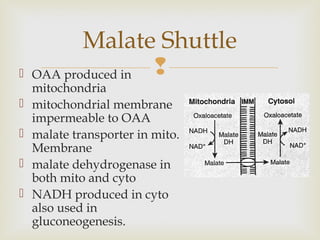
Malate Shuttle 
 OAA produced in  
mitochondria 
 mitochondrial membrane 
impermeable to OAA 
 malate transporter in mito. 
Membrane 
 malate dehydrogenase in 
both mito and cyto 
 NADH produced in cyto 
also used in 
gluconeogenesis.
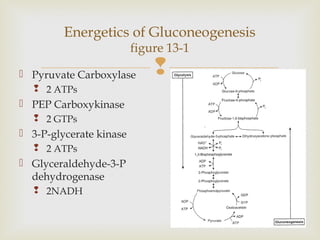
Energetics of Gluconeogenesis 
  Pyruvate Carboxylase 
 2 ATPs 
 PEP Carboxykinase 
 2 GTPs 
 3-P-glycerate kinase 
 2 ATPs 
 Glyceraldehyde-3-P 
dehydrogenase 
 2NADH 
figure 13-1
Precursers for gluconeogenesis 
figure 13-2 
 
 Glycerol 
 derived from adipocyte lipolysis 
 hepatic glycerol kinase
Precursers for gluconeogenesis 
 Lactate  
 RBC 
 muscle 
 the Cori Cycle 
Figure13-3
Precursers for gluconeogenesis 
 Alanine and other amino acids 
 transamination of pyruvate 
 pyruvate derived from glycolysis or from amino acid 
degradation 
 alanine cycle 
figure 13-4
Coordinated Regulation of 
Gluconeogenesis and Glycolysis 
  Gluconeogenesis and Glycolysis are 
regulated by similar effector molecues 
but in the opposite direction 
 avoid futile cycles 
 PK vs PC&PEPCK 
 PFK-1 vs FDP’tase 
 GK vs G6P’tase
Coordinated Regulation of 
Gluconeogenesis and Glycolysis 
 Regulation of enzyme  
quantity 
 Fasting: glucagon, cortisol 
 induces gluconeogenic 
enzymes 
 represses glycolytic enzymes 
 liver making glucose 
 Feeding: insulin 
 induces glycolytic enzymes 
 represses gluconeogenic 
enzymes 
 liver using glucose
Coordinated Regulation of 
Gluconeogenesis and Glycolysis 
 Short-term Hormonal Effects 
 Glucagon, Insulin 
 cAMP & F2,6P2 
 PFK-2 & FBPase-2 
 A Bifunctional enzyme 
 cAMP 
 Inactivates PFK-2 
 Activates FBPase-2 
 Decreases F2,6P2 
 Reduces activation of PFK-1 
 Reduces inhibition of FBPase-1 
 Low blood sugar results in 
 Hi gluconeogenesis 
 Lo glycolysis
Coordinated Regulation of 
Gluconeogenesis and Glycolysis 
  Allosteric Effects 
 Pyruvate kinase vs Pyruvate carboxylase 
 PK - Inhibited by ATP and alanine 
 PC - Activated by acetyl CoA 
 Fasting results in gluconeogenesis 
 PFK-1 vs FBPase-1 
 FBPase-1 inhibited by AMP & F2,6P2 
 PFK-1 activated by AMP and & F2,6P2 
 Feeding results in glycolysis

Gluconeogenesis

  • 1.
    s The denovo syynntthheessiiss ooff gglluuccoossee aanndd iittss rroollee iinn pprreevveennttiinngg hhyyppooggllyycceemmiiaa
  • 2.
  • 3.
    General Features Tissues:   liver (80%)  kidneys (20%)  Subcellular location of enzymes  pyruvate carboxylase: mitochondrial  glucose-6-phosphatase: ER  all other enzymes cytoplasmic
  • 4.
    Malate Shuttle OAA produced in  mitochondria  mitochondrial membrane impermeable to OAA  malate transporter in mito. Membrane  malate dehydrogenase in both mito and cyto  NADH produced in cyto also used in gluconeogenesis.
  • 5.
    Energetics of Gluconeogenesis   Pyruvate Carboxylase  2 ATPs  PEP Carboxykinase  2 GTPs  3-P-glycerate kinase  2 ATPs  Glyceraldehyde-3-P dehydrogenase  2NADH figure 13-1
  • 6.
    Precursers for gluconeogenesis figure 13-2   Glycerol  derived from adipocyte lipolysis  hepatic glycerol kinase
  • 7.
    Precursers for gluconeogenesis  Lactate   RBC  muscle  the Cori Cycle Figure13-3
  • 8.
    Precursers for gluconeogenesis  Alanine and other amino acids  transamination of pyruvate  pyruvate derived from glycolysis or from amino acid degradation  alanine cycle figure 13-4
  • 9.
    Coordinated Regulation of Gluconeogenesis and Glycolysis   Gluconeogenesis and Glycolysis are regulated by similar effector molecues but in the opposite direction  avoid futile cycles  PK vs PC&PEPCK  PFK-1 vs FDP’tase  GK vs G6P’tase
  • 10.
    Coordinated Regulation of Gluconeogenesis and Glycolysis  Regulation of enzyme  quantity  Fasting: glucagon, cortisol  induces gluconeogenic enzymes  represses glycolytic enzymes  liver making glucose  Feeding: insulin  induces glycolytic enzymes  represses gluconeogenic enzymes  liver using glucose
  • 11.
    Coordinated Regulation of Gluconeogenesis and Glycolysis  Short-term Hormonal Effects  Glucagon, Insulin  cAMP & F2,6P2  PFK-2 & FBPase-2  A Bifunctional enzyme  cAMP  Inactivates PFK-2  Activates FBPase-2  Decreases F2,6P2  Reduces activation of PFK-1  Reduces inhibition of FBPase-1  Low blood sugar results in  Hi gluconeogenesis  Lo glycolysis
  • 12.
    Coordinated Regulation of Gluconeogenesis and Glycolysis   Allosteric Effects  Pyruvate kinase vs Pyruvate carboxylase  PK - Inhibited by ATP and alanine  PC - Activated by acetyl CoA  Fasting results in gluconeogenesis  PFK-1 vs FBPase-1  FBPase-1 inhibited by AMP & F2,6P2  PFK-1 activated by AMP and & F2,6P2  Feeding results in glycolysis