MODERN EPIDEMIOLOGY 
DR RITESH SHIWAKOTI
DEFINATION 
Study of the occurrence and distribution of health-related 
diseases or events in specified populations, including the study of 
the determinants influencing such states, and the application of 
this knowledge to control the health problem . 
(Porta M, Last J, Greenland S. A Dictionary of Epidemiology, 2008)
PURPOSES OF EPIDEMIOLOGY 
1. Investigate nature / extent of health-related phenomena in 
the community / identify priorities 
2. Study natural history and prognosis of health-related 
problems 
3. Identify causes and risk factors 
4. Recommend / assist in application of / evaluate best 
interventions (preventive and therapeutic measures) 
5. Provide foundation for public policy
HISTORY 
Epidemiologic transition of the 20th century caused shift in focus 
from acute infectious diseases to chronic “life style” diseases 
Several exemplar studies are discussed in the chapter 
• The British Doctors Study 
• The Framingham Heart Study
JOHN SNOW 
John Snow (15 March 1813 – 16 June 1858) was an English 
physician and a leader in the adoption of anaesthesia and medical 
hygiene. 
He is considered one of the fathers of modern epidemiology, in 
part because of his work in tracing the source of a cholera 
outbreak in Soho, London, in 1854. 
His findings inspired fundamental changes in the water and waste 
systems of London, which led to similar changes in other cities, 
and a significant improvement in general public health around the 
world.
WHO IS AN EPIDEMIOLOGIST ? 
A professional who strives to study and control the 
factors that influence the occurrence of disease or health-related 
conditions and events in specified populations and societies, has 
an experience in population thinking and epidemiologic methods, 
and is knowledgeable about public health and causal inference in 
health 
(Porta M, Last J, Greenland S. A Dictionary of Epidemiology, 2008)
CLASSICAL VERSUS MODERN 
Classical: 
descriptive, 
observational, 
field, 
analytical, 
experimental, 
applied, 
healthcare, 
primary care, 
hospital, 
environmental, 
occupational, 
psycho-social, etc 
Modern: 
risk-factor, 
molecular, 
genetic, 
life-course, 
nutritional, 
cancer, 
disaster, etc 
APPLICATIONS
MEASURING DISEASE 
FREQUENCY 
Classifying and 
categorizing disease 
 
Deciding what constitutes 
a case of disease in a study 
 
Finding a source for 
ascertaining the cases 
Defining the population at 
risk of disease 
 Defining the period of 
time of risk of disease 
Obtaining permission to 
study people 
 
Making measurements of 
disease frequency 
Relating cases to 
population and time at risk
COMPONENTS OF 
EPIDEMIOLOGY 
DISEASE FREQUENCY. 
DISTRIBUTION OF DISEASE. 
DETERMINANTS OF DISEASE.
DISEASE FREQUENCY 
Refers to the measurement of health related event in the form of 
rates & ratios. 
E.g.Prevalence rate, Incidence rates, Death rate etc. 
These rates are essential for comparing the disease frequency in 
different populations or sub groups of the same population. 
Such comparison yield valuable information on disease etiology. 
This is a vital step in the development of strategies for 
prevention of control of health problems.
DISTRIBUTION OF DISEASE 
The basic tenet of epidemiology is that the distribution of 
disease occurs in patterns in a community. 
An important function is to study the pattern of the distribution 
in various subgroups. 
Thus epidemiology examines whether there has been an increase 
or decrease over time span. 
An important outcome of this step is formulation of etiological 
hypothesis.
DETERMINANTS OF DISEASE. 
This aspect of epidemiology is known as “analytical 
epidemiology”. 
Analytical strategies help in developing scientifically sound health 
programmes, interventions & policies.
These aims are achieved by holding scientific meetings and 
seminars, by publication of journals, reports, translations of 
books, by contact amongst members and by other activities 
consistent with these aims. Members are accepted without regard 
to race, religion, sex, political affiliation or country of origin
The International Epidemiological Association (IEA) was started 
in 1954 by John Pemberton of Great Britain and Harold N 
Willard of the United States inorder to facilitate communication 
amongst those engaged in research and teaching of epidemiology 
throughout the world, and to encourage its use in all fields of 
health including social, community and preventative medicine. 
The IEA is in official relations with the World Health 
Organization (WHO) and is run by a Council including Executive 
and Regional Councilors for its 7 regions in addition to the Ex-officio 
members
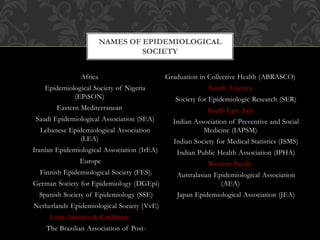
Africa 
NAMES OF EPIDEMIOLOGICAL 
SOCIETY 
Epidemiological Society of Nigeria 
(EPiSON) 
Eastern Mediterranean 
Saudi Epidemiological Association (SEA) 
Lebanese Epidemiological Association 
(LEA) 
Iranian Epidemiological Association (IrEA) 
Europe 
Finnish Epidemiological Society (FES). 
German Society for Epidemiology (DGEpi) 
Spanish Society of Epidemiology (SSE) 
Netherlands Epidemiological Society (VvE) 
Latin America & Caribbean 
The Brazilian Association of Post- 
Graduation in Collective Health (ABRASCO) 
North America 
Society for Epidemiologic Research (SER) 
South East Asia 
Indian Association of Preventive and Social 
Medicine (IAPSM) 
Indian Society for Medical Statistics (ISMS) 
Indian Public Health Association (IPHA) 
Western Pacific 
Australasian Epidemiological Association 
(AEA) 
Japan Epidemiological Association (JEA)
EPIDEMIOLOGICAL APPROACH 
Asking questions. 
Making comparisons.
ASKING QUESTIONS 
QUESTIONS RELATED TO HEALTH EVENTS. 
QUESTIONS RELATED TO HEALTH ACTION
RELATED TO HEALTH EVENTS. 
What is the event? ( The problem). 
What is the magnitude? 
Where did it happen ? 
When did it happen? 
Who are affected? 
Why did it happen?
RELATED TO HEALTH ACTION 
What can be done to reduce this problem and its consequences? 
How can it be prevented in future? 
What action should be taken by the community? By whom these 
activities be carried out? 
What resources are required? How are the activities to be 
organized? 
What difficulties might arise, & how might they be overcome?
MAKING COMPARISION 
The basic approach in epidemiology is to make comparison & 
draw inferences. 
This may be comparison of two or more groups. 
The first consideration before making . 
comparison is to the “comparability”. 
Matching or randomization helps in ensuring comparability.
MEASUREMENTS IN 
EPIDEMIOLOGY 
Measurements of mortality. 
Measurements of morbidity. 
Measurements of disability. 
Measurements of natality.
Measurement of the presence, absence or distribution of the 
characteristic or attributes of the disease. 
Measurement of medical needs, health care facilities, utilization 
of health services & other related events. 
Measurement of the presence, absence or distribution of the 
environmental & other factors suspected of the environmental & 
other factors suspected of causing the disease. 
Measurement of demographic variables.
TOOLS OF MEASUREMENT 
The epidemiologist usually expresses disease magnitude as a 
RATE, RATIO OR PROPORTION.
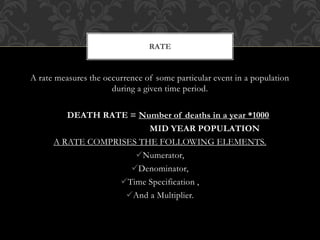
RATE 
A rate measures the occurrence of some particular event in a population 
during a given time period. 
DEATH RATE = Number of deaths in a year *1000 
MID YEAR POPULATION 
A RATE COMPRISES THE FOLLOWING ELEMENTS. 
Numerator, 
Denominator, 
Time Specification , 
And a Multiplier.
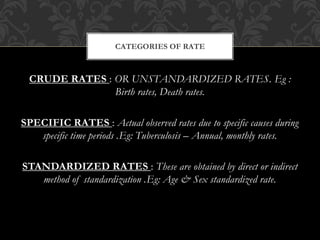
CATEGORIES OF RATE 
CRUDE RATES : OR UNSTANDARDIZED RATES. Eg : 
Birth rates, Death rates. 
SPECIFIC RATES : Actual observed rates due to specific causes during 
specific time periods .Eg: Tuberculosis – Annual, monthly rates. 
STANDARDIZED RATES : These are obtained by direct or indirect 
method of standardization .Eg: Age & Sex standardized rate.
RATIO 
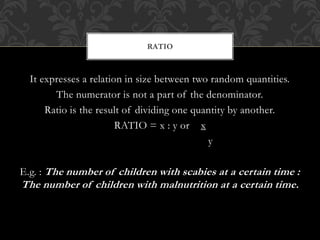
It expresses a relation in size between two random quantities. 
The numerator is not a part of the denominator. 
Ratio is the result of dividing one quantity by another. 
RATIO = x : y or x 
y 
E.g. : The number of children with scabies at a certain time : 
The number of children with malnutrition at a certain time.
PROPORTION 
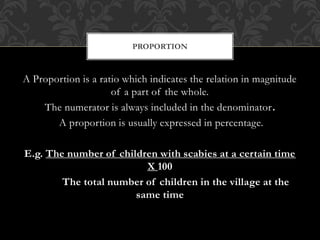
A Proportion is a ratio which indicates the relation in magnitude 
of a part of the whole. 
The numerator is always included in the denominator. 
A proportion is usually expressed in percentage. 
E.g. The number of children with scabies at a certain time 
X 100 
The total number of children in the village at the 
same time
MORTALITY RATES & RATIOS 
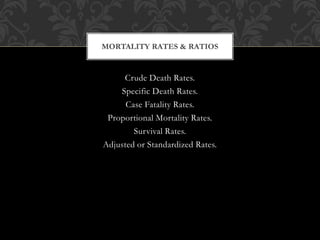
Crude Death Rates. 
Specific Death Rates. 
Case Fatality Rates. 
Proportional Mortality Rates. 
Survival Rates. 
Adjusted or Standardized Rates.
MEASUREMENTS OF MORBIDITY 
Incidence. 
Prevalence.
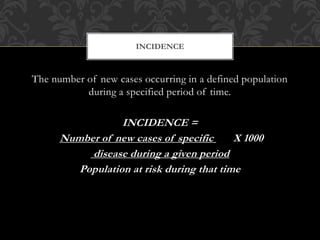
INCIDENCE 
The number of new cases occurring in a defined population 
during a specified period of time. 
INCIDENCE = 
Number of new cases of specific X 1000 
disease during a given period 
Population at risk during that time
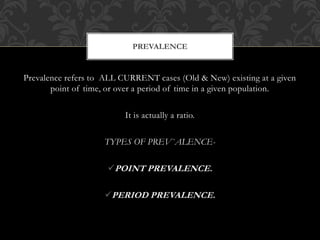
PREVALENCE 
Prevalence refers to ALL CURRENT cases (Old & New) existing at a given 
point of time, or over a period of time in a given population. 
It is actually a ratio. 
TYPES OF PREV`ALENCE- 
POINT PREVALENCE. 
PERIOD PREVALENCE.
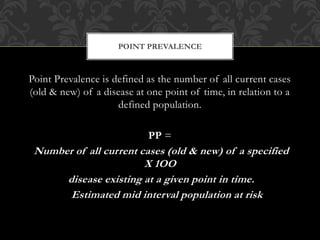
POINT PREVALENCE 
Point Prevalence is defined as the number of all current cases 
(old & new) of a disease at one point of time, in relation to a 
defined population. 
PP = 
Number of all current cases (old & new) of a specified 
X 1OO 
disease existing at a given point in time. 
Estimated mid interval population at risk
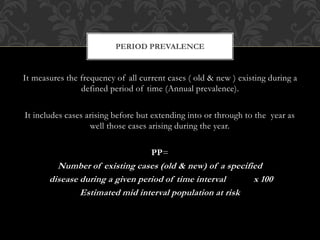
PERIOD PREVALENCE 
It measures the frequency of all current cases ( old & new ) existing during a 
defined period of time (Annual prevalence). 
It includes cases arising before but extending into or through to the year as 
well those cases arising during the year. 
PP= 
Number of existing cases (old & new) of a specified 
disease during a given period of time interval x 100 
Estimated mid interval population at risk
RELATIONSHIP BETWEEN 
INCIDENCE & PREVALENCE 
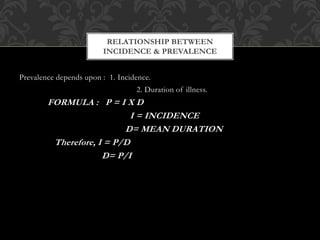
Prevalence depends upon : 1. Incidence. 
2. Duration of illness. 
FORMULA : P = I X D 
I = INCIDENCE 
D= MEAN DURATION 
Therefore, I = P/D 
D= P/I
CLASSIFICATION OF DISEASE BASED 
ON THE FREQUENCY OF 
OCCURANCE. 
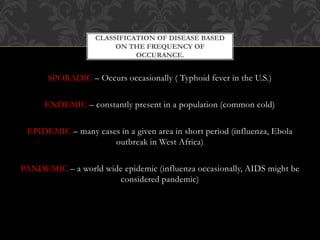
SPORADIC – Occurs occasionally ( Typhoid fever in the U.S.) 
ENDEMIC – constantly present in a population (common cold) 
EPIDEMIC – many cases in a given area in short period (influenza, Ebola 
outbreak in West Africa) 
PANDEMIC – a world wide epidemic (influenza occasionally, AIDS might be 
considered pandemic)
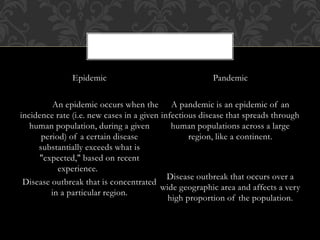
Epidemic 
An epidemic occurs when the 
incidence rate (i.e. new cases in a given 
human population, during a given 
period) of a certain disease 
substantially exceeds what is 
"expected," based on recent 
experience. 
Disease outbreak that is concentrated 
in a particular region. 
Pandemic 
A pandemic is an epidemic of an 
infectious disease that spreads through 
human populations across a large 
region, like a continent. 
Disease outbreak that occurs over a 
wide geographic area and affects a very 
high proportion of the population.
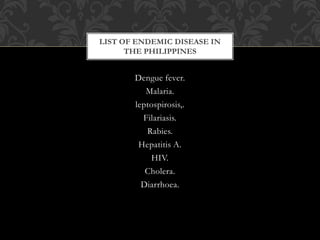
LIST OF ENDEMIC DISEASE IN 
THE PHILIPPINES 
Dengue fever. 
Malaria. 
leptospirosis,. 
Filariasis. 
Rabies. 
Hepatitis A. 
HIV. 
Cholera. 
Diarrhoea.

Modern epidemiology

  • 1.
    MODERN EPIDEMIOLOGY DRRITESH SHIWAKOTI
  • 2.
    DEFINATION Study ofthe occurrence and distribution of health-related diseases or events in specified populations, including the study of the determinants influencing such states, and the application of this knowledge to control the health problem . (Porta M, Last J, Greenland S. A Dictionary of Epidemiology, 2008)
  • 3.
    PURPOSES OF EPIDEMIOLOGY 1. Investigate nature / extent of health-related phenomena in the community / identify priorities 2. Study natural history and prognosis of health-related problems 3. Identify causes and risk factors 4. Recommend / assist in application of / evaluate best interventions (preventive and therapeutic measures) 5. Provide foundation for public policy
  • 4.
    HISTORY Epidemiologic transitionof the 20th century caused shift in focus from acute infectious diseases to chronic “life style” diseases Several exemplar studies are discussed in the chapter • The British Doctors Study • The Framingham Heart Study
  • 5.
    JOHN SNOW JohnSnow (15 March 1813 – 16 June 1858) was an English physician and a leader in the adoption of anaesthesia and medical hygiene. He is considered one of the fathers of modern epidemiology, in part because of his work in tracing the source of a cholera outbreak in Soho, London, in 1854. His findings inspired fundamental changes in the water and waste systems of London, which led to similar changes in other cities, and a significant improvement in general public health around the world.
  • 6.
    WHO IS ANEPIDEMIOLOGIST ? A professional who strives to study and control the factors that influence the occurrence of disease or health-related conditions and events in specified populations and societies, has an experience in population thinking and epidemiologic methods, and is knowledgeable about public health and causal inference in health (Porta M, Last J, Greenland S. A Dictionary of Epidemiology, 2008)
  • 7.
    CLASSICAL VERSUS MODERN Classical: descriptive, observational, field, analytical, experimental, applied, healthcare, primary care, hospital, environmental, occupational, psycho-social, etc Modern: risk-factor, molecular, genetic, life-course, nutritional, cancer, disaster, etc APPLICATIONS
  • 8.
    MEASURING DISEASE FREQUENCY Classifying and categorizing disease  Deciding what constitutes a case of disease in a study  Finding a source for ascertaining the cases Defining the population at risk of disease  Defining the period of time of risk of disease Obtaining permission to study people  Making measurements of disease frequency Relating cases to population and time at risk
  • 9.
    COMPONENTS OF EPIDEMIOLOGY DISEASE FREQUENCY. DISTRIBUTION OF DISEASE. DETERMINANTS OF DISEASE.
  • 10.
    DISEASE FREQUENCY Refersto the measurement of health related event in the form of rates & ratios. E.g.Prevalence rate, Incidence rates, Death rate etc. These rates are essential for comparing the disease frequency in different populations or sub groups of the same population. Such comparison yield valuable information on disease etiology. This is a vital step in the development of strategies for prevention of control of health problems.
  • 11.
    DISTRIBUTION OF DISEASE The basic tenet of epidemiology is that the distribution of disease occurs in patterns in a community. An important function is to study the pattern of the distribution in various subgroups. Thus epidemiology examines whether there has been an increase or decrease over time span. An important outcome of this step is formulation of etiological hypothesis.
  • 12.
    DETERMINANTS OF DISEASE. This aspect of epidemiology is known as “analytical epidemiology”. Analytical strategies help in developing scientifically sound health programmes, interventions & policies.
  • 13.
    These aims areachieved by holding scientific meetings and seminars, by publication of journals, reports, translations of books, by contact amongst members and by other activities consistent with these aims. Members are accepted without regard to race, religion, sex, political affiliation or country of origin
  • 14.
    The International EpidemiologicalAssociation (IEA) was started in 1954 by John Pemberton of Great Britain and Harold N Willard of the United States inorder to facilitate communication amongst those engaged in research and teaching of epidemiology throughout the world, and to encourage its use in all fields of health including social, community and preventative medicine. The IEA is in official relations with the World Health Organization (WHO) and is run by a Council including Executive and Regional Councilors for its 7 regions in addition to the Ex-officio members
  • 15.
    Africa NAMES OFEPIDEMIOLOGICAL SOCIETY Epidemiological Society of Nigeria (EPiSON) Eastern Mediterranean Saudi Epidemiological Association (SEA) Lebanese Epidemiological Association (LEA) Iranian Epidemiological Association (IrEA) Europe Finnish Epidemiological Society (FES). German Society for Epidemiology (DGEpi) Spanish Society of Epidemiology (SSE) Netherlands Epidemiological Society (VvE) Latin America & Caribbean The Brazilian Association of Post- Graduation in Collective Health (ABRASCO) North America Society for Epidemiologic Research (SER) South East Asia Indian Association of Preventive and Social Medicine (IAPSM) Indian Society for Medical Statistics (ISMS) Indian Public Health Association (IPHA) Western Pacific Australasian Epidemiological Association (AEA) Japan Epidemiological Association (JEA)
  • 16.
    EPIDEMIOLOGICAL APPROACH Askingquestions. Making comparisons.
  • 17.
    ASKING QUESTIONS QUESTIONSRELATED TO HEALTH EVENTS. QUESTIONS RELATED TO HEALTH ACTION
  • 18.
    RELATED TO HEALTHEVENTS. What is the event? ( The problem). What is the magnitude? Where did it happen ? When did it happen? Who are affected? Why did it happen?
  • 19.
    RELATED TO HEALTHACTION What can be done to reduce this problem and its consequences? How can it be prevented in future? What action should be taken by the community? By whom these activities be carried out? What resources are required? How are the activities to be organized? What difficulties might arise, & how might they be overcome?
  • 20.
    MAKING COMPARISION Thebasic approach in epidemiology is to make comparison & draw inferences. This may be comparison of two or more groups. The first consideration before making . comparison is to the “comparability”. Matching or randomization helps in ensuring comparability.
  • 21.
    MEASUREMENTS IN EPIDEMIOLOGY Measurements of mortality. Measurements of morbidity. Measurements of disability. Measurements of natality.
  • 22.
    Measurement of thepresence, absence or distribution of the characteristic or attributes of the disease. Measurement of medical needs, health care facilities, utilization of health services & other related events. Measurement of the presence, absence or distribution of the environmental & other factors suspected of the environmental & other factors suspected of causing the disease. Measurement of demographic variables.
  • 23.
    TOOLS OF MEASUREMENT The epidemiologist usually expresses disease magnitude as a RATE, RATIO OR PROPORTION.
  • 24.
    RATE A ratemeasures the occurrence of some particular event in a population during a given time period. DEATH RATE = Number of deaths in a year *1000 MID YEAR POPULATION A RATE COMPRISES THE FOLLOWING ELEMENTS. Numerator, Denominator, Time Specification , And a Multiplier.
  • 25.
    CATEGORIES OF RATE CRUDE RATES : OR UNSTANDARDIZED RATES. Eg : Birth rates, Death rates. SPECIFIC RATES : Actual observed rates due to specific causes during specific time periods .Eg: Tuberculosis – Annual, monthly rates. STANDARDIZED RATES : These are obtained by direct or indirect method of standardization .Eg: Age & Sex standardized rate.
  • 26.
    RATIO It expressesa relation in size between two random quantities. The numerator is not a part of the denominator. Ratio is the result of dividing one quantity by another. RATIO = x : y or x y E.g. : The number of children with scabies at a certain time : The number of children with malnutrition at a certain time.
  • 27.
    PROPORTION A Proportionis a ratio which indicates the relation in magnitude of a part of the whole. The numerator is always included in the denominator. A proportion is usually expressed in percentage. E.g. The number of children with scabies at a certain time X 100 The total number of children in the village at the same time
  • 28.
    MORTALITY RATES &RATIOS Crude Death Rates. Specific Death Rates. Case Fatality Rates. Proportional Mortality Rates. Survival Rates. Adjusted or Standardized Rates.
  • 29.
    MEASUREMENTS OF MORBIDITY Incidence. Prevalence.
  • 30.
    INCIDENCE The numberof new cases occurring in a defined population during a specified period of time. INCIDENCE = Number of new cases of specific X 1000 disease during a given period Population at risk during that time
  • 31.
    PREVALENCE Prevalence refersto ALL CURRENT cases (Old & New) existing at a given point of time, or over a period of time in a given population. It is actually a ratio. TYPES OF PREV`ALENCE- POINT PREVALENCE. PERIOD PREVALENCE.
  • 32.
    POINT PREVALENCE PointPrevalence is defined as the number of all current cases (old & new) of a disease at one point of time, in relation to a defined population. PP = Number of all current cases (old & new) of a specified X 1OO disease existing at a given point in time. Estimated mid interval population at risk
  • 33.
    PERIOD PREVALENCE Itmeasures the frequency of all current cases ( old & new ) existing during a defined period of time (Annual prevalence). It includes cases arising before but extending into or through to the year as well those cases arising during the year. PP= Number of existing cases (old & new) of a specified disease during a given period of time interval x 100 Estimated mid interval population at risk
  • 34.
    RELATIONSHIP BETWEEN INCIDENCE& PREVALENCE Prevalence depends upon : 1. Incidence. 2. Duration of illness. FORMULA : P = I X D I = INCIDENCE D= MEAN DURATION Therefore, I = P/D D= P/I
  • 35.
    CLASSIFICATION OF DISEASEBASED ON THE FREQUENCY OF OCCURANCE. SPORADIC – Occurs occasionally ( Typhoid fever in the U.S.) ENDEMIC – constantly present in a population (common cold) EPIDEMIC – many cases in a given area in short period (influenza, Ebola outbreak in West Africa) PANDEMIC – a world wide epidemic (influenza occasionally, AIDS might be considered pandemic)
  • 36.
    Epidemic An epidemicoccurs when the incidence rate (i.e. new cases in a given human population, during a given period) of a certain disease substantially exceeds what is "expected," based on recent experience. Disease outbreak that is concentrated in a particular region. Pandemic A pandemic is an epidemic of an infectious disease that spreads through human populations across a large region, like a continent. Disease outbreak that occurs over a wide geographic area and affects a very high proportion of the population.
  • 37.
    LIST OF ENDEMICDISEASE IN THE PHILIPPINES Dengue fever. Malaria. leptospirosis,. Filariasis. Rabies. Hepatitis A. HIV. Cholera. Diarrhoea.