NORTHERN and
SOUTHERN BLOT
Molecular Biology
Prepared by:
DR RITESH SHIWAKOTI
Northern Blot
 is a technique used in molecular biology research to
study gene expression by detection of RNA (or
isolated mRNA) in a sample.
 developed in 1977 by James Alwine, David Kemp,
and George Stark at Stanford University.
 With northern blotting it is possible to observe cellular
control over structure and function by determining
the particular gene expression levels during
differentiation, morphogenesis, as well as abnormal
or diseased conditions.
 involves the use of electrophoresis to separate RNA
samples by size and detection with a hybridization
probe complementary to part of or the entire target
sequence.
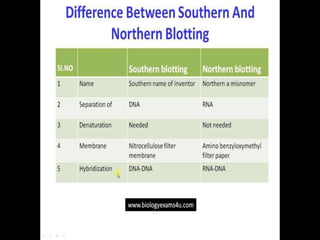
Northern Blot
 The term 'northern blot' actually refers
specifically to the capillary transfer of RNA from
the electrophoresis gel to the blotting
membrane.
 However, the entire process is commonly
referred to as northern blotting.
 Northern blotting takes its name from its
similarity to the first blotting technique,
the Southern blot, named for biologist Edwin
Southern.The major difference is that RNA,
rather than DNA, is analyzed in the northern
blot.
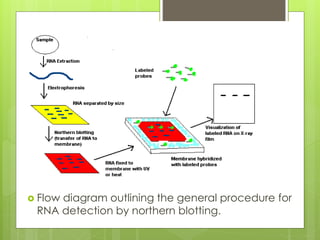
 Flow diagram outlining the general procedure for
RNA detection by northern blotting.
Southern Blot
 is a method used in molecular biology for
detection of a specific DNA sequence in
DNA samples
 combines transfer of electrophoresis-
separated DNA fragments to a filter
membrane and subsequent fragment
detection by probe hybridization.
 The method is named after its inventor,
the British biologist Edwin Southern.
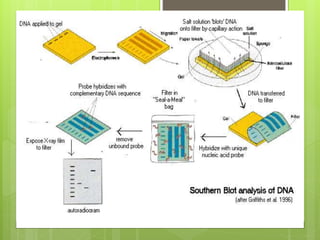
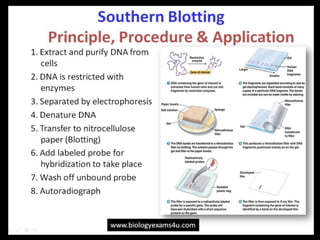
Procedures
Southern Blot
Applications
 Southern transfer may be used for homology-based cloning
on the basis of amino acid sequence of the protein product
of the target gene.
 Oligonucleotides are designed that are similar to the target
sequence. The oligonucleotides are chemically synthesised,
radiolabeled, and used to screen a DNA library, or other
collections of cloned DNA fragments. Sequences that
hybridise with the hybridisation probe are further analysed,
for example, to obtain the full length sequence of the
targeted gene. Second, Southern blotting can also be used
to identify methylated sites in particular genes. Particularly
useful are the restriction nucleases MspI and HpaII, both of
which recognize and cleave within the same sequence.
However, HpaII requires that a C within that site be
methylated, whereas MspI cleaves only DNA unmethylated
at that site. Therefore, any methylated sites within a
sequence analyzed with a particular probe will be cleaved
by the former, but not the latter, enzyme.[4]
Southern Blot
Northern and southern blot

Northern and southern blot

  • 1.
    NORTHERN and SOUTHERN BLOT MolecularBiology Prepared by: DR RITESH SHIWAKOTI
  • 2.
    Northern Blot  isa technique used in molecular biology research to study gene expression by detection of RNA (or isolated mRNA) in a sample.  developed in 1977 by James Alwine, David Kemp, and George Stark at Stanford University.  With northern blotting it is possible to observe cellular control over structure and function by determining the particular gene expression levels during differentiation, morphogenesis, as well as abnormal or diseased conditions.  involves the use of electrophoresis to separate RNA samples by size and detection with a hybridization probe complementary to part of or the entire target sequence.
  • 3.
    Northern Blot  Theterm 'northern blot' actually refers specifically to the capillary transfer of RNA from the electrophoresis gel to the blotting membrane.  However, the entire process is commonly referred to as northern blotting.  Northern blotting takes its name from its similarity to the first blotting technique, the Southern blot, named for biologist Edwin Southern.The major difference is that RNA, rather than DNA, is analyzed in the northern blot.
  • 4.
     Flow diagramoutlining the general procedure for RNA detection by northern blotting.
  • 5.
    Southern Blot  isa method used in molecular biology for detection of a specific DNA sequence in DNA samples  combines transfer of electrophoresis- separated DNA fragments to a filter membrane and subsequent fragment detection by probe hybridization.  The method is named after its inventor, the British biologist Edwin Southern.
  • 6.
  • 7.
    Applications  Southern transfermay be used for homology-based cloning on the basis of amino acid sequence of the protein product of the target gene.  Oligonucleotides are designed that are similar to the target sequence. The oligonucleotides are chemically synthesised, radiolabeled, and used to screen a DNA library, or other collections of cloned DNA fragments. Sequences that hybridise with the hybridisation probe are further analysed, for example, to obtain the full length sequence of the targeted gene. Second, Southern blotting can also be used to identify methylated sites in particular genes. Particularly useful are the restriction nucleases MspI and HpaII, both of which recognize and cleave within the same sequence. However, HpaII requires that a C within that site be methylated, whereas MspI cleaves only DNA unmethylated at that site. Therefore, any methylated sites within a sequence analyzed with a particular probe will be cleaved by the former, but not the latter, enzyme.[4] Southern Blot