Gluconeogenesis
R. C. Gupta
Professor and Head
Department of Biochemistry
National Institute of Medical Sciences
Jaipur, India
Gluconeogenesis is synthesis of glucose
from non-carbohydrate substrates
Gluconeogenesis occurs when the
availability of carbohydrates is low
In diabetes mellitus, carbohydrates are
available but cannot be metabolized
During fasting, dietary carbohydrates are
not available
Availability of carbohydrates is low
during fasting and in diabetes mellitus
Though the energy requirements can be
met by lipids, provision of some amount of
carbohydrate is essential
Certain tissues, e.g. brain and erythro-
cytes, are dependent almost exclusively on
glucose as a source of energy
Adipose tissue requires glucose as a
source of glycerol-3-phosphate for esteri-
fication of fatty acids
Muscles require glucose as a source of
energy under anaerobic conditions
Glucose is also required for the synthesis
of lactose during lactation
Therefore, glucose requirement is met by
converting non-carbohydrates into glucose
EMB-RCG
The main substrates for gluconeogenesis
are:
• Lactate
• Glycerol
• Amino acids (except leucine & lysine)
• Intermediates of glycolysis
• Intermediates of citric acid cycle
The principal sites of gluconeogenesis are
liver and kidneys
Gluconeogenesis was believed in the past
to be a reversal of glycolysis
It was shown later that free energy is
released in some reactions of glycolysis
These functionally irreversible reactions are
energy barriers for gluconeogenesis
The energy barriers can be circumvented
by using different enzymes for catalysing
the reactions in backward direction
The reversible reactions are catalysed by
enzymes of the glycolytic pathway
EMB-RCG
The following reactions of glycolytic
pathway constitute energy barriers:
Conversion of glucose into glucose-
6-phosphate
Conversion of fructose-6-phosphate
into fructose-1,6-biphosphate
Conversion of phosphoenol pyruvate
into pyruvate
Energy barriers
EMB-RCG
In gluconeogenic pathway, the irreversible
glycolytic reactions are catalysed by:
Glucose-6-phosphatase
Fructose-1,6-biphosphatase
Pyruvate carboxylase
Phosphoenol pyruvate carboxykinase
Bypassing the energy barriers
Conversion of oxaloacetate into
phosphoenol pyruvate
Conversion of pyruvate into phosphoenol
pyruvate requires two reactions:
Conversion of pyruvate into oxalo-
acetate
EMB-RCG
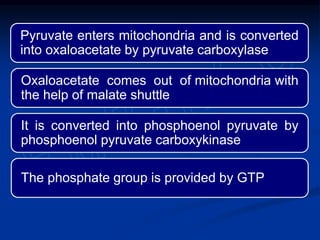
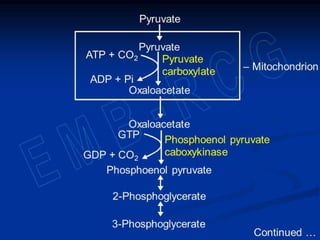
Pyruvate enters mitochondria and is converted
into oxaloacetate by pyruvate carboxylase
Oxaloacetate comes out of mitochondria with
the help of malate shuttle
It is converted into phosphoenol pyruvate by
phosphoenol pyruvate carboxykinase
The phosphate group is provided by GTP
Thus, gluconeogenic enzymes (or key
enzymes of gluconeogenesis) are:
Glucose-6-phosphatase
Fructose-1,6-biphosphatase
Pyruvate carboxylase
Phosphoenol pyruvate carboxykinase
For converting pyruvate into glucose:
Some of the reactions are catalysed
by glycolytic enzymes
Some reactions are catalysed by
gluconeogenic enzymes
The substrates for gluconeogenesis enter
the pathway at different stages
Lactate is a major substrate for gluco-
neogenesis
It is formed in muscles during anaerobic
conditions
Lactate cannot be utilized in muscles as
gluconeogenic enzymes are not present
there
It is used for synthesis of glucose in liver
via Cori cycle
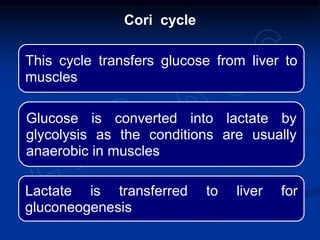
Cori cycle
This cycle transfers glucose from liver to
muscles
Glucose is converted into lactate by
glycolysis as the conditions are usually
anaerobic in muscles
Lactate is transferred to liver for
gluconeogenesis
Glucose-alanine cycle
This cycle transfers glucose from liver to
muscles and alanine from muscles to liver
Alanine carries carbon atoms for glucose
synthesis and amino group for urea
synthesis from muscles to liver
Pyruvate formed in muscles by aerobic
glycolysis is transaminated to alanine
Alanine goes to liver via circulation
This transports carbon atoms of pyruvate and
amino groups of amino acids to liver
Alanine transfers its amino group to a-keto-
glutarate in liver
Amino group of glutamate is used to synthesize
urea
Pyruvate is converted into glucose by gluco-
neogenesis which goes back to liver via blood
Alanine is converted into pyruvate, and a-keto-
glutarate into glutamate
Glycerol is released from triglycerides and
glycerophospholipids
It can be converted into dihydroxyacetone
phosphate via glycerol-3-phosphate
Dihydroxyacetone phosphate, a glycolytic inter-
mediate, can enter gluconeogenic pathway
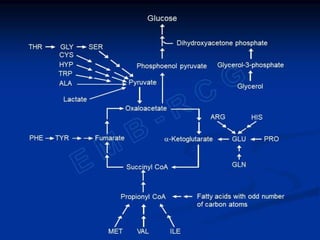
Gluconeogenic amino acids are converted into
intermediates of glycolysis or citric acid cycle
Intermediates of glycolysis enter the pathway
directly at the stages where they are formed
Intermediates of citric acid cycle are converted
into oxaloacetate
Oxaloacetate is converted into PEP which is an
intermediate of gluconeogenesis
Regulation of gluconeogenesis is long-term
as well as short-term
Long-term regulation occurs through induction
and repression
Synthesis of gluconeogenic enzymes is
induced by glucocorticoids
The synthesis is repressed by insulin
EMB-RCG
Regulation
The immediate regulator is
fructose-2,6-biphosphate
The ultimate regulator is glucagon
Short-term regulation occurs by:
Covalent modification
Allosteric mechanism
Fructose-2,6-biphosphate is the allosteric
modifier of two enzymes
It activates phosphofructokinase-1 which
increases glycolysis
It inhibits fructose-1,6-biphosphatase which
decreases gluconeogenesis
EMB-RCG
Fructose-2,6-biphosphate is formed from
fructose-6-phosphate
EMB-RCG
The phosphate is removed from carbon 2
by fructose-2,6-biphosphatase
Phosphate is added to carbon 2 of fructose-
6-phosphate by phosphofructokinase-2
EMB-RCG
Phosphofructokinase-2 and fructose-2,6-
biphosphatase activities are present in a
common bifunctional enzyme
The bifunctional enzyme is subject to
covalent modification
When it is phosphorylated, phosphofructo-
kinase-2 is inactive and fructose-2,6-
biphosphatase is active
EMB-RCG
When the enzyme is dephosphorylated,
phosphofructokinase-2 is active and
fructose-2,6-biphosphatase is inactive
EMB-RCG
In the absence of glucagon (as after a
meal), the enzyme is dephosphorylated
Phosphofructokinase-2 is active and
fructose-2,6-biphosphatase is inactive
Concentration of fructose-2,6-biphosphate
rises
Raised concentration of
fructose-2,6-biphosphate:
Increases glycolysis by activating
phosphofructokinase-1
Decreases gluconeogenesis by
inhibiting fructose-1,6-biphosphatase
The reverse occurs after secretion of
glucagon
Glycolysis is decreased and gluco-
neogenesis is increased
Short-term regulation of gluconeogenesis
and glycolysis is reciprocal
EMB-RCG
Gluconeogenesis
Gluconeogenesis

Gluconeogenesis

  • 1.
    Gluconeogenesis R. C. Gupta Professorand Head Department of Biochemistry National Institute of Medical Sciences Jaipur, India
  • 2.
    Gluconeogenesis is synthesisof glucose from non-carbohydrate substrates Gluconeogenesis occurs when the availability of carbohydrates is low
  • 3.
    In diabetes mellitus,carbohydrates are available but cannot be metabolized During fasting, dietary carbohydrates are not available Availability of carbohydrates is low during fasting and in diabetes mellitus
  • 4.
    Though the energyrequirements can be met by lipids, provision of some amount of carbohydrate is essential Certain tissues, e.g. brain and erythro- cytes, are dependent almost exclusively on glucose as a source of energy Adipose tissue requires glucose as a source of glycerol-3-phosphate for esteri- fication of fatty acids
  • 5.
    Muscles require glucoseas a source of energy under anaerobic conditions Glucose is also required for the synthesis of lactose during lactation Therefore, glucose requirement is met by converting non-carbohydrates into glucose
  • 6.
    EMB-RCG The main substratesfor gluconeogenesis are: • Lactate • Glycerol • Amino acids (except leucine & lysine) • Intermediates of glycolysis • Intermediates of citric acid cycle The principal sites of gluconeogenesis are liver and kidneys
  • 7.
    Gluconeogenesis was believedin the past to be a reversal of glycolysis It was shown later that free energy is released in some reactions of glycolysis These functionally irreversible reactions are energy barriers for gluconeogenesis
  • 8.
    The energy barrierscan be circumvented by using different enzymes for catalysing the reactions in backward direction The reversible reactions are catalysed by enzymes of the glycolytic pathway
  • 9.
    EMB-RCG The following reactionsof glycolytic pathway constitute energy barriers: Conversion of glucose into glucose- 6-phosphate Conversion of fructose-6-phosphate into fructose-1,6-biphosphate Conversion of phosphoenol pyruvate into pyruvate Energy barriers
  • 10.
    EMB-RCG In gluconeogenic pathway,the irreversible glycolytic reactions are catalysed by: Glucose-6-phosphatase Fructose-1,6-biphosphatase Pyruvate carboxylase Phosphoenol pyruvate carboxykinase Bypassing the energy barriers
  • 13.
    Conversion of oxaloacetateinto phosphoenol pyruvate Conversion of pyruvate into phosphoenol pyruvate requires two reactions: Conversion of pyruvate into oxalo- acetate EMB-RCG
  • 14.
    Pyruvate enters mitochondriaand is converted into oxaloacetate by pyruvate carboxylase Oxaloacetate comes out of mitochondria with the help of malate shuttle It is converted into phosphoenol pyruvate by phosphoenol pyruvate carboxykinase The phosphate group is provided by GTP
  • 16.
    Thus, gluconeogenic enzymes(or key enzymes of gluconeogenesis) are: Glucose-6-phosphatase Fructose-1,6-biphosphatase Pyruvate carboxylase Phosphoenol pyruvate carboxykinase
  • 17.
    For converting pyruvateinto glucose: Some of the reactions are catalysed by glycolytic enzymes Some reactions are catalysed by gluconeogenic enzymes
  • 20.
    The substrates forgluconeogenesis enter the pathway at different stages Lactate is a major substrate for gluco- neogenesis It is formed in muscles during anaerobic conditions
  • 21.
    Lactate cannot beutilized in muscles as gluconeogenic enzymes are not present there It is used for synthesis of glucose in liver via Cori cycle
  • 22.
    Cori cycle This cycletransfers glucose from liver to muscles Glucose is converted into lactate by glycolysis as the conditions are usually anaerobic in muscles Lactate is transferred to liver for gluconeogenesis
  • 24.
    Glucose-alanine cycle This cycletransfers glucose from liver to muscles and alanine from muscles to liver Alanine carries carbon atoms for glucose synthesis and amino group for urea synthesis from muscles to liver
  • 25.
    Pyruvate formed inmuscles by aerobic glycolysis is transaminated to alanine Alanine goes to liver via circulation This transports carbon atoms of pyruvate and amino groups of amino acids to liver
  • 26.
    Alanine transfers itsamino group to a-keto- glutarate in liver Amino group of glutamate is used to synthesize urea Pyruvate is converted into glucose by gluco- neogenesis which goes back to liver via blood Alanine is converted into pyruvate, and a-keto- glutarate into glutamate
  • 28.
    Glycerol is releasedfrom triglycerides and glycerophospholipids It can be converted into dihydroxyacetone phosphate via glycerol-3-phosphate Dihydroxyacetone phosphate, a glycolytic inter- mediate, can enter gluconeogenic pathway
  • 30.
    Gluconeogenic amino acidsare converted into intermediates of glycolysis or citric acid cycle Intermediates of glycolysis enter the pathway directly at the stages where they are formed Intermediates of citric acid cycle are converted into oxaloacetate Oxaloacetate is converted into PEP which is an intermediate of gluconeogenesis
  • 32.
    Regulation of gluconeogenesisis long-term as well as short-term Long-term regulation occurs through induction and repression Synthesis of gluconeogenic enzymes is induced by glucocorticoids The synthesis is repressed by insulin EMB-RCG Regulation
  • 33.
    The immediate regulatoris fructose-2,6-biphosphate The ultimate regulator is glucagon Short-term regulation occurs by: Covalent modification Allosteric mechanism
  • 34.
    Fructose-2,6-biphosphate is theallosteric modifier of two enzymes It activates phosphofructokinase-1 which increases glycolysis It inhibits fructose-1,6-biphosphatase which decreases gluconeogenesis EMB-RCG
  • 35.
    Fructose-2,6-biphosphate is formedfrom fructose-6-phosphate EMB-RCG The phosphate is removed from carbon 2 by fructose-2,6-biphosphatase Phosphate is added to carbon 2 of fructose- 6-phosphate by phosphofructokinase-2
  • 36.
    EMB-RCG Phosphofructokinase-2 and fructose-2,6- biphosphataseactivities are present in a common bifunctional enzyme The bifunctional enzyme is subject to covalent modification
  • 37.
    When it isphosphorylated, phosphofructo- kinase-2 is inactive and fructose-2,6- biphosphatase is active EMB-RCG When the enzyme is dephosphorylated, phosphofructokinase-2 is active and fructose-2,6-biphosphatase is inactive
  • 38.
    EMB-RCG In the absenceof glucagon (as after a meal), the enzyme is dephosphorylated Phosphofructokinase-2 is active and fructose-2,6-biphosphatase is inactive Concentration of fructose-2,6-biphosphate rises
  • 39.
    Raised concentration of fructose-2,6-biphosphate: Increasesglycolysis by activating phosphofructokinase-1 Decreases gluconeogenesis by inhibiting fructose-1,6-biphosphatase
  • 40.
    The reverse occursafter secretion of glucagon Glycolysis is decreased and gluco- neogenesis is increased Short-term regulation of gluconeogenesis and glycolysis is reciprocal EMB-RCG