Gluconeogenesis;
Regulation of Glycolysis & Gluconeogenesis
Made by- Yashi Jain
• Gluconeogenesis occurs mainly in liver.
• Gluconeogenesis occurs to a more limited extent in kidney &
small intestine under some conditions.
• Synthesis of glucose from pyruvate utilizes many of the same
enzymes as Glycolysis.
• Three Glycolysis reactions have such a large negative DG that
they are essentially irreversible.
 Hexokinase (or Glucokinase)
 Phosphofructokinase
 Pyruvate Kinase.
• These steps must be bypassed in Gluconeogenesis.
• Two of the bypass reactions involve simple hydrolysis
reactions.
Introduction
Hexokinase or Glucokinase (Glycolysis) catalyzes:
glucose + ATP  glucose-6-phosphate + ADP
Glucose-6-Phosphatase (Gluconeogenesis)
catalyzes:
glucose-6-phosphate + H2O  glucose + Pi
H O
OH
H
OHH
OH
CH2OH
H
OH
HH O
OH
H
OHH
OH
CH2OPO3
2
H
OH
H
H2O
1
6
5
4
3 2
+ Pi
glucose-6-phosphate glucose
Glucose-6-phosphatase
H O
OH
H
OHH
OH
CH2OH
H
OH
HH O
OH
H
OHH
OH
CH2OPO3
2
H
OH
H
H2O
1
6
5
4
3 2
+ Pi
glucose-6-phosphate glucose
Glucose-6-phosphatase
Glucose-6-phosphatase enzyme is embedded in the
endoplasmic reticulum (ER) membrane in liver cells.
The catalytic site is found to be exposed to the ER
lumen. Another subunit may function as a
translocase, providing access of substrate to the
active site.
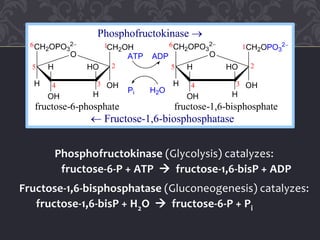
Phosphofructokinase (Glycolysis) catalyzes:
fructose-6-P + ATP  fructose-1,6-bisP + ADP
Fructose-1,6-bisphosphatase (Gluconeogenesis) catalyzes:
fructose-1,6-bisP + H2O  fructose-6-P + Pi
fructose-6-phosphate fructose-1,6-bisphosphate
Phosphofructokinase 
CH2OPO3
2
OH
CH2OH
H
OH H
H HO
O
6
5
4 3
2
1 CH2OPO3
2
OH
CH2OPO3
2
H
OH H
H HO
O
6
5
4 3
2
1
ATP ADP
Pi H2O
 Fructose-1,6-biosphosphatase
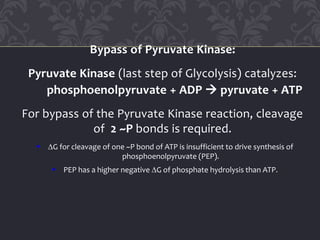
Bypass of Pyruvate Kinase:
Pyruvate Kinase (last step of Glycolysis) catalyzes:
phosphoenolpyruvate + ADP  pyruvate + ATP
For bypass of the Pyruvate Kinase reaction, cleavage
of 2 ~P bonds is required.
 DG for cleavage of one ~P bond of ATP is insufficient to drive synthesis of
phosphoenolpyruvate (PEP).
 PEP has a higher negative DG of phosphate hydrolysis than ATP.
Bypass of Pyruvate Kinase (2 enzymes):
Pyruvate Carboxylase (Gluconeogenesis) catalyzes:
pyruvate + HCO3
 + ATP  oxaloacetate + ADP + Pi
PEP Carboxykinase (Gluconeogenesis) catalyzes:
oxaloacetate + GTP  PEP + GDP + CO2
C
C
CH2
O O
OPO3
2
C
C
CH3
O O
O
ATP ADP + Pi C
CH2
C
C
O
O O
O
O
HCO3

GTP GDP
CO2
pyruvate oxaloacetate PEP
Pyruvate Carboxylase PEP Carboxykinase
Contributing to spontaneity of the 2-step process:
Free energy of one ~P bond of ATP is conserved in
the carboxylation reaction.
Spontaneous decarboxylation contributes to
spontaneity of the 2nd reaction.
Cleavage of a second ~P bond of GTP also
contributes to driving synthesis of PEP.
C
C
CH2
O O
OPO3
2
C
C
CH3
O O
O
ATP ADP + Pi C
CH2
C
C
O
O O
O
O
HCO3

GTP GDP
CO2
pyruvate oxaloacetate PEP
Pyruvate Carboxylase PEP Carboxykinase
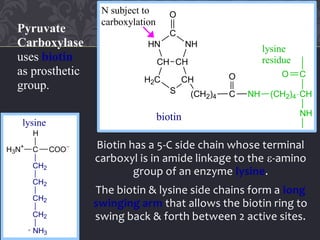
Biotin has a 5-C side chain whose terminal
carboxyl is in amide linkage to the e-amino
group of an enzyme lysine.
The biotin & lysine side chains form a long
swinging arm that allows the biotin ring to
swing back & forth between 2 active sites.
Pyruvate
Carboxylase
uses biotin
as prosthetic
group.
CHCH
H2C
S
CH
NH
C
HN
O
(CH2)4 C NH (CH2)4 CH
CO
NH
O
biotin
N subject to
carboxylation
lysine
residue
H3N+
C COO
CH2
CH2
CH2
CH2
NH3
H

lysine
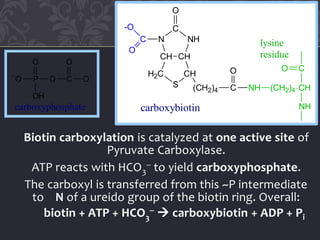
Biotin carboxylation is catalyzed at one active site of
Pyruvate Carboxylase.
ATP reacts with HCO3
 to yield carboxyphosphate.
The carboxyl is transferred from this ~P intermediate
to N of a ureido group of the biotin ring. Overall:
biotin + ATP + HCO3
  carboxybiotin + ADP + Pi

O P O
O
OH
C O
O
carboxyphosphate
CHCH
H2C
S
CH
NH
C
N
O
(CH2)4 C NH (CH2)4 CH
CO
NH
O
C
O
-O
carboxybiotin
lysine
residue
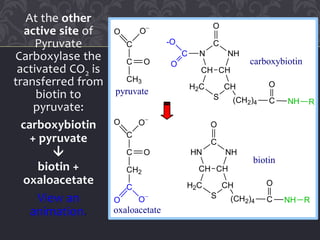
At the other
active site of
Pyruvate
Carboxylase the
activated CO2 is
transferred from
biotin to
pyruvate:
carboxybiotin
+ pyruvate

biotin +
oxaloacetate
View an
animation.
CHCH
H2C
S
CH
NH
C
N
O
(CH2)4 C NH R
O
C
O
-OC
C
CH3
O O
O
C
CH2
C
C
O
O O
O
O
CHCH
H2C
S
CH
NH
C
HN
O
(CH2)4 C NH R
O
carboxybiotin
pyruvate
oxaloacetate
biotin
When gluconeogenesis is active in liver, oxaloacetate is
diverted to form glucose. Oxaloacetate depletion hinders
acetyl CoA entry into Krebs Cycle. The increase in [acetyl
CoA] activates Pyruvate Carboxylase to make oxaloacetate.
Pyruvate
Carboxylase
(pyruvate 
oxaloactate)
is allosterically
activated by
acetyl CoA.
[Oxaloacetate]
tends to be
limiting for
Krebs cycle.
Glucose-6-phosphatase
glucose-6-P glucose
Gluconeogenesis Glycolysis
pyruvate
fatty acids
acetyl CoA ketone bodies
oxaloacetate citrate
Krebs Cycle
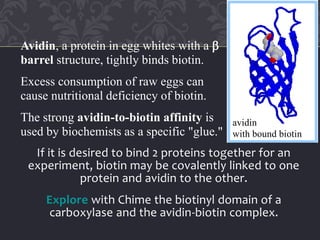
If it is desired to bind 2 proteins together for an
experiment, biotin may be covalently linked to one
protein and avidin to the other.
Explore with Chime the biotinyl domain of a
carboxylase and the avidin-biotin complex.
avidin
with bound biotin
Avidin, a protein in egg whites with a b
barrel structure, tightly binds biotin.
Excess consumption of raw eggs can
cause nutritional deficiency of biotin.
The strong avidin-to-biotin affinity is
used by biochemists as a specific "glue."
PEP Carboxykinase catalyzes GTP-dependent
oxaloacetate  PEP. It is thought to proceed in 2
steps:
 Oxaloacetate is first decarboxylated to yield a pyruvate
enolate anion intermediate.
 Phosphate transfer from GTP then yields
phosphoenolpyruvate (PEP).
C
C
CH2
O O
OPO3
2
C
CH2
C
C
O
O O
O
O
CO2
C
C
CH2
O O
O
GTP GDP
oxaloacetate PEP
PEP Carboxykinase Reaction
In the bacterial enzyme, ATP
is Pi donor instead of GTP.
In this crystal structure of an
E. Coli PEP Carboxykinase,
pyruvate is at the active site
as an analog of PEP/
oxaloacetate.
Mg++
pyruvate
Mn++
ATP
PEP Carboxykinase
active site ligands PDB 1AQ2
A metal ion such as Mn++ is required for the PEP
Carboxykinase reaction, in addition to a Mg++ ion that
binds with the nucleotide substrate at the active site.
Mn++ is thought to promote Pi transfer by interacting
simultaneously with the enolate oxygen atom and an
oxygen atom of the terminal phosphate of GTP or ATP.
The source of pyruvate and oxaloacetate for
gluconeogenesis during fasting or carbohydrate
starvation is mainly amino acid catabolism.
Some amino acids are catabolized to pyruvate,
oxaloacetate, or precursors of these.
Muscle proteins may break down to supply amino
acids. These are transported to liver where they are
deaminated and converted to gluconeogenesis
inputs.
Glycerol, derived from hydrolysis of triacylglycerols
in fat cells, is also a significant input to
gluconeogenesis.
Glyceraldehyde-3-phosphate
Dehydrogenase
Phosphoglycerate Kinase
Enolase
PEP Carboxykinase
glyceraldehyde-3-phosphate
NAD+
+ Pi
NADH + H+
1,3-bisphosphoglycerate
ADP
ATP
3-phosphoglycerate
Phosphoglycerate Mutase
2-phosphoglycerate
H2O
phosphoenolpyruvate
CO2 + GDP
GTP
oxaloacetate
Pi + ADP
HCO3

+ ATP
pyruvate
Pyruvate Carboxylase
Gluconeogenesis
Summary of
Gluconeogenesis
Pathway:
Gluconeogenesis
enzyme names in
red.
Glycolysis enzyme
names in blue.
Glucose-6-phosphatase
Fructose-1,6-bisphosphatase
glucose Gluconeogenesis
Pi
H2O
glucose-6-phosphate
Phosphoglucose Isomerase
fructose-6-phosphate
Pi
H2O
fructose-1,6-bisphosphate
Aldolase
glyceraldehyde-3-phosphate + dihydroxyacetone-phosphate
Triosephosphate
Isomerase
(continued)
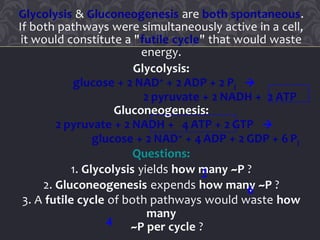
Glycolysis & Gluconeogenesis are both spontaneous.
If both pathways were simultaneously active in a cell,
it would constitute a "futile cycle" that would waste
energy.
Glycolysis:
glucose + 2 NAD+ + 2 ADP + 2 Pi 
2 pyruvate + 2 NADH + 2 ATP
Gluconeogenesis:
2 pyruvate + 2 NADH + 4 ATP + 2 GTP 
glucose + 2 NAD+ + 4 ADP + 2 GDP + 6 Pi
Questions:
1. Glycolysis yields how many ~P ?
2. Gluconeogenesis expends how many ~P ?
3. A futile cycle of both pathways would waste how
many
~P per cycle ?
2
6
4
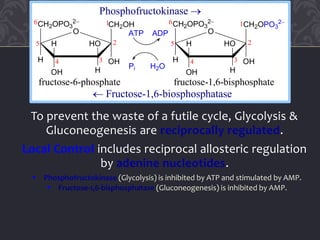
To prevent the waste of a futile cycle, Glycolysis &
Gluconeogenesis are reciprocally regulated.
Local Control includes reciprocal allosteric regulation
by adenine nucleotides.
 Phosphofructokinase (Glycolysis) is inhibited by ATP and stimulated by AMP.
 Fructose-1,6-bisphosphatase (Gluconeogenesis) is inhibited by AMP.
fructose-6-phosphate fructose-1,6-bisphosphate
Phosphofructokinase 
CH2OPO3
2
OH
CH2OH
H
OH H
H HO
O
6
5
4 3
2
1 CH2OPO3
2
OH
CH2OPO3
2
H
OH H
H HO
O
6
5
4 3
2
1
ATP ADP
Pi H2O
 Fructose-1,6-biosphosphatase
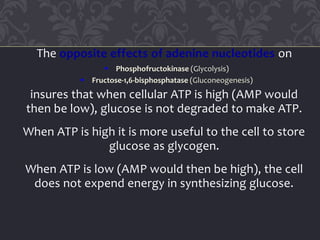
The opposite effects of adenine nucleotides on
 Phosphofructokinase (Glycolysis)
 Fructose-1,6-bisphosphatase (Gluconeogenesis)
insures that when cellular ATP is high (AMP would
then be low), glucose is not degraded to make ATP.
When ATP is high it is more useful to the cell to store
glucose as glycogen.
When ATP is low (AMP would then be high), the cell
does not expend energy in synthesizing glucose.
Global Control in liver cells includes reciprocal
effects of a cyclic AMP cascade, triggered by the
hormone glucagon when blood glucose is low.
Phosphorylation of enzymes & regulatory proteins
in liver by Protein Kinase A (cAMP Dependent
Protein Kinase) results in
 inhibition of glycolysis
 stimulation of gluconeogenesis,
making glucose available for release to the blood.
 Pyruvate Kinase, a glycolysis enzyme that is inhibited
when phosphorylated.
 CREB (cAMP response element binding protein) which
activates, through other factors, transcription of the
gene for PEP Carboxykinase, leading to increased
gluconeogenesis.
 A bi-functional enzyme that makes and degrades an
allosteric regulator, fructose-2,6-bisphosphate.
Enzymes relevant to these pathways that are
phosphorylated by Protein Kinase A include:
 Fructose-2,6-bisphosphate stimulates Glycolysis.
Fructose-2,6-bisphosphate allosterically activates the
Glycolysis enzyme Phosphofructokinase.
Fructose-2,6-bisphosphate also activates transcription
of the gene for Glucokinase, the liver variant of
Hexokinase that phosphorylates glucose to glucose-6-
phosphate, the input to Glycolysis.
 Fructose-2,6-bisphosphate allosterically inhibits the
gluconeogenesis enzyme Fructose-1,6-
bisphosphatase.
Reciprocal regulation by fructose-2,6-
bisphosphate:
Recall that Phosphofructokinase, the rate-limiting
step of Glycolysis, is allosterically inhibited by ATP.
At high concentration, ATP binds at a low-affinity
regulatory site, promoting the tense conformation.
0
10
20
30
40
50
60
0 0.5 1 1.5 2
[Fructose-6-phosphate] mM
PFKActivity
high [ATP]
low [ATP]
Sigmoidal
dependence of
reaction rate on
[fructose-6-
phosphate] is
observed at
high [ATP].
Fructose-2,6-bisphosphate promotes the relaxed state,
activating Phosphofructokinase even at high [ATP].
Thus activation by fructose-2,6-bisphosphate, whose
concentration fluctuates in response to external
hormonal signals, supersedes local control by [ATP].
0
10
20
30
40
50
60
0 0.5 1 1.5 2
[Fructose-6-phosphate] mM
PFKActivity
high [ATP]
low [ATP]
PFK activity in
the presence of the
globally controlled
allosteric regulator
fructose-2,6-
bisphosphate is
similar to that at
low ATP.
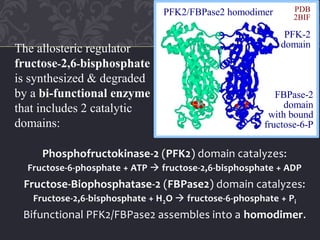
Phosphofructokinase-2 (PFK2) domain catalyzes:
Fructose-6-phosphate + ATP  fructose-2,6-bisphosphate + ADP
Fructose-Biophosphatase-2 (FBPase2) domain catalyzes:
Fructose-2,6-bisphosphate + H2O  fructose-6-phosphate + Pi
Bifunctional PFK2/FBPase2 assembles into a homodimer.
PFK2/FBPase2 homodimer PDB
2BIF
PFK-2
domain
FBPase-2
domain
with bound
fructose-6-P
in active site
The allosteric regulator
fructose-2,6-bisphosphate
is synthesized & degraded
by a bi-functional enzyme
that includes 2 catalytic
domains:
Adjacent to the PFK-2 domain in each copy of the liver
enzyme is a regulatory domain subject to
phosphorylation by cAMP-dependent Protein Kinase.
Which catalytic domains of the enzyme are active
depends on whether the regulatory domains are
phosphorylated.
PFK2/FBPase2 homodimer PDB
2BIF
PFK-2
domain
FBPase-2
domain
with bound
fructose-6-P
in active site
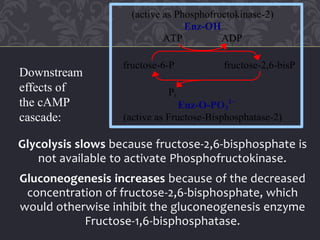
cAMP-dependent phosphorylation of the bi-functional
enzyme activates FBPase2 and inhibits PFK2.
[Fructose-2,6-bisphosphate] thus decreases in liver cells
in response to a cAMP signal cascade, activated by
glucagon when blood glucose is low.
(active as Phosphofructokinase-2)
Enz-OH
ATP ADP
fructose-6-P fructose-2,6-bisP
Pi
Enz-O-PO3
2
(active as Fructose-Bisphosphatase-2)
View an
animation.
Glycolysis slows because fructose-2,6-bisphosphate is
not available to activate Phosphofructokinase.
Gluconeogenesis increases because of the decreased
concentration of fructose-2,6-bisphosphate, which
would otherwise inhibit the gluconeogenesis enzyme
Fructose-1,6-bisphosphatase.
(active as Phosphofructokinase-2)
Enz-OH
ATP ADP
fructose-6-P fructose-2,6-bisP
Pi
Enz-O-PO3
2
(active as Fructose-Bisphosphatase-2)
Downstream
effects of
the cAMP
cascade:
Summary of effects of glucagon-cAMP cascade in liver:
 Gluconeogenesis is stimulated.
 Glycolysis is inhibited.
 Glycogen breakdown is stimulated.
 Glycogen synthesis is inhibited.
 Free glucose is formed for release to the blood.
Glycogen Pyruvate
Gluconeogenesis
Glucose-1-P Glucose-6-P Glucose + Pi
Glucose-6-Pase
Glycolysis
Pathway
X
X
The Cori Cycle operates during exercise.
For a brief burst of ATP utilization, muscle cells
utilize ~P stored as phosphocreatine.
Once phosphocreatine is exhausted, ATP is provided
mainly by Glycolysis, with the input coming from
glycogen breakdown and from glucose uptake from
the blood.
(Aerobic fat metabolism, discussed elsewhere, is
more significant during a lengthy period of exertion
such as a marathon run.)
Cori Cycle
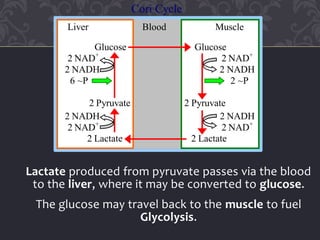
Lactate produced from pyruvate passes via the blood
to the liver, where it may be converted to glucose.
The glucose may travel back to the muscle to fuel
Glycolysis.
Cori Cycle
Liver Blood Muscle
Glucose Glucose
2 NAD+
2 NAD+
2 NADH 2 NADH
6 ~P 2 ~P
2 Pyruvate 2 Pyruvate
2 NADH 2 NADH
2 NAD+
2 NAD+
2 Lactate 2 Lactate
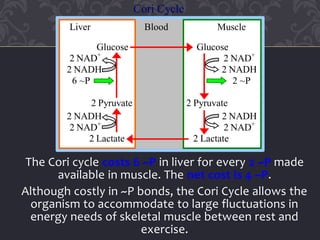
The Cori cycle costs 6 ~P in liver for every 2 ~P made
available in muscle. The net cost is 4 ~P.
Although costly in ~P bonds, the Cori Cycle allows the
organism to accommodate to large fluctuations in
energy needs of skeletal muscle between rest and
exercise.
Cori Cycle
Liver Blood Muscle
Glucose Glucose
2 NAD+
2 NAD+
2 NADH 2 NADH
6 ~P 2 ~P
2 Pyruvate 2 Pyruvate
2 NADH 2 NADH
2 NAD+
2 NAD+
2 Lactate 2 Lactate
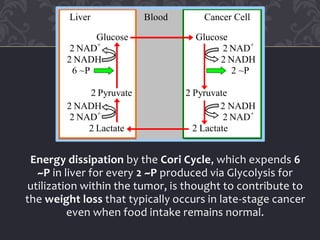
The equivalent of the Cori Cycle also operates during
cancer.
If blood vessel development does not keep pace
with growth of a solid tumor, decreased O2
concentration within the tumor leads to activation
of signal processes that result in a shift to anaerobic
metabolism.
Energy dissipation by the Cori Cycle, which expends 6
~P in liver for every 2 ~P produced via Glycolysis for
utilization within the tumor, is thought to contribute to
the weight loss that typically occurs in late-stage cancer
even when food intake remains normal.
Liver Blood Cancer Cell
Glucose Glucose
2 NAD+
2 NAD+
2 NADH 2 NADH
6 ~P 2 ~P
2 Pyruvate 2 Pyruvate
2 NADH 2 NADH
2 NAD+
2 NAD+
2 Lactate 2 Lactate
Gluconeogenesis

Gluconeogenesis

  • 1.
    Gluconeogenesis; Regulation of Glycolysis& Gluconeogenesis Made by- Yashi Jain
  • 2.
    • Gluconeogenesis occursmainly in liver. • Gluconeogenesis occurs to a more limited extent in kidney & small intestine under some conditions. • Synthesis of glucose from pyruvate utilizes many of the same enzymes as Glycolysis. • Three Glycolysis reactions have such a large negative DG that they are essentially irreversible.  Hexokinase (or Glucokinase)  Phosphofructokinase  Pyruvate Kinase. • These steps must be bypassed in Gluconeogenesis. • Two of the bypass reactions involve simple hydrolysis reactions. Introduction
  • 3.
    Hexokinase or Glucokinase(Glycolysis) catalyzes: glucose + ATP  glucose-6-phosphate + ADP Glucose-6-Phosphatase (Gluconeogenesis) catalyzes: glucose-6-phosphate + H2O  glucose + Pi H O OH H OHH OH CH2OH H OH HH O OH H OHH OH CH2OPO3 2 H OH H H2O 1 6 5 4 3 2 + Pi glucose-6-phosphate glucose Glucose-6-phosphatase
  • 4.
    H O OH H OHH OH CH2OH H OH HH O OH H OHH OH CH2OPO3 2 H OH H H2O 1 6 5 4 32 + Pi glucose-6-phosphate glucose Glucose-6-phosphatase Glucose-6-phosphatase enzyme is embedded in the endoplasmic reticulum (ER) membrane in liver cells. The catalytic site is found to be exposed to the ER lumen. Another subunit may function as a translocase, providing access of substrate to the active site.
  • 5.
    Phosphofructokinase (Glycolysis) catalyzes: fructose-6-P+ ATP  fructose-1,6-bisP + ADP Fructose-1,6-bisphosphatase (Gluconeogenesis) catalyzes: fructose-1,6-bisP + H2O  fructose-6-P + Pi fructose-6-phosphate fructose-1,6-bisphosphate Phosphofructokinase  CH2OPO3 2 OH CH2OH H OH H H HO O 6 5 4 3 2 1 CH2OPO3 2 OH CH2OPO3 2 H OH H H HO O 6 5 4 3 2 1 ATP ADP Pi H2O  Fructose-1,6-biosphosphatase
  • 6.
    Bypass of PyruvateKinase: Pyruvate Kinase (last step of Glycolysis) catalyzes: phosphoenolpyruvate + ADP  pyruvate + ATP For bypass of the Pyruvate Kinase reaction, cleavage of 2 ~P bonds is required.  DG for cleavage of one ~P bond of ATP is insufficient to drive synthesis of phosphoenolpyruvate (PEP).  PEP has a higher negative DG of phosphate hydrolysis than ATP.
  • 7.
    Bypass of PyruvateKinase (2 enzymes): Pyruvate Carboxylase (Gluconeogenesis) catalyzes: pyruvate + HCO3  + ATP  oxaloacetate + ADP + Pi PEP Carboxykinase (Gluconeogenesis) catalyzes: oxaloacetate + GTP  PEP + GDP + CO2 C C CH2 O O OPO3 2 C C CH3 O O O ATP ADP + Pi C CH2 C C O O O O O HCO3  GTP GDP CO2 pyruvate oxaloacetate PEP Pyruvate Carboxylase PEP Carboxykinase
  • 8.
    Contributing to spontaneityof the 2-step process: Free energy of one ~P bond of ATP is conserved in the carboxylation reaction. Spontaneous decarboxylation contributes to spontaneity of the 2nd reaction. Cleavage of a second ~P bond of GTP also contributes to driving synthesis of PEP. C C CH2 O O OPO3 2 C C CH3 O O O ATP ADP + Pi C CH2 C C O O O O O HCO3  GTP GDP CO2 pyruvate oxaloacetate PEP Pyruvate Carboxylase PEP Carboxykinase
  • 9.
    Biotin has a5-C side chain whose terminal carboxyl is in amide linkage to the e-amino group of an enzyme lysine. The biotin & lysine side chains form a long swinging arm that allows the biotin ring to swing back & forth between 2 active sites. Pyruvate Carboxylase uses biotin as prosthetic group. CHCH H2C S CH NH C HN O (CH2)4 C NH (CH2)4 CH CO NH O biotin N subject to carboxylation lysine residue H3N+ C COO CH2 CH2 CH2 CH2 NH3 H  lysine
  • 10.
    Biotin carboxylation iscatalyzed at one active site of Pyruvate Carboxylase. ATP reacts with HCO3  to yield carboxyphosphate. The carboxyl is transferred from this ~P intermediate to N of a ureido group of the biotin ring. Overall: biotin + ATP + HCO3   carboxybiotin + ADP + Pi  O P O O OH C O O carboxyphosphate CHCH H2C S CH NH C N O (CH2)4 C NH (CH2)4 CH CO NH O C O -O carboxybiotin lysine residue
  • 11.
    At the other activesite of Pyruvate Carboxylase the activated CO2 is transferred from biotin to pyruvate: carboxybiotin + pyruvate  biotin + oxaloacetate View an animation. CHCH H2C S CH NH C N O (CH2)4 C NH R O C O -OC C CH3 O O O C CH2 C C O O O O O CHCH H2C S CH NH C HN O (CH2)4 C NH R O carboxybiotin pyruvate oxaloacetate biotin
  • 12.
    When gluconeogenesis isactive in liver, oxaloacetate is diverted to form glucose. Oxaloacetate depletion hinders acetyl CoA entry into Krebs Cycle. The increase in [acetyl CoA] activates Pyruvate Carboxylase to make oxaloacetate. Pyruvate Carboxylase (pyruvate  oxaloactate) is allosterically activated by acetyl CoA. [Oxaloacetate] tends to be limiting for Krebs cycle. Glucose-6-phosphatase glucose-6-P glucose Gluconeogenesis Glycolysis pyruvate fatty acids acetyl CoA ketone bodies oxaloacetate citrate Krebs Cycle
  • 13.
    If it isdesired to bind 2 proteins together for an experiment, biotin may be covalently linked to one protein and avidin to the other. Explore with Chime the biotinyl domain of a carboxylase and the avidin-biotin complex. avidin with bound biotin Avidin, a protein in egg whites with a b barrel structure, tightly binds biotin. Excess consumption of raw eggs can cause nutritional deficiency of biotin. The strong avidin-to-biotin affinity is used by biochemists as a specific "glue."
  • 14.
    PEP Carboxykinase catalyzesGTP-dependent oxaloacetate  PEP. It is thought to proceed in 2 steps:  Oxaloacetate is first decarboxylated to yield a pyruvate enolate anion intermediate.  Phosphate transfer from GTP then yields phosphoenolpyruvate (PEP). C C CH2 O O OPO3 2 C CH2 C C O O O O O CO2 C C CH2 O O O GTP GDP oxaloacetate PEP PEP Carboxykinase Reaction
  • 15.
    In the bacterialenzyme, ATP is Pi donor instead of GTP. In this crystal structure of an E. Coli PEP Carboxykinase, pyruvate is at the active site as an analog of PEP/ oxaloacetate. Mg++ pyruvate Mn++ ATP PEP Carboxykinase active site ligands PDB 1AQ2 A metal ion such as Mn++ is required for the PEP Carboxykinase reaction, in addition to a Mg++ ion that binds with the nucleotide substrate at the active site. Mn++ is thought to promote Pi transfer by interacting simultaneously with the enolate oxygen atom and an oxygen atom of the terminal phosphate of GTP or ATP.
  • 16.
    The source ofpyruvate and oxaloacetate for gluconeogenesis during fasting or carbohydrate starvation is mainly amino acid catabolism. Some amino acids are catabolized to pyruvate, oxaloacetate, or precursors of these. Muscle proteins may break down to supply amino acids. These are transported to liver where they are deaminated and converted to gluconeogenesis inputs. Glycerol, derived from hydrolysis of triacylglycerols in fat cells, is also a significant input to gluconeogenesis.
  • 17.
    Glyceraldehyde-3-phosphate Dehydrogenase Phosphoglycerate Kinase Enolase PEP Carboxykinase glyceraldehyde-3-phosphate NAD+ +Pi NADH + H+ 1,3-bisphosphoglycerate ADP ATP 3-phosphoglycerate Phosphoglycerate Mutase 2-phosphoglycerate H2O phosphoenolpyruvate CO2 + GDP GTP oxaloacetate Pi + ADP HCO3  + ATP pyruvate Pyruvate Carboxylase Gluconeogenesis Summary of Gluconeogenesis Pathway: Gluconeogenesis enzyme names in red. Glycolysis enzyme names in blue.
  • 18.
  • 19.
    Glycolysis & Gluconeogenesisare both spontaneous. If both pathways were simultaneously active in a cell, it would constitute a "futile cycle" that would waste energy. Glycolysis: glucose + 2 NAD+ + 2 ADP + 2 Pi  2 pyruvate + 2 NADH + 2 ATP Gluconeogenesis: 2 pyruvate + 2 NADH + 4 ATP + 2 GTP  glucose + 2 NAD+ + 4 ADP + 2 GDP + 6 Pi Questions: 1. Glycolysis yields how many ~P ? 2. Gluconeogenesis expends how many ~P ? 3. A futile cycle of both pathways would waste how many ~P per cycle ? 2 6 4
  • 20.
    To prevent thewaste of a futile cycle, Glycolysis & Gluconeogenesis are reciprocally regulated. Local Control includes reciprocal allosteric regulation by adenine nucleotides.  Phosphofructokinase (Glycolysis) is inhibited by ATP and stimulated by AMP.  Fructose-1,6-bisphosphatase (Gluconeogenesis) is inhibited by AMP. fructose-6-phosphate fructose-1,6-bisphosphate Phosphofructokinase  CH2OPO3 2 OH CH2OH H OH H H HO O 6 5 4 3 2 1 CH2OPO3 2 OH CH2OPO3 2 H OH H H HO O 6 5 4 3 2 1 ATP ADP Pi H2O  Fructose-1,6-biosphosphatase
  • 21.
    The opposite effectsof adenine nucleotides on  Phosphofructokinase (Glycolysis)  Fructose-1,6-bisphosphatase (Gluconeogenesis) insures that when cellular ATP is high (AMP would then be low), glucose is not degraded to make ATP. When ATP is high it is more useful to the cell to store glucose as glycogen. When ATP is low (AMP would then be high), the cell does not expend energy in synthesizing glucose.
  • 22.
    Global Control inliver cells includes reciprocal effects of a cyclic AMP cascade, triggered by the hormone glucagon when blood glucose is low. Phosphorylation of enzymes & regulatory proteins in liver by Protein Kinase A (cAMP Dependent Protein Kinase) results in  inhibition of glycolysis  stimulation of gluconeogenesis, making glucose available for release to the blood.
  • 23.
     Pyruvate Kinase,a glycolysis enzyme that is inhibited when phosphorylated.  CREB (cAMP response element binding protein) which activates, through other factors, transcription of the gene for PEP Carboxykinase, leading to increased gluconeogenesis.  A bi-functional enzyme that makes and degrades an allosteric regulator, fructose-2,6-bisphosphate. Enzymes relevant to these pathways that are phosphorylated by Protein Kinase A include:
  • 24.
     Fructose-2,6-bisphosphate stimulatesGlycolysis. Fructose-2,6-bisphosphate allosterically activates the Glycolysis enzyme Phosphofructokinase. Fructose-2,6-bisphosphate also activates transcription of the gene for Glucokinase, the liver variant of Hexokinase that phosphorylates glucose to glucose-6- phosphate, the input to Glycolysis.  Fructose-2,6-bisphosphate allosterically inhibits the gluconeogenesis enzyme Fructose-1,6- bisphosphatase. Reciprocal regulation by fructose-2,6- bisphosphate:
  • 25.
    Recall that Phosphofructokinase,the rate-limiting step of Glycolysis, is allosterically inhibited by ATP. At high concentration, ATP binds at a low-affinity regulatory site, promoting the tense conformation. 0 10 20 30 40 50 60 0 0.5 1 1.5 2 [Fructose-6-phosphate] mM PFKActivity high [ATP] low [ATP] Sigmoidal dependence of reaction rate on [fructose-6- phosphate] is observed at high [ATP].
  • 26.
    Fructose-2,6-bisphosphate promotes therelaxed state, activating Phosphofructokinase even at high [ATP]. Thus activation by fructose-2,6-bisphosphate, whose concentration fluctuates in response to external hormonal signals, supersedes local control by [ATP]. 0 10 20 30 40 50 60 0 0.5 1 1.5 2 [Fructose-6-phosphate] mM PFKActivity high [ATP] low [ATP] PFK activity in the presence of the globally controlled allosteric regulator fructose-2,6- bisphosphate is similar to that at low ATP.
  • 27.
    Phosphofructokinase-2 (PFK2) domaincatalyzes: Fructose-6-phosphate + ATP  fructose-2,6-bisphosphate + ADP Fructose-Biophosphatase-2 (FBPase2) domain catalyzes: Fructose-2,6-bisphosphate + H2O  fructose-6-phosphate + Pi Bifunctional PFK2/FBPase2 assembles into a homodimer. PFK2/FBPase2 homodimer PDB 2BIF PFK-2 domain FBPase-2 domain with bound fructose-6-P in active site The allosteric regulator fructose-2,6-bisphosphate is synthesized & degraded by a bi-functional enzyme that includes 2 catalytic domains:
  • 28.
    Adjacent to thePFK-2 domain in each copy of the liver enzyme is a regulatory domain subject to phosphorylation by cAMP-dependent Protein Kinase. Which catalytic domains of the enzyme are active depends on whether the regulatory domains are phosphorylated. PFK2/FBPase2 homodimer PDB 2BIF PFK-2 domain FBPase-2 domain with bound fructose-6-P in active site
  • 29.
    cAMP-dependent phosphorylation ofthe bi-functional enzyme activates FBPase2 and inhibits PFK2. [Fructose-2,6-bisphosphate] thus decreases in liver cells in response to a cAMP signal cascade, activated by glucagon when blood glucose is low. (active as Phosphofructokinase-2) Enz-OH ATP ADP fructose-6-P fructose-2,6-bisP Pi Enz-O-PO3 2 (active as Fructose-Bisphosphatase-2) View an animation.
  • 30.
    Glycolysis slows becausefructose-2,6-bisphosphate is not available to activate Phosphofructokinase. Gluconeogenesis increases because of the decreased concentration of fructose-2,6-bisphosphate, which would otherwise inhibit the gluconeogenesis enzyme Fructose-1,6-bisphosphatase. (active as Phosphofructokinase-2) Enz-OH ATP ADP fructose-6-P fructose-2,6-bisP Pi Enz-O-PO3 2 (active as Fructose-Bisphosphatase-2) Downstream effects of the cAMP cascade:
  • 31.
    Summary of effectsof glucagon-cAMP cascade in liver:  Gluconeogenesis is stimulated.  Glycolysis is inhibited.  Glycogen breakdown is stimulated.  Glycogen synthesis is inhibited.  Free glucose is formed for release to the blood. Glycogen Pyruvate Gluconeogenesis Glucose-1-P Glucose-6-P Glucose + Pi Glucose-6-Pase Glycolysis Pathway X X
  • 32.
    The Cori Cycleoperates during exercise. For a brief burst of ATP utilization, muscle cells utilize ~P stored as phosphocreatine. Once phosphocreatine is exhausted, ATP is provided mainly by Glycolysis, with the input coming from glycogen breakdown and from glucose uptake from the blood. (Aerobic fat metabolism, discussed elsewhere, is more significant during a lengthy period of exertion such as a marathon run.) Cori Cycle
  • 33.
    Lactate produced frompyruvate passes via the blood to the liver, where it may be converted to glucose. The glucose may travel back to the muscle to fuel Glycolysis. Cori Cycle Liver Blood Muscle Glucose Glucose 2 NAD+ 2 NAD+ 2 NADH 2 NADH 6 ~P 2 ~P 2 Pyruvate 2 Pyruvate 2 NADH 2 NADH 2 NAD+ 2 NAD+ 2 Lactate 2 Lactate
  • 34.
    The Cori cyclecosts 6 ~P in liver for every 2 ~P made available in muscle. The net cost is 4 ~P. Although costly in ~P bonds, the Cori Cycle allows the organism to accommodate to large fluctuations in energy needs of skeletal muscle between rest and exercise. Cori Cycle Liver Blood Muscle Glucose Glucose 2 NAD+ 2 NAD+ 2 NADH 2 NADH 6 ~P 2 ~P 2 Pyruvate 2 Pyruvate 2 NADH 2 NADH 2 NAD+ 2 NAD+ 2 Lactate 2 Lactate
  • 35.
    The equivalent ofthe Cori Cycle also operates during cancer. If blood vessel development does not keep pace with growth of a solid tumor, decreased O2 concentration within the tumor leads to activation of signal processes that result in a shift to anaerobic metabolism.
  • 36.
    Energy dissipation bythe Cori Cycle, which expends 6 ~P in liver for every 2 ~P produced via Glycolysis for utilization within the tumor, is thought to contribute to the weight loss that typically occurs in late-stage cancer even when food intake remains normal. Liver Blood Cancer Cell Glucose Glucose 2 NAD+ 2 NAD+ 2 NADH 2 NADH 6 ~P 2 ~P 2 Pyruvate 2 Pyruvate 2 NADH 2 NADH 2 NAD+ 2 NAD+ 2 Lactate 2 Lactate